

- Industry Size (2026)
- USD 443.6 Mn
- Forecast (2036)
- USD 975.6 Mn
- CAGR (2026 to 2036)
- 8.2%
Vibration Test Controller Market Forecast and Outlook 2026 to 2036
The vibration test controller market, valued at USD 443.6 million in 2026 and projected to reach USD 975.6 million by 2036, is growing at a CAGR of 8.2%. Electrodynamic shaker controllers lead the market with a 38% share, followed by hydraulic vibration controllers, multi-axis or 6DOF controllers, and other types. These controllers are essential for generating controlled vibrations in product testing. In terms of end users, Aerospace & Defense dominates with a 30% share, driven by the need for rigorous testing of aerospace and defense systems. Other key sectors include automotive, electronics, and industrial applications.
Quick Stats for Vibration Test Controller Market
- Vibration Test Controller Market Value (2026): USD 443.6 Million
- Vibration Test Controller Market Forecast Value (2036): USD 975.6 Million
- Vibration Test Controller Market Forecast CAGR (2026-2036): 8.2%
- Leading Controller Type: Electrodynamic Shaker Controllers
- Key Growth Regions in Vibration Test Controller Market: Asia Pacific, Europe, North America
- Top Key Players in Vibration Test Controller Market: HBK, IMV Corporation, Unholtz-Dickie, Sentek Dynamics, Data Physics, Dewesoft, National Instruments (NI), MTS Systems, Lansmont, ETS Solutions
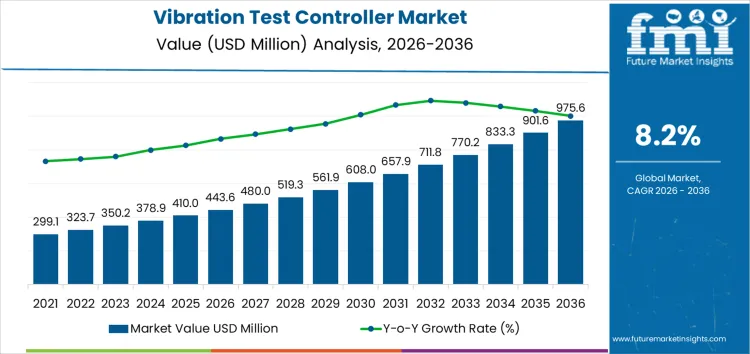
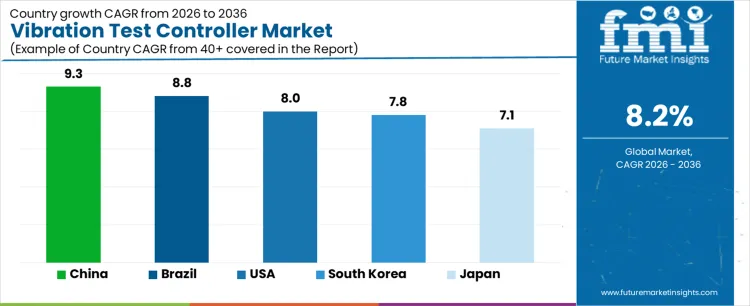
China leads with the highest growth rate of 9.3% CAGR, fueled by investments in manufacturing, aerospace, and electronics, as well as the country’s growing need for vibration testing in its industrial sectors. Brazil follows closely with 8.8%, benefiting from infrastructure modernization and automotive sector expansion. The USA grows at 8%, supported by advancements in aerospace and automotive testing. South Korea experiences 7.8% growth, driven by its leadership in electronics and automotive manufacturing. Japan, with a 7.1% CAGR, continues to invest in precision testing solutions for its advanced manufacturing and robotics sectors. These trends highlight the growing demand for vibration test controllers across key global industries.
Vibration Test Controller Market Key Takeaways
| Metric | Value |
|---|---|
| Industry Value (2026) | USD 443.6 Million |
| Forecast Value (2036) | USD 975.6 Million |
| Forecast CAGR (2026-2036) | 8.2% |
How is the Global Vibration Test Controller Market Advancing?
The global vibration test controller market is experiencing steady growth, driven by the increasing demand for testing and validation in industries such as automotive, aerospace, electronics, and manufacturing. Vibration test controllers are essential tools used to simulate real-world conditions by applying controlled vibrations to test products and components. This is critical for ensuring that products meet durability and performance standards before they are released to the market.
The market is being influenced by the rapid development of advanced technologies and the growing complexity of modern products. As industries strive to design more reliable and robust products, vibration test controllers have become crucial in quality control, product development, and failure analysis. Particularly in aerospace and automotive sectors, the need to meet stringent performance and safety standards is fueling the adoption of these controllers for testing components like engines, seats, and structural parts under various vibration conditions.
Advancements in vibration testing technologies, such as the integration of IoT and AI for real-time monitoring and predictive analytics, are enhancing the capabilities of vibration test controllers. These innovations allow for more precise testing, greater efficiency, and the ability to simulate more complex environmental conditions. Despite the challenges of high setup costs and the technical expertise required to operate sophisticated vibration test systems, the growing demand for high-quality, reliable products is expected to drive continued market growth over the next decade.
What is the Segment-Wise Analysis for the Vibration Test Controller Market?
The vibration test controller market is segmented by controller type and end user. Electrodynamic Shaker Controllers lead the market with a 38% share, followed by Hydraulic Vibration Controllers, Multi-Axis or 6DOF Controllers, and Other types. These controllers are essential for generating precise vibrations to simulate real-world conditions for product testing. In terms of end users, Aerospace & Defense holds the largest share at 30%, driven by the need for testing the performance and durability of aerospace and defense systems. Other significant end users include Automotive, Electronics, and Industrial sectors, each contributing to the growing demand for vibration test controllers.
How Do Electrodynamic Shaker Controllers Lead the Vibration Test Controller Market?

Electrodynamic Shaker Controllers hold a 38% share of the vibration test controller market, primarily due to their ability to generate accurate and controlled vibrations for a wide range of testing applications. These controllers are used extensively in industries like aerospace, automotive, and electronics, where precision is crucial for validating the durability and performance of products under various stress conditions. Electrodynamic shaker controllers are favored for their versatility, reliability, and ability to simulate both low and high-frequency vibrations. Their demand is further supported by the increasing need for quality testing in the design and development of complex systems, making them a dominant player in the vibration test controller market.
How Do Aerospace & Defense Applications Contribute to the Vibration Test Controller Market?
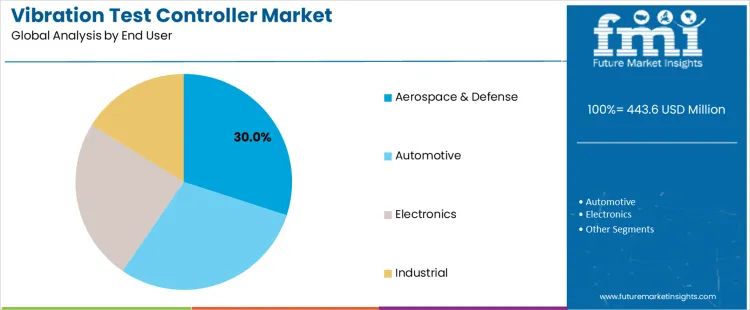
Aerospace & Defense applications account for 30% of the vibration test controller market share, reflecting the critical role of vibration testing in ensuring the performance and safety of aerospace and defense systems. These sectors require high-precision testing to simulate the harsh environments that aerospace and defense equipment face, such as vibrations during flight, launch, or field operations. Vibration test controllers are used to replicate these conditions, ensuring that systems and components meet stringent performance standards. The growing investments in aerospace technologies, defense modernization, and military equipment development contribute significantly to the increasing demand for vibration test controllers in these sectors.
What Are the Key Dynamics for the Vibration Test Controller Market?
The vibration test controller market is shaped by the growing need for testing the durability and performance of products subjected to mechanical vibrations and shocks across various industries, including automotive, aerospace, electronics, and manufacturing. Vibration test controllers play a key role in simulating real-world conditions, ensuring that products meet safety, performance, and quality standards. With the increasing emphasis on product development, quality assurance, and regulatory compliance, the market for vibration test controllers is expected to grow steadily, supported by advancements in sensor technology, control systems, and data analytics.
What Are the Key Drivers for the Vibration Test Controller Market?
A primary driver is the rising demand for durability testing in industries such as automotive, aerospace, and electronics, where components and products must endure harsh vibration environments. The increasing focus on quality control, product safety, and performance optimization is pushing the adoption of vibration test controllers for simulating and evaluating real-world vibrations. The trend towards more advanced product designs, such as lightweight materials and compact electronics, has spurred the need for more precise and efficient vibration testing solutions. The shift toward automation and Industry 4.0 is also fueling growth by increasing the demand for integrated, automated vibration testing systems that enhance operational efficiency and reduce testing time.
What Are the Key Restraints Impacting the Vibration Test Controller Market?
A significant restraint is the high cost of advanced vibration test controllers, particularly for small and mid-sized enterprises (SMEs), which may find it difficult to invest in such specialized equipment. The complexity of setting up and maintaining vibration testing systems, especially in industries with legacy equipment, may also slow down adoption. There is a need for highly skilled operators to manage vibration testing procedures and interpret the data accurately, which can limit broader usage. Variability in testing requirements across industries and geographic regions could also complicate the standardization of vibration test controllers, leading to higher customization costs and slower adoption.
What is the Growth Outlook for the Vibration Test Controller Market by Country?
| Country | CAGR (%) |
|---|---|
| China | 9.3% |
| Brazil | 8.8% |
| USA | 8% |
| South Korea | 7.8% |
| Japan | 7.1% |
The vibration test controller market is experiencing robust growth, with China leading at a 9.3% CAGR, driven by its expanding manufacturing, aerospace, and automotive sectors. Brazil follows with 8.8%, supported by the modernization of infrastructure, automotive, and energy industries. The USA’s market grows at 8%, fueled by advancements in aerospace, automotive, and defense sectors, with strong demand for product safety and quality control. South Korea’s market grows at 7.8%, driven by its electronics, automotive, and industrial automation industries, while Japan’s market grows at 7.1%, supported by its precision engineering and technology leadership in manufacturing.
What is Driving the Growth of the Vibration Test Controller Market in China?
China’s vibration test controller market is growing at 9.3%, driven by the country’s booming manufacturing and aerospace sectors. As China continues to expand its industrial base, there is a growing demand for vibration testing systems to ensure the reliability and performance of machinery and electronic components. The rapid development of the automotive and consumer electronics industries further fuels the market, where vibration test controllers are essential for ensuring product durability. China’s expanding space exploration, defense, and transportation sectors rely on vibration testing for equipment and infrastructure validation. The government’s focus on technological innovation and the increase in manufacturing automation contribute significantly to the growth of the vibration test controller market in the country.
What is Contributing to the Growth of the Vibration Test Controller Market in Brazil?
Brazil’s vibration test controller market is growing at 8.8%, supported by expanding infrastructure, automotive, and aerospace sectors. As the country strengthens its industrial base and upgrades its manufacturing capabilities, the need for vibration testing systems to ensure the safety and performance of equipment is increasing. Brazil’s growing focus on industrial automation and the adoption of advanced testing technologies also plays a critical role in the market’s growth. As the automotive and energy sectors modernize and embrace smart manufacturing, vibration test controllers become essential to validate the durability and reliability of components. The demand for vibration testing systems in Brazil is further supported by the expansion of local production facilities and government investments in research and development.
How is the Vibration Test Controller Market Expanding in the USA?
The USA’s vibration test controller market is growing at 8%, driven by the country’s strong aerospace, automotive, and manufacturing industries. With the continuous advancements in these sectors, especially in automotive and defense, the demand for vibration test controllers has increased to ensure the quality and reliability of components. The USA’s emphasis on product safety and quality control in critical industries, including transportation and infrastructure, contributes to the market’s expansion. The growth of IoT and automation technologies in manufacturing processes enhances the need for precise testing solutions. The government’s ongoing investments in infrastructure and technology research further boost the demand for vibration test controllers, positioning the USA as a leading market for vibration testing systems.
Why is the Vibration Test Controller Market Growing in South Korea?
South Korea’s vibration test controller market is growing at 7.8%, driven by the country’s leadership in electronics, automotive, and industrial automation. As South Korea’s automotive and electronics industries continue to innovate, the need for advanced testing solutions, such as vibration test controllers, has increased. These systems are essential for ensuring the durability and performance of components used in automotive manufacturing, electronics, and aerospace. The rapid growth of South Korea’s smart manufacturing sector and the adoption of IoT technologies further drive the demand for vibration testing equipment. With strong investments in research and development and an emphasis on high-quality manufacturing, South Korea remains a key player in the growth of the vibration test controller market.
What is Driving the Growth of the Vibration Test Controller Market in Japan?
Japan’s vibration test controller market is growing at 7.1%, supported by the country’s advanced manufacturing, automotive, and robotics industries. Japan has a long history of high-quality engineering, and as the demand for precision testing solutions grows in the automotive and aerospace sectors, the need for vibration test controllers has increased. These controllers play a critical role in ensuring the reliability of components exposed to vibrations, such as in transportation and robotics. Japan’s emphasis on technological innovation and efficiency in industrial production is driving the market for vibration test controllers, with a focus on quality assurance and product safety. Japan’s strong position in the global supply chain for electronic components and machinery contributes to the continued demand for vibration testing solutions.
What Are the Competition and Strategies in the Vibration Test Controller Market?

Competition in the vibration test controller market is anchored in precision control, system flexibility, user centric software, and scalable architectures. HBK is positioned with controllers that emphasize high resolution feedback and robust control loops, often showcased in brochures as part of complete vibration test solutions for aerospace and automotive applications. IMV Corporation focuses on controller systems known for reliability and long term stability, with product literature highlighting ease of integration with shakers and accelerometers. Unholtz Dickie differentiates through modular controller designs that support a wide range of test profiles and environmental conditions, appealing to labs with varied test needs.
Sentek Dynamics and Data Physics are positioned around high performance control algorithms and real time system monitoring, with brochures stressing precision waveform generation and adaptive test capabilities. Dewesoft brings software driven control platforms that simplify setup and analysis, and its materials underscore intuitive interfaces for complex test sequences. National Instruments (NI) competes with customizable, PXI based controller platforms tied to LabVIEW, promoted as flexible solutions for bespoke test systems.
Further competition is seen with MTS Systems and Lansmont, where controller ecosystems are paired with shakers and accessories that support environmental and vibration test standards, with brochures focused on end to end test confidence. ETS Solutions rounds out the field with controllers designed for rugged, industrial environments, its documentation highlighting durability and long service life. Across the market, product collateral is used strategically to communicate reliability, modularity, and integration into broader test workflows.
Key Players in Vibration Test Controller Market
- HBK
- IMV Corporation
- Unholtz-Dickie
- Sentek Dynamics
- Data Physics
- Dewesoft
- National Instruments (NI)
- MTS Systems
- Lansmont
- ETS Solutions
Scope of Report
| Items | Values |
|---|---|
| Quantitative Unit (2026) | USD million |
| Controller Type | Electrodynamic Shaker Controllers, Hydraulic Vibration Controllers, Multi-Axis or 6DOF Controllers, Other |
| Control Mode | Random Vibration, Sine & Resonance Search, Shock or Transient, Mixed |
| End User | Aerospace & Defense, Automotive, Electronics, Industrial |
| Regions Covered | Asia Pacific, Europe, North America, Latin America, Middle East & Africa |
| Countries Covered | USA, China, Japan, South Korea, India, Australia & New Zealand, ASEAN, Germany, UK, France, Italy, Spain, Nordic, BENELUX, Brazil, Chile, Mexico, Saudi Arabia, Other GCC Countries, Turkey, South Africa, Other African Union |
| Key Companies Profiled | HBK, IMV Corporation, Unholtz-Dickie, Sentek Dynamics, Data Physics, Dewesoft, National Instruments (NI), MTS Systems, Lansmont, ETS Solutions |
| Additional Attributes | Dollar sales by controller type, control mode, end user, and region; regional CAGR and growth outlook. |
Vibration Test Controller Market by Segments
Controller Type
- Electrodynamic Shaker Controllers
- Hydraulic Vibration Controllers
- Multi-Axis or 6DOF Controllers
- Other
Control Mode
- Random Vibration
- Sine & Resonance Search
- Shock or Transient
- Mixed
End User
- Aerospace & Defense
- Automotive
- Electronics
- Industrial
Region
- Asia Pacific
- China
- Japan
- South Korea
- India
- Australia & New Zealand
- ASEAN
- Rest of Asia Pacific
- Europe
- Germany
- United Kingdom
- France
- Italy
- Spain
- Nordic
- BENELUX
- Rest of Europe
- North America
- United States
- Canada
- Mexico
- Latin America
- Brazil
- Chile
- Rest of Latin America
- Middle East & Africa
- Kingdom of Saudi Arabia
- Other GCC Countries
- Turkey
- South Africa
- Other African Union
- Rest of Middle East & Africa
Frequently Asked Questions
How big is the vibration test controller market in 2026?
The global vibration test controller market is estimated to be valued at USD 443.6 million in 2026.
What will be the size of vibration test controller market in 2036?
The market size for the vibration test controller market is projected to reach USD 975.6 million by 2036.
How much will the vibration test controller market grow between 2026 and 2036?
The vibration test controller market is expected to grow at a 8.2% CAGR between 2026 and 2036.
What are the key controller types in the vibration test controller market?
The key controller types in vibration test controller market are electrodynamic shaker controllers, hydraulic vibration controllers, multi-axis or 6DOF controllers, and other.
Which end user segment is expected to contribute a significant share in the vibration test controller market in 2026?
In terms of end user, Aerospace & Defense segment to command 30% share in the vibration test controller market in 2026.
Preview the report firsthand - request a free sample
Get SampleGet the brochure for pricing and purchase details.
Get PDFTable of Content
- Executive Summary
- Global Market Outlook
- Demand-side Trends
- Supply-side Trends
- Technology Roadmap Analysis
- Analysis and Recommendations
- Market Overview
- Market Coverage / Taxonomy
- Market Definition / Scope / Limitations
- Market Background
- Market Dynamics
- Drivers
- Restraints
- Opportunity
- Trends
- Scenario Forecast
- Demand in Optimistic Scenario
- Demand in Likely Scenario
- Demand in Conservative Scenario
- Opportunity Map Analysis
- Product Life Cycle Analysis
- Supply Chain Analysis
- Investment Feasibility Matrix
- Value Chain Analysis
- PESTLE and Porter’s Analysis
- Regulatory Landscape
- Regional Parent Market Outlook
- Production and Consumption Statistics
- Import and Export Statistics
- Market Dynamics
- Global Market Analysis 2021 to 2025 and Forecast, 2026 to 2036
- Historical Market Size Value (USD Million) Analysis, 2021 to 2025
- Current and Future Market Size Value (USD Million) Projections, 2026 to 2036
- Y-o-Y Growth Trend Analysis
- Absolute $ Opportunity Analysis
- Global Market Pricing Analysis 2021 to 2025 and Forecast 2026 to 2036
- Global Market Analysis 2021 to 2025 and Forecast 2026 to 2036, By Controller Type
- Introduction / Key Findings
- Historical Market Size Value (USD Million) Analysis By Controller Type , 2021 to 2025
- Current and Future Market Size Value (USD Million) Analysis and Forecast By Controller Type , 2026 to 2036
- Electrodynamic Shaker Controllers
- Hydraulic Vibration Controllers
- Multi-Axis or 6DOF Controllers
- Other
- Electrodynamic Shaker Controllers
- Y-o-Y Growth Trend Analysis By Controller Type , 2021 to 2025
- Absolute $ Opportunity Analysis By Controller Type , 2026 to 2036
- Global Market Analysis 2021 to 2025 and Forecast 2026 to 2036, By Control Mode
- Introduction / Key Findings
- Historical Market Size Value (USD Million) Analysis By Control Mode, 2021 to 2025
- Current and Future Market Size Value (USD Million) Analysis and Forecast By Control Mode, 2026 to 2036
- Random Vibration
- Sine & Resonance Search
- Shock or Transient
- Mixed
- Random Vibration
- Y-o-Y Growth Trend Analysis By Control Mode, 2021 to 2025
- Absolute $ Opportunity Analysis By Control Mode, 2026 to 2036
- Global Market Analysis 2021 to 2025 and Forecast 2026 to 2036, By End User
- Introduction / Key Findings
- Historical Market Size Value (USD Million) Analysis By End User, 2021 to 2025
- Current and Future Market Size Value (USD Million) Analysis and Forecast By End User, 2026 to 2036
- Aerospace & Defense
- Automotive
- Electronics
- Industrial
- Aerospace & Defense
- Y-o-Y Growth Trend Analysis By End User, 2021 to 2025
- Absolute $ Opportunity Analysis By End User, 2026 to 2036
- Global Market Analysis 2021 to 2025 and Forecast 2026 to 2036, By Region
- Introduction
- Historical Market Size Value (USD Million) Analysis By Region, 2021 to 2025
- Current Market Size Value (USD Million) Analysis and Forecast By Region, 2026 to 2036
- North America
- Latin America
- Western Europe
- Eastern Europe
- East Asia
- South Asia and Pacific
- Middle East & Africa
- Market Attractiveness Analysis By Region
- North America Market Analysis 2021 to 2025 and Forecast 2026 to 2036, By Country
- Historical Market Size Value (USD Million) Trend Analysis By Market Taxonomy, 2021 to 2025
- Market Size Value (USD Million) Forecast By Market Taxonomy, 2026 to 2036
- By Country
- USA
- Canada
- Mexico
- By Controller Type
- By Control Mode
- By End User
- By Country
- Market Attractiveness Analysis
- By Country
- By Controller Type
- By Control Mode
- By End User
- Key Takeaways
- Latin America Market Analysis 2021 to 2025 and Forecast 2026 to 2036, By Country
- Historical Market Size Value (USD Million) Trend Analysis By Market Taxonomy, 2021 to 2025
- Market Size Value (USD Million) Forecast By Market Taxonomy, 2026 to 2036
- By Country
- Brazil
- Chile
- Rest of Latin America
- By Controller Type
- By Control Mode
- By End User
- By Country
- Market Attractiveness Analysis
- By Country
- By Controller Type
- By Control Mode
- By End User
- Key Takeaways
- Western Europe Market Analysis 2021 to 2025 and Forecast 2026 to 2036, By Country
- Historical Market Size Value (USD Million) Trend Analysis By Market Taxonomy, 2021 to 2025
- Market Size Value (USD Million) Forecast By Market Taxonomy, 2026 to 2036
- By Country
- Germany
- UK
- Italy
- Spain
- France
- Nordic
- BENELUX
- Rest of Western Europe
- By Controller Type
- By Control Mode
- By End User
- By Country
- Market Attractiveness Analysis
- By Country
- By Controller Type
- By Control Mode
- By End User
- Key Takeaways
- Eastern Europe Market Analysis 2021 to 2025 and Forecast 2026 to 2036, By Country
- Historical Market Size Value (USD Million) Trend Analysis By Market Taxonomy, 2021 to 2025
- Market Size Value (USD Million) Forecast By Market Taxonomy, 2026 to 2036
- By Country
- Russia
- Poland
- Hungary
- Balkan & Baltic
- Rest of Eastern Europe
- By Controller Type
- By Control Mode
- By End User
- By Country
- Market Attractiveness Analysis
- By Country
- By Controller Type
- By Control Mode
- By End User
- Key Takeaways
- East Asia Market Analysis 2021 to 2025 and Forecast 2026 to 2036, By Country
- Historical Market Size Value (USD Million) Trend Analysis By Market Taxonomy, 2021 to 2025
- Market Size Value (USD Million) Forecast By Market Taxonomy, 2026 to 2036
- By Country
- China
- Japan
- South Korea
- By Controller Type
- By Control Mode
- By End User
- By Country
- Market Attractiveness Analysis
- By Country
- By Controller Type
- By Control Mode
- By End User
- Key Takeaways
- South Asia and Pacific Market Analysis 2021 to 2025 and Forecast 2026 to 2036, By Country
- Historical Market Size Value (USD Million) Trend Analysis By Market Taxonomy, 2021 to 2025
- Market Size Value (USD Million) Forecast By Market Taxonomy, 2026 to 2036
- By Country
- India
- ASEAN
- Australia & New Zealand
- Rest of South Asia and Pacific
- By Controller Type
- By Control Mode
- By End User
- By Country
- Market Attractiveness Analysis
- By Country
- By Controller Type
- By Control Mode
- By End User
- Key Takeaways
- Middle East & Africa Market Analysis 2021 to 2025 and Forecast 2026 to 2036, By Country
- Historical Market Size Value (USD Million) Trend Analysis By Market Taxonomy, 2021 to 2025
- Market Size Value (USD Million) Forecast By Market Taxonomy, 2026 to 2036
- By Country
- Kingdom of Saudi Arabia
- Other GCC Countries
- Turkiye
- South Africa
- Other African Union
- Rest of Middle East & Africa
- By Controller Type
- By Control Mode
- By End User
- By Country
- Market Attractiveness Analysis
- By Country
- By Controller Type
- By Control Mode
- By End User
- Key Takeaways
- Key Countries Market Analysis
- USA
- Pricing Analysis
- Market Share Analysis, 2025
- By Controller Type
- By Control Mode
- By End User
- Canada
- Pricing Analysis
- Market Share Analysis, 2025
- By Controller Type
- By Control Mode
- By End User
- Mexico
- Pricing Analysis
- Market Share Analysis, 2025
- By Controller Type
- By Control Mode
- By End User
- Brazil
- Pricing Analysis
- Market Share Analysis, 2025
- By Controller Type
- By Control Mode
- By End User
- Chile
- Pricing Analysis
- Market Share Analysis, 2025
- By Controller Type
- By Control Mode
- By End User
- Germany
- Pricing Analysis
- Market Share Analysis, 2025
- By Controller Type
- By Control Mode
- By End User
- UK
- Pricing Analysis
- Market Share Analysis, 2025
- By Controller Type
- By Control Mode
- By End User
- Italy
- Pricing Analysis
- Market Share Analysis, 2025
- By Controller Type
- By Control Mode
- By End User
- Spain
- Pricing Analysis
- Market Share Analysis, 2025
- By Controller Type
- By Control Mode
- By End User
- France
- Pricing Analysis
- Market Share Analysis, 2025
- By Controller Type
- By Control Mode
- By End User
- India
- Pricing Analysis
- Market Share Analysis, 2025
- By Controller Type
- By Control Mode
- By End User
- ASEAN
- Pricing Analysis
- Market Share Analysis, 2025
- By Controller Type
- By Control Mode
- By End User
- Australia & New Zealand
- Pricing Analysis
- Market Share Analysis, 2025
- By Controller Type
- By Control Mode
- By End User
- China
- Pricing Analysis
- Market Share Analysis, 2025
- By Controller Type
- By Control Mode
- By End User
- Japan
- Pricing Analysis
- Market Share Analysis, 2025
- By Controller Type
- By Control Mode
- By End User
- South Korea
- Pricing Analysis
- Market Share Analysis, 2025
- By Controller Type
- By Control Mode
- By End User
- Russia
- Pricing Analysis
- Market Share Analysis, 2025
- By Controller Type
- By Control Mode
- By End User
- Poland
- Pricing Analysis
- Market Share Analysis, 2025
- By Controller Type
- By Control Mode
- By End User
- Hungary
- Pricing Analysis
- Market Share Analysis, 2025
- By Controller Type
- By Control Mode
- By End User
- Kingdom of Saudi Arabia
- Pricing Analysis
- Market Share Analysis, 2025
- By Controller Type
- By Control Mode
- By End User
- Turkiye
- Pricing Analysis
- Market Share Analysis, 2025
- By Controller Type
- By Control Mode
- By End User
- South Africa
- Pricing Analysis
- Market Share Analysis, 2025
- By Controller Type
- By Control Mode
- By End User
- USA
- Market Structure Analysis
- Competition Dashboard
- Competition Benchmarking
- Market Share Analysis of Top Players
- By Regional
- By Controller Type
- By Control Mode
- By End User
- Competition Analysis
- Competition Deep Dive
- HBK
- Overview
- Product Portfolio
- Profitability by Market Segments (Product/Age /Sales Channel/Region)
- Sales Footprint
- Strategy Overview
- Marketing Strategy
- Product Strategy
- Channel Strategy
- IMV Corporation
- Unholtz-Dickie
- Sentek Dynamics
- Data Physics
- Dewesoft
- National Instruments (NI)
- MTS Systems
- Lansmont
- ETS Solutions
- HBK
- Competition Deep Dive
- Assumptions & Acronyms Used
- Research Methodology


