

- Industry Size (2026)
- USD 420 Mn
- Forecast (2036)
- USD 994.3 Mn
- CAGR (2026 to 2036)
- 9%
Iron-Oxide Optimized Complexion Pigment Blends for Inclusive Shades Market Forecast and Outlook 2026 to 2036
The iron-oxide optimized complexion pigment blends for inclusive shades market is projected to grow from USD 420 million in 2026 to USD 994.3 million by 2036, reflecting a compound annual growth rate (CAGR) of 9%. Procurement priorities will be shaped by a growing demand for inclusivity in beauty products, with buyers increasingly focused on sourcing pigments that meet diverse skin tones. Buyer risk aversion will be heightened, with a preference for established vendors who can consistently provide high-quality, scalable solutions.
Vendor lock-in is likely to occur as long-term relationships are formed around trusted suppliers capable of meeting stringent formulation standards. Switching costs will play a significant role, as changing pigment suppliers often involves significant re-formulation and re-certification, creating barriers to entry for new vendors. These factors will contribute to a more stable, competitive market, where long-term reliability and performance will outweigh short-term cost considerations, pushing decision-makers to prioritize proven value over price alone.
Quick Stats of the Iron-Oxide Optimized Complexion Pigment Blends for Inclusive Shades Market
- Iron-Oxide Optimized Complexion Pigment Blends for Inclusive Shades Market Value (2026): USD 420 million
- Iron-Oxide Optimized Complexion Pigment Blends for Inclusive Shades Market Forecast Value (2036): USD 994.3 million
- Iron-Oxide Optimized Complexion Pigment Blends for Inclusive Shades Market Global Forecast CAGR (2026 to 2036): 9%
- Iron-Oxide Optimized Complexion Pigment Blends for Inclusive Shades Market Leading Segment: End Use (Consumer Cosmetics) 51%
- Key Growth Regions in Iron-Oxide Optimized Complexion Pigment Blends for Inclusive Shades Market: USA
- Top Players in Iron-Oxide Optimized Complexion Pigment Blends for Inclusive Shades Market: Sensient Cosmetic Technologies, Merck KGaA, BASF SE, Kobo Products Inc., Sun Chemical Corporation, Clariant AG, ColorTone Cosmetics
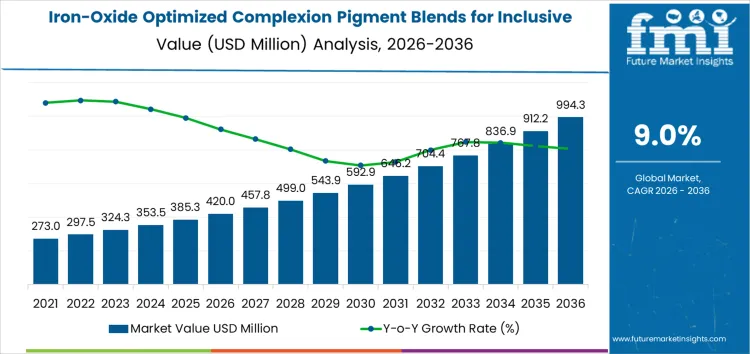
What is the Growth Forecast for the Iron-Oxide Optimized Complexion Pigment Blends for Inclusive Shades Market through 2036?
The market growth curve shape analysis for the iron-oxide optimized complexion pigment blends for inclusive shades market indicates a steady, predictable growth pattern with a gradual acceleration followed by stable expansion. The market will see consistent increases in value throughout the forecast period, starting at USD 420 million in 2026 and reaching USD 994.3 million by 2036.
In the early years (2026 to 2031), the market will experience an acceleration in growth, with the demand for inclusive shades driving a steady increase in adoption. From USD 420 million in 2026, the market will rise to USD 653 million by 2031, representing a significant portion of the overall market growth. The growth curve during this phase will be marked by a moderate, but steady, increase in market value year over year.
As the market matures (2031 to 2036), the growth rate will stabilize, and the curve will reflect a more predictable, steady expansion. While the market will continue to increase from USD 653 million in 2031 to USD 1,040 million in 2036, the rate of acceleration will slow as the technology becomes more widely adopted and inclusivity in makeup formulations becomes the norm. This stabilization is typical of a maturing market where growth is driven by sustained demand and established product offerings, rather than the rapid adoption seen in earlier years.
Iron-Oxide Optimized Complexion Pigment Blends for Inclusive Shades Market Key Takeaways
| Metric | Value |
|---|---|
| Industry Sales Value (2026) | USD 420 million |
| Industry Forecast Value (2036) | USD 994.3 million |
| Industry Forecast CAGR (2026 to 2036) | 9% |
What Is Driving the Demand for Iron-Oxide Optimized Complexion Pigment Blends for Inclusive Shades Market Globally?
The global demand for iron-oxide optimized complexion pigment blends for inclusive shades is driven by rising consumer expectations for makeup that matches a broad spectrum of skin tones and undertones. Traditional complexion products often failed to deliver accurate color matches for deeper or varied complexions because of limited pigment selection and formulation approaches that favored a narrow range of tones. Iron oxides, which provide stable red, yellow, and brown hues, are key ingredients in blends that can be tuned to achieve diverse skin representations.
Makeup brands, retailers, and professional artists have responded to consumer feedback and market research showing that inclusivity in shade ranges is now a baseline expectation rather than a niche feature. Growth in social media influence, online tutorials, and beauty communities has amplified awareness of products that offer true representation, reinforcing investment in pigment technologies that deliver consistent, true to tone performance. At the same time, expansion of global beauty markets in Latin America, Africa, the Middle East, and Asia Pacific has increased demand for formulations that address regional and ethnic diversity in complexion palettes.
Future demand for iron-oxide optimized complexion pigment blends for inclusive shades is expected to grow as formulation science, digital tools, and market competition continue to evolve. Advances in dispersion technology and pigment calibration are improving uniformity and color accuracy across lighting conditions and finish types, which is essential for consumer confidence and product reviews. Brands that integrate advanced pigment systems into foundations, concealers, powders, and tinted products can differentiate offerings and build loyalty among consumers who previously struggled to find satisfactory matches. Regulatory environments that emphasize product safety and labeling transparency support adoption of optimized pigment systems that align with consumer health expectations.
The rise of augmented reality and shade matching apps will further reinforce demand, as these tools make it easier for consumers to identify precise matches and expect high performance from inclusive formulations. Direct to consumer and e commerce channels will accelerate distribution of products with expanded shade ranges, making inclusive pigment technologies accessible to more consumers worldwide. As the beauty industry continues to reflect diverse populations and values, optimized iron-oxide pigment blends that deliver inclusive, high quality complexion results are poised for steady market expansion.
What are the Leading Segments in the Global Iron-Oxide Optimized Complexion Pigment Blends for Inclusive Shades Market?
The global iron-oxide optimized complexion pigment blends for inclusive shades market is segmented by application type and end use. Among application types, foundation & concealer lead the market, capturing 46% of the share, followed by BB & CC creams, tinted moisturizers, and color correctors. Foundation & concealer products are the largest segment due to their widespread use in daily makeup routines. On the end-use side, consumer cosmetics dominates the market, holding 51% of the share, followed by professional makeup artists, dermatology & specialty brands, and luxury beauty segments. The demand in consumer cosmetics is driven by the need for diverse and inclusive shade ranges that cater to various skin tones.
What Drives the Growth of Foundation & Concealer in the Iron-Oxide Optimized Complexion Pigment Blends for Inclusive Shades Market?
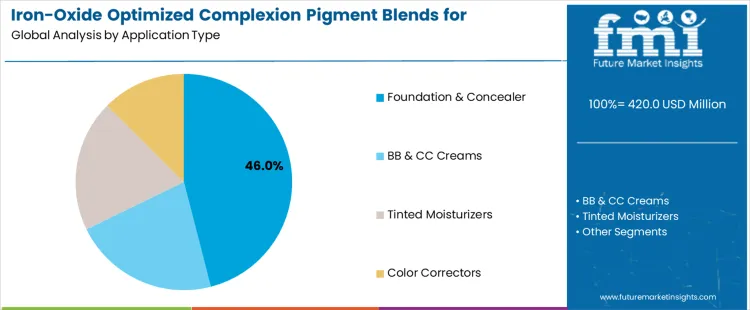
Foundation & concealer is the leading application type in the iron-oxide optimized complexion pigment blends for inclusive shades market, holding 46% of the share. This demand is primarily driven by the increasing consumer demand for makeup products that offer a wide range of shades to cater to diverse skin tones.
The growing emphasis on inclusivity in the beauty industry has led to the development of foundation and concealer products that feature iron-oxide optimized pigments, which provide more natural, customizable shades for a variety of complexions. Iron oxide-based pigments are particularly effective in achieving rich, warm shades that are crucial for inclusive products. As the beauty industry continues to focus on diversity and representation, the demand for foundations and concealers made with iron-oxide optimized pigment blends is expected to grow, further cementing this application as the dominant segment in the market.
What is Driving the Demand for Consumer Cosmetics in the Iron-Oxide Optimized Complexion Pigment Blends for Inclusive Shades Market?
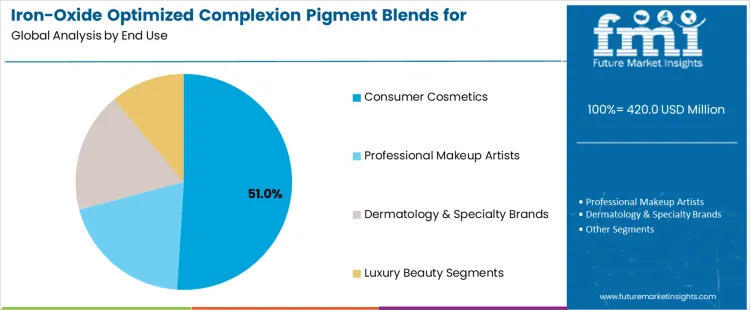
Consumer cosmetics is the leading end-use sector in the iron-oxide optimized complexion pigment blends for inclusive shades market, capturing 51% of the share. This growth is driven by the increasing demand for makeup products that are inclusive, offering a broad range of shades that cater to all skin tones. As consumers seek more options for personalized beauty solutions, particularly in foundation, concealer, and complexion products, brands are responding by developing products that are more diverse and reflective of a wider range of skin tones.
Iron-oxide optimized complexion pigments are particularly sought after because of their ability to create rich, long-lasting shades suitable for both light and deep complexions. The growing focus on inclusivity, combined with the trend toward clean, effective beauty, has led to a rise in consumer demand for complexion products that meet these needs. As the market for inclusive beauty continues to expand, the demand for consumer cosmetics with iron-oxide optimized pigment blends is expected to remain strong.
What are the Key Dynamics in the Global Iron-Oxide Optimized Complexion Pigment Blends for Inclusive Shades Market?
The global iron-oxide optimized complexion pigment blends for inclusive shades market is expanding as beauty brands prioritise representation and performance across diverse skin tones. These pigment blends use calibrated combinations of iron oxides and complementary colorants to deliver consistent, true to skin shades in foundations, concealers, bronzers and tinted products. Growth is driven by rising consumer demand for inclusive offerings, expansion of personalized beauty tools, and data driven color matching technologies. Adoption spans mass, prestige and indie segments where shade diversity and quality performance influence purchasing choices and brand loyalty worldwide.
What are the Key Drivers for the Iron-Oxide Optimized Complexion Pigment Blends for Inclusive Shades Market?
A key driver is heightened consumer expectation for products that reflect a wide range of skin tones and undertones, challenging brands to expand and refine shade portfolios. Digital beauty trends, social media advocacy and influencers spotlight inclusivity, motivating investment in pigment systems that ensure uniformity, stability and blendability across diverse shades. Advances in iron-oxide processing and coating technologies improve opacity, undertone control and light reflection, enabling rich, natural finishes. Integration of virtual try on and shade matching platforms boosts consumer confidence and supports conversion. Expansion of global beauty markets with varied complexion needs reinforces demand for optimized pigment blends that truly perform.
What are the Restraints for the Iron-Oxide Optimized Complexion Pigment Blends for Inclusive Shades Market?
One restraint is the technical complexity of formulating and standardizing pigment blends that perform consistently across global manufacturing batches and product formats. Variability in raw iron-oxide quality, particle size distribution and coating can influence shade accuracy and stability, requiring stringent quality control and testing. Specialty pigment systems may carry higher raw material and processing costs, which can affect pricing strategies, especially in entry level segments. Consumer perception that added shades may not always match expectations without in person sampling influences adoption. Regulatory differences in allowed colorant definitions and labeling across regions complicate global shade line rollout and claims.
What are the Key Trends in the Iron-Oxide Optimized Complexion Pigment Blends for Inclusive Shades Market?
A key trend is development of advanced pigment dispersion and coating technologies that improve uniformity, minimize flashback in photography, and deliver smooth, skin like finishes across a broad shade spectrum. Manufacturers are leveraging data analytics and machine learning to refine shade libraries and predict formulation behavior across light conditions and skin types. Growth of customizable and modular beauty systems encourages brands to offer build your shade and layerable solutions. Collaboration between pigment specialists, color scientists and makeup brands accelerates innovation in undertone mapping and performance validation. Transparency in formulation and shade matching tools enhances consumer trust and drives repeat purchase in inclusive beauty portfolios.
What is the Country-Wise Analysis of the Iron-Oxide Optimized Complexion Pigment Blends for Inclusive Shades Market?
The iron-oxide optimized complexion pigment blends for inclusive shades market is witnessing significant growth, driven by increasing demand for diversity and inclusivity in the beauty industry. These pigments, which offer a wide range of shades suitable for various skin tones, are becoming a key ingredient in formulations for foundations, concealers, and other complexion products. The shift towards more inclusive beauty standards, where brands are now offering shades for a broader spectrum of skin tones, is propelling the demand for these optimized pigment blends.
Developed markets such as the USA, Germany, and the UK are seeing strong demand, driven by a rising focus on inclusivity in the beauty industry and consumer preference for brands that cater to diverse skin tones. Emerging markets like China and South Korea are also witnessing steady growth, fueled by the increasing consumer awareness of inclusivity and the growing beauty market in these regions.
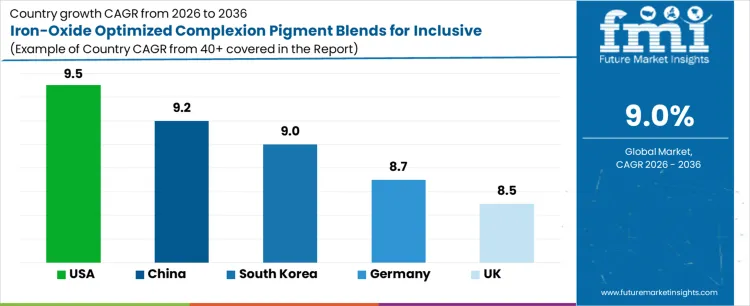
| Country | CAGR (2026 to 2036) |
|---|---|
| USA | 9.5% |
| China | 9.2% |
| South Korea | 9% |
| Germany | 8.7% |
| UK | 8.5% |
What is the Growth Outlook for the Iron-Oxide Optimized Complexion Pigment Blends for Inclusive Shades Market in the USA?
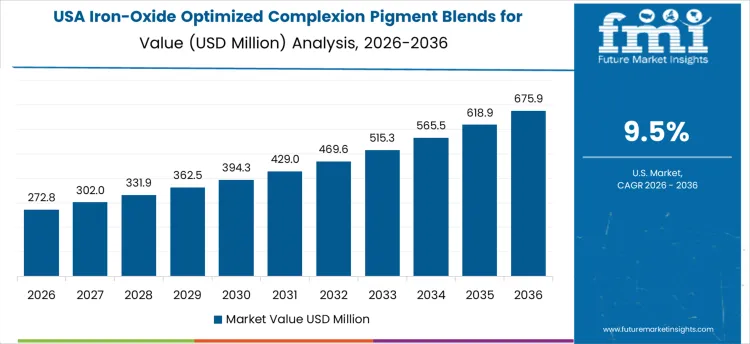
The iron-oxide optimized complexion pigment blends for inclusive shades market in the USA is expected to grow at a steady pace, with a projected CAGR of 9.5% from 2026 to 2036. The USA beauty industry has been at the forefront of the inclusive beauty movement, where the demand for a wide range of shades in complexion products is growing rapidly.
With increasing consumer awareness and the demand for diversity in beauty, brands are increasingly adopting iron-oxide optimized pigments to cater to various skin tones. USA consumers are more conscious of the need for inclusive products, leading to an increase in product offerings that cater to all ethnicities. The rise of inclusive beauty brands and the success of products like Fenty Beauty, which revolutionized the beauty industry by offering a wide range of foundation shades, has set a precedent for other brands to follow. As inclusivity continues to be a major focus in the beauty sector, the USA market for these pigments is expected to see sustained growth.
What is the Market Outlook for the Iron-Oxide Optimized Complexion Pigment Blends for Inclusive Shades Market in China?
The iron-oxide optimized complexion pigment blends for inclusive shades market in China is projected to grow steadily, with a projected CAGR of 9.2% from 2026 to 2036. China’s rapidly expanding beauty market is becoming increasingly diverse, with consumers seeking products that reflect a wider range of skin tones.
As the beauty industry in China continues to grow, there is an increasing demand for complexion products that cater to various skin colors. The influence of global beauty trends, such as the shift towards inclusivity, is driving Chinese beauty brands to adopt iron-oxide optimized pigment blends to create more inclusive product ranges. China’s growing middle class and increasing purchasing power are also contributing to this demand, with more consumers willing to invest in high-quality, inclusive products. As awareness of the need for diversity in beauty continues to spread, China’s market for inclusive beauty products is expected to see sustained growth.
What is the Growth Forecast for the Iron-Oxide Optimized Complexion Pigment Blends for Inclusive Shades Market in South Korea?
The iron-oxide optimized complexion pigment blends for inclusive shades market in South Korea is expected to grow steadily, with a projected CAGR of 9% from 2026 to 2036. South Korea is known for its highly innovative beauty market, and there is a growing interest in inclusivity and diversity in cosmetic products.
As South Korean beauty consumers increasingly seek products that reflect a broader range of skin tones, there is an emerging demand for complexion products that cater to various ethnicities. South Korean brands, which have traditionally focused on lighter skin tones, are now responding to the changing landscape by adopting iron-oxide optimized pigment blends to offer more diverse shades. Additionally, the global rise in inclusive beauty trends is influencing South Korean consumers, who are becoming more conscious of the need for a broader range of products to match different skin tones. This shift is expected to contribute to steady growth in the market for inclusive complexion pigment blends in South Korea.
What is the Market Outlook for the Iron-Oxide Optimized Complexion Pigment Blends for Inclusive Shades Market in Germany?
Germany is projected to see steady growth in the iron-oxide optimized complexion pigment blends for inclusive shades market, with a projected CAGR of 8.7% from 2026 to 2036. As Europe’s beauty industry continues to focus on sustainability and inclusivity, Germany is becoming a key market for diverse cosmetic formulations. Consumers in Germany are increasingly seeking products that offer a wide range of shades, and beauty brands are responding by incorporating iron-oxide optimized pigments to create inclusive products for all skin tones.
Germany’s strong commitment to diversity and inclusivity is influencing the beauty sector, with consumers demanding products that reflect a broader spectrum of skin tones. The growing acceptance and appreciation of diverse beauty standards, coupled with Germany’s emphasis on high-quality products, is driving demand for complexion pigment blends that can cater to a variety of skin colors. As the demand for inclusive beauty grows, the market for iron-oxide optimized pigments is expected to expand steadily.
What are the Growth Prospects for the Iron-Oxide Optimized Complexion Pigment Blends for Inclusive Shades Market in the UK?
The iron-oxide optimized complexion pigment blends for inclusive shades market in the UK is expected to grow steadily, with a projected CAGR of 8.5% from 2026 to 2036. The UK market has seen significant shifts towards inclusivity, with consumers increasingly demanding products that reflect their diverse skin tones. The rise in awareness around diversity and representation in beauty has led to a growing demand for complexion products that cater to all ethnicities. As the UK continues to embrace inclusive beauty, brands are turning to iron-oxide optimized pigment systems to create a wider range of foundation and concealer shades.
The UK’s focus on ethical, inclusive, and sustainable beauty practices further supports the adoption of these optimized pigment blends. With consumers becoming more empowered to make purchasing decisions based on inclusivity and diversity, the UK market for these pigments is expected to grow steadily, contributing to the overall expansion of inclusive beauty globally.
What is the Competitive Landscape for the Iron-Oxide Optimized Complexion Pigment Blends for Inclusive Shades Market?
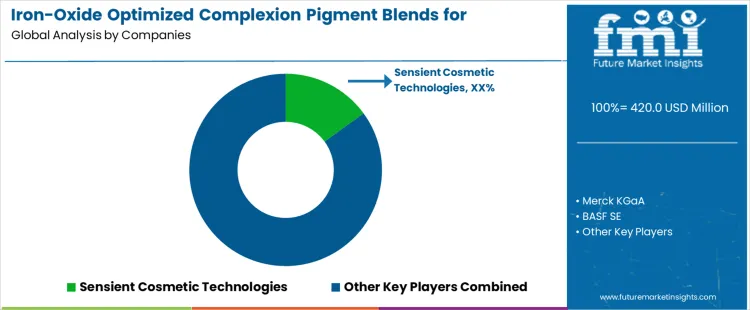
The iron-oxide optimized complexion pigment blends market is expanding rapidly as the cosmetics industry shifts toward more inclusive and diverse makeup shades that cater to a wider range of skin tones. Sensient Cosmetic Technologies leads the market with its innovative iron-oxide optimized pigment blends, offering high-performance solutions designed to provide a broad spectrum of inclusive shades for complexion products. Their commitment to product quality, innovation, and meeting the diverse needs of consumers has positioned them as a dominant player in this space.
Merck KGaA, BASF SE, and Kobo Products Inc. are key competitors, each offering specialized iron-oxide pigment systems for developing inclusive and natural-looking shades. Merck KGaA provides advanced pigment technologies that enable the creation of a wide variety of shades with excellent color fidelity, while BASF SE and Kobo Products Inc. focus on delivering high-quality blends that meet consumer demand for inclusivity and precision in complexion products.
Sun Chemical Corporation, Clariant AG, and ColorTone Cosmetics further contribute to the competitive landscape by offering their own optimized iron-oxide blends designed to create diverse, inclusive shades. Sun Chemical Corporation offers a range of pigments that provide natural, buildable color, while Clariant AG focuses on sustainable, high-performance colorants for cosmetics. ColorTone Cosmetics specializes in providing natural pigments that cater to a variety of skin tones, ensuring inclusivity in makeup formulations.
These companies compete by focusing on innovation, inclusivity, and sustainability, addressing the increasing demand for complexion products that suit a wide array of skin tones. As consumer demand for diversity in beauty continues to rise, the market for iron-oxide optimized complexion pigment blends is expected to continue growing, fostering further competition and innovation in the sector.
Key Players of the Iron-Oxide Optimized Complexion Pigment Blends for Inclusive Shades Market
- Sensient Cosmetic Technologies
- Merck KGaA
- BASF SE
- Kobo Products Inc.
- Sun Chemical Corporation
- Clariant AG
- ColorTone Cosmetics
Scope of the Report
| Items | Values |
|---|---|
| Quantitative Units (2026) | USD Million |
| Material Type | Iron Oxide Concentrates, High Chromatic Pigment Blends, Modified Titanium Dioxide, Other Mineral Pigments |
| Application Type | Foundation & Concealer, BB & CC Creams, Tinted Moisturizers, Color Correctors |
| End Use | Consumer Cosmetics, Professional Makeup Artists, Dermatology & Specialty Brands, Luxury Beauty Segments |
| Companies | Sensient Cosmetic Technologies, Merck KGaA, BASF SE, Kobo Products Inc., Sun Chemical Corporation, Clariant AG, ColorTone Cosmetics |
| Regions Covered | North America, Latin America, Western Europe, Eastern Europe, South Asia and Pacific, East Asia, Middle East & Africa |
| Countries Covered | United States, Canada, Mexico, Brazil, Argentina, Germany, France, United Kingdom, Italy, Spain, Netherlands, China, India, Japan, South Korea, ANZ, GCC Countries, South Africa |
| Additional Attributes | Dollar by sales by material type, application type, end use, and region. Includes market dynamics in iron oxide optimized complexion pigment blends for inclusive shades, performance in cosmetic formulations, color range and shade diversity, formulation cost factors, regulatory and safety considerations for mineral pigments, consumer demand for inclusive shade products, market share and competitive positioning of key companies, innovations in pigment blending technologies, and evaluation of impact on complexion coverage, appearance, and wear performance. |
Iron-Oxide Optimized Complexion Pigment Blends for Inclusive Shades Market Segmentation
By Material Type:
- Iron Oxide Concentrates
- High-Chromatic Pigment Blends
- Modified Titanium Dioxide
- Other Mineral Pigments
By Application Type:
- Foundation & Concealer
- BB & CC Creams
- Tinted Moisturizers
- Color Correctors
By End Use:
- Consumer Cosmetics
- Professional Makeup Artists
- Dermatology & Specialty Brands
- Luxury Beauty Segments
By Region:
- Asia Pacific
- China
- Japan
- South Korea
- India
- Australia & New Zealand
- ASEAN
- Rest of Asia Pacific
- Europe
- Germany
- United Kingdom
- France
- Italy
- Spain
- Nordic
- BENELUX
- Rest of Europe
- North America
- United States
- Canada
- Mexico
- Latin America
- Brazil
- Chile
- Rest of Latin America
- Middle East & Africa
- Kingdom of Saudi Arabia
- Other GCC Countries
- Turkey
- South Africa
- Other African Union
- Rest of Middle East & Africa
Frequently Asked Questions
How big is the iron-oxide optimized complexion pigment blends for inclusive shades market in 2026?
The global iron-oxide optimized complexion pigment blends for inclusive shades market is estimated to be valued at USD 420.0 million in 2026.
What will be the size of iron-oxide optimized complexion pigment blends for inclusive shades market in 2036?
The market size for the iron-oxide optimized complexion pigment blends for inclusive shades market is projected to reach USD 994.3 million by 2036.
How much will be the iron-oxide optimized complexion pigment blends for inclusive shades market growth between 2026 and 2036?
The iron-oxide optimized complexion pigment blends for inclusive shades market is expected to grow at a 9.0% CAGR between 2026 and 2036.
What are the key product types in the iron-oxide optimized complexion pigment blends for inclusive shades market?
The key product types in iron-oxide optimized complexion pigment blends for inclusive shades market are iron oxide concentrates, high‑chromatic pigment blends, modified titanium dioxide and other mineral pigments.
Which application type segment to contribute significant share in the iron-oxide optimized complexion pigment blends for inclusive shades market in 2026?
In terms of application type, foundation & concealer segment to command 46.0% share in the iron-oxide optimized complexion pigment blends for inclusive shades market in 2026.
Preview the report firsthand - request a free sample
Get SampleGet the brochure for pricing and purchase details.
Get PDFTable of Content
- Executive Summary
- Global Market Outlook
- Demand-side Trends
- Supply-side Trends
- Technology Roadmap Analysis
- Analysis and Recommendations
- Market Overview
- Market Coverage / Taxonomy
- Market Definition / Scope / Limitations
- Market Background
- Market Dynamics
- Drivers
- Restraints
- Opportunity
- Trends
- Scenario Forecast
- Demand in Optimistic Scenario
- Demand in Likely Scenario
- Demand in Conservative Scenario
- Opportunity Map Analysis
- Product Life Cycle Analysis
- Supply Chain Analysis
- Investment Feasibility Matrix
- Value Chain Analysis
- PESTLE and Porter’s Analysis
- Regulatory Landscape
- Regional Parent Market Outlook
- Production and Consumption Statistics
- Import and Export Statistics
- Market Dynamics
- Global Market Analysis 2021 to 2025 and Forecast, 2026 to 2036
- Historical Market Size Value (USD Million) Analysis, 2021 to 2025
- Current and Future Market Size Value (USD Million) Projections, 2026 to 2036
- Y-o-Y Growth Trend Analysis
- Absolute $ Opportunity Analysis
- Global Market Pricing Analysis 2021 to 2025 and Forecast 2026 to 2036
- Global Market Analysis 2021 to 2025 and Forecast 2026 to 2036, By Material Type
- Introduction / Key Findings
- Historical Market Size Value (USD Million) Analysis By Material Type , 2021 to 2025
- Current and Future Market Size Value (USD Million) Analysis and Forecast By Material Type , 2026 to 2036
- Iron Oxide Concentrates
- High‑Chromatic Pigment Blends
- Modified Titanium Dioxide
- Other Mineral Pigments
- Iron Oxide Concentrates
- Y-o-Y Growth Trend Analysis By Material Type , 2021 to 2025
- Absolute $ Opportunity Analysis By Material Type , 2026 to 2036
- Global Market Analysis 2021 to 2025 and Forecast 2026 to 2036, By Application Type
- Introduction / Key Findings
- Historical Market Size Value (USD Million) Analysis By Application Type, 2021 to 2025
- Current and Future Market Size Value (USD Million) Analysis and Forecast By Application Type, 2026 to 2036
- Foundation & Concealer
- BB & CC Creams
- Tinted Moisturizers
- Color Correctors
- Foundation & Concealer
- Y-o-Y Growth Trend Analysis By Application Type, 2021 to 2025
- Absolute $ Opportunity Analysis By Application Type, 2026 to 2036
- Global Market Analysis 2021 to 2025 and Forecast 2026 to 2036, By End Use
- Introduction / Key Findings
- Historical Market Size Value (USD Million) Analysis By End Use, 2021 to 2025
- Current and Future Market Size Value (USD Million) Analysis and Forecast By End Use, 2026 to 2036
- Consumer Cosmetics
- Professional Makeup Artists
- Dermatology & Specialty Brands
- Luxury Beauty Segments
- Consumer Cosmetics
- Y-o-Y Growth Trend Analysis By End Use, 2021 to 2025
- Absolute $ Opportunity Analysis By End Use, 2026 to 2036
- Global Market Analysis 2021 to 2025 and Forecast 2026 to 2036, By Region
- Introduction
- Historical Market Size Value (USD Million) Analysis By Region, 2021 to 2025
- Current Market Size Value (USD Million) Analysis and Forecast By Region, 2026 to 2036
- North America
- Latin America
- Western Europe
- Eastern Europe
- East Asia
- South Asia and Pacific
- Middle East & Africa
- Market Attractiveness Analysis By Region
- North America Market Analysis 2021 to 2025 and Forecast 2026 to 2036, By Country
- Historical Market Size Value (USD Million) Trend Analysis By Market Taxonomy, 2021 to 2025
- Market Size Value (USD Million) Forecast By Market Taxonomy, 2026 to 2036
- By Country
- USA
- Canada
- Mexico
- By Material Type
- By Application Type
- By End Use
- By Country
- Market Attractiveness Analysis
- By Country
- By Material Type
- By Application Type
- By End Use
- Key Takeaways
- Latin America Market Analysis 2021 to 2025 and Forecast 2026 to 2036, By Country
- Historical Market Size Value (USD Million) Trend Analysis By Market Taxonomy, 2021 to 2025
- Market Size Value (USD Million) Forecast By Market Taxonomy, 2026 to 2036
- By Country
- Brazil
- Chile
- Rest of Latin America
- By Material Type
- By Application Type
- By End Use
- By Country
- Market Attractiveness Analysis
- By Country
- By Material Type
- By Application Type
- By End Use
- Key Takeaways
- Western Europe Market Analysis 2021 to 2025 and Forecast 2026 to 2036, By Country
- Historical Market Size Value (USD Million) Trend Analysis By Market Taxonomy, 2021 to 2025
- Market Size Value (USD Million) Forecast By Market Taxonomy, 2026 to 2036
- By Country
- Germany
- UK
- Italy
- Spain
- France
- Nordic
- BENELUX
- Rest of Western Europe
- By Material Type
- By Application Type
- By End Use
- By Country
- Market Attractiveness Analysis
- By Country
- By Material Type
- By Application Type
- By End Use
- Key Takeaways
- Eastern Europe Market Analysis 2021 to 2025 and Forecast 2026 to 2036, By Country
- Historical Market Size Value (USD Million) Trend Analysis By Market Taxonomy, 2021 to 2025
- Market Size Value (USD Million) Forecast By Market Taxonomy, 2026 to 2036
- By Country
- Russia
- Poland
- Hungary
- Balkan & Baltic
- Rest of Eastern Europe
- By Material Type
- By Application Type
- By End Use
- By Country
- Market Attractiveness Analysis
- By Country
- By Material Type
- By Application Type
- By End Use
- Key Takeaways
- East Asia Market Analysis 2021 to 2025 and Forecast 2026 to 2036, By Country
- Historical Market Size Value (USD Million) Trend Analysis By Market Taxonomy, 2021 to 2025
- Market Size Value (USD Million) Forecast By Market Taxonomy, 2026 to 2036
- By Country
- China
- Japan
- South Korea
- By Material Type
- By Application Type
- By End Use
- By Country
- Market Attractiveness Analysis
- By Country
- By Material Type
- By Application Type
- By End Use
- Key Takeaways
- South Asia and Pacific Market Analysis 2021 to 2025 and Forecast 2026 to 2036, By Country
- Historical Market Size Value (USD Million) Trend Analysis By Market Taxonomy, 2021 to 2025
- Market Size Value (USD Million) Forecast By Market Taxonomy, 2026 to 2036
- By Country
- India
- ASEAN
- Australia & New Zealand
- Rest of South Asia and Pacific
- By Material Type
- By Application Type
- By End Use
- By Country
- Market Attractiveness Analysis
- By Country
- By Material Type
- By Application Type
- By End Use
- Key Takeaways
- Middle East & Africa Market Analysis 2021 to 2025 and Forecast 2026 to 2036, By Country
- Historical Market Size Value (USD Million) Trend Analysis By Market Taxonomy, 2021 to 2025
- Market Size Value (USD Million) Forecast By Market Taxonomy, 2026 to 2036
- By Country
- Kingdom of Saudi Arabia
- Other GCC Countries
- Turkiye
- South Africa
- Other African Union
- Rest of Middle East & Africa
- By Material Type
- By Application Type
- By End Use
- By Country
- Market Attractiveness Analysis
- By Country
- By Material Type
- By Application Type
- By End Use
- Key Takeaways
- Key Countries Market Analysis
- USA
- Pricing Analysis
- Market Share Analysis, 2025
- By Material Type
- By Application Type
- By End Use
- Canada
- Pricing Analysis
- Market Share Analysis, 2025
- By Material Type
- By Application Type
- By End Use
- Mexico
- Pricing Analysis
- Market Share Analysis, 2025
- By Material Type
- By Application Type
- By End Use
- Brazil
- Pricing Analysis
- Market Share Analysis, 2025
- By Material Type
- By Application Type
- By End Use
- Chile
- Pricing Analysis
- Market Share Analysis, 2025
- By Material Type
- By Application Type
- By End Use
- Germany
- Pricing Analysis
- Market Share Analysis, 2025
- By Material Type
- By Application Type
- By End Use
- UK
- Pricing Analysis
- Market Share Analysis, 2025
- By Material Type
- By Application Type
- By End Use
- Italy
- Pricing Analysis
- Market Share Analysis, 2025
- By Material Type
- By Application Type
- By End Use
- Spain
- Pricing Analysis
- Market Share Analysis, 2025
- By Material Type
- By Application Type
- By End Use
- France
- Pricing Analysis
- Market Share Analysis, 2025
- By Material Type
- By Application Type
- By End Use
- India
- Pricing Analysis
- Market Share Analysis, 2025
- By Material Type
- By Application Type
- By End Use
- ASEAN
- Pricing Analysis
- Market Share Analysis, 2025
- By Material Type
- By Application Type
- By End Use
- Australia & New Zealand
- Pricing Analysis
- Market Share Analysis, 2025
- By Material Type
- By Application Type
- By End Use
- China
- Pricing Analysis
- Market Share Analysis, 2025
- By Material Type
- By Application Type
- By End Use
- Japan
- Pricing Analysis
- Market Share Analysis, 2025
- By Material Type
- By Application Type
- By End Use
- South Korea
- Pricing Analysis
- Market Share Analysis, 2025
- By Material Type
- By Application Type
- By End Use
- Russia
- Pricing Analysis
- Market Share Analysis, 2025
- By Material Type
- By Application Type
- By End Use
- Poland
- Pricing Analysis
- Market Share Analysis, 2025
- By Material Type
- By Application Type
- By End Use
- Hungary
- Pricing Analysis
- Market Share Analysis, 2025
- By Material Type
- By Application Type
- By End Use
- Kingdom of Saudi Arabia
- Pricing Analysis
- Market Share Analysis, 2025
- By Material Type
- By Application Type
- By End Use
- Turkiye
- Pricing Analysis
- Market Share Analysis, 2025
- By Material Type
- By Application Type
- By End Use
- South Africa
- Pricing Analysis
- Market Share Analysis, 2025
- By Material Type
- By Application Type
- By End Use
- USA
- Market Structure Analysis
- Competition Dashboard
- Competition Benchmarking
- Market Share Analysis of Top Players
- By Regional
- By Material Type
- By Application Type
- By End Use
- Competition Analysis
- Competition Deep Dive
- Sensient Cosmetic Technologies
- Overview
- Product Portfolio
- Profitability by Market Segments (Product/Age /Sales Channel/Region)
- Sales Footprint
- Strategy Overview
- Marketing Strategy
- Product Strategy
- Channel Strategy
- Merck KGaA
- BASF SE
- Kobo Products Inc.
- Sun Chemical Corporation
- Clariant AG
- ColorTone Cosmetics
- Sensient Cosmetic Technologies
- Competition Deep Dive
- Assumptions & Acronyms Used
- Research Methodology


