

- Industry Size (2026)
- USD 430.7 Mn
- Forecast (2036)
- USD 786.1 Mn
- CAGR (2026 to 2036)
- 6.2%
Sack Tip Stations Market Size, Market Forecast and Outlook By FMI
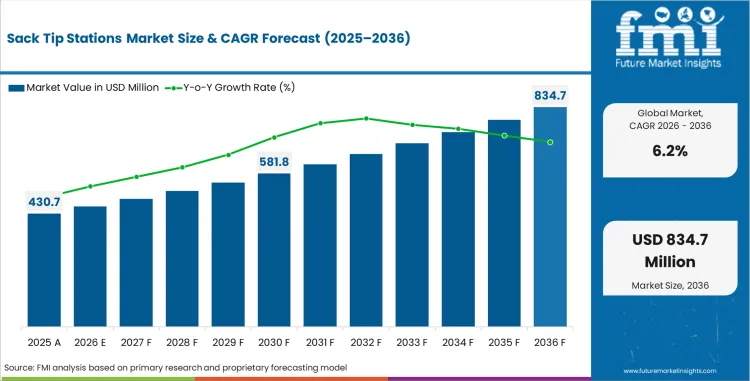
The sack tip stations market was valued at USD 405.6 million in 2025. Industry is estimated to reach USD 430.7 million in 2026, reflecting steady demand for controlled powder handling systems which is projected to grow at a CAGR of 6.2% from 2026 to 2036. Total revenue expected to reach USD 786.1 million by 2036, primarily owing to upgrades in powder discharge systems to meet stricter workplace exposure limits.
Summary of Sack Tip Stations Market
- The market is forecast to reach USD 786.1 million by 2036.
- The market is expected to grow at a CAGR of 6.2% from 2026 to 2036.
- The market was estimated at USD 405.6 million in 2025.
- The forecast period represents an incremental opportunity of USD 355.4 million.
- Sack tip stations are used to unload bagged powders and bulk solids while controlling dust and improving operator safety.
- Demand is driven by the need for cleaner powder handling, reduced airborne dust, and safer material intake operations.
- Food and pharmaceutical industries are key adopters due to strict hygiene, CGMP, and GMP compliance requirements.
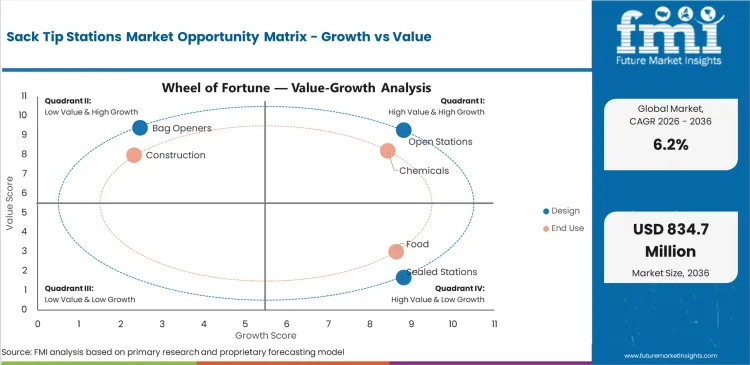
- Open stations are expected to lead the design segment with a 46.0% share in 2026 due to cost efficiency and widespread use.
- The chemicals segment is projected to account for 27.0% share of end use in 2026.
- Basic extraction systems dominate dust control with a 39.0% share, reflecting standard localized filtration setups.
- Manual systems are expected to hold 63.0% share in 2026, indicating continued reliance on operator-assisted processes.
- India and China are the fastest-growing markets, while the United States remains a stable demand base.
- Growth is constrained by long equipment replacement cycles and continued use of manual unloading in simpler operations.
- Key companies include Flexicon, Palamatic Process, Gericke, AZO, Matcon, Coperion, and Volkmann.
Manual sack tipping operations require control of airborne dust during material transfer. Open discharge setups such as floor grates do not provide sufficient containment. Facilities are shifting toward enclosed systems with integrated dust extraction to reduce exposure risk. Equipment selection depends on early planning of dust control specifications within capital investment cycles. Filter maintenance adds complexity to system selection. Cartridge-based filtration systems often vary by supplier, which can limit interchangeability. This creates long-term dependence on specific replacement components and affects operating cost over time. Maintenance planning is becoming a key factor in procurement decisions.
Plant requirements now include integrated bag compaction at discharge points. This requirement increases demand for enclosed sack tip stations designed for higher containment levels. Equipment suppliers benefit from ongoing filter replacement and service contracts once systems are installed. Pre-qualification now includes extended testing of dust control performance and system reliability under continuous use.
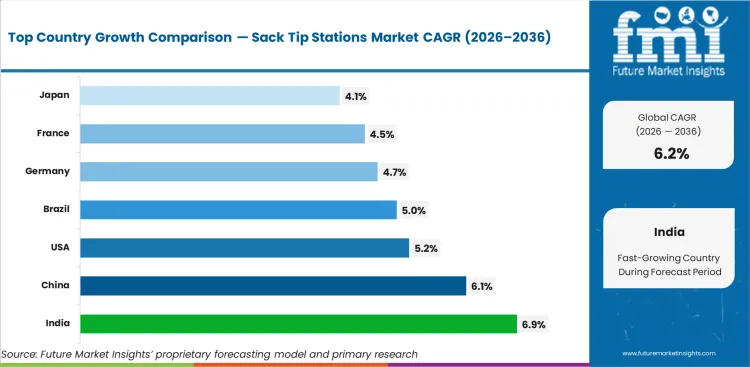
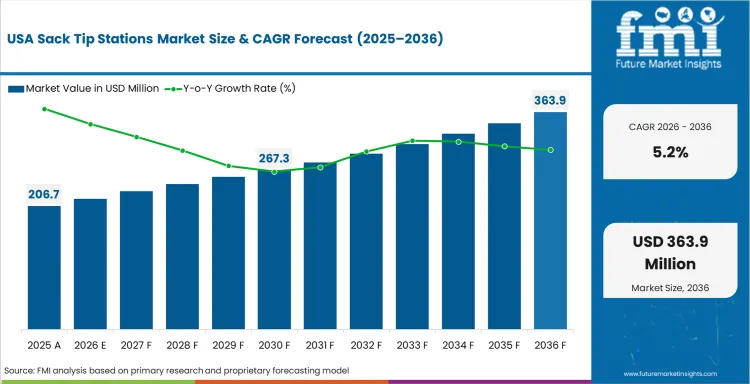
India is projected to rise at a CAGR of 6.9% in the sack tip stations market from 2026 to 2036, supported by industrial upgrades across processing sectors. China is expected to expand at a CAGR of 6.1% over the same period, with demand linked to particulate control requirements in chemical handling operations. The United States is anticipated to grow at 5.2% from 2026 to 2036, driven by compliance requirements in workplace safety standards. Brazil is forecast to record a CAGR of 5.0% during the forecast period, supported by demand from agricultural processing facilities. Germany is set to grow at a CAGR of 4.7% through 2036, with focus on compliance with air quality regulations in industrial environments. France is expected to expand at a CAGR of 4.5% over the forecast period, supported by hygienic material handling requirements in food processing. Japan is projected to grow at a CAGR of 4.1% from 2026 to 2036, with demand centered on compact and enclosed systems for urban manufacturing sites.
Segmental Analysis
Sack Tip Stations Market Analysis by Design
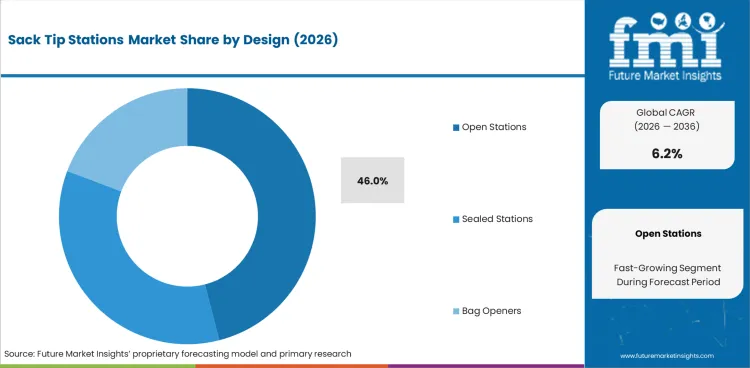
Open configurations remain central to material intake processes where speed and accessibility take priority over containment. Open stations are expected to account for nearly 46.0% share of the sack tip stations market in 2026, supported by their compatibility with high-frequency dumping operations. Unrestricted access improves handling efficiency while reducing cycle time per batch. Enclosed alternatives introduce airflow control but can slow manual operations. Equipment selection depends on balancing throughput with containment needs, especially in facilities handling non-hazardous bulk materials at scale.
- Baseline handling requirement: Open configurations establish fundamental transfer capabilities for new processing lines. Plant directors achieve reliable throughput modeling data.
- Extended ergonomic mapping: Unrestricted access reveals physical strain patterns inside complex dumping workflows over thousands of shifts. Production engineers adjust grate heights to prevent localized injuries.
- Safety bottleneck prevention: Successful completion of uninterrupted basic discharging unlocks commercial line approvals. Factory procurement teams avoid purchasing over-engineered containment infrastructure.
Sack Tip Stations Market Analysis by End Use
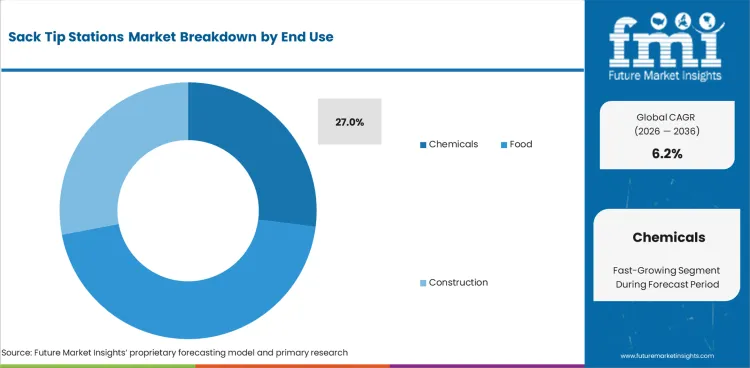
Chemicals is likely to hold 27.0% share in 2026, supported by routine handling of dusty and potentially hazardous powders that require controlled unloading and localized extraction. In chemical processing, EHS and operations teams use sack tip stations to reduce operator exposure during material charging and maintain more controlled transfer into downstream mixing systems. Procurement teams often favor modular sack tip stations over larger custom intake arrangements when they need lower upfront cost, faster installation, and easier retrofit into existing plant layouts. Fully automated batching systems typically require higher capital investment because they involve added controls, integration work, and facility modifications. One contradiction characterizing this sector involves extraction infrastructure; while the sack tip station price itself is moderately approachable, the facility-level ducting upgrades required to run multiple dust control systems simultaneously often exceed the cost of the intake hardware itself. Managers who miscalculate total site airflow requirements face stranded, unusable transfer assets.
- Chemical alignment precision: Rigs operating in toxic environments mirror exact specifications of standard safety containers. Engineering teams validate real-world exposure profiles efficiently.
- Infrastructure cost optimization: Facilities avoid installing massive dedicated bag-houses required for extreme central dust extraction. Capital expenditure directors maintain sustainable operating margins.
- Toxicity synchronization testing: Engineers deploy multiple sealed rigs simultaneously to manage complex explosive powders across networked lines. Developers verify grounding stability before full production.
Sack Tip Stations Market Analysis by Dust Control
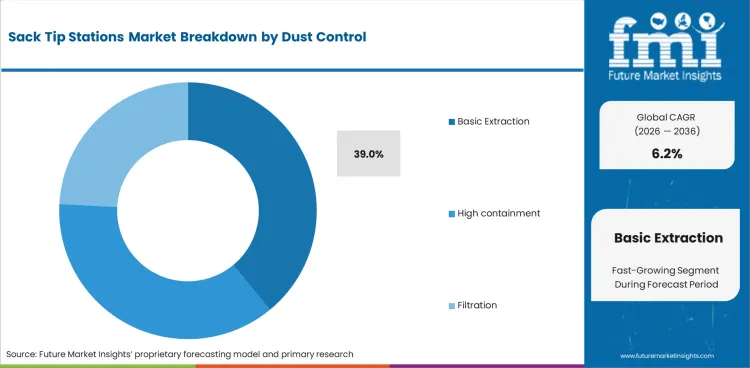
Extraction performance determines operational safety across applications involving airborne particulates. Basic extraction systems are anticipated to hold 39.0% share over the assessment period, reflecting widespread use in non-hazardous material handling. Filter performance depends on maintaining airflow while preventing clogging under continuous use. Material variability introduces additional challenges, especially with cohesive or coated powders. System flexibility becomes critical to accommodate different particle behaviors without compromising extraction efficiency.
- Blinding resistance necessity: Basic extraction testing protocols require specialized PTFE-coated cartridges. Maintenance supervisors avoid catastrophic internal clogs during multi-month production cycles.
- Cross-contamination risk: Switching powders within a single intake bench introduces massive batch corruption variables. Quality assurance directors demand dedicated exhaust loops for specific allergen profiles.
- Velocity mapping capability: Testing heavy particulates at extreme flow variations requires advanced variable frequency drives on exhaust fans. Process engineers calculate precise aerodynamic capture velocities.
Sack Tip Stations Market Analysis by Automation
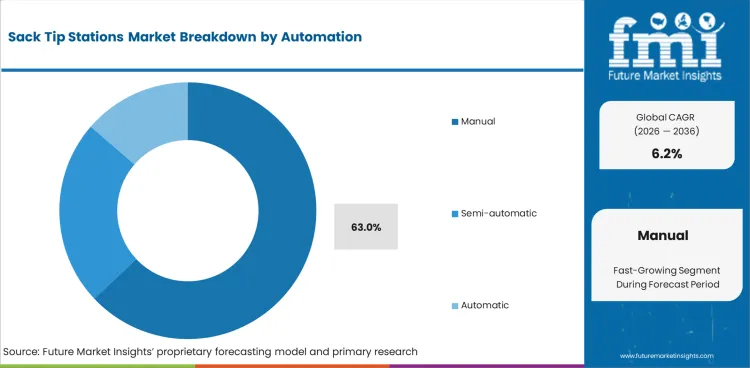
Manual systems are projected to account for 63.0% share in 2026, as processors must iterate dozens of small custom batches before finalizing commercial blends. Operational directors executing manual vs automatic sack tip station comparisons consume massive amounts of human labor just to manage minor ingredient additions. Outsourcing this specialty batching to fully robotic lines burns through development capital rapidly. While raw capacity figures emphasize automation, low-volume processors frequently purchase bare-bones manual rigs to manage waste bags directly, avoiding the premium costs of automated crushers. Manufacturers lacking sufficient manual intake channels face severe delays launching limited-edition product variations.
- Iterative batch discovery: Operators deploy manual test rigs to deliberately tweak experimental recipe formulations under precise weight conditions. Research directors identify mixing weaknesses efficiently.
- Proprietary formulation security: Keeping manual additions unnetworked prevents sensitive ingredient ratios from leaking via cloud analytics. Chief technology officers maintain absolute control over proprietary recipes.
- Pre-blending readiness: Manual intake ensures minor ingredients pass official quality protocols on the first attempt before entering powder packing machine lines. Compliance managers avoid expensive external rework fees.
Sack Tip Stations Market Drivers, Restraints, and Opportunities
Regulatory limits on workplace exposure require powder processors to provide verified data on particulate containment before operations begin. This requirement drives equipment upgrades across facilities handling bulk powders. Procurement teams factor compliance risk into investment decisions, as failure to meet standards can result in penalties and loss of contracts. Personal protective equipment alone does not address this requirement, making integrated dust extraction systems necessary for safe operation.
Powder characteristics create operational challenges in multi-product processing environments. Variations in fat content and moisture levels affect flow behavior and handling conditions. Facilities face difficulty when switching between different materials on the same equipment. Each change requires cleaning, component replacement, and system reset, which increases downtime and reduces throughput. Modular dust collection designs are being introduced to improve flexibility across different powder types. Flat bag back-blowing systems aim to reduce cleaning time and maintain airflow efficiency. These systems still face performance issues in high-humidity conditions, where powder buildup can occur at hopper junctions and restrict material flow.
Opportunities in the Sack Tip Stations Market
- Predictive maintenance software integration: Equipment manufacturers can bundle AI-driven filter-blinding models directly into bench control software. Plant directors capture premium uptime by offering predictive analytics alongside raw intake data.
- Automated bag compaction capabilities: Integrating pneumatic waste extrusion systems allows real-time plastic disposal without exposing the operator to residual dust. Facility engineers achieve higher safety ratings without interrupting the dumping timeline.
- Mobile modular transfer rigs: Building self-contained, caster-mounted intake environments enables flexible routing across multiple powder induction and dispersion systems within a plant. Production planners validate diverse recipe changes safely.
Regional Analysis
Based on regional analysis, Sack Tip Stations is segmented into Asia Pacific, North America, and Europe across 40 plus countries.
.webp "Top Country Growth Comparison Sack Tip Stations Market Cagr (2026 2036)")
| Country | CAGR (2026 to 2036) |
|---|---|
| India | 6.9% |
| China | 6.1% |
| United States | 5.2% |
| Brazil | 5.0% |
| Germany | 4.7% |
| France | 4.5% |
| Japan | 4.1% |
Source: Future Market Insights (FMI) analysis, based on proprietary forecasting model and primary research
Asia Pacific Sack Tip Stations Market Analysis
Industrial modernization across Asia Pacific is increasing the need for controlled and safe material intake systems. Facilities handling hazardous powders are shifting toward enclosed tipping stations to reduce operator exposure and maintain process safety. Processing plants are expanding intake capacity while integrating extraction and containment systems to meet regulatory requirements. Equipment demand is influenced by the need to balance manual handling with automated material flow systems.
- India: India is projected to record 6.9% CAGR in the sack tip stations market during 2026 to 2036. Expansion of pharmaceutical and chemical manufacturing drives demand for safe powder intake systems. Factory operators prioritize multi-line tipping stations that support continuous production without exposure risks. Equipment selection focuses on containment efficiency and compatibility with existing extraction systems. Bulk procurement by large manufacturing groups supports consistent demand. Installation timelines remain tight due to rapid facility expansion. These conditions support steady adoption of enclosed and operator-safe tipping systems across industrial applications.
- China: The sack tip stations market in China is expected to grow at 6.1% from 2026 to 2036. Demand is shaped by strict environmental and safety enforcement across industrial zones such as Jiangsu and Shandong chemical clusters, where handling of hazardous powders requires controlled intake systems. Facilities upgrade legacy setups that fail to meet current exposure limits. Equipment with high-capacity suction and continuous dust extraction gains preference. Operators focus on maintaining stable containment during long production cycles. Regulatory audits influence procurement cycles. These conditions are expected to shape how quickly facilities transition toward compliant systems.
- Japan: Industrial facilities in Japan operate under strict hygiene and contamination control standards, especially in food and specialty material processing. Sack tip stations are selected based on their ability to support clean operations and rapid product changeovers. Growth in Japan is anticipated to reach 4.1% over the forecast period. Equipment with automated cleaning features gains preference in multi-product environments. Operators prioritize systems that reduce cross-contamination risks. Installation often occurs within space-constrained facilities, requiring compact designs. These requirements support continued demand for high-precision and hygienic tipping systems across regulated industries.
FMI's report includes extensive analysis of emerging Southeast Asian manufacturing hubs. Rapid industrialization across adjacent nations drives secondary demand for standardized ergonomic validation protocols.
North America Sack Tip Stations Market Analysis
Federal occupational safety programs specifically targeting combustible dust mitigation create a massive influx of capital for independent chemical processors. Safety compliance officers require facility managers to utilize certified explosion-proof extraction centers to release operating permits. As per FMI's projection, this dynamic guarantees high replacement rates for any plant operating legacy manual hoppers. Purchasing departments aggressively secure high-power downdraft rigs to handle the anticipated surge in dust suppression chemicals for mining and construction formulation evaluations.
- United States: The sack tip stations market in the United States is anticipated to expand at 5.2% CAGR through 2036. OSHA regulations related to combustible dust push facilities toward enclosed intake systems. Operators replace legacy setups with stations that include filtration and dust control mechanisms. Retrofitting existing processing lines shapes procurement decisions across industries. Equipment must integrate without disrupting established workflows. Installation flexibility remains critical in older plants. These conditions support steady adoption of compliant and safety-focused tipping systems.
FMI's report includes analysis of Canadian processing dynamics. Cross-border food integration initiatives push northern plants to standardize cold-weather static mitigation protocols.
Europe Sack Tip Stations Market Analysis
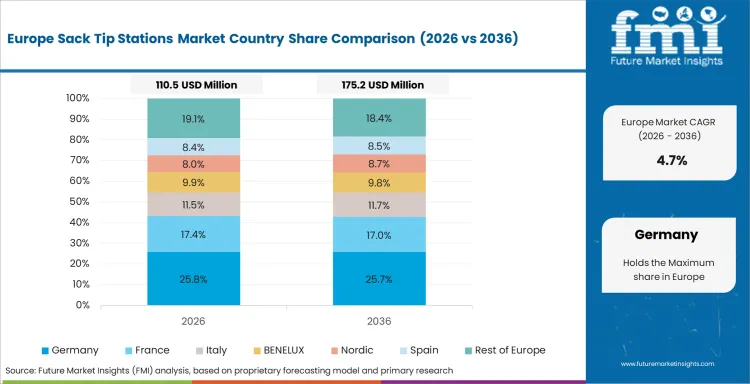
Stringent cross-border ATEX standardization mandates require equipment manufacturers to map complex static discharge risks continuously over thousands of operational hours. Compliance managers rely on certified benches to prove long-term explosion prevention stability under simulated European atmospheric variations. Independent processors prioritize sophisticated grounding control suites over raw extraction capacity to generate compliant certification dossiers. Operating high-precision static diagnostic alarms alongside global powder injection molding intake becomes a baseline requirement.
- Germany: Germany’s sack tip stations market is likely to reach 4.7% CAGR from 2026 to 2036. Industrial facilities handling chemicals and fine powders require precise airflow and filtration control. Equipment selection depends on systems that maintain stable containment during continuous operation. Operators prioritize advanced monitoring features that detect filter performance and airflow variation. Integration with existing plant systems remains a key requirement. These factors support demand for high-performance tipping systems aligned with strict safety expectations.
- France: Pharmaceutical and food processing applications shape demand for sack tip stations in France. Equipment must support hygienic intake while maintaining product integrity during handling. The market in France is expected to expand at a CAGR of 4.5% over the forecast period. Operators prioritize systems that allow quick cleaning and reduce contamination risks between batches. Smooth internal surfaces and sanitary design remain key selection criteria. Facilities require compliance with strict product safety standards. These conditions support consistent demand across regulated processing environments.
Competitive Aligners for Market Players
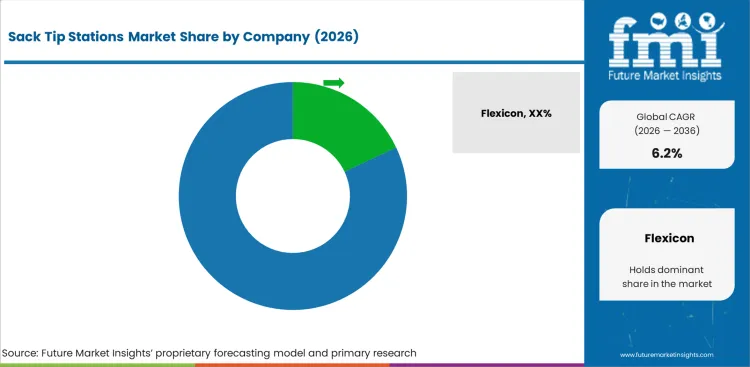
Aerodynamic design capability plays a central role in supplier selection, often outweighing basic fabrication strength. Buyers comparing sack tip station systems focus on how exhaust airflow control aligns with plant ventilation systems. Control systems must manage fan performance, airflow balance, and pressure stability during operation. Processing facilities evaluate equipment based on how easily operators can replace clogged filters between production runs. Filter changeovers must be completed without releasing dust into the work area. Suppliers offering modular compaction and discharge systems improve usability by reducing handling steps and limiting exposure during waste removal.
Established suppliers benefit from global service coverage and long-standing relationships with industrial facilities. Equipment reliability remains critical in high-containment applications, as system failure can expose operators to hazardous materials. Procurement teams require proven performance data before approving new suppliers, even when lower-cost options are available.
Processing companies standardize filter configurations to avoid long-term dependence on a single supplier. Equipment selection favors systems that support interchangeable filter media rather than proprietary formats. Suppliers that restrict compatibility through exclusive designs face resistance during evaluation. Competition is expected to shift toward performance monitoring and predictive maintenance tools. Suppliers are likely to differentiate through models that estimate filter loading and replacement timing, alongside improvements in airflow control and system design.
Key Players in Sack Tip Stations Market
- Flexicon
- Palamatic Process
- Gericke
- AZO
- Matcon
- Coperion
- Volkmann
Scope of the Report
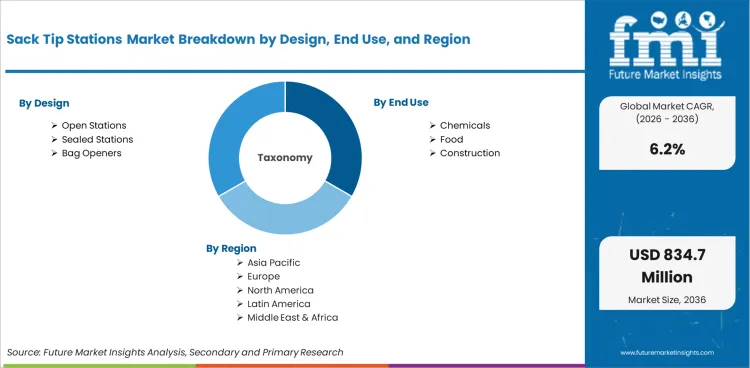
| Metric | Value |
|---|---|
| Quantitative Units | USD 430.7 million to USD 786.1 million, at a CAGR of 6.2% |
| Market Definition | Specialized intake platforms engineered specifically to facilitate safe, ergonomic manual discharging of powdered or granular materials while incorporating integrated aerodynamic containment controls. |
| Segmentation | Design, End Use, Dust Control, Automation, and Region |
| Regions Covered | North America, Latin America, Europe, East Asia, South Asia & Pacific, Middle East & Africa |
| Countries Covered | United States, Germany, France, China, India, Japan, Brazil |
| Key Companies Profiled | Flexicon, Palamatic Process, Gericke, AZO, Matcon, Coperion, Volkmann |
| Forecast Period | 2026 to 2036 |
| Approach | Independent material handling facility capital expenditure data cross-validated with federal occupational safety program equipment registries. |
Source: Future Market Insights (FMI) analysis, based on proprietary forecasting model and primary research
Sack Tip Stations Market Analysis by Segments
Design
- Open stations
- Sealed stations
- Bag openers
End Use
- Chemicals
- Food
- Construction
- Pharma
- Other
Dust Control
- Basic extraction
- High containment
- Filtration
Automation
- Manual
- Semi-automatic
- Automatic
Region
- North America
- United States
- Canada
- Europe
- Germany
- United Kingdom
- France
- Italy
- Spain
- Asia Pacific
- China
- Japan
- South Korea
- Taiwan
- Singapore
- Latin America
- Brazil
- Mexico
- Argentina
- Middle East & Africa
- GCC Countries
- South Africa
- Israel
Bibliography
- European Commission. (2025). EudraLex - Volume 4 - Public Health.
- Food and Drug Administration. (2024, April 24). Current Good Manufacturing Practices (CGMPs) for Food and Dietary Supplements.
- Hashimoto, H., Eto, K., Kawakami, S., & Kawai, K. (2025). Analysis of dispersal characteristics of five food powders and hygienic control for prevention of cross-contact. Journal of Food Engineering, 389, 113490
- International Union of Food Science and Technology. (2025, May). A clean sweep: Enhancing “flushing” as a dry sanitation strategy for low moisture food manufacturers.
- Pejanovic, I., Rajkovic, A., Smigic, N., & Devlieghere, F. (2026). Assessment and standards in hygienic design of food processing equipment. Foods, 15(1), 9.
This bibliography is provided for reader reference. The full FMI report contains the complete reference list with primary source documentation.
This Report Addresses
- Component specification criteria procurement managers utilize to evaluate aerodynamic extraction benches.
- Capital expenditure impacts plant directors navigate when building continuous multi-line discharging floors.
- Powder incompatibility constraints engineering teams must solve to maximize individual intake platform utilization.
- Exposure barriers independent processors bypass by integrating advanced predictive filter-blinding algorithms.
- Ventilation connectivity complications facility planners resolve to operate fully integrated extraction frameworks safely.
- Wetted material requirements R&D directors implement for extreme cohesive powder testing environments.
- Occupational validation mandates compelling massive near-term safety expansions across global manufacturing agencies.
- Ergonomic vulnerabilities processing operators face when lacking adequate automated waste compaction channels.
Frequently Asked Questions
How big is the sack tip stations forecast by 2036?
Capital expenditure data indicates industry revenue hits USD 430.7 million in 2026, advancing to USD 786.1 million by 2036. This figure establishes clear structural intent from independent processing agencies preparing for massive occupational safety certification pipelines over the coming decade.
What is the difference between a sack tip station and a bag dump station?
These terms represent identical industrial powder receiving systems used interchangeably by facility engineers. Both configurations provide localized dust extraction and ergonomic support for operators discharging dry bulk materials from 25-kilogram bags into downstream processes.
How do manual automation classes capture majority investment?
The manual category mirrors existing commercial specialty batching architectures perfectly. Purchasing directors deploy these modular intake systems to process massive recipe variations economically without incurring extreme facility robotic upgrade costs associated with fully automated depalletizing.
Who are the top sack tip station manufacturers?
Leading global equipment suppliers include Flexicon, Palamatic Process, Gericke, AZO, Matcon, Coperion, and Volkmann. Processing plant directors select hardware from these sack tip station suppliers based entirely on how easily operators can swap out blinded filters without inducing secondary dust clouds.
What secures basic extraction's position as the primary testing control?
Basic reverse-pulse systems represent the most mature, widely deployed dust mitigation architecture globally. Plant managers acquire specialized testing hardware featuring highly specific PTFE filters required exclusively to handle cohesive flour and cement particulate circulation over multi-month runs.
What operational metric matters most for independent processors?
Modular filtration integration capability allows plant operators to drastically cut maintenance expenses. Discharging massive waste volumes into integrated compactors prevents unrecoverable cleanup overhead costs during year-long continuous specialty recipe evaluations.
Why is manual sack tipping still dominant?
The manual automation tier mirrors existing commercial specialty batching architectures perfectly. Purchasing directors deploy these modular intake systems to process massive recipe variations economically without incurring extreme facility robotic upgrade costs associated with fully automated depalletizing.
Which country is growing fastest in sack tip stations?
India leads adoption globally due to centralized industrial safety modernization programs forcing rapid implementation of high-capacity extraction. Independent manufacturing agencies immediately scale their dumping floors to secure lucrative government compliance contracts before deploying massive material handling technologies locally.
What complicates extraction infrastructure across different regions?
Humid-climate deployments require specialized ambient air testing. Engineering directors in tropical zones purchase expensive dehumidification containment rigs to ensure complex pneumatic systems do not fail suffer systemic failure under extreme moisture stress.
How do manufacturers bypass extraction bottlenecks?
Major food producers build substantial internal testing floors using simplified evaluation equipment. Chief safety officers test proprietary aerodynamic designs internally to eliminate fundamental weaknesses before submitting finalized stations to independent hygiene auditors for official certification.
What structural limit caps rapid testing expansion?
Powder incompatibility severely reduces raw equipment utilization efficiency. Cleaning technicians spend excessive hours manually washing grates and replacing blinded filters when switching a single bag dump station for powder handling between completely different proprietary allergen formulations.
Why do test platforms require localized ventilation upgrades?
Running multiple high-capacity downdraft benches injects dangerous pressure drops back into factory exhaust systems. Facility managers install costly advanced airflow booster infrastructure to prevent containment failure during continuous hazardous material evaluations.
How do procurement directors evaluate new hardware suppliers?
Ergonomic metrics heavily outweigh initial hardware discount offers. Plant managers refuse to purchase unproven multi-trip woven pp fibc jumbo bags equivalents or low-grade hoppers because a single containment failure exposes workers to severe respiratory risks.
What prevents standardization across intake hardware?
Diverse proprietary sack geometries demand heavily customized grate connections. Equipment suppliers struggle to build universal craft bags splitters capable of interfacing directly with every unique bag size entering the market.
How do processors manage extreme exposure data volumes?
EHS operations managers enforce strict open-source sensor architectures. Refusing encrypted proprietary filter alarms guarantees safety engineers can integrate years of continuous particulate data directly into their predictive maintenance software systems.
What drives secondary equipment adoption across European plants?
Strict ATEX explosion regulations force safety directors to validate complex static grounding logic alongside physical dust extraction. Factory directors purchase highly polished stainless benches to simulate rapid hazardous chemical transfers safely.
How do regional constraints impact North American operations?
OSHA combustible dust mandates dictate mandatory third-party system verification. Domestic independent processing agencies aggressively expand their intake channels to capture immense funding tranches linked strictly to localized safe powder handling validation programs.
What role does AI play in future equipment capabilities?
Hardware manufacturers integrate advanced predictive algorithms directly into fan control software. Plant directors offer enhanced filter degradation forecasting services, generating premium uptime alongside standard physical transfer metrics.
How do urban zones navigate dense manufacturing requirements?
Space limitations force extreme facility containment measures. Processing agencies deploy automated clean-in-place simulation platforms to verify absolute physical allergen protocols before local health authorities approve massive sack tip stations for food plants.
What limits the adoption of fully mobile test rigs?
Vibration during transport frequently compromises highly sensitive draft-monitoring sensors. Quality assurance directors require intensive recalibration protocols before utilizing caster-mounted transfer platforms to validate local line interactions.
Why are customized grates essential for advanced platforms?
Flowability differences between various sticky and free-flowing powders strain standard gravity hardware. Process engineering directors require adjustable vibration-monitoring features to accurately calculate bridging risks under complex operational conditions.
How does automated compaction improve validation protocols?
Pneumatic extrusion systems pull empty waste bags into sealed tubes during active dumping. Safety officers gather critical continuous throughput data without ever exposing the operator to secondary dust plumes or skewing long-term ergonomic results.
What drives investment in standalone polyamide 12 powder benches?
Small-scale 3D printing and private research institutions lack the facility ductwork capacity for massive central networks. Department heads procure isolated, self-filtering units to conduct fundamental polymer research.
How does hazardous evaluation impact titanium powder intake demand?
Aerospace developers require precise baseline inerting measurements to model long-term metal fire risks accurately. Safety engineers employ specialized sack tip station with vacuum conveying systems purged with argon to calculate explosive limits for reactive alloys long before actual component sintering occurs.
Preview the report firsthand - request a free sample
Get SampleGet the brochure for pricing and purchase details.
Get PDFTable of Content
- Executive Summary
- Global Market Outlook
- Demand-side Trends
- Supply-side Trends
- Technology Roadmap Analysis
- Analysis and Recommendations
- Market Overview
- Market Coverage / Taxonomy
- Market Definition / Scope / Limitations
- Research Methodology
- Chapter Orientation
- Analytical Lens and Working Hypotheses
- Market Structure, Signals, and Trend Drivers
- Benchmarking and Cross-market Comparability
- Market Sizing, Forecasting, and Opportunity Mapping
- Research Design and Evidence Framework
- Desk Research Programme (Secondary Evidence)
- Company Annual and Sustainability Reports
- Peer-reviewed Journals and Academic Literature
- Corporate Websites, Product Literature, and Technical Notes
- Earnings Decks and Investor Briefings
- Statutory Filings and Regulatory Disclosures
- Technical White Papers and Standards Notes
- Trade Journals, Industry Magazines, and Analyst Briefs
- Conference Proceedings, Webinars, and Seminar Materials
- Government Statistics Portals and Public Data Releases
- Press Releases and Reputable Media Coverage
- Specialist Newsletters and Curated Briefings
- Sector Databases and Reference Repositories
- FMI Internal Proprietary Databases and Historical Market Datasets
- Subscription Datasets and Paid Sources
- Social Channels, Communities, and Digital Listening Inputs
- Additional Desk Sources
- Expert Input and Fieldwork (Primary Evidence)
- Primary Modes
- Qualitative Interviews and Expert Elicitation
- Quantitative Surveys and Structured Data Capture
- Blended Approach
- Why Primary Evidence is Used
- Field Techniques
- Interviews
- Surveys
- Focus Groups
- Observational and In-context Research
- Social and Community Interactions
- Stakeholder Universe Engaged
- C-suite Leaders
- Board Members
- Presidents and Vice Presidents
- R&D and Innovation Heads
- Technical Specialists
- Domain Subject-matter Experts
- Scientists
- Physicians and Other Healthcare Professionals
- Governance, Ethics, and Data Stewardship
- Research Ethics
- Data Integrity and Handling
- Primary Modes
- Tooling, Models, and Reference Databases
- Desk Research Programme (Secondary Evidence)
- Data Engineering and Model Build
- Data Acquisition and Ingestion
- Cleaning, Normalisation, and Verification
- Synthesis, Triangulation, and Analysis
- Quality Assurance and Audit Trail
- Market Background
- Market Dynamics
- Drivers
- Restraints
- Opportunity
- Trends
- Scenario Forecast
- Demand in Optimistic Scenario
- Demand in Likely Scenario
- Demand in Conservative Scenario
- Opportunity Map Analysis
- Product Life Cycle Analysis
- Supply Chain Analysis
- Investment Feasibility Matrix
- Value Chain Analysis
- PESTLE and Porter’s Analysis
- Regulatory Landscape
- Regional Parent Market Outlook
- Production and Consumption Statistics
- Import and Export Statistics
- Market Dynamics
- Global Market Analysis 2021 to 2025 and Forecast, 2026 to 2036
- Historical Market Size Value (USD Million) Analysis, 2021 to 2025
- Current and Future Market Size Value (USD Million) Projections, 2026 to 2036
- Y-o-Y Growth Trend Analysis
- Absolute $ Opportunity Analysis
- Global Market Pricing Analysis 2021 to 2025 and Forecast 2026 to 2036
- Global Market Analysis 2021 to 2025 and Forecast 2026 to 2036, By Design
- Introduction / Key Findings
- Historical Market Size Value (USD Million) Analysis By Design , 2021 to 2025
- Current and Future Market Size Value (USD Million) Analysis and Forecast By Design , 2026 to 2036
- Open Stations
- Sealed Stations
- Bag Openers
- Open Stations
- Y-o-Y Growth Trend Analysis By Design , 2021 to 2025
- Absolute $ Opportunity Analysis By Design , 2026 to 2036
- Global Market Analysis 2021 to 2025 and Forecast 2026 to 2036, By End Use
- Introduction / Key Findings
- Historical Market Size Value (USD Million) Analysis By End Use, 2021 to 2025
- Current and Future Market Size Value (USD Million) Analysis and Forecast By End Use, 2026 to 2036
- Chemicals
- Food
- Construction
- Chemicals
- Y-o-Y Growth Trend Analysis By End Use, 2021 to 2025
- Absolute $ Opportunity Analysis By End Use, 2026 to 2036
- Global Market Analysis 2021 to 2025 and Forecast 2026 to 2036, By Dust Control
- Introduction / Key Findings
- Historical Market Size Value (USD Million) Analysis By Dust Control, 2021 to 2025
- Current and Future Market Size Value (USD Million) Analysis and Forecast By Dust Control, 2026 to 2036
- Basic Extraction
- High containment
- Filtration
- Basic Extraction
- Y-o-Y Growth Trend Analysis By Dust Control, 2021 to 2025
- Absolute $ Opportunity Analysis By Dust Control, 2026 to 2036
- Global Market Analysis 2021 to 2025 and Forecast 2026 to 2036, By Automation
- Introduction / Key Findings
- Historical Market Size Value (USD Million) Analysis By Automation, 2021 to 2025
- Current and Future Market Size Value (USD Million) Analysis and Forecast By Automation, 2026 to 2036
- Manual
- Semi-automatic
- Automatic
- Manual
- Y-o-Y Growth Trend Analysis By Automation, 2021 to 2025
- Absolute $ Opportunity Analysis By Automation, 2026 to 2036
- Global Market Analysis 2021 to 2025 and Forecast 2026 to 2036, By Region
- Introduction
- Historical Market Size Value (USD Million) Analysis By Region, 2021 to 2025
- Current Market Size Value (USD Million) Analysis and Forecast By Region, 2026 to 2036
- North America
- Latin America
- Western Europe
- Eastern Europe
- East Asia
- South Asia and Pacific
- Middle East & Africa
- Market Attractiveness Analysis By Region
- North America Market Analysis 2021 to 2025 and Forecast 2026 to 2036, By Country
- Historical Market Size Value (USD Million) Trend Analysis By Market Taxonomy, 2021 to 2025
- Market Size Value (USD Million) Forecast By Market Taxonomy, 2026 to 2036
- By Country
- USA
- Canada
- Mexico
- By Design
- By End Use
- By Dust Control
- By Automation
- By Country
- Market Attractiveness Analysis
- By Country
- By Design
- By End Use
- By Dust Control
- By Automation
- Key Takeaways
- Latin America Market Analysis 2021 to 2025 and Forecast 2026 to 2036, By Country
- Historical Market Size Value (USD Million) Trend Analysis By Market Taxonomy, 2021 to 2025
- Market Size Value (USD Million) Forecast By Market Taxonomy, 2026 to 2036
- By Country
- Brazil
- Chile
- Rest of Latin America
- By Design
- By End Use
- By Dust Control
- By Automation
- By Country
- Market Attractiveness Analysis
- By Country
- By Design
- By End Use
- By Dust Control
- By Automation
- Key Takeaways
- Western Europe Market Analysis 2021 to 2025 and Forecast 2026 to 2036, By Country
- Historical Market Size Value (USD Million) Trend Analysis By Market Taxonomy, 2021 to 2025
- Market Size Value (USD Million) Forecast By Market Taxonomy, 2026 to 2036
- By Country
- Germany
- UK
- Italy
- Spain
- France
- Nordic
- BENELUX
- Rest of Western Europe
- By Design
- By End Use
- By Dust Control
- By Automation
- By Country
- Market Attractiveness Analysis
- By Country
- By Design
- By End Use
- By Dust Control
- By Automation
- Key Takeaways
- Eastern Europe Market Analysis 2021 to 2025 and Forecast 2026 to 2036, By Country
- Historical Market Size Value (USD Million) Trend Analysis By Market Taxonomy, 2021 to 2025
- Market Size Value (USD Million) Forecast By Market Taxonomy, 2026 to 2036
- By Country
- Russia
- Poland
- Hungary
- Balkan & Baltic
- Rest of Eastern Europe
- By Design
- By End Use
- By Dust Control
- By Automation
- By Country
- Market Attractiveness Analysis
- By Country
- By Design
- By End Use
- By Dust Control
- By Automation
- Key Takeaways
- East Asia Market Analysis 2021 to 2025 and Forecast 2026 to 2036, By Country
- Historical Market Size Value (USD Million) Trend Analysis By Market Taxonomy, 2021 to 2025
- Market Size Value (USD Million) Forecast By Market Taxonomy, 2026 to 2036
- By Country
- China
- Japan
- South Korea
- By Design
- By End Use
- By Dust Control
- By Automation
- By Country
- Market Attractiveness Analysis
- By Country
- By Design
- By End Use
- By Dust Control
- By Automation
- Key Takeaways
- South Asia and Pacific Market Analysis 2021 to 2025 and Forecast 2026 to 2036, By Country
- Historical Market Size Value (USD Million) Trend Analysis By Market Taxonomy, 2021 to 2025
- Market Size Value (USD Million) Forecast By Market Taxonomy, 2026 to 2036
- By Country
- India
- ASEAN
- Australia & New Zealand
- Rest of South Asia and Pacific
- By Design
- By End Use
- By Dust Control
- By Automation
- By Country
- Market Attractiveness Analysis
- By Country
- By Design
- By End Use
- By Dust Control
- By Automation
- Key Takeaways
- Middle East & Africa Market Analysis 2021 to 2025 and Forecast 2026 to 2036, By Country
- Historical Market Size Value (USD Million) Trend Analysis By Market Taxonomy, 2021 to 2025
- Market Size Value (USD Million) Forecast By Market Taxonomy, 2026 to 2036
- By Country
- Kingdom of Saudi Arabia
- Other GCC Countries
- Turkiye
- South Africa
- Other African Union
- Rest of Middle East & Africa
- By Design
- By End Use
- By Dust Control
- By Automation
- By Country
- Market Attractiveness Analysis
- By Country
- By Design
- By End Use
- By Dust Control
- By Automation
- Key Takeaways
- Key Countries Market Analysis
- USA
- Pricing Analysis
- Market Share Analysis, 2025
- By Design
- By End Use
- By Dust Control
- By Automation
- Canada
- Pricing Analysis
- Market Share Analysis, 2025
- By Design
- By End Use
- By Dust Control
- By Automation
- Mexico
- Pricing Analysis
- Market Share Analysis, 2025
- By Design
- By End Use
- By Dust Control
- By Automation
- Brazil
- Pricing Analysis
- Market Share Analysis, 2025
- By Design
- By End Use
- By Dust Control
- By Automation
- Chile
- Pricing Analysis
- Market Share Analysis, 2025
- By Design
- By End Use
- By Dust Control
- By Automation
- Germany
- Pricing Analysis
- Market Share Analysis, 2025
- By Design
- By End Use
- By Dust Control
- By Automation
- UK
- Pricing Analysis
- Market Share Analysis, 2025
- By Design
- By End Use
- By Dust Control
- By Automation
- Italy
- Pricing Analysis
- Market Share Analysis, 2025
- By Design
- By End Use
- By Dust Control
- By Automation
- Spain
- Pricing Analysis
- Market Share Analysis, 2025
- By Design
- By End Use
- By Dust Control
- By Automation
- France
- Pricing Analysis
- Market Share Analysis, 2025
- By Design
- By End Use
- By Dust Control
- By Automation
- India
- Pricing Analysis
- Market Share Analysis, 2025
- By Design
- By End Use
- By Dust Control
- By Automation
- ASEAN
- Pricing Analysis
- Market Share Analysis, 2025
- By Design
- By End Use
- By Dust Control
- By Automation
- Australia & New Zealand
- Pricing Analysis
- Market Share Analysis, 2025
- By Design
- By End Use
- By Dust Control
- By Automation
- China
- Pricing Analysis
- Market Share Analysis, 2025
- By Design
- By End Use
- By Dust Control
- By Automation
- Japan
- Pricing Analysis
- Market Share Analysis, 2025
- By Design
- By End Use
- By Dust Control
- By Automation
- South Korea
- Pricing Analysis
- Market Share Analysis, 2025
- By Design
- By End Use
- By Dust Control
- By Automation
- Russia
- Pricing Analysis
- Market Share Analysis, 2025
- By Design
- By End Use
- By Dust Control
- By Automation
- Poland
- Pricing Analysis
- Market Share Analysis, 2025
- By Design
- By End Use
- By Dust Control
- By Automation
- Hungary
- Pricing Analysis
- Market Share Analysis, 2025
- By Design
- By End Use
- By Dust Control
- By Automation
- Kingdom of Saudi Arabia
- Pricing Analysis
- Market Share Analysis, 2025
- By Design
- By End Use
- By Dust Control
- By Automation
- Turkiye
- Pricing Analysis
- Market Share Analysis, 2025
- By Design
- By End Use
- By Dust Control
- By Automation
- South Africa
- Pricing Analysis
- Market Share Analysis, 2025
- By Design
- By End Use
- By Dust Control
- By Automation
- USA
- Market Structure Analysis
- Competition Dashboard
- Competition Benchmarking
- Market Share Analysis of Top Players
- By Regional
- By Design
- By End Use
- By Dust Control
- By Automation
- Competition Analysis
- Competition Deep Dive
- Flexicon
- Overview
- Product Portfolio
- Profitability by Market Segments (Product/Age /Sales Channel/Region)
- Sales Footprint
- Strategy Overview
- Marketing Strategy
- Product Strategy
- Channel Strategy
- Palamatic Process
- Gericke
- AZO
- Matcon
- Coperion
- Flexicon
- Competition Deep Dive
- Assumptions & Acronyms Used


