

- Industry Size (2026)
- USD 4.2 Bn
- Forecast (2036)
- USD 7.5 Bn
- CAGR (2026 to 2036)
- 5.9%
Concentrated Face Serum Drops Market Forecast and Outlook 2026 to 2036
The concentrated face serum drops market is valued at USD 4.26 billion in 2026 and is projected to reach USD 7.56 billion by 2036, expanding at a 5.9% CAGR, supported by a gradual shift toward premiumized, active-first skincare routines. After a period of high-volume expansion, growth is now being shaped by consumer willingness to invest in higher-efficacy formulations positioned around visible performance outcomes. Concentrated drops address several structural limitations of conventional serums, including lower active load, higher water dependence, and reduced differentiation across mass-market formats. Product activity between 2024 and 2026 highlights rising emphasis on epigenetic actives, peptide complexes, and oil-based delivery systems, reflecting demand for clinically positioned solutions within daily skincare regimens.
Leading beauty companies are strengthening high-concentration serum portfolios through advanced research platforms and green chemistry investments that improve formulation stability and sustainability performance. This strategic direction aligns with L’Oréal’s positioning around long-term skin function and resilience. As L’Oréal CEO Nicolas Hieronimus says the future of beauty lies in a “new paradigm of longevity” - and the group plans to democratise longevity beauty via a new range of products and devices. The integration of dermatology-led product positioning with digital skin diagnostics is reinforcing professional skincare channels and embedding concentrated drops within routine anti-aging and brightening regimens. Future Market Insights observes that premium skincare demand is being shaped by ingredient transparency, targeted efficacy narratives, and manufacturing practices aligned with sustainability benchmarks. Wider acceptance of professional-grade formulations, supported by digital consultation tools and personalized skincare pathways, is expected to drive repeat usage, portfolio expansion, and steady value growth over the medium term.
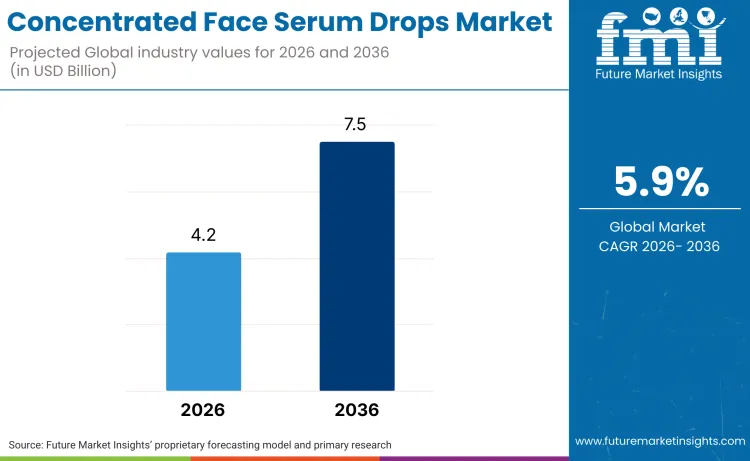
Summary of the Concentrated Face Serum Drops Market
What Is Growth Outlook for the Concentrated Face Serum Drops Market as per Future Market Insights Projection?
Future Market Insights projects the concentrated face serum drops market to grow at a 5.9% CAGR from 2026 to 2036, expanding from USD 4.26 billion in 2026 to USD 7.56 billion by 2036.
FMI Research Approach: FMI proprietary forecasting model based on bottom-up revenue estimation, tracking penetration of high-potency serum drops across premium facial skincare portfolios, and demand modeling linked to anti-aging, brightening, hydration, and acne-control routines within daily and treatment-led skincare use.
How Do FMI Analysts Perceive Concentrated Face Serum Drops Market to Evolve?
FMI analysts perceive the market shifting from general-purpose hydration serums toward active-first, targeted treatment drops positioned for visible performance outcomes. Concentrated drops are increasingly used for anti-aging correction, pigmentation management, and intensive skin repair without replacing existing facial care steps.
FMI Research Approach: Assessment of product positioning centered on high-efficacy actives, expansion of concentrated serum drops within premium and dermatology-led skincare assortments, and evaluation of consumer acceptance of high-concentration, precision-dose facial treatment formats.
Which Country Holds Largest Share in the Global Concentrated Face Serum Drops Market?
China holds the largest share of the global concentrated face serum drops market by value, supported by strong uptake of premium facial skincare and rising demand for targeted treatment products.
FMI Research Approach: FMI country-level demand assessment across urban consumers, evaluation of anti-aging and brightening skincare adoption, and tracking of domestic and international brand expansion within Chinese premium skincare retail.
How Large Will the Concentrated Face Serum Drops Market Be by 2036?
The global concentrated face serum drops market is projected to reach USD 7.56 billion by 2036.
FMI Research Approach: FMI long-term forecast by country, product type, ingredient preference, and distribution channel, incorporating scaling assumptions for premium serum adoption and cross-checking against broader facial treatment category growth trends.
What Is Definition of Concentrated Face Serum Drops Market?
The concentrated face serum drops market comprises high-potency facial treatment products formulated in liquid dropper or precision-dose formats, designed for targeted application to address specific skin concerns such as aging, hydration loss, pigmentation, acne, and environmental stress.
FMI Research Approach: FMI market taxonomy and inclusion-exclusion framework covering anti-aging, hydrating, brightening, acne-control, and specialty serum drops, while excluding facial creams, lotions, emulsions, and low-active conventional serums.
What Are Globally Unique Trends Shaping Concentrated Face Serum Drops Market?
Globally unique trends include active-first formulation strategies, rising demand for natural and plant-based ingredients, and strong growth of online retail as a primary discovery and replenishment channel, with Asia-led adoption driven by China and India.
FMI Research Approach: Analysis of product-type demand shares, ingredient preference shifts, distribution channel contribution trends, country-wise growth differentials, and expansion of concentrated drops across routine facial care use.
Concentrated Face Serum Drops Market Key Takeaways
| Metric | Details |
|---|---|
| Industry Size (2026) | USD 4.2 Billion |
| Industry Value (2036) | USD 7.5 Billion |
| CAGR (2026-2036) | 5.90% |
Source: Future Market Insights (FMI) analysis, based on proprietary forecasting model and primary research.
Why Is the Demand for Concentrated Face Serum Drops Growing?
Expectations around facial skincare performance are shifting as concentrated serum drops move from occasional treatment use into regular daily routines. According to Future Market Insights, consumers are placing greater emphasis on visible efficacy, ingredient transparency, and targeted application for specific skin concerns. Earlier serum formats were often viewed as supplemental steps layered onto basic routines, which limited frequency of use. That perception is changing as high-concentration drops gain stronger placement within core facial care regimens.
Brand portfolio strategies reflect this transition. L’Oréal has positioned concentrated serum drops within its core anti-aging and brightening franchises, presented alongside standard serums and creams rather than as niche booster products. These drops are designed for precise dosing and rapid absorption, fitting into established skincare sequences without adding complexity. FMI notes that brands embedding concentrated drops within routine skincare lines, supported by clear performance positioning and consistent formulation outcomes, are more likely to drive repeat usage as consumers adopt high-efficacy serums as everyday facial care staples.
How Is the Concentrated Face Serum Drops Market Segmented?
The concentrated face serum drops market is segmented by product type, ingredient preference, and distribution channel, reflecting targeted facial treatment usage within routine skincare. By product type, the market includes anti-aging, hydrating, brightening, acne control, anti-pollution, and customized serum drops, with anti-aging serums holding the largest share due to sustained demand for wrinkle correction and skin renewal. Ingredient preferences span natural or organic, plant-based, vitamin-infused, and synthetic formulations, shaped by clean beauty interest and efficacy expectations. By distribution channel, online retail leads sales, supported by convenience and repeat purchasing, followed by specialty beauty stores, supermarkets and hypermarkets, department stores, and pharmacies, which support product discovery, consultation, and routine replenishment.
What Is Supporting the Leading Share of Anti-Aging Concentrated Face Serum Drops?
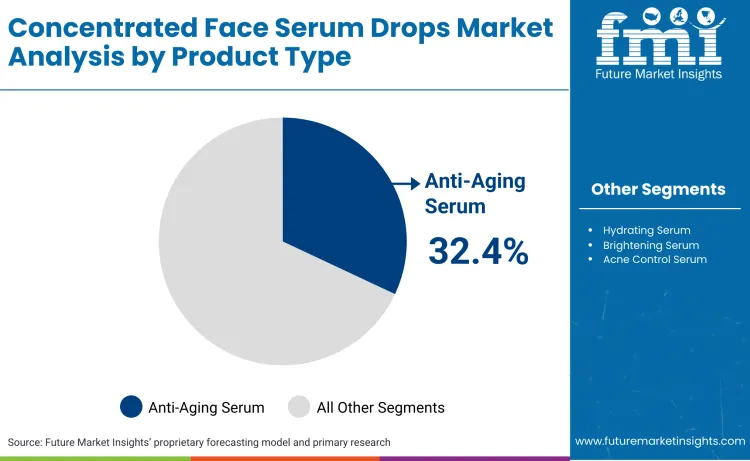
Anti-aging serums account for 32.4% of the concentrated face serum drops market, reflecting sustained consumer focus on wrinkle reduction, firmness improvement, and long-term skin renewal. These formulations are designed to deliver higher active concentrations through precision dosing, making them suitable for routine use across face and targeted areas such as the eye contour and nasolabial zones. Consumers associate anti-aging drops with measurable performance, faster absorption, and compatibility with layered skincare routines. Their positioning within daily regimens supports consistent use rather than episodic treatment. FMI observes that anti-aging serum drops are increasingly framed as core facial care steps rather than optional boosters, supporting higher purchase frequency. Their relevance across multiple age groups, including early prevention and maintenance use, helps anchor demand and sustain their leading share within the product type segment.
What Explains the Strong Preference for Natural and Organic Ingredients in Serum Drops?
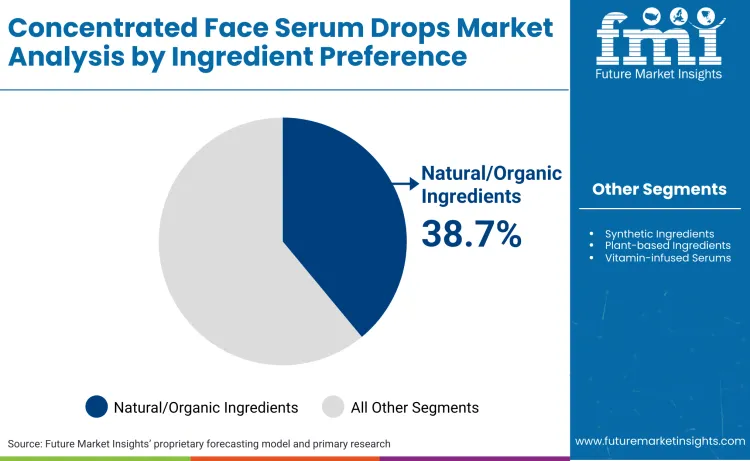
Natural and organic ingredients represent 38.7% of ingredient preference within the concentrated face serum drops market, supported by growing attention to formulation transparency and skin tolerance. Consumers increasingly associate naturally derived actives with gentler performance, suitability for sensitive skin, and lower risk of irritation when used daily. Plant extracts, botanical oils, and bio-fermented actives are frequently positioned as compatible with long-term use alongside clinical actives. FMI notes that natural and organic positioning supports trust-led purchasing behavior, especially among consumers seeking clean beauty alignment without compromising visible results. Brands emphasize sourcing narratives, simplified ingredient lists, and absence of harsh additives to reinforce perceived safety. This positioning encourages routine adoption of concentrated drops as part of daily facial care rather than limiting usage to corrective or occasional treatment cycles.
Why Has Online Retail Become the Primary Channel for Concentrated Serum Drops?
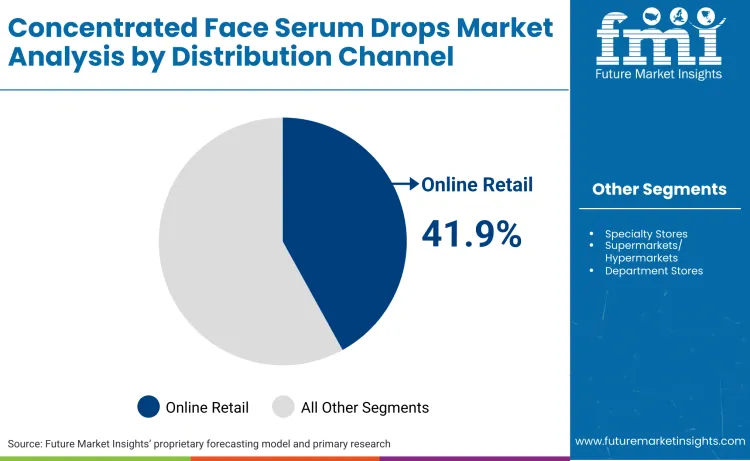
Online retail accounts for 41.9% of concentrated face serum drops sales, reflecting strong alignment between the category and digital purchasing habits. Serum drops are lightweight, compact, and stable for shipping, reducing fulfillment complexity compared with bulkier skincare formats. Digital platforms support product comparison, ingredient education, and repeat replenishment, which aligns with the routine use patterns of concentrated serums. Consumers frequently repurchase serum drops online due to familiarity with specific formulations and consistent usage cycles within skincare routines. FMI notes that online channels also support discovery of niche and premium serum brands that may have limited physical retail presence. While specialty stores and pharmacies play an important role in trust-building and consultation-led purchases, online retail continues to lead as consumers prioritize convenience, availability, and access to detailed product information.
What Trends Are Influencing the Shift Toward Concentrated Face Serum Drops?
Concentrated face serum drops are gaining wider acceptance as brands respond to demand for higher-efficacy skincare, precise dosing, and lighter application formats compared with conventional serums and creams. Dropper-based delivery supports controlled application and allows consumers to target specific facial zones such as the under-eye area, pigmentation spots, and fine lines. Brands such as Estée Lauder Companies and Beiersdorf are strengthening this shift by expanding active-first serum portfolios positioned around visible performance outcomes. As per Future Market Insights, concentrated drops are increasingly positioned for regular daily use rather than occasional corrective treatment. Their lightweight texture and fast absorption reduce friction within existing skincare routines, supporting broader integration into morning and evening regimens. This usability profile is contributing to wider acceptance of concentrated drops as practical, performance-led facial care solutions.
How Is Portfolio Diversification Strengthening Competitive Positioning in Serum Drops?
Portfolio diversification is reinforcing competitive positioning by enabling companies to integrate concentrated serum drops into existing facial care ranges alongside cleansers, moisturizers, and treatment creams. Large skincare brands are extending core franchises into dropper-based, high-potency formats to address anti-aging, brightening, and hydration needs without displacing established products. This approach improves consistency in formulation standards, retail placement, and consumer familiarity across product tiers. According to FMI, embedding concentrated drops within broader skincare portfolios accelerates adoption by leveraging existing brand trust and distribution reach. It allows brands to scale premium and professional-grade serums across mass, prestige, and dermatology-linked channels while maintaining coherence in routine-use positioning. This portfolio strategy supports category expansion without disrupting established facial care habits.
Why Is Formulation Optimization Central to Innovation in Concentrated Serum Drops?
Rising expectations around performance and skin tolerance are pushing manufacturers to refine concentrated serum formulations while maintaining stability and comfort across repeated use. High-active loads require careful balancing of solvents, penetration enhancers, and stabilizing systems to ensure consistent absorption without irritation. Minor formulation differences can influence texture, layering compatibility, and perceived efficacy when drops are used daily with other skincare products. FMI notes that increasing competition is placing greater emphasis on formulation discipline, including stability across climates and compatibility with sensitive skin profiles. This focus on formulation optimization supports scalability across global markets and positions concentrated serum drops as reliable, everyday treatment options rather than intermittent or specialist-use products.
How Does Growth Differ Across Key Countries for Concentrated Face Serum Drops?
Growth trends for concentrated face serum drops vary by country, reflecting differences in skincare sophistication, premium product uptake, and consumer readiness to adopt high-potency facial treatments. China leads with a 7.97% CAGR, supported by strong demand for anti-aging and brightening serums among urban consumers. India follows at 7.38%, driven by expanding daily facial care routines and wider acceptance of concentrated drops within premium mass segments. Germany posts 6.79% growth, reflecting structured skincare regimens and preference for clinically positioned facial treatments. Brazil advances at 6.20%, supported by demand for hydration and tone-correction in humid climates. The United States records 5.61%, indicating steady premiumization within a mature serum market. The United Kingdom reaches 5.02%, while Japan posts 4.43%, shaped by conservative adoption of newer concentrated formats.
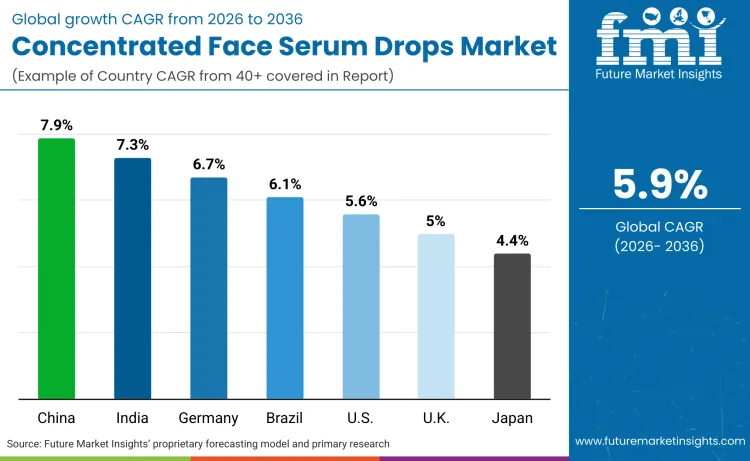
| Country | CAGR (2026 to 2036) |
|---|---|
| China | 7.9% |
| India | 7.3% |
| Germany | 6.7% |
| Brazil | 6.1% |
| United States | 5.6% |
| UK | 5.0% |
| Japan | 4.4% |
Source: FMI historical analysis and forecast data.
What Is Driving China’s Leadership in Concentrated Face Serum Drops?
China’s 7.97% CAGR is supported by strong urban demand for high-efficacy facial treatments and growing acceptance of premium skincare routines. Concentrated serum drops align with multi-step regimens common among digitally active consumers who prioritize visible results from targeted actives. Precision dosing and fast absorption suit dense urban lifestyles where efficiency and portability matter. Strong e-commerce penetration accelerates discovery, education, and repeat purchasing of serum drops, while live-stream retail supports rapid product trial and adoption. Usage growth is shaped more by increased frequency within daily routines and selective upgrading from standard serums for specific concerns such as pigmentation and early aging rather than by broad category substitution. As consumers seek performance-led skincare with clear ingredient positioning, concentrated drops are becoming embedded within routine facial care practices.
What Factors Are Supporting Rapid Uptake of Concentrated Serum Drops in India?
India’s 7.38% CAGR reflects expanding facial care engagement among urban consumers and rising willingness to invest in performance-oriented skincare. Concentrated drops appeal due to lightweight textures suited for warm climates and compatibility with simplified daily routines. Younger consumers increasingly use targeted serums for acne management, uneven tone, and early signs of aging, supporting repeat usage. Improved access through online platforms and beauty marketplaces is extending availability beyond tier-one cities, enabling broader trial. Price-tier diversification across premium mass and mid-range brands supports gradual mainstream adoption without displacing basic skincare steps. Growth is reinforced by increasing exposure to ingredient-led education, influencer-driven regimen building, and rising preference for formats that deliver visible results without adding complexity to existing facial care habits.
Why Is Germany Experiencing Consistent Growth in Concentrated Face Serum Drops?
Germany records a 6.79% CAGR, supported by structured skincare routines and preference for clinically positioned, performance-led facial treatments. Consumers value formulation reliability, ingredient clarity, and controlled application, which aligns with concentrated drops designed for targeted use. Adoption tends to be measured and evidence-driven, with consumers integrating serum drops into established routines for anti-aging, hydration, and barrier support rather than frequent product switching. Pharmacy and specialty retail channels support informed purchasing through professional guidance, reinforcing trust in high-efficacy formats. Growth is driven by steady upgrades from conventional serums to higher-concentration drops for specific concerns, supporting consistent demand without rapid format disruption. This disciplined adoption profile sustains moderate but dependable expansion anchored by routine use.
What Is Contributing to Growth of Concentrated Serum Drops in Brazil?
Brazil’s 6.20% CAGR is shaped by rising demand for tone-correcting and hydration-focused facial treatments across warm and humid climates. Lightweight, fast-absorbing serum drops suit frequent daily use without heaviness, supporting repeat application throughout the year. Urban consumers increasingly incorporate targeted serums into simplified routines to address pigmentation, uneven texture, and environmental stress. Improved availability across online platforms and specialty beauty retail is broadening exposure and encouraging trial. Adoption is supported by growing interest in performance-led skincare within expanding middle-income segments, while localized retail promotions support category awareness. Serum drops are commonly used alongside moisturizers and sunscreens rather than as standalone treatments, reinforcing steady growth through complementary integration into routine facial care practices.
Why Is Growth More Measured in the United States Concentrated Serum Drops Market?
The United States posts a 5.61% CAGR, reflecting steady premiumization within a mature facial skincare market. Concentrated serum drops are often layered into existing routines rather than replacing conventional serums and creams, which moderates’ volume acceleration. Growth is concentrated among consumers seeking targeted solutions for aging, pigmentation, and barrier repair, supported by strong digital retail and ingredient education. High brand loyalty and wide availability of conventional serums slow rapid switching across the mass segment. Dermatology-influenced positioning supports trust-led adoption, while subscription models encourage replenishment among established users. As familiarity with high-concentration drops increases, uptake continues at a stable pace without significant disruption to entrenched facial care habits.
What Is the Competitive Landscape for the Concentrated Face Serum Drops Market?
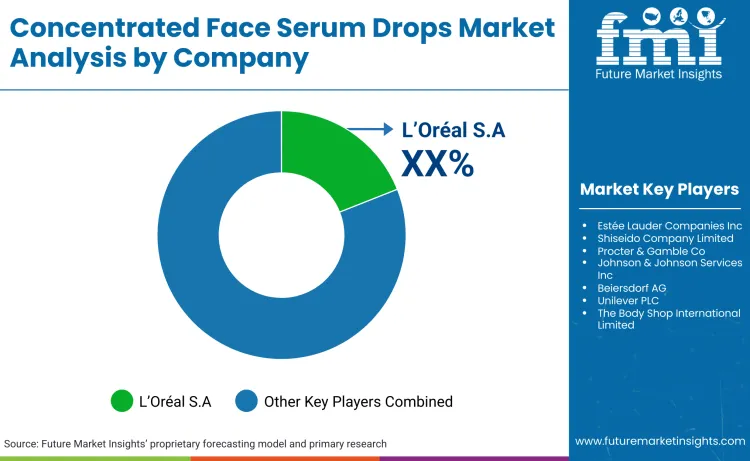
The competitive environment for concentrated face serum drops is anchored by global beauty and personal care companies that are expanding beyond conventional serums and creams to strengthen format relevance and portfolio depth. Players such as L’Oréal S.A., Estée Lauder Companies Inc., Shiseido Company Limited, Procter & Gamble Co., and Johnson & Johnson Services Inc. benefit from wide retail coverage, strong brand equity, and established facial care franchises. L’Oréal holds an estimated 18.6% share, reflecting its ability to scale high-efficacy serum drops across mass and prestige brands while leveraging research platforms and marketing reach. Competitive positioning in this market emphasizes portfolio completeness and routine integration rather than short-term volume leadership.
Future Market Insights observes that competition is increasingly shaped by formulation performance, ingredient credibility, and skin tolerance rather than rapid line proliferation. Companies such as Beiersdorf AG, Kao Corporation, and Clarins Group emphasize clinically positioned actives, barrier-friendly formulations, and targeted treatment benefits. At the same time, brands including The Body Shop International Limited, Avon Products Inc., Mary Kay Inc., Amway Corporation, and Coty Inc. broaden access through diverse price tiers and lifestyle-led portfolios. FMI notes that sustained advantage will depend on embedding concentrated serum drops into everyday facial care routines and professional skincare platforms, rather than positioning them as standalone booster products.
Recent Developments:
- In September 2025, Weleda launched a modular range of Serum Booster Drops featuring plant-based actives for hydration, brightening, and skin barrier support. The introduction reflects rising demand for customizable, high-potency drop formats that allow consumers to tailor concentrated serums to specific skin concerns within daily skincare routines.
- In November 2025, Estée Lauder Companies expanded its advanced night repair portfolio with a new high-concentration serum dropper format designed to enhance active penetration and support overnight skin recovery. The launch highlights continued investment by prestige skincare brands in precision-dosed serum drops positioned for routine anti-aging use.
- In February 2026, Shiseido introduced a concentrated essence-serum hybrid in drop format under its premium skincare line, positioned around targeted brightening and barrier-repair benefits. The release reinforces the growing focus on lightweight, fast-absorbing concentrated serums that fit seamlessly into layered skincare regimens while delivering visible performance outcomes.
Key Players in Concentrated Face Serum Drops Market
- L’Oréal S.A.
- Estée Lauder Companies Inc.
- Shiseido Company Limited
- Procter & Gamble Co.
- Johnson & Johnson Services Inc.
- Beiersdorf AG
- Unilever PLC
- The Body Shop International Limited
- Kao Corporation
- Colgate-Palmolive Company
- Amway Corporation
- Avon Products Inc.
- Mary Kay Inc.
- Clarins Group
- Coty Inc.
- Others
Market Definition
The concentrated face serum drops market captures revenue generated from high-potency facial treatment products formulated in liquid dropper or precision-dose formats intended for direct topical application on facial skin. This assessment covers commercially available serum drops positioned for targeted treatment outcomes such as anti-aging correction, hydration support, tone improvement, barrier repair, and environmental stress defense. Market sizing reflects the value of finished consumer products sold through online platforms and physical retail channels, analyzed by product type, ingredient preference, sales channel, and region, and reported in USD billion.
The scope includes concentrated serum drops developed for anti-aging, brightening, hydration, acne control, anti-pollution protection, and customized or specialty facial treatments. Products designed for localized application on facial areas such as the under-eye region, forehead, cheeks, and pigmentation-prone zones are included when marketed specifically as concentrated serum drops. Sales through e-commerce platforms, specialty beauty retailers, department stores, pharmacies, and mass retail formats are counted. Geographic coverage spans North America, Europe, Asia Pacific, Latin America, and the Middle East & Africa.
The market excludes facial creams, lotions, emulsions, ampoules not sold in dropper formats, sheet masks, facial oils not positioned as serums, and cosmetic products primarily intended for makeup purposes. Revenues from bulk active ingredients, private-label raw materials, contract formulation services, packaging supply, and logistics operations are excluded. Products distributed exclusively for professional clinic or spa use without consumer retail availability fall outside the defined market scope.
Scope of Report
| Items | Values |
|---|---|
| Quantitative Units (2026) | USD 4.26 Billion |
| Product Type | Anti-Aging Serum; Hydrating Serum; Brightening Serum; Acne Control Serum; Anti-Pollution Serum; Others |
| Ingredient Preference | Natural/Organic Ingredients; Plant-based Ingredients; Vitamin-infused Serums; Synthetic Ingredients |
| Distribution Channel | Online Retail; Specialty Stores; Supermarkets/Hypermarkets; Department Stores; Pharmacies/Drugstores; Others |
| Regions Covered | North America, Europe, Asia Pacific, Latin America, Middle East & Africa |
| Countries Covered | United States, Germany, United Kingdom, India, China, Brazil, and 40+ countries |
| Key Companies Profiled | L’Oréal S.A.; Estée Lauder Companies Inc.; Shiseido Company Limited; Procter & Gamble Co.; Johnson & Johnson Services Inc.; Beiersdorf AG; Unilever PLC; The Body Shop International Limited; Kao Corporation; Colgate-Palmolive Company; Amway Corporation; Avon Products Inc.; Mary Kay Inc.; Clarins Group; Coty Inc.; Others |
| Additional Attributes | Dollar sales by product type, ingredient preference, and distribution channel; country-wise growth analysis; adoption trends for high-potency and precision-dose serum formats; usage patterns for anti-aging, brightening, hydration, and acne-control routines; competitive brand positioning across mass, premium, and dermatology-aligned skincare channels |
Source: FMI historical analysis and forecast data
Concentrated Face Serum Drops Market by Segments
By Product Type:
- Anti-Aging Serum
- Hydrating Serum
- Brightening Serum
- Acne Control Serum
- Anti-Pollution Serum
- Others (Customized Serums, Specialty Serums)
By Ingredient Preference:
- Natural / Organic Ingredients
- Synthetic Ingredients
- Plant-based Ingredients
- Vitamin-infused Serums
By Distribution Channel:
- Online Retail
- Specialty Stores
- Supermarkets / Hypermarkets
- Department Stores
- Pharmacies / Drugstores
- Others (Direct Selling, Beauty Salons)
By Region:
- North America
- Europe
- Asia Pacific
- Latin America
- Middle East & Africa
Bibliography
- Euromonitor International. (2024). Premiumisation and efficacy-led positioning in global facial skincare. Euromonitor Passport: Beauty and Personal Care Analysis Series.
- Journal of Drugs in Dermatology. (2023). Precision dosing and dropper-based delivery systems in topical dermatology. Journal of Drugs in Dermatology, 22(9), 917-924.
- McKinsey & Company Global Institute. (2024). Global beauty: Consumer behavior shifts toward performance-led skincare. McKinsey Global Consumer Report.
- British Journal of Dermatology. (2023). Clinical outcomes of high-concentration topical treatments for aging and pigmentation. British Journal of Dermatology, 189(3), 455-468.
- American Academy of Dermatology Association. (2023). Evidence-based use of topical active ingredients in facial skincare. AAD Clinical Guidance Series.
- Society of Cosmetic Chemists. (2024). Formulation discipline for concentrated skincare products. SCC Technical Monograph Series.
Frequently Asked Questions
What is the current global market size for Concentrated Face Serum Drops?
The global concentrated face serum drops market is valued at USD 4.26 billion in 2026, supported by rising demand for high-efficacy facial treatments, precision dosing formats, and ingredient-led skincare routines.
What is the projected CAGR for the Concentrated Face Serum Drops market?
Market revenues are projected to grow at a 5.90% CAGR from 2026 to 2036, reaching USD 7.56 billion by the end of the forecast period.
Which segment currently dominates the industry?
Anti-aging serum drops dominate the market with a 32.4% share, driven by sustained consumer focus on wrinkle reduction, firmness improvement, and long-term skin renewal within daily facial care routines.
What are the primary risks or barriers to adoption?
Key barriers include price sensitivity in mass skincare segments, risk of skin irritation from high-active formulations, consumer confusion around layering multiple serums, and slower adoption among users accustomed to conventional low-concentration serums and creams.
Who are the leading players in the Concentrated Face Serum Drops space?
Leading companies include L’Oréal S.A., Estée Lauder Companies Inc., Shiseido Company Limited, Procter & Gamble Co., Johnson & Johnson Services Inc., Beiersdorf AG, Unilever PLC, and Kao Corporation, supported by strong R&D platforms and global skincare distribution networks.
Preview the report firsthand - request a free sample
Get SampleGet the brochure for pricing and purchase details.
Get PDFTable of Content
- Executive Summary
- Global Market Snapshot
- Key Demand Trends
- Key Supply-side Developments
- Strategic Implications
- Market Overview
- Market Definition and Scope
- Market Taxonomy
- Market Assumptions and Limitations
- Research Methodology
- Chapter Orientation
- FMI Research Framework
- Market Sizing Approach
- Forecasting Methodology
- Data Triangulation and Validation
- Primary and Secondary Research Sources
- Market Background
- Market Dynamics
- Drivers
- Restraints
- Opportunities
- Trends
- Value Chain Analysis
- Supply Chain Assessment
- Regulatory Landscape
- Pricing Analysis
- Market Dynamics
- Global Concentrated Face Serum Drops Market Analysis 2021 to 2025 and Forecast 2026 to 2036
- Market Size Value Analysis (USD Billion)
- Y-o-Y Growth Analysis
- Absolute Dollar Opportunity
- Global Concentrated Face Serum Drops Market Analysis by Product Type
- Anti-Aging Serum Drops
- Hydrating Serum Drops
- Brightening Serum Drops
- Acne Control Serum Drops
- Anti-Pollution Serum Drops
- Others (Customized and Specialty Serums)
- Global Concentrated Face Serum Drops Market Analysis by Ingredient Preference
- Natural / Organic Ingredients
- Plant-based Ingredients
- Vitamin-infused Serums
- Synthetic Ingredients
- Global Concentrated Face Serum Drops Market Analysis by Distribution Channel
- Online Retail
- Specialty Stores
- Supermarkets and Hypermarkets
- Department Stores
- Pharmacies and Drugstores
- Others
- Global Concentrated Face Serum Drops Market Analysis by Region
- North America
- Latin America
- Europe
- Asia Pacific
- Middle East and Africa
- North America Concentrated Face Serum Drops Market Analysis
- United States
- Canada
- Latin America Concentrated Face Serum Drops Market Analysis
- Brazil
- Mexico
- Rest of Latin America
- Europe Concentrated Face Serum Drops Market Analysis
- Germany
- United Kingdom
- France
- Italy
- Spain
- Rest of Europe
- Asia Pacific Concentrated Face Serum Drops Market Analysis
- China
- India
- Japan
- South Korea
- ASEAN
- Rest of Asia Pacific
- Middle East and Africa Concentrated Face Serum Drops Market Analysis
- GCC Countries
- South Africa
- Rest of MEA
- Competitive Landscape
- Market Share Analysis
- Competitive Dashboard
- Strategic Developments
- Company Profiles
- L’Oréal S.A.
- Estée Lauder Companies Inc.
- Shiseido Company Limited
- Procter & Gamble Co.
- Johnson & Johnson Services Inc.
- Beiersdorf AG
- Unilever PLC
- The Body Shop International Limited
- Kao Corporation
- Others
- Assumptions and Acronyms


