

- Industry Size (2026)
- USD 1.3 Bn
- Forecast (2036)
- USD 3.3 Bn
- CAGR (2026 to 2036)
- 9.5%
Concentrated Massage Bars Market Forecast and Outlook 2026 to 2036
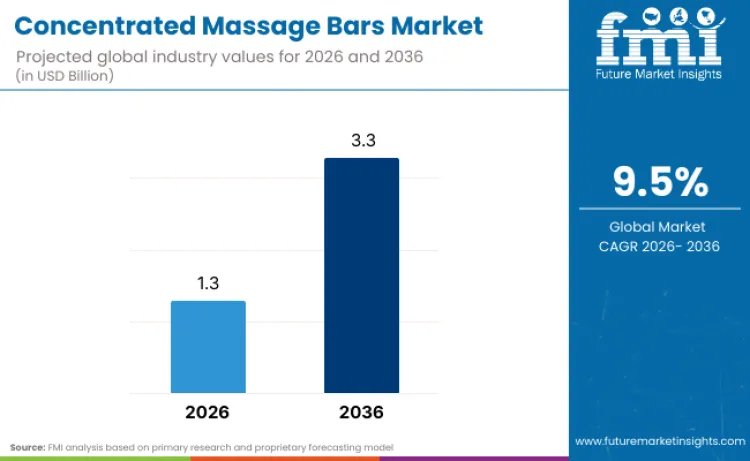
The global concentrated massage bars market is projected to reach a valuation of USD 1.3 Billion in 2026 and advance to USD 3.3 Billion by 2036, expanding at a strong 9.50% CAGR. Demand for concentrated massage bars, as per Future Market Insights, is being driven by a structural shift away from water-heavy cosmetic formulations toward solid, anhydrous formats that materially reduce packaging waste, logistics inefficiency, and formulation redundancy. This growth reflects rising consumer and regulatory pressure to eliminate unnecessary water content in personal care products, while preserving efficacy and sensorial performance.
Category formation has been strongly influenced by sustainability-led founders who reframed concentration as both an environmental and functional advantage. Brianne West, Founder and former CEO of Ethique, articulated the core logic behind the category, stating: "I reached the logical conclusion that with so much water found in our bathrooms there’s no need to add it to the likes of shampoo, conditioners, moisturisers, household cleaners and cosmetics, which are usually 60-95% water. By making these products solid and simply sending the active ingredients to our customers, there’s no need for plastic containers." This philosophy directly underpins the rise of solid massage bars as a high-impact, low-waste alternative to traditional creams and oils.
Manufacturers are now scaling this logic beyond niche sustainability markets into premium wellness and therapeutic massage applications. Concentrated massage bars allow brands to deliver richer active loads, longer product life, and improved transport efficiency, while aligning with plastic reduction mandates and clean beauty positioning. As brands move from experimentation to scale, the market is transitioning from eco-driven novelty to a commercially defensible, margin-resilient personal care format through 2036.
Summary of Concentrated Massage Bars Market
What Is Growth Outlook for Concentrated Massage Bars Market as per Future Market Insights Projection?
Future Market Insights projects the concentrated massage bars market to expand at a CAGR of 9.5% from 2026 to 2036, increasing from USD 1.3 Billion in 2026 to USD 3.3 Billion by 2036.
FMI Research Approach: FMI proprietary forecasting model based on waterless personal care adoption, solid-format efficiency gains, and sustainability-led premium wellness demand.
How Do FMI Analysts Perceive Concentrated Massage Bars Market to Evolve?
FMI analysts perceive the market evolving from eco-niche products to mainstream anhydrous wellness formats, valued for higher active concentration, longer life, and logistics efficiency.
FMI Research Approach: Analysis of waterless formulation economics, plastic reduction mandates, and premium wellness positioning.
Which Country Holds Largest Share in Global Concentrated Massage Bars Market?
China holds a significant share of the global concentrated massage bars market, supported by rapid e-commerce adoption and demand for compact premium wellness products.
FMI Research Approach: FMI country-level revenue modeling based on online retail penetration and solid-format personal care uptake.
How Large Will Concentrated Massage Bars Market Be by 2036?
The global concentrated massage bars market is projected to reach USD 3.3 Billion by 2036.
FMI Research Approach: FMI long-term revenue forecast derived from solid-format penetration, repeat-use intensity, and professional wellness adoption.
What Is Definition of Concentrated Massage Bars Market?
The concentrated massage bars market comprises solid, anhydrous massage products formulated without added water to deliver skin nourishment, relaxation, and therapeutic benefits.
FMI Research Approach: FMI market taxonomy and inclusion-exclusion framework aligned with waterless body care and solid cosmetic classifications.
What Are Globally Unique Trends Shaping Concentrated Massage Bars Market?
Globally unique trends include waterless formulation, naked and unpackaged products, and naturally self-preserving solid formats.
FMI Research Approach: Sustainability regulation tracking, packaging reduction analysis, and clean beauty formulation assessment.
Concentrated Massage Bars Market Key Takeaways
| Metric | Details |
|---|---|
| Industry Size (2026) | USD 1.3 Billion |
| Industry Value (2036) | USD 3.3 Billion |
| CAGR (2026-2036) | 9.5% |
Source: Future Market Insights (FMI) analysis, based on proprietary forecasting model and primary research
Which Factors Drive Concentrated Massage Bar Adoption?
The personal care industry is confronting a structural efficiency challenge, as traditional liquid formulations typically contain 60-95% water, creating unnecessary burdens in transportation, packaging, and emissions. This inefficiency is accelerating demand for concentrated, solid-format alternatives such as massage bars that can significantly reduce carbon footprint and plastic usage without compromising performance. Consumer and internal industry data indicate that waterless formats materially extend product life and reduce shipping weight, effectively multiplying functional usage while lowering logistical intensity across the value chain.
Mark Constantine, Co-Founder and Managing Director of Lush Cosmetics, captured this strategic shift toward solid, unpackaged formats, stating: "This is why the majority of Lush products are designed to be solid and can be sold without packaging." This emphasis on "naked" products reflects a broader operational logic where sustainability and efficiency are embedded directly into product design rather than treated as downstream fixes.
Lush further validated the scale impact of concentration by disclosing that a single truckload of shampoo bars can deliver an estimated 800,000 washes, whereas transporting the same number of washes in liquid form would require 15 trucks. This dramatic efficiency gain illustrates how concentrated massage bars enable brands to redirect consumer spend toward high-quality active ingredients instead of plastic containers and water transport, reinforcing adoption across premium and sustainability-led personal care portfolios.
How Is the Concentrated Massage Bars Market Segmented?
The concentrated massage bars market is segmented by product type, application, distribution channel, end user, and region to reflect how waterless body care formats are being adopted across both consumer and professional settings. By product type, the market includes skin-nourishing and moisturizing bars, standard massage bars, aromatherapy-infused bars, and other specialized solid formulations that address hydration, relaxation, and muscle recovery needs. By application, demand spans personal care and daily use, professional and spa use, and therapeutic or sports massage, highlighting the category’s crossover from at-home wellness into clinical and performance-oriented environments. By distribution channel, adoption is led by online retail and e-commerce platforms, followed by specialty stores and wellness boutiques, and supermarkets and hypermarkets that provide broader consumer access. By end user, individual consumers account for the majority of demand, while commercial clients such as spas, wellness centers, and therapy providers represent a growing secondary segment.
FMI analysis suggests that while consumer-driven daily use is scaling fastest, the market structure remains supported by professional validation from spa and therapeutic applications. This segmentation highlights a dual-track market where convenience-led e-commerce adoption provides volume growth, while professional and wellness channels reinforce credibility and long-term category expansion.
Why do Solid Concentrated Formats hold a Dominant Share?
Solid concentrated formats command a dominant 38.40% share in the concentrated massage bars market because they function as true "hero products" that structurally eliminate the need for synthetic stabilizers and preservatives. Unlike liquid formulations, which require chemical preservation to control bacterial growth in water, solid massage bars rely on high concentrations of cocoa butter, shea butter, and botanical oils to remain naturally self-preserving. This formulation advantage supports cleaner labels, higher active density, and longer product life, making skin-nourishing and moisturizing bars the leading product type, followed by standard massage bars and aromatherapy-infused bars that extend the format into relaxation and therapeutic use cases.
Karl Bygrave, Director and Co-Founder of Lush Cosmetics, highlighted the deep consumer loyalty that protects this segment, stating: "When you realise you have what I call a ‘hero product’, something that is someone’s absolute favourite and they can’t find anything else that works for them in the same way anywhere else… that’s when I think to myself ‘wow’, these products are really important to people." This emotional attachment and repeat purchasing behavior insulate solid concentrated formats from displacement, reinforcing their leadership even as new liquid and hybrid alternatives enter the market.
Why does the "Naked" (Unpackaged) Segment Dominate Market?
The naked or unpackaged segment dominates the concentrated massage bars market as it leads adoption within personal care and daily use applications, which account for 41.70% of total demand. This segment benefits from a direct alignment between ethical positioning and operational efficiency, as removing water from formulations allows brands to eliminate plastic bottles entirely. Solid, unpackaged formats bypass the need for antimicrobial preservatives required in liquid products, enabling brands to meet modern ethical certification standards while simultaneously reducing packaging, transportation weight, and cost intensity. These advantages make naked formats especially attractive for everyday consumer use, where repeat purchasing and convenience are critical.
The dominance of this segment is reinforced by the realization that concentrated solids are not merely a sustainability-led alternative but a structurally superior logistical solution. By eliminating water weight, brands can market "fresh and handmade" attributes that liquid-based competitors cannot credibly claim. Leadership at Lush Cosmetics underscored this logic, stating: "I worked through my ‘list’ realising that products in this form did not require preservatives. All our careers have been spent considering this and working to make products without preservatives." These dynamics firmly position naked formats as the cornerstone of sustained adoption, particularly in daily personal care routines, while professional and therapeutic uses remain secondary growth channels.
Why Is Anhydrous Formulation Reshaping the Massage Bar Segment?
Anhydrous formulation is fundamentally reshaping the massage bar segment by replacing water-dependent cosmetics with naturally self-preserving solid systems. By eliminating water, massage bars drastically reduce microbial risk, removing the structural need for synthetic preservatives that dominate liquid formulations. Instead, stability and skin-conditioning performance are achieved through high concentrations of butters, waxes, and natural humectants, allowing massage bars to act as high-fidelity delivery systems for active ingredients. This transition converts massage bars into compact, travel-friendly formats that concentrate value in formulation rather than packaging or transport. Mark Constantine, Co-Founder of Lush Cosmetics, explained the functional logic behind this approach, noting that the use of raw honeycomb and dense butters helps keep products "self-preserving." This formulation shift reduces carbon footprint across the value chain while enabling cleaner labels and higher perceived efficacy.
Why do Skin-Nourishing / Moisturizing Bars hold a Dominant Share?
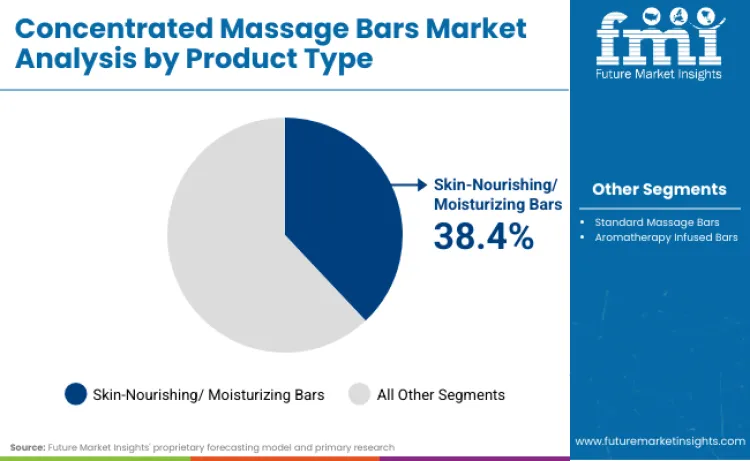
Skin-nourishing / moisturizing bars command a dominant 38.40% share in the concentrated massage bars market because they function as true "hero products" that structurally eliminate the need for synthetic stabilizers and preservatives. Unlike liquid formulations, which require chemical preservation to control bacterial growth in water, solid massage bars rely on high concentrations of cocoa butter, shea butter, and botanical oils to remain naturally self-preserving. This formulation advantage supports cleaner labels, higher active density, and longer product life, making skin-nourishing and moisturizing bars the leading product type, followed by standard massage bars and aromatherapy-infused bars that extend the format into relaxation and therapeutic use cases.
Karl Bygrave, Director and Co-Founder of Lush Cosmetics, highlighted the deep consumer loyalty that protects this segment, stating: "When you realise you have what I call a ‘hero product’, something that is someone’s absolute favourite and they can’t find anything else that works for them in the same way anywhere else… that’s when I think to myself ‘wow’, these products are really important to people." This emotional attachment and repeat purchasing behavior insulate solid concentrated formats from displacement, reinforcing their leadership even as new liquid and hybrid alternatives enter the market.
Why does the Personal Care & Daily Use Segment Dominate Market?
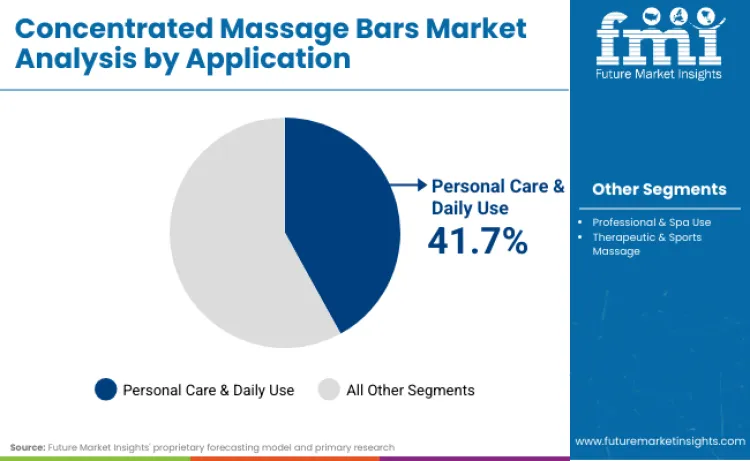
The personal care & daily use segment dominates the concentrated massage bars market as it leads the 41.70% of total demand. This segment benefits from a direct alignment between ethical positioning and operational efficiency, as removing water from formulations allows brands to eliminate plastic bottles entirely. Solid, unpackaged formats bypass the need for antimicrobial preservatives required in liquid products, enabling brands to meet modern ethical certification standards while simultaneously reducing packaging, transportation weight, and cost intensity. These advantages make naked formats especially attractive for everyday consumer use, where repeat purchasing and convenience are critical.
The dominance of this segment is reinforced by the realization that concentrated solids are not merely a sustainability-led alternative but a structurally superior logistical solution. By eliminating water weight, brands can market “fresh and handmade” attributes that liquid-based competitors cannot credibly claim. Leadership at Lush Cosmetics underscored this logic, stating: “I worked through my ‘list’ realising that products in this form did not require preservatives. All our careers have been spent considering this and working to make products without preservatives.” These dynamics firmly position naked formats as the cornerstone of sustained adoption, particularly in daily personal care routines, while professional and therapeutic uses remain secondary growth channels.
What Is the Concentrated Massage Bars Market Regional Outlook?
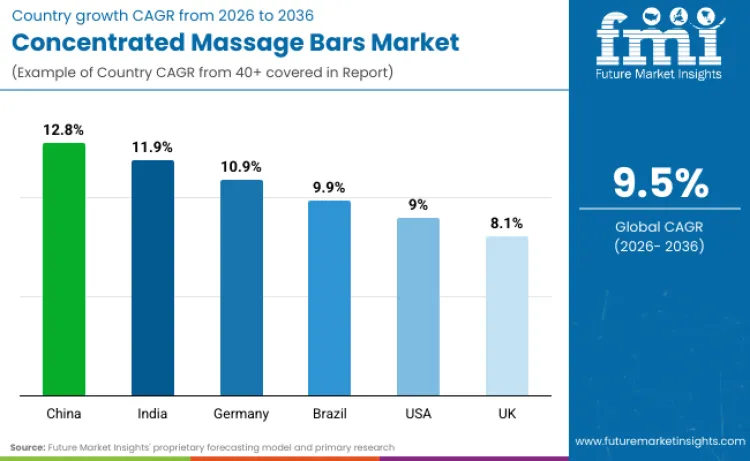
Sales of concentrated massage bars are expanding faster in emerging and sustainability-driven markets, where waterless beauty adoption, e-commerce penetration, and ethical consumption are accelerating category uptake. While the global concentrated massage bars market grows at a 9.50% CAGR, high-growth regions are leapfrogging traditional liquid personal care formats by adopting solid, low-waste alternatives that align with cost efficiency and environmental priorities. China leads with a 12.8% CAGR, driven by strong online retail adoption and rising demand for premium, compact wellness products. India follows closely at 11.9%, supported by rapid urbanization, digital-first beauty discovery, and increasing acceptance of concentrated daily-use formats among younger consumers.
In contrast, developed markets are growing at more moderate but stable rates, with adoption anchored in wellness culture and specialty retail. Germany records a 10.9% CAGR, reflecting strong professional and spa usage supported by wellness boutiques. Brazil grows at 9.9%, led by aromatherapy and therapeutic massage applications, while the United States (9.0%) and United Kingdom (8.1%) emphasize artisanal, organic, and specialty labels rather than mass expansion. FMI analysis indicates that future growth will be driven by emerging markets scaling e-commerce-led access, while mature markets reinforce premium, professional, and lifestyle positioning.
| Country | CAGR (2026 to 2036) |
|---|---|
| China | 12.8% |
| India | 11.9% |
| Germany | 10.9% |
| Brazil | 9.9% |
| United States | 9.0% |
| United Kingdom | 8.1% |
Source: FMI historical analysis and forecast data.
Why is the Indian Government Standardizing Personal Care Formats?
India is expanding at a 11.9% CAGR, driven by a structural shift toward formalized, sustainable personal care formats that align regulatory oversight with evolving premium consumption. The Indian market is moving away from fragmented, informal beauty retail toward organized, compliant models that can support solid and naked cosmetic formats at scale. A key inflection point came in November 2025, when Lush Cosmetics announced its re-entry into India through a Licensee Agreement, targeting a luxury and premium beauty segment valued at roughly USD 28 billion. This move reflects growing regulatory and commercial acceptance of waterless cosmetics as legitimate, high-value products rather than niche imports. Rowena Bird, Co-Founder of Lush, emphasized that Indian consumers will actively guide product relevance, signaling a demand-led standardization process. FMI analysis indicates that India’s growth is anchored in urbanization, digital-first discovery, and increasing policy support for sustainable formats, positioning solid massage bars as a compliant, scalable solution within India’s evolving beauty ecosystem.
How Is China Deploying Mass-Market Solid Infrastructure?
China leads the concentrated massage bars market with a 12.8% CAGR, driven by rapid mass-market adoption of high-performance solid formats that are positioned as superior to liquid alternatives. Unlike early sustainability narratives, China’s adoption is being fueled by performance-first consumer expectations, where efficacy, immediacy of results, and supply-chain transparency outweigh purely environmental considerations. E-commerce platforms and social commerce channels are accelerating education around concentrated formats, enabling solids to scale rapidly across urban consumers. Brianne West, Founder of Ethique, has noted that even in markets where plastic waste was not initially a concern, concentrated formats succeeded because they matched or exceeded liquid performance. FMI analysis suggests that China’s solid-format infrastructure is being built through science-led marketing, premium wellness positioning, and logistics efficiency. As a result, concentrated massage bars are becoming mainstream wellness products rather than ethical niche items, redefining how solid cosmetics penetrate large-scale consumer markets.
Why is the Germany Market Focusing on Environmental Operational Efficiency?
Germany is expanding at a 10.9% CAGR, with growth shaped by a strong emphasis on environmental operational efficiency rather than rapid consumer experimentation. The German personal care market is characterized by disciplined purchasing behavior, regulatory compliance, and a preference for formats that optimize resource use across the supply chain. This environment favors concentrated massage bars, which reduce transport weight, packaging waste, and storage intensity compared to liquid formulations. Brands operating in Germany are increasingly aligning sustainability goals with measurable operational savings, making solids an economically rational choice. The executive leadership of Lush Cosmetics highlighted this focus through its internally driven "Jigsaw" initiative, which prioritizes efficiency savings that can be reinvested into brand and growth activities. FMI analysis indicates that Germany’s adoption is anchored in professional and spa use, supported by wellness boutiques and specialty retail. Concentrated formats fit seamlessly into Germany’s efficiency-led sustainability model, reinforcing steady, credibility-driven market expansion.
Why is Brazil Evolving Through Ethical Insetting?
Brazil is growing at a 9.9% CAGR, with the concentrated massage bars market evolving through ethical insetting rather than traditional carbon offsetting. Brands are increasingly investing directly in their own supply chains, focusing on biodiversity protection, community sourcing, and responsible ingredient cultivation. This shift is particularly relevant in Brazil, where environmental impact and social responsibility are deeply intertwined with consumer trust. Concentrated massage bars, which rely heavily on natural butters and essential oils, provide a clear framework for documenting and managing upstream environmental impact. The leadership team at Lush Cosmetics has emphasized a more human, community-led approach that integrates charitable giving and environmental causes into core business operations. FMI analysis suggests that Brazil’s growth is led by aromatherapy and therapeutic massage applications, where ethical sourcing enhances both brand equity and functional credibility. This insetting-driven model positions Brazil as a proving ground for regenerative personal care economics.
How Is the USA Market Maturing Around Product "Nakedness"?
The United States is expanding at a 9.0% CAGR, reflecting a maturing market that is transitioning from novelty adoption to routine use of naked, self-preserving formats. Growth is not driven by regulatory pressure, but by a product-led strategy that emphasizes experiential retail, ingredient transparency, and tangible performance benefits. Consumers are increasingly receptive to solid massage bars as they deliver longer product life, portability, and reduced exposure to synthetic preservatives. As of mid-2024, leading brands have redirected investment toward highlighting these functional advantages rather than sustainability messaging alone. The executive leadership of Lush Cosmetics outlined a strategy focused on expanding retail presence in stable North American markets while letting hero products drive adoption. FMI analysis indicates that the USA market is consolidating around premium, experiential formats, positioning naked massage bars as credible everyday wellness solutions rather than experimental alternatives.
How Is the UK Market Anchoring the "Cosmetic Revolution"?
The United Kingdom remains a foundational market for concentrated massage bars, growing at a 8.1% CAGR and serving as the ideological and commercial anchor for the broader "cosmetic revolution." UK consumers are highly familiar with waterless and naked formats, enabling brands to focus on depth of adoption rather than market education. Growth is driven by a strategic ambition to replace traditional bathroom staples with solid alternatives across multiple categories. Mark Constantine, Co-Founder and Managing Director of Lush Cosmetics, has framed this transition as a long-term master plan aimed at delivering sustainable growth through systemic change. FMI analysis suggests that the UK market emphasizes artisanal quality, ethical manufacturing, and brand loyalty, making it a stability anchor rather than a volume-growth engine. This maturity allows the UK to act as a blueprint for global concentrated beauty adoption.
How is the Competition in the Concentrated Massage Bar Market?
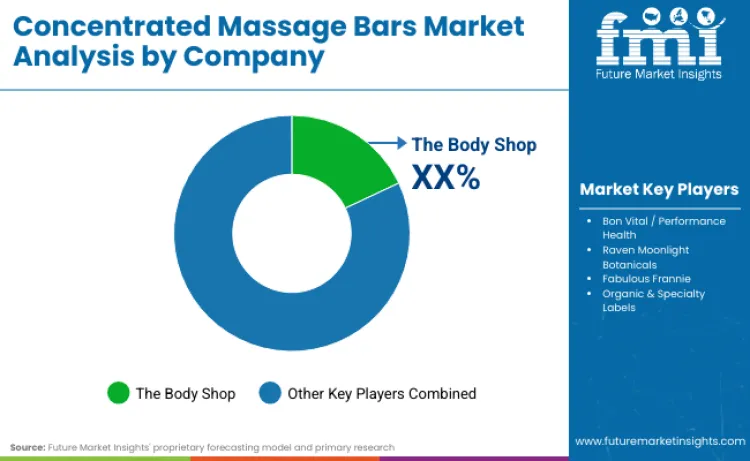
Established leaders such as Lush Cosmetics protect their market share through deep community integration and long-standing leadership in anhydrous, waterless formulation innovation. Lush leverages its identity as an inventor of solid personal care formats to maintain loyalty among ethically motivated consumers, who act as key gatekeepers for sustainable beauty adoption. This competitive moat is reinforced by intellectual property ownership and decades of consumer education around naked and self-preserving products. Mo Constantine, Co-Founder and Manufacturing Director at Lush, underscored this advantage by stating: "We own the patent on many of our solid inventions, ranging from Bath Ballistics and Shampoo Bars to Toothy Tabs, so you can experience our unique products just as we imagined them."
At the same time, independent artisans and niche manufacturers are challenging this dominance by carving out specialized positions focused on ingredient performance and therapeutic outcomes. Brands such as The Cornish Seaweed Bath Co. are shifting competition toward skin resilience and long-term conditioning benefits, highlighting the functional value of marine botanicals and essential oils. This fragmentation is redefining competition away from scale alone toward formulation quality, ingredient provenance, and specialized skin health utility within the concentrated massage bar market.
Recent Developments:
- October 2025, The Body Shop is returning to the US market through e-commerce, launching a dedicated website and Amazon storefront. The brand will offer bath, body, skincare, and haircare favorites, with plans to expand into fragrances as part of a renewed global growth strategy.
Key Players in Concentrated Massage Bars Market
- The Body Shop
- Bon Vital / Performance Health
- Raven Moonlight Botanicals
- Fabulous Frannie
- Organic & Specialty Labels
Market Definition
The Concentrated Massage Bars Market refers to the global category of solid, anhydrous massage and body care products formulated without added water and designed to deliver skin-conditioning, relaxation, and therapeutic benefits. These products rely on high concentrations of butters, waxes, botanical oils, and active ingredients to remain naturally self-preserving, eliminating the need for synthetic preservatives and plastic-heavy packaging. The market reflects a structural shift away from liquid massage oils and creams toward compact, long-lasting formats that improve logistics efficiency and sustainability performance. Concentrated massage bars are positioned across personal care, wellness, spa, and therapeutic applications, and are increasingly adopted as "hero products" within waterless beauty portfolios focused on efficacy, ethical manufacturing, and reduced environmental footprint.
Market Inclusion
The market includes solid massage bars used for skin nourishment, moisturization, relaxation, aromatherapy, and therapeutic or sports massage. It covers skin-nourishing and moisturizing bars, standard massage bars, aromatherapy-infused variants, and other functional solid formats formulated for personal, professional, and spa use. Included are products sold through online retail, specialty wellness boutiques, supermarkets, and professional channels such as spas and massage clinics. The scope also includes naked or unpackaged formats, ethically sourced formulations, and products positioned around clean beauty, self-preservation, and reduced plastic use. Both mass-premium and premium offerings are included, across emerging and developed markets where waterless personal care adoption is driving category growth.
Market Exclusion
The market excludes liquid massage oils, lotions, creams, and gels that rely on water-based formulations and synthetic preservatives. Decorative cosmetics, fragrances, and non-massage solid beauty products such as soaps, shampoos, and conditioners are excluded unless explicitly positioned for massage or body treatment use. Prescription-only dermatological treatments, medical devices, and pharmaceutical topical therapies are not part of this market. Low-quality novelty bars without functional massage or skin-conditioning intent are also excluded, as are private-label solid products that compete purely on price without formulation differentiation. Additionally, packaging-focused sustainability initiatives without corresponding concentrated product formats fall outside the defined market scope.
Scope of Report
| Items | Values |
|---|---|
| Quantitative Units | USD billion |
| Product Type | Skin-Nourishing & Moisturizing Bars; Standard Massage Bars; Aromatherapy-Infused Bars; Specialized Solid Therapy Bars |
| Core Functional Focus | Anhydrous solid formulations; natural self-preserving systems; high-active concentration delivery; preservative-free body care; zero-water cosmetic platforms |
| Application | Personal Care & Daily Use; Professional Spa & Wellness Use; Therapeutic & Sports Massage |
| End User | Individual Consumers; Commercial Clients (Spas, Wellness Centers, Therapy Clinics) |
| Distribution Channel | Online Retail & E-commerce; Specialty Stores & Wellness Boutiques; Supermarkets & Hypermarkets |
| Sustainability & Innovation Platform | Waterless beauty systems; naked/unpackaged formats; ethical manufacturing models; plastic-free logistics; concentrated active formulation science |
| Regions Covered | North America; Europe; Asia Pacific; Latin America; Middle East & Africa |
| Countries Covered | China; India; Germany; Brazil; United States; United Kingdom; Japan; South Korea; France; and 35+ additional countries |
| Key Companies Profiled | The Body Shop; Bon Vital (Performance Health); Raven Moonlight Botanicals; Fabulous Frannie; Lush Cosmetics; Organic & Specialty Wellness Brands |
| Additional Attributes | Solid format penetration rates; packaging-free adoption trends; professional spa channel expansion; e-commerce growth intensity; sustainability-driven purchasing behavior |
Concentrated Massage Bars Market by Segments
By Product Type:
- Skin-Nourishing & Moisturizing Bars
- Standard Massage Bars
- Aromatherapy-Infused Bars
- Other Specialized Solid Formulations
By Application:
- Personal Care & Daily Use
- Professional & Spa Use
- Therapeutic & Sports Massage
By Distribution Channel:
- Online Retail & E-Commerce Platforms
- Specialty Stores & Wellness Boutiques
- Supermarkets & Hypermarkets
By End User:
- Individual Consumers
- Commercial Clients (Spas, Wellness Centers, Therapy Providers)
By Region:
- North America
- Europe
- Asia Pacific
- Latin America
- Middle East & Africa
Bibliography
- Department for Business and Trade. (2025). Department for Business and Trade offices around the world. GOV.UK.
- Lush Cosmetics. (2024). Lush audited accounts: Year ending June 2024.
- Bird, R. (2025, November 11). British cosmetic firm Lush re-enters India aiming it to be among top 10 markets in next 5 years. The Economic Times.
Frequently Asked Questions
What is the current global market size for Concentrated Massage Bars?
The global market is valued at USD 1.3 billion in 2026, driven by the shift toward waterless, low-waste personal care formats that concentrate active ingredients and reduce packaging impact.
What is the projected CAGR for the Concentrated Massage Bars market?
The market is projected to grow at a 9.5% CAGR from 2026 to 2036, reflecting rapid adoption of solid, anhydrous wellness products across consumer and professional segments.
Which segment currently dominates the industry?
Skin-nourishing and moisturizing solid bars lead with a 38.4% share, while personal care and daily use applications dominate with 41.7% of demand.
What are the primary drivers for adoption in emerging markets?
Rising e-commerce penetration, sustainability awareness, compact premium wellness consumption, and preference for waterless beauty formats in China and India are the main growth drivers.
Who are the leading players in the Concentrated Massage Bars space?
Key players include The Body Shop, Bon Vital (Performance Health), Raven Moonlight Botanicals, Fabulous Frannie, and various organic and specialty wellness brands.
Preview the report firsthand - request a free sample
Get SampleGet the brochure for pricing and purchase details.
Get PDFTable of Content
- Executive Summary
- Global Market Outlook
- Demand Side Trends
- Supply Side Trends
- Technology Roadmap Analysis
- Analysis and Recommendations
- Market Overview
- Market Coverage / Taxonomy
- Market Definition / Scope / Limitations
- Research Methodology
- Chapter Orientation
- Analytical Lens and Working Hypotheses
- Market Structure, Signals, and Trend Drivers
- Benchmarking and Cross-market Comparability
- Market Sizing, Forecasting, and Opportunity Mapping
- Research Design and Evidence Framework
- Desk Research Programme (Secondary Evidence)
- Company Annual and Sustainability Reports
- Peer-reviewed Journals and Academic Literature
- Corporate Websites, Product Literature, and Technical Notes
- Earnings Decks and Investor Briefings
- Statutory Filings and Regulatory Disclosures
- Technical White Papers and Standards Notes
- Trade Journals, Industry Magazines, and Analyst Briefs
- Conference Proceedings, Webinars, and Seminar Materials
- Government Statistics Portals and Public Data Releases
- Press Releases and Reputable Media Coverage
- Specialist Newsletters and Curated Briefings
- Sector Databases and Reference Repositories
- FMI Internal Knowledge Base and Historical Datasets
- Subscription Datasets and Paid Sources
- Social Channels, Communities, and Digital Listening Inputs
- Additional Desk Sources
- Expert Input and Fieldwork (Primary Evidence)
- Primary Modes
- Qualitative Interviews and Expert Elicitation
- Quantitative Surveys and Structured Data Capture
- Blended Approach
- Why Primary Evidence is Used
- Field Techniques
- Interviews
- Surveys
- Focus Groups
- Observational and In-context Research
- Social and Community Interactions
- Stakeholder Universe Engaged
- C-suite Leaders
- Board Members
- Presidents and Vice Presidents
- R&D and Innovation Heads
- Technical Specialists
- Domain Subject-matter Experts
- Scientists
- Physicians and Other Healthcare Professionals
- Governance, Ethics, and Data Stewardship
- Research Ethics
- Data Integrity and Handling
- Primary Modes
- Tooling, Models, and Reference Databases
- Desk Research Programme (Secondary Evidence)
- Data Engineering and Model Build
- Data Acquisition and Ingestion
- Cleaning, Normalisation, and Verification
- Synthesis, Triangulation, and Analysis
- Quality Assurance and Audit Trail
- Market Background
- Market Dynamics
- Drivers
- Restraints
- Opportunity
- Trends
- Scenario Forecast
- Demand in Optimistic Scenario
- Demand in Likely Scenario
- Demand in Conservative Scenario
- Opportunity Map Analysis
- Product Life Cycle Analysis
- Supply Chain Analysis
- Investment Feasibility Matrix
- Value Chain Analysis
- PESTLE and Porter's Analysis
- Regulatory Landscape
- Regional Parent Market Outlook
- Production and Consumption Statistics
- Import and Export Statistics
- Market Dynamics
- Global Market Analysis 2021 to 2025 and Forecast, 2026 to 2036
- Historical Market Size Value (USD Million) Analysis, 2021 to 2025
- Current and Future Market Size Value (USD Million) Projections, 2026 to 2036
- Y-o-Y Growth Trend Analysis
- Absolute $ Opportunity Analysis
- Global Market Pricing Analysis 2021 to 2025 and Forecast 2026 to 2036
- Y-o-Y Growth Trend Analysis 2021 to 2025
- Absolute $ Opportunity Analysis 2026 to 2036
- Global Market Analysis 2021 to 2025 and Forecast 2026 to 2036, By Product Type
- Introduction / Key Findings
- Historical Market Size Value (USD Million) Analysis By Product Type, 2021 to 2025
- Current and Future Market Size Value (USD Million) Analysis and Forecast By Product Type, 2026 to 2036
- Skin-Nourishing & Moisturizing Bars
- Standard Massage Bars
- Aromatherapy-Infused Bars
- Specialized Solid Therapy Bars
- Y-o-Y Growth Trend Analysis By Product Type, 2021 to 2025
- Absolute $ Opportunity Analysis By Product Type, 2026 to 2036
- Global Market Analysis 2021 to 2025 and Forecast 2026 to 2036, By Application
- Introduction / Key Findings
- Historical Market Size Value (USD Million) Analysis By Application, 2021 to 2025
- Current and Future Market Size Value (USD Million) Analysis and Forecast By Application, 2026 to 2036
- Personal Care & Daily Use
- Professional & Spa Use
- Therapeutic & Sports Massage
- Y-o-Y Growth Trend Analysis By Application, 2021 to 2025
- Absolute $ Opportunity Analysis By Application, 2026 to 2036
- Global Market Analysis 2021 to 2025 and Forecast 2026 to 2036, By Distribution Channel
- Introduction / Key Findings
- Historical Market Size Value (USD Million) Analysis By Distribution Channel, 2021 to 2025
- Current and Future Market Size Value (USD Million) Analysis and Forecast By Distribution Channel, 2026 to 2036
- Online Retail & E-Commerce Platforms
- Specialty Stores & Wellness Boutiques
- Supermarkets & Hypermarkets
- Y-o-Y Growth Trend Analysis By Distribution Channel, 2021 to 2025
- Absolute $ Opportunity Analysis By Distribution Channel, 2026 to 2036
- Global Market Analysis 2021 to 2025 and Forecast 2026 to 2036, By End User
- Introduction / Key Findings
- Historical Market Size Value (USD Million) Analysis By End User, 2021 to 2025
- Current and Future Market Size Value (USD Million) Analysis and Forecast By End User, 2026 to 2036
- Individual Consumers
- Commercial Clients (Spas, Wellness Centers, Therapy Providers)
- Y-o-Y Growth Trend Analysis By End User, 2021 to 2025
- Absolute $ Opportunity Analysis By End User, 2026 to 2036
- Global Market Analysis 2021 to 2025 and Forecast 2026 to 2036, By Region
- Introduction
- Historical Market Size Value (USD Million) Analysis By Region, 2021 to 2025
- Current Market Size Value (USD Million) Analysis and Forecast By Region, 2026 to 2036
- North America
- Latin America
- Western Europe
- Eastern Europe
- East Asia
- South Asia and Pacific
- Middle East & Africa
- Market Attractiveness Analysis By Region
- North America Market Analysis 2021 to 2025 and Forecast 2026 to 2036, By Country
- Historical Market Size Value (USD Million) Trend Analysis By Market Taxonomy, 2021 to 2025
- Market Size Value (USD Million) Forecast By Market Taxonomy, 2026 to 2036
- By Country
- USA
- Canada
- Mexico
- By Product Type
- By Application
- By Distribution Channel
- By End User
- By Country
- Market Attractiveness Analysis
- By Country
- By Product Type
- By Application
- By Distribution Channel
- By End User
- Key Takeaways
- Latin America Market Analysis 2021 to 2025 and Forecast 2026 to 2036, By Country
- Historical Market Size Value (USD Million) Trend Analysis By Market Taxonomy, 2021 to 2025
- Market Size Value (USD Million) Forecast By Market Taxonomy, 2026 to 2036
- By Country
- Brazil
- Chile
- Rest of Latin America
- By Product Type
- By Application
- By Distribution Channel
- By End User
- By Country
- Market Attractiveness Analysis
- By Country
- By Product Type
- By Application
- By Distribution Channel
- By End User
- Key Takeaways
- Western Europe Market Analysis 2021 to 2025 and Forecast 2026 to 2036, By Country
- Historical Market Size Value (USD Million) Trend Analysis By Market Taxonomy, 2021 to 2025
- Market Size Value (USD Million) Forecast By Market Taxonomy, 2026 to 2036
- By Country
- Germany
- UK
- Italy
- Spain
- France
- Nordic
- BENELUX
- Rest of Western Europe
- By Product Type
- By Application
- By Distribution Channel
- By End User
- By Country
- Market Attractiveness Analysis
- By Country
- By Product Type
- By Application
- By Distribution Channel
- By End User
- Key Takeaways
- Eastern Europe Market Analysis 2021 to 2025 and Forecast 2026 to 2036, By Country
- Historical Market Size Value (USD Million) Trend Analysis By Market Taxonomy, 2021 to 2025
- Market Size Value (USD Million) Forecast By Market Taxonomy, 2026 to 2036
- By Country
- Russia
- Poland
- Hungary
- Balkan & Baltic
- Rest of Eastern Europe
- By Product Type
- By Application
- By Distribution Channel
- By End User
- By Country
- Market Attractiveness Analysis
- By Country
- By Product Type
- By Application
- By Distribution Channel
- By End User
- Key Takeaways
- East Asia Market Analysis 2021 to 2025 and Forecast 2026 to 2036, By Country
- Historical Market Size Value (USD Million) Trend Analysis By Market Taxonomy, 2021 to 2025
- Market Size Value (USD Million) Forecast By Market Taxonomy, 2026 to 2036
- By Country
- China
- Japan
- South Korea
- By Product Type
- By Application
- By Distribution Channel
- By End User
- By Country
- Market Attractiveness Analysis
- By Country
- By Product Type
- By Application
- By Distribution Channel
- By End User
- Key Takeaways
- South Asia and Pacific Market Analysis 2021 to 2025 and Forecast 2026 to 2036, By Country
- Historical Market Size Value (USD Million) Trend Analysis By Market Taxonomy, 2021 to 2025
- Market Size Value (USD Million) Forecast By Market Taxonomy, 2026 to 2036
- By Country
- India
- ASEAN
- Australia & New Zealand
- Rest of South Asia and Pacific
- By Product Type
- By Application
- By Distribution Channel
- By End User
- By Country
- Market Attractiveness Analysis
- By Country
- By Product Type
- By Application
- By Distribution Channel
- By End User
- Key Takeaways
- Middle East & Africa Market Analysis 2021 to 2025 and Forecast 2026 to 2036, By Country
- Historical Market Size Value (USD Million) Trend Analysis By Market Taxonomy, 2021 to 2025
- Market Size Value (USD Million) Forecast By Market Taxonomy, 2026 to 2036
- By Country
- Kingdom of Saudi Arabia
- Other GCC Countries
- Turkiye
- South Africa
- Other African Union
- Rest of Middle East & Africa
- By Product Type
- By Application
- By Distribution Channel
- By End User
- By Country
- Market Attractiveness Analysis
- By Country
- By Product Type
- By Application
- By Distribution Channel
- By End User
- Key Takeaways
- Key Countries Market Analysis
- USA
- Pricing Analysis
- Market Share Analysis, 2025
- By Product Type
- By Application
- By Distribution Channel
- By End User
- Canada
- Pricing Analysis
- Market Share Analysis, 2025
- By Product Type
- By Application
- By Distribution Channel
- By End User
- Mexico
- Pricing Analysis
- Market Share Analysis, 2025
- By Product Type
- By Application
- By Distribution Channel
- By End User
- Brazil
- Pricing Analysis
- Market Share Analysis, 2025
- By Product Type
- By Application
- By Distribution Channel
- By End User
- Chile
- Pricing Analysis
- Market Share Analysis, 2025
- By Product Type
- By Application
- By Distribution Channel
- By End User
- Germany
- Pricing Analysis
- Market Share Analysis, 2025
- By Product Type
- By Application
- By Distribution Channel
- By End User
- UK
- Pricing Analysis
- Market Share Analysis, 2025
- By Product Type
- By Application
- By Distribution Channel
- By End User
- Italy
- Pricing Analysis
- Market Share Analysis, 2025
- By Product Type
- By Application
- By Distribution Channel
- By End User
- Spain
- Pricing Analysis
- Market Share Analysis, 2025
- By Product Type
- By Application
- By Distribution Channel
- By End User
- France
- Pricing Analysis
- Market Share Analysis, 2025
- By Product Type
- By Application
- By Distribution Channel
- By End User
- India
- Pricing Analysis
- Market Share Analysis, 2025
- By Product Type
- By Application
- By Distribution Channel
- By End User
- ASEAN
- Pricing Analysis
- Market Share Analysis, 2025
- By Product Type
- By Application
- By Distribution Channel
- By End User
- Australia & New Zealand
- Pricing Analysis
- Market Share Analysis, 2025
- By Product Type
- By Application
- By Distribution Channel
- By End User
- China
- Pricing Analysis
- Market Share Analysis, 2025
- By Product Type
- By Application
- By Distribution Channel
- By End User
- Japan
- Pricing Analysis
- Market Share Analysis, 2025
- By Product Type
- By Application
- By Distribution Channel
- By End User
- South Korea
- Pricing Analysis
- Market Share Analysis, 2025
- By Product Type
- By Application
- By Distribution Channel
- By End User
- Russia
- Pricing Analysis
- Market Share Analysis, 2025
- By Product Type
- By Application
- By Distribution Channel
- By End User
- Poland
- Pricing Analysis
- Market Share Analysis, 2025
- By Product Type
- By Application
- By Distribution Channel
- By End User
- Hungary
- Pricing Analysis
- Market Share Analysis, 2025
- By Product Type
- By Application
- By Distribution Channel
- By End User
- Kingdom of Saudi Arabia
- Pricing Analysis
- Market Share Analysis, 2025
- By Product Type
- By Application
- By Distribution Channel
- By End User
- Turkiye
- Pricing Analysis
- Market Share Analysis, 2025
- By Product Type
- By Application
- By Distribution Channel
- By End User
- South Africa
- Pricing Analysis
- Market Share Analysis, 2025
- By Product Type
- By Application
- By Distribution Channel
- By End User
- USA
- Market Structure Analysis
- Competition Dashboard
- Competition Benchmarking
- Market Share Analysis of Top Players
- By Regional
- By Product Type
- By Application
- By Distribution Channel
- By End User
- Competition Analysis
- Competition Deep Dive
- The Body Shop
- Bon Vital / Performance Health
- Raven Moonlight Botanicals
- Fabulous Frannie
- Lush Cosmetics
- Organic & Specialty Labels
- Competition Deep Dive
- Assumptions & Acronyms Used


