

- Industry Size (2026)
- USD 458.0 Mn
- Forecast (2036)
- USD 1285.0 Mn
- CAGR (2026 to 2036)
- 10.0%
Marine Microalgae Protein Concentrate Market Size, Market Forecast and Outlook By FMI
In 2025, the marine microalgae protein concentrate market surpassed a value of USD 420.0 million. Based on Future Market Insights’ analysis, demand is estimated to grow to USD 458.0 million in 2026 and USD 1,285.0 million by 2036. FMI projects a CAGR of 10.0%. Scale economics define this trajectory, as extraction protocols advance beyond pilot stages into commercial reliability. High capital expenditure historically constrained mass adoption, but the achievement of a minimum biomass selling price benchmark of USD 654 per ton establishes a feasible floor for downstream dietary ingredient formulations [4].
Emerging industrial hubs present significant untapped potential for supply chain stabilization as cultivation footprints expand rapidly to meet institutional demand. This transition materialized fully when SimpliiGood launched a dedicated manufacturing line in April 2025 capable of yielding hundreds of tons of textured material annually [8]. Procurement teams respond by signing long-term agreements, securing bulk inventory and bypassing traditional agricultural price volatility to formulate highly stable algal protein product lines.
Summary of Marine Microalgae Protein Concentrate Market
- Marine Microalgae Protein Concentrate Market Definition
- Processed marine biomass refined for high protein density serves human nutrition applications.
- Demand Drivers in the Market
- Supplement adoption accelerates across urban demographics.
- Extraction efficiency improvements lower biomass selling prices.
- Commercial plant expansions secure consistent B2B volumes.
- Key Segments Analyzed in the FMI Report
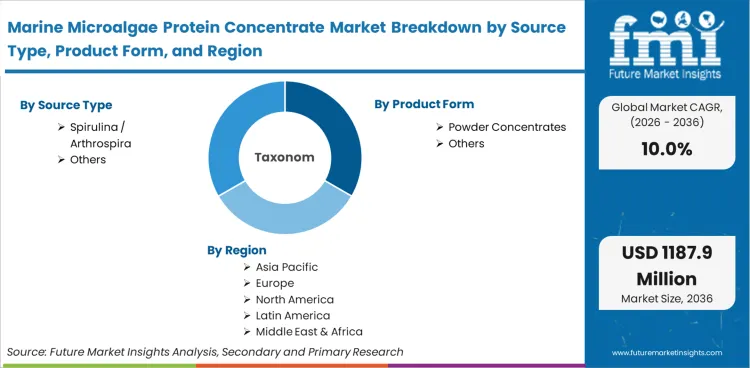
- Source Type: Dominant Spirulina / Arthrospira (34%) versus other microalgae strains.
- Product Form: Powder concentrates (61% of total volume) versus other formats.
- Geography: High-growth Asia-Pacific (India 11.6%, China 10.9%) versus regulatory-heavy mature markets in Europe and North America.
- Analyst Opinion at FMI
- Nandini Roy Choudhury, Principal Consultant for Food & Beverage at Future Market Insights, opines, "In our latest Marine Microalgae Protein Concentrate Market outlook, my team and I have identified downstream cost engineering as the defining scalability lever. While upstream cultivation technologies have matured significantly, harvesting, dewatering, and protein concentration still dictate commercial viability. Investors often underestimate the capex intensity of drying and fractionation. The companies that successfully integrate energy-efficient processing with strain-specific optimization will shift microalgae protein from a sustainability showcase into a competitive, high-performance protein platform across global nutrition value chains."
- Strategic Implications/Executive Takeaways
- Secure long-term supply contracts with smart farming facilities.
- Target functional gummy formats to capture premium retail margins.
- Audit extraction protocols to ensure clean label compliance.
- Methodology
- Validated through first-hand corporate production and capacity data.
- Zero reliance on speculative third-party market research reports.
- Based on verifiable industrial benchmarks and verified sources.
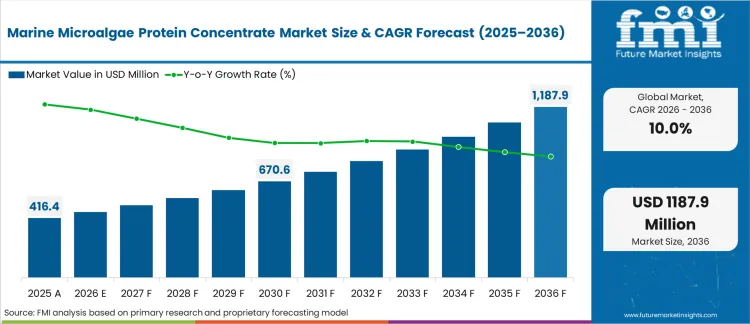
Marine Microalgae Protein Concentrate Market Key Takeaways
| Metric | Details |
|---|---|
| Industry Size (2026) | USD 458.0 Million |
| Industry Value (2036) | USD 1,285.0 Million |
| CAGR (2026-2036) | 10.0% |
Capital allocation is pivoting rapidly toward sustainable marine inputs to satisfy corporate environmental mandates and reduce scope 3 emissions. "Sun Chemical, as part of the DIC Group, views sustainability as a key aspect of its management policy," said Yangyang Jin, Business Manager, Food and Nutrition at Sun Chemical. "By combining smart farming techniques with sustainable solutions, such as renewable energy and zero discharge of industrial offsite wastewater, this new facility ensures our California-grown spirulina will remain a superior environmentally-friendly solution to our customers around the world." [14] This capability directly influences vendor selection, pushing dietary brand owners to abandon carbon-intensive terrestrial inputs in favor of verified algae-based ingredients.
Across the globe, growth concentrates where production scale aligns with high dietary supplement consumption. Geographic dispersion across India, China, the United States, the United Kingdom, Germany, and Brazil reveals distinct regional capabilities. Sourcing clusters align with zones demonstrating high aquaculture expertise; specifically, nations processing portions of the global algae yield of 37.8 million tons capture outsized contract value [2].
Marine Microalgae Protein Concentrate Market Definition
Marine microalgae protein concentrate captures processed biomass derived from marine cultivated strains, isolated specifically to yield high protein density. Formulations supply nutritional and functional benefits for human consumption and industrial applications. Processing involves extraction and drying to achieve standardized protein weight specifications. Value represents wholesale ingredient shipments globally, encompassing refined algae products formulated for integration into food matrices.
Marine Microalgae Protein Concentrate Market Inclusions
The Marine Microalgae Protein Concentrate category covers commercially dried and standardized powder concentrate formulations derived primarily from Spirulina and Arthrospira species. It includes ingredients positioned for dietary supplement use and traded through wholesale supply agreements as well as structured online retail channels where concentrates are sold as bulk or semi-bulk nutritional inputs.
Marine Microalgae Protein Concentrate Market Exclusions
The scope excludes unprocessed wet biomass transported directly from cultivation sites without concentration or drying. It does not include synthetic protein substitutes, land-based crop proteins, or macroalgae processing streams such as kelp or seaweed derivatives. Non-commercial laboratory research materials without established industrial distribution are also excluded.
Marine Microalgae Protein Concentrate Market Research Methodology
- Primary Research: Direct interviews with extraction facility operators and dietary supplement formulators.
- Desk Research: Assessment of official national laboratory statistics alongside UN Trade and Development publications.
- Market-Sizing and Forecasting: Bottom-up volume modelling validated against commercial plant capacity announcements.
- Data Validation and Update Cycle: Continuous peer review against regulatory import licenses and vendor earnings disclosures.
Segmental Analysis
Marine Microalgae Protein Concentrate Market Analysis by Source Type
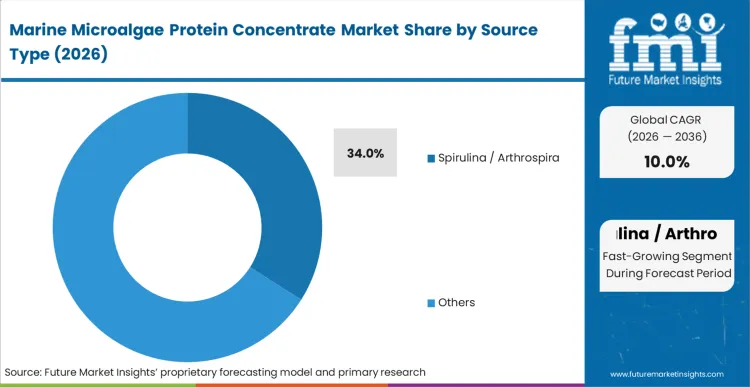
Spirulina / Arthrospira commands 34% of volume in 2026. Dominance stems from established cultivation protocols and high baseline protein content. Cultivators prefer these strains due to rapid growth cycles and proven safety profiles in human nutrition. As per FMI's projection, formulation scientists favor spirulina for its complete amino acid profile, integrating it efficiently into sports nutrition blends. Facility upgrades expand industrial capacity, ensuring steady availability for multinational buyers looking to procure high-grade spirulina protein.
- Procurement parameter: Formulators select high yield strains to ensure batch consistency across dietary supplement lines, as protein content reaches 50% to 70% of dry weight in controlled environments [3].
- Capacity upgrade: Ongoing infrastructure investments are modernizing cultivation systems to better align with growing global demand. Companies are adopting smarter, more sustainable farming technologies to improve efficiency, traceability, and environmental performance, strengthening long-term supply capabilities and export readiness.
- Equipment rationalization: Facilities removing extrusion processes lower operational overhead significantly, which Baruch Dach of AlgaeCore noted eliminates the need for expensive 3D printers or complex texturization equipment [13].
Marine Microalgae Protein Concentrate Market Analysis by Product Form
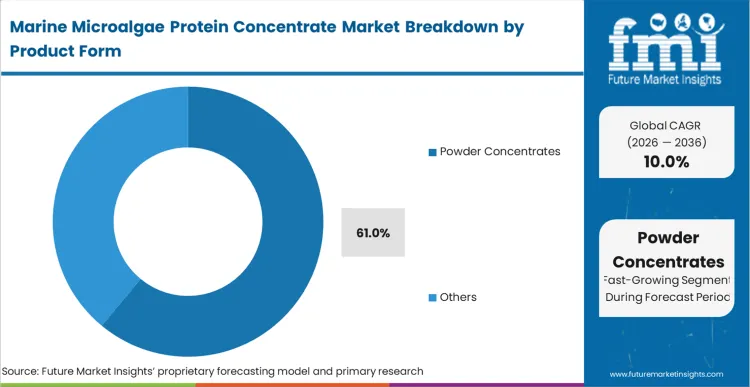
Manufacturers increasingly favor dry formats to overcome shelf life constraints and lower transportation expenses. Powder concentrates integrate smoothly into encapsulation and blending systems without the need for specialized liquid handling infrastructure. FMI estimates that processors are directing capital toward advanced drying technologies to comply with strict moisture control standards. The stability of dry ingredients also supports longer storage periods and efficient international distribution of pure spirulina products, resulting in powder concentrates accounting for 61% of total share in 2026.
- Manufacturing priority: Drying technology investments reduce spoilage risks during long-haul transit, which became apparent after Brevel achieved commercial scale powder supply in June 2024 to support hundreds of tons in output [6].
- Formulation constraint: Moisture content limits functional beverage applications due to emulsion instability, making dry concentrates essential for clean label drink formulations that require high solubility.
- Market diversification: Strategic positioning pivots toward multi-product business models encompassing both human and animal nutrition, reinforced when Cellana and PhytoSmart signed definitive merger agreements in October 2024 to expand plant-based portfolios [5].
Marine Microalgae Protein Concentrate Market Drivers, Restraints, and Opportunities
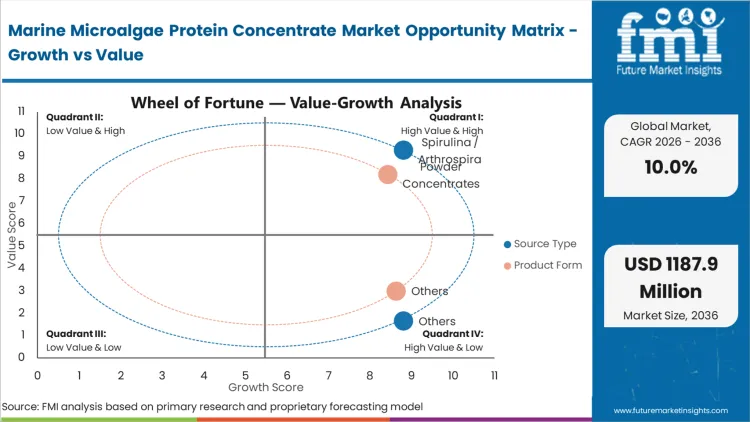
Commercial capacity scaling acts as a primary demand driver. Historical pilot projects struggled to produce consistent ingredient volumes, deterring multinational food conglomerates from reformulating core products. Capital deployment into industrial-scale processing solves availability bottlenecks. The United States national-scale microalgae biomass production potential stands at 152 million tons per year, illustrating the massive supply ceiling available for commercialization [1]. Predictable supply allows food scientists to list marine proteins on permanent ingredient decks rather than limited edition runs. Procurement teams shift from spot purchasing to long-term contracts, stabilizing revenues across supply chains and boosting the integration of refined microalgae.
High baseline production costs restrain immediate mass-market substitution. Cultivating marine biomass requires precise light, temperature, and nutrient controls, leading to elevated energy consumption compared to traditional agriculture. Buyers hesitate to replace inexpensive soy or pea proteins unless product positioning supports a significant retail premium. Ingredient conglomerates divest legacy portfolios to fund this expensive marine protein expansion, such as DSM-Firmenich selling its MEG-3 fish oil business in July 2024.[11]. Phased capacity additions prevent oversupply while maintaining focus on quality-certified output.
Regional Analysis
Based on the regional analysis, the Marine Microalgae Protein Concentrate market is segmented into North America, Latin America, Europe, East Asia, South Asia, Oceania and Middle East & Africa across 40+ countries. The full report also offers market attractiveness analysis based on regional trends.
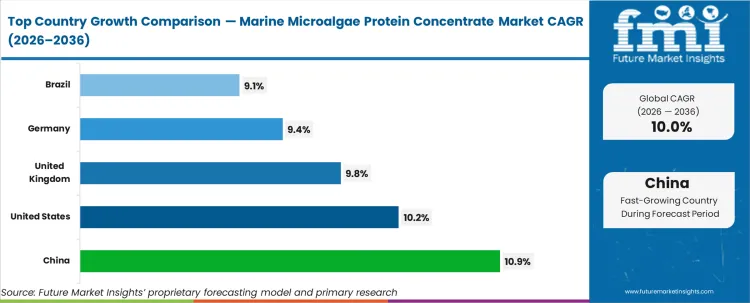
.webp "Top Country Growth Comparison Marine Microalgae Protein Concentrate Market Cagr (2026 2036)")
| Country | CAGR (2026 to 2036) |
|---|---|
| India | 11.6% |
| China | 10.9% |
| United States | 10.2% |
| United Kingdom | 9.8% |
| Germany | 9.4% |
| Brazil | 9.1% |
Source: Future Market Insights (FMI) analysis, based on proprietary forecasting model and primary research
Asia Pacific Marine Microalgae Protein Concentrate Analysis
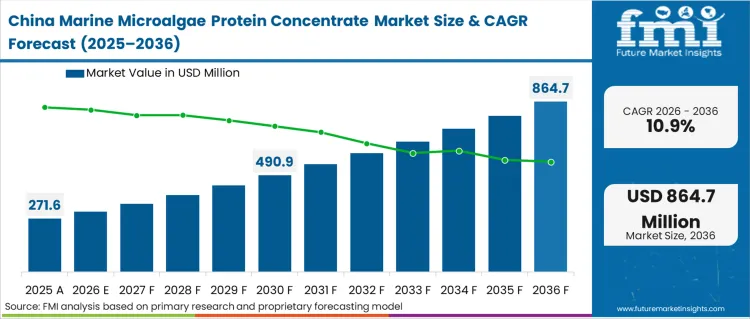
Asia Pacific dominates global cultivation capability, leveraging favorable climatic conditions and established aquaculture infrastructure. Regional processors upgrade from raw powder exports to highly refined protein concentrates, capturing downstream value. Domestic consumption rises as urban populations increase dietary supplement intake. FMI analysts opine that government policies supporting sustainable agricultural innovation accelerate facility modernization. Commercial plants deploy smart farming techniques to meet international purity standards.
- India: Demand for powder concentrates in India is set to grow at 11.6% CAGR through 2036, supported by facility upgrades before procurement and budgeting cycles translate into higher deployment volumes. Regional suppliers upgrade from commodity powder to standardized protein concentrates to secure lucrative export margins under stringent EU frameworks, a pathway validated by recent regulatory clearances.
- China: In China, expanding high-throughput processing capacity is strengthening the commercial outlook for powder concentrates as policy direction and industrial spending increasingly convert into confirmed purchase orders. Large-scale facilities are integrating substantial raw biomass volumes into functional B2B ingredients, supported by regional expertise linked to 223.2 million tons of global fisheries and aquaculture production [15]. As industrial integration deepens and downstream demand accelerates, powder concentrate sales in China are projected to grow at a 10.9% CAGR from 2026 to 2036.
FMI's report includes detailed analysis covering Japan, South Korea, and Indonesia. These nations present lucrative expansion vectors due to high disposable incomes and ingrained cultural acceptance of seaweed protein. Procurement focuses on securing stable supply lines immune to terrestrial weather events.
North America Marine Microalgae Protein Concentrate Analysis
In North America, demand is largely driven by premium dietary supplements and sports nutrition products, where consumers increasingly prefer clean-label and sustainably sourced protein options. Suppliers are differentiating themselves through strong traceability standards and environmentally responsible cultivation practices, including zero-discharge systems. To maintain consistent quality, regional processors are investing in automation, robotics, and drone-based monitoring. Some facilities are even using captured carbon emissions to stimulate algae growth, positioning their operations as both performance-driven and environmentally progressive for major food companies.
- United States: The United States is expected to record 10.2% CAGR in concentrate demand over 2026 to 2036 as consumer preference shifts toward sustainable sources, tightening the link between operational constraints and adoption-led investment. Product launches in premium retail aisles drive this expansion, allowing brands to capture premium margins through novel delivery formats.
FMI's report includes comprehensive evaluation addressing Canada and Mexico. Cross border distribution networks facilitate rapid ingredient transport to contract manufacturers. Formulators prioritize reliable supply chains to satisfy growing functional beverage consumption.
Europe Marine Microalgae Protein Concentrate Analysis
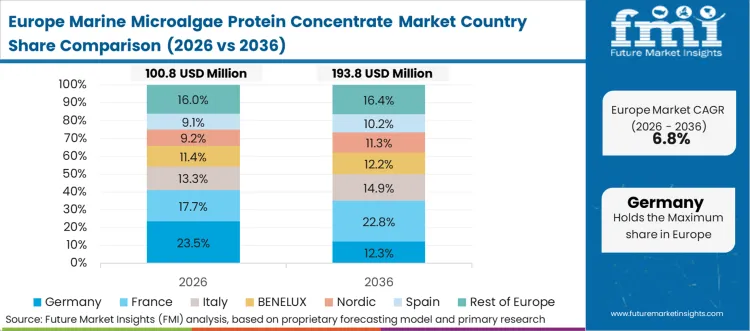
European processors excel in strict quality control and advanced extraction engineering. Regional demand outpaces domestic cultivation capacity, necessitating substantial import volumes from Asian producers. Ingredient buyers enforce rigorous traceability and heavy metal testing protocols. Suppliers commanding European Union import certifications secure long-term contracts. Engineering precision yields highly soluble concentrates suitable for plant-based dairy alternatives. Processors apply technical expertise to refine imported biomass into high-value nutritional isolates.
- United Kingdom: Growth in concentrates across the United Kingdom is estimated at 9.8% CAGR through 2036, driven by retail penetration that increases the value of reliability and compliance in buyer criteria. Formulation innovation leads regional product launches in the functional food sector, bringing novel proteins to commercial catering supply chains.
- Germany: Germany’s functional food sector continues to gain momentum as clean-label specifications become stricter and manufacturers scale deployment plans accordingly. Beverage producers increasingly prefer neutral-tasting proteins, placing greater emphasis on high-purity extraction technologies that ensure clarity and stability in finished products. As compliance requirements and product innovation advance in parallel, the German functional food landscape is projected to grow at a 9.4% CAGR through 2036.
FMI's report includes extensive coverage profiling France, Italy, and Spain. Mediterranean aquaculture expertise provides technical foundations for localized algae oil cultivation projects. Investors evaluate protein extraction facilities to decrease reliance on imported Asian biomass.
Latin America Marine Microalgae Protein Concentrate Analysis
Latin American cultivation potential remains largely untapped despite optimal solar irradiation levels. Initial growth stems from rising urban wellness trends and digital supplement sales. Infrastructure investments slowly modernize extraction capabilities to meet international export criteria. Local brands partner with multinational ingredient suppliers to formulate affordable protein alternatives. Distributors establish regional hubs to lower consumer price points, navigating fragmented physical retail networks to reach health-conscious demographics.
- Brazil: Over 2026 to 2036, concentrates in Brazil are projected to grow at 9.1% CAGR, reflecting wellness market expansion that steadily raises adoption intensity in core end users. Domestic e-commerce acceleration bypasses logistical hurdles, allowing targeted supplement distribution directly to online shoppers year-over-year.
FMI's report includes strategic mapping detailing Argentina, Chile, and Peru. Extensive coastline geography offers compelling sites for future commercial cultivation ponds. Regional conglomerates explore coproduction techniques to maximize biomass utilization efficiency.
Competitive Aligners for Market Players
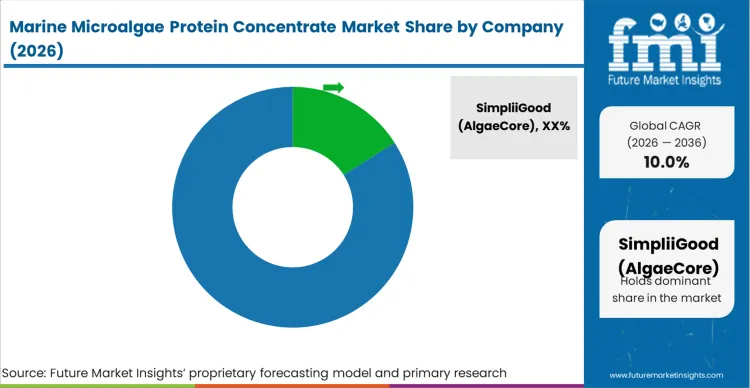
Consolidation strategies accelerate as cultivation operators seek downstream formulation expertise. Mergers combine distinct production technologies to address broader dietary supplement categories. Joint entities achieve scale economies, reducing per-unit processing expenses and expanding addressable customer bases across international markets. This sequenced approach mitigates initial commercialization risks while funding advanced extraction infrastructure.
Strategic positioning pivots toward multi-product business models encompassing both human and animal nutrition. Suppliers establish operations in high-volume pet categories before transitioning to stringent human supplement protocols. Focused investments in automated cultivation environments fundamentally alter supply-side dynamics, elevating the quality baseline across the industry.
Corporate resource allocation shifts toward sustainable, bio-based platforms to capture premium ingredient valuations. Facilities integrating renewable energy and zero-discharge processes attract tier-one food manufacturers seeking scope 3 emission reductions. These capital deployments provide a competitive moat, ensuring long-term volume commitments from sustainability-focused consumer packaged goods companies.
Key Players in Marine Microalgae Protein Concentrate
- SimpliiGood (AlgaeCore)
- Sun Chemical (DIC)
- Earthrise Nutritionals
- Cyanotech Corporation
- Cellana
- PhytoSmart
- Brevel
- Parry Nutraceuticals
- Edonia
- dsm-firmenich
Scope of the Report
| Metric | Value |
|---|---|
| Quantitative Units | USD 458.0 million (2026) to USD 1,285.0 million (2036), at a CAGR of 10.0% |
| Market Definition | Marine microalgae protein concentrate captures processed biomass derived from marine cultivated strains, isolated specifically to yield high protein density. |
| Source Type Segmentation | Spirulina / Arthrospira, Others |
| Product Form Segmentation | Powder Concentrates, Others |
| Application Coverage | Dietary Supplements, Others |
| Distribution Channel Segmentation | Online Retail, Others |
| Regions Covered | North America, Latin America, Europe, East Asia, South Asia, Oceania, Middle East and Africa |
| Countries Covered | United States, United Kingdom, Germany, China, India, Brazil and 40 plus countries |
| Key Companies Profiled | SimpliiGood, Sun Chemical, Cyanotech, Cellana, PhytoSmart, Brevel, Parry Nutraceuticals, Edonia, dsm-firmenich |
| Forecast Period | 2026 to 2036 |
| Approach | Bottom up volume modelling validated against commercial plant capacity announcements. |
Marine Microalgae Protein Concentrate Market Analysis by Segments
Source Type:
- Spirulina / Arthrospira
- Others
Product Form:
- Powder Concentrates
- Others
Application:
- Dietary Supplements
- Others
Distribution Channel:
- Online Retail
- Others
Region:
- Asia Pacific
- India
- China
- Japan
- South Korea
- Indonesia
- Australia & New Zealand
- ASEAN
- Rest of Asia Pacific
- Europe
- Germany
- Italy
- France
- United Kingdom
- Spain
- Benelux
- Nordics
- Central & Eastern Europe
- Rest of Europe
- North America
- United States
- Canada
- Mexico
- Latin America
- Brazil
- Argentina
- Chile
- Rest of Latin America
- Middle East & Africa
- Kingdom of Saudi Arabia
- United Arab Emirates
- South Africa
- Turkey
- Rest of Middle East & Africa
Bibliography
- [1] USA Department of Energy. Updated Algae Report Analyzes National-Scale Prospects (152m).
- [2] FAO. Global algae production (37.8m).
- [3] PMC. Microalgae protein content Arthrospira/Chlorella (50%-70%).
- [4] NREL. Minimum biomass selling price benchmark ($654).
- [5] PhytoSmart. Cellana and PhytoSmart Sign Definitive Merger Agreement (Oct 28, 2024).
- [6] PR Newswire. Brevel Launches Commercial Plant for Microalgae Protein Supply (Jun 4, 2024).
- [7] Sun Chemical. Sun Chemical Launches Sustainable Smart Farming Facility (May 8, 2025).
- [8] PR Newswire. SimpliiGood Spirulina-Based Smoked Salmon Goes Commercial (Apr 22, 2025).
- [9] NutraIngredients. Parry Nutraceuticals obtains EU import license for spirulina (Oct 2024).
- [11] dsm-firmenich. dsm-firmenich to sell MEG-3 fish oil business (Jul 18, 2024).
- [12] Sun Chemical. Facility scale 420,000 m2 disclosure.
- [13] PR Newswire. Quote from Baruch Dach, CTO & Co-founder, AlgaeCore.
- [14] Sun Chemical. Quote from Yangyang Jin, Business Manager.
- [15] FAO. Global fisheries and aquaculture production (223.2m).
This bibliography is provided for reader reference and is not exhaustive. The full report contains the complete reference list and detailed citations.
This Report Addresses
- Market intelligence to enable structured strategic decision making across mature and emerging marine biotechnology economies.
- Market size estimation and 10-year revenue forecasts from 2026 to 2036, supported by validated algal cultivation capacity and trade benchmarks.
- Growth opportunity mapping across powder concentrates and textured formats with emphasis on clean-label dietary supplement transitions.
- Segment and regional revenue forecasts covering dietary supplements, online retail channels, and functional B2B food applications.
- Competition strategy assessment including smart farming integration models, extraction cost survivability, and vegan compliance capability benchmarking.
- Product reformulation and quality compliance tracking including strict food safety-aligned microalgae extraction protocols.
- Regulatory impact analysis covering international import thresholds, European Union organic certifications, and export-driven specification upgrades.
- Market report delivery in PDF, Excel, PPT, and interactive dashboard formats for executive and operational use.
Frequently Asked Questions
How large is the demand for Marine Microalgae Protein Concentrate in the global market in 2026?
Demand is estimated to be valued at USD 458.0 million in 2026.
What will be the market size of Marine Microalgae Protein Concentrate in the global market by 2036?
Valuation is projected to reach USD 1,285.0 million by 2036.
What is the expected demand growth for Marine Microalgae Protein Concentrate in the global market between 2026 and 2036?
Revenues are expected to grow at a CAGR of 10.0% between 2026 and 2036.
Which Source Type is poised to lead global sales by 2026?
Spirulina / Arthrospira is expected to capture approximately 34% of global volume due to rapid growth cycles and proven safety profiles.
How significant is the role of Dietary Supplements in driving Marine Microalgae Protein Concentrate adoption in 2026?
Dietary supplements represent a critical segment holding 38% share as preventive wellness routines drive ingredient discovery.
What is driving demand in India?
Demand grows as facility upgrades clear procurement cycles and export compliance forces domestic quality standardization.
What compliance standards or regulations are referenced for India?
European Union import licenses are referenced as a key compliance benchmark for export normalization.
What is the India growth outlook in this report?
India is projected to grow at a CAGR of 11.6% during 2026 to 2036.
Why is North America described as a priority region in this report?
Demand focuses on premium formulations where consumers actively seek clean label, sustainably sourced protein alternatives.
What type of demand dominates in North America?
Demand driven by premium dietary supplements and sports nutrition formulations dominates regional consumption.
What is the United States growth outlook in this report?
The United States is projected to expand at a CAGR of 10.2% during 2026 to 2036.
Does the report cover China in its regional analysis?
China is included within Asia Pacific under regional analysis.
What are the sources referred to for analyzing China?
Official statistics published by international agricultural bodies and commercial plant capacity announcements are cited as primary reference sources.
What is the main demand theme linked to China in its region coverage?
Demand is tied to high throughput processing scaling and industrial integration for functional B2B ingredients.
Does the report cover United Kingdom in its regional analysis?
United Kingdom is included within Europe under the regional coverage framework.
What is the main United Kingdom related demand theme in its region coverage?
Retail penetration and formulation innovation lead regional product launches.
Which product formats or configurations are strategically important for Asia Pacific supply chains?
Powder concentrates are prioritized due to extended shelf life and reduced international shipping expenses.
What is Marine Microalgae Protein Concentrate and what is it mainly used for?
It is processed marine biomass refined for high protein density, primarily used in dietary supplements and functional foods.
What does Marine Microalgae Protein Concentrate mean in this report?
It refers to wholesale ingredient shipments of extracted and dried microalgae isolates globally.
What is included in the scope of this Marine Microalgae Protein Concentrate report?
Scope covers powder formulations, spirulina derivatives, dietary supplement ingredients, and online retail sales.
What is excluded from the scope of this report?
Unprocessed wet biomass, synthetic protein alternatives, and macroalgae processing streams are excluded.
What does market forecast mean on this page?
Market forecast represents a model based projection built on defined assumptions for strategic planning purposes.
How does FMI build and validate the Marine Microalgae Protein Concentrate forecast?
Forecast is developed using bottom up volume modelling validated against commercial plant capacity announcements and official trade data.
What does zero reliance on speculative third party market research mean here?
Primary interviews and verifiable public datasets are used instead of unverified syndicated market estimates.
Preview the report firsthand - request a free sample
Get SampleGet the brochure for pricing and purchase details.
Get PDFTable of Content
- Executive Summary
- Global Market Outlook
- Demand-side Trends
- Supply-side Trends
- Technology Roadmap Analysis
- Analysis and Recommendations
- Market Overview
- Market Coverage / Taxonomy
- Market Definition / Scope / Limitations
- Research Methodology
- Chapter Orientation
- Analytical Lens and Working Hypotheses
- Market Structure, Signals, and Trend Drivers
- Benchmarking and Cross-market Comparability
- Market Sizing, Forecasting, and Opportunity Mapping
- Research Design and Evidence Framework
- Desk Research Programme (Secondary Evidence)
- Company Annual and Sustainability Reports
- Peer-reviewed Journals and Academic Literature
- Corporate Websites, Product Literature, and Technical Notes
- Earnings Decks and Investor Briefings
- Statutory Filings and Regulatory Disclosures
- Technical White Papers and Standards Notes
- Trade Journals, Industry Magazines, and Analyst Briefs
- Conference Proceedings, Webinars, and Seminar Materials
- Government Statistics Portals and Public Data Releases
- Press Releases and Reputable Media Coverage
- Specialist Newsletters and Curated Briefings
- Sector Databases and Reference Repositories
- FMI Internal Proprietary Databases and Historical Market Datasets
- Subscription Datasets and Paid Sources
- Social Channels, Communities, and Digital Listening Inputs
- Additional Desk Sources
- Expert Input and Fieldwork (Primary Evidence)
- Primary Modes
- Qualitative Interviews and Expert Elicitation
- Quantitative Surveys and Structured Data Capture
- Blended Approach
- Why Primary Evidence is Used
- Field Techniques
- Interviews
- Surveys
- Focus Groups
- Observational and In-context Research
- Social and Community Interactions
- Stakeholder Universe Engaged
- C-suite Leaders
- Board Members
- Presidents and Vice Presidents
- R&D and Innovation Heads
- Technical Specialists
- Domain Subject-matter Experts
- Scientists
- Physicians and Other Healthcare Professionals
- Governance, Ethics, and Data Stewardship
- Research Ethics
- Data Integrity and Handling
- Primary Modes
- Tooling, Models, and Reference Databases
- Desk Research Programme (Secondary Evidence)
- Data Engineering and Model Build
- Data Acquisition and Ingestion
- Cleaning, Normalisation, and Verification
- Synthesis, Triangulation, and Analysis
- Quality Assurance and Audit Trail
- Market Background
- Market Dynamics
- Drivers
- Restraints
- Opportunity
- Trends
- Scenario Forecast
- Demand in Optimistic Scenario
- Demand in Likely Scenario
- Demand in Conservative Scenario
- Opportunity Map Analysis
- Product Life Cycle Analysis
- Supply Chain Analysis
- Investment Feasibility Matrix
- Value Chain Analysis
- PESTLE and Porter’s Analysis
- Regulatory Landscape
- Regional Parent Market Outlook
- Production and Consumption Statistics
- Import and Export Statistics
- Market Dynamics
- Global Market Analysis 2021 to 2025 and Forecast, 2026 to 2036
- Historical Market Size Value (USD Million) Analysis, 2021 to 2025
- Current and Future Market Size Value (USD Million) Projections, 2026 to 2036
- Y-o-Y Growth Trend Analysis
- Absolute $ Opportunity Analysis
- Global Market Pricing Analysis 2021 to 2025 and Forecast 2026 to 2036
- Global Market Analysis 2021 to 2025 and Forecast 2026 to 2036, By Source Type
- Introduction / Key Findings
- Historical Market Size Value (USD Million) Analysis By Source Type , 2021 to 2025
- Current and Future Market Size Value (USD Million) Analysis and Forecast By Source Type , 2026 to 2036
- Spirulina / Arthrospira
- Others
- Spirulina / Arthrospira
- Y-o-Y Growth Trend Analysis By Source Type , 2021 to 2025
- Absolute $ Opportunity Analysis By Source Type , 2026 to 2036
- Global Market Analysis 2021 to 2025 and Forecast 2026 to 2036, By Product Form
- Introduction / Key Findings
- Historical Market Size Value (USD Million) Analysis By Product Form, 2021 to 2025
- Current and Future Market Size Value (USD Million) Analysis and Forecast By Product Form, 2026 to 2036
- Powder Concentrates
- Others
- Powder Concentrates
- Y-o-Y Growth Trend Analysis By Product Form, 2021 to 2025
- Absolute $ Opportunity Analysis By Product Form, 2026 to 2036
- Global Market Analysis 2021 to 2025 and Forecast 2026 to 2036, By Region
- Introduction
- Historical Market Size Value (USD Million) Analysis By Region, 2021 to 2025
- Current Market Size Value (USD Million) Analysis and Forecast By Region, 2026 to 2036
- North America
- Latin America
- Western Europe
- Eastern Europe
- East Asia
- South Asia and Pacific
- Middle East & Africa
- Market Attractiveness Analysis By Region
- North America Market Analysis 2021 to 2025 and Forecast 2026 to 2036, By Country
- Historical Market Size Value (USD Million) Trend Analysis By Market Taxonomy, 2021 to 2025
- Market Size Value (USD Million) Forecast By Market Taxonomy, 2026 to 2036
- By Country
- USA
- Canada
- Mexico
- By Source Type
- By Product Form
- By Country
- Market Attractiveness Analysis
- By Country
- By Source Type
- By Product Form
- Key Takeaways
- Latin America Market Analysis 2021 to 2025 and Forecast 2026 to 2036, By Country
- Historical Market Size Value (USD Million) Trend Analysis By Market Taxonomy, 2021 to 2025
- Market Size Value (USD Million) Forecast By Market Taxonomy, 2026 to 2036
- By Country
- Brazil
- Chile
- Rest of Latin America
- By Source Type
- By Product Form
- By Country
- Market Attractiveness Analysis
- By Country
- By Source Type
- By Product Form
- Key Takeaways
- Western Europe Market Analysis 2021 to 2025 and Forecast 2026 to 2036, By Country
- Historical Market Size Value (USD Million) Trend Analysis By Market Taxonomy, 2021 to 2025
- Market Size Value (USD Million) Forecast By Market Taxonomy, 2026 to 2036
- By Country
- Germany
- UK
- Italy
- Spain
- France
- Nordic
- BENELUX
- Rest of Western Europe
- By Source Type
- By Product Form
- By Country
- Market Attractiveness Analysis
- By Country
- By Source Type
- By Product Form
- Key Takeaways
- Eastern Europe Market Analysis 2021 to 2025 and Forecast 2026 to 2036, By Country
- Historical Market Size Value (USD Million) Trend Analysis By Market Taxonomy, 2021 to 2025
- Market Size Value (USD Million) Forecast By Market Taxonomy, 2026 to 2036
- By Country
- Russia
- Poland
- Hungary
- Balkan & Baltic
- Rest of Eastern Europe
- By Source Type
- By Product Form
- By Country
- Market Attractiveness Analysis
- By Country
- By Source Type
- By Product Form
- Key Takeaways
- East Asia Market Analysis 2021 to 2025 and Forecast 2026 to 2036, By Country
- Historical Market Size Value (USD Million) Trend Analysis By Market Taxonomy, 2021 to 2025
- Market Size Value (USD Million) Forecast By Market Taxonomy, 2026 to 2036
- By Country
- China
- Japan
- South Korea
- By Source Type
- By Product Form
- By Country
- Market Attractiveness Analysis
- By Country
- By Source Type
- By Product Form
- Key Takeaways
- South Asia and Pacific Market Analysis 2021 to 2025 and Forecast 2026 to 2036, By Country
- Historical Market Size Value (USD Million) Trend Analysis By Market Taxonomy, 2021 to 2025
- Market Size Value (USD Million) Forecast By Market Taxonomy, 2026 to 2036
- By Country
- India
- ASEAN
- Australia & New Zealand
- Rest of South Asia and Pacific
- By Source Type
- By Product Form
- By Country
- Market Attractiveness Analysis
- By Country
- By Source Type
- By Product Form
- Key Takeaways
- Middle East & Africa Market Analysis 2021 to 2025 and Forecast 2026 to 2036, By Country
- Historical Market Size Value (USD Million) Trend Analysis By Market Taxonomy, 2021 to 2025
- Market Size Value (USD Million) Forecast By Market Taxonomy, 2026 to 2036
- By Country
- Kingdom of Saudi Arabia
- Other GCC Countries
- Turkiye
- South Africa
- Other African Union
- Rest of Middle East & Africa
- By Source Type
- By Product Form
- By Country
- Market Attractiveness Analysis
- By Country
- By Source Type
- By Product Form
- Key Takeaways
- Key Countries Market Analysis
- USA
- Pricing Analysis
- Market Share Analysis, 2025
- By Source Type
- By Product Form
- Canada
- Pricing Analysis
- Market Share Analysis, 2025
- By Source Type
- By Product Form
- Mexico
- Pricing Analysis
- Market Share Analysis, 2025
- By Source Type
- By Product Form
- Brazil
- Pricing Analysis
- Market Share Analysis, 2025
- By Source Type
- By Product Form
- Chile
- Pricing Analysis
- Market Share Analysis, 2025
- By Source Type
- By Product Form
- Germany
- Pricing Analysis
- Market Share Analysis, 2025
- By Source Type
- By Product Form
- UK
- Pricing Analysis
- Market Share Analysis, 2025
- By Source Type
- By Product Form
- Italy
- Pricing Analysis
- Market Share Analysis, 2025
- By Source Type
- By Product Form
- Spain
- Pricing Analysis
- Market Share Analysis, 2025
- By Source Type
- By Product Form
- France
- Pricing Analysis
- Market Share Analysis, 2025
- By Source Type
- By Product Form
- India
- Pricing Analysis
- Market Share Analysis, 2025
- By Source Type
- By Product Form
- ASEAN
- Pricing Analysis
- Market Share Analysis, 2025
- By Source Type
- By Product Form
- Australia & New Zealand
- Pricing Analysis
- Market Share Analysis, 2025
- By Source Type
- By Product Form
- China
- Pricing Analysis
- Market Share Analysis, 2025
- By Source Type
- By Product Form
- Japan
- Pricing Analysis
- Market Share Analysis, 2025
- By Source Type
- By Product Form
- South Korea
- Pricing Analysis
- Market Share Analysis, 2025
- By Source Type
- By Product Form
- Russia
- Pricing Analysis
- Market Share Analysis, 2025
- By Source Type
- By Product Form
- Poland
- Pricing Analysis
- Market Share Analysis, 2025
- By Source Type
- By Product Form
- Hungary
- Pricing Analysis
- Market Share Analysis, 2025
- By Source Type
- By Product Form
- Kingdom of Saudi Arabia
- Pricing Analysis
- Market Share Analysis, 2025
- By Source Type
- By Product Form
- Turkiye
- Pricing Analysis
- Market Share Analysis, 2025
- By Source Type
- By Product Form
- South Africa
- Pricing Analysis
- Market Share Analysis, 2025
- By Source Type
- By Product Form
- USA
- Market Structure Analysis
- Competition Dashboard
- Competition Benchmarking
- Market Share Analysis of Top Players
- By Regional
- By Source Type
- By Product Form
- Competition Analysis
- Competition Deep Dive
- SimpliiGood (AlgaeCore)
- Overview
- Product Portfolio
- Profitability by Market Segments (Product/Age /Sales Channel/Region)
- Sales Footprint
- Strategy Overview
- Marketing Strategy
- Product Strategy
- Channel Strategy
- Sun Chemical (DIC)
- Earthrise Nutritionals
- Cyanotech Corporation
- Cellana
- PhytoSmart
- Brevel
- Parry Nutraceuticals
- Edonia
- dsm-firmenich
- SimpliiGood (AlgaeCore)
- Competition Deep Dive
- Assumptions & Acronyms Used


