

- Industry Size (2026)
- USD 118.0 Mn
- Forecast (2036)
- USD 232.1 Mn
- CAGR (2026 to 2036)
- 7.0%
Marine Mineral Complexes from Mediterranean Shells Market Size, Market Forecast and Outlook By FMI
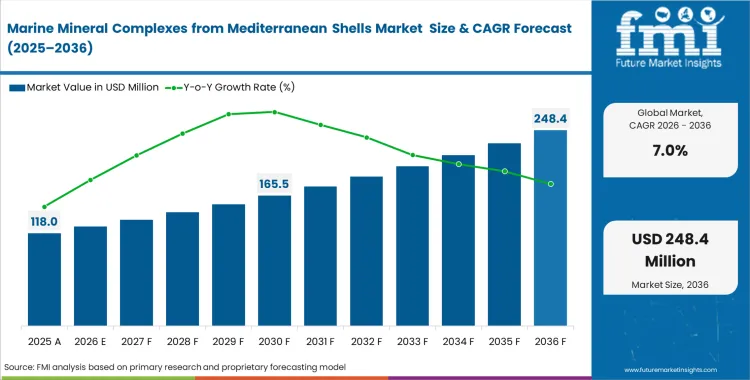
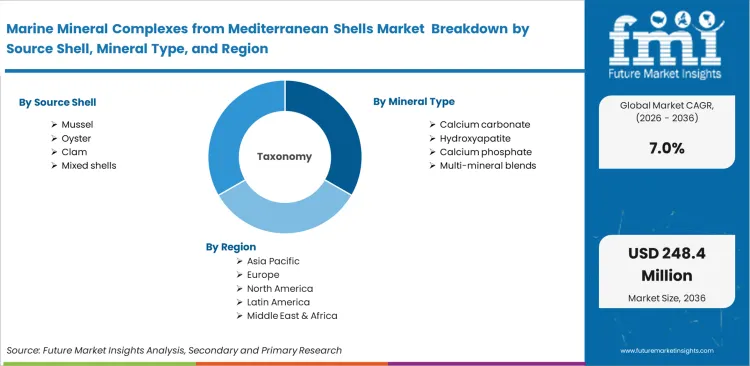
The marine mineral complexes from mediterranean shells market crossed a valuation of USD 110.3 million in 2025. Sales are expected to be USD 118.0 million in 2026 at a CAGR of 7.0% during the forecast period. Revenue is projected to reach USD 232.1 million through 2036 as regional aquaculture operators standardize shell waste recovery to supply the growing shell-derived marine minerals market.
Summary of Marine Mineral Complexes from Mediterranean Shells Market
- The market is forecast to reach USD 232.1 million by 2036.
- The market is expected to grow at a CAGR of 7.0% from 2026 to 2036.
- The market was estimated at USD 110.3 million in 2025.
- The forecast period represents an incremental opportunity of USD 114.1 million.
- This market is a circular-economy-driven niche focused on extracting calcium carbonate, calcium phosphate, and hydroxyapatite from Mediterranean shell waste.
- Demand is supported by strong regional shellfish production, providing a steady feedstock base for mineral recovery and valorization.
- Shell-derived calcium carbonate is gaining traction as a sustainable alternative to mined minerals in ingredient and material applications.
- Hydroxyapatite demand is increasing in bone, dental, and biomaterial uses due to its biocompatibility and suitability for medical-grade formulations.
- Mussel shells lead the source segment with a 41% share, supported by scalable Mediterranean production volumes.
- Calcium carbonate dominates the mineral type segment with a 56% share as the primary conversion product with broad application scope.
- Powder form holds a 63% share, driven by ease of use in premixes, supplements, and food fortification systems.
- Nutraceuticals account for 36% of application demand due to strong positioning in calcium supplementation and preventive health.
- Turkey, Spain, and Tunisia are the fastest-growing markets, with Turkey leading at a 9.2% CAGR.
- Marigot Ltd. (Aquamin), Caltron Clays & Chemicals Pvt. Ltd., Gangotri Inorganic Pvt. Ltd., Calspar India, Neelkanth Finechem LLP, and Vinzai Chemical Industries are key participants in the competitive landscape.
Interest in Mediterranean shell calcium ingredients is rising as supplement manufacturers place greater weight on traceable raw materials and lower-waste sourcing models. Replacing mined calcium sources with natural calcium from marine shells can require fresh validation of purity, composition, and contaminant limits across selected formulations. Adoption can still move gradually where conventional mineral inputs remain cheaper, and qualification costs stay hard to justify. Regional shell streams can offer stronger source traceability than conventional waste-disposal routes, which improves their appeal in specification-driven applications. Traceability prevents supplier fraud, turning regional sourcing into a strict compliance mechanism.
Recovery economics improve when shell handling, cleaning, and mineral conversion move closer to primary processing sites, reducing transport and disposal inefficiencies. Scale economics trigger accelerated adoption across secondary applications, expanding the mediterranean shell waste valorization sector. Shell recovery also improves value realization by shifting part of the shell waste calcium carbonate from disposal cost into usable calcium carbonate output.
Turkey is expected to register the highest pace at 9.2% CAGR as domestic mussel farming expands from a relatively small base, improving shell recovery volumes and downstream mineral conversion potential. Spain is anticipated to record 7.8% CAGR because its established aquaculture infrastructure supports larger-scale processing and strengthens the commercial base for marine calcium ingredients Europe supply. Tunisia is set to post 7.5% CAGR as shell-processing capacity begins to develop, while Italy is estimated to record 7.1% CAGR on the back of its mollusc-heavy production structure. Croatia is likely to deliver 6.8% CAGR as targeted recovery investments improve shell utilization economics. France is expected to see 6.3% CAGR due to mature supply chains and steadier operating conditions, whereas Greece is projected to remain lower at 5.9% CAGR amid continued strain in local shellfish farming.
Segmental Analysis
Marine Mineral Complexes from Mediterranean Shells Market Analysis by Source Shell
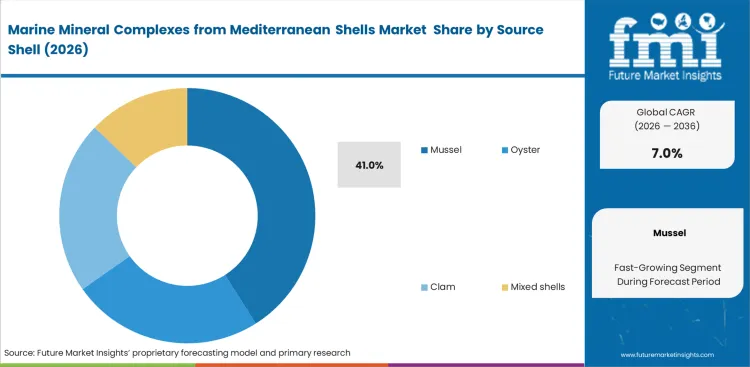
Concentrated aquaculture activity keeps mussel-based feedstock ahead of other source options because it delivers more predictable shell volumes and cleaner recovery flows than fragmented clam or oyster streams. Larger mussel farming clusters also make collection, handling, and conversion into calcium phosphate easier to scale, especially where shell waste moves quickly from processing sites into mineral recovery. Cost control improves when transport distance, storage loss, and contamination risk stay low across the recovery chain. Mussel is expected to hold 41.0% share of the Source Shell segment in 2026 because this source combines supply concentration with better processing practicality. Comparison between mussel shell minerals vs oyster shell minerals also continues to favor mussels in volume-led applications, since steadier feedstock flow and simpler aggregation support more consistent operating yields.
- Collection density: Industrial mussel operations create continuous shell volumes, which improves feedstock availability and reduce reliance on fragmented sourcing networks.
- Seasonal variability: Mineral content can shift with harvest timing and water conditions, making process calibration important for batch consistency and yield control.
- Bivalve displacement: Steadier mussel availability limits the need for multi-species blending, which helps simplify purification and supports tighter quality management in higher-specification applications.
Marine Mineral Complexes from Mediterranean Shells Market Analysis by Mineral Type
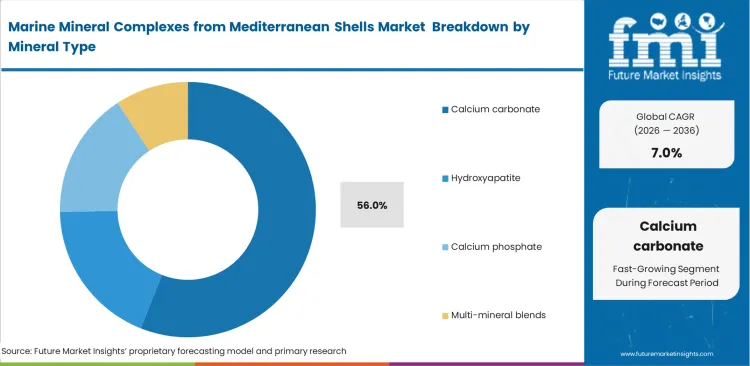
Immediate compatibility with existing processing systems keeps calcium carbonate ahead of more specialized mineral formats. Calcium carbonate is anticipated to capture 56.0% share of the Mineral Type segment in 2026. Manufacturers can introduce shell-derived calcium carbonate into established supplement and food production lines with far less adjustment than hydroxyapatite or other advanced calcium-phosphate systems, which reduces qualification friction and protects line efficiency. Familiar milling behavior, particle handling, and blending performance also make this format easier to commercialize at scale where output consistency matters more than technical novelty. Trace-element variation in biogenic material still requires tighter purification and color control, especially in white-tablet applications, yet calcium carbonate remains the preferred route where scale, formulation continuity, and cost discipline shape adoption.
- Direct substitution: Standard milling and blending practices are more easily applied to shell-derived calcium carbonate, which limits disruption to existing manufacturing workflows.
- Hidden purification: Biogenic mineral sources can carry different trace-metal profiles, making stronger purification control and analytical testing important for regulatory consistency.
- Margin expansion: Premium positioning around marine sourcing and circular-material value can help offset higher early-stage processing costs in selected end uses.
Marine Mineral Complexes from Mediterranean Shells Market Analysis by Form
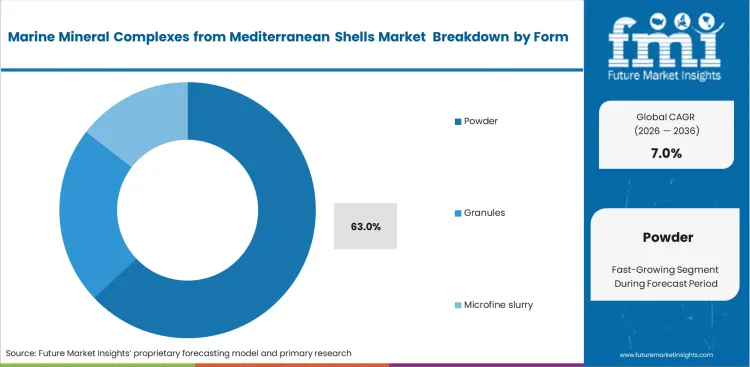
Dry-format compatibility with tablets, capsules, sachets, and premix systems keeps powder ahead despite its handling challenges. Fine particle size improves dispersion and supports faster release in calcium supplement applications, which makes powder easier to position across a wider set of formulations than granules or slurry formats. Granules may offer better flow on high-speed lines, but powder remains more commercially useful where manufacturers want higher active loading without relying on additional binders that can weaken clean-label positioning. Powder is projected to secure 63.0% share of the Form segment in 2026 because it combines dosage flexibility with broader formulation fit across mainstream end uses. Moisture sensitivity and higher equipment friction still require tighter humidity control and press management, yet the format remains preferred where label simplicity and active concentration matter more than line convenience.
- Ambient absorption: Microfine powders absorb moisture more readily from factory air, which increases clumping risk and makes humidity control important for stable line performance.
- Binder elimination: Powder formats can reach target dosages without the same dependence on added structural aids, which helps preserve cleaner ingredient positioning.
- Machinery friction: Finer biogenic particles can raise wear on presses and handling equipment, increasing maintenance needs where operating conditions are not tightly controlled.
Marine Mineral Complexes from Mediterranean Shells Market Analysis by Application
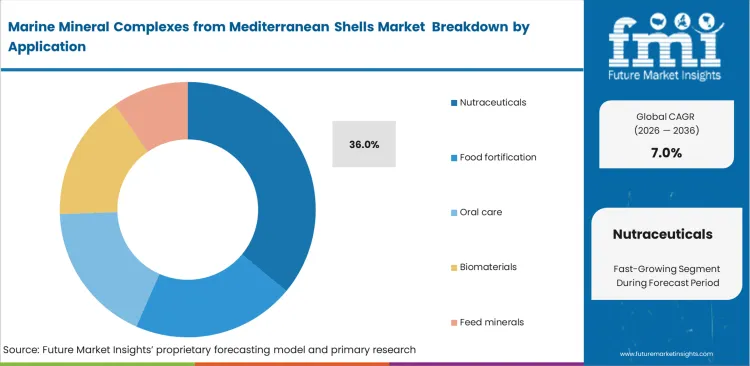
Clean-label positioning gives this application an easier route to market than regulated medical or technically demanding delivery systems. Shell-derived minerals for nutraceuticals fit naturally into tablets, capsules, and powder blends, where slight variation in texture, color, or mineral profile is easier to manage. Commercial acceptance also benefits from stronger alignment with sustainability messaging, source transparency, and preventive health positioning at the shelf level. Comparison work around shell calcium vs calcium citrate further supports this category, since conventional supplement formats can absorb differences in mouthfeel or handling without disrupting mainstream product design. Solubility limits still restrict wider use in clear beverages and other appearance-sensitive systems. Nutraceuticals are expected to hold 36.0% share of the Application segment in 2026 because this channel offers the most practical fit between shell-derived input and finished-product commercialization.
- Retail mandates: Pharmacy and health retail channels place greater weight on cleaner sourcing narratives, which improves shelf appeal for shell-derived nutraceutical ingredients.
- Label transparency: Mediterranean shell origin supports cleaner-label positioning and helps justify premium pricing in selected supplement formats.
- Solubility limits: Raw shell powders remain harder to use in suspended or clear-liquid systems, which restricts adoption in beverage-led applications.
Marine Mineral Complexes from Mediterranean Shells Market Analysis by End Use
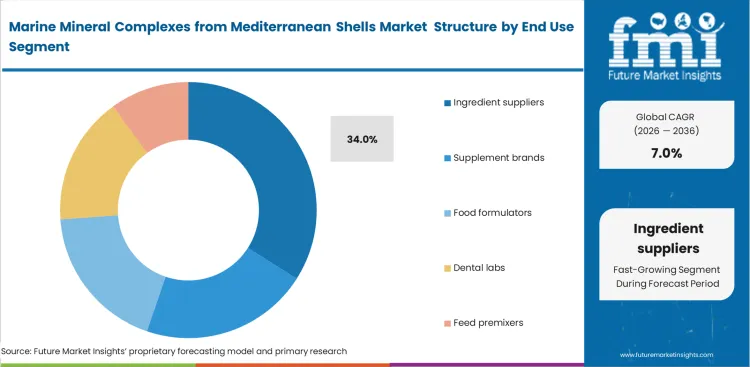
Processing control stays concentrated with ingredient suppliers because pharmaceutical shell calcium ingredients and other shell-derived mineral inputs require purification, calcination, and quality standardization capabilities that most downstream brands do not operate in-house. Converting aquaculture shell waste into usable calcium inputs demands thermal treatment, contamination control, and specification management before the material can move into supplement, food, or pharmaceutical-adjacent applications. This keeps commercial value upstream, where specialized processors can handle sterilization, ash control, particle consistency, and compliance documentation more efficiently than finished-product manufacturers. Ingredient suppliers are projected to secure 34.0% share of the end-use segment in 2026 because they sit at the critical conversion point between raw shell waste and market-ready mineral ingredients. Capacity remains constrained where permitted thermal processing infrastructure is limited, which keeps supply assurance and qualification depth central to supplier preference.
- Sterilization barrier: Raw shells require controlled thermal and purification treatment before they can move into higher-specification mineral applications, raising the technical threshold for in-house processing.
- Regulatory firewall: Independent suppliers absorb much of the compliance and process-control burden tied to waste conversion, which makes them a more practical route for downstream brands.
- Capacity constraints: Limited access to permitted thermal processing and purification infrastructure can tighten availability during peak shell recovery periods, reinforcing the position of established ingredient suppliers.
Marine Mineral Complexes from Mediterranean Shells Market Drivers, Restraints, and Opportunities
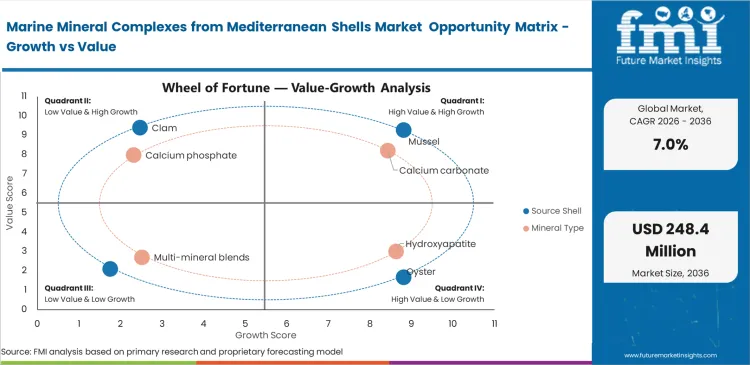
Impending European landfill taxes compel aquaculture operations managers to aggressively seek alternative disposal routes for shell waste. Paying external contractors to haul away tons of heavy wet mussel shells devours operating margins at processing facilities. Transitioning this waste into a feedstock for bio marine ingredients transforms a strict liability into a revenue-generating asset. Delaying this transition exposes processors to escalating regulatory fines as local municipalities restrict organic dumping. This immediate financial pressure forces rapid partnerships between seafood companies and mineral extractors.
Inconsistent shell mineralization creates severe operational friction that slows adoption among high-precision medical buyers. Formulating bone-graft substitutes requires exacting calcium-to-phosphorus ratios that geological minerals provide predictably. Biogenic shells vary wildly depending on water temperature, algae blooms, and harvest timing. Comparing shell-derived hydroxyapatite vs synthetic hydroxyapatite, quality assurance directors at medical device companies frequently reject biogenic batches that fall outside tight elemental specifications. Advanced spectral sorting provides a partial solution, but the technology remains prohibitively expensive for mid-tier processors.
Opportunities in the Marine Mineral Complexes from Mediterranean Shells Market
- Dental application expansion: Medical device engineers require highly biocompatible surfaces for titanium implants. Utilizing shell-derived hydroxyapatite for dental materials accelerates patient bone integration.
- Agricultural substitution: Livestock nutritionists face pressure to remove animal-derived bone meal from poultry diets. Sourcing shell calcium for animal feed premixes provides vital nutrition without triggering cross-species contamination concerns.
- Topical hygiene integration: Formulation chemists seek natural alternatives to banned plastic microbeads. Deploying shell calcium for toothpaste formulations delivers precise abrasive action while supporting ocean-friendly branding initiatives.
Regional Analysis
Based on regional analysis, marine mineral complexes from mediterranean shells market is segmented into Turkey, Spain, Tunisia, Italy, Croatia, France, and Greece across 40 plus countries.
.webp "Top Country Growth Comparison Marine Mineral Complexes From Mediterranean Shells Market Cagr (2026 2036)")
| Country | CAGR (2026 to 2036) |
|---|---|
| Turkey | 9.2% |
| Spain | 7.8% |
| Tunisia | 7.5% |
| Italy | 7.1% |
| Croatia | 6.8% |
| France | 6.3% |
| Greece | 5.9% |
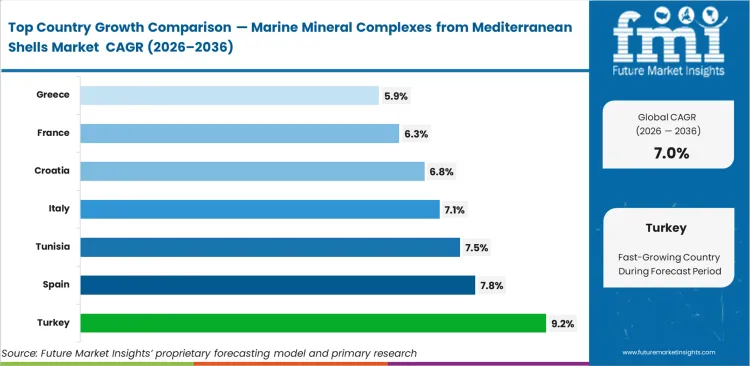
Source: Future Market Insights (FMI) analysis, based on proprietary forecasting model and primary research
Europe Marine Mineral Complexes from Mediterranean Shells Market Analysis
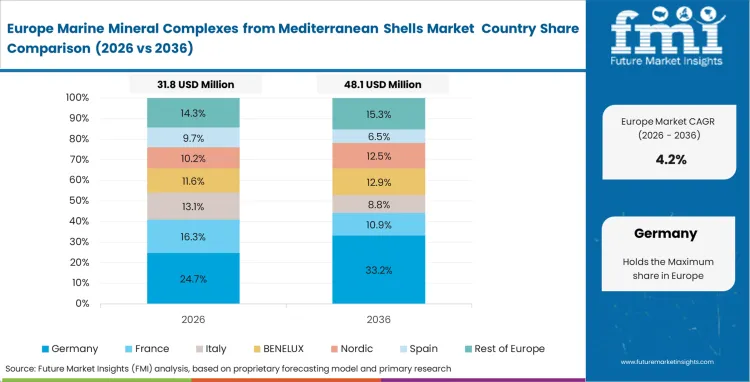
Europe remains central to this market because shellfish farming, seafood processing, and downstream mineral conversion already sit within the same operating corridor across much of the Mediterranean belt. Dense aquaculture activity gives processors a more workable shell collection base than in regions where feedstock is scattered across smaller landing points and disconnected waste streams. Tight purity requirements for food, nutraceutical, cosmetic, and biomaterial applications also favor a region where traceability, contaminant control, and processing discipline carry real commercial weight. Growth across Europe is being shaped less by raw shell availability alone than by how efficiently shells can be collected, cleaned, calcined, and converted into consistent mineral inputs for higher-value uses.
- Spain: Spain remains one of the strongest markets because shell collection and primary seafood processing are concentrated enough to support efficient mineral recovery at a commercial scale. Cooperative handling networks and shorter movement between source and conversion sites reduce feedstock loss and improve operating continuity. This advantage keeps conversion economics more favorable than in fragmented coastal systems. Demand for marine mineral complexes from Mediterranean shells in Spain is expected to rise 7.8% CAGR from 2026 to 2036, reflecting a stronger base in scale, throughput, and shell access.
- Italy: Italy draws strength from its long-standing mollusc production base and from the closer fit between shell-derived minerals and higher-value medical, dental, and specialty applications. More demanding qualification pathways slow the pace of fresh capacity additions, yet they also favor processors that can maintain tighter purification and certification standards. Premium application focus gives Italy a firmer role in value-added mineral conversion, and sales are projected to increase at a 7.1% CAGR during the forecast period. Commercial relevance here comes more from product mix and process control than from raw volume alone.
- France: Mature oyster and shellfish processing routes keep France commercially relevant, especially where traceable biogenic minerals are required in cosmetic, nutraceutical, and selected specialty-material formats. Existing supply lines support steadier integration of shell recovery into established seafood operations, which reduces the need for entirely new collection infrastructure. France is forecast to register 6.3% CAGR in demand for marine mineral complexes from Mediterranean shells over the 2026 to 2036 period. Slower expansion still leaves the country important, where supply reliability and specification control carry more weight than aggressive capacity buildout.
- Croatia: Recovery economics in Croatia are improving because a larger share of shell waste is beginning to move toward usable mineral conversion rather than disposal. Demand for marine mineral complexes from Mediterranean shells in Croatia is anticipated to advance at a 6.8% CAGR. Early commercial traction is likely to remain stronger in agricultural and feed-linked applications, where qualification barriers are lower and substitution against imported mineral inputs is easier to justify. Entry through lower-complexity applications gives Croatia a practical route to wider mineral-processing maturity over time.
- Greece: Fragmented shell collection and more uneven operating continuity keep Greece on a slower path than other Mediterranean countries in this market. Dispersed farming activity and more difficult movement between collection points raise handling costs and limit the efficiency of centralized calcination and purification. Wider scale will remain tied to better collection coordination and more dependable processing throughput. Sales of marine mineral complexes from Mediterranean shells in Greece are expected to increase at a 5.9% CAGR from 2026 to 2036, keeping the country in the market but on a more measured trajectory than higher-efficiency Mediterranean peers.
Middle East and Africa Marine Mineral Complexes from Mediterranean Shells Market Analysis
Expanding shellfish production, lower-cost coastal processing conditions, and rising interest in aquaculture by-product utilization keep this region relevant to the market. Shell recovery remains less mature than in Southern Europe, yet newer processing setups can incorporate waste handling and mineral conversion earlier in the facility chain, which improves operating efficiency where volumes are increasing. Cost competitiveness carries more weight here, particularly in feed, agricultural, cosmetic, and export-oriented mineral applications, where buyers are more open to new supply origins once quality thresholds are met. Future progress will depend on how quickly collection systems, purification standards, and export-grade consistency improve alongside aquaculture expansion.
- Turkey: A larger mussel farming base gives Turkey the strongest position in this regional market, as rising shell volumes improve the commercial case for domestic mineral conversion and reduce reliance on imported calcium inputs. Newer processing lines also face less retrofit burden than older facilities, which supports faster integration of shell recovery and downstream treatment. Demand for marine mineral complexes from Mediterranean shells in Turkey is expected to rise at a CAGR of 9.2% from 2026 to 2036 as domestic supply chains stabilize and qualification depth improves. Better local feedstock access keeps the country well placed for feed, nutraceutical, and export-oriented mineral applications where cost control remains important.
- Tunisia: Emerging coastal processing capacity makes Tunisia an increasingly relevant sourcing base as local aquaculture activity starts to generate a more usable shell stream for conversion. Shorter movement from shell generation points to treatment sites improves collection economics and gives early processors a more workable entry into feed, cosmetic, and selected ingredient applications. Sales of marine mineral complexes from Mediterranean shells in Tunisia are projected to increase at a 7.5% CAGR from 2026 to 2036 as this operating base strengthens. Export potential is likely to develop ahead of broader domestic value addition, which keeps Tunisia more relevant as a conversion and supply platform than as a fully mature end-use market.
FMI’s report also examines adjacent regulatory frameworks tied to aquaculture waste transport across borders, especially where shell movement, treatment, and reuse must align with environmental and traceability requirements. Morocco is likely to draw more attention over time as coastal aquaculture handling improves and shell by-product streams become easier to recover for low-to-mid value mineral applications.
Competitive Aligners for Market Players
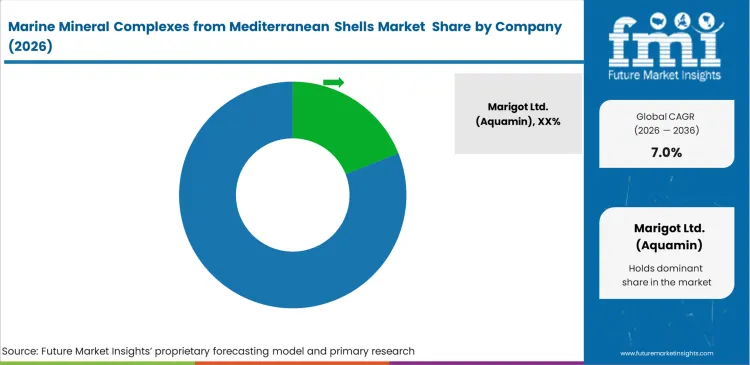
Competitive standing in this market is shaped more by purification standards and certification depth than by processing volume alone. Marigot Ltd. (Aquamin), Caltron Clays & Chemicals Pvt. Ltd., Gangotri Inorganic Pvt. Ltd., Calspar India, Neelkanth Finechem LLP, and Vinzai Chemical Industries Private Limited are relevant in supply structures where low-impurity output and controlled conversion are critical to product acceptance. Movement beyond basic crushing and washing into calibrated thermal treatment and refined mineral processing requires higher capital commitment. That shift can support stronger pricing discipline by placing suppliers in specification-sensitive demand segments. Buyer assessment of pharma-grade shell calcium carbonate usually rests on impurity control, batch consistency, and documentation strength rather than nameplate capacity alone.
Supply stability remains another important point of differentiation. Processors with established shell collection links and steady access to uniform feedstock are better placed to maintain output consistency across core production hubs. This matters because shell quality, moisture variation, and collection disruption can all affect downstream processing stability. Smaller entrants often face a slower path since parallel sourcing systems take time to organize and may not remain cost-efficient at lower throughput. Feedstock control therefore carries nearly the same weight as conversion capability in marine-derived mineral supply.
Supplement manufacturers also tend to distribute volumes across several certified suppliers rather than depend on a single source. This sourcing pattern helps reduce interruption risk tied to seasonal harvesting cycles, localized biological variation, and collection shortfalls. Multi-supplier allocation also improves continuity where buyers require stable batch characteristics over time. Traceability is expected to gain further importance where mineral feed batches must be linked back to defined coastal collection origins. This keeps source verification and documentation quality central to supplier evaluation.
Key Players in Marine Mineral Complexes from the Mediterranean Shells Market
- Marigot Ltd. (Aquamin)
- Caltron Clays & Chemicals Pvt. Ltd.
- Gangotri Inorganic Pvt. Ltd.
- Calspar India
- Neelkanth Finechem LLP
- Vinzai Chemical Industries Private Limited
Scope of the Report
| Metric | Value |
|---|---|
| Quantitative Units | USD 118.0 Million to USD 232.1 Million, at a CAGR of 7.0% |
| Market Definition | Extracted bio-minerals derived from discarded Mediterranean mollusc shells, capturing biogenic crystalline structures for industrial, nutritional, and medical applications. |
| Segmentation | Source Shell, Mineral Type, Form, Application, End Use |
| Regions Covered | North America, Latin America, Europe, Asia Pacific, Middle East and Africa |
| Countries Covered | Turkey, Spain, Tunisia, Italy, Croatia, France, Greece |
| Key Companies Profiled | Marigot Ltd. (Aquamin), Caltron Clays & Chemicals Pvt. Ltd., Gangotri Inorganic Pvt. Ltd., Calspar India, Neelkanth Finechem LLP, Vinzai Chemical Industries Private Limited |
| Forecast Period | 2026 to 2036 |
| Approach | Shell waste recovery tonnage anchored against regional mollusc production statistics. |
Source: Future Market Insights (FMI) analysis, based on proprietary forecasting model and primary research
Marine Mineral Complexes from Mediterranean Shells Market Analysis by Segments
Source Shell
- Mussel
- Oyster
- Clam
- Mixed shells
Mineral Type
- Calcium carbonate
- Hydroxyapatite
- Calcium phosphate
- Multi-mineral blends
Form
- Powder
- Granules
- Microfine slurry
Application
- Nutraceuticals
- Food fortification
- Oral care
- Biomaterials
- Feed minerals
End Use
- Ingredient suppliers
- Supplement brands
- Food formulators
- Dental labs
- Feed premixers
Region
- North America
- Latin America
- Europe
- Spain
- Italy
- France
- Greece
- Croatia
- Asia Pacific
- Middle East and Africa
- Turkey
- Tunisia
Bibliography
- Basile, M. L., Castellani, R., Mollica, F., Maccaferri, E., Frache, A., & Torre, L. (2024). Stearate-coated biogenic calcium carbonate from waste seashells as a sustainable plastic filler. ACS Omega.
- Istituto Superiore per la Protezione e la Ricerca Ambientale. (2025). Aquaculture enterprises and production. ISPRA.
- Piras, S., Galotta, A., Castellini, L., Basile, M. L., & Torre, L. (2024). Biomimetic use of food-waste sources of calcium carbonate and phosphate for sustainable materials. Materials.
- Pop, F. L., Muntean, L., & collaborators. (2024). Hydroxyapatite from mollusk shells: Characteristics and biomedical applications. PMC.
This bibliography is provided for reader reference. The full FMI report contains the complete reference list with primary source documentation.
This Report Addresses
- Regulatory pressures forcing European nutraceutical brands to adopt biogenic calcium sources over conventional geological minerals.
- Strategic integration of shell decalcification equipment directly into existing industrial mussel processing facilities across the Mediterranean basin.
- Pricing dynamics and margin expansion opportunities for aquaculture operators transitioning shell waste into revenue-generating raw materials.
- Traceability mechanisms ensuring isotopic verification of Mediterranean shell outputs for stringent medical and dental biomaterial qualification.
- Capacity constraints within specialized thermal processing facilities required to sterilize raw aquaculture waste for pharmaceutical-grade applications.
- Regional divergence in adoption rates based on baseline aquaculture volumes, heavily favoring dense processing hubs in Spain and Turkey.
- Operational friction caused by aggressive moisture absorption rates in microfine biogenic powders during high-speed encapsulation.
- Competitive positioning of incumbent extractors leveraging multi-year cooperative supply agreements against new entrants lacking localized collection networks.
Frequently Asked Questions
what are marine mineral complexes from shells?
These represent purified bio-minerals extracted exclusively from discarded mollusc shells harvested within coastal zones. This distinct raw material category captures biogenic crystalline structures, functioning primarily as nutritional supplements and medical biomaterials.
how are shell-derived mineral complexes made?
Processors integrate automated decalcification units and thermal kilns to safely calcine raw aquaculture waste. This process removes organic matter and biological pathogens, yielding sterile calcium carbonate or converting the matrix into hydroxyapatite.
are mussel shell minerals safe for supplements?
Yes, provided they undergo strict biological sterilization and mass spectrometry testing. Extractors must achieve pharmaceutical-grade heavy metal clearances to ensure these biogenic sources meet stringent European safety mandates.
who are the key suppliers in shell-derived marine calcium?
Active processors include Marigot Ltd. (Aquamin), Caltron Clays & Chemicals Pvt. Ltd., Gangotri Inorganic Pvt. Ltd., Calspar India, Neelkanth Finechem LLP, Vinzai Chemical Industries Private Limited.
what applications drive mediterranean shell mineral demand?
Nutraceutical formulation officers seek sustainable calcium sources for preventive nutrition. Medical device engineers require biocompatible hydroxyapatite for orthopedic coatings, and livestock nutritionists utilize feed-grade shell calcium to replace animal-derived bone meal.
which mediterranean countries produce the most shell feedstock?
Spain provides the largest established aquaculture volume through dense cooperative processing hubs. Turkey offers the highest growth trajectory due to rapid industrialization of domestic mussel farming, while Italy supplies premium mollusc volumes.
compare shell-derived calcium carbonate and hydroxyapatite demand?
Calcium carbonate captures the largest volume due to simple processing and broad nutraceutical use. Hydroxyapatite commands much smaller volumes but secures the highest price premiums, driven strictly by medical device and dental laboratory procurement.
What is the baseline valuation for this specific mineral sector?
The sector recorded a baseline valuation of USD 118.0 million in 2026. This figure signals strong structural transition as industrial aquaculture operators finally begin monetizing shell waste rather than paying landfill disposal fees.
What revenue expansion is projected by the end of the forecast period?
Cumulative revenue reaches USD 232.1 million by 2036. Sustained investment in centralized thermal calcination facilities drives this buildup, shifting biogenic mineral recovery from a niche circular economy project to a standardized industrial process.
Why does the Mussel segment dominate the Source Shell category?
Mussel processing generates massive, localized shell deposits directly at the factory gate. Procurement officers target these centralized waste streams because they completely eliminate the transportation friction associated with dispersed artisanal clam harvesting.
What specific mechanism keeps Calcium carbonate in the leading position?
Direct substitution capability ensures calcium carbonate maintains its dominant share. Plant managers can integrate basic shell carbonate into existing rotary presses without investing capital in the specialized machinery required for complex biomaterials.
How does moisture absorption impact the Form segment?
Microfine powders exhibit aggressive hygroscopic behavior on humid factory floors, creating constant clumping issues. Encapsulation line operators battle this mechanical friction daily, yet powder remains dominant because it avoids the chemical binders required to produce granules.
Why are Nutraceuticals driving the application segment forward?
Retail shelf placement dictates purchasing decisions rather than clinical efficacy alone. Category buyers at major pharmacy chains mandate sustainable ingredients, leaving legacy supplement brand managers no choice but to transition to biogenic sources.
What is the hidden bottleneck for Ingredient suppliers?
Raw shells harbor biological pathogens requiring intensive thermal calcination. Only a handful of Mediterranean facilities possess the specific environmental permits needed to burn off organic shell matter, creating severe capacity constraints during peak harvest months.
Which country exhibits the highest adoption speed in the region?
Turkey leads the structural transition with a 9.2% compound growth rate. Newly commissioned domestic processing lines incorporate shell decalcification technology by default, allowing local extractors to bypass the expensive retrofitting costs plaguing older European facilities.
How does Spain leverage its existing aquaculture infrastructure?
Massive cooperative processing hubs pool thousands of tons of bivalve waste weekly in Spain. Logistics managers negotiate highly favorable freight rates for bulk shell transport, eliminating the geographic fragmentation that stalls biomaterial projects elsewhere.
Why do Italian buyers pay premium prices for these complexes?
Regional medical device manufacturers heavily subsidize local shell collection networks to satisfy strict European medical device regulations. Sourcing directors prioritize chemical purity over raw volume, willingly paying premiums for converted medical-grade hydroxyapatite.
What operational risk do brands face when switching to biogenic calcium?
Trace organic matrices alter solubility rates unpredictably during high-shear blending. Brands attempting to swap geologic calcium for marine equivalents without re-engineering their mixing workflows frequently suffer severe line-clogging issues and rejected batches.
How do seasonal fluctuations affect mineral extractors?
Shell mineralization fluctuates wildly with water temperature and harvest timing. Quality assurance managers must adjust their extraction chemistry quarterly to maintain consistent calcium yields, a biological reality that disrupts static manufacturing protocols.
Why do dental laboratories specify biogenic hydroxyapatite?
Medical device engineers require highly biocompatible surfaces for implants. Coating metallic joints with shell-derived hydroxyapatite provides superior osteoconductive properties compared to synthetic variants, accelerating patient bone integration and commanding premium clinical pricing.
What prevents new entrants from capturing market share easily?
Incumbents hold deep multi-year supply agreements with major aquaculture cooperatives. Establishing a reliable feedstock pipeline takes years of localized relationship building, forcing challengers to build redundant collection logistics that destroy early profitability.
How do large buyers protect themselves against biological supply disruptions?
Procurement directors deliberately split their biomaterial contracts across multiple certified suppliers. This dual-sourcing strategy mitigates the risk of catastrophic production line shutdowns if an unpredictable localized algae bloom temporarily halts regional aquaculture harvesting.
What role does isotopic verification play in procurement?
Mediterranean shell outputs carry distinct isotopic signatures traceable to specific coastal zones. Quality control technicians use mass spectrometry to verify these signatures, preventing supplier fraud and transforming regional sourcing from a marketing claim into a hard compliance mechanism.
Preview the report firsthand - request a free sample
Get SampleGet the brochure for pricing and purchase details.
Get PDFTable of Content
- Executive Summary
- Global Market Outlook
- Demand-side Trends
- Supply-side Trends
- Technology Roadmap Analysis
- Analysis and Recommendations
- Market Overview
- Market Coverage / Taxonomy
- Market Definition / Scope / Limitations
- Research Methodology
- Chapter Orientation
- Analytical Lens and Working Hypotheses
- Market Structure, Signals, and Trend Drivers
- Benchmarking and Cross-market Comparability
- Market Sizing, Forecasting, and Opportunity Mapping
- Research Design and Evidence Framework
- Desk Research Programme (Secondary Evidence)
- Company Annual and Sustainability Reports
- Peer-reviewed Journals and Academic Literature
- Corporate Websites, Product Literature, and Technical Notes
- Earnings Decks and Investor Briefings
- Statutory Filings and Regulatory Disclosures
- Technical White Papers and Standards Notes
- Trade Journals, Industry Magazines, and Analyst Briefs
- Conference Proceedings, Webinars, and Seminar Materials
- Government Statistics Portals and Public Data Releases
- Press Releases and Reputable Media Coverage
- Specialist Newsletters and Curated Briefings
- Sector Databases and Reference Repositories
- FMI Internal Proprietary Databases and Historical Market Datasets
- Subscription Datasets and Paid Sources
- Social Channels, Communities, and Digital Listening Inputs
- Additional Desk Sources
- Expert Input and Fieldwork (Primary Evidence)
- Primary Modes
- Qualitative Interviews and Expert Elicitation
- Quantitative Surveys and Structured Data Capture
- Blended Approach
- Why Primary Evidence is Used
- Field Techniques
- Interviews
- Surveys
- Focus Groups
- Observational and In-context Research
- Social and Community Interactions
- Stakeholder Universe Engaged
- C-suite Leaders
- Board Members
- Presidents and Vice Presidents
- R&D and Innovation Heads
- Technical Specialists
- Domain Subject-matter Experts
- Scientists
- Physicians and Other Healthcare Professionals
- Governance, Ethics, and Data Stewardship
- Research Ethics
- Data Integrity and Handling
- Primary Modes
- Tooling, Models, and Reference Databases
- Desk Research Programme (Secondary Evidence)
- Data Engineering and Model Build
- Data Acquisition and Ingestion
- Cleaning, Normalisation, and Verification
- Synthesis, Triangulation, and Analysis
- Quality Assurance and Audit Trail
- Market Background
- Market Dynamics
- Drivers
- Restraints
- Opportunity
- Trends
- Scenario Forecast
- Demand in Optimistic Scenario
- Demand in Likely Scenario
- Demand in Conservative Scenario
- Opportunity Map Analysis
- Product Life Cycle Analysis
- Supply Chain Analysis
- Investment Feasibility Matrix
- Value Chain Analysis
- PESTLE and Porter’s Analysis
- Regulatory Landscape
- Regional Parent Market Outlook
- Production and Consumption Statistics
- Import and Export Statistics
- Market Dynamics
- Global Market Analysis 2021 to 2025 and Forecast, 2026 to 2036
- Historical Market Size Value (USD Million) Analysis, 2021 to 2025
- Current and Future Market Size Value (USD Million) Projections, 2026 to 2036
- Y-o-Y Growth Trend Analysis
- Absolute $ Opportunity Analysis
- Global Market Pricing Analysis 2021 to 2025 and Forecast 2026 to 2036
- Global Market Analysis 2021 to 2025 and Forecast 2026 to 2036, By Source Shell
- Introduction / Key Findings
- Historical Market Size Value (USD Million) Analysis By Source Shell , 2021 to 2025
- Current and Future Market Size Value (USD Million) Analysis and Forecast By Source Shell , 2026 to 2036
- Mussel
- Oyster
- Clam
- Mixed shells
- Mussel
- Y-o-Y Growth Trend Analysis By Source Shell , 2021 to 2025
- Absolute $ Opportunity Analysis By Source Shell , 2026 to 2036
- Global Market Analysis 2021 to 2025 and Forecast 2026 to 2036, By Mineral Type
- Introduction / Key Findings
- Historical Market Size Value (USD Million) Analysis By Mineral Type, 2021 to 2025
- Current and Future Market Size Value (USD Million) Analysis and Forecast By Mineral Type, 2026 to 2036
- Calcium carbonate
- Hydroxyapatite
- Calcium phosphate
- Multi-mineral blends
- Calcium carbonate
- Y-o-Y Growth Trend Analysis By Mineral Type, 2021 to 2025
- Absolute $ Opportunity Analysis By Mineral Type, 2026 to 2036
- Global Market Analysis 2021 to 2025 and Forecast 2026 to 2036, By Form
- Introduction / Key Findings
- Historical Market Size Value (USD Million) Analysis By Form, 2021 to 2025
- Current and Future Market Size Value (USD Million) Analysis and Forecast By Form, 2026 to 2036
- Powder
- Granules
- Microfine slurry
- Powder
- Y-o-Y Growth Trend Analysis By Form, 2021 to 2025
- Absolute $ Opportunity Analysis By Form, 2026 to 2036
- Global Market Analysis 2021 to 2025 and Forecast 2026 to 2036, By Application
- Introduction / Key Findings
- Historical Market Size Value (USD Million) Analysis By Application, 2021 to 2025
- Current and Future Market Size Value (USD Million) Analysis and Forecast By Application, 2026 to 2036
- Nutraceuticals
- Food fortification
- Oral care
- Biomaterials
- Feed minerals
- Nutraceuticals
- Y-o-Y Growth Trend Analysis By Application, 2021 to 2025
- Absolute $ Opportunity Analysis By Application, 2026 to 2036
- Global Market Analysis 2021 to 2025 and Forecast 2026 to 2036, By End Use
- Introduction / Key Findings
- Historical Market Size Value (USD Million) Analysis By End Use, 2021 to 2025
- Current and Future Market Size Value (USD Million) Analysis and Forecast By End Use, 2026 to 2036
- Ingredient suppliers
- Supplement brands
- Food formulators
- Dental labs
- Feed premixers
- Ingredient suppliers
- Y-o-Y Growth Trend Analysis By End Use, 2021 to 2025
- Absolute $ Opportunity Analysis By End Use, 2026 to 2036
- Global Market Analysis 2021 to 2025 and Forecast 2026 to 2036, By Region
- Introduction
- Historical Market Size Value (USD Million) Analysis By Region, 2021 to 2025
- Current Market Size Value (USD Million) Analysis and Forecast By Region, 2026 to 2036
- North America
- Latin America
- Western Europe
- Eastern Europe
- East Asia
- South Asia and Pacific
- Middle East & Africa
- Market Attractiveness Analysis By Region
- North America Market Analysis 2021 to 2025 and Forecast 2026 to 2036, By Country
- Historical Market Size Value (USD Million) Trend Analysis By Market Taxonomy, 2021 to 2025
- Market Size Value (USD Million) Forecast By Market Taxonomy, 2026 to 2036
- By Country
- USA
- Canada
- Mexico
- By Source Shell
- By Mineral Type
- By Form
- By Application
- By End Use
- By Country
- Market Attractiveness Analysis
- By Country
- By Source Shell
- By Mineral Type
- By Form
- By Application
- By End Use
- Key Takeaways
- Latin America Market Analysis 2021 to 2025 and Forecast 2026 to 2036, By Country
- Historical Market Size Value (USD Million) Trend Analysis By Market Taxonomy, 2021 to 2025
- Market Size Value (USD Million) Forecast By Market Taxonomy, 2026 to 2036
- By Country
- Brazil
- Chile
- Rest of Latin America
- By Source Shell
- By Mineral Type
- By Form
- By Application
- By End Use
- By Country
- Market Attractiveness Analysis
- By Country
- By Source Shell
- By Mineral Type
- By Form
- By Application
- By End Use
- Key Takeaways
- Western Europe Market Analysis 2021 to 2025 and Forecast 2026 to 2036, By Country
- Historical Market Size Value (USD Million) Trend Analysis By Market Taxonomy, 2021 to 2025
- Market Size Value (USD Million) Forecast By Market Taxonomy, 2026 to 2036
- By Country
- Germany
- UK
- Italy
- Spain
- France
- Nordic
- BENELUX
- Rest of Western Europe
- By Source Shell
- By Mineral Type
- By Form
- By Application
- By End Use
- By Country
- Market Attractiveness Analysis
- By Country
- By Source Shell
- By Mineral Type
- By Form
- By Application
- By End Use
- Key Takeaways
- Eastern Europe Market Analysis 2021 to 2025 and Forecast 2026 to 2036, By Country
- Historical Market Size Value (USD Million) Trend Analysis By Market Taxonomy, 2021 to 2025
- Market Size Value (USD Million) Forecast By Market Taxonomy, 2026 to 2036
- By Country
- Russia
- Poland
- Hungary
- Balkan & Baltic
- Rest of Eastern Europe
- By Source Shell
- By Mineral Type
- By Form
- By Application
- By End Use
- By Country
- Market Attractiveness Analysis
- By Country
- By Source Shell
- By Mineral Type
- By Form
- By Application
- By End Use
- Key Takeaways
- East Asia Market Analysis 2021 to 2025 and Forecast 2026 to 2036, By Country
- Historical Market Size Value (USD Million) Trend Analysis By Market Taxonomy, 2021 to 2025
- Market Size Value (USD Million) Forecast By Market Taxonomy, 2026 to 2036
- By Country
- China
- Japan
- South Korea
- By Source Shell
- By Mineral Type
- By Form
- By Application
- By End Use
- By Country
- Market Attractiveness Analysis
- By Country
- By Source Shell
- By Mineral Type
- By Form
- By Application
- By End Use
- Key Takeaways
- South Asia and Pacific Market Analysis 2021 to 2025 and Forecast 2026 to 2036, By Country
- Historical Market Size Value (USD Million) Trend Analysis By Market Taxonomy, 2021 to 2025
- Market Size Value (USD Million) Forecast By Market Taxonomy, 2026 to 2036
- By Country
- India
- ASEAN
- Australia & New Zealand
- Rest of South Asia and Pacific
- By Source Shell
- By Mineral Type
- By Form
- By Application
- By End Use
- By Country
- Market Attractiveness Analysis
- By Country
- By Source Shell
- By Mineral Type
- By Form
- By Application
- By End Use
- Key Takeaways
- Middle East & Africa Market Analysis 2021 to 2025 and Forecast 2026 to 2036, By Country
- Historical Market Size Value (USD Million) Trend Analysis By Market Taxonomy, 2021 to 2025
- Market Size Value (USD Million) Forecast By Market Taxonomy, 2026 to 2036
- By Country
- Kingdom of Saudi Arabia
- Other GCC Countries
- Turkiye
- South Africa
- Other African Union
- Rest of Middle East & Africa
- By Source Shell
- By Mineral Type
- By Form
- By Application
- By End Use
- By Country
- Market Attractiveness Analysis
- By Country
- By Source Shell
- By Mineral Type
- By Form
- By Application
- By End Use
- Key Takeaways
- Key Countries Market Analysis
- USA
- Pricing Analysis
- Market Share Analysis, 2025
- By Source Shell
- By Mineral Type
- By Form
- By Application
- By End Use
- Canada
- Pricing Analysis
- Market Share Analysis, 2025
- By Source Shell
- By Mineral Type
- By Form
- By Application
- By End Use
- Mexico
- Pricing Analysis
- Market Share Analysis, 2025
- By Source Shell
- By Mineral Type
- By Form
- By Application
- By End Use
- Brazil
- Pricing Analysis
- Market Share Analysis, 2025
- By Source Shell
- By Mineral Type
- By Form
- By Application
- By End Use
- Chile
- Pricing Analysis
- Market Share Analysis, 2025
- By Source Shell
- By Mineral Type
- By Form
- By Application
- By End Use
- Germany
- Pricing Analysis
- Market Share Analysis, 2025
- By Source Shell
- By Mineral Type
- By Form
- By Application
- By End Use
- UK
- Pricing Analysis
- Market Share Analysis, 2025
- By Source Shell
- By Mineral Type
- By Form
- By Application
- By End Use
- Italy
- Pricing Analysis
- Market Share Analysis, 2025
- By Source Shell
- By Mineral Type
- By Form
- By Application
- By End Use
- Spain
- Pricing Analysis
- Market Share Analysis, 2025
- By Source Shell
- By Mineral Type
- By Form
- By Application
- By End Use
- France
- Pricing Analysis
- Market Share Analysis, 2025
- By Source Shell
- By Mineral Type
- By Form
- By Application
- By End Use
- India
- Pricing Analysis
- Market Share Analysis, 2025
- By Source Shell
- By Mineral Type
- By Form
- By Application
- By End Use
- ASEAN
- Pricing Analysis
- Market Share Analysis, 2025
- By Source Shell
- By Mineral Type
- By Form
- By Application
- By End Use
- Australia & New Zealand
- Pricing Analysis
- Market Share Analysis, 2025
- By Source Shell
- By Mineral Type
- By Form
- By Application
- By End Use
- China
- Pricing Analysis
- Market Share Analysis, 2025
- By Source Shell
- By Mineral Type
- By Form
- By Application
- By End Use
- Japan
- Pricing Analysis
- Market Share Analysis, 2025
- By Source Shell
- By Mineral Type
- By Form
- By Application
- By End Use
- South Korea
- Pricing Analysis
- Market Share Analysis, 2025
- By Source Shell
- By Mineral Type
- By Form
- By Application
- By End Use
- Russia
- Pricing Analysis
- Market Share Analysis, 2025
- By Source Shell
- By Mineral Type
- By Form
- By Application
- By End Use
- Poland
- Pricing Analysis
- Market Share Analysis, 2025
- By Source Shell
- By Mineral Type
- By Form
- By Application
- By End Use
- Hungary
- Pricing Analysis
- Market Share Analysis, 2025
- By Source Shell
- By Mineral Type
- By Form
- By Application
- By End Use
- Kingdom of Saudi Arabia
- Pricing Analysis
- Market Share Analysis, 2025
- By Source Shell
- By Mineral Type
- By Form
- By Application
- By End Use
- Turkiye
- Pricing Analysis
- Market Share Analysis, 2025
- By Source Shell
- By Mineral Type
- By Form
- By Application
- By End Use
- South Africa
- Pricing Analysis
- Market Share Analysis, 2025
- By Source Shell
- By Mineral Type
- By Form
- By Application
- By End Use
- USA
- Market Structure Analysis
- Competition Dashboard
- Competition Benchmarking
- Market Share Analysis of Top Players
- By Region
- By Source Shell
- By Mineral Type
- By Form
- By Application
- By End Use
- Competition Analysis
- Competition Deep Dive
- Marigot Ltd. (Aquamin)
- Overview
- Product Portfolio
- Profitability by Market Segments (Product/Age /Sales Channel/Region)
- Sales Footprint
- Strategy Overview
- Marketing Strategy
- Product Strategy
- Channel Strategy
- Caltron Clays & Chemicals Pvt. Ltd.
- Gangotri Inorganic Pvt. Ltd.
- Calspar India
- Neelkanth Finechem LLP
- Vinzai Chemical Industries Private Limited
- Marigot Ltd. (Aquamin)
- Competition Deep Dive
- Assumptions & Acronyms Used


