

- Industry Size (2026)
- USD 170.2 Mn
- Forecast (2036)
- USD 180.2 Mn
- CAGR (2026 to 2036)
- 5.9%
Citrus Pectin from Mediterranean Juice Side Streams Market Size, Market Forecast and Outlook By FMI
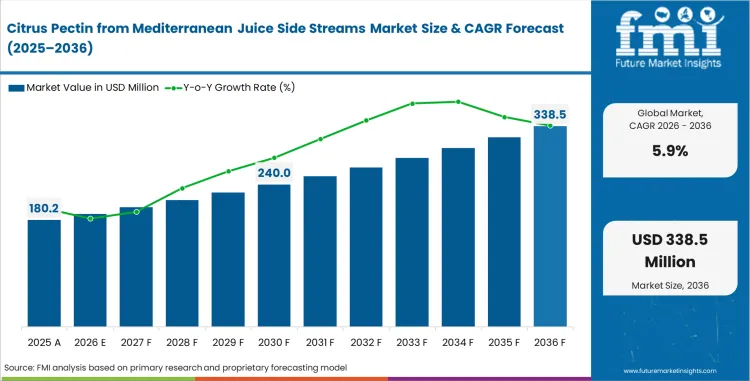
The citrus pectin from Mediterranean juice side streams market crossed a valuation of USD 170.2 million in 2025. Revenue is expected to reach USD 180.2 million in 2026 at a CAGR of 5.9% during the forecast period. The market is projected to reach USD 319.7 million by 2036, supported by sustained investment and continued clean-label reformulation activity as manufacturers reassess ingredient systems across food and beverage applications.
Summary of Citrus Pectin from Mediterranean Juice Side Streams Market
- Market Snapshot
- Citrus pectin from Mediterranean juice side streams market was USD 170.2 million in 2025 and is projected to reach USD 319.7 million by 2036.
- Market is expected to expand at a 5.9% CAGR from 2026 to 2036, generating an incremental opportunity of USD 139.5 million across ten years.
- Specialty hydrocolloid and circular-bioeconomy ingredient space relies on feedstock access, extraction expertise, and application-grade consistency for commercial strength.
- Supply structure remains closely linked to juice-industry side streams, with orange peel, pulp, and seeds serving as a major valorization base for pectin recovery.
- Demand and Growth Drivers
- Food companies are expanding use of citrus pectin where they need plant-based gelling and stabilizing systems that can meet clean-label targets without creating major reformulation risk.
- Citrus side-stream valorization continues gaining commercial relevance across Europe and broader Mediterranean processing regions, supported by large orange and citrus residue volumes entering industrial recovery streams instead of disposal channels.
- Beverage, dairy, fruit preparation, and low-sugar formulation activity continues supporting pectin demand, especially across low-pH systems needing stable texture and suspension performance.
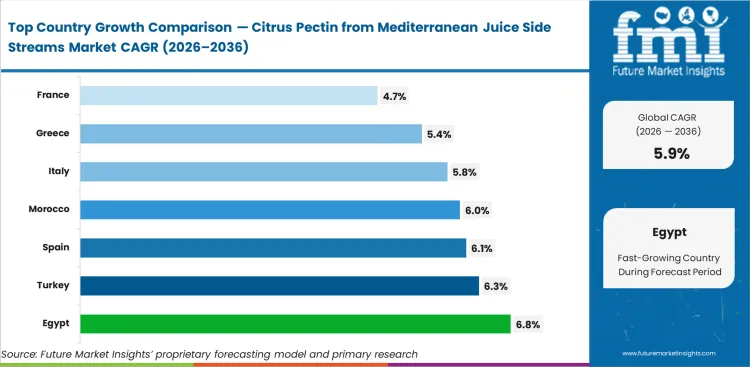
- Egypt is projected to witness 6.8% CAGR in citrus pectin from Mediterranean juice side streams market through 2036, followed by Turkey at 6.3%, Spain at 6.1%, Morocco at 6.0%, Italy at 5.8%, Greece at 5.4%, and France at 4.7%.
- Feedstock seasonality, extraction-cost sensitivity, and pressure to maintain uniform methylation and viscosity specifications continue placing limits on market expansion.
- Product and Segment View
- Market covers citrus-derived pectin recovered mainly from orange, lemon, mandarin, grapefruit, and bitter orange side streams for gelling, thickening, and stabilizing functions across food, beverage, pharma, and personal care applications.
- Core commercial grades include high methoxyl, low methoxyl, amidated, and modified pectin, while extraction routes include conventional acid systems along with emerging organic-acid, microwave-assisted, and ultrasound-assisted approaches.
- Orange leads source segment with 58.0% share, supported by substantial orange juice side-stream availability across Europe and broader Mediterranean processing regions.
- High methoxyl leads grade segment with 49.0% share, reflecting sustained use across jams, fruit preparations, and standard acidic food applications.
- Jams and fillings lead the application segment with 31.0% share, since fruit-based systems continue absorbing a significant portion of commercial pectin demand.
- Conventional acid leads the extraction route segment with 62.0% share, supported by its established industrial position despite rising interest in greener processing routes.
- Food and beverage leads the end use segment with 74.0% share, while pharmaceuticals and nutraceuticals remain smaller but commercially relevant outlets for higher-purity grades.
- Scope includes pectin recovered from Mediterranean juice-processing side streams, excluding apple pectin, sugar beet pectin, non-Mediterranean citrus feedstock, and broad hydrocolloid blends not primarily based on Mediterranean citrus by-products.
- Geography and Competitive Outlook
- Egypt, Turkey, and Spain remain strongest growth engines, while Italy continues serving as a strategically important feedstock-to-processing link across Mediterranean pectin trade.
- Competitive position depends on extraction capability, application support, citrus-peel sourcing strength, and capacity to deliver consistent grades across beverage, dairy, fruit, and healthcare demand centers.
- Key companies include Tate & Lyle, Cargill, CEAMSA, Herbstreith & Fox, Silvateam, and dsm-firmenich.
Key Takeaways, Market Size, and Forecast
- Citrus Pectin from Mediterranean Juice Side Streams Market is projected to grow from USD 180.2 million in 2026 to USD 319.7 million by 2036, at a CAGR of 5.9%.
- The citrus pectin from Mediterranean juice side streams market was valued at USD 170.2 million in 2025.
- By 2036, the Citrus Pectin from Mediterranean Juice Side Streams Market is expected to be worth USD 319.7 million.
- From 2026 to 2036, the market is projected to expand at a CAGR of 5.9%.
- The market is projected to create an incremental opportunity of USD 139.5 million between 2026 and 2036.
- In 2026, Orange is expected to account for 58.0% of the source segment.
- Egypt (6.8%) and Turkey (6.3%) are two of the fastest growing markets.
Ingredient manufacturers are showing increasing commercial interest in citrus pectin sourced from Mediterranean juice side streams. This trend is driven by the commercial advantage of converting peel residue into a functional ingredient stream that supports raw material efficiency, waste reduction, and cleaner label positioning. Juice processors across Spain, Italy, Turkey, Greece, and parts of North Africa are generating substantial citrus peel residues, giving pectin producers a dependable raw material base without reliance on dedicated cultivation for extraction. This supply structure helps improve raw material utilization and supports margin control for extractors, while also strengthening the commercial appeal of pectin in food, beverage, nutraceutical, and personal care applications.
Market outlook remains positive because formulators continue valuing citrus pectin for gelling, thickening, stabilizing, and texturizing performance across jam, dairy, confectionery, bakery, beverage, and supplement categories. Mediterranean origin is adding extra appeal in premium product positioning, particularly in applications tied to traceability, natural-origin labeling, and upcycled ingredient value. Demand is rising because brands need plant-derived stabilizers that can replace synthetic additives without disrupting texture, shelf stability, or formulation familiarity in consumer-facing products.
Commercial progress is also hinging on extraction efficiency, raw material uniformity, seasonal fruit availability, and energy expenses at processing facilities. Suppliers with stronger purification control, tighter viscosity specifications, and direct sourcing relationships with juice processors are more likely to win long-term contracts, especially in applications where batch reproducibility matters more than price. Consistent output, reliable functionality, and stable sourcing discipline are keeping proven producers in a favorable position as buyer expectations around performance, traceability, and sustainability continue rising.
Demand for citrus pectin from Mediterranean juice side streams in Egypt is anticipated to rise at a CAGR of 6.8% through 2036. Sales of citrus pectin from Mediterranean juice side streams in Turkey are expected to increase at a CAGR of 6.3% during the forecast period, supported by continued investment in processing infrastructure. The citrus pectin from Mediterranean juice side streams market in Spain is poised to expand at a CAGR of 6.1% through 2036 as established extraction facilities continue to improve output efficiency. Morocco is set to record a CAGR of 6.0% in citrus pectin from Mediterranean juice side streams during the assessment period. Citrus pectin from Mediterranean juice side streams adoption in Italy is likely to advance at a CAGR of 5.8% by 2036, supported by strong local peel availability. Greece is projected to witness 5.4% CAGR in the citrus pectin from Mediterranean juice side streams market through 2036. France is set to record a comparatively slower CAGR of 4.7% in citrus pectin from Mediterranean juice side streams during the assessment period, reflecting a more mature application base. Differences across these markets mainly reflect feedstock access, processing depth, and the pace of commercial demand development.
Citrus Pectin from Mediterranean Juice Side Streams Market Key Takeaways
| Metric | Details |
|---|---|
| Industry Size (2026) | USD 180.2 million |
| Industry Value (2036) | USD 319.7 million |
| CAGR (2026-2036) | 5.9% |
Source: Future Market Insights (FMI) analysis, based on proprietary forecasting model and primary research
Segmental Analysis
Citrus Pectin from Mediterranean Juice Side Streams Market Analysis by Source
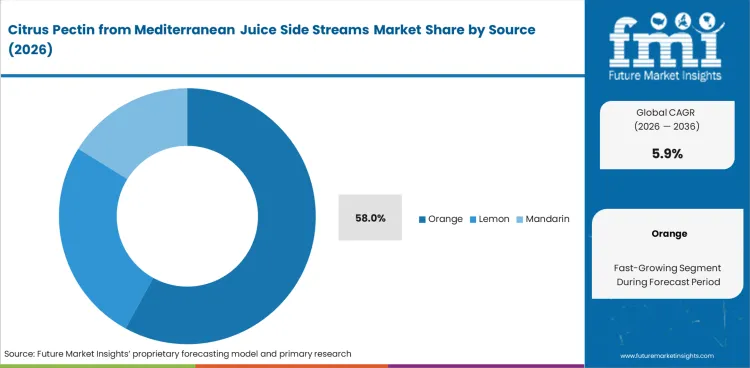
Orange processing across Mediterranean citrus belts provides the most dependable feedstock base for pectin extraction, but buyer preference is shaped not only by peel volume; year-round storage discipline and batch consistency are equally important for contract retention. Stable peel availability, familiar extraction practices, and lower collection friction are keeping orange-derived input commercially attractive compared with narrower citrus streams. In 2026, the orange segment is poised to account for 58.0% of market share. Seasonal harvest compression is still determining purchase timing, storage planning, and annual contract structures across pectin supply networks. To secure consistent annual volumes, buyers are proactively implementing storage strategies. This investment is necessary because manufacturing cycles begin before the fresh peel season is fully underway. Year-round supply also requires warehousing capacity from downstream buyers.
- Feedstock baseline reliance: Commercial orange processing is generating heavy peel output close to extraction units, reducing transit loss and helping maintain fresher raw material quality. Direct sourcing from major juicing clusters is supporting steadier inbound flow and tighter cost control across the supply chain.
- Seasonal operational constraints: Harvest timing across Mediterranean citrus zones is narrowing the fresh extraction window, placing added pressure on inventory planning and warehouse readiness. Extended storage capacity is becoming essential for processors aiming to maintain continuous supply outside peak crushing periods.
- Long-term agricultural shifts: Climatic variability is altering crop volume, peel thickness, and composition across key producing areas. Multi-origin sourcing strategies are gaining importance as suppliers work to reduce exposure to local crop stress and seasonal disruption.
Citrus Pectin from Mediterranean Juice Side Streams Market Analysis by Grade
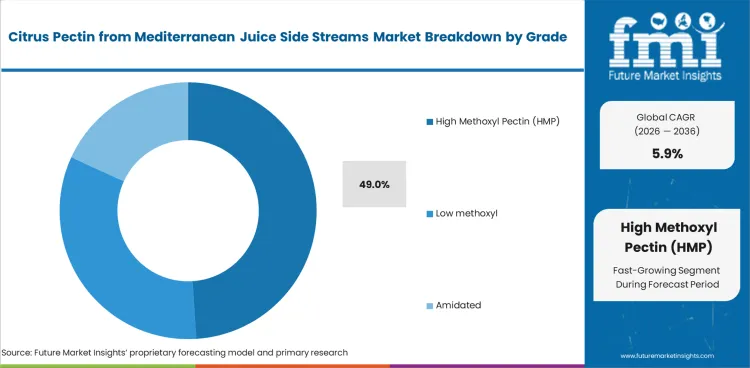
High methoxyl pectin (HMP) is still a key ingredient in many fruit formulations. Its gelling properties are well-suited to the established jam, preserve, and filling systems prevalent in large-scale food manufacturing. HMP remains preferred in mature production lines because it fits existing high-sugar, low-pH systems with less process disruption, reducing the risk of longer validation cycles or texture failure during scale-up. However, slight variations in peel chemistry across Mediterranean supply batches can still impact viscosity consistency. Thorough technical qualification remains a crucial part of the supplier approval process. The high methoxyl segment is expected to hold 49.0% share in 2026. Any mismatch in gel strength, set time, or rheology can disrupt line efficiency and raise rejection risk during commercial production.
- Initial specification selection: Formulation teams are assessing set speed, gel firmness, and cooking tolerance during early product trials. Equipment compatibility is carrying equal importance, especially in legacy factories built around long-established preserve and fruit filling recipes.
- Rigorous qualification testing: Rheological consistency is guiding supplier acceptance during plant validation and scale-up. Non-conforming material is often removed early from qualification pools to avoid texture failure, waste generation, and costly rework inside commercial batches.
- Industrial scale-up execution: Large-volume production is demanding repeatable viscosity performance across every shipment. Supply agreements are increasingly tying vendor retention to narrow tolerance bands, creating stronger pressure for uniformity across high methoxyl pectin deliveries.
Citrus Pectin from Mediterranean Juice Side Streams Market Analysis by Application
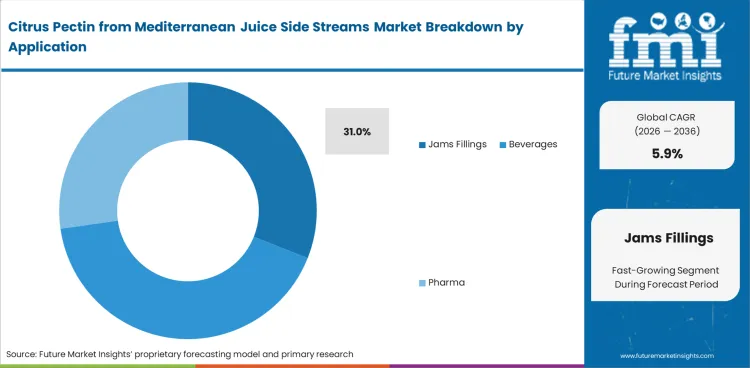
The jams fillings segment is anticipated to capture 31.0% of market share in 2026. Any inconsistency in grade selection or dosing practice can lead to texture drift, liquid separation, and reduced visual quality across finished packs. Fruit processors continue relying on pectin in jams and fillings because poor gel control affects not just texture, but also fill performance, visual consistency, and shelf-life stability across high-volume production runs. Natural stabilizer demand is also rising as brands move away from synthetic texturizers in consumer-facing recipes. Extended thermal exposure during cooking and long storage periods is placing extra emphasis on pectin performance that remains stable from kettle to shelf.
- Structural failure prevention: Correct pectin use is limiting separation during transport, storage, and variable distribution temperatures. Continuous viscosity checks along the production line are helping maintain spread texture and filling integrity across packed products.
- Unresolved processing challenges: Fruit acidity is varying naturally from batch to batch, altering set behavior during commercial runs. Adaptable pectin grades are becoming more valuable in high-volume operations that need dependable performance under shifting pH conditions.
- Commercial optimization requirements: Yield improvement depends on disciplined temperature control during concentration and setting. Processing parameters are being fine-tuned carefully to support stable gel formation without compromising throughput or finished texture.
Citrus Pectin from Mediterranean Juice Side Streams Market Analysis by Extraction Route
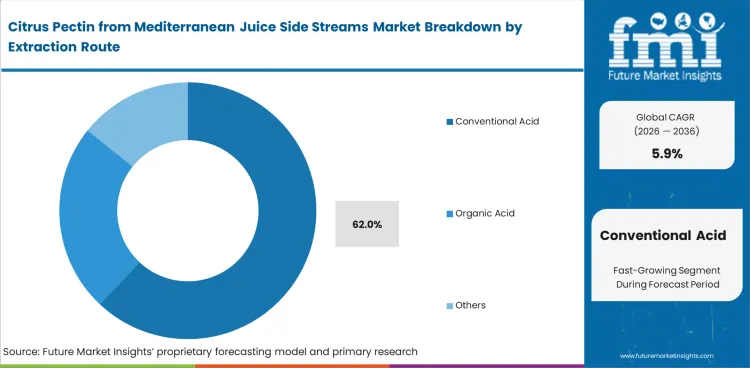
Conventional acid extraction remains the leading route because factories are already built around it, plant teams know how to run it, and buyers trust its output consistency. The conventional acid segment is forecast to command 62.0% share in 2026. Familiar processing behavior across changing peel qualities is preserving its relevance in large-scale commercial settings. Wastewater treatment costs, corrosion exposure, and tighter environmental expectations are adding pressure to upgrade older production assets. Long-term competitiveness depends on whether processors can preserve extraction yield while lowering wastewater burden, corrosion-related maintenance, and energy intensity across older plant infrastructure.
- Legacy supplier capability: Mature extraction plants are continuing to run on long-depreciated equipment with established operating routines. Preventive maintenance programs are staying critical because acidic conditions place constant stress on piping, vessels, seals, and internal processing surfaces.
- Severe material constraints: Corrosive environments are shortening equipment life and pushing up replacement spending across many facilities. Use of higher-grade alloys and more resistant components is expanding as processors aim to protect uptime and product purity.
- Future technological development: Greener extraction systems are gaining measured commercial interest as disposal obligations and compliance costs rise. Pilot-scale work around lower-impact processing alternatives is advancing, especially in facilities evaluating sustainability gains without sacrificing viscosity yield and product functionality.
Citrus Pectin from Mediterranean Juice Side Streams Market Analysis by End Use
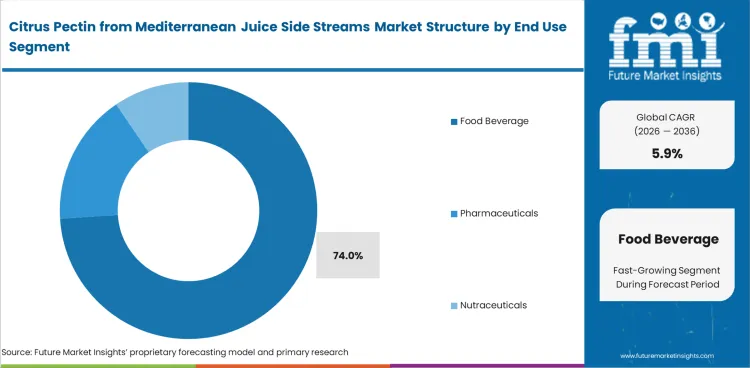
In 2026, the food beverage segment is expected to contribute 74.0% of total market share. Food and beverage use remains the main outlet for citrus pectin from Mediterranean juice side streams because natural stabilizers are becoming more important across mainstream packaged products. Reformulation activity across jams, dairy, fruit preparations, confectionery, bakery fillings, and beverage systems is strengthening demand for ingredients that support clean-label positioning without undermining shelf stability or texture. Functional replacement of older stabilizers still requires recipe adjustment, process trials, and hydration control, yet commercial interest remains broad. The widespread use of this end-use base reflects the large-scale production of packaged food and the persistent preference for familiar ingredient systems. When formulation teams underestimate hydration behavior, pH response, or dosage requirements, shelf-life stability and finished texture can become harder to maintain.
- Strategic savings: Food-grade pectin programs are offering more stable cost planning than many niche specialty hydrocolloids linked to smaller raw material streams. Long-term volume contracts are used not only to manage seasonal citrus peel fluctuation, but also to secure tighter specification control in applications where requalification costs are high.
- Hidden daily operational costs: Natural powder handling often requires longer mixing, hydration, and dispersion time inside factory operations. Line scheduling is being adjusted in many plants to manage slower incorporation rates and preserve total output efficiency.
- Comprehensive lifecycle analysis: Full formulation economics extend beyond ingredient price alone, covering process time, energy demand, yield stability, and waste reduction. Premium clean-label positioning is proving most viable in applications supported by both technical performance and clear consumer value recognition.
Citrus Pectin from Mediterranean Juice Side Streams Market Drivers, Restraints, and Opportunities
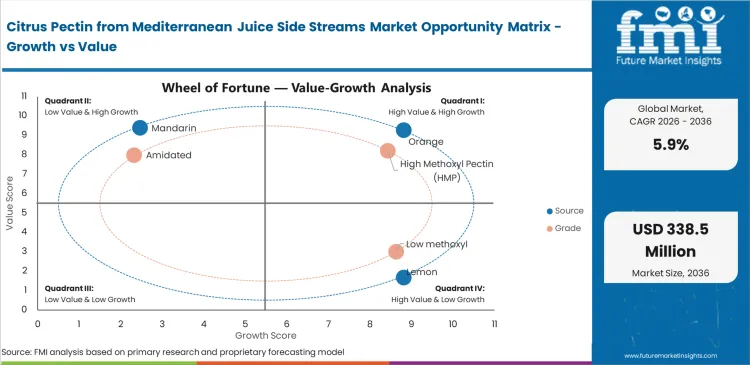
Growing interest in upcycled ingredients is pushing demand for citrus pectin recovered from Mediterranean juice side streams. Juice processors across Spain, Italy, Turkey, Greece, and nearby citrus-producing areas are generating substantial peel residue, giving extractors a concentrated raw material base without reliance on dedicated cultivation. Clean-label reformulation across jams, fillings, dairy, confectionery, and beverage systems is also accelerating adoption, since citrus pectin delivers familiar gelling, stabilizing, and texturizing performance in consumer-facing formulations. Rising attention toward waste reduction, circular processing economics, and stronger by-product value recovery is adding commercial momentum across supply networks. Wider acceptance among food formulators is also reinforcing long-term demand, especially in applications requiring dependable viscosity control and stable gel structure.
Raw material seasonality is a major restraint, currently. Peel availability follows harvest cycles, making year-round supply planning more difficult for processors lacking storage depth or diversified sourcing. Energy-intensive extraction, purification expense, wastewater treatment requirements, and quality variation across citrus lots are also limiting margin expansion. Batch inconsistency can create formulation difficulties for food manufacturers working under narrow texture and viscosity tolerances.
Commercial opportunity is strongest in supply programs that combine Mediterranean-origin traceability with repeatable technical performance, since buyers increasingly need both sustainability value and formulation reliability. Closer integration with juice processors, better extraction efficiency, and tighter quality control are opening added commercial pathways. Manufacturers are also seeking reliable natural sources that support sustainability targets and provide steady citrus pulp supply for commercial use.
Opportunities in the Citrus Pectin from Mediterranean Juice Side Streams Market
- Upcycled ingredient certification: Third-party recognition can strengthen premium positioning in categories where traceability and waste-reduction claims influence retailer acceptance and consumer messaging.
- Pharmaceutical application expansion: High-purity grades may create additional value where excipient performance, documentation quality, and regulatory consistency justify more specialized supply relationships.
- Customized performance blending: Developing precise citrus powder mixtures solves specific customer rheological problems directly. Technical sales teams capture higher margins by providing tailored formulation engineering rather than competing solely on bulk commodity pricing.
Regional Analysis
Based on regional analysis, the citrus pectin from Mediterranean juice side streams market is segmented into Southern Europe, North Africa, and Eastern Mediterranean across 40 plus countries.
.webp "Top Country Growth Comparison Citrus Pectin From Mediterranean Juice Side Streams Market Cagr (2026 2036)")
| Country | CAGR (2026 to 2036) |
|---|---|
| Egypt | 6.8% |
| Turkey | 6.3% |
| Spain | 6.1% |
| Morocco | 6.0% |
| Italy | 5.8% |
| Greece | 5.4% |
| France | 4.7% |
Source: Future Market Insights (FMI) analysis, based on proprietary forecasting model and primary research
Europe Citrus Pectin from Mediterranean Juice Side Streams Market Analysis
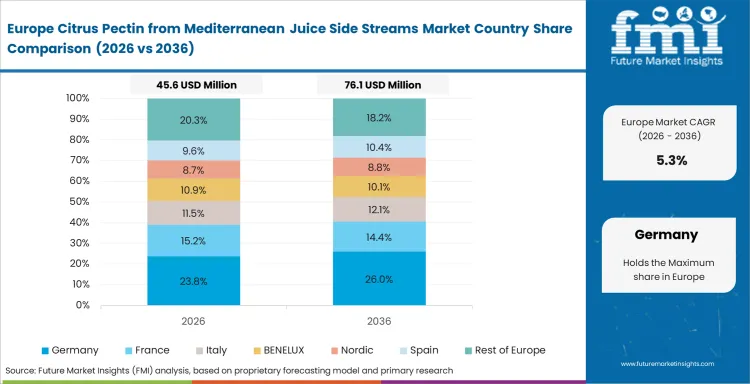
Europe has an advantage from a mature juice-processing base supported by close alignment between citrus cultivation belts and pectin recovery units. Proximity between raw material generation points and extraction sites helps preserve peel quality, reduce transit loss, and support tighter control over input consistency. Producers across this region also benefit from long operating experience in hydrocolloid processing, giving buyers stronger confidence in viscosity control, esterification performance, and batch-to-batch uniformity across food and beverage applications.
- Spain: Sales of citrus pectin from Mediterranean juice side streams in Spain are expected to increase at a CAGR of 6.1% during the forecast period. Dense orange cultivation, established extraction assets, and efficient movement of citrus residue into commercial recovery channels continue supporting Spain’s position in this market. Existing industrial capacity sustains dependable throughput, while circular-economy investment improves utilization of juice side streams across major processing zones. Strong connectivity with Europe food manufacturing networks also supports repeat demand from buyers seeking secure regional supply.
- Italy: Italy gains advantage from ample domestic peel generation, practical logistics links between citrus-growing areas and processing units, and rising interest in converting side streams into higher-value ingredients. The market for citrus pectin from Mediterranean juice side streams in Italy is expected to grow at a CAGR of 5.8% from 2026 to 2036. The demand for these ingredients is driven by preference for Mediterranean-origin sources in premium food and clean-label products. Local sourcing helps to stabilize purchasing economics for industrial users by decreasing reliance on imported feedstock.
- Greece: Greece is forecast to record steady growth at a CAGR of 5.4% by 2036. Continued alignment with green production themes and careful use of specialized extraction capacity support steady advancement across targeted end-use categories. Expansion of market in Greece is driven by manufacturing programs focused on sustainability, targeted upgrades to smaller processing systems, and a shift in commercial strategy towards premium-formulation niches instead of bulk hydrocolloid trading. This strategic focus allows local suppliers to gain an advantage in applications where traceable sourcing and differentiated ingredient positioning are essential.
- France: Demand for citrus pectin from Mediterranean juice side streams in France is anticipated to rise at a CAGR of 4.7% through 2036. France continues to offer value in premium food development, clean-label formulation work, and upcycled ingredient positioning across sophisticated consumer product categories. Buyers in this market often place greater emphasis on verified quality, application support, and ingredient story than on low-cost sourcing alone. Elevated raw material costs can narrow margin flexibility at input level, yet stronger pricing power in finished applications helps preserve commercial interest.
North Africa Citrus Pectin from Mediterranean Juice Side Streams Market Analysis
North Africa is emerging as a strong processing corridor for citrus side-stream conversion, supported by export-oriented industrial planning and a growing focus on waste-to-value manufacturing. Public and private investment continues moving agricultural by-products into more formal ingredient recovery chains, improving utilization of citrus residue from juice operations. Lower conversion costs, improving technical capability, and better infrastructure across selected processing clusters are strengthening regional appeal for international buyers seeking broader sourcing diversity.
- Egypt: The citrus pectin from Mediterranean juice side streams market in Egypt is poised to expand at a CAGR of 6.8% through 2036. Egypt is experiencing significant growth in its citrus-related industrial sector, driven by a combination of factors. These include a rapidly increasing industrial capacity linked to citrus, readily available raw materials (feedstock), and growing investments in state-of-the-art extraction facilities. This momentum is further bolstered by robust government policies that encourage the utilization of side-streams. Egypt's cost-competitiveness continues to draw foreign investment into its processing and export infrastructure. Early capacity buildout supports stronger participation in external markets and improves Egypt’s role in regional ingredient trade.
- Morocco: Morocco continues building commercial momentum through modernization of legacy juice assets, improved recovery efficiency, and favorable proximity to Europe buyers. Morocco is likely to post a CAGR of 6.0% in citrus pectin from Mediterranean juice side streams industry by 2036. Shorter supply routes support attractive freight economics, while ongoing technical development strengthens operating reliability across ingredient manufacturing lines. A broader effort to diversify export revenue through value-added agricultural processing also supports long-term market expansion.
Eastern Mediterranean Citrus Pectin from Mediterranean Juice Side Streams Market Analysis
Eastern Mediterranean market development is due to ongoing investment in extraction infrastructure, certification readiness, and the gradual expansion of export-grade production. Initial output often serves domestic industrial users, creating an operating base for quality refinement before higher-volume international sales scale further. Regional processors are also placing greater emphasis on meeting European compliance expectations, an important step for entry into higher-value ingredient channels.
- Turkey: Turkey stands out through continued investment in agricultural processing assets, productive use of historic waste streams, and strong integration with cross-border supply routes. Industrial expansion in citrus conversion is improving extraction yield, supporting broader commercial use of side streams, and strengthening Turkey’s position as a reliable secondary sourcing base for international buyers. Citrus pectin from Mediterranean juice side streams sales in Turkey are poised to grow at a CAGR of 6.3% during the assessment period. Domestic scale, logistics depth, and export orientation together create a strong operating foundation for future demand.
FMI's comprehensive report includes critical evaluations of peripheral regional extraction centers and emerging market capabilities.
Competitive Aligners for Market Players
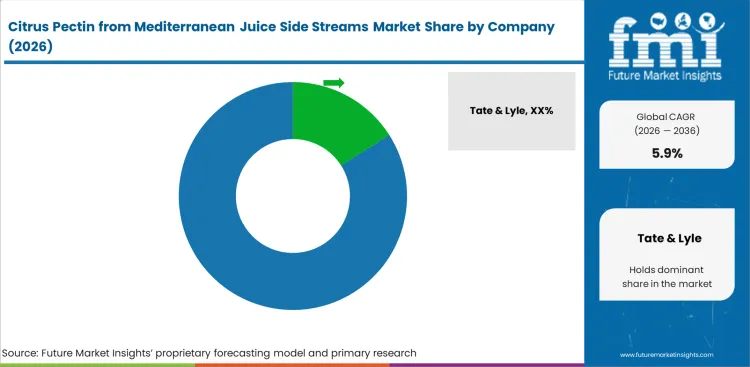
A fragmented supplier base increases vendor qualification requirements for large buyers, especially where rheology consistency, documentation, and batch reproducibility are critical. Incumbent leaders like Tate & Lyle compete directly against specialized regional entities such as CEAMSA and Silvateam based strictly on extraction capability, volume consistency, and dedicated technical application support. Proximity to Mediterranean citrus-processing clusters improves raw material access and inbound logistics efficiency, making feedstock security an important competitive advantage. Commercial partner selection is driven more by supply reliability, quality consistency, and application support than by small pricing differences, particularly in qualification-sensitive end uses.
Incumbents possess deep extraction engineering knowledge accumulated over decades of operational refinement. Maintaining tight rheological consistency across commercial batches requires deep process experience, which raises entry barriers for suppliers trying to compete without established qualification history. Established suppliers benefit from accumulated process knowledge, customer qualification history, and tighter control over performance consistency, which makes entry harder for new suppliers competing mainly on price.
Key Players in Citrus Pectin from Mediterranean Juice Side Streams Market
- Tate & Lyle
- Cargill
- CEAMSA
- Herbstreith & Fox
- Silvateam
- dsm-firmenich
Scope of the Report
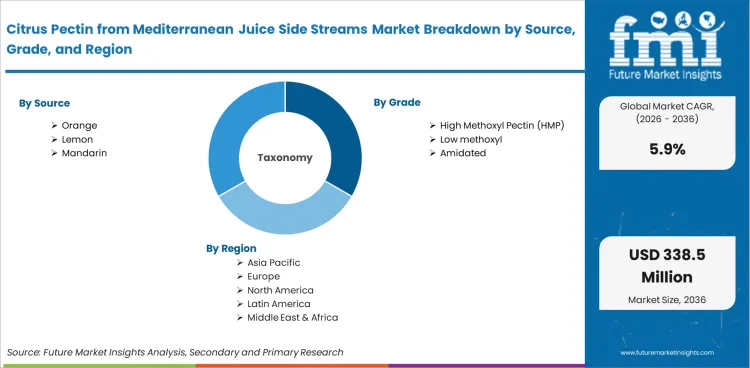
| Metric | Value |
|---|---|
| Quantitative Units | USD 180.2 million to USD 319.7 million, at a CAGR of 5.9% |
| Market Definition | Specialized hydrocolloids extracted from regional juice waste, functioning as clean-label gelling and stabilizing agents. |
| Segmentation | Source, Grade, Application, Extraction route, End use |
| Regions Covered | North America, Latin America, Europe, Asia Pacific, Middle East and Africa |
| Countries Covered | Spain, Italy, Egypt, Turkey, Morocco, Greece, France |
| Key Companies Profiled | Tate & Lyle, Cargill, CEAMSA, Herbstreith & Fox, Silvateam, dsm-firmenich |
| Forecast Period | 2026 to 2036 |
| Approach | EU pectic-substances export tonnages cross-referenced with Mediterranean production. |
Source: Future Market Insights (FMI) analysis, based on proprietary forecasting model and primary research
Citrus Pectin from Mediterranean Juice Side Streams Market Analysis by Segments
By Source:
- Orange
- Lemon
- Mandarin
- Grapefruit
- Bitter orange
By Grade:
- High methoxyl
- Low methoxyl
- Amidated
- Modified
By Application:
- Jams fillings
- Acidified dairy
- Beverages
- Confectionery
- Pharma
By Extraction route:
- Conventional acid
- Organic acid
- Microwave assisted
- Ultrasound assisted
By End use:
- Food beverage
- Pharmaceuticals
- Nutraceuticals
- Personal care
Region
- North America
- United States
- Canada
- Europe
- Germany
- United Kingdom
- France
- Italy
- Spain
- Asia Pacific
- China
- Japan
- South Korea
- Taiwan
- Singapore
- Latin America
- Brazil
- Mexico
- Argentina
- Middle East & Africa
- GCC Countries
- South Africa
- Israel
- Rest of Middle East & Africa
Bibliography
- Munir, H., Yaqoob, S., Awan, K. A., Imtiaz, A., Naveed, H., Ahmad, N., Naeem, M., Sultan, W., & Ma, Y. (2024). Unveiling the chemistry of citrus peel: Insights into nutraceutical potential and therapeutic applications.
- Sharma, S., Wani, K. M., Mujahid, S. M., Jayan, L. S., & Soundara Rajan, S. (2026). Review on pectin: Sources, properties, health benefits and its applications in food industry.
- Zannini, D., Monteforte, M., Gargiulo, L., Marino, T., Gomez d’Ayala, G., Santagata, G., & Dal Poggetto, G. (2025). Citrus wastes as source of pectin and bioactive compounds extracted via one-pot microwave process: An in situ path to modulated property control.
- Mansor, M. H., Williamson, L., Ludwikowski, D., Howard, F., & Muthana, M. (2025). Pectin extraction from citrus waste: Structural quality and yield with mineral and organic acids.
- Carpio-Rivas, V., Balois-Morales, R., Ochoa-Jiménez, V. A., Bello-Lara, J. E., Tafolla-Arellano, J. C., & Berumen-Varela, G. (2025). Characterization of pectin extracted from the peel of dragon fruit (Selenicereus cf. guatemalensis ‘Queen Purple’).
This bibliography is provided for reader reference. The full FMI report contains the complete reference list with primary source documentation.
This Report Addresses
- Companies secure supply lines through Mediterranean sourcing.
- R&D scientists replace synthetic additives with natural pectin.
- Operations heads valorize massive citrus peel waste streams.
- Strategy personnel navigate seasonal harvesting supply constraints.
- Quality managers standardize high methoxyl grade viscosity profiles.
- Process engineers optimize conventional acid extraction routes.
- Category managers launch clean-label fruit preparation products.
- Financial controllers evaluate total formulation substitution costs.
Frequently Asked Questions
What is the defining boundary of this market?
This sector focuses strictly on hydrocolloids extracted directly from regional juice-processing waste. It operates as a highly localized supply solution where regional agricultural side streams efficiently meet mass industrial stabilizer demand.
What is the baseline valuation in 2026?
Revenue reaches USD 180.2 million in 2026. Companies systematically anchor corporate budgets on this specific origin-defined valuation rather than utilizing volatile global commodity pricing indices.
What growth rate characterizes adoption?
Expansion tracks at a 5.9% CAGR, supported by continued reformulation demand in applications where citrus pectin can deliver label-friendly texture, stabilization, and gelling performance.
Why does orange lead the source segment?
Regional juice operations generate immense, concentrated orange peel volumes. Dedicated processing infrastructure already exists entirely around these primary streams, offering supply chain managers abundant, low-risk feedstock.
Which countries lead regional capacity expansion?
Egypt, Turkey, and Spain operate as the primary industrial growth engines. Sourcing teams prioritize these strategic locations to minimize complex logistics risks and secure origin-certified raw material.
Who are the dominant extraction suppliers?
Companies such as Tate & Lyle, Cargill, CEAMSA, and Silvateam are relevant participants in the market, with competitive positioning shaped by extraction capability, supply consistency, and application support.
How does citrus pectin compare with apple derivatives?
In selected acidified beverage systems, citrus pectin may be preferred where clarity, flavor fit, or formulation familiarity align better with the target product requirements.
Why do formulators prefer pectin over xanthan gum?
Pectin delivers superior natural mouthfeel and a substantially cleaner ingredient label profile in premium fruit drinks. Beverage technologists specify it to systematically avoid the artificial texture commonly associated with heavy synthetic gums.
How is bulk pricing structured?
Prices vary by specific technical grade and seasonal crop yield. Industrial departments require highly accurate, origin-specific pricing benchmarks to negotiate rigid long-term contracts effectively.
What volume minimums apply to regional supply?
Extraction facilities strictly base their minimum order quantities on large pallet-level industrial volumes to maintain continuous, highly efficient plant operational efficiency.
Why are side streams commercially valuable?
Converting juice waste into high-value functional texturizers eliminates prohibitive disposal costs while capturing entirely new revenue. This circular processing approach helps manufacturers support sustainability targets while also improving value recovery from citrus-processing waste.
What drives High methoxyl grade adoption?
High methoxyl pectin performs highly predictably in demanding high-acid, high-sugar manufacturing systems. Formulators strictly prioritize this specialized grade for traditional jams and fruit preserves to prevent structural syneresis.
Does contract manufacturing exist in Europe?
Extraction outsourcing services are expanding rapidly across the region. Brands frequently utilize specialized contract facilities to develop customized rheological grade profiles without investing massive capital in dedicated extraction equipment.
How does harvest timing affect downstream operations?
Extraction windows depend entirely on strict regional agricultural cycles. Operations heads manage raw material inventory aggressively to avoid catastrophic winter stockouts when fresh peel availability drops to zero.
Preview the report firsthand - request a free sample
Get SampleGet the brochure for pricing and purchase details.
Get PDFTable of Content
- Executive Summary
- Global Market Outlook
- Demand-side Trends
- Supply-side Trends
- Technology Roadmap Analysis
- Analysis and Recommendations
- Market Overview
- Market Coverage / Taxonomy
- Market Definition / Scope / Limitations
- Research Methodology
- Chapter Orientation
- Analytical Lens and Working Hypotheses
- Market Structure, Signals, and Trend Drivers
- Benchmarking and Cross-market Comparability
- Market Sizing, Forecasting, and Opportunity Mapping
- Research Design and Evidence Framework
- Desk Research Programme (Secondary Evidence)
- Company Annual and Sustainability Reports
- Peer-reviewed Journals and Academic Literature
- Corporate Websites, Product Literature, and Technical Notes
- Earnings Decks and Investor Briefings
- Statutory Filings and Regulatory Disclosures
- Technical White Papers and Standards Notes
- Trade Journals, Industry Magazines, and Analyst Briefs
- Conference Proceedings, Webinars, and Seminar Materials
- Government Statistics Portals and Public Data Releases
- Press Releases and Reputable Media Coverage
- Specialist Newsletters and Curated Briefings
- Sector Databases and Reference Repositories
- FMI Internal Proprietary Databases and Historical Market Datasets
- Subscription Datasets and Paid Sources
- Social Channels, Communities, and Digital Listening Inputs
- Additional Desk Sources
- Expert Input and Fieldwork (Primary Evidence)
- Primary Modes
- Qualitative Interviews and Expert Elicitation
- Quantitative Surveys and Structured Data Capture
- Blended Approach
- Why Primary Evidence is Used
- Field Techniques
- Interviews
- Surveys
- Focus Groups
- Observational and In-context Research
- Social and Community Interactions
- Stakeholder Universe Engaged
- C-suite Leaders
- Board Members
- Presidents and Vice Presidents
- R&D and Innovation Heads
- Technical Specialists
- Domain Subject-matter Experts
- Scientists
- Physicians and Other Healthcare Professionals
- Governance, Ethics, and Data Stewardship
- Research Ethics
- Data Integrity and Handling
- Primary Modes
- Tooling, Models, and Reference Databases
- Desk Research Programme (Secondary Evidence)
- Data Engineering and Model Build
- Data Acquisition and Ingestion
- Cleaning, Normalisation, and Verification
- Synthesis, Triangulation, and Analysis
- Quality Assurance and Audit Trail
- Market Background
- Market Dynamics
- Drivers
- Restraints
- Opportunity
- Trends
- Scenario Forecast
- Demand in Optimistic Scenario
- Demand in Likely Scenario
- Demand in Conservative Scenario
- Opportunity Map Analysis
- Product Life Cycle Analysis
- Supply Chain Analysis
- Investment Feasibility Matrix
- Value Chain Analysis
- PESTLE and Porter’s Analysis
- Regulatory Landscape
- Regional Parent Market Outlook
- Production and Consumption Statistics
- Import and Export Statistics
- Market Dynamics
- Global Market Analysis 2021 to 2025 and Forecast, 2026 to 2036
- Historical Market Size Value (USD Million) Analysis, 2021 to 2025
- Current and Future Market Size Value (USD Million) Projections, 2026 to 2036
- Y-o-Y Growth Trend Analysis
- Absolute $ Opportunity Analysis
- Global Market Pricing Analysis 2021 to 2025 and Forecast 2026 to 2036
- Global Market Analysis 2021 to 2025 and Forecast 2026 to 2036, By Source
- Introduction / Key Findings
- Historical Market Size Value (USD Million) Analysis By Source , 2021 to 2025
- Current and Future Market Size Value (USD Million) Analysis and Forecast By Source , 2026 to 2036
- Orange
- Lemon
- Mandarin
- Orange
- Y-o-Y Growth Trend Analysis By Source , 2021 to 2025
- Absolute $ Opportunity Analysis By Source , 2026 to 2036
- Global Market Analysis 2021 to 2025 and Forecast 2026 to 2036, By Grade
- Introduction / Key Findings
- Historical Market Size Value (USD Million) Analysis By Grade, 2021 to 2025
- Current and Future Market Size Value (USD Million) Analysis and Forecast By Grade, 2026 to 2036
- High Methoxyl Pectin (HMP)
- Low methoxyl
- Amidated
- High Methoxyl Pectin (HMP)
- Y-o-Y Growth Trend Analysis By Grade, 2021 to 2025
- Absolute $ Opportunity Analysis By Grade, 2026 to 2036
- Global Market Analysis 2021 to 2025 and Forecast 2026 to 2036, By Application
- Introduction / Key Findings
- Historical Market Size Value (USD Million) Analysis By Application, 2021 to 2025
- Current and Future Market Size Value (USD Million) Analysis and Forecast By Application, 2026 to 2036
- Jams Fillings
- Beverages
- Pharma
- Jams Fillings
- Y-o-Y Growth Trend Analysis By Application, 2021 to 2025
- Absolute $ Opportunity Analysis By Application, 2026 to 2036
- Global Market Analysis 2021 to 2025 and Forecast 2026 to 2036, By Extraction Route
- Introduction / Key Findings
- Historical Market Size Value (USD Million) Analysis By Extraction Route, 2021 to 2025
- Current and Future Market Size Value (USD Million) Analysis and Forecast By Extraction Route, 2026 to 2036
- Conventional Acid
- Organic Acid
- Others
- Conventional Acid
- Y-o-Y Growth Trend Analysis By Extraction Route, 2021 to 2025
- Absolute $ Opportunity Analysis By Extraction Route, 2026 to 2036
- Global Market Analysis 2021 to 2025 and Forecast 2026 to 2036, By End Use
- Introduction / Key Findings
- Historical Market Size Value (USD Million) Analysis By End Use, 2021 to 2025
- Current and Future Market Size Value (USD Million) Analysis and Forecast By End Use, 2026 to 2036
- Food Beverage
- Pharmaceuticals
- Nutraceuticals
- Food Beverage
- Y-o-Y Growth Trend Analysis By End Use, 2021 to 2025
- Absolute $ Opportunity Analysis By End Use, 2026 to 2036
- Global Market Analysis 2021 to 2025 and Forecast 2026 to 2036, By Region
- Introduction
- Historical Market Size Value (USD Million) Analysis By Region, 2021 to 2025
- Current Market Size Value (USD Million) Analysis and Forecast By Region, 2026 to 2036
- North America
- Latin America
- Western Europe
- Eastern Europe
- East Asia
- South Asia and Pacific
- Middle East & Africa
- Market Attractiveness Analysis By Region
- North America Market Analysis 2021 to 2025 and Forecast 2026 to 2036, By Country
- Historical Market Size Value (USD Million) Trend Analysis By Market Taxonomy, 2021 to 2025
- Market Size Value (USD Million) Forecast By Market Taxonomy, 2026 to 2036
- By Country
- USA
- Canada
- Mexico
- By Source
- By Grade
- By Application
- By Extraction Route
- By End Use
- By Country
- Market Attractiveness Analysis
- By Country
- By Source
- By Grade
- By Application
- By Extraction Route
- By End Use
- Key Takeaways
- Latin America Market Analysis 2021 to 2025 and Forecast 2026 to 2036, By Country
- Historical Market Size Value (USD Million) Trend Analysis By Market Taxonomy, 2021 to 2025
- Market Size Value (USD Million) Forecast By Market Taxonomy, 2026 to 2036
- By Country
- Brazil
- Chile
- Rest of Latin America
- By Source
- By Grade
- By Application
- By Extraction Route
- By End Use
- By Country
- Market Attractiveness Analysis
- By Country
- By Source
- By Grade
- By Application
- By Extraction Route
- By End Use
- Key Takeaways
- Western Europe Market Analysis 2021 to 2025 and Forecast 2026 to 2036, By Country
- Historical Market Size Value (USD Million) Trend Analysis By Market Taxonomy, 2021 to 2025
- Market Size Value (USD Million) Forecast By Market Taxonomy, 2026 to 2036
- By Country
- Germany
- UK
- Italy
- Spain
- France
- Nordic
- BENELUX
- Rest of Western Europe
- By Source
- By Grade
- By Application
- By Extraction Route
- By End Use
- By Country
- Market Attractiveness Analysis
- By Country
- By Source
- By Grade
- By Application
- By Extraction Route
- By End Use
- Key Takeaways
- Eastern Europe Market Analysis 2021 to 2025 and Forecast 2026 to 2036, By Country
- Historical Market Size Value (USD Million) Trend Analysis By Market Taxonomy, 2021 to 2025
- Market Size Value (USD Million) Forecast By Market Taxonomy, 2026 to 2036
- By Country
- Russia
- Poland
- Hungary
- Balkan & Baltic
- Rest of Eastern Europe
- By Source
- By Grade
- By Application
- By Extraction Route
- By End Use
- By Country
- Market Attractiveness Analysis
- By Country
- By Source
- By Grade
- By Application
- By Extraction Route
- By End Use
- Key Takeaways
- East Asia Market Analysis 2021 to 2025 and Forecast 2026 to 2036, By Country
- Historical Market Size Value (USD Million) Trend Analysis By Market Taxonomy, 2021 to 2025
- Market Size Value (USD Million) Forecast By Market Taxonomy, 2026 to 2036
- By Country
- China
- Japan
- South Korea
- By Source
- By Grade
- By Application
- By Extraction Route
- By End Use
- By Country
- Market Attractiveness Analysis
- By Country
- By Source
- By Grade
- By Application
- By Extraction Route
- By End Use
- Key Takeaways
- South Asia and Pacific Market Analysis 2021 to 2025 and Forecast 2026 to 2036, By Country
- Historical Market Size Value (USD Million) Trend Analysis By Market Taxonomy, 2021 to 2025
- Market Size Value (USD Million) Forecast By Market Taxonomy, 2026 to 2036
- By Country
- India
- ASEAN
- Australia & New Zealand
- Rest of South Asia and Pacific
- By Source
- By Grade
- By Application
- By Extraction Route
- By End Use
- By Country
- Market Attractiveness Analysis
- By Country
- By Source
- By Grade
- By Application
- By Extraction Route
- By End Use
- Key Takeaways
- Middle East & Africa Market Analysis 2021 to 2025 and Forecast 2026 to 2036, By Country
- Historical Market Size Value (USD Million) Trend Analysis By Market Taxonomy, 2021 to 2025
- Market Size Value (USD Million) Forecast By Market Taxonomy, 2026 to 2036
- By Country
- Kingdom of Saudi Arabia
- Other GCC Countries
- Turkiye
- South Africa
- Other African Union
- Rest of Middle East & Africa
- By Source
- By Grade
- By Application
- By Extraction Route
- By End Use
- By Country
- Market Attractiveness Analysis
- By Country
- By Source
- By Grade
- By Application
- By Extraction Route
- By End Use
- Key Takeaways
- Key Countries Market Analysis
- USA
- Pricing Analysis
- Market Share Analysis, 2025
- By Source
- By Grade
- By Application
- By Extraction Route
- By End Use
- Canada
- Pricing Analysis
- Market Share Analysis, 2025
- By Source
- By Grade
- By Application
- By Extraction Route
- By End Use
- Mexico
- Pricing Analysis
- Market Share Analysis, 2025
- By Source
- By Grade
- By Application
- By Extraction Route
- By End Use
- Brazil
- Pricing Analysis
- Market Share Analysis, 2025
- By Source
- By Grade
- By Application
- By Extraction Route
- By End Use
- Chile
- Pricing Analysis
- Market Share Analysis, 2025
- By Source
- By Grade
- By Application
- By Extraction Route
- By End Use
- Germany
- Pricing Analysis
- Market Share Analysis, 2025
- By Source
- By Grade
- By Application
- By Extraction Route
- By End Use
- UK
- Pricing Analysis
- Market Share Analysis, 2025
- By Source
- By Grade
- By Application
- By Extraction Route
- By End Use
- Italy
- Pricing Analysis
- Market Share Analysis, 2025
- By Source
- By Grade
- By Application
- By Extraction Route
- By End Use
- Spain
- Pricing Analysis
- Market Share Analysis, 2025
- By Source
- By Grade
- By Application
- By Extraction Route
- By End Use
- France
- Pricing Analysis
- Market Share Analysis, 2025
- By Source
- By Grade
- By Application
- By Extraction Route
- By End Use
- India
- Pricing Analysis
- Market Share Analysis, 2025
- By Source
- By Grade
- By Application
- By Extraction Route
- By End Use
- ASEAN
- Pricing Analysis
- Market Share Analysis, 2025
- By Source
- By Grade
- By Application
- By Extraction Route
- By End Use
- Australia & New Zealand
- Pricing Analysis
- Market Share Analysis, 2025
- By Source
- By Grade
- By Application
- By Extraction Route
- By End Use
- China
- Pricing Analysis
- Market Share Analysis, 2025
- By Source
- By Grade
- By Application
- By Extraction Route
- By End Use
- Japan
- Pricing Analysis
- Market Share Analysis, 2025
- By Source
- By Grade
- By Application
- By Extraction Route
- By End Use
- South Korea
- Pricing Analysis
- Market Share Analysis, 2025
- By Source
- By Grade
- By Application
- By Extraction Route
- By End Use
- Russia
- Pricing Analysis
- Market Share Analysis, 2025
- By Source
- By Grade
- By Application
- By Extraction Route
- By End Use
- Poland
- Pricing Analysis
- Market Share Analysis, 2025
- By Source
- By Grade
- By Application
- By Extraction Route
- By End Use
- Hungary
- Pricing Analysis
- Market Share Analysis, 2025
- By Source
- By Grade
- By Application
- By Extraction Route
- By End Use
- Kingdom of Saudi Arabia
- Pricing Analysis
- Market Share Analysis, 2025
- By Source
- By Grade
- By Application
- By Extraction Route
- By End Use
- Turkiye
- Pricing Analysis
- Market Share Analysis, 2025
- By Source
- By Grade
- By Application
- By Extraction Route
- By End Use
- South Africa
- Pricing Analysis
- Market Share Analysis, 2025
- By Source
- By Grade
- By Application
- By Extraction Route
- By End Use
- USA
- Market Structure Analysis
- Competition Dashboard
- Competition Benchmarking
- Market Share Analysis of Top Players
- By Regional
- By Source
- By Grade
- By Application
- By Extraction Route
- By End Use
- Competition Analysis
- Competition Deep Dive
- Tate & Lyle
- Overview
- Product Portfolio
- Profitability by Market Segments (Product/Age /Sales Channel/Region)
- Sales Footprint
- Strategy Overview
- Marketing Strategy
- Product Strategy
- Channel Strategy
- Cargill
- CEAMSA
- Herbstreith & Fox
- Silvateam
- dsm-firmenich
- Tate & Lyle
- Competition Deep Dive
- Assumptions & Acronyms Used


