

- Market Size (2026)
- USD 12 Mn
- Forecast (2036)
- USD 26.9 Mn
- CAGR (2026 to 2036)
- 8.4%
Mediterranean Lemon Bioflavonoid Shot Bases Market Size, Market Forecast and Outlook By FMI
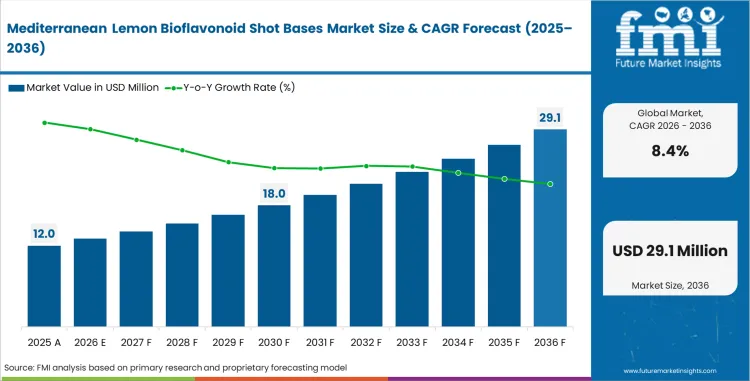
The Mediterranean lemon bioflavonoid shot bases market crossed a valuation of USD 11.1 million in 2025. Sales are set to reach USD 12.0 million in 2026 at a CAGR of 8.4% during the forecast period. Total market value is poised to surpass USD 26.9 million by 2036.
Summary of Mediterranean Lemon Bioflavonoid Shot Bases Market
- Mediterranean Lemon Bioflavonoid Shot Bases Market Snapshot
- The Mediterranean lemon bioflavonoid shot bases market was USD 11.1 million in 2025 and is projected to reach USD 26.9 million by 2036.
- The market is expected to expand at a 8.4% CAGR from 2026 to 2036, generating an incremental opportunity of USD 14.9 million over the forecast period.
- This category represents a specialty beverage-input market centered on lemon-bioflavonoid-standardized bases used in wellness shots, rather than the broader citrus-bioactives market or the overall functional-shots category.
- Supply-chain capability plays a decisive role in this market because Mediterranean lemon availability, peel recovery economics, extract standardization, and beverage-formulation compatibility determine which suppliers can operate profitably at scale.
- Mediterranean Lemon Bioflavonoid Shot Bases Market Demand and Growth Drivers
- Demand is rising as lemon peel continues to stand out as a rich source of eriocitrin and related bioactives, giving suppliers a commercially relevant raw material base for beverage-ready ingredient development.
- Category expansion is supported by the broader functional-shots space, which provides a credible downstream demand pool for specialized lemon-bioflavonoid bases while still leaving this segment niche in scale.
- Formulation interest is strengthening because lemon-derived bioactives can be incorporated into juice-style and wellness-shot systems in ways that reinforce health-focused beverage positioning.
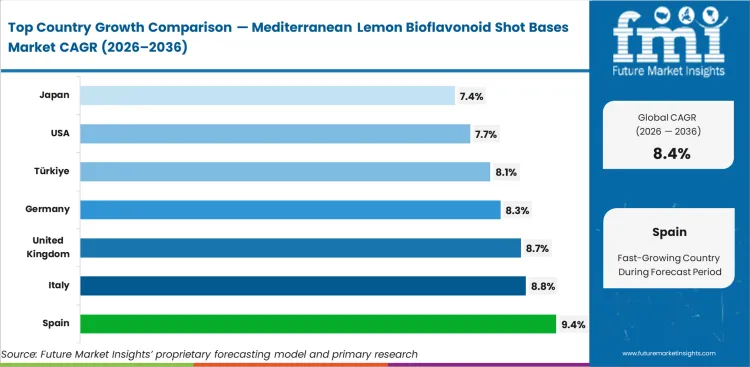
- Among key countries, Spain leads at 9.4% CAGR, followed by Italy at 8.8%, the United Kingdom at 8.7%, Germany at 8.3%, Türkiye at 8.1%, the United States at 7.7%, and Japan at 7.4%.
- Growth still moves within practical limits because weather exposure, competition from fresh-fruit channels, and the continued use of Mediterranean lemon volumes in broader citrus applications constrain raw material diversion into a narrow standardized-shot-base niche.
- Mediterranean Lemon Bioflavonoid Shot Bases Market Product and Segment View
- The market includes lemon-bioflavonoid shot bases supplied as concentrates, premixes, and beverage-ready ingredient systems derived mainly from lemon peel and related citrus fractions.
- These bases are used across immunity shots, antioxidant shots, metabolism-positioned shots, and adjacent functional beverage formats where citrus-linked wellness cues are already commercially recognized.
- Liquid concentrates lead the Base Format segment with 53.0% share, as shot manufacturers typically favor soluble, scalable, and easy-to-dose systems that simplify both pilot runs and commercial beverage production.
- Eriocitrin-rich products account for 48.0% of the Active Profile segment because eriocitrin remains one of the clearest lemon-specific actives available for differentiating citrus-bioflavonoid ingredient systems.
- Immunity-focused products hold 42.0% of the Function segment, supported by the strong fit between lemon positioning, vitamin C associations, and antioxidant language already familiar in the wellness-shot category.
- Peel extracts command 58.0% of the Source Material segment because lemon peel and pomace provide the richest and most practical extraction streams for beverage-grade flavonoid recovery.
- Beverage brands lead the End User segment with 47.0% share, reflecting their role as the most direct buyers of standardized liquid bases for branded shots and adjacent functional-drink formulations.
- Scope includes standardized lemon-bioflavonoid bases used in shot formulations, while excluding the broader citrus-bioflavonoids market, standalone supplements, general lemon juice concentrates, and non-Mediterranean origin systems.
- Mediterranean Lemon Bioflavonoid Shot Bases Market Geography and Competitive Outlook
- Spain, Italy, and the United Kingdom represent the fastest-rising national markets in this niche, while Germany continues to serve as a steady high-value center for formulation activity and downstream demand.
- Competitive positioning depends more on extract standardization, solubility performance, clean-label suitability, and Mediterranean sourcing credibility than on lemon-processing scale alone.
- Key participants include Euromed S.A., Zukán, Ingredients By Nature, Botanic Healthcare, Nans Products.
- Supplier advantage in this market is shaped by the ability to secure reliable citrus side streams, maintain consistent active profiles, and deliver beverage-ready systems that reduce formulation effort for shot manufacturers.
Key Takeaways, Market Size, and Forecast
- Mediterranean Lemon Bioflavonoid Shot Bases Market is projected to grow from USD 12.0 million in 2026 to USD 26.9 million by 2036, at a CAGR of 8.4%.
- The Mediterranean lemon bioflavonoid shot bases market was valued at USD 11.1 million in 2025.
- By 2036, the Mediterranean Lemon Bioflavonoid Shot Bases Market is expected to be worth USD 26.9 million.
- From 2026 to 2036, the market is projected to expand at a CAGR of 8.4%.
- The market is projected to create an incremental opportunity of USD 14.9 million between 2026 and 2036.
- In 2026, Liquid concentrates are expected to account for 53.0% of the base format segment.
- Spain (9.4%) and Italy (8.8%) are two of the fastest growing markets.
Mediterranean lemon bioflavonoid shot bases are seeing stronger interest as functional beverage brands develop cleaner citrus-based wellness products. Market outlook remains favorable, supported by rising demand for convenient immunity, vitality, and antioxidant-led formats suited to daily routines. Mediterranean sourcing adds authenticity, premium appeal, and clear traceability, helping brands stand out in new product launches. Category growth also reflects wider interest in concentrated liquid supplements that combine sensory freshness with low-volume nutritional intake. Market interest continues to grow as formulators replace synthetic fortification with citrus compounds carrying familiar appeal and clean-label appeal. Private-label expansion and premium wellness merchandising also support broader demand across beauty-from-within concepts and focused beverage products.
Taste balance remains important in the market, since bitterness control shapes repeat usage, product perception, and premium price acceptance. Brands delivering smoother mouthfeel and cleaner flavor balance often see better retention across regular functional consumption habits. Securing reliable citrus bioflavonoid extracts is essential for new wellness shots to pass shelf-life testing and prevent precipitation in commercial bottles. Expansion across pharmacies, digital wellness platforms, and specialty retail also improves visibility for distinct citrus shot products. Competitive advantage depends on formulation clarity, dosage credibility, sourcing quality, and packaging suited to portable daily use. Long-term growth depends on clinical backing that strengthens premium positioning, especially where brands need stronger substantiation and scalable manufacturing support. The market offers solid prospects for brands combining clinical relevance, palatable delivery, and a believable Mediterranean product image.
Spain is projected to post a 9.4% CAGR in the Mediterranean lemon bioflavonoid shot bases market, supported by concentrated Mediterranean lemon cultivation that keeps raw material access closer to processors. Italy follows at 8.8% CAGR, helped by established peel recovery infrastructure that supports more efficient citrus by-product utilization for bioflavonoid extraction. The United Kingdom is set to record 8.7% CAGR, reflecting strong consumption of functional beverages. Germany is likely to see 8.3% CAGR, backed by demand from premium health-positioned brands. Türkiye is anticipated to achieve 8.1% CAGR, while the United States is expected to grow at 7.7% CAGR during the forecast period. Japan is projected to witness 7.4% CAGR. Differences across these markets mainly reflect proximity to processing hubs and the strength of consumer demand.
Mediterranean Lemon Bioflavonoid Shot Bases Market Key Takeaways
| Metric | Details |
|---|---|
| Industry Size (2026) | USD 12.0 million |
| Industry Value (2036) | USD 26.9 million |
| CAGR (2026 to 2036) | 8.4% |
Source: Future Market Insights (FMI) analysis, based on proprietary forecasting model and primary research
Segmental Analysis
Mediterranean Lemon Bioflavonoid Shot Bases Market Analysis by Base Format
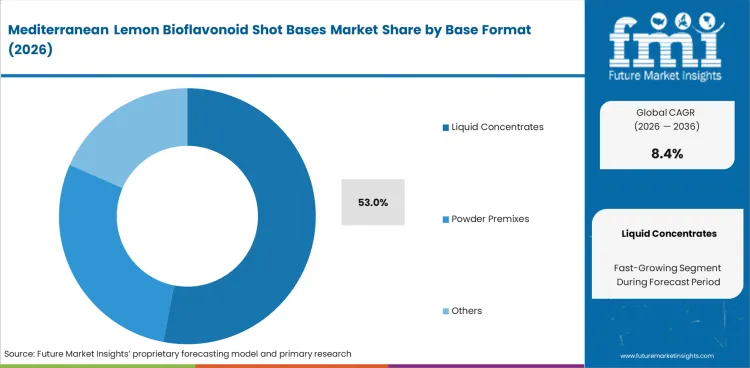
Commercial use in this market favors formats that lower plant effort instead of adding extra handling at the filling stage. Liquid concentrates lead because beverage programs built for fast turnaround need ingredients that move into blending systems with little preparation and with fewer chances of line disturbance. Ease of dosing also matters, since tighter control over ingredient addition supports more uniform finished shots across repeated runs. In 2026, the liquid concentrates segment is poised to account for 53.0% of market share. Segment revenue growth comes from better fit with high-speed bottling, reduced reliance on hydration work, and stronger day-to-day operating reliability in contract manufacturing. Dry alternatives may enter with a lower material cost, yet many commercial buyers place greater value on line continuity, shorter preparation time, and lower batch risk once production moves from pilot scale into routine output. That balance keeps liquid concentrates in a stronger position across branded wellness shot programs.
- Solubility during production: Fast-moving filling lines leave little room for ingredients that dissolve unevenly or leave visible residue in tanks, transfer systems, and dosing points. Liquid concentrates support steadier incorporation, cleaner flow through processing equipment, and fewer disruptions during scheduled output, making them a more practical choice for large-volume beverage operations.
- Fewer preparation steps: Liquid bases reduce dependence on soaking, dispersion correction, and long pre-mixing stages before commercial filling starts. This gives operators a shorter path from ingredient loading to finished bottling, lowers handling effort on the plant floor, and improves production planning in facilities working with tight daily throughput targets.
- Operational buying logic: Format choice often reflects manufacturing practicality more than raw ingredient price at the quotation stage. Beverage brands and contract bottlers tend to favor inputs that protect production speed, maintain batch consistency, and lower avoidable process losses, since those factors carry more commercial value over repeated manufacturing cycles.
Mediterranean Lemon Bioflavonoid Shot Bases Market Analysis by Active Profile
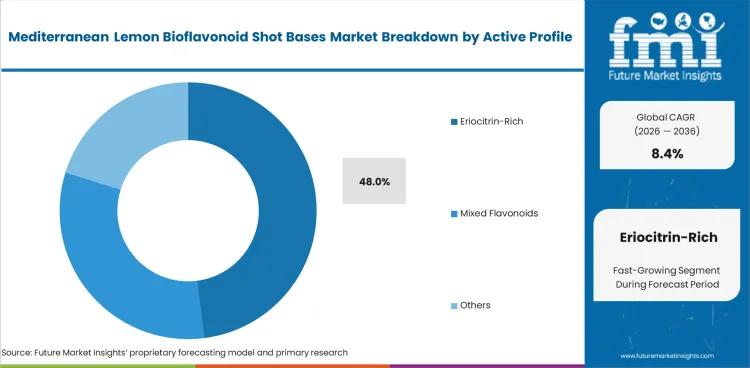
Active profile selection shapes taste, product stability, formulation confidence, and claim direction at the same time. Eriocitrin-rich formats draw stronger interest because wellness shots need a profile that can support palatability without weakening the technical quality of a dense liquid blend. Brands entering this space often look beyond broad functional extract labeling and pay closer attention to marker composition, since variation in flavonoid balance can create visible differences in flavor performance and shelf behavior. The eriocitrin-rich segment is estimated to account for 48.0% share in 2026. This lead position reflects stronger usefulness in flavor masking, better support for standardized formulation work, and a clearer route toward consistent batch quality during scale-up. Segment preference also signals a larger market truth: buyers in functional beverages favor active profiles with defined formulation value, not just general botanical identity. That gives eriocitrin-rich inputs a clearer role across premium and technically managed product lines.
- Taste support: Higher eriocitrin content helps soften bitter and sharp notes that often emerge in concentrated wellness blends combining citrus ingredients with other active ingredients. Better taste control improves repeat use, gives formulators more room to build complex functional profiles, and supports a finished product experience that feels more acceptable to daily consumers.
- Batch consistency: Standardized active ratios help reduce variation from one production cycle to another, giving brands more confidence in flavor stability, blend performance, and finished product matching across pilot and commercial runs. Better input control also lowers reformulation risk after launch, a factor that matters in strictly managed premium beverage programs.
- Technical selection value: Defined active composition supports more disciplined ingredient selection during product development and supplier review. Buyers gain a clearer basis for comparing extract quality, aligning formulation targets with finished product expectations, and building a stronger technical case for keeping one active profile across large-scale production.
Mediterranean Lemon Bioflavonoid Shot Bases Market Analysis by Function
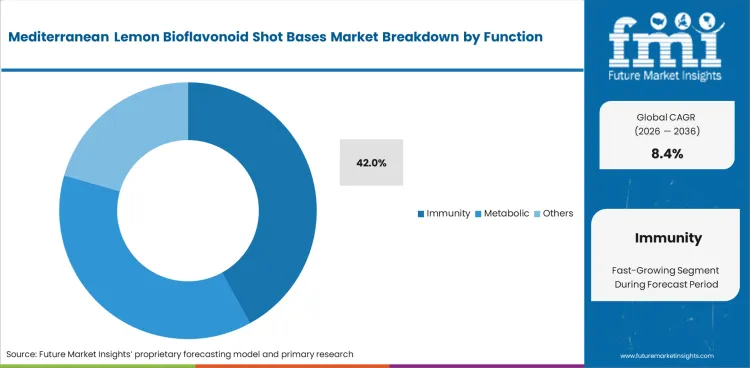
Function-led demand stays central in wellness shots because consumers respond more easily to simple and familiar health positioning than to abstract ingredient science. Immunity leads for that reason, yet category strength does not come from front-label language alone. Citrus-linked bioflavonoids fit naturally into immunity concepts while also adding formulation value in liquid systems, giving brands both consumer-facing and technical reasons to build around this use case. The market is expected to see immunity account for 42.0% share in 2026. Segment standing is supported by broad recognition of immune support, easy alignment with vitamin C-based product logic, and added usefulness in helping preserve blend quality over shelf life. A second commercial advantage comes from lower education burden at launch, since brands do not need to explain the function from the ground up. That mix of familiarity, formulation relevance, and retail clarity keeps immunity in a stronger position than narrower wellness benefit claims.
- Protection of actives: Bioflavonoids can help guard sensitive ingredients from faster loss of quality inside liquid systems, a point that matters in compact shot formats with concentrated active loads. Better stability supports shelf performance, helps products maintain intended value longer, and reduces the chance of early quality decline after filling and distribution.
- Support for claims: Many markets require active ingredients to meet specific thresholds before health-facing messaging can move onto pack or into product communication. Verified composition helps brands build more reliable internal documentation, reduce approval uncertainty, and move forward with immunity-led positioning from a firmer technical base.
- Category-level selling strength: Immunity gives brands a familiar benefit platform that works across mainstream wellness buyers as well as more active supplement users. This wider recognition can improve shelf communication, shorten consumer understanding time, and support stronger product acceptance in a crowded shot category with limited on-pack selling space.
Mediterranean Lemon Bioflavonoid Shot Bases Market Analysis by Source Material
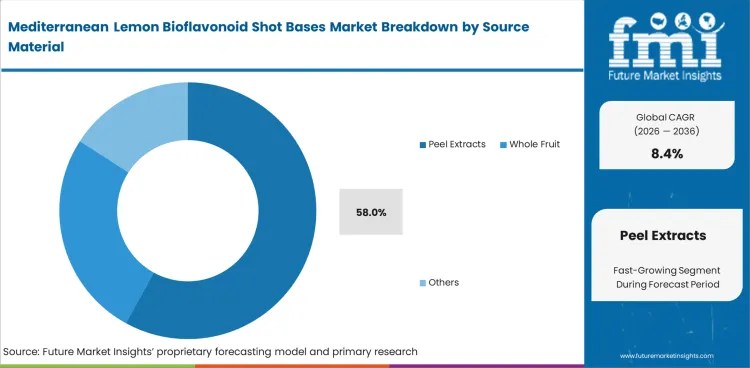
Source material choice carries direct weight in extraction economics, active density, and the long-term viability of ingredient supply. Peel-derived inputs lead because they offer a practical mix of higher-value compound concentration and better use of output already generated through citrus processing activity. For manufacturers serving wellness shots, this matters because small-format products need dense active delivery without adding unnecessary volume or weakening flavor balance. Peel extracts segment is set to represent 58.0% of market share in 2026. Segment growth is supported by richer bioflavonoid content, better fit with value recovery from juice-side operations, and stronger suitability for concentrated ingredient development. Commercial appeal also comes from the ability to turn a secondary material stream into a higher-value functional input, improving raw material economics across processing systems. That advantage becomes more important in categories seeking both ingredient performance and cleaner sourcing narratives linked to better material utilization.
- High active concentration: Peel streams often provide a richer source of target bioflavonoids than many other citrus flavor options, making extraction more attractive from both yield and formulation standpoints. Higher compound density supports stronger ingredient output per processing cycle and fits the needs of compact wellness shot products seeking measurable functionality in small servings.
- Better use of by-products: Using leftover peel from juice processing improves value recovery and reduces disposal pressure across citrus handling operations. This gives processors a stronger commercial base for ingredient extraction, while also helping beverage brands present a sourcing story built around fuller material use and more efficient resource conversion.
- Supply and processing relevance: Peel-based extraction aligns well with established citrus processing flows, allowing ingredient producers to build from existing raw material streams instead of depending only on separate fruit allocation. This closer fit with current operations can support steadier supply access, better cost discipline, and stronger scalability in commercial ingredient programs.
Mediterranean Lemon Bioflavonoid Shot Bases Market Analysis by End User
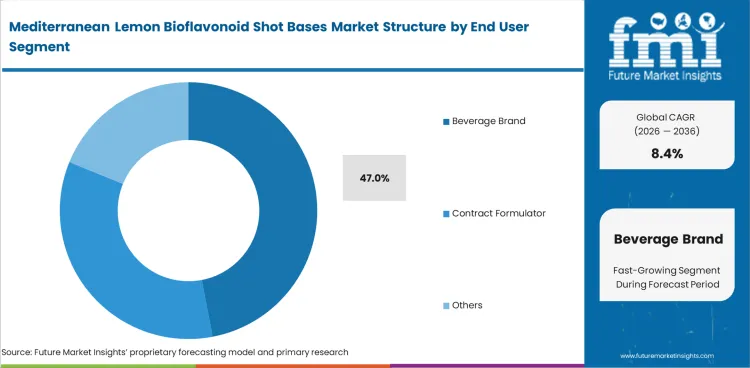
Market influence in this category is due to beverage brands because branded product owners define the finished offer entering retail shelves and wellness channels. Ingredient choice, flavor direction, functional emphasis, and clean-label priorities often start from brand strategy rather than from plant preference alone. Contract bottlers still shape final line acceptance, yet early commercial direction usually comes from the brand side because consumer fit and shelf positioning decide whether a concept moves forward. In 2026, the beverage brands segment is poised to account for 47.0% of market share. This standing reflects brand control over specification design, premium product framing, and the balance between ingredient credibility and finished product appeal. Companies actively select functional food ingredients based on precise brand identity and targeted demographic preferences. Supplier success in this segment depends on meeting two tests at once: the extract must work cleanly in production and also support the message, taste profile, and positioning the brand wants to carry into the market. That dual requirement gives beverage brands a central role in end-user demand formation.
- Product brief control: Beverage brands usually set the commercial direction early by defining target claims, label tone, flavor style, and the level of functional emphasis expected in the finished shot. This makes brand owners a key force behind extract choice, active profile preference, and the overall path a formulation project takes.
- Plant fit requirements: Contract bottlers still test ingredients for handling ease, blend behavior, and equipment compatibility before approving routine use. Inputs that look attractive from a branding view can still face rejection if they create settling issues, slow processing speed, or add instability during commercial-scale filling activity.
- Commercial margin discipline: Branded and private label programs both operate within cost boundaries, even in premium wellness categories. Supplier selection, pack format planning, and ingredient efficiency all influence viability, making end-user demand less about one input in isolation and more about total product economics across a sellable finished offer.
Mediterranean Lemon Bioflavonoid Shot Bases Market Drivers, Restraints, and Opportunities
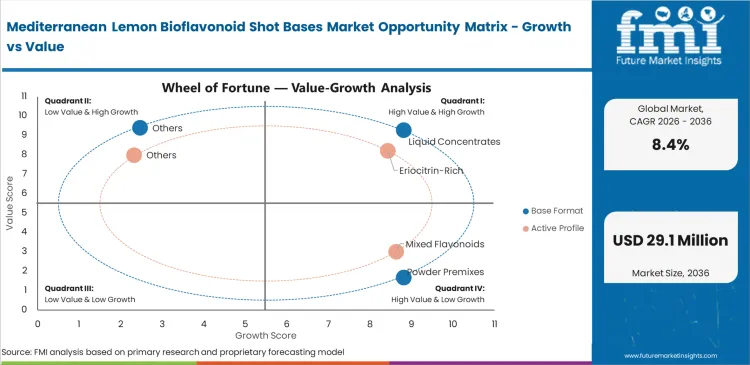
Growth in the Mediterranean lemon bioflavonoid shot bases market is being driven by a clear change in functional beverage demand, with consumers moving toward compact wellness formats that offer easy daily use, familiar citrus appeal, and direct health positioning. Shot-based products fit modern buying habits because they are portable, quick to consume, and easier for brands to position around immunity, antioxidant value, and premium wellness cues. Short-run specialty manufacturing could become more viable if contract formulators standardize extraction protocols. Mediterranean lemon bioflavonoids also give formulators an ingredient base that supports both label appeal and technical relevance, a combination that strengthens commercial interest across branded launches.
Market expansion still faces real pressure from formulation difficulty, because bioflavonoid-rich shot bases can create bitterness, active variation, and stability concerns if extraction quality and profile standardization are not managed carefully. These issues matter commercially, since poor taste balance or inconsistent active composition can raise reformulation costs, weaken repeat purchase, and limit brand confidence in premium product launches. Raw material variability across citrus streams adds another layer of restraint by affecting extraction efficiency and finished ingredient consistency.
Opportunities in the Mediterranean Lemon Bioflavonoid Shot Bases Market
- Peel-side value recovery: Citrus processors can improve extraction economics by converting peel-rich side streams into higher-value beverage-grade bioflavonoid inputs, especially where recovery systems already support separation and standardization.
- Clean-label formulation support: Lemon-derived actives can help brands build wellness-shot systems around more recognizable ingredient stories, particularly in premium formats where label simplicity influences shelf appeal.
- Standardized active development: Suppliers able to deliver consistent eriocitrin profiles, stable solubility, and better taste control may gain stronger traction with brands seeking technically dependable shot bases for repeat commercial use.
Regional Analysis
Based on regional analysis, Mediterranean Lemon Bioflavonoid Shot Bases Market is segmented into North America, Europe, Asia Pacific, Latin America, and Middle East & Africa, across 40 plus countries.
.webp "Top Country Growth Comparison Mediterranean Lemon Bioflavonoid Shot Bases Market Cagr (2026 2036)")
| Country | CAGR (2026 to 2036) |
|---|---|
| Spain | 9.4% |
| Italy | 8.8% |
| United Kingdom | 8.7% |
| Germany | 8.3% |
| Türkiye | 8.1% |
| United States | 7.7% |
| Japan | 7.4% |
Source: Future Market Insights (FMI) analysis, based on proprietary forecasting model and primary research
Europe Mediterranean Lemon Bioflavonoid Shot Bases Market Analysis
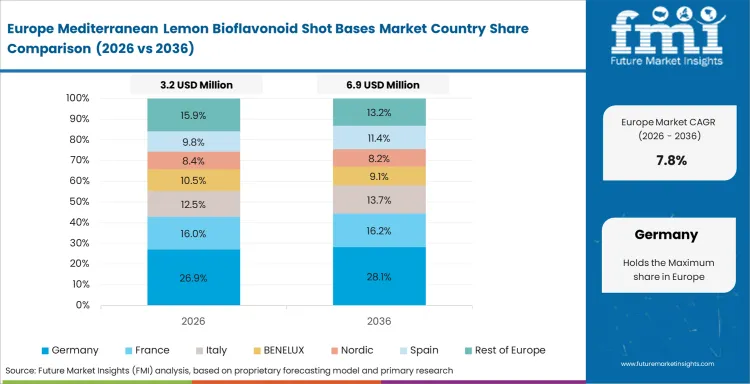
Europe gains a clear practical advantage from close access to Mediterranean citrus processing, since shorter movement from peel recovery to extraction helps preserve active quality and supports faster ingredient turnover. Regional beverage companies also benefit from easier coordination with nearby processors during formulation refinement, an advantage that matters in wellness shot categories built around stability, solubility, and repeatable batch performance. Freight exposure stays lower than in distant import-led markets, giving local supply chains added commercial value beyond simple transport savings. Origin visibility adds another layer of strength, as Mediterranean-linked sourcing supports premium product positioning across functional beverages. Taken together, proximity, processing depth, and easier technical collaboration give Europe one of the strongest foundations for sustained category development.
- Spain: Spain stands out through concentrated citrus cultivation and a dense extraction ecosystem that keeps raw material access close to ingredient processing. Stable peel availability supports continuous production runs, while shorter internal supply routes reduce exposure to transit-related active loss. Regional processors also gain room to respond faster to beverage brand requirements on specification, delivery, and formulation fit. Demand for Mediterranean lemon bioflavonoid shot bases in Spain is anticipated to rise at a CAGR of 9.4% from 2026 to 2036. This combination keeps Spain in a leading position across supply security, processing continuity, and ability to respond quickly.
- Italy: Italy benefits from established peel recovery systems and deeper experience in converting citrus side streams into higher-value functional ingredients. Strong extraction capability, efficient separation practice, and mature technical handling all improve confidence in ingredient consistency across large-scale production. Local expertise also supports margin protection by improving recovery value from available citrus material. Sales of Mediterranean lemon bioflavonoid shot bases in Italy are expected to increase at a CAGR of 8.8% during the forecast period. Italy therefore strengthens its role as a technically reliable supply base for premium beverage formulations.
- United Kingdom: Consumer openness to wellness drinks keeps the United Kingdom active even without raw material proximity on the level seen in Southern Europe. Market traction comes from strong functional beverage interest, steady import access, and a retail environment that supports premium shot concepts with clear health cues. Product development activity also stays high, giving suppliers room to serve a market receptive to differentiated liquid formats. The Mediterranean lemon bioflavonoid shot bases market in the United Kingdom is poised to expand at a CAGR of 8.7% through 2036. Commercial momentum here rests on category innovation, premium market placement, and sustained interest in convenient wellness delivery.
- Germany: Germany offers a careful market environment shaped by quality scrutiny, premium health positioning, and careful ingredient acceptance standards. Beverage programs in this market place greater value on formulation credibility and technical reliability than on lower-cost sourcing alone. Supplier success therefore depends on proving integrity, consistency, and fit for high-value product concepts rather than competing only on price. Germany is set to record a CAGR of 8.3% in Mediterranean lemon bioflavonoid shot bases during the assessment period. Such conditions support steady growth grounded in product trust and tighter performance expectations.
Middle East and Africa Mediterranean Lemon Bioflavonoid Shot Bases Market Analysis
Market direction across the Middle East and Africa depends on raw material allocation, since citrus output often serves export channels and ingredient processing at the same time. Fresh fruit economics can pull supply away from extraction, while seasonal shifts and crop variability create pressure on volume planning across processing sites. Weather-linked swings add further uncertainty by affecting peel availability and narrowing visibility on longer supply commitments. In this setting, extraction businesses gain stronger footing by prioritizing higher-value bioflavonoid recovery rather than lower-margin concentration routes. Regional growth therefore depends as much on agricultural flow and material economics as on downstream beverage demand.
- Türkiye: Türkiye operates within a citrus economy shaped first by export value and only then by local ingredient conversion potential. Crop variability and weather pressure can narrow feedstock access, making processing plans less predictable across seasons. At the same time, stronger returns from specialized bioflavonoid isolation improve the case for deeper extraction activity inside the regional value chain. Adoption in Türkiye is likely to advance at a CAGR of 8.1% by 2036. Market progress here reflects a practical balance between export-led citrus use and rising interest in higher-value functional ingredient output.
North America Mediterranean Lemon Bioflavonoid Shot Bases Market Analysis
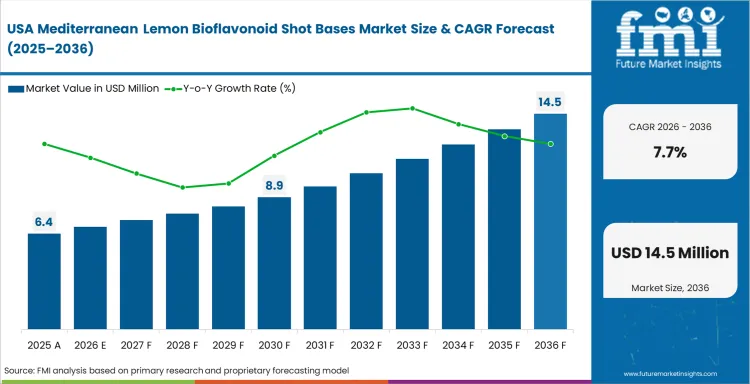
North America brings strong category demand through large functional beverage volumes, premium wellness positioning, and broad retail reach across health-focused drink formats. Unlike Mediterranean source markets, regional expansion depends more on secure imported ingredient flow than on domestic extraction depth. Long freight routes raise the cost of instability, making shipment condition, specification control, and supplier consistency central to commercial success. Buyers in this region therefore place unusual weight on documentation quality and arrival integrity, since any decline in active performance can affect large-scale product programs across multiple channels. Market size gives North America major commercial importance, yet operating success depends on disciplined import execution rather than local raw material advantage.
- United States: Large-scale wellness beverage consumption keeps the United States at the center of regional demand, especially across products positioned around daily health support and premium function-led refreshment. Import reliance increases the importance of stable supply agreements, since beverage producers need dependable extract quality across extended logistics chains. Supplier approval in this market depends not only on ingredient promise, but also on consistent arrival conditions and support for large production schedules. Market in the United States is expected to grow at a CAGR of 7.7% during the study period. Stronger supplier performance therefore translates into better continuity across scaled beverage programs.
FMI’s report also reviews market trends across Canada, Mexico, Brazil, China, India, Japan, and Australia. Distant consumer markets place more value on reliable solubility and ingredient integrity because longer transit times raise the risk of active loss before materials enter beverage production.
Asia Pacific Mediterranean Lemon Bioflavonoid Shot Bases Market Analysis
Asia Pacific depends on imported premium extracts, making logistics control and regulatory validation central to ingredient buying decisions. Demand support comes from rising health awareness, greater interest in active aging, and wider acceptance of compact wellness beverages across urban retail channels. At the same time, buyer approval standards stay exacting, so extract partners need strong documentation, reliable composition, and shipment stability before materials reach commercial bottling lines. Long-distance freight adds another layer of risk, since active loss during transit can weaken formulation confidence and slow market execution. Regional preference therefore leans toward suppliers able to combine clean compliance support, consistent extract quality, and dependable performance after extended movement from Mediterranean source points.
- Japan: Japan remains important through its preference for refined wellness products and high standards around ingredient acceptance in premium beverage categories. Buyer focus on purity, solubility, and formulation reliability gives technically stronger extract partners a clearer route into commercial programs. Imported supply also faces closer scrutiny here, making documentation depth and shipment integrity more important than broad volume alone. Japan is projected to witness 7.4% CAGR in the Mediterranean Lemon Bioflavonoid Shot Bases market through 2036. Such market conditions favor suppliers capable of supporting both premium positioning and disciplined product quality requirements.
Competitive Aligners for Market Players
Competitive advantage in this market comes from formulation performance, not from extract availability alone. Euromed S.A. and Zukán strengthen their market position through refined liquid concentrate offerings that dissolve more reliably in commercial beverage systems than standard botanical powders. That difference matters at plant level because contract bottlers place high value on ingredients that move through blending and filling lines without raising residue risk, slowing throughput, or creating batch inconsistency. Raw material access supports scale, yet scale does not secure supplier preference unless the extract performs cleanly inside finished formulations. Vendor approval therefore depends on dissolution testing, stability review, and compatibility with high-speed beverage production. Suppliers that fail at this stage lose market value even before price becomes a key issue.
Long-established regional processors also benefit from closer working ties with Mediterranean citrus growers, giving them steadier peel access and better control over active profile consistency. Ingredients By Nature gains an advantage here through sourcing continuity that supports year-round eriocitrin standardization, a factor with direct value in applications needing repeatable flavor balance and stable formulation behavior. New entrants face a harder path because this market rewards integrated supply relationships and precise extract control rather than simple participation in citrus sourcing. Competitive pressure rises further at the processing stage, since higher-value metabolic support ingredients require advanced separation capability and tighter composition management. Market leadership therefore rests on three linked strengths: dependable solubility, steady raw material continuity, and standardized extract quality at commercial scale.
Key Players in Mediterranean Lemon Bioflavonoid Shot Bases Market
- Euromed S.A.
- Zukán
- Ingredients By Nature
- Botanic Healthcare
- Nans Products
Scope of the Report
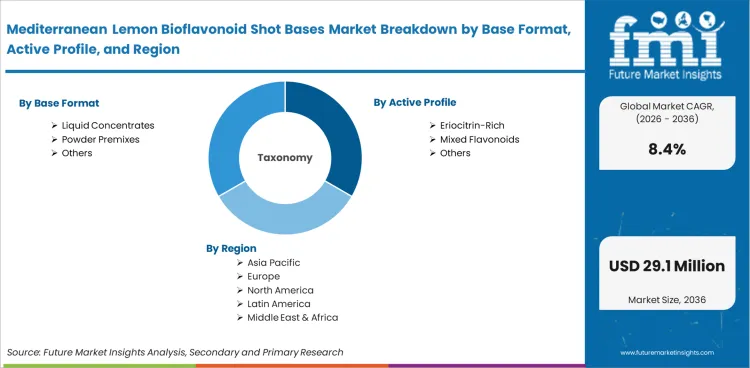
| Metric | Value |
|---|---|
| Quantitative Units | USD 12.0 million to USD 26.9 million, at a CAGR of 8.4% |
| Market Definition | Specialty beverage-use concentrates and powders in this market are standardized for lemon bioflavonoid content and are developed specifically for wellness shot formulations. Market scope does not include generic citrus juice bases, since inclusion depends on measurable eriocitrin profiles that support clear ingredient differentiation and more precise formulation use. |
| Segmentation | Base Format, Active Profile, Function, Source Material, End User, Region |
| Regions Covered | North America, Europe, Asia Pacific, Latin America, and Middle East & Africa |
| Countries Covered | United States, Canada, Mexico, Brazil, Germany, United Kingdom, France, Italy, Spain, Russia, China, Japan, India, South Korea, Australia, Türkiye, South Africa |
| Key Companies Profiled | Euromed S.A., Zukán, Ingredients By Nature, Botanic Healthcare, Nans Products |
| Forecast Period | 2026 to 2036 |
| Approach | Concentrated Mediterranean lemon peel processing volumes cross-referenced against functional shot ingredient adoption rates. |
Source: Future Market Insights (FMI) analysis, based on proprietary forecasting model and primary research
Mediterranean Lemon Bioflavonoid Shot Bases Market Analysis by Segments
Base Format
- Liquid concentrates
- Powder premixes
- Cloud emulsions
Active Profile
- Eriocitrin-rich
- Mixed flavonoids
- Vitamin C paired
Function
- Immunity
- Metabolic
- Digestive
- Antioxidant
Source Material
- Peel extracts
- Whole fruit
- Juice serum
End User
- Beverage brands
- Contract formulators
- Private label
- Foodservice labs
Region
- North America
- Latin America
- Europe
- East Asia
- South Asia
- Oceania
- Middle East and Africa
Bibliography
- USA Department of Agriculture, Foreign Agricultural Service. (2026). Report Name: Citrus Annual. USDA FAS.
- Ji-Yoon Baek, Jeong-Eun Kwak, and Mok-Ryeon Ahn (2024). Eriocitrin Inhibits Angiogenesis by Targeting VEGFR2-Mediated PI3K/AKT/mTOR Signaling Pathways.
- Branka Šošić-Jurjević, Slavica Borković-Mitić, Slađan Pavlović, Dragana Vlahović, Marko Miler, Thais Cesar, Vladimir Ajdžanović, Dragan Milenkovic, Frans Stellaard, and Dieter Lütjohann. (2024). Lemon Flavonoid Extract Eriomin Improves Pro/Antioxidant Status and Interferes with Cholesterol Metabolism without Affecting Serum Cholesterol Levels in Aged Rats.
- Francesco Iervese, Federica Flamminii, Giulia D'Alessio, Lilia Neri, Alessandra De Bruno, Valeria Imeneo, Luca Valbonetti, Carla Daniela Di Mattia (2024). Flavonoid- and limonoid-rich extracts from lemon pomace by-products: Technological properties for the formulation of o/w emulsions.
- Giulia Modica, Luana Pulvirenti, Alessandra Gentile, Giuseppe Ruberto, Laura Siracusa, and Alberto Continella (2026). Biochemical discrimination and market-oriented qualitative traits of a 24 lemon cultivar collection. Journal of Agriculture and Food Research, 26, 102658.
This bibliography is provided for reader reference. The full FMI report contains the complete reference list with primary source documentation.
This Report Addresses
- Mediterranean processing capacity required to support commercial-scale production of soluble lemon bioflavonoid extracts for wellness shot formulations.
- Eriocitrin standardization methods used by premium European contract formulators to maintain repeatable active quality across scaled beverage programs.
- Bioflavonoid ratio control approaches used to reduce bitterness and improve taste balance in concentrated wellness shot applications.
- Shelf-stability performance requirements applied to liquid concentrates intended for commercial bottling, storage, and retail distribution.
- Yield improvement methods used to raise active compound recovery from citrus peel while strengthening extraction economics.
- Ingredient approval factors used by beverage brands sourcing Mediterranean-origin lemon bioflavonoid inputs for premium and function-led product lines.
- Extraction solvent control practices needed to isolate purer botanical compounds with stronger formulation suitability and cleaner technical performance.
- Quality control parameters used to verify acceptable active profiles for products positioned around clinically supported health claims.
Frequently Asked Questions
How big is the Mediterranean lemon bioflavonoid shot bases market?
FMI analysis indicate that this sector at USD 12.0 million in 2026. That figure reflects a narrow specialty ingredient category rather than the full citrus-processing industry. Operations teams track this growth closely because premium supply remains limited.
What are Mediterranean lemon bioflavonoid shot bases?
These are specialty beverage concentrates standardized for defined bioflavonoid profiles. Their scope does not include generic citrus juices. R&D teams use these verified inputs to build stable wellness shot formulations.
What is eriocitrin in lemon shot formulations?
Eriocitrin is a key active flavonoid in lemon-based formulations and helps soften bitterness from other functional ingredients. It also supports structural stability in complex beverage systems. Formulators rely on precise eriocitrin levels to maintain a consistent taste experience.
Are lemon bioflavonoid shot bases different from lemon juice concentrate?
Yes. Standardized shot bases deliver verified active compound profiles instead of basic flavor and acidity alone. Companies source these extracts for clinically positioned products. Juice concentrates do not provide the same degree of chemical standardization required for premium functional labels.
Who supplies lemon bioflavonoid shot base ingredients?
Important processors include Euromed S.A., Zukán, Ingredients By Nature, and Botanic Healthcare. These Mediterranean-focused companies operate advanced separation facilities. Supply chain teams assess these suppliers carefully to confirm origin authenticity and strong solubility performance.
How do liquid shot bases compare to powder shot premixes?
Liquid concentrates remove the need for difficult hydration steps during commercial production. Powders may carry a lower starting cost, but often create blending problems on high-speed lines. Contract bottlers often favor liquid formats because line efficiency matters in scaled manufacturing.
How does Mediterranean origin affect sourcing decisions?
Mediterranean origin acts as a premium sourcing signal for many brands. Verified regional traceability often matters more than simple unit price. Sourcing teams usually avoid generic extracts lacking dependable geographic documentation.
What structural gate enables adoption?
Adoption strengthens once contract formulators establish standardized peel extraction protocols that support short-run manufacturing. Better extract standardization can improve supplier preference among technically selective buyers. Faster formulation progress also follows once active ingredients dissolve cleanly in finished systems.
Why does Spain lead regional sales?
Spain benefits from concentrated Mediterranean lemon cultivation and strong raw material access. Processing teams can secure steady peel volumes for large extraction runs. Established infrastructure also gives the country a strong commercial advantage.
What friction slows immediate category expansion?
Extraction complexity limits the amount of premium supply available. Facilities without specialized equipment often struggle to isolate specific flavonoid profiles from raw citrus streams. Yield improvement also requires major investment in advanced separation systems.
How do incumbents maintain competitive advantages?
Established processors benefit from deep relationships with Mediterranean citrus growers. These networks support dependable peel access throughout the year. New challengers often find integrated sourcing systems difficult to replicate quickly.
Why do immunity applications dominate end-use formulations?
Consumers already recognize immunity-focused wellness positioning very easily. That application aligns closely with familiar vitamin C expectations. Formulators use this trusted claim to introduce more complex antioxidant blends.
What hidden costs affect powder premix adoption?
Dry ingredients require extra mechanical mixing during commercial bottling. That added step raises total facility energy use and operational strain. Plant managers often move toward ready-to-use liquid formats to improve process efficiency.
How do brands resist single-supplier lock-in?
Operations teams qualify multiple Mediterranean extraction partners at the same time. This approach reduces exposure to crop-related disruptions caused by regional weather events. Backup suppliers compete hard for these secondary contracts because the relationships carry long-term value.
What consequence faces formulators ignoring solubility tests?
Ingredients that precipitate inside finished bottles can damage brand credibility. Retailers may reject full shipments showing visible sediment. Quality failures can also trigger expensive reformulation cycles and disrupt launch timelines.
Why does Italy hold strong regional positioning?
Italy benefits from sophisticated peel recovery infrastructure that supports large extract manufacturing volumes. Processing teams use advanced separation technologies to raise recovery efficiency. Technical depth also strengthens long-term competitive positioning.
What dictates active profile selection during R&D?
Clinical studies often focus on specific flavonoid markers for efficacy support. Claim support requirements vary by market, making composition control commercially important. Compliance teams review these ratios carefully before approving launch timelines.
How does whole fruit processing compare to peel extraction?
Whole fruit processing produces higher total liquid volume. Peel extraction delivers the concentrated active density needed for compact shot formats. Processing teams often improve efficiency further by using concentrated waste streams as valuable inputs.
What role do contract bottlers play in ingredient selection?
Manufacturing facilities test ingredients for compatibility with processing equipment and line conditions. Operations teams reject formulations that slow throughput or complicate filling. Ingredient suppliers must meet these practical requirements to secure production contracts.
Why do United Kingdom buyers import Mediterranean extracts?
The United Kingdom has strong functional beverage demand and needs reliable ingredient supply. Category buyers continue launching new wellness formats across the market. Sourcing teams import premium Mediterranean extracts to support this steady consumer pull.
What limits Türkiye's extraction industry growth?
Frost losses and a strong focus on fresh exports reduce visibility for steady processing growth. Processors must balance fresh fruit shipments with domestic ingredient manufacturing capacity. Uneven raw material availability also makes long-term supply agreements more difficult.
How do sustainability metrics influence purchasing?
Upcycling citrus waste streams improves resource efficiency and supports stronger business case. Sourcing teams also highlight transparent supply chains in corporate reporting. Brands increasingly buy upcycled ingredients to appeal to environmentally conscious consumers.
What prevents new entrants from matching incumbent quality?
Reliable standardized extracts require precise chemical separation capabilities and strong process control. That work demands major capital investment in specialized equipment. Less experienced operators often produce weaker grades that fail basic solubility standards.
Why do brands pair bioflavonoids with vitamin C?
This combination is often linked with protective wellness benefits. Product development teams use the pairing to create more targeted functional profiles. It also supports both formulation goals and familiar market-facing health positioning.
Preview the report firsthand - request a free sample
Get SampleGet the brochure for pricing and purchase details.
Get PDFTable of Content
- Executive Summary
- Global Market Outlook
- Demand-side Trends
- Supply-side Trends
- Technology Roadmap Analysis
- Analysis and Recommendations
- Market Overview
- Market Coverage / Taxonomy
- Market Definition / Scope / Limitations
- Research Methodology
- Chapter Orientation
- Analytical Lens and Working Hypotheses
- Market Structure, Signals, and Trend Drivers
- Benchmarking and Cross-market Comparability
- Market Sizing, Forecasting, and Opportunity Mapping
- Research Design and Evidence Framework
- Desk Research Programme (Secondary Evidence)
- Company Annual and Sustainability Reports
- Peer-reviewed Journals and Academic Literature
- Corporate Websites, Product Literature, and Technical Notes
- Earnings Decks and Investor Briefings
- Statutory Filings and Regulatory Disclosures
- Technical White Papers and Standards Notes
- Trade Journals, Industry Magazines, and Analyst Briefs
- Conference Proceedings, Webinars, and Seminar Materials
- Government Statistics Portals and Public Data Releases
- Press Releases and Reputable Media Coverage
- Specialist Newsletters and Curated Briefings
- Sector Databases and Reference Repositories
- FMI Internal Proprietary Databases and Historical Market Datasets
- Subscription Datasets and Paid Sources
- Social Channels, Communities, and Digital Listening Inputs
- Additional Desk Sources
- Expert Input and Fieldwork (Primary Evidence)
- Primary Modes
- Qualitative Interviews and Expert Elicitation
- Quantitative Surveys and Structured Data Capture
- Blended Approach
- Why Primary Evidence is Used
- Field Techniques
- Interviews
- Surveys
- Focus Groups
- Observational and In-context Research
- Social and Community Interactions
- Stakeholder Universe Engaged
- C-suite Leaders
- Board Members
- Presidents and Vice Presidents
- R&D and Innovation Heads
- Technical Specialists
- Domain Subject-matter Experts
- Scientists
- Physicians and Other Healthcare Professionals
- Governance, Ethics, and Data Stewardship
- Research Ethics
- Data Integrity and Handling
- Primary Modes
- Tooling, Models, and Reference Databases
- Desk Research Programme (Secondary Evidence)
- Data Engineering and Model Build
- Data Acquisition and Ingestion
- Cleaning, Normalisation, and Verification
- Synthesis, Triangulation, and Analysis
- Quality Assurance and Audit Trail
- Market Background
- Market Dynamics
- Drivers
- Restraints
- Opportunity
- Trends
- Scenario Forecast
- Demand in Optimistic Scenario
- Demand in Likely Scenario
- Demand in Conservative Scenario
- Opportunity Map Analysis
- Product Life Cycle Analysis
- Supply Chain Analysis
- Investment Feasibility Matrix
- Value Chain Analysis
- PESTLE and Porter’s Analysis
- Regulatory Landscape
- Regional Parent Market Outlook
- Production and Consumption Statistics
- Import and Export Statistics
- Market Dynamics
- Global Market Analysis 2021 to 2025 and Forecast, 2026 to 2036
- Historical Market Size Value (USD Million) Analysis, 2021 to 2025
- Current and Future Market Size Value (USD Million) Projections, 2026 to 2036
- Y-o-Y Growth Trend Analysis
- Absolute $ Opportunity Analysis
- Global Market Pricing Analysis 2021 to 2025 and Forecast 2026 to 2036
- Global Market Analysis 2021 to 2025 and Forecast 2026 to 2036, By Base Format
- Introduction / Key Findings
- Historical Market Size Value (USD Million) Analysis By Base Format , 2021 to 2025
- Current and Future Market Size Value (USD Million) Analysis and Forecast By Base Format , 2026 to 2036
- Liquid Concentrates
- Powder Premixes
- Others
- Liquid Concentrates
- Y-o-Y Growth Trend Analysis By Base Format , 2021 to 2025
- Absolute $ Opportunity Analysis By Base Format , 2026 to 2036
- Global Market Analysis 2021 to 2025 and Forecast 2026 to 2036, By Active Profile
- Introduction / Key Findings
- Historical Market Size Value (USD Million) Analysis By Active Profile, 2021 to 2025
- Current and Future Market Size Value (USD Million) Analysis and Forecast By Active Profile, 2026 to 2036
- Eriocitrin-Rich
- Mixed Flavonoids
- Others
- Eriocitrin-Rich
- Y-o-Y Growth Trend Analysis By Active Profile, 2021 to 2025
- Absolute $ Opportunity Analysis By Active Profile, 2026 to 2036
- Global Market Analysis 2021 to 2025 and Forecast 2026 to 2036, By Function
- Introduction / Key Findings
- Historical Market Size Value (USD Million) Analysis By Function, 2021 to 2025
- Current and Future Market Size Value (USD Million) Analysis and Forecast By Function, 2026 to 2036
- Immunity
- Metabolic
- Others
- Immunity
- Y-o-Y Growth Trend Analysis By Function, 2021 to 2025
- Absolute $ Opportunity Analysis By Function, 2026 to 2036
- Global Market Analysis 2021 to 2025 and Forecast 2026 to 2036, By Source Material
- Introduction / Key Findings
- Historical Market Size Value (USD Million) Analysis By Source Material, 2021 to 2025
- Current and Future Market Size Value (USD Million) Analysis and Forecast By Source Material, 2026 to 2036
- Peel Extracts
- Whole Fruit
- Others
- Peel Extracts
- Y-o-Y Growth Trend Analysis By Source Material, 2021 to 2025
- Absolute $ Opportunity Analysis By Source Material, 2026 to 2036
- Global Market Analysis 2021 to 2025 and Forecast 2026 to 2036, By End User
- Introduction / Key Findings
- Historical Market Size Value (USD Million) Analysis By End User, 2021 to 2025
- Current and Future Market Size Value (USD Million) Analysis and Forecast By End User, 2026 to 2036
- Beverage Brand
- Contract Formulator
- Others
- Beverage Brand
- Y-o-Y Growth Trend Analysis By End User, 2021 to 2025
- Absolute $ Opportunity Analysis By End User, 2026 to 2036
- Global Market Analysis 2021 to 2025 and Forecast 2026 to 2036, By Region
- Introduction
- Historical Market Size Value (USD Million) Analysis By Region, 2021 to 2025
- Current Market Size Value (USD Million) Analysis and Forecast By Region, 2026 to 2036
- North America
- Latin America
- Western Europe
- Eastern Europe
- East Asia
- South Asia and Pacific
- Middle East & Africa
- Market Attractiveness Analysis By Region
- North America Market Analysis 2021 to 2025 and Forecast 2026 to 2036, By Country
- Historical Market Size Value (USD Million) Trend Analysis By Market Taxonomy, 2021 to 2025
- Market Size Value (USD Million) Forecast By Market Taxonomy, 2026 to 2036
- By Country
- USA
- Canada
- Mexico
- By Base Format
- By Active Profile
- By Function
- By Source Material
- By End User
- By Country
- Market Attractiveness Analysis
- By Country
- By Base Format
- By Active Profile
- By Function
- By Source Material
- By End User
- Key Takeaways
- Latin America Market Analysis 2021 to 2025 and Forecast 2026 to 2036, By Country
- Historical Market Size Value (USD Million) Trend Analysis By Market Taxonomy, 2021 to 2025
- Market Size Value (USD Million) Forecast By Market Taxonomy, 2026 to 2036
- By Country
- Brazil
- Chile
- Rest of Latin America
- By Base Format
- By Active Profile
- By Function
- By Source Material
- By End User
- By Country
- Market Attractiveness Analysis
- By Country
- By Base Format
- By Active Profile
- By Function
- By Source Material
- By End User
- Key Takeaways
- Western Europe Market Analysis 2021 to 2025 and Forecast 2026 to 2036, By Country
- Historical Market Size Value (USD Million) Trend Analysis By Market Taxonomy, 2021 to 2025
- Market Size Value (USD Million) Forecast By Market Taxonomy, 2026 to 2036
- By Country
- Germany
- UK
- Italy
- Spain
- France
- Nordic
- BENELUX
- Rest of Western Europe
- By Base Format
- By Active Profile
- By Function
- By Source Material
- By End User
- By Country
- Market Attractiveness Analysis
- By Country
- By Base Format
- By Active Profile
- By Function
- By Source Material
- By End User
- Key Takeaways
- Eastern Europe Market Analysis 2021 to 2025 and Forecast 2026 to 2036, By Country
- Historical Market Size Value (USD Million) Trend Analysis By Market Taxonomy, 2021 to 2025
- Market Size Value (USD Million) Forecast By Market Taxonomy, 2026 to 2036
- By Country
- Russia
- Poland
- Hungary
- Balkan & Baltic
- Rest of Eastern Europe
- By Base Format
- By Active Profile
- By Function
- By Source Material
- By End User
- By Country
- Market Attractiveness Analysis
- By Country
- By Base Format
- By Active Profile
- By Function
- By Source Material
- By End User
- Key Takeaways
- East Asia Market Analysis 2021 to 2025 and Forecast 2026 to 2036, By Country
- Historical Market Size Value (USD Million) Trend Analysis By Market Taxonomy, 2021 to 2025
- Market Size Value (USD Million) Forecast By Market Taxonomy, 2026 to 2036
- By Country
- China
- Japan
- South Korea
- By Base Format
- By Active Profile
- By Function
- By Source Material
- By End User
- By Country
- Market Attractiveness Analysis
- By Country
- By Base Format
- By Active Profile
- By Function
- By Source Material
- By End User
- Key Takeaways
- South Asia and Pacific Market Analysis 2021 to 2025 and Forecast 2026 to 2036, By Country
- Historical Market Size Value (USD Million) Trend Analysis By Market Taxonomy, 2021 to 2025
- Market Size Value (USD Million) Forecast By Market Taxonomy, 2026 to 2036
- By Country
- India
- ASEAN
- Australia & New Zealand
- Rest of South Asia and Pacific
- By Base Format
- By Active Profile
- By Function
- By Source Material
- By End User
- By Country
- Market Attractiveness Analysis
- By Country
- By Base Format
- By Active Profile
- By Function
- By Source Material
- By End User
- Key Takeaways
- Middle East & Africa Market Analysis 2021 to 2025 and Forecast 2026 to 2036, By Country
- Historical Market Size Value (USD Million) Trend Analysis By Market Taxonomy, 2021 to 2025
- Market Size Value (USD Million) Forecast By Market Taxonomy, 2026 to 2036
- By Country
- Kingdom of Saudi Arabia
- Other GCC Countries
- Turkiye
- South Africa
- Other African Union
- Rest of Middle East & Africa
- By Base Format
- By Active Profile
- By Function
- By Source Material
- By End User
- By Country
- Market Attractiveness Analysis
- By Country
- By Base Format
- By Active Profile
- By Function
- By Source Material
- By End User
- Key Takeaways
- Key Countries Market Analysis
- USA
- Pricing Analysis
- Market Share Analysis, 2025
- By Base Format
- By Active Profile
- By Function
- By Source Material
- By End User
- Canada
- Pricing Analysis
- Market Share Analysis, 2025
- By Base Format
- By Active Profile
- By Function
- By Source Material
- By End User
- Mexico
- Pricing Analysis
- Market Share Analysis, 2025
- By Base Format
- By Active Profile
- By Function
- By Source Material
- By End User
- Brazil
- Pricing Analysis
- Market Share Analysis, 2025
- By Base Format
- By Active Profile
- By Function
- By Source Material
- By End User
- Chile
- Pricing Analysis
- Market Share Analysis, 2025
- By Base Format
- By Active Profile
- By Function
- By Source Material
- By End User
- Germany
- Pricing Analysis
- Market Share Analysis, 2025
- By Base Format
- By Active Profile
- By Function
- By Source Material
- By End User
- UK
- Pricing Analysis
- Market Share Analysis, 2025
- By Base Format
- By Active Profile
- By Function
- By Source Material
- By End User
- Italy
- Pricing Analysis
- Market Share Analysis, 2025
- By Base Format
- By Active Profile
- By Function
- By Source Material
- By End User
- Spain
- Pricing Analysis
- Market Share Analysis, 2025
- By Base Format
- By Active Profile
- By Function
- By Source Material
- By End User
- France
- Pricing Analysis
- Market Share Analysis, 2025
- By Base Format
- By Active Profile
- By Function
- By Source Material
- By End User
- India
- Pricing Analysis
- Market Share Analysis, 2025
- By Base Format
- By Active Profile
- By Function
- By Source Material
- By End User
- ASEAN
- Pricing Analysis
- Market Share Analysis, 2025
- By Base Format
- By Active Profile
- By Function
- By Source Material
- By End User
- Australia & New Zealand
- Pricing Analysis
- Market Share Analysis, 2025
- By Base Format
- By Active Profile
- By Function
- By Source Material
- By End User
- China
- Pricing Analysis
- Market Share Analysis, 2025
- By Base Format
- By Active Profile
- By Function
- By Source Material
- By End User
- Japan
- Pricing Analysis
- Market Share Analysis, 2025
- By Base Format
- By Active Profile
- By Function
- By Source Material
- By End User
- South Korea
- Pricing Analysis
- Market Share Analysis, 2025
- By Base Format
- By Active Profile
- By Function
- By Source Material
- By End User
- Russia
- Pricing Analysis
- Market Share Analysis, 2025
- By Base Format
- By Active Profile
- By Function
- By Source Material
- By End User
- Poland
- Pricing Analysis
- Market Share Analysis, 2025
- By Base Format
- By Active Profile
- By Function
- By Source Material
- By End User
- Hungary
- Pricing Analysis
- Market Share Analysis, 2025
- By Base Format
- By Active Profile
- By Function
- By Source Material
- By End User
- Kingdom of Saudi Arabia
- Pricing Analysis
- Market Share Analysis, 2025
- By Base Format
- By Active Profile
- By Function
- By Source Material
- By End User
- Turkiye
- Pricing Analysis
- Market Share Analysis, 2025
- By Base Format
- By Active Profile
- By Function
- By Source Material
- By End User
- South Africa
- Pricing Analysis
- Market Share Analysis, 2025
- By Base Format
- By Active Profile
- By Function
- By Source Material
- By End User
- USA
- Market Structure Analysis
- Competition Dashboard
- Competition Benchmarking
- Market Share Analysis of Top Players
- By Regional
- By Base Format
- By Active Profile
- By Function
- By Source Material
- By End User
- Competition Analysis
- Competition Deep Dive
- Competition Deep Dive
- Assumptions & Acronyms Used


