

- Industry Size (2026)
- USD 17.2 Mn
- Forecast (2036)
- USD 35.9 Mn
- CAGR (2026 to 2036)
- 6.9%
Mediterranean Kimchi-Style Vegetable Culture Starters Market Size, Market Forecast and Outlook By FMI
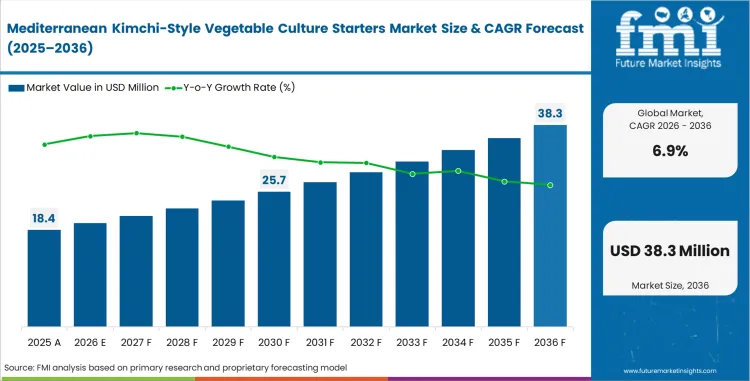
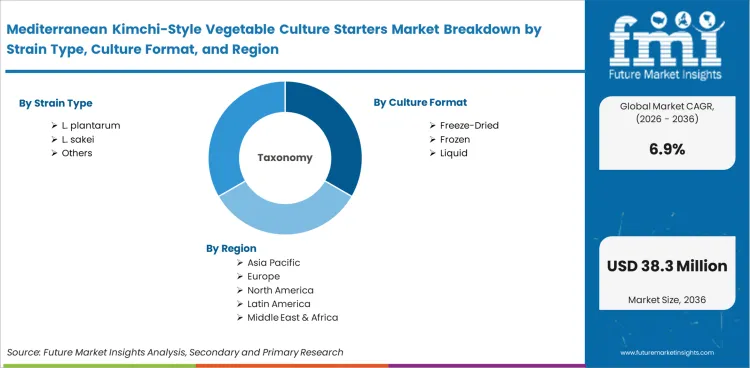
The Mediterranean Kimchi-style vegetable culture starters market was valued at USD 17.2 million in 2025 and is estimated at USD 18.4 million in 2026. Revenue is poised to expand at a CAGR of 6.9% through 2036, reaching approximately USD 35.9 million. Growth is strongest where processors move into retail and export supply, because batch inconsistency in acidity, taste, and shelf life becomes harder to absorb at commercial scale.
Summary of Mediterranean Kimchi-Style Vegetable Culture Starters Market
- Market Snapshot
- The Mediterranean Kimchi-Style Vegetable Culture Starters Market is valued at USD 17.2 million in 2025 and is projected to reach USD 35.9 million by 2036.
- Growth from USD 18.4 million in 2026 to USD 35.9 million in 2036 reflects a forecast CAGR of 6.9% and an incremental opportunity of USD 17.5 million.
- This category covers lactic starter systems used to improve acidification, flavor control, batch stability, and shelf-life performance in kimchi-style vegetable fermentation.
- Commercial value stays concentrated in processors and specialist brands that need repeatable output rather than one-off artisanal fermentation.
- Demand and Growth Drivers
- Demand improves as more fermented vegetable brands move into formal retail and export channels where inconsistent acidity or early over-ripening can damage repeat sales.
- Starter use gains support from a wider base of lactic acid bacteria, probiotic strains, and fermented ingredients being positioned for controlled food applications.
- Mediterranean uptake also benefits from the region’s long-standing fermentation know-how in brined vegetables, pickles, and related preserved foods.
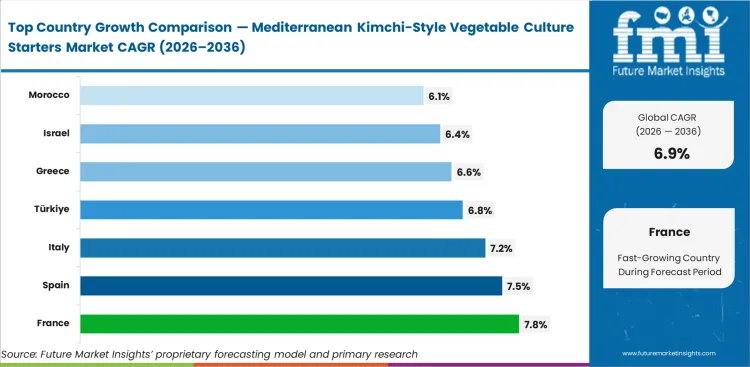
- Country growth is led by France at 7.8%, followed by Spain at 7.5%, Italy at 7.2%, Türkiye at 6.8%, Greece at 6.6%, Israel at 6.4%, and Morocco at 6.1%.
- Full conversion still slows where smaller producers rely on spontaneous fermentation and remain cautious about culture cost, handling discipline, and formulation learning.
- Product and Segment View
- Scope includes starter systems sold as freeze-dried, frozen, liquid, and DVS formats for cabbage, radish, cucumber, pepper, and mixed-vegetable ferments.
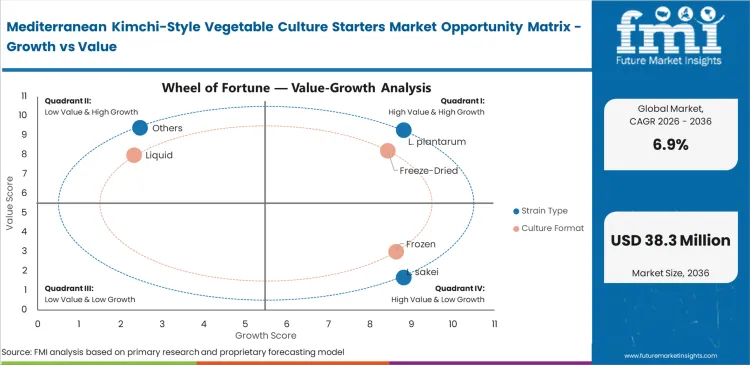
- L. plantarum is expected to account for 28.0% of strain demand in 2026 because it adapts well to vegetable fermentation and supports dependable acid development.
- Freeze-dried formats are projected to contribute 46.0% of the market in 2026 since storage, dosing, and shipping are simpler for both processors and specialist retail channels.
- Multi-strain formulations are anticipated to represent 54.0% of total demand in 2026 because buyers prefer broader fermentation support over a single-task culture choice.
- Acidification-led use is set to make up 33.0% of fermentation-role demand in 2026 as pH control remains the first practical reason many processors adopt a starter.
- Food processors are likely to secure 44.0% share in 2026 because production consistency matters more in branded and private-label supply than in small-batch home use.
- Cabbage blends are expected to hold 38.0% of target-vegetable demand in 2026, while direct sales are forecast to account for 47.0% of channel demand.
- Scope includes starter cultures for kimchi-style vegetable fermentation but excludes finished kimchi products, broad probiotic supplements, and general fermented-food sales.
- Geography and Competitive Outlook
- Western Europe carries the strongest near-term pull because premium retail, foodservice experimentation, and Korean cuisine awareness are more visible there than in smaller markets.
- Fermentation familiarity does not guarantee starter adoption, because buyers still need proof that formal culture use reduces rework, improves shelf performance, or supports scale-up.
- Competition remains fragmented, and supplier choice depends more on technical guidance, handling clarity, and repeat fermentation performance than on broad brand visibility.
- No single supplier controls this niche, and buyer preference remains tied to culture reliability, ease of use, and technical support across different production settings.
Key Takeaways, Market Size, and Forecast
- Mediterranean Kimchi-Style Vegetable Culture Starters Market is projected to grow from USD 18.4 million in 2026 to USD 35.9 million by 2036, at a CAGR of 6.9%.
- The Mediterranean kimchi-style vegetable culture starters market was valued at USD 17.2 million in 2025.
- By 2036, the Mediterranean Kimchi-Style Vegetable Culture Starters Market is expected to be worth USD 35.9 million.
- From 2026 to 2036, the market is projected to expand at a CAGR of 6.9%.
- The market is projected to create an incremental opportunity of USD 17.5 million between 2026 and 2036.
- In 2026, Multi-strain formulations are expected to account for 54.0% of the formulation type segment.
- France (7.8%) and Spain (7.5%) are two of the fastest growing markets.
Starter adoption rises when processors can no longer treat batch variation as manageable and must deliver the same product quality across repeated runs. Retail and export supply favor starter-led fermentation because inconsistent acidity or early over-ripening can lead to shelf failure, customer complaints, and weaker repeat sales. This shift is reinforcing the role of starter cultures across premium fermented foods, particularly as kimchi demand and broader interest in fermented foods continues to rise in parallel. Smaller processors still delay adoption when spontaneous fermentation gives acceptable results for local sales and does not yet create costly quality problems.
Starter use becomes easier to justify once scaling exposes the cost of rejected batches, unstable shelf performance, or weaker retailer confidence. Once processors see that starter use reduces batch failures in live production, repeat ordering becomes easier to justify. Protective cultures and microbial food cultures align with this transition by improving batch reliability while supporting safety and product stability.
France is expected to record a CAGR of 7.8% through 2036, followed by Spain at 7.5% and Italy at 7.2%. Türkiye is projected to grow at 6.8%, while Greece and Israel are likely to register 6.6% and 6.4%, respectively. Morocco is estimated at 6.1% over the same period. Higher-growth markets reflect stronger alignment with premium food positioning and greater exposure to Korean-style products, while others expand at a measured pace due to continued reliance on artisanal fermentation practices.
Segmental Analysis
Mediterranean Kimchi-Style Vegetable Culture Starters Market Analysis by Strain Type
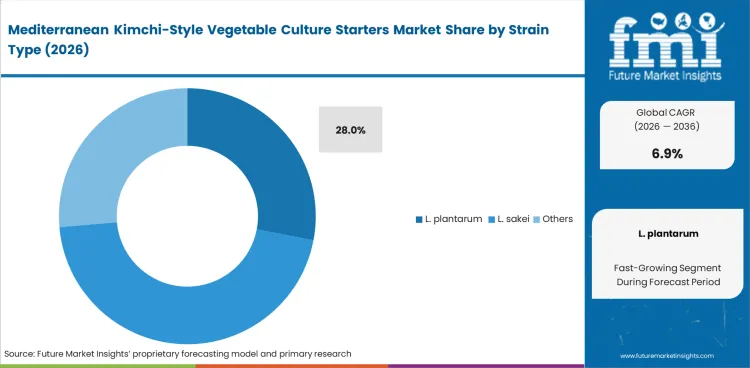
L. plantarum is projected to secure 28.0% share in 2026. Strain selection in this market depends on whether cultures can stay stable under salt pressure, rising acidity, and variable batch conditions that often distort fermentation consistency. Processors usually prefer strains that reduce variability early, since poor fermentation control becomes harder to correct once texture, aroma, and shelf behavior begin to drift. Familiar use across microbial food cultures and probiotic strains also keeps demand centered on organisms with a broader record of dependable performance in food applications. Other strains still matter where sharper flavor shaping or texture response is required, but their use is often narrower and more product-specific. Commercial preference stays with strains that perform reliably across routine production rather than those that work only under tightly managed conditions. Segment value is decided by how well the selected strain keeps batches controlled, repeatable, and easier to release with confidence.
- Salt-pressure stability: Reliable performance under brined conditions helps processors avoid uneven acid build-up across mixed vegetable batches.
- Balanced flavor profile: A familiar fermentation pattern supports repeat buying where brands want clean sourness without sharp batch variation.
- Early batch discipline: Strain choice shapes hold time and first-stage consistency, and poor selection can weaken shelf performance later.
Mediterranean Kimchi-Style Vegetable Culture Starters Market Analysis by Culture Format
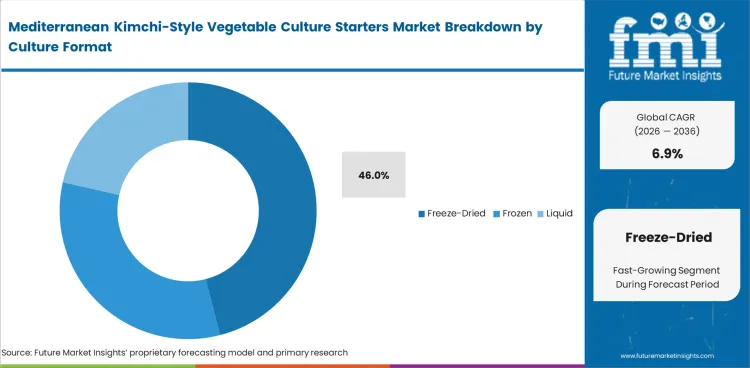
Culture format selection reflects daily operating practicality as much as microbial performance, especially in a market serving users with uneven storage conditions, batch sizes, and handling discipline. Buyers often prefer formats that can move through transport, storage, and dosing without creating extra friction for production teams or smaller specialty operators. Freeze-dried systems remain widely preferred because they fit that requirement more cleanly than liquid or frozen options in many real commercial settings. Industrial users, small-batch fermenters, and specialty retailers do not all have the same cold-chain consistency, so stable handling becomes a real purchase driver rather than a secondary convenience. Freeze-dried formats are expected to account for 46.0% share in 2026. Liquid and frozen systems continue in better-controlled environments, but their narrower handling fit limits broader uptake. Segment leadership therefore rests on ease of use across the full operating path, not only on technical culture viability under ideal conditions.
- Simpler handling fit: Easy storage and dosing lower the barrier for buyers shifting from spontaneous fermentation to starter-led production.
- Wider channel reach: Formats that travel well suit supplier-led distribution and specialist online channels better than fragile alternatives.
- Lower usable waste: Longer working life helps reduce losses where order size stays small or reorder timing remains uneven.
Mediterranean Kimchi-Style Vegetable Culture Starters Market Analysis by Formulation Type
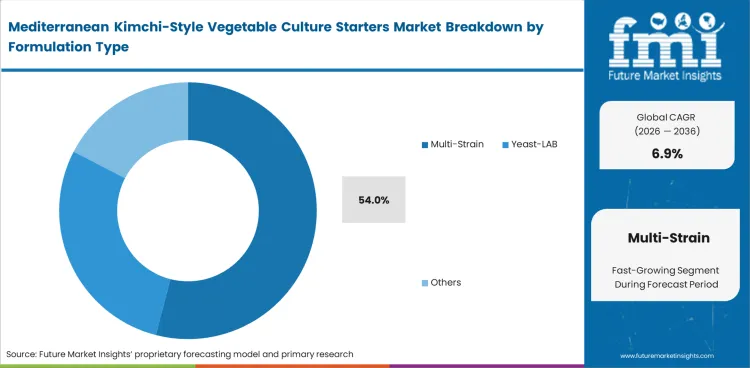
Formulation strategy matters because processors increasingly want one starter system to address more than one production need without building unnecessary complexity into the fermentation program. Blended systems stay ahead where acidification, flavor development, and batch stability need to work together instead of being managed through separate culture additions. Demand also reflects growing interest in multistrain probiotics and probiotic ferments across adjacent application areas, reinforcing the commercial pull toward broader-function systems. Multi-strain formulations are anticipated to represent 54.0% share in 2026. Single-strain options still serve more targeted outcomes, but their use becomes narrower once production expands across more recipes or higher-volume runs. That lead is not just about technical breadth; it also comes from reducing reformulation effort when processors move pilot work into routine production. Segment value ultimately depends on whether the formulation can carry consistency across varied product lines without introducing difficult-to-correct instability later.
- Broader operating function: Multi-strain blends reduce the need to manage acid control and flavor support through separate culture additions.
- Stronger recipe fit: Mixed vegetable applications benefit from systems that perform across more than one product line.
- Better scale-up support: Broader formulations help carry pilot success into regular production without repeated reformulation work.
Mediterranean Kimchi-Style Vegetable Culture Starters Market Analysis by Fermentation Role
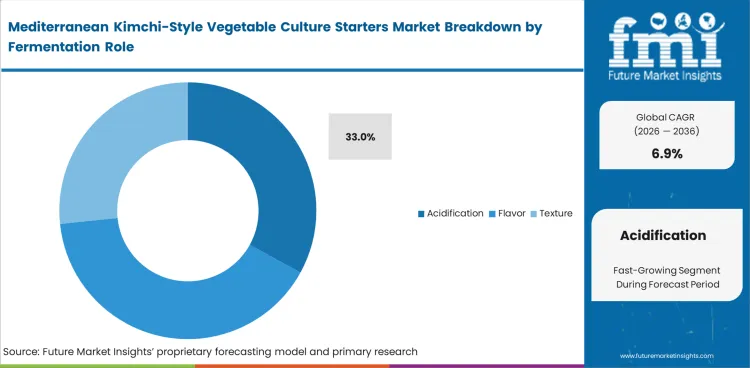
Fermentation role in this market is led by the functions that make production more controllable before they make the final product more differentiated. Buyers usually begin with acidification because predictable pH reduction gives them a more manageable fermentation window, steadier batch timing, and better confidence in release quality. Flavor development, texture support, and shelf-life improvement gain value after that foundation is in place, but they rarely come first in the buying sequence. Patterns seen across fermented ingredients and naturally fermented food point to the same commercial logic, where process control usually comes before premium positioning or flavor refinement. Acidification-led applications are set to represent 33.0% share in 2026. Weak control at this stage can move quality problems deeper into production, where they become more expensive to resolve. Accordingly, segment value depends on improving the key control point upfront, instead of relying on corrections later in the process.
- Predictable pH control: Managed acidification creates a clearer fermentation window and improves operational consistency for processors.
- Stronger safety support: Stable fermentation reduces the chance of uneven or unstable batches reaching commercial release.
- Better process timing: Controlled acid build-up helps production teams plan to hold periods and release cycles more accurately.
Mediterranean Kimchi-Style Vegetable Culture Starters Market Analysis by End User
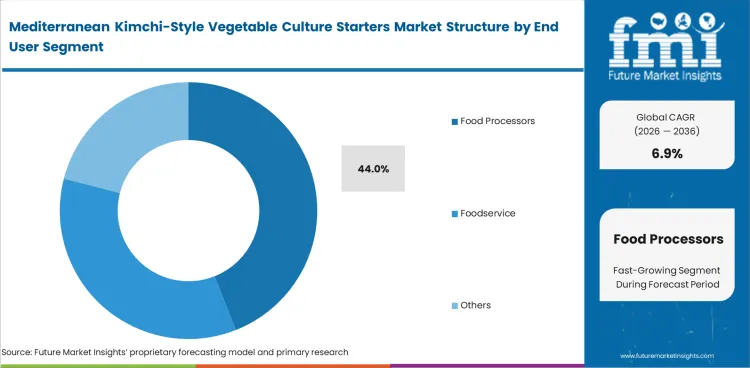
End-user demand is led by the buyers for whom fermentation inconsistency creates the highest commercial and operational cost across repeated production runs. Food processors stay ahead because larger batch volumes, fixed delivery schedules, and retail expectations leave limited tolerance for flavor drift, unstable acidity, or uneven shelf behavior. Small craft producers and foodservice users continue to participate, though their buying patterns are usually less predictable and less tied to continuous volume output. Demand also links closely with fermented processed food, where consistent multi-batch production matters more than occasional artisanal variation. That operating requirement keeps food processors in the lead because standardization matters more as commercial output expands, and retailer expectations become stricter. Food processors are projected to contribute 44.0% share of the market in 2026. Segment value is strongest where starter use reduces variability before it spreads across packaged output and creates broader correction costs.
- Higher volume pressure: Larger batch cycles increase the value of controlled fermentation and reduce tolerance for process drift.
- Stronger retail fit: Packaged products require more consistent taste and shelf stability across repeated production runs.
- Private-label readiness: Contract manufacturing depends on lower variation to meet buyer specifications across multiple batches.
Mediterranean Kimchi-Style Vegetable Culture Starters Market Analysis by Target Vegetable
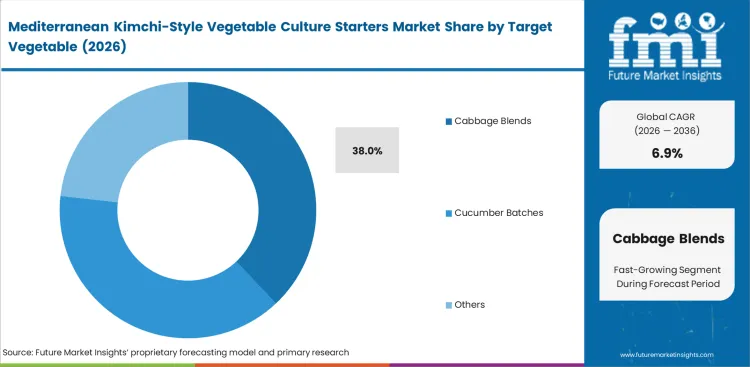
Target vegetable choice matters because fermentation behavior changes with texture, water release, and formulation stability, and not every base gives processors the same degree of control. Cabbage remains the preferred starting point in kimchi-style applications because it offers a more predictable balance of crunch retention, moisture response, and scale-up familiarity than many less stable alternatives. Processors often begin with cabbage to establish dependable formulations before extending into more variable combinations that require tighter handling. Interest in brined vegetables and dill pickles reflects a similar commercial pattern, where fermentation systems often expand outward from simpler, more manageable bases. Moving too quickly into vegetables with less stable texture or more variable fermentation response can introduce unwanted inconsistency before process control is fully established. Cabbage blends are likely to hold 38.0% share in 2026. Segment value, therefore rests on using a base that keeps product development and scale-up more disciplined from the outset.
- Recipe-development familiarity: A stable base helps producers build products more easily outside traditional kimchi consumption patterns.
- Reliable texture hold: Cabbage offers a workable balance between crunch retention and fermentation response during production.
- Clearer expansion path: Many producers begin with cabbage before moving into radish or mixed-vegetable variants.
Mediterranean Kimchi-Style Vegetable Culture Starters Market Analysis by Sales Channel
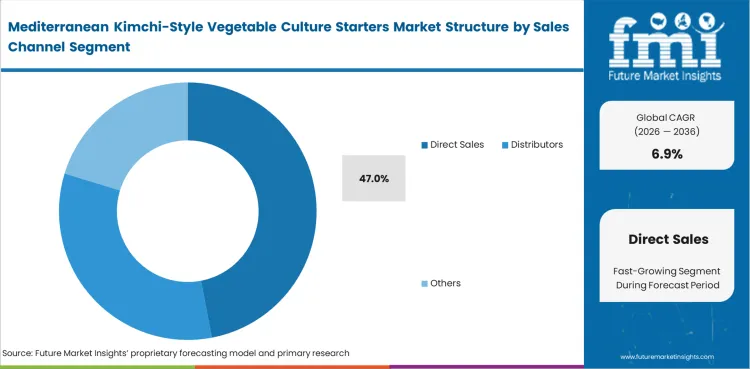
Sales-channel performance in this market depends on how well the route to market supports technical understanding at the point where buyers are still learning how to use fermentation cultures correctly. Early adoption often requires guidance on strain selection, dosage, handling, and storage, especially for users moving from spontaneous fermentation toward more controlled starter-led production. Direct engagement therefore, carries more weight than indirect channels during the first conversion stage, since uncertainty can slow uptake even where end-product demand is already visible. Similar channel behavior can be seen across probiotic ingredients and synbiotic products, where product understanding strongly influences trial and repeat purchase. Distributor and online routes continue to support replenishment and smaller-volume orders, but they play a weaker role in first-use confidence building. Segment value depends mainly on whether the channel can convert technical hesitation into regular adoption. Direct sales are forecast to account for 47.0% share in 2026.
- Technical guidance fit: Clear support on usage improves buyer confidence during early-stage adoption of fermentation cultures.
- Stronger trial support: Direct interaction helps first-time users move into pilot production with fewer avoidable errors.
- Higher repeat potential: Established supplier relationships support more consistent culture performance across future purchase cycles.
Mediterranean Kimchi-Style Vegetable Culture Starters Market Drivers, Restraints, and Opportunities
Retail-ready fermented vegetables are moving toward tighter process control, and that change is the main demand driver for this category. Buyers adopting kimchi-style lines need flavor consistency, safer hold time, and fewer unstable batches once products reach supermarkets, specialty retail, and export channels. Starter cultures reduce variability by making acid development and fermentation timing more predictable across repeated batches. Support from starter cultures and fermented processed food makes this shift easier to understand. Demand grows fastest where producers see starter use as a practical quality tool instead of a specialist extra.
Traditional fermentation habits remain the main restraint because many smaller producers still see spontaneous fermentation as good enough for local or limited-volume sales. Culture use can also feel like added handling work when a processor has not yet built a disciplined dosing and storage routine. This restraint is likely to persist because many smaller producers still see starter use as an added cost and handling step rather than a necessary control tool. Naturally fermented food and brined vegetables show why cultural familiarity with fermentation does not automatically translate into formal starter adoption. Wider use improves only when buyers feel the gain in repeatability is worth the extra process step.
Opportunities in the Mediterranean Kimchi-Style Vegetable Culture Starters Market
- Premium retail lines: Premium packaged kimchi-style vegetables are the clearest near-term opportunity because retail buyers expect stable taste, texture, and shelf life across repeated deliveries.
- Private label supply: Private label producers can gain from starter systems that make repeated specifications easier to meet across many production runs and customer accounts.
- Specialist online channels: Smaller pack sizes and easier formats can widen conversion where first-time buyers discover cultures through probiotic ingredients and synbiotic products in adjacent search and buying journeys.
Regional Analysis
Based on the regional analysis, the Mediterranean Kimchi-Style Vegetable Culture Starters Market is segmented into Western Europe, Eastern Mediterranean, and North Africa across 40 plus countries.
.webp "Top Country Growth Comparison Mediterranean Kimchi Style Vegetable Culture Starters Market Cagr (2026 2036)")
| Country | CAGR (2026 to 2036) |
|---|---|
| France | 7.8% |
| Spain | 7.5% |
| Italy | 7.2% |
| Türkiye | 6.8% |
| Greece | 6.6% |
| Israel | 6.4% |
| Morocco | 6.1% |
Source: Future Market Insights (FMI) analysis, based on proprietary forecasting model and primary research.
Western Europe Mediterranean Kimchi-Style Vegetable Culture Starters Market Analysis
Western Europe is likely to remain the clearest demand center for this niche because premium food retail and international cuisine adoption are already more established here than in much of the surrounding region. Buyers across France, Spain, and Italy are not only looking for fermented flavor. They also need packaged products that taste stable across repeated deliveries. That pulls starter cultures into a more practical role for quality control, especially where kimchi demand and fermented foods already support category visibility. Commercial progress in this region is helped by stronger willingness to pay for process consistency when it protects repeat shelf placement and customer trust.
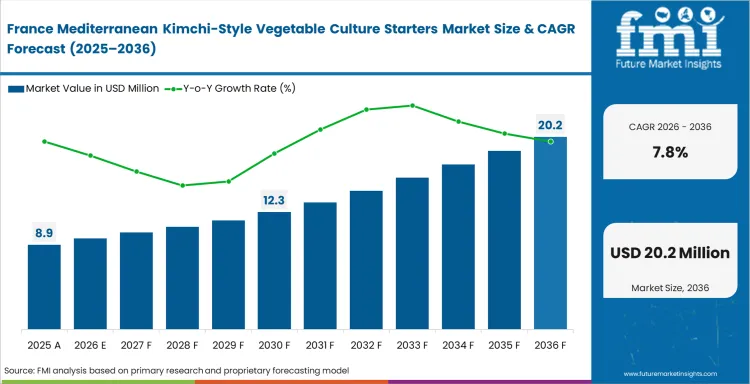
- France: French demand is moving ahead because premium grocery, natural food stores, and urban restaurants have given kimchi-style products a clearer commercial shelf than in many neighboring markets. Buyers in Paris, Lyon, and Marseille are more willing to test controlled starter systems when retail quality needs to stay steady across repeated supplies. Demand for Mediterranean kimchi-style vegetable culture starters in France is anticipated to rise at a CAGR of 7.8% from 2026 to 2036. Growth in this market reflects stronger exposure to Korean cuisine and a broader habit of paying for fermentation quality when it improves repeat sales. Producers who keep relying only on spontaneous fermentation may find scaling harder once batch consistency becomes a retail expectation.
- Spain: Spanish food producers have a practical advantage in fermentation familiarity, and that matters as kimchi-style vegetables move from novelty into a more stable, premium food slot. Barcelona and Madrid show stronger product experimentation, while Valencia adds relevance through food processing depth and export handling. A forecast CAGR of 7.5% is expected for this industry in Spain through 2036 because starter use fits the needs of brands that want predictable flavor and safer production windows. Caution remains in smaller operations where process learning still feels like added work. In Spain, adoption is likely to widen when processors can show that starter use reduces batch variation across repeat retail deliveries.
- Italy: Italian uptake is supported by a food culture that values fermentation quality and ingredient character, yet buyers still move carefully when a new format asks for extra process discipline. Milan and Bologna are likely to stay at the strongest commercial points because premium packaged foods and specialty distribution are already well developed there. Sales of Mediterranean kimchi-style vegetable culture starters in Italy are expected to increase at a CAGR of 7.2% during the forecast period. Cabbage-based formats and mixed-vegetable recipes fit best in early-stage expansion because they are easier to stabilize. In Italy, suppliers focused on repeatable cabbage and mixed-vegetable formats are likely to scale more cleanly than brands relying on novelty alone.
FMI analysis also covers additional Western European demand pockets beyond the three countries listed above. Growth in those markets is likely to follow the same pattern: early traction in premium food channels first, followed by slower movement into broader retail once starter-led consistency becomes easier to justify.
Eastern Mediterranean Mediterranean Kimchi-Style Vegetable Culture Starters Market Analysis
Eastern Mediterranean demand is shaped by a different base. Fermentation familiarity is already present in food culture, but formal kimchi-style starter use is still building commercial ground. Buyers in this region often understand preserved vegetable behavior, yet many are still weighing whether structured starter use improves enough of the final product to justify a more deliberate process.
- Türkiye: Türkiye has deep familiarity with preserved vegetables, pickling, and sour flavor formats, which gives this industry a useful cultural base even though formal kimchi-style starter demand is still developing. Istanbul and Izmir are likely to remain the main points of product experimentation as specialty retail and restaurant demand broaden. Türkiye is projected to witness 6.8% CAGR in the Mediterranean kimchi-style vegetable culture starters segment from 2026 to 2036. Growth stays below France and Spain because many smaller producers still trust inherited fermentation practice before structured starter systems. Commercial adoption improves once the value of consistency is seen in packaged retail rather than only in kitchen-scale production.
- Greece: Greek demand benefits from familiarity with brined vegetables and preserved-food traditions, yet starter-led kimchi-style production is still a young idea in commercial terms. Athens and Thessaloniki offer the best early outlet because premium retail and foodservice buyers are more open to fermented specialty foods with stable taste. Adoption of Mediterranean kimchi-style vegetable culture starters in Greece is expected to move ahead at a CAGR of 6.6% over the forecast period. Buyers tend to adopt more carefully where batch craft still carries weight and formal fermentation controls are seen as a later-stage upgrade. Suppliers that simplify usage and explain performance clearly are more likely to convert first-time interest into repeat demand.
- Israel: Israeli food innovation and premium health-oriented consumption support the category, especially in urban centers such as Tel Aviv and Jerusalem where fermented foods are more visible in specialty channels. Demand is helped by openness to premium ingredient positioning, but scale remains selective because this is still a narrow application rather than a broad pantry staple. The demand for Mediterranean kimchi-style vegetable culture starters in Israel is expected to grow at a CAGR of 6.4% during the study period. Buyers are more likely to value starters when they support stable product character in smaller premium lines. Slow translation into mass-volume formats keeps growth steady rather than sharp.
FMI analysis includes more countries across the Eastern Mediterranean than the shortlist presented here. Outside the leading markets, demand is expected to remain selective and tied to premium retail, restaurant experimentation, and smaller branded lines rather than mass-volume conversion.
North Africa Mediterranean Kimchi-Style Vegetable Culture Starters Market Analysis
North Africa remains an earlier-stage but credible part of the regional story. Product familiarity with preserved vegetables gives the market a useful operating base, yet kimchi-style fermented products still need channel building and consumer education before starter demand scales meaningfully. Morocco gives the best signal for how the sub-region may develop because modern retail and specialty packaged foods are more visible there than in many neighboring countries.
- Morocco: Morocco brings long experience in preserved vegetables and flavor-forward food preparation, though formal kimchi-style culture use is still at an earlier commercial stage than in Western Europe. Casablanca and Rabat offer the clearest first route because modern retail and premium packaged foods are more visible there. Mediterranean kimchi-style vegetable culture starter sales in Morocco are expected to grow at a CAGR of 6.1% during the forecast period. Progress is shaped by a smaller specialty-food base and more limited starter familiarity in everyday production. Growth remains credible, yet scale depends on patient channel building and simple starter formats that do not add heavy handling burden.
FMI analysis also considers additional North African markets where fermented vegetable culture use remains narrow. Wider adoption in those countries is expected to depend on easier starter handling, stronger modern retail penetration, and more visible premium fermented-food demand.
Competitive Aligners for Market Players
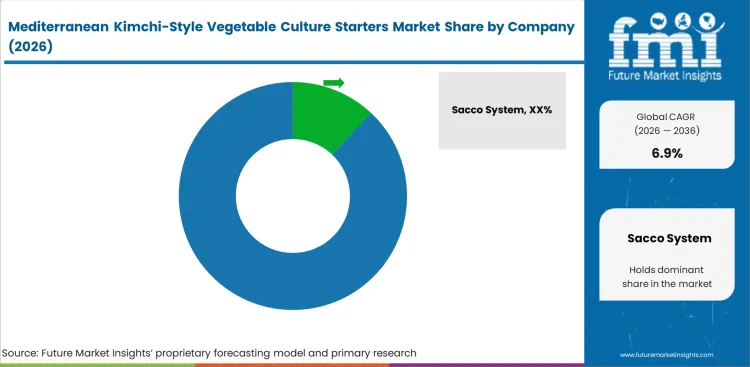
In the Mediterranean kimchi-style vegetable culture starters market, competitive positioning is defined primarily by operational trust rather than broad brand recognition. Buyers place greater weight on technical assurance, predictable fermentation outcomes, and confidence that starter cultures will perform consistently across batches. Suppliers with strong fermentation know-how tend to be favored where processors seek reliability for scaled or repeat applications. At the same time, the market continues to accommodate suppliers that reduce complexity and provide straightforward guidance, particularly for smaller processors at early adoption stages.
Supplier strength depends on helping buyers reduce trial risk through clear dosing guidance, stable handling, and reliable batch performance. Entry into starter-driven kimchi-style production often involves learning curves, and buyers evaluate suppliers based on how clearly they communicate usage parameters such as dosing levels, storage stability, recipe alignment, and fermentation timelines. Clarity in these areas strengthens buyer confidence and encourages longer-term relationships. As a result, established suppliers sustain an advantage even within a fragmented structure, while smaller players remain competitive by prioritizing accessible starter cultures, reducing technical friction, and guiding first-time users through simplified product frameworks and multistrain probiotics.
Buyer bargaining power is expected to strengthen gradually through 2036, shaped more by experience accumulation than by rapid supplier substitution. Switching becomes more viable once processors understand how a culture behaves within their own formulation and production environment. Until then, buyers prefer consistency over experimentation. Although no supplier holds dominant control today, those offering dependable technical support and clearly defined handling guidance are likely to retain customers more effectively as volumes stabilize. Market leadership therefore rests less on scale and more on sustained performance as trial use evolves into routine commercial production. In this context, segments linked to probiotic ingredients and custom probiotics indicate that ease of application and reduced operational uncertainty will remain central to supplier preference as the niche matures.
Key Players in Mediterranean Kimchi-Style Vegetable Culture Starters Market
- Sacco System
- Novonesis
- Lallemand Specialty Cultures
- IFF
- Kultured (SIGURD BV)
Scope of the Report
| Metric | Value |
|---|---|
| Quantitative Units | USD 18.4 million to USD 35.9 million, at a CAGR of 6.9% |
| Market Definition | Starter cultures used to guide kimchi-style vegetable fermentation across commercial, craft, and specialist packaged-food settings in the Mediterranean region. |
| Strain Type Segmentation | L. plantarum, Leuconostoc, L. sakei, Pediococcus, Lactococcus, Mixed LAB |
| Culture Format Segmentation | Freeze-dried, Frozen, Liquid, DVS |
| Formulation Type Segmentation | Multi-strain, Single-strain, Yeast-LAB, Protective blends |
| Additional Segmentation | Fermentation Role, End User, Target Vegetable, Sales Channel |
| Countries Covered | France, Spain, Italy, Türkiye, Greece, Israel, Morocco |
| Key Companies Profiled | Sacco System, Novonesis, Lallemand Specialty Cultures, IFF, Kultured (SIGURD BV) |
| Forecast Period | 2026 to 2036 |
Source: Future Market Insights (FMI) analysis, based on proprietary forecasting model and primary research.
Mediterranean Kimchi-Style Vegetable Culture Starters Market Analysis by Segments
Strain Type
- L. plantarum
- Leuconostoc
- L. sakei
- Pediococcus
- Lactococcus
- Mixed LAB
Culture Format
- Freeze-dried
- Frozen
- Liquid
- DVS
Formulation Type
- Multi-strain
- Single-strain
- Yeast-LAB
- Protective blends
Fermentation Role
- Acidification
- Flavor
- Shelf-life
- Texture
- Bioprotection
End User
- Food processors
- Craft brands
- Foodservice
- Home fermenters
Target Vegetable
- Cabbage blends
- Radish blends
- Mixed vegetables
- Cucumber batches
- Pepper mixes
Sales Channel
- Direct sales
- Distributors
- Online retail
- Specialty stores
Region
- North America
- United States
- Canada
- Europe
- Germany
- United Kingdom
- France
- Italy
- Spain
- Asia Pacific
- China
- Japan
- South Korea
- Taiwan
- Singapore
- Latin America
- Brazil
- Mexico
- Argentina
- Middle East & Africa
- GCC Countries
- South Africa
Bibliography
- Giavalisco, M., Romeo, F. V., Perpetuini, G., and Tofalo, R. (2024). Starter Cultures for the Production of Fermented Table Olives: Current Status and Future Perspectives
- Jeong, C. H., Kim, H. J., Lee, S. H., Lim, J. H., Lee, H. G., Park, K. Y., and Lee, M. E. (2024). Combination approach of paired starter culture and lactic acid on inhibiting autochthonous lactic acid bacteria for extending kimchi shelf life.
- Kang, J. Y., Lee, H. Y., Kim, M. Y., Jung, M. J., Jeong, H. G., Kim, J. Y., and Kim, S. I. (2024). Organic acid type in kimchi is a key factor for determining kimchi starters for kimchi fermentation control.
- Lee, M., Shin, Y., Lee, D. H., Kim, M., Lee, H. Y., and Kim, Y. S. (2024). Kimchi Lactic Acid Bacteria Starter Culture: Impact on Fermented Malt Beverage Volatile Profile, Sensory Analysis, and Physicochemical Traits.
- Ministry of Agriculture, Food and Rural Affairs. (2026). Exports of K-Food Plus Reached USD 13.6 Billion in 2025, the Highest Ever.
This bibliography is provided for the reader's reference. The full FMI report contains the complete reference list with primary source documentation.
This Report Addresses
- Market intelligence to support strategic decision making across kimchi-style vegetable starter formats, strain choices, and fermentation-control systems.
- Market size estimation and 10-year forecasts from 2026 to 2036 built around a narrow starter-culture opportunity rather than finished kimchi sales.
- Growth opportunity mapping across strain type, format, formulation type, fermentation role, end user, target vegetable, and channel structure.
- Country-level growth evaluation covering France, Spain, Italy, Türkiye, Greece, Israel, and Morocco.
- Competitive assessment across specialist culture suppliers and fermentation-focused sellers active in this niche.
- Scope clarification that separates starter-culture demand from finished fermented vegetables, probiotic supplements, and broad fermented food revenues.
- Segment interpretation explains why leading sub-segments attract higher demand in 2026.
- Practical insight into where controlled fermentation is becoming commercially necessary rather than optional.
Frequently Asked Questions
What does this market cover?
It covers starter cultures used to control fermentation in kimchi-style vegetable products across Mediterranean supply chains.
What is the market value in 2025?
FMI estimates the market at USD 17.2 million in 2025.
What is the market value in 2026?
Demand is projected to reach USD 18.4 million in 2026.
What is the forecast value for 2036?
FMI projects the market to reach USD 35.9 million by 2036.
What is the forecast CAGR?
The market is expected to expand at a CAGR of 6.9% from 2026 to 2036.
Why is starter use gaining ground?
Starter use is gaining ground because brands want steadier flavor, cleaner batch control, and better shelf-life discipline in packaged fermented vegetables.
What slows faster conversion?
Faster conversion is slowed by reliance on spontaneous fermentation and caution around added process cost in smaller operations.
Which strain type leads the market?
L. plantarum leads strain demand and is expected to account for 28.0% share in 2026.
Which culture format leads the market?
Freeze-dried cultures lead the format mix and are projected to hold 46.0% share in 2026.
Which formulation type leads the market?
Multi-strain formulations lead the market with an estimated 54.0% share in 2026.
Which fermentation role is the largest?
Acidification-led use remains the largest fermentation role with 33.0% share expected in 2026.
Which end user holds the largest share?
Food processors are expected to represent 44.0% of market demand in 2026.
Which target vegetable stays ahead?
Cabbage blends lead target-vegetable demand and are expected to hold 38.0% share in 2026.
Which sales channel leads?
Direct sales are forecast to account for 47.0% of channel demand in 2026.
Which country grows the fastest?
France is expected to post the fastest growth at 7.8% through 2036.
How does Spain compare?
Spain follows closely behind France with a projected CAGR of 7.5% through 2036.
How does Italy compare?
Italy is forecast to grow at 7.2% as premium packaged fermented foods gain wider commercial room.
What is the outlook for Türkiye?
Türkiye is expected to expand at 6.8% as formal starter use grows on top of an established fermentation base.
What is the outlook for Greece?
Greece is projected to record 6.6% CAGR through 2036 with demand led by premium retail and foodservice experimentation.
What is the outlook for Israel?
Israel is forecast to grow at 6.4% as health-led premium food positioning supports selective starter adoption.
What is the outlook for Morocco?
Morocco is expected to post 6.1% CAGR with growth tied to gradual premium channel development.
Is the market concentrated?
No single company dominates this niche, and FMI views the market as fragmented across culture specialists and fermentation-focused suppliers.
Who is the estimated market leader?
Sacco System is estimated to lead in this niche.
What matters most in supplier choice?
Buyers usually prioritize reliable fermentation performance, simple handling, clear dosage guidance, and responsive technical support during first-time adoption.
Preview the report firsthand - request a free sample
Get SampleGet the brochure for pricing and purchase details.
Get PDFTable of Content
- Executive Summary
- Global Market Outlook
- Demand-side Trends
- Supply-side Trends
- Technology Roadmap Analysis
- Analysis and Recommendations
- Market Overview
- Market Coverage / Taxonomy
- Market Definition / Scope / Limitations
- Research Methodology
- Chapter Orientation
- Analytical Lens and Working Hypotheses
- Market Structure, Signals, and Trend Drivers
- Benchmarking and Cross-market Comparability
- Market Sizing, Forecasting, and Opportunity Mapping
- Research Design and Evidence Framework
- Desk Research Programme (Secondary Evidence)
- Company Annual and Sustainability Reports
- Peer-reviewed Journals and Academic Literature
- Corporate Websites, Product Literature, and Technical Notes
- Earnings Decks and Investor Briefings
- Statutory Filings and Regulatory Disclosures
- Technical White Papers and Standards Notes
- Trade Journals, Industry Magazines, and Analyst Briefs
- Conference Proceedings, Webinars, and Seminar Materials
- Government Statistics Portals and Public Data Releases
- Press Releases and Reputable Media Coverage
- Specialist Newsletters and Curated Briefings
- Sector Databases and Reference Repositories
- FMI Internal Proprietary Databases and Historical Market Datasets
- Subscription Datasets and Paid Sources
- Social Channels, Communities, and Digital Listening Inputs
- Additional Desk Sources
- Expert Input and Fieldwork (Primary Evidence)
- Primary Modes
- Qualitative Interviews and Expert Elicitation
- Quantitative Surveys and Structured Data Capture
- Blended Approach
- Why Primary Evidence is Used
- Field Techniques
- Interviews
- Surveys
- Focus Groups
- Observational and In-context Research
- Social and Community Interactions
- Stakeholder Universe Engaged
- C-suite Leaders
- Board Members
- Presidents and Vice Presidents
- R&D and Innovation Heads
- Technical Specialists
- Domain Subject-matter Experts
- Scientists
- Physicians and Other Healthcare Professionals
- Governance, Ethics, and Data Stewardship
- Research Ethics
- Data Integrity and Handling
- Primary Modes
- Tooling, Models, and Reference Databases
- Desk Research Programme (Secondary Evidence)
- Data Engineering and Model Build
- Data Acquisition and Ingestion
- Cleaning, Normalisation, and Verification
- Synthesis, Triangulation, and Analysis
- Quality Assurance and Audit Trail
- Market Background
- Market Dynamics
- Drivers
- Restraints
- Opportunity
- Trends
- Scenario Forecast
- Demand in Optimistic Scenario
- Demand in Likely Scenario
- Demand in Conservative Scenario
- Opportunity Map Analysis
- Product Life Cycle Analysis
- Supply Chain Analysis
- Investment Feasibility Matrix
- Value Chain Analysis
- PESTLE and Porter’s Analysis
- Regulatory Landscape
- Regional Parent Market Outlook
- Production and Consumption Statistics
- Import and Export Statistics
- Market Dynamics
- Global Market Analysis 2021 to 2025 and Forecast, 2026 to 2036
- Historical Market Size Value (USD Million) Analysis, 2021 to 2025
- Current and Future Market Size Value (USD Million) Projections, 2026 to 2036
- Y-o-Y Growth Trend Analysis
- Absolute $ Opportunity Analysis
- Global Market Pricing Analysis 2021 to 2025 and Forecast 2026 to 2036
- Global Market Analysis 2021 to 2025 and Forecast 2026 to 2036, By Strain Type
- Introduction / Key Findings
- Historical Market Size Value (USD Million) Analysis By Strain Type , 2021 to 2025
- Current and Future Market Size Value (USD Million) Analysis and Forecast By Strain Type , 2026 to 2036
- L. plantarum
- L. sakei
- Others
- L. plantarum
- Y-o-Y Growth Trend Analysis By Strain Type , 2021 to 2025
- Absolute $ Opportunity Analysis By Strain Type , 2026 to 2036
- Global Market Analysis 2021 to 2025 and Forecast 2026 to 2036, By Culture Format
- Introduction / Key Findings
- Historical Market Size Value (USD Million) Analysis By Culture Format, 2021 to 2025
- Current and Future Market Size Value (USD Million) Analysis and Forecast By Culture Format, 2026 to 2036
- Freeze-Dried
- Frozen
- Liquid
- Freeze-Dried
- Y-o-Y Growth Trend Analysis By Culture Format, 2021 to 2025
- Absolute $ Opportunity Analysis By Culture Format, 2026 to 2036
- Global Market Analysis 2021 to 2025 and Forecast 2026 to 2036, By Formulation Type
- Introduction / Key Findings
- Historical Market Size Value (USD Million) Analysis By Formulation Type, 2021 to 2025
- Current and Future Market Size Value (USD Million) Analysis and Forecast By Formulation Type, 2026 to 2036
- Multi-Strain
- Yeast-LAB
- Others
- Multi-Strain
- Y-o-Y Growth Trend Analysis By Formulation Type, 2021 to 2025
- Absolute $ Opportunity Analysis By Formulation Type, 2026 to 2036
- Global Market Analysis 2021 to 2025 and Forecast 2026 to 2036, By Fermentation Role
- Introduction / Key Findings
- Historical Market Size Value (USD Million) Analysis By Fermentation Role, 2021 to 2025
- Current and Future Market Size Value (USD Million) Analysis and Forecast By Fermentation Role, 2026 to 2036
- Acidification
- Flavor
- Texture
- Acidification
- Y-o-Y Growth Trend Analysis By Fermentation Role, 2021 to 2025
- Absolute $ Opportunity Analysis By Fermentation Role, 2026 to 2036
- Global Market Analysis 2021 to 2025 and Forecast 2026 to 2036, By End User
- Introduction / Key Findings
- Historical Market Size Value (USD Million) Analysis By End User, 2021 to 2025
- Current and Future Market Size Value (USD Million) Analysis and Forecast By End User, 2026 to 2036
- Food Processors
- Foodservice
- Others
- Food Processors
- Y-o-Y Growth Trend Analysis By End User, 2021 to 2025
- Absolute $ Opportunity Analysis By End User, 2026 to 2036
- Global Market Analysis 2021 to 2025 and Forecast 2026 to 2036, By Target Vegetable
- Introduction / Key Findings
- Historical Market Size Value (USD Million) Analysis By Target Vegetable, 2021 to 2025
- Current and Future Market Size Value (USD Million) Analysis and Forecast By Target Vegetable, 2026 to 2036
- Cabbage Blends
- Cucumber Batches
- Others
- Cabbage Blends
- Y-o-Y Growth Trend Analysis By Target Vegetable, 2021 to 2025
- Absolute $ Opportunity Analysis By Target Vegetable, 2026 to 2036
- Global Market Analysis 2021 to 2025 and Forecast 2026 to 2036, By Sales Channel
- Introduction / Key Findings
- Historical Market Size Value (USD Million) Analysis By Sales Channel, 2021 to 2025
- Current and Future Market Size Value (USD Million) Analysis and Forecast By Sales Channel, 2026 to 2036
- Direct Sales
- Distributors
- Others
- Direct Sales
- Y-o-Y Growth Trend Analysis By Sales Channel, 2021 to 2025
- Absolute $ Opportunity Analysis By Sales Channel, 2026 to 2036
- Global Market Analysis 2021 to 2025 and Forecast 2026 to 2036, By Region
- Introduction
- Historical Market Size Value (USD Million) Analysis By Region, 2021 to 2025
- Current Market Size Value (USD Million) Analysis and Forecast By Region, 2026 to 2036
- North America
- Latin America
- Western Europe
- Eastern Europe
- East Asia
- South Asia and Pacific
- Middle East & Africa
- Market Attractiveness Analysis By Region
- North America Market Analysis 2021 to 2025 and Forecast 2026 to 2036, By Country
- Historical Market Size Value (USD Million) Trend Analysis By Market Taxonomy, 2021 to 2025
- Market Size Value (USD Million) Forecast By Market Taxonomy, 2026 to 2036
- By Country
- USA
- Canada
- Mexico
- By Strain Type
- By Culture Format
- By Formulation Type
- By Fermentation Role
- By End User
- By Target Vegetable
- By Sales Channel
- By Country
- Market Attractiveness Analysis
- By Country
- By Strain Type
- By Culture Format
- By Formulation Type
- By Fermentation Role
- By End User
- By Target Vegetable
- By Sales Channel
- Key Takeaways
- Latin America Market Analysis 2021 to 2025 and Forecast 2026 to 2036, By Country
- Historical Market Size Value (USD Million) Trend Analysis By Market Taxonomy, 2021 to 2025
- Market Size Value (USD Million) Forecast By Market Taxonomy, 2026 to 2036
- By Country
- Brazil
- Chile
- Rest of Latin America
- By Strain Type
- By Culture Format
- By Formulation Type
- By Fermentation Role
- By End User
- By Target Vegetable
- By Sales Channel
- By Country
- Market Attractiveness Analysis
- By Country
- By Strain Type
- By Culture Format
- By Formulation Type
- By Fermentation Role
- By End User
- By Target Vegetable
- By Sales Channel
- Key Takeaways
- Western Europe Market Analysis 2021 to 2025 and Forecast 2026 to 2036, By Country
- Historical Market Size Value (USD Million) Trend Analysis By Market Taxonomy, 2021 to 2025
- Market Size Value (USD Million) Forecast By Market Taxonomy, 2026 to 2036
- By Country
- Germany
- UK
- Italy
- Spain
- France
- Nordic
- BENELUX
- Rest of Western Europe
- By Strain Type
- By Culture Format
- By Formulation Type
- By Fermentation Role
- By End User
- By Target Vegetable
- By Sales Channel
- By Country
- Market Attractiveness Analysis
- By Country
- By Strain Type
- By Culture Format
- By Formulation Type
- By Fermentation Role
- By End User
- By Target Vegetable
- By Sales Channel
- Key Takeaways
- Eastern Europe Market Analysis 2021 to 2025 and Forecast 2026 to 2036, By Country
- Historical Market Size Value (USD Million) Trend Analysis By Market Taxonomy, 2021 to 2025
- Market Size Value (USD Million) Forecast By Market Taxonomy, 2026 to 2036
- By Country
- Russia
- Poland
- Hungary
- Balkan & Baltic
- Rest of Eastern Europe
- By Strain Type
- By Culture Format
- By Formulation Type
- By Fermentation Role
- By End User
- By Target Vegetable
- By Sales Channel
- By Country
- Market Attractiveness Analysis
- By Country
- By Strain Type
- By Culture Format
- By Formulation Type
- By Fermentation Role
- By End User
- By Target Vegetable
- By Sales Channel
- Key Takeaways
- East Asia Market Analysis 2021 to 2025 and Forecast 2026 to 2036, By Country
- Historical Market Size Value (USD Million) Trend Analysis By Market Taxonomy, 2021 to 2025
- Market Size Value (USD Million) Forecast By Market Taxonomy, 2026 to 2036
- By Country
- China
- Japan
- South Korea
- By Strain Type
- By Culture Format
- By Formulation Type
- By Fermentation Role
- By End User
- By Target Vegetable
- By Sales Channel
- By Country
- Market Attractiveness Analysis
- By Country
- By Strain Type
- By Culture Format
- By Formulation Type
- By Fermentation Role
- By End User
- By Target Vegetable
- By Sales Channel
- Key Takeaways
- South Asia and Pacific Market Analysis 2021 to 2025 and Forecast 2026 to 2036, By Country
- Historical Market Size Value (USD Million) Trend Analysis By Market Taxonomy, 2021 to 2025
- Market Size Value (USD Million) Forecast By Market Taxonomy, 2026 to 2036
- By Country
- India
- ASEAN
- Australia & New Zealand
- Rest of South Asia and Pacific
- By Strain Type
- By Culture Format
- By Formulation Type
- By Fermentation Role
- By End User
- By Target Vegetable
- By Sales Channel
- By Country
- Market Attractiveness Analysis
- By Country
- By Strain Type
- By Culture Format
- By Formulation Type
- By Fermentation Role
- By End User
- By Target Vegetable
- By Sales Channel
- Key Takeaways
- Middle East & Africa Market Analysis 2021 to 2025 and Forecast 2026 to 2036, By Country
- Historical Market Size Value (USD Million) Trend Analysis By Market Taxonomy, 2021 to 2025
- Market Size Value (USD Million) Forecast By Market Taxonomy, 2026 to 2036
- By Country
- Kingdom of Saudi Arabia
- Other GCC Countries
- Turkiye
- South Africa
- Other African Union
- Rest of Middle East & Africa
- By Strain Type
- By Culture Format
- By Formulation Type
- By Fermentation Role
- By End User
- By Target Vegetable
- By Sales Channel
- By Country
- Market Attractiveness Analysis
- By Country
- By Strain Type
- By Culture Format
- By Formulation Type
- By Fermentation Role
- By End User
- By Target Vegetable
- By Sales Channel
- Key Takeaways
- Key Countries Market Analysis
- USA
- Pricing Analysis
- Market Share Analysis, 2025
- By Strain Type
- By Culture Format
- By Formulation Type
- By Fermentation Role
- By End User
- By Target Vegetable
- By Sales Channel
- Canada
- Pricing Analysis
- Market Share Analysis, 2025
- By Strain Type
- By Culture Format
- By Formulation Type
- By Fermentation Role
- By End User
- By Target Vegetable
- By Sales Channel
- Mexico
- Pricing Analysis
- Market Share Analysis, 2025
- By Strain Type
- By Culture Format
- By Formulation Type
- By Fermentation Role
- By End User
- By Target Vegetable
- By Sales Channel
- Brazil
- Pricing Analysis
- Market Share Analysis, 2025
- By Strain Type
- By Culture Format
- By Formulation Type
- By Fermentation Role
- By End User
- By Target Vegetable
- By Sales Channel
- Chile
- Pricing Analysis
- Market Share Analysis, 2025
- By Strain Type
- By Culture Format
- By Formulation Type
- By Fermentation Role
- By End User
- By Target Vegetable
- By Sales Channel
- Germany
- Pricing Analysis
- Market Share Analysis, 2025
- By Strain Type
- By Culture Format
- By Formulation Type
- By Fermentation Role
- By End User
- By Target Vegetable
- By Sales Channel
- UK
- Pricing Analysis
- Market Share Analysis, 2025
- By Strain Type
- By Culture Format
- By Formulation Type
- By Fermentation Role
- By End User
- By Target Vegetable
- By Sales Channel
- Italy
- Pricing Analysis
- Market Share Analysis, 2025
- By Strain Type
- By Culture Format
- By Formulation Type
- By Fermentation Role
- By End User
- By Target Vegetable
- By Sales Channel
- Spain
- Pricing Analysis
- Market Share Analysis, 2025
- By Strain Type
- By Culture Format
- By Formulation Type
- By Fermentation Role
- By End User
- By Target Vegetable
- By Sales Channel
- France
- Pricing Analysis
- Market Share Analysis, 2025
- By Strain Type
- By Culture Format
- By Formulation Type
- By Fermentation Role
- By End User
- By Target Vegetable
- By Sales Channel
- India
- Pricing Analysis
- Market Share Analysis, 2025
- By Strain Type
- By Culture Format
- By Formulation Type
- By Fermentation Role
- By End User
- By Target Vegetable
- By Sales Channel
- ASEAN
- Pricing Analysis
- Market Share Analysis, 2025
- By Strain Type
- By Culture Format
- By Formulation Type
- By Fermentation Role
- By End User
- By Target Vegetable
- By Sales Channel
- Australia & New Zealand
- Pricing Analysis
- Market Share Analysis, 2025
- By Strain Type
- By Culture Format
- By Formulation Type
- By Fermentation Role
- By End User
- By Target Vegetable
- By Sales Channel
- China
- Pricing Analysis
- Market Share Analysis, 2025
- By Strain Type
- By Culture Format
- By Formulation Type
- By Fermentation Role
- By End User
- By Target Vegetable
- By Sales Channel
- Japan
- Pricing Analysis
- Market Share Analysis, 2025
- By Strain Type
- By Culture Format
- By Formulation Type
- By Fermentation Role
- By End User
- By Target Vegetable
- By Sales Channel
- South Korea
- Pricing Analysis
- Market Share Analysis, 2025
- By Strain Type
- By Culture Format
- By Formulation Type
- By Fermentation Role
- By End User
- By Target Vegetable
- By Sales Channel
- Russia
- Pricing Analysis
- Market Share Analysis, 2025
- By Strain Type
- By Culture Format
- By Formulation Type
- By Fermentation Role
- By End User
- By Target Vegetable
- By Sales Channel
- Poland
- Pricing Analysis
- Market Share Analysis, 2025
- By Strain Type
- By Culture Format
- By Formulation Type
- By Fermentation Role
- By End User
- By Target Vegetable
- By Sales Channel
- Hungary
- Pricing Analysis
- Market Share Analysis, 2025
- By Strain Type
- By Culture Format
- By Formulation Type
- By Fermentation Role
- By End User
- By Target Vegetable
- By Sales Channel
- Kingdom of Saudi Arabia
- Pricing Analysis
- Market Share Analysis, 2025
- By Strain Type
- By Culture Format
- By Formulation Type
- By Fermentation Role
- By End User
- By Target Vegetable
- By Sales Channel
- Turkiye
- Pricing Analysis
- Market Share Analysis, 2025
- By Strain Type
- By Culture Format
- By Formulation Type
- By Fermentation Role
- By End User
- By Target Vegetable
- By Sales Channel
- South Africa
- Pricing Analysis
- Market Share Analysis, 2025
- By Strain Type
- By Culture Format
- By Formulation Type
- By Fermentation Role
- By End User
- By Target Vegetable
- By Sales Channel
- USA
- Market Structure Analysis
- Competition Dashboard
- Competition Benchmarking
- Market Share Analysis of Top Players
- By Regional
- By Strain Type
- By Culture Format
- By Formulation Type
- By Fermentation Role
- By End User
- By Target Vegetable
- By Sales Channel
- Competition Analysis
- Competition Deep Dive
- Sacco System
- Overview
- Product Portfolio
- Profitability by Market Segments (Product/Age /Sales Channel/Region)
- Sales Footprint
- Strategy Overview
- Marketing Strategy
- Product Strategy
- Channel Strategy
- Novonesis
- Lallemand Specialty Cultures
- IFF
- Kultured (SIGURD BV)
- Sacco System
- Competition Deep Dive
- Assumptions & Acronyms Used


