

- Market Size (2026)
- USD 732.8 Mn
- Forecast (2036)
- USD 1432.6 Mn
- CAGR (2026 to 2036)
- 6.9%
Mediterranean Lentil Crisps and Inclusion Bases Market Size, Market Forecast and Outlook By FMI
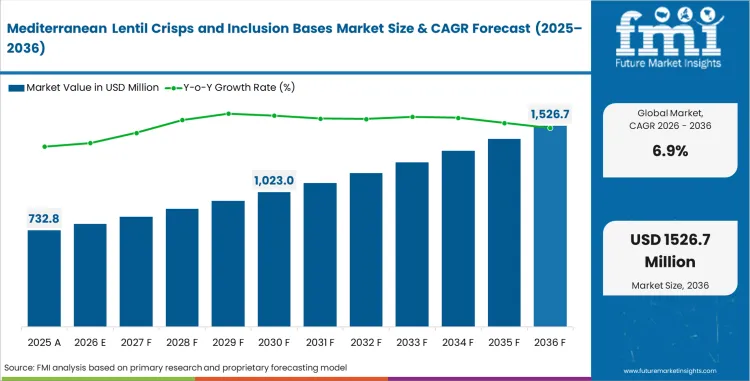
The Mediterranean lentil crisps and inclusion bases market crossed a valuation of USD 684.3 million in 2025. Demand is expected to reach USD 732.8 million in 2026 at a CAGR of 6.9% during the forecast period. Market value is projected to reach USD 1,432.6 million by 2036.
Summary of Mediterranean Lentil Crisps and Inclusion Bases Market
- Market Snapshot
- The Mediterranean lentil crisps and inclusion bases market is valued at USD 684.3 million in 2025 and is projected to reach USD 1,432.6 million by 2036.
- The industry is expected to grow at a rate of 6.9% from 2026 to 2036, creating an incremental opportunity of USD 699.8 million.
- The market operates as a premium plant-based snack and ingredient category where formulation quality, extrusion capability, and flavor authenticity define competitiveness.
- Supply is closely linked to lentil processing infrastructure and trade flows across North America, India, and Mediterranean regions.
- Demand and Growth Drivers
- Demand is improving where lentil-based snacks deliver a cleaner ingredient story and better nutrition cues without sacrificing familiar crunch, format, or shelf recognition.
- Extruded lentil crisps are gaining traction due to improved texture, shelf stability, and compatibility with Mediterranean seasoning profiles.
- Growth is supported by expansion of premium snack categories in Europe and Middle East retail channels.
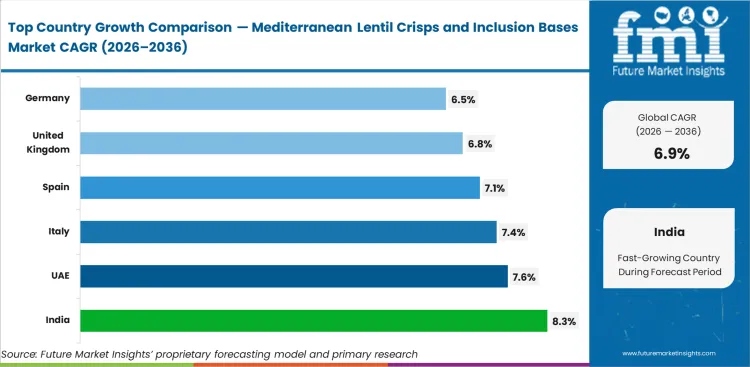
- Among key countries, India leads at 8.3% CAGR, followed by UAE at 7.6%, Italy at 7.4%, Spain at 7.1%, UK at 6.8%, Germany at 6.5%, and USA at 6.2%.
- Growth is moderated by raw material price volatility linked to pulse harvest variability.
- Product and Segment View
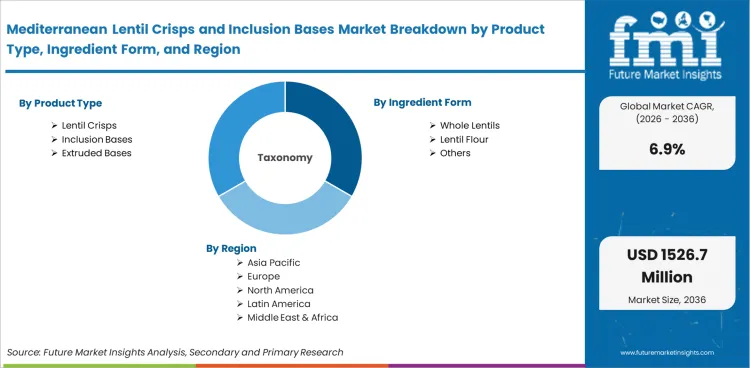
- The market covers lentil crisps and extrusion-based inclusion bases made mainly from whole lentils, flour, and protein fractions for snack and food formulation uses.
- These products are used across packaged snacks, bakery inclusions, confectionery fillings, and ready meal toppings.
- Lentil crisps lead the product type segment with 54.2% share, driven by retail snack dominance.
- Whole lentils lead the ingredient form segment with 41.6% share due to clean-label positioning.
- Savory Mediterranean leads the flavor profile segment with 48.7% share due to regional taste preference alignment.
- Snacks lead the application segment with 58.9% share, reflecting their direct-consumption format.
- Retail leads the distribution channel segment with 46.3% share supported by supermarket penetration.
- Extrusion leads the processing type segment with 52.5% share due to scalability and consistency.
- Snack brands lead the end user segment with 49.8% share reflecting branded product commercialization.
- The scope includes lentil-based crisps and inclusion bases but excludes non-pulse snacks and generic vegetable chips.
- Geography and Competitive Outlook
- India, UAE, and Italy are the fastest-growing markets, while the USA remains a stable high-value demand base.
- Competition is separating along three practical lines: brands that understand shelf conversion, suppliers that can keep lentil inputs commercially usable, and processors that can hold texture, shape, and seasoning consistency at scale.
- Key players include Calbee Inc., PepsiCo Inc., Intersnack Group, Kraft Heinz, AGT Food, Ardent Mills, and Bühler Group.
Key Takeaways, Market Size, and Forecast
- Mediterranean Lentil Crisps and Inclusion Bases Market is projected to grow from USD 732.8 million in 2026 to USD 1,432.6 million by 2036, at a CAGR of 6.9%.
- The Mediterranean lentil crisps and inclusion bases market was valued at USD 684.3 million in 2025.
- By 2036, the Mediterranean Lentil Crisps and Inclusion Bases Market is expected to be worth USD 1,432.6 million.
- From 2026 to 2036, the market is projected to expand at a CAGR of 6.9%.
- The market is projected to create an incremental opportunity of USD 699.8 million between 2026 and 2036.
- In 2026, Lentil Crisps is expected to account for 54.2% of the product type segment.
- India (8.3%) and UAE (7.6%) are two of the fastest growing markets.
Mediterranean lentil crisps and inclusion bases are moving beyond niche formulation and becoming a more relevant snacking platform. Demand is building as brands look for cleaner-label crisp formats that combine pulse ingredients, familiar savory cues, and a premium regional identity without pushing cost too high. Lentils offer a practical base because input availability is broader than for several specialty grains, while extrusion and baked snack systems already understand how to work with pulse-heavy blends. Growth in this market depends on one basic test: flavor credibility must hold up even when health positioning appears on pack. Olive oil notes, herb blends, tomato, garlic, and roasted vegetable cues give Mediterranean positioning stronger shelf logic, yet repeat purchase still depends on texture, oil control, and a clean bite. Inclusion-base suppliers are becoming more important because seasoning and base composition now need to work together.
Extrusion capability matters in this niche because throughput and texture consistency stay closely linked at commercial scale. For companies deciding to enter this industry, reliable line behavior usually deserves attention before broader flavor spread, because weak expansion control can erase the value of premium positioning.
India is expected to register an 8.3% CAGR during the forecast period, due to high pulse familiarity and a receptive base for premium snack experimentation. The UAE is estimated to expand at a 7.6% CAGR over the forecast period, as faster-growth settings reward immediate category fit for plant-forward products. Growth in Italy is poised to expand at a 7.4% CAGR, Spain at a 7.1% CAGR, the United Kingdom at a 6.8% CAGR, Germany and the United States at a 6.5% and 6.2% CAGR respectively. Demand across these European markets draws support from continued interest in cleaner savory positioning such as plant-based snacks, while mature shelves expand at a slower pace because wider assortments require sharper execution, clearer pack language, and steadier repeat purchase mechanics to drive consumer switching.
Mediterranean Lentil Crisps and Inclusion Bases Market Key Takeaways
| Metric | Details |
|---|---|
| Industry Size (2026) | USD 732.8 million |
| Industry Value (2036) | USD 1,432.6 million |
| CAGR (2026-2036) | 6.9% |
Source: Future Market Insights (FMI) analysis, based on proprietary forecasting model and primary research.
Segmental Analysis
Mediterranean Lentil Crisps and Inclusion Bases Market Analysis by Product Type
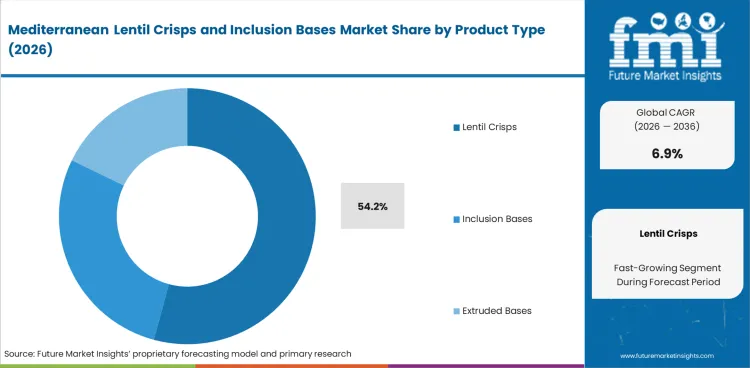
Direct snacking gives lentil crisps a clearer commercial route because shoppers recognize the format quickly and retailers can place packs beside familiar salty snacks without asking consumers to learn a new use occasion. Inclusion bases still carry value, yet movement across this side of the market usually depends on longer validation cycles, more formulation work, and a slower path to scale. The lentil crisps segment is expected to account for 54.2% share in 2026 because crisp texture, visible lentil identity, and fast flavor payoff create an easier shelf story for both branded and private label programs. Demand is also supported by broader acceptance of pulse-led snacking across Western countries. Texture failure can diminish repeat purchases, so volume tends to move toward products delivering reliable bite, shape retention, and seasoning balance from one pack to another. A practical commercial approach is to start with direct crisps, since they reach the market faster. Launching too many versions too early can make it harder for manufacturers to learn what customers actually prefer.
- Lentil Crisps: Familiar shelf placement, faster shopper recognition, and easier merchandising make this format the clearest route to branded scale. Commercial traction is stronger here because consumers immediately understand usage, flavor, and texture expectations at the point of purchase.
- Inclusion Bases: Demand builds across mixes, bowls, coatings, and topping systems needing visible crunch and Mediterranean-style flavor support. Adoption usually moves through a more technical route because downstream manufacturers need confidence around aspects such as breakage, moisture exposure, and handling performance before committing on volume.
- Extruded Bases and Pellet Bases: Maintaining relevance for processors, both formats enable tighter control over final shape, density, and applied seasoning load. Value increases significantly in manufacturing programs prioritizing flexibility over direct shelf communication, especially for products necessitating custom finishing, controlled expansion, or adjustments to seasoning during later production stages.
Mediterranean Lentil Crisps and Inclusion Bases Market Analysis by Ingredient Form
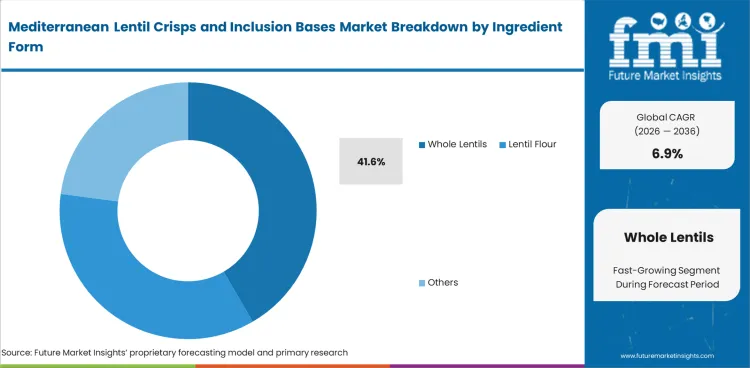
Whole lentils remain attractive in this market because the ingredient is easier for brands to explain and easier for shoppers to recognize. While lentil flour and protein isolates offer enhanced processing control for manufacturers, the clean-label appeal might diminish when the end product no longer contains clearly recognizable pulse ingredients. The whole lentils segment is expected to account for 41.6% of total market share in 2026, due to extended shelf-life of lentils, versatility in cuisines, and high nutritional value. Ongoing demand for pulse-based products also supports use in formats where visible lentil content matters more than a highly engineered base. Ingredient form affects bite, expansion, seasoning hold, and surface texture, so this choice shapes product performance early in development. Ingredient selection is a balance between simpler consumer communication and better manufacturing control. Strong results usually come from keeping the formula simple without losing processing consistency.
- Whole Lentils: This format supports clearer label language and easier brand communication across retail and private-label programs because visible pulse identity strengthens front-of-pack messaging without requiring much explanation of ingredient processing.
- Lentil Flour: The milling process enhances operational control, providing manufacturers with greater flexibility to precisely adjust density, thickness, and surface feel, making the use of flour particularly desirable in programs requiring superior line consistency, more uniform expansion, and meticulous control over the final crisp structure.
- Protein Isolates and Blended Pulses: These formats expand nutritional and textural options, though they usually require more flavor balancing. They are useful in formulations targeting higher protein claims, a more engineered mouthfeel, or broader functional positioning, even if brand communication becomes less simple.
Mediterranean Lentil Crisps and Inclusion Bases Market Analysis by Flavor Profile
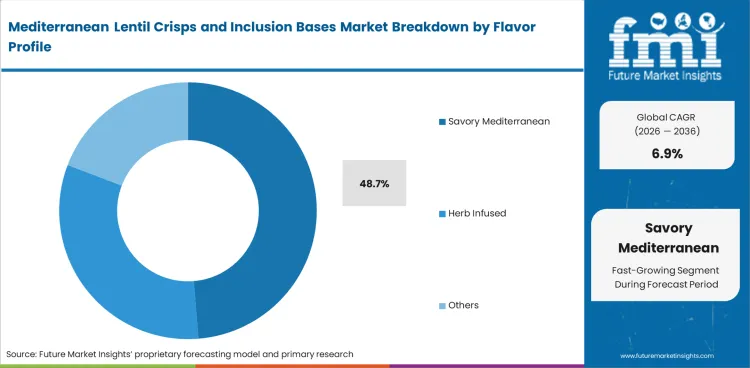
Flavor profiles elevate the product beyond just taste, effectively establishing the relevance of lentil crisps amid numerous potato, corn, and multigrain options on store shelves. Herbs, olive notes, garlic, lemon, and tangy savory undertones help make the category feel premium while staying accessible to consumers. Maintaining Mediterranean positioning remains readily understandable for a broad segment of the consumer base through these distinct flavor characteristics. The savory Mediterranean segment is anticipated to capture 48.7% of market share in 2026. Flavor innovation, particularly with herb-infused and spiced variants, remains significant, but typically gains traction after the base product has established consumer trust and repeat purchases. Interest is growing in cleaner savory systems that use flavor modulators to reduce bitterness and improve pulse-heavy formulations without masking lentil character. Commercial success hinges on seasoning restraint. Excessively strong or novel seasoning risks alienating repeat buyers by overpowering the base identity. Mediterranean flavor cues, for instance, are most effective as subtle support rather than a dominant profile. Long-term market performance is achieved through flavor architecture that ensures the base product's core identity remains recognizable while still offering enough distinction to encourage initial trial.
- Savory Mediterranean: Familiar pantry cues help products feel premium and approachable at the same time. This flavor family gives brands a practical middle ground between health-forward communication and indulgent snacking, making repeat purchase easier to defend.
- Herb Infused: This subsegment suits consumers preferring softer flavor layering and a less intense savory profile. It tends to work well in premium or cleaner-label positioning, especially in products trying to present lentils as part of a balanced, less overpowering eating experience.
- Spiced Variants and Plain Salted: One serves trial-led interest, while the other supports everyday snacking occasions. Spiced variants can create shelf differentiation and short-term excitement, whereas plain salted products often become the more dependable option for repeat consumption and broader household acceptance.
Mediterranean Lentil Crisps and Inclusion Bases Market Analysis by Application
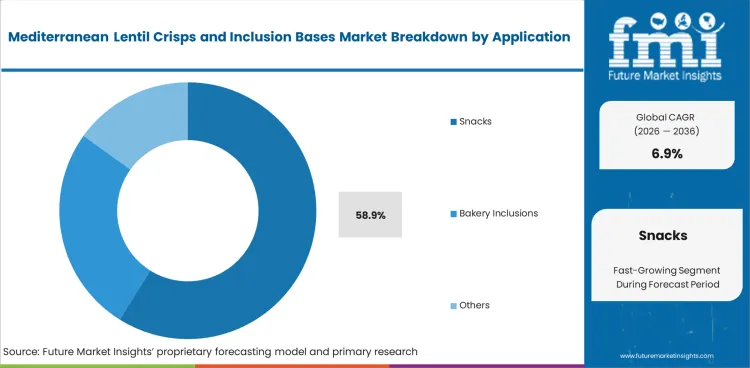
Snacks present the broadest application base due to the minimal reformulation required for movement from the production line to the point of sale, compared to ingredient-driven applications. Bakery inclusions and prepared meals can add stable revenue, but adoption depends on resistance to moisture absorption, physical damage, and texture change during storage and distribution. The snacks segment is estimated to account for 58.9% share in 2026, driven by accelerated consumer acceptance and improved merchandising strategies within the better-for-you snacking category. Adjacent health-focused categories also support this application, especially in gluten-free foods, where pulse-based alternatives expand product variety without moving too far from familiar eating formats. Application context is crucial for ensuring product quality, as poor matching often leads to textural issues like degradation after processes such as filling, reheating, or mixing. Performance validation should therefore extend beyond simple crisp format, encompassing the texture through filling, holding, shipping, and final consumption.
- Snacks: Direct consumption stays the most practical and fastest commercial outlet for Mediterranean lentil formats. Commercial learning also happens fastest here because brands can read shelf response, flavor acceptance, and repeat purchase behavior without waiting for performance testing inside a more complex food system.
- Bakery Inclusions: Best fit appears in products needing crunch and visible differentiation in toppings or mix-ins. Relevance increases in applications where texture contrast adds value, yet success depends on controlling moisture migration and keeping structure intact during filling and storage.
- Confectionery Inclusions and Ready Meals: Both add niche demand, though moisture control and careful handling stay essential. Commercial upside exists, but growth usually depends on very specific formulation discipline because texture loss can appear quickly once bases move into more demanding environments.
Mediterranean Lentil Crisps and Inclusion Bases Market Analysis by Distribution Channel
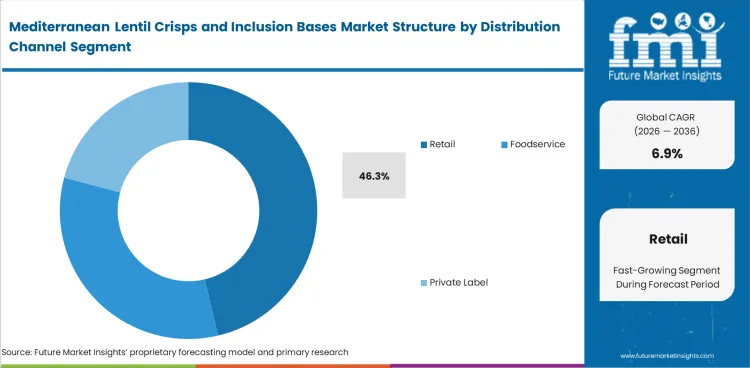
Retail leads because this category is still being judged in real time at shelf, where pack clarity, flavor naming, and visible familiarity decide trial faster than broader nutrition messaging alone. Foodservice and B2B ingredient channels also bring real value, but volume growth in both usually takes more time because menu planning and product formulation move slower than retail shelf decisions. The retail segment is expected to account for 46.3% share in 2026 as supermarkets, club stores, and online grocery platforms continue to expand the reach of pulse-based snack products. Shelf growth of plant-based snacks is increasing, supported by consumers’ interest in familiar products with a cleaner nutrition image. Weak flavor names or poor packaging placement can slow sales even if the product tastes good. Channel choice affects learning speed as much as physical reach, because retail shows consumer response quickly, while foodservice and B2B ingredient channels depend on longer commercial testing and acceptance.
- Retail: Strong visibility and immediate product comparison make retail the main route for category learning and repeat purchase. This channel also gives brands faster readouts on pricing tolerance, pack communication, and flavor acceptance, all of it useful in a category still building mainstream familiarity.
- Foodservice: Growth depends on menu fit and on a base surviving back-of-house storage and preparation with quality intact. Relevance rises in casual dining, travel, and convenience-led formats, yet adoption often stays selective because consistency matters more than novelty in operational foodservice settings.
- B2B Ingredients and Private Label: Both support scale, though price control and formulation fit often influence conversion more than brand identity. These routes become more valuable after product performance is proven, especially in programs seeking manufacturing efficiency or retailer-owned expansion without full consumer brand-building costs.
Mediterranean Lentil Crisps and Inclusion Bases Market Analysis by Processing Type
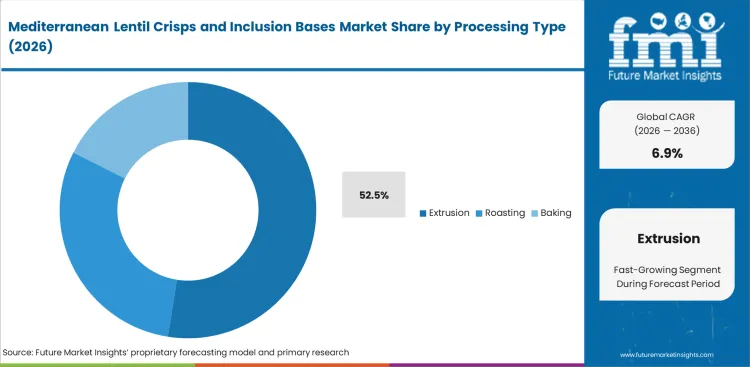
Extrusion is preferred because it gives manufacturers stronger control over shape, density, expansion, and seasoning pickup in lentil-rich dough systems. Roasting and baking can support lighter positioning, yet consistency often becomes harder to maintain once base recipe moves across varied line speeds or more demanding texture targets. By 2026, the extrusion segment is expected to account for 52.5% share in this market. Processing preference also reflects the need for equipment reliability and accurate line tuning, keeping snack pellet equipment and adjacent process capability commercially relevant even in premium crisp programs. Weak process control usually shows through breakage, uneven expansion, and less dependable shelf confidence, all of it capable of limiting repeat orders quickly. Process choice therefore functions as a risk decision as much as a technical decision. Packaging with a lighter communication style can enhance initial appeal, yet inconsistency in crunch, shape, or seasoning adhesion can damage repeat demand much faster than packaging can repair.
- Extrusion: Scale, repeatability, and texture control make extrusion a practical route for commercial expansion. It gives manufacturers a stronger handle on product uniformity, seasoning pickup, and throughput stability, all are important in programs aiming for larger-volume repeat orders.
- Roasting: This process supports lighter positioning, though shape flexibility may narrow in more complex snack forms. Its appeal grows in products needing a cleaner or less heavy eating proposition, but process limitations can appear once brands push for more engineered formats.
- Baking and Frying: Both stay valid for taste or mouthfeel targets needing a finish different from classic extrusion. Their role depends on texture strategy, flavor delivery, and finished-pack positioning rather than on a single universal processing advantage.
Mediterranean Lentil Crisps and Inclusion Bases Market Analysis by End User
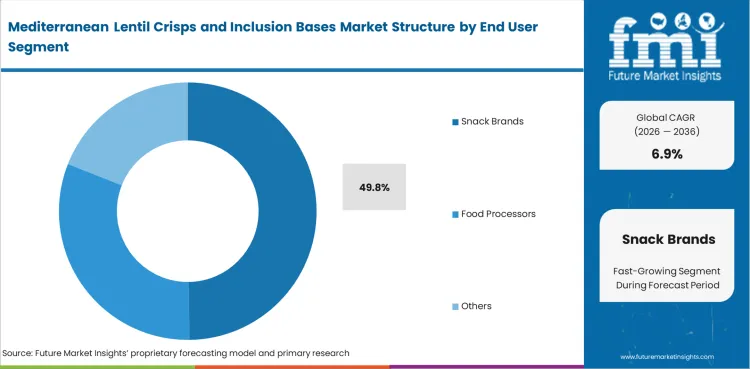
Snack brands stay ahead because pack design, shelf placement, and flavor naming give brands a direct path to repeat demand without waiting for another manufacturer to adopt base format first. Food processors and bakeries still generate useful follow-on demand, yet purchase cycles across both groups usually begin only after ingredient or inclusion performance has already been proven in a finished product. The snack brands segment is poised to represent 49.8% share in 2026. A common trend in the alternative protein sector is that branded consumer products usually drive early market growth first, and ingredient sales grow later. Concerns at end-user level can appear if texture does not feel right or if health messaging becomes stronger than actual eating experience. Consumer-level leadership is usually built first by understanding shelf performance, and ingredient adoption grows afterwards. Success in a branded product works as real proof for later downstream buyers because of this pattern. Long-term growth usually starts only after consumers confirm product appeal through repeat purchases based on crunch, flavor, and format.
- Snack Brands: Brand voice and pack clarity give this group a strong chance to educate consumers and defend shelf space. Success often starts here because branded players can move faster on flavor communication, design cues, and positioning around Mediterranean identity.
- Food Processors: This group matters in programs using lentil bases as inclusions or textured components. Commercial interest rises once product stability is proven, especially in formulations needing added crunch, visible pulse identity, or a better-for-you ingredient story.
- Bakeries and QSR Chains: Both can create targeted demand, though menu fit and moisture stability determine depth of expansion. Growth potential exists, yet conversion usually depends on operational practicality rather than trend appeal alone.
Mediterranean Lentil Crisps and Inclusion Bases Market Drivers, Restraints, and Opportunities
Mediterranean lentil crisps and inclusion bases are gaining popularity because buyers want cleaner labels, better texture, and stronger nutritional value from the same product, and lentils fit that need well. Lentils contain protein, fiber, and a familiar pulse-based positioning that works across snacks, bakery, meal kits, toppings, and prepared foods. Mediterranean flavor cues such as olive oil, herbs, tomato, garlic, and paprika add wider shelf appeal because make the end products recognizable and premium without looking artificial. Food brands are using this mix to build products that feel healthier than fried snacks and more interesting than plain extruded crisps.
Cost and processing limits still challenge market growth. Lentil ingredients can create texture inconsistency if moisture control, oil pickup, and seasoning adhesion are not managed properly. Inclusion bases used in crackers, bars, salads, or coated snacks must be crisp during filling, transport, and shelf life, and this raises formulation pressure for manufacturers. Raw material pricing can shift with crop quality, harvest conditions, and sourcing geography.
Opportunity is strongest if manufacturers can pair nutrition with format flexibility. Lentil crisps deserve early attention in private label and adjacent meal-format expansion because they fit familiar eating occasions while still giving brands room to trade up on pulse identity, cleaner labels, and premium savory positioning. Brands that control breakage, seasoning balance, and shelf stability can move faster with retail and foodservice buyers. Potential growth possibility persists in baked formats, gluten-free offerings, and children’s snacking. Demand can rise further as brands look for pulse-based formats that support clean labels, strong crunch, and broader meal-time use.
Opportunities
- Private label widening: Retailers can grow health-focused private-label snack lines with lentil crisps without moving too far from familiar snacking habits. This gives the segment more shelf space and supports better pricing across modern retail channels. The opportunity is stronger in markets where shoppers already compare wellness claims in regular snack aisles and still want a familiar crunchy texture.
- Inclusion base expansion: Food manufacturers can use lentil-based crisps in toppings, coatings, and bowl add-ins, where crunch and plant-forward appeal matter more than brand name. This creates opportunities beyond direct snacking and helps build demand across more finished food categories. Commercial success depends on showing that texture can hold up after moisture exposure, filling, holding, and reheating.
- Premium shelf targeting: Urban convenience growth and modern retail expansion are creating room for Mediterranean-style products positioned between mass-market chips and niche wellness snacks. This is supported by continued interest in USA protein snacks and by retailers seeking premium savory options that are still easy for shoppers to understand. The model works best when Mediterranean cues clearly justify a higher price than mainstream chips without making the product feel too expensive. The opportunity is strongest when pricing is managed carefully, because Mediterranean positioning can expand appeal only if it feels like a believable upgrade rather than a niche treat.
Regional Analysis
Regional performance separates into three clear groups. Europe benefits from established savory snacking habits, India and the UAE represent the faster-growth edge, and the United States provides a steadier base where pulse-led snacks compete on crowded but well-developed shelves. Entry strategy should reflect that split, because one commercial playbook does not fit all three demand settings.
.webp "Top Country Growth Comparison Mediterranean Lentil Crisps And Inclusion Bases Market Cagr (2026 2036)")
| Country | Forecast CAGR, 2026-2036 |
|---|---|
| India | 8.3% |
| UAE | 7.6% |
| Italy | 7.4% |
| Spain | 7.1% |
| United Kingdom | 6.8% |
| Germany | 6.5% |
Source: Future Market Insights (FMI) analysis, based on proprietary forecasting model and primary research.
North America Mediterranean Lentil Crisps and Inclusion Bases Market Analysis
North America offers a clear view of the way pulse-based snacks adoption move from novelty into routine shelf consideration. Consumers already recognize better-for-you snacking, so progress depends less on ingredient education and more on texture, flavor clarity, and repeatability. Mainstream retail shelves carry wide assortments, raising entry pressure for new crisp formats and making straightforward communication far more important. Products that taste good and deliver a clean crunch tend to hold attention longer. Growth is steadier in the region, yet it still provides a dependable value base for premium pulse-led formats. North America is therefore useful for testing pack clarity, price tolerance, and repeat-buying discipline before wider international rollout.
- United States: United States demand develops against one of the most crowded snack shelves in this assessment, giving product clarity almost equal weight to ingredient choice. Retailers already stock a wide mix of protein-led, gluten-free, and plant-forward snacks, so lentil crisps need to earn space through taste, texture, and repeat buying instead of novelty alone. That competitive pressure makes execution quality far more important than concept strength on its own. Sales of Mediterranean lentil crisps and inclusion bases in the United States are expected to increase at a CAGR of 6.2% during the forecast period. This pace looks moderate beside faster-growing markets such as India or the UAE, yet it reflects maturity in the competitive set rather than weak consumer interest. Mediterranean seasoning helps lower first-purchase hesitation as long as the pack stays clear and the eating experience stays consistent from one purchase to the next.
FMI’s report includes a detailed assessment of the United States and Canada. Mature snack aisles across North America, combined with strong retail standardization and broad manufacturing familiarity with pulse-based formulations.
Europe Mediterranean Lentil Crisps and Inclusion Bases Market Analysis
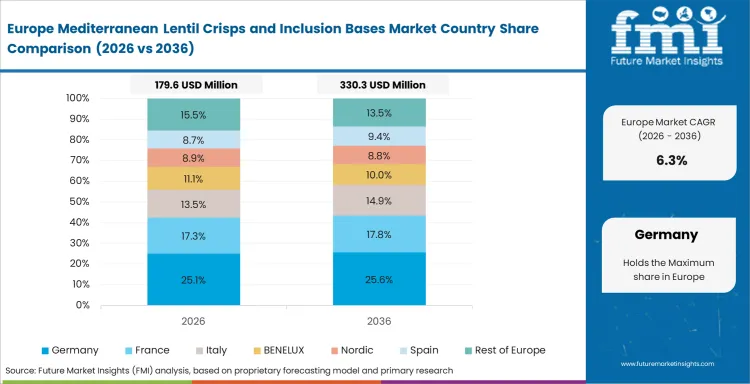
Europe's industry is well-established because savory snacking already forms part of everyday consumption and Mediterranean flavor language feels native rather than an imported trend. Premium herbs, olive notes, and tangy profiles fit cleanly into local eating habits. Private label also matters because it can move pulse-led formats into mainstream baskets faster than a narrow specialist brand. Regional category logic stays close to what FMI observes in UK protein snacks, where snack quality and convenient nutrition need to work together. Europe therefore combines taste familiarity with room for product upgrading. This makes Europe a strong proving ground for launches that rely on taste legitimacy rather than heavy consumer education. Europe also helps decision-making because it shows where flavor familiarity can shorten communication needs, allowing brand owners to test premium cues without relying on heavy education at shelf.
- Italy: Italy benefits from strong familiarity with Mediterranean taste cues and from consumers already reading olive, herb, and garlic-led snacks as natural premium options. Lentil crisps do not need a long flavor explanation here, so the trial gap for new launches stays shorter than in many other markets. Growth still depends on keeping the base light and crisp, since flavor strength alone cannot secure repeat purchase. Italy is projected to witness 7.4% CAGR in the Mediterranean lentil crisps and inclusion bases market through 2036. Pack designs leaning too rustic or too wellness-heavy can narrow appeal instead of broadening it, particularly in a market that values taste credibility and easy everyday relevance at the same time.
- Spain: Spain shows a similar cultural fit, though its commercial path depends on balancing indulgence with perceived lightness. Salted snack buyers across this market respond well to herb-led and olive-linked formats, yet eating experience still needs to feel snackable rather than medicinal. Price control matters here because pulse-led formats can lose momentum once shoppers read them as overly premium beside mainstream alternatives. Strong flavor balance helps keep the product in regular rotation instead of occasional trial. The Mediterranean lentil crisps and inclusion bases market in Spain is poised to expand at a CAGR of 7.1% from 2026 to 2036. That pace reflects both familiarity and selectiveness, giving well-positioned products room to grow without removing pressure on value perception.
- United Kingdom: United Kingdom retail shelves are crowded with health-positioned snacks, so lentil crisps enter a market that is receptive yet highly comparative. Buyers can choose from protein-led, baked, popped, and gluten-aware formats, making texture and flavor naming important from the first shelf glance. Category expansion is likely to favor brands keeping Mediterranean positioning clear without making the product feel specialist or overly technical. Confusing claims or overbuilt nutrition language can slow conversion in a fixture already full of alternatives. Demand for Mediterranean lentil crisps and inclusion bases in the United Kingdom is anticipated to rise at a CAGR of 6.8% by 2036. Stronger performers here usually pair clean communication with familiar taste cues and dependable crunch.
- Germany: Germany brings steady demand through structured retail channels and through consumers responding well to ingredients that feel functional, transparent, and easy to trust. Pulse-based products fit that expectation, though the category still needs a convincing eating experience to move beyond initial purchase. Reliable crunch, tidy labeling, and sensible pricing continue to define the main winning conditions. Germany is likely to post a CAGR of 6.5% in Mediterranean lentil crisps and inclusion bases during the study period. That figure points to sound category development, though it also signals a market in which operational consistency matters more than novelty-led shelf excitement.
Asia Pacific Mediterranean Lentil Crisps and Inclusion Bases Market Analysis
Asia Pacific is one of the fastest-growing markets because pulse familiarity is stronger in several food systems and packaged snack adoption still has room to deepen across urban retail channels. Category momentum in this region comes from commercial fit rather than novelty alone. Lentils already carry everyday relevance in parts of Asia Pacific, so brands do not face the same ingredient education burden seen in less familiar markets. Commercial success still depends on texture consistency, seasoning balance, and pack communication, especially in shelves carrying a rising mix of modern better-for-you snacks. Entry planning in this region works best through value-conscious scale building, supported by products that keep pulse identity visible while adapting format and flavor for contemporary snacking habits.
- India: India carries a natural advantage because lentils already belong to the everyday food system, reducing ingredient education pressure for brands entering this space. In snack format, the shift comes through delivery and positioning rather than through unfamiliar raw material logic. Wider packaged-snack adoption and rising interest in modern formats still support the category, especially in urban retail environments looking for familiar ingredients in a more contemporary form. Faster expansion is likely to favor products keeping seasoning broad enough for urban shelf appeal without losing pulse identity. India is anticipated to see Mediterranean lentil crisps and inclusion bases grow at a CAGR of 8.3% over the forecast period. Weak texture control can hurt quickly in a market balancing value expectations with repeat purchase discipline.
Middle East & Africa Mediterranean Lentil Crisps and Inclusion Bases Market Analysis
Middle East & Africa presents a different growth pattern, led more by premium retail behavior, imported food exposure, and demand for globally styled snack formats in well-developed urban channels. Market progress here depends less on pulse familiarity and more on presentation quality, flavor clarity, and premium shelf fit. Mediterranean taste cues carry a natural advantage because olive-led, herb-based, and savory profiles already connect well with premium food positioning across many retail and hospitality settings. Commercial success in this region comes from polished execution rather than broad-market affordability alone. Products entering this space need to look refined, travel well across premium retail environments, and deliver a clean eating experience strong enough to support repeat purchase.
- United Arab Emirates: UAE growth leans on premium shelf behavior, travel-linked food exposure, and a retail environment absorbing imported or globally inspired snack formats at a faster pace. Mediterranean taste cues fit comfortably into this setting because such cues already carry premium food associations across many retail and hospitality spaces. Polished presentation matters here, and pack quality can shape early perception almost as much as the eating experience itself. Mediterranean lentil crisps and inclusion bases demand across the UAE are set to rise at 7.6% CAGR through 2036. Expansion is likely to favor crisps that look refined and travel well through premium retail presentation. Products feeling too basic on pack or too sharp in flavor can lose ground despite supportive market conditions.
Competitive Aligners for Market Players
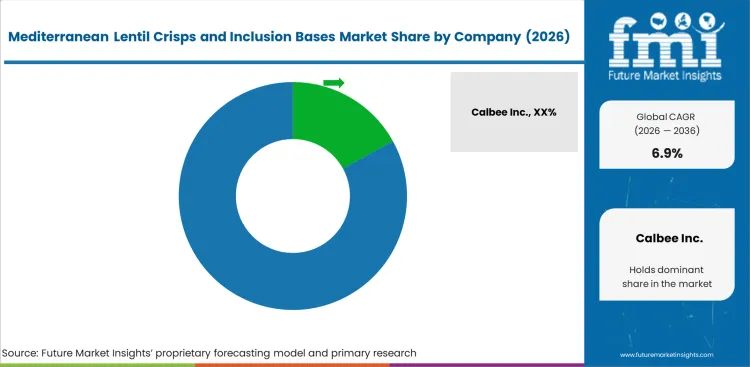
Competition within this particular category involves distribution across multiple player types demonstrating varying capabilities and influences. Calbee Inc., PepsiCo Inc., and Intersnack Group GmbH contribute shelf understanding, stringent flavor discipline, and effective branded snack execution within the market. Turning a less familiar lentil base into an easily adoptable and repeatable product format constitutes their primary competitive advantage in this consumer goods space. Shelf fit and flavor clarity consistently determine brands achieving scale more quickly across the entire competitive landscape. Competitive advantage at this level originates from transforming an unfamiliar base into an effortless, low-friction shelf purchasing decision for consumers. Buyers evaluating this competitive arena need to separate the brand's marketplace influence from the underlying ingredient capability and inherent line know-how within the manufacturing process. Scale achieved in one foundational layer does not automatically equate to control over the remaining layers of the value chain.
Key Players in Mediterranean Lentil Crisps and Inclusion Bases Market
- Calbee Inc.
- PepsiCo Inc.
- Intersnack Group GmbH
- AGT Food and Ingredients
- Bühler Group
Scope of the Report
| Metric | Value |
|---|---|
| Quantitative Units | USD 732.8 million to USD 1,432.6 million, at a CAGR of 6.9% |
| Market Definition | Mediterranean lentil crisps and inclusion bases are pulse-based snack and ingredient formats made from lentils and related blends, used in direct snacking as well as in toppings, bakery inclusions, confectionery fillings, and ready meal applications. |
| Segmentation | Product Type, Ingredient Form, Flavor Profile, Application, Distribution Channel, Processing Type, End User, Region |
| Regions Covered | North America, Europe, Asia Pacific, Latin America, and Middle East & Africa |
| Countries Covered | United States, Germany, United Kingdom, Italy, Spain, India, United Arab Emirates |
| Key Companies Profiled | Calbee Inc., PepsiCo Inc., Intersnack Group GmbH, AGT Food and Ingredients, Bühler Group |
| Forecast Period | 2026 to 2036 |
| Approach | FMI analysis based on proprietary forecasting model and primary research, with market sizing anchored to lentil-based crisps and inclusion-base demand across snack, ingredient, and retail commercialization channels. |
Source: Future Market Insights (FMI) analysis, based on proprietary forecasting model and primary research
Mediterranean Lentil Crisps and Inclusion Bases Market Analysis by Segments
By Product Type
- Lentil Crisps
- Inclusion Bases
- Extruded Bases
- Pellet Bases
By Ingredient Form
- Whole Lentils
- Lentil Flour
- Protein Isolates
- Blended Pulses
By Flavor Profile
- Savory Mediterranean
- Herb Infused
- Spiced Variants
- Plain Salted
By Application
- Snacks
- Bakery Inclusions
- Confectionery Inclusions
- Ready Meals
By Distribution Channel
- Retail
- Foodservice
- B2B Ingredients
- Private Label
By Processing Type
- Extrusion
- Roasting
- Baking
- Frying
By End User
- Snack Brands
- Food Processors
- Bakeries
- QSR Chains
Region
- North America
- United States
- Canada
- Europe
- Germany
- United Kingdom
- France
- Italy
- Spain
- Asia Pacific
- China
- Japan
- South Korea
- Taiwan
- Singapore
- Latin America
- Brazil
- Mexico
- Argentina
- Middle East & Africa
- GCC Countries
- South Africa
- Israel
- Rest of Middle East & Africa
Bibliography
- Seedhabadee Ganeshan, Nancy Asen, Yingxin Wang, Mehmet Ç., and Michael T. Nickerson (2024). Sustainable Pulse Proteins: Physical, Chemical and Fermentative Modifications.
- Nas Ys, and Filiz Koksel. (2024). Effects of dietary fiber source and content and extrusion conditions on the physicochemical composition and physical quality of fiber-enriched lentil snacks.
- Rahul Kumar Thakur, Shalini Gaur Rudra, Harsh Kr. Dikshit. Sukanta Dash, Rakesh Bhardwaj, T. Vinutha, Shiv Kumar, and Sangeeta Chopra. (2024). Baked crisps from Indian biofortified lentils: Effect of seed coat on rheology, texture and composition.
- Drewnowski, A., & Conrad, Z. (2024). Pulse crops: Nutrient density, affordability, and environmental impact.
- Costantini, L., Frangipane, M. T., Massantini, R., Garzoli, S., & Merendino, N. (2025). Hazelnut Skin Fortification of Dehulled Lentil Chips to Improve Nutritional, Antioxidant, Sensory, and Chemical Properties.
This Report Addresses
- Current and forecast market value changes from 2025 to 2036.
- The business logic behind the 6.9% CAGR outlook and the operating conditions influencing adoption.
- The product path that deserves first priority when direct crisps and inclusion bases compete for investment.
- The role of Whole Lentils, Savory Mediterranean flavors, and Snacks in shaping label simplicity, texture control, and repeat purchases.
- The reasons Retail, Extrusion, and Snack Brands generate faster commercial learning than slower channel or process routes.
- The country markets that support premium, taste-led entry and the markets that reward strong execution before scaling.
- The way branded snack companies, ingredient suppliers, and processing specialists shape different levels of competition.
- The point at which inclusion bases create useful secondary demand and the stage at which direct snacks still deserve first priority.
Frequently Asked Questions
What was the estimated value in 2025?
FMI estimates the category at USD 684.3 million in 2025.
What value is expected in 2026?
Projected industry size for 2026 stands at USD 732.8 million.
What value is projected by 2036?
Forecast valuation reaches USD 1,432.6 million by 2036.
What CAGR is expected through the forecast period?
FMI projects a 6.9% CAGR from 2026 to 2036.
Which product type leads?
Lentil Crisps lead Product Type and are expected to account for 54.2% share in 2026.
Which ingredient form leads?
Whole Lentils lead Ingredient Form with an expected 41.6% share in 2026.
Which flavor profile leads?
Savory Mediterranean leads Flavor Profile with 48.7% share in 2026.
Which application leads demand?
Snacks lead Application and are projected to represent 58.9% share in 2026.
Which distribution channel stays ahead?
Retail leads Distribution Channel with an expected 46.3% share in 2026.
Which processing route is most important?
Extrusion leads Processing Type and is forecast to hold 52.5% share in 2026.
Which end user group is largest?
Snack Brands form the largest End User group with 49.8% share in 2026.
Which country grows fastest?
India leads the country outlook with an estimated 8.3% CAGR through 2036.
What puts the UAE near the top of the growth range?
Premium retail behavior, faster acceptance of globally styled snacks, and strong response to polished pack presentation keep the UAE on a 7.6% CAGR path through 2036.
Why does Italy grow faster than Germany?
Italy benefits from a stronger natural fit for Mediterranean taste cues, while Germany advances at a steadier 6.5% pace with a more measured buying pattern.
Why do lentil crisps stay ahead of inclusion bases?
Direct snacking scales faster because it reaches shelves without waiting for longer food development cycles and reveals repeat-purchase behavior sooner.
What keeps whole lentils relevant in formulation?
Whole lentils help brands keep ingredient stories shorter, while still preserving a base identity consumers can recognize more easily.
Why do Mediterranean flavors matter here?
Mediterranean cues give lentil snacks a premium identity without making the flavor story feel unfamiliar.
What is the biggest restraint in this category?
Many launches overestimate the selling power of plant-based positioning and underestimate how quickly weak crunch, breakage, or uneven seasoning can stop a second purchase.
How do inclusion bases differ from direct crisps?
Inclusion bases serve other finished foods, while lentil crisps are sold for immediate snacking, so channel speed and texture validation differ across the two routes.
Is competition concentrated or fragmented?
Competition is moderately fragmented because shelf pull, ingredient readiness, and processing capability sit with different participant groups.
Which region gives the strongest taste fit?
Europe offers the clearest flavor fit because Mediterranean seasoning already aligns with established savory snacking habits.
What changes by 2036?
By 2036 the category is expected to rely less on novelty and more on repeatable texture, simpler labels, broader use across both snacks and inclusion formats, and sharper channel selection by product role.
Preview the report firsthand - request a free sample
Get SampleGet the brochure for pricing and purchase details.
Get PDFTable of Content
- Executive Summary
- Global Market Outlook
- Demand-side Trends
- Supply-side Trends
- Technology Roadmap Analysis
- Analysis and Recommendations
- Market Overview
- Market Coverage / Taxonomy
- Market Definition / Scope / Limitations
- Research Methodology
- Chapter Orientation
- Analytical Lens and Working Hypotheses
- Market Structure, Signals, and Trend Drivers
- Benchmarking and Cross-market Comparability
- Market Sizing, Forecasting, and Opportunity Mapping
- Research Design and Evidence Framework
- Desk Research Programme (Secondary Evidence)
- Company Annual and Sustainability Reports
- Peer-reviewed Journals and Academic Literature
- Corporate Websites, Product Literature, and Technical Notes
- Earnings Decks and Investor Briefings
- Statutory Filings and Regulatory Disclosures
- Technical White Papers and Standards Notes
- Trade Journals, Industry Magazines, and Analyst Briefs
- Conference Proceedings, Webinars, and Seminar Materials
- Government Statistics Portals and Public Data Releases
- Press Releases and Reputable Media Coverage
- Specialist Newsletters and Curated Briefings
- Sector Databases and Reference Repositories
- FMI Internal Proprietary Databases and Historical Market Datasets
- Subscription Datasets and Paid Sources
- Social Channels, Communities, and Digital Listening Inputs
- Additional Desk Sources
- Expert Input and Fieldwork (Primary Evidence)
- Primary Modes
- Qualitative Interviews and Expert Elicitation
- Quantitative Surveys and Structured Data Capture
- Blended Approach
- Why Primary Evidence is Used
- Field Techniques
- Interviews
- Surveys
- Focus Groups
- Observational and In-context Research
- Social and Community Interactions
- Stakeholder Universe Engaged
- C-suite Leaders
- Board Members
- Presidents and Vice Presidents
- R&D and Innovation Heads
- Technical Specialists
- Domain Subject-matter Experts
- Scientists
- Physicians and Other Healthcare Professionals
- Governance, Ethics, and Data Stewardship
- Research Ethics
- Data Integrity and Handling
- Primary Modes
- Tooling, Models, and Reference Databases
- Desk Research Programme (Secondary Evidence)
- Data Engineering and Model Build
- Data Acquisition and Ingestion
- Cleaning, Normalisation, and Verification
- Synthesis, Triangulation, and Analysis
- Quality Assurance and Audit Trail
- Market Background
- Market Dynamics
- Drivers
- Restraints
- Opportunity
- Trends
- Scenario Forecast
- Demand in Optimistic Scenario
- Demand in Likely Scenario
- Demand in Conservative Scenario
- Opportunity Map Analysis
- Product Life Cycle Analysis
- Supply Chain Analysis
- Investment Feasibility Matrix
- Value Chain Analysis
- PESTLE and Porter’s Analysis
- Regulatory Landscape
- Regional Parent Market Outlook
- Production and Consumption Statistics
- Import and Export Statistics
- Market Dynamics
- Global Market Analysis 2021 to 2025 and Forecast, 2026 to 2036
- Historical Market Size Value (USD Million) Analysis, 2021 to 2025
- Current and Future Market Size Value (USD Million) Projections, 2026 to 2036
- Y-o-Y Growth Trend Analysis
- Absolute $ Opportunity Analysis
- Global Market Pricing Analysis 2021 to 2025 and Forecast 2026 to 2036
- Global Market Analysis 2021 to 2025 and Forecast 2026 to 2036, By Product Type
- Introduction / Key Findings
- Historical Market Size Value (USD Million) Analysis By Product Type , 2021 to 2025
- Current and Future Market Size Value (USD Million) Analysis and Forecast By Product Type , 2026 to 2036
- Lentil Crisps
- Inclusion Bases
- Extruded Bases
- Lentil Crisps
- Y-o-Y Growth Trend Analysis By Product Type , 2021 to 2025
- Absolute $ Opportunity Analysis By Product Type , 2026 to 2036
- Global Market Analysis 2021 to 2025 and Forecast 2026 to 2036, By Ingredient Form
- Introduction / Key Findings
- Historical Market Size Value (USD Million) Analysis By Ingredient Form, 2021 to 2025
- Current and Future Market Size Value (USD Million) Analysis and Forecast By Ingredient Form, 2026 to 2036
- Whole Lentils
- Lentil Flour
- Others
- Whole Lentils
- Y-o-Y Growth Trend Analysis By Ingredient Form, 2021 to 2025
- Absolute $ Opportunity Analysis By Ingredient Form, 2026 to 2036
- Global Market Analysis 2021 to 2025 and Forecast 2026 to 2036, By Flavor Profile
- Introduction / Key Findings
- Historical Market Size Value (USD Million) Analysis By Flavor Profile, 2021 to 2025
- Current and Future Market Size Value (USD Million) Analysis and Forecast By Flavor Profile, 2026 to 2036
- Savory Mediterranean
- Herb Infused
- Others
- Savory Mediterranean
- Y-o-Y Growth Trend Analysis By Flavor Profile, 2021 to 2025
- Absolute $ Opportunity Analysis By Flavor Profile, 2026 to 2036
- Global Market Analysis 2021 to 2025 and Forecast 2026 to 2036, By Application
- Introduction / Key Findings
- Historical Market Size Value (USD Million) Analysis By Application, 2021 to 2025
- Current and Future Market Size Value (USD Million) Analysis and Forecast By Application, 2026 to 2036
- Snacks
- Bakery Inclusions
- Others
- Snacks
- Y-o-Y Growth Trend Analysis By Application, 2021 to 2025
- Absolute $ Opportunity Analysis By Application, 2026 to 2036
- Global Market Analysis 2021 to 2025 and Forecast 2026 to 2036, By Distribution Channel
- Introduction / Key Findings
- Historical Market Size Value (USD Million) Analysis By Distribution Channel, 2021 to 2025
- Current and Future Market Size Value (USD Million) Analysis and Forecast By Distribution Channel, 2026 to 2036
- Retail
- Foodservice
- Private Label
- Retail
- Y-o-Y Growth Trend Analysis By Distribution Channel, 2021 to 2025
- Absolute $ Opportunity Analysis By Distribution Channel, 2026 to 2036
- Global Market Analysis 2021 to 2025 and Forecast 2026 to 2036, By Processing Type
- Introduction / Key Findings
- Historical Market Size Value (USD Million) Analysis By Processing Type, 2021 to 2025
- Current and Future Market Size Value (USD Million) Analysis and Forecast By Processing Type, 2026 to 2036
- Extrusion
- Roasting
- Baking
- Extrusion
- Y-o-Y Growth Trend Analysis By Processing Type, 2021 to 2025
- Absolute $ Opportunity Analysis By Processing Type, 2026 to 2036
- Global Market Analysis 2021 to 2025 and Forecast 2026 to 2036, By End User
- Introduction / Key Findings
- Historical Market Size Value (USD Million) Analysis By End User, 2021 to 2025
- Current and Future Market Size Value (USD Million) Analysis and Forecast By End User, 2026 to 2036
- Snack Brands
- Food Processors
- Others
- Snack Brands
- Y-o-Y Growth Trend Analysis By End User, 2021 to 2025
- Absolute $ Opportunity Analysis By End User, 2026 to 2036
- Global Market Analysis 2021 to 2025 and Forecast 2026 to 2036, By Region
- Introduction
- Historical Market Size Value (USD Million) Analysis By Region, 2021 to 2025
- Current Market Size Value (USD Million) Analysis and Forecast By Region, 2026 to 2036
- North America
- Latin America
- Western Europe
- Eastern Europe
- East Asia
- South Asia and Pacific
- Middle East & Africa
- Market Attractiveness Analysis By Region
- North America Market Analysis 2021 to 2025 and Forecast 2026 to 2036, By Country
- Historical Market Size Value (USD Million) Trend Analysis By Market Taxonomy, 2021 to 2025
- Market Size Value (USD Million) Forecast By Market Taxonomy, 2026 to 2036
- By Country
- USA
- Canada
- Mexico
- By Product Type
- By Ingredient Form
- By Flavor Profile
- By Application
- By Distribution Channel
- By Processing Type
- By End User
- By Country
- Market Attractiveness Analysis
- By Country
- By Product Type
- By Ingredient Form
- By Flavor Profile
- By Application
- By Distribution Channel
- By Processing Type
- By End User
- Key Takeaways
- Latin America Market Analysis 2021 to 2025 and Forecast 2026 to 2036, By Country
- Historical Market Size Value (USD Million) Trend Analysis By Market Taxonomy, 2021 to 2025
- Market Size Value (USD Million) Forecast By Market Taxonomy, 2026 to 2036
- By Country
- Brazil
- Chile
- Rest of Latin America
- By Product Type
- By Ingredient Form
- By Flavor Profile
- By Application
- By Distribution Channel
- By Processing Type
- By End User
- By Country
- Market Attractiveness Analysis
- By Country
- By Product Type
- By Ingredient Form
- By Flavor Profile
- By Application
- By Distribution Channel
- By Processing Type
- By End User
- Key Takeaways
- Western Europe Market Analysis 2021 to 2025 and Forecast 2026 to 2036, By Country
- Historical Market Size Value (USD Million) Trend Analysis By Market Taxonomy, 2021 to 2025
- Market Size Value (USD Million) Forecast By Market Taxonomy, 2026 to 2036
- By Country
- Germany
- UK
- Italy
- Spain
- France
- Nordic
- BENELUX
- Rest of Western Europe
- By Product Type
- By Ingredient Form
- By Flavor Profile
- By Application
- By Distribution Channel
- By Processing Type
- By End User
- By Country
- Market Attractiveness Analysis
- By Country
- By Product Type
- By Ingredient Form
- By Flavor Profile
- By Application
- By Distribution Channel
- By Processing Type
- By End User
- Key Takeaways
- Eastern Europe Market Analysis 2021 to 2025 and Forecast 2026 to 2036, By Country
- Historical Market Size Value (USD Million) Trend Analysis By Market Taxonomy, 2021 to 2025
- Market Size Value (USD Million) Forecast By Market Taxonomy, 2026 to 2036
- By Country
- Russia
- Poland
- Hungary
- Balkan & Baltic
- Rest of Eastern Europe
- By Product Type
- By Ingredient Form
- By Flavor Profile
- By Application
- By Distribution Channel
- By Processing Type
- By End User
- By Country
- Market Attractiveness Analysis
- By Country
- By Product Type
- By Ingredient Form
- By Flavor Profile
- By Application
- By Distribution Channel
- By Processing Type
- By End User
- Key Takeaways
- East Asia Market Analysis 2021 to 2025 and Forecast 2026 to 2036, By Country
- Historical Market Size Value (USD Million) Trend Analysis By Market Taxonomy, 2021 to 2025
- Market Size Value (USD Million) Forecast By Market Taxonomy, 2026 to 2036
- By Country
- China
- Japan
- South Korea
- By Product Type
- By Ingredient Form
- By Flavor Profile
- By Application
- By Distribution Channel
- By Processing Type
- By End User
- By Country
- Market Attractiveness Analysis
- By Country
- By Product Type
- By Ingredient Form
- By Flavor Profile
- By Application
- By Distribution Channel
- By Processing Type
- By End User
- Key Takeaways
- South Asia and Pacific Market Analysis 2021 to 2025 and Forecast 2026 to 2036, By Country
- Historical Market Size Value (USD Million) Trend Analysis By Market Taxonomy, 2021 to 2025
- Market Size Value (USD Million) Forecast By Market Taxonomy, 2026 to 2036
- By Country
- India
- ASEAN
- Australia & New Zealand
- Rest of South Asia and Pacific
- By Product Type
- By Ingredient Form
- By Flavor Profile
- By Application
- By Distribution Channel
- By Processing Type
- By End User
- By Country
- Market Attractiveness Analysis
- By Country
- By Product Type
- By Ingredient Form
- By Flavor Profile
- By Application
- By Distribution Channel
- By Processing Type
- By End User
- Key Takeaways
- Middle East & Africa Market Analysis 2021 to 2025 and Forecast 2026 to 2036, By Country
- Historical Market Size Value (USD Million) Trend Analysis By Market Taxonomy, 2021 to 2025
- Market Size Value (USD Million) Forecast By Market Taxonomy, 2026 to 2036
- By Country
- Kingdom of Saudi Arabia
- Other GCC Countries
- Turkiye
- South Africa
- Other African Union
- Rest of Middle East & Africa
- By Product Type
- By Ingredient Form
- By Flavor Profile
- By Application
- By Distribution Channel
- By Processing Type
- By End User
- By Country
- Market Attractiveness Analysis
- By Country
- By Product Type
- By Ingredient Form
- By Flavor Profile
- By Application
- By Distribution Channel
- By Processing Type
- By End User
- Key Takeaways
- Key Countries Market Analysis
- USA
- Pricing Analysis
- Market Share Analysis, 2025
- By Product Type
- By Ingredient Form
- By Flavor Profile
- By Application
- By Distribution Channel
- By Processing Type
- By End User
- Canada
- Pricing Analysis
- Market Share Analysis, 2025
- By Product Type
- By Ingredient Form
- By Flavor Profile
- By Application
- By Distribution Channel
- By Processing Type
- By End User
- Mexico
- Pricing Analysis
- Market Share Analysis, 2025
- By Product Type
- By Ingredient Form
- By Flavor Profile
- By Application
- By Distribution Channel
- By Processing Type
- By End User
- Brazil
- Pricing Analysis
- Market Share Analysis, 2025
- By Product Type
- By Ingredient Form
- By Flavor Profile
- By Application
- By Distribution Channel
- By Processing Type
- By End User
- Chile
- Pricing Analysis
- Market Share Analysis, 2025
- By Product Type
- By Ingredient Form
- By Flavor Profile
- By Application
- By Distribution Channel
- By Processing Type
- By End User
- Germany
- Pricing Analysis
- Market Share Analysis, 2025
- By Product Type
- By Ingredient Form
- By Flavor Profile
- By Application
- By Distribution Channel
- By Processing Type
- By End User
- UK
- Pricing Analysis
- Market Share Analysis, 2025
- By Product Type
- By Ingredient Form
- By Flavor Profile
- By Application
- By Distribution Channel
- By Processing Type
- By End User
- Italy
- Pricing Analysis
- Market Share Analysis, 2025
- By Product Type
- By Ingredient Form
- By Flavor Profile
- By Application
- By Distribution Channel
- By Processing Type
- By End User
- Spain
- Pricing Analysis
- Market Share Analysis, 2025
- By Product Type
- By Ingredient Form
- By Flavor Profile
- By Application
- By Distribution Channel
- By Processing Type
- By End User
- France
- Pricing Analysis
- Market Share Analysis, 2025
- By Product Type
- By Ingredient Form
- By Flavor Profile
- By Application
- By Distribution Channel
- By Processing Type
- By End User
- India
- Pricing Analysis
- Market Share Analysis, 2025
- By Product Type
- By Ingredient Form
- By Flavor Profile
- By Application
- By Distribution Channel
- By Processing Type
- By End User
- ASEAN
- Pricing Analysis
- Market Share Analysis, 2025
- By Product Type
- By Ingredient Form
- By Flavor Profile
- By Application
- By Distribution Channel
- By Processing Type
- By End User
- Australia & New Zealand
- Pricing Analysis
- Market Share Analysis, 2025
- By Product Type
- By Ingredient Form
- By Flavor Profile
- By Application
- By Distribution Channel
- By Processing Type
- By End User
- China
- Pricing Analysis
- Market Share Analysis, 2025
- By Product Type
- By Ingredient Form
- By Flavor Profile
- By Application
- By Distribution Channel
- By Processing Type
- By End User
- Japan
- Pricing Analysis
- Market Share Analysis, 2025
- By Product Type
- By Ingredient Form
- By Flavor Profile
- By Application
- By Distribution Channel
- By Processing Type
- By End User
- South Korea
- Pricing Analysis
- Market Share Analysis, 2025
- By Product Type
- By Ingredient Form
- By Flavor Profile
- By Application
- By Distribution Channel
- By Processing Type
- By End User
- Russia
- Pricing Analysis
- Market Share Analysis, 2025
- By Product Type
- By Ingredient Form
- By Flavor Profile
- By Application
- By Distribution Channel
- By Processing Type
- By End User
- Poland
- Pricing Analysis
- Market Share Analysis, 2025
- By Product Type
- By Ingredient Form
- By Flavor Profile
- By Application
- By Distribution Channel
- By Processing Type
- By End User
- Hungary
- Pricing Analysis
- Market Share Analysis, 2025
- By Product Type
- By Ingredient Form
- By Flavor Profile
- By Application
- By Distribution Channel
- By Processing Type
- By End User
- Kingdom of Saudi Arabia
- Pricing Analysis
- Market Share Analysis, 2025
- By Product Type
- By Ingredient Form
- By Flavor Profile
- By Application
- By Distribution Channel
- By Processing Type
- By End User
- Turkiye
- Pricing Analysis
- Market Share Analysis, 2025
- By Product Type
- By Ingredient Form
- By Flavor Profile
- By Application
- By Distribution Channel
- By Processing Type
- By End User
- South Africa
- Pricing Analysis
- Market Share Analysis, 2025
- By Product Type
- By Ingredient Form
- By Flavor Profile
- By Application
- By Distribution Channel
- By Processing Type
- By End User
- USA
- Market Structure Analysis
- Competition Dashboard
- Competition Benchmarking
- Market Share Analysis of Top Players
- By Regional
- By Product Type
- By Ingredient Form
- By Flavor Profile
- By Application
- By Distribution Channel
- By Processing Type
- By End User
- Competition Analysis
- Competition Deep Dive
- Calbee Inc.
- Overview
- Product Portfolio
- Profitability by Market Segments (Product/Age /Sales Channel/Region)
- Sales Footprint
- Strategy Overview
- Marketing Strategy
- Product Strategy
- Channel Strategy
- PepsiCo Inc.
- Intersnack Group GmbH
- AGT Food and Ingredients
- Bühler Group
- Calbee Inc.
- Competition Deep Dive
- Assumptions & Acronyms Used


