

- Industry Size (2026)
- USD 170.0 Mn
- Forecast (2036)
- USD 470.0 Mn
- CAGR (2026 to 2036)
- 10.70%
Mediterranean Marine Ingredients for Pet Health Market Size, Market Forecast and Outlook By FMI
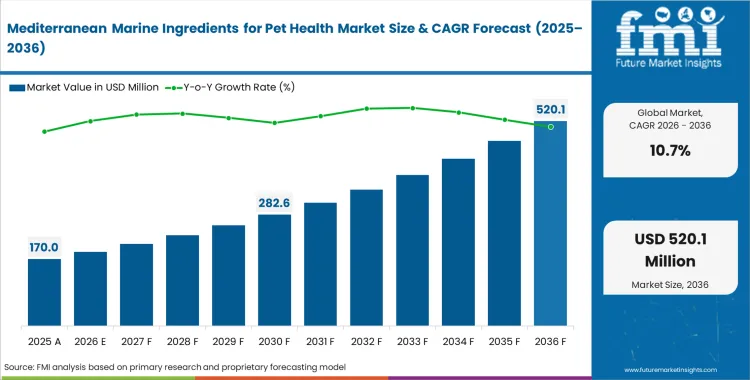
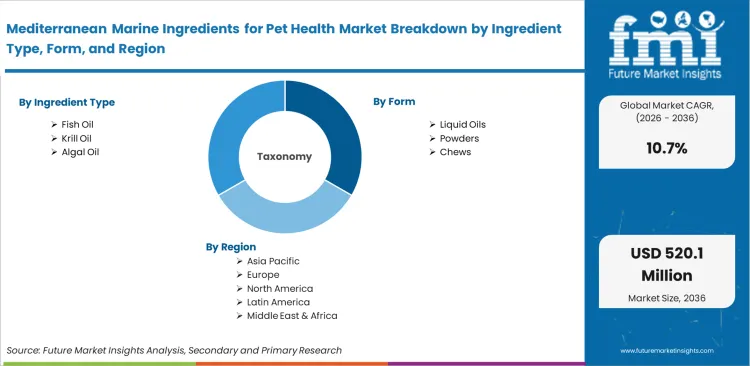
The Mediterranean marine ingredients for pet health market was valued at USD 153.6 million in 2025. Demand for marine pet health ingredients is estimated to surpass USD 170.0 million in 2026 at a CAGR of 10.70% during forecast periods. Revenue expansion lifts total valuation to USD 470.0 million through 2036 as companion animal nutrition brands shift procurement from generic oceanic catch to origin-traceable Mediterranean pelagic sources to satisfy premiumization requirements.
Summary of Mediterranean Marine Ingredients for Pet Health Market
- Mediterranean Marine Ingredients for Pet Health Market Definition
- This market refers to nutritional inputs obtained from Mediterranean biomass with confirmed geographic origin and designated solely for companion animal dietary formulations. It includes ingredients tailored for pet nutrition, particularly for dogs and cats, where sourcing transparency and regional authenticity carry commercial value.
- Demand Drivers in the Market
- Retail transparency mandates compel brand procurement teams to abandon untraceable global lipid blends.
- Veterinary clinical guidelines push formulation officers to mandate specific EPA and DHA ratios found consistently in regional pelagic species.
- Premiumization trends force category managers to secure human-grade origin claims for retail differentiation.
- Key Segments Analyzed in the FMI Report
- Ingredient Type: Fish oil is expected to hold 34.0% share in 2026, driven by established extraction infrastructure.
- Form: Liquid oils is anticipated to lead form choices, matching optimal lipid stabilization requirements.
- Health Application: Skin and coat is set to capture 31.0% share, representing primary visible health priorities for owners.
- Pet Type: Dogs is projected to account for 62.0% share, reflecting massive baseline consumption volumes.
- Turkey: 12.4% compound growth, supported by rapid scaling of Eastern basin extraction capacity.
- Analyst Opinion at FMI
- Nandini Roy Choudhury, Principal Analyst, Food and Beverage, at FMI, notes that, "Generalist assumptions suggest ingredient cost remains the primary barrier to regional sourcing adoption. True structural friction actually exists within formulation stability testing. Once a cosmetic chemist or pet nutritionist validates a specific lipid profile from a localized catch zone, switching to an alternative source voids existing stability data. Re-qualifying a different regional supplier requires an entirely new testing cycle. Procurement directors at mid-size brands treat this lengthy retesting protocol as a functional vendor lock-in, prioritizing supply continuity over minor unit cost improvements."
- Strategic Implications / Executive Takeaways
- Procurement directors must secure long-term yield contracts before regulatory origin mandates trigger spot-market price spikes.
- R&D leaders face critical decisions regarding formulation stabilization when transitioning from synthetic antioxidants to natural preservation.
- Retail category managers gain significant pricing power by replacing generic fish graphics with verified regional sourcing certifications.
- Methodology
- Primary Research: Procurement directors and chief formulation officers within premium companion animal nutrition brands.
- Desk Research: Regional catch quota registries, aquaculture harvest manifests, and veterinary clinical trial databases.
- Market-Sizing and Forecasting: Biomass extraction volumes cross-referenced with regional processing facility output metrics.
- Data Validation and Update Cycle: Independent shipping manifests from major Mediterranean export hubs validate baseline projections.
Pet nutrition buyers are placing more focus on regional, traceable supply chains as pressure builds across the premium segment. Formulation teams need marine-derived ingredients that offer dependable EPA and DHA levels, especially in products positioned around health benefits. Relying on blended global supply is becoming harder to defend when pet owners want clearer sourcing information and stronger quality assurance. Verified sourcing from specific marine regions is moving into the center of premium product strategy. According to FMI analysis, brands that continue to favor low-cost blends may run into rising formulation and positioning challenges.
Regulatory bodies mandating explicit catch-zone labeling on companion animal supplements trigger an immediate scramble for limited Mediterranean biomass quotas. Purchasing managers who locked in localized supplier agreements before this regulatory shift secure massive cost advantages over competitors forced to buy remaining spot-market allocations.
Turkey leads expansion at 12.4% as localized processing infrastructure scales to capture Eastern basin pelagic yields. Spain advances at 11.6% driven by established coastal extraction facilities pivoting toward high-margin applications. Greece tracks at 11.2% through specialized aquaculture integration. Italy reaches 10.8% alongside Croatia at 10.5%, supported by deep domestic premiumization trends. France expands at 10.2% while Malta registers 9.8% on niche processing capabilities. Geographic divergence separates nations with primary extraction assets from those relying strictly on secondary refinement.
Mediterranean Marine Ingredients for Pet Health Market Definition
Mediterranean Marine Ingredients for Pet Health includes origin-specific nutritional inputs extracted from biomass harvested within Mediterranean coastal and pelagic zones. Analytical boundaries require verifiable geographic tracing for these marine bioactives for pets. Functional profiles include omega fatty acids, unique proteins, and structural compounds utilized specifically within companion animal dietary applications.
Mediterranean Marine Ingredients for Pet Health Market Inclusions
The scope covers concentrated lipid extracts, dried protein fractions, and specialized structural ingredients sourced from clearly defined regional waters. It includes stabilized liquid formats, dry blends, and premixes developed for companion animal digestion. FMI assessment also covers marine derived proteins processed specifically for dogs and cats.
Mediterranean Marine Ingredients for Pet Health Market Exclusions
Global oceanic blends lacking specific regional traceability fall completely outside analytical boundaries. Synthetic fatty acid compounds and plant-based omega alternatives receive strict exclusion. Human dietary supplements containing identical base materials remain excluded due to divergent regulatory pathways.
Mediterranean Marine Ingredients for Pet Health Market Research Methodology
- Primary Research: Procurement directors and chief formulation officers within premium companion animal nutrition brands.
- Desk Research: Regional catch quota registries, aquaculture harvest manifests, and veterinary clinical trial databases.
- Market-Sizing and Forecasting: Biomass extraction volumes cross-referenced with regional processing facility output metrics to determine exact pet health marine ingredients market size parameters.
- Data Validation and Update Cycle: Independent shipping manifests from major Mediterranean export hubs validate baseline projections.
Segmental Analysis
Mediterranean Marine Ingredients for Pet Health Market Analysis by Ingredient Type
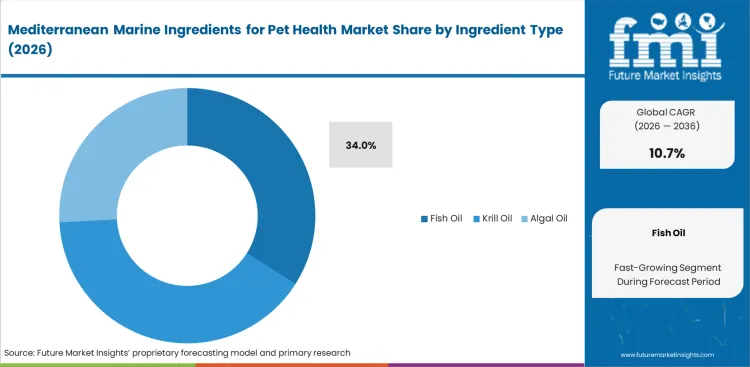
Fish oil holds 34.0% share due to major coastal processors already possess optimized centrifuges necessary for high-yield pelagic refinement. Procurement directors at global nutrition brands prefer this established pathway over emerging alternatives to guarantee uninterrupted production schedules. Choosing established lipid streams ensures predictable omega 3 pet supplement manufacturing timelines without requiring novel equipment investments. FMI's analysis indicates true volume constraint lies not in processing capacity but rather seasonal catch quota fluctuations. What most purchasing models miss is that Mediterranean pet omega-3 ingredients experience distinct localized variations, making single-source reliance highly vulnerable.
- Legacy extraction infrastructure: Coastal processors control massive refinement capacity. Procurement directors secure volume guarantees through these established operators.
- Alternative sourcing constraints: Clinical directors specifying a krill oil pet ingredient profile face severe supply bottlenecks. Purchasing managers navigate extreme pricing volatility when pivoting away from traditional fish streams.
- Geographic diversification: Spreading contracts across different regional fleets mitigates localized harvest failures. Sourcing executives achieve supply resilience through deliberate geographic distribution.
Mediterranean Marine Ingredients for Pet Health Market Analysis by Form
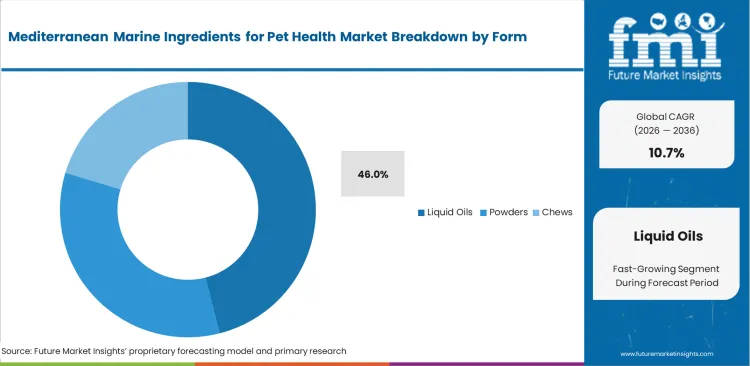
The ability to withstand extrusion conditions shapes demand across ingredient presentation formats. Liquid oils represent a 46.0% share, largely as the major processors use vacuum infusion systems after extrusion to apply them. This keeps heat-sensitive ingredients intact and allows manufacturers to protect lipid performance during production. The model is widely used in large-scale kibble operations. FMI estimates suggest that fluid formats still lead among high-capacity plants, while demand for stabilized dry formats is rising among smaller specialty brands. Running unstabilized fluids on legacy lines can lead to rapid omega-3 oxidation and serious production losses. Powders come at a higher price, though they reduce handling complexity for mid-sized producers.
- Vacuum equipment compatibility: Fluid application requires specialized post-extrusion coaters. Extrusion engineers justify capital expenditure through massive volume throughput.
- Rapid oxidation risk: Unprotected lipids degrade instantly upon oxygen exposure. Quality control managers face immediate product recall scenarios without strict nitrogen blanketing.
- Dry format economics: Topical fluid application minimizes thermal destruction, but specialty brands prefer stable particulates. Plant managers realize lower total formulation costs by avoiding liquid retrofitting completely.
Mediterranean Marine Ingredients for Pet Health Market Analysis by Health Application
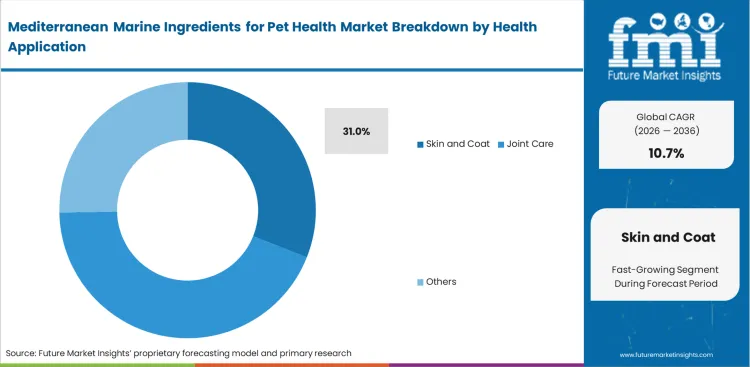
Visible improvement remains a major cause for first-time purchases in pet nutrition. Skin and coat uses account for 31.0% share because better coat texture is easier for owners and veterinarians to notice within a short period. That makes the benefit easier to explain and easier to trust. Marine ingredients are used in these formulations to support quicker outward results and strengthen brand loyalty. Effective performance depends on well-managed EPA and DHA inclusion levels. FMI analysis indicates that this segment may gradually face pressure as aging pets increase demand for joint and mobility support. Brands that shift too strongly in that direction could lose buyers seeking faster and more visible results.
- Visible aesthetic validation: Rapid fur improvement confirms product efficacy visually. Clinical nutritionists leverage this immediate feedback loop for initial customer acquisition.
- Clinical therapeutic dosing: Specific mobility complaints require sustained high-level lipid delivery. Veterinary directors recommend aggressive intervention protocols involving marine collagen for pet food during senior consultations.
- Multi-condition stacking: Owners increasingly demand overlapping functional support. Product development managers blend structural proteins and lipids to address mobility and dermatological concerns simultaneously.
Mediterranean Marine Ingredients for Pet Health Market Analysis by Pet Type
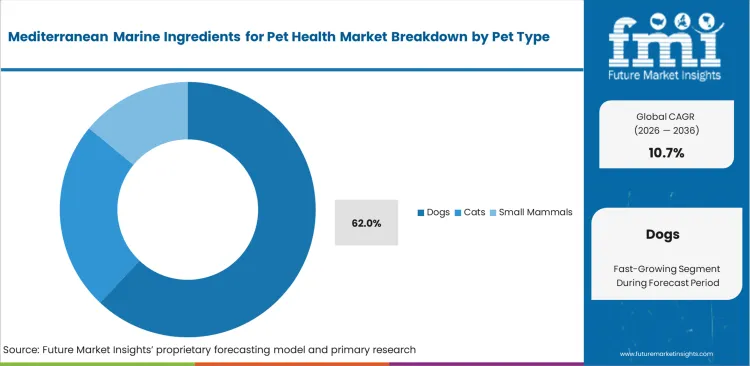
Dogs command 62.0% share simply due to massive physiological baseline needs compared to smaller animals. Formulators design bulk pet joint health supplements targeting large canine breeds prone to structural mobility degradation. Delivering efficacious doses to fifty-kilo animals requires entirely different concentration strategies than feline applications, often utilizing algal omega-3 for dogs to bypass heavy metal accumulation associated with continuous long-term fish extract dosing. Based on FMI's assessment, canine dominance obscures rapid innovation happening within specialized feline cardiac formulations. Cats possess unique metabolic pathways requiring specific pre-formed marine compounds, demanding highly specialized extraction techniques. Nutritionists ignoring these species-specific metabolic pathways produce largely ineffective feline products.
- Baseline volume demands: Large canines require massive daily lipid doses. Formulation officers design high-concentration products specifically to avoid excessive caloric loading.
- Strict palatability thresholds: Feline sensory preferences reject highly oxidized materials. Quality assurance managers maintain strict peroxide value limits to ensure consistent feline consumption.
- Metabolic extraction specificity: Unique species require precise nutrient profiles. Clinical directors demand tailored extractions rather than applying generic canine formulas across all animal types.
Mediterranean Marine Ingredients for Pet Health Market Drivers, Restraints, and Opportunities
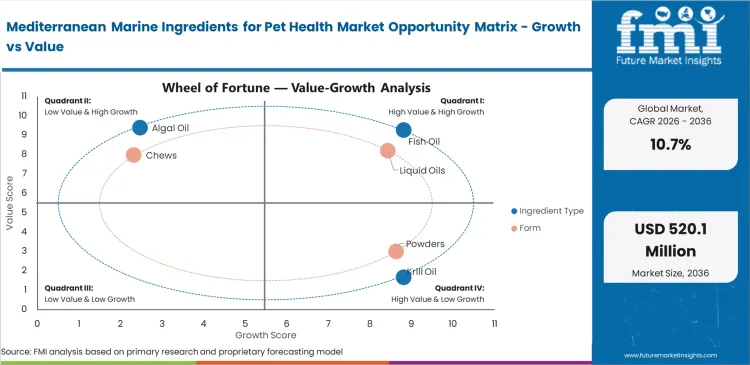
Retail transparency mandates compel brand procurement teams to abandon untraceable global lipid blends. Pet owners demand explicit origin verification, forcing major retail chains to enforce strict marine ingredient traceability for pet brands. Delaying origin-verified contracts exposes brands to immediate retail delisting. Sourcing executives scramble to secure fish based pet food components consisting of traceable marine ingredients for pet food before competitors lock up available quotas. Securing traceable Mediterranean supply represents survival rather than mere premiumization.
The stability testing process can strongly limit how quickly brands move between suppliers. When a specific lipid profile from a regional source has already been validated, bringing in a new supplier often means starting fresh with qualification testing. That extra work can take months and adds cost, delay, and operational complexity. For many mid-sized brands, the process feels less like supplier choice and more like supplier dependence. Faster testing options are emerging, but they still do not fully meet the strict stability standards expected across regulated global markets.
Opportunities in the Mediterranean Marine Ingredients for Pet Health Market
- Premium traceability monetization: Implementing blockchain verification across regional catch zones provides undeniable origin proof. Brand managers command massive price premiums using unassailable geographic data.
- Circular upcycled extraction: Recovering high-value lipids from marine by-products minimizes waste footprints. Operations directors improve margin profiles while satisfying sustainability mandates simultaneously.
- Next-generation sustainable formulations: Driving sustainable omega-3 innovation in pet nutrition opens novel therapeutic categories. R&D heads bypass crowded generalist segments by targeting highly specific cardiovascular and cognitive needs.
Regional Analysis
Based on regional analysis, Mediterranean Marine Ingredients for Pet Health is segmented into Eastern Mediterranean, Western Mediterranean, and Central Mediterranean across 40 plus countries.
.webp "Top Country Growth Comparison Mediterranean Marine Ingredients For Pet Health Market Cagr (2026 2036)")
| Country | CAGR (2026 to 2036) |
|---|---|
| Turkey | 12.4% |
| Spain | 11.6% |
| Greece | 11.2% |
| Italy | 10.8% |
| Croatia | 10.5% |
| France | 10.2% |
| Malta | 9.8% |
Source: Future Market Insights (FMI) analysis, based on proprietary forecasting model and primary research
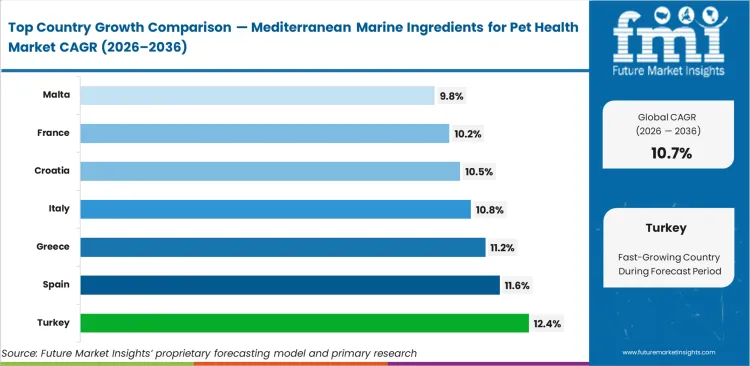
Eastern Mediterranean Mediterranean Marine Ingredients for Pet Health Market Analysis
The rapid build-out of processing infrastructure is reshaping biomass use across Eastern basin territories. Extraction plants are scaling up to handle strong local pelagic volumes that had previously left the region without value-added processing. Buyers are increasingly securing omega 3 in animal feed through direct agreements with fleet operators. According to FMI analysis, this approach is starting to bypass established European refining networks. As a result, Eastern processors are gaining greater pricing flexibility. Operations that pair aquaculture with modern lipid extraction are especially well placed, as they are less exposed to fluctuations in wild catch availability.
- Turkey: In Turkey, government-backed aquaculture expansion is improving the reliability of biomass supply in several key sourcing areas. That is making long-term procurement planning easier for buyers and giving them more confidence in volume negotiations. Revenue from this market in Turkey is projected to grow at a CAGR of 12.4%. In response, many purchasing teams are securing multi-year supply agreements early to protect access, manage future cost pressure, and reduce the risk of disruption as demand continues to build.
- Greece: Greece is developing a more specialized position in this market through refinement facilities that process local Mediterranean species into ingredients with distinct lipid profiles. Those characteristics are drawing attention from formulators looking for more tailored inputs for premium companion animal nutrition. The market in Greece is forecast to expand at a CAGR of 11.2%. Growth is being supported by niche brands that want ingredients with clearer functional value, stronger product differentiation, and a sourcing story that adds to premium positioning.
Western Mediterranean Mediterranean Marine Ingredients for Pet Health Market Analysis
Seafood processors across Western coastal regions are increasingly shifting their expertise toward higher-margin companion animal applications. Large fisheries are using established cold-chain networks to supply high-quality raw material for pharmaceutical-grade extraction. Supply chain teams rely on these proven EPA and DHA ingredient channels to keep production steady. FMI estimates suggest that facilities once focused mainly on human nutrition are now dedicating a larger share of capacity to premium pet formulations. That shift is increasing competition for top-grade raw materials across regional processing networks.
- Spain: In Spain, established canning operators are increasingly adding advanced lipid recovery systems to make use of biomass streams that were once treated as waste. This is helping plants improve profitability without relying only on higher production volumes. By converting processing residue into usable nutritional inputs, companies are creating an additional source of revenue while also lowering disposal costs and improving overall resource use. This shift is expected to support an 11.6% CAGR for the Spain market from 2026 to 2036, as sustainability targets and zero-waste programs gain greater importance across food processing and marine ingredient supply chains.
- France: In France, tight veterinary pharmaceutical standards are playing a major role in how extraction systems are built, validated, and monitored. That compliance-heavy environment allows producers to offer stronger control over purity, batch consistency, and contaminant limits, which makes their ingredients more attractive in premium companion animal nutrition. In many export markets, that regulatory discipline is becoming a commercial advantage, especially where buyers place a high value on safety and formulation reliability. As a result, the France market is projected to expand at a 10.2% CAGR between 2026 and 2036, supported by rising demand for ingredients with well-documented quality and compliance credentials.
Central Mediterranean Mediterranean Marine Ingredients for Pet Health Market Analysis
Premium growth in the domestic market is forcing local processors to upgrade their capabilities. Instead of stopping at standard lipid extraction, they are investing in molecular distillation to produce more refined and targeted compounds. R&D directors are also working with regional academic institutions to validate marine pet ingredients for cardiovascular support applications. FMI finds that these more specialized ingredients command stronger premiums in global markets where buyers want credible functional positioning. That is encouraging processors to leave lower-margin commodity volumes behind.
- Italy: In Italy, cooperation between regional fisheries and research institutions is helping bring new marine-derived bioactive compounds into companion animal nutrition. That is giving formulation teams a wider stream of ingredients to test, refine, and commercialize in premium products. Brands are drawing on these discoveries to refresh formulations, build stronger functional positioning, and keep their product lines distinct in a competitive specialty segment. This steady flow of innovation is expected to keep the Italy market for these ingredients growing at a CAGR of 10.8% through 2036, supported by continued formulation upgrades and broader use of newly identified compounds.
- Croatia: Croatia’s advantage comes from cleaner coastal sourcing, which can deliver marine raw materials with fewer impurities and a lower contamination burden. That reduces the amount of heavy downstream purification required and makes the inputs more attractive to manufacturers focused on quality consistency. For premium companion animal nutrition brands, that cleaner sourcing profile also strengthens claims around purity, trust, and label quality. Because of that, demand in Croatia is projected to rise at 10.5% CAGR over the forecast period, as buyers continue to favor high-quality marine ingredients that fit premium and natural product positioning.
- Malta: Malta plays a more specialized role, with small-scale extraction focused on rare, high-value marine components rather than broad volume supply. Those ingredients appeal to companies looking for something distinctive in premium companion animal nutrition, especially where traceable origin and formulation exclusivity carry commercial weight. Output remains limited by geography, infrastructure, and biomass availability, but that scarcity also helps preserve the market’s niche value. As a result, the Malta segment is forecast to expand at 9.8% CAGR during the 2026-2036 assessment period, driven by continued interest in specialty inputs that are difficult to source through larger conventional channels.
FMI's report includes adjacent North African coastal territories developing emerging extraction capabilities. Facility investments across these emerging zones slowly disrupt established European pricing models.
Competitive Aligners for Market Players
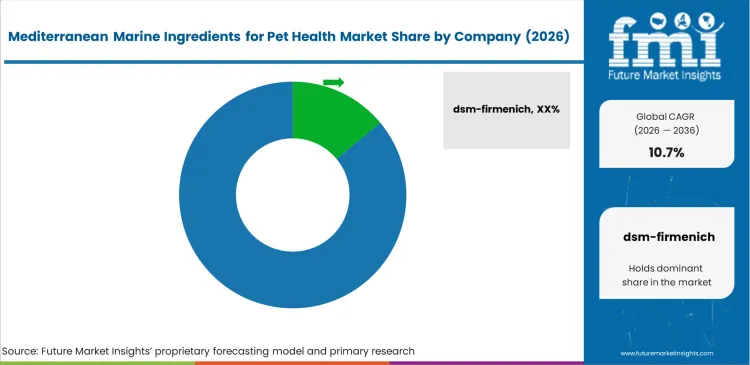
The real competitive divide is increasingly shaped by biomass access rather than extraction technology. Companies with long-term fleet agreements can protect premium sourcing claims and make it harder for competitors to secure similar raw material. Large pet food manufacturers are moving toward direct integration with fishing fleets, cutting around mid-tier processors. Independent processors are then forced to depend more heavily on spot-market quotas, which are often unstable during changing harvest conditions. That shift is making supplier reliability a growing concern for buyers outside the biggest integrated groups.
Established processors hold a major advantage because they have built up stability testing data over many years. New entrants may be able to buy the same extraction equipment, but they still cannot avoid the long validation work required by global brands. R&D teams at premium pet food companies are usually reluctant to change suppliers without detailed multi-year stability records. In practice, these data libraries act as a quiet barrier to entry, protecting incumbent marine ingredient manufacturers from newer competitors trying to win business on price alone.
Large retail conglomerates resist this supplier consolidation by aggressively funding alternative fermentation facilities. Sourcing executives intentionally cultivate terrestrial algae omega sources to maintain pricing leverage, sparking intense internal debates over fish oil vs algal oil for pet food unit economics. Processors failing to integrate fermentation capabilities face severe margin compression as massive buyers successfully play terrestrial and marine suppliers against one another, frequently evaluating a krill oil ingredient supplier for pet food against advanced algal competitors to hedge supply risks.
Key Players in Mediterranean Marine Ingredients for Pet Health Market
- dsm-firmenich
- Aker BioMarine
- KD Pharma Group
- Hofseth BioCare
- LYSI hf.
- OLVEA Omega Solutions
- Symrise AG
Scope of the Report
| Metric | Value |
|---|---|
| Quantitative Units | USD 170.0 million to USD 470.0 million, at a CAGR of 10.70% |
| Market Definition | Origin-specific nutritional inputs extracted from Mediterranean biomass, requiring verifiable geographic tracing and utilized strictly within companion animal dietary applications. |
| Segmentation | Ingredient Type, Form, Health Application, Pet Type, Region |
| Regions Covered | North America, Latin America, Western Europe, Eastern Europe, Asia Pacific |
| Countries Covered | Türkiye, Spain, Greece, Italy, Croatia, France, Malta |
| Key Companies Profiled | dsm-firmenich, Aker BioMarine, KD Pharma Group, Hofseth BioCare, LYSI hf., OLVEA Omega Solutions, Symrise AG |
| Forecast Period | 2026 to 2036 |
| Approach | Biomass extraction volumes cross-referenced with regional processing facility output metrics. |
Source: Future Market Insights (FMI) analysis, based on proprietary forecasting model and primary research
Mediterranean Marine Ingredients for Pet Health Market Analysis by Segments
Ingredient Type:
- Fish oil
- Krill oil
- Algal oil
- Marine collagen
- Mussel extracts
Form:
- Liquid oils
- Powders
- Chews
- Capsules
- Premixes
Health Application:
- Skin and coat
- Joint care
- Cognitive care
- Cardiac care
- Immune care
Pet Type:
- Dogs
- Cats
- Small mammals
- Other pets
Region:
- North America
- Latin America
- Western Europe
- Eastern Europe
- Asia Pacific
Bibliography
- Smith, T., Lang, C., & Craft, E. (2025). USA sales of herbal supplements increase 5.4% in 2024. HerbalGram, 144, 46-69.
- Allcock, L., Mantzioris, E., & Villani, A. (2024). Adherence to a Mediterranean diet is inversely associated with anxiety and stress but not depression: A cross-sectional analysis of community-dwelling older Australians. Nutrients, 16(3), 366.
- Council for Responsible Nutrition. (2024). CRN survey shows consistent supplement usage with increase of specialty product use over time.
- Amadieu, C., et al. (2025). Effect of saffron extract supplementation on mood in healthy adults with subclinical symptoms of depression: A randomized, double-blind, placebo-controlled study. The American Journal of Clinical Nutrition.
- Lopresti, A. L., et al. (2025). An examination into the effects of a saffron extract (Affron) on depression, anxiety, stress, and sleep in adults with low mood: A randomized, double-blind, placebo-controlled trial. The Journal of Nutrition.
This bibliography is provided for reader reference. The full FMI report contains the complete reference list with primary source documentation.
This Report Addresses
- Specific processing infrastructure investments required to handle Mediterranean pelagic yields.
- Formulation stability testing protocols dictating vendor lock-in dynamics among premium pet food brands.
- Retail transparency mandates forcing supply chain shifts toward verified regional oceanic catch zones.
- Extrusion application methods preserving delicate lipid structures during high-temperature kibble manufacturing.
- Unique metabolic differences demanding precise extraction profiles for advanced feline cardiac support.
- Direct-to-fleet sourcing contracts bypassing legacy European refinement hubs entirely.
- Upcycled extraction techniques recovering high-value compounds from massive legacy canning operations.
- Terrestrial microalgae fermentation investments cultivated specifically to break marine incumbent pricing monopolies.
Frequently Asked Questions
What drives the 10.70% CAGR through 2036?
Regulatory bodies increasingly mandate explicit catch-zone labeling on premium animal nutrition. Sourcing directors scramble to secure verifiable Mediterranean biomass quotas before competitors, driving rapid valuation increases across localized extraction facilities.
How to properly evaluate marine ingredient suppliers for pet health?
Procurement teams usually favor vendors with long-term supply agreements and strong two-year stability data. Choosing suppliers without that level of support can raise the risk of formulation issues during commercial scale-up.
Why does fish oil hold 34.0% share?
Legacy coastal processors control massive existing refinement capacity built originally for human consumption. Procurement directors prefer these established pathways, securing volume guarantees without requiring novel capital expenditure.
How do you compare fish oil, krill oil, and algal oil for pets?
Fish streams offer cheap volume scale, krill delivers superior phospholipid bioavailability for joints, and algal sources eliminate oceanic contamination risks. Formulators balance these profiles based entirely on target retail pricing constraints.
How do liquid formats maintain 46.0% dominance?
Extrusion engineers utilize specialized vacuum infusion systems post-extrusion. Applying fluids topically prevents thermal degradation of delicate marine compounds, allowing massive scale manufacturing without compromising final product efficacy.
Are algal omega-3 ingredients better than fish oil for pets?
Terrestrial fermentation bypasses oceanic heavy metal contamination completely. Quality assurance directors increasingly favor these controlled bio-reactor environments, despite higher unit costs, to ensure unassailable purity credentials for premium lines.
What pushes skin and coat applications to 31.0%?
Visible physiological improvements provide immediate validation for pet owners. Clinical nutritionists formulate specific lipid profiles to deliver rapid aesthetic results, securing rapid brand loyalty before internal benefits register.
Do dogs need EPA and DHA?
Canine metabolic pathways require continuous pre-formed lipid supplementation to mitigate structural inflammation. Veterinary scientists confirm that regular dosage directly supports long-term mobility, cognitive function, and cardiovascular resilience in large breeds.
Why do canine formulations capture 62.0% volume?
Large animal physiology dictates massive daily caloric intake requirements. Formulation officers design high-concentration products specifically for fifty-kilo animals, dominating total volume consumption compared to smaller companion species.
What accelerates expansion in Türkiye at 12.4%?
Government-backed aquaculture expansion creates massive predictable biomass volumes. Purchasing managers secure multi-year direct-to-fleet agreements, locking competitors out of emerging Eastern basin supply corridors.
How does Spain achieve 11.6% compound growth?
Massive legacy canning operations install advanced lipid recovery systems. Operations directors monetize previously discarded biomass streams, capturing high-margin premium animal nutrition contracts while satisfying zero-waste targets.
What makes formulation stability testing structural friction?
Validating specific lipid profiles requires exhaustive testing cycles. Switching suppliers voids existing data, forcing mid-size brands to treat these retesting protocols as functional vendor lock-in rather than pursuing minor unit cost savings.
How do buyers resist incumbent consolidation?
Massive retail conglomerates aggressively fund alternative microalgae fermentation facilities. Sourcing executives cultivate these terrestrial sources to decouple omega production from unpredictable oceanic quotas, maintaining vital pricing leverage.
Why do generalist models misjudge feline cardiac segments?
Cats possess unique metabolic pathways requiring specific pre-formed marine compounds. Clinical directors demand highly specialized molecular distillation rather than applying generic high-volume canine formulas across all animal types.
What operational risk haunts single-source contracts?
Mediterranean pelagic catches vary by season and by fishing zone. Supply chain teams that depend on a single regional processor face a higher risk of supply gaps, which is why many spread sourcing across multiple coastal fleets.
How do powder formats compete against bulk liquids?
Un-stabilized fluids oxidize rapidly inside legacy manufacturing equipment. Quality control managers at mid-tier facilities specify stabilized powders, eliminating complex liquid handling infrastructure requirements despite higher initial unit costs.
What shifts joint care away from primary visible metrics?
Aging animal demographics force priority pivots toward structural mobility. Veterinary directors recommend aggressive long-term intervention protocols, slowly cannibalizing purely aesthetic dermatological formulations over extended animal lifespans.
How does direct-to-fleet sourcing alter pricing models?
Securing contracts directly with independent fishing vessels bypasses established European refinement hubs entirely. Emerging processors gain unprecedented margin flexibility, severely disrupting traditional legacy seafood pricing structures.
Preview the report firsthand - request a free sample
Get SampleGet the brochure for pricing and purchase details.
Get PDFTable of Content
- Executive Summary
- Global Market Outlook
- Demand-side Trends
- Supply-side Trends
- Technology Roadmap Analysis
- Analysis and Recommendations
- Market Overview
- Market Coverage / Taxonomy
- Market Definition / Scope / Limitations
- Research Methodology
- Chapter Orientation
- Analytical Lens and Working Hypotheses
- Market Structure, Signals, and Trend Drivers
- Benchmarking and Cross-market Comparability
- Market Sizing, Forecasting, and Opportunity Mapping
- Research Design and Evidence Framework
- Desk Research Programme (Secondary Evidence)
- Company Annual and Sustainability Reports
- Peer-reviewed Journals and Academic Literature
- Corporate Websites, Product Literature, and Technical Notes
- Earnings Decks and Investor Briefings
- Statutory Filings and Regulatory Disclosures
- Technical White Papers and Standards Notes
- Trade Journals, Industry Magazines, and Analyst Briefs
- Conference Proceedings, Webinars, and Seminar Materials
- Government Statistics Portals and Public Data Releases
- Press Releases and Reputable Media Coverage
- Specialist Newsletters and Curated Briefings
- Sector Databases and Reference Repositories
- FMI Internal Proprietary Databases and Historical Market Datasets
- Subscription Datasets and Paid Sources
- Social Channels, Communities, and Digital Listening Inputs
- Additional Desk Sources
- Expert Input and Fieldwork (Primary Evidence)
- Primary Modes
- Qualitative Interviews and Expert Elicitation
- Quantitative Surveys and Structured Data Capture
- Blended Approach
- Why Primary Evidence is Used
- Observational and In-context Research
- Social and Community Interactions
- Primary Modes
- Stakeholder Universe Engaged
- C-suite Leaders
- Board Members
- Presidents and Vice Presidents
- R&D and Innovation Heads
- Technical Specialists
- Domain Subject-matter Experts
- Scientists
- Physicians and Other Healthcare Professionals
- Governance, Ethics, and Data Stewardship
- Research Ethics
- Data Integrity and Handling
- Desk Research Programme (Secondary Evidence)
- Tooling, Models, and Reference Databases
- Data Engineering and Model Build
- Data Acquisition and Ingestion
- Cleaning, Normalisation, and Verification
- Synthesis, Triangulation, and Analysis
- Quality Assurance and Audit Trail
- Market Background
- Market Dynamics
- Drivers
- Restraints
- Opportunity
- Trends
- Scenario Forecast
- Demand in Optimistic Scenario
- Demand in Likely Scenario
- Demand in Conservative Scenario
- Opportunity Map Analysis
- Product Life Cycle Analysis
- Supply Chain Analysis
- Investment Feasibility Matrix
- Value Chain Analysis
- PESTLE and Porter’s Analysis
- Regulatory Landscape
- Regional Parent Market Outlook
- Production and Consumption Statistics
- Import and Export Statistics
- Market Dynamics
- Global Market Analysis 2021 to 2025 and Forecast, 2026 to 2036
- Historical Market Size Value (USD Million) Analysis, 2021 to 2025
- Current and Future Market Size Value (USD Million) Projections, 2026 to 2036
- Y-o-Y Growth Trend Analysis
- Absolute $ Opportunity Analysis
- Global Market Pricing Analysis 2021 to 2025 and Forecast 2026 to 2036
- Global Market Analysis 2021 to 2025 and Forecast 2026 to 2036, By Ingredient Type
- Introduction / Key Findings
- Historical Market Size Value (USD Million) Analysis By Ingredient Type , 2021 to 2025
- Current and Future Market Size Value (USD Million) Analysis and Forecast By Ingredient Type , 2026 to 2036
- Fish Oil
- Krill Oil
- Algal Oil
- Fish Oil
- Y-o-Y Growth Trend Analysis By Ingredient Type , 2021 to 2025
- Absolute $ Opportunity Analysis By Ingredient Type , 2026 to 2036
- Global Market Analysis 2021 to 2025 and Forecast 2026 to 2036, By Form
- Introduction / Key Findings
- Historical Market Size Value (USD Million) Analysis By Form, 2021 to 2025
- Current and Future Market Size Value (USD Million) Analysis and Forecast By Form, 2026 to 2036
- Liquid Oils
- Powders
- Chews
- Liquid Oils
- Y-o-Y Growth Trend Analysis By Form, 2021 to 2025
- Absolute $ Opportunity Analysis By Form, 2026 to 2036
- Global Market Analysis 2021 to 2025 and Forecast 2026 to 2036, By Health Application
- Introduction / Key Findings
- Historical Market Size Value (USD Million) Analysis By Health Application, 2021 to 2025
- Current and Future Market Size Value (USD Million) Analysis and Forecast By Health Application, 2026 to 2036
- Skin and Coat
- Joint Care
- Others
- Skin and Coat
- Y-o-Y Growth Trend Analysis By Health Application, 2021 to 2025
- Absolute $ Opportunity Analysis By Health Application, 2026 to 2036
- Global Market Analysis 2021 to 2025 and Forecast 2026 to 2036, By Pet Type
- Introduction / Key Findings
- Historical Market Size Value (USD Million) Analysis By Pet Type, 2021 to 2025
- Current and Future Market Size Value (USD Million) Analysis and Forecast By Pet Type, 2026 to 2036
- Dogs
- Cats
- Small Mammals
- Dogs
- Y-o-Y Growth Trend Analysis By Pet Type, 2021 to 2025
- Absolute $ Opportunity Analysis By Pet Type, 2026 to 2036
- Global Market Analysis 2021 to 2025 and Forecast 2026 to 2036, By Region
- Introduction
- Historical Market Size Value (USD Million) Analysis By Region, 2021 to 2025
- Current Market Size Value (USD Million) Analysis and Forecast By Region, 2026 to 2036
- North America
- Latin America
- Western Europe
- Eastern Europe
- East Asia
- South Asia and Pacific
- Middle East & Africa
- Market Attractiveness Analysis By Region
- North America Market Analysis 2021 to 2025 and Forecast 2026 to 2036, By Country
- Historical Market Size Value (USD Million) Trend Analysis By Market Taxonomy, 2021 to 2025
- Market Size Value (USD Million) Forecast By Market Taxonomy, 2026 to 2036
- By Country
- USA
- Canada
- Mexico
- By Ingredient Type
- By Form
- By Health Application
- By Pet Type
- By Country
- Market Attractiveness Analysis
- By Country
- By Ingredient Type
- By Form
- By Health Application
- By Pet Type
- Key Takeaways
- Latin America Market Analysis 2021 to 2025 and Forecast 2026 to 2036, By Country
- Historical Market Size Value (USD Million) Trend Analysis By Market Taxonomy, 2021 to 2025
- Market Size Value (USD Million) Forecast By Market Taxonomy, 2026 to 2036
- By Country
- Brazil
- Chile
- Rest of Latin America
- By Ingredient Type
- By Form
- By Health Application
- By Pet Type
- By Country
- Market Attractiveness Analysis
- By Country
- By Ingredient Type
- By Form
- By Health Application
- By Pet Type
- Key Takeaways
- Western Europe Market Analysis 2021 to 2025 and Forecast 2026 to 2036, By Country
- Historical Market Size Value (USD Million) Trend Analysis By Market Taxonomy, 2021 to 2025
- Market Size Value (USD Million) Forecast By Market Taxonomy, 2026 to 2036
- By Country
- Germany
- UK
- Italy
- Spain
- France
- Nordic
- BENELUX
- Rest of Western Europe
- By Ingredient Type
- By Form
- By Health Application
- By Pet Type
- By Country
- Market Attractiveness Analysis
- By Country
- By Ingredient Type
- By Form
- By Health Application
- By Pet Type
- Key Takeaways
- Eastern Europe Market Analysis 2021 to 2025 and Forecast 2026 to 2036, By Country
- Historical Market Size Value (USD Million) Trend Analysis By Market Taxonomy, 2021 to 2025
- Market Size Value (USD Million) Forecast By Market Taxonomy, 2026 to 2036
- By Country
- Russia
- Poland
- Hungary
- Balkan & Baltic
- Rest of Eastern Europe
- By Ingredient Type
- By Form
- By Health Application
- By Pet Type
- By Country
- Market Attractiveness Analysis
- By Country
- By Ingredient Type
- By Form
- By Health Application
- By Pet Type
- Key Takeaways
- East Asia Market Analysis 2021 to 2025 and Forecast 2026 to 2036, By Country
- Historical Market Size Value (USD Million) Trend Analysis By Market Taxonomy, 2021 to 2025
- Market Size Value (USD Million) Forecast By Market Taxonomy, 2026 to 2036
- By Country
- China
- Japan
- South Korea
- By Ingredient Type
- By Form
- By Health Application
- By Pet Type
- By Country
- Market Attractiveness Analysis
- By Country
- By Ingredient Type
- By Form
- By Health Application
- By Pet Type
- Key Takeaways
- South Asia and Pacific Market Analysis 2021 to 2025 and Forecast 2026 to 2036, By Country
- Historical Market Size Value (USD Million) Trend Analysis By Market Taxonomy, 2021 to 2025
- Market Size Value (USD Million) Forecast By Market Taxonomy, 2026 to 2036
- By Country
- India
- ASEAN
- Australia & New Zealand
- Rest of South Asia and Pacific
- By Ingredient Type
- By Form
- By Health Application
- By Pet Type
- By Country
- Market Attractiveness Analysis
- By Country
- By Ingredient Type
- By Form
- By Health Application
- By Pet Type
- Key Takeaways
- Middle East & Africa Market Analysis 2021 to 2025 and Forecast 2026 to 2036, By Country
- Historical Market Size Value (USD Million) Trend Analysis By Market Taxonomy, 2021 to 2025
- Market Size Value (USD Million) Forecast By Market Taxonomy, 2026 to 2036
- By Country
- Kingdom of Saudi Arabia
- Other GCC Countries
- Turkiye
- South Africa
- Other African Union
- Rest of Middle East & Africa
- By Ingredient Type
- By Form
- By Health Application
- By Pet Type
- By Country
- Market Attractiveness Analysis
- By Country
- By Ingredient Type
- By Form
- By Health Application
- By Pet Type
- Key Takeaways
- Key Countries Market Analysis
- USA
- Pricing Analysis
- Market Share Analysis, 2025
- By Ingredient Type
- By Form
- By Health Application
- By Pet Type
- Canada
- Pricing Analysis
- Market Share Analysis, 2025
- By Ingredient Type
- By Form
- By Health Application
- By Pet Type
- Mexico
- Pricing Analysis
- Market Share Analysis, 2025
- By Ingredient Type
- By Form
- By Health Application
- By Pet Type
- Brazil
- Pricing Analysis
- Market Share Analysis, 2025
- By Ingredient Type
- By Form
- By Health Application
- By Pet Type
- Chile
- Pricing Analysis
- Market Share Analysis, 2025
- By Ingredient Type
- By Form
- By Health Application
- By Pet Type
- Germany
- Pricing Analysis
- Market Share Analysis, 2025
- By Ingredient Type
- By Form
- By Health Application
- By Pet Type
- UK
- Pricing Analysis
- Market Share Analysis, 2025
- By Ingredient Type
- By Form
- By Health Application
- By Pet Type
- Italy
- Pricing Analysis
- Market Share Analysis, 2025
- By Ingredient Type
- By Form
- By Health Application
- By Pet Type
- Spain
- Pricing Analysis
- Market Share Analysis, 2025
- By Ingredient Type
- By Form
- By Health Application
- By Pet Type
- France
- Pricing Analysis
- Market Share Analysis, 2025
- By Ingredient Type
- By Form
- By Health Application
- By Pet Type
- India
- Pricing Analysis
- Market Share Analysis, 2025
- By Ingredient Type
- By Form
- By Health Application
- By Pet Type
- ASEAN
- Pricing Analysis
- Market Share Analysis, 2025
- By Ingredient Type
- By Form
- By Health Application
- By Pet Type
- Australia & New Zealand
- Pricing Analysis
- Market Share Analysis, 2025
- By Ingredient Type
- By Form
- By Health Application
- By Pet Type
- China
- Pricing Analysis
- Market Share Analysis, 2025
- By Ingredient Type
- By Form
- By Health Application
- By Pet Type
- Japan
- Pricing Analysis
- Market Share Analysis, 2025
- By Ingredient Type
- By Form
- By Health Application
- By Pet Type
- South Korea
- Pricing Analysis
- Market Share Analysis, 2025
- By Ingredient Type
- By Form
- By Health Application
- By Pet Type
- Russia
- Pricing Analysis
- Market Share Analysis, 2025
- By Ingredient Type
- By Form
- By Health Application
- By Pet Type
- Poland
- Pricing Analysis
- Market Share Analysis, 2025
- By Ingredient Type
- By Form
- By Health Application
- By Pet Type
- Hungary
- Pricing Analysis
- Market Share Analysis, 2025
- By Ingredient Type
- By Form
- By Health Application
- By Pet Type
- Kingdom of Saudi Arabia
- Pricing Analysis
- Market Share Analysis, 2025
- By Ingredient Type
- By Form
- By Health Application
- By Pet Type
- Turkiye
- Pricing Analysis
- Market Share Analysis, 2025
- By Ingredient Type
- By Form
- By Health Application
- By Pet Type
- South Africa
- Pricing Analysis
- Market Share Analysis, 2025
- By Ingredient Type
- By Form
- By Health Application
- By Pet Type
- USA
- Market Structure Analysis
- Competition Dashboard
- Competition Benchmarking
- Market Share Analysis of Top Players
- By Regional
- By Ingredient Type
- By Form
- By Health Application
- By Pet Type
- Competition Analysis
- Competition Deep Dive
- dsm-firmenich
- Overview
- Product Portfolio
- Profitability by Market Segments (Product/Age /Sales Channel/Region)
- Sales Footprint
- Strategy Overview
- Marketing Strategy
- Product Strategy
- Channel Strategy
- Aker BioMarine
- KD Pharma Group
- Hofseth BioCare
- LYSI hf.
- OLVEA Omega Solutions
- dsm-firmenich
- Competition Deep Dive
- Assumptions & Acronyms Used


