

- Market Size (2026)
- USD 96.4 Mn
- Forecast (2036)
- USD 193.2 Mn
- CAGR (2026 to 2036)
- 7.2%
Mediterranean Barley Beta-Glucan Ingredients Market Size, Market Forecast and Outlook By FMI
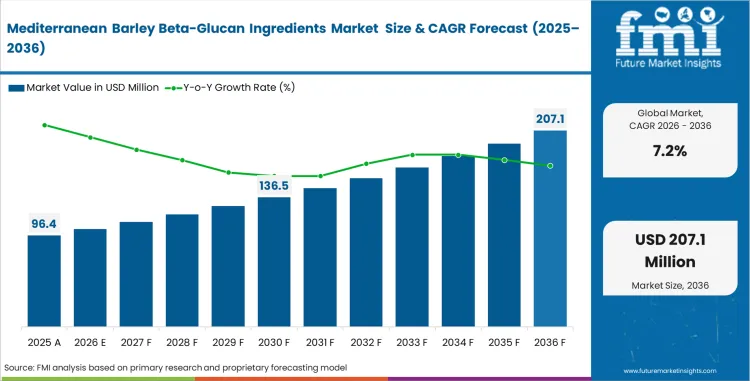
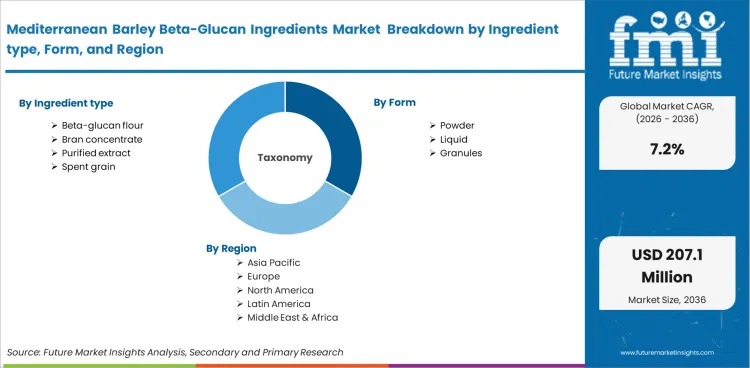
The Mediterranean barley beta-glucan ingredients market was valued at USD 89.9 million in 2025. Market valuation is expected to reach USD 96.4 million in 2026 at a CAGR of 7.2% during the forecast period. The sector is projected to reach USD 193.2 million by 2036 as food manufacturers expand the use of plant-derived thickeners in place of synthetic additives.
Summary of Mediterranean Barley Beta-Glucan Ingredients Market
- The market is forecast to reach USD 193.2 million by 2036.
- The market is expected to grow at a CAGR of 7.2% from 2026 to 2036.
- The market was estimated at USD 89.9 million in 2025.
- The forecast period represents an incremental opportunity of USD 96.8 million.
- The market operates within functional ingredients, focused on barley-derived soluble fiber for heart health, glycemic control, and digestive support.
- Demand is supported by established health benefits of barley beta-glucan, particularly for cholesterol management and metabolic health.
- Mediterranean supply strength across southern Europe and North Africa supports ingredient processing and export capabilities.
- Clean-label trends are driving adoption, with ingredients offered in flour, concentrate, and simple fiber formats.
- Türkiye leads growth at 8.4% CAGR, followed by Spain, Morocco, Greece, Tunisia, Italy, and Algeria.
- Beta-glucan flour dominates the ingredient type segment with a 42.0% share due to ease of formulation and labeling.
- Powder form leads with a 61.0% share, supported by advantages in storage, handling, and transport.
- Food and beverage applications account for 46.0% share, driven by usage in cereals, bakery, and functional drinks.
- Soluble beta-glucan holds a 68.0% share in functionality due to its role in viscosity and metabolic benefits.
- B2B direct sales dominate with a 57.0% share, reflecting strong ingredient supply to manufacturers rather than retail.
- The market remains fragmented, with competition driven by formulation expertise, health-claim compliance, and ingredient standardization rather than scale alone.
Key Takeaways, Market Size, and Forecast
- Mediterranean Barley Beta-Glucan Ingredients Market is projected to grow from USD 96.4 million in 2026 to USD 193.2 million by 2036, at a CAGR of 7.2%.
- The Mediterranean barley beta-glucan ingredients market was valued at USD 89.9 million in 2025.
- By 2036, the Mediterranean Barley Beta-Glucan Ingredients Market is expected to be worth USD 193.2 million.
- From 2026 to 2036, the market is projected to expand at a CAGR of 7.2%.
- The market is projected to create an incremental opportunity of USD 96.8 million between 2026 and 2036.
- In 2026, Beta-glucan flour is expected to account for 42.0% of the ingredient type segment.
- Türkiye (8.4%) and Spain (8.1%) are two of the fastest growing markets.
Key Takeaways
| Metric | Details |
|---|---|
| Industry Size (2026) | USD 96.4 Million |
| Industry Value (2036) | USD 193.2 Million |
| CAGR (2026 to 2036) | 7.2% |
Source: Future Market Insights (FMI) analysis, based on proprietary forecasting model and primary research
Food manufacturers are reassessing additive budgets against European health claim thresholds tied to cholesterol reduction. Products falling short of those intake levels can lose premium shelf position and move into lower-value categories. Reformulation also depends on stable viscosity control, which keeps buyer attention on beta glucans isolates offering more consistent performance across batches. Standard extracts do not always deliver the same processing outcome. Suppliers offering narrow molecular weight specifications are in a stronger position with buyers managing repeat formulation runs.
Work on oat-to-barley substitution ratios is expected to improve recipe standardization for commercial bakeries. A clearer substitution framework reduces formulation risk for mid-sized producers trying to adjust recipes without disrupting process stability. Local milling and extraction capacity is also expanding to support rising requirements.
Türkiye is projected to expand at a CAGR of 8.4% through 2036 as domestic mills build extraction capacity for export-oriented supply. Spain is likely to post 8.1% CAGR in the sector by 2036, supported by a favorable setting for heart-health food positioning. Morocco is expected to record 8.0% CAGR in the market during the forecast period as cereal processing investment aligns with drought-resilient crop priorities. Greece is set to register 7.4% CAGR through 2036, supported by steady use of fortified traditional food products. Tunisia is anticipated to move ahead at a CAGR of 7.1% during the assessment period as local blending capability improves. Italy is forecast to register 6.8% CAGR in this market over the study period through premium pasta fortification initiatives. Algeria trails at 6.5% CAGR, with the sector still at an earlier stage but supported by expanding interest in clinical nutrition. Grain subsidy models differ across these markets, and that keeps extraction economics uneven from one country to another.
Segmental Analysis
Mediterranean Barley Beta-Glucan Ingredients Market Analysis by Ingredient type
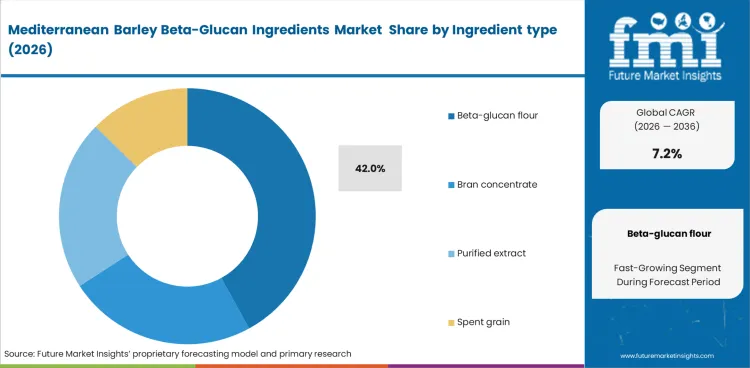
Product developers using raw bran extracts often run into uneven hydration in industrial mixers, which makes process control harder at scale. The beta-glucan flour segment is expected to account for 42.0% share in 2026 because it offers a more workable balance between active content and handling ease. Commercial production depends on ingredient formats that can move through extrusion lines without repeated equipment adjustments. Seasonal grain shifts can still affect flour particle size, and milling conditions may weaken water-binding performance before the material reaches the plant. Specification sheets do not always capture such small but commercially important differences. Buyers relying only on headline concentration figures can face batch inconsistency during scale-up. Some suppliers reduce this risk by pairing standardized flours with prebiotic fiber blends to improve hydration stability. Delayed qualification of consistent flour grades can leave manufacturers exposed to avoidable production pressure during peak demand periods.
- Initial screening: R&D scientists evaluate flour grades based purely on dispersion speed in cold liquids. Failing this test disqualifies suppliers immediately.
- Validation phase: Quality managers require three consecutive production runs proving viscosity stability over six months. Passing ensures vendor approval.
- Volume expansion: Category managers increase order volumes only when suppliers guarantee fixed pricing across consecutive harvest cycles.
Mediterranean Barley Beta-Glucan Ingredients Market Analysis by Form
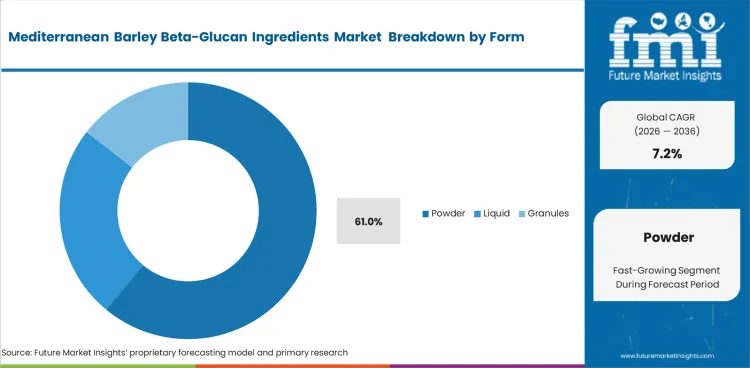
Moisture control remains a basic requirement for bulk movement across Mediterranean shipping routes. Powder is projected to represent the Form segment at 61.0% share in 2026 because it travels more reliably over long distances and carries lower spoilage risk than higher-moisture formats. That makes it easier for supply chain teams to avoid added cold-chain costs and keep handling simpler across standard dry logistics networks. Powder also fits existing dry-blend operations without requiring liquid dosing changes at the plant level. Liquid functional carbohydrates inputs can create added cleaning time and slower line changeovers between production cycles. Powder performance still depends on processing quality, since flowability and clumping can shift with extraction methods and plant humidity. Facilities that do not manage ambient moisture well can end up with avoidable material loss before blending even starts.
- Purchasing savings: Buying teams capture immediate freight cost reductions by avoiding heavy water weight in liquid alternatives.
- Operational drain: Plant managers incur hidden labor costs breaking up agglomerated powder sacks stored in poorly ventilated warehouses.
- Lifecycle parity: Production accountants realize total cost equalizes when factoring in high-shear mixing energy required for complete powder hydration.
Mediterranean Barley Beta-Glucan Ingredients Market Analysis by Application
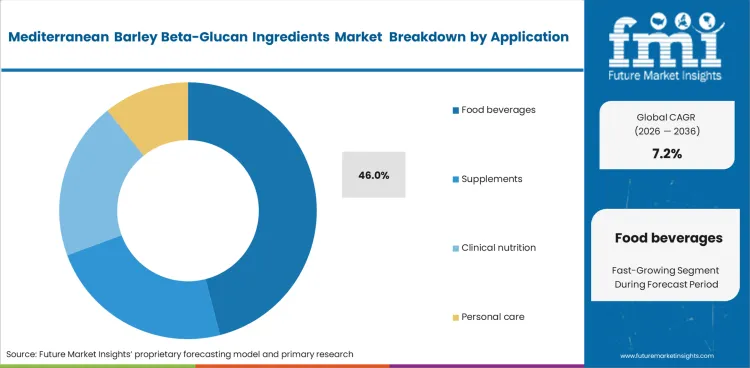
Food beverages are likely to represent 46.0% of the market in 2026 as brands use barley beta-glucan ingredients to replace synthetic thickeners in cleaner-label formulations. Broader use in dairy alternatives and functional drinks supports this position, especially in formulations where mouthfeel, label acceptance, and fiber positioning all carry equal weight. Product developers also value these ingredients in liquid systems tied to digestive health supplements, where solubility and processing stability directly affect formulation choices. Clear performance in acidic beverages still requires tighter control over fraction quality and molecular profile. Standard extracts do not always hold up well under pasteurization, which can reduce performance in finished drinks. Thermal stress during bottling also remains a practical issue for manufacturers, so buyers place greater value on fractions able to retain functionality through commercial processing.
- Phase separation: Formulation chemists prevent ingredient settling by selecting specific enzymatic extraction grades. Poor selection results in visible sludge.
- Thermal breakdown: Quality directors monitor continuous flow pasteurizers to prevent polysaccharide chain degradation. Heat spikes destroy functional claims.
- Full capture: Brand managers must coordinate precise bottling timelines to ensure active compounds remain viable throughout stated shelf life.
Mediterranean Barley Beta-Glucan Ingredients Market Analysis by Functionality
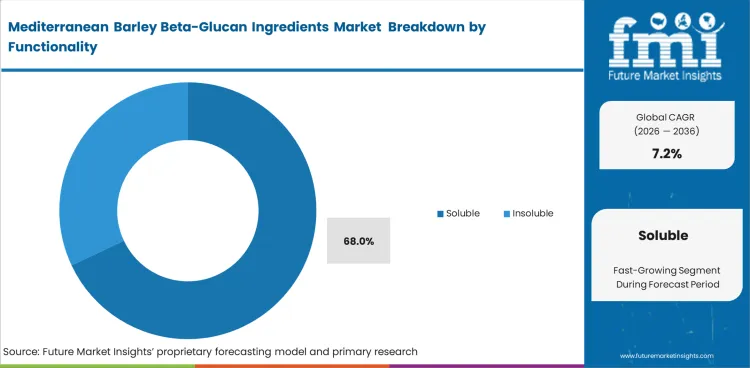
Brands want fortification that does not alter texture or appearance, while manufacturing teams need ingredient formats that move through production without added handling issues. Soluble variants are anticipated to lead the segment because they meet both formulation and processing requirements more effectively across a wide product mix, with 2026 share expected at 68.0%. Preference for soluble grades is stronger in premium nutritional shakes, clear broths, and other applications where smooth dispersion remains important. Use of nutraceutical ingredients in liquid systems also supports this position, since incomplete dispersion can create visible quality issues in the finished product. Insoluble bran fractions are harder to manage in commercial bottling lines because they can interfere with fine filtration and flow consistency. Soluble extracts still require control during cooling, as poor temperature management can affect fluid stability before packaging. Producers that manage those processing conditions well are better placed to avoid batch loss and unnecessary equipment disruption.
- Peak dispersion: R&D scientists achieve optimal clarity using warm water pre-hydration sequences. Cold mixing yields unacceptable turbidity.
- Edge condition: Factory workers observe severe viscosity drops when formulations encounter highly acidic fruit purees during secondary blending.
- Acceptability standard: Quality assurance managers reject any batch demonstrating visual precipitation after forty-eight hours of ambient storage.
Mediterranean Barley Beta-Glucan Ingredients Market Analysis by Sales channel
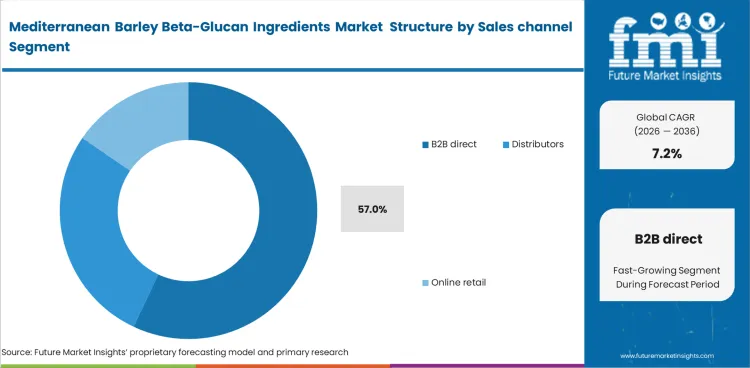
Buying teams weigh distributor convenience against necessitating unbroken chain-of-custody documentation. B2B direct channels are forecast to represent 57.0% share in 2026 because clinical nutrition brands require exact provenance data. Contract manufacturers bypass intermediaries to secure customized extraction specifications directly from mills. Direct relationships enable rapid troubleshooting when food dietary fibers behave unexpectedly in new liquid matrices. Relying on spot-market distributors introduces unacceptable batch-to-batch variability in molecular weight. Direct purchasing masks intense minimum-order-quantity pressure placed on mid-sized brands. Companies committing to direct mill contracts often find cash flow paralyzed by massive upfront raw material inventories. Securing direct allocation during poor harvest years determines which brands maintain retail shelf space. Brands lacking direct mill relationships face immediate supply cutoffs when regional yields drop.
- Primary output: Large regional mills sustain direct supply lines by dedicating specific harvest processing days entirely to functional extraction.
- Volume restriction: Buying teams navigate tight allocation quotas during drought years by prioritizing legacy supplier relationships over spot pricing.
- Future capacity: Agricultural cooperatives consolidate processing centers to offer direct multinational contracts by next decade.
Mediterranean Barley Beta-Glucan Ingredients Market Drivers, Restraints, and Opportunities
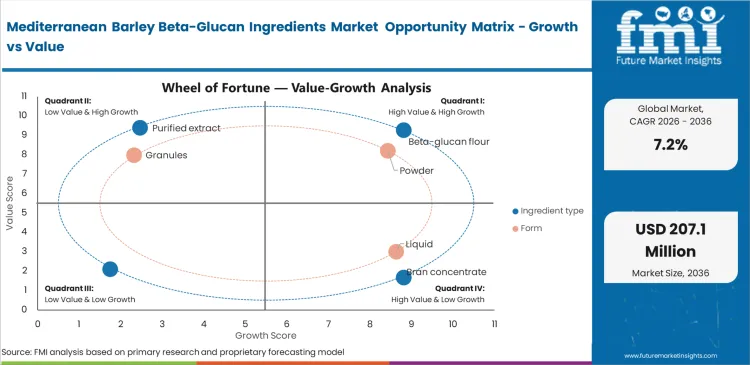
European packaging rules are pushing brands to justify cleaner ingredient compositions more clearly, raising the commercial risk around artificial hydrocolloids in breakfast cereals. Category managers therefore have stronger reason to shift toward recognizable plant-based alternatives before retail reviews become stricter. Label acceptance is only one part of the sourcing decision. Formulation teams also need stable viscosity through shelf life, which is why interest in beta glucanase control and standardized extraction quality is rising. Supply is becoming a planning issue at the same time, as buyers try to secure output from compliant extraction facilities before capacity tightens ahead of key retail reset periods.
Use in medical foods moves more slowly because clinical substantiation is harder to build and takes time. Regulatory teams cannot automatically transfer oat beta-glucan evidence to barley-based ingredients when product claims depend on ingredient-specific validation. Human studies are often needed to support cholesterol-related positioning, and which creates a heavier burden for smaller formulation houses with limited research budgets. Many therefore stay with basic functional positioning while the evidence base expands. Adding postbiotic fermented barley extract into the formulation path can make approvals even more complex, especially when the product concept already carries a specialized health claim.
Opportunities in the Mediterranean Barley Beta-Glucan Ingredients Market
- Upcycled grain extraction: Supply chain controllers capture value from brewing waste by isolating functional compounds from spent mash. This significantly lowers raw material acquisition costs.
- Topical cosmetic integration: Formulation chemists adapt high-purity fractions for skin barrier repair serums. Moving into personal care unlocks entirely new high-margin revenue streams.
- Synergistic gut-health blends: Product developers combine isolates with plant based fiber to create comprehensive microbiome support products. This unified approach appeals strongly to premium retail buyers.
Regional Analysis
Based on regional analysis, the Mediterranean barley beta-glucan ingredients market is segmented into Southern Europe, Western Asia, and North Africa, with country-level analysis focused on Türkiye, Spain, Morocco, Greece, Tunisia, Italy, and Algeria.
.webp "Top Country Growth Comparison Mediterranean Barley Beta Glucan Ingredients Market Cagr (2026 2036)")
| Country | CAGR (2026 to 2036) |
|---|---|
| Türkiye | 8.4% |
| Spain | 8.1% |
| Morocco | 8.0% |
| Greece | 7.4% |
| Tunisia | 7.1% |
| Italy | 6.8% |
| Algeria | 6.5% |
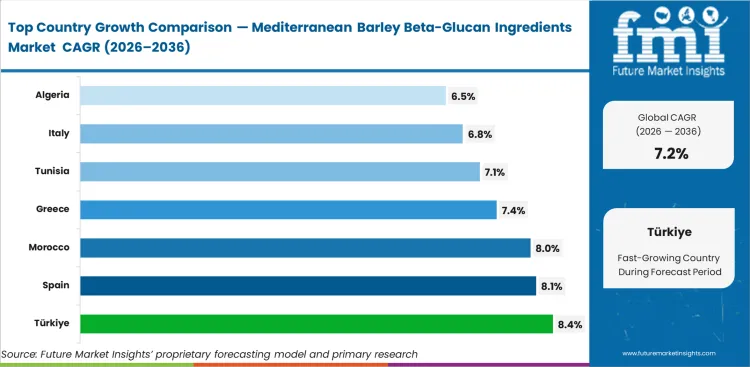
Source: Future Market Insights (FMI) analysis, based on proprietary forecasting model and primary research
Southern Europe Mediterranean Barley Beta-Glucan Ingredients Market Analysis
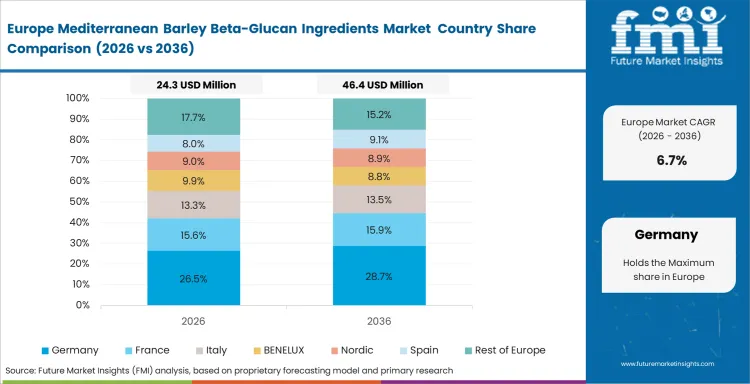
Southern Europe remains a commercially important base for Mediterranean barley beta-glucan ingredients because food manufacturers in the region are under steady pressure to improve nutritional positioning in everyday products. Reformulation activity is strongest where processors can work with local grain networks, established bakery demand, and familiar cereal-based food formats. Buyer preference in this region is tied not only to health positioning, but also to supply consistency and processing fit. That keeps extraction quality, local sourcing, and formulation reliability central to the industry outlook across Southern Europe.
- Spain: Spain is projected to expand at a CAGR of 8.1% through 2036 as domestic processors continue to reformulate core food lines around heart-health positioning. Consumer acceptance is relatively strong in fortified bakery and cereal-based products, which gives local manufacturers a clearer route to commercial uptake. Cooperative grain systems also support more dependable raw material availability for national bakery and ingredient networks. Spanish extraction facilities are raising purity benchmarks as buyers look for supply that can meet both formulation and labeling expectations.
- Greece: Traditional grain-based food habits give Greece a practical base for concentrated cereal ingredients, and the sector is likely to post 7.4% CAGR by 2036. Soluble isolates fit more comfortably into dairy and bakery applications where product familiarity still matters to local buyers. It helps manufacturers extend fortified yogurt and baked product ranges without pushing too far from established consumption patterns. Export-oriented premium food lines add further support to ingredient uptake in the Greek market.
- Italy: Italy is expected to record 6.8% CAGR in the market during the forecast period, supported by premium pasta and bakery producers looking for clearer product differentiation. Competitive pressure in mature retail channels is pushing manufacturers toward functional grain ingredients that can support higher-value positioning. Process compatibility remains important here, especially in pasta applications where ingredient performance must remain stable through extrusion. Producers able to manage fortified dough systems well are better placed to support premium domestic and export programs.
FMI's report includes adjacent Mediterranean nations that are upgrading milling and grain-processing capabilities. Cross-border coordination on testing and quality standards is likely to improve ingredient consistency over time.
North Africa Mediterranean Barley Beta-Glucan Ingredients Market Analysis
North Africa is advancing as a secondary supply and processing base for Mediterranean barley beta-glucan ingredients, supported by drought-tolerant cereal cultivation and rising interest in local value addition. The regional industry outlook is shaped by agricultural resilience programs, lower dependence on imported hydrocolloids, and investment in grain handling and extraction capacity. Buyers also view the region as a useful hedge against supply and cost pressure elsewhere in the Mediterranean which is giving North Africa a larger role in the broader sourcing map for this market.
- Morocco: Agricultural programs supporting drought-tolerant cereal cultivation are strengthening Morocco’s position in local processing and ingredient supply. International ingredient firms and domestic partners are using that base to build more reliable sourcing channels, with the sector in the country expected to post 8.0% CAGR through 2036. Local harvest availability also helps limit exposure to sudden input cost swings seen in more water-stressed markets.
- Tunisia: Tunisia is anticipated to move ahead at a CAGR of 7.1% during the assessment period as older grain handling systems are upgraded for higher-value ingredient processing. Better separation capability and plant modernization are improving the sector’s ability to serve more specialized food and nutrition applications. Investment is helping local mills improve technical capability, even though operating conditions still require tighter plant-level control. Power reliability remains an operational issue, and that keeps processing costs more exposed than in larger neighboring markets.
- Algeria: Algeria is drawing more attention for natural bioactive ingredients in clinical and nutrition-focused applications, as buyers place greater value on purified grades suited to specialized end uses. Public purchasing preferences for locally formulated nutrition products are also supporting the case for stronger domestic capability, with the sector expected to register 6.5% CAGR over the study period. A more reliable extraction base would help reduce exposure to imported ingredient volatility over time.
FMI's report includes surrounding arid nations exploring similar agricultural resilience strategies. Stronger domestic extraction capability is likely to reduce regional reliance on imported functional ingredients over time.
Western Asia Mediterranean Barley Beta-Glucan Ingredients Market Analysis
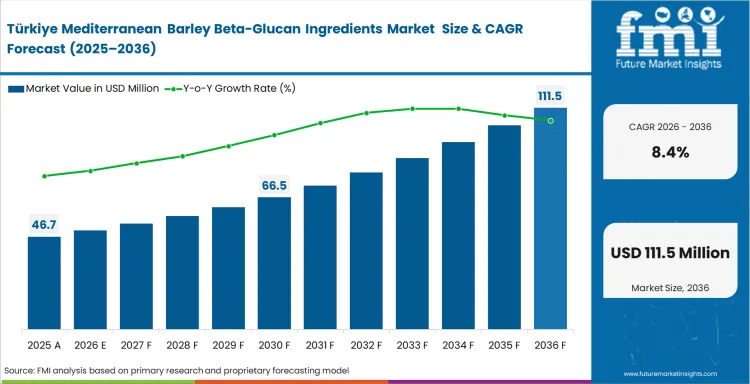
Western Asia plays an important role in this market because milling upgrades and extraction investment are improving the region’s position as a supply bridge between Mediterranean production and export demand. The sector is expanding as local processors install more specialized lines and align more closely with functional ingredient requirements. Buyers also value the region as a practical diversification base beyond narrower northern cereal supply channels. Processing investment, trade access, and supply flexibility continue to support a favorable industry outlook across Western Asia.
- Türkiye: Expanding extraction capacity is turning local mills into stronger export platforms, and the market in Türkiye is projected to expand at a CAGR of 8.4% through 2036. Processing upgrades are helping suppliers respond more effectively to European demand for whole grain and high fiber foods. Domestic brands are also using these capabilities to support functional snack and cereal-based product development. For multinational buyers, Türkiye offers a practical sourcing alternative with geographic reach, competitive processing economics, and closer alignment to Mediterranean trade routes.
FMI's report includes neighboring nations exploring cross-border trade agreements for raw materials. Better raw material stability would support functional food formulators across the wider region.
Competitive Aligners for Market Players
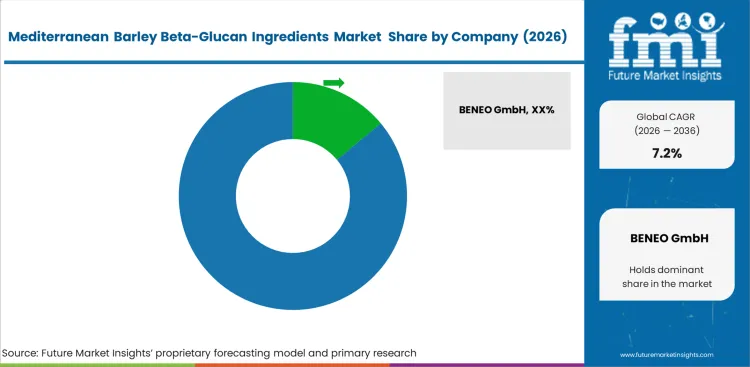
Large ingredient suppliers strengthen their position by securing off-take arrangements with major agricultural cooperatives, which gives them tighter control over raw material availability. That matters in this category because supplier selection often depends as much on technical support and documentation quality as on ingredient pricing. BENEO GmbH retains a visible lead through a stronger clinical and application support profile, while companies such as Ardent Mills LLC and Sunny Boy Foods Ltd. compete through more tailored milling specifications for specific beverage uses. Mid-sized producers face a harder path in the premium supplement tier because clinical substantiation and qualification work require a level of investment many cannot easily absorb. In practice, supply of fibers and specialty carbohydrates ingredients depends on close coordination between growers, processors, and formulation teams.
Established players also defend their position through processing know-how that smaller manufacturers cannot easily replicate. High-solubility fractions depend on stable extraction control, consistent quality, and tighter molecular-weight management, especially in applications where buyers expect repeat performance. This raises the entry barrier for newer participants trying to move into clinical nutrition and other specialized uses. Many smaller manufacturers stay focused on simpler bakery or food applications while building technical capability. Neogen Corporation also supports the wider supply base through analytical testing tools that help manufacturers verify production quality.
Large beverage and food brands are addressing this concentration by qualifying supply across more than one Mediterranean country to reduce exposure to local crop disruption or plant-level interruptions. Such an approach is gradually widening the sourcing base and creating more room for smaller mills to participate through pooled supply arrangements. Digital trade coordination is also helping some independent processors compete for larger contracts which would otherwise remain with established suppliers. Over time, more flexible separation systems could allow multifunctional food ingredients processing to move closer to raw material origin which would ease some dependence on fully centralized milling networks, though scale, consistency, and qualification standards will still matter.
Key Players in Mediterranean Barley Beta-Glucan Ingredients Market
- BENEO GmbH
- Ardent Mills LLC
- Sunny Boy Foods Ltd.
- ALSIANO A/S
- BECARRE Natural
- Neogen Corporation
- Cerabeta
Scope of the Report
| Metric | Value |
|---|---|
| Quantitative Units | USD 96.4 Million to USD 193.2 Million, at a CAGR of 7.2% |
| Market Definition | Mediterranean barley beta-glucan ingredients are barley-derived fiber ingredients supplied as flours, concentrates, extracts, and related functional formats for food, supplement, and clinical nutrition use. Their core utility lies in viscosity control, fiber enrichment, and health-positioned formulations where approved claim conditions can be met. |
| Segmentation | Ingredient type, Form, Application, Functionality, Sales channel, Region |
| Regions Covered | North America, Latin America, Europe, Asia Pacific, Middle East and Africa |
| Countries Covered | Türkiye, Spain, Morocco, Greece, Tunisia, Italy, Algeria |
| Key Companies Profiled | BENEO GmbH, Ardent Mills LLC, Sunny Boy Foods Ltd., ALSIANO A/S, BECARRE Natural, Neogen Corporation, Cerabeta |
| Forecast Period | 2026 to 2036 |
| Approach | Mill extraction yield reports cross-referenced with commercial supplier shipping volumes |
Source: Future Market Insights (FMI) analysis, based on proprietary forecasting model and primary research
Mediterranean Barley Beta-Glucan Ingredients Market Analysis by Segments
Ingredient type
- Beta-glucan flour
- Bran concentrate
- Purified extract
- Spent grain
Form
- Powder
- Liquid
- Granules
Application
- Food beverages
- Supplements
- Clinical nutrition
- Personal care
Functionality
- Soluble
- Insoluble
Sales channel
- B2B direct
- Distributors
- Online retail
Region
- North America
- Latin America
- Europe
- Asia Pacific
- Middle East and Africa
Bibliography
- Ali, A., Khan, N., Yaqoob, M., & Khan, M. I. (2024, September 28). Barley a nutritional powerhouse for gut health and chronic disease defense. Discover Food.
- European Parliament and Council. (2025, September 19). Beta‐glucans from oats or barley and reduction of post‐prandial glycaemic responses. EFSA Journal.
- Kaur, A., Kumar, S., Sharma, P., et al. (2024, August 30). Unraveling the Hidden Potential of Barley (Hordeum vulgare): An Important Review. Plants.
- Khaleghdoust, B., Korge, K., Sinkovič, L., et al. (2024, January 09). Barley and wheat beta-glucan content influenced by weather, fertilization, and genotype. Frontiers in Sustainable Food Systems.
- Kim, I. S., Lee, H., Kim, J., et al. (2024, November 15). Effect of Barley on Postprandial Blood Glucose Response and Appetite in Healthy Individuals: A Randomized, Double-Blind, Placebo-Controlled Trial. Nutrients.
This bibliography is provided for reader reference. The full FMI report contains the complete reference list with primary source documentation.
This Report Addresses
- Regulatory timeline modeling for impending European cholesterol-reduction labeling mandates affecting breakfast cereals.
- Yield comparison metrics between raw beta-glucan flour and highly purified isolates across commercial milling facilities.
- Supplier capability assessments tracking molecular-weight precision across major Mediterranean extraction hubs.
- Thermal stability benchmarks for soluble fractions utilized in continuous-flow beverage pasteurization systems.
- Freight cost differentials analyzing powder versus liquid transport constraints across regional supply lines.
- Clinical validation timelines required for integrating functional polysaccharides into specialized medical foods.
- Capital expenditure requirements for retrofitting traditional grain handlers with advanced membrane filtration technology.
- Contract manufacturing strategies bypassing spot-market distributors to secure direct agricultural cooperative supply lines.
Frequently Asked Questions
How large is the Mediterranean Barley Beta-Glucan Ingredients sector currently?
Values reached USD 89.9 million in 2025 as major bakery brands replaced synthetic thickeners to secure clean-label certifications.
What valuation will this ingredient category reach by 2036?
Forecast models point to USD 193.2 million by 2036, relying entirely on successful clinical trials proving specific heart-health benefits.
What is the projected compound annual growth rate?
Data indicates a 7.2% CAGR through 2036, driven by impending regulatory changes forcing processors to standardize active compound concentrations.
Why does beta-glucan flour dominate the ingredient type segment?
Beta-glucan flour balances functional concentration with more familiar handling properties, which makes it easier to use in routine food manufacturing.
What forces product developers toward powder formats?
Powder formats are easier to store, ship, and handle across standard dry logistics networks.
Why do food beverages lead application segments?
Food and beverage applications lead because barley beta-glucan can support texture, fiber positioning, and cleaner-label formulation goals.
What limits the adoption of insoluble fractions?
Insoluble fractions are harder to use in filtered and bottled applications, which keeps demand stronger for soluble variants.
Why do buyers prefer B2B direct purchasing channels?
Clinical nutrition brands often prefer direct purchasing so they can work more closely with mills on consistency, documentation, and specification control.
What drives extraction capability expansion in Türkiye?
Domestic processing upgrades are helping Türkiye strengthen its position as an export-oriented supply base.
How does Spanish policy affect local sourcing?
Heart-health positioning and bakery reformulation are helping support local demand in Spain.
What role does Moroccan agriculture play?
Local drought-resilient cereal supply is helping Morocco build a more stable processing base.
How do Greek consumer habits influence product development?
Traditional grain-based food habits make Greece a practical market for fortified dairy and bakery applications.
Why do Tunisian facilities struggle despite strong growth?
Plant upgrades are improving Tunisia's processing capability, though operating conditions still require tighter plant-level control.
What forces Italian pasta makers to adapt?
Premium pasta and bakery producers in Italy are using functional grain ingredients to support product differentiation.
How does clinical nutrition shape Algerian demand?
Interest in clinical and nutrition-focused applications is helping support demand in Algeria.
What prevents immediate substitution between oat and barley extracts?
Regulatory teams cannot automatically transfer oat beta-glucan evidence to barley-based ingredients when claim support depends on ingredient-specific validation.
How do seasonal harvests impact formulation chemistry?
Seasonal grain variation can affect beta-glucan content and functional performance, which makes standardization more difficult.
What hidden costs accompany powder formats?
Powder formats still require moisture control because humidity can affect flowability, clumping, and handling.
How does thermal processing threaten functional claims?
Thermal processing still matters because excessive heat can reduce functionality in beverage systems.
Why do direct mill contracts paralyze brand cash flow?
Direct mill contracts can create cash-flow pressure for mid-sized brands because order commitments are often larger.
What technical advantage protects established ingredient suppliers?
Established suppliers retain an advantage through processing know-how, technical support, and stronger qualification records.
How will mobile processing units alter raw material sourcing?
More flexible separation systems could allow some extraction activity to move closer to raw material origin over time.
Preview the report firsthand - request a free sample
Get SampleGet the brochure for pricing and purchase details.
Get PDFTable of Content
- Executive Summary
- Global Market Outlook
- Demand-side Trends
- Supply-side Trends
- Technology Roadmap Analysis
- Analysis and Recommendations
- Market Overview
- Market Coverage / Taxonomy
- Market Definition / Scope / Limitations
- Research Methodology
- Chapter Orientation
- Analytical Lens and Working Hypotheses
- Market Structure, Signals, and Trend Drivers
- Benchmarking and Cross-market Comparability
- Market Sizing, Forecasting, and Opportunity Mapping
- Research Design and Evidence Framework
- Desk Research Programme (Secondary Evidence)
- Company Annual and Sustainability Reports
- Peer-reviewed Journals and Academic Literature
- Corporate Websites, Product Literature, and Technical Notes
- Earnings Decks and Investor Briefings
- Statutory Filings and Regulatory Disclosures
- Technical White Papers and Standards Notes
- Trade Journals, Industry Magazines, and Analyst Briefs
- Conference Proceedings, Webinars, and Seminar Materials
- Government Statistics Portals and Public Data Releases
- Press Releases and Reputable Media Coverage
- Specialist Newsletters and Curated Briefings
- Sector Databases and Reference Repositories
- FMI Internal Proprietary Databases and Historical Market Datasets
- Subscription Datasets and Paid Sources
- Social Channels, Communities, and Digital Listening Inputs
- Additional Desk Sources
- Expert Input and Fieldwork (Primary Evidence)
- Primary Modes
- Qualitative Interviews and Expert Elicitation
- Quantitative Surveys and Structured Data Capture
- Blended Approach
- Why Primary Evidence is Used
- Field Techniques
- Interviews
- Surveys
- Focus Groups
- Observational and In-context Research
- Social and Community Interactions
- Stakeholder Universe Engaged
- C-suite Leaders
- Board Members
- Presidents and Vice Presidents
- R&D and Innovation Heads
- Technical Specialists
- Domain Subject-matter Experts
- Scientists
- Physicians and Other Healthcare Professionals
- Governance, Ethics, and Data Stewardship
- Research Ethics
- Data Integrity and Handling
- Primary Modes
- Tooling, Models, and Reference Databases
- Desk Research Programme (Secondary Evidence)
- Data Engineering and Model Build
- Data Acquisition and Ingestion
- Cleaning, Normalisation, and Verification
- Synthesis, Triangulation, and Analysis
- Quality Assurance and Audit Trail
- Market Background
- Market Dynamics
- Drivers
- Restraints
- Opportunity
- Trends
- Scenario Forecast
- Demand in Optimistic Scenario
- Demand in Likely Scenario
- Demand in Conservative Scenario
- Opportunity Map Analysis
- Product Life Cycle Analysis
- Supply Chain Analysis
- Investment Feasibility Matrix
- Value Chain Analysis
- PESTLE and Porter’s Analysis
- Regulatory Landscape
- Regional Parent Market Outlook
- Production and Consumption Statistics
- Import and Export Statistics
- Market Dynamics
- Global Market Analysis 2021 to 2025 and Forecast, 2026 to 2036
- Historical Market Size Value (USD Million) Analysis, 2021 to 2025
- Current and Future Market Size Value (USD Million) Projections, 2026 to 2036
- Y-o-Y Growth Trend Analysis
- Absolute $ Opportunity Analysis
- Global Market Pricing Analysis 2021 to 2025 and Forecast 2026 to 2036
- Global Market Analysis 2021 to 2025 and Forecast 2026 to 2036, By Ingredient type
- Introduction / Key Findings
- Historical Market Size Value (USD Million) Analysis By Ingredient type , 2021 to 2025
- Current and Future Market Size Value (USD Million) Analysis and Forecast By Ingredient type , 2026 to 2036
- Beta-glucan flour
- Bran concentrate
- Purified extract
- Spent grain
- Beta-glucan flour
- Y-o-Y Growth Trend Analysis By Ingredient type , 2021 to 2025
- Absolute $ Opportunity Analysis By Ingredient type , 2026 to 2036
- Global Market Analysis 2021 to 2025 and Forecast 2026 to 2036, By Form
- Introduction / Key Findings
- Historical Market Size Value (USD Million) Analysis By Form, 2021 to 2025
- Current and Future Market Size Value (USD Million) Analysis and Forecast By Form, 2026 to 2036
- Powder
- Liquid
- Granules
- Powder
- Y-o-Y Growth Trend Analysis By Form, 2021 to 2025
- Absolute $ Opportunity Analysis By Form, 2026 to 2036
- Global Market Analysis 2021 to 2025 and Forecast 2026 to 2036, By Application
- Introduction / Key Findings
- Historical Market Size Value (USD Million) Analysis By Application, 2021 to 2025
- Current and Future Market Size Value (USD Million) Analysis and Forecast By Application, 2026 to 2036
- Food beverages
- Supplements
- Clinical nutrition
- Personal care
- Food beverages
- Y-o-Y Growth Trend Analysis By Application, 2021 to 2025
- Absolute $ Opportunity Analysis By Application, 2026 to 2036
- Global Market Analysis 2021 to 2025 and Forecast 2026 to 2036, By Functionality
- Introduction / Key Findings
- Historical Market Size Value (USD Million) Analysis By Functionality, 2021 to 2025
- Current and Future Market Size Value (USD Million) Analysis and Forecast By Functionality, 2026 to 2036
- Soluble
- Insoluble
- Soluble
- Y-o-Y Growth Trend Analysis By Functionality, 2021 to 2025
- Absolute $ Opportunity Analysis By Functionality, 2026 to 2036
- Global Market Analysis 2021 to 2025 and Forecast 2026 to 2036, By Sales channel
- Introduction / Key Findings
- Historical Market Size Value (USD Million) Analysis By Sales channel, 2021 to 2025
- Current and Future Market Size Value (USD Million) Analysis and Forecast By Sales channel, 2026 to 2036
- B2B direct
- Distributors
- Online retail
- B2B direct
- Y-o-Y Growth Trend Analysis By Sales channel, 2021 to 2025
- Absolute $ Opportunity Analysis By Sales channel, 2026 to 2036
- Global Market Analysis 2021 to 2025 and Forecast 2026 to 2036, By Region
- Introduction
- Historical Market Size Value (USD Million) Analysis By Region, 2021 to 2025
- Current Market Size Value (USD Million) Analysis and Forecast By Region, 2026 to 2036
- North America
- Latin America
- Western Europe
- Eastern Europe
- East Asia
- South Asia and Pacific
- Middle East & Africa
- Market Attractiveness Analysis By Region
- North America Market Analysis 2021 to 2025 and Forecast 2026 to 2036, By Country
- Historical Market Size Value (USD Million) Trend Analysis By Market Taxonomy, 2021 to 2025
- Market Size Value (USD Million) Forecast By Market Taxonomy, 2026 to 2036
- By Country
- USA
- Canada
- Mexico
- By Ingredient type
- By Form
- By Application
- By Functionality
- By Sales channel
- By Country
- Market Attractiveness Analysis
- By Country
- By Ingredient type
- By Form
- By Application
- By Functionality
- By Sales channel
- Key Takeaways
- Latin America Market Analysis 2021 to 2025 and Forecast 2026 to 2036, By Country
- Historical Market Size Value (USD Million) Trend Analysis By Market Taxonomy, 2021 to 2025
- Market Size Value (USD Million) Forecast By Market Taxonomy, 2026 to 2036
- By Country
- Brazil
- Chile
- Rest of Latin America
- By Ingredient type
- By Form
- By Application
- By Functionality
- By Sales channel
- By Country
- Market Attractiveness Analysis
- By Country
- By Ingredient type
- By Form
- By Application
- By Functionality
- By Sales channel
- Key Takeaways
- Western Europe Market Analysis 2021 to 2025 and Forecast 2026 to 2036, By Country
- Historical Market Size Value (USD Million) Trend Analysis By Market Taxonomy, 2021 to 2025
- Market Size Value (USD Million) Forecast By Market Taxonomy, 2026 to 2036
- By Country
- Germany
- UK
- Italy
- Spain
- France
- Nordic
- BENELUX
- Rest of Western Europe
- By Ingredient type
- By Form
- By Application
- By Functionality
- By Sales channel
- By Country
- Market Attractiveness Analysis
- By Country
- By Ingredient type
- By Form
- By Application
- By Functionality
- By Sales channel
- Key Takeaways
- Eastern Europe Market Analysis 2021 to 2025 and Forecast 2026 to 2036, By Country
- Historical Market Size Value (USD Million) Trend Analysis By Market Taxonomy, 2021 to 2025
- Market Size Value (USD Million) Forecast By Market Taxonomy, 2026 to 2036
- By Country
- Russia
- Poland
- Hungary
- Balkan & Baltic
- Rest of Eastern Europe
- By Ingredient type
- By Form
- By Application
- By Functionality
- By Sales channel
- By Country
- Market Attractiveness Analysis
- By Country
- By Ingredient type
- By Form
- By Application
- By Functionality
- By Sales channel
- Key Takeaways
- East Asia Market Analysis 2021 to 2025 and Forecast 2026 to 2036, By Country
- Historical Market Size Value (USD Million) Trend Analysis By Market Taxonomy, 2021 to 2025
- Market Size Value (USD Million) Forecast By Market Taxonomy, 2026 to 2036
- By Country
- China
- Japan
- South Korea
- By Ingredient type
- By Form
- By Application
- By Functionality
- By Sales channel
- By Country
- Market Attractiveness Analysis
- By Country
- By Ingredient type
- By Form
- By Application
- By Functionality
- By Sales channel
- Key Takeaways
- South Asia and Pacific Market Analysis 2021 to 2025 and Forecast 2026 to 2036, By Country
- Historical Market Size Value (USD Million) Trend Analysis By Market Taxonomy, 2021 to 2025
- Market Size Value (USD Million) Forecast By Market Taxonomy, 2026 to 2036
- By Country
- India
- ASEAN
- Australia & New Zealand
- Rest of South Asia and Pacific
- By Ingredient type
- By Form
- By Application
- By Functionality
- By Sales channel
- By Country
- Market Attractiveness Analysis
- By Country
- By Ingredient type
- By Form
- By Application
- By Functionality
- By Sales channel
- Key Takeaways
- Middle East & Africa Market Analysis 2021 to 2025 and Forecast 2026 to 2036, By Country
- Historical Market Size Value (USD Million) Trend Analysis By Market Taxonomy, 2021 to 2025
- Market Size Value (USD Million) Forecast By Market Taxonomy, 2026 to 2036
- By Country
- Kingdom of Saudi Arabia
- Other GCC Countries
- Turkiye
- South Africa
- Other African Union
- Rest of Middle East & Africa
- By Ingredient type
- By Form
- By Application
- By Functionality
- By Sales channel
- By Country
- Market Attractiveness Analysis
- By Country
- By Ingredient type
- By Form
- By Application
- By Functionality
- By Sales channel
- Key Takeaways
- Key Countries Market Analysis
- USA
- Pricing Analysis
- Market Share Analysis, 2025
- By Ingredient type
- By Form
- By Application
- By Functionality
- By Sales channel
- Canada
- Pricing Analysis
- Market Share Analysis, 2025
- By Ingredient type
- By Form
- By Application
- By Functionality
- By Sales channel
- Mexico
- Pricing Analysis
- Market Share Analysis, 2025
- By Ingredient type
- By Form
- By Application
- By Functionality
- By Sales channel
- Brazil
- Pricing Analysis
- Market Share Analysis, 2025
- By Ingredient type
- By Form
- By Application
- By Functionality
- By Sales channel
- Chile
- Pricing Analysis
- Market Share Analysis, 2025
- By Ingredient type
- By Form
- By Application
- By Functionality
- By Sales channel
- Germany
- Pricing Analysis
- Market Share Analysis, 2025
- By Ingredient type
- By Form
- By Application
- By Functionality
- By Sales channel
- UK
- Pricing Analysis
- Market Share Analysis, 2025
- By Ingredient type
- By Form
- By Application
- By Functionality
- By Sales channel
- Italy
- Pricing Analysis
- Market Share Analysis, 2025
- By Ingredient type
- By Form
- By Application
- By Functionality
- By Sales channel
- Spain
- Pricing Analysis
- Market Share Analysis, 2025
- By Ingredient type
- By Form
- By Application
- By Functionality
- By Sales channel
- France
- Pricing Analysis
- Market Share Analysis, 2025
- By Ingredient type
- By Form
- By Application
- By Functionality
- By Sales channel
- India
- Pricing Analysis
- Market Share Analysis, 2025
- By Ingredient type
- By Form
- By Application
- By Functionality
- By Sales channel
- ASEAN
- Pricing Analysis
- Market Share Analysis, 2025
- By Ingredient type
- By Form
- By Application
- By Functionality
- By Sales channel
- Australia & New Zealand
- Pricing Analysis
- Market Share Analysis, 2025
- By Ingredient type
- By Form
- By Application
- By Functionality
- By Sales channel
- China
- Pricing Analysis
- Market Share Analysis, 2025
- By Ingredient type
- By Form
- By Application
- By Functionality
- By Sales channel
- Japan
- Pricing Analysis
- Market Share Analysis, 2025
- By Ingredient type
- By Form
- By Application
- By Functionality
- By Sales channel
- South Korea
- Pricing Analysis
- Market Share Analysis, 2025
- By Ingredient type
- By Form
- By Application
- By Functionality
- By Sales channel
- Russia
- Pricing Analysis
- Market Share Analysis, 2025
- By Ingredient type
- By Form
- By Application
- By Functionality
- By Sales channel
- Poland
- Pricing Analysis
- Market Share Analysis, 2025
- By Ingredient type
- By Form
- By Application
- By Functionality
- By Sales channel
- Hungary
- Pricing Analysis
- Market Share Analysis, 2025
- By Ingredient type
- By Form
- By Application
- By Functionality
- By Sales channel
- Kingdom of Saudi Arabia
- Pricing Analysis
- Market Share Analysis, 2025
- By Ingredient type
- By Form
- By Application
- By Functionality
- By Sales channel
- Turkiye
- Pricing Analysis
- Market Share Analysis, 2025
- By Ingredient type
- By Form
- By Application
- By Functionality
- By Sales channel
- South Africa
- Pricing Analysis
- Market Share Analysis, 2025
- By Ingredient type
- By Form
- By Application
- By Functionality
- By Sales channel
- USA
- Market Structure Analysis
- Competition Dashboard
- Competition Benchmarking
- Market Share Analysis of Top Players
- By Regional
- By Ingredient type
- By Form
- By Application
- By Functionality
- By Sales channel
- Competition Analysis
- Competition Deep Dive
- BENEO GmbH
- Overview
- Product Portfolio
- Profitability by Market Segments (Product/Age /Sales Channel/Region)
- Sales Footprint
- Strategy Overview
- Marketing Strategy
- Product Strategy
- Channel Strategy
- Ardent Mills LLC
- Sunny Boy Foods Ltd.
- ALSIANO A/S
- BECARRE Natural
- Neogen Corporation
- Cerabeta
- BENEO GmbH
- Competition Deep Dive
- Assumptions & Acronyms Used


