

- Market Size (2026)
- USD 462.4 Mn
- Forecast (2036)
- USD 970.9 Mn
- CAGR (2026 to 2036)
- 7.7%
Mediterranean Probiotic-polyphenol Synbiotic Concepts Market Size, Forecast and Outlook By FMI
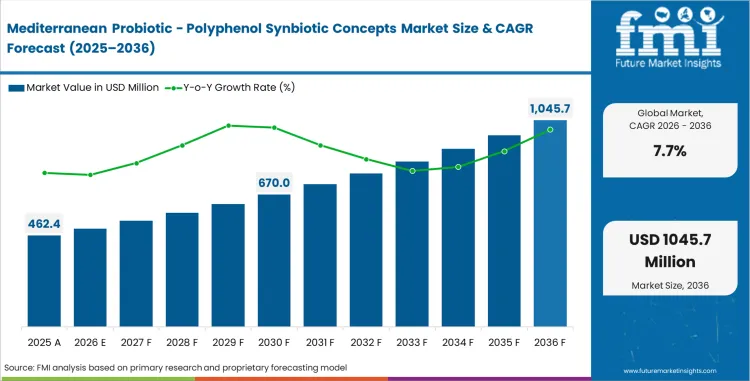
The Mediterranean probiotic-polyphenol synbiotic concepts market crossed a valuation of USD 429.3 million in 2025. Industry demand is expected to reach USD 462.4 million in 2026 at a CAGR of 7.7% during the forecast period. Total valuation is set to cross USD 970.9 million by 2036.
Summary of Mediterranean Probiotic-polyphenol Synbiotic Concepts Market
- The market is forecast to reach USD 970.9 million by 2036.
- The market is expected to grow at a rate of 7.7% from 2026 to 2036.
- The market value was USD 429.3 million in 2025.
- The forecast period represents an incremental opportunity of USD 508.5 million.
- Mediterranean probiotic-polyphenol synbiotic concepts are used in capsules, sachets, powders, gummies, RTD shots, fermented dairy products, and related daily wellness formats.
- Core commercial demand is shaped by probiotic viability, polyphenol consistency, dose control, shelf-life discipline, and ease of use in repeat daily consumption.
- Olive, grape, citrus, and pomegranate-linked concepts are gaining more attention in premium digestive, metabolic, women’s wellness, and broader microbiome-focused product development.
- Novonesis, ADM, IFF, dsm-firmenich, Kerry Group, and Probi are among the key suppliers in the market.
Key Takeaways, Market Size, and Forecast
- Mediterranean Probiotic-Polyphenol Synbiotic Concepts Market is projected to rise from USD 462.4 million in 2026 to USD 970.9 million by 2036, at a CAGR of 7.7%.
- The Mediterranean probiotic-polyphenol synbiotic concepts market was valued at USD 429.3 million in 2025.
- By 2036, the Mediterranean Probiotic-Polyphenol Synbiotic Concepts Market is expected to be worth USD 970.9 million.
- Across 2026 to 2036, the market is forecast to advance at a CAGR of 7.7%.
- The market is set to generate an incremental opportunity of USD 508.5 million over the forecast period.
- In 2026, Olive is expected to account for 26.0% of the polyphenol source segment.
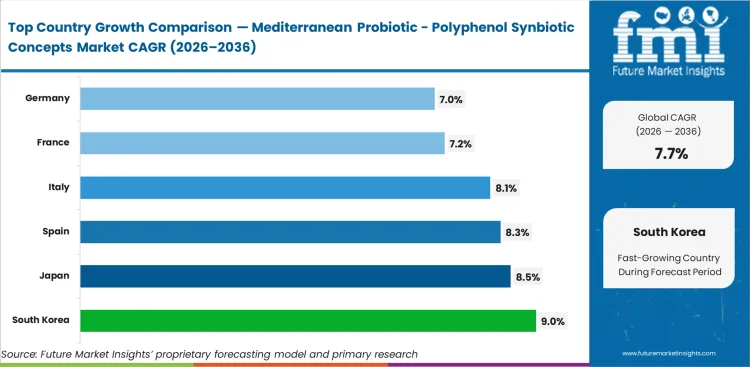
- South Korea (9.0%) and Japan (8.5%) are two of the fastest growing markets.
Mediterranean Probiotic-polyphenol Synbiotic Concepts Market Key Takeaways
| Parameter | Details |
|---|---|
| Market value (2026) | USD 462.4 million |
| Forecast value (2036) | USD 970.9 million |
| CAGR (2026 to 2036) | 7.7% |
| Estimated market value (2025) | USD 429.3 million |
| Incremental opportunity | USD 508.5 million |
| Leading polyphenol source segment | Olive |
| Leading probiotic strain type | Lactobacillus |
| Leading technology platform | Dry Blend |
| Leading product format | Capsules |
| Leading delivery matrix | Supplements |
| Leading application | Digestive Health |
| Leading end user | Adults |
| Leading distribution channel | E-commerce |
| Key suppliers referenced in market landscape | Novonesis, ADM, IFF, dsm-firmenich, Kerry Group, and Probi |
Source: Future Market Insights (FMI) analysis, based on proprietary forecasting model and primary research
Broader scale becomes realistic only after live cultures remain stable beside Mediterranean polyphenols through filling, storage, and daily use, since early concept appeal alone rarely carries a product into repeat commercial runs. Until that point, many concepts remain limited to early samples or narrow pilot batches, due to restart risk in formulation work and owing to extra caution around long-term stability. Similar lessons can be read across probiotic strains, multistrain probiotics, and prebiotic ingredients, since broader market movement usually begins only after the formula proves easy to handle through sourcing, filling, packing, and storage. Daily manufacturing ease matters just as much as concept strength, especially in products built for repeat use and broader retail placement.
Italy is expected to register an 8.1% CAGR during the forecast period, due to stronger familiarity with olive-based wellness concepts and easier acceptance of Mediterranean ingredient stories. Spain is estimated to expand at an 8.3% CAGR over the forecast period, owing to preventive health interest and a good fit between citrus and digestive positioning. Japan is poised to advance at 8.5% CAGR, supported by mature functional wellness routines and wider acceptance of premium microbiome products. South Korea is likely to post 9.0% CAGR through 2036, driven by fast movement in beauty-linked wellness and premium supplement trial. Demand in the United States is anticipated to rise at a CAGR of 7.4% through 2036, while France and Germany are expected to grow at 7.2% and 7.0% respectively. Country differences stay tied to product education, channel depth, and comfort with premium digestive concepts.
Global Biotics Platforms Hold the Upper Hand on Scale and Formulation Breadth
In the Mediterranean probiotic-polyphenol synbiotic concepts market, the suppliers most likely to command share are not pure-play botanical houses but larger biotics platforms that can combine clinically documented strains, formulation support, stability testing, and multi-country commercialization across dairy, supplements, and functional foods. Their advantage is reinforced by the scale of the underlying fermentation ecosystem: Eurostat reported that EU farms produced 161.8 million tonnes of raw milk in 2024, with 150.8 million tonnes delivered to dairies, and 10.8 million tonnes of cheese manufactured from milk streams in the same year. [1]
Segmental Analysis
Key Facts About Segments
- Lactobacillus plantarum is projected to account for 33.0% of market share by 2026.
- Demand for Lactobacillus plantarum is supported by digestive-health relevance, wider formulation familiarity, stronger plant-based positioning, and better compatibility with polyphenol-rich systems.
- Olive polyphenols are expected to capture 36.0% of the polyphenol source segment in 2026.
- Preference for olive polyphenols remains strong due to regional identity, strong antioxidant appeal, better fit with Mediterranean wellness positioning, and cleaner premium branding potential.
- Capsules are projected to contribute 31.0% of the delivery format segment by 2026.
- Adoption of capsules is supported by dosage precision, better probiotic protection, stronger supplement-format acceptance, and easier commercialization across adult wellness products.
- Gut health is expected to account for 39.0% of the functional positioning segment in 2026.
- Demand for gut health concepts is supported by stronger consumer awareness, repeat supplement use, clearer communication value, and better retail conversion across daily wellness categories.
- Microencapsulation is projected to hold 42.0% of the encapsulation approach segment by 2026.
- Use of microencapsulation is supported by stability improvement, moisture protection, stronger shelf-life support, and better survivability of live cultures in blended synbiotic systems.
- Powder blends are expected to represent 28.0% of the end-use format segment in 2026.
- Preference for powder blends is driven by formulation flexibility, multi-ingredient loading, easier dose customization, and stronger fit across stick packs and sachet systems.
- Pharmacies are projected to account for 29.0% of the distribution channel segment by 2026.
- Demand for pharmacies is supported by higher trust, stronger wellness conversion, better supplement guidance, and more consistent movement of clinically positioned digestive products.
- Adults aged 30 to 50 are expected to contribute 34.0% of the consumer target segment in 2026.
- Preference within this consumer group remains strong due to rising preventive-health spending, stronger digestive-health awareness, and regular use of condition-linked wellness supplements.
Mediterranean Probiotic-polyphenol Synbiotic Concepts Market Analysis by Polyphenol Source
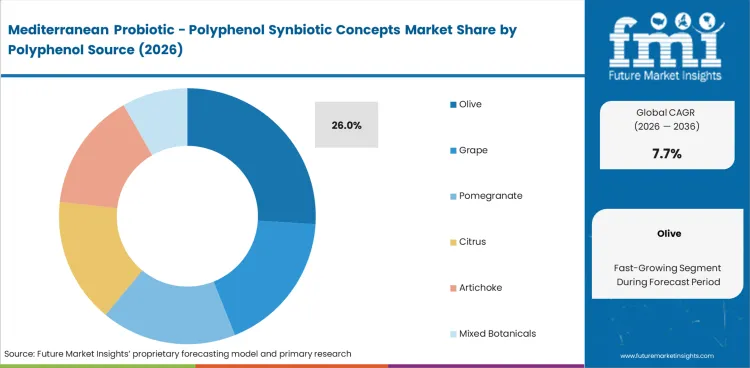
Polyphenol source often shapes how the full concept is read in the market, since the botanical side of the formulation usually creates the first layer of product understanding. Olive remains ahead in early commercial assessment because it carries a clear Mediterranean identity and fits naturally with everyday wellness positioning. Olive is expected to account for 26.0% of total market share in 2026, supported by familiar ingredient recognition and easier premium placement across supplement shelves. Grape, citrus, and pomegranate continue to hold commercial value, though each one needs a more defined product story to support buyer understanding. Source choice plays a direct role in deciding whether the concept feels clear, credible, and easy to market or overly layered and harder to explain.
- Leading source: Olive stays in front due to easier consumer recognition, steadier wellness storytelling, broader Mediterranean relevance, and a cleaner route into premium digestive products.
- Secondary options: Grape and citrus add room for variety, owing to antioxidant familiarity, brighter sensory fit, stronger format flexibility, and easier crossover into daily wellness lines.
- Commercial implication: Source choice shapes label clarity, product recall, repeat purchase comfort, and shelf appeal, supported by simpler communication and lower concept confusion.
Mediterranean Probiotic-polyphenol Synbiotic Concepts Market Analysis by Probiotic Strain Type
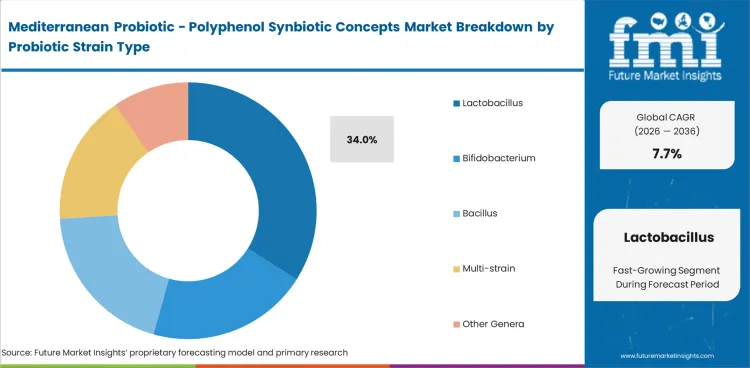
Strain selection shapes both formulation logic and product positioning at the same time. Lactobacillus remains the most practical starting point for many concepts because digestive support is easy to communicate and routine use feels familiar to supplement buyers. Lactobacillus is anticipated to capture 34.0% of the market in 2026, supported by broad supplement familiarity and stronger alignment with daily gut comfort messaging. Bifidobacterium and multi-strain systems continue to attract interest in wider microbiome-focused concepts, though that added complexity can make the product brief less direct. A simpler strain story often helps a concept move more smoothly from development planning into shelf-ready commercialization.
- Leading strain family: Lactobacillus remains easier to commercialize due to consumer familiarity, digestive relevance, simple education value, and smoother movement across everyday supplement formats.
- Broader options: Bifidobacterium and multi-strain systems add depth, driven by broader microbiome interest and supported by premium positioning in more layered wellness products.
- Commercial implication: Strain choice affects claim comfort, stability planning, line extension ease, and repeat sales potential, owing to easier product understanding at purchase stage.
Mediterranean Probiotic-polyphenol Synbiotic Concepts Market Analysis by Technology Platform
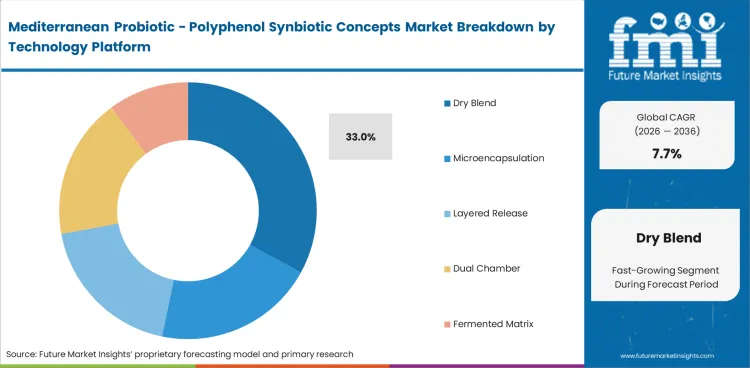
Technology platform carries added importance in this market because both parts of the formulation need to remain workable within one finished system. Dry blend formats stay attractive in early commercial development since product teams can adjust ratios, ingredient loads, and delivery formats with less disruption. The dry blend segment is estimated to account for 33.0% share in 2026, supported by easier development handling and a lower restart burden during concept revisions. Encapsulation and layered systems still matter where stability demands are higher, though those routes can increase cost and reduce flexibility during early-stage work. Platform choice often determines whether a concept remains commercially manageable or becomes too complex too early.
- Leading platform: Dry blend formats move first due to simpler development flow, easier ratio adjustment, lower production burden, and stronger flexibility across early commercial programs.
- Higher-control options: Encapsulation and layered systems gain relevance, owing to added protection needs and supported by tougher shelf-life demands in sensitive finished products.
- Commercial implication: Platform choice influences revision speed, cost discipline, launch timing, and supplier fit, driven by either flexibility or added control requirements.
Mediterranean Probiotic-polyphenol Synbiotic Concepts Market Analysis by Product Format
Format shapes daily use comfort and handling ease well before scale becomes the main concern. Capsules remain the clearest route for many formulations because dose control and storage discipline are easier to manage in a closed system. Capsules are projected to secure 37.0% share in 2026, supported by easier shelf-life management and stronger consumer comfort with familiar supplement routines. Sachets and powders still offer value where convenience and mixing flexibility matter, though added handling can shift user preference. Gummies and shots can draw attention at launch, yet taste balance and delivery consistency often require more development work before the format becomes commercially steady.
- Leading format: Capsules remain strongest due to cleaner dosage control, steadier storage handling, easier travel use, and better alignment with premium daily wellness habits.
- Growth formats: Powders and sachets gain space, driven by routine flexibility and supported by wider use across personalized supplement plans and at-home mixing habits.
- Commercial implication: Format selection influences user comfort, technical discipline, retail fit, and repeat use patterns, owing to visible differences in convenience and product stability.
Mediterranean Probiotic-polyphenol Synbiotic Concepts Market Analysis by Delivery Matrix
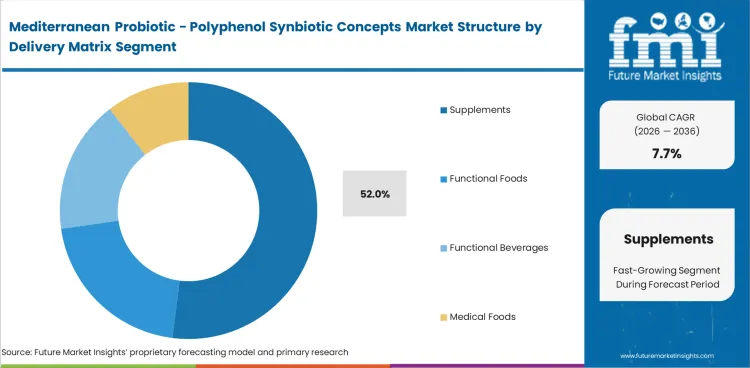
Delivery matrix shows how easily a concept can move into actual commerce with fewer formulation and handling barriers. Supplements remain the leading delivery route because controlled dosage formats reduce stability risk, protect probiotic viability more effectively, and keep Mediterranean polyphenol handling easier during commercial production. Supplements are set to represent 52.0% of market share in 2026, supported by tighter dose control and better handling of probiotic viability and polyphenol consistency. Functional foods and beverages still offer long-term expansion potential, though heat exposure, taste balance, and storage conditions can make product design more demanding. A controlled delivery matrix usually provides the first dependable commercial route for a new synbiotic line.
- Leading matrix: Supplements lead due to better dose precision, steadier viability protection, easier extract handling, and a cleaner route into premium wellness communication.
- Secondary matrices: Foods and beverages add future room, owing to routine-use appeal and supported by consumer interest in more convenient daily nutrition forms.
- Commercial implication: Matrix choice affects launch speed, product durability, sensory balance, and line economics, driven by large differences in technical control.
Mediterranean Probiotic-polyphenol Synbiotic Concepts Market Analysis by Application
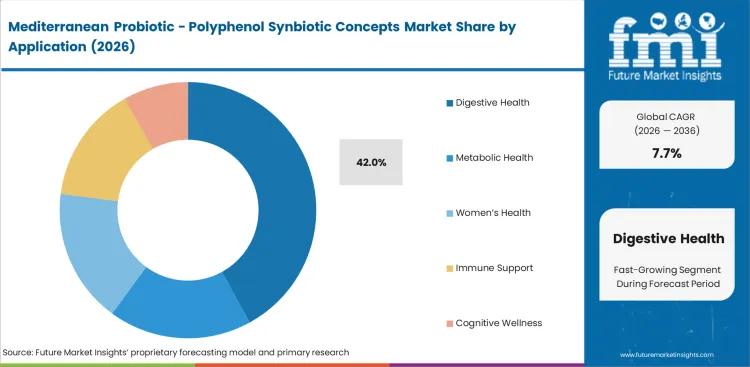
Application remains central in this market because benefit framing often shapes purchase confidence more directly than ingredient novelty alone. Digestive health stays ahead since the connection between probiotics and plant actives feels clear and easy to translate into everyday routines. The digestive health segment is likely to account for 42.0% share in 2026, supported by a more defined product purpose and stronger consumer acceptance of gut-comfort language. Metabolic support, women’s wellness, immune support, and cognitive wellness continue to expand the category, though each one needs tighter communication and a more specific product brief. Category development tends to stay cleaner once benefit language remains simple, credible, and easy to repeat across formats.
- Leading application: Digestive health leads due to direct consumer understanding, steady routine relevance, easier product explanation, and stronger alignment with everyday supplement use.
- Expansion areas: Metabolic and women’s wellness create upside, supported by broader daily health goals and driven by interest in more complete wellness formulas.
- Commercial implication: Application framing shapes shelf clarity, conversion quality, repeat use comfort, and premium value perception, owing to benefit simplicity at purchase stage.
Mediterranean Probiotic-polyphenol Synbiotic Concepts Market Analysis by End User
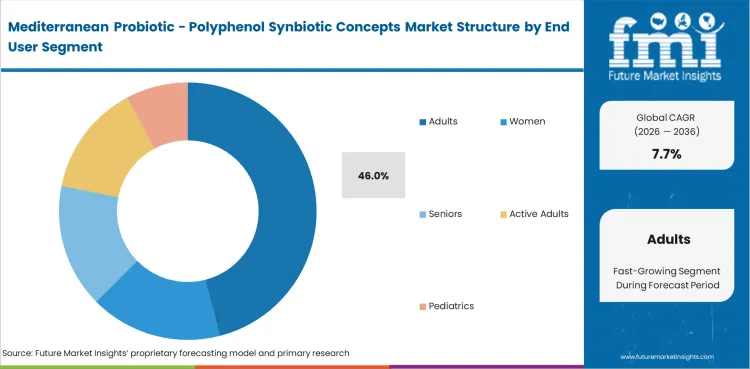
End-user focus shapes both the formulation tone and the way the product is presented in the market. Adults remain in the lead because digestive and daily wellness supplements already fit well into established adult routines across online and specialist channels. In 2026, adults are expected to contribute 46.0% of total market share, supported by stronger repeat-purchase potential and a better fit with familiar supplement habits. Women, seniors, and active adults continue to offer solid room for more targeted concepts, though each group needs a sharper product message and clearer benefit framing. Pediatric use remains narrower because trust requirements are higher and the product brief usually needs a more careful and controlled structure.
- Leading user base: Adults remain first due to routine supplement use, stronger self-directed buying, easier premium adoption, and better alignment with digestive wellness needs.
- Secondary user groups: Women and seniors add value, driven by targeted daily needs and supported by clearer room for specialized wellness positioning.
- Commercial implication: User focus changes pack style, message depth, channel mix, and product simplicity, owing to different levels of comfort and product intent.
Mediterranean Probiotic-polyphenol Synbiotic Concepts Market Analysis by Distribution Channel
Distribution choice shapes selling style as much as it shapes the volume route. E-commerce remains the strongest channel because detailed product explanation, ingredient comparison, and niche discovery work more effectively in a digital environment. E-commerce is expected to hold 34.0% share in 2026, supported by richer education space and easier comparison across premium digestive wellness products. Pharmacies and health stores continue to matter in trust-led purchase moments, especially for concepts that need stronger reassurance before conversion. Grocery can add scale over time, though shelf communication becomes harder when the product carries layered wellness logic and needs more context to support buyer understanding.
- Leading channel: E-commerce leads due to stronger education space, easier product comparison, broader assortment reach, and better support for premium niche concepts.
- Trust channels: Pharmacies and health stores stay relevant, supported by guided buying habits and driven by stronger confidence in specialist wellness settings.
- Commercial implication: Channel mix affects product discovery, message depth, conversion quality, and repeat ordering behavior, owing to different buying environments and expectations.
Mediterranean Probiotic-polyphenol Synbiotic Concepts Market Drivers, Restraints, and Opportunities
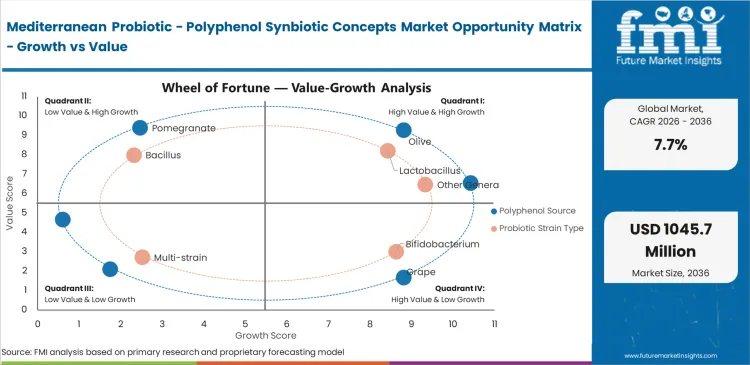
Demand growth in this category reflects a broader shift in everyday wellness buying behavior. More products now carry wider health positioning, and that change gives Mediterranean probiotic-polyphenol combinations a stronger shelf presence through cleaner botanical identity and a more premium gut-health narrative. Brand owners are showing greater interest in concepts that feel complete without appearing overloaded. Product appeal improves further when olive, grape, citrus, or pomegranate actives are paired with familiar strain families, especially in formulations built around probiotic ingredients, and premium probiotic supplements. Interest also rises when consumers recognize the role of plant compounds such as flavonoids in supporting a more credible wellness story. Stronger demand often begins with clearer communication, though long-term category value depends on how easily the product fits into repeat daily use.
Commercial restraint remains tied more to execution than to concept appeal alone. A formulation can look strong during early development and still lose momentum during scale-up because strain sensitivity, botanical variation, sensory changes, and storage discipline all need to work inside one finished format. Added complexity in one part of the formula can quickly affect overall performance. That is why many early concepts remain concentrated in safer delivery routes such as capsules, sachets, and powders. A narrower but workable format usually moves further than a broader concept that struggles on stability. Market direction remains positive, though viability, consistency, and format fit continue to shape the pace of adoption.
Opportunities
- Daily wellness extension: Capsules, powders, and sachets offer strong room for growth due to repeat-use convenience, simpler dosage control, and cleaner premium digestive positioning across digital and specialist channels.
- Selective food crossover: Longer-term space can open in beverages and functional foods, owing to wider routine-use appeal and supported by rising interest in microbiome-led everyday nutrition formats.
- Women’s wellness and beauty-linked expansion: New product room continues to build across women’s daily wellness and beauty-support concepts, driven by premium self-care demand and supported by broader acceptance of microbiome-focused supplement language.
Regional Analysis
Regional movement in this category follows a story of fit rather than pure size. Ingredient familiarity, microbiome awareness, premium product acceptance, and channel depth all shape demand in different ways. Southern Europe gives the concept a natural cultural base. North America provides broad supplement reach. Asia Pacific brings faster premium trial in advanced wellness formats.
Key Facts About Country:
- South Korea is identified as the fastest-growing market among the countries highlighted, with a CAGR of 9.0% through 2036.
- Japan follows at 8.5%, placing it among the stronger-growth markets covered in the analysis.
- Spain records 8.3%, indicating a solid growth outlook among the countries assessed in this market.
- Italy stands at 8.1%, while the United States reaches 7.4%, reflecting comparatively steady growth.
- France posts 7.2%, remaining close to the mid-range growth pattern projected across the countries covered.
- Germany records 7.0%, making it the slowest-growing market among the countries cited here.
.webp "Top Country Growth Comparison Mediterranean Probiotic Polyphenol Synbiotic Concepts Market Cagr (2026 2036)")
| Country | CAGR |
|---|---|
| United States | 7.4% |
| Italy | 8.1% |
| Spain | 8.3% |
| France | 7.2% |
| Germany | 7.0% |
| Japan | 8.5% |
| South Korea | 9.0% |
North America Mediterranean Probiotic-polyphenol Synbiotic Concepts Market Analysis
North America gives the category a broad commercial base because supplement purchasing habits are already well established and digital channels provide enough space for concept education. Premium products can enter through online and specialist routes without depending on immediate mass retail acceptance. Product developers also benefit from a consumer base that is already comfortable with capsules, powders, and daily wellness routines, especially across gut health supplements and digestive health supplements. A concept usually moves with a steadier rhythm in this region when the benefit story remains clear and the format feels easy to use.
- United States: A large supplement base keeps the United States central to category development, and demand for Mediterranean probiotic-polyphenol synbiotic concepts in the country is anticipated to rise at a CAGR of 7.4% through 2036, driven by broad e-commerce reach and supported by stronger consumer comfort with premium digestive formulas. Capsules and powders fit especially well in this setting because they align with familiar supplement habits. Clear dosage communication improves product trust and helps new concepts gain traction. Brand activity also tends to move faster in education-led channels than in crowded mass retail shelves.
North America demand stays healthy due to a strong habit base for daily supplements and premium wellness purchasing. Clean product framing matters more than broad benefit stacking. A concise concept usually converts better. Real commercial strength comes from practical use and steady reorder comfort.
Europe Mediterranean Probiotic-polyphenol Synbiotic Concepts Market Analysis
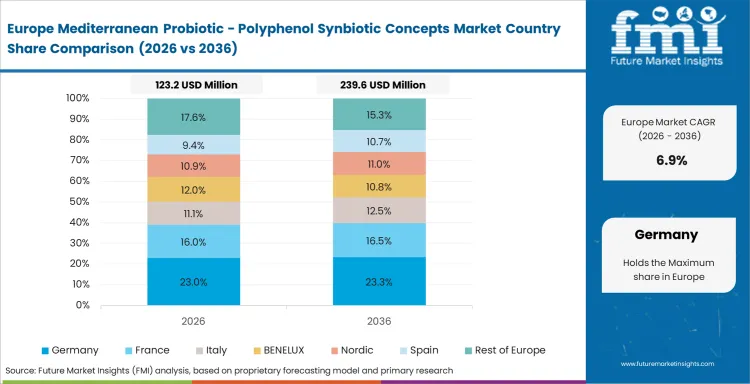
Europe gives this category a natural source advantage because olive, citrus, grape, and related plant ingredients already carry cultural familiarity across the region. Southern Europe benefits from product language that feels native and easier to translate into premium digestive wellness positioning. Western Europe adds specialist retail depth and a more structured supplement environment. Country variation still remains visible because product simplicity, channel behavior, and premium acceptance differ across major economies. Interest is also widening into Mediterranean healthy-aging ingredients and Mediterranean pre-diabetes concepts, which gives the category broader room beyond core digestive positioning.
- Italy: Mediterranean ingredient familiarity gives Italy a smoother route into this category, and sales of Mediterranean probiotic-polyphenol synbiotic concepts are expected to increase at a CAGR of 8.1% during the forecast period, driven by stronger comfort with olive-led wellness formats and supported by premium supplement demand in digestive health. Products feel more natural here because local food and wellness culture already supports Mediterranean plant narratives. Clear daily-use framing helps conversion. Capsules and powders remain practical entry routes.
- Spain: Preventive health interest and stronger alignment with citrus and olive wellness stories keep Spain attractive for this niche. Spain is set to record a CAGR of 8.3% in Mediterranean probiotic-polyphenol synbiotic concepts during the assessment period, owing to a better fit with Mediterranean dietary language and supported by premium digestive product acceptance. Product appeal improves once the formula stays clean and easy to place in daily routines. Powder and capsule formats carry less technical strain than more delicate food systems.
- France: Premium botanical products already carry good consumer attention in France, and Mediterranean probiotic-polyphenol synbiotic concept adoption in the country is likely to advance at a CAGR of 7.2% by 2036, driven by interest in premium wellness and supported by stronger appreciation for clean product architecture. Product success improves once the message stays restrained and direct. Digestive support remains easier to place than broad multi-benefit language. Specialist channels help the category maintain credibility. A measured concept often performs better than an overloaded one.
- Germany: A structured supplement environment gives Germany durable value in this space, though product discipline matters from the first stage. Germany is projected to witness 7.0% CAGR in Mediterranean probiotic-polyphenol synbiotic concepts through 2036, due to careful product evaluation and supported by stronger preference for precise use positioning. Capsules, powders, and specialist formats fit this environment better than more novelty-led routes. Product clarity supports trust. Overbuilt concepts can lose pace in a methodical buying setting.
Demand in Europe stays attractive for practical reasons as much as cultural reasons. Familiar ingredients reduce one layer of explanation. Product discipline still decides repeat sales. Southern Europe can move faster, while Western Europe can deliver more measured and durable value.
Asia Pacific Mediterranean Probiotic-polyphenol Synbiotic Concepts Market Analysis
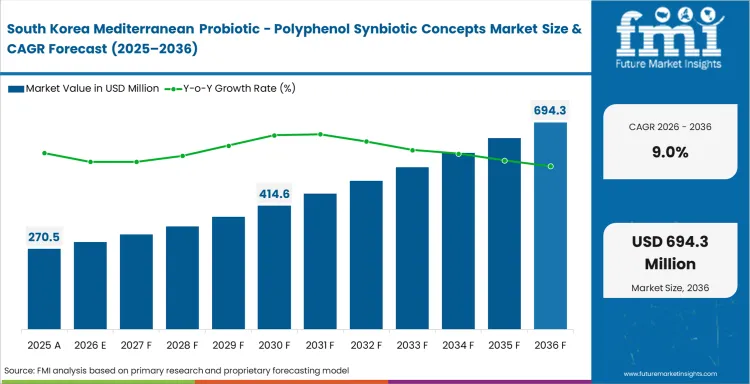
Asia Pacific stands out due to strong openness toward digestive wellness, premium self-care, and advanced supplement formats. Biotic products already hold a meaningful place in daily health routines across several major markets. That habit base gives premium concepts a better chance to enter through clear use positioning rather than through heavy education. Growth remains promising, though the formula still needs to feel practical in taste, routine, and delivery. Interest around probiotic supplement formats, botanical supplements, and more premium probiotic ingredients continues to widen category room across the region.
- Japan: Mature functional wellness habits keep Japan important in this category, and Japan is anticipated to see Mediterranean probiotic-polyphenol synbiotic concepts grow at a CAGR of 8.5% over the forecast period, driven by steady acceptance of digestive support products and supported by stronger comfort with premium daily nutrition formats. Precise product framing matters here. Beverage crossover can attract attention, though supplement formats keep control easier during early commercialization. Probiotic drinks offer a useful adjacent route, while grape seed extracts and other premium plant actives fit better once the message remains controlled and easy to place in daily use.
- South Korea: Premium trial moves quickly in South Korea due to strong interest in beauty-linked wellness and more advanced supplement concepts. Mediterranean probiotic-polyphenol synbiotic concept demand across South Korea is set to rise at 9.0% CAGR through 2036, driven by faster premium adoption and supported by a wider comfort base for microbiome-led self-care products. Product excitement can build early in this market. Lasting value still depends on clear use logic and stable delivery. Botanical supplements and women-focused probiotics both sit close to this demand pattern, while cleaner probiotic ingredients help support a more premium and credible product frame.
Asia Pacific offers a faster growth path due to consumer comfort with premium wellness routines and regular biotic product use. Early trial can arrive quickly. Repeat demand still depends on stable delivery and easy daily fit. Product practicality remains central even in the most receptive markets.
Competitive Aligners for Market Players
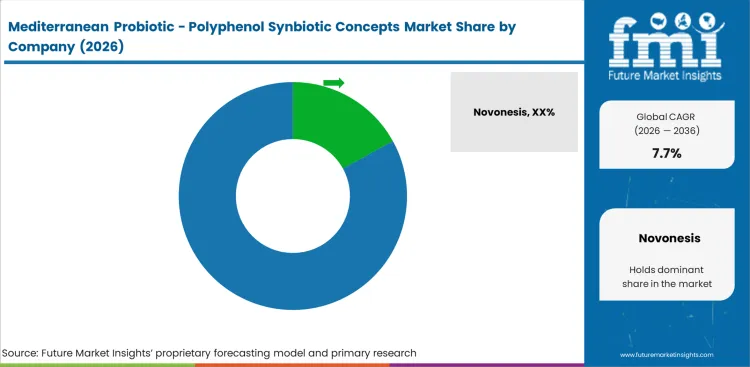
Competitive advantage in this category depends less on a novel label claim and more on the ability to combine dependable strains, steady botanical quality, and a formulation path that remains workable through commercialization. Novonesis, IFF, dsm-firmenich, Kerry Group, ADM, and Probi all remain close to the opportunity for different reasons, yet purchase decisions usually turn on a limited set of commercial realities. Buyers look for dependable strains, steady botanical quality, and a finished-product path that stays manageable during commercialization. A supplier can enter the discussion early and still lose momentum if the formula becomes difficult to handle after the first prototype.
Novonesis, IFF, Kerry Group, and dsm-firmenich bring value through broader ingredient access and stronger support across product design. ADM remains relevant because it sits at the intersection of microbiome logic and plant bioactives inside one concept brief. Probi continue to matter due to stronger strain credibility and a clearer digestive-health foundation. Reading across multistrain probiotics, probiotic supplements positioning, and premium probiotic ingredients points toward the same conclusion. Product usability matters as much as ingredient identity.
A supplier gains stronger alignment once positioning, stability, and product architecture remain workable inside one commercial discussion. Reading across grape seed extracts, probiotic ingredients, and other premium botanical supplements shows the same need for platform trust in higher-value wellness categories. Lasting business often stays with suppliers that help keep the concept workable from the first brief to repeat production.
Key Players in Mediterranean Probiotic-polyphenol Synbiotic Concepts Market
- Novonesis
- ADM
- IFF
- dsm-firmenich
- Kerry Group
- Probi
Scope of the Report
| Attribute | Details |
|---|---|
| Market title | Mediterranean Probiotic-polyphenol Synbiotic Concepts Market |
| Base year | 2025 |
| Estimated market value 2025 | USD 429.3 million |
| Estimated market value 2026 | USD 462.4 million |
| Forecast market value 2036 | USD 970.9 million |
| Forecast CAGR 2026 to 2036 | 7.7% |
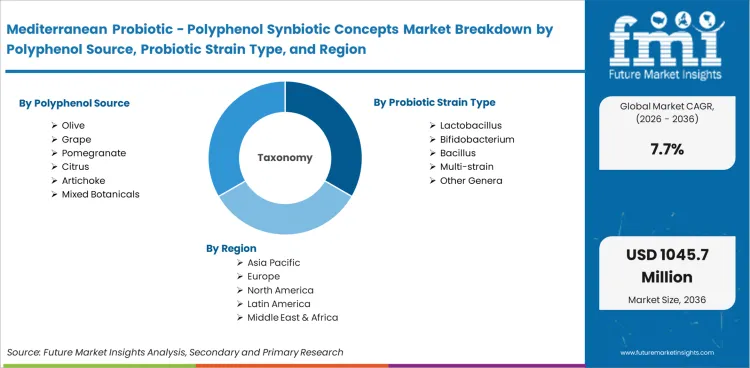
| Polyphenol source | Olive, Grape, Pomegranate, Citrus, Artichoke, Mixed Botanicals |
| Probiotic strain type | Lactobacillus, Bifidobacterium, Bacillus, Multi-strain, Other Genera |
| Technology platform | Dry Blend, Microencapsulation, Layered Release, Dual Chamber, Fermented Matrix |
| Product format | Capsules, Sachets, Powders, Gummies, RTD Shots, Fermented Dairy |
| Delivery matrix | Supplements, Functional Foods, Functional Beverages, Medical Foods |
| Application | Digestive Health, Metabolic Health, Women’s Health, Immune Support, Cognitive Wellness |
| End user | Adults, Women, Seniors, Active Adults, Pediatrics |
| Distribution channel | E-commerce, Pharmacies, Health Stores, Practitioners, Grocery |
| Countries covered | United States, Italy, Spain, France, Germany, Japan, South Korea |
| Key companies | Novonesis, ADM, IFF, dsm-firmenich, Kerry Group, Probi |
Source: Future Market Insights (FMI) analysis, based on proprietary forecasting model and primary research
Mediterranean Probiotic-polyphenol Synbiotic Concepts Market Analysis by Segments
Polyphenol Source:
- Olive
- Grape
- Pomegranate
- Citrus
- Artichoke
- Mixed Botanicals
Probiotic Strain Type:
- Lactobacillus
- Bifidobacterium
- Bacillus
- Multi-strain
- Other Genera
Technology Platform:
- Dry Blend
- Microencapsulation
- Layered Release
- Dual Chamber
- Fermented Matrix
Product Format:
- Capsules
- Sachets
- Powders
- Gummies
- RTD Shots
- Fermented Dairy
Delivery Matrix:
- Supplements
- Functional Foods
- Functional Beverages
- Medical Foods
Application:
- Digestive Health
- Metabolic Health
- Women’s Health
- Immune Support
- Cognitive Wellness
End User:
- Adults
- Women
- Seniors
- Active Adults
- Pediatrics
Distribution Channel:
- E-commerce
- Pharmacies
- Health Stores
- Practitioners
- Grocery
Region:
- North America
- United States
- Europe
- Italy
- Spain
- France
- Germany
- Asia Pacific
- Japan
- South Korea
Bibliography
- Eurostat. (2025). Milk production reached 161.8 million tonnes in 2024.
- Anna Rita Bavaro, Alessia Tarantini, Angela Bruno, Maria Cristina Frassanito, Angelo Poli, Elena Cocca, and Andrea Lenzi. (2024). Functional foods in Mediterranean diet: Exploring the functional features of vegetable case-studies obtained also by biotechnological approaches.
- Mónica Sánchez-Gutiérrez, Ricardo Gómez-García, Manuela Pintado, Alejandro Rodríguez, and Elena Carrasco. (2025). Prebiotic potential of olive leaf by-product throughout in vitro human colon fermentation.
- Bhutada Sarita, Dahikar Samadhan, Md Zakir Hassan, and Elena G. Kovaleva. (2025). A comprehensive review of probiotics and human health-current prospective and applications.
This bibliography is provided for reader reference. The full FMI report contains the complete reference list with primary source documentation.
This Report Addresses
- Market intelligence on probiotic-polyphenol synbiotic concepts across olive, grape, pomegranate, citrus, and mixed botanical routes.
- Ten-year revenue outlook from 2026 to 2036 for a specialty category sitting between probiotics, synbiotics, and Mediterranean wellness ingredients.
- Growth opportunity mapping across strain families, product formats, delivery matrices, applications, and distribution channels.
- Country demand reading for the United States, Italy, Spain, France, Germany, Japan, and South Korea.
- Segment interpretation for capsules, dry blends, supplements, digestive health positioning, adult use, and e-commerce-led sales.
- Competitive reading across Novonesis, ADM, IFF, dsm-firmenich, Kerry Group, and Probi.
- Commercial implications for supplement development, channel choice, and product architecture in microbiome-led wellness.
- Scope definition separating live probiotic and Mediterranean polyphenol combinations from standalone botanicals, undefined ferments, and non-viable alternatives.
Frequently Asked Questions
What defines the commercial scope of Mediterranean probiotic-polyphenol synbiotic systems?
Commercial scope depends on the difference between simple ingredient blends and true interactive synbiotic systems. A real synbiotic needs proof that selected probiotic strains can convert olive or grape polyphenols into more usable compounds inside the gut. Product developers usually do not accept basic co-packaging alone and often seek clinical proof of this metabolic activity before approving premium ingredient use.
How do procurement directors evaluate pricing for these premium ingredient systems?
Buyers focus more on probiotic survival than on starting cell count alone. A polyphenol system that protects bacteria through stomach conditions can justify a higher price than a standard uncoated probiotic. Manufacturers often accept that extra cost if it reduces the bacterial loading needed to meet end-of-shelf-life claims.
Which sub-segment currently dominates commercial formulation pipelines?
Cardiovascular and metabolic health applications currently lead product development. Strong interest comes from pairings such as olive-derived hydroxytyrosol with selected bifidobacteria, especially in functional foods built around heart-health positioning. This pairing gives brands a more measurable and premium point of difference than many common supplement formats.
Why do formulators pair pomegranate extracts specifically with lactobacilli?
Pomegranate ellagitannins are not absorbed efficiently on their own. Certain bacterial strains can convert them into urolithin A, changing their biological value. Product developers use this pairing in healthy-aging concepts because it gives the extract a clearer functional role than it would have on its own.
How does the polyphenol component alter probiotic survival rates during manufacturing?
Some Mediterranean polyphenols help protect bacterial cells from heat and processing stress during manufacturing. Production teams use these compounds as natural support materials instead of relying only on synthetic coatings. This makes them useful for clean-label products that still need strong viable cell counts.
What mechanism dictates the shift toward grape seed-derived synbiotics in nutricosmetics?
Skin-focused formulators use grape seed compounds to support the gut-skin axis. Bacterial fermentation of these compounds can create metabolites that help manage inflammation in the body. Brands use this mechanism to support claims linked to skin quality, elasticity, and redness control.
Skin-focused formulators use grape seed compounds to support the gut-skin axis. Bacterial fermentation of these compounds can create metabolites that help manage inflammation in the body. Brands use this mechanism to support claims linked to skin quality, elasticity, and redness control.
Water creates a major stability issue for both live probiotics and active polyphenols. Beverage manufacturers struggle to keep both ingredients stable over long ambient shelf-life periods. Until better delivery systems appear, wider use is likely to remain concentrated in dry powders and oil-based capsule formats.
Why do some traditional probiotic suppliers struggle to enter this specific niche?
Many standard freeze-dried probiotic strains react poorly when mixed directly with strong plant extracts. Existing probiotic portfolios often fail in these formulas because the strains are not built to handle high-polyphenol environments. Success usually depends on finding more resistant strains that can work with these active plant compounds.
How does regional raw material sourcing impact final product viability?
Seasonal and climate differences can change the polyphenol profile of Mediterranean botanicals from one harvest to another. A probiotic strain designed for one extract profile may not perform the same way if the next batch of plant material has a different composition. Standardization of botanical inputs is therefore essential for stable product performance.
How do contract manufacturers manage the cross-reactivity risk during blending?
Manufacturers reduce this risk through low-shear mixing and tight humidity control. Too much friction during blending can expose dormant bacteria to reactive polyphenols too early and damage the cells. Moisture control also matters because even small environmental shifts can trigger unwanted activity during processing.
What specific testing protocols do buyers mandate before accepting delivery?
Buyers often want more than a basic probiotic cell count certificate. They look for testing that shows the polyphenol system actually improves survival under acidic gastric-like conditions. Suppliers that cannot provide this deeper bioaccessibility or survivability data often struggle to pass qualification.
How are formulators addressing the intense astringency of therapeutic polyphenol doses?
High-dose olive and grape extracts can create strong bitterness and astringency. To manage this, formulators use masking systems such as lipid-based matrices to reduce direct taste impact. Solving this sensory issue often decides whether a product succeeds as a daily chewable or stays limited to harder-to-consume dosage forms.
Where is the technological boundary for these systems heading by 2036?
The category is moving toward more personalized synbiotic combinations. Future systems are likely to match specific Mediterranean extracts with selected bacterial strains based on individual microbiome needs. This could shift the category away from broad wellness products and toward more targeted nutrition solutions.
What commercial risks do early brand adopters currently face?
Consumer understanding of microbiome science is still limited, making complex synbiotic concepts harder to explain on-pack. Brands face price pressure if shoppers see the product as only a probiotic mixed with fruit or plant powder. Clear communication is therefore important to support premium positioning.
How will climate change alter the supply chain for these specific ingredients?
Heat stress and changing rainfall patterns in Southern Europe can affect the phenolic strength of olive, citrus, and other Mediterranean botanicals. That creates supply risk for brands needing very specific extract profiles. To manage this, buyers may need longer-term sourcing agreements and tighter raw material planning.
What structural shift will force mandatory adoption of advanced encapsulation?
A shift away from pills and toward gummies and soft chews is likely to increase the need for better encapsulation. Heat and moisture in these formats can quickly damage both live probiotics and polyphenols. Suppliers that want to support these delivery forms will need stronger protection systems.
How do cosmetic formulators integrate these concepts into topical applications?
Topical formulators often use bacterial lysates instead of live bacteria because live cultures create stability problems in cosmetic bases. They combine these non-living bacterial fragments with stabilized Mediterranean polyphenols to support skin microbiome balance. This approach gives functional benefits without creating fermentation issues inside the product.
Why are citrus-derived flavonoids gaining traction over traditional olive extracts?
Citrus flavonoids such as hesperidin and naringin are gaining attention because they work well with selected gut bacteria and are easier to formulate in some consumer products. Another advantage is that they are often easier to mask from a taste standpoint than bitter olive extracts. This makes them more attractive for weight-management and functional snack applications.
What defines a successful clinical validation for these combined matrices?
A strong clinical validation must show that the combined system performs better than the separate ingredients used alone. Researchers need to prove that the bacteria actually ferment the polyphenol in the body and create measurable metabolites. Without that level of evidence, the product is usually treated as a simple botanical-probiotic blend rather than a proven synbiotic system.
Preview the report firsthand - request a free sample
Get SampleGet the brochure for pricing and purchase details.
Get PDFTable of Content
- Executive Summary
- Global Market Outlook
- Demand-side Trends
- Supply-side Trends
- Technology Roadmap Analysis
- Analysis and Recommendations
- Market Overview
- Market Coverage / Taxonomy
- Market Definition / Scope / Limitations
- Research Methodology
- Chapter Orientation
- Analytical Lens and Working Hypotheses
- Market Structure, Signals, and Trend Drivers
- Benchmarking and Cross-market Comparability
- Market Sizing, Forecasting, and Opportunity Mapping
- Research Design and Evidence Framework
- Desk Research Programme (Secondary Evidence)
- Company Annual and Sustainability Reports
- Peer-reviewed Journals and Academic Literature
- Corporate Websites, Product Literature, and Technical Notes
- Earnings Decks and Investor Briefings
- Statutory Filings and Regulatory Disclosures
- Technical White Papers and Standards Notes
- Trade Journals, Industry Magazines, and Analyst Briefs
- Conference Proceedings, Webinars, and Seminar Materials
- Government Statistics Portals and Public Data Releases
- Press Releases and Reputable Media Coverage
- Specialist Newsletters and Curated Briefings
- Sector Databases and Reference Repositories
- FMI Internal Proprietary Databases and Historical Market Datasets
- Subscription Datasets and Paid Sources
- Social Channels, Communities, and Digital Listening Inputs
- Additional Desk Sources
- Expert Input and Fieldwork (Primary Evidence)
- Primary Modes
- Qualitative Interviews and Expert Elicitation
- Quantitative Surveys and Structured Data Capture
- Blended Approach
- Why Primary Evidence is Used
- Field Techniques
- Interviews
- Surveys
- Focus Groups
- Observational and In-context Research
- Social and Community Interactions
- Stakeholder Universe Engaged
- C-suite Leaders
- Board Members
- Presidents and Vice Presidents
- R&D and Innovation Heads
- Technical Specialists
- Domain Subject-matter Experts
- Scientists
- Physicians and Other Healthcare Professionals
- Governance, Ethics, and Data Stewardship
- Research Ethics
- Data Integrity and Handling
- Primary Modes
- Tooling, Models, and Reference Databases
- Desk Research Programme (Secondary Evidence)
- Data Engineering and Model Build
- Data Acquisition and Ingestion
- Cleaning, Normalisation, and Verification
- Synthesis, Triangulation, and Analysis
- Quality Assurance and Audit Trail
- Market Background
- Market Dynamics
- Drivers
- Restraints
- Opportunity
- Trends
- Scenario Forecast
- Demand in Optimistic Scenario
- Demand in Likely Scenario
- Demand in Conservative Scenario
- Opportunity Map Analysis
- Product Life Cycle Analysis
- Supply Chain Analysis
- Investment Feasibility Matrix
- Value Chain Analysis
- PESTLE and Porter’s Analysis
- Regulatory Landscape
- Regional Parent Market Outlook
- Production and Consumption Statistics
- Import and Export Statistics
- Market Dynamics
- Global Market Analysis 2021 to 2025 and Forecast, 2026 to 2036
- Historical Market Size Value (USD Million) Analysis, 2021 to 2025
- Current and Future Market Size Value (USD Million) Projections, 2026 to 2036
- Y-o-Y Growth Trend Analysis
- Absolute $ Opportunity Analysis
- Global Market Pricing Analysis 2021 to 2025 and Forecast 2026 to 2036
- Global Market Analysis 2021 to 2025 and Forecast 2026 to 2036, By Polyphenol Source
- Introduction / Key Findings
- Historical Market Size Value (USD Million) Analysis By Polyphenol Source , 2021 to 2025
- Current and Future Market Size Value (USD Million) Analysis and Forecast By Polyphenol Source , 2026 to 2036
- Olive
- Grape
- Pomegranate
- Citrus
- Artichoke
- Mixed Botanicals
- Olive
- Y-o-Y Growth Trend Analysis By Polyphenol Source , 2021 to 2025
- Absolute $ Opportunity Analysis By Polyphenol Source , 2026 to 2036
- Global Market Analysis 2021 to 2025 and Forecast 2026 to 2036, By Probiotic Strain Type
- Introduction / Key Findings
- Historical Market Size Value (USD Million) Analysis By Probiotic Strain Type, 2021 to 2025
- Current and Future Market Size Value (USD Million) Analysis and Forecast By Probiotic Strain Type, 2026 to 2036
- Lactobacillus
- Bifidobacterium
- Bacillus
- Multi-strain
- Other Genera
- Lactobacillus
- Y-o-Y Growth Trend Analysis By Probiotic Strain Type, 2021 to 2025
- Absolute $ Opportunity Analysis By Probiotic Strain Type, 2026 to 2036
- Global Market Analysis 2021 to 2025 and Forecast 2026 to 2036, By Technology Platform
- Introduction / Key Findings
- Historical Market Size Value (USD Million) Analysis By Technology Platform, 2021 to 2025
- Current and Future Market Size Value (USD Million) Analysis and Forecast By Technology Platform, 2026 to 2036
- Dry Blend
- Microencapsulation
- Layered Release
- Dual Chamber
- Fermented Matrix
- Dry Blend
- Y-o-Y Growth Trend Analysis By Technology Platform, 2021 to 2025
- Absolute $ Opportunity Analysis By Technology Platform, 2026 to 2036
- Global Market Analysis 2021 to 2025 and Forecast 2026 to 2036, By Product Format
- Introduction / Key Findings
- Historical Market Size Value (USD Million) Analysis By Product Format, 2021 to 2025
- Current and Future Market Size Value (USD Million) Analysis and Forecast By Product Format, 2026 to 2036
- Capsules
- Sachets
- Powders
- Gummies
- RTD Shots
- Fermented Dairy
- Capsules
- Y-o-Y Growth Trend Analysis By Product Format, 2021 to 2025
- Absolute $ Opportunity Analysis By Product Format, 2026 to 2036
- Global Market Analysis 2021 to 2025 and Forecast 2026 to 2036, By Delivery Matrix
- Introduction / Key Findings
- Historical Market Size Value (USD Million) Analysis By Delivery Matrix, 2021 to 2025
- Current and Future Market Size Value (USD Million) Analysis and Forecast By Delivery Matrix, 2026 to 2036
- Supplements
- Functional Foods
- Functional Beverages
- Medical Foods
- Supplements
- Y-o-Y Growth Trend Analysis By Delivery Matrix, 2021 to 2025
- Absolute $ Opportunity Analysis By Delivery Matrix, 2026 to 2036
- Global Market Analysis 2021 to 2025 and Forecast 2026 to 2036, By Application
- Introduction / Key Findings
- Historical Market Size Value (USD Million) Analysis By Application, 2021 to 2025
- Current and Future Market Size Value (USD Million) Analysis and Forecast By Application, 2026 to 2036
- Digestive Health
- Metabolic Health
- Women’s Health
- Immune Support
- Cognitive Wellness
- Digestive Health
- Y-o-Y Growth Trend Analysis By Application, 2021 to 2025
- Absolute $ Opportunity Analysis By Application, 2026 to 2036
- Global Market Analysis 2021 to 2025 and Forecast 2026 to 2036, By End User
- Introduction / Key Findings
- Historical Market Size Value (USD Million) Analysis By End User, 2021 to 2025
- Current and Future Market Size Value (USD Million) Analysis and Forecast By End User, 2026 to 2036
- Adults
- Women
- Seniors
- Active Adults
- Pediatrics
- Adults
- Y-o-Y Growth Trend Analysis By End User, 2021 to 2025
- Absolute $ Opportunity Analysis By End User, 2026 to 2036
- Global Market Analysis 2021 to 2025 and Forecast 2026 to 2036, By Region
- Introduction
- Historical Market Size Value (USD Million) Analysis By Region, 2021 to 2025
- Current Market Size Value (USD Million) Analysis and Forecast By Region, 2026 to 2036
- North America
- Latin America
- Western Europe
- Eastern Europe
- East Asia
- South Asia and Pacific
- Middle East & Africa
- Market Attractiveness Analysis By Region
- North America Market Analysis 2021 to 2025 and Forecast 2026 to 2036, By Country
- Historical Market Size Value (USD Million) Trend Analysis By Market Taxonomy, 2021 to 2025
- Market Size Value (USD Million) Forecast By Market Taxonomy, 2026 to 2036
- By Country
- USA
- Canada
- Mexico
- By Polyphenol Source
- By Probiotic Strain Type
- By Technology Platform
- By Product Format
- By Delivery Matrix
- By Application
- By End User
- By Country
- Market Attractiveness Analysis
- By Country
- By Polyphenol Source
- By Probiotic Strain Type
- By Technology Platform
- By Product Format
- By Delivery Matrix
- By Application
- By End User
- Key Takeaways
- Latin America Market Analysis 2021 to 2025 and Forecast 2026 to 2036, By Country
- Historical Market Size Value (USD Million) Trend Analysis By Market Taxonomy, 2021 to 2025
- Market Size Value (USD Million) Forecast By Market Taxonomy, 2026 to 2036
- By Country
- Brazil
- Chile
- Rest of Latin America
- By Polyphenol Source
- By Probiotic Strain Type
- By Technology Platform
- By Product Format
- By Delivery Matrix
- By Application
- By End User
- By Country
- Market Attractiveness Analysis
- By Country
- By Polyphenol Source
- By Probiotic Strain Type
- By Technology Platform
- By Product Format
- By Delivery Matrix
- By Application
- By End User
- Key Takeaways
- Western Europe Market Analysis 2021 to 2025 and Forecast 2026 to 2036, By Country
- Historical Market Size Value (USD Million) Trend Analysis By Market Taxonomy, 2021 to 2025
- Market Size Value (USD Million) Forecast By Market Taxonomy, 2026 to 2036
- By Country
- Germany
- UK
- Italy
- Spain
- France
- Nordic
- BENELUX
- Rest of Western Europe
- By Polyphenol Source
- By Probiotic Strain Type
- By Technology Platform
- By Product Format
- By Delivery Matrix
- By Application
- By End User
- By Country
- Market Attractiveness Analysis
- By Country
- By Polyphenol Source
- By Probiotic Strain Type
- By Technology Platform
- By Product Format
- By Delivery Matrix
- By Application
- By End User
- Key Takeaways
- Eastern Europe Market Analysis 2021 to 2025 and Forecast 2026 to 2036, By Country
- Historical Market Size Value (USD Million) Trend Analysis By Market Taxonomy, 2021 to 2025
- Market Size Value (USD Million) Forecast By Market Taxonomy, 2026 to 2036
- By Country
- Russia
- Poland
- Hungary
- Balkan & Baltic
- Rest of Eastern Europe
- By Polyphenol Source
- By Probiotic Strain Type
- By Technology Platform
- By Product Format
- By Delivery Matrix
- By Application
- By End User
- By Country
- Market Attractiveness Analysis
- By Country
- By Polyphenol Source
- By Probiotic Strain Type
- By Technology Platform
- By Product Format
- By Delivery Matrix
- By Application
- By End User
- Key Takeaways
- East Asia Market Analysis 2021 to 2025 and Forecast 2026 to 2036, By Country
- Historical Market Size Value (USD Million) Trend Analysis By Market Taxonomy, 2021 to 2025
- Market Size Value (USD Million) Forecast By Market Taxonomy, 2026 to 2036
- By Country
- China
- Japan
- South Korea
- By Polyphenol Source
- By Probiotic Strain Type
- By Technology Platform
- By Product Format
- By Delivery Matrix
- By Application
- By End User
- By Country
- Market Attractiveness Analysis
- By Country
- By Polyphenol Source
- By Probiotic Strain Type
- By Technology Platform
- By Product Format
- By Delivery Matrix
- By Application
- By End User
- Key Takeaways
- South Asia and Pacific Market Analysis 2021 to 2025 and Forecast 2026 to 2036, By Country
- Historical Market Size Value (USD Million) Trend Analysis By Market Taxonomy, 2021 to 2025
- Market Size Value (USD Million) Forecast By Market Taxonomy, 2026 to 2036
- By Country
- India
- ASEAN
- Australia & New Zealand
- Rest of South Asia and Pacific
- By Polyphenol Source
- By Probiotic Strain Type
- By Technology Platform
- By Product Format
- By Delivery Matrix
- By Application
- By End User
- By Country
- Market Attractiveness Analysis
- By Country
- By Polyphenol Source
- By Probiotic Strain Type
- By Technology Platform
- By Product Format
- By Delivery Matrix
- By Application
- By End User
- Key Takeaways
- Middle East & Africa Market Analysis 2021 to 2025 and Forecast 2026 to 2036, By Country
- Historical Market Size Value (USD Million) Trend Analysis By Market Taxonomy, 2021 to 2025
- Market Size Value (USD Million) Forecast By Market Taxonomy, 2026 to 2036
- By Country
- Kingdom of Saudi Arabia
- Other GCC Countries
- Turkiye
- South Africa
- Other African Union
- Rest of Middle East & Africa
- By Polyphenol Source
- By Probiotic Strain Type
- By Technology Platform
- By Product Format
- By Delivery Matrix
- By Application
- By End User
- By Country
- Market Attractiveness Analysis
- By Country
- By Polyphenol Source
- By Probiotic Strain Type
- By Technology Platform
- By Product Format
- By Delivery Matrix
- By Application
- By End User
- Key Takeaways
- Key Countries Market Analysis
- USA
- Pricing Analysis
- Market Share Analysis, 2025
- By Polyphenol Source
- By Probiotic Strain Type
- By Technology Platform
- By Product Format
- By Delivery Matrix
- By Application
- By End User
- Canada
- Pricing Analysis
- Market Share Analysis, 2025
- By Polyphenol Source
- By Probiotic Strain Type
- By Technology Platform
- By Product Format
- By Delivery Matrix
- By Application
- By End User
- Mexico
- Pricing Analysis
- Market Share Analysis, 2025
- By Polyphenol Source
- By Probiotic Strain Type
- By Technology Platform
- By Product Format
- By Delivery Matrix
- By Application
- By End User
- Brazil
- Pricing Analysis
- Market Share Analysis, 2025
- By Polyphenol Source
- By Probiotic Strain Type
- By Technology Platform
- By Product Format
- By Delivery Matrix
- By Application
- By End User
- Chile
- Pricing Analysis
- Market Share Analysis, 2025
- By Polyphenol Source
- By Probiotic Strain Type
- By Technology Platform
- By Product Format
- By Delivery Matrix
- By Application
- By End User
- Germany
- Pricing Analysis
- Market Share Analysis, 2025
- By Polyphenol Source
- By Probiotic Strain Type
- By Technology Platform
- By Product Format
- By Delivery Matrix
- By Application
- By End User
- UK
- Pricing Analysis
- Market Share Analysis, 2025
- By Polyphenol Source
- By Probiotic Strain Type
- By Technology Platform
- By Product Format
- By Delivery Matrix
- By Application
- By End User
- Italy
- Pricing Analysis
- Market Share Analysis, 2025
- By Polyphenol Source
- By Probiotic Strain Type
- By Technology Platform
- By Product Format
- By Delivery Matrix
- By Application
- By End User
- Spain
- Pricing Analysis
- Market Share Analysis, 2025
- By Polyphenol Source
- By Probiotic Strain Type
- By Technology Platform
- By Product Format
- By Delivery Matrix
- By Application
- By End User
- France
- Pricing Analysis
- Market Share Analysis, 2025
- By Polyphenol Source
- By Probiotic Strain Type
- By Technology Platform
- By Product Format
- By Delivery Matrix
- By Application
- By End User
- India
- Pricing Analysis
- Market Share Analysis, 2025
- By Polyphenol Source
- By Probiotic Strain Type
- By Technology Platform
- By Product Format
- By Delivery Matrix
- By Application
- By End User
- ASEAN
- Pricing Analysis
- Market Share Analysis, 2025
- By Polyphenol Source
- By Probiotic Strain Type
- By Technology Platform
- By Product Format
- By Delivery Matrix
- By Application
- By End User
- Australia & New Zealand
- Pricing Analysis
- Market Share Analysis, 2025
- By Polyphenol Source
- By Probiotic Strain Type
- By Technology Platform
- By Product Format
- By Delivery Matrix
- By Application
- By End User
- China
- Pricing Analysis
- Market Share Analysis, 2025
- By Polyphenol Source
- By Probiotic Strain Type
- By Technology Platform
- By Product Format
- By Delivery Matrix
- By Application
- By End User
- Japan
- Pricing Analysis
- Market Share Analysis, 2025
- By Polyphenol Source
- By Probiotic Strain Type
- By Technology Platform
- By Product Format
- By Delivery Matrix
- By Application
- By End User
- South Korea
- Pricing Analysis
- Market Share Analysis, 2025
- By Polyphenol Source
- By Probiotic Strain Type
- By Technology Platform
- By Product Format
- By Delivery Matrix
- By Application
- By End User
- Russia
- Pricing Analysis
- Market Share Analysis, 2025
- By Polyphenol Source
- By Probiotic Strain Type
- By Technology Platform
- By Product Format
- By Delivery Matrix
- By Application
- By End User
- Poland
- Pricing Analysis
- Market Share Analysis, 2025
- By Polyphenol Source
- By Probiotic Strain Type
- By Technology Platform
- By Product Format
- By Delivery Matrix
- By Application
- By End User
- Hungary
- Pricing Analysis
- Market Share Analysis, 2025
- By Polyphenol Source
- By Probiotic Strain Type
- By Technology Platform
- By Product Format
- By Delivery Matrix
- By Application
- By End User
- Kingdom of Saudi Arabia
- Pricing Analysis
- Market Share Analysis, 2025
- By Polyphenol Source
- By Probiotic Strain Type
- By Technology Platform
- By Product Format
- By Delivery Matrix
- By Application
- By End User
- Turkiye
- Pricing Analysis
- Market Share Analysis, 2025
- By Polyphenol Source
- By Probiotic Strain Type
- By Technology Platform
- By Product Format
- By Delivery Matrix
- By Application
- By End User
- South Africa
- Pricing Analysis
- Market Share Analysis, 2025
- By Polyphenol Source
- By Probiotic Strain Type
- By Technology Platform
- By Product Format
- By Delivery Matrix
- By Application
- By End User
- USA
- Market Structure Analysis
- Competition Dashboard
- Competition Benchmarking
- Market Share Analysis of Top Players
- By Regional
- By Polyphenol Source
- By Probiotic Strain Type
- By Technology Platform
- By Product Format
- By Delivery Matrix
- By Application
- By End User
- Competition Analysis
- Competition Deep Dive
- Novonesis
- Overview
- Product Portfolio
- Profitability by Market Segments (Product/Age /Sales Channel/Region)
- Sales Footprint
- Strategy Overview
- Marketing Strategy
- Product Strategy
- Channel Strategy
- ADM
- IFF
- dsm-firmenich
- Kerry Group
- Probi
- Novonesis
- Competition Deep Dive
- Assumptions & Acronyms Used


