

- Market Size (2026)
- USD 52.8 Mn
- Forecast (2036)
- USD 92.8 Mn
- CAGR (2026 to 2036)
- 5.8%
Buckwheat–Mediterranean Grain Blend Ingredients Market Size, Market Forecast and Outlook By FMI
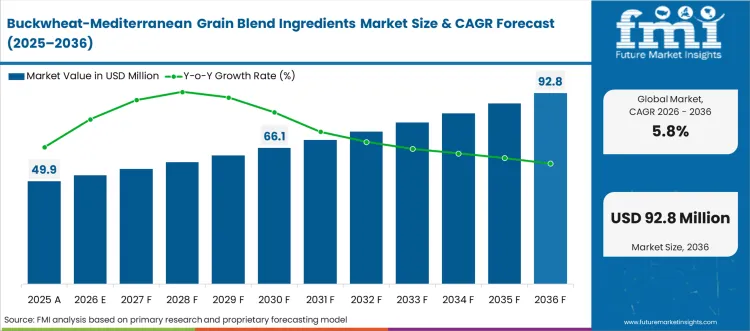
The buckwheat–Mediterranean grain blend ingredients market surpassed a valuation of USD 49.9 million in 2025. Revenue is set to reach USD 52.8 million in 2026, rising at a 5.8% CAGR through the forecast period. Industry value is projected to total USD 92.8 million by 2036 as processors shift from in-house grain handling toward standardized pre-milled blend systems that reduce batch inconsistency, improve dough hydration, and support gluten-free plus whole-grain reformulation needs across bakery, pasta, cereal, and snack applications.
Summary of Buckwheat-Mediterranean Grain Blend Ingredients Market
- Market Snapshot
- The buckwheat–mediterranean grain blend ingredients market is valued at USD 49.9 million in 2025 and is projected to reach USD 92.8 million by 2036.
- The market expands at a 5.8% CAGR from 2026 to 2036, creating an incremental opportunity of USD 40.0 million over the period.
- This category covers standardized ingredient systems combining buckwheat with Mediterranean-associated grains for industrial food formulation rather than bulk commodity buckwheat or finished branded foods.
- Supply-side feasibility is supported by global buckwheat production of about 2.2 million tonnes, giving processors enough raw material depth for niche blend commercialization without implying mass-market staple scale.
- Demand and Growth Drivers
- Demand is rising because Mediterranean-style eating patterns still favor whole grains, while food makers need ingredients that link health positioning with familiar grain formats.
- Buckwheat remains relevant in formulation because it is naturally gluten-free and nutrient-dense, which makes it useful in premium bakery, pasta, cereal, and snack products.
- Growth is also supported by ingredient suppliers offering buckwheat inside ancient-grain, gluten-free, and multigrain blend systems rather than as a single raw flour alone.
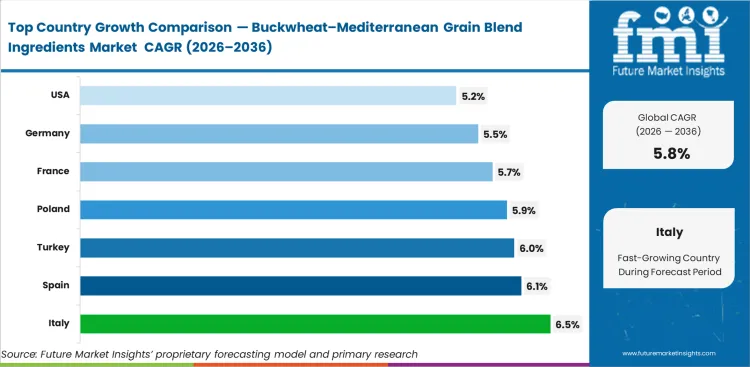
- Among key countries, Italy leads at 6.5% CAGR, followed by Spain at 6.1%, Turkey at 6.0%, Poland at 5.9%, France at 5.7%, Germany at 5.5%, and the United States at 5.2%.
- Flavor intensity, gluten-management requirements for mixed facilities, and narrower raw-material sourcing bases keep adoption below the pace seen in broad flour mixes or mainstream cereal ingredients.
- Product and Segment View
- The market covers flour, flake, cracked, and semolina-style blend systems used mainly in bakery, breakfast cereal, pasta, and snack applications.
- Flour blends lead the form segment with 46.0% share, supported by easier dosing, faster incorporation, and broader use across bread, crackers, batters, and dry-mix systems.
- Bakery mixes lead the application segment with 41.0% share, reflecting bread, flatbread, pancake, and premium baked-snack formulation demand.
- Barley leads the grain pairing segment with 31.0% share, helped by Mediterranean diet familiarity, fiber positioning, and process compatibility in multigrain bakery systems.
- Conventional leads the nature segment with 64.0% share, as mainstream industrial users still prioritize price, scale, and easier purchase over organic-only sourcing.
- Industrial b2b leads the channel segment with 59.0% share, since most value creation sits in premix supply, milling, and formulation support rather than direct retail packs.
- The scope includes ingredient blends sold to food manufacturers and bakery/cereal processors, but excludes single-origin raw buckwheat grain, finished branded foods, and broad non-buckwheat grain premixes.
- Geography and Competitive Outlook
- Italy, Spain, and Turkey are the fastest-growing markets in this niche, while Germany and the United States remain steadier large-scale formulation markets with stronger industrial processing bases.
- Competition is shaped less by consumer branding and more by milling capability, gluten-control infrastructure, sourcing reliability, organic availability, and custom blending competence.
- Key participants include ADM, Trouw, Bay State Milling, Healthy Food Ingredients, Ziegler Organic, Incola, and Limagrain Ingredients, each relevant through milling capability, blend customization, or application support in specialty grain systems.
- The market remains moderately fragmented, though supply influence tends to cluster around processors with broader portfolios, stronger custom-processing capability, and better application support.
Key Takeaways, Market Size, and Forecast
- Buckwheat–Mediterranean Grain Blend Ingredients Market is projected to grow from USD 52.8 million in 2026 to USD 92.8 million by 2036, at a CAGR of 5.8%.
- The buckwheat–mediterranean grain blend ingredients market was valued at USD 49.9 million in 2025.
- By 2036, the Buckwheat–Mediterranean Grain Blend Ingredients Market is expected to be worth USD 92.8 million.
- From 2026 to 2036, the market is projected to expand at a CAGR of 5.8%.
- The market is projected to create an incremental opportunity of USD 40.0 million between 2026 and 2036.
- In 2026, Flour blends are expected to account for 46.0% of the form segment.
- Italy (6.5%) and Spain (6.1%) are two of the fastest growing markets.
Buckwheat–Mediterranean Grain Blend Ingredients Market Key Takeaways
| Metric | Details |
|---|---|
| Industry Size (2026) | USD 52.8 million |
| Industry Value (2036) | USD 92.8 million |
| CAGR (2026 to 2036) | 5.8% |
Source: Future Market Insights (FMI) analysis, based on proprietary forecasting model and primary research
Companies once treated gluten-free grain substitution as a functional requirement rather than a premium positioning tool. That changed when formulation teams recognized the margin potential of pairing buckwheat with Mediterranean grains such as barley and spelt. Commercial bakers now face a distinct challenge: consumers want the digestive profile of gluten-free systems but reject the chalky texture and flat flavor of basic rice or corn flour blends. Sourcing managers must therefore qualify standardized ancient grains that deliver sensory balance at scale. Delays in supplier qualification can slow commercialization, particularly where buyers expect consistent dough hydration and repeatable plant performance. By integrating advanced milling techniques into broader portfolios, processors solve the consistency gap. Raw material availability alone does not determine adoption. Mill-level blending competence plays a bigger role in securing long-term contracts.
Once line production scales beyond regional pilot facilities, the requirement for standardized batch hydration becomes necessary. Facility managers trigger the shift from in-house mixing to pre-formulated buckwheat flour systems when internal blending errors begin compressing margins. Crossing this threshold eliminates the operational variance inherent in handling multiple raw grain streams. The facility shifts from managing agricultural inconsistency to a more streamlined ingredient-handling process. That can support faster compliance review and lower batch rejection.
Italy benefits from strong pasta-formulation demand and established milling capability, supporting an estimated CAGR of 6.5% over the forecast period. Spain follows with 6.1% CAGR, helped by commercial bakeries scaling up whole-grain Mediterranean profiles across industrial production lines. Turkey is projected to post 6.0% CAGR, supported by deep domestic milling infrastructure and efficient ancient-grain processing capacity. Poland is likely to record 5.9% CAGR, with established regional cultivation networks contributing to raw material access and supply continuity. Market growth in France remains supported at 5.7% CAGR, reflecting clean-label reformulation pressure in legacy bread production. Germany is set to see 5.5% CAGR, while the United States is anticipated to achieve 5.2% CAGR, with growth shaped by industrial snack sourcing needs in Germany and more complex multi-facility supply chains in the United States.
Segmental Analysis
Buckwheat–Mediterranean Grain Blend Ingredients Market Analysis by Form
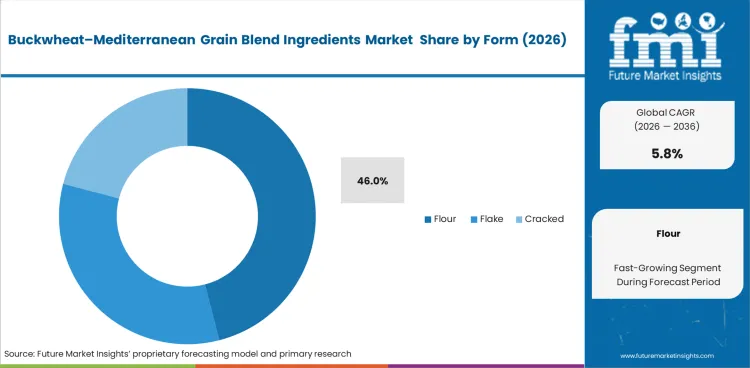
The flour blends segment is estimated to account for 46.0% share in 2026 because it fits automated bakery lines where particle-size consistency and rapid hydration matter. Facility managers place high value on consistent particle size because variation can disrupt automated dough-handling and extrusion performance. Flour systems provide immediate dispersion, ensuring consistent hydration kinetics crucial for large-scale continuous mixing environments. Product developers need materials that behave predictably under intense mechanical shear when they incorporate ancient grains. The practitioner insight generalists overlook is the hidden cost of secondary grinding; food manufacturers refuse to purchase functional grain blends if it means adding a milling step to their own factory floor. Pre-milled composite flours solve this friction. If purchasing departments select cheaper, poorly standardized flakes instead of optimized gluten-free flours for batter, the resulting viscosity fluctuations cause equipment fouling and batch rejection. Technical processors who guarantee tight particle-size distribution secure long-term supplier status. This operational reality insulates the flour segment from raw material price pressures, as the value lies heavily in the mechanical processing and standardization rather than the underlying agricultural commodity.
- Flour dominance: Automated facilities require uniform particle dispersion for rapid hydration. This eliminates manual batch corrections during continuous mixing. Processors must invest in precision classification equipment to meet strict specifications.
- Flake utility: Snack bar formulators demand visible texture inclusions for premium positioning. This creates a distinct niche separate from dough-based applications. Suppliers should secure clean-label certifications to maximize value here.
- Semolina viability: Pasta manufacturers need specific granular structures for high-pressure extrusion. This allows alternative grains to mimic traditional wheat behavior. Developers must calibrate moisture content to prevent cracking.
Buckwheat–Mediterranean Grain Blend Ingredients Market Analysis by Application
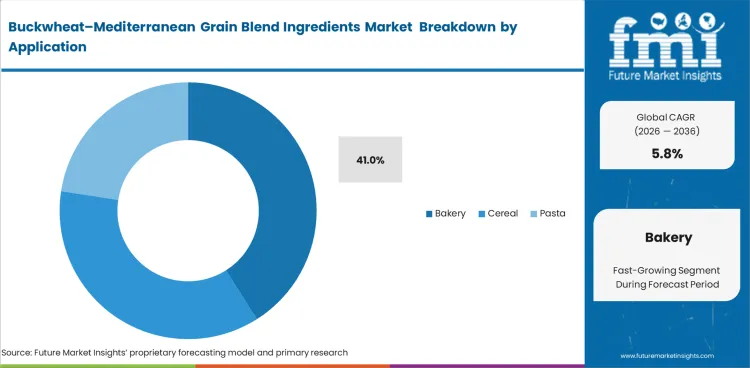
The bakery mixes category is expected to hold 41.0% share in 2026, as commercial bakers continue to prioritize systems that protect loaf volume while supporting clean-label reformulation. Production departments at Tier-1 bread facilities operate continuous lines that tolerate zero variance in dough elasticity. Integrating raw grains directly into these systems often results in crumb collapse due to the absence of traditional gluten networks. Pre-formulated bakery mixes resolve this tension by providing balanced hydration ratios engineered for high-throughput ovens. A critical reality often missed is that bakeries are not buying grains; but are buying guaranteed oven-springs. If companies source uncalibrated grain systems to cut costs, loaf quality can deteriorate, which raises the risk of retailer complaints, reformulation expense, and weaker repeat acceptance. Suppliers providing validated mixes that drop seamlessly into existing industrial bread lines hold stronger pricing power. The ability to maintain structural integrity across diverse thermal environments ensures that bakery applications remain the highest-value commercialization pathway for these specialized ingredient systems, far outpacing simpler extrusion processes.
- Bread formulators: Technical departments struggle with crumb structure in gluten-free environments. Securing standardized matrix blends results in consistent loaf volume and retail acceptance.
- Pasta extruders: Facility operators face high equipment friction when utilizing non-traditional flours. Implementing precision-milled semolina alternatives prevents die-head clogging and reduces maintenance downtime.
- Snack developers: R&D teams encounter flavor masking challenges with heavy ancient-grain profiles. Utilizing specifically toasted grain pairings yields a balanced sensory profile without synthetic additives.
Buckwheat–Mediterranean Grain Blend Ingredients Market Analysis by Grain Pairing
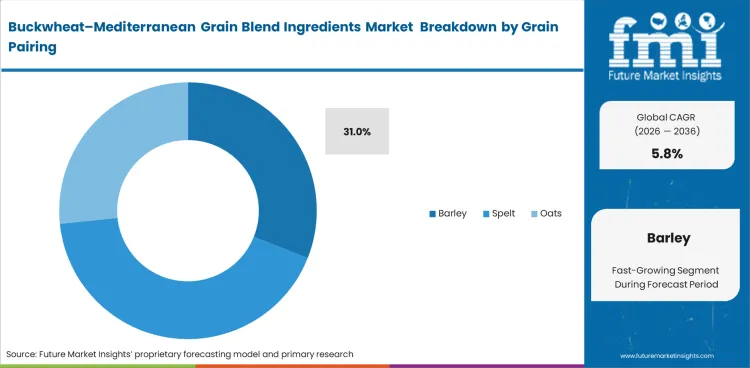
Barley is anticipated to capture 31.0% of the market in 2026, helped by its ability to balance formulation functionality with steadier sourcing continuity in large-scale production. Product development teams desire exotic multi-grain profiles for packaging claims, but purchasing departments require large, stable agricultural volumes to keep production lines running. Barley bridges this gap by offering strong European and North American supply chains while still fitting Mediterranean diet positioning. When processors mill barley alongside buckwheat, the resulting reduced-gluten matrices demonstrate superior water-binding capacity compared to utilizing oats or millet alone. The nuance generalists miss is the sheer processing volume required to make a blend commercially viable; if a supplier cannot guarantee a thousand metric tons of consistent input material, Tier-1 food brands may not qualify, regardless of the nutritional profile. Choosing niche grains like farro for high-volume applications exposes buyers to seasonal price spikes and stock-outs. Barley mitigates this risk, providing an economical, functionally reliable bulk carrier that stabilizes the more volatile, specialized components within the overall blend system.
- Barley integration: Higher beta-glucan content can support moisture retention in baked goods. Lesser-used alternatives often face a narrower sourcing base and more variable pricing. Strong barley access can therefore improve supplier negotiating position in composite blends.
- Oat compatibility: Neutral flavor profiles mitigate the intense earthy notes of raw buckwheat. Strict dedicated-facility requirements for certified gluten-free status limit processor participation. Securing certified supply chains unlocks premium formulation contracts.
- Millet functionality: Rapid hydration kinetics support high-speed batter mixing operations. Inconsistent post-harvest drying creates unpredictable microbial loads. Standardizing heat-treatment protocols opens lucrative pathways into infant nutrition lines.
Buckwheat–Mediterranean Grain Blend Ingredients Market Analysis by Nature
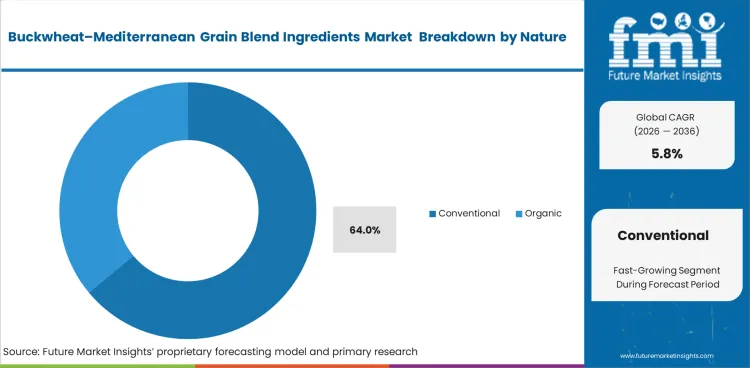
The conventional blends segment is poised to garner 64.0% share in 2026, reflecting the continued preference for cost stability and easier scale management across industrial food manufacturing. Plant managers operating low-margin, high-volume cereal and snack lines cannot absorb the 30% to 50% price premiums associated with certified organic supply chains. Conventional sourcing is better suited to the large tonnages needed to keep continuous processing facilities running without interruption. While retail marketing departments promote clean label grain blends, the mathematical reality of factory-floor economics determines that functional grain systems must first meet strict cost-in-use targets before securing spend management approval. The practitioner's truth is that cross-contamination risks during transport and milling make handling organic multi-grain systems difficult and expensive. If a facility loses its organic certification due to a trace conventional input error, the entire batch is downgraded, destroying profitability. Major ingredient suppliers focus their primary infrastructure on optimizing conventional yields, ensuring reliable, highly standardized bulk deliveries that protect their clients' baseline margins while reserving organic processing for specialized, lower-volume premium lines.
- Conventional dominance: Bulk purchasing relies on established, non-segregated agricultural networks. Securing volumes of specialized grains without price spikes remains difficult. Processors expand dedicated contract farming to stabilize baseline conventional supplies.
- Organic constraints: Premium brands demand certified inputs for clean-label positioning. Strict facility isolation protocols reduce overall milling efficiency. Suppliers push toward dedicated single-purpose mills to eliminate cross-contamination risks to some extent.
- Transitional sourcing: Brands seek sustainable narratives without full organic premiums. Verifying pesticide residue limits adds significant laboratory overhead. Market standards migrate toward regenerative agriculture metrics rather than strict organic certification.
Buckwheat–Mediterranean Grain Blend Ingredients Market Analysis by Channel
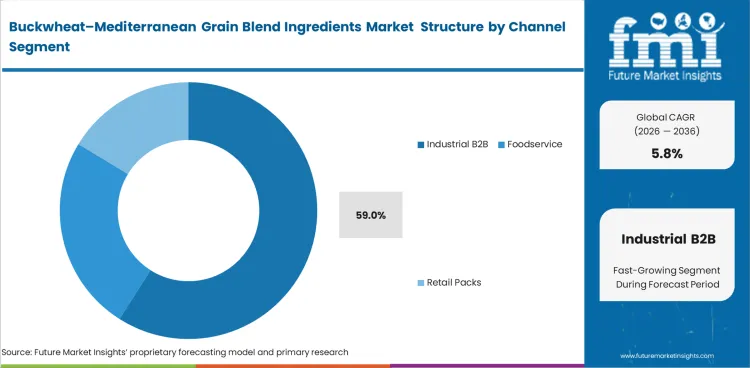
Industrial B2B is set to represent 59.0% of market share in 2026, since most category value remains concentrated in premix supply, technical milling, and formulation support rather than end-consumer education. Ingredient processors generate value not by selling flour to consumers, but by solving technical formulation problems for global food conglomerates. A bakery producing thousands of loaves per hour requires pre-mixed, verified whole grain ingredients that perform identically in every batch. Foodservice and retail channels simply do not possess the volume requirements or the technical demands to drive this sector's core economics. One practical advantage of B2B suppliers is that part of the formulation is absorbed and a validation burden that food manufacturers would otherwise manage internally. If a snack manufacturer attempts to blend multiple specialty grains internally, all the raw material waste and rheological testing costs are absorbed. By outsourcing this to specialized B2B ingredient providers, food companies shift the technical risk off their own balance sheets. This dynamic ensures that multi-ton industrial contracts remain the foundation of category profitability.
- Industrial scale: Manufacturers demand consistency across production runs. Suppliers utilize advanced optical sorting and precision blending to guarantee uniformity. Smaller regional mills struggle to meet these rigorous Tier-1 vendor specifications.
- Foodservice limitations: Restaurant chains require simple, foolproof baking mixes for back-of-house operations. Processors develop tolerant formulations that withstand varied operator skill levels. The cost of bespoke packaging limits penetration into smaller independent venues.
- Retail constraints: Consumers want ancient-grain benefits without altering traditional cooking methods. Formulators engineer retail packs to mimic standard wheat behavior closely. Price sensitivity at the supermarket shelf restricts the inclusion rate of premium components.
Buckwheat–Mediterranean Grain Blend Ingredients Market Drivers, Restraints, and Opportunities
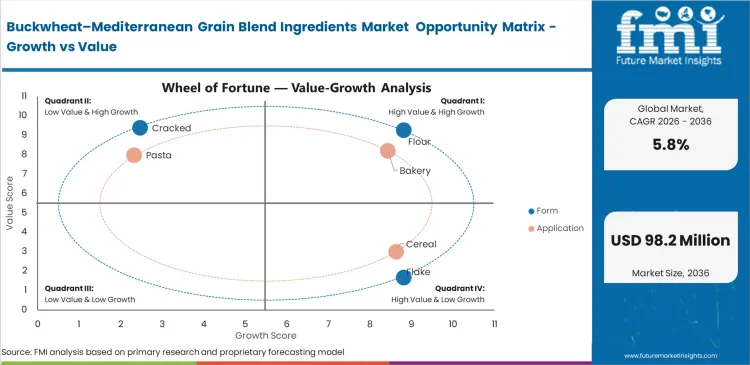
Sourcing departments at multinational bakery corporations constantly battle shifting clean-label mandates while trying to maintain dough stability, driving the aggressive integration of specialized blend systems. Synthetic dough conditioners and artificial binders face intense regulatory scrutiny and consumer rejection. To replace these functional chemicals, formulators require stable physical ingredients that naturally provide moisture retention and structural support. High-performance buckwheat ingredients combined with specific Mediterranean staples deliver this precise rheological functionality without triggering clean-label red flags. When this driver activates, food manufacturers cease buying separate commodity grains and instead issue large requests for proposals (RFPs) for proprietary, pre-mixed functional systems. This completely changes the power dynamic in the supply chain, elevating specialized milling operators from simple agricultural processors to indispensable technical partners who control the proprietary formulas keeping commercial bakeries operational.
The constraint is not consumer demand for healthy grains; it is the technical difficulty of managing multiple allergens and cross-contamination protocols within a single milling facility. Processing pseudo cereals alongside barley or spelt introduces profound complexities in gluten management. Facilities attempting to process gluten-free buckwheat alongside gluten-containing grains often need stricter line segregation, added air-handling controls, and tighter packaging discipline, which can raise capital and operating costs. If a supplier fails a trace-gluten audit, its qualification status can weaken materially, especially in stricter Tier-1 supply programs. This structural reality prevents generalist flour mills from easily entering the category, limiting the sheer number of qualified suppliers capable of delivering these complex blends at commercial scale.
Opportunities in the Buckwheat–Mediterranean Grain Blend Ingredients Market
- Extrusion specialists: Snack manufacturers risk losing market share to clean-label competitors. By investing in twin-screw extrusion technology optimized for sustainable grain ingredients, these companies secure lucrative contracts in the premium savory snack aisle.
- Specialized millers: Regional processors face margin compression from bulk commodity traders. Upgrading facilities to handle segregated alternative grains alongside certified gluten-free oats allows them to lead the high-margin allergen-friendly bakery sector.
- Formulation scientists: Pasta developers risk texture degradation when removing wheat. Calibrating specific thermal treatments for ancient-grain blends ensures structural integrity during boiling, capturing large value in the premium alternative-pasta category.
Regional Analysis
.webp "Top Country Growth Comparison Buckwheat Mediterranean Grain Blend Ingredients Market Cagr (2026 2036)")
Regional demand dynamics reflect distinct agricultural processing capabilities and varying levels of industrial bakery sophistication.
| Country | CAGR (2026 to 2036) |
|---|---|
| Italy | 6.5% |
| Spain | 6.1% |
| Turkey | 6.0% |
| Poland | 5.9% |
| France | 5.7% |
| Germany | 5.5% |
| United States | 5.2% |
Source: Future Market Insights (FMI) analysis, based on proprietary forecasting model and primary research
Europe Buckwheat–Mediterranean Grain Blend Ingredients Market Analysis
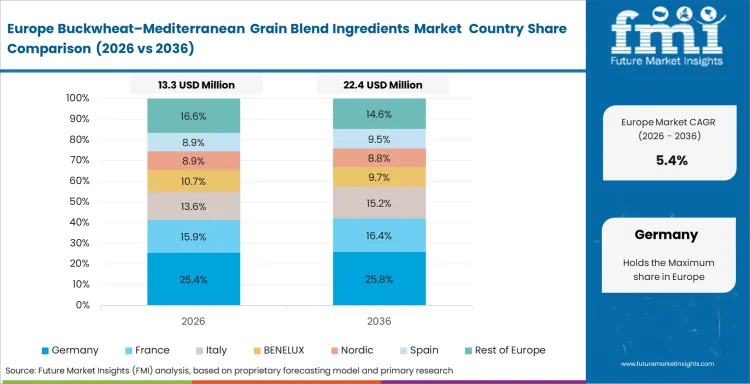
Clean-label pressure is rising across Europe, and traditional baking systems are being pushed to adopt more engineered alternative grain systems. The region possesses the world's most mature infrastructure for specialty milling, yet plant managers face constant pressure to remove synthetic additives from legacy recipes. This tension drives the rapid commercialization of Europe buckwheat blends that physically mimic the dough-handling properties of conventional wheat without violating clean-label standards. Furthermore, the European Union's strict traceability requirements favor regional suppliers who can guarantee crop provenance, insulating domestic millers from cheaper, unverified imports. Buyer behavior here is highly technical. Purchasing teams want detailed rheological data and batch-consistency support before changing long-established bread or pasta formulations. Europe rewards specialized, technically competent milling operations capable of delivering precision-engineered functional flours over high-volume, low-cost commodity brokers.
- Italy: Demand for buckwheat–Mediterranean grain blend ingredients in Italy is anticipated to rise at a CAGR of 6.5% through 2036. Facility operators cannot rely on basic flours; requiring calibrated semolina-style blends that survive high-pressure extrusion without shattering. These specialized milling contracts help eliminate the texture failures common in early-generation gluten-free pasta. Securing reliable, extrusion-ready ancient grain matrices could open various commercial opportunities for brands targeting the upscale Mediterranean diet consumer base.
- Spain: Production departments face extreme heat and humidity variations, requiring stable ingredient systems that maintain consistent hydration levels. Sales of buckwheat–Mediterranean grain blend ingredients in Spain are expected to increase at a CAGR of 6.1% during the forecast period. Integrating pre-mixed functional grain bases prevents the large dough-spoilage issues associated with erratic raw agricultural inputs. This structural reliance on technical processors creates strong competitive positioning for local mills that master complex, multi-grain hydration dynamics.
- Turkey: Facility managers utilize established processing capacities to efficiently clean, dehull, and blend regional specialty crops. Buyers here capitalize on robust agricultural access, allowing them to formulate complex bakery mixes without the crippling import costs seen in other markets. The buckwheat–Mediterranean grain blend ingredients market in Turkey is projected to grow at a CAGR of 6.0% through 2036. This high-volume domestic supply integration supports more efficient operations for regional food manufacturers.
- Poland: Processors leverage established regional cultivation networks, helping the sector expand. Poland is set to record a CAGR of 5.9% in buckwheat–Mediterranean grain blend ingredients during the assessment period. Agricultural proximity reduces freight costs for raw materials, allowing local mills to offer competitive pricing on technical blends. Sourcing departments qualify these regional suppliers to shorten supply chains and mitigate international logistics risks. This deep integration between local farming output and advanced processing facilities secures dominant competitive positioning against broader European imports.
- France: Strict clean-label reformulation pressures in legacy bread production push the market to grow in France. Buckwheat–Mediterranean grain blend ingredients adoption in France is likely to advance at a CAGR of 5.7% by 2036. Technical departments operating large continuous-baking lines demand ingredient systems that provide natural dough elasticity without synthetic conditioners. Failure to secure these functional blends results in immediate rejection by major supermarket chains enforcing strict ingredient policies. The heavy reliance on advanced, naturally derived rheological solutions indicates a permanent structural trajectory toward specialized milling partnerships.
- Germany: Germany is projected to witness 5.5% CAGR in the buckwheat–Mediterranean grain blend ingredients market through 2036, because industrial snack manufacturers are standardizing sourcing protocols. Spend management teams require large, unbroken supply chains of uniform flake and flour systems to run automated extrusion lines efficiently. Operating these high-speed facilities with inconsistent agricultural inputs causes unacceptable downtime and margin erosion. The practitioner reality is that German buyers prioritize flawless batch consistency and delivery reliability over marginal cost savings on raw materials.
North America Buckwheat–Mediterranean Grain Blend Ingredients Market Analysis
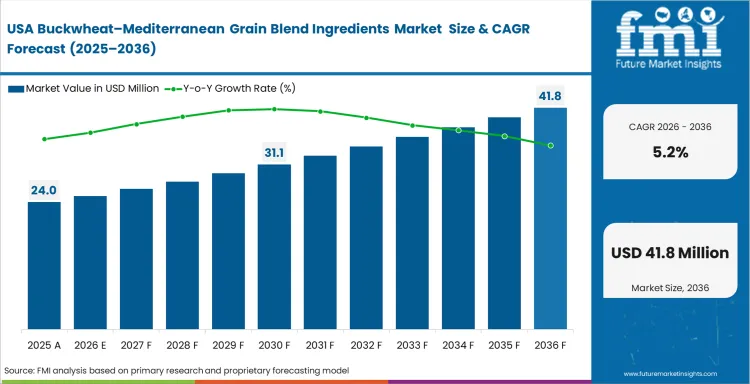
Large consolidation within the commercial baking sector determines ingredient sourcing strategies across North America. Tier-1 food conglomerates operate mega-facilities that simply cannot accommodate the operational friction of blending specialized ancient grains in-house. Plant managers demand drop-in, pre-formulated solutions that arrive perfectly calibrated for immediate hydration and mixing. Corporate purchasing desks issue large contracts requiring identical ingredient performance across bakeries. Suppliers must engineer resilient United States buckwheat combinations that tolerate varied ambient facility conditions. The logistical reality of moving materials across vast distances also favors stabilized, low-moisture blend formats that survive extended transit times without degrading. In North America, allergen-control expectations and internal risk management often make certified third-party millers more practical than handling complex gluten-free processing in-house. This concentrates market power into the hands of a few large, technically advanced ingredient suppliers who possess the dedicated infrastructure necessary to guarantee batch purity and rheological consistency on a continental scale.
- United States: Corporate sourcing groups lock in multi-year agreements to supply identical blend profiles to plants located across different climate zones. Processors must engineer functional matrices that perform uniformly regardless of local humidity during proofing or baking. The market for buckwheat–Mediterranean grain blend ingredients in the United States is expected to grow at a rate of 5.2% during the study period, due to increasing consumer interest in gluten-free foods and rising demand for diverse, healthy grain options. Delivering this level of continental standardization unlocks large commercial opportunities for milling partners capable of supporting national brand rollouts.
Competitive Aligners for Market Players
Formulation teams do not choose suppliers based only on bulk agricultural pricing. They qualify suppliers based on rheological consistency, which drives consolidation among top-tier millers. The structural reason for this concentration lies in the capital requirements of modern food safety and allergen segregation. Facility managers cannot risk purchasing Mediterranean grain blend ingredients from generalist mills that run wheat on the same equipment. Competition hinges on infrastructure. Buyers actually choose partners who possess dedicated processing lines, advanced optical sorting technologies, and in-house laboratory testing capabilities. If a supplier cannot provide a certificate of analysis covering particle-size control and trace-allergen compliance, its chances of progressing through the RFP process usually weaken. This makes the competitive landscape unusual. Technical milling capability and strict quality assurance often matter more here than traditional commodity-trading advantages.
Once a supplier achieves Tier-1 vendor status with a major food conglomerate, its position can become difficult to displace, especially where reformulation risk and qualification costs are high. Incumbents possess deep integration into their clients' enterprise resource planning systems and hold proprietary formulation data that is costly for buyers to transition. Challengers usually need a long audited track record before being considered for secondary-supplier status in stricter industrial programs. The barrier to entry is not simply buying grain; it is proving to a multinational bakery that a new functional food ingredients system may not jam their automated dough extruders. Challengers often attempt to compete by offering novel pairings, but frequently fail the stringent, multi-stage qualification protocols required for industrial scale-up. The cost and duration of plant trials often favor established processors with stronger balance sheets and proven logistical reliability.
When processing capabilities finally standardize across the mid-tier, value inevitably migrates away from basic milling and toward highly specialized, application-specific engineering. Looking toward 2036, competitive differentiation is likely to shift from supplying a clean blend alone to supplying systems that can support better line efficiency, more stable proofing behavior, or lower processing variability. Buyers could wield increasing power as alternative grain networks mature, demanding more sophisticated performance guarantees from their suppliers. Structural changes in climate-resilient agriculture could also force processors to dynamically recalibrate their nutritional grain blend ingredients to mask variations in crop quality. Suppliers that remain competitive are likely to be those that pair milling scale with stronger formulation support, tighter process control, and more application-specific technical service.
Key Players in Buckwheat–Mediterranean Grain Blend Ingredients Market
- ADM
- Trouw
- Bay State Milling
- Healthy Food Ingredients
- Ziegler Organic
- Incola
- Limagrain Ingredients
Scope of the Report
| Metric | Value |
|---|---|
| Quantitative Units | USD 52.8 million to USD 92.8 million, at a CAGR of 5.8% |
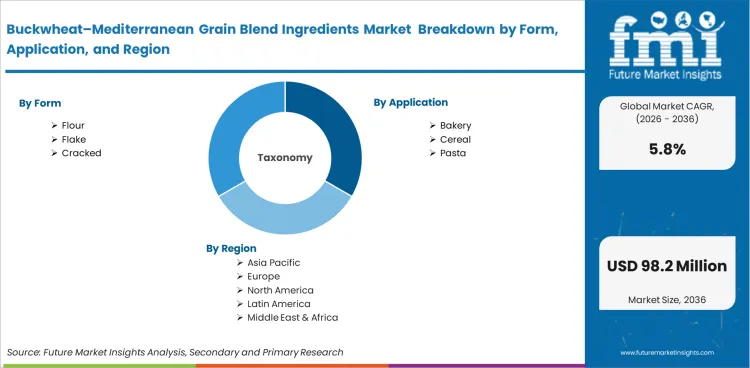
| Market Definition | This market encompasses standardized B2B ingredient systems blending buckwheat with Mediterranean-associated grains for industrial food formulation. It excludes single-origin raw commodities and finished retail products, focusing on pre-milled, application-ready composite flours, flakes, and bases that provide specific hydration and structural properties for secondary manufacturing. |
| Form Segmentation | Flour blends, Flake blends, Cracked blends, Semolina blends |
| Application Segmentation | Bakery mixes, Cereal mixes, Pasta bases, Snack bases |
| Grain Pairing Segmentation | Barley, Spelt, Oats, Millet, Farro |
| Nature Segmentation | Conventional, Organic |
| Channel Segmentation | Industrial B2B, Foodservice, Retail packs |
| Regions Covered | North America, Latin America, Europe, Asia Pacific, Middle East and Africa |
| Countries Covered | United States, Canada, Brazil, Mexico, Germany, United Kingdom, France, Italy, Spain, Russia, Poland, Turkey, China, Japan, South Korea, India, Australia, ASEAN Countries, South Africa, GCC Countries, and 40 plus countries |
| Key Companies Profiled | ADM, Trouw, Bay State Milling, Healthy Food Ingredients, Ziegler Organic, Incola, Limagrain Ingredients |
| Forecast Period | 2026 to 2036 |
| Approach | Bottom-up volume modeling anchored to global buckwheat production, overlaid with conversion shares for standardized industrial blend utilization and cross-referenced with mill-capacity disclosures. |
Buckwheat–Mediterranean Grain Blend Ingredients Market Analysis by Segments
Form:
- Flour blends
- Flake blends
- Cracked blends
- Semolina blends
Application:
- Bakery mixes
- Cereal mixes
- Pasta bases
- Snack bases
Grain Pairing:
- Barley
- Spelt
- Oats
- Millet
- Farro
Nature:
- Conventional
- Organic
Channel:
- Industrial B2B
- Foodservice
- Retail packs
Region:
- North America:
- United States
- Canada
- Latin America:
- Brazil
- Mexico
- Argentina
- Rest of Latin America
- Europe:
- Germany
- United Kingdom
- France
- Italy
- Spain
- BENELUX
- Russia
- Poland
- Turkey
- Rest of Europe
- East Asia:
- China
- Japan
- South Korea
- South Asia and Pacific:
- India
- Australia
- ASEAN Countries
- New Zealand
- Rest of South Asia and Pacific
- Middle East and Africa:
- GCC Countries
- Northern Africa
- South Africa
- Rest of Middle East and Africa
Bibliography
- Food and Agriculture Organization of the United Nations. (2026). FAO Cereal Supply and Demand Brief. FAO.
- Peiman Milani, Lawrence Haddad, Roy Steiner, Penjani Mkambula, Mehrdad Ehsani, David Kamau, Daniel Ndung'u, Saskia de Pee (2024). Fortified whole grains and whole blends: A timely food systems shift.
- Nigel Poole, Jason Donovan, Sarah Kariuki, Pieter Rutsaert, Maria Itria Ibba, Alison Bentley. (2024). Flour blending can mitigate food insecurity and economic stress.
- Alexandra Andreea Lițoiu, Adriana Păucean, Claudiu Lung, Alexandru Zmuncilă, and Maria Simona Chiș (2025). An Overview of Buckwheat—A Superfood with Applicability in Human Health and Food Packaging.
- Lingtao Kang, Jiaqian Luo, Zhipeng Su, Liling Zhou, Qiutao Xie, and Gaoyang Li. (2024). Effect of Sprouted Buckwheat on Glycemic Index and Quality Characteristics of Reconstituted Rice.
The Report Addresses
- Market intelligence to support formulation strategy and ingredient qualification protocols across industrial bakery and snack operations.
- Market size estimation and 10-year forecasts utilizing bottom-up milling capacity analysis and raw material conversion rates.
- Growth opportunity mapping focusing on specific rheological challenges and clean-label substitution mandates within high-volume production lines.
- Segment and regional forecasts detailing structural processing disparities and domestic agricultural integration across major European and North American manufacturing hubs.
- Competition strategy assessment analyzing facility-level allergen segregation capabilities and dedicated technical milling infrastructure.
- Technology development tracking regarding advanced optical sorting, precision moisture calibration, and specialized extrusion compatibility for multi-grain systems.
- Market access analysis identifying stringent third-party certification requirements and vendor approval pathways for multinational food conglomerates.
- Report delivery formats structured to optimize sourcing planning and facility upgrading decisions for specialized milling operators.
Frequently Asked Questions
What is the baseline valuation for these specialty ingredient systems?
Revenue for these standardized industrial blends reached USD 49.9 million in 2025. This measurement specifically captures the B2B wholesale value of precision-milled multi-grain composites, actively excluding the large volume of raw agricultural buckwheat traded globally.
How rapidly is the sector expanding commercially?
Formulation demand drives a projected 5.8% CAGR through 2036. This steady trajectory reflects the complex, multi-year qualification processes required by industrial bakeries, preventing the erratic spike-and-crash cycles often seen in consumer-facing fad ingredient categories.
What is the projected value of this specialized milling segment?
Industrial processors are forecast to generate USD 92.8 million by 2036. This value expansion relies heavily on suppliers maintaining strict margin discipline and optimizing their high-throughput conventional milling lines to offset rising agricultural input costs.
Why do flour blends lead the format requirements?
Facility managers require immediate, uniform hydration during continuous mixing operations, making flour the essential format. Attempting to run uncalibrated coarse materials through automated dough-handling equipment causes mechanical fouling, batch rejection, and unacceptable line downtime.
What makes bakery applications the primary commercial driver?
Technical departments struggle to maintain loaf volume and crumb structure when removing traditional wheat gluten. Pre-formulated ancient grain mixes provide the exact rheological support necessary to achieve acceptable oven-spring in high-throughput commercial bread facilities.
How does barley maintain its lead in grain pairings?
Companies need large, stable agricultural networks to prevent supply chain interruptions. Barley offers global availability, strict cost controls, and excellent moisture retention properties, making it the ideal functional carrier for more volatile specialty crops.
Why do conventional blends outpace organic options?
Plant managers running high-volume snack and cereal lines cannot absorb organic price premiums or the operational friction of segregated processing. Conventional sourcing ensures the large, uninterrupted tonnage required to maintain baseline factory profitability.
What limits the foodservice channel's adoption of these systems?
Restaurant operators require foolproof, tolerant ingredients that perform consistently despite varied kitchen skill levels. Developing bespoke packaging and distribution networks for independent venues remains less efficient than securing large, multi-ton B2B industrial contracts.
How does allergen segregation restrict supplier participation?
Operating a facility that handles gluten-free buckwheat alongside wheat or barley requires large capital expenditure in separate air-handling and dust-collection systems. A trace-gluten failure can materially weaken a supplier’s standing in stricter Tier-1 programs, which makes participation harder for generalist mills.
What determines the rapid expansion in the Italian market?
Pasta formulators face intense pressure to develop sound alternative-grain products that survive high-pressure extrusion. Securing tightly calibrated semolina-style blends eliminates the texture failures common in early-generation gluten-free pasta, unlocking premium retail positioning.
How do North America supply chains influence ingredient design?
Corporate spend management issues large contracts requiring identical performance across bakeries located in completely different climate zones. Processors must engineer highly stable, low-moisture blends that tolerate extreme ambient variance during long-haul transit and facility storage.
Why do technical specifications override raw material pricing?
Generalist buyers focus on agricultural commodity costs, but production departments calculate the large expense of line downtime caused by erratic dough hydration. Guaranteeing batch consistency ultimately saves food manufacturers far more money than sourcing cheaper, unstandardized inputs.
What leads processors toward dedicated single-purpose mills?
Attempting to clean down large industrial equipment between conventional and certified organic runs can materially reduce baseline line efficiency. Committing entire facilities to specific certifications eliminates cross-contamination risks and optimizes overall production throughput.
How does extraction control influence competitive positioning?
Advanced optical sorting and precision dehulling determine the final flavor profile of the blend. Suppliers who master these mechanical separation techniques eliminate the bitter, earthy notes associated with poor-processed raw materials, securing lucrative contracts in delicate bakery applications.
Why do retail brands monitor dough hydration kinetics?
Erratic water absorption during continuous mixing causes equipment fouling and produces dense, unsliceable loaves. Retail rejection risk makes hydration control a serious concern, which is why formulators usually require tighter performance parameters from ingredient suppliers.
What prevents rapid market share shifts among incumbents?
Challengers must build flawless, audited track records over multiple years to secure even secondary-supplier status. The huge financial cost of undergoing year-long plant trials favors established processors with deep balance sheets and proven logistical reliability.
Preview the report firsthand - request a free sample
Get SampleGet the brochure for pricing and purchase details.
Get PDFTable of Content
- Executive Summary
- Global Market Outlook
- Demand-side Trends
- Supply-side Trends
- Technology Roadmap Analysis
- Analysis and Recommendations
- Market Overview
- Market Coverage / Taxonomy
- Market Definition / Scope / Limitations
- Research Methodology
- Chapter Orientation
- Analytical Lens and Working Hypotheses
- Market Structure, Signals, and Trend Drivers
- Benchmarking and Cross-market Comparability
- Market Sizing, Forecasting, and Opportunity Mapping
- Research Design and Evidence Framework
- Desk Research Programme (Secondary Evidence)
- Company Annual and Sustainability Reports
- Peer-reviewed Journals and Academic Literature
- Corporate Websites, Product Literature, and Technical Notes
- Earnings Decks and Investor Briefings
- Statutory Filings and Regulatory Disclosures
- Technical White Papers and Standards Notes
- Trade Journals, Industry Magazines, and Analyst Briefs
- Conference Proceedings, Webinars, and Seminar Materials
- Government Statistics Portals and Public Data Releases
- Press Releases and Reputable Media Coverage
- Specialist Newsletters and Curated Briefings
- Sector Databases and Reference Repositories
- FMI Internal Proprietary Databases and Historical Market Datasets
- Subscription Datasets and Paid Sources
- Social Channels, Communities, and Digital Listening Inputs
- Additional Desk Sources
- Expert Input and Fieldwork (Primary Evidence)
- Primary Modes
- Qualitative Interviews and Expert Elicitation
- Quantitative Surveys and Structured Data Capture
- Blended Approach
- Why Primary Evidence is Used
- Field Techniques
- Interviews
- Surveys
- Focus Groups
- Observational and In-context Research
- Social and Community Interactions
- Stakeholder Universe Engaged
- C-suite Leaders
- Board Members
- Presidents and Vice Presidents
- R&D and Innovation Heads
- Technical Specialists
- Domain Subject-matter Experts
- Scientists
- Physicians and Other Healthcare Professionals
- Governance, Ethics, and Data Stewardship
- Research Ethics
- Data Integrity and Handling
- Primary Modes
- Tooling, Models, and Reference Databases
- Desk Research Programme (Secondary Evidence)
- Data Engineering and Model Build
- Data Acquisition and Ingestion
- Cleaning, Normalisation, and Verification
- Synthesis, Triangulation, and Analysis
- Quality Assurance and Audit Trail
- Market Background
- Market Dynamics
- Drivers
- Restraints
- Opportunity
- Trends
- Scenario Forecast
- Demand in Optimistic Scenario
- Global Market Analysis 2021 to 2025 and Forecast, 2026 to 2036
- Historical Market Size Value (USD Million) Analysis, 2021 to 2025
- Current and Future Market Size Value (USD Million) Projections, 2026 to 2036
- Y-o-Y Growth Trend Analysis
- Absolute $ Opportunity Analysis
- Global Market Pricing Analysis 2021 to 2025 and Forecast 2026 to 2036
- Global Market Analysis 2021 to 2025 and Forecast 2026 to 2036, By Form
- Introduction / Key Findings
- Historical Market Size Value (USD Million) Analysis By Form , 2021 to 2025
- Current and Future Market Size Value (USD Million) Analysis and Forecast By Form , 2026 to 2036
- Flour
- Flake
- Cracked
- Flour
- Y-o-Y Growth Trend Analysis By Form , 2021 to 2025
- Absolute $ Opportunity Analysis By Form , 2026 to 2036
- Global Market Analysis 2021 to 2025 and Forecast 2026 to 2036, By Application
- Introduction / Key Findings
- Historical Market Size Value (USD Million) Analysis By Application, 2021 to 2025
- Current and Future Market Size Value (USD Million) Analysis and Forecast By Application, 2026 to 2036
- Bakery
- Cereal
- Pasta
- Bakery
- Y-o-Y Growth Trend Analysis By Application, 2021 to 2025
- Absolute $ Opportunity Analysis By Application, 2026 to 2036
- Global Market Analysis 2021 to 2025 and Forecast 2026 to 2036, By Grain Pairing
- Introduction / Key Findings
- Historical Market Size Value (USD Million) Analysis By Grain Pairing, 2021 to 2025
- Current and Future Market Size Value (USD Million) Analysis and Forecast By Grain Pairing, 2026 to 2036
- Barley
- Spelt
- Oats
- Barley
- Y-o-Y Growth Trend Analysis By Grain Pairing, 2021 to 2025
- Absolute $ Opportunity Analysis By Grain Pairing, 2026 to 2036
- Global Market Analysis 2021 to 2025 and Forecast 2026 to 2036, By Nature
- Introduction / Key Findings
- Historical Market Size Value (USD Million) Analysis By Nature, 2021 to 2025
- Current and Future Market Size Value (USD Million) Analysis and Forecast By Nature, 2026 to 2036
- Conventional
- Organic
- Conventional
- Y-o-Y Growth Trend Analysis By Nature, 2021 to 2025
- Absolute $ Opportunity Analysis By Nature, 2026 to 2036
- Global Market Analysis 2021 to 2025 and Forecast 2026 to 2036, By Channel
- Introduction / Key Findings
- Historical Market Size Value (USD Million) Analysis By Channel, 2021 to 2025
- Current and Future Market Size Value (USD Million) Analysis and Forecast By Channel, 2026 to 2036
- Industrial B2B
- Foodservice
- Retail Packs
- Y-o-Y Growth Trend Analysis By Channel, 2021 to 2025
- Absolute $ Opportunity Analysis By Channel, 2026 to 2036
- Industrial B2B
- Global Market Analysis 2021 to 2025 and Forecast 2026 to 2036, By Region
- Introduction
- Historical Market Size Value (USD Million) Analysis By Region, 2021 to 2025
- Current Market Size Value (USD Million) Analysis and Forecast By Region, 2026 to 2036
- North America
- Latin America
- Western Europe
- Eastern Europe
- East Asia
- South Asia and Pacific
- Middle East & Africa
- Market Attractiveness Analysis By Region
- North America Market Analysis 2021 to 2025 and Forecast 2026 to 2036, By Country
- Historical Market Size Value (USD Million) Trend Analysis By Market Taxonomy, 2021 to 2025
- Market Size Value (USD Million) Forecast By Market Taxonomy, 2026 to 2036
- By Country
- USA
- Canada
- Mexico
- By Form
- By Application
- By Grain Pairing
- By Nature
- By Channel
- By Country
- Market Attractiveness Analysis
- By Country
- By Form
- By Application
- By Grain Pairing
- By Nature
- By Channel
- Key Takeaways
- Latin America Market Analysis 2021 to 2025 and Forecast 2026 to 2036, By Country
- Historical Market Size Value (USD Million) Trend Analysis By Market Taxonomy, 2021 to 2025
- Market Size Value (USD Million) Forecast By Market Taxonomy, 2026 to 2036
- By Country
- Brazil
- Chile
- Rest of Latin America
- By Form
- By Application
- By Grain Pairing
- By Nature
- By Channel
- By Country
- Market Attractiveness Analysis
- By Country
- By Form
- By Application
- By Grain Pairing
- By Nature
- By Channel
- Key Takeaways
- Western Europe Market Analysis 2021 to 2025 and Forecast 2026 to 2036, By Country
- Historical Market Size Value (USD Million) Trend Analysis By Market Taxonomy, 2021 to 2025
- Market Size Value (USD Million) Forecast By Market Taxonomy, 2026 to 2036
- By Country
- Germany
- UK
- Italy
- Spain
- France
- Nordic
- BENELUX
- Rest of Western Europe
- By Form
- By Application
- By Grain Pairing
- By Nature
- By Channel
- By Country
- Market Attractiveness Analysis
- By Country
- By Form
- By Application
- By Grain Pairing
- By Nature
- By Channel
- Key Takeaways
- Eastern Europe Market Analysis 2021 to 2025 and Forecast 2026 to 2036, By Country
- Historical Market Size Value (USD Million) Trend Analysis By Market Taxonomy, 2021 to 2025
- Market Size Value (USD Million) Forecast By Market Taxonomy, 2026 to 2036
- By Country
- Russia
- Poland
- Hungary
- Balkan & Baltic
- Rest of Eastern Europe
- By Form
- By Application
- By Grain Pairing
- By Nature
- By Channel
- By Country
- Market Attractiveness Analysis
- By Country
- By Form
- By Application
- By Grain Pairing
- By Nature
- By Channel
- Key Takeaways
- East Asia Market Analysis 2021 to 2025 and Forecast 2026 to 2036, By Country
- Historical Market Size Value (USD Million) Trend Analysis By Market Taxonomy, 2021 to 2025
- Market Size Value (USD Million) Forecast By Market Taxonomy, 2026 to 2036
- By Country
- China
- Japan
- South Korea
- By Form
- By Application
- By Grain Pairing
- By Nature
- By Channel
- By Country
- Market Attractiveness Analysis
- By Country
- By Form
- By Application
- By Grain Pairing
- By Nature
- By Channel
- Key Takeaways
- South Asia and Pacific Market Analysis 2021 to 2025 and Forecast 2026 to 2036, By Country
- Historical Market Size Value (USD Million) Trend Analysis By Market Taxonomy, 2021 to 2025
- Market Size Value (USD Million) Forecast By Market Taxonomy, 2026 to 2036
- By Country
- India
- ASEAN
- Australia & New Zealand
- Rest of South Asia and Pacific
- By Form
- By Application
- By Grain Pairing
- By Nature
- By Channel
- By Country
- Market Attractiveness Analysis
- By Country
- By Form
- By Application
- By Grain Pairing
- By Nature
- By Channel
- Key Takeaways
- Middle East & Africa Market Analysis 2021 to 2025 and Forecast 2026 to 2036, By Country
- Historical Market Size Value (USD Million) Trend Analysis By Market Taxonomy, 2021 to 2025
- Market Size Value (USD Million) Forecast By Market Taxonomy, 2026 to 2036
- By Country
- Kingdom of Saudi Arabia
- Other GCC Countries
- Turkiye
- South Africa
- Other African Union
- Rest of Middle East & Africa
- By Form
- By Application
- By Grain Pairing
- By Nature
- By Channel
- By Country
- Market Attractiveness Analysis
- By Country
- By Form
- By Application
- By Grain Pairing
- By Nature
- By Channel
- Key Takeaways
- Key Countries Market Analysis
- USA
- Pricing Analysis
- Market Share Analysis, 2025
- By Form
- By Application
- By Grain Pairing
- By Nature
- By Channel
- Canada
- Pricing Analysis
- Market Share Analysis, 2025
- By Form
- By Application
- By Grain Pairing
- By Nature
- By Channel
- Mexico
- Pricing Analysis
- Market Share Analysis, 2025
- By Form
- By Application
- By Grain Pairing
- By Nature
- By Channel
- Brazil
- Pricing Analysis
- Market Share Analysis, 2025
- By Form
- By Application
- By Grain Pairing
- By Nature
- By Channel
- Chile
- Pricing Analysis
- Market Share Analysis, 2025
- By Form
- By Application
- By Grain Pairing
- By Nature
- By Channel
- Germany
- Pricing Analysis
- Market Share Analysis, 2025
- By Form
- By Application
- By Grain Pairing
- By Nature
- By Channel
- UK
- Pricing Analysis
- Market Share Analysis, 2025
- By Form
- By Application
- By Grain Pairing
- By Nature
- By Channel
- Italy
- Pricing Analysis
- Market Share Analysis, 2025
- By Form
- By Application
- By Grain Pairing
- By Nature
- By Channel
- Spain
- Pricing Analysis
- Market Share Analysis, 2025
- By Form
- By Application
- By Grain Pairing
- By Nature
- By Channel
- France
- Pricing Analysis
- Market Share Analysis, 2025
- By Form
- By Application
- By Grain Pairing
- By Nature
- By Channel
- India
- Pricing Analysis
- Market Share Analysis, 2025
- By Form
- By Application
- By Grain Pairing
- By Nature
- By Channel
- ASEAN
- Pricing Analysis
- Market Share Analysis, 2025
- By Form
- By Application
- By Grain Pairing
- By Nature
- By Channel
- Australia & New Zealand
- Pricing Analysis
- Market Share Analysis, 2025
- By Form
- By Application
- By Grain Pairing
- By Nature
- By Channel
- China
- Pricing Analysis
- Market Share Analysis, 2025
- By Form
- By Application
- By Grain Pairing
- By Nature
- By Channel
- Japan
- Pricing Analysis
- Market Share Analysis, 2025
- By Form
- By Application
- By Grain Pairing
- By Nature
- By Channel
- South Korea
- Pricing Analysis
- Market Share Analysis, 2025
- By Form
- By Application
- By Grain Pairing
- By Nature
- By Channel
- Russia
- Pricing Analysis
- Market Share Analysis, 2025
- By Form
- By Application
- By Grain Pairing
- By Nature
- By Channel
- Poland
- Pricing Analysis
- Market Share Analysis, 2025
- By Form
- By Application
- By Grain Pairing
- By Nature
- By Channel
- Hungary
- Pricing Analysis
- Market Share Analysis, 2025
- By Form
- By Application
- By Grain Pairing
- By Nature
- By Channel
- Kingdom of Saudi Arabia
- Pricing Analysis
- Market Share Analysis, 2025
- By Form
- By Application
- By Grain Pairing
- By Nature
- By Channel
- Turkiye
- Pricing Analysis
- Market Share Analysis, 2025
- By Form
- By Application
- By Grain Pairing
- By Nature
- By Channel
- South Africa
- Pricing Analysis
- Market Share Analysis, 2025
- By Form
- By Application
- By Grain Pairing
- By Nature
- By Channel
- USA
- Market Structure Analysis
- Competition Dashboard
- Competition Benchmarking
- Market Share Analysis of Top Players
- By Regional
- By Form
- By Application
- By Grain Pairing
- By Nature
- By Channel
- Competition Analysis
- Competition Deep Dive
- Competition Deep Dive
- Assumptions & Acronyms Used
- Market Dynamics


