

- Industry Size (2026)
- USD 30 Mn
- Forecast (2036)
- USD 285 Mn
- CAGR (2026 to 2036)
- 25.2%
Grain-Based Mycelium Meat Alternatives Market Size, Market Forecast and Outlook By FMI
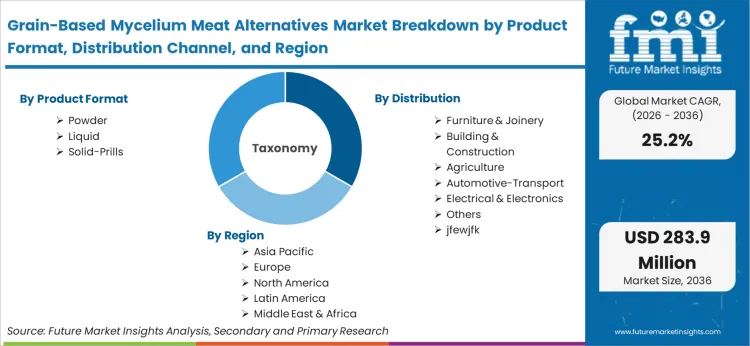
In 2025, the grain-based mycelium meat alternatives market was valued at USD 18 million. It is expected to reach USD 30 million in 2026 and USD 285 million by 2036, implying a CAGR of 25.2%. This explosive growth reflects a structural pivot in the alternative protein sector, where manufacturers are moving beyond energy-intensive isolates toward biomass fermentation that utilizes global grain surpluses as high-efficiency substrates.
As per FMI's projection, procurement strategies are evolving as food systems seek to decouple protein production from livestock volatility. With global cereal utilization forecast at 2,938 million tonnes for 2025/26, the abundance of substrate allows mycelium producers to position themselves as value-added grain processors rather than just niche food manufacturers [12]. This integration into the broader carbohydrate economy provides a hedge against feedstock inflation, enabling the sector to target mass-market price points previously unattainable for fermented protein.
Summary of Grain-Based Mycelium Meat Alternatives Market
- Grain-Based Mycelium Meat Alternatives Market Definition
- Biomass fermentation products using grain substrates to create meat-like textures.
- Demand Drivers in the Market
- Need for sustainable proteins with lower carbon footprints than livestock.
- Consumer demand for cleaner labels and less processed textures.
- Scalability of grain-based feedstocks compared to specialized media.
- Key Segments Analyzed in the FMI Report
- Bites and Chunks format leading early adoption.
- Foodservice dominance due to culinary versatility.
- High-growth markets in grain-rich economies like India and China.
- Analyst Opinion at FMI
- Nandini Roy Choudhury, Principal Consultant for Food & Beverage, opines, "The 'hybridization' of mycelium with traditional grains offers a pragmatic path to scale. By leveraging existing agricultural supply chains, manufacturers can reduce capex intensity and deliver a product that bridges the gap between plant-based ethics and meat-eater expectations."
- Strategic Implications/Executive Takeaways
- Prioritize partnerships with grain majors to secure consistent substrate supply.
- Invest in solid-state fermentation efficiency to lower unit costs.
- Focus on 'bites' formats for easy integration into existing foodservice menus.
- Methodology
- Validated through first-hand corporate production and capacity data.
- Zero reliance on speculative third-party market research reports.
- Based on verifiable industrial benchmarks and verified sources.
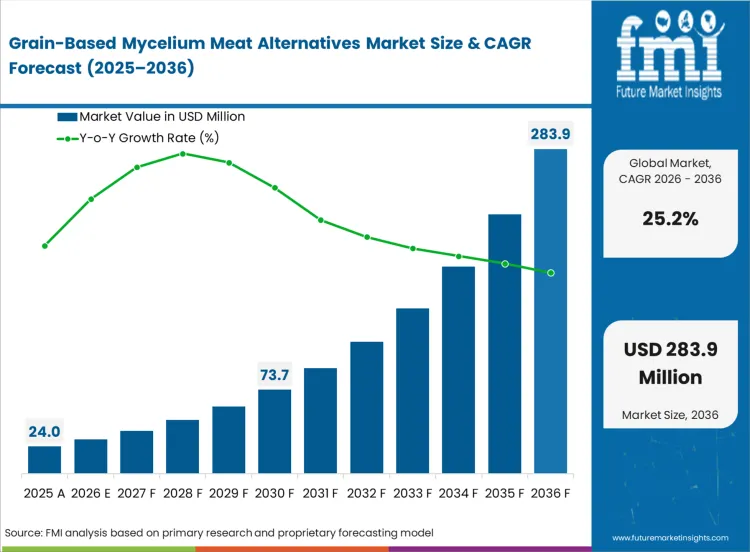
Eben Bayer, Co-founder of MyForest Foods, noted regarding the sector's commercial traction, "We are seeing strong repeat purchase and accelerating velocity." [20] This stickiness suggests that once consumers overcome the initial trial barrier, the superior texture and nutritional profile of mycelium, compared to highly processed plant-based meat, drive consistent basket inclusion, securing long-term shelf space in competitive retail environments.
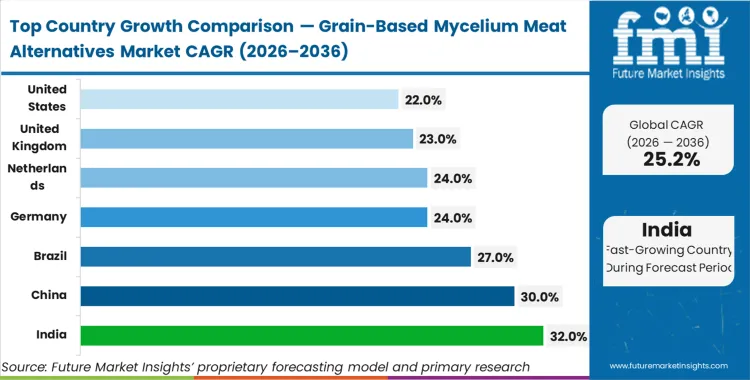
Growth is widely dispersed but led by regions with strong agrarian bases or advanced biotech infrastructure. India (32.0%), China (30.0%), and Brazil (27.0%) are leveraging domestic grain outputs to drive cost-effective production, while Western markets like the United States (22.0%), Germany (24.0%), and the Netherlands (24.0%) focus on premiumization and technology exports.
Grain-Based Mycelium Meat Alternatives Market Definition
The grain-based mycelium meat alternatives market comprises the production and trade of high-protein food products derived from fungi grown directly on grain substrates (such as wheat, rice, oats, or corn) through solid-state or submerged biomass fermentation. In this process, the mycelium hyphae consume the grain scaffolding or hydrolysates, creating a fibrous, muscle-like texture that mimics whole-cut meats without the need for extensive downstream extrusion.
Grain-Based Mycelium Meat Alternatives Market Inclusions
The report includes whole-muscle analogs (steaks, filets), unstructured products (chunks, bites, shreds), and hybrid blends where mycelium is mixed with meat substitutes to improve texture and cost profiles. It covers products sold through foodservice channels, retail groceries, and direct-to-consumer platforms, as well as the B2B trade of fermented fungal protein ingredients for use in processed foods.
Grain-Based Mycelium Meat Alternatives Market Exclusions
The market excludes precision fermentation products where genetically modified fungi produce specific molecules (like heme or casein) rather than whole biomass. It also omits purely plant-based protein isolates derived from soy, pea, or wheat gluten that do not involve a fungal fermentation step. Mushroom cultivation for fresh produce sales (button, shiitake, oyster mushrooms) is strictly excluded.
Grain-Based Mycelium Meat Alternatives Market Research Methodology
- Primary Research: Interviews with fermentation startups, grain processors, regulatory consultants, and foodservice buyers.
- Desk Research: Analysis of global grain trade data, fermentation capacity reports, patent filings, and retail scanner data.
- Market-Sizing and Forecasting: A bottom-up approach aggregating production capacities of key players, adjusted for utilization rates and regional demand adoption curves.
- Data Validation and Update Cycle: Verification of funding rounds, facility groundbreakings, and partnership announcements against public disclosures.
Segmental Analysis
Grain-Based Mycelium Meat Alternatives Market Analysis by Product Format
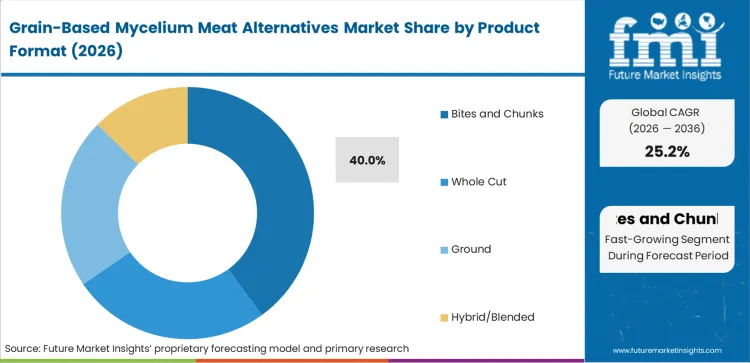
Bites and Chunks are estimated to hold a 40% share in 2026. This dominance is driven by the technical readiness of current solid-state fermentation processes, which naturally produce fibrous mats that are easily diced into nuggets, strips, or cubes suitable for stir-fries, curries, and wraps.
- Culinary utility: Foodservice operators prefer bites and chunks because they withstand high-heat cooking methods like frying and simmering better than ground meat alternatives, maintaining texture in sauces. This versatility allows chains to swap chicken or pork chunks with mycelium alternatives without altering core menu recipes, a key factor in the rapid distribution expansion of brands like Meati into major retailers [4].
- Processing efficiency: Producing unstructured bites requires less downstream processing than forming perfect whole-cut steaks, allowing startups to scale volume faster while refining texturization technologies. Quorn's move to launch blended meat-mycoprotein products for foodservice highlights how chunks and bites serve as the primary vehicle for entering volume-driven catering markets [9].
- Consumer familiarity: Nuggets and tenders are familiar entry points for consumers skeptical of novel proteins. By replicating the "bite" of muscle meat, these formats bridge the sensory gap, supported by innovations like Nature's Fynd utilizing fungal biomass for diverse applications including yogurt, proving the adaptability of the substrate [8].
Grain-Based Mycelium Meat Alternatives Market Analysis by Route-to-Market
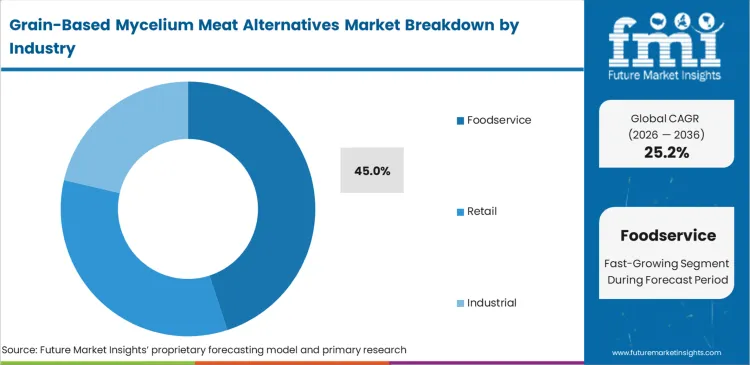
Foodservice is projected to capture 45% of the market share in 2026. The complexity of cooking novel proteins often requires chef-led education to ensure optimal eating experiences, making restaurants the ideal initial touchpoint for consumer trial.
- Adoption catalyst: Institutional catering and QSR chains are actively seeking plant-based beef and chicken alternatives to meet Scope 3 emissions targets. FMI analysts opine that the foodservice channel allows brands to bypass the "sticker shock" of retail pricing by integrating mycelium into value-added meals where the ingredient cost is obscured by the total dish price.
- Supply chain integration: Industrial catering demands consistent, high-volume protein sources that are safe and traceable. The acquisition of Mycorena by Naplasol signals a shift toward industrial-scale production capable of meeting the rigorous volume and reliability standards of large foodservice contracts [11].
- Menu innovation: Chefs use grain-based mycelium to create signature dishes that highlight the ingredient's umami profile. Collaborative launches, such as blended meat-mycoprotein offerings, allow foodservice operators to offer "flexitarian" options that reduce meat consumption without eliminating it entirely, expanding the addressable market beyond strict vegans [10].
Grain-Based Mycelium Meat Alternatives Market Analysis by Source
Grain substrates such as wheat, rice, and oats serve as the economic backbone of the sector. The alignment with global agricultural outputs allows manufacturers to tap into established supply chains rather than building new feedstock ecosystems from scratch.
- Substrate abundance: With global rice stocks forecast to reach record highs and wheat inventories rising, the availability of low-cost carbohydrate inputs is secure [13, 14]. This abundance minimizes raw material volatility, a crucial advantage over precision fermentation ingredients that often compete for limited dextrose or sugar processing capacity.
- Local sourcing: Manufacturers are increasingly utilizing regional grains to reduce carbon footprints and appeal to local consumer preferences. Millow’s strategy of using Nordic oats and mycelium demonstrates how local grain integration can create a "terroir" narrative that resonates with sustainability-conscious buyers in specific geographies [15].
- Cost structure: Using whole grains in solid-state fermentation is often more energy-efficient than liquid fermentation requiring purified sugars. This efficiency is critical for reaching price parity, as noted by the industry's push toward "asset-light" operations and strategic partnerships to manage capital intensity [3].
Grain-Based Mycelium Meat Alternatives Market Drivers, Restraints, and Opportunities
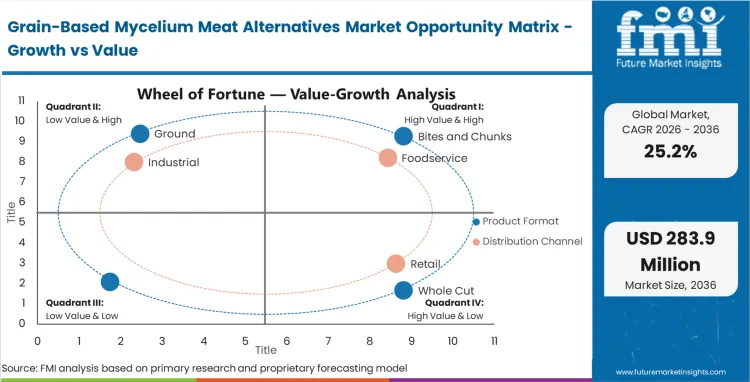
The primary demand driver is the urgent need to decarbonize agrifood systems, which generated 16.2 Gt CO₂e in 2022 [15]. Corporate net-zero commitments are forcing food companies to procure low-emission proteins. Grain-based mycelium offers a superior conversion efficiency compared to livestock, transforming carbohydrates into high-quality protein with a fraction of the land and water use. According to FMI's estimates, this environmental arbitrage is accelerating public investment, evidenced by the US government's $51 million grant to the iFAB Tech Hub to scale microbial fermentation technology infrastructure [10].
Capital intensity and manufacturing scalability remain significant restraints. Building fermentation capacity is expensive, and the recent pause of Mycorena's large-scale facility highlights the risks associated with high-capex projects in a high-interest-rate environment [12]. Startups often face the "valley of death" between pilot scale and industrial commercialization, limiting the volume available to meet potential demand. This bottleneck forces companies to rely on contract manufacturing or acquisition by larger entities to survive, potentially slowing the pace of independent innovation.
- Hybridization: Developing products that blend mycelium with animal meat or plant proteins offers a massive opportunity to penetrate the mass market. By acting as a high-quality extender, mycelium can improve the texture and nutritional profile of processed meats while reducing costs. Quorn’s strategic pivot to blended products for foodservice exemplifies this approach, targeting the vast majority of consumers who are meat-reducers rather than vegetarians [9].
- Waste Valorization: utilizing agricultural side-streams and food waste as fermentation substrates presents a circular economy opportunity. With over 1 billion meals wasted daily in households alone [20], technologies that can convert carbohydrate-rich waste into protein address both food security and waste reduction goals, aligning with UN SDG 12 targets [19].
- Functional Ingredients: Beyond whole cuts, there is growing demand for mycelium as a functional ingredient in animal feed alternative protein and processed foods. Its natural fibrous structure and water-binding capabilities make it a clean-label alternative to fermentation enhancers, opening B2B revenue streams in the broader food processing industry.
Regional Analysis
Based on the regional analysis, the Grain-Based Mycelium Meat Alternatives market is segmented into North America, Latin America, Europe, East Asia, South Asia, Oceania and Middle East & Africa across 40+ countries. The full report also offers market attractiveness analysis based on regional trends.
.webp "Top Country Growth Comparison Grain Based Mycelium Meat Alternatives Market Cagr (2026 2036)")
| Country | CAGR (2026 to 2036) |
|---|---|
| India | 32.0% |
| China | 30.0% |
| Brazil | 27.0% |
| Germany | 24.0% |
| Netherlands | 24.0% |
| United Kingdom | 23.0% |
| United States | 22.0% |
| Sweden | 18.0% |
Source: Future Market Insights (FMI) analysis, based on proprietary forecasting model and primary research
Asia Pacific Grain-Based Mycelium Meat Alternatives Market Analysis
Asia Pacific is positioned to become the volume engine of the global market, leveraging its immense agricultural base and rapidly modernizing food processing sector. The region's growth is driven by the need to feed massive urban populations with sustainable, protein-dense foods that fit within traditional culinary formats.
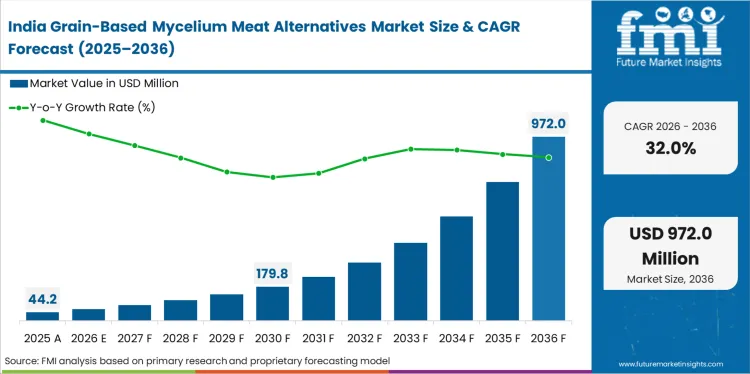
- India: Demand for grain-based mycelium in India is set to grow at 32.0% CAGR through 2036, supported by reliable grain supply chains and foodgrains production of 357.73 million tonnes before procurement and budgeting cycles translate into higher deployment volumes [6]. This trajectory is underpinned by the displacement opportunity in the meat sector, where production stands at 102.53 lakh tonnes, offering significant headroom for alternative proteins to capture market share [8].
- China: China’s market is poised to expand at 30.0% CAGR during 2026 to 2036 because domestic biomanufacturing capacity and cold-chain compatibility are improving, which lifts utilization rates and justifies technology refresh decisions. Growth is anchored in the government's push for food security and biomanufacturing, aligning with global trends where public investment in fermentation infrastructure is accelerating [11].
FMI’s report includes a detailed growth analysis for the Asia Pacific region. Beyond India and China, Singapore and Japan are critical markets. Singapore serves as a regulatory sandbox for novel foods, while Japan's high import reliance drives interest in domestically produced mycoprotein. Opportunities in these markets focus on high-value, functional food applications that cater to aging populations seeking digestible protein sources.
Europe Grain-Based Mycelium Meat Alternatives Market Analysis
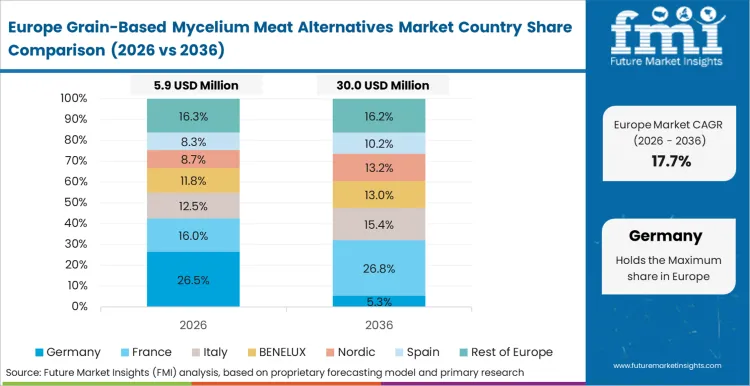
Europe acts as the global innovation hub for the sector, characterized by strong consumer demand for sustainability and rigorous novel food regulations. The region is witnessing significant investment in scaling technology and creating cross-border supply chains.
- Germany: The Germany grain-based mycelium sector is forecast to advance at 24.0% CAGR through 2036, with growth anchored in major funding events like Infinite Roots’ $58 million Series B that converts into measurable budget allocation for scaling asset-light operations [1, 3]. This investment signals strong investor confidence in the region's ability to lead in alternative protein technology.
- Netherlands: The Netherlands is likely to see revenue increase at 24.0% CAGR during 2026 to 2036, given its status as a fermentation center of excellence and the resulting push for capacity and workflow upgrades. The growth is supported by a rising ecosystem of contract manufacturers and shared infrastructure, similar to the iFAB model seen in the US, which facilitates scale-up for fungal protein market share analysis participants [10].
- United Kingdom: In the UK, the market is expected to expand at 23.0% CAGR from 2026 to 2036, supported by strategic moves like Quorn’s launch of blended meat-mycoprotein products that increase ROI visibility for buyers [9]. This hybrid approach addresses consumer hesitation and price sensitivity, smoothing the transition away from conventional meat.
- Sweden: Sweden is projected to post 18.0% CAGR between 2026 and 2036 as "clean label + local grains" positioning gains traction, improving the conversion rate from pilots to enterprise rollouts. Brands like Millow are pioneering the use of local oats in mycelium fermentation, creating a sustainable, locally sourced protein option [15].
FMI’s report includes a comprehensive assessment of the European market. Countries like France and Denmark are also emerging as key players, with France's strong gastronomic culture driving demand for high-quality whole cuts and Denmark's biotech heritage supporting bioprocess fermentation monitoring innovation.
North America Grain-Based Mycelium Meat Alternatives Market Analysis
North America is the commercialization leader, where retail velocity and foodservice partnerships are testing the mainstream viability of mycelium meats. The market is characterized by rapid retail expansion and significant capital deployment.
- United States: The United States market is projected to grow at 22.0% CAGR through 2036, reflecting distribution scale-up as Meati Foods expands into Super Target and Kroger stores, helping suppliers align positioning with local buying triggers [4, 5]. This retail push is complemented by robust public support, with over $150 million invested in the alt-protein ecosystem in 2024, signaling a favorable policy environment [11].
FMI’s report includes a detailed analysis of North American trends. Canada is also a significant market, leveraging its status as a major grain exporter to develop domestic fermentation capabilities. The integration of Canadian pulses and grains into mycelium substrates offers a strategic advantage for local producers.
Latin America Grain-Based Mycelium Meat Alternatives Market Analysis
Latin America is emerging as a powerhouse for "hybrid" applications, where cost is a primary decision factor.
- Brazil: Brazil is expected to record 27.0% CAGR in demand over 2026 to 2036 as price parity pathways emerge, tightening the link between operational constraints and adoption-led investment. The growth is driven by the need to address agrifood emissions, which account for a significant share of the region's carbon footprint, creating pressure for lower-emission protein blends [16].
Competitive Aligners for Market Players
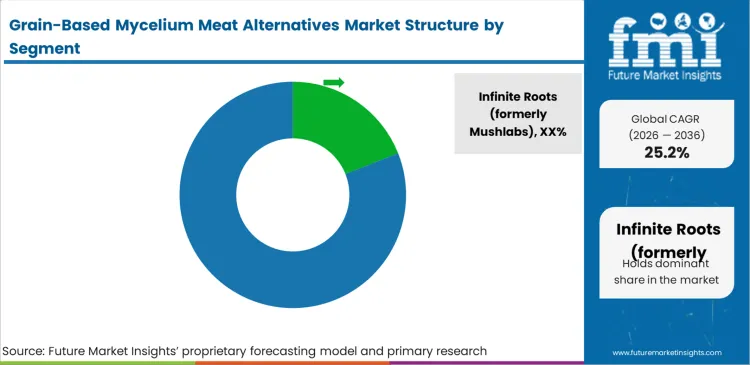
The competitive landscape is shifting from pure-play startups to industrial partnerships and acquisitions. Companies recognize that vertical integration is capital-intensive and risky. Consequently, strategic alliances, such as Naplasol’s acquisition of Mycorena, are becoming a preferred route to scale. This consolidation allows technology holders to access the industrial manufacturing capabilities of established plant-based ingredients players, solving the "steel in the ground" bottleneck [11].
Differentiation is increasingly based on "substrate-to-fork" efficiency. Players like MyForest Foods are scaling up localized production facilities to 180,000 sq ft, demonstrating a commitment to controlling the entire value chain to ensure quality and cost control [13]. This vertical approach contrasts with the B2B ingredient model, creating two distinct competitive archetypes: the branded consumer product company and the backend technology provider.
Regulatory navigation capabilities are a critical competitive asset. As the sector matures, the ability to secure novel food approvals in markets like the EU and Singapore determines speed to market. Companies that can leverage safety data and lobby for policy support, as seen with the growing public investment in the US fermentation sector, gain a significant early-mover advantage [10].
Recent Developments
The report includes full coverage of key trends from competitive benchmarking. Some of the recent developments covered in the reports:
- In August 2024, Naplasol acquired Mycorena to produce Promyc® at an industrial facility.[11]
- In November 2025, Meati Holdings acquired Meati Foods’ assets debt-free, invested $14.2 million to stabilize operations, resolved $14 million secured debt, relaunched expansion plans, and targets GLP-1 consumers for accelerated brand growth. [1]
Key Players in Grain-Based Mycelium Meat Alternatives
- Infinite Roots (formerly Mushlabs)
- Meati Foods
- MyForest Foods (Ecovative)
- Nature’s Fynd
- Quorn (Marlow Foods)
- Mycorena (acquired by Naplasol)
- Millow
- The Better Meat Co.
- Prime Roots
- Mush Foods
Scope of the Report
| Metric | Value |
| Quantitative Units | USD 30 Million (2026) to USD 285 Million (2036), at a CAGR of 25.2% |
| Market Definition | The grain-based mycelium meat alternatives market comprises the production and trade of high-protein food products derived from fungi grown directly on grain substrates through solid-state or submerged biomass fermentation. |
| Source Segmentation | Wheat, Rice, Oats, Barley, Sorghum, Corn, Others |
| Product Format Segmentation | Bites & Chunks, Whole Cut, Ground, Hybrid/Blended |
| Distribution Channel Segmentation | Foodservice (QSR, Fast Casual, Institutional), Retail (Supermarkets, Specialty Stores), Industrial (Ingredient B2B) |
| Regions Covered | North America, Latin America, Europe, East Asia, South Asia, Oceania, Middle East and Africa |
| Countries Covered | United States, Canada, Mexico, Brazil, Argentina, Germany, France, United Kingdom, Italy, Spain, Netherlands, Sweden, China, India, Japan, Singapore, Australia and 40 plus countries |
| Key Companies Profiled | Infinite Roots, Meati Foods, MyForest Foods, Nature’s Fynd, Quorn, Mycorena, Millow, The Better Meat Co., Prime Roots, Mush Foods |
| Forecast Period | 2026 to 2036 |
| Approach | Hybrid top down and bottom up market modeling validated through primary interviews with fermentation startups and grain processors, supported by trade data benchmarking and plant level capacity verification |
Grain-Based Mycelium Meat Alternatives Market Analysis by Segments
Source
- Wheat
- Rice
- Oats
- Barley
- Sorghum
- Corn
- Others
Product Format
- Bites & Chunks
- Whole Cut
- Ground
- Hybrid/Blended
Distribution Channel
- Foodservice
- Retail
- Industrial
Region
- Asia Pacific
- India
- China
- Japan
- Singapore
- South Korea
- Indonesia
- Australia & New Zealand
- ASEAN
- Rest of Asia Pacific
- Europe
- Germany
- Italy
- France
- United Kingdom
- Spain
- Benelux
- Nordics
- Central & Eastern Europe
- Rest of Europe
- North America
- United States
- Canada
- Mexico
- Latin America
- Brazil
- Argentina
- Rest of Latin America
- Middle East & Africa
- Kingdom of Saudi Arabia
- United Arab Emirates
- South Africa
- Turkey
- Rest of Middle East & Africa
Bibliography
- [1] Meati Foods. (2025). Meati Holdings announces strategic revival and market expansion.
- [2] Infinite Roots. (2024). Company post confirming $58M raise led by HRH + EIC Fund.
- [3] AgFunderNews. (2024). “Largest investment in mycelium in Europe” coverage of the $58M round.
- [4] Food Dive. (2024). Distribution expansion at Target (Super Target stores).
- [5] FoodNavigator-USA.com. (2024). Raised $100M+ Series C-1 and expanded into 2,000 Kroger family stores.
- [6] Govt of India DESAgri. (2025). India foodgrains production 2024–25.
- [7] MyFOREST FOODS. (2024). Announced availability in Whole Foods Market (Northeast region).
- [8] Nature's Fynd. (2024). Launched fungi-based yogurt nationwide at Whole Foods Market.
- [9] Food Dive. (2024). Announced blended meat-mycoprotein offerings for foodservice.
- [10] The Good Food Institute. (2025). US iFAB Tech Hub grant $51M.
- [11] Tech.eu. (2024). Naplasol acquired Mycorena; plan to produce Promyc® at industrial facility.
- [12] Cultivated X. (2024). Announced discontinuation of large-scale factory project.
- [13] Times Union. (2025). Facility expansion to 180k sq ft, ~20,000 lbs/week capacity.
- [14] FAO. (2025). Global rice stocks forecast +2.2% to a new record high.
- [15] Millow. (2024). Revealed oat-and-mycelium approach using Nordic oats.
- [16] FAO. (2024). Farm-gate crop + livestock emissions share 7.8 Gt CO₂e.
- [17] WHO. (2024). Foodborne illness burden 600M fall ill.
- [18] WHO. (2026). People unable to access safe/nutritious/sufficient food ~3B people.
- [19] UN Stats. (2024). Food waste at retail/consumption stage 19% wasted in 2022.
- [20] AgFunderNews. (2025). “We are seeing strong repeat purchase and accelerating velocity”.
This Report Addresses
- Market intelligence to enable structured strategic decision making across mature and emerging fermentation economies
- Market size estimation and 10 year revenue forecasts from 2026 to 2036, supported by validated capacity and trade benchmarks
- Growth opportunity mapping across bites, whole cuts, and hybrid forms with emphasis on grain substrate transitions
- Segment and regional revenue forecasts covering foodservice, retail, and industrial applications
- Competition strategy assessment including integration models, cost survivability positioning, and compliance capability benchmarking
- Product reformulation and sustainability tracking including carbon footprint, water usage, and circular economy aligned grades
- Regulatory impact analysis covering novel food mandates, labeling thresholds, and export driven specification upgrades
- Market report delivery in PDF, Excel, PPT, and interactive dashboard formats for executive and operational use
Frequently Asked Questions
How large is the demand for Grain-Based Mycelium Meat Alternatives in the global market in 2026?
Demand for Grain-Based Mycelium Meat Alternatives in the global market is estimated to be valued at USD 30 Million in 2026.
What will be the market size of Grain-Based Mycelium Meat Alternatives in the global market by 2036?
Market size for Grain-Based Mycelium Meat Alternatives is projected to reach USD 285 Million by 2036.
What is the expected demand growth for Grain-Based Mycelium Meat Alternatives in the global market between 2026 and 2036?
Demand for Grain-Based Mycelium Meat Alternatives in the global market is expected to grow at a CAGR of 25.2% between 2026 and 2036.
Which Product Format is poised to lead global sales by 2026?
Bites & Chunks are expected to be the dominant form, capturing approximately 40% of global market share in 2026 due to culinary versatility and processing efficiency.
How significant is the role of Foodservice in driving Grain-Based Mycelium Meat Alternatives adoption in 2026?
Foodservice represents a critical segment, projected to hold a substantial 45% share of the total market in 2026 as chefs drive consumer trial and education.
What is Driving Demand in the United States?
Retail velocity and expansion into major grocery chains like Kroger and Target are driving growth in the United States.
What Compliance Standards are Referenced for the United States?
FDA GRAS (Generally Recognized As Safe) status for mycelium strains is a key compliance benchmark referenced.
What is the United States Growth Outlook in this Report?
The United States is projected to grow at a CAGR of 22.0% during 2026 to 2036.
Why is Europe described as an Important Innovation Hub in this Report?
Europe drives innovation through strong public funding, novel food regulations, and high consumer demand for sustainable proteins.
What Type of Demand Dominates in Europe?
Demand for premium, sustainable, and clean-label whole cut alternatives dominates regional consumption.
What is Germany Growth Outlook in this Report?
Germany is projected to expand at a CAGR of 24.0% during 2026 to 2036.
Does the Report Cover India in its Regional Analysis?
India is included within South Asia under the regional scope of analysis.
What are the Sources referred to for analyzing the Market in India?
Government agricultural statistics on foodgrains production and meat industry data are cited as primary reference sources.
What is the Main Demand Theme Linked to India in Asia Coverage?
Asia Pacific demand is associated with leveraging abundant domestic grain substrates to produce cost-effective protein for mass markets.
Does the Report Cover China in its Regional Analysis?
China is included within East Asia under the regional coverage framework.
What is the Main China Related Demand Theme in Asia Coverage?
Industrial biomanufacturing scale-up and government support for food security drive the market theme in China.
Which Product Formats are Strategically Important for Asia Pacific Supply Chains?
Bites and chunks are prioritized due to their suitability for traditional stir-fry and curry applications prevalent in the region.
What is Grain-Based Mycelium Meat Alternatives and What is It Mainly Used For?
It is a high-protein food derived from fungi grown on grain substrates, mainly used as a sustainable meat substitute in center-of-plate applications.
What does Grain-Based Mycelium Meat Alternatives Market Mean in this Report?
It refers to the global production, trade, and consumption of fungal biomass proteins cultivated specifically on grain feedstocks.
What is Included in the Scope of this Grain-Based Mycelium Meat Alternatives Report?
Scope covers solid-state and biomass fermentation products, including whole cuts, bites, and hybrid blends.
What is Excluded from the Scope of this Report?
Precision fermentation for specific molecules, plant-based isolates without mycelium, and fresh mushroom cultivation are excluded.
What does Market Forecast Mean on this Page?
Market forecast represents a model based projection built on defined assumptions for strategic planning purposes.
How does FMI Build and Validate the Grain-Based Mycelium Meat Alternatives Forecast?
Forecast is developed using hybrid top down and bottom up market modeling validated through primary interviews and capacity verification.
What does Zero Reliance on Speculative Third Party Market Research Mean Here?
Primary interviews and verifiable public datasets are used instead of unverified syndicated market estimates.
Preview the report firsthand - request a free sample
Get SampleGet the brochure for pricing and purchase details.
Get PDFTable of Content
- Executive Summary
- Global Market Outlook
- Demand-side Trends
- Supply-side Trends
- Technology Roadmap Analysis
- Analysis and Recommendations
- Market Overview
- Market Coverage / Taxonomy
- Market Definition / Scope / Limitations
- Research Methodology
- Chapter Orientation
- Analytical Lens and Working Hypotheses
- Market Structure, Signals, and Trend Drivers
- Benchmarking and Cross-market Comparability
- Market Sizing, Forecasting, and Opportunity Mapping
- Research Design and Evidence Framework
- Desk Research Programme (Secondary Evidence)
- Company Annual and Sustainability Reports
- Peer-reviewed Journals and Academic Literature
- Corporate Websites, Product Literature, and Technical Notes
- Earnings Decks and Investor Briefings
- Statutory Filings and Regulatory Disclosures
- Technical White Papers and Standards Notes
- Trade Journals, Industry Magazines, and Analyst Briefs
- Conference Proceedings, Webinars, and Seminar Materials
- Government Statistics Portals and Public Data Releases
- Press Releases and Reputable Media Coverage
- Specialist Newsletters and Curated Briefings
- Sector Databases and Reference Repositories
- FMI Internal Proprietary Databases and Historical Market Datasets
- Subscription Datasets and Paid Sources
- Social Channels, Communities, and Digital Listening Inputs
- Additional Desk Sources
- Expert Input and Fieldwork (Primary Evidence)
- Primary Modes
- Qualitative Interviews and Expert Elicitation
- Quantitative Surveys and Structured Data Capture
- Blended Approach
- Why Primary Evidence is Used
- Field Techniques
- Interviews
- Surveys
- Focus Groups
- Observational and In-context Research
- Social and Community Interactions
- Stakeholder Universe Engaged
- C-suite Leaders
- Board Members
- Presidents and Vice Presidents
- R&D and Innovation Heads
- Technical Specialists
- Domain Subject-matter Experts
- Scientists
- Physicians and Other Healthcare Professionals
- Governance, Ethics, and Data Stewardship
- Research Ethics
- Data Integrity and Handling
- Primary Modes
- Tooling, Models, and Reference Databases
- Desk Research Programme (Secondary Evidence)
- Data Engineering and Model Build
- Data Acquisition and Ingestion
- Cleaning, Normalisation, and Verification
- Synthesis, Triangulation, and Analysis
- Quality Assurance and Audit Trail
- Market Background
- Market Dynamics
- Drivers
- Restraints
- Opportunity
- Trends
- Scenario Forecast
- Demand in Optimistic Scenario
- Demand in Likely Scenario
- Demand in Conservative Scenario
- Opportunity Map Analysis
- Product Life Cycle Analysis
- Supply Chain Analysis
- Investment Feasibility Matrix
- Value Chain Analysis
- PESTLE and Porter’s Analysis
- Regulatory Landscape
- Regional Parent Market Outlook
- Production and Consumption Statistics
- Import and Export Statistics
- Market Dynamics
- Global Market Analysis 2021 to 2025 and Forecast, 2026 to 2036
- Historical Market Size Value (USD Million) Analysis, 2021 to 2025
- Current and Future Market Size Value (USD Million) Projections, 2026 to 2036
- Y-o-Y Growth Trend Analysis
- Absolute $ Opportunity Analysis
- Global Market Pricing Analysis 2021 to 2025 and Forecast 2026 to 2036
- Global Market Analysis 2021 to 2025 and Forecast 2026 to 2036, By Product Format
- Introduction / Key Findings
- Historical Market Size Value (USD Million) Analysis By Product Format , 2021 to 2025
- Current and Future Market Size Value (USD Million) Analysis and Forecast By Product Format , 2026 to 2036
- Bites and Chunks
- Whole Cut
- Ground
- Hybrid/Blended
- Bites and Chunks
- Y-o-Y Growth Trend Analysis By Product Format , 2021 to 2025
- Absolute $ Opportunity Analysis By Product Format , 2026 to 2036
- Global Market Analysis 2021 to 2025 and Forecast 2026 to 2036, By Distribution Channel
- Introduction / Key Findings
- Historical Market Size Value (USD Million) Analysis By Distribution Channel, 2021 to 2025
- Current and Future Market Size Value (USD Million) Analysis and Forecast By Distribution Channel, 2026 to 2036
- Foodservice
- Retail
- Industrial
- Foodservice
- Y-o-Y Growth Trend Analysis By Distribution Channel, 2021 to 2025
- Absolute $ Opportunity Analysis By Distribution Channel, 2026 to 2036
- Global Market Analysis 2021 to 2025 and Forecast 2026 to 2036, By Region
- Introduction
- Historical Market Size Value (USD Million) Analysis By Region, 2021 to 2025
- Current Market Size Value (USD Million) Analysis and Forecast By Region, 2026 to 2036
- North America
- Latin America
- Western Europe
- Eastern Europe
- East Asia
- South Asia and Pacific
- Middle East & Africa
- Market Attractiveness Analysis By Region
- North America Market Analysis 2021 to 2025 and Forecast 2026 to 2036, By Country
- Historical Market Size Value (USD Million) Trend Analysis By Market Taxonomy, 2021 to 2025
- Market Size Value (USD Million) Forecast By Market Taxonomy, 2026 to 2036
- By Country
- USA
- Canada
- Mexico
- By Product Format
- By Distribution Channel
- By Country
- Market Attractiveness Analysis
- By Country
- By Product Format
- By Distribution Channel
- Key Takeaways
- Latin America Market Analysis 2021 to 2025 and Forecast 2026 to 2036, By Country
- Historical Market Size Value (USD Million) Trend Analysis By Market Taxonomy, 2021 to 2025
- Market Size Value (USD Million) Forecast By Market Taxonomy, 2026 to 2036
- By Country
- Brazil
- Chile
- Rest of Latin America
- By Product Format
- By Distribution Channel
- By Country
- Market Attractiveness Analysis
- By Country
- By Product Format
- By Distribution Channel
- Key Takeaways
- Western Europe Market Analysis 2021 to 2025 and Forecast 2026 to 2036, By Country
- Historical Market Size Value (USD Million) Trend Analysis By Market Taxonomy, 2021 to 2025
- Market Size Value (USD Million) Forecast By Market Taxonomy, 2026 to 2036
- By Country
- Germany
- UK
- Italy
- Spain
- France
- Nordic
- BENELUX
- Rest of Western Europe
- By Product Format
- By Distribution Channel
- By Country
- Market Attractiveness Analysis
- By Country
- By Product Format
- By Distribution Channel
- Key Takeaways
- Eastern Europe Market Analysis 2021 to 2025 and Forecast 2026 to 2036, By Country
- Historical Market Size Value (USD Million) Trend Analysis By Market Taxonomy, 2021 to 2025
- Market Size Value (USD Million) Forecast By Market Taxonomy, 2026 to 2036
- By Country
- Russia
- Poland
- Hungary
- Balkan & Baltic
- Rest of Eastern Europe
- By Product Format
- By Distribution Channel
- By Country
- Market Attractiveness Analysis
- By Country
- By Product Format
- By Distribution Channel
- Key Takeaways
- East Asia Market Analysis 2021 to 2025 and Forecast 2026 to 2036, By Country
- Historical Market Size Value (USD Million) Trend Analysis By Market Taxonomy, 2021 to 2025
- Market Size Value (USD Million) Forecast By Market Taxonomy, 2026 to 2036
- By Country
- China
- Japan
- South Korea
- By Product Format
- By Distribution Channel
- By Country
- Market Attractiveness Analysis
- By Country
- By Product Format
- By Distribution Channel
- Key Takeaways
- South Asia and Pacific Market Analysis 2021 to 2025 and Forecast 2026 to 2036, By Country
- Historical Market Size Value (USD Million) Trend Analysis By Market Taxonomy, 2021 to 2025
- Market Size Value (USD Million) Forecast By Market Taxonomy, 2026 to 2036
- By Country
- India
- ASEAN
- Australia & New Zealand
- Rest of South Asia and Pacific
- By Product Format
- By Distribution Channel
- By Country
- Market Attractiveness Analysis
- By Country
- By Product Format
- By Distribution Channel
- Key Takeaways
- Middle East & Africa Market Analysis 2021 to 2025 and Forecast 2026 to 2036, By Country
- Historical Market Size Value (USD Million) Trend Analysis By Market Taxonomy, 2021 to 2025
- Market Size Value (USD Million) Forecast By Market Taxonomy, 2026 to 2036
- By Country
- Kingdom of Saudi Arabia
- Other GCC Countries
- Turkiye
- South Africa
- Other African Union
- Rest of Middle East & Africa
- By Product Format
- By Distribution Channel
- By Country
- Market Attractiveness Analysis
- By Country
- By Product Format
- By Distribution Channel
- Key Takeaways
- Key Countries Market Analysis
- USA
- Pricing Analysis
- Market Share Analysis, 2025
- By Product Format
- By Distribution Channel
- Canada
- Pricing Analysis
- Market Share Analysis, 2025
- By Product Format
- By Distribution Channel
- Mexico
- Pricing Analysis
- Market Share Analysis, 2025
- By Product Format
- By Distribution Channel
- Brazil
- Pricing Analysis
- Market Share Analysis, 2025
- By Product Format
- By Distribution Channel
- Chile
- Pricing Analysis
- Market Share Analysis, 2025
- By Product Format
- By Distribution Channel
- Germany
- Pricing Analysis
- Market Share Analysis, 2025
- By Product Format
- By Distribution Channel
- UK
- Pricing Analysis
- Market Share Analysis, 2025
- By Product Format
- By Distribution Channel
- Italy
- Pricing Analysis
- Market Share Analysis, 2025
- By Product Format
- By Distribution Channel
- Spain
- Pricing Analysis
- Market Share Analysis, 2025
- By Product Format
- By Distribution Channel
- France
- Pricing Analysis
- Market Share Analysis, 2025
- By Product Format
- By Distribution Channel
- India
- Pricing Analysis
- Market Share Analysis, 2025
- By Product Format
- By Distribution Channel
- ASEAN
- Pricing Analysis
- Market Share Analysis, 2025
- By Product Format
- By Distribution Channel
- Australia & New Zealand
- Pricing Analysis
- Market Share Analysis, 2025
- By Product Format
- By Distribution Channel
- China
- Pricing Analysis
- Market Share Analysis, 2025
- By Product Format
- By Distribution Channel
- Japan
- Pricing Analysis
- Market Share Analysis, 2025
- By Product Format
- By Distribution Channel
- South Korea
- Pricing Analysis
- Market Share Analysis, 2025
- By Product Format
- By Distribution Channel
- Russia
- Pricing Analysis
- Market Share Analysis, 2025
- By Product Format
- By Distribution Channel
- Poland
- Pricing Analysis
- Market Share Analysis, 2025
- By Product Format
- By Distribution Channel
- Hungary
- Pricing Analysis
- Market Share Analysis, 2025
- By Product Format
- By Distribution Channel
- Kingdom of Saudi Arabia
- Pricing Analysis
- Market Share Analysis, 2025
- By Product Format
- By Distribution Channel
- Turkiye
- Pricing Analysis
- Market Share Analysis, 2025
- By Product Format
- By Distribution Channel
- South Africa
- Pricing Analysis
- Market Share Analysis, 2025
- By Product Format
- By Distribution Channel
- USA
- Market Structure Analysis
- Competition Dashboard
- Competition Benchmarking
- Market Share Analysis of Top Players
- By Regional
- By Product Format
- By Distribution Channel
- Competition Analysis
- Competition Deep Dive
- Infinite Roots (formerly Mushlabs)
- Overview
- Product Portfolio
- Profitability by Market Segments (Product/Age /Sales Channel/Region)
- Sales Footprint
- Strategy Overview
- Marketing Strategy
- Product Strategy
- Channel Strategy
- Meati Foods
- MyForest Foods (Ecovative)
- Nature’s Fynd
- Quorn (Marlow Foods)
- Mycorena (acquired by Naplasol)
- Millow
- Infinite Roots (formerly Mushlabs)
- Competition Deep Dive
- Assumptions & Acronyms Used


