

- Industry Size (2026)
- USD 190.1 Mn
- Forecast (2036)
- USD 433.8 Mn
- CAGR (2026 to 2036)
- 8.60%
Mediterranean Citrus Nutricosmetic Complex Market Size, Market Forecast and Outlook By FMI
The mediterranean citrus nutricosmetic complex industry was valued at USD 175.0 million in 2025. Sector valuation is expected to cross USD 190.1 million in 2026 at a CAGR of 8.60% during the forecast period. Continued investment is expected to lift the market size to USD 433.8 million through 2036, as contract manufacturers standardize flavonoid extraction protocols to meet European clinical efficacy thresholds across dietary supplements.
Summary of Mediterranean Citrus Nutricosmetic Complex Market
- The market is estimated at USD 175.0 million in 2025.
- The market is projected to reach USD 433.8 million by 2036.
- The market is expected to grow at a CAGR of 8.6% from 2026 to 2036.
- The forecast period represents an incremental opportunity of USD 243.7 million.
- Polyphenol extracts lead the ingredient segment with a 38.0% share.
- Capsules dominate the format segment with a 34.0% share.
- Photoprotection leads the application segment with a 31.0% share.
- Grapefruit-based sources account for 29.0% of the market.
- B2B ingredients dominate the value chain with a 56.0% share.
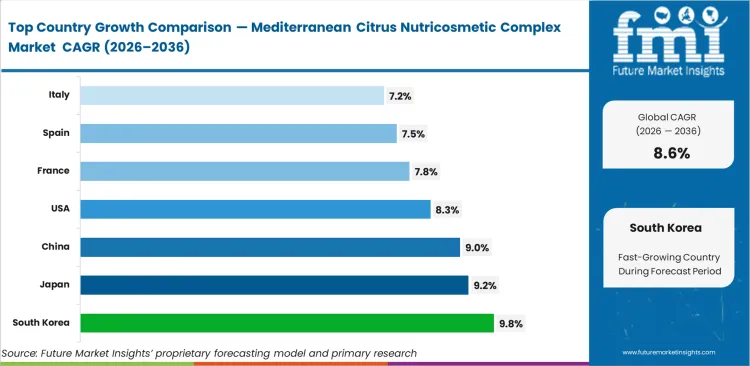
- South Korea (9.8%), Japan (9.2%), and China (9.0%) are among the fastest-growing markets.
Mediterranean Citrus Nutricosmetic Complex Market Key Takeaways
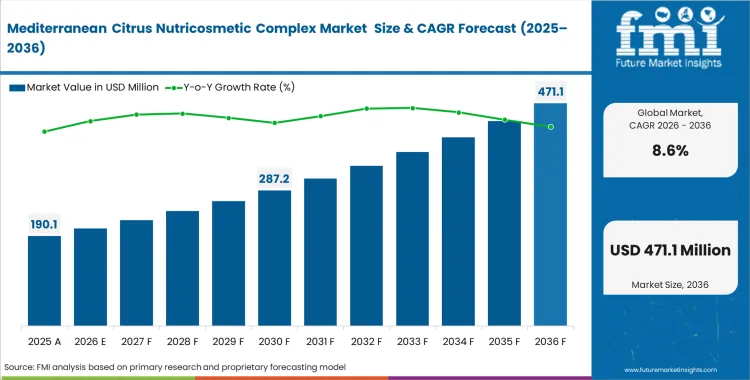
Mediterranean citrus nutricosmetic complex market
- 2025 market size: USD 175.0 million
- 2026 market size: USD 190.1 million
- 2036 forecast: USD 433.8 million
- CAGR: 8.6%
- Top product type: Polyphenol extracts (38.0%)
- Top form: Capsules (34.0%)
- Top application: Photoprotection (31.0%)
- Top source fruit: Grapefruit (29.0%)
- Top sales channel: B2B ingredients (56.0%)
| Metric | Details |
|---|---|
| Industry Size (2026) | USD 190.1 million |
| Industry Value (2036) | USD 433.8 million |
| CAGR (2026 to 2036) | 8.60% |
Source: Future Market Insights (FMI) analysis, based on proprietary forecasting model and primary research
Securing pre-standardized citrus polyphenol extracts guarantees lot-to-lot consistency, which effectively transfers the validation burden back to ingredient suppliers. Delaying this transition leaves mid-tier brands vulnerable to clean-label competitors operating with verifiable clinical backing. Incorporating specialized nutricosmetics dictates an immediate shift toward integrated botanical systems providing full-spectrum coverage rather than isolated vitamins, pushing brands to secure verifiable extracts to avoid failing efficacy audits during retail buyer reviews.
Once contract manufacturers secure dedicated extraction partnerships with Sicilian and Andalusian cooperatives, batch variability drops to negligible levels. Establishing this raw material pipeline allows ingredient houses to offer guaranteed bioactive concentrations year-round. Consistent flavonoid delivery fundamentally shifts purchasing conversations from basic antioxidant claims to specific dermal protection metrics, prompting buyers to transition from opportunistic spot purchasing to multi-year volume commitments for their active beauty formulations.
South Korea leads the citrus nutricosmetic sector, advancing at 9.8% in 2026 as local contract manufacturers aggressively substitute synthetic brightening agents with standardized botanical extracts in functional beverages. Japan expands at 9.2%, driven by a senior demographic preference for swallowable dermal protection formats. China tracks an upward trajectory at 9.0% as domestic direct-to-consumer brands seek European-sourced clinical claims to bypass local ingredient skepticism. The United States industry outlook ascends at 8.3% based on an inclining consumer preference for whole-food ingestible routines impacting usa nutricosmetics. France follows at 7.8%, guided by luxury skincare brands moving into adjacencies. Spain and Italy register 7.5% and 7.2% respectively, directly benefiting from domestic proximity to raw material cultivation and established extraction expertise.
Segmental Analysis
Mediterranean Citrus Nutricosmetic Complex Market Analysis by Product Type
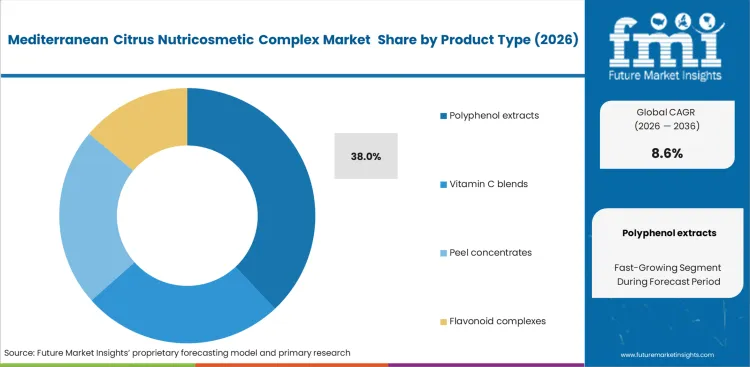
Formulation chemists prioritize raw material stability above initial cost when developing ingestible beauty lines. Polyphenol extracts is estimated to hold 38.0% share in 2026. This dominance stems directly from superior heat tolerance these extracts exhibit during high-speed blending operations. Contract manufacturers require compounds surviving the mechanical stress of tableting without degrading active components. Selecting standardized citrus powder matrices ensures final products meet label claims after full shelf life. What generalist metrics miss is buyers rarely buy these extracts for baseline nutrition; they purchase clinical dossiers attached to specific citrus polyphenol beauty supplements. Switching to unstandardized alternatives forces R&D directors to initiate entirely new stability testing protocols, exposing brands to compliance failures during routine retail audits if they delay the shift toward clinical-grade extracts.
- Qualification threshold: Formulation chemists evaluate polyphenol extracts based on survival rates through high-heat extrusion, ensuring brands avoid unpredictable active ingredient degradation associated with unstandardized complexes.
- Formulation lock-in: Once contract manufacturers validate specific polyphenol matrices, altering supply sources voids all existing stability data, creating a steep vendor switching cost for procurement teams.
- Label claim defense: Standardized extraction ensures identical batch concentrations of active compounds, providing regulatory compliance officers the consistency required to defend explicit photoprotection marketing claims against regulatory scrutiny.
Mediterranean Citrus Nutricosmetic Complex Market Analysis by Form
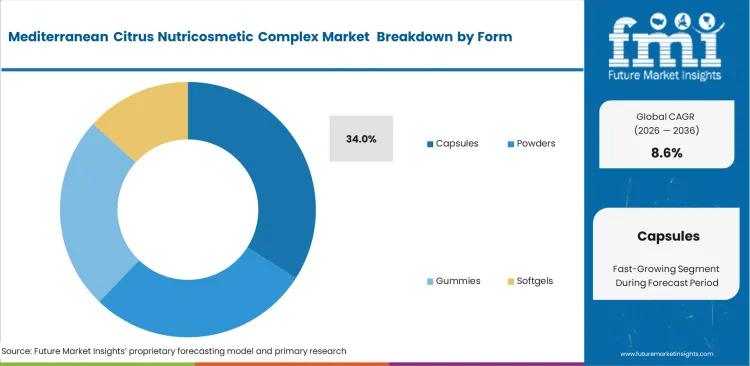
Protecting volatile botanical compounds from premature oxidation dictates primary delivery mechanisms, allowing capsules to secure 34.0% share in 2026. It has been estimated that this position relies on the absolute barrier protection hard-shell formats provide against environmental moisture. Production managers prefer capsules because they eliminate complex flavoring challenges associated with bitter citrus flavonoids, circumventing the need for expensive masking agents that inflate unit economics. What basic consumer preference data conceals is that formulation teams actively push capsule adoption to avoid the technical headaches of liquid suspension stability.
- Oxidation barrier: Production managers select hard-shell capsules to completely isolate reactive flavonoids from ambient oxygen, avoiding the rapid degradation of active photoprotective compounds seen in porous formats.
- Flavor masking: Encapsulation bypasses severe bitter notes inherent in concentrated citrus botanical extracts, allowing flavor scientists to avoid complex liquid suspensions requiring expensive proprietary masking technologies.
- Dosing precision: Manufacturing lines dispense precise milligram volumes into individual capsule chambers, equipping quality control directors with the accuracy necessary to guarantee exact clinical dosages for premium product lines.
Mediterranean Citrus Nutricosmetic Complex Market Analysis by Application
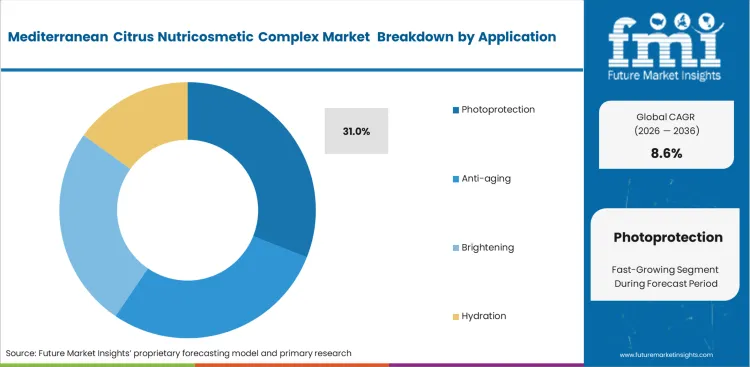
Systemic defense against UV degradation represents the highest-margin commercial opportunity for ingestible brands. Photoprotection is anticipated to command 31.0% share in 2026. This leading position results from clear mechanistic links between specific citrus flavonoids and dermal cell resilience. Clinical researchers target these complexes to neutralize reactive oxygen species generated by solar exposure, providing buyers with ingredients that differentiate portfolios from basic hydration supplements.
- Clinical differentiation: Marketing directors leverage oral photoprotection claims to separate premium product lines from generic beauty supplements, avoiding the trap of competing entirely on price.
- Systemic delivery: Formulation scientists utilize ingestible complexes to deliver antioxidant protection to dermal layers inaccessible to topical creams, tapping into massive internal defense markets.
- Efficacy validation: Regulatory teams require exhaustive clinical trials supporting systemic UV defense marketing, compelling procurement officers to secure extracts carrying complete safety and efficacy dossiers to satisfy compliance audits.
Mediterranean Citrus Nutricosmetic Complex Market Analysis by Source Fruit
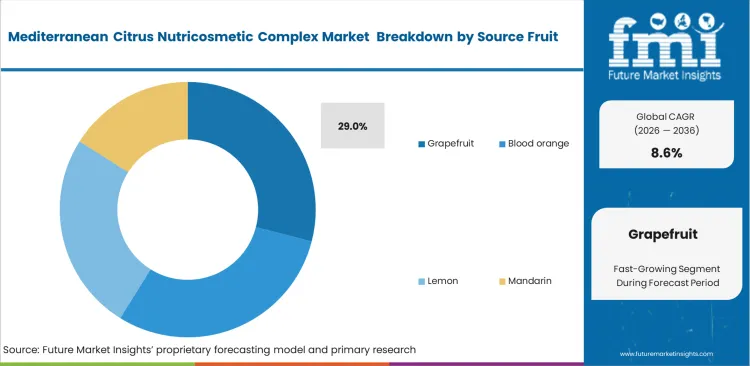
Extracting maximum dermal benefit requires specific molecular profiles found only in distinct botanical species. Grapefruit is predicted to garner 29.0% share in 2026 and this specific varietal dominates due to unusually high concentrations of naringenin, a flavonoid critical for maintaining dermal elasticity. Extraction facility managers design entire processing lines around grapefruit biomass to capture this specific molecular payload, allowing brands to pair these extracts effectively with collagen peptide formulations. The non-obvious reality within supply chains is that buyers prioritize specific regional grapefruits not for total yield, but for specific bioactive ratios absent in standard commercial juice varietals.
- Targeted extraction: Processing engineers calibrate equipment specifically isolating naringenin from grapefruit raw material, ensuring ingredient suppliers do not yield low-value generic botanical powders.
- Biomarker consistency: Quality assurance directors measure incoming grapefruit batches strictly by specific flavonoid concentrations, prompting buyers to reject shipments falling below minimum clinical efficacy thresholds required for formulation.
- Synergistic pairing: R&D directors formulate grapefruit extracts alongside complementary dermal proteins maximizing skin benefits, ensuring brands do not miss the compounding effects of these targeted complexes.
Mediterranean Citrus Nutricosmetic Complex Market Analysis by Sales Channel
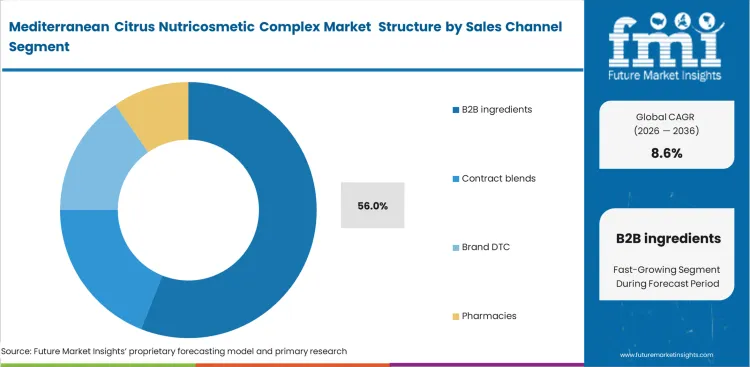
Sourcing highly specialized botanical matrices demands direct interaction with primary extraction facilities. B2B ingredients are expected to account for 56.0% share in 2026. This channel concentration reflects the technical barriers involved in producing clinical-grade extracts. Brand procurement officers cannot source these materials from generic commodity brokers; they must negotiate directly with dedicated mediterranean citrus nutricosmetic ingredients suppliers capable of providing exhaustive clinical documentation. Supplying premium nutricosmetic ingredients involves complex intellectual property transfers and formulation support.
- Dossier access: Procurement officers rely on specialized B2B suppliers providing comprehensive clinical research documentation, preventing brands from sourcing generic brokers that cannot legally substantiate specific health claims.
- Formulation support: Contract manufacturing scientists depend on primary ingredient suppliers for critical stability and integration guidance, protecting buyers from frequent production line failures.
- Supply security: Supply chain directors establish multi-year B2B contracts insulating brands from agricultural harvest variations, shielding finished product lines from sudden ingredient shortages caused by opportunistic purchasing.
Mediterranean Citrus Nutricosmetic Complex Market Drivers, Restraints, and Opportunities
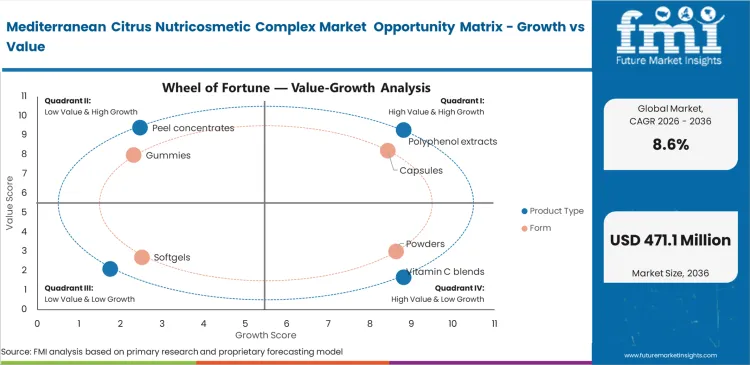
Understanding what drives the sector for citrus nutricosmetics requires looking at retail buyer mandates. Procurement directors must secure ingredients backed by human trials, as the immediate penalty for presenting unsupported claims is rapid removal from premium retail shelves. Brands can no longer rely on generic antioxidant assumptions. They must transition to specialized botanical complexes providing verifiable physiological changes to dermal matrices. This commercial reality accelerates the adoption of standardized Mediterranean extracts capable of delivering exact flavonoid dosages. Securing specific raw materials allows formulation teams to bypass regulatory skepticism and command premium shelf placement for their citrus flavonoids for skin elasticity lines.
Immediate operational friction slowing adoption centers on the complex integration of these botanical matrices into existing liquid and gummy manufacturing lines. Flavor scientists struggle to mask the intense bitterness of concentrated citrus extracts without degrading active compounds, creating technical limitations that restrict the rapid expansion of standardized extracts into novel formats. Contract manufacturers often lack the specialized extrusion equipment necessary to protect reactive molecules during production. Until ingredient houses develop advanced microencapsulation technologies, brands must restrict their most potent formulations to traditional hard-shell capsules.
Opportunities in the Mediterranean Citrus Nutricosmetic Complex Market
- Microencapsulation integration: R&D directors command premium pricing by developing microencapsulated extracts surviving high-heat gummy manufacturing, expanding capabilities beyond standard capsule production.
- Synergistic complexing: Ingredient suppliers capture extended market share by pre-blending citrus flavonoids with specialized functional cosmetic ingredients, aligning with procurement teams that prioritize single-source purchasing for advanced anti-aging matrices.
- Regional traceability: Marketing directors utilize blockchain tracking verifying specific Mediterranean origin of raw botanical inputs, enabling brands to attract stringent clean-label consumers through absolute supply chain transparency.
Regional Analysis
Based on regional analysis, Mediterranean Citrus Nutricosmetic Complex Market is segmented into South Korea, Japan, China, United States, France, Spain, and Italy across 40 plus countries.
.webp "Top Country Growth Comparison Mediterranean Citrus Nutricosmetic Complex Market Cagr (2026 2036)")
| Country | CAGR (2026 to 2036) |
|---|---|
| South Korea | 9.8% |
| Japan | 9.2% |
| China | 9.0% |
| United States | 8.3% |
| France | 7.8% |
| Spain | 7.5% |
| Italy | 7.2% |
Source: Future Market Insights (FMI) analysis, based on proprietary forecasting model and primary research
East Asia Mediterranean Citrus Nutricosmetic Complex Market Analysis
East Asia remains the fastest-rising regional cluster for Mediterranean citrus nutricosmetic complexes. Demand is moving up as ingestible beauty brands across the region look for cleaner botanical positioning, stronger clinical backing, and premium imported actives that can support skin-health claims. South Korea, Japan, and China lead this regional demand pattern, though each market is shaped by a different buying logic ranging from premium beauty-drink formulation to traceable imported ingredient sourcing.
- South Korea: South Korea is set to record a CAGR of 9.8% in the mediterranean citrus nutricosmetic complex market through 2036. Functional beverage and ingestible beauty brands in the country are moving toward clinical-grade botanical inputs that can support clearer product differentiation in crowded premium channels. Product teams are replacing basic brightening systems with standardized citrus extracts that fit clean-label expectations and support stronger skin-health positioning. Brands that secure verified Mediterranean botanical inputs improve their chances of winning premium pharmacy and beauty retail placements. Generic vitamin-only positioning leaves little room for pricing power in this market.
- Japan: Japan remains a disciplined market for ingestible skin-health products, especially those aimed at older consumers looking for convenient daily-use formats. Swallowable beauty supplements fit well with local demand for simple routines backed by measurable efficacy and strong safety documentation. Ingredient suppliers that combine citrus flavonoids with collagen and other well-understood actives are better placed to enter regulated functional food pipelines. The market for mediterranean citrus nutricosmetic complex in Japan is expected to grow at a CAGR of 9.2% during the study period. That pace reflects steady demand for clinically documented ingredients rather than broad acceptance of unverified botanical claims.
- China: China’s ingestible beauty category places clear commercial value on documented Mediterranean sourcing, especially among urban brands selling into premium segments. Buyers use origin assurance to justify higher pricing and to support stronger product storytelling across digital retail channels. Contract manufacturers are tightening import verification, batch documentation, and supplier screening as ingredient claims become more source-sensitive. The mediterranean citrus nutricosmetic complex market in China is expected to grow at a CAGR of 9.0% through 2036. Suppliers that can demonstrate traceability are likely to stay better placed in high-end formulations.
FMI's report includes detailed analysis covering South Korea, Japan, and China. The region remains central to future category expansion because premium ingestible beauty demand, strict product qualification, and imported botanical positioning continue to influence formulation choices.
North American Mediterranean Citrus Nutricosmetic Complex Market Analysis
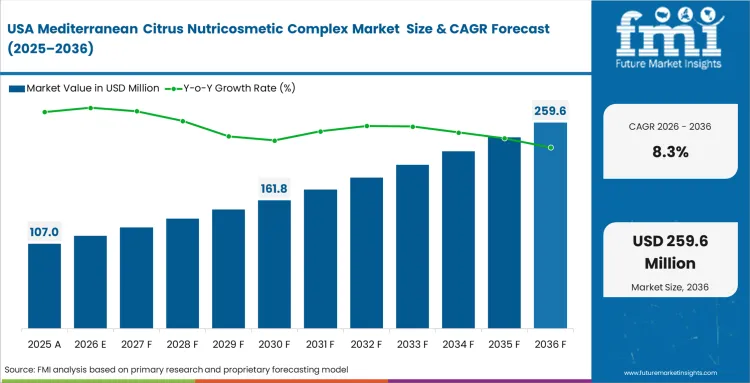
North America remains an important market for Mediterranean citrus nutricosmetic complexes because the region already supports a broad base for beauty-from-within, healthy-aging, and premium supplement products. Buyers are familiar with antioxidant positioning, but product acceptance depends on whether brands can connect Mediterranean citrus actives with clear clinical support, clean-label appeal, and differentiated skin-health claims. The United States anchors regional demand, with premium retail, practitioner-led wellness channels, and e-commerce brands shaping product selection.
- United States: The United States remains a stable high-value market for Mediterranean citrus nutricosmetic complexes as brands fold these ingredients into broader beauty-from-within and healthy-aging portfolios. Retailers and digital-first supplement brands look for formulations that can stand apart from collagen blends, hyaluronic acid products, and general antioxidant capsules already crowding the category. Mediterranean citrus inputs are more relevant where the formulation story combines origin credibility with recognizable clinical support and premium ingestible beauty positioning. The mediterranean citrus nutricosmetic complex market in the United States is anticipated to rise at a CAGR of 8.3% through 2036. Premium formulation quality is likely to matter more than wide-market volume in this country.
FMI's report includes detailed analysis covering the United States. The region remains commercially relevant because beauty-from-within supplements already have an established consumer base, but product acceptance depends on stronger differentiation, cleaner label positioning, and clinically supportable ingredient narratives.
Europe Mediterranean Citrus Nutricosmetic Complex Market Analysis
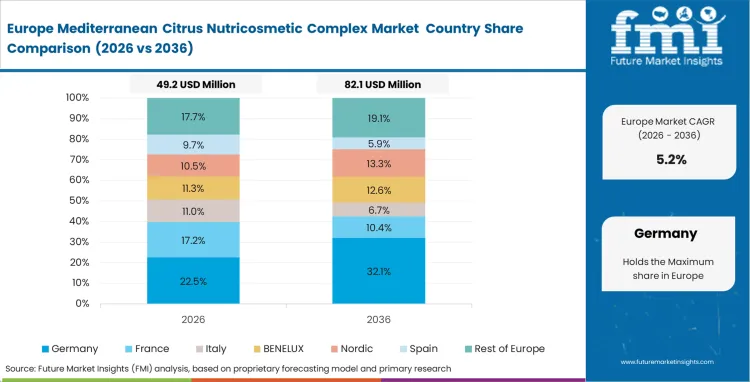
Europe remains central to this industry because the region combines citrus raw material availability, extraction know-how, and established nutraceutical formulation expertise. France contributes demand from premium beauty and dermonutrition channels, while Spain and Italy matter both as commercial markets and as origin points for Mediterranean citrus actives. Regional suppliers benefit from proximity to raw materials, stronger provenance claims, and deeper familiarity with citrus-derived ingredient development.
- France: France benefits from close overlap between nutraceutical, dermocosmetic, and botanical formulation expertise. Buyers in this market pay close attention to ingredient quality, extraction consistency, and compatibility with premium skin-health positioning. Citrus-based nutricosmetic complexes fit best where the formulation message is tied to beauty support, antioxidant intake, and ingredient origin rather than broad wellness language. France is likely to post a CAGR of 7.8% in the Mediterranean Citrus Nutricosmetic Complex Market by 2036. The pace is moderate, though the country remains commercially important because it favors higher-specification ingredients.
- Spain: The market for mediterranean citrus nutricosmetic complex in Spain is expected to advance at a CAGR of 7.5% through 2036.Spain plays a dual role in this industry as both a demand market and a key sourcing base for Mediterranean citrus raw materials. Local extraction capability, agricultural depth, and proximity to citrus-growing regions support supplier credibility and keep the country important in ingredient development. Brands and formulators in Spain also benefit from easier access to region-linked sourcing narratives that matter in premium ingestible beauty positioning.
- Italy: Italy is forecast to record growth in the mediterranean citrus nutricosmetic complex market at a CAGR of 7.2% through 2036. Blood orange and other citrus-derived actives give Italy a strong position in branded botanical development for beauty-from-within applications. Ingredient firms in the country benefit from familiarity with Mediterranean plant extraction, premium nutraceutical formulation, and export-oriented product development. Commercial interest is strongest where citrus complexes are tied to antioxidant protection, skin appearance support, and region-specific ingredient identity.
FMI's report includes detailed analysis covering France, Spain, and Italy. Europe remains important not only as a consumption base for premium nutricosmetic formulations, but also as a sourcing and ingredient-development hub for Mediterranean citrus actives.
Competitive Aligners for Market Players
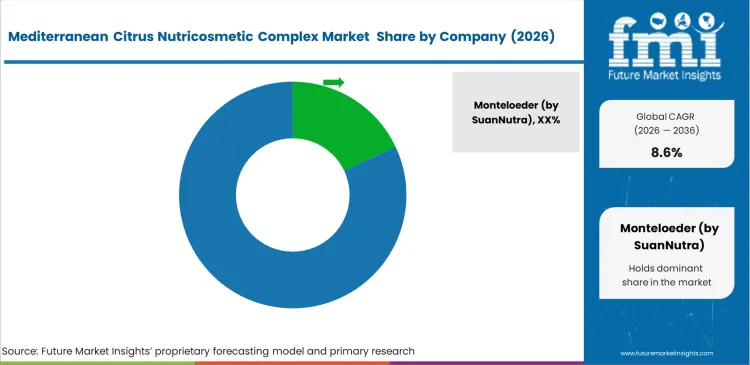
Control over verified agricultural biomass matters more in this market than extraction capacity alone. Companies such as Bionap and Euromed strengthen their position by building sourcing relationships with regional agricultural cooperatives that can support origin credibility and raw material consistency. Beauty and nutricosmetic buyers assess suppliers on their ability to deliver stable bioactive profiles across harvest cycles, especially when seasonal weather can affect citrus quality and composition. Spot-market buying weakens that position because it raises the risk of supply disruption and greater variation between batches. The stronger players are the ones that can manage the chain from Mediterranean grove selection to standardized finished extract.
Contract manufacturers add another competitive filter by resisting overdependence on a single ingredient source. Formulation teams increasingly ask for transparent standardization parameters and dual-source qualification for key flavonoid inputs so that product continuity is not disrupted by one supplier failure. Incoming material is reviewed against strict analytical benchmarks, often including chromatography-based checks to confirm that each batch matches the required molecular profile. That raises the operating standard across the supplier base. Extract producers that cannot maintain narrow batch tolerances or document their standardization methods are less likely to win multi-year supply agreements.
Key Players in Mediterranean Citrus Nutricosmetic Complex Market
- Monteloeder (by SuanNutra)
- Bionap
- Euromed
- Indena
- dsm-firmenich
- Givaudan
- Nektium
Scope of the Report
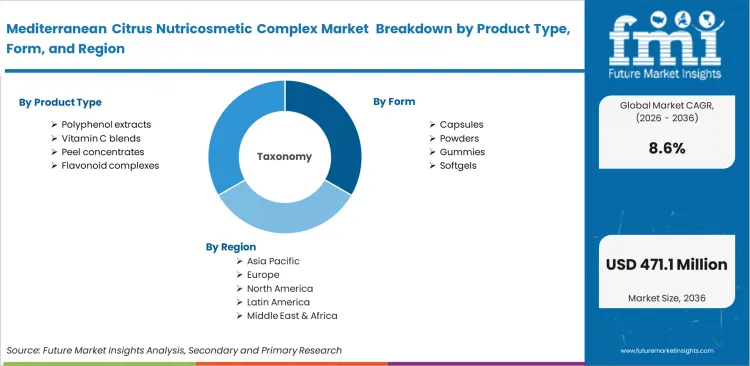
| Metric | Value |
|---|---|
| Quantitative Units | USD 190.1 million to USD 433.8 million, at a CAGR of 8.60% |
| Market Definition | Standardized botanical extracts derived from Mediterranean citrus varietals engineered for oral beauty applications. These matrices deliver verified concentrations of flavonoids and polyphenols to support dermal health, photoprotection, and skin elasticity. |
| Segmentation | By Product Type, By Form, By Application, By Source Fruit, By Sales Channel, and Region |
| Regions Covered | North America, Latin America, Western Europe, Eastern Europe, Asia Pacific (Excluding Japan), Japan, Middle East and Africa |
| Countries Covered | South Korea, Japan, China, United States, France, Spain, Italy |
| Key Companies Profiled | Monteloeder (by SuanNutra), Bionap, Euromed, Indena, dsm-firmenich, Givaudan, Nektium |
| Forecast Period | 2026 to 2036 |
| Approach | Baseline established via direct sales volumes of standardized extracts to beauty supplement sectors |
Source: Future Market Insights (FMI) analysis, based on proprietary forecasting model and primary research
Mediterranean Citrus Nutricosmetic Complex Market Analysis by Segments
By Product Type
- Polyphenol extracts
- Vitamin C blends
- Peel concentrates
- Flavonoid complexes
By Form
- Capsules
- Powders
- Gummies
- Softgels
By Application
- Photoprotection
- Anti-aging
- Brightening
- Hydration
By Source Fruit
- Grapefruit
- Blood orange
- Lemon
- Mandarin
By Sales Channel
- B2B ingredients
- Contract blends
- Brand DTC
- Pharmacies
By Region
- North America
- Latin America
- Western Europe
- Eastern Europe
- Asia Pacific (Excluding Japan)
- Japan
- Middle East and Africa
Bibliography
- Cianciabella, M., Giordano, A., Santoro, A., & others. (2024, November 24). Health-promoting potential of the Mediterranean diet and its phytochemicals in healthy aging and longevity.
- Martínez, R. J. G., Valverde-Merino, M. I., & others. (2025, March 6). Bioactive substances and skin health: An integrative review from a pharmacy and nutrition perspective.
- Munir, H., & others. (2024, March 27). Unveiling the chemistry of citrus peel: A rich source of bioactive compounds for functional foods and nutraceuticals.
- Navarro, P., Nobile, V., & others. (2025, April 23). Skin photoprotection and anti-aging benefits of a combination of rosemary and grapefruit extracts: Evidence from in vitro models and human study. International Journal of Molecular Sciences.
- Ng, J. Y., Xuan Min, Y., Ng, G. Y., & Chew, F. T. (2025, October 31). Dietary interventions in skin ageing: A systematic review and meta-analysis.
This bibliography is provided for reader reference. The full FMI report contains the complete reference list with primary source documentation.
This Report Addresses
- Specific concentration metrics required for effective oral photoprotection applications.
- Best citrus extract for skin supplements based on clinical efficacy dossiers.
- Supply chain dynamics controlling Sicilian and Andalusian botanical biomass processing.
- Technical barriers preventing rapid adoption of ingestible skincare ingredients market solutions in liquid formats.
- Formulation stability data needed to defend brand claims during regulatory audits.
- Competitive advantages of long-term sourcing contracts over spot commodity purchasing.
- Primary extraction methods necessary to isolate naringenin from grapefruit raw materials.
- Strategic positioning differences between basic vitamin C delivery and specialized flavonoid matrices.
Frequently Asked Questions
What is the Mediterranean citrus nutricosmetic complex market?
It tracks standardized citrus botanical extracts engineered for oral beauty, delivering verified flavonoids for dermal health.
How big is the Mediterranean citrus nutricosmetic complex market?
Revenue is forecast to reach USD 433.8 million by 2036, driven by demand for clinical botanical matrices.
Why are citrus polyphenols used in oral skin health supplements?
They maintain molecular integrity during high-heat manufacturing, delivering measurable physiological changes directly to dermal layers.
Which countries lead mediterranean citrus nutricosmetic demand?
South Korea advances at 9.8% via functional beverages, while Japan expands at 9.2% through senior-focused supplements.
Which companies sell mediterranean citrus nutricosmetic ingredients?
Major B2B suppliers include Monteloeder, Bionap, Euromed, Indena, dsm-firmenich, Givaudan, and Nektium, controlling dedicated regional supply chains.
Compare grapefruit and blood orange ingredients for beauty from within?
Grapefruit naringenin targets dermal elasticity, while Sicilian blood orange anthocyanins dominate systemic photoprotection and brightening applications.
Are grapefruit extracts used for skin supplements?
Yes, extraction engineers optimize processing lines around grapefruit biomass specifically to isolate naringenin for cellular resilience.
Can citrus polyphenols support photoprotection?
Yes, clinical researchers map direct mechanistic links between specific citrus flavonoids and dermal reactive oxygen species neutralization.
What drives demand for citrus nutricosmetics?
Retail buyer mandates force ingestible beauty brands to substantiate claims with distinct clinical evidence and human trials.
How does encapsulation protect these specific botanical complexes?
Hard-shell capsules provide absolute barriers against ambient oxygen, preventing premature oxidation of highly reactive citrus flavonoids.
Which citrus extracts are used in nutricosmetics?
Formulations utilize polyphenol extracts, vitamin C blends, and flavonoid complexes derived from grapefruit, blood orange, and mandarin.
What prevents brands from using generic citrus powders instead of specialized extracts?
Generic powders lack standardized flavonoid concentrations, causing brands to consistently fail clinical efficacy evaluations and regulatory audits.
Explain the mediterranean citrus nutricosmetic complex market in simple terms?
It involves standardizing specific Mediterranean citrus compounds into ingestible formats to improve skin hydration and sun defense.
Why do B2B ingredients account for 56.0% of the sales channel distribution?
Extracting exact clinical flavonoid ratios requires massive technical infrastructure, forcing brands to partner with specialized extraction facilities.
What specific formulation challenges slow adoption of these complexes in gummies?
Flavor scientists struggle masking intense bitterness without degrading active payloads, often destroying clinical efficacy in liquid suspensions.
How do extraction companies maintain consistency across variable harvest seasons?
Ingredient houses establish exclusive multi-year contracts with regional cooperatives, allowing them to standardize raw biomass batch-to-batch.
Why do Japanese senior demographics prefer these functional supplements?
Older consumer segments prioritize ingestible dermal defense formats over complex topical routines, aligning with functional food preferences.
What role do clinical safety dossiers play in procurement decisions?
Regulatory officers mandate extensive human trial data, allowing B2B suppliers to block generic competitors lacking analytical proof.
How do European origin certifications impact Chinese market demand?
Strict geographic traceability allows Chinese direct-to-consumer labels to bypass domestic ingredient skepticism and establish premium commercial credibility.
Why are contract manufacturers critical to expansion of this market?
Brand owners lack specialized blending equipment, relying entirely on formulation scientists to preserve raw material clinical efficacy.
What technical metrics define a high-quality citrus nutricosmetic extract?
Quality assurance directors require precise high-performance liquid chromatography profiles demonstrating exact, repeatable concentrations of specific functional flavonoids.
How does the shift toward clean-label purchasing affect raw material sourcing?
Procurement teams must secure traceable plant-based complexes aligning with stringent retail requirements without sacrificing demonstrable clinical performance.
What immediate commercial risk does brands face delaying standard extract adoption?
Brands relying on unstandardized botanical blends risk failing efficacy audits and losing premium pharmacy shelf placement immediately.
How do formulation chemist pair citrus complexes with specific dermal proteins?
R&D directors formulate hesperidin-rich extracts alongside targeted collagen peptides to maximize compounding skin benefits systematically.
Preview the report firsthand - request a free sample
Get SampleGet the brochure for pricing and purchase details.
Get PDFTable of Content
- Executive Summary
- Global Market Outlook
- Demand-side Trends
- Supply-side Trends
- Technology Roadmap Analysis
- Analysis and Recommendations
- Market Overview
- Market Coverage / Taxonomy
- Market Definition / Scope / Limitations
- Research Methodology
- Chapter Orientation
- Analytical Lens and Working Hypotheses
- Market Structure, Signals, and Trend Drivers
- Benchmarking and Cross-market Comparability
- Market Sizing, Forecasting, and Opportunity Mapping
- Research Design and Evidence Framework
- Desk Research Programme (Secondary Evidence)
- Company Annual and Sustainability Reports
- Peer-reviewed Journals and Academic Literature
- Corporate Websites, Product Literature, and Technical Notes
- Earnings Decks and Investor Briefings
- Statutory Filings and Regulatory Disclosures
- Technical White Papers and Standards Notes
- Trade Journals, Industry Magazines, and Analyst Briefs
- Conference Proceedings, Webinars, and Seminar Materials
- Government Statistics Portals and Public Data Releases
- Press Releases and Reputable Media Coverage
- Specialist Newsletters and Curated Briefings
- Sector Databases and Reference Repositories
- FMI Internal Proprietary Databases and Historical Market Datasets
- Subscription Datasets and Paid Sources
- Social Channels, Communities, and Digital Listening Inputs
- Additional Desk Sources
- Expert Input and Fieldwork (Primary Evidence)
- Primary Modes
- Qualitative Interviews and Expert Elicitation
- Quantitative Surveys and Structured Data Capture
- Blended Approach
- Why Primary Evidence is Used
- Field Techniques
- Interviews
- Surveys
- Focus Groups
- Observational and In-context Research
- Social and Community Interactions
- Stakeholder Universe Engaged
- C-suite Leaders
- Board Members
- Presidents and Vice Presidents
- R&D and Innovation Heads
- Technical Specialists
- Domain Subject-matter Experts
- Scientists
- Physicians and Other Healthcare Professionals
- Governance, Ethics, and Data Stewardship
- Research Ethics
- Data Integrity and Handling
- Primary Modes
- Tooling, Models, and Reference Databases
- Desk Research Programme (Secondary Evidence)
- Data Engineering and Model Build
- Data Acquisition and Ingestion
- Cleaning, Normalisation, and Verification
- Synthesis, Triangulation, and Analysis
- Quality Assurance and Audit Trail
- Market Background
- Market Dynamics
- Drivers
- Restraints
- Opportunity
- Trends
- Scenario Forecast
- Demand in Optimistic Scenario
- Demand in Likely Scenario
- Demand in Conservative Scenario
- Opportunity Map Analysis
- Product Life Cycle Analysis
- Supply Chain Analysis
- Investment Feasibility Matrix
- Value Chain Analysis
- PESTLE and Porter’s Analysis
- Regulatory Landscape
- Regional Parent Market Outlook
- Production and Consumption Statistics
- Import and Export Statistics
- Market Dynamics
- Global Market Analysis 2021 to 2025 and Forecast, 2026 to 2036
- Historical Market Size Value (USD Million) Analysis, 2021 to 2025
- Current and Future Market Size Value (USD Million) Projections, 2026 to 2036
- Y-o-Y Growth Trend Analysis
- Absolute $ Opportunity Analysis
- Global Market Pricing Analysis 2021 to 2025 and Forecast 2026 to 2036
- Global Market Analysis 2021 to 2025 and Forecast 2026 to 2036, By Product Type
- Introduction / Key Findings
- Historical Market Size Value (USD Million) Analysis By Product Type , 2021 to 2025
- Current and Future Market Size Value (USD Million) Analysis and Forecast By Product Type , 2026 to 2036
- Polyphenol extracts
- Vitamin C blends
- Peel concentrates
- Flavonoid complexes
- Polyphenol extracts
- Y-o-Y Growth Trend Analysis By Product Type , 2021 to 2025
- Absolute $ Opportunity Analysis By Product Type , 2026 to 2036
- Global Market Analysis 2021 to 2025 and Forecast 2026 to 2036, By Form
- Introduction / Key Findings
- Historical Market Size Value (USD Million) Analysis By Form, 2021 to 2025
- Current and Future Market Size Value (USD Million) Analysis and Forecast By Form, 2026 to 2036
- Capsules
- Powders
- Gummies
- Softgels
- Capsules
- Y-o-Y Growth Trend Analysis By Form, 2021 to 2025
- Absolute $ Opportunity Analysis By Form, 2026 to 2036
- Global Market Analysis 2021 to 2025 and Forecast 2026 to 2036, By Application
- Introduction / Key Findings
- Historical Market Size Value (USD Million) Analysis By Application, 2021 to 2025
- Current and Future Market Size Value (USD Million) Analysis and Forecast By Application, 2026 to 2036
- Photoprotection
- Anti-aging
- Brightening
- Hydration
- Photoprotection
- Y-o-Y Growth Trend Analysis By Application, 2021 to 2025
- Absolute $ Opportunity Analysis By Application, 2026 to 2036
- Global Market Analysis 2021 to 2025 and Forecast 2026 to 2036, By Source Fruit
- Introduction / Key Findings
- Historical Market Size Value (USD Million) Analysis By Source Fruit, 2021 to 2025
- Current and Future Market Size Value (USD Million) Analysis and Forecast By Source Fruit, 2026 to 2036
- Grapefruit
- Blood orange
- Lemon
- Mandarin
- Grapefruit
- Y-o-Y Growth Trend Analysis By Source Fruit, 2021 to 2025
- Absolute $ Opportunity Analysis By Source Fruit, 2026 to 2036
- Global Market Analysis 2021 to 2025 and Forecast 2026 to 2036, By Sales Channel
- Introduction / Key Findings
- Historical Market Size Value (USD Million) Analysis By Sales Channel, 2021 to 2025
- Current and Future Market Size Value (USD Million) Analysis and Forecast By Sales Channel, 2026 to 2036
- B2B ingredients
- Contract blends
- Brand DTC
- Pharmacies
- B2B ingredients
- Y-o-Y Growth Trend Analysis By Sales Channel, 2021 to 2025
- Absolute $ Opportunity Analysis By Sales Channel, 2026 to 2036
- Global Market Analysis 2021 to 2025 and Forecast 2026 to 2036, By Region
- Introduction
- Historical Market Size Value (USD Million) Analysis By Region, 2021 to 2025
- Current Market Size Value (USD Million) Analysis and Forecast By Region, 2026 to 2036
- North America
- Latin America
- Western Europe
- Eastern Europe
- East Asia
- South Asia and Pacific
- Middle East & Africa
- Market Attractiveness Analysis By Region
- North America Market Analysis 2021 to 2025 and Forecast 2026 to 2036, By Country
- Historical Market Size Value (USD Million) Trend Analysis By Market Taxonomy, 2021 to 2025
- Market Size Value (USD Million) Forecast By Market Taxonomy, 2026 to 2036
- By Country
- USA
- Canada
- Mexico
- By Product Type
- By Form
- By Application
- By Source Fruit
- By Sales Channel
- By Country
- Market Attractiveness Analysis
- By Country
- By Product Type
- By Form
- By Application
- By Source Fruit
- By Sales Channel
- Key Takeaways
- Latin America Market Analysis 2021 to 2025 and Forecast 2026 to 2036, By Country
- Historical Market Size Value (USD Million) Trend Analysis By Market Taxonomy, 2021 to 2025
- Market Size Value (USD Million) Forecast By Market Taxonomy, 2026 to 2036
- By Country
- Brazil
- Chile
- Rest of Latin America
- By Product Type
- By Form
- By Application
- By Source Fruit
- By Sales Channel
- By Country
- Market Attractiveness Analysis
- By Country
- By Product Type
- By Form
- By Application
- By Source Fruit
- By Sales Channel
- Key Takeaways
- Western Europe Market Analysis 2021 to 2025 and Forecast 2026 to 2036, By Country
- Historical Market Size Value (USD Million) Trend Analysis By Market Taxonomy, 2021 to 2025
- Market Size Value (USD Million) Forecast By Market Taxonomy, 2026 to 2036
- By Country
- Germany
- UK
- Italy
- Spain
- France
- Nordic
- BENELUX
- Rest of Western Europe
- By Product Type
- By Form
- By Application
- By Source Fruit
- By Sales Channel
- By Country
- Market Attractiveness Analysis
- By Country
- By Product Type
- By Form
- By Application
- By Source Fruit
- By Sales Channel
- Key Takeaways
- Eastern Europe Market Analysis 2021 to 2025 and Forecast 2026 to 2036, By Country
- Historical Market Size Value (USD Million) Trend Analysis By Market Taxonomy, 2021 to 2025
- Market Size Value (USD Million) Forecast By Market Taxonomy, 2026 to 2036
- By Country
- Russia
- Poland
- Hungary
- Balkan & Baltic
- Rest of Eastern Europe
- By Product Type
- By Form
- By Application
- By Source Fruit
- By Sales Channel
- By Country
- Market Attractiveness Analysis
- By Country
- By Product Type
- By Form
- By Application
- By Source Fruit
- By Sales Channel
- Key Takeaways
- East Asia Market Analysis 2021 to 2025 and Forecast 2026 to 2036, By Country
- Historical Market Size Value (USD Million) Trend Analysis By Market Taxonomy, 2021 to 2025
- Market Size Value (USD Million) Forecast By Market Taxonomy, 2026 to 2036
- By Country
- China
- Japan
- South Korea
- By Product Type
- By Form
- By Application
- By Source Fruit
- By Sales Channel
- By Country
- Market Attractiveness Analysis
- By Country
- By Product Type
- By Form
- By Application
- By Source Fruit
- By Sales Channel
- Key Takeaways
- South Asia and Pacific Market Analysis 2021 to 2025 and Forecast 2026 to 2036, By Country
- Historical Market Size Value (USD Million) Trend Analysis By Market Taxonomy, 2021 to 2025
- Market Size Value (USD Million) Forecast By Market Taxonomy, 2026 to 2036
- By Country
- India
- ASEAN
- Australia & New Zealand
- Rest of South Asia and Pacific
- By Product Type
- By Form
- By Application
- By Source Fruit
- By Sales Channel
- By Country
- Market Attractiveness Analysis
- By Country
- By Product Type
- By Form
- By Application
- By Source Fruit
- By Sales Channel
- Key Takeaways
- Middle East & Africa Market Analysis 2021 to 2025 and Forecast 2026 to 2036, By Country
- Historical Market Size Value (USD Million) Trend Analysis By Market Taxonomy, 2021 to 2025
- Market Size Value (USD Million) Forecast By Market Taxonomy, 2026 to 2036
- By Country
- Kingdom of Saudi Arabia
- Other GCC Countries
- Turkiye
- South Africa
- Other African Union
- Rest of Middle East & Africa
- By Product Type
- By Form
- By Application
- By Source Fruit
- By Sales Channel
- By Country
- Market Attractiveness Analysis
- By Country
- By Product Type
- By Form
- By Application
- By Source Fruit
- By Sales Channel
- Key Takeaways
- Key Countries Market Analysis
- USA
- Pricing Analysis
- Market Share Analysis, 2025
- By Product Type
- By Form
- By Application
- By Source Fruit
- By Sales Channel
- Canada
- Pricing Analysis
- Market Share Analysis, 2025
- By Product Type
- By Form
- By Application
- By Source Fruit
- By Sales Channel
- Mexico
- Pricing Analysis
- Market Share Analysis, 2025
- By Product Type
- By Form
- By Application
- By Source Fruit
- By Sales Channel
- Brazil
- Pricing Analysis
- Market Share Analysis, 2025
- By Product Type
- By Form
- By Application
- By Source Fruit
- By Sales Channel
- Chile
- Pricing Analysis
- Market Share Analysis, 2025
- By Product Type
- By Form
- By Application
- By Source Fruit
- By Sales Channel
- Germany
- Pricing Analysis
- Market Share Analysis, 2025
- By Product Type
- By Form
- By Application
- By Source Fruit
- By Sales Channel
- UK
- Pricing Analysis
- Market Share Analysis, 2025
- By Product Type
- By Form
- By Application
- By Source Fruit
- By Sales Channel
- Italy
- Pricing Analysis
- Market Share Analysis, 2025
- By Product Type
- By Form
- By Application
- By Source Fruit
- By Sales Channel
- Spain
- Pricing Analysis
- Market Share Analysis, 2025
- By Product Type
- By Form
- By Application
- By Source Fruit
- By Sales Channel
- France
- Pricing Analysis
- Market Share Analysis, 2025
- By Product Type
- By Form
- By Application
- By Source Fruit
- By Sales Channel
- India
- Pricing Analysis
- Market Share Analysis, 2025
- By Product Type
- By Form
- By Application
- By Source Fruit
- By Sales Channel
- ASEAN
- Pricing Analysis
- Market Share Analysis, 2025
- By Product Type
- By Form
- By Application
- By Source Fruit
- By Sales Channel
- Australia & New Zealand
- Pricing Analysis
- Market Share Analysis, 2025
- By Product Type
- By Form
- By Application
- By Source Fruit
- By Sales Channel
- China
- Pricing Analysis
- Market Share Analysis, 2025
- By Product Type
- By Form
- By Application
- By Source Fruit
- By Sales Channel
- Japan
- Pricing Analysis
- Market Share Analysis, 2025
- By Product Type
- By Form
- By Application
- By Source Fruit
- By Sales Channel
- South Korea
- Pricing Analysis
- Market Share Analysis, 2025
- By Product Type
- By Form
- By Application
- By Source Fruit
- By Sales Channel
- Russia
- Pricing Analysis
- Market Share Analysis, 2025
- By Product Type
- By Form
- By Application
- By Source Fruit
- By Sales Channel
- Poland
- Pricing Analysis
- Market Share Analysis, 2025
- By Product Type
- By Form
- By Application
- By Source Fruit
- By Sales Channel
- Hungary
- Pricing Analysis
- Market Share Analysis, 2025
- By Product Type
- By Form
- By Application
- By Source Fruit
- By Sales Channel
- Kingdom of Saudi Arabia
- Pricing Analysis
- Market Share Analysis, 2025
- By Product Type
- By Form
- By Application
- By Source Fruit
- By Sales Channel
- Turkiye
- Pricing Analysis
- Market Share Analysis, 2025
- By Product Type
- By Form
- By Application
- By Source Fruit
- By Sales Channel
- South Africa
- Pricing Analysis
- Market Share Analysis, 2025
- By Product Type
- By Form
- By Application
- By Source Fruit
- By Sales Channel
- USA
- Market Structure Analysis
- Competition Dashboard
- Competition Benchmarking
- Market Share Analysis of Top Players
- By Regional
- By Product Type
- By Form
- By Application
- By Source Fruit
- By Sales Channel
- Competition Analysis
- Competition Deep Dive
- Monteloeder (by SuanNutra)
- Overview
- Product Portfolio
- Profitability by Market Segments (Product/Age /Sales Channel/Region)
- Sales Footprint
- Strategy Overview
- Marketing Strategy
- Product Strategy
- Channel Strategy
- Bionap
- Euromed
- Indena
- dsm-firmenich
- Givaudan
- Nektium
- Monteloeder (by SuanNutra)
- Competition Deep Dive
- Assumptions & Acronyms Used


