

- Industry Size (2026)
- USD 439.4 Mn
- Forecast (2036)
- USD 472.8 Mn
- CAGR (2026 to 2036)
- 7.6%
Citrus Aromatic Fractions for Mood Support Market Size, Market Forecast and Outlook By FMI
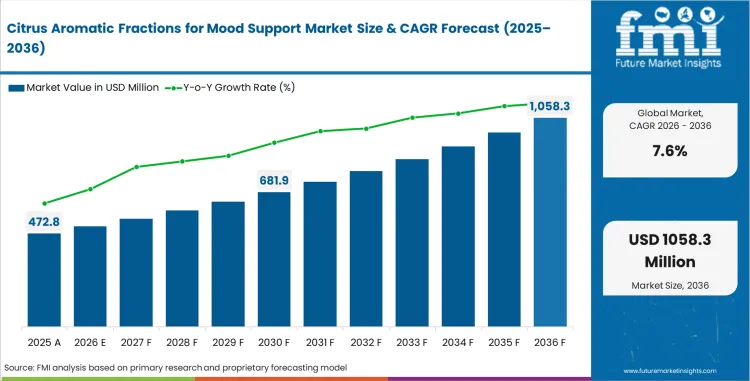
The citrus aromatic fractions for mood support market stood at USD 439.4 million in 2025. Demand is projected to touch USD 472.8 million in 2026, expanding at a CAGR of 7.6% during the forecast period. Continued investment in extraction precision, fraction standardization, and stability is expected to lift market value to USD 983.6 million by 2036. Scientific interest in terpenes such as limonene and linalool is also supporting demand in mood-support applications.
Summary Of Citrus Aromatic Fractions for Mood Support Market
- Market Snapshot
- The citrus aromatic fractions for mood support market is valued at USD 439.4 million in 2025 and is projected to reach USD 983.6 million by 2036.
- The market is expected to grow at a 7.6% CAGR from 2026 to 2036, creating an incremental opportunity of USD 510.8 million.
- This remains a narrow, application-defined market for wellness ingredients and finished aromatherapy products, not the broader citrus oil or orange terpene market. That is why its value stays below larger comparison categories.
- Supply-side feasibility is supported by large citrus-processing flows, including 17.1 million tons of oranges delivered to processors globally in 2025/26 and 2.6 million tons of lemon/lime processing volume.
- Demand and Growth Drivers
- Demand continues to rise because citrus aromas carry strong commercial appeal as “uplift” and “refresh” signals in aromatherapy, while clinical literature still places Citrus aurantium among leading essential oils associated with anxiety reduction.
- Lemon oil also keeps a meaningful place in mood-support positioning because meta-analytic evidence showed notable trait-anxiety reduction, supporting continued use in formulation and merchandising.
- Expansion also draws support from a broader wellness and aromatherapy consumer base instead of pharmaceutical demand, keeping citrus fractions attractive in diffuser blends, roll-ons, and ambient formats.
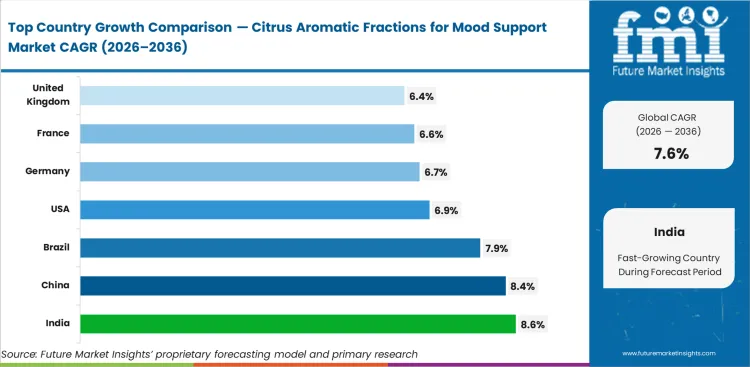
- Among key countries, India leads at 8.6% CAGR, followed by China at 8.4%, Brazil at 7.9%, United States at 6.9%, Germany at 6.7%, France at 6.6%, and United Kingdom at 6.4%.
- Expansion is moderated by evidence limitations, safety and sensitization issues around some citrus constituents, and competition from lavender, chamomile, saffron, lemon balm, and broader mood-support botanicals.
- Product and Segment View
- The market includes essential oils, terpene fractions, folded oils, and isolates sourced mainly from sweet orange, bergamot, bitter orange, lemon, mandarin, and grape fruit, aimed primarily at inhalation-led mood support and adjacent wellness use.
- Usage spans diffusers, roll-ons, inhalers, room sprays, and personal-wellness routines, while ingestion-led formats remain secondary in this market title.
- Essential oils lead the product type segment with 41.0% share, because finished mood-support products still rely more on recognizable whole aromatic profiles than on single-molecule isolates.
- Sweet orange leads the source fruit segment with 29.0% share, reflecting its broad emotional-positioning appeal, lower odor harshness, and wide supply availability.
- Diffuser oils lead the delivery format segment with 46.0% share, supported by home-use convenience and strong fit with mood-lift and stress-relief rituals.
- Aromatherapy leads the end use segment with 52.0% share, since most commercial demand is still tied to ambient inhalation and emotional-wellbeing positioning rather than regulated therapeutic channels.
- B2C online leads the sales channel segment with 39.0% share, helped by repeat purchases, direct education, and cross-selling of oils, diffusers, and blends.
- Scope includes citrus-derived aromatic fractions sold for mood support in wellness and aromatherapy; it excludes synthetic fragrance-only accords, non-citrus mood botanicals, and prescription or drug-style neuropsychiatric products.
- Geography and Competitive Outlook
- India, China, and Brazil rank among fastest-growing national markets, while the United States remains a stable high-value demand base.
- Competition reflects direct-to-consumer brand ecosystems, citrus-crop volatility, proprietary blends, and supplier control over citrus-oil quality, traceability, and fraction consistency.
- dōTERRA, Young Living, Givaudan, Symrise AG, Berjé, Citrus and Allied Essences, and Ultra International remain key participants across finished blends, fragrance systems, and bulk ingredient supply.
- Market concentration stays moderate to low, with a few key finished-product players.
Key Takeaways, Market Size, and Forecast
- Citrus Aromatic Fractions for Mood Support Market is projected to grow from USD 472.8 million in 2026 to USD 983.6 million by 2036, at a CAGR of 7.6%.
- The citrus aromatic fractions for mood support market was valued at USD 439.4 million in 2025.
- By 2036, the Citrus Aromatic Fractions for Mood Support Market is expected to be worth USD 983.6 million.
- From 2026 to 2036, the market is projected to expand at a CAGR of 7.6%.
- The market is projected to create an incremental opportunity of USD 510.8 million between 2026 and 2036.
- In 2026, Essential Oils are expected to account for 41.0% of the product type segment.
- India (8.6%) and China (8.4%) are two of the fastest growing markets.
The consumer wellness industry is shifting its focus for aromatic ingredients from basic citrus oils to more rigorously standardized aromatic fractions. This shift reflects the need for consistent evaporation behavior in inhalation products, which are sensitive to room temperature, humidity, and usage conditions. Suppliers now prioritize documented Gas Chromatography-Mass Spectrometry (GC-MS) profiling for mood-relevant compounds over simple bulk oil pricing. This demand is pushing raw-material suppliers to provide stronger documentation, cleaner fractionation methods, and tighter batch-to-batch consistency. Brands that fail to make this transition risk inconsistent sensory performance, weaker product credibility, and greater scrutiny of claims in wellness retail.
Development of high-potency mood-support products is being advanced by formulation teams focusing on targeted aromatic clusters. Such innovation is expanding product applications across personal care, ambient wellness, and various functional formats. One key development is the use of refined aromatic fractions, which reduce the off-notes found in crude extracts. This makes integration easier in premium product bases while preserving sensory quality.
Better stabilization of volatile aromatic fractions in aqueous and hybrid delivery systems is supporting market growth. Stabilization is critical for maintaining unique, bright top-notes linked to feelings of freshness and emotional uplift. Improved stabilization systems are helping brands balance aromatic strength with longer shelf life. Such enhanced stability is allowing brands to expand beyond niche aromatherapy offerings and build broader wellness portfolios capable of satisfying sustained retail demand.
Sales in India are projected to expand at an 8.6% CAGR, supported by a rising domestic aromatherapy trade, broader urban wellness spending, and stronger digital access to premium personal care and home-fragrance products. China is set to advance at an 8.4% CAGR during the forecast period, with growth supported by sophisticated e-commerce wellness channels, premiumization across self-care categories, and a large middle-income consumer base seeking emotionally supportive lifestyle products. Brazil is anticipated to record a 7.9% CAGR through 2036, aided by established citrus processing capacity that gives domestic formulators a meaningful sourcing and cost advantage. Demand in the United States is expected to rise at a 6.9% CAGR over the forecast period, supported by premium botanical positioning, brand investment in traceability, and continued consumer interest in clean-label emotional wellness. Germany is likely to register the market expansion at a 6.7% CAGR through 2036, as buyers continue favoring ethically sourced botanical inputs backed by strong quality documentation. France is projected to witness a 6.6% CAGR in this market during the study period, supported by mature aromatherapy acceptance and premium beauty culture. The United Kingdom is poised to expand at a 6.4% CAGR through 2036, although a mature market structure and tighter shelf competition keep entry conditions more demanding than fast-expanding Asia markets.
Citrus Aromatic Fractions for Mood Support Market Key Takeaways
| Metric | Details |
|---|---|
| Industry Size (2026) | USD 472.8 million |
| Industry Value (2036) | USD 983.6 million |
| CAGR (2026-2036) | 7.6% |
Source: Future Market Insights (FMI) analysis, based on proprietary forecasting model and primary research
Segmental Analysis
Citrus Aromatic Fractions for Mood Support Market Analysis by Product Type
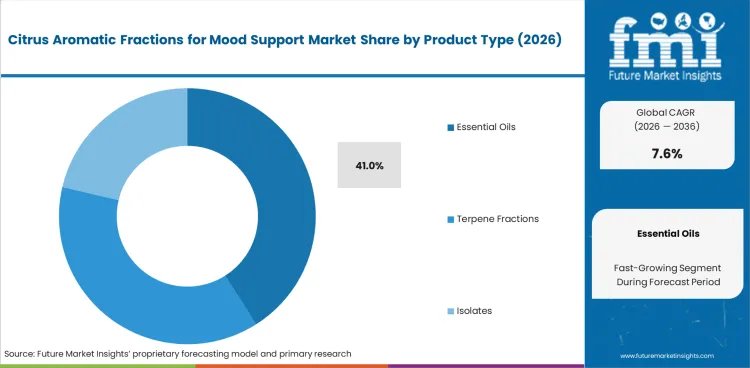
The essential oils segment is estimated to account for 41.0% share in 2026. Premium retail positioning and spa-led demand continue to support that lead, even as purified fractions gain attention in broader-volume applications. Authenticity is a key driver in the mood-support aromatics market, giving essential oils a significant commercial advantage in premium wellness products. Consumer preference still leans toward less-refined aromatic systems because of complex scent profiles, minor-constituent synergy, established aromatherapy use, and clean-label botanical sourcing. The connection consumers make between whole-oil profiles and natural wellness value pressures sourcing teams to use cold-pressed supplies, despite the resulting challenges in storage, transport, and oxidation control. Aromatherapy practitioners also favor whole-oil use, especially for profiles like tangerine essential oil, believing that the nuanced balance of constituents is vital for the desired emotional effect and sensory quality. Use of whole oils introduces considerable formulation difficulties compared to highly refined isolates, particularly in formats sensitive to stability.
- Whole-profile validation: Preference for layered, natural-smelling aromatic systems keeps cold-pressed sourcing relevant in premium product lines, pushing supply-chain teams to manage higher freight exposure, tighter storage standards, and stronger oxidation safeguards to preserve volatile integrity.
- Isolate-purity focus: Formulation specialists in functional beverage and hybrid wellness formats secure valencene and related isolates to maintain flavor-aroma precision without bitter carryover, allowing active mood-support positioning to scale more smoothly across larger manufacturing programs.
- Stability-led Purchasing: Product teams assessing shelf-life risk increasingly adopt terpene fractions for long-life roll-ons and similar formats, lowering oxidation concerns and reducing exposure to complaints linked with degraded aromatic material.
Citrus Aromatic Fractions for Mood Support Market Analysis by Source Fruit
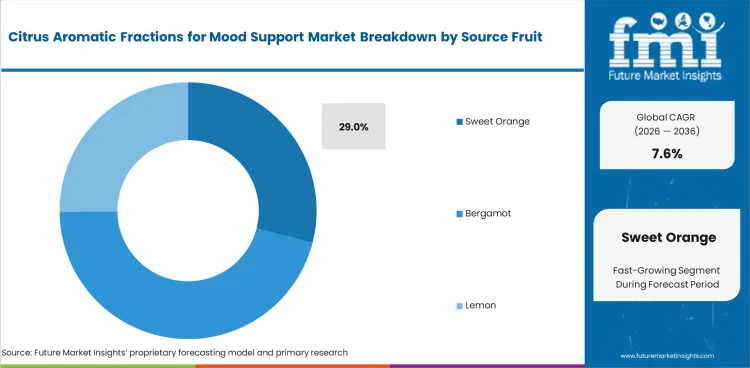
Sweet orange remains commercially important due to one simple structural advantage: abundant supply flowing from the global juice industry. Waste material from orange processing gives companies a steady supply of raw ingredients, keeps costs more predictable, and offers a smell that works well for everyday wellness products. Ingredients taken from orange-processing leftovers often give big consumer brands a good balance between cost and performance, making it easier to expand production without facing sharp price jumps tied to less common citrus types. Though Bergamot is attractive for stress-relief products, its global portfolio use is restricted as a primary ingredient due to limited cultivation availability and significant price instability. Sweet orange also works effectively as a blending base for more expensive materials such as neroli or yuzu, helping preserve an uplifting and familiar sensory signature while controlling finished-product economics. In 2026, sweet orange is expected to contribute 29.0% of total market share. That position also reflects its usefulness as a practical foundation for both entry-tier and mid-premium mood-support blends.
- Volume-led anchor: Large-scale orange processing in Florida and Brazil gives brands a reliable route for expanding mood-lift product lines with steadier cost visibility, creating a workable path for mid-tier wellness labels entering broader consumer channels.
- Specialty-niche qualification: Cosmetic chemists at luxury labels use grapefruit oil to create sharper product differentiation from common sweet-orange profiles seen across lower-priced offerings, supporting more sophisticated scent identity and stronger premium shelf presence.
- Claim-specific sourcing: Stress-relief formulations frequently lean toward Bergamot extract since its higher linalool profile supports stronger emotional-benefit positioning, giving brands a more distinctive therapeutic narrative than simple ambient fragrance placement.
Citrus Aromatic Fractions for Mood Support Market Analysis by Delivery Format
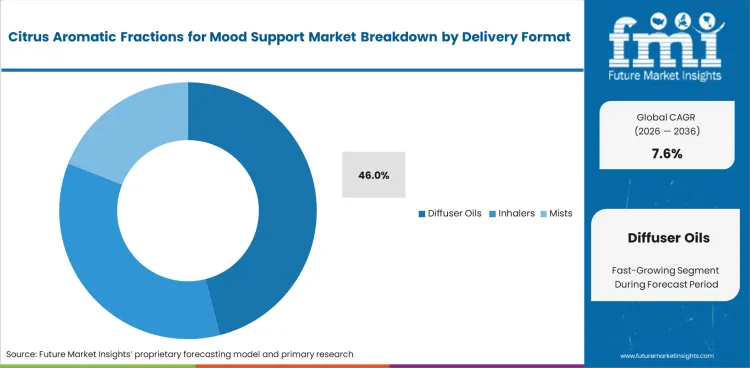
The diffuser oils is expected to account for 46.0% share in 2026. Delivery format has a strong effect on how mood-support aromatics perform, and this continues to favor diffuser oils. Ambient inhalation offers a rapid sensory route for emotional impact, making diffusion a more immediate experience compared to many topical alternatives. Demand for this category is boosted by several factors such as integration of daily home wellness rituals, growing ownership of diffuser hardware, and desire for passive mood regulation during work, rest, and evening routines. Buyer preferences are shifting toward ultrasonic and nebulizing systems. These advanced devices are favored over heat-based options because they more effectively preserve the delicate character of terpenes, thereby enhancing sensory fidelity and supporting premium refill programs. A key commercial strength of this category is the recurring purchase behavior it encourages, as hardware ownership consistently drives repeat buying of compatible aroma ingredients liquids and proprietary blends. Control over both dispensing systems and consumable liquid continues to strengthen brand retention and repeat sales across this category.
- Ritual-led adoption: Daily citrus flavors diffusion supports sustained volume movement across home-wellness channels, embedding product use into morning reset and evening unwind routines that encourage faster replenishment.
- On-the-go qualification: Corporate wellness initiatives are expanding use of inhalers and roll-ons for quick stress relief during high-pressure work cycles, opening a decentralized route to consumers outside traditional store-based distribution.
- Clinical-environment expansion: Hospital and care-setting evaluation of ambient citrus misting for pre-procedure anxiety reduction is opening an institutional lane for high-purity fractions, raising demand for standardization and adding credibility to qualified suppliers.
Citrus Aromatic Fractions for Mood Support Market Drivers, Restraints, and Opportunities
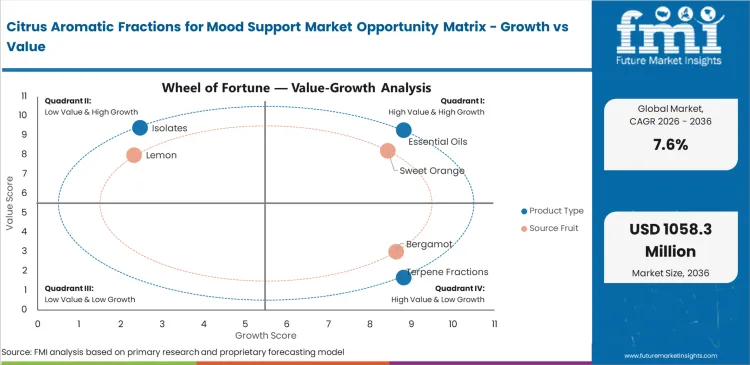
Cognitive fatigue, emotionally taxing urban routines, and rising interest in small daily wellness rituals are strengthening commercial demand for citrus aromatic fractions in mood-support applications. Brands increasingly use such fractions as quick sensory reset tools across home fragrance, personal care, topical wellness, and inhalation-led formats. The retail environment demonstrates a growing focus on ingredients that offer defined emotional benefits, moving beyond mere passive scent. This shift is reinforced by increased scientific investigation into the performance of citrus terpenes. Aromatherapy experts and formulators are more confidently developing stress-relief products centered on specific citrus fractions, rather than relegating these materials to secondary fragrance roles. The continued alignment of sensory appeal, recognizable botanicals, and wellness claims is widening market appeal. Brands that fail to meet this demand risk losing shelf space to competing mood-support botanical products.
Clean beauty expectations are exposing a deeper technical challenge across this market: aromatic stability under real storage and usage conditions. Oxidation risk remains a major concern, particularly for limonene-rich materials that can become more sensitizing after degradation. Premium skincare and adjacent leave-on applications face tighter scrutiny as a result, pushing brands toward stabilized fractions, antioxidant-protected systems, and stronger packaging discipline. Limonene sensitization risk is pushing brands to invest in stabilized oils or antioxidant-protected fractions that reduce irritation after oxidation. Smaller suppliers often struggle to fund advanced oxidative-stability testing, full safety documentation, and repeat batch validation at the level demanded by retail buyers and premium wellness brands. That cost burden can narrow supplier access and slow adoption across quality-sensitive channels.
Opportunities in the Citrus Aromatic Fractions for Mood Support Market
- Clinical-Adjacent Wellness: Clinical-adjacent wellness presents a promising commercial opportunity. Hospital-grade lemon compound delivery systems aimed at easing patient stress can create a higher-value institutional route for carefully standardized aromatic ingredients.
- Synergy-Based Systems: Synergy-based systems offer another attractive path. Rosemary-citrus antioxidant systems give brands a dual-positioning platform that links emotional support with skin or personal care benefits, adding more depth to finished-product positioning.
- Precision Quality-control: Rigorous supplier selection criteria allow mid-size brands to secure traceable, pesticide-free fractions that appeal directly to the conscious consumer demographic.
Regional Analysis
Based on regional analysis, the citrus aromatic fractions for mood support market is segmented into North America, Europe, Asia Pacific, Latin America, and Middle East & Africa across 40 plus countries.
.webp "Top Country Growth Comparison Citrus Aromatic Fractions For Mood Support Market Cagr (2026 2036)")
| Country | CAGR (2026 to 2036) |
|---|---|
| India | 8.6% |
| China | 8.4% |
| Brazil | 7.9% |
| United States | 6.9% |
| Germany | 6.7% |
| France | 6.6% |
| United Kingdom | 6.4% |
Source: Future Market Insights (FMI) analysis, based on proprietary forecasting model and primary research
Asia Pacific Citrus Aromatic Fractions for Mood Support Market Analysis
Digital wellness platforms across Asia Pacific are moving far beyond simple online retail and are now determining product discovery, ingredient awareness, and premium buying behavior for mood-support aromatics. Urban consumers with strong exposure to self-care content increasingly treat aromatherapy as part of daily focus, calm, and emotional reset routines rather than as an occasional indulgence. Ultrasonic diffusers, portable inhalers, and compact ambient formats are gaining visibility across major metropolitan centers, especially in high-pressure work settings that favor fast sensory relief without pharmaceutical association. Supply networks across the region are responding through stronger traceability, cleaner botanical positioning, and more disciplined fraction standardization suited to cross-border digital commerce. Product quality, sensory consistency, and origin credibility are now being considered while making purchase decisions, giving suppliers with validated botanical portfolios a clearer commercial edge.
- India: India continues to draw strong demand from rising urban stress, expanding digital wellness storefronts, growing fusion between ayurvedic practice and modern aromatherapy, and higher discretionary spending across professional consumer groups. Product visibility has improved across online-first personal care and home-wellness channels, while familiar acceptance of plant-based wellness concepts gives citrus-derived mood-support fractions a practical route into broader daily-use formats. Demand for citrus aromatic fractions for mood support in India is anticipated to rise at a CAGR of 8.6% from 2026 to 2036. Continuous movement toward premium but accessible emotional-wellness products support growth.
- China: Sales of citrus aromatic fractions for mood support market in China are expected to increase at a CAGR of 8.4% during the forecast period. Demand is driven by a strong gifting culture in premium wellness and home-fragrance categories. China is gaining advantage from a highly developed cross-border e-commerce structure, stronger consumer attention toward clean-label sourcing, rising investment in urban wellness infrastructure, and a visible preference for premium imported botanical inputs across upper-middle-income buyers. Citrus aromatic products used for stress relief, freshness, and emotional balance fit well into digitally led self-care purchasing habits, especially in premium urban clusters. This demand is supported by cross-border e-commerce, stronger scrutiny of clean-label sourcing, rising investment in urban wellness infrastructure, and preference for imported botanical ingredients.
FMI’s report includes additional countries like Japan, South Korea, and Australia. Meditative living, sensory refinement, and preference for premium aromatic profiles in Japan are opening room for high-purity yuzu flavor extracts and mandarin fractions that command pricing well above generic orange oils.
Latin America Citrus Aromatic Fractions for Mood Support Market Analysis
Market growth in Latin America comes from direct proximity to raw citrus supply, deep processing infrastructure, and an operating environment that supports fresher aromatic material for both domestic use and export programs. Supply-side advantage strengthens commercial feasibility for mood-support formulations by reducing transit-related oxidation risk and improving access to recently processed botanical fractions. Extraction facilities across key producing zones are upgrading into higher-value folded oils, isolates, and specialized fractions prepared closer to source, creating stronger economics than long-distance shipment of lower-value material. Domestic wellness brands are taking advantage through better input access, lower freshness-related losses, and a more practical path toward premium product development. Margin protection improves further in periods of freight volatility, giving this region an important strategic role in global citrus-derived wellness ingredients. Infrastructure depth in Latin America defines the demand for citrus oil in EU and global sectors, and the domestic mood-support layer is accelerating rapidly due to supply-side proximity.
- Brazil: Market expansion in the country is expected, due to large-scale citrus processing, extensive vertical integration across flavor and fragrance houses, reduced exposure to transoceanic degradation, and growing local base of boutique wellness brands working with specialized L-limonene oil and related aromatic fractions. The citrus aromatic fractions for mood support market in Brazil is poised to expand at a CAGR of 7.9% through 2036. Local processing depth continues to strengthen both export competitiveness and domestic value creation. Supply continuity gives formulators room to launch premium mood-support blends with stronger consistency and better input control than many import-dependent markets can sustain.
FMI’s report includes additional countries like Mexico, Argentina, and Colombia. Regional producers are using local citrus availability to build smaller aromatherapy brands centered on provenance, artisanal extraction, and direct trade relationships with farming cooperatives.
North America Citrus Aromatic Fractions for Mood Support Market Analysis
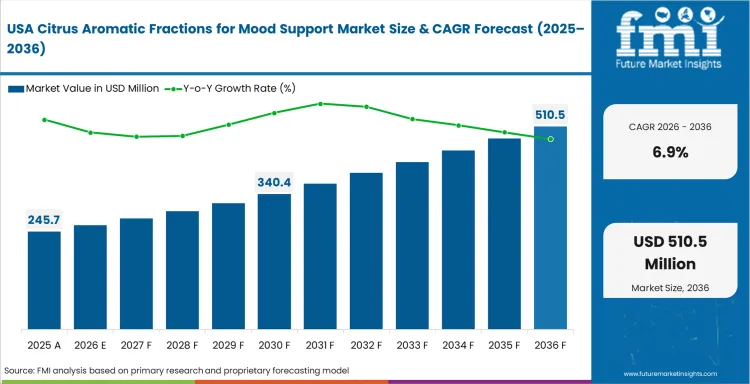
Ingredient transparency expectations across North America now determine product development, sourcing decisions, and retail acceptance at a very high level. Wellness brands operating in this region face close scrutiny around safety support, allergen disclosure, and evidence-backed claims, making precision in raw material selection far more important than simple fragrance appeal. Buyers increasingly favor fractions supplied with extensive documentation, including safety files, allergen statements, and efficacy-related testing that supports premium emotional-wellness positioning. Clinical-adjacent wellness, premium botanical storytelling, and clean-label expectations together continue to define this market’s operating strategies. Ingredient transparency has moved from a preference to a requirement across much of North America, which is pushing wellness brands toward better-documented botanical systems that include citrus.
- United States: The United States is set to record a CAGR of 6.9% in citrus aromatic fractions for mood support market during the assessment period. Demand in the United States is rising due to tighter regulatory expectations, and stronger commercialization of emotional-wellbeing positioning. Premium consumer willingness to pay for GC-MS-tested botanicals, and continued expansion across clinical-adjacent wellness channels are driving product demand. High-value buyers often seek documented ingredient quality before purchase, especially in premium aromatherapy, personal-wellness, and ambient scent applications. Mature retail structures and high trust requirements keep quality assurance central to competitive advantage.
FMI’s report includes additional countries like Canada. Demand in Canada is gaining support from citrus blends paired with forest-inspired botanicals and calming aromatic concepts suited to premium wellness positioning.
Europe Citrus Aromatic Fractions for Mood Support Market Analysis
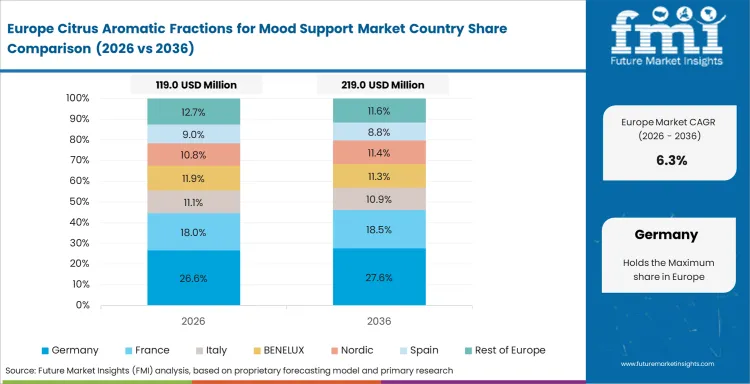
Regulatory framework is one of the key factors determining Europe’s market structure for citrus aromatic fractions used in mood support. Wellness companies across this region operate under demanding compliance frameworks tied to sensitization documentation, ingredient traceability, allergen declarations, and broader REACH-linked expectations. Market maturity is already well established, so incremental gains depend less on raw volume expansion and more on premiumization, cleaner sourcing, and clinical-adjacent credibility. Buyers are increasingly shifting preference from synthetic mood-positioned ingredients and toward traceable, high-purity citrus fractions backed by batch validation and ethical sourcing support. Entry barriers therefore remain substantial for low-cost generic suppliers, while established fragrance houses with stronger documentation capabilities continue to protect commercial influence.
- Germany: Germany is gaining advantage from institutional acceptance of wellness protocols, rigorous certification culture, and strong spending power in clean-label personal care. Product credibility, documentation strength, and supply reliability matter greatly in this market, giving established botanical suppliers an advantage in long-cycle commercial relationships. Sales across Germany are poised to grow at a CAGR of 6.7% during the assessment period. Continued preference for well-documented botanical inputs keeps demand stable across premium channels.
- France: France benefits from a long history in fragrance creation and a luxury retail sector that supports high-end aromatherapy. Broad appreciation for provenance-backed whole oils, along with sophisticated domestic formulation expertise, is supporting product adoption. Market culture that values sensorial refinement alongside emotional-wellness positioning, especially in major beauty and home-fragrance brands is an added advantage. France is anticipated to register a CAGR of 6.6% over the forecast period. Premiumization remains a key commercial lever across retail and formulation strategy in France.
- United Kingdom: Urban cognitive fatigue, growing use of portable inhalers, and expansion of subscription-led home diffuser platforms, reinforce demand across the United Kingdom. Strict clean beauty expectations, and rising incorporation of mood-support botanicals into premium skincare are also supporting market growth. Consumer familiarity with self-care rituals supports repeat purchasing, especially in digitally influenced categories due to home ambiance and emotional reset. The market for citrus aromatic fractions for mood support market in the United Kingdom is expected to grow at a rate of 6.4% during the study period. Brand retention remains closely linked to sensory consistency, refill behavior, and trust in ingredient quality.
Competitive Aligners for Market Players
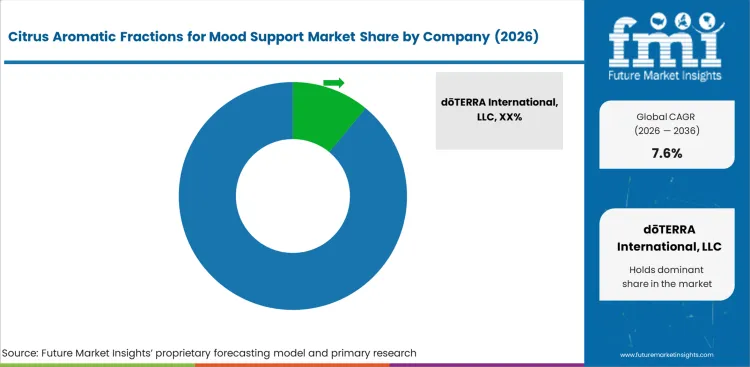
Manufacturer dynamics operate with moderate concentration at the extraction tier, where major firms like Givaudan and Symrise AG control high-purity isolation technology. The retail layer remains highly fragmented within the citrus aromatic fractions for mood support market. Buyers qualify suppliers based on claim-readiness rather than aromatic potency alone. Fragrance and botanical extraction firms must provide the safety data and clinical narrative required to support the fraction. Direct-to-consumer brands such as dōTERRA have built strong positions by creating ecosystems that bypass traditional retail and shape customer education through large distributor networks.
Incumbents hold an advantage through larger certification libraries, including validated formulas and stability profiles that are difficult for challengers to match quickly. Berjé and Citrus and Allied Essences maintain their position by bridging raw citrus processing and the refined wellness channel, providing supply chain visibility that newer fragrance houses struggle to match. Ultra International B.V. uses its global sourcing network to supply provenance-based oils, which aligns with demand for ethical and traceable botanical ingredients.
Large wellness brands resist vendor lock-in by qualifying secondary suppliers for critical fractions like bergamot and bitter orange, though matching specific aromatic signatures makes this a slow transition. Agricultural volatility compels companies to diversify their geographic sourcing. Competition relies increasingly on the ownership of proprietary aromatic synergies rather than raw volume, as customized stabilization blends prove harder for low-cost generic producers to replicate.
Key Players in Citrus Aromatic Fractions for Mood Support Market
- dōTERRA International, LLC
- Young Living Essential Oils
- Givaudan
- Symrise AG
- Berjé Inc.
- Citrus and Allied Essences Ltd.
- Ultra International B.V.
Scope of the Report
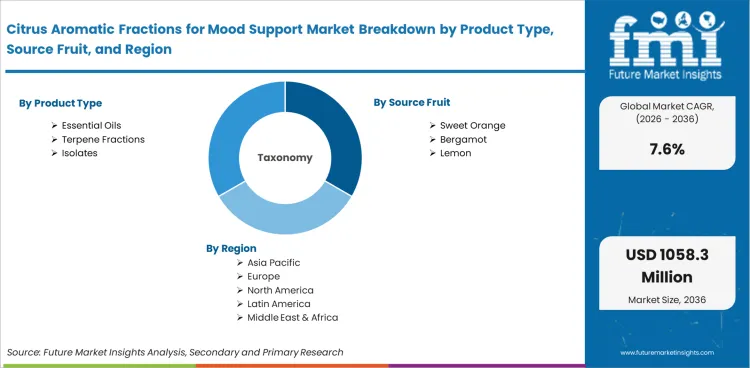
| Metric | Value |
|---|---|
| Quantitative Units | USD 472.8 million in 2026 to USD 983.6 million by 2036, at a CAGR of 7.6% |
| Market Definition | Precision wellness sector focused on citrus-derived aromatic molecules utilized to influence emotional states through inhalation-led delivery, prioritizing chemical purity and specific terpene ratios. |
| Segmentation | Product Type, Source Fruit, Delivery Format, End Use, Sales Channel, Region |
| Regions Covered | North America, Latin America, Europe, Asia Pacific, Middle East & Africa |
| Countries Covered | United States, Brazil, Germany, France, United Kingdom, China, India, and 30+ others |
| Key Companies Profiled | dōTERRA, Young Living, Givaudan, Symrise AG, Berjé, Citrus and Allied Essences, Ultra International |
| Forecast Period | 2026 to 2036 |
| Approach | FMI's model cross-references USDA citrus-processing throughput with retail-side wellness demand and parent-market ratios within the global essential-oils trade. |
Source: Future Market Insights (FMI) analysis, based on proprietary forecasting model and primary research
Citrus Aromatic Fractions for Mood Support Market Analysis by Segments
Product Type
- Essential oils
- Terpene fractions
- Folded oils
- Isolates
Source Fruit
- Sweet orange
- Bergamot
- Bitter orange
- Lemon
- Mandarin
- Grapefruit
Delivery Format
- Diffuser oils
- Roll-ons
- Inhalers
- Room sprays
- Mists
End Use
- Aromatherapy
- Personal care
- Home ambience
- Clinical wellness
- Functional ingestibles
Sales Channel
- B2C online
- Specialty retail
- MLM direct
- B2B ingredients
- Practitioners
Region
- North America
- United States
- Canada
- Europe
- Germany
- United Kingdom
- France
- Italy
- Spain
- Asia Pacific
- China
- Japan
- South Korea
- Taiwan
- Singapore
- Latin America
- Brazil
- Mexico
- Argentina
- Middle East & Africa
- GCC Countries
- South Africa
- Israel
- Rest of Middle East & Africa
Bibliography
- Luying Liu, Rui Liu, Lijun Zhang, and Yuanyuan Tang (2024). The effect of aromatherapy on patients with acute coronary syndrome: A systematic review and meta-analysis.
- Fatemeh Mahmoodabadipoor, Zahra Imani-Goghary, Mohadeseh Balvardi, Esmat Nouhi. (2024). Effect of Citrus aurantium and chamomile aromas on anxiety and vital signs in cardiac care unit patients: A randomized clinical trial. Health Science Reports, 7(12), e70113.
- Judith Czakert, Farid I. Kandil, Hiba Boujnah, Pantea Tavakolian, Sarah B. Blakeslee, Wiebke Stritter, Henrik Dommisch & Georg Seifert (2024). Scenting serenity: Influence of essential-oil vaporization on dental anxiety - A cluster-randomized, controlled, single-blinded study (AROMA_dent).
- Maryam Moradi, Azin Niazi, Fereshteh Mohammadi Payandar, Jamshid Jamali, and Noushin Arefadib. (2025). The effect of aromatherapy with Citrus aurantium essential oil on depression, stress and anxiety in pregnant women: A randomized controlled clinical trial. Taiwanese Journal of Obstetrics & Gynecology.
- Esra Özer, Şerife İrem Döner & Hafize Dağ Tüzmen (2025). The effect of aromatherapy intervention with bergamot and grapefruit essential oils on premenstrual syndrome and menstrual symptoms: A randomized controlled trial.
This bibliography is provided for reader reference. The full FMI report contains the complete reference list with primary source documentation.
This Report Addresses
- Structural relationship between global orange-processing throughput and the high-value aromatherapy niche within the citrus aromatic fractions for mood support market.
- Competitive impact of standardized terpene fractions on the traditional whole-oil aromatherapeutic narrative.
- Operational hurdles of stabilizing volatile citrus molecules within modern aqueous personal-care bases.
- Role of MLM direct-to-consumer ecosystems in shaping global consumer education regarding uplifting aromatic cues.
- Regulatory friction between natural citrus sensitization risks and the demand for clean-label mood support.
- Comparative growth dynamics between mature Western demand centers and accelerating Asian wellness channels.
- Impact of citrus crop volatility in Brazil on the margin stability of global fragrance and wellness houses.
- Technological shift from heat-based diffusion to ultrasonic nebulizing systems for preserving aromatic fraction integrity.
Frequently Asked Questions
How big is the market?
The sector is assessed at USD 439.4 million in 2025 and is projected to reach USD 983.6 million by 2036. This figure represents a narrow, application-specific segment of the broader essential-oils industry, focused exclusively on wellness and aromatherapy channels.
What is driving demand for these ingredients?
Cognitive fatigue and rising urban stress compel wellness personnel to integrate quick emotional reset tools into daily routines. Clinical validation of specific terpenes stabilizes buyer confidence, moving these ingredients from optional additives to mandatory functional actives.
Which citrus oils are used for anxiety support?
Bergamot, bitter orange, and lemon are the most frequently utilized oils for anxiety protocols. Bergamot and bitter orange contain higher ratios of linalool, which aligns closely with stress-reduction literature, while lemon retains relevance through trait-anxiety reduction studies.
Are citrus essential oils effective for stress relief?
Clinical literature indicates that specific fractions are effective when utilized in targeted inhalation protocols. The evidence base is bounded by safety constraints, meaning formulation stability and chemical purity dictate the actual therapeutic outcome.
Can you explain the aromatic fractions space for mood support?
This is a precision wellness sector focused on citrus-derived aromatic molecules utilized to influence emotional states. Unlike the broader industrial citrus oil trade, this niche prioritizes chemical purity, targeted terpene ratios, and functional fragrance capabilities.
Which companies supply these fractions for wellness brands?
Key suppliers include major fragrance houses like Givaudan and Symrise AG, as well as specialized botanical extraction firms such as Berjé Inc., Citrus and Allied Essences Ltd., and Ultra International B.V. These companies provide the standardized fractions and safety data required for commercialization.
What is the best citrus oil for anxiety?
Sweet orange is the most popular for general uplift, but clinical evidence often points to Citrus aurantium (bitter orange) and bergamot as superior options for targeted anxiety reduction due to their specific linalool and linalyl acetate profiles.
What does the bitter orange anxiety evidence reveal?
Network meta-analyses place Citrus aurantium among the more effective essential-oil interventions for anxiety reduction. This supports its stronger positioning in clinical-adjacent wellness applications.
How does limonene research influence formulation?
Research validating limonene's uplifting properties drives cosmetic chemists to isolate and standardize this terpene. Its tendency to oxidize requires brands to invest in antioxidant stabilization to prevent skin sensitization.
Why does sweet orange lead commercial mood products?
Sweet orange holds the dominant share due to its massive supply availability as a byproduct of the global juice industry. This allows for the most consistent price-to-potency ratio for large-scale wellness brands.
Why do diffuser oils dominate this category?
Diffuser oils capture a 46.0% share because they align with the ritualization of home wellness. The convenience of ambient inhalation makes this the most commercially intuitive format for sustaining repeat purchases.
What are the fastest-growing countries in this market?
India leads at an 8.6% CAGR, followed closely by China at 8.4%. Rapid urbanization and expanding digital wellness ecosystems in these regions are driving sophisticated demand for mood-support fractions among the middle class.
What risks limit growth in mood-support ingredients?
The primary limits are formulation stability challenges and sensitization risks. Constituents like limonene can oxidize into skin irritants, forcing brands to navigate tightening clean beauty regulations and invest in expensive stability testing.
How is this niche different from the broader citrus-oil industry?
The broader trade focuses on raw volume for food flavoring and industrial solvents. This niche evaluates oils based on psychological outcomes, requiring higher purity, specific psycho-aromatherapeutic profiles, and rigorous safety documentation.
Are aromatic fractions used more in aromatherapy or in supplements?
Aromatherapy remains the dominant end-use, as inhalation provides the fastest limbic system response. Functional ingestibles and supplements represent a secondary, emerging channel that requires distinct food-grade qualification.
How do crop failures in Brazil affect global products?
Because Brazil is a primary source of orange aromatic byproduct, crop volatility causes immediate price spikes in the wellness channel. Companies must secure diversified sourcing to maintain margin stability during agricultural events.
What prevents synthetic citrus accords from competing here?
Authentic aromatherapy relies on the complex chemical synergy of natural plant molecules to trigger neuro-emotional responses. Synthetic accords lack this complexity and are routinely rejected by the clean-label consumer base.
Are there non-citrus botanicals that compete for stress relief applications?
Lavender and chamomile remain the primary competitors for calming protocols, while saffron and lemon balm challenge the mood-lift niche. Citrus maintains its edge through its uniquely uplifting and refreshing odor profile.
How do ultrasonic diffusers impact the quality of fractions?
Unlike heat-based diffusers, ultrasonic systems use high-frequency vibrations to disperse the oil. This avoids thermal degradation, ensuring the consumer receives the full aromatherapeutic benefit of delicate citrus terpenes.
What does the term "functional fragrance" imply for procurement?
It implies that the aromatic fraction is selected for a specific psychological outcome, such as alertness or calm, rather than mere aesthetic appeal. This forces a transition toward rigorous, standardized terpene testing across the supply chain.
Preview the report firsthand - request a free sample
Get SampleGet the brochure for pricing and purchase details.
Get PDFTable of Content
- Executive Summary
- Global Market Outlook
- Demand-side Trends
- Supply-side Trends
- Technology Roadmap Analysis
- Analysis and Recommendations
- Market Overview
- Market Coverage / Taxonomy
- Market Definition / Scope / Limitations
- Research Methodology
- Chapter Orientation
- Analytical Lens and Working Hypotheses
- Market Structure, Signals, and Trend Drivers
- Benchmarking and Cross-market Comparability
- Market Sizing, Forecasting, and Opportunity Mapping
- Research Design and Evidence Framework
- Desk Research Programme (Secondary Evidence)
- Company Annual and Sustainability Reports
- Peer-reviewed Journals and Academic Literature
- Corporate Websites, Product Literature, and Technical Notes
- Earnings Decks and Investor Briefings
- Statutory Filings and Regulatory Disclosures
- Technical White Papers and Standards Notes
- Trade Journals, Industry Magazines, and Analyst Briefs
- Conference Proceedings, Webinars, and Seminar Materials
- Government Statistics Portals and Public Data Releases
- Press Releases and Reputable Media Coverage
- Specialist Newsletters and Curated Briefings
- Additional Desk Sources
- Expert Input and Fieldwork (Primary Evidence)
- Primary Modes
- Qualitative Interviews and Expert Elicitation
- Quantitative Surveys and Structured Data Capture
- Blended Approach
- Why Primary Evidence is Used
- Field Techniques
- Interviews
- Surveys
- Focus Groups
- Observational and In-context Research
- Social and Community Interactions
- Stakeholder Universe Engaged
- C-suite Leaders
- Board Members
- Presidents and Vice Presidents
- R&D and Innovation Heads
- Technical Specialists
- Domain Subject-matter Experts
- Scientists
- Physicians and Other Healthcare Professionals
- Governance, Ethics, and Data Stewardship
- Research Ethics
- Data Integrity and Handling
- Primary Modes
- Tooling, Models, and Reference Databases
- Desk Research Programme (Secondary Evidence)
- Data Engineering and Model Build
- Data Acquisition and Ingestion
- Cleaning, Normalisation, and Verification
- Synthesis, Triangulation, and Analysis
- Quality Assurance and Audit Trail
- Market Background
- Market Dynamics
- Drivers
- Restraints
- Opportunity
- Trends
- Scenario Forecast
- Demand in Optimistic Scenario
- Demand in Likely Scenario
- Demand in Conservative Scenario
- Opportunity Map Analysis
- Product Life Cycle Analysis
- Supply Chain Analysis
- Investment Feasibility Matrix
- Value Chain Analysis
- PESTLE and Porter’s Analysis
- Regulatory Landscape
- Regional Parent Market Outlook
- Production and Consumption Statistics
- Import and Export Statistics
- Market Dynamics
- Global Market Analysis 2021 to 2025 and Forecast, 2026 to 2036
- Historical Market Size Value (USD Million) Analysis, 2021 to 2025
- Current and Future Market Size Value (USD Million) Projections, 2026 to 2036
- Y-o-Y Growth Trend Analysis
- Absolute $ Opportunity Analysis
- Global Market Pricing Analysis 2021 to 2025 and Forecast 2026 to 2036
- Global Market Analysis 2021 to 2025 and Forecast 2026 to 2036, By Product Type
- Introduction / Key Findings
- Historical Market Size Value (USD Million) Analysis By Product Type , 2021 to 2025
- Current and Future Market Size Value (USD Million) Analysis and Forecast By Product Type , 2026 to 2036
- Essential Oils
- Terpene Fractions
- Isolates
- Essential Oils
- Y-o-Y Growth Trend Analysis By Product Type , 2021 to 2025
- Absolute $ Opportunity Analysis By Product Type , 2026 to 2036
- Global Market Analysis 2021 to 2025 and Forecast 2026 to 2036, By Source Fruit
- Introduction / Key Findings
- Historical Market Size Value (USD Million) Analysis By Source Fruit, 2021 to 2025
- Current and Future Market Size Value (USD Million) Analysis and Forecast By Source Fruit, 2026 to 2036
- Sweet Orange
- Bergamot
- Lemon
- Sweet Orange
- Y-o-Y Growth Trend Analysis By Source Fruit, 2021 to 2025
- Absolute $ Opportunity Analysis By Source Fruit, 2026 to 2036
- Global Market Analysis 2021 to 2025 and Forecast 2026 to 2036, By Delivery Format
- Introduction / Key Findings
- Historical Market Size Value (USD Million) Analysis By Delivery Format, 2021 to 2025
- Current and Future Market Size Value (USD Million) Analysis and Forecast By Delivery Format, 2026 to 2036
- Diffuser Oils
- Inhalers
- Mists
- Diffuser Oils
- Y-o-Y Growth Trend Analysis By Delivery Format, 2021 to 2025
- Absolute $ Opportunity Analysis By Delivery Format, 2026 to 2036
- Global Market Analysis 2021 to 2025 and Forecast 2026 to 2036, By Region
- Introduction
- Historical Market Size Value (USD Million) Analysis By Region, 2021 to 2025
- Current Market Size Value (USD Million) Analysis and Forecast By Region, 2026 to 2036
- North America
- Latin America
- Western Europe
- Eastern Europe
- East Asia
- South Asia and Pacific
- Middle East & Africa
- Market Attractiveness Analysis By Region
- North America Market Analysis 2021 to 2025 and Forecast 2026 to 2036, By Country
- Historical Market Size Value (USD Million) Trend Analysis By Market Taxonomy, 2021 to 2025
- Market Size Value (USD Million) Forecast By Market Taxonomy, 2026 to 2036
- By Country
- USA
- Canada
- Mexico
- By Product Type
- By Source Fruit
- By Delivery Format
- By Country
- Market Attractiveness Analysis
- By Country
- By Product Type
- By Source Fruit
- By Delivery Format
- Key Takeaways
- Latin America Market Analysis 2021 to 2025 and Forecast 2026 to 2036, By Country
- Historical Market Size Value (USD Million) Trend Analysis By Market Taxonomy, 2021 to 2025
- Market Size Value (USD Million) Forecast By Market Taxonomy, 2026 to 2036
- By Country
- Brazil
- Chile
- Rest of Latin America
- By Product Type
- By Source Fruit
- By Delivery Format
- By Country
- Market Attractiveness Analysis
- By Country
- By Product Type
- By Source Fruit
- By Delivery Format
- Key Takeaways
- Western Europe Market Analysis 2021 to 2025 and Forecast 2026 to 2036, By Country
- Historical Market Size Value (USD Million) Trend Analysis By Market Taxonomy, 2021 to 2025
- Market Size Value (USD Million) Forecast By Market Taxonomy, 2026 to 2036
- By Country
- Germany
- UK
- Italy
- Spain
- France
- Nordic
- BENELUX
- Rest of Western Europe
- By Product Type
- By Source Fruit
- By Delivery Format
- By Country
- Market Attractiveness Analysis
- By Country
- By Product Type
- By Source Fruit
- By Delivery Format
- Key Takeaways
- Eastern Europe Market Analysis 2021 to 2025 and Forecast 2026 to 2036, By Country
- Historical Market Size Value (USD Million) Trend Analysis By Market Taxonomy, 2021 to 2025
- Market Size Value (USD Million) Forecast By Market Taxonomy, 2026 to 2036
- By Country
- Russia
- Poland
- Hungary
- Balkan & Baltic
- Rest of Eastern Europe
- By Product Type
- By Source Fruit
- By Delivery Format
- By Country
- Market Attractiveness Analysis
- By Country
- By Product Type
- By Source Fruit
- By Delivery Format
- Key Takeaways
- East Asia Market Analysis 2021 to 2025 and Forecast 2026 to 2036, By Country
- Historical Market Size Value (USD Million) Trend Analysis By Market Taxonomy, 2021 to 2025
- Market Size Value (USD Million) Forecast By Market Taxonomy, 2026 to 2036
- By Country
- China
- Japan
- South Korea
- By Product Type
- By Source Fruit
- By Delivery Format
- By Country
- Market Attractiveness Analysis
- By Country
- By Product Type
- By Source Fruit
- By Delivery Format
- Key Takeaways
- South Asia and Pacific Market Analysis 2021 to 2025 and Forecast 2026 to 2036, By Country
- Historical Market Size Value (USD Million) Trend Analysis By Market Taxonomy, 2021 to 2025
- Market Size Value (USD Million) Forecast By Market Taxonomy, 2026 to 2036
- By Country
- India
- ASEAN
- Australia & New Zealand
- Rest of South Asia and Pacific
- By Product Type
- By Source Fruit
- By Delivery Format
- By Country
- Market Attractiveness Analysis
- By Country
- By Product Type
- By Source Fruit
- By Delivery Format
- Key Takeaways
- Middle East & Africa Market Analysis 2021 to 2025 and Forecast 2026 to 2036, By Country
- Historical Market Size Value (USD Million) Trend Analysis By Market Taxonomy, 2021 to 2025
- Market Size Value (USD Million) Forecast By Market Taxonomy, 2026 to 2036
- By Country
- Kingdom of Saudi Arabia
- Other GCC Countries
- Turkiye
- South Africa
- Other African Union
- Rest of Middle East & Africa
- By Product Type
- By Source Fruit
- By Delivery Format
- By Country
- Market Attractiveness Analysis
- By Country
- By Product Type
- By Source Fruit
- By Delivery Format
- Key Takeaways
- Key Countries Market Analysis
- USA
- Pricing Analysis
- Market Share Analysis, 2025
- By Product Type
- By Source Fruit
- By Delivery Format
- Canada
- Pricing Analysis
- Market Share Analysis, 2025
- By Product Type
- By Source Fruit
- By Delivery Format
- Mexico
- Pricing Analysis
- Market Share Analysis, 2025
- By Product Type
- By Source Fruit
- By Delivery Format
- Brazil
- Pricing Analysis
- Market Share Analysis, 2025
- By Product Type
- By Source Fruit
- By Delivery Format
- Chile
- Pricing Analysis
- Market Share Analysis, 2025
- By Product Type
- By Source Fruit
- By Delivery Format
- Germany
- Pricing Analysis
- Market Share Analysis, 2025
- By Product Type
- By Source Fruit
- By Delivery Format
- UK
- Pricing Analysis
- Market Share Analysis, 2025
- By Product Type
- By Source Fruit
- By Delivery Format
- Italy
- Pricing Analysis
- Market Share Analysis, 2025
- By Product Type
- By Source Fruit
- By Delivery Format
- Spain
- Pricing Analysis
- Market Share Analysis, 2025
- By Product Type
- By Source Fruit
- By Delivery Format
- France
- Pricing Analysis
- Market Share Analysis, 2025
- By Product Type
- By Source Fruit
- By Delivery Format
- India
- Pricing Analysis
- Market Share Analysis, 2025
- By Product Type
- By Source Fruit
- By Delivery Format
- ASEAN
- Pricing Analysis
- Market Share Analysis, 2025
- By Product Type
- By Source Fruit
- By Delivery Format
- Australia & New Zealand
- Pricing Analysis
- Market Share Analysis, 2025
- By Product Type
- By Source Fruit
- By Delivery Format
- China
- Pricing Analysis
- Market Share Analysis, 2025
- By Product Type
- By Source Fruit
- By Delivery Format
- Japan
- Pricing Analysis
- Market Share Analysis, 2025
- By Product Type
- By Source Fruit
- By Delivery Format
- South Korea
- Pricing Analysis
- Market Share Analysis, 2025
- By Product Type
- By Source Fruit
- By Delivery Format
- Russia
- Pricing Analysis
- Market Share Analysis, 2025
- By Product Type
- By Source Fruit
- By Delivery Format
- Poland
- Pricing Analysis
- Market Share Analysis, 2025
- By Product Type
- By Source Fruit
- By Delivery Format
- Hungary
- Pricing Analysis
- Market Share Analysis, 2025
- By Product Type
- By Source Fruit
- By Delivery Format
- Kingdom of Saudi Arabia
- Pricing Analysis
- Market Share Analysis, 2025
- By Product Type
- By Source Fruit
- By Delivery Format
- Turkiye
- Pricing Analysis
- Market Share Analysis, 2025
- By Product Type
- By Source Fruit
- By Delivery Format
- South Africa
- Pricing Analysis
- Market Share Analysis, 2025
- By Product Type
- By Source Fruit
- By Delivery Format
- USA
- Market Structure Analysis
- Competition Dashboard
- Competition Benchmarking
- Market Share Analysis of Top Players
- By Regional
- By Product Type
- By Source Fruit
- By Delivery Format
- Competition Analysis
- Competition Deep Dive
- dōTERRA International, LLC
- Overview
- Product Portfolio
- Profitability by Market Segments (Product/Age /Sales Channel/Region)
- Sales Footprint
- Strategy Overview
- Marketing Strategy
- Product Strategy
- Channel Strategy
- Young Living Essential Oils
- Givaudan
- Symrise AG
- Berjé Inc.
- dōTERRA International, LLC
- Competition Deep Dive
- Assumptions & Acronyms Used


