

- Industry Size (2026)
- USD 5.2 Bn
- Forecast (2036)
- USD 16.8 Bn
- CAGR (2026 to 2036)
- 12.4%
Mood Snacks Market Size, Market Forecast and Outlook By FMI
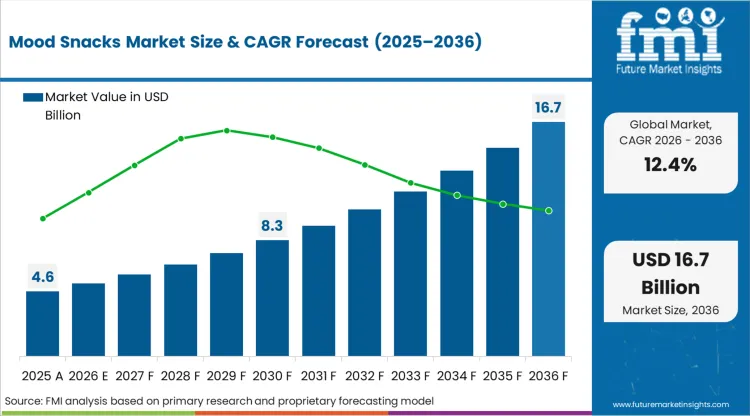
In 2025, the mood snacks market was valued at USD 4.6 billion. Based on Future Market Insights' analysis, demand for mental wellness-targeted snacks is estimated to grow to USD 5.2 billion in 2026 and USD 16.8 billion by 2036. FMI projects a CAGR of 12.4% during the forecast period.
Absolute dollar growth of USD 11.6 billion over the decade reflects a fundamental shift from reactive mental health treatment toward proactive daily wellbeing management through functional food formats. Growth depends on scientific substantiation advancing beyond ingredient correlation toward clinical causation, as psychobiotic research documents specific Bifidobacterium longum and Lactobacillus strains producing GABA and serotonin precursors with measurable anxiety reduction outcomes in controlled trials. Without this evidence progression, premium pricing will face sustained consumer scepticism.
Summary of Mood Snacks Market
- Mood Snacks Market Definition:
- The market covers snack formats incorporating psychobiotics, adaptogens, nootropics, and mineral complexes formulated to deliver measurable mental wellness outcomes through daily consumption across stress relief, cognitive, and sleep support positioning.
- Demand Drivers in the Market:
- Gut-brain axis validation where Lactobacillus and Bifidobacterium strains producing GABA and serotonin precursors convert mood positioning from marketing claim to clinical substantiation.
- Post-pandemic mental health normalisation shifting consumers from reactive clinical intervention to proactive daily functional food habits through mainstream retail.
- E-commerce and subscription channel growth enabling clinical education and 90-day dosage protocols impossible within conventional mass retail shelf formats.
- Key Segments Analyzed in the FMI Report:
- Functional Ingredient: Psychobiotics lead through clinical validation; adaptogens hold broadest retail penetration through ashwagandha familiarity.
- Product Type: Functional chocolates command highest per-unit value; adaptogenic gummies show fastest volume growth.
- Geography: North America leads revenue; Asia Pacific shows highest growth through fermented food cultural familiarity.
- Analyst Opinion at FMI:
- Nandini Roy Choudhury, Principal Consultant for Food & Beverage at Future Market Insights, opines, "In the updated Mood Snacks Market Report for 2026 to 2036, CXOs will find that brands without proprietary psychobiotic strain libraries face mounting private label competition, while science-backed products command durable margin premiums across pharmacy and subscription channels."
- Strategic Implications/Executive Takeaways;
- Secure psychobiotic strain partnerships before clinical validation creates first-mover barriers competitors cannot overcome through reformulation.
- Invest in subscription models enabling 90-day dosage protocols that single-purchase retail formats cannot deliver.
- Prioritise pharmacy and health food distribution over mass supermarket entry to preserve premium pricing integrity.
- Methodology:
- Built on primary interviews with psychobiotic ingredient suppliers, snack formulators, and retail channel buyers across North America, Europe, and Asia Pacific.
- Benchmarked against functional food market sizing, mental health supplement trends, and clinical trial publication volumes.
- Validated using randomised controlled trial literature on gut-brain axis efficacy and structured internal review as per FMI modelling standards.
The gut-brain axis research validating bidirectional microbiome-CNS communication has attracted significant investment from established snack manufacturers seeking functional differentiation beyond flavour innovation. Major consumer goods companies are acquiring psychobiotic ingredient suppliers and clinical-stage nutrition firms to secure proprietary strain libraries, as off-patent adaptogens alone no longer justify premium shelf positioning in competitive wellness retail environments.
United States (15.1% CAGR) and United Kingdom (13.8% CAGR) lead growth through mental wellness cultural normalisation and established functional food retail infrastructure. Australia (13.2% CAGR) follows through wellness lifestyle penetration and e-commerce channel maturity. Germany (11.9% CAGR) and Japan (11.4% CAGR) contribute through precision nutrition adoption and fermented food cultural familiarity enabling psychobiotic acceptance. Mature snack markets including France (10.2%) and Canada (10.6%) generate incremental volume through pharmacy and subscription channel expansion, constrained by stringent health claim regulatory frameworks limiting on-pack substantiation language.
Mood Snacks Market Definition
The mood snacks market comprises functional food products formulated with clinically validated or emerging bioactive ingredients targeting mental wellness outcomes including stress relief, anxiety reduction, cognitive enhancement, mood elevation, and sleep support. Products span protein bars, functional chocolates, adaptogenic gummies, prebiotic snacks, fermented treats, and energy bites incorporating psychobiotics, adaptogens, nootropics, GABA-producing strains, omega-3 fatty acids, and magnesium complexes.
Mood Snacks Market Inclusions
The report includes a comprehensive analysis of market dynamics, featuring global and regional market sizes (volume and value) and a 10-year forecast (2026 to 2036). It covers segmental breakdowns by functional ingredient, product type, health claim, distribution channel, and consumer segment, alongside pricing analysis, e-commerce channel dynamics, and clinical substantiation trends across 40 plus countries.
Mood Snacks Market Exclusions
The scope excludes conventional snacks without functional mental wellness ingredient positioning, pharmaceutical-grade nutraceuticals and mood-support supplements sold in capsule or tablet form, and energy drinks where stimulant rather than mood-modulating mechanisms define the product. It omits downstream meal replacement formats and general protein nutrition products not carrying mental wellness health claims.
Mood Snacks Market Research Methodology
- Primary Research: Interviews were conducted with psychobiotic ingredient suppliers, functional snack brand founders, clinical nutritionists specialising in gut-brain axis research, retail buyers from health food and pharmacy channels, and consumer behaviour researchers tracking mental wellness purchasing patterns.
- Desk Research: Randomised controlled trial publications on psychobiotic strain efficacy, regulatory authority guidance on functional food health claims, national mental health statistics, and trade association data from functional food industry bodies supported market benchmarking.
- Market-Sizing and Forecasting: A hybrid top-down and bottom-up model was applied. Demand was reconstructed from functional food market sizing, mental wellness consumer survey data, and ingredient supplier volumes, then validated against retail sales data and brand revenue disclosures.
- Data Validation and Update Cycle: Outputs undergo cross-referencing with functional food market benchmarks, clinical literature consistency checks, and structured peer review prior to release.
Segmental Analysis
Mood Snacks Market Analysis by Functional Ingredient
Based on FMI's mood snacks market report, psychobiotics are estimated to hold the leading functional ingredient share in 2026, driven by accumulating clinical evidence distinguishing them from unsubstantiated adaptogen claims. Specific Bifidobacterium longum 1714 and Lactobacillus rhamnosus JB-1 strain documentation in peer-reviewed anxiety and stress reduction trials gives psychobiotic-positioned products a regulatory and marketing differentiation that generic ashwagandha inclusions cannot match at equivalent dosage levels.
- Clinical Strain Investment: Chr. Hansen acquired a portfolio of clinically documented psychobiotic strains in 2024 through its Human Microbiome division, with the acquisition disclosed in its annual investor report as part of a strategic expansion into mental wellness ingredient supply for functional food manufacturers seeking substantiated gut-brain axis positioning [1].
- Dosage Optimisation Technology: Gnosis by Lesaffre disclosed a microencapsulation technology in 2024 specifically designed to protect psychobiotic viability through snack manufacturing thermal processes, addressing the primary technical barrier preventing GABA-producing strain survival in baked and chocolate-format mood snacks [2].
- Retail Validation: The UK's Holland & Barrett reported in its 2024 trading update that psychobiotic and adaptogen-positioned functional snacks were among the top three fastest-growing product subcategories by revenue, confirming mainstream health food retail acceptance beyond supplement aisle positioning [3].
Mood Snacks Market Analysis by Product Type
Functional chocolates hold the highest per-unit average selling price in 2026 through premium gifting channel positioning and consumer association of dark chocolate's existing polyphenol credentials with mood benefit legitimacy. Adaptogenic gummies demonstrate the fastest volume growth by converting supplement-averse consumers through familiar confectionery format, eliminating the pill-fatigue barrier that prevents functional ingredient adoption among the millennial and Gen Z consumer segments most aligned with mental wellness purchasing behaviour.
- Format Innovation: Hu Kitchen launched a clinical-grade adaptogenic dark chocolate bar in 2024 incorporating clinically dosed ashwagandha KSM-66 extract, disclosed through the brand's product launch press release, positioning the format as a bridge between premium confectionery and functional nutrition at a price point accessible to mainstream wellness retail [4].
- Gummy Category Expansion: Olly Nutrition disclosed expansion of its mood-specific gummy range in 2024 annual retail performance communications, adding GABA and L-theanine combinations targeting sleep-adjacent mood support claims as consumer search data indicated sustained demand growth for non-stimulant evening snack formats [5].
- Pharmacy Channel Entry: Vitabiotics extended its Wellwoman and Wellman mood nutrition range into functional snack formats in 2024 through UK pharmacy chain distribution agreements, leveraging existing clinical credibility in the pharmacy channel to introduce adaptogenic energy bites alongside established supplement ranges [6].
Mood Snacks Market Drivers, Restraints, and Opportunities
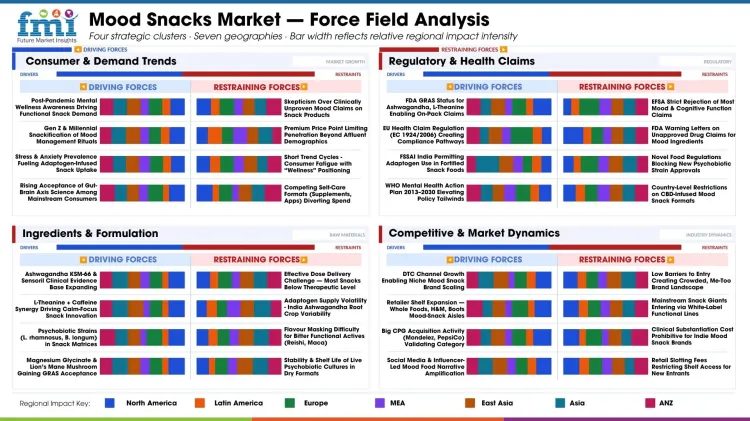
Future Market Insights analysis confirms the mood snacks category is transitioning from novelty wellness positioning toward evidence-based functional food classification, driven by post-pandemic mental health awareness converting aspiration into daily purchasing behaviour. The USD 5.2 billion 2026 valuation reflects early mainstream penetration, where functional food retail infrastructure built through protein bar and probiotic yogurt categories has created accessible shelf and digital pathways for mood-targeted formats without requiring consumer category education from zero.
As per FMI, the central market tension sits between consumer appetite for mood benefit claims and regulatory authority scepticism toward unsubstantiated functional food health claims in key markets. Brands with clinical trial documentation can access authorised health claim frameworks in the EU and qualified health claim pathways in the USA, commanding pharmacy channel entry and premium pricing unavailable to adaptogen-only competitors relying on structure-function claims that retailers and consumers increasingly associate with marketing rather than science.
- Regulatory Claim Pathways: The European Food Safety Authority's authorised health claim list includes specific probiotic strain-cognitive function associations under Annex III review processes updated in 2023, creating a regulatory pathway for psychobiotic snack brands meeting clinical evidence thresholds to make on-pack claims inaccessible to unsubstantiated competitors, establishing durable differentiation in European pharmacy and premium retail channels [7].
- Mental Health Spending Normalisation: The World Health Organization's 2022 World Mental Health Report documented a 25% increase in global anxiety and depression prevalence during 2020 to 2021, establishing the public health baseline that functional food brands are legitimately addressing through daily consumption formats rather than clinical intervention channels [8].
- Subscription Channel Economics: Direct-to-consumer subscription models enable mood snack brands to deliver 90-day clinical dosage protocols matching randomised controlled trial consumption periods, aligning commercial subscription retention economics with the minimum duration required to generate measurable psychobiotic outcomes that drive reorder rates through genuine efficacy rather than marketing alone.
Regional Analysis
Based on the regional analysis, the mood snacks market is segmented into North America, Latin America, Europe, East Asia, South Asia, Oceania, and Middle East & Africa across 40 plus countries. The full report also offers market attractiveness analysis based on regional regulatory environments and consumer wellness trends.
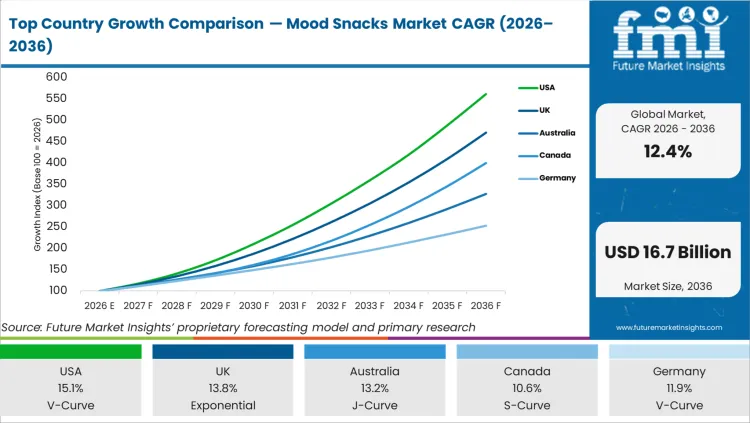
| Country | CAGR (2026 to 2036) |
|---|---|
| United States | 15.1% |
| United Kingdom | 13.8% |
| Australia | 13.2% |
| Canada | 10.6% |
| Germany | 11.9% |
| Japan | 11.4% |
Source: Future Market Insights (FMI) analysis, based on proprietary forecasting model and primary research
North America Mood Snacks Market Analysis
North America is the category's largest revenue region through functional food retail infrastructure, e-commerce subscription ecosystems, and mental health cultural normalisation. Kind Snacks and Olly Nutrition lead through retail distribution breadth; RXBAR commands functional protein formats through gym and convenience channels.
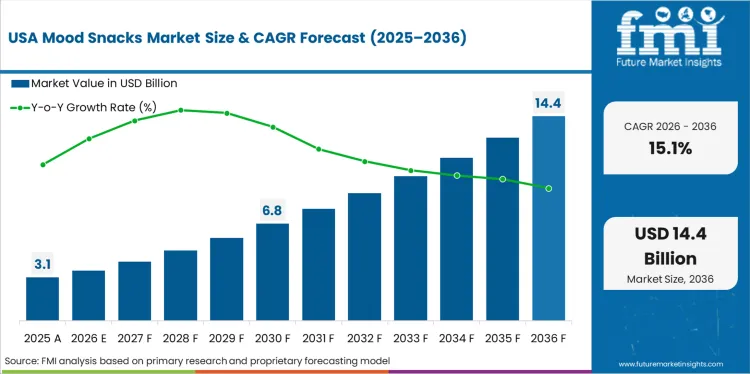
- United States: Demand for mood snacks in the United States is projected to rise at 15.1% CAGR through 2036. The FDA's 2023 updated guidance on structure-function claims for probiotic and adaptogen ingredients clarified permissible gut-brain axis benefit language, reducing launch timeline delays. NIH's National Center for Complementary and Integrative Health allocated USD 47 million in 2023 toward gut microbiome and mental health trials, generating substantiation publications functional snack brands cite in pharmacy buyer presentations [8].
- Canada: Demand for mood snacks in Canada is projected to rise at 10.6% CAGR through 2036. Health Canada's Natural Health Products Directorate updated its licensed framework in 2023 to include psychobiotic strain claims for stress and anxiety reduction, enabling pharmacy channel positioning unavailable under conventional food regulations. The federal Wellness Together Canada platform committed CAD 500 million to mental health access from 2020 onward, normalising proactive wellness spending that brands are converting into premium snack purchasing [9].
FMI's report includes a detailed analysis of the North America mood snacks market covering the United States and Canada. Readers can find distribution channel dynamics, health claim frameworks, and e-commerce subscription trends across the region.
Europe Mood Snacks Market Analysis
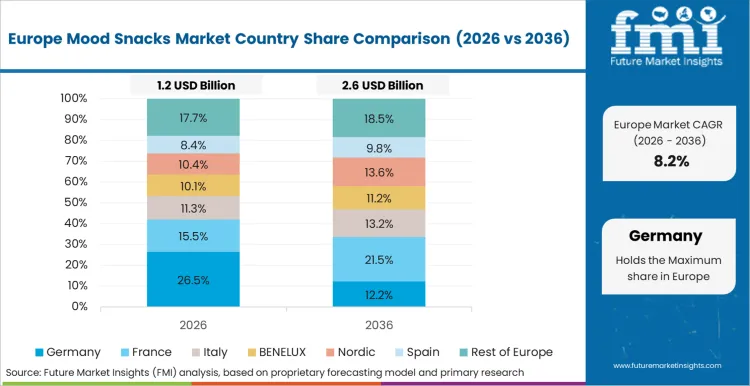
Europe is the market's regulatory validation environment where EFSA substantiation requirements protect premium pricing for clinically credentialed brands. Vitabiotics leads through pharmacy credibility; Pukka Herbs commands adaptogen formats through organic retail; Fazer Group drives Nordic psychobiotic innovation.
- United Kingdom: Demand for mood snacks in the United Kingdom is projected to rise at 13.8% CAGR through 2036. The UK Food Standards Agency's post-Brexit framework created a domestic novel ingredient review pathway faster than EFSA timelines, giving UK brands a commercial speed advantage. Holland & Barrett's 2024 expansion into dedicated mood nutrition shelf sections across 800 plus stores normalised mood snack purchasing alongside established supplement categories [3].
- Germany: Demand for mood snacks in Germany is projected to rise at 11.9% CAGR through 2036. The German Federal Institute for Risk Assessment published updated adaptogen and probiotic ingredient usage guidance in 2023, providing dosage compliance certainty enabling product development investment. Germany's EUR 15.9 billion organic food retail market documented by Agrarmarkt Informations-Gesellschaft in 2023 provides channel infrastructure supporting clinical ingredient cost structures [10].
FMI's analysis of the mood snacks market in Europe includes country-wise assessment covering the United Kingdom, Germany, France, Netherlands, Sweden, and Rest of Europe. Readers can access EFSA claim pathway analysis and pharmacy channel penetration trends.
Asia Pacific Mood Snacks Market Analysis
Asia Pacific is the market's highest-growth region through fermented food cultural familiarity accelerating psychobiotic acceptance in Japan and South Korea. Meiji Holdings leads Japanese functional snack innovation; Mondelez captures mass-market mood positioning in China; domestic Indian brands leverage Ayurvedic adaptogen heritage for ashwagandha credibility.
- Japan: Demand for mood snacks in Japan is projected to rise at 11.4% CAGR through 2036. The Consumer Affairs Agency expanded Japan's FOSHU framework in 2023 to include stress reduction and cognitive support claims substantiated by clinical trial data, providing an authorised claim pathway unavailable in less developed regulatory markets. Meiji Holdings' 2024 annual report disclosed R&D investment in Lactobacillus strain-specific snack bar formats targeting FOSHU claim eligibility [1].
FMI's analysis of the Asia Pacific mood snacks market covers Japan, South Korea, China, India, Australia, and Rest of Asia Pacific. Readers can find FOSHU framework analysis, e-commerce channel dynamics, and psychobiotic adoption trends across the region.
Competitive Aligners for Market Players
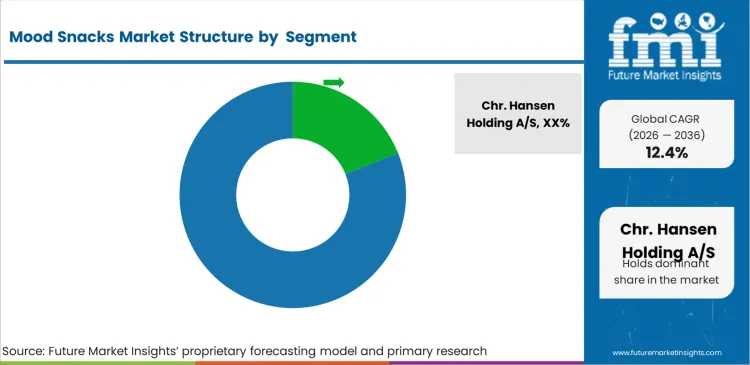
The mood snacks market remains fragmented, with no single player holding more than 8 to 10% global revenue share, yet competitive concentration is building around brands with proprietary psychobiotic strain agreements and clinical trial documentation. Mass snack manufacturers hold distribution advantages but lack the clinical credibility that pharmacy and health food channels require, while specialist functional nutrition brands hold science credentials but face scale limitations in mass retail negotiation.
Brands with exclusive or semi-exclusive agreements with clinical-stage ingredient suppliers, particularly Chr. Hansen, Gnosis by Lesaffre, and Ganeden, maintain structural formulation advantages that competitors cannot replicate through off-the-shelf ingredient procurement. These supplier relationships enable access to patented strain libraries with existing clinical dossiers, reducing the time and capital required to build regulatory-compliant health claim substantiation from the three to five years typical for proprietary clinical programmes to twelve to eighteen months through licensed ingredient utilisation.
Retail buyer leverage remains significant as mood snack category managers at major health food chains evaluate brands on clinical evidence quality, not just consumer demand signals. Holland & Barrett, Whole Foods Market, and pharmacy chains including Boots require structured clinical evidence summaries before approving premium shelf positioning, creating a buyer-imposed substantiation barrier that protects existing credentialed brands from rapid displacement by reformulated commodity competitors entering the mood claim space without genuine scientific differentiation.
Recent Developments:
- In October 2024, Chr. Hansen expanded its Human Microbiome Solutions division with a dedicated mood and cognitive health strain portfolio, disclosed through its annual investor report, targeting functional food manufacturers seeking licensed psychobiotic ingredients with existing clinical trial documentation [1].
- In August 2024, Olly Nutrition launched a sleep and mood dual-benefit gummy format incorporating GABA, L-theanine, and chamomile extract, with launch details disclosed through the brand's retail partner communications, targeting the growing evening snack occasion where stress relief and sleep support claims overlap [5].
Key Players in Mood Snacks Market
- Chr. Hansen Holding A/S
- Olly Nutrition (Unilever)
- Hu Kitchen
- Kind Snacks (Mars Inc.)
- Vitabiotics Ltd
- Pukka Herbs (Unilever)
- Meiji Holdings Co. Ltd
- Fazer Group
- RXBAR (Kellogg Company)
- Gnosis by Lesaffre
Scope of the Report
| Metric | Value |
|---|---|
| Quantitative Units | USD 5.2 billion (2026) to USD 16.8 billion (2036), at a CAGR of 12.4% |
| Market Definition | The mood snacks market comprises functional food products formulated with psychobiotics, adaptogens, nootropics, GABA-producing strains, omega-3 fatty acids, and magnesium complexes targeting mental wellness outcomes including stress relief, anxiety reduction, cognitive enhancement, mood elevation, and sleep support across snack formats. |
| Functional Ingredient Segmentation | Psychobiotics, Adaptogens, Nootropics, GABA-Producing Strains, Omega-3 Fortified, Magnesium-Enhanced |
| Product Type Segmentation | Protein Bars, Functional Chocolates, Adaptogenic Gummies, Prebiotic Snacks, Fermented Treats, Energy Bites |
| Health Claim Segmentation | Stress Relief, Anxiety Reduction, Cognitive Enhancement, Mood Elevation, Sleep Support |
| Distribution Channel Segmentation | E-commerce, Health Food Stores, Pharmacies, Supermarkets, Subscription Services |
| Consumer Segment | Millennials/Gen Z, Working Professionals, Students, Wellness Enthusiasts |
| Regions Covered | North America, Latin America, Europe, East Asia, South Asia, Oceania, Middle East and Africa |
| Countries Covered | United States, Canada, United Kingdom, Germany, France, Japan, South Korea, China, India, Australia and 40 plus countries |
| Key Companies Profiled | Chr. Hansen Holding A/S, Olly Nutrition, Hu Kitchen, Kind Snacks, Vitabiotics Ltd, Pukka Herbs, Meiji Holdings Co. Ltd, Fazer Group, RXBAR, Gnosis by Lesaffre |
| Forecast Period | 2026 to 2036 |
| Approach | Hybrid top-down and bottom-up market modelling validated through primary interviews with psychobiotic ingredient suppliers, functional snack formulators, and retail channel buyers, supported by clinical nutrition literature and structured internal review |
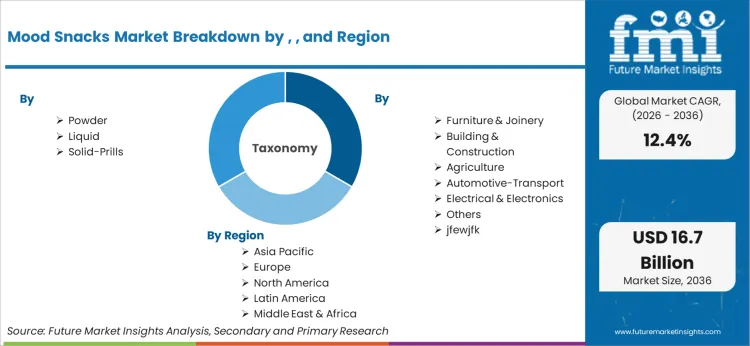
Mood Snacks Market Analysis by Segments
Functional Ingredient:
- Psychobiotics
- Adaptogens
- Nootropics
- GABA-Producing Strains
- Omega-3 Fortified
- Magnesium-Enhanced
Product Type:
- Protein Bars
- Functional Chocolates
- Adaptogenic Gummies
- Prebiotic Snacks
- Fermented Treats
- Energy Bites
Health Claim:
- Stress Relief
- Anxiety Reduction
- Cognitive Enhancement
- Mood Elevation
- Sleep Support
Distribution Channel:
- E-commerce
- Health Food Stores
- Pharmacies
- Supermarkets
- Subscription Services
Consumer Segment:
- Millennials/Gen Z
- Working Professionals
- Students
- Wellness Enthusiasts
Region:
- Asia Pacific
- Japan
- South Korea
- China
- India
- Australia & New Zealand
- Rest of Asia Pacific
- Europe
- United Kingdom
- Germany
- France
- Netherlands
- Sweden
- Rest of Europe
- North America
- United States
- Canada
- Mexico
- Latin America
- Brazil
- Rest of Latin America
- Middle East & Africa
- United Arab Emirates
- South Africa
- Rest of Middle East & Africa
Bibliography
- [1] Chr. Hansen Holding A/S. (2024). Annual Report 2023/24: Human Microbiome Solutions mood and cognitive health portfolio expansion. Chr. Hansen Investor Relations, October 2024.
- [2] Gnosis by Lesaffre. (2024). Microencapsulation technology for psychobiotic viability in snack manufacturing. Product Innovation Disclosure, 2024.
- [3] Holland & Barrett. (2024). 2024 Trading Update: functional snack category growth. Holland & Barrett Corporate Communications, 2024.
- [4] Hu Kitchen. (2024). Adaptogenic dark chocolate bar launch press release. Hu Kitchen Brand Communications, 2024.
- [5] Olly Nutrition. (2024). Sleep and mood dual-benefit gummy format launch. Olly Retail Partner Communications, August 2024.
- [6] Vitabiotics Ltd. (2024). Wellwoman and Wellman mood nutrition snack range pharmacy distribution expansion. Vitabiotics Corporate Announcement, 2024.
- [7] European Food Safety Authority. (2023). Annex III review update: probiotic strain and cognitive function health claim assessment. EFSA Journal, 2023.
- [8] World Health Organization. (2022). World Mental Health Report: transforming mental health for all. WHO Publications, June 2022.
- [9] Health Canada. (2023). Natural Health Products Directorate: updated psychobiotic strain claim framework. Government of Canada, 2023.
- [10] Agrarmarkt Informations-Gesellschaft. (2023). German organic food market data 2022. AMI, 2023.
This Report Addresses
- Market intelligence for structured decision making across functional snack, mental wellness ingredient, and retail channel investment strategies
- Market size estimation and 10-year revenue forecasts from 2026 to 2036, supported by validated ingredient supplier volumes and retail sales benchmarks
- Growth opportunity mapping across psychobiotic, adaptogen, and nootropic ingredient segments with emphasis on clinical substantiation pathway transitions
- Segment and regional revenue forecasts covering stress relief, cognitive enhancement, and sleep support health claim categories across key markets
- Competition strategy assessment including proprietary strain IP positioning, clinical dossier depth, and pharmacy versus mass retail channel dynamics
- Regulatory compliance tracking including EFSA claim substantiation, FDA structure-function guidance, FOSHU framework eligibility, and Health Canada licensed claim pathways
- Regulatory impact analysis covering gut-brain axis claim permissibility and clinical evidence thresholds across North America, Europe, and Asia Pacific
- Market report delivery in PDF, Excel, PPT, and interactive dashboard formats for executive and operational use
Frequently Asked Questions
How large is the demand for mood snacks in the global market in 2026?
Demand for mood snacks in the global market is estimated to be valued at USD 5.2 billion in 2026.
What will be the market size of mood snacks by 2036?
The mood snacks market is projected to reach USD 16.8 billion by 2036.
What is the expected demand growth for mood snacks between 2026 and 2036?
Demand for mood snacks is expected to grow at a CAGR of 12.4% between 2026 and 2036.
Which functional ingredient is poised to lead global sales in 2026?
Psychobiotics are expected to lead functional ingredient adoption in 2026, driven by accumulating clinical evidence from randomised controlled trials documenting measurable anxiety reduction and cognitive improvement outcomes.
Which product type holds the highest per-unit value in the mood snacks market?
Functional chocolates command the highest per-unit average selling price in 2026 through premium gifting positioning and consumer association of dark chocolate polyphenol credentials with mood benefit legitimacy.
Which region leads revenue in the mood snacks market?
North America leads global mood snacks revenue in 2026 through established functional food retail infrastructure, e-commerce subscription ecosystems, and mental health cultural normalisation enabling mainstream purchasing behaviour.
What is driving mood snacks demand in the United States?
FDA 2023 updated structure-function claim guidance for probiotic and adaptogen ingredients and NIH National Center for Complementary and Integrative Health's USD 47 million gut microbiome mental health research funding are the primary regulatory and scientific drivers.
What is the United States growth outlook in this report?
The United States is projected to grow at a CAGR of 15.1% during 2026 to 2036.
Does the report cover Japan in its regional analysis?
Japan is included within the Asia Pacific regional scope with individual country-level CAGR, FOSHU regulatory framework analysis, and psychobiotic snack demand driver assessment.
What is the main demand theme linked to Japan in Asia Pacific coverage?
Japan's demand is driven by the Consumer Affairs Agency's 2023 FOSHU framework expansion to include stress reduction and cognitive support claims, creating an authorised regulatory pathway for clinical-grade mood snack positioning unavailable in less developed markets.
Does the report cover the United Kingdom in its regional analysis?
The United Kingdom is included within the Europe regional scope with individual country-level assessment covering post-Brexit functional food claim frameworks and pharmacy retail channel expansion.
What is the main United Kingdom demand theme in Europe coverage?
The UK Food Standards Agency's post-Brexit domestic review pathway enabling faster novel ingredient authorisation and Holland & Barrett's 2024 dedicated mood nutrition shelf expansion across 800 plus stores are the defining demand themes.
Which distribution channel demonstrates the fastest growth in mood snacks?
Subscription services demonstrate the fastest channel growth by enabling 90-day clinical dosage protocol delivery aligned with minimum psychobiotic efficacy periods, converting retention economics into genuine ingredient outcome demonstration.
What consumer segment drives the highest volume of mood snack purchases?
Millennials and Gen Z consumers drive the highest purchase volume through mental wellness cultural normalisation, digital health literacy enabling ingredient evaluation, and e-commerce accessibility bypassing conventional retail discovery barriers.
What is the mood snacks market and what products does it cover?
The mood snacks market covers functional food products including protein bars, functional chocolates, adaptogenic gummies, prebiotic snacks, fermented treats, and energy bites formulated with psychobiotics, adaptogens, nootropics, and mineral complexes targeting mental wellness outcomes.
What does the mood snacks market mean in this report?
The mood snacks market refers to global production, trade, and consumer purchasing of snack format products carrying mental wellness health claims supported by functional ingredient inclusion across foodservice, retail, and direct-to-consumer channels.
What is included in the scope of this mood snacks market report?
Scope covers functional ingredients, product types, health claims, distribution channels, and consumer segments alongside market sizing, 10-year forecasts, clinical substantiation tracking, and regional regulatory analysis across 40 plus countries.
What is excluded from the scope of this report?
Conventional snacks without functional mental wellness positioning, pharmaceutical mood supplements in capsule or tablet form, stimulant-mechanism energy drinks, and general protein nutrition products without mental wellness health claims are excluded.
What does the market forecast mean on this page?
Market forecast represents a model-based projection built on defined assumptions for functional food adoption rates, clinical substantiation progression, and regulatory claim pathway development for strategic planning purposes.
How does FMI build and validate the mood snacks market forecast?
The forecast is developed using a hybrid top-down and bottom-up model validated through primary interviews with psychobiotic ingredient suppliers and functional snack formulators, supported by clinical nutrition literature review and structured internal review as per FMI modelling standards.
Preview the report firsthand - request a free sample
Get SampleGet the brochure for pricing and purchase details.
Get PDFTable of Content
- Executive Summary
- Global Market Outlook
- Demand-side Trends
- Supply-side Trends
- Technology Roadmap Analysis
- Analysis and Recommendations
- Market Overview
- Market Coverage / Taxonomy
- Market Definition / Scope / Limitations
- Research Methodology
- Chapter Orientation
- Analytical Lens and Working Hypotheses
- Market Structure, Signals, and Trend Drivers
- Benchmarking and Cross-market Comparability
- Market Sizing, Forecasting, and Opportunity Mapping
- Research Design and Evidence Framework
- Desk Research Programme (Secondary Evidence)
- Company Annual and Sustainability Reports
- Peer-reviewed Journals and Academic Literature
- Corporate Websites, Product Literature, and Technical Notes
- Earnings Decks and Investor Briefings
- Statutory Filings and Regulatory Disclosures
- Technical White Papers and Standards Notes
- Trade Journals, Industry Magazines, and Analyst Briefs
- Conference Proceedings, Webinars, and Seminar Materials
- Government Statistics Portals and Public Data Releases
- Press Releases and Reputable Media Coverage
- Specialist Newsletters and Curated Briefings
- Sector Databases and Reference Repositories
- FMI Internal Proprietary Databases and Historical Market Datasets
- Subscription Datasets and Paid Sources
- Social Channels, Communities, and Digital Listening Inputs
- Additional Desk Sources
- Expert Input and Fieldwork (Primary Evidence)
- Primary Modes
- Qualitative Interviews and Expert Elicitation
- Quantitative Surveys and Structured Data Capture
- Blended Approach
- Why Primary Evidence is Used
- Field Techniques
- Interviews
- Surveys
- Focus Groups
- Observational and In-context Research
- Social and Community Interactions
- Stakeholder Universe Engaged
- C-suite Leaders
- Board Members
- Presidents and Vice Presidents
- R&D and Innovation Heads
- Technical Specialists
- Domain Subject-matter Experts
- Scientists
- Physicians and Other Healthcare Professionals
- Governance, Ethics, and Data Stewardship
- Research Ethics
- Data Integrity and Handling
- Primary Modes
- Tooling, Models, and Reference Databases
- Desk Research Programme (Secondary Evidence)
- Data Engineering and Model Build
- Data Acquisition and Ingestion
- Cleaning, Normalisation, and Verification
- Synthesis, Triangulation, and Analysis
- Quality Assurance and Audit Trail
- Market Background
- Market Dynamics
- Drivers
- Restraints
- Opportunity
- Trends
- Scenario Forecast
- Demand in Optimistic Scenario
- Demand in Likely Scenario
- Demand in Conservative Scenario
- Opportunity Map Analysis
- Product Life Cycle Analysis
- Supply Chain Analysis
- Investment Feasibility Matrix
- Value Chain Analysis
- PESTLE and Porter’s Analysis
- Regulatory Landscape
- Regional Parent Market Outlook
- Production and Consumption Statistics
- Import and Export Statistics
- Market Dynamics
- Global Market Analysis 2021 to 2025 and Forecast, 2026 to 2036
- Historical Market Size Value (USD Million) Analysis, 2021 to 2025
- Current and Future Market Size Value (USD Million) Projections, 2026 to 2036
- Y-o-Y Growth Trend Analysis
- Absolute $ Opportunity Analysis
- Global Market Pricing Analysis 2021 to 2025 and Forecast 2026 to 2036
- Introduction / Key Findings
- Global Market Analysis 2021 to 2025 and Forecast 2026 to 2036, By Region
- Introduction
- Historical Market Size Value (USD Million) Analysis By Region, 2021 to 2025
- Current Market Size Value (USD Million) Analysis and Forecast By Region, 2026 to 2036
- North America
- Latin America
- Western Europe
- Eastern Europe
- East Asia
- South Asia and Pacific
- Middle East & Africa
- Market Attractiveness Analysis By Region
- North America Market Analysis 2021 to 2025 and Forecast 2026 to 2036, By Country
- Historical Market Size Value (USD Million) Trend Analysis By Market Taxonomy, 2021 to 2025
- Market Size Value (USD Million) Forecast By Market Taxonomy, 2026 to 2036
- By Country
- USA
- Canada
- Mexico
- Market Attractiveness Analysis
- By Country
- Key Takeaways
- By Country
- Latin America Market Analysis 2021 to 2025 and Forecast 2026 to 2036, By Country
- Historical Market Size Value (USD Million) Trend Analysis By Market Taxonomy, 2021 to 2025
- Market Size Value (USD Million) Forecast By Market Taxonomy, 2026 to 2036
- By Country
- Brazil
- Chile
- Rest of Latin America
- Market Attractiveness Analysis
- By Country
- Key Takeaways
- By Country
- Western Europe Market Analysis 2021 to 2025 and Forecast 2026 to 2036, By Country
- Historical Market Size Value (USD Million) Trend Analysis By Market Taxonomy, 2021 to 2025
- Market Size Value (USD Million) Forecast By Market Taxonomy, 2026 to 2036
- By Country
- Germany
- UK
- Italy
- Spain
- France
- Nordic
- BENELUX
- Rest of Western Europe
- Market Attractiveness Analysis
- By Country
- Key Takeaways
- By Country
- Eastern Europe Market Analysis 2021 to 2025 and Forecast 2026 to 2036, By Country
- Historical Market Size Value (USD Million) Trend Analysis By Market Taxonomy, 2021 to 2025
- Market Size Value (USD Million) Forecast By Market Taxonomy, 2026 to 2036
- By Country
- Russia
- Poland
- Hungary
- Balkan & Baltic
- Rest of Eastern Europe
- Market Attractiveness Analysis
- By Country
- Key Takeaways
- By Country
- East Asia Market Analysis 2021 to 2025 and Forecast 2026 to 2036, By Country
- Historical Market Size Value (USD Million) Trend Analysis By Market Taxonomy, 2021 to 2025
- Market Size Value (USD Million) Forecast By Market Taxonomy, 2026 to 2036
- By Country
- China
- Japan
- South Korea
- Market Attractiveness Analysis
- By Country
- Key Takeaways
- By Country
- South Asia and Pacific Market Analysis 2021 to 2025 and Forecast 2026 to 2036, By Country
- Historical Market Size Value (USD Million) Trend Analysis By Market Taxonomy, 2021 to 2025
- Market Size Value (USD Million) Forecast By Market Taxonomy, 2026 to 2036
- By Country
- India
- ASEAN
- Australia & New Zealand
- Rest of South Asia and Pacific
- Market Attractiveness Analysis
- By Country
- Key Takeaways
- By Country
- Middle East & Africa Market Analysis 2021 to 2025 and Forecast 2026 to 2036, By Country
- Historical Market Size Value (USD Million) Trend Analysis By Market Taxonomy, 2021 to 2025
- Market Size Value (USD Million) Forecast By Market Taxonomy, 2026 to 2036
- By Country
- Kingdom of Saudi Arabia
- Other GCC Countries
- Turkiye
- South Africa
- Other African Union
- Rest of Middle East & Africa
- Market Attractiveness Analysis
- By Country
- Key Takeaways
- By Country
- Key Countries Market Analysis
- USA
- Pricing Analysis
- Market Share Analysis, 2025
- Canada
- Pricing Analysis
- Market Share Analysis, 2025
- Mexico
- Pricing Analysis
- Market Share Analysis, 2025
- Brazil
- Pricing Analysis
- Market Share Analysis, 2025
- Chile
- Pricing Analysis
- Market Share Analysis, 2025
- Germany
- Pricing Analysis
- Market Share Analysis, 2025
- UK
- Pricing Analysis
- Market Share Analysis, 2025
- Italy
- Pricing Analysis
- Market Share Analysis, 2025
- Spain
- Pricing Analysis
- Market Share Analysis, 2025
- France
- Pricing Analysis
- Market Share Analysis, 2025
- India
- Pricing Analysis
- Market Share Analysis, 2025
- ASEAN
- Pricing Analysis
- Market Share Analysis, 2025
- Australia & New Zealand
- Pricing Analysis
- Market Share Analysis, 2025
- China
- Pricing Analysis
- Market Share Analysis, 2025
- Japan
- Pricing Analysis
- Market Share Analysis, 2025
- South Korea
- Pricing Analysis
- Market Share Analysis, 2025
- Russia
- Pricing Analysis
- Market Share Analysis, 2025
- Poland
- Pricing Analysis
- Market Share Analysis, 2025
- Hungary
- Pricing Analysis
- Market Share Analysis, 2025
- Kingdom of Saudi Arabia
- Pricing Analysis
- Market Share Analysis, 2025
- Turkiye
- Pricing Analysis
- Market Share Analysis, 2025
- South Africa
- Pricing Analysis
- Market Share Analysis, 2025
- USA
- Market Structure Analysis
- Competition Dashboard
- Competition Benchmarking
- Market Share Analysis of Top Players
- By Regional
- Competition Analysis
- Competition Deep Dive
- Chr. Hansen Holding A/S
- Overview
- Product Portfolio
- Profitability by Market Segments (Product/Age /Sales Channel/Region)
- Sales Footprint
- Strategy Overview
- Marketing Strategy
- Product Strategy
- Channel Strategy
- Olly Nutrition (Unilever)
- Hu Kitchen
- Kind Snacks (Mars Inc.)
- Vitabiotics Ltd
- Pukka Herbs (Unilever)
- Meiji Holdings Co. Ltd
- Fazer Group
- Chr. Hansen Holding A/S
- Competition Deep Dive
- Assumptions & Acronyms Used


