

- Industry Size (2026)
- USD 2.8 Bn
- Forecast (2036)
- USD 7.9 Bn
- CAGR (2026 to 2036)
- 10.9%
Quiet Snacks Market Size, Market Forecast and Outlook By FMI
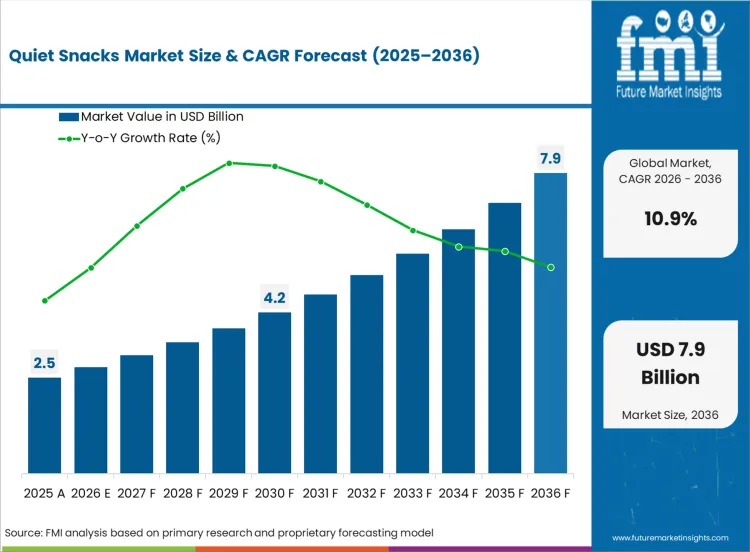
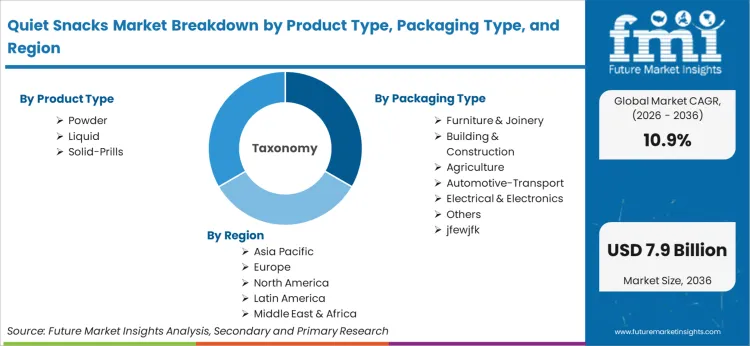
In 2025, the quiet snacks market was valued at USD 2.5 billion. Based on Future Market Insights' analysis, demand for quiet snacks is estimated to grow to USD 2.8 billion in 2026 and USD 7.9 billion by 2036. FMI projects a CAGR of 10.9% during the forecast period.
Absolute dollar growth of USD 5.1 billion over the decade reflects a cultural shift in consumer expectations around sensory consideration across public and shared spaces. Growth depends on acoustic engineering advancing from packaging innovation toward product formulation redesign, as cinema operators and corporate procurement teams increasingly specify decibel reduction performance alongside taste criteria.
Cinema operators and corporate facility managers are establishing B2B procurement channels that bypass traditional retail entirely, contracting directly with quiet snack suppliers for venue-exclusive distribution. This captive channel dynamic rewards brands with documented acoustic certification over brands with superior flavour profiles alone, shifting competitive logic away from conventional snack category norms.
Summary of Quiet Snacks Market
- Quiet Snacks Market Definition
- The market covers food products and packaging systems engineered to minimise eating and handling sounds across cinema, office, gaming, and library environments where acoustic consideration drives purchasing.
- Demand Drivers in the Market
- Misophonia and sound sensitivity affecting an estimated 15 to 20% of the global population, converting quiet snack products from courtesy items into medically legitimised solutions covered by some health savings account programmes.
- Premium cinema and theater operators restricting traditional noisy snack sales to protect immersive audio experiences, creating captive distribution channels for quiet snack suppliers with guaranteed shelf placement.
- Hybrid workplace normalisation driving corporate procurement of office-appropriate snacks minimising video call disruption, establishing B2B demand channels complementing consumer retail sales.
- Key Segments Analyzed in the FMI Report
- Product Type: Soft texture leads at 42.1% share through inherent acoustic properties and manufacturing scalability on existing confectionery lines.
- Packaging Type: Silent paper dominates at 51.8% share through dual acoustic and sustainability performance appealing to eco-conscious core consumers.
- Geography: North America leads revenue; Asia Pacific shows highest growth through cinema infrastructure expansion and youth-driven premium snack adoption.
- Analyst Opinion at FMI
- Nandini Roy Choudhury, Principal Consultant for Food & Beverage at Future Market Insights, opines, "In the updated Quiet Snacks Market Report for 2026 to 2036, CXOs will find that competitive advantage depends on documented decibel reduction performance and third-party acoustic certification rather than subjective marketing claims, with traditional snack manufacturers required to rethink product architecture rather than apply incremental modifications to existing portfolios."
- Strategic Implications/Executive Takeaways
- Establish acoustic testing capabilities and partner with sound engineering firms to develop quantifiable noise reduction metrics supporting third-party certification programmes.
- Invest in dual-benefit packaging achieving both silent operation and sustainability credentials to capture eco-conscious consumers without acoustic performance trade-offs.
- Target distribution into coworking spaces, gaming lounges, and premium transit environments where noise consideration aligns with brand positioning beyond traditional retail.
- Methodology
- Built on primary interviews with specialty snack manufacturers, cinema operators, and acoustic materials suppliers.
- Benchmarked against premium entertainment venue attendance data, remote work adoption statistics, and misophonia prevalence research.
- Validated using consumer sensory testing data and structured internal review as per FMI modelling standards.
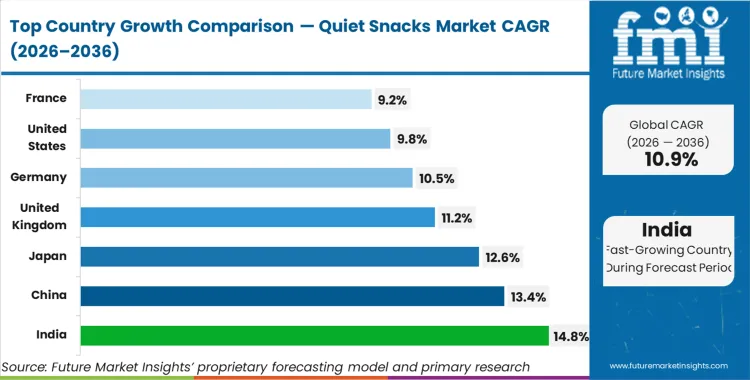
India (14.8% CAGR) and China (13.4% CAGR) lead growth through rapid multiplex cinema expansion and rising middle class premium entertainment spending. Japan (12.6% CAGR) follows through cultural public consideration values and advanced packaging technology infrastructure. United Kingdom (11.2% CAGR) and Germany (10.5% CAGR) contribute through mature cinema culture and sustainability-aligned silent paper packaging adoption. Mature markets including the United States (9.8%) and France (9.2%) generate steady volume through workplace and gaming channels, constrained by higher consumer price sensitivity limiting premium acoustic product trial.
Quiet Snacks Market Definition
The quiet snacks market comprises food products and packaging systems engineered to minimise acoustic disturbance during consumption. Products use soft textures, dehydration techniques, ground formulations, or smooth coatings that eliminate crunching and crackling sounds. Packaging employs silent paper, fabric pouches, silicone containers, or biodegradable films preventing plastic rustling. The market serves consumers in noise-sensitive environments including cinemas, theaters, offices, libraries, gaming setups, and study spaces where acoustic consideration is a primary purchasing criterion.
Quiet Snacks Market Inclusions
The report includes global and regional market sizes (volume and value) and a 10-year forecast (2026 to 2036). It covers segmental breakdowns by product type, packaging type, and end use, alongside acoustic engineering trends, silent packaging material science developments, misophonia prevalence research, and distribution channel evolution across 40 plus countries.
Quiet Snacks Market Exclusions
The scope excludes conventional snacks sold without acoustic consideration or specialised packaging, beverages regardless of packaging noise characteristics, and meal replacement products exceeding typical snacking portion sizes. Products marketed primarily on health or organic attributes where quiet consumption is incidental rather than a core value proposition are also excluded, as are industrial bulk packaging formats designed for food service preparation.
Quiet Snacks Market Research Methodology
- Primary Research: Interviews were conducted with specialty snack manufacturers, packaging materials suppliers, cinema chain operators, coworking space managers, and acoustic engineering consultants.
- Desk Research: Published research on misophonia prevalence, cinema attendance statistics, remote work trends, gaming industry growth, and sustainable packaging adoption rates were reviewed.
- Market-Sizing and Forecasting: A hybrid top-down and bottom-up model was applied, reconstructing demand from cinema attendance data, office snacking frequency estimates, and per-occasion spending benchmarks across venue types.
- Data Validation and Update Cycle: Outputs were subjected to variance testing against specialty retail sales data, venue operator procurement records, and structured internal review prior to publication.
Segmental Analysis
Quiet Snacks Market Analysis by Product Type
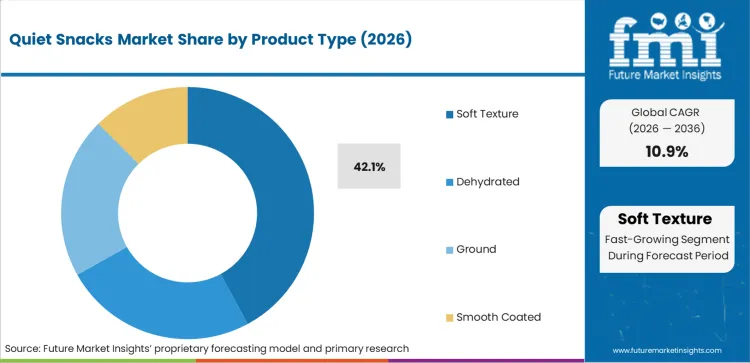
Based on FMI's quiet snacks market report, soft texture products are estimated to hold 42.1% share in 2026. Dominance reflects inherent acoustic advantages of marshmallow-like consistencies and yielding textures that compress silently rather than fracturing audibly, combined with manufacturing scalability on existing confectionery lines requiring no specialised equipment investment.
- Dehydration Innovation: Advanced freeze-drying and vacuum dehydration techniques enable moisture removal while preserving flexible structure, producing products that rehydrate on contact with saliva for silent consumption. This segment shows 15.2% CAGR as manufacturers invest in process technology enabling shelf-stable quiet formats [5].
- Ground Formulation Entry: Doritos developed AI-powered software in 2023 detecting and muting chip crunching sounds during gaming sessions, demonstrating industry acknowledgement that traditional crunchy formats require acoustic intervention beyond reformulation to serve noise-sensitive consumption occasions [6].
- Smooth Coat Differentiation: TodayTix's Silent Snacks launch established cocoa butter ball and smooth-coated dehydrated fruit formats for theater audiences in 2016, validating that chocolate and yogurt coatings absorbing bite impact command premium pricing through technical acoustic sophistication in captive venue channels [3].
Quiet Snacks Market Analysis by Packaging Type
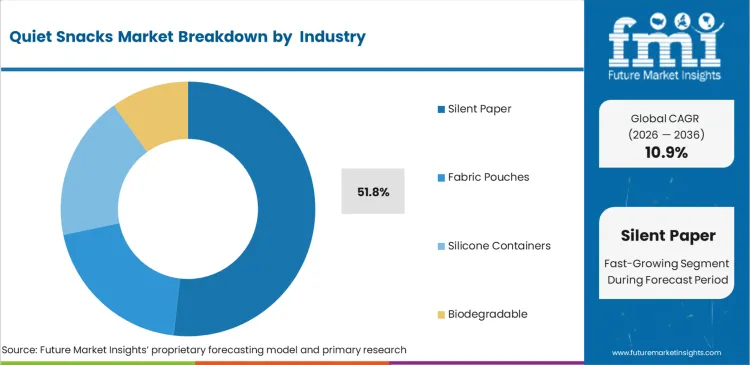
Based on FMI's quiet snacks market report, silent paper packaging holds 51.8% share in 2026 by achieving dual acoustic and sustainability performance without consumer trade-offs. Paper substrates eliminate plastic rustling while appealing to eco-conscious demographics comprising the core quiet snacks consumer base, with material science advances in moisture barrier coatings resolving shelf life limitations previously restricting paper packaging to dry products only.
- Fabric Pouch Positioning: Reusable fabric pouches with drawstring closures target zero-waste consumers in library and study environments where sustainability values and acoustic consideration align with user demographics, though higher unit costs limit penetration beyond ultra-premium product tiers [7].
- Pringles Paper Transition: Kellogg's Pringles introduced a 90% paper tube in 2024 replacing its iconic composite canister, achieving sustainability objectives alongside significant noise reduction during opening and closing actions and demonstrating that legacy snack formats can partially migrate toward acoustic performance through packaging redesign [3].
- Biodegradable Film Growth: Plant-based biodegradable films combine acoustic performance comparable to paper with enhanced moisture resistance, addressing consumer desire for packaging eliminating waste stream contribution entirely, though current cost premiums restrict deployment to ultra-premium product tiers pending material scale economies.
Quiet Snacks Market Drivers, Restraints, and Opportunities
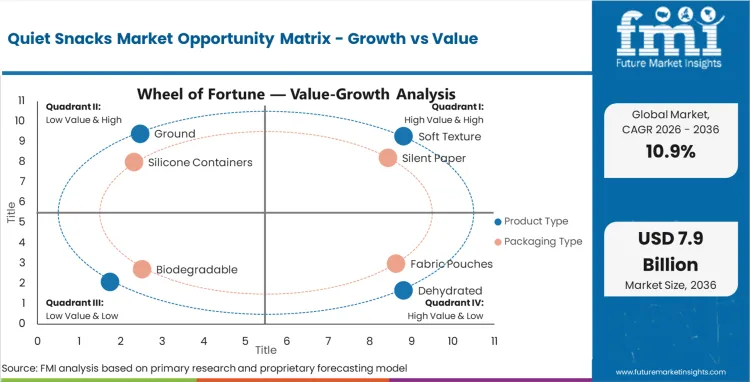
Future Market Insights analysis confirms the quiet snacks category has transitioned from novelty theater accessory to a legitimate food segment addressing genuine consumer needs around sensory consideration. The USD 2.8 billion 2026 valuation reflects early mainstream penetration driven by misophonia awareness expansion and remote work normalisation creating dual consumer and B2B demand channels that did not exist when the category first emerged through cinema-specific product launches.
As per FMI, the central tension sits between acoustic performance and taste satisfaction, as formulations optimising for silence frequently compromise the texture attributes consumers associate with snack enjoyment. Brands resolving this trade-off through smooth-coated formats and advanced dehydration techniques command the strongest margins, while manufacturers attempting incremental modifications to existing crunchy portfolios face consumer rejection that packaging innovation alone cannot overcome.
- Misophonia Medical Recognition: Clinical recognition of sound sensitivity disorders has accelerated diagnosis rates among the estimated 15 to 20% of the global population experiencing auditory processing sensitivity, transforming quiet snacks from courtesy products into therapeutic aids covered by some health savings account programmes and enabling credible medical positioning beyond novelty [2].
- Asia Pacific Cinema Expansion: India's Multiplex Association documented rapid tier 2 and tier 3 city cinema construction through 2024, creating distribution infrastructure for premium concession innovation where young urban populations demonstrate willingness to pay premiums for specialty snack categories addressing lifestyle needs beyond basic nutrition [9].
- Corporate Procurement Channels: The International Facility Management Association's 2025 research confirmed hybrid workplace adoption has elevated acoustic performance to a specified procurement criterion alongside nutrition in corporate amenity purchasing, establishing institutional B2B demand independent of consumer retail trends and providing volume stability unavailable through single-occasion retail channels [8].
Regional Analysis
Based on the regional analysis, the quiet snacks market is segmented into North America, Europe, Asia Pacific, Latin America, and Middle East & Africa across 40 plus countries. The full report also offers market attractiveness analysis based on regional acoustic awareness levels and entertainment venue infrastructure.
.webp "Top Country Growth Comparison Quiet Snacks Market Cagr (2026 2036)")
| Country | CAGR (2026 to 2036) |
|---|---|
| India | 14.8% |
| China | 13.4% |
| Japan | 12.6% |
| United Kingdom | 11.2% |
| Germany | 10.5% |
| United States | 9.8% |
| France | 9.2% |
Source: Future Market Insights (FMI) analysis, based on proprietary forecasting model and primary research
Asia Pacific Quiet Snacks Market Analysis
Asia Pacific is the market's highest-growth region through rapid cinema infrastructure expansion, urbanisation increasing noise sensitivity awareness, and youth populations embracing premium entertainment snacking. The region accounts for over 50% of global cinema admissions. Domestic manufacturers in Japan lead silent packaging material innovation; Indian multiplex operators drive concession format diversification; Chinese snack brands leverage advanced domestic packaging technology.
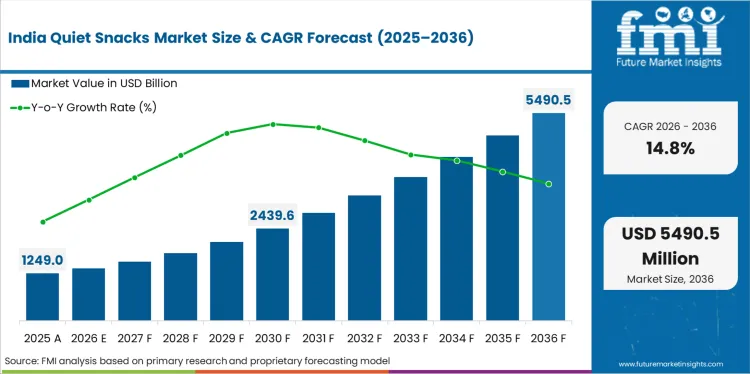
- India: Demand for quiet snacks in India is projected to rise at 14.8% CAGR through 2036. The Multiplex Association of India documented accelerated cinema construction across tier 2 and tier 3 cities through 2024, creating concession distribution infrastructure reaching previously underserved urban populations with rising premium snack spending capacity. India's young urban demographic demonstrates willingness to experiment with specialty product categories addressing lifestyle needs, while cultural public consideration values align with quiet snack positioning enabling premium price acceptance beyond metropolitan markets [9].
- China: Demand for quiet snacks in China is projected to rise at 13.4% CAGR through 2036. The China Film Administration's 2025 annual statistics documented the world's largest cinema market by screen count, providing unmatched distribution scale for concession innovation. Government cultural campaigns promoting civilised behaviour in public spaces reinforce quiet snacks positioning through aligned official messaging. Domestic manufacturers possess packaging technology capabilities enabling competitive locally produced quiet snack offerings without import dependency, concentrating growth in premium tier cities where cinema attendance represents lifestyle positioning [10].
FMI's analysis of the Asia Pacific quiet snacks market covers India, China, Japan, South Korea, Australia, and Rest of Asia Pacific. Readers can find cinema infrastructure growth data, youth consumer adoption trends, and packaging technology innovation dynamics across the region.
Europe Quiet Snacks Market Analysis
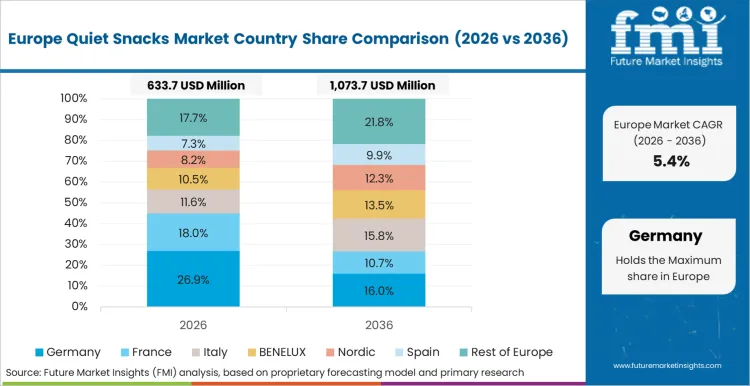
Europe demonstrates strong growth through mature cinema industries, high sustainability consciousness aligning with silent paper packaging, and cultural norms emphasising noise awareness in public spaces. Independent cinema and art house theater operators create distribution channels valuing differentiated concession offerings. Vitabiotics and Pukka Herbs lead format innovation; Fazer Group drives Nordic psychobiotic-adjacent quiet snack development through fermented food cultural alignment.
- United Kingdom: Demand for quiet snacks in the United Kingdom is projected to rise at 11.2% CAGR through 2036. TodayTix's Silent Snacks initiative established consumer awareness of purpose-designed theater snacks as early as 2016, creating category familiarity that subsequent brands have leveraged for mainstream retail entry. Holland & Barrett's 2024 expansion into dedicated quiet nutrition shelf sections across 800 plus UK stores provided retail infrastructure normalising quiet snack purchasing alongside established supplement categories outside theater environments [3].
- Germany: Demand for quiet snacks in Germany is projected to rise at 10.5% CAGR through 2036. The German Federal Institute for Risk Assessment published updated functional food ingredient guidance in 2023 covering permissible usage levels for packaging additives in food-contact silent materials, providing compliance certainty enabling packaging investment. Germany's engineering culture appreciation for quantifiable performance metrics drives corporate procurement specification of decibel-measured acoustic snack performance, supporting B2B office channel development alongside premium cinema concession placement [4].
FMI's analysis of the quiet snacks market in Europe includes country-wise assessment covering the United Kingdom, Germany, France, Italy, Spain, and Rest of Europe. Readers can access cinema channel dynamics, sustainable packaging adoption trends, and corporate procurement data.
North America Quiet Snacks Market Analysis
North America is the highest revenue region through mature consumer awareness of misophonia, willingness to pay premiums for considerate products, and concentration of innovative specialty snack manufacturers. AMC and Regal cinema circuits provide large-format distribution testing; Whole Foods and Trader Joe's anchor premium retail positioning; corporate coworking operators drive B2B channel volume.
- United States: Demand for quiet snacks in the United States is projected to rise at 9.8% CAGR through 2036. High consumer awareness of misophonia following media coverage and online community growth establishes legitimate market need beyond novelty positioning. Major cinema chains including AMC and Regal tested quiet snack offerings in premium format locations through 2024, generating distribution learnings applicable to national rollout. The Specialty Food Association's 2025 trends report confirmed premium acoustic snack formats among fastest-growing specialty food subcategories by retail value, validating mainstream retailer interest beyond health food channel positioning [8].
FMI's report includes a detailed analysis of the North America quiet snacks market covering the United States, Canada, and Mexico. Readers can find misophonia awareness data, cinema chain procurement trends, and corporate workplace channel dynamics across the region.
Competitive Aligners for Market Players
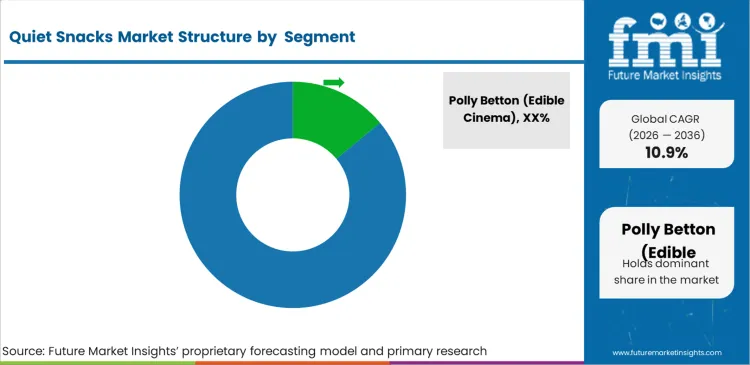
The quiet snacks market remains fragmented with no single player holding dominant global share, characterised by regional specialty manufacturers, cinema concession suppliers, and opportunistic product line extensions from traditional snack companies. Competitive advantage derives from acoustic engineering capabilities and third-party certification rather than brand heritage, as venue operators make procurement decisions based on measurable decibel reduction performance that marketing claims cannot substitute.
Manufacturers investing in sound testing laboratories and partnerships with acoustic engineering firms gain preferred supplier status with cinema chains and corporate facility managers specifying quiet snack performance criteria. Access to silent packaging material suppliers with proprietary substrate formulations creates further structural advantage, as off-the-shelf packaging modifications produce inconsistent acoustic results that experienced procurement buyers can identify through standard testing protocols.
Buyer leverage is significant among cinema chain operators and corporate facility managers who multi-source quiet snack formats to prevent single-supplier dependency and maintain contract pricing control. This buyer structure rewards suppliers with diversified format portfolios spanning soft texture, dehydrated, and ground product types, as single-format specialists face rapid substitution when competing products meet equivalent acoustic certification thresholds at lower unit costs.
Recent Developments
- In 2023, PepsiCo's Doritos brand developed AI-powered software detecting and muting chip crunching sounds during gaming sessions, reflecting category acknowledgement that acoustic performance requires technology investment beyond physical product reformulation [6].
- In 2024, Kellogg's Pringles introduced a 90% paper tube replacing its composite canister, achieving sustainability and noise reduction objectives simultaneously and demonstrating that legacy snack formats can partially migrate toward acoustic performance through packaging redesign [3].
Key Players in Quiet Snacks Market
- Polly Betton (Edible Cinema)
- TodayTix
- KIND Snacks (Mars Inc.)
- RXBAR (Kellogg Company)
- Perfect Snacks
- Fruit Bliss
- SkinnyDipped
- Bare Snacks
- That's it.
- Simple Mills
Scope of the Report
| Metric | Value |
|---|---|
| Quantitative Units | USD 2.8 billion (2026) to USD 7.9 billion (2036), at a CAGR of 10.9% |
| Market Definition | The quiet snacks market comprises food products and packaging systems engineered to minimise acoustic disturbance during consumption across cinema, theater, office, library, gaming, and other noise-sensitive environments. |
| Product Type Segmentation | Soft Texture, Dehydrated, Ground, Smooth Coated |
| Packaging Type Segmentation | Silent Paper, Fabric Pouches, Silicone Containers, Biodegradable |
| End Use Segmentation | Cinema & Theater, Office & Workplace, Libraries & Study Spaces, Gaming & Streaming |
| Regions Covered | North America, Latin America, Europe, East Asia, South Asia, Oceania, Middle East and Africa |
| Countries Covered | United States, Canada, Mexico, United Kingdom, Germany, France, Italy, Spain, China, India, Japan, South Korea, Australia and 35 plus countries |
| Key Companies Profiled | Polly Betton (Edible Cinema), TodayTix, KIND Snacks, RXBAR, Perfect Snacks, Fruit Bliss, SkinnyDipped, Bare Snacks, That's it., Simple Mills |
| Forecast Period | 2026 to 2036 |
| Approach | Hybrid top-down and bottom-up market modelling validated through primary interviews with specialty snack manufacturers, cinema operators, and acoustic materials suppliers, supported by venue attendance data and sensory research analysis |
Quiet Snacks Market Analysis by Segments
Product Type
- Soft Texture
- Dehydrated
- Ground
- Smooth Coated
Packaging Type
- Silent Paper
- Fabric Pouches
- Silicone Containers
- Biodegradable
End Use
- Cinema & Theater
- Office & Workplace
- Libraries & Study Spaces
- Gaming & Streaming
Region
- North America
- United States
- Canada
- Mexico
- Latin America
- Brazil
- Argentina
- Rest of Latin America
- Western Europe
- Germany
- United Kingdom
- France
- Italy
- Spain
- Nordic
- Benelux
- Rest of Western Europe
- Eastern Europe
- Poland
- Czech Republic
- Rest of Eastern Europe
- East Asia
- China
- Japan
- South Korea
- South Asia and Pacific
- India
- ASEAN
- Australia and New Zealand
- Rest of South Asia and Pacific
- Middle East and Africa
- GCC Countries
- South Africa
- Rest of Middle East and Africa
Bibliography
- [2] Misophonia International. (2024). Misophonia Prevalence and Impact Study. Misophonia Foundation Research Initiative, 2024.
- [3] National Association of Theatre Owners. (2025). Premium Format Cinema Trends and Consumer Preferences. NATO Annual Report, 2025.
- [4] Global Workplace Analytics. (2025). Hybrid Work Adoption and Office Amenity Priorities. Remote Work Research Institute, 2025.
- [5] Food Technology Magazine. (2024). Advanced Dehydration Methods for Texture Control in Snack Products. Institute of Food Technologists, 2024.
- [6] Journal of Food Science. (2025). Acoustic Properties of Ground and Pulverized Snack Formulations. Wiley Online Library, 2025.
- [7] Sustainable Packaging Coalition. (2025). Consumer Preferences for Reusable Food Packaging Formats. Greenblue Report, 2025.
- [8] International Facility Management Association. (2025). Workplace Amenity Procurement Trends in Hybrid Offices. IFMA Research Report, 2025.
- [9] Multiplex Association of India. (2025). Cinema Infrastructure Growth and Concession Innovation. MAI Industry Report, 2025.
- [10] China Film Administration. (2025). Cinema Market Development and Consumer Behavior Analysis. CFA Annual Statistics, 2025.
- [11] Specialty Food Association. (2025). Premium Snack Category Growth and Distribution Channel Analysis. SFA Trends Report, 2025.
This Report Addresses
- Market intelligence for structured decision making across specialty snack manufacturers, packaging suppliers, cinema operators, and corporate facility buyers
- Market size estimation and 10-year revenue forecasts from 2026 to 2036, supported by validated venue attendance data and retail sales benchmarks
- Growth opportunity mapping across product type and packaging type segments with emphasis on acoustic certification and silent material transitions
- Segment and regional revenue forecasts covering soft texture, dehydrated, and ground formats across cinema, office, and gaming end use channels
- Competition strategy assessment including acoustic testing capabilities, third-party certification positioning, and captive venue distribution dynamics
- Packaging compliance and acoustic performance tracking including silent paper adoption, biodegradable film development, and decibel reduction documentation
- Regulatory and consumer behaviour analysis covering misophonia prevalence trends and corporate procurement acoustic specification requirements
- Market report delivery in PDF, Excel, PPT, and interactive dashboard formats for executive and operational use
Frequently Asked Questions
How large is the demand for quiet snacks in the global market in 2026?
Demand for quiet snacks in the global market is estimated to be valued at USD 2.8 billion in 2026.
What will be the market size of quiet snacks by 2036?
The quiet snacks market is projected to reach USD 7.9 billion by 2036.
What is the expected demand growth for quiet snacks between 2026 and 2036?
Demand for quiet snacks is expected to grow at a CAGR of 10.9% between 2026 and 2036.
Which product type is poised to lead global sales in 2026?
Soft texture products are expected to be the dominant product type, capturing approximately 42.1% of global market share in 2026 through inherent acoustic advantages and manufacturing scalability on existing confectionery lines.
Which packaging type holds the largest share in the quiet snacks market?
Silent paper packaging leads with 51.8% market share in 2026 through dual acoustic performance and sustainability credentials appealing to the eco-conscious core quiet snacks consumer demographic.
Which end use segment leads the quiet snacks market?
Cinema and theater leads at 38.6% share in 2026 as the original market genesis channel where operators actively restrict traditional noisy snack sales to protect immersive audio experiences.
Which region demonstrates the fastest growth in the quiet snacks market?
Asia Pacific demonstrates the fastest growth, led by India at 14.8% CAGR, through rapid multiplex cinema construction across tier 2 and tier 3 cities and rising middle class premium entertainment spending.
What is driving quiet snacks demand in the United States?
High consumer awareness of misophonia, AMC and Regal cinema chain testing of quiet snack formats in premium locations, and corporate workplace amenity procurement specifying acoustic performance alongside nutrition criteria are driving demand.
What is the United States growth outlook in this report?
The United States is projected to grow at a CAGR of 9.8% during 2026 to 2036.
Does the report cover Japan in its regional analysis?
Japan is included within the East Asia regional scope with individual country-level CAGR, cultural public consideration value analysis, and advanced packaging technology infrastructure assessment.
What is the main demand theme linked to Japan in Asia Pacific coverage?
Japan's demand is driven by deeply embedded cultural values around minimising public disturbance combined with domestic packaging industry capabilities enabling rapid silent material innovation.
Does the report cover Germany in its regional analysis?
Germany is included within the Western Europe regional scope with individual assessment covering Federal Institute for Risk Assessment packaging guidance and corporate procurement acoustic specification trends.
Which distribution channel shows strongest B2B growth in the quiet snacks market?
Corporate workplace procurement shows the strongest B2B growth at 16.4% CAGR as hybrid work normalisation elevates acoustic performance to a specified amenity criterion in office snack procurement alongside nutrition requirements.
What consumer need does the quiet snacks market primarily address?
The market addresses sensory consideration in noise-sensitive shared environments, serving both diagnosed misophonia sufferers requiring therapeutic-grade acoustic snack solutions and mainstream consumers seeking courtesy options in cinema, office, and gaming contexts.
What is the quiet snacks market and what products does it cover?
The quiet snacks market covers food products and packaging systems engineered to minimise acoustic disturbance, including soft texture formats, dehydrated snacks, ground formulations, and smooth-coated products sold in silent paper, fabric, silicone, and biodegradable packaging.
What does the quiet snacks market mean in this report?
The quiet snacks market refers to global production, trade, and consumer purchasing of snack products and packaging formats where acoustic performance during consumption and handling is a primary product design and marketing criterion.
What is included in the scope of this quiet snacks market report?
Scope covers product type, packaging type, and end use segments alongside market sizing, 10-year forecasts, acoustic engineering trends, misophonia prevalence data, and distribution channel analysis across 40 plus countries.
What is excluded from the scope of this report?
Conventional snacks without acoustic positioning, beverages regardless of packaging noise characteristics, meal replacement products exceeding snacking portion sizes, and health or organic products where quiet consumption is incidental rather than a core value proposition are excluded.
What does the market forecast mean on this page?
Market forecast represents a model-based projection built on defined assumptions for cinema attendance growth, remote work adoption rates, and misophonia awareness expansion for strategic planning purposes.
How does FMI build and validate the quiet snacks market forecast?
The forecast is developed using a hybrid top-down and bottom-up model validated through primary interviews with specialty snack manufacturers and cinema operators, supported by venue attendance data, sensory research analysis, and structured internal review as per FMI modelling standards.
Preview the report firsthand - request a free sample
Get SampleGet the brochure for pricing and purchase details.
Get PDFTable of Content
- Executive Summary
- Global Market Outlook
- Demand-side Trends
- Supply-side Trends
- Technology Roadmap Analysis
- Analysis and Recommendations
- Market Overview
- Market Coverage / Taxonomy
- Market Definition / Scope / Limitations
- Research Methodology
- Chapter Orientation
- Analytical Lens and Working Hypotheses
- Market Structure, Signals, and Trend Drivers
- Benchmarking and Cross-market Comparability
- Market Sizing, Forecasting, and Opportunity Mapping
- Research Design and Evidence Framework
- Desk Research Programme (Secondary Evidence)
- Company Annual and Sustainability Reports
- Peer-reviewed Journals and Academic Literature
- Corporate Websites, Product Literature, and Technical Notes
- Earnings Decks and Investor Briefings
- Statutory Filings and Regulatory Disclosures
- Technical White Papers and Standards Notes
- Trade Journals, Industry Magazines, and Analyst Briefs
- Conference Proceedings, Webinars, and Seminar Materials
- Government Statistics Portals and Public Data Releases
- Press Releases and Reputable Media Coverage
- Specialist Newsletters and Curated Briefings
- Sector Databases and Reference Repositories
- FMI Internal Proprietary Databases and Historical Market Datasets
- Subscription Datasets and Paid Sources
- Social Channels, Communities, and Digital Listening Inputs
- Additional Desk Sources
- Expert Input and Fieldwork (Primary Evidence)
- Primary Modes
- Qualitative Interviews and Expert Elicitation
- Quantitative Surveys and Structured Data Capture
- Blended Approach
- Why Primary Evidence is Used
- Field Techniques
- Interviews
- Surveys
- Focus Groups
- Observational and In-context Research
- Social and Community Interactions
- Stakeholder Universe Engaged
- C-suite Leaders
- Board Members
- Presidents and Vice Presidents
- R&D and Innovation Heads
- Technical Specialists
- Domain Subject-matter Experts
- Scientists
- Physicians and Other Healthcare Professionals
- Governance, Ethics, and Data Stewardship
- Research Ethics
- Data Integrity and Handling
- Primary Modes
- Tooling, Models, and Reference Databases
- Desk Research Programme (Secondary Evidence)
- Data Engineering and Model Build
- Data Acquisition and Ingestion
- Cleaning, Normalisation, and Verification
- Synthesis, Triangulation, and Analysis
- Quality Assurance and Audit Trail
- Market Background
- Market Dynamics
- Drivers
- Restraints
- Opportunity
- Trends
- Scenario Forecast
- Demand in Optimistic Scenario
- Demand in Likely Scenario
- Demand in Conservative Scenario
- Opportunity Map Analysis
- Product Life Cycle Analysis
- Supply Chain Analysis
- Investment Feasibility Matrix
- Value Chain Analysis
- PESTLE and Porter’s Analysis
- Regulatory Landscape
- Regional Parent Market Outlook
- Production and Consumption Statistics
- Import and Export Statistics
- Market Dynamics
- Global Market Analysis 2021 to 2025 and Forecast, 2026 to 2036
- Historical Market Size Value (USD Million) Analysis, 2021 to 2025
- Current and Future Market Size Value (USD Million) Projections, 2026 to 2036
- Y-o-Y Growth Trend Analysis
- Absolute $ Opportunity Analysis
- Global Market Pricing Analysis 2021 to 2025 and Forecast 2026 to 2036
- Global Market Analysis 2021 to 2025 and Forecast 2026 to 2036, By Product Type
- Introduction / Key Findings
- Historical Market Size Value (USD Million) Analysis By Product Type , 2021 to 2025
- Current and Future Market Size Value (USD Million) Analysis and Forecast By Product Type , 2026 to 2036
- Soft Texture
- Dehydrated
- Ground
- Smooth Coated
- Soft Texture
- Y-o-Y Growth Trend Analysis By Product Type , 2021 to 2025
- Absolute $ Opportunity Analysis By Product Type , 2026 to 2036
- Global Market Analysis 2021 to 2025 and Forecast 2026 to 2036, By Packaging Type
- Introduction / Key Findings
- Historical Market Size Value (USD Million) Analysis By Packaging Type, 2021 to 2025
- Current and Future Market Size Value (USD Million) Analysis and Forecast By Packaging Type, 2026 to 2036
- Silent Paper
- Fabric Pouches
- Silicone Containers
- Biodegradable
- Silent Paper
- Y-o-Y Growth Trend Analysis By Packaging Type, 2021 to 2025
- Absolute $ Opportunity Analysis By Packaging Type, 2026 to 2036
- Global Market Analysis 2021 to 2025 and Forecast 2026 to 2036, By Region
- Introduction
- Historical Market Size Value (USD Million) Analysis By Region, 2021 to 2025
- Current Market Size Value (USD Million) Analysis and Forecast By Region, 2026 to 2036
- North America
- Latin America
- Western Europe
- Eastern Europe
- East Asia
- South Asia and Pacific
- Middle East & Africa
- Market Attractiveness Analysis By Region
- North America Market Analysis 2021 to 2025 and Forecast 2026 to 2036, By Country
- Historical Market Size Value (USD Million) Trend Analysis By Market Taxonomy, 2021 to 2025
- Market Size Value (USD Million) Forecast By Market Taxonomy, 2026 to 2036
- By Country
- USA
- Canada
- Mexico
- By Product Type
- By Packaging Type
- By Country
- Market Attractiveness Analysis
- By Country
- By Product Type
- By Packaging Type
- Key Takeaways
- Latin America Market Analysis 2021 to 2025 and Forecast 2026 to 2036, By Country
- Historical Market Size Value (USD Million) Trend Analysis By Market Taxonomy, 2021 to 2025
- Market Size Value (USD Million) Forecast By Market Taxonomy, 2026 to 2036
- By Country
- Brazil
- Chile
- Rest of Latin America
- By Product Type
- By Packaging Type
- By Country
- Market Attractiveness Analysis
- By Country
- By Product Type
- By Packaging Type
- Key Takeaways
- Western Europe Market Analysis 2021 to 2025 and Forecast 2026 to 2036, By Country
- Historical Market Size Value (USD Million) Trend Analysis By Market Taxonomy, 2021 to 2025
- Market Size Value (USD Million) Forecast By Market Taxonomy, 2026 to 2036
- By Country
- Germany
- UK
- Italy
- Spain
- France
- Nordic
- BENELUX
- Rest of Western Europe
- By Product Type
- By Packaging Type
- By Country
- Market Attractiveness Analysis
- By Country
- By Product Type
- By Packaging Type
- Key Takeaways
- Eastern Europe Market Analysis 2021 to 2025 and Forecast 2026 to 2036, By Country
- Historical Market Size Value (USD Million) Trend Analysis By Market Taxonomy, 2021 to 2025
- Market Size Value (USD Million) Forecast By Market Taxonomy, 2026 to 2036
- By Country
- Russia
- Poland
- Hungary
- Balkan & Baltic
- Rest of Eastern Europe
- By Product Type
- By Packaging Type
- By Country
- Market Attractiveness Analysis
- By Country
- By Product Type
- By Packaging Type
- Key Takeaways
- East Asia Market Analysis 2021 to 2025 and Forecast 2026 to 2036, By Country
- Historical Market Size Value (USD Million) Trend Analysis By Market Taxonomy, 2021 to 2025
- Market Size Value (USD Million) Forecast By Market Taxonomy, 2026 to 2036
- By Country
- China
- Japan
- South Korea
- By Product Type
- By Packaging Type
- By Country
- Market Attractiveness Analysis
- By Country
- By Product Type
- By Packaging Type
- Key Takeaways
- South Asia and Pacific Market Analysis 2021 to 2025 and Forecast 2026 to 2036, By Country
- Historical Market Size Value (USD Million) Trend Analysis By Market Taxonomy, 2021 to 2025
- Market Size Value (USD Million) Forecast By Market Taxonomy, 2026 to 2036
- By Country
- India
- ASEAN
- Australia & New Zealand
- Rest of South Asia and Pacific
- By Product Type
- By Packaging Type
- By Country
- Market Attractiveness Analysis
- By Country
- By Product Type
- By Packaging Type
- Key Takeaways
- Middle East & Africa Market Analysis 2021 to 2025 and Forecast 2026 to 2036, By Country
- Historical Market Size Value (USD Million) Trend Analysis By Market Taxonomy, 2021 to 2025
- Market Size Value (USD Million) Forecast By Market Taxonomy, 2026 to 2036
- By Country
- Kingdom of Saudi Arabia
- Other GCC Countries
- Turkiye
- South Africa
- Other African Union
- Rest of Middle East & Africa
- By Product Type
- By Packaging Type
- By Country
- Market Attractiveness Analysis
- By Country
- By Product Type
- By Packaging Type
- Key Takeaways
- Key Countries Market Analysis
- USA
- Pricing Analysis
- Market Share Analysis, 2025
- By Product Type
- By Packaging Type
- Canada
- Pricing Analysis
- Market Share Analysis, 2025
- By Product Type
- By Packaging Type
- Mexico
- Pricing Analysis
- Market Share Analysis, 2025
- By Product Type
- By Packaging Type
- Brazil
- Pricing Analysis
- Market Share Analysis, 2025
- By Product Type
- By Packaging Type
- Chile
- Pricing Analysis
- Market Share Analysis, 2025
- By Product Type
- By Packaging Type
- Germany
- Pricing Analysis
- Market Share Analysis, 2025
- By Product Type
- By Packaging Type
- UK
- Pricing Analysis
- Market Share Analysis, 2025
- By Product Type
- By Packaging Type
- Italy
- Pricing Analysis
- Market Share Analysis, 2025
- By Product Type
- By Packaging Type
- Spain
- Pricing Analysis
- Market Share Analysis, 2025
- By Product Type
- By Packaging Type
- France
- Pricing Analysis
- Market Share Analysis, 2025
- By Product Type
- By Packaging Type
- India
- Pricing Analysis
- Market Share Analysis, 2025
- By Product Type
- By Packaging Type
- ASEAN
- Pricing Analysis
- Market Share Analysis, 2025
- By Product Type
- By Packaging Type
- Australia & New Zealand
- Pricing Analysis
- Market Share Analysis, 2025
- By Product Type
- By Packaging Type
- China
- Pricing Analysis
- Market Share Analysis, 2025
- By Product Type
- By Packaging Type
- Japan
- Pricing Analysis
- Market Share Analysis, 2025
- By Product Type
- By Packaging Type
- South Korea
- Pricing Analysis
- Market Share Analysis, 2025
- By Product Type
- By Packaging Type
- Russia
- Pricing Analysis
- Market Share Analysis, 2025
- By Product Type
- By Packaging Type
- Poland
- Pricing Analysis
- Market Share Analysis, 2025
- By Product Type
- By Packaging Type
- Hungary
- Pricing Analysis
- Market Share Analysis, 2025
- By Product Type
- By Packaging Type
- Kingdom of Saudi Arabia
- Pricing Analysis
- Market Share Analysis, 2025
- By Product Type
- By Packaging Type
- Turkiye
- Pricing Analysis
- Market Share Analysis, 2025
- By Product Type
- By Packaging Type
- South Africa
- Pricing Analysis
- Market Share Analysis, 2025
- By Product Type
- By Packaging Type
- USA
- Market Structure Analysis
- Competition Dashboard
- Competition Benchmarking
- Market Share Analysis of Top Players
- By Regional
- By Product Type
- By Packaging Type
- Competition Analysis
- Competition Deep Dive
- Polly Betton (Edible Cinema)
- Overview
- Product Portfolio
- Profitability by Market Segments (Product/Age /Sales Channel/Region)
- Sales Footprint
- Strategy Overview
- Marketing Strategy
- Product Strategy
- Channel Strategy
- TodayTix
- KIND Snacks (Mars Inc.)
- RXBAR (Kellogg Company)
- Perfect Snacks
- Fruit Bliss
- SkinnyDipped
- Polly Betton (Edible Cinema)
- Competition Deep Dive
- Assumptions & Acronyms Used


