

- Industry Size (2026)
- USD 310.0 Mn
- Forecast (2036)
- USD 638.9 Mn
- CAGR (2026 to 2036)
- 31.0%
Citrus Flavonoid Complexes from Mediterranean Peels Market Size, Market Forecast and Outlook By FMI
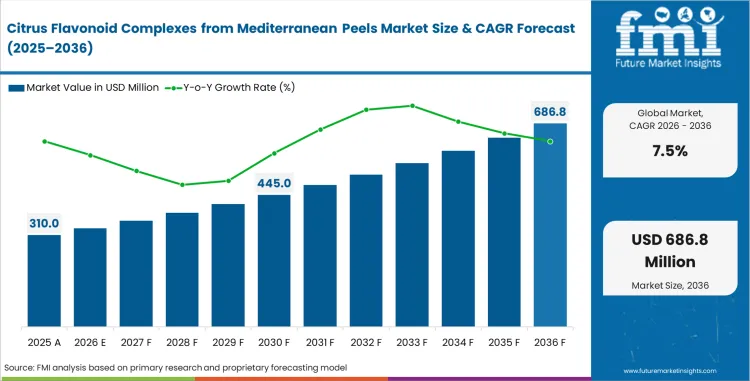
The citrus flavonoid complexes from Mediterranean peels market crossed a valuation of USD 288.4 million in 2025. Revenue is expected to surpass USD 310.0 million in 2026 at a CAGR of 7.5% during the forecast period. Total valuation is predicted to be USD 638.9 million through 2036 as processing infrastructure shifts from bulk juice extraction toward precision active compound recovery.
Summary of Citrus Flavonoid Complexes from Mediterranean Peels Market
- The market is forecast to reach USD 638.9 million by 2036.
- The market is expected to grow at a CAGR of 7.5% from 2026 to 2036.
- The market was estimated at USD 288.4 million in 2025.
- The forecast period represents an incremental opportunity of USD 328.9 million.
- Demand is driven by increasing use of citrus-derived flavonoids like hesperidin and naringin in nutraceuticals, functional foods, and personal care products.
- Hesperidin is projected to lead the flavonoid type segment with a 31.0% share due to strong availability from orange peels.
- Orange peels are expected to account for 38.0% of the source segment, supported by high Mediterranean citrus processing volumes.
- Powder form dominates with a 62.0% share, driven by better stability and ease of use in supplements and premixes.
- Nutraceuticals are anticipated to contribute 44.0% of the application segment due to growing demand for antioxidant and cardiometabolic health products.
- Türkiye, Spain, and Italy are key supply markets, while the United States and Germany remain major demand hubs for high-spec formulations.
Key Takeaways, Market Size, and Forecast
- Citrus Flavonoid Complexes from Mediterranean Peels Market is projected to grow from USD 310.0 million in 2026 to USD 638.9 million by 2036, at a CAGR of 7.5%.
- The citrus flavonoid complexes from Mediterranean peels market was valued at USD 288.4 million in 2025.
- By 2036, the Citrus Flavonoid Complexes from Mediterranean Peels Market is expected to be worth USD 638.9 million.
- From 2026 to 2036, the market is projected to expand at a CAGR of 7.5%.
- The market is projected to create an incremental opportunity of USD 328.9 million between 2026 and 2036.
- In 2026, Hesperidin is expected to account for 31.0% of the flavonoid type segment.
- Türkiye (8.3%) and Spain (7.9%) are two of the fastest growing markets.
Citrus Flavonoid Complexes from Mediterranean Peels Market Key Takeaways
| Metric | Details |
|---|---|
| Industry Size (2026) | USD 310.0 million |
| Industry Value (2036) | USD 638.9 million |
| CAGR (2026-2036) | 7.5% |
Source: Future Market Insights (FMI) analysis, based on proprietary forecasting model and primary research
Ingredient makers continue to convert citrus-processing by-products into higher-value nutraceutical and functional-formulation inputs. Mediterranean supply is important because southern Europe still handles a large share of the region’s citrus output. Weather pressure on orange, mandarin, and lemon crops can still affect peel availability and extract consistency. This gives extractors a steady peel base, though supplier performance still depends on raw material quality, seasonality, and batch standardization.
Demand depends less on peel availability alone and more on whether suppliers can deliver consistent flavonoid profiles across key compounds such as hesperidin, naringin, and eriocitrin. Recent research continues to reinforce that citrus peels are rich in these bioactives and remain a practical extraction base for antioxidant, metabolic-health, and functional-ingredient applications, which supports continued interest from supplement, food, and wellness formulators.
Crop variability, compositional swings across peel streams, and the cost of maintaining consistent extract specifications could continue to separate established processors from smaller entrants. Suppliers that pair Mediterranean sourcing depth with extraction efficiency, documentation strength, and stable powder-format delivery are likely to retain the strongest commercial position over the forecast period.
Türkiye is expected to register an 8.3% CAGR during the forecast period, due to rapid industrialization within its domestic processing base. Spain is estimated to expand at a 7.9% CAGR over the forecast period, as its established citrus infrastructure provides unmatched feedstock access. Growth in the United States is poised to expand at a 7.8% CAGR, Italy at 7.6% CAGR, Germany at 7.4% CAGR, France and Greece at a 7.2% and 7.1% CAGR respectively. Supply chains diverge sharply between countries processing domestic crops and regions relying entirely on imported Mediterranean citrus by-product extracts.
Segmental Analysis
Citrus Flavonoid Complexes from Mediterranean Peels Market Analysis by Flavonoid Type
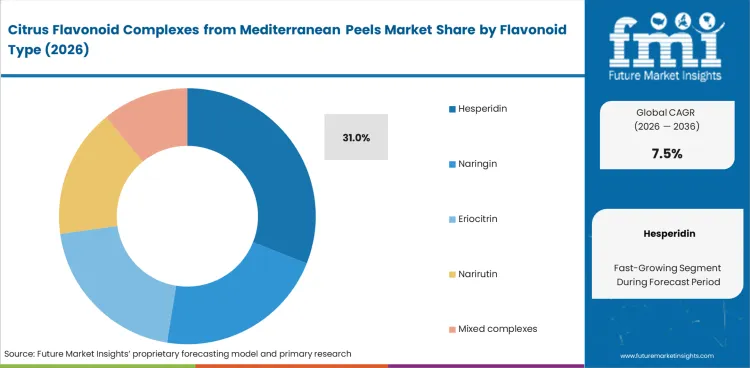
Industrial orange peel contains enough hesperidin to support cost-effective recovery at scale. Output remains easier to standardize across changing harvest conditions, and recovery economics stay more favorable than for several lower-volume citrus flavonoids. Clinical familiarity around vascular and antioxidant use also strengthens commercial acceptance across supplement and wellness formulations. In 2026, hesperidin is expected to contribute 31.0% of total market share. Established isolation workflows, lower raw material strain, and broader buyer confidence continue to support leading demand across formulation pipelines.
- Yield predictability: Standardized isolation practices support steadier output across changing seasonal conditions, helping processors protect plant efficiency and maintain margin discipline over longer production cycles.
- Clinical validation: Published evidence around vascular and antioxidant relevance gives brands stronger support during product development, label preparation, and market entry across regulated supplement categories.
- Cost efficiency: High natural abundance across orange-derived feedstock keeps pricing more stable through annual sourcing cycles, giving extract suppliers better room to build longer commercial contracts.
Citrus Flavonoid Complexes from Mediterranean Peels Market Analysis by Peel Source
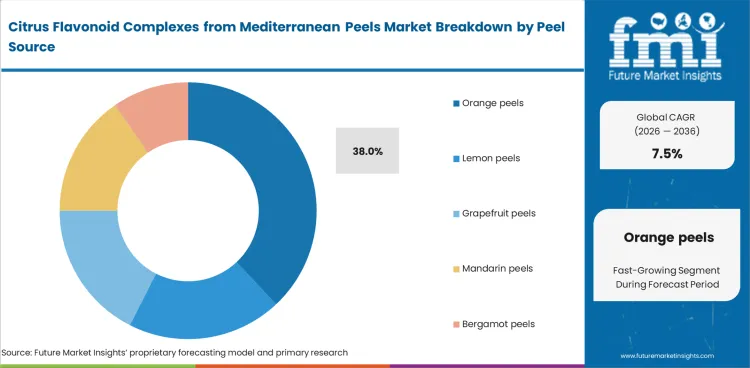
Orange peels are projected to secure 38.0% share in 2026. Bergamot extract and grapefruit retain value in specialized formulations, yet orange-led recovery keeps a stronger advantage in scale, cost balance, and supply continuity. Orange peel remains a preferred recovery base because industrial juice processing generates a deeper and more continuous feedstock stream than smaller citrus categories. Large-volume peel supply supports better blending flexibility, tighter standardization, and lower collection costs across commercial extraction programs. Proximity between juicing plants and extraction units also helps preserve raw material quality before flavonoid recovery begins.
- Logistical proximity: Extraction units placed near major juicing centers reduce freight strain, shorten handling time, and preserve peel condition before active recovery starts.
- Scale economies: Large and uninterrupted processing runs bring down per-unit recovery cost and help maintain steadier commercial pricing across wider sales programs.
- Profile consistency: Deep peel availability allows batch blending across multiple runs, improving standardization and reducing out-of-spec risk in finished flavonoid ingredients.
Citrus Flavonoid Complexes from Mediterranean Peels Market Analysis by Form
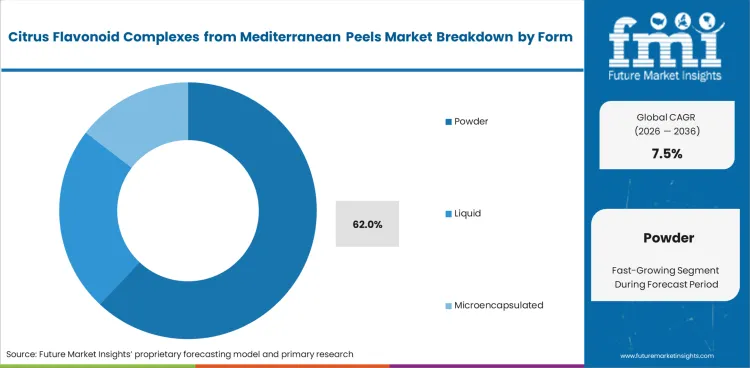
Powder remains most practical for large-scale commercialization because dry material handles storage, shipment, and blending more efficiently than liquid formats. Lower moisture exposure supports better stability during warehousing and cross-border distribution, while dry flow behavior suits capsules, tablets, sachets, and premix systems. Production settings also favor powders because dosing control stays easier across high-throughput filling lines. Powder is anticipated to emerge with 62.0% market share in 2026. Microencapsulated options continue to attract premium interest, especially in bioavailability-focused products, yet mainstream demand still rests with stable dry formats carrying broader manufacturing compatibility.
- Moisture control: Dry formats reduce early compound loss during storage and transit, helping brands preserve active quality through extended commercial distribution.
- Equipment compatibility: Consistent powder flow supports smoother operation across encapsulation and tableting lines, reducing interruptions linked to sticky or unstable input materials.
- Dose precision: More uniform particle distribution improves active-content control at serving level, supporting cleaner testing outcomes and stronger formulation accuracy.
Citrus Flavonoid Complexes from Mediterranean Peels Market Analysis by Application
Nutraceutical use continues to absorb most citrus flavonoid demand because capsule and tablet formats align well with documented dosage practices and targeted health positioning. Consumers already understand daily supplement routines, and brands gain stronger control over active loading, claims structure, and product differentiation inside premium wellness channels. Food and beverage use remains relevant, though bitterness, solubility, and dispersion issues still require extra formulation work. Nutraceuticals segment is set to capture a 44.0% market share in 2026. Margin structure also stays more attractive in this application area, encouraging continued investment across metabolic-health, antioxidant, and healthy-aging product lines.
- Claim substantiation: Controlled dosage formats support stronger alignment with published clinical evidence, helping brands present more precise product value across regulated supplement categories.
- Format familiarity: Daily capsules, tablets, and sachets fit established consumer routines, supporting steadier repeat purchasing across preventive health segments.
- Margin expansion: Premium supplement positioning often supports higher realized pricing than broader food inclusion, improving commercial returns for branded flavonoid systems.
Citrus Flavonoid Complexes from Mediterranean Peels Market Analysis by Extraction Technology
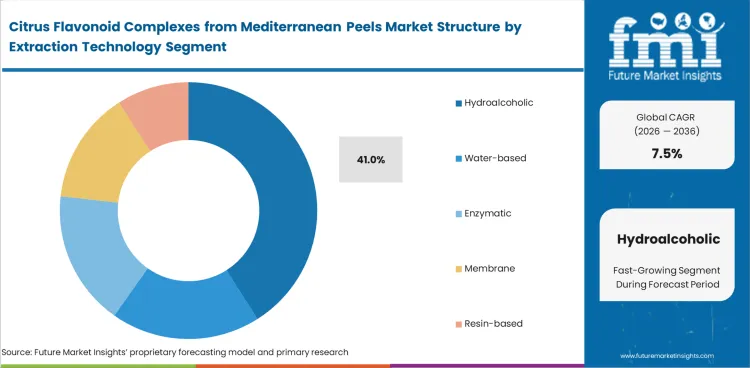
Hydroalcoholic processing remains commercially important because it offers a workable balance between recovery breadth, flavonoid selectivity, and downstream standardization. Water-only methods often limit total recovery, while harsher solvent systems can create residue concerns and weaken clean-label acceptance. Modern closed-loop recovery platforms have improved residue management, making alcohol-water systems more acceptable across regulated ingredient categories. Hydroalcoholic extraction is likely to hold a share of 41.0% in 2026. Process flexibility also allows recovery teams to adjust solvent ratios for target flavonoid families, giving suppliers more room to meet specification-driven customer demand.
- Yield optimization: Blended solvent systems support broader recovery across multiple citrus flavonoids, helping processors raise value generated from each ton of peel input.
- Residue management: Closed-loop recovery and better purification steps reduce trace-solvent concerns and support cleaner compliance pathways across food, supplement, and wellness applications.
- Profile tuning: Ratio adjustment during extraction gives suppliers stronger control over target compound balance, supporting more customized ingredient profiles for differentiated end-use formulations.
Citrus Flavonoid Complexes from Mediterranean Peels Market Drivers, Restraints, and Opportunities
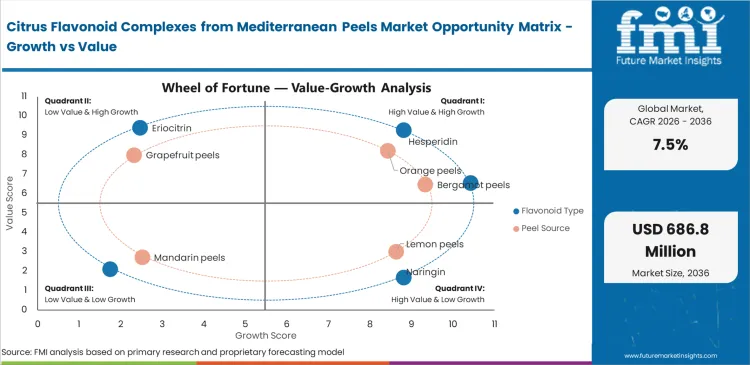
Clean-label demand keeps rising across supplements, functional beverages, and wellness-focused food lines, as brands move away from synthetic antioxidants and preservative systems without sacrificing product stability or label credibility. Citrus flavonoid complexes sourced from Mediterranean peels answer that requirement through natural-origin positioning and familiar bioactive compounds such as hesperidin, naringin, and eriocitrin, each carrying strong relevance in cardiometabolic, antioxidant, and healthy-aging formulations. Mediterranean citrus processing also supplies a practical by-product base, giving extract producers room to build stronger value around waste recovery, resource efficiency, and ingredient upgrading that matter in buyer discussions and brand messaging. Demand also comes from beverage and nutraceutical formulators looking for Mediterranean ingredients linked with healthy-aging and natural-origin positioning. Better standardization, clearer assay control, and stronger extraction discipline can further improve market confidence and support broader use across capsules, tablets, powders, ready-mix beverages, and fortified food applications.
Companies face certain challenges because citrus peel chemistry shifts across seasons, varieties, and sourcing areas. Rainfall patterns, fruit maturity, soil variation, and processing intervals can alter flavonoid concentration in meaningful ways, making strict standardization harder for producers lacking blending capacity, in-line testing, and tightly managed extraction parameters. Higher operating expense, more complex delivery planning, and added qualification pressure follow from that variability, especially across customers needing repeatable potency in capsules, tablets, beverage premixes, and functional food systems. This challenge opens room for stronger processors to separate themselves from smaller rivals. Companies capable of managing origin selection, batch balancing, live monitoring, and precise process calibration gain a clearer path toward long-term supply agreements in premium applications, particularly across customers placing consistency, documentation quality, and formulation reliability above simple peel availability. Stronger validation support, application data, and formulation guidance also add commercial weight during supplier selection.
Opportunities in Citrus Flavonoid Complexes from Mediterranean Peels Market
- Microencapsulation advancement: Protection for sensitive molecules during digestion can raise bioaccessibility and strengthen finished-product performance. R&D teams gain added room for premium positioning through delivery systems offering better stability, cleaner handling, longer shelf confidence, and stronger formulation flexibility across powders, sachets, capsules, and drink mixes.
- Synergistic blending: Pairing selected flavonoids with complementary actives can create more differentiated metabolic-health, antioxidant, and healthy-aging formulations. Product developers gain scope for proprietary combinations that support margin expansion, improve market distinction, and reduce direct comparability against standard single-compound offers.
- Cosmeceutical expansion: Topical use of citrus-derived actives continues gaining interest across skincare and beauty-from-within platforms. Personal care brands can unlock fresh revenue potential by adding citrus flavonoid systems into anti-aging, brightening, and skin-defense concepts supported by natural sourcing appeal, traceable origin narratives, and premium ingredient positioning.
Regional Analysis
Based on regional analysis, the citrus flavonoid complexes from Mediterranean peels market is segmented into North America, Europe, Asia Pacific, Latin America, and Middle East & Africa, across 40 plus countries.
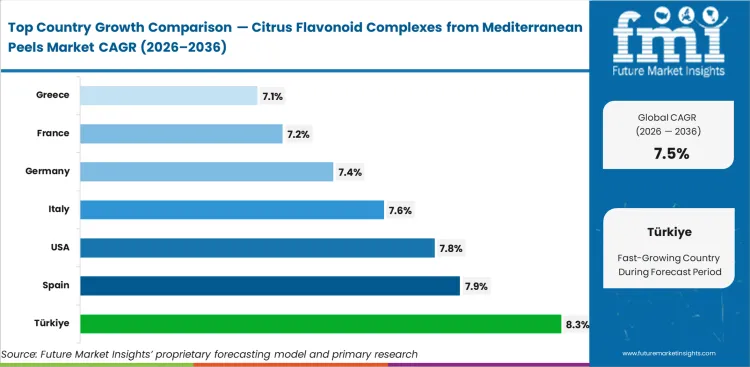
| Country | CAGR (2026 to 2036) |
|---|---|
| Türkiye | 8.3% |
| Spain | 7.9% |
| United States | 7.8% |
| Italy | 7.6% |
| Germany | 7.4% |
| France | 7.2% |
| Greece | 7.1% |
Source: Future Market Insights (FMI) analysis, based on proprietary forecasting model and primary research
Middle East and Africa Citrus Flavonoid Complexes from Mediterranean Peels Market Analysis
Industrial expansion in agricultural processing continues to shape commercial prospects across this region. Local extractors are investing in equipment, process control, and ingredient recovery systems that convert citrus peel residues into higher-value flavonoid outputs. Capital allocation increasingly favors extraction lines with stronger recovery rates, cleaner processing profiles, and tighter quality assurance, since export access depends heavily on certification readiness. Technical progress in standardization, drying, solvent management, and assay consistency remains important for suppliers aiming to move beyond commodity positioning. Better machinery, stronger documentation, and improved manufacturing discipline are helping regional participants build credibility with nutraceutical and functional food buyers.
- Türkiye: Government-backed value-addition efforts continue to strengthen local extraction economics, especially across citrus-processing clusters seeking greater returns from peel streams. Juicing facilities are adding newer extraction capacity, improved filtration systems, and better compound recovery practices so more active ingredient value stays within domestic processing networks. Cost competitiveness supports Türkiye’s market position, particularly for buyers seeking reliable alternatives to Europe-based suppliers. Improved compliance pathways, stronger export discipline, and rising process maturity are widening access to global nutraceutical accounts. Sales of citrus flavonoid complexes from Mediterranean peels in Türkiye are expected to increase at a CAGR of 8.3% during the forecast period. Improving manufacturing capability is strengthening Türkiye’s position as a credible source of standardized flavonoid ingredients for supplements, beverage premixes, and adjacent wellness formulations.
Europe Citrus Flavonoid Complexes from Mediterranean Peels Market Analysis
Europe retains a leading position due to strong citrus-processing infrastructure, close agricultural integration, and faster movement from peel collection to extraction. Shorter supply routes help preserve compound quality, support fresher feedstock handling, and reduce losses after juice production. Regulatory frameworks across Europe push manufacturers toward cleaner extraction routes, tighter residue control, and better process validation, which strengthens buyer confidence in ingredient quality. Leadership in this region depends on peel availability, advanced isolation capability, higher-purity concentration methods, and delivery systems suited to finished formulations. Premium nutraceutical, cosmetic, and functional beverage demand continues to support regional market strength.
- Spain: Spain benefits from a deep orange-processing base that supports steady peel supply, fast collection cycles, and dependable feedstock flow for large-scale extraction. Supplement manufacturers favor supply from Spain due to stronger confidence in raw material continuity, commercial maturity, and repeatable output across large contract volumes. Established processors are advancing closed-loop extraction, yield optimization, and compound preservation, which improves assay consistency and ingredient quality. Efficient transport systems across Europe add commercial value by reducing movement delays for finished flavonoid powders and concentrates. Demand for citrus flavonoid complexes from Mediterranean peels in Spain is anticipated to rise at a CAGR of 7.9% through 2036.
- Italy: The citrus flavonoid complexes from Mediterranean peels market in Italy is poised to expand at a CAGR of 7.6% through 2036. Italy holds a distinct position through specialization in citrus varieties linked with premium health-positioned formulations, especially across bergamot-related extraction and cardiometabolic ingredient development. Buyers seeking differentiated botanical profiles often look to Italian supply for more specialized compound mixes. Regional expertise in handling minor molecules, tighter cultivar knowledge, and process familiarity around niche citrus inputs add commercial defensibility for local extractors. Premium supplement brands value this specialization because it supports stronger product differentiation and more tailored formulation claims around citrus-derived bioactives.
- Germany: Germany is projected to garner 7.4% CAGR in the citrus flavonoid complexes from Mediterranean peels market through 2036. Germany’s expansion is driven less by raw citrus availability and more by formulation demand, technical processing requirements, and sophisticated ingredient-use patterns across food, beverage, and supplement manufacturing. Product developers in this market often seek highly soluble flavonoid formats that enter liquid systems smoothly without disrupting flavor balance, clarity, or stability. Broad consumer interest in plant-based, clean-label, and function-oriented packaged foods supports continuing ingredient uptake across domestic channels. Strict safety expectations and preference for validated natural substitutes keep demand anchored in specification quality and dependable formulation performance.
- France: France presents attractive demand from premium beauty, personal care, and wellness-led applications using natural antioxidants in place of more scrutinized synthetic inputs. The citrus flavonoid complexes from Mediterranean peels market in France is expected to grow at a CAGR of 7.2% during the study period. Standardized citrus flavonoid ingredients support anti-aging, skin-defense, and beauty-positioned product concepts that rely on traceability, clean sourcing narratives, and premium botanical positioning. Beauty and wellness buyers place meaningful weight on transparency across plant sourcing and processing history, adding value for suppliers with stronger documentation standards.
- Greece: Greece is moving forward through gradual modernization of legacy citrus-processing assets, with more sites adding better recovery equipment and upgraded handling for peel-derived actives. Such investment improves operational efficiency and creates added income opportunities for agricultural cooperatives and regional processors seeking stronger returns from citrus by-products. Citrus flavonoid complexes from Mediterranean peels adoption in Greece is likely to advance at a CAGR of 7.1% by 2036. Circular-economy funding and wider interest in waste valorization are encouraging fuller use of peel streams. Further progress in process discipline, drying control, and assay reliability can strengthen Greece’s role in regional flavonoid supply over time.
North America Citrus Flavonoid Complexes from Mediterranean Peels Market Analysis
North America generates strong end-market demand even though local feedstock access remains limited, creating heavy reliance on imported standardized extracts from Mediterranean processing centers. Nutraceutical expansion, functional wellness demand, and greater interest in clinically supported botanical ingredients are pulling more imported citrus flavonoids into supplement and fortified product pipelines. Supply security remains a constant commercial concern because poor harvest conditions, freight disruption, or uneven assay quality can quickly affect inventory planning. Long-term processor relationships, stronger import validation, and better traceability systems are becoming more important for brands seeking dependable supply. Regulatory scrutiny around imported supplement ingredients keeps full-chain transparency, identity confirmation, and bioactive verification high on buyer agendas.
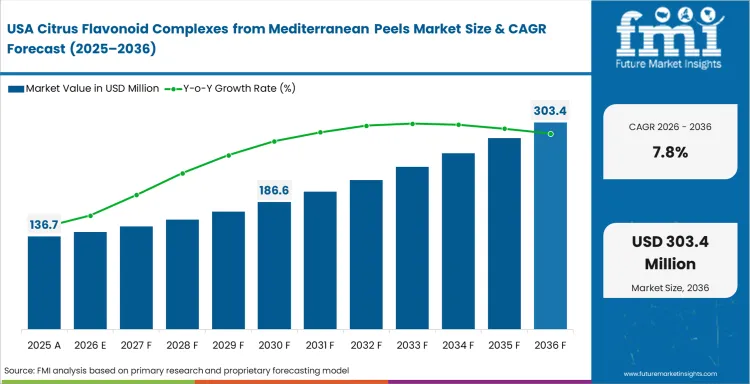
- United States: Large preventive-health, cardiometabolic-support, and wellness supplement categories continue to create sizeable demand for premium imported botanical ingredients across this market. Brand owners are responding through multi-year sourcing arrangements, closer processor relationships, and stricter qualification standards designed to protect ingredient access during volatile harvest cycles or freight disruption. Commercial competition among established wellness companies is raising interest in standardized flavonoid inputs with reliable bioactive profiles and stronger technical documentation. Imported ingredient suppliers able to meet consistency expectations, regulatory documentation needs, and formulation-grade quality standards remain better placed to secure repeat business. Citrus flavonoid complexes from Mediterranean peels sales in United States are poised to grow at a CAGR of 7.8% during the assessment period.
Competitive Aligners for Market Players
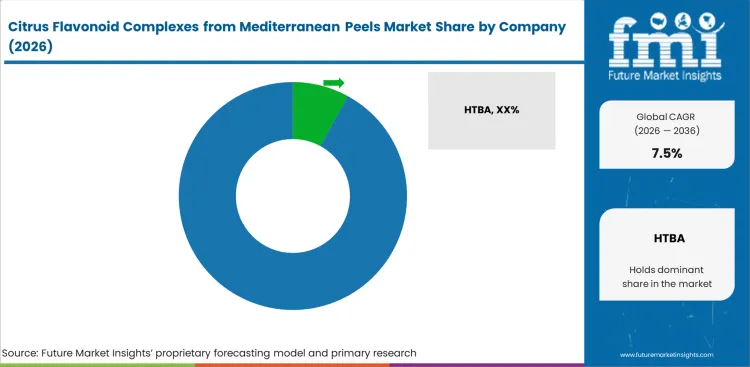
Specialized extraction expertise separates dominant citrus flavonoid ingredient suppliers from struggling commodity producers. Companies like HTBA and Euromed compete on their ability to guarantee exact molecular profiles across variable harvests. Purchasing departments evaluate suppliers based on clinical documentation portfolios rather than simple price-per-kilo metrics. Operations lacking advanced analytical testing capabilities fail to secure contracts with major nutraceutical brands. Providing consistent bioavailability data proves more valuable than offering discounted bulk powders.
Incumbents possess deep, multi-generational relationships with massive juicing cooperatives, ensuring priority access to fresh peel streams. Challengers cannot replicate these agricultural networks quickly, forcing them to purchase lower-quality degraded materials on open markets. Established Mediterranean citrus flavonoid manufacturers utilize extensive fruit pomace processing data to optimize their extraction parameters perfectly. Overcoming this historical data advantage requires challengers to invest heavily in artificial intelligence modeling. Securing reliable feedstock remains a major barrier for undercapitalized market entrants.
Key Players in Citrus Flavonoid Complexes from Mediterranean Peels Market
- HTBA
- Euromed
- BIONAP
- Bordas
- IFF Health Sciences
Scope of the Report
| Metric | Value |
|---|---|
| Quantitative Units | USD 310.0 million to USD 638.9 million, at a CAGR of 7.5% |
| Market Definition | Standardized bioactive compounds extracted specifically from Mediterranean-sourced citrus waste streams. This sector isolates specific molecules like hesperidin and eriocitrin for integration into human health applications. Functional boundaries exclude generic citrus oils and focus entirely on scientifically validated chemical profiles. |
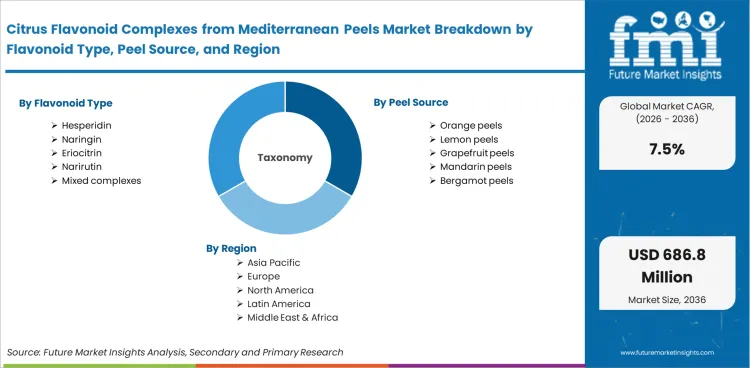
| Segmentation | By Flavonoid Type, By Peel Source, By Form, By Application, By Extraction Technology, By Region |
| Regions Covered | North America, Europe, Asia Pacific, Latin America, and Middle East & Africa, |
| Countries Covered | Türkiye, Spain, United States, Italy, Germany, France, Greece |
| Key Companies Profiled | HTBA, Euromed, BIONAP, Bordas, IFF Health Sciences |
| Forecast Period | 2026 to 2036 |
| Approach | Bottom-up value model based on Mediterranean peel availability, industrial processing share, extractable flavonoid-rich concentrate yield, and specialty ingredient ASPs |
Source: Future Market Insights (FMI) analysis, based on proprietary forecasting model and primary research
Citrus Flavonoid Complexes from Mediterranean Peels Market Analysis by Segments
Flavonoid Type:
- Hesperidin
- Naringin
- Eriocitrin
- Narirutin
- Mixed complexes
Peel Source:
- Orange peels
- Lemon peels
- Grapefruit peels
- Mandarin peels
- Bergamot peels
Form:
- Powder
- Liquid
- Microencapsulated
Application:
- Nutraceuticals
- Functional food
- Beverages
- Personal care
- Pharma blends
Extraction Technology:
- Hydroalcoholic
- Water-based
- Enzymatic
- Membrane
- Resin-based
Region:
- North America
- United States
- Canada
- Europe
- Germany
- United Kingdom
- France
- Italy
- Spain
- Asia Pacific
- China
- Japan
- South Korea
- Taiwan
- Singapore
- Latin America
- Brazil
- Mexico
- Argentina
- Middle East & Africa
- GCC Countries
- South Africa
- Israel
- Rest of Middle East & Africa
Bibliography
- Di Sano, C., D’Anna, C., Li Petri, G., Angellotti, G., Meneguzzo, F., Ciriminna, R., & Pagliaro, M. (2025). Citrus flavonoid-pectin conjugates: Towards broad scope therapeutic agents. Food Hydrocolloids for Health, 8, 100246.
- Morales, J., Medina, A., & Bermejo, A. (2025). Sustainable extraction of flavonoids from citrus waste: A fast and simple approach with UHPLC-PDA ESI-MS characterization.
- Ahranjani, P. J., Esfandiari, Z., & Rashidi Nodeh, H. (2025). A systematic review of traditional and eco-friendly methods for extracting bioactive compounds from Citrus aurantium L. plant. Journal of Food Composition and Analysis, 142, 107472.
- Aouant, K., Christodoulou, P., Tsiaka, T., Strati, I. F., Cavouras, D., & Sinanoglou, V. J. (2025). Implementation of instrumental analytical methods, image analysis and chemometrics for the comparative evaluation of citrus fruit peels.
- Vilas-Boas, A. A., et al. (2025). Upcycled orange peel ingredients: A scoping review on phytochemical composition, extraction techniques, and biorefinery strategies.
This bibliography is provided for reader reference. The full FMI report contains the complete reference list with primary source documentation.
This Report Addresses
- Purchasing strategies for securing standardized hesperidin yields.
- Cost implications of adopting solvent-free water extraction methods.
- Operational impacts caused by seasonal Mediterranean crop fluctuations.
- Competitive advantages derived from specialized bergamot processing capabilities.
- Regulatory hurdles impacting hydroalcoholic residue management protocols.
- Formulation challenges associated with liquid citrus fiber complex formats.
- Strategic positioning required for entering functional beverage sectors.
- Capital requirements for upgrading legacy citrus pectin juicing facilities.
Frequently Asked Questions
What are citrus flavonoid complexes from Mediterranean peels?
Standardized bioactive compounds extracted specifically from regional agricultural waste streams. This sector isolates specific molecules like hesperidin and eriocitrin for integration into human health applications, excluding generic citrus ingredients lacking scientific validation.
How big is the citrus flavonoid complexes market in 2026?
Revenues are projected to hit USD 310.0 million. Continuous integration of targeted flavonoids into cardiometabolic supplements drives this expansion, elevating raw peel from byproduct to primary specialty feedstock.
What is the 2036 forecast for citrus flavonoid complexes from Mediterranean peels?
Compound annual growth is expected to track at 7.5% toward USD 638.9 million. Sustained demand for clean-label clinical functional food ingredients forces processors to optimize their extraction technologies, protecting margins against raw material price fluctuations.
Which flavonoids dominate this market: hesperidin, naringin, or eriocitrin?
High natural abundance inside orange waste makes hesperidin highly economical to extract. Operations managers prefer processing this specific molecule because predictable yields minimize equipment downtime and simplify quality control protocols.
Why do Mediterranean peels matter in citrus flavonoid extraction?
Massive industrial juicing operations generate immense volumes of orange peel daily across this geography. Large processors can secure this material through established sourcing networks, which helps support stable production through the year.
What limits scale in citrus peel flavonoid commercialization?
Seasonal climate variations alter peel chemistry unpredictably. Extraction facility managers must recalibrate separation parameters constantly to ensure batch consistency, raising overhead costs significantly for these delicate botanical extracts.
What applications use citrus flavonoid complexes the most?
Consumers accept pill formats readily for targeted cardiometabolic interventions. Clinical researchers utilize precise dosage forms to validate health claims, providing regulatory officers with necessary documentation for product approvals.
Why do hydroalcoholic methods lead to extraction technologies?
Blended solvents maximize active compound recovery while maintaining reasonable operational expenses. Facility engineers fine-tune alcohol ratios to target specific molecular profiles without destroying delicate bioactive structures during processing.
Which countries drive supply and demand in this market?
Aggressive domestic processing modernization allows operators to capture export value locally, while massive domestic agricultural output guarantees immense feedstock stability across Spain for downstream United States buyers.
Which companies are active in citrus flavonoid complexes?
HTBA, Euromed, BIONAP, Bordas, and IFF Health Sciences operate heavily here. These entities compete on their ability to guarantee exact molecular profiles rather than simple volume output.
How is this market different from bergamot extract or citrus fiber?
Deep specialization in rare citrus varieties creates highly defensible commercial niches. Formulation scientists specify exact extraction origins to match specific clinical profiles, creating effective vendor lock-in for premium brands.
Why is microencapsulation becoming critical?
Protecting delicate flavonoids from gastric degradation improves overall bioavailability. R&D departments specify these advanced formats to differentiate premium products inside crowded retail supplement aisles.
How do large buyers resist vendor lock-in?
Spend management intentionally qualify multiple regional extraction partners. Splitting massive orders across different processors mitigates localized crop failure risks while maintaining competitive pricing leverage.
What advantage do incumbent processors hold?
Deep historical relationships with juicing cooperatives guarantee priority access to fresh peel. Challengers struggle to secure high-quality raw material, forcing them to process degraded open-market feedstock.
Why do formulators avoid liquid formats?
Temperature sensitivity causes rapid molecular degradation during transit. Quality assurance managers reject liquid shipments frequently due to shortened shelf lives and inconsistent bioactive concentrations.
How do regulatory pressures impact extraction?
Strict clean-label requirements force brands to eliminate trace solvent residues. Compliance officers reject batches containing acceptable but undesirable chemicals, pushing processors toward pure water separation methods.
Why are minor flavonoids gaining commercial traction?
Unique metabolic benefits differentiate products containing eriocitrin or narirutin. Marketing departments highlight these rare compounds to justify premium pricing tiers against generic naringin or hesperidin supplements.
What risk do open-market purchasers face?
Untraceable sourcing exposes buyers to severe pesticide residue violations. Quality control technicians reject contaminated batches routinely, causing massive production delays for uncontracted manufacturers.
Why is functional food application technically challenging?
Inherent bitterness requires sophisticated taste-masking technologies. Food scientists struggle to integrate required clinical dosages without destroying acceptable consumer flavor profiles.
How does North America demand behave structurally?
Aggressive brand demand exists completely decoupled from local sourcing. Supply chain officers rely entirely upon European imports, exposing them to significant cross-border logistical disruptions.
What changes by 2036?
Precision isolation replaces bulk processing entirely. Chief scientists are expected to design custom synergistic blends targeting specific disease pathways rather than offering generic broad-spectrum citrus antioxidant powders.
Preview the report firsthand - request a free sample
Get SampleGet the brochure for pricing and purchase details.
Get PDFTable of Content
- Executive Summary
- Global Market Outlook
- Demand-side Trends
- Supply-side Trends
- Technology Roadmap Analysis
- Analysis and Recommendations
- Market Overview
- Market Coverage / Taxonomy
- Market Definition / Scope / Limitations
- Research Methodology
- Chapter Orientation
- Analytical Lens and Working Hypotheses
- Market Structure, Signals, and Trend Drivers
- Benchmarking and Cross-market Comparability
- Market Sizing, Forecasting, and Opportunity Mapping
- Research Design and Evidence Framework
- Desk Research Programme (Secondary Evidence)
- Company Annual and Sustainability Reports
- Peer-reviewed Journals and Academic Literature
- Corporate Websites, Product Literature, and Technical Notes
- Earnings Decks and Investor Briefings
- Statutory Filings and Regulatory Disclosures
- Technical White Papers and Standards Notes
- Trade Journals, Industry Magazines, and Analyst Briefs
- Conference Proceedings, Webinars, and Seminar Materials
- Government Statistics Portals and Public Data Releases
- Press Releases and Reputable Media Coverage
- Specialist Newsletters and Curated Briefings
- Sector Databases and Reference Repositories
- FMI Internal Proprietary Databases and Historical Market Datasets
- Subscription Datasets and Paid Sources
- Social Channels, Communities, and Digital Listening Inputs
- Additional Desk Sources
- Expert Input and Fieldwork (Primary Evidence)
- Primary Modes
- Qualitative Interviews and Expert Elicitation
- Quantitative Surveys and Structured Data Capture
- Blended Approach
- Why Primary Evidence is Used
- Field Techniques
- Interviews
- Surveys
- Focus Groups
- Observational and In-context Research
- Social and Community Interactions
- Stakeholder Universe Engaged
- C-suite Leaders
- Board Members
- Presidents and Vice Presidents
- R&D and Innovation Heads
- Technical Specialists
- Domain Subject-matter Experts
- Scientists
- Physicians and Other Healthcare Professionals
- Governance, Ethics, and Data Stewardship
- Research Ethics
- Data Integrity and Handling
- Primary Modes
- Tooling, Models, and Reference Databases
- Desk Research Programme (Secondary Evidence)
- Data Engineering and Model Build
- Data Acquisition and Ingestion
- Cleaning, Normalisation, and Verification
- Synthesis, Triangulation, and Analysis
- Quality Assurance and Audit Trail
- Market Background
- Market Dynamics
- Drivers
- Restraints
- Opportunity
- Trends
- Scenario Forecast
- Demand in Optimistic Scenario
- Demand in Likely Scenario
- Demand in Conservative Scenario
- Opportunity Map Analysis
- Product Life Cycle Analysis
- Supply Chain Analysis
- Investment Feasibility Matrix
- Value Chain Analysis
- PESTLE and Porter’s Analysis
- Regulatory Landscape
- Regional Parent Market Outlook
- Production and Consumption Statistics
- Import and Export Statistics
- Market Dynamics
- Global Market Analysis 2021 to 2025 and Forecast, 2026 to 2036
- Historical Market Size Value (USD Million) Analysis, 2021 to 2025
- Current and Future Market Size Value (USD Million) Projections, 2026 to 2036
- Y-o-Y Growth Trend Analysis
- Absolute $ Opportunity Analysis
- Global Market Pricing Analysis 2021 to 2025 and Forecast 2026 to 2036
- Global Market Analysis 2021 to 2025 and Forecast 2026 to 2036, By Flavonoid Type
- Introduction / Key Findings
- Historical Market Size Value (USD Million) Analysis By Flavonoid Type , 2021 to 2025
- Current and Future Market Size Value (USD Million) Analysis and Forecast By Flavonoid Type , 2026 to 2036
- Hesperidin
- Naringin
- Eriocitrin
- Narirutin
- Mixed complexes
- Hesperidin
- Y-o-Y Growth Trend Analysis By Flavonoid Type , 2021 to 2025
- Absolute $ Opportunity Analysis By Flavonoid Type , 2026 to 2036
- Global Market Analysis 2021 to 2025 and Forecast 2026 to 2036, By Peel Source
- Introduction / Key Findings
- Historical Market Size Value (USD Million) Analysis By Peel Source, 2021 to 2025
- Current and Future Market Size Value (USD Million) Analysis and Forecast By Peel Source, 2026 to 2036
- Orange peels
- Lemon peels
- Grapefruit peels
- Mandarin peels
- Bergamot peels
- Orange peels
- Y-o-Y Growth Trend Analysis By Peel Source, 2021 to 2025
- Absolute $ Opportunity Analysis By Peel Source, 2026 to 2036
- Global Market Analysis 2021 to 2025 and Forecast 2026 to 2036, By Form
- Introduction / Key Findings
- Historical Market Size Value (USD Million) Analysis By Form, 2021 to 2025
- Current and Future Market Size Value (USD Million) Analysis and Forecast By Form, 2026 to 2036
- Powder
- Liquid
- Microencapsulated
- Powder
- Y-o-Y Growth Trend Analysis By Form, 2021 to 2025
- Absolute $ Opportunity Analysis By Form, 2026 to 2036
- Global Market Analysis 2021 to 2025 and Forecast 2026 to 2036, By Application
- Introduction / Key Findings
- Historical Market Size Value (USD Million) Analysis By Application, 2021 to 2025
- Current and Future Market Size Value (USD Million) Analysis and Forecast By Application, 2026 to 2036
- Nutraceuticals
- Functional food
- Beverages
- Personal care
- Pharma blends
- Nutraceuticals
- Y-o-Y Growth Trend Analysis By Application, 2021 to 2025
- Absolute $ Opportunity Analysis By Application, 2026 to 2036
- Global Market Analysis 2021 to 2025 and Forecast 2026 to 2036, By Extraction Technology
- Introduction / Key Findings
- Historical Market Size Value (USD Million) Analysis By Extraction Technology, 2021 to 2025
- Current and Future Market Size Value (USD Million) Analysis and Forecast By Extraction Technology, 2026 to 2036
- Hydroalcoholic
- Water-based
- Enzymatic
- Membrane
- Resin-based
- Hydroalcoholic
- Y-o-Y Growth Trend Analysis By Extraction Technology, 2021 to 2025
- Absolute $ Opportunity Analysis By Extraction Technology, 2026 to 2036
- Global Market Analysis 2021 to 2025 and Forecast 2026 to 2036, By Region
- Introduction
- Historical Market Size Value (USD Million) Analysis By Region, 2021 to 2025
- Current Market Size Value (USD Million) Analysis and Forecast By Region, 2026 to 2036
- North America
- Latin America
- Western Europe
- Eastern Europe
- East Asia
- South Asia and Pacific
- Middle East & Africa
- Market Attractiveness Analysis By Region
- North America Market Analysis 2021 to 2025 and Forecast 2026 to 2036, By Country
- Historical Market Size Value (USD Million) Trend Analysis By Market Taxonomy, 2021 to 2025
- Market Size Value (USD Million) Forecast By Market Taxonomy, 2026 to 2036
- By Country
- USA
- Canada
- Mexico
- By Flavonoid Type
- By Peel Source
- By Form
- By Application
- By Extraction Technology
- By Country
- Market Attractiveness Analysis
- By Country
- By Flavonoid Type
- By Peel Source
- By Form
- By Application
- By Extraction Technology
- Key Takeaways
- Latin America Market Analysis 2021 to 2025 and Forecast 2026 to 2036, By Country
- Historical Market Size Value (USD Million) Trend Analysis By Market Taxonomy, 2021 to 2025
- Market Size Value (USD Million) Forecast By Market Taxonomy, 2026 to 2036
- By Country
- Brazil
- Chile
- Rest of Latin America
- By Flavonoid Type
- By Peel Source
- By Form
- By Application
- By Extraction Technology
- By Country
- Market Attractiveness Analysis
- By Country
- By Flavonoid Type
- By Peel Source
- By Form
- By Application
- By Extraction Technology
- Key Takeaways
- Western Europe Market Analysis 2021 to 2025 and Forecast 2026 to 2036, By Country
- Historical Market Size Value (USD Million) Trend Analysis By Market Taxonomy, 2021 to 2025
- Market Size Value (USD Million) Forecast By Market Taxonomy, 2026 to 2036
- By Country
- Germany
- UK
- Italy
- Spain
- France
- Nordic
- BENELUX
- Rest of Western Europe
- By Flavonoid Type
- By Peel Source
- By Form
- By Application
- By Extraction Technology
- By Country
- Market Attractiveness Analysis
- By Country
- By Flavonoid Type
- By Peel Source
- By Form
- By Application
- By Extraction Technology
- Key Takeaways
- Eastern Europe Market Analysis 2021 to 2025 and Forecast 2026 to 2036, By Country
- Historical Market Size Value (USD Million) Trend Analysis By Market Taxonomy, 2021 to 2025
- Market Size Value (USD Million) Forecast By Market Taxonomy, 2026 to 2036
- By Country
- Russia
- Poland
- Hungary
- Balkan & Baltic
- Rest of Eastern Europe
- By Flavonoid Type
- By Peel Source
- By Form
- By Application
- By Extraction Technology
- By Country
- Market Attractiveness Analysis
- By Country
- By Flavonoid Type
- By Peel Source
- By Form
- By Application
- By Extraction Technology
- Key Takeaways
- East Asia Market Analysis 2021 to 2025 and Forecast 2026 to 2036, By Country
- Historical Market Size Value (USD Million) Trend Analysis By Market Taxonomy, 2021 to 2025
- Market Size Value (USD Million) Forecast By Market Taxonomy, 2026 to 2036
- By Country
- China
- Japan
- South Korea
- By Flavonoid Type
- By Peel Source
- By Form
- By Application
- By Extraction Technology
- By Country
- Market Attractiveness Analysis
- By Country
- By Flavonoid Type
- By Peel Source
- By Form
- By Application
- By Extraction Technology
- Key Takeaways
- South Asia and Pacific Market Analysis 2021 to 2025 and Forecast 2026 to 2036, By Country
- Historical Market Size Value (USD Million) Trend Analysis By Market Taxonomy, 2021 to 2025
- Market Size Value (USD Million) Forecast By Market Taxonomy, 2026 to 2036
- By Country
- India
- ASEAN
- Australia & New Zealand
- Rest of South Asia and Pacific
- By Flavonoid Type
- By Peel Source
- By Form
- By Application
- By Extraction Technology
- By Country
- Market Attractiveness Analysis
- By Country
- By Flavonoid Type
- By Peel Source
- By Form
- By Application
- By Extraction Technology
- Key Takeaways
- Middle East & Africa Market Analysis 2021 to 2025 and Forecast 2026 to 2036, By Country
- Historical Market Size Value (USD Million) Trend Analysis By Market Taxonomy, 2021 to 2025
- Market Size Value (USD Million) Forecast By Market Taxonomy, 2026 to 2036
- By Country
- Kingdom of Saudi Arabia
- Other GCC Countries
- Turkiye
- South Africa
- Other African Union
- Rest of Middle East & Africa
- By Flavonoid Type
- By Peel Source
- By Form
- By Application
- By Extraction Technology
- By Country
- Market Attractiveness Analysis
- By Country
- By Flavonoid Type
- By Peel Source
- By Form
- By Application
- By Extraction Technology
- Key Takeaways
- Key Countries Market Analysis
- USA
- Pricing Analysis
- Market Share Analysis, 2025
- By Flavonoid Type
- By Peel Source
- By Form
- By Application
- By Extraction Technology
- Canada
- Pricing Analysis
- Market Share Analysis, 2025
- By Flavonoid Type
- By Peel Source
- By Form
- By Application
- By Extraction Technology
- Mexico
- Pricing Analysis
- Market Share Analysis, 2025
- By Flavonoid Type
- By Peel Source
- By Form
- By Application
- By Extraction Technology
- Brazil
- Pricing Analysis
- Market Share Analysis, 2025
- By Flavonoid Type
- By Peel Source
- By Form
- By Application
- By Extraction Technology
- Chile
- Pricing Analysis
- Market Share Analysis, 2025
- By Flavonoid Type
- By Peel Source
- By Form
- By Application
- By Extraction Technology
- Germany
- Pricing Analysis
- Market Share Analysis, 2025
- By Flavonoid Type
- By Peel Source
- By Form
- By Application
- By Extraction Technology
- UK
- Pricing Analysis
- Market Share Analysis, 2025
- By Flavonoid Type
- By Peel Source
- By Form
- By Application
- By Extraction Technology
- Italy
- Pricing Analysis
- Market Share Analysis, 2025
- By Flavonoid Type
- By Peel Source
- By Form
- By Application
- By Extraction Technology
- Spain
- Pricing Analysis
- Market Share Analysis, 2025
- By Flavonoid Type
- By Peel Source
- By Form
- By Application
- By Extraction Technology
- France
- Pricing Analysis
- Market Share Analysis, 2025
- By Flavonoid Type
- By Peel Source
- By Form
- By Application
- By Extraction Technology
- India
- Pricing Analysis
- Market Share Analysis, 2025
- By Flavonoid Type
- By Peel Source
- By Form
- By Application
- By Extraction Technology
- ASEAN
- Pricing Analysis
- Market Share Analysis, 2025
- By Flavonoid Type
- By Peel Source
- By Form
- By Application
- By Extraction Technology
- Australia & New Zealand
- Pricing Analysis
- Market Share Analysis, 2025
- By Flavonoid Type
- By Peel Source
- By Form
- By Application
- By Extraction Technology
- China
- Pricing Analysis
- Market Share Analysis, 2025
- By Flavonoid Type
- By Peel Source
- By Form
- By Application
- By Extraction Technology
- Japan
- Pricing Analysis
- Market Share Analysis, 2025
- By Flavonoid Type
- By Peel Source
- By Form
- By Application
- By Extraction Technology
- South Korea
- Pricing Analysis
- Market Share Analysis, 2025
- By Flavonoid Type
- By Peel Source
- By Form
- By Application
- By Extraction Technology
- Russia
- Pricing Analysis
- Market Share Analysis, 2025
- By Flavonoid Type
- By Peel Source
- By Form
- By Application
- By Extraction Technology
- Poland
- Pricing Analysis
- Market Share Analysis, 2025
- By Flavonoid Type
- By Peel Source
- By Form
- By Application
- By Extraction Technology
- Hungary
- Pricing Analysis
- Market Share Analysis, 2025
- By Flavonoid Type
- By Peel Source
- By Form
- By Application
- By Extraction Technology
- Kingdom of Saudi Arabia
- Pricing Analysis
- Market Share Analysis, 2025
- By Flavonoid Type
- By Peel Source
- By Form
- By Application
- By Extraction Technology
- Turkiye
- Pricing Analysis
- Market Share Analysis, 2025
- By Flavonoid Type
- By Peel Source
- By Form
- By Application
- By Extraction Technology
- South Africa
- Pricing Analysis
- Market Share Analysis, 2025
- By Flavonoid Type
- By Peel Source
- By Form
- By Application
- By Extraction Technology
- USA
- Market Structure Analysis
- Competition Dashboard
- Competition Benchmarking
- Market Share Analysis of Top Players
- By Regional
- By Flavonoid Type
- By Peel Source
- By Form
- By Application
- By Extraction Technology
- Competition Analysis
- Competition Deep Dive
- HTBA
- Overview
- Product Portfolio
- Profitability by Market Segments (Product/Age /Sales Channel/Region)
- Sales Footprint
- Strategy Overview
- Marketing Strategy
- Product Strategy
- Channel Strategy
- Euromed
- BIONAP
- Bordas
- IFF Health Sciences
- HTBA
- Competition Deep Dive
- Assumptions & Acronyms Used


