

- Market Size (2026)
- USD 322.8 Mn
- Forecast (2036)
- USD 651.0 Mn
- CAGR (2026 to 2036)
- 7.3%
Citrus-Derived Gastrointestinal Comfort Blends Market Size, Market Forecast and Outlook By FMI
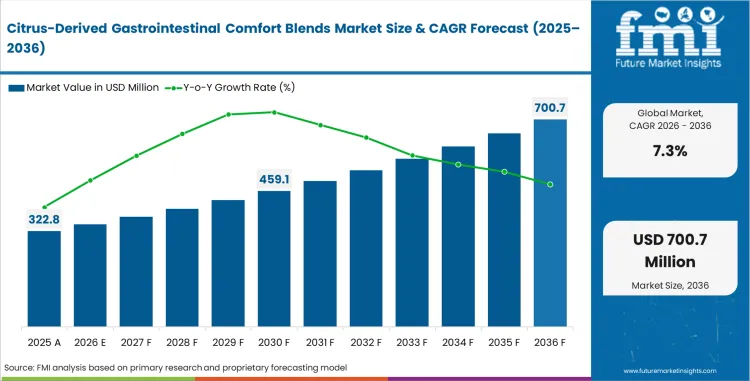
The citrus-derived gastrointestinal comfort blends market surpassed a valuation of USD 300.9 million in 2025. Revenue is set to reach USD 322.8 million in 2026, rising at a 7.3% CAGR through the forecast period. Industry value is projected to reach USD 651.0 million by 2036 as product developers shift from fragile probiotic-led digestive formats toward citrus-based blend systems with better storage stability and easier use in daily gut health supplements and functional wellness products.
Summary of Citrus-Derived Gastrointestinal Comfort Blends Market
- Market Snapshot
- The citrus-derived gastrointestinal comfort blends market is valued at USD 300.9 million in 2025 and is projected to reach USD 651.0 million by 2036.
- The market is expected to grow at a rate of 7.3% from 2026 to 2036, creating an incremental opportunity of USD 328.2 million.
- This category sits between broader digestive health supplements and narrower citrus functional ingredients, covering citrus-derived blends formulated for bloating, gastric comfort, transit support, and microbiome-oriented wellness.
- Supply feasibility is supported by large citrus-processing streams, including 17.1 million tons of oranges sent to processors and 2.6 million tons of lemon/lime processing volume in 2025/26.
- Demand And Growth Drivers
- Demand is rising because plant-derived digestive support is gaining share within a larger gut health category still led by probiotics, enzymes, and fibers, making citrus blends a targeted but credible subsegment.
- Citrus flavonoids and related phytochemicals are gaining attention because recent reviews describe intestinal protective effects, interactions with gut microbiota, and broader GI metabolic relevance.
- Citrus fiber systems are also benefiting from cleaner-label formulation demand, especially where brands want digestive positioning without relying only on live-culture systems.
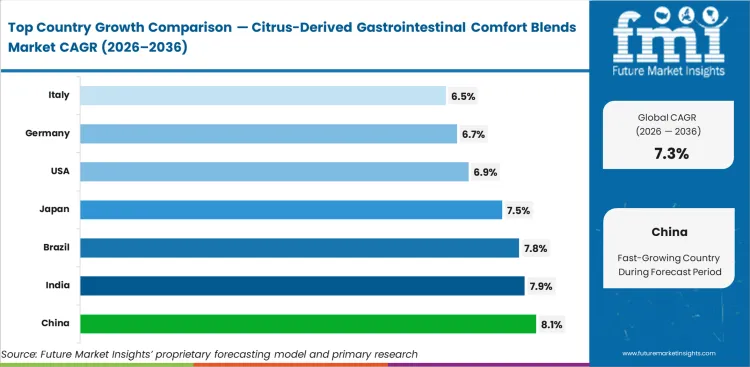
- Among key countries, China leads at 8.1% CAGR, followed by India at 7.9% CAGR, Brazil at 7.8% CAGR, Japan at 7.5% CAGR, United States at 6.9% CAGR, Germany at 6.7% CAGR, and Italy at 6.5% CAGR.
- Growth is moderated by supplement-claim boundaries, the need for stronger human clinical substantiation, and the fact that citrus GI blends still compete against more established probiotic and enzyme formats.
- Product And Segment View
- The market covers citrus-derived pectin, fiber, flavonoid, polyphenol, and aromatic extract systems formulated mainly as powders, capsules, gummies, liquids, and sachets.
- Pectin-fiber blends lead the ingredient type segment with 29.0% share, supported by their better fit with digestive regularity, satiety, texture, and tolerated daily-use positioning.
- Powders dominate the form segment with 42.0% share, reflecting B2B premix demand and easier use in sachets, stick packs, and beverage systems.
- Bloating relief leads the application segment because it is the most familiar consumer use case in everyday digestive support. This segment is expected to account for 34.0% share in 2026.
- Dietary supplements remain the leading end-use segment as they offer easier dosage control and clearer structure/function positioning than conventional foods. The segment is estimated to represent 49.0% share in 2026.
- Scope includes citrus-derived GI-comfort premixes, standardized citrus fibers, flavonoid blends, peel-derived polyphenol systems, and supplement-ready citrus wellness combinations, but excludes standalone probiotics, pure digestive enzymes, general citrus flavor systems, and bulk citrus hydrocolloids sold without digestive positioning.
- Geography And Competitive Outlook
- China, India, and Brazil are the fastest-growing markets, while the United States remains the most stable high-value demand base.
- Competition is determined less by scale alone than by formulation support, branded ingredient credibility, evidence packaging, and ability to supply powders and premixes into both supplements and gut-friendly foods.
- Ingredients by Nature, Fiberstar, Indena, CP Kelco, CEAMSA, and Herbafood Ingredients GmbH are among the key participants, and the market remains fragmented with the leading player.
Key Takeaways, Market Size, and Forecast
- Citrus-Derived Gastrointestinal Comfort Blends Market is projected to grow from USD 322.8 million in 2026 to USD 651.0 million by 2036, at a CAGR of 7.3%.
- The citrus-derived gastrointestinal comfort blends market was valued at USD 300.9 million in 2025.
- By 2036, the Citrus-Derived Gastrointestinal Comfort Blends Market is expected to be worth USD 651.0 million.
- From 2026 to 2036, the market is projected to expand at a CAGR of 7.3%.
- The market is projected to create an incremental opportunity of USD 328.2 million between 2026 and 2036.
- In 2026, Pectin-fiber blends are expected to account for 29.0% of the ingredient type segment.
- China (8.1%) and India (7.9%) are two of the fastest growing markets.
Citrus-Derived Gastrointestinal Comfort Blends Market Key Takeaways
| Metric | Details |
|---|---|
| Industry Size (2026) | USD 322.8 million |
| Industry Value (2036) | USD 651.0 million |
| CAGR (2026 to 2036) | 7.3% |
Source: Future Market Insights (FMI) analysis, based on proprietary forecasting model and primary research
Reliable forecasting for citrus-derived gut health products starts with a close reading of real buying patterns across supplements. Interest is shifting toward plant-based digestive support with broader everyday use, and brand planning is adjusting in the same direction. Live-culture products still hold space in digestive care, yet storage risk, heat exposure, and moisture sensitivity continue to create strain during filling, packing, shipping, and shelf placement. Stable citrus fiber ingredients bring a more workable path, while broader use of dietary fibers in digestive formulations keeps product teams focused on ingredient forms with better storage tolerance and easier use across multiple dosage formats.
China is expected to register an 8.1% CAGR during the forecast period, supported by rising middle-class supplement consumption and wider distribution of functional botanical products. India is estimated to expand at a 7.9% CAGR over the same period, aided by the scaling of domestic nutraceutical manufacturing capacity. Brazil is poised to grow at a 7.8% CAGR, benefiting from its position as a major global orange processing hub and access to cost-advantaged domestic feedstock. Japan is projected to record a 7.5% CAGR as mature functional food demand moves toward senior-focused digestive formats. The United States is likely to advance at a 6.9% CAGR, while Germany and Italy are expected to grow at 6.7% and 6.5% CAGR respectively, reflecting stronger emphasis on clinical substantiation, regulatory compliance, and localized citrus bioactive positioning.
Segmental Analysis
Citrus-Derived Gastrointestinal Comfort Blends Market Analysis by Ingredient Type
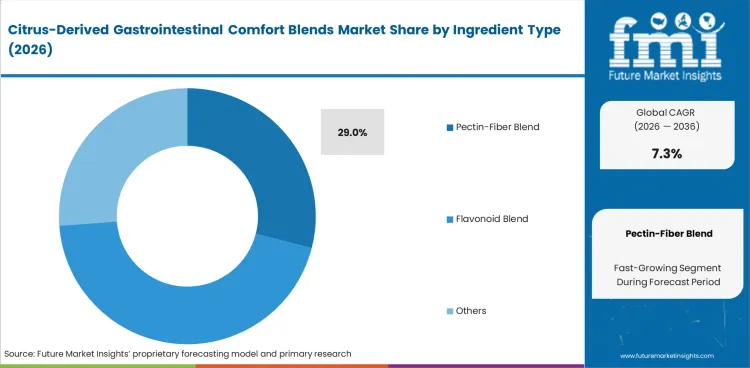
Ingredient choice in this market often comes down to a simple trade-off. Brands want strong digestive support, yet finished products also need acceptable taste, easy mixing, and smooth scale-up during commercial production. Pectin-fiber blends answer all three needs in one go, so wider use continues across mass-market digestive formats. Use of citrus pectin keeps gaining relevance here, while citrus pulp fiber adds clean-label appeal and prebiotic value in the same formulation space. The pectin-fiber blends segment is estimated to account for 29.0% share in 2026 because it offers strong bulking functionality and better sensory balance in finished products. Real value comes from physical bulking support along with slower release across lower intestinal pathways, giving formulators more room to build products for regular use. Citrus pulp fiber also brings clean-label appeal and prebiotic value, so buyers get more than one benefit from a single ingredient system.
- Primary actor limitation: Beverage formulators often run into viscosity issues after adding standard fibers to liquid formats, due to unwanted thickening during mixing, filling, and final consumption. Excess body in a digestive beverage can quickly reduce consumer acceptance, especially in products positioned for daily use. This creates a practical ceiling on fiber loading and limits room for brands trying to combine digestive support with easy drinkability.
- Mechanical resolution: Enzymatic adjustment of pectin structure reduces molecular weight and supports higher-dose inclusion without changing mouthfeel too much. This gives formulators more freedom to raise functional loading while keeping the final product lighter and easier to consume. Improved control over texture also supports broader use across ready-to-mix drinks, digestive sachets, and liquid wellness formats built for repeat intake.
- Commercial residual: Suppliers with proprietary enzymatic treatment capability gain pricing strength, while standard millers stay closer to basic commodity competition. Commercial advantage grows further once buyers begin valuing ease of formulation, cleaner taste, and smoother scale-up over raw ingredient volume alone. A supplier offering modified pectin with proven usability often enters the conversation earlier and keeps stronger margin room across premium digestive applications.
Citrus-Derived Gastrointestinal Comfort Blends Market Analysis by Form
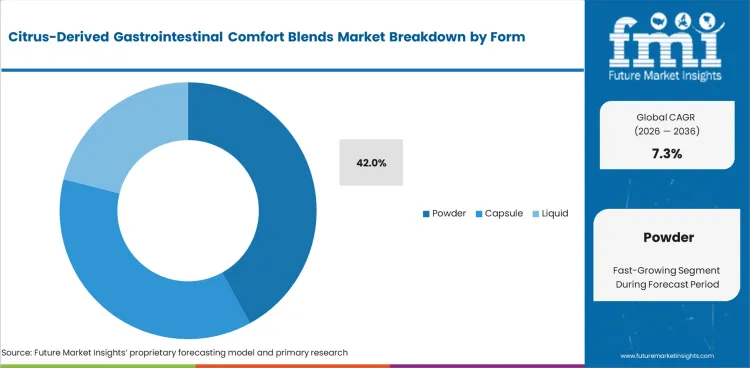
Powders continue to lead because dry delivery makes room for high active loading without bringing capsule size limits or gummy format constraints into play. Ribbon blending also fits existing factory operations with less process adjustment, and dry premix handling remains simpler for contract manufacturers working across multiple supplement brands. Portable stick packs, sachets, and single-serve digestive formats add more momentum here, since consumers now prefer products with easy travel use and quick mixing at home or on routine daily movement. In 2026, powders are expected to contribute 42.0% of total market share, driven by easier storage stability and supported by smoother handling across commercial blending lines. The commercial fit of citrus powder continues to support this direction. Liquid extracts still carry appeal in small herbal formats, yet precipitation during warehousing and active inconsistency during storage create real commercial strain.
- Current baseline: Liquid botanical extracts still serve traditional herbal channels, yet dry powder lines remain more practical for large-scale supplement production. Powder systems move more smoothly through standard factory equipment, reduce storage complexity, and support easier batching across high-volume operations. This makes them more suitable for contract manufacturers and private-label programs looking for consistency, easier packing flow, and better operational control during everyday production runs.
- Formulation friction: Converting liquids into stable pectin powder often needs costly spray-drying, owing to sensitivity around volatile aromatic compounds. Part of the challenge comes from balancing drying efficiency with protection of delicate citrus notes and active fractions. Once aroma loss or thermal damage enters the process, finished product quality can slip, and brands may need extra correction through flavor balancing or additional formulation work later.
- Trajectory path: Advanced liposomal powder systems improve protection during processing, supported by better survival of delicate citrus bioactives in premium formulations. This creates added value for brands aiming at higher-end digestive products with cleaner dosing accuracy and longer shelf reliability. Better protection during drying and storage also helps position premium powders for medical nutrition, OTC support products, and specialized gut health formulas with stronger performance expectations.
Citrus-Derived Gastrointestinal Comfort Blends Market Analysis by Application
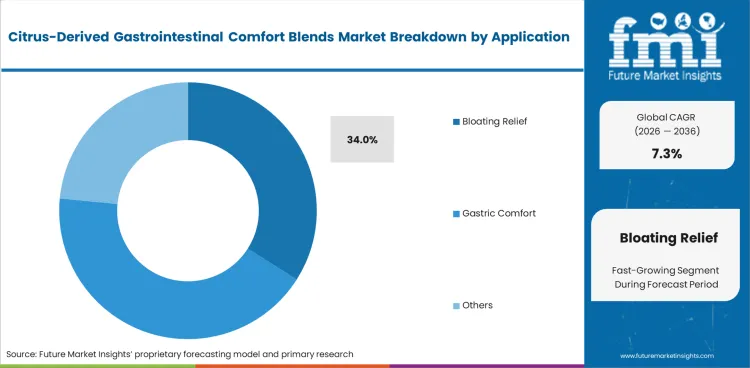
Products aimed at bloating reduction perform well because users can feel change quickly, and quick feedback builds confidence far faster than long-horizon wellness messaging. Daily compliance tends to fall once benefits stay unclear across early use cycles, so brands often place stronger focus on visible comfort outcomes during first product design stages. Citrus-derived blends built for gastric distension, gas pressure, and abdominal comfort fit this demand pattern well, especially once paired with prebiotic systems designed to reduce fermentation-related discomfort over time. Bloating relief is anticipated to capture 34.0% of the market in 2026 because consumers notice results faster and repeat-purchase potential is stronger. Faster consumer recognition gives this application a strong retail edge, since repeat purchase depends on simple proof felt during ordinary daily life. Longer-term microbiome positioning still carries value, yet retention often weakens if immediate comfort stays absent. Product development in this area also keeps drawing from citrus flavors and selected lemon compound systems where quick sensory recognition matters. Stronger products in this space usually combine short-term ease with longer digestive support, allowing one formula to serve both first-use satisfaction and sustained gut care.
- Observation trigger: Retail users often drop daily digestive routines after early cycles if noticeable physical relief does not come through. Patience tends to stay low in this category because digestive discomfort is felt directly and judged quickly after use. A product without clear short-term comfort can struggle to build trust, even if longer-term gut support remains part of the formula and looks strong on paper.
- Meaningful consequence: Formulators increasingly pair fast-acting citrus oils and flavor systems with slower-fermenting fibers, due to demand for both quick comfort and longer digestive support. This pairing helps brands answer two needs at once: early relief that users can notice and ongoing gut support that adds depth to product value.
- Actionable response: Ingredient buyers need dual-phase systems with immediate and delayed benefit profiles, supported by supplier proof around release behavior. Selection criteria now move beyond simple ingredient familiarity and place more focus on usable evidence tied to comfort timing, digestive tolerance, and finished-product reliability.
Citrus-Derived Gastrointestinal Comfort Blends Market Analysis by End Use
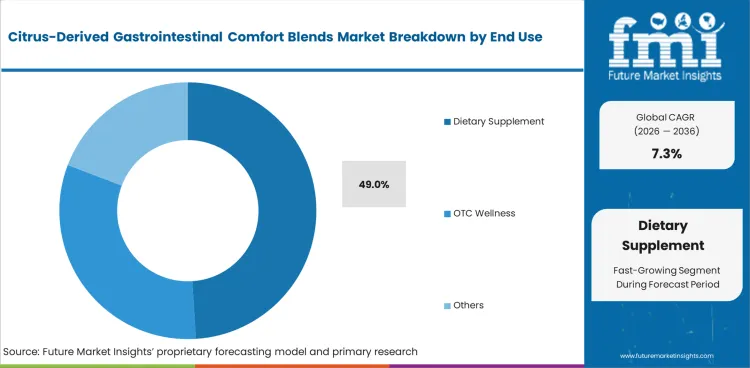
Dietary supplements are better suited to these needs than mainstream food formats, so capsules, tablets, powders, and related nutraceutical formats continue to lead. Functional food launches face more pressure during heating, baking, pasteurization, and shelf-life management, and sensitive flavonoids can lose practical value once exposed to harsh processing steps. Supplement formats avoid much of this strain and give formulators more control over release timing, ingredient protection, and active placement across lower intestinal regions. Dietary supplements are projected to secure 49.0% share in 2026, owing to wider claim flexibility and supported by better active-delivery control. Regulatory flexibility also gives brands more room to communicate digestive comfort benefits with clarity, and premium pricing becomes easier to support once active delivery remains controlled. Food and beverage producers often hold back from broad use of newer citrus gut health ingredients because claim limits and processing loss reduce commercial appeal.
- Stakeholder profile: Compliance teams inside large food companies review citrus gut health ingredients carefully, due to claim sensitivity in mass-market formats. Food labels leave less room for pointed digestive language, and any mismatch between product promise and accepted support can create legal and commercial strain. Caution becomes even stronger once novel citrus actives enter mainstream food discussions without enough public-use background across major markets.
- Commercial stakes: Weak claim support can bring fines, withdrawals, and label challenges across multiple markets, owing to stricter food-category scrutiny. A failed claim does not only affect one product launch; it can also weaken retailer confidence, delay future approvals, and raise internal review pressure across related wellness lines. Commercial exposure therefore remains much higher in food and beverage channels than in tightly controlled supplement formats.
- Strategic response: Many companies keep complex citrus bioactives inside supplement portfolios first, supported by better legal room for targeted digestive positioning. This route gives more control over dosage, delivery format, and consumer communication while reducing exposure to processing losses seen in mainstream foods. Supplement channels also allow brands to build a stronger usage record before moving into broader functional food opportunities later.
Citrus-Derived Gastrointestinal Comfort Blends Market Drivers, Restraints, and Opportunities
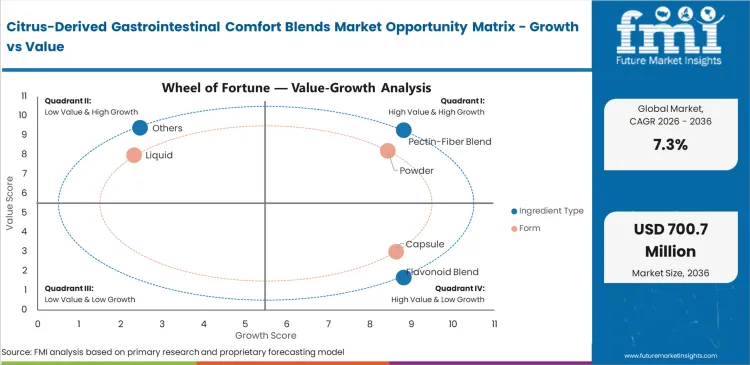
Supply-chain volatility is pushing sourcing priorities away from pure cost savings and toward supply assurance. Global citrus processing provides a steadier raw material base, giving digestive ingredient producers access to large byproduct streams already linked to food manufacturing. Functional ingredient teams often face interruptions with exotic or wild-harvested botanicals, since poor harvests and geopolitical shocks can stall input availability and disrupt production planning. Citrus-derived matrices reduce exposure to stock-outs and sharp raw material price swings, while familiar fruit positioning supports easier consumer acceptance in retail channels. Once buyers see comparable digestive support coming from regulated and transparent agricultural inputs, confidence in scale-up improves and larger production volumes become easier to plan.
Adoption still faces pressure from strict evidence requirements tied to digestive health claims. Citrus polyphenol formulations do not lend themselves to simple proof models, since observed benefits often come from combined activity across multiple compounds rather than one isolated active. European food safety review has kept a tight line on broad wellness language unless supported by strong human intervention studies. Mid-sized manufacturers often lack financial room for long clinical programs, leaving promising formulations stuck in limited commercial use. Clear progress depends on accepted biomarkers for non-disease gastrointestinal comfort, since vague wording around gut support weakens product messaging and slows wider retail traction.
Opportunities in the Citrus-Derived Gastrointestinal Comfort Blends Market
- Opportunity: Exploiting recognized synergy between specialized citrus flavonoids gut microbiota interactions and established probiotic strains to create resilient synbiotic formulations.
- Beneficiary: Contract manufacturing organizations acting as premier citrus bloating relief ingredient suppliers, possessing advanced dual-chamber encapsulation technologies capable of keeping components separated until ingestion.
- Mechanism: Utilizing moisture-scavenging citrus pulp to protect dormant bacterial cultures from environmental degradation, drastically extending retail shelf life.
Regional Analysis
.webp "Top Country Growth Comparison Citrus Derived Gastrointestinal Comfort Blends Market Cagr (2026 2036)")
Following tables detail commercial growth trajectories for key national markets evaluated within current forecasting models. Based on regional analysis, the citrus-derived gastrointestinal comfort blends market is segmented into North America, Europe, Asia Pacific, Latin America, and Middle East & Africa, across 40 plus countries.
| Country | CAGR (2026 to 2036) |
|---|---|
| China | 8.1% |
| India | 7.9% |
| Brazil | 7.8% |
| Japan | 7.5% |
| United States | 6.9% |
| Germany | 6.7% |
| Italy | 6.5% |
Source: Future Market Insights (FMI) analysis, based on proprietary forecasting model and primary research
Asia Pacific Citrus-Derived Gastrointestinal Comfort Blends Market Analysis
Across Asia Pacific, citrus-based digestive blends are gaining ground as buyers move from loosely specified herbal inputs toward standardized extracts backed by cleaner documentation and stronger validation. Regional producers are upgrading extraction and drying capacity so export-grade material can move into higher-value supplement and functional beverage programs without losing local relevance. Daily-use digestive support remains a better commercial fit than acute relief positioning, since repeat consumption aligns more closely with habitual wellness spending across urban households.
- China: China has added advantage of a deep domestic citrus base, giving processors a reliable stream of peel, pulp, and related byproducts suited for standardized ingredient production. Local manufacturers are also in a strong position to build complex blends at price points attractive for both domestic brands and export-oriented production. Regulatory tightening around ingredient quality is pushing more supplement makers toward cleaner, verified botanical inputs, and citrus extracts fit that need with less sourcing uncertainty than niche botanicals. China is set to record a CAGR of 8.1% in citrus-derived gastrointestinal comfort blends during the assessment period, driven by abundant domestic citrus feedstock and supported by cost-efficient large-scale processing. Strong raw material access, processing scale, and formulation economics keep China in a favorable position for sustained category expansion.
- Japan: Japan presents a different demand pattern, determined by an aging consumer base looking for gentle digestive support suited to routine use. Product developers are focusing on soluble, easy-to-consume formats with a better fit for gastric comfort and regularity support in older adults. Clinical backing carries extra weight in Japan, since validated functional positioning can improve long-term brand credibility and strengthen repeat purchase in mature wellness channels. Premium buyers also place greater trust in products with a clear evidence base and refined formulation profile. The market for citrus-derived gastrointestinal comfort blends in Japan is expected to grow at a CAGR of 7.5% during the study period, owing to senior-focused digestive demand and supported by strong preference for clinically validated wellness products. Demand in Japan rests less on novelty and more on trust, usability, and consistent performance in senior-oriented wellness formats.
- India: India is building momentum through a rapidly expanding nutraceutical manufacturing base and rising interest in plant-derived digestive solutions. Domestic firms are putting more effort into localized ingredient development as a way to reduce dependence on imported specialty materials and improve cost control across high-volume categories. Climate exposure during storage and transit also makes powder handling, moisture resistance, and shelf stability more important in formulation planning. Suppliers with strong drying, blending, and packaging capability have a clear edge under such conditions. Sales of citrus-derived gastrointestinal comfort blends in India are expected to increase at a CAGR of 7.9% during the forecast period because domestic nutraceutical manufacturing is expanding and preference for plant-based digestive products is rising. Local extraction and processing capacity is therefore becoming a central factor in long-term competitiveness across Indian supply chains.
Latin America Citrus-Derived Gastrointestinal Comfort Blends Market Analysis
Latin America holds a strong upstream position in citrus feedstock, and commercial logic increasingly favors converting more of that volume into human-grade functional ingredients rather than low-value byproduct outlets. Proximity to juice-processing infrastructure supports faster handling of wet biomass, helping preserve usable fractions before quality drops. Producers are adding fractionation, drying, and milling systems near source, creating a more efficient flow from raw citrus residue into standardized ingredient formats. Such integration supports better margins, tighter process control, and a more credible export story for buyers looking for dependable botanical inputs.
- Brazil: Brazil stands out because the domestic industry already operates at exceptional scale in orange processing, giving ingredient makers direct access to abundant feedstock at structurally favorable cost levels. Processing plants can capture peel and pulp fractions early, before degradation reduces functional value, and such timing improves recovery economics for fiber and polyphenol-rich material. Exporters from Brazil therefore hold a solid base in bulk citrus derivatives, while overseas competitors often need to rely on higher-cost sourcing or more specialized downstream positioning. Brazil is projected to grow at a 7.8% CAGR through 2036 because low-cost citrus byproducts are readily available and the market is closely integrated with large juice-processing infrastructure.
North America Citrus-Derived Gastrointestinal Comfort Blends Market Analysis
North America remains a credibility-driven market, with buyers placing significant weight on traceability, cleaner processing methods, and proof supporting digestive benefit claims. Legacy supplement infrastructure built around low-cost vitamins is no longer enough for premium botanical categories seeking long-term trust. Brands now face closer scrutiny around input sourcing, solvent use, and consistency from orchard to finished dosage form, pushing processors toward water-based extraction, mechanical separation, and stronger lot-level documentation. Premium segments are gaining room in this environment, particularly for clinically supported fibers and botanicals carrying a cleaner-label profile.
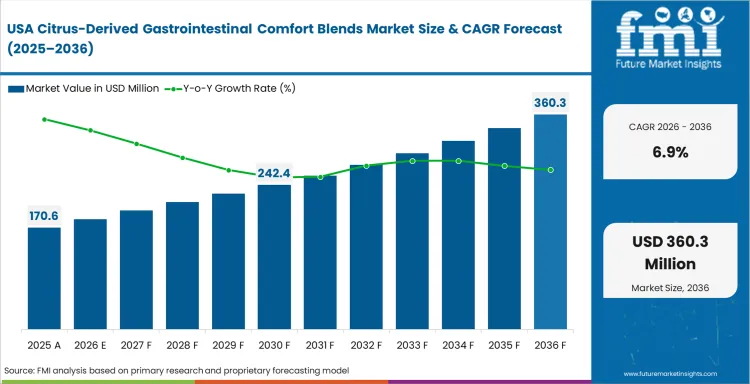
- United States: In the United States, legal and commercial pressure around on-pack claims is shaping product strategy just as much as ingredient science. Brands need more than a promising concept; solid human data and defensible substantiation carry direct value in a market sensitive to litigation and label scrutiny. Ingredient suppliers with well-built clinical dossiers, stable sourcing programs, and transparent processing standards gain stronger access to premium supplement and functional wellness channels. Market value also remains supported by consumers ready to pay for trusted digestive support with a clear formulation story. The United States is likely to grow at a CAGR of 6.9% through 2036 because demand for clinically substantiated products remains strong and consumers are willing to pay for trusted digestive wellness formats. Reliable science and well-documented sourcing remain central to competitive strength across this market.
Europe Citrus-Derived Gastrointestinal Comfort Blends Market Analysis
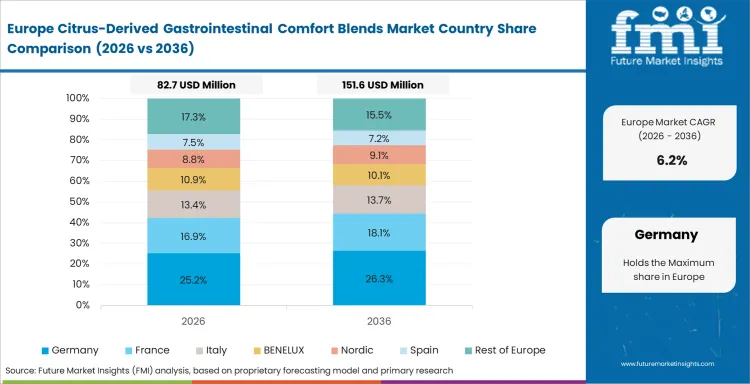
Europe offers a more exacting commercial setting for citrus digestive blends, since product positioning depends on precise language, validated physiological relevance, and consistent analytical quality. Broad wellness claims carry limited room under a regulatory system favoring measurable outcomes and strong substantiation. For many suppliers, success depends on turning citrus-derived ingredients into tightly standardized products with repeatable composition and documented functionality. Batch testing, extract refinement, and careful specification control therefore carry unusual importance across regional trade.
- Germany: Germany has a science-minded buyer base and a market preference for ingredients backed by recognized standards and dependable technical files. Formulators and brand owners often look for materials with a stronger history of documented use, making market entry harder for unfamiliar extraction profiles lacking a persuasive validation package. Such conditions favor suppliers capable of meeting exacting compliance expectations while maintaining uniformity across batches and product lines. Consolidation also tends to rise under such pressure, since smaller operators often struggle to maintain full compliance depth over time. The market for citrus-derived gastrointestinal comfort blends in Germany is expected to grow at a CAGR of 6.7% during the study period because buyers prefer compliant, validated ingredients and demand remains strong for standardized botanical extracts. Germany therefore rewards precision, consistency, and well-substantiated product architecture over novelty-led selling.
- Italy: Italy carries a distinct edge through long familiarity with specialized Mediterranean citrus varieties such as bergamot and blood orange, both of interest for differentiated extract positioning. Local processors benefit from technical know-how built over many years in handling region-specific citrus inputs, and such experience supports quality differentiation beyond commodity bulk supply. Premium wellness branding also carries stronger room in Italy, especially for products drawing on regional identity and refined botanical heritage. Such positioning helps local suppliers defend margins in a market often crowded by lower-cost global material. Italy is forecast to grow at a CAGR of 6.5% through 2036 because it benefits from established expertise in Mediterranean citrus extraction and premium positioning built around regional ingredient identity. This also creates more room for suppliers working across adjacent digestive and metabolic wellness spaces, including product concepts linked to functional food ingredients.
Competitive Aligners for Market Players
Competition in this market starts much earlier than final blending. Control over raw citrus material matters because wet peel, pulp, and related byproducts need timely handling, proper drying, and consistent processing before any refined digestive ingredient can be sold at scale. A small group of large processors tends to stay stronger at this upstream stage because plant setup, drying systems, extraction capacity, and supply coordination require meaningful investment. Further down, blending and refinement remain more open, with many specialist botanical firms participating. Even so, price alone rarely decides supplier selection. Buyers usually stay focused on one practical question: can a supplier deliver the same active profile from one batch to the next, even after harvest conditions change from season to season.
Established ingredient companies also benefit from prior investment in safety work, toxicology support, and basic regulatory documentation. This does not block all new entrants, but it does give larger incumbents an easier path into conservative multinational accounts, especially in categories tied to digestive comfort, functional wellness, and regulated label language. At the same time, smaller challengers still find room in fast-moving supplement niches, particularly in direct-to-consumer channels and specialized dosage formats. Success in these areas usually comes from solving a clear product problem rather than simply introducing a new citrus extract. Better water dispersibility, lower bitterness, cleaner use in gummies or sachets, and easier dose delivery can all make a challenger more attractive. Without a practical product advantage, switching becomes difficult because brand owners must review stability again, rework formulas, and reassess label fit before moving away from an existing botanical system.
Key Players in Citrus-Derived Gastrointestinal Comfort Blends Market
- Ingredients by Nature
- Fiberstar
- Indena
- CP Kelco
- CEAMSA
- Herbafood Ingredients GmbH
Scope of the Report
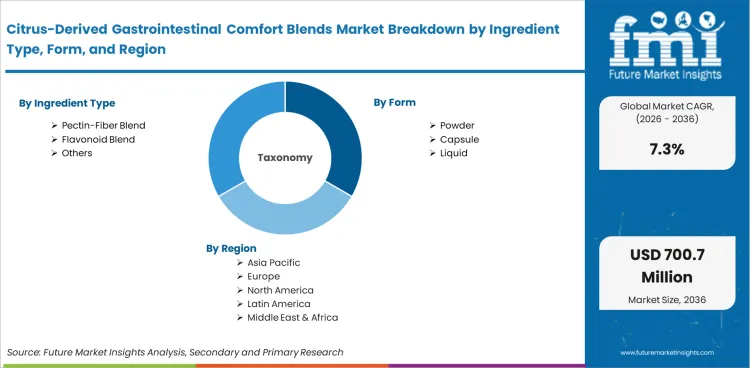
| Metric | Value |
|---|---|
| Quantitative Units | USD 322.8 million to USD 651.0 million, at a CAGR of 7.3% |
| Market Definition | Citrus-derived gastrointestinal comfort blends consist exclusively of active compounds extracted from hesperidium fruits specifically standardized for digestive applications. Categories separate from general botanical derivatives by requiring proven interactions involving human gut microbiota, transit time modulation, or gastric mucosal protection, functioning as primary active ingredients within human nutrition protocols rather than basic caloric or structural requirements. |
| Ingredient Type Segmentation | Pectin-fiber blends, Flavonoid blends, Polyphenol blends, Essential oil blends, Hybrid blends |
| Form Segmentation | Powders, Capsules, Gummies, Liquids, Sachets |
| Application Segmentation | Bloating relief, Gastric comfort, Transit support, Microbiome support, Post-meal comfort |
| End Use Segmentation | Dietary supplements, Functional beverages, Functional foods, OTC wellness, Sports nutrition |
| Regions Covered | North America, Latin America, Europe, Asia Pacific, Middle East and Africa |
| Countries Covered | United States, Canada, Brazil, Mexico, Argentina, Germany, United Kingdom, France, Italy, Spain, BENELUX, Russia, China, Japan, South Korea, India, Australia, ASEAN Countries, New Zealand, GCC Countries, Turkey, Northern Africa, South Africa and 40 plus countries |
| Key Companies Profiled | Ingredients by Nature, Fiberstar, Indena, CP Kelco, CEAMSA, Herbafood Ingredients GmbH |
| Forecast Period | 2026 to 2036 |
| Approach | Standardized botanical extract sales volumes tracked against prevailing B2B contract pricing structures per metric ton, validated against raw orange and grapefruit processing yields. |
Citrus-Derived Gastrointestinal Comfort Blends Market Analysis by Segments
Ingredient Type:
- Pectin-fiber blends
- Flavonoid blends
- Polyphenol blends
- Essential oil blends
- Hybrid blends
Form:
- Powders
- Capsules
- Gummies
- Liquids
- Sachets
Application:
- Bloating relief
- Gastric comfort
- Transit support
- Microbiome support
- Post-meal comfort
End Use:
- Dietary supplements
- Functional beverages
- Functional foods
- OTC wellness
- Sports nutrition
Region:
- North America:
- United States
- Canada
- Latin America:
- Brazil
- Mexico
- Argentina
- Rest of Latin America
- Europe:
- Germany
- United Kingdom
- France
- Italy
- Spain
- BENELUX
- Russia
- Rest of Europe
- East Asia:
- China
- Japan
- South Korea
- South Asia and Pacific:
- India
- Australia
- ASEAN Countries
- New Zealand
- Rest of South Asia and Pacific
- Middle East and Africa:
- GCC Countries
- Turkey
- Northern Africa
- South Africa
- Rest of Middle East and Africa
Bibliography
- Amrita Vijay, Anthony Kelly, Suzanne Miller, Melanie Marshall, Althea Alonso, Afroditi Kouraki, Catherine Probert, Elizabeth J. Simpson, and Ana M. Valdes (2024). Supplementation with Citrus Low-Methoxy Pectin Reduces Levels of Inflammation and Anxiety in Healthy Volunteers: A Pilot Controlled Dietary Intervention Study.
- Débora Preceliano de Oliveira, Svetoslav Dimitrov Todorov, and João Paulo Fabi. (2024). Exploring the Prebiotic Potentials of Hydrolyzed Pectins: Mechanisms of Action and Gut Microbiota Modulation.
- USA Department of Agriculture, Foreign Agricultural Service. (2025). Citrus Annual.
- Luis Valladares, Fernando Vio. (2025, July). Pectin and Its Beneficial Effect on Health: New Contributions in Research and the Need to Increase Fruits and Vegetables Consumption, A Review.
- USA Department of Agriculture, Foreign Agricultural Service. (2025). Citrus: World Markets and Trade.
This Report Addresses
- Market intelligence for direct sourcing qualification and supplier evaluation
- Market size estimates and 10-year forecasts checked against global citrus processing output
- Growth opportunity mapping covering synbiotic combinations and premium supplement tier needs
- Segment and regional outlook highlighting growth in Asian domestic extraction capacity
- Competition assessment showing the technical strengths needed to challenge established suppliers
- Technology tracking focused on liposomal powders and delayed-release capsule formats
- Market access review covering European claim limits and FDA botanical monograph requirements
- Report formats prepared for quick use in executive sourcing and planning discussions
Frequently Asked Questions
Are citrus-derived gastrointestinal comfort blends defined by functional boundaries?
Yes. These blends are made from citrus-derived active compounds prepared for digestive use, not for general texture or bulk applications. They are used for gut microbiota support, transit support, or gastric comfort.
Does market size data exist for citrus digestive blends?
Yes. The market is estimated at USD 322.8 million in 2026. This shows it has moved beyond a small herbal niche and into wider nutraceutical production.
What is the citrus-derived gastrointestinal comfort blends market?
This market covers citrus-based ingredient blends used in digestive health products. Peel, pulp, and related citrus inputs are processed into pectin, flavonoids, and similar compounds for gut comfort applications.
Is there a forecast for citrus digestive comfort blends?
Yes. The market is projected to rise from USD 322.8 million in 2026 to USD 651.0 million by 2036. That reflects a CAGR of 7.3% over the forecast period.
Can you list companies selling citrus gut comfort ingredients?
Key suppliers include Ingredients by Nature, Fiberstar, Indena, CP Kelco, CEAMSA, and Herbafood Ingredients GmbH. Buyers compare them on standardization, technical support, and dependable ingredient performance.
Can you list companies selling citrus gut comfort ingredients?
They both support gut health, though they work differently. Probiotics add live bacteria, while citrus fibers offer better storage stability and easier handling in many formulations.
Is there a preferred citrus ingredient for bloating relief?
Pectin-fiber blends with selected citrus volatile compounds are often preferred in bloating-focused products. They can support faster gastric comfort while also contributing slower digestive support.
Does thermal stability matter in South Asia?
Yes. Heat and humidity can damage less stable ingredients during storage and transport. Suppliers with stronger powder processing and shelf stability have an advantage in this region.
Do dietary supplements remain the main end-use channel?
Yes. Heat and humidity can damage less stable ingredients during storage and transport. Suppliers with stronger powder processing and shelf stability have an advantage in this region.
Do Italian suppliers avoid some commodity pricing pressure?
Some do. Suppliers working with bergamot, blood orange, and other region-specific citrus materials can build value through extraction know-how and specialty positioning rather than bulk pricing alone.
Do hygroscopic botanical powders create operational risks?
Some do. Suppliers working with bergamot, blood orange, and other region-specific citrus materials can build value through extraction know-how and specialty positioning rather than bulk pricing alone.
Does North America focus strongly on upstream quality control?
Yes. Traceability, solvent transparency, and documented sourcing matter strongly in North America. Buyers want cleaner extraction routes and stronger chain-of-custody support.
What triggers adoption of specific citrus flavonoids?
Human evidence is usually the key trigger. Adoption rises when studies show a clear digestive role, such as transit support, rather than broad antioxidant value alone.
Do advanced liposomal powder technologies change market direction?
Yes. These technologies help protect sensitive citrus compounds during drying and storage. They matter most in premium supplement tiers where buyers expect better stability and cleaner delivery.
Preview the report firsthand - request a free sample
Get SampleGet the brochure for pricing and purchase details.
Get PDFTable of Content
- Executive Summary
- Global Market Outlook
- Demand-side Trends
- Technology Roadmap Analysis
- Analysis and Recommendations
- Market Overview
- Market Coverage / Taxonomy
- Market Definition / Scope / Limitations
- Research Methodology
- Market Structure, Signals, and Trend Drivers
- Benchmarking and Cross-market Comparability
- Market Sizing, Forecasting, and Opportunity Mapping
- Research Design and Evidence Framework
- Desk Research Programme (Secondary Evidence)
- Company Annual and Sustainability Reports
- Peer-reviewed Journals and Academic Literature
- Corporate Websites, Product Literature, and Technical Notes
- Earnings Decks and Investor Briefings
- Statutory Filings and Regulatory Disclosures
- Technical White Papers and Standards Notes
- Trade Journals, Industry Magazines, and Analyst Briefs
- Conference Proceedings, Webinars, and Seminar Materials
- Government Statistics Portals and Public Data Releases
- Press Releases and Reputable Media Coverage
- Specialist Newsletters and Curated Briefings
- Sector Databases and Reference Repositories
- FMI Internal Proprietary Databases and Historical Market Datasets
- Subscription Datasets and Paid Sources
- Social Channels, Communities, and Digital Listening Inputs
- Additional Desk Sources
- Expert Input and Fieldwork (Primary Evidence)
- Primary Modes
- Qualitative Interviews and Expert Elicitation
- Quantitative Surveys and Structured Data Capture
- Blended Approach
- Why Primary Evidence is Used
- Observational and In-context Research
- Social and Community Interactions
- Primary Modes
- Stakeholder Universe Engaged
- C-suite Leaders
- Board Members
- Presidents and Vice Presidents
- R&D and Innovation Heads
- Technical Specialists
- Domain Subject-matter Experts
- Scientists
- Physicians and Other Healthcare Professionals
- Governance, Ethics, and Data Stewardship
- Research Ethics
- Data Integrity and Handling
- Desk Research Programme (Secondary Evidence)
- Tooling, Models, and Reference Databases
- Data Engineering and Model Build
- Data Acquisition and Ingestion
- Cleaning, Normalisation, and Verification
- Synthesis, Triangulation, and Analysis
- Quality Assurance and Audit Trail
- Market Background
- Market Dynamics
- Drivers
- Restraints
- Opportunity
- Trends
- Scenario Forecast
- Demand in Optimistic Scenario
- Demand in Likely Scenario
- Demand in Conservative Scenario
- Opportunity Map Analysis
- Product Life Cycle Analysis
- Supply Chain Analysis
- Investment Feasibility Matrix
- Value Chain Analysis
- PESTLE and Porter’s Analysis
- Regulatory Landscape
- Regional Parent Market Outlook
- Production and Consumption Statistics
- Import and Export Statistics
- Market Dynamics
- Global Market Analysis 2021 to 2025 and Forecast, 2026 to 2036
- Historical Market Size Value (USD Million) Analysis, 2021 to 2025
- Current and Future Market Size Value (USD Million) Projections, 2026 to 2036
- Y-o-Y Growth Trend Analysis
- Absolute $ Opportunity Analysis
- Global Market Pricing Analysis 2021 to 2025 and Forecast 2026 to 2036
- Global Market Analysis 2021 to 2025 and Forecast 2026 to 2036, By Ingredient Type
- Introduction / Key Findings
- Historical Market Size Value (USD Million) Analysis By Ingredient Type , 2021 to 2025
- Current and Future Market Size Value (USD Million) Analysis and Forecast By Ingredient Type , 2026 to 2036
- Pectin-Fiber Blend
- Flavonoid Blend
- Others
- Pectin-Fiber Blend
- Y-o-Y Growth Trend Analysis By Ingredient Type , 2021 to 2025
- Absolute $ Opportunity Analysis By Ingredient Type , 2026 to 2036
- Global Market Analysis 2021 to 2025 and Forecast 2026 to 2036, By Form
- Introduction / Key Findings
- Historical Market Size Value (USD Million) Analysis By Form, 2021 to 2025
- Current and Future Market Size Value (USD Million) Analysis and Forecast By Form, 2026 to 2036
- Powder
- Capsule
- Liquid
- Powder
- Y-o-Y Growth Trend Analysis By Form, 2021 to 2025
- Absolute $ Opportunity Analysis By Form, 2026 to 2036
- Global Market Analysis 2021 to 2025 and Forecast 2026 to 2036, By Application
- Introduction / Key Findings
- Historical Market Size Value (USD Million) Analysis By Application, 2021 to 2025
- Current and Future Market Size Value (USD Million) Analysis and Forecast By Application, 2026 to 2036
- Bloating Relief
- Gastric Comfort
- Others
- Bloating Relief
- Y-o-Y Growth Trend Analysis By Application, 2021 to 2025
- Absolute $ Opportunity Analysis By Application, 2026 to 2036
- Global Market Analysis 2021 to 2025 and Forecast 2026 to 2036, By End Use
- Introduction / Key Findings
- Historical Market Size Value (USD Million) Analysis By End Use, 2021 to 2025
- Current and Future Market Size Value (USD Million) Analysis and Forecast By End Use, 2026 to 2036
- Dietary Supplement
- OTC Wellness
- Others
- Dietary Supplement
- Y-o-Y Growth Trend Analysis By End Use, 2021 to 2025
- Absolute $ Opportunity Analysis By End Use, 2026 to 2036
- Global Market Analysis 2021 to 2025 and Forecast 2026 to 2036, By Region
- Introduction
- Historical Market Size Value (USD Million) Analysis By Region, 2021 to 2025
- Current Market Size Value (USD Million) Analysis and Forecast By Region, 2026 to 2036
- North America
- Latin America
- Western Europe
- Eastern Europe
- East Asia
- South Asia and Pacific
- Middle East & Africa
- Market Attractiveness Analysis By Region
- North America Market Analysis 2021 to 2025 and Forecast 2026 to 2036, By Country
- Historical Market Size Value (USD Million) Trend Analysis By Market Taxonomy, 2021 to 2025
- Market Size Value (USD Million) Forecast By Market Taxonomy, 2026 to 2036
- By Country
- USA
- Canada
- Mexico
- By Ingredient Type
- By Form
- By Application
- By End Use
- By Country
- Market Attractiveness Analysis
- By Country
- By Ingredient Type
- By Form
- By Application
- By End Use
- Key Takeaways
- Latin America Market Analysis 2021 to 2025 and Forecast 2026 to 2036, By Country
- Historical Market Size Value (USD Million) Trend Analysis By Market Taxonomy, 2021 to 2025
- Market Size Value (USD Million) Forecast By Market Taxonomy, 2026 to 2036
- By Country
- Brazil
- Chile
- Rest of Latin America
- By Ingredient Type
- By Form
- By Application
- By End Use
- By Country
- Market Attractiveness Analysis
- By Country
- By Ingredient Type
- By Form
- By Application
- By End Use
- Key Takeaways
- Western Europe Market Analysis 2021 to 2025 and Forecast 2026 to 2036, By Country
- Historical Market Size Value (USD Million) Trend Analysis By Market Taxonomy, 2021 to 2025
- Market Size Value (USD Million) Forecast By Market Taxonomy, 2026 to 2036
- By Country
- Germany
- UK
- Italy
- Spain
- France
- Nordic
- BENELUX
- Rest of Western Europe
- By Ingredient Type
- By Form
- By Application
- By End Use
- By Country
- Market Attractiveness Analysis
- By Country
- By Ingredient Type
- By Form
- By Application
- By End Use
- Key Takeaways
- Eastern Europe Market Analysis 2021 to 2025 and Forecast 2026 to 2036, By Country
- Historical Market Size Value (USD Million) Trend Analysis By Market Taxonomy, 2021 to 2025
- Market Size Value (USD Million) Forecast By Market Taxonomy, 2026 to 2036
- By Country
- Russia
- Poland
- Hungary
- Balkan & Baltic
- Rest of Eastern Europe
- By Ingredient Type
- By Form
- By Application
- By End Use
- By Country
- Market Attractiveness Analysis
- By Country
- By Ingredient Type
- By Form
- By Application
- By End Use
- Key Takeaways
- East Asia Market Analysis 2021 to 2025 and Forecast 2026 to 2036, By Country
- Historical Market Size Value (USD Million) Trend Analysis By Market Taxonomy, 2021 to 2025
- Market Size Value (USD Million) Forecast By Market Taxonomy, 2026 to 2036
- By Country
- China
- Japan
- South Korea
- By Ingredient Type
- By Form
- By Application
- By End Use
- By Country
- Market Attractiveness Analysis
- By Country
- By Ingredient Type
- By Form
- By Application
- By End Use
- Key Takeaways
- South Asia and Pacific Market Analysis 2021 to 2025 and Forecast 2026 to 2036, By Country
- Historical Market Size Value (USD Million) Trend Analysis By Market Taxonomy, 2021 to 2025
- Market Size Value (USD Million) Forecast By Market Taxonomy, 2026 to 2036
- By Country
- India
- ASEAN
- Australia & New Zealand
- Rest of South Asia and Pacific
- By Ingredient Type
- By Form
- By Application
- By End Use
- By Country
- Market Attractiveness Analysis
- By Country
- By Ingredient Type
- By Form
- By Application
- By End Use
- Key Takeaways
- Middle East & Africa Market Analysis 2021 to 2025 and Forecast 2026 to 2036, By Country
- Historical Market Size Value (USD Million) Trend Analysis By Market Taxonomy, 2021 to 2025
- Market Size Value (USD Million) Forecast By Market Taxonomy, 2026 to 2036
- By Country
- Kingdom of Saudi Arabia
- Other GCC Countries
- Turkiye
- South Africa
- Other African Union
- Rest of Middle East & Africa
- By Ingredient Type
- By Form
- By Application
- By End Use
- By Country
- Market Attractiveness Analysis
- By Country
- By Ingredient Type
- By Form
- By Application
- By End Use
- Key Takeaways
- Key Countries Market Analysis
- USA
- Pricing Analysis
- Market Share Analysis, 2025
- By Ingredient Type
- By Form
- By Application
- By End Use
- Canada
- Pricing Analysis
- Market Share Analysis, 2025
- By Ingredient Type
- By Form
- By Application
- By End Use
- Mexico
- Pricing Analysis
- Market Share Analysis, 2025
- By Ingredient Type
- By Form
- By Application
- By End Use
- Brazil
- Pricing Analysis
- Market Share Analysis, 2025
- By Ingredient Type
- By Form
- By Application
- By End Use
- Chile
- Pricing Analysis
- Market Share Analysis, 2025
- By Ingredient Type
- By Form
- By Application
- By End Use
- Germany
- Pricing Analysis
- Market Share Analysis, 2025
- By Ingredient Type
- By Form
- By Application
- By End Use
- UK
- Pricing Analysis
- Market Share Analysis, 2025
- By Ingredient Type
- By Form
- By Application
- By End Use
- Italy
- Pricing Analysis
- Market Share Analysis, 2025
- By Ingredient Type
- By Form
- By Application
- By End Use
- Spain
- Pricing Analysis
- Market Share Analysis, 2025
- By Ingredient Type
- By Form
- By Application
- By End Use
- France
- Pricing Analysis
- Market Share Analysis, 2025
- By Ingredient Type
- By Form
- By Application
- By End Use
- India
- Pricing Analysis
- Market Share Analysis, 2025
- By Ingredient Type
- By Form
- By Application
- By End Use
- ASEAN
- Pricing Analysis
- Market Share Analysis, 2025
- By Ingredient Type
- By Form
- By Application
- By End Use
- Australia & New Zealand
- Pricing Analysis
- Market Share Analysis, 2025
- By Ingredient Type
- By Form
- By Application
- By End Use
- China
- Pricing Analysis
- Market Share Analysis, 2025
- By Ingredient Type
- By Form
- By Application
- By End Use
- Japan
- Pricing Analysis
- Market Share Analysis, 2025
- By Ingredient Type
- By Form
- By Application
- By End Use
- South Korea
- Pricing Analysis
- Market Share Analysis, 2025
- By Ingredient Type
- By Form
- By Application
- By End Use
- Russia
- Pricing Analysis
- Market Share Analysis, 2025
- By Ingredient Type
- By Form
- By Application
- By End Use
- Poland
- Pricing Analysis
- Market Share Analysis, 2025
- By Ingredient Type
- By Form
- By Application
- By End Use
- Hungary
- Pricing Analysis
- Market Share Analysis, 2025
- By Ingredient Type
- By Form
- By Application
- By End Use
- Kingdom of Saudi Arabia
- Pricing Analysis
- Market Share Analysis, 2025
- By Ingredient Type
- By Form
- By Application
- By End Use
- Turkiye
- Pricing Analysis
- Market Share Analysis, 2025
- By Ingredient Type
- By Form
- By Application
- By End Use
- South Africa
- Pricing Analysis
- Market Share Analysis, 2025
- By Ingredient Type
- By Form
- By Application
- By End Use
- USA
- Market Structure Analysis
- Competition Dashboard
- Competition Benchmarking
- Market Share Analysis of Top Players
- By Regional
- By Ingredient Type
- By Form
- By Application
- By End Use
- Competition Analysis
- Competition Deep Dive
- Competition Deep Dive
- Assumptions & Acronyms Used


