

- Industry Size (2026)
- USD 20.88 Bn
- Forecast (2036)
- USD 36.70 Bn
- CAGR (2026 to 2036)
- 5.8%
Marine Mineral Market Size, Market Forecast and Outlook By FMI
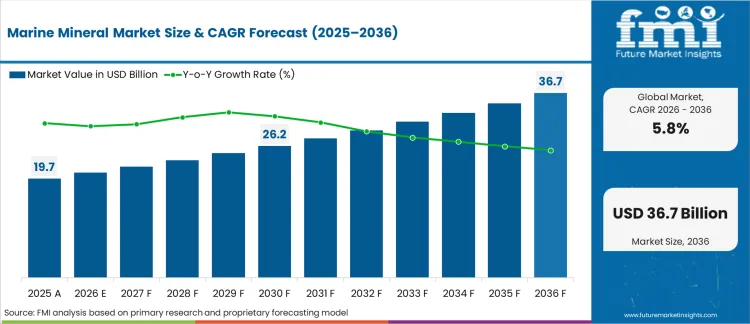
In 2025, the marine mineral market was valued at USD 19.74 billion. Based on Future Market Insights' analysis, demand for marine minerals is estimated to grow to USD 20.88 billion in 2026 and USD 36.70 billion by 2036. FMI projects a CAGR of 5.8% during the forecast period.
Absolute dollar growth of USD 15.82 billion over the decade reflects a market whose breadth spans industrial deep-sea mineral extraction, nutraceutical calcium and magnesium supplement formulation, food and beverage fortification, and agricultural applications, each with distinct demand dynamics and pricing structures. In February 2026, The Metals Company became the first deep-sea miner to apply for a commercial permit under a new streamlined review process introduced by the USA National Oceanic and Atmospheric Administration, targeting the Clarion-Clipperton Zone in the Pacific estimated to contain 800 million metric tons of polymetallic nodules rich in nickel, copper, cobalt, and manganese, a regulatory milestone that signals the imminent commercialisation of deep-sea mineral extraction at industrial scale. [1]
Summary of Marine Mineral Market
- Marine Mineral Market Definition
- The market covers globally traded mineral compounds from marine sources including seaweed calcium, marine sediment mineral concentrates, polymetallic nodule extracts, and marine shell calcium in solid, powder, granule, flake, and liquid formats for dietary supplement, food fortification, agricultural, and industrial applications.
- Demand Drivers in the Market
- The Metals Company's February 2026 first commercial permit application under NOAA's streamlined process for the Clarion-Clipperton Zone confirms that deep-sea mineral extraction is transitioning from exploration to commercial operation, introducing a high-volume industrial demand driver independent of conventional nutraceutical channel growth.
- ATURA Proteins' April 2025 Vitafoods research demonstrating that Aquamin marine calcium combined with fava bean protein significantly reduces bone breakdown and optimises calcium absorption confirms a clinically validated combination ingredient positioning that expands the addressable functional nutrition market for marine calcium.
- The Crown Estate's January 2026 third floating offshore wind site award in the Celtic Sea is accelerating subsea infrastructure investment that directly benefits marine resource extraction logistics and supports regional marine mineral procurement development.
- Key Segments Analyzed in the FMI Report
- Form: Solid format holds 35.0% of form share, reflecting primary procurement patterns in dietary supplement tablet and capsule manufacturing and food processing mineral additive applications.
- End Use: Dietary Supplements capture 40.0% of demand as the leading segment, driven by bone health, mineral balance, and functional nutrition positioning of seaweed-derived calcium and magnesium products.
- Geography: The United States leads growth at a 5.6% CAGR, generating USD 7.59 billion in 2026 demand across supplement, food fortification, and deep-sea regulatory activities.
- Analyst Opinion at FMI
- Nandini Roy Choudhury, Principal Consultant for Food & Beverage Industry at Future Market Insights, opines, "In the updated version of the Marine Mineral Market Report for 2026 to 2036, CXOs will find that the market's growth trajectory is being driven by two completely different demand mechanisms that are rarely analysed together. The deep-sea commercial mining regulatory breakthrough represented by The Metals Company's NOAA commercial permit application is an industrial-scale demand signal for nickel, cobalt, and manganese with a commodity volume potential that dwarfs the entire nutraceutical calcium segment. Simultaneously, the Aquamin clinical evidence for bone health in combination with plant protein is generating a premium functional nutrition demand tier that land-based calcium competitors cannot address with equivalent provenance and sustainability credentials."
- Strategic Implications / Executive Takeaways
- Develop clinical nutrition combination products pairing Aquamin-certified marine calcium with plant protein to capture the bone health functional nutrition premium that ATURA Proteins' Vitafoods research is validating as a differentiated market position.
- Monitor NOAA and International Seabed Authority deep-sea mining permit developments to assess industrial mineral supply chain implications for cobalt, manganese, and nickel procurement strategies linked to marine mineral extraction.
- Build marine-provenance and sustainability documentation for seaweed calcium products to meet the clean-label and traceability requirements of premium supplement and food fortification buyers who are increasingly requiring certified sustainable sourcing.
- Methodology
- Validated through primary interviews with marine mineral producers, supplement formulators, and deep-sea mining regulatory specialists.
- Zero reliance on speculative third-party market research reports.
- Based on ISA licensing data, NOAA resource assessments, supplement market association records, and major producer annual report disclosures.
The United States leads regional growth at a 5.6% CAGR through 2036, generating USD 7.59 billion in 2026 demand across dietary supplement, food fortification, and deep-sea mineral extraction regulatory activities. Japan holds the largest individual country value at USD 14.89 billion in 2026, reflecting deep penetration across dietary supplement, functional food, and processed food mineral fortification channels. South Korea contributes USD 0.67 billion through supplement and functional food channels. Solid form holds 35.0% of format share, and Dietary Supplements capture 40.0% of end-use demand as the leading application.
Marine Mineral Market Definition
The marine mineral market comprises the global extraction, processing, and distribution of mineral compounds and mineral-rich materials derived from marine sources including seaweed-derived calcium and magnesium (Aquamin, Lithothamnion), marine sediment mineral concentrates, polymetallic nodule and seafloor mineral deposits, and processed marine shell and coral calcium products. The market spans dietary supplement and nutraceutical ingredient applications, food and beverage mineral fortification, agricultural mineral input applications, and industrial deep-sea mineral extraction operations in solid, powder, granule, flake, and liquid forms.
Marine Mineral Market Inclusions
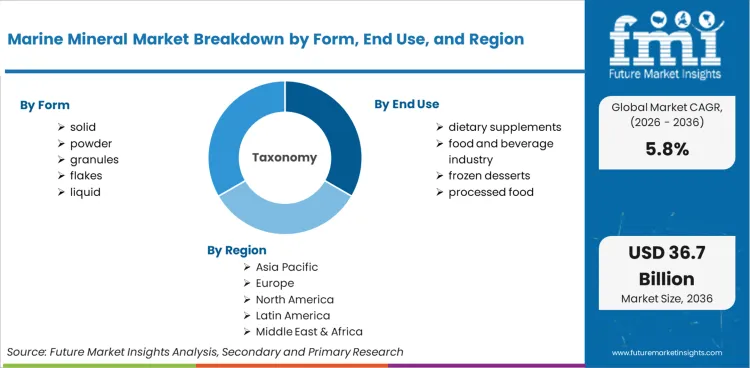
The report includes global and regional market sizes by volume and value with a 10-year forecast from 2026 to 2036. Coverage spans segmental breakdowns by form (Solid, Powder, Granules, Flakes, Liquid) and end use (Dietary Supplements, Food and Beverage Industry, Frozen Desserts, Processed Food). Country-level analysis covers all major marine mineral producing and consuming markets globally.
Marine Mineral Market Exclusions
The scope excludes synthetic calcium carbonate and magnesium oxide produced through chemical manufacturing without marine source inputs, marine fish oil and omega-3 fatty acid products where mineral content is incidental, and offshore oil and gas extraction operations. Fresh water mineral extraction from non-marine sources and land-based mining operations without marine provenance documentation are outside scope.
Marine Mineral Market Research Methodology
- Primary Research: Interviews were conducted with marine mineral producers, seaweed calcium ingredient manufacturers, dietary supplement formulators, food and beverage fortification ingredient buyers, deep-sea mining regulatory specialists, and agricultural mineral input buyers across Ireland, Norway, the United States, Japan, and China.
- Desk Research: Production data from the International Seabed Authority, NOAA marine mineral resource reports, national geological survey seabed mineral assessments, company annual reports from Marigot, Celtic Sea Minerals, and The Metals Company, and dietary supplement market association data supported volume benchmarking.
- Market-Sizing and Forecasting: A hybrid top-down and bottom-up model was applied. Demand was reconstructed from dietary supplement retail channel sales, food fortification ingredient import records, agricultural mineral input procurement data, and deep-sea mining operational capacity projections, then validated against seaweed calcium harvest volumes and ISA licensing data.
- Data Validation and Update Cycle: Outputs undergo anomaly screening, cross-validation against ISA licensing records and supplement market association data, and structured peer review prior to release.
Key Industry Highlights
Expanding Applications in Food and Beverage Sector Propelling Growth
Applications of marine minerals in the food and beverage sector are expanding substantially, owing to their health and nutritional benefits. These minerals are widely used in a variety of products, including frozen desserts, processed food, instant beverages, fruit juices, smoothies, and shakes. This versatility is set to provide impetus for sales growth through 2035.
Changing lifestyles and growing demand for convenience food products are likely to boost the growth rate of the industry. Subsequently, growing consumer preference for natural and organic products is rising, which is expected to fuel demand during the upcoming years.
Ongoing Mineral Fortification Trend Creating Growth Prospects
Many modern diets often lack certain essential minerals like calcium, magnesium, and potassium. As a result, food manufacturers are increasingly incorporating marine minerals in a variety of food products and beverages, creating growth avenues for players.
Extracting minerals from oceans and seas provides a consistent and sustainable source for fortifying food and beverage products. Thus, mineral fortification trend is predicted to continue its stride in the marine mineral industry through 2035.
Environmental Concerns and Availability of Alternative Hampering Growth
Despite a positive growth trajectory, certain factors are anticipated to limit growth of the marine mineral market. These include sustainability concerns and availability of land-based alternatives.
Extracting minerals from marine sources can disrupt marine ecosystems, creating concerns about biodiversity loss. This, in turn, is expected to negatively impact the target segment as modern consumers demand sustainable practices and products.
Several minerals used for food fortification applications can be sourced from land-based sources. Growing usage of these land-based minerals is becoming a hurdle for the target industry.
2020 to 2025 Global Marine Mineral Sales Analysis Compared to Demand Forecast for 2026 to 2036
Global marine mineral sales recorded a CAGR of 5.8% between 2021 and 2036. This steady growth was triggered by increased consumer awareness about the health benefits of different minerals and high demand for dietary supplements.
Looking forward, the global industry is anticipated to progress at a similar CAGR of 5.8%, indicating a constant growth trajectory. Prominent growth factors influencing the marine mineral market include growing usage of marine minerals across diverse sectors and depleting land-based resources.
Escalating awareness about the nutritional benefits of minerals derived from marine sources, including calcium and iodine, is set to boost sales growth. Similarly, surging consumer demand for healthier food options and supplements containing these minerals will likely benefit the industry.
Ongoing food fortification trend is becoming a key growth driver. Leading food and beverage manufacturers are incorporating these minerals in their products to enhance their nutritional profile and woo health-conscious consumers.
Increasing demand for mineral oils from the animal nutrition sector is another key growth influencing factor. Minerals like zinc, calcium, and magnesium can support animal health by boosting immunity, strengthening bones, and enhancing overall well-being. As a result, their usage is growing in animal nutrition applications.
Expanding usage of these minerals in non-food industries like electronics, cosmetics, and others will likely create new growth prospects for players. In addition to this, increasing government support is expected to positively impact the target industry through 2035.
Market Concentration
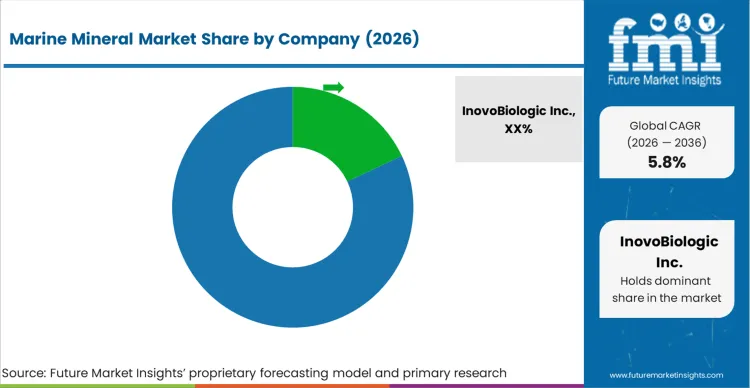
Tier 1 companies comprising industry leaders like Marigot Ltd. and Celtic Sea Minerals hold a market share of 40%. These leaders are focused on increasing their production capacities to meet growing end user demand. They offer different minerals with specific health benefits.
Tier 1 companies are employing advanced extraction technologies to get access to different essential minerals located in deep ocean depths. They have well-established distribution channels, giving them a competitive edge over others.
Celtic Sea Minerals leads the way in marine minerals extracted from the red seaweed algae Lithothamnium calcareum. The company’s products are exported to more than 40 countries globally for use in different animal diets and livestock farming systems. Celtic Sea Minerals’ success lies mostly in sustainable natural marine minerals, strong scientific research, high-quality production techniques, and a dedicated team of professionals.
Tier 2 companies include mid-size players that have a presence in specific regions and only influence the local business. These players hold 9.6% share of the sector. They are striving to educate consumers about the health and environmental benefits of minerals derived from marine sources.
One key company in tier 2 category is Alesco S.r.l. This Italian-based company specializes in producing and distributing functional ingredients and raw materials for nutraceuticals, pharmaceuticals, cosmetics, and food sectors.
Tier 3 companies, including start-ups, also hold a prominent share of around 50.4%. These players are concentrating on employing sustainable production practices, just like tier 1 companies, to appeal to eco-conscious customers and solidify their positions. They are using aggressive marketing and branding strategies to expand their reach and customer base.
Country-wise Insights
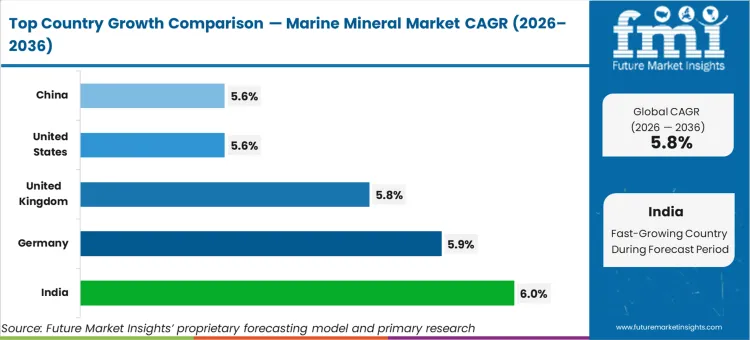
The below section depicts marine mineral market forecast across various nations. Among these, India and Germany are set to witness significant CAGRs of 6% and 5.9%, respectively, through 2036.
.webp "Top Country Growth Comparison Marine Mineral Market Cagr (2026 2036)")
| Countries | CAGR 2026 to 2036 |
|---|---|
| United States | 5.6% |
| China | 5.6% |
| United Kingdom | 5.8% |
| Germany | 5.9% |
| India | 6% |
Ongoing Functional Food Trend Spurring Growth in the United States
The United States marine mineral market is projected to advance at a CAGR of 5.6% during the assessment period. This is attributable to growing functional food trend, favorable government support, and rising popularity of personalized nutrition.
Americans are increasingly showing interest in consuming functional foods that provide multiple health benefits beyond basic nutrition. This is playing a key role in fueling growth of the marine mineral market in the nation.
Leading food and beverage manufacturers in the United States are using marine minerals to develop functional foods and beverages enriched with specific minerals for targeted health. Thus, as the demand for functional foods and beverages continues to rise in the nation, so will sales of marine minerals.
Expanding Applications in Beauty Products Propelling Demand in China
China is poised to register a CAGR of 5.6% during the projection period, offering lucrative opportunities to players. A prominent factor behind this growth is the growing usage of marine minerals in cosmetics and personal care products.
Consumers in China are inclined towards using beauty products with natural and unique ingredients. This is expanding the scope of minerals derived from marine sources in the cosmetics and personal care sector.
Marine minerals are associated with reducing inflammation, promoting healthy skin, and even offering anti-aging properties. Courtesy of these benefits, the scope and usage of deep ocean minerals is increasing rapidly in China’s cosmetics and personal care industry.
Increasing Geriatric Population Influencing Sales in the United Kingdom
The United Kingdom industry is projected to exhibit a CAGR of 5.8% during the assessment period. Key factors propelling sales in the nation include increasing geriatric population, surging interest in preventive healthcare.
There has been a spike in the geriatric population across the United Kingdom in the last few years. According to Census 2021, the number of people aged 65 and over grew from 9.2 million in 2011 to over 11 million in 2021 across England and Wales.
Aging population in the nation is constantly seeking products that support longevity and healthy aging. As a result, there is a significant demand for marine minerals marketed for their role in maintaining health and older adults, and the trend will likely continue through 2034.
Category-wise Insights
The section below sheds some light on leading segments of the marine mineral market. Granules segment is set to account for a value share of 35.0% in 2026. Based on source, organic category will likely witness high growth, holding a share of 23.7% in 2026.
Granules Becoming Popular Form Courtesy of their Versatility

| Segment | Granules (Form) |
|---|---|
| Value Share (2026) | 35.0% |
Demand is expected to remain high for mineral granules owing to multiple advantages of this form, including versatility and ease of transportation. The target segment will likely account for a value share of 35.0% in 2026.
Mineral granules are versatile and can be used in several industries, including food and beverage, dietary supplements, and animal nutrition. End users can easily process these granules as per their requirements.
Granules are also easier to transport and store than liquid or powdered forms. As a result, they reduce logistical costs and challenges, further contributing to their growing popularity among end-use industries.
Competition Outlook
The competitive landscape of marine mineral market is becoming fiercer with more and more companies entering the business. Leading players are constantly focusing on expanding their portfolios by launching new minerals with potential health benefits and wider applications.
Industry leaders are concentrating on mining a wide range of minerals from seabed to cater to growing demand from different industries. They are also consolidating their positions by employing strategies like partnerships, acquisitions, distribution agreements, and mergers. Companies are attending trade shows and exhibitions to expand their customer base.
Recent Developments
The report includes full coverage of key trends from competitive benchmarking. Some of the recent developments covered in the reports:
- In February 2026, The Metals Company became the first deep-sea miner to apply for a commercial permit under NOAA's new streamlined review process, targeting the Clarion-Clipperton Zone estimated to contain 800 million metric tons of polymetallic nodules rich in nickel, copper, cobalt, and manganese. [1]
- In April 2025, ATURA Proteins debuted research at Vitafoods Europe demonstrating that Fava Bean Protein combined with Aquamin natural marine calcium significantly reduces bone breakdown and optimises calcium absorption, targeting the functional plant-based nutrition market. [2]
- In January 2026, The Crown Estate confirmed the award of a third floating offshore wind site in the Celtic Sea to Ocean Winds, serving as a catalyst for regional subsea infrastructure development that supports broader marine resource market activity. [3]
Leading Marine Mineral Brands
- InovoBiologic Inc.
- Marigot Ltd.
- Celtic Sea Minerals
- Maxicrop USA, Inc.
- Alesco S.r.l.
- Humates and Seaweeds Pvt Ltd
- BioFlora, LLC
- Sar Agrochemicals & Fertilizers Pvt. Ltd
- HMHS Solutions Limited
Scope of the Report
| Metric | Value |
|---|---|
| Quantitative Units | USD 20.88 billion (2026) to USD 36.70 billion (2036), at a CAGR of 5.8% |
| Market Definition | The marine mineral market covers globally traded mineral compounds from marine sources including seaweed calcium, marine sediment concentrates, polymetallic nodule extracts, and marine shell calcium in multiple forms for dietary supplement, food fortification, agricultural, and industrial applications. |
| Form Segmentation | Solid, Powder, Granules, Flakes, Liquid |
| End Use Segmentation | Dietary Supplements, Food and Beverage Industry, Frozen Desserts, Processed Food |
| Regions Covered | North America, Latin America, Europe, East Asia, South Asia, Oceania, Middle East and Africa |
| Countries Covered | United States, Ireland, Norway, Iceland, United Kingdom, France, Japan, China, South Korea, Australia, Canada and 40 plus countries |
| Key Companies Profiled | Marigot Ltd. (Aquamin), Celtic Sea Minerals, Maxicrop USA Inc., Alesco S.r.l., Humates and Seaweeds Pvt Ltd, BioFlora LLC, InovoBiologic Inc., Sar Agrochemicals and Fertilizers Pvt. Ltd., HMHS Solutions Limited, QingDao ZhongZheng ChiCheng Industry and Trade Co. Ltd. |
| Forecast Period | 2026 to 2036 |
| Approach | Hybrid top-down and bottom-up market modeling validated through primary interviews with marine mineral producers and supplement buyers, supported by ISA licensing data, NOAA resource assessments, and supplement market association records |
Key Segments of the Marine Mineral Market Report
By Form:
Based on form, the marine mineral market is segmented into solid, powder, granules, flakes, and liquid.
By End Use:
Leading end use segments include dietary supplements, food and beverage industry, frozen desserts, processed food, meat processing, fruit juices, smoothies and shakes, instant beverages, pharmaceuticals, cosmetics and personal care, industrial, animal nutrition, and others.
By Region:
Marine mineral market analysis has been carried out in key countries of North America, Latin America, Europe, East Asia, South Asia, Oceania, and the Middle East and Africa.
Bibliography
- [1] Marine Technology News / The Metals Company. (2026). TMC seeks first commercial deep-sea mining permit under NOAA streamlined process. February 2026. https://www.marinetechnologynews.com/news/metals-seeks-international-mining-657794
- [2] ATURA Proteins. (2025). ATURA Proteins at Vitafoods 2025: Fava Bean Protein with Aquamin marine calcium reduces bone breakdown. April 2025. https://aturaproteins.com/news/atura-proteins-at-vitafoods-2025-unlocking-the-power-of-plant-based-and-mineral-nutrition/
- [3] The Crown Estate. (2026). The Crown Estate announces award of third floating wind farm in the Celtic Sea. January 2026. https://www.thecrownestate.co.uk/news/the-crown-estate-announces-successful-award-to-develop-third-floating-wind-farm-in-the-celtic-sea
- [4] International Seabed Authority. (2025). Annual Report on Deep-Sea Mineral Exploration Contracts and Regulatory Status. ISA, Kingston, Jamaica.
This bibliography is provided for reader reference and is not exhaustive. The full report contains the complete reference list and detailed citations.
This Report Addresses
- Market intelligence to enable structured sourcing, product development, and channel strategy decisions across dietary supplement, food fortification, agricultural, and deep-sea mineral extraction applications
- Market size estimation and 10-year revenue forecasts from 2026 to 2036, supported by validated ISA licensing data, NOAA assessments, and supplement market association benchmarks
- Growth opportunity mapping across form and end-use segments with emphasis on Aquamin clinical nutrition positioning, deep-sea mining commercial transition, and food fortification channel expansion
- Segment and regional revenue forecasts covering solid, powder, granule, flake, and liquid forms across supplement, food, and industrial end uses in 40 plus countries
- Competition strategy assessment including seaweed calcium clinical differentiation, deep-sea mining supply chain positioning, and marine-provenance sustainability documentation investment
- Regulatory impact analysis covering NOAA deep-sea mining permit frameworks, ISA exploration contract requirements, and dietary supplement mineral ingredient labeling standards
- Deep-sea mineral extraction commercial readiness analysis covering Clarion-Clipperton Zone polymetallic nodule reserves, NOAA permit process timelines, and industrial procurement implications
- Market report delivery in PDF, Excel, PPT, and interactive dashboard formats for executive and operational use
Frequently Asked Questions
How large is the demand for Marine Minerals in the global market in 2026?
Demand for Marine Minerals in the global market is estimated to be valued at USD 20.88 billion in 2026.
What will the market size of Marine Minerals be by 2036?
Market size for Marine Minerals is projected to reach USD 36.70 billion by 2036.
What is the expected CAGR for the Marine Mineral Market between 2026 and 2036?
Demand for Marine Minerals is expected to grow at a CAGR of 5.8% between 2026 and 2036.
Which Form segment leads the Marine Mineral Market in 2026?
Solid format holds 35.0% of form share, reflecting primary procurement in dietary supplement tablet and capsule manufacturing and food processing mineral additive applications.
Which End Use segment dominates the Marine Mineral Market?
Dietary Supplements capture 40.0% of demand as the leading segment, driven by bone health, mineral balance, and functional nutrition positioning of seaweed-derived calcium and magnesium products.
What is the United States CAGR and market value for Marine Minerals?
The United States leads growth at a 5.6% CAGR, generating USD 7.59 billion in 2026 demand across supplement, food fortification, and deep-sea regulatory activities.
What does The Metals Company's NOAA permit application signal?
The February 2026 first commercial permit application under NOAA's streamlined process confirms that deep-sea mineral extraction is transitioning from exploration to commercial operation, introducing industrial-scale demand for nickel, cobalt, and manganese.
What clinical evidence supports Aquamin marine calcium?
ATURA Proteins' April 2025 Vitafoods research demonstrated that Aquamin natural marine calcium combined with fava bean protein significantly reduces bone breakdown and optimises calcium absorption, validating a clinically differentiated functional nutrition positioning.
What is included in the scope of this report?
Scope covers mineral compounds from marine sources including seaweed calcium, marine sediment concentrates, polymetallic nodule extracts, and marine shell calcium across supplement, food fortification, agricultural, and industrial applications.
What is excluded from this report's scope?
Synthetic calcium carbonate without marine source inputs, marine fish oil, offshore oil and gas extraction, fresh water mineral extraction, and land-based mining are excluded.
How does FMI validate its Marine Mineral Market forecast?
The forecast uses a hybrid model validated through primary interviews with marine mineral producers and supplement buyers, cross-checked against ISA licensing records, NOAA resource assessments, and supplement market association data.
Preview the report firsthand - request a free sample
Get SampleGet the brochure for pricing and purchase details.
Get PDFTable of Content
- Executive Summary
- Global Market Outlook
- Demand-side Trends
- Supply-side Trends
- Technology Roadmap Analysis
- Analysis and Recommendations
- Market Overview
- Market Coverage / Taxonomy
- Market Definition / Scope / Limitations
- Research Methodology
- Chapter Orientation
- Analytical Lens and Working Hypotheses
- Market Structure, Signals, and Trend Drivers
- Company Annual and Sustainability Reports
- Peer-reviewed Journals and Academic Literature
- Corporate Websites, Product Literature, and Technical Notes
- Earnings Decks and Investor Briefings
- Statutory Filings and Regulatory Disclosures
- Technical White Papers and Standards Notes
- Trade Journals, Industry Magazines, and Analyst Briefs
- Conference Proceedings, Webinars, and Seminar Materials
- Government Statistics Portals and Public Data Releases
- Press Releases and Reputable Media Coverage
- Specialist Newsletters and Curated Briefings
- Sector Databases and Reference Repositories
- FMI Internal Proprietary Databases and Historical Market Datasets
- Subscription Datasets and Paid Sources
- Social Channels, Communities, and Digital Listening Inputs
- Additional Desk Sources
- Expert Input and Fieldwork (Primary Evidence)
- Primary Modes
- Qualitative Interviews and Expert Elicitation
- Quantitative Surveys and Structured Data Capture
- Blended Approach
- Why Primary Evidence is Used
- Field Techniques
- Interviews
- Surveys
- Focus Groups
- Observational and In-context Research
- Social and Community Interactions
- Stakeholder Universe Engaged
- C-suite Leaders
- Board Members
- Presidents and Vice Presidents
- R&D and Innovation Heads
- Technical Specialists
- Domain Subject-matter Experts
- Scientists
- Physicians and Other Healthcare Professionals
- Governance, Ethics, and Data Stewardship
- Research Ethics
- Data Integrity and Handling
- Primary Modes
- Tooling, Models, and Reference Databases
- Data Engineering and Model Build
- Data Acquisition and Ingestion
- Cleaning, Normalisation, and Verification
- Synthesis, Triangulation, and Analysis
- Quality Assurance and Audit Trail
- Market Background
- Market Dynamics
- Drivers
- Restraints
- Opportunity
- Trends
- Scenario Forecast
- Demand in Optimistic Scenario
- Demand in Likely Scenario
- Demand in Conservative Scenario
- Opportunity Map Analysis
- Product Life Cycle Analysis
- Supply Chain Analysis
- Investment Feasibility Matrix
- Value Chain Analysis
- PESTLE and Porter’s Analysis
- Regulatory Landscape
- Regional Parent Market Outlook
- Production and Consumption Statistics
- Import and Export Statistics
- Market Dynamics
- Global Market Analysis 2021 to 2025 and Forecast, 2026 to 2036
- Historical Market Size Value (USD Million) Analysis, 2021 to 2025
- Current and Future Market Size Value (USD Million) Projections, 2026 to 2036
- Y-o-Y Growth Trend Analysis
- Absolute $ Opportunity Analysis
- Global Market Pricing Analysis 2021 to 2025 and Forecast 2026 to 2036
- Global Market Analysis 2021 to 2025 and Forecast 2026 to 2036, By Form
- Introduction / Key Findings
- Historical Market Size Value (USD Million) Analysis By Form , 2021 to 2025
- Current and Future Market Size Value (USD Million) Analysis and Forecast By Form , 2026 to 2036
- solid
- powder
- granules
- flakes
- liquid
- solid
- Y-o-Y Growth Trend Analysis By Form , 2021 to 2025
- Absolute $ Opportunity Analysis By Form , 2026 to 2036
- Global Market Analysis 2021 to 2025 and Forecast 2026 to 2036, By End Use
- Introduction / Key Findings
- Historical Market Size Value (USD Million) Analysis By End Use, 2021 to 2025
- Current and Future Market Size Value (USD Million) Analysis and Forecast By End Use, 2026 to 2036
- dietary supplements
- food and beverage industry
- frozen desserts
- processed food
- dietary supplements
- Y-o-Y Growth Trend Analysis By End Use, 2021 to 2025
- Absolute $ Opportunity Analysis By End Use, 2026 to 2036
- Global Market Analysis 2021 to 2025 and Forecast 2026 to 2036, By Region
- Introduction
- Historical Market Size Value (USD Million) Analysis By Region, 2021 to 2025
- Current Market Size Value (USD Million) Analysis and Forecast By Region, 2026 to 2036
- North America
- Latin America
- Western Europe
- Eastern Europe
- East Asia
- South Asia and Pacific
- Middle East & Africa
- Market Attractiveness Analysis By Region
- North America Market Analysis 2021 to 2025 and Forecast 2026 to 2036, By Country
- Historical Market Size Value (USD Million) Trend Analysis By Market Taxonomy, 2021 to 2025
- Market Size Value (USD Million) Forecast By Market Taxonomy, 2026 to 2036
- By Country
- USA
- Canada
- Mexico
- By Form
- By End Use
- By Country
- Market Attractiveness Analysis
- By Country
- By Form
- By End Use
- Key Takeaways
- Latin America Market Analysis 2021 to 2025 and Forecast 2026 to 2036, By Country
- Historical Market Size Value (USD Million) Trend Analysis By Market Taxonomy, 2021 to 2025
- Market Size Value (USD Million) Forecast By Market Taxonomy, 2026 to 2036
- By Country
- Brazil
- Chile
- Rest of Latin America
- By Form
- By End Use
- By Country
- Market Attractiveness Analysis
- By Country
- By Form
- By End Use
- Key Takeaways
- Western Europe Market Analysis 2021 to 2025 and Forecast 2026 to 2036, By Country
- Historical Market Size Value (USD Million) Trend Analysis By Market Taxonomy, 2021 to 2025
- Market Size Value (USD Million) Forecast By Market Taxonomy, 2026 to 2036
- By Country
- Germany
- UK
- Italy
- Spain
- France
- Nordic
- BENELUX
- Rest of Western Europe
- By Form
- By End Use
- By Country
- Market Attractiveness Analysis
- By Country
- By Form
- By End Use
- Key Takeaways
- Eastern Europe Market Analysis 2021 to 2025 and Forecast 2026 to 2036, By Country
- Historical Market Size Value (USD Million) Trend Analysis By Market Taxonomy, 2021 to 2025
- Market Size Value (USD Million) Forecast By Market Taxonomy, 2026 to 2036
- By Country
- Russia
- Poland
- Hungary
- Balkan & Baltic
- Rest of Eastern Europe
- By Form
- By End Use
- By Country
- Market Attractiveness Analysis
- By Country
- By Form
- By End Use
- Key Takeaways
- East Asia Market Analysis 2021 to 2025 and Forecast 2026 to 2036, By Country
- Historical Market Size Value (USD Million) Trend Analysis By Market Taxonomy, 2021 to 2025
- Market Size Value (USD Million) Forecast By Market Taxonomy, 2026 to 2036
- By Country
- China
- Japan
- South Korea
- By Form
- By End Use
- By Country
- Market Attractiveness Analysis
- By Country
- By Form
- By End Use
- Key Takeaways
- South Asia and Pacific Market Analysis 2021 to 2025 and Forecast 2026 to 2036, By Country
- Historical Market Size Value (USD Million) Trend Analysis By Market Taxonomy, 2021 to 2025
- Market Size Value (USD Million) Forecast By Market Taxonomy, 2026 to 2036
- By Country
- India
- ASEAN
- Australia & New Zealand
- Rest of South Asia and Pacific
- By Form
- By End Use
- By Country
- Market Attractiveness Analysis
- By Country
- By Form
- By End Use
- Key Takeaways
- Middle East & Africa Market Analysis 2021 to 2025 and Forecast 2026 to 2036, By Country
- Historical Market Size Value (USD Million) Trend Analysis By Market Taxonomy, 2021 to 2025
- Market Size Value (USD Million) Forecast By Market Taxonomy, 2026 to 2036
- By Country
- Kingdom of Saudi Arabia
- Other GCC Countries
- Turkiye
- South Africa
- Other African Union
- Rest of Middle East & Africa
- By Form
- By End Use
- By Country
- Market Attractiveness Analysis
- By Country
- By Form
- By End Use
- Key Takeaways
- Key Countries Market Analysis
- USA
- Pricing Analysis
- Market Share Analysis, 2025
- By Form
- By End Use
- Canada
- Pricing Analysis
- Market Share Analysis, 2025
- By Form
- By End Use
- Mexico
- Pricing Analysis
- Market Share Analysis, 2025
- By Form
- By End Use
- Brazil
- Pricing Analysis
- Market Share Analysis, 2025
- By Form
- By End Use
- Chile
- Pricing Analysis
- Market Share Analysis, 2025
- By Form
- By End Use
- Germany
- Pricing Analysis
- Market Share Analysis, 2025
- By Form
- By End Use
- UK
- Pricing Analysis
- Market Share Analysis, 2025
- By Form
- By End Use
- Italy
- Pricing Analysis
- Market Share Analysis, 2025
- By Form
- By End Use
- Spain
- Pricing Analysis
- Market Share Analysis, 2025
- By Form
- By End Use
- France
- Pricing Analysis
- Market Share Analysis, 2025
- By Form
- By End Use
- India
- Pricing Analysis
- Market Share Analysis, 2025
- By Form
- By End Use
- ASEAN
- Pricing Analysis
- Market Share Analysis, 2025
- By Form
- By End Use
- Australia & New Zealand
- Pricing Analysis
- Market Share Analysis, 2025
- By Form
- By End Use
- China
- Pricing Analysis
- Market Share Analysis, 2025
- By Form
- By End Use
- Japan
- Pricing Analysis
- Market Share Analysis, 2025
- By Form
- By End Use
- South Korea
- Pricing Analysis
- Market Share Analysis, 2025
- By Form
- By End Use
- Russia
- Pricing Analysis
- Market Share Analysis, 2025
- By Form
- By End Use
- Poland
- Pricing Analysis
- Market Share Analysis, 2025
- By Form
- By End Use
- Hungary
- Pricing Analysis
- Market Share Analysis, 2025
- By Form
- By End Use
- Kingdom of Saudi Arabia
- Pricing Analysis
- Market Share Analysis, 2025
- By Form
- By End Use
- Turkiye
- Pricing Analysis
- Market Share Analysis, 2025
- By Form
- By End Use
- South Africa
- Pricing Analysis
- Market Share Analysis, 2025
- By Form
- By End Use
- USA
- Market Structure Analysis
- Competition Dashboard
- Competition Benchmarking
- Market Share Analysis of Top Players
- By Regional
- By Form
- By End Use
- Competition Analysis
- Competition Deep Dive
- InovoBiologic Inc.
- Overview
- Product Portfolio
- Profitability by Market Segments (Product/Age /Sales Channel/Region)
- Sales Footprint
- Strategy Overview
- Marketing Strategy
- Product Strategy
- Channel Strategy
- Marigot Ltd.
- Celtic Sea Minerals
- Maxicrop USA, Inc.
- Alesco S.r.l.
- Humates and Seaweeds Pvt Ltd
- BioFlora, LLC
- Sar Agrochemicals & Fertilizers Pvt. Ltd
- HMHS Solutions Limited
- InovoBiologic Inc.
- Competition Deep Dive
- Assumptions & Acronyms Used


