

- Industry Size (2026)
- USD 10.41 Mn
- Forecast (2036)
- USD 32.03 Mn
- CAGR (2026 to 2036)
- 11.9%
Marine Spicules Market Size, Market Forecast and Outlook By FMI
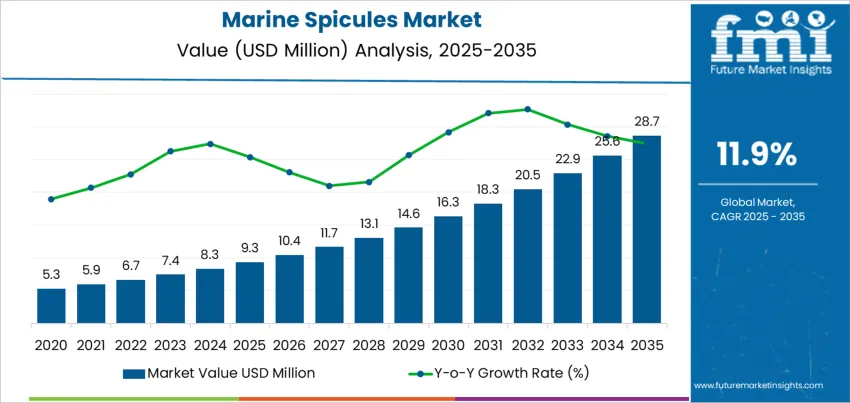
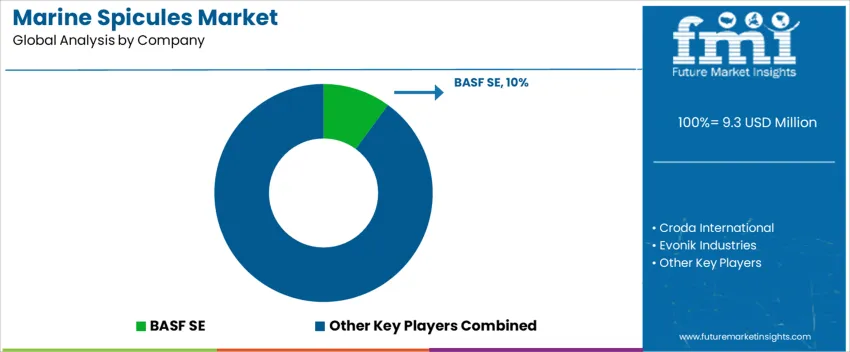
The marine spicules market was valued at USD 9.30 million in 2025, projected to reach USD 10.41 million in 2026, and is forecast to expand to USD 32.03 million by 2036 at a 11.9% CAGR. Growing consumer demand for marine-origin bioactive cosmetic ingredients with documented skin renewal properties is accelerating adoption of sponge-derived spicule extracts across premium skin care and dermocosmetic formulation platforms. Based on FMI's analysis, the micro-needling effect of marine spicules is positioning these ingredients as a natural alternative to synthetic microdermabrasion actives, enabling cosmetic brands to offer clinically supported exfoliation and collagen stimulation claims within clean beauty product lines.
Summary of Marine Spicules Market
- Market Overview
- The market is valued at USD 9.30 million in 2025 and is projected to reach USD 32.03 million by 2036.
- The industry is expected to grow at a 11.9% CAGR from 2026 to 2036, creating an incremental opportunity of USD 21.62 million.
- The market is a premium marine bioactive ingredient category where micro-needling exfoliation efficacy, clean beauty positioning, and dermocosmetic channel expansion define spicule ingredient specification and adoption in global personal care formulation.
- Demand and Growth Drivers
- Consumer demand for natural exfoliation alternatives is driving adoption of marine spicule ingredients that deliver micro-needling collagen stimulation effects without synthetic particles or harsh chemical actives.
- Dermocosmetic and professional aesthetics channels are expanding marine spicule treatment adoption as a gentler alternative to chemical peels for sensitive skin protocols.
- Clean beauty brand reformulation activity is creating new specification opportunities for marine-origin actives with documented bioactivity and traceable sourcing credentials.
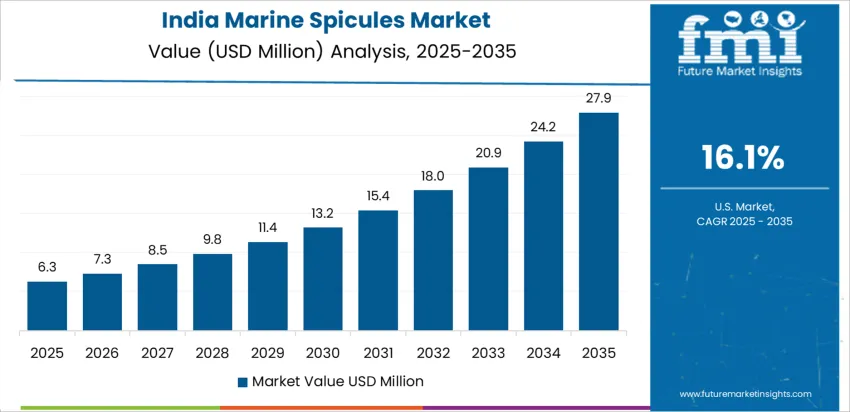
- Among key countries, India leads at 16.1% CAGR, followed by China at 14.9%, Japan at 13.7%, the UK at 12.5%, Germany at 11.3%, and the USA at 10.1%.
- Product and Segment View
- The market covers microscopic marine sponge-derived structural elements processed into cosmetic-grade powders, granules, gels, and dispersions for skin exfoliation and renewal applications.
- End-use applications span skin care, body care, dermocosmetic treatments, and professional aesthetics formulations across premium consumer and clinical channels.
- Powder leads by Product Form with 14.5% share in 2026, reflecting the requirement to preserve spicule micro-needle morphology during processing for efficacy retention.
- Skin Care leads by End Use Application with 9.9% share in 2026 as exfoliation treatments, peeling masks, and renewal serums drive the primary demand channel.
- Scope includes all cosmetic-grade marine spicule extracts and excludes synthetic micro-needling particles, chemical peels, and pharmaceutical-grade preparations.
- Geography and Competitive Outlook
- India and China are the fastest-growing markets driven by premium skin care segment expansion and domestic cosmetic ingredient manufacturing capacity.
- Japan maintains a strong position through consumer familiarity with marine-origin beauty actives and established sponge harvesting and processing infrastructure.
- Competition is shaped by spicule purity, particle size consistency, and bioactivity documentation, with key players including BASF SE, Croda International, Evonik Industries, Symrise, Dow Inc., Ashland, and Clariant.
- Analyst Opinion at FMI
- Ronak Shah, Principal Consultant for Personal Care Ingredients at Future Market Insights, opines: 'In my analysis, the marine spicules market is transitioning from a niche professional treatment ingredient to a scalable consumer skin care active as leading brands develop retail-format exfoliation products with marine spicule micro-needling claims. Ingredient suppliers that can demonstrate batch-consistent particle size distribution and documented collagen stimulation efficacy through third-party clinical testing will capture the premium formulation tier that mass-market synthetic alternatives cannot access.'
- Strategic Implications / Executive Takeaways
- Ingredient suppliers must invest in third-party clinical testing programs documenting spicule micro-needling efficacy and collagen stimulation to build the evidence base that premium skin care brands require for product claims.
- Cosmetic brand formulation teams should evaluate marine spicules as a multifunctional active delivering exfoliation, collagen stimulation, and skin renewal within a single natural-origin ingredient, reducing formulation complexity.
- Sustainable sourcing programs for marine sponge raw materials must be established to ensure supply chain continuity as demand scales beyond current artisanal harvesting capacity.
Marine Spicules Market Key Takeaways
| Metric | Details |
|---|---|
| Industry Size (2026) | USD 10.41 million |
| Industry Value (2036) | USD 32.03 million |
| CAGR (2026-2036) | 11.9% |
Source: Future Market Insights, 2026
Powder form dominates the product format because spicule particles must maintain their micro-needle structure during processing, and powder formats preserve this morphology more effectively than liquid dispersions. Skin care represents the primary end-use application, as marine spicule-based exfoliation treatments, peeling masks, and renewal serums command premium retail positioning in both professional dermocosmetic and consumer skin care channels. The dermocosmetic and professional care segment is expanding rapidly as aesthetic clinics incorporate marine spicule treatments as gentler alternatives to chemical peels for sensitive skin patients.
India leads with a 16.1% CAGR, driven by the fast-growing domestic premium skin care market and expanding cosmetic ingredient manufacturing capacity. China follows at 14.9%, supported by a large cosmetics industry and increasing formulator adoption of marine bioactive ingredients. Japan registers 13.7% growth, reflecting consumer acceptance of marine-origin beauty actives and domestic sponge harvesting infrastructure. The United Kingdom tracks at 12.5%, Germany at 11.3% reflecting European dermocosmetic channel growth, and the United States at 10.1% supported by professional aesthetics clinic adoption.
Marine Spicules Market Definition
Marine spicules are microscopic siliceous or calcareous structural elements derived from marine sponges, processed into cosmetic-grade raw materials that deliver physical micro-needling exfoliation and collagen stimulation effects when applied to skin. Core product forms include powders, granules, gels, and dispersions used in skin care, body care, and dermocosmetic formulations.
Marine Spicules Market Inclusions
Market scope covers marine sponge-derived spicule extracts in powder, granule, liquid, gel, and concentrate product forms for cosmetic and personal care applications. End-use coverage spans skin care, body care, hair care, sun care, color cosmetics, men's grooming, baby care, and dermocosmetic/professional care. Regional and country-level market sizes for 2026 to 2036 are included.
Marine Spicules Market Exclusions
The scope excludes synthetic micro-needling particles, chemical exfoliation actives, pharmaceutical-grade spicule preparations for medical dermatology, and marine spicule materials used in non-cosmetic research applications. Whole sponge products not processed into cosmetic-grade extracts are also excluded.
Marine Spicules Market Research Methodology
- Primary Research: Analysts engaged with procurement managers, operations engineers, and industry supply chain directors to identify the decision triggers, specification requirements, and budget allocation patterns governing equipment and technology upgrades.
- Desk Research: Data collection aggregated publicly available regulatory filings, government procurement records, trade association publications, and company annual reports and investor presentations.
- Market-Sizing and Forecasting: Baseline values derive from a bottom-up aggregation of product-level shipment volumes and average selling prices, applying region-specific adoption curves to project demand through the forecast period.
- Data Validation and Update Cycle: Projections are cross-validated against publicly reported company revenue guidance, government statistical agency databases, and trade body shipment records.
How Is the Marine Spicules Market Developing Across Cosmetic, Biomedical, and Delivery System Applications?
The marine spicules market developed from scientific research into sponge derived microstructures originally studied for skeletal support and filtration in marine organisms. Commercial relevance emerged when formulators identified that this microscopic silica based needles could create controlled microchannels in the skin. Early adoption was concentrated in professional cosmetic treatments where spicules were used to enhance exfoliation and improve transdermal delivery of active ingredients. As processing and sterilization methods improved, marine spicules moved from niche clinical use into broader cosmetic ingredient supply chains. Their physical mode of action differentiated them from chemical exfoliants and positioned them within advanced skin treatment systems rather than mass market formulations.
Future growth of the marine spicules market will be shaped by expansion of non-invasive delivery technologies, professional grade skincare, and bio inspired material research. Demand is expected to rise in cosmeceuticals, dermatology focused products, and transdermal delivery platforms where controlled micro penetration improves absorption efficiency. Research interest in spicules as carriers for drugs, peptides, and vaccines also supports long term biomedical relevance. Barriers include supply limitations from marine harvesting, stringent purification requirements, and variability in particle size and strength that affect performance consistency. Regulatory classification challenges between cosmetic and medical use will also influence adoption pace. Market expansion will depend on scalable synthesis routes, consistent quality control, and clinical validation across therapeutic and cosmetic applications.
How Are End Use Application and Product Form Structuring the Demand for Marine Spicules?
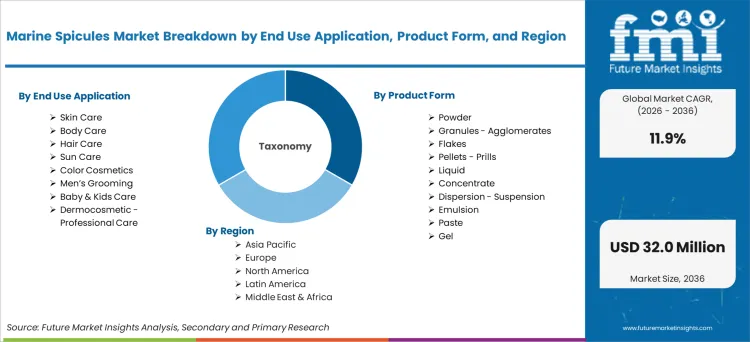
The demand for marine spicules is structured by end use application and product form. Skin care represents 9.9% of total demand, followed by body care, hair care, sun care, color cosmetics, men grooming, baby and kids care, and dermocosmetic and professional care. By product form, powder accounts for 14.5% of total consumption, followed by granules and agglomerates, flakes, pellets and prills, liquid solutions, high active concentrates, dispersions and suspensions, emulsions, pastes, gels, wax or solid block formats, and oils. Demand behavior is shaped by exfoliation precision, transdermal delivery effectiveness, particle size control, safety validation, and compatibility with professional and consumer topical treatment systems.
Why Does Skin Care Lead the Marine Spicules End Use Demand?
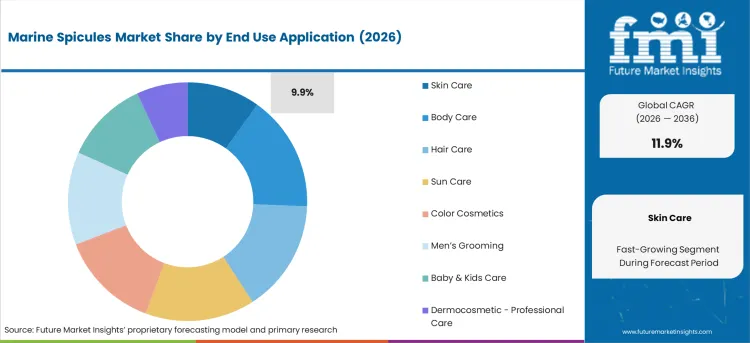
Skin care accounts for 9.9% of total marine spicules demand due to their distinctive role in micro needling inspired topical treatments that enhance skin renewal and ingredient penetration. Marine spicules, derived from sponge skeletal structures, create controlled micro channels on the skin surface that stimulate cell turnover and improve absorption of active ingredients such as peptides, vitamins, and brightening agents. These effects support use in resurfacing serums, treatment ampoules, peeling masks, and professional exfoliation products.
Skin care brands adopt marine spicules for their ability to deliver visible smoothing and texture refinement without relying on mechanical devices. They are frequently used in treatment focused products aimed at acne scarring, pigmentation irregularities, and uneven skin tone. Clinical positioning and professional spa adoption further strengthen this segment. These transdermal enhancement functions, resurfacing performance, and treatment positioning factors sustain skin care as the leading end use segment within marine spicules demand.
Why Does Powder Lead the Marine Spicules Product Form Demand?
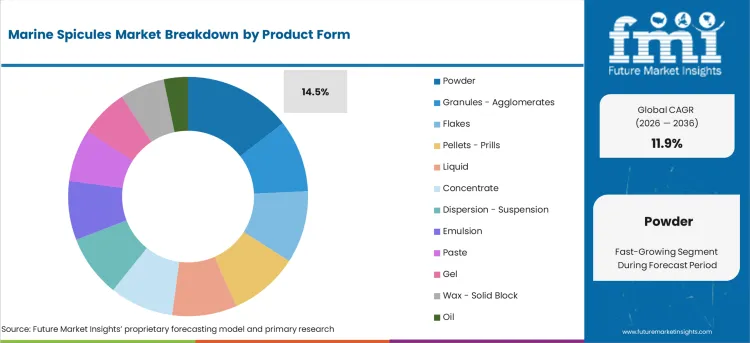
Powder accounts for 14.5% of total marine spicules demand due to its superior stability, controlled particle distribution, and precise formulation dosing. Powdered spicules allow manufacturers to standardize exfoliation intensity by tightly regulating particle size and concentration. This control is essential for maintaining predictable skin response and minimizing irritation risk across repeated production batches. Low moisture content preserves structural integrity and prevents premature breakdown during storage.
Powder form also supports flexible integration into serums, gels, masks, and professional peel systems where spicules are activated only during application. Packaging in moisture barrier containers protects the microstructure during transport and long term warehousing. Logistics efficiency is improved compared with pre dispersed liquid formats, which carry higher stability and sedimentation risks. These formulation accuracy, storage durability, and safety control advantages position powder as the leading product form within marine spicules demand.
Why Are Marine Spicules Being Treated as Transdermal Delivery Tools Rather Than Cosmetic Exfoliants?
Global demand for marine spicules is no longer centered on surface exfoliation alone. These microscopic silica structures are now applied as mechanical delivery vectors that create controlled micro-channels in the skin. This transient permeability allows deeper penetration of peptides, growth factors, and regenerative actives. Unlike chemical enhancers, spicules rely on physical micro-stimulation to trigger cellular response. Their value lies in controlled injury signaling rather than abrasion. This shifts marine spicules from cosmetic texture agents into bio-physical interface tools used in professional-grade skin treatment systems.
How Do Sponge Harvest Dependency and Processing Precision Shape Supply Economics?
Marine spicules are derived mainly from specific sponge species found in restricted ocean zones. Harvesting relies on regulated marine collection or limited aquaculture replication. Post-harvest separation requires exact mechanical filtration to isolate uniform spicule length and diameter. Over-fragmentation destroys functional performance, while uneven sizing reduces delivery consistency. Drying and sterilization must preserve structural rigidity. These processing sensitivities elevate cost and limit mass scalability. Supply growth depends more on marine biology management and precision refinement capacity than on commodity extraction volume.
What Skin Sensitivity, Regulatory Positioning, and Practitioner Control Limit Broad Consumer Adoption?
Marine spicule systems face strict boundaries due to irritation risk and regulatory classification uncertainty. Improper dosage or technique can trigger prolonged erythema, barrier disruption, and inflammatory flare. This confines most applications to clinics, dermatology offices, and trained aestheticians rather than unrestricted retail. Consumer-grade products use heavily diluted forms with reduced penetration power. Regulatory bodies monitor claims that imply drug-like delivery. These safety, compliance, and skill constraints slow open-market expansion and keep marine spicules positioned in controlled-use professional skincare channels.
How Are Regenerative Aesthetics, Hair Follicle Stimulation, and Post-Procedure Recovery Reframing Demand?
Future demand for marine spicules is shifting toward regenerative signaling rather than exfoliation benefits. Hair restoration programs apply spicules to enhance scalp permeability for stem cell exosomes and growth peptides. Post-laser and microneedling recovery systems use them to drive anti-inflammatory and matrix-repair compounds deeper into treated tissue. Scar modulation and stretch mark therapies also integrate spicules for controlled dermal activation. These applications reposition marine spicules as precision biological response triggers within regenerative aesthetics rather than as mechanical skincare additives.
What Is the Global Growth Outlook for the Marine Spicules Industry by Country?
.webp "Top Country Growth Comparison Marine Spicules Market Cagr (2026 2036)")
| Country | CAGR (%) |
|---|---|
| India | 16.1% |
| China | 14.9% |
| Japan | 13.7% |
| UK | 12.5% |
| Germany | 11.3% |
| USA | 10.1% |
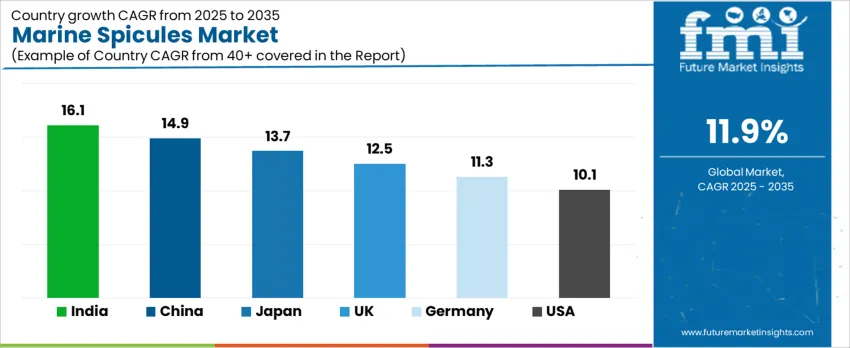
The marine spicules industry is showing strong global growth across both Asian and Western markets, led by India at a 16.1% CAGR. Growth in India is supported by rising use of marine derived microstructures in cosmetic formulations, dermatology treatments, and advanced skincare applications. China follows at 14.9%, driven by expanding production capacity, rapid scaling of cosmeceutical manufacturing, and growing domestic demand for active beauty ingredients. Japan at 13.7% reflects steady adoption in premium skincare, aesthetic medicine, and personal care product innovation. The UK and Germany record 12.5% and 11.3% growth, supported by clinical skincare demand and professional dermatology product usage. The USA at 10.1% reflects a mature but steadily expanding market driven by medical aesthetics, premium skincare brands, and dermatology focused ingredient integration.
What Is Driving Rapid Marine Spicule Adoption in India?
Expansion in India is progressing at a CAGR of 16.1% through 2036 for marine spicules demand, driven by strong growth in professional skincare, dermatology clinics, and cosmetic formulation innovation. Marine spicules are used in skin resurfacing treatments, anti aging serums, and acne correction protocols across aesthetic centers. Domestic cosmetic brands adopt spicule based actives for exfoliation and collagen stimulation positioning. Imports dominate supply due to the absence of commercial marine spicule extraction locally. Demand remains procedure led and formulation focused, shaped by rising clinic density, growing beauty investment, and strong online cosmetic retail expansion.
- Dermatology clinics anchor professional treatment demand
- Anti aging serums drive cosmetic formulation uptake
- Import based sourcing dominates raw material supply
- Ecommerce channels expand branded product availability
How Is China Scaling Industrial Use of Marine Spicules?
Growth in China reflects a CAGR of 14.9% through 2036 for marine spicules utilization, supported by large scale cosmetic ingredient manufacturing, medical aesthetics expansion, and export oriented skincare production. Marine spicules are applied in peeling solutions, microneedle substitutes, and skin renewal creams. Domestic marine biomass processing facilities enable cost control and consistent spicule refinement. Export focused cosmetic ingredient suppliers ship to global beauty brands. Demand remains production driven and volume oriented, aligned with large scale beauty manufacturing output, strong overseas shipments, and steady expansion of medical aesthetic treatment infrastructure.
- Cosmetic ingredient processing drives bulk demand
- Peeling and resurfacing systems support clinical usage
- Domestic refining stabilizes volume and pricing
- Export driven production strengthens global supply chains
Why Does Japan Remain a High Value Market for Marine Spicules?
Demand in Japan is increasing at a CAGR of 13.7% through 2036 for marine spicules usage, sustained by advanced dermatology science, premium skincare product development, and strong clinical-grade cosmetic standards. Marine spicules are used in professional exfoliation systems, skin regeneration products, and corrective aesthetic treatments. Dermatologist supervised beauty care supports controlled and repeat usage. Domestic refinement ensures high purity and safety compliance. Demand stays innovation driven and quality focused, supported by aging population skincare requirements, continuous cosmetic R and D investment, and strong consumer trust in medically guided beauty solutions.
- Professional aesthetic treatments anchor spicule usage
- Premium skincare products support high value demand
- Domestic refinement stabilizes purity consistency
- Dermatology supervision supports safe repeat adoption
What Is Supporting Marine Spicule Market Expansion in the United Kingdom?
Growth in the UK is advancing at a CAGR of 12.5% through 2036 for marine spicules demand, supported by clean beauty innovation, clinical skincare adoption, and premium cosmetic brand development. Marine spicules are used in resurfacing serums, texture correction products, and professional facial treatment kits. Aesthetic clinics and dermatology centers expand product offtake. Imports dominate raw material sourcing. Demand remains retail driven and clinic supported, shaped by rising demand for non invasive skin procedures, steady growth in premium skincare spending, and strong penetration of science based beauty brands.
- Clinical facial treatments drive procedure based demand
- Resurfacing serums support cosmetic formulation growth
- Aesthetic clinics expand recurring product usage
- Imported sourcing dominates raw material procurement
How Is Germany Integrating Marine Spicules into Regulated Cosmetic Systems?
Growth in Germany reflects a CAGR of 11.3% through 2036 for marine spicules consumption, driven by regulated dermaceutical manufacturing, certified medical grade skincare, and clinical aesthetic integration. Marine spicules are applied in exfoliation systems, scar correction treatments, and skin barrier renewal products. Strict testing, safety validation, and labeling rules govern usage approval. Imports remain the primary supply route. Demand stays quality focused and regulation aligned, supported by preventive dermatology practices, clinically supervised cosmetic usage, and steady expansion of science based skin treatment protocols across medical and pharmacy aligned retail channels.
- Dermaceutical products anchor regulated demand
- Scar correction treatments support clinical usage
- Safety testing controls qualification of spicule suppliers
- Pharmacy aligned retail stabilizes long term demand
What Is Driving Measured Marine Spicule Growth in the United States?
Expansion in the United States is moving at a CAGR of 10.1% through 2036 for marine spicules demand, supported by medical aesthetics growth, anti-aging skincare innovation, and professional beauty treatment expansion. Marine spicules are used in microneedle alternative therapies, resurfacing serums, and clinic grade exfoliation programs. Coastal wellness markets lead early adoption, with gradual diffusion into mass professional skincare brands. Imports supply most raw material. Demand remains innovation driven and application diverse, shaped by steady clinic expansion, rising demand for noninvasive treatments, and strong premium skincare product development pipelines.
- Medical aesthetics clinics drive professional usage volume
- Microneedle alternative treatments support technology adoption
- Premium exfoliation serums sustain consumer retail demand
- Import dependence dominates national sourcing
What Is Driving the Global Demand for Marine Sponge Spicules and Who Are the Key Suppliers Supplying Them?
Demand for marine sponge spicules is rising as the cosmetics, skincare, and dermatology industries explore new, natural methods for exfoliation, skin renewal, and transdermal delivery of active ingredients. Spicules are microscopic, needle like structures derived from certain marine sponges. Their rigid, siliceous structure can create transient micro channels in the skin’s outer layer, improving absorption of serums or actives applied afterward, while also providing gentle physical exfoliation and stimulating renewal of skin surface cells. This demand grows as consumers and formulators seek natural, minimally processed, and marine derived ingredients with functional benefits beyond basic care.
Key global suppliers positioned to supply marine sponge spicules and related extracts include large specialty ingredient firms such as BASF SE, Croda International, Evonik Industries, Symrise (including IFF/Givaudan actives), Dow Inc., Ashland, Clariant and more focused ingredient houses such as Seppic, Lubrizol, Lonza, Inolex among others. These companies can supply raw or purified spicule powders, spicule enriched extracts, or formulation ready spicule based materials suited for exfoliating creams, serums, masks and skin delivery systems. Larger providers offer scale, quality control and regulatory compliance; smaller specialist suppliers deliver customized grades and higher purity materials for premium or niche skin care applications. This multi tiered supply architecture supports global adoption of marine derived spicules in skin and cosmetic formulations.
Key Players in the Marine Sponge Spicules Market
- BASF SE
- Croda International
- Evonik Industries
- Symrise (incl. IFF/Givaudan actives)
- Dow / Dow Inc.
- Ashland
- Clariant
- Seppic / Others (Seppic, Lubrizol, Lonza, Inolex etc.)
- Others
Scope of the Report
| Metric | Value |
|---|---|
| Quantitative Units | USD 10.41 million to USD 32.03 million, at a CAGR of 11.9% |
| Market Definition | Marine spicules are microscopic siliceous or calcareous structural elements derived from marine sponges, processed into cosmetic-grade raw materials that deliver physical micro-needling exfoliation an... |
| Segmentation | End Use Application: Skin Care, Body Care, Hair Care, Sun Care, Color Cosmetics, Men's Grooming, Baby & Kids Care, Dermocosmetic / Professional Care; Product Form: Powder, Granules / Agglomerates, Flakes, Liquid, Concentrate, Gel, Oil |
| Regions Covered | North America, Latin America, Europe, East Asia, South Asia, Oceania, Middle East & Africa |
| Countries Covered | India, China, Japan, UK, Germany, USA, and 40 plus countries |
| Key Companies Profiled | BASF SE, Croda International, Evonik Industries, Symrise, Dow Inc., Ashland, Clariant, Seppic |
| Forecast Period | 2026 to 2036 |
| Approach | Forecasting models apply a bottom-up methodology starting with global installed base metrics and product-level demand curves, cross-validated against publicly reported revenue and trade data. |
Marine Sponge Spicules Market Segmentation
End Use Application:
- Skin Care
- Body Care
- Hair Care
- Sun Care
- Color Cosmetics
- Men’s Grooming
- Baby & Kids Care
- Dermocosmetic / Professional Care
Product Form:
- Powder
- Granules / Agglomerates
- Flakes
- Pellets / Prills
- Liquid (Solution)
- Concentrate (High-active Liquid)
- Dispersion / Suspension
- Emulsion
- Paste
- Gel
- Wax / Solid Block
- Oil
Region:
-
Asia Pacific
- China
- Japan
- South Korea
- India
- Australia & New Zealand
- ASEAN
- Rest of Asia Pacific
-
Europe
- Germany
- United Kingdom
- France
- Italy
- Spain
- Nordic
- BENELUX
- Rest of Europe
-
North America
- United States
- Canada
- Mexico
-
Latin America
- Brazil
- Chile
- Rest of Latin America
-
Middle East & Africa
- Kingdom of Saudi Arabia
- Other GCC Countries
- Turkey
- South Africa
- Other African Union
- Rest of Middle East & Africa
Bibliography
- International Organization for Standardization. (2024). ISO 16128: Cosmetic Ingredients, Natural and Organic Content Definition. ISO.
- European Commission. (2024). Cosmetic Products Regulation: Safety Assessment for Marine-Derived Ingredients. European Commission.
- Society of Cosmetic Chemists. (2024). Marine Bioactives in Personal Care: Efficacy Testing and Formulation. SCC.
- Personal Care Products Council. (2024). INCI Dictionary: Marine Sponge-Derived Cosmetic Ingredients. PCPC.
- World Health Organization. (2024). Safety Evaluation of Cosmetic Ingredients: Marine Origin Materials. WHO.
- Organisation for Economic Co-operation and Development. (2024). Marine Biotechnology Applications in Consumer Products. OECD.
This bibliography is provided for reader reference. The full Future Market Insights report contains the complete reference list with primary research documentation.
Frequently Asked Questions
How large is the demand for Marine Spicules in the global market in 2026?
Demand is estimated to be valued at USD 10.41 million in 2026.
What will be the market size by 2036?
Market size is projected to reach USD 32.03 million by 2036.
What is the expected demand growth between 2026 and 2036?
Demand is expected to grow at a CAGR of 11.9% between 2026 and 2036.
Which Product Form is poised to lead by 2026?
Powder leads with 14.5% share in 2026, preserving spicule micro-needle morphology for efficacy retention during cosmetic formulation.
What is driving demand in India?
The fast-growing domestic premium skin care market and expanding cosmetic ingredient manufacturing capacity sustain procurement growth.
What is China's growth outlook in this report?
China is projected to grow at a CAGR of 14.9% during 2026 to 2036.
What is Japan's growth outlook in this report?
Japan is projected to grow at a CAGR of 13.7% during 2026 to 2036.
Preview the report firsthand - request a free sample
Get SampleGet the brochure for pricing and purchase details.
Get PDFTable of Content
- Executive Summary
- Global Market Outlook
- Demand-side Trends
- Supply-side Trends
- Technology Roadmap Analysis
- Market Definition / Scope / Limitations
- Research Methodology
- Benchmarking and Cross-market Comparability
- Market Sizing, Forecasting, and Opportunity Mapping
- Research Design and Evidence Framework
- Desk Research Programme (Secondary Evidence)
- Company Annual and Sustainability Reports
- Peer-reviewed Journals and Academic Literature
- Corporate Websites, Product Literature, and Technical Notes
- Earnings Decks and Investor Briefings
- Statutory Filings and Regulatory Disclosures
- Technical White Papers and Standards Notes
- Trade Journals, Industry Magazines, and Analyst Briefs
- Conference Proceedings, Webinars, and Seminar Materials
- Government Statistics Portals and Public Data Releases
- Press Releases and Reputable Media Coverage
- Specialist Newsletters and Curated Briefings
- Sector Databases and Reference Repositories
- FMI Internal Proprietary Databases and Historical Market Datasets
- Subscription Datasets and Paid Sources
- Social Channels, Communities, and Digital Listening Inputs
- Additional Desk Sources
- Expert Input and Fieldwork (Primary Evidence)
- Primary Modes
- Qualitative Interviews and Expert Elicitation
- Quantitative Surveys and Structured Data Capture
- Blended Approach
- Why Primary Evidence is Used
- Field Techniques
- Interviews
- Surveys
- Focus Groups
- Observational and In-context Research
- Social and Community Interactions
- Stakeholder Universe Engaged
- C-suite Leaders
- Board Members
- Presidents and Vice Presidents
- R&D and Innovation Heads
- Technical Specialists
- Domain Subject-matter Experts
- Scientists
- Physicians and Other Healthcare Professionals
- Governance, Ethics, and Data Stewardship
- Research Ethics
- Data Integrity and Handling
- Primary Modes
- Tooling, Models, and Reference Databases
- Desk Research Programme (Secondary Evidence)
- Data Engineering and Model Build
- Data Acquisition and Ingestion
- Cleaning, Normalisation, and Verification
- Synthesis, Triangulation, and Analysis
- Quality Assurance and Audit Trail
- Market Background
- Market Dynamics
- Drivers
- Restraints
- Opportunity
- Trends
- Scenario Forecast
- Demand in Optimistic Scenario
- Demand in Likely Scenario
- Demand in Conservative Scenario
- Opportunity Map Analysis
- Product Life Cycle Analysis
- Supply Chain Analysis
- Investment Feasibility Matrix
- Value Chain Analysis
- PESTLE and Porter’s Analysis
- Regulatory Landscape
- Regional Parent Market Outlook
- Production and Consumption Statistics
- Import and Export Statistics
- Market Dynamics
- Global Market Analysis 2021 to 2025 and Forecast, 2026 to 2036
- Historical Market Size Value (USD Million) Analysis, 2021 to 2025
- Current and Future Market Size Value (USD Million) Projections, 2026 to 2036
- Y-o-Y Growth Trend Analysis
- Absolute $ Opportunity Analysis
- Global Market Pricing Analysis 2021 to 2025 and Forecast 2026 to 2036
- Global Market Analysis 2021 to 2025 and Forecast 2026 to 2036, By End Use Application
- Introduction / Key Findings
- Historical Market Size Value (USD Million) Analysis By End Use Application , 2021 to 2025
- Current and Future Market Size Value (USD Million) Analysis and Forecast By End Use Application , 2026 to 2036
- Skin Care
- Body Care
- Hair Care
- Sun Care
- Color Cosmetics
- Men’s Grooming
- Baby & Kids Care
- Dermocosmetic / Professional Care
- Skin Care
- Y-o-Y Growth Trend Analysis By End Use Application , 2021 to 2025
- Absolute $ Opportunity Analysis By End Use Application , 2026 to 2036
- Global Market Analysis 2021 to 2025 and Forecast 2026 to 2036, By Product Form
- Introduction / Key Findings
- Historical Market Size Value (USD Million) Analysis By Product Form, 2021 to 2025
- Current and Future Market Size Value (USD Million) Analysis and Forecast By Product Form, 2026 to 2036
- Powder
- Granules / Agglomerates
- Flakes
- Pellets / Prills
- Liquid
- Concentrate
- Dispersion / Suspension
- Emulsion
- Paste
- Gel
- Wax / Solid Block
- Powder
- Y-o-Y Growth Trend Analysis By Product Form, 2021 to 2025
- Absolute $ Opportunity Analysis By Product Form, 2026 to 2036
- Global Market Analysis 2021 to 2025 and Forecast 2026 to 2036, By Region
- Introduction
- Historical Market Size Value (USD Million) Analysis By Region, 2021 to 2025
- Current Market Size Value (USD Million) Analysis and Forecast By Region, 2026 to 2036
- North America
- Latin America
- Western Europe
- Eastern Europe
- East Asia
- South Asia and Pacific
- Middle East & Africa
- Market Attractiveness Analysis By Region
- North America Market Analysis 2021 to 2025 and Forecast 2026 to 2036, By Country
- Historical Market Size Value (USD Million) Trend Analysis By Market Taxonomy, 2021 to 2025
- Market Size Value (USD Million) Forecast By Market Taxonomy, 2026 to 2036
- By Country
- USA
- Canada
- Mexico
- By End Use Application
- By Product Form
- By Country
- Market Attractiveness Analysis
- By Country
- By End Use Application
- By Product Form
- Key Takeaways
- Latin America Market Analysis 2021 to 2025 and Forecast 2026 to 2036, By Country
- Historical Market Size Value (USD Million) Trend Analysis By Market Taxonomy, 2021 to 2025
- Market Size Value (USD Million) Forecast By Market Taxonomy, 2026 to 2036
- By Country
- Brazil
- Chile
- Rest of Latin America
- By End Use Application
- By Product Form
- By Country
- Market Attractiveness Analysis
- By Country
- By End Use Application
- By Product Form
- Key Takeaways
- Western Europe Market Analysis 2021 to 2025 and Forecast 2026 to 2036, By Country
- Historical Market Size Value (USD Million) Trend Analysis By Market Taxonomy, 2021 to 2025
- Market Size Value (USD Million) Forecast By Market Taxonomy, 2026 to 2036
- By Country
- Germany
- UK
- Italy
- Spain
- France
- Nordic
- BENELUX
- Rest of Western Europe
- By End Use Application
- By Product Form
- By Country
- Market Attractiveness Analysis
- By Country
- By End Use Application
- By Product Form
- Key Takeaways
- Eastern Europe Market Analysis 2021 to 2025 and Forecast 2026 to 2036, By Country
- Historical Market Size Value (USD Million) Trend Analysis By Market Taxonomy, 2021 to 2025
- Market Size Value (USD Million) Forecast By Market Taxonomy, 2026 to 2036
- By Country
- Russia
- Poland
- Hungary
- Balkan & Baltic
- Rest of Eastern Europe
- By End Use Application
- By Product Form
- By Country
- Market Attractiveness Analysis
- By Country
- By End Use Application
- By Product Form
- Key Takeaways
- East Asia Market Analysis 2021 to 2025 and Forecast 2026 to 2036, By Country
- Historical Market Size Value (USD Million) Trend Analysis By Market Taxonomy, 2021 to 2025
- Market Size Value (USD Million) Forecast By Market Taxonomy, 2026 to 2036
- By Country
- China
- Japan
- South Korea
- By End Use Application
- By Product Form
- By Country
- Market Attractiveness Analysis
- By Country
- By End Use Application
- By Product Form
- Key Takeaways
- South Asia and Pacific Market Analysis 2021 to 2025 and Forecast 2026 to 2036, By Country
- Historical Market Size Value (USD Million) Trend Analysis By Market Taxonomy, 2021 to 2025
- Market Size Value (USD Million) Forecast By Market Taxonomy, 2026 to 2036
- By Country
- India
- ASEAN
- Australia & New Zealand
- Rest of South Asia and Pacific
- By End Use Application
- By Product Form
- By Country
- Market Attractiveness Analysis
- By Country
- By End Use Application
- By Product Form
- Key Takeaways
- Middle East & Africa Market Analysis 2021 to 2025 and Forecast 2026 to 2036, By Country
- Historical Market Size Value (USD Million) Trend Analysis By Market Taxonomy, 2021 to 2025
- Market Size Value (USD Million) Forecast By Market Taxonomy, 2026 to 2036
- By Country
- Kingdom of Saudi Arabia
- Other GCC Countries
- Turkiye
- South Africa
- Other African Union
- Rest of Middle East & Africa
- By End Use Application
- By Product Form
- By Country
- Market Attractiveness Analysis
- By Country
- By End Use Application
- By Product Form
- Key Takeaways
- Key Countries Market Analysis
- USA
- Pricing Analysis
- Market Share Analysis, 2025
- By End Use Application
- By Product Form
- Canada
- Pricing Analysis
- Market Share Analysis, 2025
- By End Use Application
- By Product Form
- Mexico
- Pricing Analysis
- Market Share Analysis, 2025
- By End Use Application
- By Product Form
- Brazil
- Pricing Analysis
- Market Share Analysis, 2025
- By End Use Application
- By Product Form
- Chile
- Pricing Analysis
- Market Share Analysis, 2025
- By End Use Application
- By Product Form
- Germany
- Pricing Analysis
- Market Share Analysis, 2025
- By End Use Application
- By Product Form
- UK
- Pricing Analysis
- Market Share Analysis, 2025
- By End Use Application
- By Product Form
- Italy
- Pricing Analysis
- Market Share Analysis, 2025
- By End Use Application
- By Product Form
- Spain
- Pricing Analysis
- Market Share Analysis, 2025
- By End Use Application
- By Product Form
- France
- Pricing Analysis
- Market Share Analysis, 2025
- By End Use Application
- By Product Form
- India
- Pricing Analysis
- Market Share Analysis, 2025
- By End Use Application
- By Product Form
- ASEAN
- Pricing Analysis
- Market Share Analysis, 2025
- By End Use Application
- By Product Form
- Australia & New Zealand
- Pricing Analysis
- Market Share Analysis, 2025
- By End Use Application
- By Product Form
- China
- Pricing Analysis
- Market Share Analysis, 2025
- By End Use Application
- By Product Form
- Japan
- Pricing Analysis
- Market Share Analysis, 2025
- By End Use Application
- By Product Form
- South Korea
- Pricing Analysis
- Market Share Analysis, 2025
- By End Use Application
- By Product Form
- Russia
- Pricing Analysis
- Market Share Analysis, 2025
- By End Use Application
- By Product Form
- Poland
- Pricing Analysis
- Market Share Analysis, 2025
- By End Use Application
- By Product Form
- Hungary
- Pricing Analysis
- Market Share Analysis, 2025
- By End Use Application
- By Product Form
- Kingdom of Saudi Arabia
- Pricing Analysis
- Market Share Analysis, 2025
- By End Use Application
- By Product Form
- Turkiye
- Pricing Analysis
- Market Share Analysis, 2025
- By End Use Application
- By Product Form
- South Africa
- Pricing Analysis
- Market Share Analysis, 2025
- By End Use Application
- By Product Form
- USA
- Market Structure Analysis
- Competition Dashboard
- Competition Benchmarking
- Market Share Analysis of Top Players
- By Regional
- By End Use Application
- By Product Form
- Competition Analysis
- Competition Deep Dive
- BASF SE
- Overview
- Product Portfolio
- Profitability by Market Segments (Product/Age /Sales Channel/Region)
- Sales Footprint
- Strategy Overview
- Marketing Strategy
- Product Strategy
- Channel Strategy
- Croda International
- Evonik Industries
- Symrise (incl. IFF/Givaudan actives)
- Dow / Dow Inc.
- Ashland
- Clariant
- Seppic / Others (Seppic, Lubrizol, Lonza, Inolex etc.)
- Others
- BASF SE
- Competition Deep Dive
- Assumptions & Acronyms Used


