

- Industry Size (2026)
- USD 12.69 Mn
- Forecast (2036)
- USD 37.01 Mn
- CAGR (2026 to 2036)
- 11.3%
Marine Polysaccharides Fucoidan Alginate Market Size, Market Forecast and Outlook By FMI
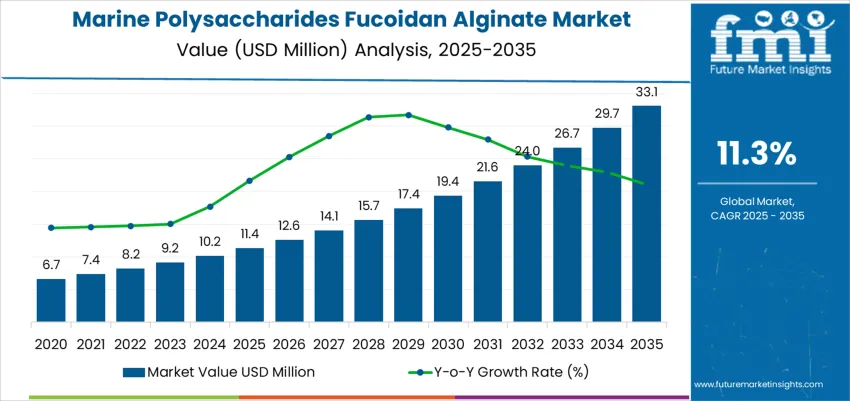
The marine polysaccharides fucoidan alginate market was valued at USD 11.40 million in 2025, projected to reach USD 12.69 million in 2026, and is forecast to expand to USD 37.01 million by 2036 at a 11.3% CAGR. Rising consumer demand for marine-derived bioactive cosmetic ingredients and the expansion of clean beauty formulation platforms are accelerating adoption of fucoidan and alginate extracts across skin care, body care, and dermocosmetic product lines. FMI analysts observe that the documented anti-inflammatory, moisturizing, and antioxidant properties of fucoidan polysaccharides are enabling formulators to position marine-origin actives as premium alternatives to synthetic counterparts in the global personal care ingredients supply chain.
Summary of Marine Polysaccharides Fucoidan Alginate Market
- Market Overview
- The market is valued at USD 11.40 million in 2025 and is projected to reach USD 37.01 million by 2036.
- The industry is expected to grow at a 11.3% CAGR from 2026 to 2036, creating an incremental opportunity of USD 24.32 million.
- The market is a marine bioactive ingredients category where clean beauty formulation trends, seaweed cultivation infrastructure expansion, and documented bioactivity claims define ingredient specification and adoption across premium personal care product lines.
- Demand and Growth Drivers
- Clean beauty formulation trends are driving demand for marine-derived bioactive ingredients as premium, naturally sourced alternatives to synthetic actives in skin care and body care product lines.
- Documented anti-inflammatory, moisturizing, and antioxidant properties of fucoidan polysaccharides are enabling formulators to differentiate premium product positioning with clinically supported marine-origin claims.
- Expanding seaweed cultivation infrastructure in India, China, and Southeast Asia is improving raw material supply reliability and reducing extraction costs for cosmetic-grade fucoidan and alginate.
- Among key countries, India leads at 15.2% CAGR, followed by China at 14.1%, Japan at 13.0%, the UK at 11.9%, Germany at 10.7%, and the USA at 9.6%.
- Product and Segment View
- The market covers bioactive polysaccharide extracts from brown seaweed and marine algae processed into cosmetic-grade powders, liquids, gels, and concentrates for personal care formulation.
- End-use applications span skin care, body care, hair care, sun care, color cosmetics, men's grooming, baby care, and dermocosmetic/professional channels.
- Powder leads by Product Form with 15.7% share in 2026, reflecting stability advantages, formulation ease, and extended shelf life for dry blend incorporation.
- Skin Care leads by End Use Application as formulators integrate fucoidan and alginate into serums, moisturizers, and anti-aging treatments where marine bioactive claims command premium positioning.
- Scope includes all cosmetic-grade fucoidan and alginate extracts and excludes food-grade, pharmaceutical-grade, and industrial alginate applications.
- Geography and Competitive Outlook
- India and China are the fastest-growing markets driven by clean beauty segment expansion and domestic seaweed cultivation infrastructure development.
- Japan maintains a strong position through its established seaweed processing industry, while Europe drives adoption through clean beauty regulatory and consumer trends.
- Competition is shaped by extraction purity, bioactivity documentation, and regulatory compliance across cosmetic ingredient registries, with key players including BASF SE, Croda International, Evonik Industries, Symrise, Dow Inc., Ashland, and Clariant.
- Analyst Opinion at FMI
- Ronak Shah, Principal Consultant for Personal Care Ingredients at Future Market Insights, opines: 'In my analysis, the marine polysaccharides fucoidan alginate market is transitioning from a niche specialty ingredient category to a mainstream formulation platform as clean beauty brands scale their marine-origin product lines. Ingredient suppliers that cannot provide batch-consistent bioactivity documentation and traceability from seaweed source to finished extract will lose specification position as major cosmetic manufacturers tighten supply chain due diligence requirements for natural-origin active claims.'
- Strategic Implications / Executive Takeaways
- Ingredient suppliers must invest in standardized bioactivity testing and batch traceability systems to meet cosmetic manufacturer due diligence requirements for natural-origin active ingredient claims.
- Personal care brand formulation teams should evaluate fucoidan alginate as a multifunctional active platform that delivers anti-inflammatory, film-forming, and moisturizing properties within a single marine-origin ingredient, simplifying formulation complexity.
- Seaweed cultivation companies in India and Southeast Asia should develop cosmetic-grade extraction partnerships with global ingredient distributors to capture the growing demand for traceable marine polysaccharide supply.
Marine Polysaccharides Fucoidan Alginate Market Key Takeaways
| Metric | Details |
|---|---|
| Industry Size (2026) | USD 12.69 million |
| Industry Value (2036) | USD 37.01 million |
| CAGR (2026-2036) | 11.3% |
Source: Future Market Insights, 2026
Powder form leads the product format mix, reflecting its stability, ease of incorporation into dry blend formulations, and extended shelf life compared to liquid alternatives. Skin care applications represent the primary demand driver as formulators integrate fucoidan and alginate fractions into serums, moisturizers, and anti-aging treatments where marine bioactive claims command premium shelf positioning. The dermocosmetic and professional care channel is emerging as a high-growth niche, driven by dermatologist-recommended formulations that leverage alginate film-forming properties for post-procedure skin recovery and fucoidan anti-inflammatory benefits for sensitive skin protocols.
India leads with a 15.2% CAGR, driven by the rapid expansion of the domestic clean beauty segment and growing domestic seaweed cultivation infrastructure. China follows at 14.1%, supported by a large cosmetics manufacturing base and increasing formulator access to marine bioactive ingredient suppliers. Japan registers 13.0% growth, reflecting its established seaweed processing industry and consumer familiarity with marine-origin cosmetic actives. The United Kingdom tracks at 11.9%, Germany at 10.7% reflecting European clean beauty trend adoption, and the United States at 9.6% supported by premium skin care brand reformulation activity.
Marine Polysaccharides Fucoidan Alginate Market Definition
Marine polysaccharides fucoidan alginate encompasses bioactive polysaccharide extracts derived from brown seaweed and marine algae sources, processed into cosmetic-grade raw materials for personal care formulation. Core product forms include powders, granules, liquids, concentrates, gels, and dispersions used as functional actives, film-formers, and texture modifiers in skin care, body care, hair care, sun care, and dermocosmetic applications.
Marine Polysaccharides Fucoidan Alginate Market Inclusions
Market scope covers fucoidan and alginate polysaccharide extracts in powder, granule, flake, liquid, concentrate, gel, and oil product forms for personal care and cosmetic applications. End-use coverage spans skin care, body care, hair care, sun care, color cosmetics, men's grooming, baby and kids care, and dermocosmetic/professional care. Regional and country-level market sizes for 2026 to 2036 are included.
Marine Polysaccharides Fucoidan Alginate Market Exclusions
The scope excludes food-grade alginate used in food processing, pharmaceutical-grade fucoidan for drug delivery applications, and industrial alginate for textile printing. Marine collagen, chitosan, and non-polysaccharide marine extracts are also excluded.
Marine Polysaccharides Fucoidan Alginate Market Research Methodology
- Primary Research: Analysts engaged with procurement managers, operations engineers, and industry supply chain directors to identify the decision triggers, specification requirements, and budget allocation patterns governing equipment and technology upgrades.
- Desk Research: Data collection aggregated publicly available regulatory filings, government procurement records, trade association publications, and company annual reports and investor presentations.
- Market-Sizing and Forecasting: Baseline values derive from a bottom-up aggregation of product-level shipment volumes and average selling prices, applying region-specific adoption curves to project demand through the forecast period.
- Data Validation and Update Cycle: Projections are cross-validated against publicly reported company revenue guidance, government statistical agency databases, and trade body shipment records.
How Is the Marine Polysaccharides Fucoidan and Alginate Market Developing Across Food, Pharma, and Industrial Uses?
The marine polysaccharides market centered on fucoidan and alginate developed from long standing use of brown seaweeds in food processing and industrial thickening applications. Alginate gained early acceptance as a stabilizer, gelling agent, and viscosity modifier in food, textile printing, and pharmaceutical formulations due to its strong binding and film forming behavior. Fucoidan followed a different trajectory, moving from traditional dietary use into extracts positioned for immune modulation and cellular protection. As extraction and purification methods improved, both compounds transitioned from bulk commodity hydrocolloids into higher value functional ingredients. Adoption expanded across processed foods, wound dressings, controlled drug release systems, and diagnostic applications.
Future growth of the marine polysaccharides market will be shaped by rising demand for natural functional ingredients, biocompatible materials, and plant sourced alternatives to synthetic polymers. Fucoidan demand will expand within supplements, medical nutrition, and therapeutic research where immune and cellular interaction properties are under evaluation. Alginate demand will increase in food reformulation, pharmaceutical encapsulation, and biodegradable packaging films. Barriers include sensitivity of seaweed supply to climate variability, harvesting pressure on coastal ecosystems, and the high cost of refined extraction for medical grade applications. Regulatory requirements around purity, heavy metal limits, and biological safety will also influence adoption. Long term market expansion will depend on sustainable cultivation, supply chain stability, and consistent functional performance across industrial and clinical uses.
How Are End Use Application and Product Form Structuring the Demand for Marine Polysaccharides Fucoidan and Alginate?
The demand for marine polysaccharides such as fucoidan and alginate is structured by end use application and product form. Skin care represents 8.7% of total demand, followed by body care, hair care, sun care, color cosmetics, men grooming, baby and kids care, and dermocosmetic and professional care. By product form, powder accounts for 15.7% of total consumption, followed by granules and agglomerates, flakes, pellets and prills, liquid solutions, high active concentrates, dispersions and suspensions, emulsions, pastes, gels, wax or solid block formats, and oils. Demand behavior is shaped by gelling performance, moisture binding capacity, film forming behavior, and compatibility with topical delivery systems.
Why Does Skin Care Lead the Marine Polysaccharides End Use Demand?
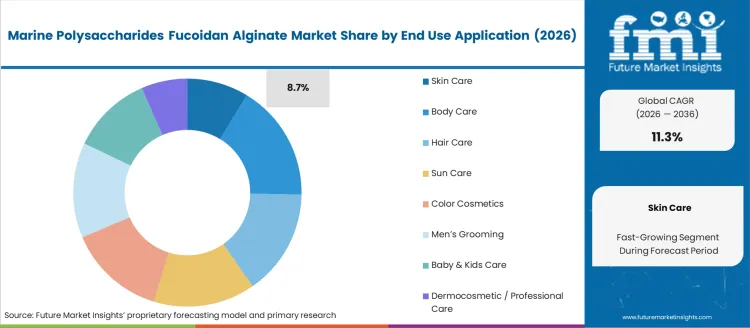
Skin care accounts for 8.7% of total fucoidan and alginate demand due to their strong functional performance in hydration control, barrier reinforcement, and soothing applications. Alginate forms breathable, moisture retaining films on the skin surface, which supports its use in sheet masks, peel off masks, and occlusive moisturizers. Fucoidan contributes anti-inflammatory and antioxidant activity that supports redness control and environmental stress protection in daily skin care products.
These polysaccharides are widely used in post procedure soothing gels, hydration boosting serums, and repair oriented creams where water retention and calm skin response are required. Their non-irritating profile supports application in sensitive skin and recovery focused formulations. Their ability to improve product texture without synthetic thickeners also strengthens formulation value. These hydration performance, skin barrier support, and texture enhancement functions sustain skin care as the leading end use segment within marine polysaccharides demand.
Why Does Powder Lead the Marine Polysaccharides Product Form Demand?
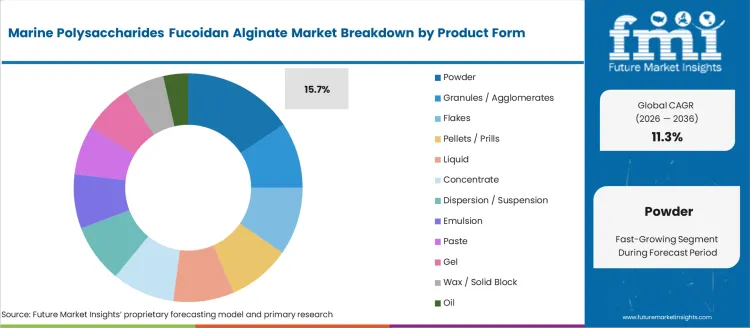
Powder accounts for 15.7% of total marine polysaccharides demand due to its high structural stability, controlled hydration behavior, and ease of concentration standardization. Powdered fucoidan and alginate allow precise control of viscosity and film strength during formulation, which is critical for masks, gels, and thickened emulsions. Low moisture content reduces premature swelling and microbial risk during storage and long distance transport.
Powder form also supports efficient dispersion under controlled mixing conditions, allowing manufacturers to activate gelling behavior only at the intended processing stage. This improves batch consistency across repeated production runs. Packaging in moisture barrier sacks and lined drums preserves polymer chain integrity and prevents humidity induced degradation. These formulation control, storage reliability, and processing predictability advantages position powder as the leading product form within marine polysaccharides fucoidan and alginate demand.
Why Are Fucoidan and Alginate Treated as Bio-Functional Polymers Rather Than Simple Seaweed Derivatives?
Global demand for fucoidan and alginate is driven by their structural and biological activity rather than by their marine origin. Fucoidan is valued for immune modulation, cell signaling interaction, and anticoagulant behavior at the molecular level. Alginate functions as a high-performance gelling and stabilization polymer with precise viscosity control. These compounds serve as biological response modifiers and physical structuring agents rather than as generic plant fibers. Their value lies in how they influence tissue response, drug release, and texture engineering across medical, pharmaceutical, and industrial systems.
How Do Brown Seaweed Species Dependence and Coastal Processing Shape Supply Stability?
Supply of fucoidan and alginate depends heavily on brown seaweed species such as kelp harvested from cold, nutrient-rich coastlines. Seasonal growth cycles, water temperature shifts, and storm activity directly affect biomass availability. Immediate coastal processing is required to prevent enzymatic breakdown of polysaccharides after harvest. Transporting wet biomass inland adds cost and degradation risk. These geographic and biological dependencies mean capacity expands through access to new coastlines and processing infrastructure rather than through conventional agricultural scaling models.
What Molecular Variability and Purification Demands Limit Interchangeability?
Fucoidan and alginate exhibit wide molecular variability based on species, harvest timing, and extraction conditions. Sulfation patterns in fucoidan influence biological response strength, while alginate viscosity and gel strength depend on precise mannuronic and guluronic acid ratios. This variability prevents generic substitution between suppliers without formulation redesign. High-purity grades require solvent control, heavy metal removal, and molecular weight fractionation. These purification requirements raise production cost and limit rapid supplier switching in pharmaceuticals, wound care, and controlled-release drug systems.
How Are Drug Delivery, Regenerative Medicine, and Active Packaging Reshaping Future Demand?
Future demand for marine polysaccharides is shifting toward advanced medical and material science applications. Fucoidan is being integrated into oncology-support formulations, antiviral research, and tissue signaling platforms. Alginate is widely used in wound dressings, cell encapsulation, and 3D bioprinting scaffolds. In packaging, alginate films support oxygen control and moisture regulation. These growth directions move marine polysaccharides beyond nutrition into structural biomedical and smart-material systems where biological interaction and controlled permeability define purchasing logic.
What Is the Global Growth Outlook for the Marine Polysaccharides Fucoidan and Alginate Industry by Country?
.webp "Top Country Growth Comparison Marine Polysaccharides Fucoidan Alginate Market Cagr (2026 2036)")
| Country | CAGR (%) |
|---|---|
| India | 15.2% |
| China | 14.1% |
| Japan | 13% |
| UK | 11.9% |
| Germany | 10.7% |
| USA | 9.6% |
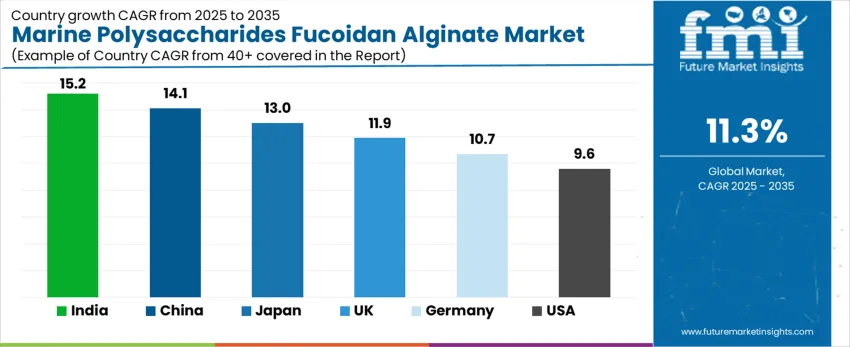
The marine polysaccharides fucoidan and alginate industry is showing strong global expansion across both Asian and Western markets, led by India at a 15.2% CAGR. Growth in India is supported by rising use of marine derived polysaccharides in nutraceuticals, functional foods, wound care products, and pharmaceutical formulations. China follows at 14.1%, driven by large scale seaweed processing capacity, expanding extraction infrastructure, and strong domestic demand from food, textile, and healthcare industries. Japan at 13% reflects stable demand rooted in long standing seaweed utilization and growing application in medical nutrition and cosmetics. The UK and Germany record 11.9% and 10.7% growth, supported by clean label food trends and biomedical research usage. The USA at 9.6% reflects a mature but steadily expanding market driven by supplements, drug delivery research, and functional ingredient adoption.
What Is Powering Strong Marine Polysaccharide Growth in India?
Expansion in India is progressing at a CAGR of 15.2% through 2035 for marine polysaccharides fucoidan and alginate demand, driven by rising nutraceutical production, pharmaceutical excipient usage, and clean label food thickening applications. Fucoidan gains traction in immunity supplements and oncology supportive nutrition, while alginate is used widely in food stabilization and tablet binding. Imports dominate supply due to limited domestic marine biopolymer extraction. Demand remains formulation led and health focused, shaped by strong supplement brand growth, expanding drug manufacturing capacity, and steady penetration of marine based hydrocolloids across food and healthcare processing.
- Immunity and oncology nutrition drive fucoidan demand
- Food stabilization supports steady alginate consumption
- Import based sourcing dominates raw material supply
- Pharmaceutical excipients strengthen volume stability
How Is China Scaling Industrial Marine Polysaccharide Processing?
Growth in China reflects a CAGR of 14.1% through 2035 for marine polysaccharides fucoidan and alginate utilization, supported by large scale seaweed farming, biopolymer extraction plants, and integrated food and pharma manufacturing. Alginate is widely applied in processed foods, wound dressings, and drug delivery systems. Fucoidan serves nutraceutical and cosmetic active markets. Domestic harvesting provides cost control and high supply reliability. Export oriented processors also serve global pharmaceutical and food ingredient buyers. Demand remains production driven and volume oriented, aligned with bioprocessing scale, export throughput, and steady expansion of marine polymers across regulated industries.
- Seaweed farming stabilizes bulk extraction volumes
- Medical wound care boosts alginate usage
- Cosmetic actives add steady fucoidan demand
- Export processing strengthens international offtake
Why Does Japan Remain a High Value Market for Fucoidan and Alginate?
Demand in Japan is increasing at a CAGR of 13% through 2035 for marine polysaccharides fucoidan and alginate usage, sustained by advanced medical nutrition, pharmaceutical formulation, and functional food innovation. Fucoidan is used in immune modulation products, elderly care nutrition, and clinical supplements. Alginate supports controlled drug release systems and medical dressings. Domestic marine harvesting and high purity refining maintain strong quality standards. Demand stays innovation driven and medically anchored, supported by aging population needs, strong clinical adoption, and long standing trust in marine derived therapeutic compounds.
- Immunity and elderly nutrition anchor fucoidan demand
- Controlled release drugs sustain alginate consumption
- Domestic refining stabilizes medical grade quality
- Clinical adoption supports premium pricing structures
What Is Supporting Marine Polysaccharide Market Expansion in the United Kingdom?
Growth in the UK is advancing at a CAGR of 11.9% through 2035 for marine polysaccharides fucoidan and alginate demand, supported by pharmaceutical R and D, vegan food formulation, and premium nutraceutical development. Alginate is used in dairy alternatives, gel based desserts, and drug encapsulation. Fucoidan appears in immune and joint health supplements. Specialty ingredient distributors expand national access. Imports dominate supply. Demand remains research driven and application focused, shaped by steady pharmaceutical innovation, plant based food expansion, and rising consumer preference for marine sourced functional ingredients.
- Drug encapsulation drives pharmaceutical alginate demand
- Vegan food formulation supports stabilizer usage
- Immune supplements sustain fucoidan uptake
- Import reliance dominates ingredient procurement
How Is Germany Integrating Marine Polysaccharides into Regulated Medical and Food Systems?
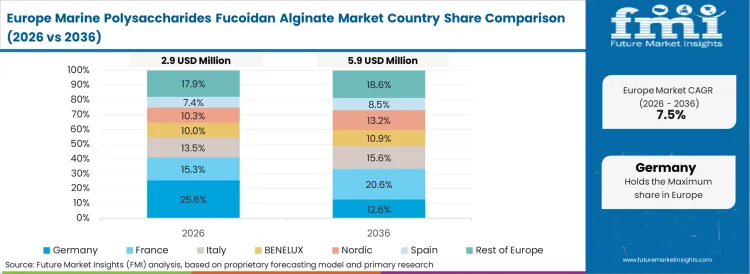
Growth in Germany reflects a CAGR of 10.7% through 2035 for marine polysaccharides fucoidan and alginate consumption, driven by regulated pharmaceutical production, certified medical dressings, and functional food manufacturing. Alginate supports wound management, dental impressions, and controlled drug delivery. Fucoidan is applied in immune support supplements and clinical nutrition blends. Strict regulatory controls govern sourcing and processing standards. Imports remain the primary supply route. Demand stays quality focused and regulation aligned, supported by strong medical device manufacturing, preventive health traditions, and stable hospital procurement of marine based biomaterials.
- Medical dressings anchor clinical alginate demand
- Dental and drug delivery applications expand usage
- Immune supplements support fucoidan consumption
- Regulatory controls shape supplier qualification
What Is Driving Measured Marine Polysaccharide Growth in the United States?
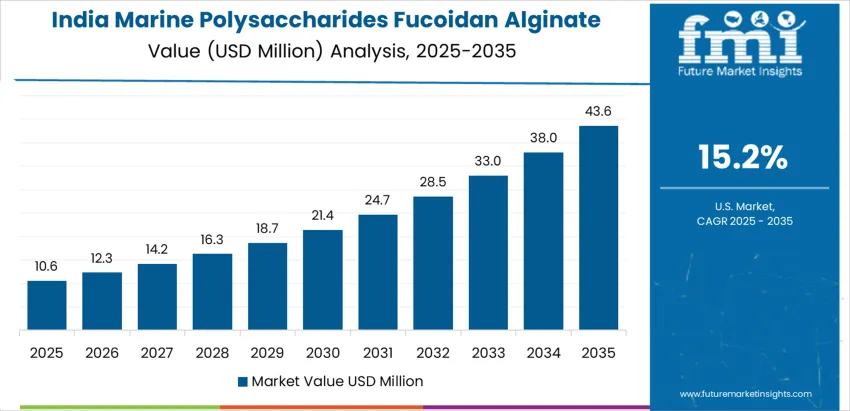
Expansion in the United States is moving at a CAGR of 9.6% through 2035 for marine polysaccharides fucoidan and alginate demand, supported by pharmaceutical formulation, biomedical engineering, and clean label food innovation. Alginate is used in wound care, controlled release drugs, and texture modification in processed foods. Fucoidan appears in immune supplements and anti-inflammatory wellness products. Coastal biotechnology clusters lead early adoption. Imports supply most raw material. Demand remains innovation driven and application diverse, shaped by strong biopharma activity, steady medical device development, and expanding use of marine polymers across food and healthcare systems.
- Wound care and drug delivery support alginate demand
- Immune and anti-inflammatory products drive fucoidan usage
- Biotech clusters lead early technical adoption
- Import based sourcing dominates national supply structure
What Is Driving the Global Demand for Marine Polysaccharides (Fucoidan / Alginate) and Who Are the Key Suppliers Shaping the Market?
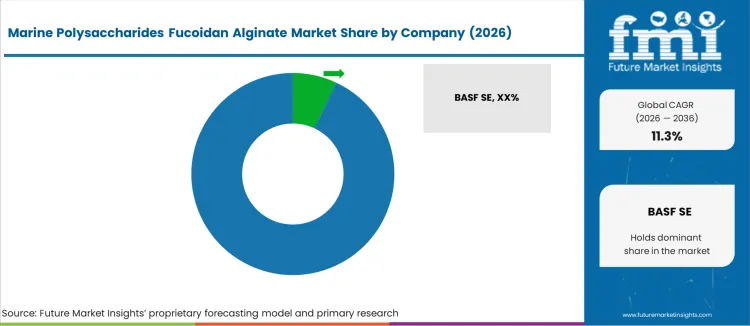
Global demand for marine polysaccharides such as fucoidan and alginate is rising as industries increasingly favor natural, bio-derived materials with functional properties in food, nutraceuticals, cosmetics, pharmaceuticals, and industrial applications. These polysaccharides deliver multiple benefits: fucoidan shows antioxidant, anti-inflammatory, immune-modulating, and potentially antiviral properties; alginate works as a versatile hydrocolloid offering gelling, stabilizing, thickening, and controlled-release characteristics. Their biocompatibility, biodegradability, and derivation from sustainable seaweed sources make them attractive to manufacturers seeking “clean label” and environmentally conscious ingredients. Growing interest in gut health, preventive nutrition, natural cosmetics, and sustainable biomaterials sustains the shift from synthetic to marine-based polysaccharides.
Major ingredient and specialty-chemicals firms that supply marine polysaccharides at global scale include BASF SE, Croda International, Evonik Industries, Symrise (including IFF/Givaudan actives), Dow / Dow Inc., Ashland, Clariant, and a cohort of smaller or niche providers such as Seppic, Lubrizol, Lonza and Inolex. These companies offer raw biomass, purified extracts, standardized polysaccharide powders, and formulation-ready ingredients suited to diverse end uses. Large suppliers support high-volume demand for food, beverage, and industrial clients. Mid- and small-scale ingredient specialists provide high-purity, application-tailored variants for nutraceutical, cosmetic, or pharmaceutical applications. This multi-tier supply base ensures flexibility, quality control, and availability, enabling broad adoption of marine polysaccharides worldwide.
Key Players in the Marine Polysaccharides Fucoidan Alginate Market
- BASF SE
- Croda International
- Evonik Industries
- Symrise (incl. IFF/Givaudan actives)
- Dow / Dow Inc.
- Ashland
- Clariant
- Seppic
- Others
Scope of the Report
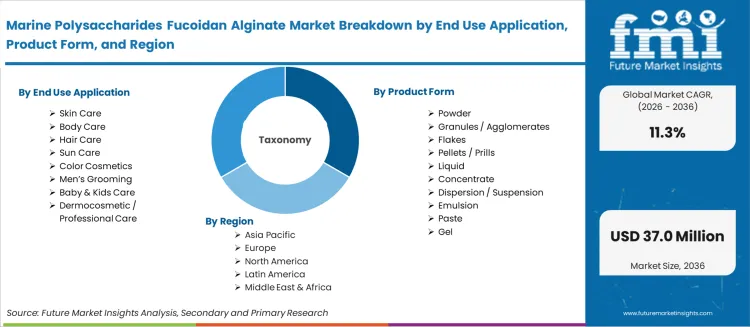
| Metric | Value |
|---|---|
| Quantitative Units | USD 12.69 million to USD 37.01 million, at a CAGR of 11.3% |
| Market Definition | Marine polysaccharides fucoidan alginate encompasses bioactive polysaccharide extracts derived from brown seaweed and marine algae sources, processed into cosmetic-grade raw materials for personal car... |
| Segmentation | End Use Application: Skin Care, Body Care, Hair Care, Sun Care, Color Cosmetics, Men's Grooming, Baby & Kids Care, Dermocosmetic / Professional Care; Product Form: Powder, Granules / Agglomerates, Flakes, Liquid, Concentrate, Gel, Oil |
| Regions Covered | North America, Latin America, Europe, East Asia, South Asia, Oceania, Middle East & Africa |
| Countries Covered | India, China, Japan, UK, Germany, USA, and 40 plus countries |
| Key Companies Profiled | BASF SE, Croda International, Evonik Industries, Symrise, Dow Inc., Ashland, Clariant, Seppic |
| Forecast Period | 2026 to 2036 |
| Approach | Forecasting models apply a bottom-up methodology starting with global installed base metrics and product-level demand curves, cross-validated against publicly reported revenue and trade data. |
Marine Polysaccharides Fucoidan Alginate Market Segmentation
End Use Application:
- Skin Care
- Body Care
- Hair Care
- Sun Care
- Color Cosmetics
- Men’s Grooming
- Baby & Kids Care
- Dermocosmetic / Professional Care
Product Form:
- Powder
- Granules / Agglomerates
- Flakes
- Pellets / Prills
- Liquid (Solution)
- Concentrate (High-active Liquid)
- Dispersion / Suspension
- Emulsion
- Paste
- Gel
- Wax / Solid Block
- Oil
Region
- Asia Pacific
- China
- Japan
- South Korea
- India
- Australia & New Zealand
- ASEAN
- Rest of Asia Pacific
- Europe
- Germany
- United Kingdom
- France
- Italy
- Spain
- Nordic
- BENELUX
- Rest of Europe
- North America
- United States
- Canada
- Mexico
- Latin America
- Brazil
- Chile
- Rest of Latin America
- Middle East & Africa
- Kingdom of Saudi Arabia
- Other GCC Countries
- Turkey
- South Africa
- Other African Union
- Rest of Middle East & Africa
Bibliography
- International Organization for Standardization. (2024). ISO 16128: Cosmetic Ingredients and Products, Natural and Organic Content Definition. ISO.
- European Commission. (2024). Cosmetic Products Regulation (EC) No 1223/2009: Ingredient Safety Assessment Updates. European Commission.
- Food and Agriculture Organization of the United Nations. (2024). Global Seaweed Production and Aquaculture Report. FAO.
- Personal Care Products Council. (2024). International Cosmetic Ingredient Dictionary and Handbook: Marine-Derived Ingredients. PCPC.
- Society of Cosmetic Chemists. (2024). Journal of Cosmetic Science: Marine Polysaccharides in Skin Care Formulation. SCC.
- Organisation for Economic Co-operation and Development. (2024). Biotechnology and the Bioeconomy: Marine Bioresource Applications. OECD.
This bibliography is provided for reader reference. The full Future Market Insights report contains the complete reference list with primary research documentation.
Frequently Asked Questions
How large is the demand for Marine Polysaccharides Fucoidan Alginate in the global market in 2026?
Demand is estimated to be valued at USD 12.69 million in 2026.
What will be the market size by 2036?
Market size is projected to reach USD 37.01 million by 2036.
What is the expected demand growth between 2026 and 2036?
Demand is expected to grow at a CAGR of 11.3% between 2026 and 2036.
Which Product Form is poised to lead by 2026?
Powder leads with 15.7% share in 2026, reflecting stability, formulation ease, and extended shelf life for cosmetic dry blend incorporation.
What is driving demand in India?
Rapid expansion of the domestic clean beauty segment and growing seaweed cultivation infrastructure sustain procurement growth.
What is China's growth outlook in this report?
China is projected to grow at a CAGR of 14.1% during 2026 to 2036.
What is Japan's growth outlook in this report?
Japan is projected to grow at a CAGR of 13.0% during 2026 to 2036.
Preview the report firsthand - request a free sample
Get SampleGet the brochure for pricing and purchase details.
Get PDFTable of Content
- Executive Summary
- Global Market Outlook
- Demand-side Trends
- Supply-side Trends
- Technology Roadmap Analysis
- Analysis and Recommendations
- Market Overview
- Market Coverage / Taxonomy
- Market Definition / Scope / Limitations
- Research Methodology
- Chapter Orientation
- Analytical Lens and Working Hypotheses
- Market Structure, Signals, and Trend Drivers
- Benchmarking and Cross-market Comparability
- Market Sizing, Forecasting, and Opportunity Mapping
- Research Design and Evidence Framework
- Desk Research Programme (Secondary Evidence)
- Company Annual and Sustainability Reports
- Peer-reviewed Journals and Academic Literature
- Corporate Websites, Product Literature, and Technical Notes
- Earnings Decks and Investor Briefings
- Statutory Filings and Regulatory Disclosures
- Technical White Papers and Standards Notes
- Sector Databases and Reference Repositories
- FMI Internal Proprietary Databases and Historical Market Datasets
- Subscription Datasets and Paid Sources
- Social Channels, Communities, and Digital Listening Inputs
- Additional Desk Sources
- Expert Input and Fieldwork (Primary Evidence)
- Primary Modes
- Qualitative Interviews and Expert Elicitation
- Quantitative Surveys and Structured Data Capture
- Blended Approach
- Why Primary Evidence is Used
- Field Techniques
- Interviews
- Surveys
- Focus Groups
- Observational and In-context Research
- Social and Community Interactions
- Stakeholder Universe Engaged
- C-suite Leaders
- Board Members
- Presidents and Vice Presidents
- R&D and Innovation Heads
- Technical Specialists
- Domain Subject-matter Experts
- Scientists
- Physicians and Other Healthcare Professionals
- Governance, Ethics, and Data Stewardship
- Research Ethics
- Data Integrity and Handling
- Primary Modes
- Tooling, Models, and Reference Databases
- Desk Research Programme (Secondary Evidence)
- Data Engineering and Model Build
- Data Acquisition and Ingestion
- Cleaning, Normalisation, and Verification
- Synthesis, Triangulation, and Analysis
- Quality Assurance and Audit Trail
- Market Background
- Market Dynamics
- Drivers
- Restraints
- Opportunity
- Trends
- Scenario Forecast
- Demand in Optimistic Scenario
- Demand in Likely Scenario
- Demand in Conservative Scenario
- Opportunity Map Analysis
- Product Life Cycle Analysis
- Supply Chain Analysis
- Investment Feasibility Matrix
- Value Chain Analysis
- PESTLE and Porter’s Analysis
- Regulatory Landscape
- Regional Parent Market Outlook
- Production and Consumption Statistics
- Import and Export Statistics
- Market Dynamics
- Global Market Analysis 2021 to 2025 and Forecast, 2026 to 2036
- Historical Market Size Value (USD Million) Analysis, 2021 to 2025
- Current and Future Market Size Value (USD Million) Projections, 2026 to 2036
- Y-o-Y Growth Trend Analysis
- Absolute $ Opportunity Analysis
- Global Market Pricing Analysis 2021 to 2025 and Forecast 2026 to 2036
- Global Market Analysis 2021 to 2025 and Forecast 2026 to 2036, By End Use Application
- Introduction / Key Findings
- Historical Market Size Value (USD Million) Analysis By End Use Application , 2021 to 2025
- Current and Future Market Size Value (USD Million) Analysis and Forecast By End Use Application , 2026 to 2036
- Skin Care
- Body Care
- Hair Care
- Sun Care
- Color Cosmetics
- Men’s Grooming
- Baby & Kids Care
- Dermocosmetic / Professional Care
- Skin Care
- Y-o-Y Growth Trend Analysis By End Use Application , 2021 to 2025
- Absolute $ Opportunity Analysis By End Use Application , 2026 to 2036
- Global Market Analysis 2021 to 2025 and Forecast 2026 to 2036, By Product Form
- Introduction / Key Findings
- Historical Market Size Value (USD Million) Analysis By Product Form, 2021 to 2025
- Current and Future Market Size Value (USD Million) Analysis and Forecast By Product Form, 2026 to 2036
- Powder
- Granules / Agglomerates
- Flakes
- Pellets / Prills
- Liquid
- Concentrate
- Dispersion / Suspension
- Emulsion
- Paste
- Gel
- Wax / Solid Block
- Powder
- Y-o-Y Growth Trend Analysis By Product Form, 2021 to 2025
- Absolute $ Opportunity Analysis By Product Form, 2026 to 2036
- Global Market Analysis 2021 to 2025 and Forecast 2026 to 2036, By Region
- Introduction
- Historical Market Size Value (USD Million) Analysis By Region, 2021 to 2025
- Current Market Size Value (USD Million) Analysis and Forecast By Region, 2026 to 2036
- North America
- Latin America
- Western Europe
- Eastern Europe
- East Asia
- South Asia and Pacific
- Middle East & Africa
- Market Attractiveness Analysis By Region
- North America Market Analysis 2021 to 2025 and Forecast 2026 to 2036, By Country
- Historical Market Size Value (USD Million) Trend Analysis By Market Taxonomy, 2021 to 2025
- Market Size Value (USD Million) Forecast By Market Taxonomy, 2026 to 2036
- By Country
- USA
- Canada
- Mexico
- By End Use Application
- By Product Form
- By Country
- Market Attractiveness Analysis
- By Country
- By End Use Application
- By Product Form
- Key Takeaways
- Latin America Market Analysis 2021 to 2025 and Forecast 2026 to 2036, By Country
- Historical Market Size Value (USD Million) Trend Analysis By Market Taxonomy, 2021 to 2025
- Market Size Value (USD Million) Forecast By Market Taxonomy, 2026 to 2036
- By Country
- Brazil
- Chile
- Rest of Latin America
- By End Use Application
- By Product Form
- By Country
- Market Attractiveness Analysis
- By Country
- By End Use Application
- By Product Form
- Key Takeaways
- Western Europe Market Analysis 2021 to 2025 and Forecast 2026 to 2036, By Country
- Historical Market Size Value (USD Million) Trend Analysis By Market Taxonomy, 2021 to 2025
- Market Size Value (USD Million) Forecast By Market Taxonomy, 2026 to 2036
- By Country
- Germany
- UK
- Italy
- Spain
- France
- Nordic
- BENELUX
- Rest of Western Europe
- By End Use Application
- By Product Form
- By Country
- Market Attractiveness Analysis
- By Country
- By End Use Application
- By Product Form
- Key Takeaways
- Eastern Europe Market Analysis 2021 to 2025 and Forecast 2026 to 2036, By Country
- Historical Market Size Value (USD Million) Trend Analysis By Market Taxonomy, 2021 to 2025
- Market Size Value (USD Million) Forecast By Market Taxonomy, 2026 to 2036
- By Country
- Russia
- Poland
- Hungary
- Balkan & Baltic
- Rest of Eastern Europe
- By End Use Application
- By Product Form
- By Country
- Market Attractiveness Analysis
- By Country
- By End Use Application
- By Product Form
- Key Takeaways
- East Asia Market Analysis 2021 to 2025 and Forecast 2026 to 2036, By Country
- Historical Market Size Value (USD Million) Trend Analysis By Market Taxonomy, 2021 to 2025
- Market Size Value (USD Million) Forecast By Market Taxonomy, 2026 to 2036
- By Country
- China
- Japan
- South Korea
- By End Use Application
- By Product Form
- By Country
- Market Attractiveness Analysis
- By Country
- By End Use Application
- By Product Form
- Key Takeaways
- South Asia and Pacific Market Analysis 2021 to 2025 and Forecast 2026 to 2036, By Country
- Historical Market Size Value (USD Million) Trend Analysis By Market Taxonomy, 2021 to 2025
- Market Size Value (USD Million) Forecast By Market Taxonomy, 2026 to 2036
- By Country
- India
- ASEAN
- Australia & New Zealand
- Rest of South Asia and Pacific
- By End Use Application
- By Product Form
- By Country
- Market Attractiveness Analysis
- By Country
- By End Use Application
- By Product Form
- Key Takeaways
- Middle East & Africa Market Analysis 2021 to 2025 and Forecast 2026 to 2036, By Country
- Historical Market Size Value (USD Million) Trend Analysis By Market Taxonomy, 2021 to 2025
- Market Size Value (USD Million) Forecast By Market Taxonomy, 2026 to 2036
- By Country
- Kingdom of Saudi Arabia
- Other GCC Countries
- Turkiye
- South Africa
- Other African Union
- Rest of Middle East & Africa
- By End Use Application
- By Product Form
- By Country
- Market Attractiveness Analysis
- By Country
- By End Use Application
- By Product Form
- Key Takeaways
- Key Countries Market Analysis
- USA
- Pricing Analysis
- Market Share Analysis, 2025
- By End Use Application
- By Product Form
- Canada
- Pricing Analysis
- Market Share Analysis, 2025
- By End Use Application
- By Product Form
- Mexico
- Pricing Analysis
- Market Share Analysis, 2025
- By End Use Application
- By Product Form
- Brazil
- Pricing Analysis
- Market Share Analysis, 2025
- By End Use Application
- By Product Form
- Chile
- Pricing Analysis
- Market Share Analysis, 2025
- By End Use Application
- By Product Form
- Germany
- Pricing Analysis
- Market Share Analysis, 2025
- By End Use Application
- By Product Form
- UK
- Pricing Analysis
- Market Share Analysis, 2025
- By End Use Application
- By Product Form
- Italy
- Pricing Analysis
- Market Share Analysis, 2025
- By End Use Application
- By Product Form
- Spain
- Pricing Analysis
- Market Share Analysis, 2025
- By End Use Application
- By Product Form
- France
- Pricing Analysis
- Market Share Analysis, 2025
- By End Use Application
- By Product Form
- India
- Pricing Analysis
- Market Share Analysis, 2025
- By End Use Application
- By Product Form
- ASEAN
- Pricing Analysis
- Market Share Analysis, 2025
- By End Use Application
- By Product Form
- Australia & New Zealand
- Pricing Analysis
- Market Share Analysis, 2025
- By End Use Application
- By Product Form
- China
- Pricing Analysis
- Market Share Analysis, 2025
- By End Use Application
- By Product Form
- Japan
- Pricing Analysis
- Market Share Analysis, 2025
- By End Use Application
- By Product Form
- South Korea
- Pricing Analysis
- Market Share Analysis, 2025
- By End Use Application
- By Product Form
- Russia
- Pricing Analysis
- Market Share Analysis, 2025
- By End Use Application
- By Product Form
- Poland
- Pricing Analysis
- Market Share Analysis, 2025
- By End Use Application
- By Product Form
- Hungary
- Pricing Analysis
- Market Share Analysis, 2025
- By End Use Application
- By Product Form
- Kingdom of Saudi Arabia
- Pricing Analysis
- Market Share Analysis, 2025
- By End Use Application
- By Product Form
- Turkiye
- Pricing Analysis
- Market Share Analysis, 2025
- By End Use Application
- By Product Form
- South Africa
- Pricing Analysis
- Market Share Analysis, 2025
- By End Use Application
- By Product Form
- USA
- Market Structure Analysis
- Competition Dashboard
- Competition Benchmarking
- Market Share Analysis of Top Players
- By Regional
- By End Use Application
- By Product Form
- Competition Analysis
- Competition Deep Dive
- BASF SE
- Overview
- Product Portfolio
- Profitability by Market Segments (Product/Age /Sales Channel/Region)
- Sales Footprint
- Strategy Overview
- Marketing Strategy
- Product Strategy
- Channel Strategy
- Croda International
- Evonik Industries
- Symrise (incl. IFF/Givaudan actives)
- Dow / Dow Inc.
- Ashland
- Clariant
- Seppic
- Others
- BASF SE
- Competition Deep Dive
- Assumptions & Acronyms Used


