

- Industry Size (2026)
- USD 417.0 Mn
- Forecast (2036)
- USD 753.8 Mn
- CAGR (2026 to 2036)
- 6.1%
Fucoidan Extract Market Size, Market Forecast and Outlook By FMI
In 2025, the fucoidan extract market was valued at USD 392.9 million. Based on Future Market Insights' analysis, demand for fucoidan extract is estimated to grow to USD 417.0 million in 2026 and USD 753.8 million by 2036. FMI projects a CAGR of 6.1% during the forecast period.
Absolute dollar growth of USD 336.8 million over the decade reflects a market where simultaneous clinical evidence generation across sarcopenia, immune health, and cosmetic anti-aging applications is creating compounding demand across channels with distinct buyer profiles and pricing structures. In February 2026, Givaudan announced that its Active Beauty business unit achieved double-digit growth throughout 2025, driven by surging demand for natural high-performance cosmetic ingredients including Maritech organic fucoidan, which is increasingly utilised in clean-label anti-aging and skin-repair formulations, a performance disclosure that confirms fucoidan's transition from specialty nutraceutical ingredient to premium cosmetic active with mainstream personal care channel demand. [1]
Summary of Fucoidan Extract Market
- Fucoidan Extract Market Definition
- The market covers globally traded sulfated polysaccharide compounds extracted from brown seaweed species including Mozuku, Wakame, and Kombu in powder and liquid formats, used across food and beverage, pharmaceutical, dietary supplement, cosmetic, veterinary, and fertilizer applications.
- Demand Drivers in the Market
- Givaudan Active Beauty's double-digit 2025 growth driven by Maritech organic fucoidan demand confirms the ingredient's transition into mainstream premium cosmetic active territory, with anti-aging and skin-repair formulations generating sustained commercial scale.
- Hi-Q Marine Biotech International's published clinical evidence demonstrating low-molecular-weight Oligo-Fucoidan improvement in muscle strength and physical performance in older adults confirms a clinically substantiated sarcopenia application with significant pharmaceutical and functional nutrition channel volume potential.
- Sanzyme Biologics' January 2026 clinical trial investigating synergistic effects of fucoidan and probiotic strains on pediatric immune resilience signals institutional investment in combination bioactive clinical evidence that could unlock new dosage form and channel positioning.
- Key Segments Analyzed in the FMI Report
- Form: Powder leads at 58.0% share, preferred for dietary supplement and cosmetic formulation applications where precise dosage, shelf stability, and formulation flexibility are required.
- Seaweed Type: Mozuku accounts for 40.0% of seaweed type share, reflecting Japan's dominant Mozuku cultivation infrastructure and the well-documented bioactivity profile of Cladosiphon okamuranus-derived fucoidan.
- End Use: Food and Beverages captures 30.0% of demand as the leading segment, driven by functional food and nutraceutical beverage formulation applications in Japanese and Asian markets.
- Analyst Opinion at FMI
- Nandini Roy Choudhury, Principal Consultant for Food & Beverage Industry at Future Market Insights, opines, "In the updated version of the Fucoidan Extract Market Report for 2026 to 2036, CXOs will find that the market is at an unusual inflection point where cosmetic channel demand, driven by Givaudan Maritech's double-digit growth, is currently the primary commercial growth engine while pharmaceutical and clinical nutrition channels are accumulating the clinical evidence base that will drive the next demand wave. The sarcopenia clinical results from Hi-Q Marine Biotech are commercially significant because sarcopenia affects an estimated 10 to 16 percent of older adults globally, creating a large addressable patient population for a clinically differentiated marine polysaccharide ingredient. Operators who build standardised low-molecular-weight fucoidan product lines now will be positioned to supply the pharmaceutical procurement demand that clinical evidence validation will generate over the next five years."
- Strategic Implications / Executive Takeaways
- Develop standardised low-molecular-weight Oligo-Fucoidan product lines with documented molecular weight distribution to capture the pharmaceutical sarcopenia and geriatric health procurement demand that Hi-Q Marine Biotech's published clinical results are validating.
- Build organic-certified Mozuku fucoidan supply to serve the Givaudan Maritech-equivalent cosmetic active ingredient demand in premium anti-aging personal care formulations where double-digit channel growth is confirmed.
- Establish China distribution partnerships for both pharmaceutical bioactive and functional food channels to capture the 8.2% CAGR growth trajectory driven by marine polysaccharide nutraceutical procurement expansion.
- Methodology
- Validated through primary interviews with fucoidan extract manufacturers, cosmetic active ingredient buyers, and pharmaceutical bioactive procurement specialists.
- Zero reliance on speculative third-party market research reports.
- Based on Japan Fisheries Agency seaweed harvest statistics, clinical trial registry records, and major ingredient company annual report disclosures.
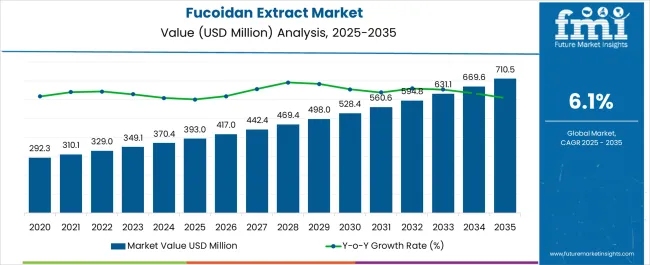
China leads regional growth at an 8.2% CAGR through 2036, driven by expanding functional food and nutraceutical procurement, growing pharmaceutical interest in marine polysaccharide bioactives, and cosmetic ingredient demand in premium personal care formulations. Japan holds the largest individual country value at USD 292.3 million in 2026, reflecting deep Mozuku seaweed cultivation infrastructure and established fucoidan ingredient procurement across pharmaceutical, supplement, and cosmetic channels. The United States generates USD 157.4 million in 2026 demand through dietary supplement retail and cosmetic ingredient procurement. South Korea contributes USD 10.5 million. Powder form leads at 58.0% share, Mozuku is the leading seaweed type at 40.0%, and Food and Beverages captures 30.0% of end-use demand.
Fucoidan Extract Market Definition
The fucoidan extract market comprises the global cultivation, extraction, and trade of sulfated polysaccharide compounds derived from brown seaweed species including Mozuku (Cladosiphon okamuranus), Wakame (Undaria pinnatifida), Kombu (Laminaria japonica), and related species, used as bioactive ingredients in food and beverage formulations, pharmaceutical preparations, dietary supplements, cosmetic and personal care products, veterinary medicine, and agricultural fertilizer applications. The market spans powder and liquid extract formats across organic and conventional seaweed sourcing, distributed to food manufacturers, pharmaceutical companies, cosmetic formulators, and agricultural input buyers.
Fucoidan Extract Market Inclusions
The report includes global and regional market sizes by volume and value with a 10-year forecast from 2026 to 2036. Coverage spans segmental breakdowns by form (Powder, Liquid), seaweed type (Mozuku, Wakame, Kombu, Others), and end use (Food and Beverages, Pharmaceutical, Dietary Supplement, Veterinary Medicine, Fertilizer, Cosmetic). Country-level analysis covers all major seaweed producing and consuming markets globally.
Fucoidan Extract Market Exclusions
The scope excludes whole dried seaweed products and seaweed meal without fucoidan extraction processing, non-fucoidan seaweed polysaccharides including alginate, carrageenan, and agar even when derived from the same seaweed species. Synthetic fucoidan chemical replicates and non-Phaeophyceae brown algae extracts marketed under similar bioactivity descriptors are excluded. Seaweed aquaculture operations without extract processing and finished consumer products where fucoidan is below 1% of total formulation content are outside scope.
Fucoidan Extract Market Research Methodology
-
Primary Research: Interviews were conducted with fucoidan extract manufacturers, seaweed cultivation cooperative operators, cosmetic active ingredient buyers, pharmaceutical bioactive procurement specialists, dietary supplement formulators, and clinical researchers across Japan, China, South Korea, Australia, France, and the United States.
- Desk Research: Production data from Japan Fisheries Agency seaweed harvest statistics, South Korean Ministry of Ocean and Fisheries reports, Australian seaweed industry association publications, clinical trial registries for fucoidan health applications, peer-reviewed marine bioactives research journals, and major ingredient company annual reports supported volume benchmarking.
- Market-Sizing and Forecasting: A hybrid top-down and bottom-up model was applied. Demand was reconstructed from dietary supplement retail channel sales, cosmetic ingredient import data, pharmaceutical procurement volumes, and food and beverage ingredient records, then validated against seaweed harvest volumes and extraction plant throughput data.
- Data Validation and Update Cycle: Outputs undergo anomaly screening, cross-validation against Japan Fisheries Agency harvest data and cosmetic ingredient import statistics, and structured peer review prior to release.
Why is the Fucoidan Extract Market Growing?
Market Overview
The Fucoidan Extract market is experiencing consistent growth, driven by the increasing consumer focus on functional foods, nutraceuticals, and natural health supplements. In 2026, rising awareness of immune-boosting, anti-inflammatory, and antioxidant properties of fucoidan is significantly influencing demand across food, beverage, and pharmaceutical sectors. Expanding adoption in health-conscious populations, coupled with research into marine bioactive compounds, has created a favorable environment for growth.
Market expansion is also being supported by technological advancements in extraction and purification processes, which improve bioavailability and consistency of fucoidan products. Investments in research and development for applications in dietary supplements and fortified food products are expected to further strengthen the market.
Regulatory approvals for food and beverage applications, along with increasing availability in both developed and emerging regions, are reinforcing the positive market outlook As consumers continue to prioritize natural and functional ingredients, fucoidan extracts are poised to become a preferred choice in health and wellness applications, offering sustainable opportunities for manufacturers and suppliers.
Segmental Analysis
The fucoidan extract market is segmented by form, seaweed type, end use, distribution channel, and geographic regions. By form, fucoidan extract market is divided into Powder and Liquid. In terms of seaweed type, fucoidan extract market is classified into Mozuku, Wakame, Kombu, and Others. Based on end use, fucoidan extract market is segmented into Food And Beverages, Pharmaceutical, Dietary Supplement, Veterinary Medicine, Fertilizer, and Cosmetic. By distribution channel, fucoidan extract market is segmented into Wholesale, Online Retailer, Supermarket, and Specialty Stores. Regionally, the fucoidan extract industry is classified into North America, Latin America, Western Europe, Eastern Europe, Balkan & Baltic Countries, Russia & Belarus, Central Asia, East Asia, South Asia & Pacific, and the Middle East & Africa.
Insights into the Powder Form Segment
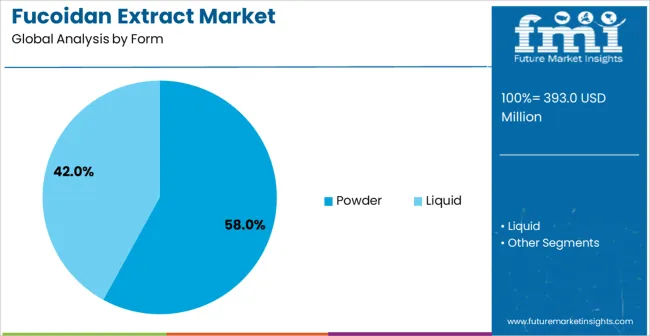
The powder form is projected to hold 58.0% of the Fucoidan Extract market revenue share in 2025, making it the leading form segment. This dominance is being attributed to its ease of handling, storage, and incorporation into a wide range of products, including beverages, dietary supplements, and functional foods. The powder form allows for precise dosing, superior solubility, and consistent quality, which are essential for both industrial and consumer applications.
Its flexibility for blending and fortification makes it highly suitable for manufacturers looking to develop new formulations or enhance existing products. Growth has also been facilitated by its compatibility with encapsulation technologies and ready integration into automated production lines.
Additionally, the long shelf life and lower logistical challenges compared to liquid or gel forms have reinforced its adoption As demand for convenient, stable, and versatile ingredient formats increases, the powder form is expected to maintain its leadership position in the fucoidan extract market.
Insights into the Mozuku Seaweed Type Segment
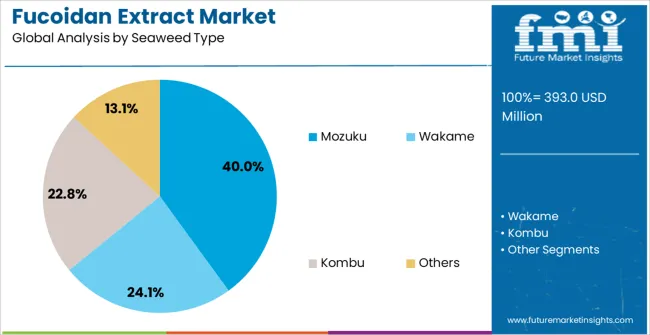
The Mozuku seaweed type is anticipated to account for 40.0% of total revenue in 2025, establishing it as the leading seaweed source for fucoidan extraction. This prominence is being driven by Mozuku’s high fucoidan content and favorable biochemical properties, which provide enhanced bioactivity for health applications. The extraction of fucoidan from Mozuku has been increasingly preferred due to its consistent quality, efficient yield, and compatibility with diverse end-use formulations.
Mozuku-based extracts are widely adopted in food and beverage, dietary supplements, and functional ingredient industries due to their proven safety and efficacy. Research supporting immune support and anti-inflammatory benefits has further accelerated market adoption.
As product developers prioritize high-potency and standardized fucoidan sources, Mozuku’s favorable properties have reinforced its status as a primary feedstock Continued innovation in extraction methods and formulation technologies is expected to sustain growth, supporting expanded applications in functional foods and nutraceutical markets.
Insights into the Food and Beverages End Use Segment
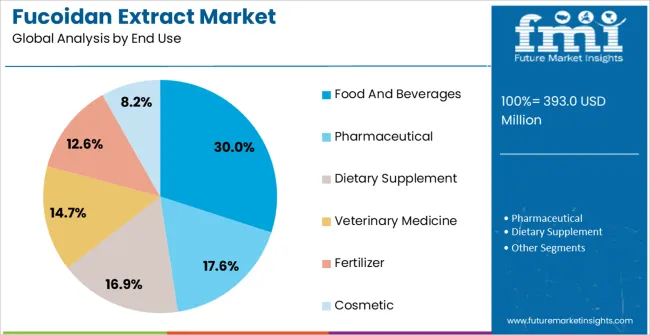
The food and beverages end-use segment is expected to capture 30.0% of the Fucoidan Extract market revenue in 2025, making it the largest end-use industry. This leadership is being supported by the incorporation of fucoidan extracts into functional drinks, fortified foods, and health-focused snack products, where consumers increasingly demand natural and bioactive ingredients. The segment has been driven by growing awareness of digestive health, immunity enhancement, and anti-aging benefits, which have encouraged product innovation among manufacturers.
Market adoption is further strengthened by the ease of integrating fucoidan into diverse product matrices without compromising taste or stability. Regulatory acceptance for food applications has enabled broader commercialization and increased consumer trust.
Rising health consciousness and the expansion of premium and functional food portfolios in both developed and emerging regions have reinforced the prominence of this end-use segment As demand for natural health ingredients continues to grow, the food and beverages sector is expected to remain the key driver of fucoidan extract consumption.
Market Overview
Fucoidan Extract Market Outlook from 2026 to 2036
Brown algae like kombu, wakame (mekabu), and mozuku are the only sources of the special sliminess known as fucoidan, which is also a form of dietary fiber that is water-soluble. Fucoidan is a high-molecular polysaccharide with sulfated fucose as its primary component. The saccharide chain that makes up fucoidan also contains galactose, mannose, xylose, and uronic acid in addition to fucose. The term fucoidan refers to high-molecular polysaccharides with fucose as their primary component but does not specifically relate to substances with a particular structure.
The market for fucoidan has grown in recent years due to the increasing demand for natural health products and ingredients. Fucoidan is not only sold as a nutritional supplement in the form of capsules and powders, but it is also utilized in a variety of functional foods and beverages. Several factors, such as consumers' growing interest in natural and organic products, rising health awareness, and a rise in chronic diseases, are contributing to the growth of this industry. Fucoidan has potential benefits in the treatment of immunological disorders, cancer, and cardiovascular disease.
In our new study, ESOMAR-certified market research and consulting firm Future Market Insights (FMI) offers insights into key factors driving demand for Fucoidan Extract.
Analysis of Fucoidan Extract Market By Key Countries
.webp "Top Country Growth Comparison Fucoidan Extract Market Cagr (2026 2036)")
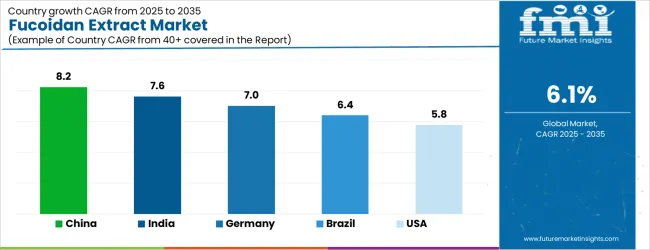
| Country | CAGR |
|---|---|
| China | 8.2% |
| India | 7.6% |
| Germany | 7.0% |
| Brazil | 6.4% |
| USA | 5.8% |
| UK | 5.2% |
| Japan | 4.6% |
Country-wise Analysis
The Fucoidan Extract Market is expected to register a CAGR of 6.1% during the forecast period, exhibiting varied country level momentum. China leads with the highest CAGR of 8.2%, followed by India at 7.6%. Developed markets such as Germany, France, and the UK continue to expand steadily, while the USA is likely to grow at consistent rates. Japan posts the lowest CAGR at 4.6%, yet still underscores a broadly positive trajectory for the global Fucoidan Extract Market. In 2025, Germany held a dominant revenue in the Western Europe market and is expected to grow with a CAGR of 7.0%. The USA Fucoidan Extract Market is estimated to be valued at USD 144.9 million in 2025 and is anticipated to reach a valuation of USD 144.9 million by 2036. Sales are projected to rise at a CAGR of 0.0% over the forecast period between 2026 and 2036. While Japan and South Korea markets are estimated to be valued at USD 20.5 million and USD 13.6 million respectively in 2026.
Recent Developments
The report includes full coverage of key trends from competitive benchmarking. Some of the recent developments covered in the reports:
- In February 2026, Givaudan announced its Active Beauty business unit achieved double-digit growth throughout 2025, driven by surging demand for natural high-performance cosmetic ingredients including Maritech organic fucoidan in clean-label anti-aging and skin-repair formulations. [1]
- In October 2025, Hi-Q Marine Biotech International published clinical results in the Archives of Gerontology and Geriatrics demonstrating that its low-molecular-weight Oligo-Fucoidan significantly boosts muscle strength and physical performance in older adults with sarcopenia. [2]
- In January 2026, Sanzyme Biologics initiated a clinical trial to evaluate the synergistic effects of probiotic strains and marine polysaccharides including low-molecular-weight fucoidan on immune resilience and gastrointestinal health in pediatric populations during the peak winter season. [3]
Key Players in the Fucoidan Extract Market
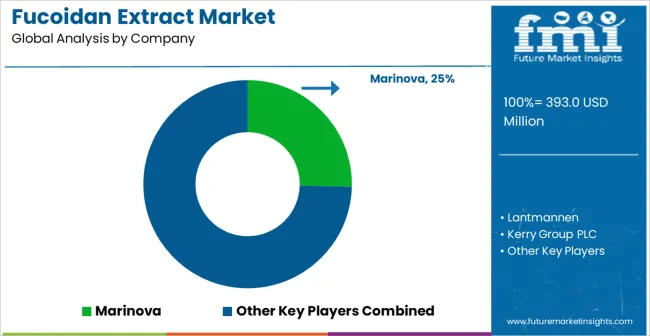
- Marinova
- Lantmannen
- Kerry Group PLC
- Koninklijke DSM NV
- Super Beta Glucan Inc.
- Arcticzymes Technologies ASA
- Caepro Inc.
- Merck KGaA
- Yaizu Suisankagaku Industry Co., Ltd
- Vesta Ingredients Inc.
- Kemin Industries
- Ohly GmbH
Scope of the Report
| Metric | Value |
|---|---|
| Quantitative Units | USD 417.0 million (2026) to USD 753.8 million (2036), at a CAGR of 6.1% |
| Market Definition | The fucoidan extract market covers globally traded sulfated polysaccharide compounds extracted from Mozuku, Wakame, Kombu, and related brown seaweed species in powder and liquid formats for food and beverage, pharmaceutical, dietary supplement, cosmetic, veterinary, and fertilizer applications. |
| Form Segmentation | Powder, Liquid |
| Seaweed Type Segmentation | Mozuku, Wakame, Kombu, Others |
| End Use Segmentation | Food and Beverages, Pharmaceutical, Dietary Supplement, Veterinary Medicine, Fertilizer, Cosmetic |
| Regions Covered | North America, Latin America, Europe, East Asia, South Asia, Oceania, Middle East and Africa |
| Countries Covered | United States, Germany, France, United Kingdom, Japan, China, South Korea, Australia, Canada, New Zealand and 40 plus countries |
| Key Companies Profiled | Marinova, Lantmannen, Kerry Group PLC, Koninklijke DSM NV, Super Beta Glucan Inc., Arcticzymes Technologies ASA, Caepro Inc., Merck KGaA, Yaizu Suisankagaku Industry Co. Ltd, Vesta Ingredients Inc., Kemin Industries, Ohly GmbH |
| Forecast Period | 2026 to 2036 |
| Approach | Hybrid top-down and bottom-up market modeling validated through primary interviews with fucoidan manufacturers and cosmetic and pharmaceutical buyers, supported by Japan Fisheries Agency data, clinical trial registries, and ingredient company disclosures |
Fucoidan Extract Market by Segments
Form:
- Powder
- Liquid
Seaweed Type:
- Mozuku
- Wakame
- Kombu
- Others
End Use:
- Food And Beverages
- Pharmaceutical
- Dietary Supplement
- Veterinary Medicine
- Fertilizer
- Cosmetic
Distribution Channel:
- Wholesale
- Online Retailer
- Supermarket
- Specialty Stores
Region:
- North America
- USA
- Canada
- Mexico
- Latin America
- Brazil
- Chile
- Rest of Latin America
- Western Europe
- Germany
- UK
- Italy
- Spain
- France
- Nordic
- BENELUX
- Rest of Western Europe
- Eastern Europe
- Russia
- Poland
- Hungary
- Balkan & Baltic
- Rest of Eastern Europe
- East Asia
- China
- Japan
- South Korea
- South Asia and Pacific
- India
- ASEAN
- Australia & New Zealand
- Rest of South Asia and Pacific
- Middle East & Africa
- Kingdom of Saudi Arabia
- Other GCC Countries
- Turkiye
- South Africa
- Other African Union
- Rest of Middle East & Africa
Bibliography
- [1] Givaudan. (2026). Givaudan 2025 full-year results: Active Beauty achieves double-digit growth driven by Maritech organic fucoidan. February 2026. https://www.givaudan.com/media/media-releases/2026/2025-full-year-results
- [2] Hi-Q Marine Biotech International. (2025). Clinical results: low-molecular-weight Oligo-Fucoidan improves muscle strength and physical performance in sarcopenia. Archives of Gerontology and Geriatrics, Volume 140, January 2026. https://clinicaltrials.gov/study/NCT06855524
- [3] ClinicalTrials.gov. (2026). Sanzyme Biologics clinical trial NCT07341750: synergistic effects of probiotic strains and marine polysaccharides on pediatric immune resilience. January 2026. https://clinicaltrials.gov/study/NCT07341750
- [4] Japan Fisheries Agency. (2025). Annual Seaweed Harvest Statistics: Mozuku, Wakame, and Kombu Production Data. Ministry of Agriculture, Forestry and Fisheries, Japan.
This bibliography is provided for reader reference and is not exhaustive. The full report contains the complete reference list and detailed citations.
This Report Addresses
- Market intelligence to enable structured seaweed sourcing, extraction, and multi-channel strategy decisions across food and beverage, pharmaceutical, cosmetic, dietary supplement, and veterinary fucoidan applications
- Market size estimation and 10-year revenue forecasts from 2026 to 2036, supported by validated seaweed harvest data and multi-channel procurement benchmarks
- Growth opportunity mapping across form, seaweed type, and end-use segments with emphasis on low-molecular-weight pharmaceutical product development and organic cosmetic active positioning
- Segment and regional revenue forecasts covering powder and liquid forms across food, pharmaceutical, cosmetic, and supplement end uses in 40 plus countries
- Competition strategy assessment including standardised Oligo-Fucoidan pharmaceutical product development, organic Mozuku cosmetic active supply, and China channel entry for marine bioactive nutraceuticals
- Clinical evidence tracking covering sarcopenia, immune health, pediatric gastrointestinal applications, and combination marine polysaccharide probiotic trials across major registered fucoidan products
- Regulatory impact analysis covering marine bioactive ingredient novel food approvals, cosmetic active ingredient safety documentation, and pharmaceutical botanical compound standards
- Market report delivery in PDF, Excel, PPT, and interactive dashboard formats for executive and operational use
Frequently Asked Questions
How large is the demand for Fucoidan Extract in the global market in 2026?
Demand for Fucoidan Extract in the global market is estimated to be valued at USD 417.0 million in 2026.
What will the market size of Fucoidan Extract be by 2036?
Market size for Fucoidan Extract is projected to reach USD 753.8 million by 2036.
What is the expected CAGR for the Fucoidan Extract Market between 2026 and 2036?
Demand for Fucoidan Extract is expected to grow at a CAGR of 6.1% between 2026 and 2036.
Which Form segment leads the Fucoidan Extract Market in 2026?
Powder leads at 58.0% share, preferred for dietary supplement and cosmetic formulation applications where precise dosage, shelf stability, and formulation flexibility are required.
Which Seaweed Type dominates the Fucoidan Extract Market?
Mozuku accounts for 40.0% of seaweed type share, reflecting Japan's dominant Mozuku cultivation infrastructure and the well-documented bioactivity profile of Cladosiphon okamuranus-derived fucoidan.
What is driving China's growth in the Fucoidan Extract Market?
China leads regional growth at an 8.2% CAGR through 2036, driven by expanding functional food and nutraceutical procurement, pharmaceutical interest in marine polysaccharide bioactives, and premium cosmetic ingredient demand.
What is the United States market value for Fucoidan Extract in 2026?
The United States generates USD 157.4 million in 2026 demand through dietary supplement retail and cosmetic ingredient procurement channels.
What does Givaudan's double-digit Maritech fucoidan growth signal for the market?
The February 2026 Givaudan Active Beauty performance disclosure confirms fucoidan's transition from specialty nutraceutical to premium cosmetic active with mainstream personal care channel demand, driven by clean-label anti-aging and skin-repair formulation adoption.
What sarcopenia clinical evidence exists for fucoidan?
Hi-Q Marine Biotech International published results in Archives of Gerontology and Geriatrics demonstrating that low-molecular-weight Oligo-Fucoidan significantly improves muscle strength and physical performance in older adults with sarcopenia, validating a clinically differentiated pharmaceutical channel application.
What is included in the scope of this report?
Scope covers sulfated polysaccharide compounds from Mozuku, Wakame, Kombu, and related brown seaweed species in powder and liquid formats across food, pharmaceutical, supplement, cosmetic, veterinary, and fertilizer applications.
How does FMI validate its Fucoidan Extract Market forecast?
The forecast uses a hybrid model validated through primary interviews with fucoidan manufacturers and cosmetic and pharmaceutical buyers, cross-checked against Japan Fisheries Agency harvest data, clinical trial registries, and ingredient company disclosures.
Preview the report firsthand - request a free sample
Get SampleGet the brochure for pricing and purchase details.
Get PDFTable of Content
- Executive Summary
- Global Market Outlook
- Demand-side Trends
- Supply-side Trends
- Technology Roadmap Analysis
- Analysis and Recommendations
- Market Overview
- Market Coverage / Taxonomy
- Market Definition / Scope / Limitations
- Research Methodology
- Chapter Orientation
- Analytical Lens and Working Hypotheses
- Market Structure, Signals, and Trend Drivers
- Benchmarking and Cross-market Comparability
- Market Sizing, Forecasting, and Opportunity Mapping
- Research Design and Evidence Framework
- Desk Research Programme (Secondary Evidence)
- Company Annual and Sustainability Reports
- Peer-reviewed Journals and Academic Literature
- Corporate Websites, Product Literature, and Technical Notes
- Earnings Decks and Investor Briefings
- Statutory Filings and Regulatory Disclosures
- Technical White Papers and Standards Notes
- Trade Journals, Industry Magazines, and Analyst Briefs
- Conference Proceedings, Webinars, and Seminar Materials
- Government Statistics Portals and Public Data Releases
- Press Releases and Reputable Media Coverage
- Specialist Newsletters and Curated Briefings
- Sector Databases and Reference Repositories
- FMI Internal Proprietary Databases and Historical Market Datasets
- Subscription Datasets and Paid Sources
- Social Channels, Communities, and Digital Listening Inputs
- Additional Desk Sources
- Expert Input and Fieldwork (Primary Evidence)
- Primary Modes
- Qualitative Interviews and Expert Elicitation
- Quantitative Surveys and Structured Data Capture
- Blended Approach
- Why Primary Evidence is Used
- Field Techniques
- Interviews
- Surveys
- Focus Groups
- Observational and In-context Research
- Social and Community Interactions
- Stakeholder Universe Engaged
- C-suite Leaders
- Board Members
- Presidents and Vice Presidents
- R&D and Innovation Heads
- Technical Specialists
- Domain Subject-matter Experts
- Scientists
- Physicians and Other Healthcare Professionals
- Governance, Ethics, and Data Stewardship
- Research Ethics
- Data Integrity and Handling
- Primary Modes
- Tooling, Models, and Reference Databases
- Desk Research Programme (Secondary Evidence)
- Data Engineering and Model Build
- Data Acquisition and Ingestion
- Cleaning, Normalisation, and Verification
- Synthesis, Triangulation, and Analysis
- Quality Assurance and Audit Trail
- Market Background
- Market Dynamics
- Drivers
- Restraints
- Opportunity
- Trends
- Scenario Forecast
- Demand in Optimistic Scenario
- Demand in Likely Scenario
- Demand in Conservative Scenario
- Opportunity Map Analysis
- Product Life Cycle Analysis
- Supply Chain Analysis
- Investment Feasibility Matrix
- Value Chain Analysis
- PESTLE and Porter’s Analysis
- Regulatory Landscape
- Regional Parent Market Outlook
- Production and Consumption Statistics
- Import and Export Statistics
- Market Dynamics
- Global Market Analysis 2021 to 2025 and Forecast, 2026 to 2036
- Historical Market Size Value (USD Million) Analysis, 2021 to 2025
- Current and Future Market Size Value (USD Million) Projections, 2026 to 2036
- Y-o-Y Growth Trend Analysis
- Absolute $ Opportunity Analysis
- Global Market Pricing Analysis 2021 to 2025 and Forecast 2026 to 2036
- Global Market Analysis 2021 to 2025 and Forecast 2026 to 2036, By Form
- Introduction / Key Findings
- Historical Market Size Value (USD Million) Analysis By Form , 2021 to 2025
- Current and Future Market Size Value (USD Million) Analysis and Forecast By Form , 2026 to 2036
- Powder
- Liquid
- Powder
- Y-o-Y Growth Trend Analysis By Form , 2021 to 2025
- Absolute $ Opportunity Analysis By Form , 2026 to 2036
- Global Market Analysis 2021 to 2025 and Forecast 2026 to 2036, By Seaweed Type
- Introduction / Key Findings
- Historical Market Size Value (USD Million) Analysis By Seaweed Type, 2021 to 2025
- Current and Future Market Size Value (USD Million) Analysis and Forecast By Seaweed Type, 2026 to 2036
- Mozuku
- Wakame
- Kombu
- Others
- Mozuku
- Y-o-Y Growth Trend Analysis By Seaweed Type, 2021 to 2025
- Absolute $ Opportunity Analysis By Seaweed Type, 2026 to 2036
- Global Market Analysis 2021 to 2025 and Forecast 2026 to 2036, By End Use
- Introduction / Key Findings
- Historical Market Size Value (USD Million) Analysis By End Use, 2021 to 2025
- Current and Future Market Size Value (USD Million) Analysis and Forecast By End Use, 2026 to 2036
- Food And Beverages
- Pharmaceutical
- Dietary Supplement
- Veterinary Medicine
- Fertilizer
- Cosmetic
- Food And Beverages
- Y-o-Y Growth Trend Analysis By End Use, 2021 to 2025
- Absolute $ Opportunity Analysis By End Use, 2026 to 2036
- Global Market Analysis 2021 to 2025 and Forecast 2026 to 2036, By Region
- Introduction
- Historical Market Size Value (USD Million) Analysis By Region, 2021 to 2025
- Current Market Size Value (USD Million) Analysis and Forecast By Region, 2026 to 2036
- North America
- Latin America
- Western Europe
- Eastern Europe
- East Asia
- South Asia and Pacific
- Middle East & Africa
- Market Attractiveness Analysis By Region
- North America Market Analysis 2021 to 2025 and Forecast 2026 to 2036, By Country
- Historical Market Size Value (USD Million) Trend Analysis By Market Taxonomy, 2021 to 2025
- Market Size Value (USD Million) Forecast By Market Taxonomy, 2026 to 2036
- By Country
- USA
- Canada
- Mexico
- By Form
- By Seaweed Type
- By End Use
- By Country
- Market Attractiveness Analysis
- By Country
- By Form
- By Seaweed Type
- By End Use
- Key Takeaways
- Latin America Market Analysis 2021 to 2025 and Forecast 2026 to 2036, By Country
- Historical Market Size Value (USD Million) Trend Analysis By Market Taxonomy, 2021 to 2025
- Market Size Value (USD Million) Forecast By Market Taxonomy, 2026 to 2036
- By Country
- Brazil
- Chile
- Rest of Latin America
- By Form
- By Seaweed Type
- By End Use
- By Country
- Market Attractiveness Analysis
- By Country
- By Form
- By Seaweed Type
- By End Use
- Key Takeaways
- Western Europe Market Analysis 2021 to 2025 and Forecast 2026 to 2036, By Country
- Historical Market Size Value (USD Million) Trend Analysis By Market Taxonomy, 2021 to 2025
- Market Size Value (USD Million) Forecast By Market Taxonomy, 2026 to 2036
- By Country
- Germany
- UK
- Italy
- Spain
- France
- Nordic
- BENELUX
- Rest of Western Europe
- By Form
- By Seaweed Type
- By End Use
- By Country
- Market Attractiveness Analysis
- By Country
- By Form
- By Seaweed Type
- By End Use
- Key Takeaways
- Eastern Europe Market Analysis 2021 to 2025 and Forecast 2026 to 2036, By Country
- Historical Market Size Value (USD Million) Trend Analysis By Market Taxonomy, 2021 to 2025
- Market Size Value (USD Million) Forecast By Market Taxonomy, 2026 to 2036
- By Country
- Russia
- Poland
- Hungary
- Balkan & Baltic
- Rest of Eastern Europe
- By Form
- By Seaweed Type
- By End Use
- By Country
- Market Attractiveness Analysis
- By Country
- By Form
- By Seaweed Type
- By End Use
- Key Takeaways
- East Asia Market Analysis 2021 to 2025 and Forecast 2026 to 2036, By Country
- Historical Market Size Value (USD Million) Trend Analysis By Market Taxonomy, 2021 to 2025
- Market Size Value (USD Million) Forecast By Market Taxonomy, 2026 to 2036
- By Country
- China
- Japan
- South Korea
- By Form
- By Seaweed Type
- By End Use
- By Country
- Market Attractiveness Analysis
- By Country
- By Form
- By Seaweed Type
- By End Use
- Key Takeaways
- South Asia and Pacific Market Analysis 2021 to 2025 and Forecast 2026 to 2036, By Country
- Historical Market Size Value (USD Million) Trend Analysis By Market Taxonomy, 2021 to 2025
- Market Size Value (USD Million) Forecast By Market Taxonomy, 2026 to 2036
- By Country
- India
- ASEAN
- Australia & New Zealand
- Rest of South Asia and Pacific
- By Form
- By Seaweed Type
- By End Use
- By Country
- Market Attractiveness Analysis
- By Country
- By Form
- By Seaweed Type
- By End Use
- Key Takeaways
- Middle East & Africa Market Analysis 2021 to 2025 and Forecast 2026 to 2036, By Country
- Historical Market Size Value (USD Million) Trend Analysis By Market Taxonomy, 2021 to 2025
- Market Size Value (USD Million) Forecast By Market Taxonomy, 2026 to 2036
- By Country
- Kingdom of Saudi Arabia
- Other GCC Countries
- Turkiye
- South Africa
- Other African Union
- Rest of Middle East & Africa
- By Form
- By Seaweed Type
- By End Use
- By Country
- Market Attractiveness Analysis
- By Country
- By Form
- By Seaweed Type
- By End Use
- Key Takeaways
- Key Countries Market Analysis
- USA
- Pricing Analysis
- Market Share Analysis, 2025
- By Form
- By Seaweed Type
- By End Use
- Canada
- Pricing Analysis
- Market Share Analysis, 2025
- By Form
- By Seaweed Type
- By End Use
- Mexico
- Pricing Analysis
- Market Share Analysis, 2025
- By Form
- By Seaweed Type
- By End Use
- Brazil
- Pricing Analysis
- Market Share Analysis, 2025
- By Form
- By Seaweed Type
- By End Use
- Chile
- Pricing Analysis
- Market Share Analysis, 2025
- By Form
- By Seaweed Type
- By End Use
- Germany
- Pricing Analysis
- Market Share Analysis, 2025
- By Form
- By Seaweed Type
- By End Use
- UK
- Pricing Analysis
- Market Share Analysis, 2025
- By Form
- By Seaweed Type
- By End Use
- Italy
- Pricing Analysis
- Market Share Analysis, 2025
- By Form
- By Seaweed Type
- By End Use
- Spain
- Pricing Analysis
- Market Share Analysis, 2025
- By Form
- By Seaweed Type
- By End Use
- France
- Pricing Analysis
- Market Share Analysis, 2025
- By Form
- By Seaweed Type
- By End Use
- India
- Pricing Analysis
- Market Share Analysis, 2025
- By Form
- By Seaweed Type
- By End Use
- ASEAN
- Pricing Analysis
- Market Share Analysis, 2025
- By Form
- By Seaweed Type
- By End Use
- Australia & New Zealand
- Pricing Analysis
- Market Share Analysis, 2025
- By Form
- By Seaweed Type
- By End Use
- China
- Pricing Analysis
- Market Share Analysis, 2025
- By Form
- By Seaweed Type
- By End Use
- Japan
- Pricing Analysis
- Market Share Analysis, 2025
- By Form
- By Seaweed Type
- By End Use
- South Korea
- Pricing Analysis
- Market Share Analysis, 2025
- By Form
- By Seaweed Type
- By End Use
- Russia
- Pricing Analysis
- Market Share Analysis, 2025
- By Form
- By Seaweed Type
- By End Use
- Poland
- Pricing Analysis
- Market Share Analysis, 2025
- By Form
- By Seaweed Type
- By End Use
- Hungary
- Pricing Analysis
- Market Share Analysis, 2025
- By Form
- By Seaweed Type
- By End Use
- Kingdom of Saudi Arabia
- Pricing Analysis
- Market Share Analysis, 2025
- By Form
- By Seaweed Type
- By End Use
- Turkiye
- Pricing Analysis
- Market Share Analysis, 2025
- By Form
- By Seaweed Type
- By End Use
- South Africa
- Pricing Analysis
- Market Share Analysis, 2025
- By Form
- By Seaweed Type
- By End Use
- USA
- Market Structure Analysis
- Competition Dashboard
- Competition Benchmarking
- Market Share Analysis of Top Players
- By Regional
- By Form
- By Seaweed Type
- By End Use
- Competition Analysis
- Competition Deep Dive
- Marinova
- Overview
- Product Portfolio
- Profitability by Market Segments (Product/Age /Sales Channel/Region)
- Sales Footprint
- Strategy Overview
- Marketing Strategy
- Product Strategy
- Channel Strategy
- Lantmannen
- Kerry Group PLC
- Koninklijke DSM NV
- Super Beta Glucan Inc.
- Arcticzymes Technologies ASA
- Caepro Inc.
- Merck KGaA
- Yaizu Suisankagaku Industry Co., Ltd
- Vesta Ingredients Inc.
- Kemin Industries
- Ohly GmbH
- Marinova
- Competition Deep Dive
- Assumptions & Acronyms Used


