

- Industry Size (2026)
- USD 11.71 Bn
- Forecast (2036)
- USD 20.00 Bn
- CAGR (2026 to 2036)
- 5.5%
Marine Outboard Engines Market Size, Market Forecast and Outlook By FMI
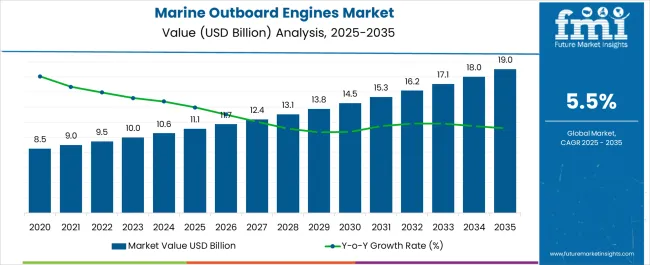
The marine outboard engines market was valued at USD 11.10 billion in 2025, projected to reach USD 11.71 billion in 2026, and is forecast to expand to USD 20.00 billion by 2036 at a 5.5% CAGR. Growing recreational boating participation, expanding commercial fishing fleet mechanization in developing economies, and the transition from two-stroke to four-stroke engine architectures are driving both new unit sales and replacement procurement across all power categories. FMI analysts note that the electrification trend, while still early-stage, is creating a parallel premium segment where battery-electric and hybrid outboard units command higher average selling prices than conventional combustion engines.
Summary of Marine Outboard Engines Market
- Market Overview
- The market is valued at USD 11.10 billion in 2025 and is projected to reach USD 20.00 billion by 2036.
- The industry is expected to grow at a 5.5% CAGR from 2026 to 2036, creating an incremental opportunity of USD 8.29 billion.
- The market is a consumer-and-commercial-driven marine propulsion category where recreational boating participation, fishing fleet mechanization, and four-stroke technology migration define engine procurement volumes and average selling price trajectories.
- Demand and Growth Drivers
- Growing recreational boating participation and consumer preference for larger center-console and pontoon platforms are driving demand for high-power outboard engines exceeding 150 HP.
- Commercial fishing fleet mechanization in China, India, and Brazil is creating first-time motorization procurement pipelines for medium-power outboard engines replacing manual propulsion.
- The transition from carbureted two-stroke to fuel-injected four-stroke engine architectures is generating replacement demand as regulatory emission standards tighten across major boating markets.
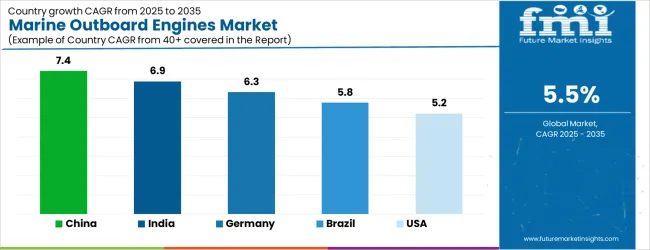
- Among key countries, China leads at 7.4% CAGR, followed by India at 6.9%, Germany at 6.3%, Brazil at 5.8%, the USA at 5.2%, the UK at 4.7%, and Japan at 4.1%.
- Product and Segment View
- The market covers self-contained outboard propulsion units in high-power and medium-power configurations integrating engine, gearbox, and propeller for transom-mounted installation.
- Engine architectures span four-stroke and two-stroke designs with electric and manual start systems operating on gasoline and diesel fuels.
- High Power Marine Outboard Engines lead by Power with 55.3% share in 2026, reflecting consumer upgrade trends toward larger boat platforms requiring engines above 150 HP.
- Four Stroke Marine Outboard Engines lead by Injection with 51.7% share in 2026, driven by fuel efficiency advantages and tightening emission standards favoring four-stroke technology.
- Scope includes all combustion-engine outboard units and excludes inboard engines, stern drives, jet drives, and fully electric outboard systems.
- Geography and Competitive Outlook
- China and India are the fastest-growing markets driven by fishing fleet mechanization and domestic manufacturing scale, while Brazil generates first-time motorization demand.
- The United States remains the highest-value market through recreational boating replacement and upgrade cycles, while Japan sustains demand through OEM production leadership.
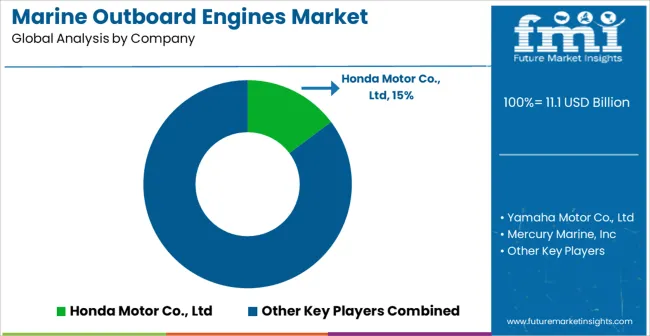
- Competition is shaped by power-to-weight ratio, fuel efficiency, and dealer network coverage, with key players including Honda Motor Co., Yamaha Motor Co., Mercury Marine, Suzuki Marine, Volvo Penta, Tohatsu Corporation, and YANMAR Co.
- Analyst Opinion at FMI
- Nikhil Kaitwade, Principal Consultant for Marine Equipment at Future Market Insights, opines: 'In my analysis, the marine outboard engines market is experiencing a bifurcation between the high-power recreational segment, where consumers are driving average horsepower per boat to record levels, and the electrification segment, where battery-electric outboards are carving a premium niche in low-speed inland and harbor applications. Combustion engine OEMs that do not develop hybrid outboard product lines within the forecast period risk losing the specification position on larger boat platforms where emission regulations and marina noise restrictions are creating procurement preferences for hybrid-capable units.'
- Strategic Implications / Executive Takeaways
- Outboard engine OEMs must develop hybrid combustion-electric product lines to maintain specification position on larger recreational boat platforms where marina noise restrictions and emission regulations are creating preferences for hybrid-capable units.
- Fishing fleet financing programs in India and Brazil should include outboard engine procurement packages to accelerate the transition from manual to mechanized propulsion on small commercial vessels.
- Dealer network expansion in Southeast Asia, South America, and coastal Africa represents a growth priority for OEMs seeking to capture first-time motorization demand in fishing and coastal transport segments.
Marine Outboard Engines Market Key Takeaways
| Metric | Details |
|---|---|
| Industry Size (2026) | USD 11.71 billion |
| Industry Value (2036) | USD 20.00 billion |
| CAGR (2026-2036) | 5.5% |
Source: Future Market Insights, 2026
High-power outboard engines lead the market as recreational boating consumers upgrade to larger center-console and pontoon platforms that require engines exceeding 150 HP for performance and safety. Four-stroke injection engines hold the technology majority, reflecting their fuel efficiency, lower emission profiles, and quieter operation compared to carbureted two-stroke designs. Electric start systems dominate start-type preference as consumer expectations for convenience and reliability eliminate manual pull-start from all but the smallest portable outboard categories. Gasoline remains the dominant fuel type, though diesel outboards serve niche commercial applications where fuel commonality with vessel main engines simplifies onboard logistics.
China leads with a 7.4% CAGR, driven by domestic outboard engine manufacturing scale and expanding inland waterway and coastal fishing fleet mechanization. India follows at 6.9%, supported by the Blue Economy policy framework encouraging small fishing vessel motorization. Germany registers 6.3% growth tied to its inland and coastal recreational boating market and marine engine engineering capability. Brazil posts 5.8% as Amazon and coastal fishing fleet expansion generates first-time motorization demand. The United States tracks at 5.2% reflecting the mature recreational boating market's replacement and upgrade cycle, the United Kingdom at 4.7% with coastal and canal boating growth, and Japan at 4.1% sustained by domestic OEM production from Yamaha, Honda, and Suzuki.
Marine Outboard Engines Market Definition
Marine outboard engines are self-contained propulsion units mounted externally on the transom of boats and small vessels, integrating engine, gearbox, and propeller into a single removable package. Core categories span high-power and medium-power configurations in two-stroke and four-stroke architectures with electric or manual start systems, operating on gasoline or diesel fuel.
Marine Outboard Engines Market Inclusions
Market scope covers high-power and medium-power outboard engines in four-stroke and two-stroke configurations. Coverage spans electric start and manual start systems across gasoline and diesel fuel types. End-use applications include recreational boating, commercial fishing, military and patrol, and personal watercraft. Regional and country-level market sizes for 2026 to 2036 are included.
Marine Outboard Engines Market Exclusions
The scope excludes inboard marine engines, stern drive propulsion systems, jet drive units, and trolling motors. Fully electric outboard units without combustion engine backup are tracked separately and excluded from combustion-engine market sizing. Outboard engine accessories and aftermarket parts are also excluded unless bundled in OEM engine packages.
Marine Outboard Engines Market Research Methodology
- Primary Research: Analysts engaged with procurement managers, operations engineers, and industry supply chain directors to identify the decision triggers, specification requirements, and budget allocation patterns governing equipment and technology upgrades.
- Desk Research: Data collection aggregated publicly available regulatory filings, government procurement records, trade association publications, and company annual reports and investor presentations.
- Market-Sizing and Forecasting: Baseline values derive from a bottom-up aggregation of product-level shipment volumes and average selling prices, applying region-specific adoption curves to project demand through the forecast period.
- Data Validation and Update Cycle: Projections are cross-validated against publicly reported company revenue guidance, government statistical agency databases, and trade body shipment records.
Why is the Marine Outboard Engines Market Growing?
The Marine Outboard Engines market is witnessing robust growth, driven by the rising demand for recreational and commercial boating activities worldwide. Growth in tourism, water sports, and commercial fishing has increased the adoption of high-performance outboard engines that provide reliability, fuel efficiency, and low maintenance. Technological advancements in engine design, fuel injection systems, and emission control are improving overall performance while meeting stringent environmental regulations.
Manufacturers are increasingly integrating advanced electronics, lightweight materials, and noise reduction technologies to enhance operational efficiency and user experience. The market is also being supported by expanding marine infrastructure, including ports, marinas, and maintenance facilities, which facilitate widespread adoption.
Rising interest in leisure boating and yacht ownership, coupled with innovations in engine durability and power output, is further fueling growth As the marine sector continues to modernize, the demand for efficient, reliable, and user-friendly outboard engines is expected to rise, providing long-term opportunities for market expansion.
Segmental Analysis
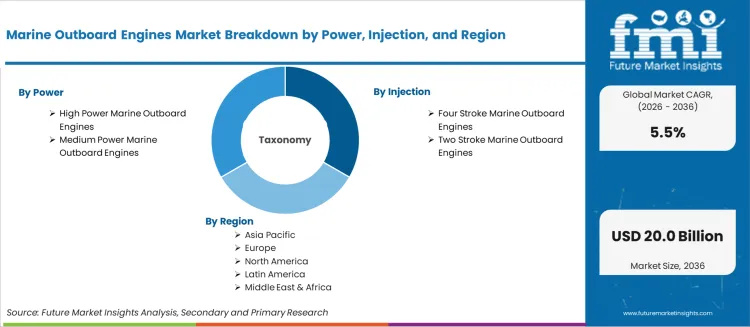
The marine outboard engines market is segmented by power, injection, start type, fuel type, and geographic regions. By power, marine outboard engines market is divided into High Power Marine Outboard Engines and Medium Power Marine Outboard Engines. In terms of injection, marine outboard engines market is classified into Four Stroke Marine Outboard Engines and Two Stroke Marine Outboard Engines. Based on start type, marine outboard engines market is segmented into Electric Start Marine Outboard Engines and Manual Start Marine Outboard Engines. By fuel type, marine outboard engines market is segmented into Gasoline Marine Outboard Engines and Diesel Marine Outboard Engines. Regionally, the marine outboard engines industry is classified into North America, Latin America, Western Europe, Eastern Europe, Balkan & Baltic Countries, Russia & Belarus, Central Asia, East Asia, South Asia & Pacific, and the Middle East & Africa.
Insights into the High Power Marine Outboard Engines Power Segment
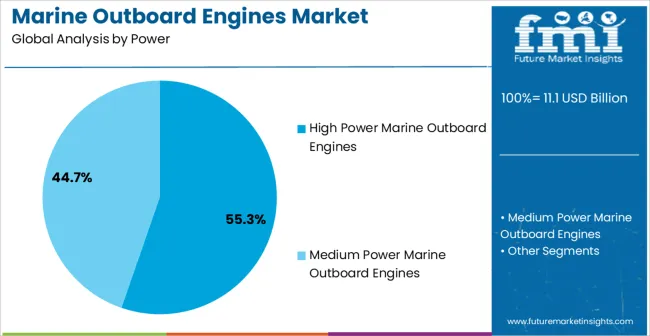
The high power marine outboard engines segment is projected to hold 55.3% of the market revenue in 2026, establishing it as the leading power category. Growth in this segment is being driven by the increasing need for engines capable of delivering high thrust and sustained performance for commercial and recreational applications.
These engines are preferred for large boats, yachts, and fishing vessels where reliability, fuel efficiency, and operational stability are critical. Continuous improvements in engine architecture, materials, and cooling systems have enhanced durability and reduced maintenance requirements, making high power engines the choice for professional and recreational users alike.
Rising adoption is also supported by innovations in fuel injection and electronic monitoring systems, which optimize power output while complying with environmental standards As boating activities expand globally, demand for high power engines is expected to remain strong, reinforcing the segment’s leading position due to performance, efficiency, and reliability advantages.
Insights into the Four Stroke Marine Outboard Engines Injection Segment
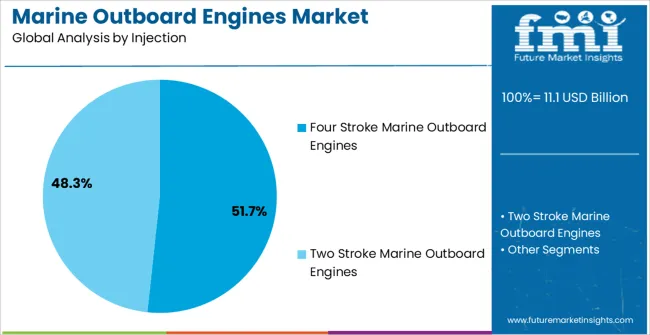
The four stroke marine outboard engines segment is anticipated to hold 51.7% of the market revenue in 2026, making it the leading injection type. Growth is being driven by the efficiency, reduced emissions, and reliability offered by four stroke engines compared to two stroke alternatives. These engines deliver smoother operation, lower fuel consumption, and reduced noise, making them ideal for both recreational and commercial boating.
Technological advancements in injection systems and engine control units have further improved fuel efficiency and performance consistency. Adoption is also supported by stricter environmental regulations in marine zones, where four stroke engines are favored for compliance with emission standards.
The segment’s leadership is reinforced by long-term cost advantages, operational stability, and wider acceptance among boat manufacturers and end users As global boating activities expand and regulatory compliance becomes increasingly stringent, four stroke engines are expected to continue leading the injection category, supported by innovation and environmental advantages.
Insights into the Electric Start Marine Outboard Engines Start Type Segment
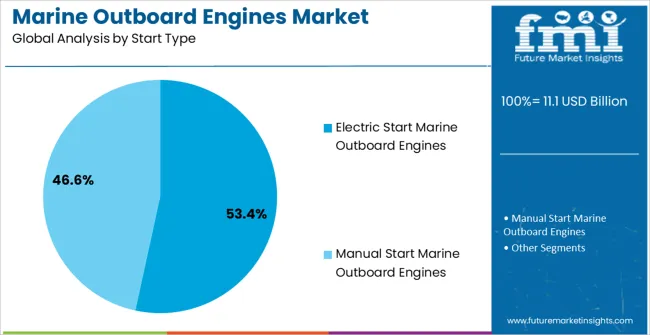
The electric start marine outboard engines segment is projected to hold 53.4% of the market revenue in 2026, establishing it as the leading start type. Its growth is being driven by the convenience, reliability, and ease of operation offered by electric start systems compared to manual alternatives. Electric start engines enhance user experience by enabling quick and effortless engine ignition, which is particularly valuable in commercial and recreational applications requiring frequent engine starts.
Integration of advanced battery systems, safety mechanisms, and starter technology has improved durability and performance reliability. Rising adoption is also supported by an increased focus on user-friendly boating solutions and expanding recreational boating activities.
Manufacturers are increasingly offering electric start options as standard features in modern outboard engines, further reinforcing market preference As boating activities grow globally and operational convenience becomes a priority for end users, electric start marine outboard engines are expected to maintain their leading position in the market, supported by technological enhancements and ease-of-use advantages.
Market Overview
Marine Outboard Engines Market Overview
The rising number of motor powered boats and water sports and growing demand rising from a strong global economy is expected to boost the demand for marine outboard engines through the forecast period.
As marine outboard engines provide users with both thrust and maneuverability, they are being increasingly being preferred for watercrafts of all types. The rise of jobs in the boating industry and gradually reducing oil prices are also expected to support the marine outboard engines market in the near future.
Analysis of Marine Outboard Engines Market By Key Countries
.webp "Top Country Growth Comparison Marine Outboard Engines Market Cagr (2026 2036)")
| Country | CAGR |
|---|---|
| China | 7.4% |
| India | 6.9% |
| Germany | 6.3% |
| Brazil | 5.8% |
| USA | 5.2% |
| UK | 4.7% |
| Japan | 4.1% |
Source: FMI analysis based on primary research and proprietary forecasting model
Country-wise Analysis
The Marine Outboard Engines Market is expected to register a CAGR of 5.5% during the forecast period, exhibiting varied country level momentum. China leads with the highest CAGR of 7.4%, followed by India at 6.9%. Developed markets such as Germany, France, and the UK continue to expand steadily, while the USA is likely to grow at consistent rates. Japan posts the lowest CAGR at 4.1%, yet still underscores a broadly positive trajectory for the global Marine Outboard Engines Market. In 2024, Germany held a dominant revenue in the Western Europe market and is expected to grow with a CAGR of 6.3%. The USA Marine Outboard Engines Market is estimated to be valued at USD 4.1 billion in 2026 and is anticipated to reach a valuation of USD 4.1 billion by 2036. Sales are projected to rise at a CAGR of 0.0% over the forecast period between 2026 and 2036. While Japan and South Korea markets are estimated to be valued at USD 561.7 million and USD 387.0 million respectively in 2026.
Key Players in the Marine Outboard Engines Market
- Honda Motor Co., Ltd
- Yamaha Motor Co., Ltd
- Mercury Marine, Inc
- Volvo Penta
- Evinrude
- Suzuki Marine
- Torqeedo GmbH
- Camfil
- Cox Powertrain
- LEHR LLC
- Tohatsu Corporation
- Elco Motor Yachts
- YANMAR Co., Ltd
- Mudd Hog Mud Motors, LLC
- Powertec Group
Scope of the Report
| Metric | Value |
|---|---|
| Quantitative Units | USD 11.71 billion to USD 20.00 billion, at a CAGR of 5.5% |
| Market Definition | Marine outboard engines are self-contained propulsion units mounted externally on the transom of boats and small vessels, integrating engine, gearbox, and propeller into a single removable package. Co... |
| Segmentation | Power: High Power Marine Outboard Engines, Medium Power Marine Outboard Engines; Injection: Four Stroke Marine Outboard Engines, Two Stroke Marine Outboard Engines; Start Type: Electric Start Marine Outboard Engines, Manual Start Marine Outboard Engines; Fuel Type: Gasoline Marine Outboard Engines, Diesel Marine Outboard Engines |
| Regions Covered | North America, Latin America, Europe, East Asia, South Asia, Oceania, Middle East & Africa |
| Countries Covered | China, India, Germany, Brazil, USA, UK, Japan, and 40 plus countries |
| Key Companies Profiled | Honda Motor Co., Ltd, Yamaha Motor Co., Ltd, Mercury Marine, Inc, Volvo Penta, Evinrude, Suzuki Marine, Torqeedo GmbH, Cox Powertrain, Tohatsu Corporation, Elco Motor Yachts, YANMAR Co., Ltd |
| Forecast Period | 2026 to 2036 |
| Approach | Forecasting models apply a bottom-up methodology starting with global installed base metrics and product-level demand curves, cross-validated against publicly reported revenue and trade data. |
Marine Outboard Engines Market by Segments
Power:
- High Power Marine Outboard Engines
- Medium Power Marine Outboard Engines
Injection:
- Four Stroke Marine Outboard Engines
- Two Stroke Marine Outboard Engines
Start Type:
- Electric Start Marine Outboard Engines
- Manual Start Marine Outboard Engines
Fuel Type:
- Gasoline Marine Outboard Engines
- Diesel Marine Outboard Engines
Region:
- North America
- USA
- Canada
- Mexico
- Latin America
- Brazil
- Chile
- Rest of Latin America
- Western Europe
- Germany
- UK
- Italy
- Spain
- France
- Nordic
- BENELUX
- Rest of Western Europe
- Eastern Europe
- Russia
- Poland
- Hungary
- Balkan & Baltic
- Rest of Eastern Europe
- East Asia
- China
- Japan
- South Korea
- South Asia and Pacific
- India
- ASEAN
- Australia & New Zealand
- Rest of South Asia and Pacific
- Middle East & Africa
- Kingdom of Saudi Arabia
- Other GCC Countries
- Turkiye
- South Africa
- Other African Union
- Rest of Middle East & Africa
Bibliography
- International Council of Marine Industry Associations. (2024). Global Recreational Boating Market Report. ICOMIA.
- Food and Agriculture Organization of the United Nations. (2024). The State of World Fisheries and Aquaculture: Fleet Mechanization. FAO.
- United States Environmental Protection Agency. (2024). Emission Standards for Marine Spark-Ignition Engines. EPA.
- European Commission. (2024). Recreational Craft Directive: Engine Emission and Noise Requirements. European Commission.
- Ministry of Fisheries, Animal Husbandry and Dairying, India. (2024). Blue Economy Policy Framework: Fishing Vessel Motorization Programme. Government of India.
- Organisation for Economic Co-operation and Development. (2024). Ocean Economy: Recreational Boating and Small Vessel Industries. OECD.
This bibliography is provided for reader reference. The full Future Market Insights report contains the complete reference list with primary research documentation.
Frequently Asked Questions
How large is the demand for Marine Outboard Engines in the global market in 2026?
Demand for marine outboard engines in the global market is estimated to be valued at USD 11.71 billion in 2026.
What will be the market size by 2036?
Market size for marine outboard engines is projected to reach USD 20.00 billion by 2036.
What is the expected demand growth between 2026 and 2036?
Demand is expected to grow at a CAGR of 5.5% between 2026 and 2036.
Which Power category is poised to lead by 2026?
High Power Marine Outboard Engines account for 55.3% share in 2026, reflecting consumer upgrade trends toward larger boat platforms requiring engines above 150 HP.
How significant are Four Stroke engines?
Four Stroke holds 51.7% share in 2026 as fuel efficiency advantages and tightening emission standards drive the replacement of carbureted two-stroke designs.
What is driving demand in China?
Domestic outboard engine manufacturing scale and expanding inland waterway and coastal fishing fleet mechanization sustain procurement growth.
What is India's growth outlook in this report?
India is projected to grow at a CAGR of 6.9% during 2026 to 2036.
Preview the report firsthand - request a free sample
Get SampleGet the brochure for pricing and purchase details.
Get PDFTable of Content
- Executive Summary
- Global Market Outlook
- Demand-side Trends
- Supply-side Trends
- Technology Roadmap Analysis
- Analysis and Recommendations
- Market Overview
- Market Coverage / Taxonomy
- Market Definition / Scope / Limitations
- Research Methodology
- Chapter Orientation
- Analytical Lens and Working Hypotheses
- Market Structure, Signals, and Trend Drivers
- Benchmarking and Cross-market Comparability
- Market Sizing, Forecasting, and Opportunity Mapping
- Research Design and Evidence Framework
- Desk Research Programme (Secondary Evidence)
- Company Annual and Sustainability Reports
- Peer-reviewed Journals and Academic Literature
- Corporate Websites, Product Literature, and Technical Notes
- Earnings Decks and Investor Briefings
- Statutory Filings and Regulatory Disclosures
- Technical White Papers and Standards Notes
- Trade Journals, Industry Magazines, and Analyst Briefs
- Conference Proceedings, Webinars, and Seminar Materials
- Government Statistics Portals and Public Data Releases
- Press Releases and Reputable Media Coverage
- Specialist Newsletters and Curated Briefings
- Sector Databases and Reference Repositories
- FMI Internal Proprietary Databases and Historical Market Datasets
- Subscription Datasets and Paid Sources
- Social Channels, Communities, and Digital Listening Inputs
- Additional Desk Sources
- Expert Input and Fieldwork (Primary Evidence)
- Primary Modes
- Qualitative Interviews and Expert Elicitation
- Quantitative Surveys and Structured Data Capture
- Blended Approach
- Why Primary Evidence is Used
- Field Techniques
- Interviews
- Surveys
- Focus Groups
- Observational and In-context Research
- Social and Community Interactions
- Stakeholder Universe Engaged
- C-suite Leaders
- Board Members
- Presidents and Vice Presidents
- R&D and Innovation Heads
- Technical Specialists
- Domain Subject-matter Experts
- Scientists
- Physicians and Other Healthcare Professionals
- Governance, Ethics, and Data Stewardship
- Research Ethics
- Data Integrity and Handling
- Primary Modes
- Tooling, Models, and Reference Databases
- Desk Research Programme (Secondary Evidence)
- Data Engineering and Model Build
- Data Acquisition and Ingestion
- Cleaning, Normalisation, and Verification
- Synthesis, Triangulation, and Analysis
- Quality Assurance and Audit Trail
- Market Background
- Market Dynamics
- Drivers
- Restraints
- Opportunity
- Trends
- Scenario Forecast
- Demand in Optimistic Scenario
- Demand in Likely Scenario
- Demand in Conservative Scenario
- Opportunity Map Analysis
- Product Life Cycle Analysis
- Supply Chain Analysis
- Investment Feasibility Matrix
- Value Chain Analysis
- PESTLE and Porter’s Analysis
- Regulatory Landscape
- Regional Parent Market Outlook
- Production and Consumption Statistics
- Import and Export Statistics
- Market Dynamics
- Global Market Analysis 2021 to 2025 and Forecast, 2026 to 2036
- Historical Market Size Value (USD Million) Analysis, 2021 to 2025
- Current and Future Market Size Value (USD Million) Projections, 2026 to 2036
- Y-o-Y Growth Trend Analysis
- Absolute $ Opportunity Analysis
- Global Market Pricing Analysis 2021 to 2025 and Forecast 2026 to 2036
- Global Market Analysis 2021 to 2025 and Forecast 2026 to 2036, By Power
- Introduction / Key Findings
- Historical Market Size Value (USD Million) Analysis By Power , 2021 to 2025
- Current and Future Market Size Value (USD Million) Analysis and Forecast By Power , 2026 to 2036
- High Power Marine Outboard Engines
- Medium Power Marine Outboard Engines
- High Power Marine Outboard Engines
- Y-o-Y Growth Trend Analysis By Power , 2021 to 2025
- Absolute $ Opportunity Analysis By Power , 2026 to 2036
- Global Market Analysis 2021 to 2025 and Forecast 2026 to 2036, By Injection
- Introduction / Key Findings
- Historical Market Size Value (USD Million) Analysis By Injection, 2021 to 2025
- Current and Future Market Size Value (USD Million) Analysis and Forecast By Injection, 2026 to 2036
- Four Stroke Marine Outboard Engines
- Two Stroke Marine Outboard Engines
- Four Stroke Marine Outboard Engines
- Y-o-Y Growth Trend Analysis By Injection, 2021 to 2025
- Absolute $ Opportunity Analysis By Injection, 2026 to 2036
- Global Market Analysis 2021 to 2025 and Forecast 2026 to 2036, By Start Type
- Introduction / Key Findings
- Historical Market Size Value (USD Million) Analysis By Start Type, 2021 to 2025
- Current and Future Market Size Value (USD Million) Analysis and Forecast By Start Type, 2026 to 2036
- Electric Start Marine Outboard Engines
- Manual Start Marine Outboard Engines
- Electric Start Marine Outboard Engines
- Y-o-Y Growth Trend Analysis By Start Type, 2021 to 2025
- Absolute $ Opportunity Analysis By Start Type, 2026 to 2036
- Global Market Analysis 2021 to 2025 and Forecast 2026 to 2036, By Fuel Type
- Introduction / Key Findings
- Historical Market Size Value (USD Million) Analysis By Fuel Type, 2021 to 2025
- Current and Future Market Size Value (USD Million) Analysis and Forecast By Fuel Type, 2026 to 2036
- Gasoline Marine Outboard Engines
- Diesel Marine Outboard Engines
- Gasoline Marine Outboard Engines
- Y-o-Y Growth Trend Analysis By Fuel Type, 2021 to 2025
- Absolute $ Opportunity Analysis By Fuel Type, 2026 to 2036
- Global Market Analysis 2021 to 2025 and Forecast 2026 to 2036, By Region
- Introduction
- Historical Market Size Value (USD Million) Analysis By Region, 2021 to 2025
- Current Market Size Value (USD Million) Analysis and Forecast By Region, 2026 to 2036
- North America
- Latin America
- Western Europe
- Eastern Europe
- East Asia
- South Asia and Pacific
- Middle East & Africa
- Market Attractiveness Analysis By Region
- North America Market Analysis 2021 to 2025 and Forecast 2026 to 2036, By Country
- Historical Market Size Value (USD Million) Trend Analysis By Market Taxonomy, 2021 to 2025
- Market Size Value (USD Million) Forecast By Market Taxonomy, 2026 to 2036
- By Country
- USA
- Canada
- Mexico
- By Power
- By Injection
- By Start Type
- By Fuel Type
- By Country
- Market Attractiveness Analysis
- By Country
- By Power
- By Injection
- By Start Type
- By Fuel Type
- Key Takeaways
- Latin America Market Analysis 2021 to 2025 and Forecast 2026 to 2036, By Country
- Historical Market Size Value (USD Million) Trend Analysis By Market Taxonomy, 2021 to 2025
- Market Size Value (USD Million) Forecast By Market Taxonomy, 2026 to 2036
- By Country
- Brazil
- Chile
- Rest of Latin America
- By Power
- By Injection
- By Start Type
- By Fuel Type
- By Country
- Market Attractiveness Analysis
- By Country
- By Power
- By Injection
- By Start Type
- By Fuel Type
- Key Takeaways
- Western Europe Market Analysis 2021 to 2025 and Forecast 2026 to 2036, By Country
- Historical Market Size Value (USD Million) Trend Analysis By Market Taxonomy, 2021 to 2025
- Market Size Value (USD Million) Forecast By Market Taxonomy, 2026 to 2036
- By Country
- Germany
- UK
- Italy
- Spain
- France
- Nordic
- BENELUX
- Rest of Western Europe
- By Power
- By Injection
- By Start Type
- By Fuel Type
- By Country
- Market Attractiveness Analysis
- By Country
- By Power
- By Injection
- By Start Type
- By Fuel Type
- Key Takeaways
- Eastern Europe Market Analysis 2021 to 2025 and Forecast 2026 to 2036, By Country
- Historical Market Size Value (USD Million) Trend Analysis By Market Taxonomy, 2021 to 2025
- Market Size Value (USD Million) Forecast By Market Taxonomy, 2026 to 2036
- By Country
- Russia
- Poland
- Hungary
- Balkan & Baltic
- Rest of Eastern Europe
- By Power
- By Injection
- By Start Type
- By Fuel Type
- By Country
- Market Attractiveness Analysis
- By Country
- By Power
- By Injection
- By Start Type
- By Fuel Type
- Key Takeaways
- East Asia Market Analysis 2021 to 2025 and Forecast 2026 to 2036, By Country
- Historical Market Size Value (USD Million) Trend Analysis By Market Taxonomy, 2021 to 2025
- Market Size Value (USD Million) Forecast By Market Taxonomy, 2026 to 2036
- By Country
- China
- Japan
- South Korea
- By Power
- By Injection
- By Start Type
- By Fuel Type
- By Country
- Market Attractiveness Analysis
- By Country
- By Power
- By Injection
- By Start Type
- By Fuel Type
- Key Takeaways
- South Asia and Pacific Market Analysis 2021 to 2025 and Forecast 2026 to 2036, By Country
- Historical Market Size Value (USD Million) Trend Analysis By Market Taxonomy, 2021 to 2025
- Market Size Value (USD Million) Forecast By Market Taxonomy, 2026 to 2036
- By Country
- India
- ASEAN
- Australia & New Zealand
- Rest of South Asia and Pacific
- By Power
- By Injection
- By Start Type
- By Fuel Type
- By Country
- Market Attractiveness Analysis
- By Country
- By Power
- By Injection
- By Start Type
- By Fuel Type
- Key Takeaways
- Middle East & Africa Market Analysis 2021 to 2025 and Forecast 2026 to 2036, By Country
- Historical Market Size Value (USD Million) Trend Analysis By Market Taxonomy, 2021 to 2025
- Market Size Value (USD Million) Forecast By Market Taxonomy, 2026 to 2036
- By Country
- Kingdom of Saudi Arabia
- Other GCC Countries
- Turkiye
- South Africa
- Other African Union
- Rest of Middle East & Africa
- By Power
- By Injection
- By Start Type
- By Fuel Type
- By Country
- Market Attractiveness Analysis
- By Country
- By Power
- By Injection
- By Start Type
- By Fuel Type
- Key Takeaways
- Key Countries Market Analysis
- USA
- Pricing Analysis
- Market Share Analysis, 2025
- By Power
- By Injection
- By Start Type
- By Fuel Type
- Canada
- Pricing Analysis
- Market Share Analysis, 2025
- By Power
- By Injection
- By Start Type
- By Fuel Type
- Mexico
- Pricing Analysis
- Market Share Analysis, 2025
- By Power
- By Injection
- By Start Type
- By Fuel Type
- Brazil
- Pricing Analysis
- Market Share Analysis, 2025
- By Power
- By Injection
- By Start Type
- By Fuel Type
- Chile
- Pricing Analysis
- Market Share Analysis, 2025
- By Power
- By Injection
- By Start Type
- By Fuel Type
- Germany
- Pricing Analysis
- Market Share Analysis, 2025
- By Power
- By Injection
- By Start Type
- By Fuel Type
- UK
- Pricing Analysis
- Market Share Analysis, 2025
- By Power
- By Injection
- By Start Type
- By Fuel Type
- Italy
- Pricing Analysis
- Market Share Analysis, 2025
- By Power
- By Injection
- By Start Type
- By Fuel Type
- Spain
- Pricing Analysis
- Market Share Analysis, 2025
- By Power
- By Injection
- By Start Type
- By Fuel Type
- France
- Pricing Analysis
- Market Share Analysis, 2025
- By Power
- By Injection
- By Start Type
- By Fuel Type
- India
- Pricing Analysis
- Market Share Analysis, 2025
- By Power
- By Injection
- By Start Type
- By Fuel Type
- ASEAN
- Pricing Analysis
- Market Share Analysis, 2025
- By Power
- By Injection
- By Start Type
- By Fuel Type
- Australia & New Zealand
- Pricing Analysis
- Market Share Analysis, 2025
- By Power
- By Injection
- By Start Type
- By Fuel Type
- China
- Pricing Analysis
- Market Share Analysis, 2025
- By Power
- By Injection
- By Start Type
- By Fuel Type
- Japan
- Pricing Analysis
- Market Share Analysis, 2025
- By Power
- By Injection
- By Start Type
- By Fuel Type
- South Korea
- Pricing Analysis
- Market Share Analysis, 2025
- By Power
- By Injection
- By Start Type
- By Fuel Type
- Russia
- Pricing Analysis
- Market Share Analysis, 2025
- By Power
- By Injection
- By Start Type
- By Fuel Type
- Poland
- Pricing Analysis
- Market Share Analysis, 2025
- By Power
- By Injection
- By Start Type
- By Fuel Type
- Hungary
- Pricing Analysis
- Market Share Analysis, 2025
- By Power
- By Injection
- By Start Type
- By Fuel Type
- Kingdom of Saudi Arabia
- Pricing Analysis
- Market Share Analysis, 2025
- By Power
- By Injection
- By Start Type
- By Fuel Type
- Turkiye
- Pricing Analysis
- Market Share Analysis, 2025
- By Power
- By Injection
- By Start Type
- By Fuel Type
- South Africa
- Pricing Analysis
- Market Share Analysis, 2025
- By Power
- By Injection
- By Start Type
- By Fuel Type
- USA
- Market Structure Analysis
- Competition Dashboard
- Competition Benchmarking
- Market Share Analysis of Top Players
- By Regional
- By Power
- By Injection
- By Start Type
- By Fuel Type
- Competition Analysis
- Competition Deep Dive
- Honda Motor Co., Ltd
- Overview
- Product Portfolio
- Profitability by Market Segments (Product/Age /Sales Channel/Region)
- Sales Footprint
- Strategy Overview
- Marketing Strategy
- Product Strategy
- Channel Strategy
- Yamaha Motor Co., Ltd
- Mercury Marine, Inc
- Volvo Penta
- Evinrude
- Suzuki Marine
- Torqeedo GmbH
- Camfil
- Cox Powertrain
- LEHR LLC
- Tohatsu Corporation
- Elco Motor Yachts
- YANMAR Co., Ltd
- Mudd Hog Mud Motors, LLC
- Powertec Group
- Honda Motor Co., Ltd
- Competition Deep Dive
- Assumptions & Acronyms Used


