

- Industry Size (2026)
- USD 1.99 Bn
- Forecast (2036)
- USD 3.25 Bn
- CAGR (2026 to 2036)
- 5%
Marine Fire Extinguishing System Market Size, Market Forecast and Outlook By FMI
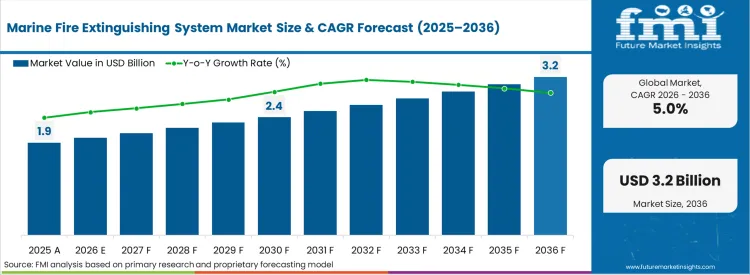
The marine fire extinguishing system market was valued at USD 1.90 billion in 2025, projected to reach USD 1.99 billion in 2026, and is forecast to expand to USD 3.25 billion by 2036 at a 5% CAGR. SOLAS Chapter II-2 fire safety provisions and tightening flag state inspection enforcement are sustaining mandatory procurement of fixed and portable fire suppression systems across the global commercial fleet. Based on FMI's analysis, the transition toward alternative low-GWP extinguishing agents and the increasing integration of automated fire detection with suppression activation is raising both the specification complexity and the average contract value of marine fire safety installations.
Summary of Marine Fire Extinguishing System Market
- Market Overview
- The market is valued at USD 1.90 billion in 2025 and is projected to reach USD 3.25 billion by 2036.
- The industry is expected to grow at a 5% CAGR from 2026 to 2036, creating an incremental opportunity of USD 1.26 billion.
- The market is a safety-regulation-driven marine equipment category where SOLAS fire safety mandates, classification society inspection cycles, and alternative agent adoption timelines define system specification and procurement patterns.
- Demand and Growth Drivers
- SOLAS Chapter II-2 provisions mandate fixed fire suppression installations in engine rooms, cargo holds, and accommodation spaces on all commercial vessels above specified tonnage thresholds, creating a non-discretionary procurement base.
- Transition toward low-GWP extinguishing agents and water mist technology is driving system replacements ahead of regulatory phase-out timelines for legacy halogenated compounds.
- Integrated fire detection and automatic suppression activation systems are replacing manual-only designs as classification societies increasingly require automated response capability.
- Among key countries, China leads at 6.8% CAGR, followed by India at 6.3%, Germany at 5.8%, France at 5.3%, the UK at 4.8%, the USA at 4.3%, and Brazil at 3.8%.
- Product and Segment View
- The market covers fixed and portable marine fire suppression systems using CO2, water, foam, powder, wet chemical, and halogen-based extinguishing agents.
- System configurations span automatic activation with integrated detection panels and manual-only designs across vessel and offshore platform applications.
- Fixed systems lead by Type with 59.6% share in 2026, reflecting SOLAS mandates for permanent fire suppression installations in engine rooms and cargo holds.
- Automatic operation leads by Operation with 63.4% share in 2026, driven by classification society requirements for integrated fire detection and automated suppression response.
- Scope includes all marine fire suppression equipment and excludes standalone detection/alarm systems, personal protective gear, and shore-side firefighting infrastructure.
- Geography and Competitive Outlook
- China and India are the fastest-growing markets driven by shipbuilding pre-delivery installation volumes and naval fleet fire safety specification requirements.
- Germany and the United Kingdom influence fire safety standards through IMO regulatory participation and classification society technical committee leadership.
- Competition is shaped by agent technology portfolio, classification society type approval, and integrated detection-suppression capability, with key players including Tyco, Kidde-Fenwal Inc., Fireboy-Xintex, Gielle, Sea-Fire, and SAFETEC International.
- Analyst Opinion at FMI
- Nikhil Kaitwade, Principal Consultant for Safety and Marine Equipment at Future Market Insights, opines: 'In my analysis, the marine fire extinguishing system market faces a technology transition inflection where legacy CO2 flooding installations are meeting increasing regulatory scrutiny over crew asphyxiation risk, while alternative water mist and clean agent systems have not yet achieved full cost parity for large-volume engine room applications. System integrators that can demonstrate integrated detection-suppression packages with documented activation response times below classification society benchmarks will capture the premium specification tier.'
- Strategic Implications / Executive Takeaways
- Fire safety system manufacturers must develop integrated detection-suppression packages with documented response times below classification society benchmarks to capture premium specification contracts from fleet operators upgrading engine room protection.
- Vessel operators should evaluate water mist and clean agent alternatives to CO2 flooding during scheduled drydocking cycles to align with anticipated crew safety regulations tightening CO2 system deployment requirements.
- Offshore platform operators must ensure fire suppression system specifications meet both maritime classification and onshore industrial safety standards, requiring dual-certified equipment from suppliers with cross-sector type approval portfolios.
Fixed fire extinguishing systems dominate procurement because SOLAS mandates permanent suppression installations in engine rooms, cargo holds, and accommodation spaces on all vessels above specified tonnage thresholds. CO2 flooding systems remain the workhorse technology for engine room and cargo hold protection, but environmental and crew safety concerns are driving evaluation of water mist, foam, and inert gas alternatives. Automatic activation systems are gaining specification preference over manual-only designs as integrated fire detection and suppression control panels reduce response times and minimize human error during emergency scenarios.
China leads with a 6.8% CAGR, driven by mandatory pre-delivery fire safety installation on every newbuilding from the world's largest shipbuilding output. India follows at 6.3%, supported by naval vessel fire safety specifications and Indian Register of Shipping classification requirements. Germany registers 5.8% growth tied to its marine safety engineering expertise and IMO regulatory drafting influence. France posts 5.3%, reflecting naval defense procurement fire safety standards. The United Kingdom tracks at 4.8% with Lloyd's Register classification testing demand, the United States at 4.3% reflecting USCG inspection cycle requirements, and Brazil at 3.8% sustained by offshore platform fire safety compliance.
Marine Fire Extinguishing System Market Key Takeaways
| Metric | Details |
|---|---|
| Industry Size (2026) | USD 1.99 billion |
| Industry Value (2036) | USD 3.25 billion |
| CAGR (2026-2036) | 5% |
Source: Future Market Insights, 2026
Marine Fire Extinguishing System Market Definition
Marine fire extinguishing systems are fixed and portable fire suppression equipment designed to detect, contain, and extinguish fires aboard commercial vessels, naval ships, offshore platforms, and recreational craft. Core system categories include CO2 flooding systems, water mist systems, foam-based suppression, dry powder extinguishers, wet chemical systems, and halogenated agent systems.
Marine Fire Extinguishing System Market Inclusions
Market scope covers fixed fire suppression installations, portable fire extinguishing equipment, CO2, water, foam, powder, wet chemical, and halogen-based systems. Coverage spans automatic and manual operation modes across ship, boat, yacht, cargo vessel, and offshore platform applications. Regional and country-level market sizes for the 2026 to 2036 period are included.
Marine Fire Extinguishing System Market Exclusions
The scope excludes standalone fire detection and alarm systems without integrated suppression capability, personal protective firefighting equipment, and shore-side port firefighting infrastructure. Marine firefighting vessels and their onboard pumping systems are also excluded.
Marine Fire Extinguishing System Market Research Methodology
- Primary Research: Analysts engaged with procurement managers, operations engineers, and industry supply chain directors to identify the decision triggers, specification requirements, and budget allocation patterns governing equipment and technology upgrades.
- Desk Research: Data collection aggregated publicly available regulatory filings, government procurement records, trade association publications, and company annual reports and investor presentations.
- Market-Sizing and Forecasting: Baseline values derive from a bottom-up aggregation of product-level shipment volumes and average selling prices, applying region-specific adoption curves to project demand through the forecast period.
- Data Validation and Update Cycle: Projections are cross-validated against publicly reported company revenue guidance, government statistical agency databases, and trade body shipment records.
Why is the Marine Fire Extinguishing System Market Growing?
The Marine Fire Extinguishing System market is experiencing steady growth driven by stringent safety regulations and increasing investments in maritime safety infrastructure. The current market is shaped by the rising adoption of advanced fire suppression technologies on commercial vessels, naval ships, and offshore platforms. The demand is being fueled by the necessity to protect high-value marine assets, crew safety, and cargo integrity, particularly in high-risk maritime environments.
Increasing awareness of maritime fire hazards, along with regulatory frameworks mandating fire safety compliance, is further supporting market expansion. Technological advancements that enhance system reliability, reduce maintenance requirements, and allow rapid response to fire incidents are paving the path for future growth.
Additionally, the integration of automated monitoring and remote control features has enabled operators to reduce human intervention, enhance operational efficiency, and ensure faster response times With the expansion of global maritime trade and offshore energy operations, the market is anticipated to continue its upward trajectory, driven by demand for safe and efficient fire suppression solutions.
Segmental Analysis
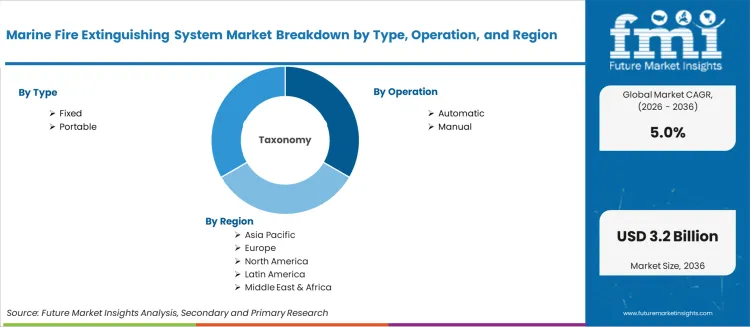
The marine fire extinguishing system market is segmented by type, operation, chemical type, application, and geographic regions. By type, marine fire extinguishing system market is divided into Fixed and Portable. In terms of operation, marine fire extinguishing system market is classified into Automatic and Manual. Based on chemical type, marine fire extinguishing system market is segmented into CO2, Water, Foam, Powder, Wet chemical, and Halogen. By application, marine fire extinguishing system market is segmented into Ships, Boats, Yachts, Cargo, and Vessels. Regionally, the marine fire extinguishing system industry is classified into North America, Latin America, Western Europe, Eastern Europe, Balkan & Baltic Countries, Russia & Belarus, Central Asia, East Asia, South Asia & Pacific, and the Middle East & Africa.
Insights into the Fixed Type Segment
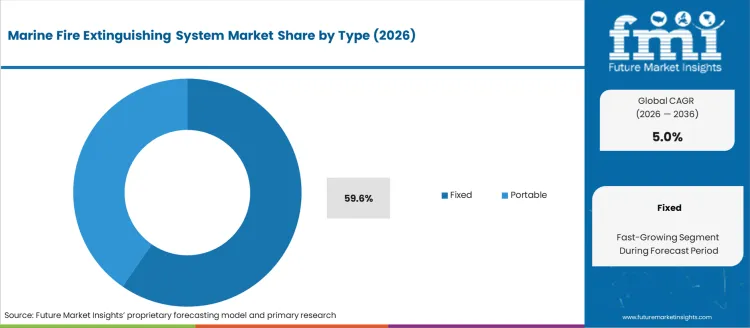
The Fixed type segment is projected to hold 59.60% of the Marine Fire Extinguishing System market revenue in 2026, making it the leading type. This dominance is being attributed to the reliability and continuous coverage provided by fixed systems, which are installed permanently on vessels and marine installations.
Adoption has been driven by the need for consistent fire suppression capabilities in engine rooms, cargo holds, and critical equipment areas where manual intervention may be delayed or impossible. Fixed systems provide precise chemical delivery and coverage for high-risk zones, ensuring rapid containment of fires and minimizing damage to marine assets.
The ability to integrate these systems with automated monitoring and alarm systems has enhanced their effectiveness, while the reduced dependency on manual firefighting makes them highly preferred by commercial operators The combination of operational reliability, low maintenance requirements, and compliance with maritime safety standards has reinforced the leadership of the fixed type segment in the market.
Insights into the Automatic Operation Segment
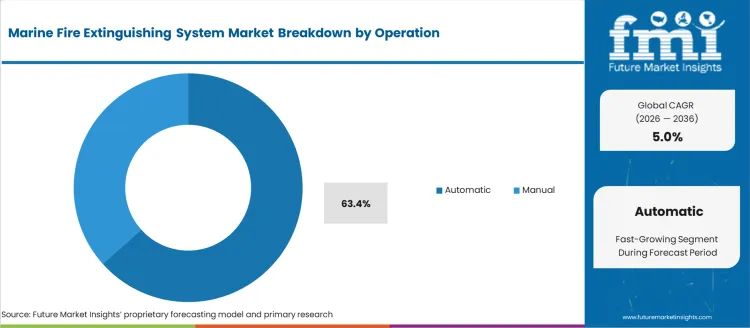
The Automatic operation segment is expected to capture 63.40% of the market revenue in 2026, emerging as the most prominent operational category. This leadership position is being driven by the growing preference for systems that can detect and suppress fires without human intervention, which is critical in hazardous and confined marine environments.
The segment’s growth has been supported by technological advancements in sensors, actuators, and control systems, which enable precise fire detection and instantaneous activation of suppression agents. Automatic systems enhance safety by reducing response times and preventing escalation, particularly in engine compartments and cargo storage areas.
The adoption of these systems is further strengthened by stringent maritime safety regulations and insurance requirements, which incentivize vessel operators to deploy fully automated fire suppression mechanisms The capability to integrate automatic operation with existing vessel management systems has further driven adoption, positioning this segment as the primary choice for modern marine safety solutions.
Insights into the CO2 Chemical Type Segment
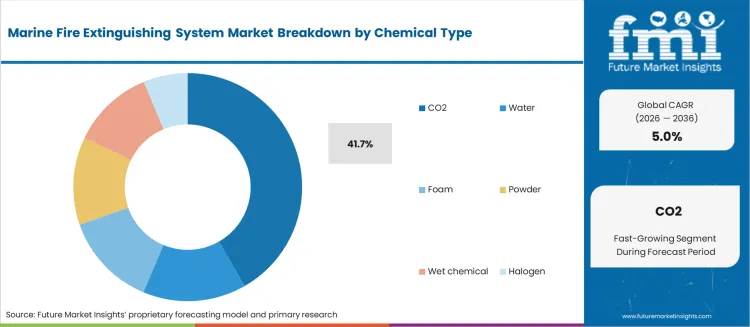
The CO2 chemical type segment is anticipated to hold 41.70% of the market revenue in 2026, establishing it as the leading chemical choice. This dominance is being driven by CO2’s effectiveness in displacing oxygen to suppress fires without leaving residue, which is particularly advantageous in engine rooms and electrical equipment areas.
Adoption has been accelerated by the need for clean suppression agents that do not damage sensitive machinery, cargo, or electronics on board. CO2 systems are compatible with both fixed and automatic configurations, offering flexibility and ease of integration into existing fire protection infrastructure.
The segment’s growth is also supported by international maritime safety standards recommending CO2 systems for enclosed spaces where rapid fire suppression is critical The ability to deliver rapid, reliable, and residue-free fire suppression has reinforced CO2’s position as the preferred chemical type in the marine fire extinguishing system market.
Market Overview
Marine Fire Extinguishing System Market Overview
The marine fire extinguishing system is the safety tool for safeguarding the livelihoods, engine room, gas turbine, propulsion unit, pump and control room, motors and generators, and cargo. Primarily carbon dioxide based marine fire extinguishing system was extensively used for the safety of fire and flame risks, and due to chemical reactions and recent advancements inert gases are used.
The marine fire safety involves the marine fire extinguishing and suppression systems for the protection of engine rooms, machinery space and other marine assets. The deployment of marine fire extinguishing system for rough sea conditions is a challenging scenario. Maintaining the safety of sensitive equipment by using Novec fire suppression system as they do not conduct electricity, non-corrosive, and reduces the damages to sensitive equipment.
The technological advancements in marine fire extinguishing system with fully automatic and fixed marine fire extinguishing system supports the safety of boats and ships. The pre-engineered solutions, and wireless detection supports the sales of marine fire extinguishing system in recent times. The periodic development with no waste deposition will drive the marine fire extinguishing system.
Marine Fire Extinguishing System Market: Market Dynamics
The global marine fire extinguishing system market is reaching maturity stage in the European and other developed countries such as the UK, France, Germany, the USA and Italy. The driving factor for the marine fire extinguishing system market is it reduces the risks of assets and human with periodic servicing of the marine fire extinguishing system.
The market is having a major growth momentum in the Asian countries as the technological advancements in marine fire extinguishing system helps in securing the safety by avoiding flames.
The boats and cargo vessels are the driving force for the sales of marine fire extinguishing system globally as they are installed in large number. It is followed by other ships and vessels as the sea transport is gaining traction due to growing population and global trade scenario. The growth of connectivity and online sales channel are also driving the sales of marine fire extinguishing system.
Marine Fire Extinguishing System Market: Regional Outlook
The Asian market is the key market place for the global marine fire extinguishing system market. The manufacturers from China are driving the sales of marine fire extinguishing system in the Asian market. Currently, ship and boat manufactures from Asia are the leading end users of marine fire extinguishing system. It is expected that this trend will continue in the forecast period due to increasing trade in countries such as India, Indonesia, Vietnam, Thailand, and Malaysia.
The regulations that are levied to maintain the safety of human labor will drive the installation of marine fire extinguishing system. The safety regulations laid by the European Union is positively impact the growth of marine fire extinguishing system market.
The developed economies such as the USA, the UK, France, Germany, and Japan are looking for sales of customized boats and yachts which will directly support the installation of marine fire extinguishing system. In addition to that, the growing tourism and fisheries sector will positively drive the adoption of marine fire extinguishing system.
The research report presents a comprehensive assessment of the marine fire extinguishing system market and contains thoughtful insights, facts, historical data and statistically supported and industry-validated market data. It also contains projections using a suitable set of assumptions and methodologies. The research report provides analysis and information according to market segments such as geographies, material type, temperature range, and end use.
The report covers exhaustive analysis on
- Market Segments
- Market Dynamics
- Market Size
- Supply & Demand
- Current Trends/Issues/Challenges
- Competition & Companies involved
- Technology
- Value Chain
Regional analysis includes
- North America (USA, Canada)
- Latin America (Mexico, Brazil, Argentina, Chile, Peru)
- Western Europe (Germany, Italy, France, UK, Spain, BENELUX, Nordics)
- Eastern Europe (Russia, Poland, CIS)
- Asia-Pacific (China, India, ASEAN, South Korea)
- Japan
- Middle East and Africa (GCC Countries, South Africa, Turkey, Iran, Israel)
The report is a compilation of first-hand information, qualitative and quantitative assessment by industry analysts, inputs from industry experts and industry participants across the value chain. The report provides in-depth analysis of parent market trends, macro-economic indicators and governing factors along with market attractiveness as per segments. The report also maps the qualitative impact of various market factors on market segments and geographies.
Analysis of Marine Fire Extinguishing System Market By Key Countries
.webp "Top Country Growth Comparison Marine Fire Extinguishing System Market Cagr (2026 2036)")
| Country | CAGR |
|---|---|
| China | 6.8% |
| India | 6.3% |
| Germany | 5.8% |
| France | 5.3% |
| UK | 4.8% |
| USA | 4.3% |
| Brazil | 3.8% |
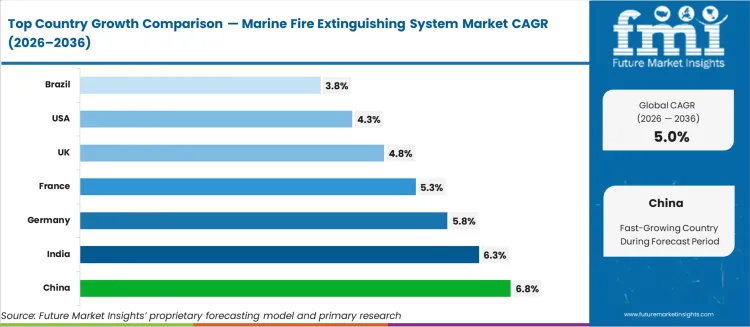
The Marine Fire Extinguishing System Market is expected to register a CAGR of 5.0% during the forecast period, exhibiting varied country level momentum. China leads with the highest CAGR of 6.8%, followed by India at 6.3%. Developed markets such as Germany, France, and the UK continue to expand steadily, while the USA is likely to grow at consistent rates. Brazil posts the lowest CAGR at 3.8%, yet still underscores a broadly positive trajectory for the global Marine Fire Extinguishing System Market. In 2024, Germany held a dominant revenue in the Western Europe market and is expected to grow with a CAGR of 5.8%. The USA Marine Fire Extinguishing System Market is estimated to be valued at USD 648.1 million in 2026 and is anticipated to reach a valuation of USD 982.6 million by 2036. Sales are projected to rise at a CAGR of 4.3% over the forecast period between 2026 and 2036. While Japan and South Korea markets are estimated to be valued at USD 97.5 million and USD 52.7 million respectively in 2026.
Key Players in the Marine Fire Extinguishing System Market
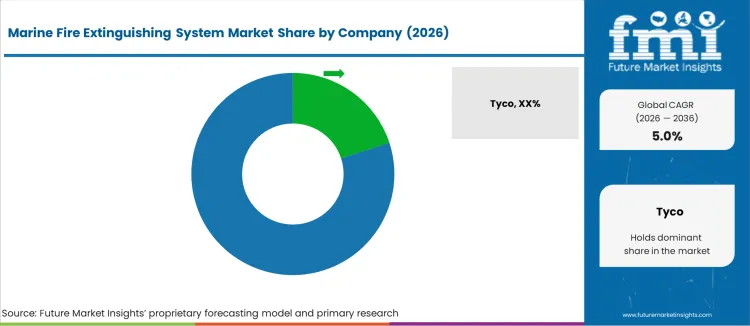
- Tyco
- Asiatic Fire System Pte Ltd.
- Bulbeck Group
- Fire Protection Technologies
- Fireboy-Xintex
- Firetronics
- Gielle
- Global Marine Safety Pte. Ltd.
- Hawk Marine Pte Ltd
- Kidde-Fenwal Inc.
- Marine Fire Safety
- SAFETEC INTERNATIONAL HOLDING PTE LTD
- Sea-Fire
Scope of the Report
| Metric | Value |
|---|---|
| Quantitative Units | USD 1.99 billion to USD 3.25 billion, at a CAGR of 5% |
| Market Definition | Marine fire extinguishing systems are fixed and portable fire suppression equipment designed to detect, contain, and extinguish fires aboard commercial vessels, naval ships, offshore platforms, and re... |
| Segmentation | Type: Fixed, Portable; Operation: Automatic, Manual; Chemical Type: CO2, Water, Foam, Powder, Wet chemical, Halogen; Application: Ships, Boats, Yachts, Cargo, Vessels |
| Regions Covered | North America, Latin America, Europe, East Asia, South Asia, Oceania, Middle East & Africa |
| Countries Covered | China, India, Germany, France, UK, USA, Brazil, and 40 plus countries |
| Key Companies Profiled | Tyco, Asiatic Fire System Pte Ltd., Bulbeck Group, Fire Protection Technologies, Fireboy-Xintex, Firetronics, Gielle, Global Marine Safety Pte. Ltd., Hawk Marine Pte Ltd, Kidde-Fenwal Inc., Marine Fire Safety, SAFETEC INTERNATIONAL HOLDING PTE LTD, Sea-Fire |
| Forecast Period | 2026 to 2036 |
| Approach | Forecasting models apply a bottom-up methodology starting with global installed base metrics and product-level demand curves, cross-validated against publicly reported revenue and trade data. |
Marine Fire Extinguishing System Market by Segments
Type:
- Fixed
- Portable
Operation:
- Automatic
- Manual
Chemical Type:
- CO2
- Water
- Foam
- Powder
- Wet chemical
- Halogen
Application:
- Ships
- Boats
- Yachts
- Cargo
- Vessels
Region:
- North America
- USA
- Canada
- Mexico
- Latin America
- Brazil
- Chile
- Rest of Latin America
- Western Europe
- Germany
- UK
- Italy
- Spain
- France
- Nordic
- BENELUX
- Rest of Western Europe
- Eastern Europe
- Russia
- Poland
- Hungary
- Balkan & Baltic
- Rest of Eastern Europe
- East Asia
- China
- Japan
- South Korea
- South Asia and Pacific
- India
- ASEAN
- Australia & New Zealand
- Rest of South Asia and Pacific
- Middle East & Africa
- Kingdom of Saudi Arabia
- Other GCC Countries
- Turkiye
- South Africa
- Other African Union
- Rest of Middle East & Africa
Bibliography
- International Maritime Organization. (2024). SOLAS Chapter II-2: Construction, Fire Protection, Fire Detection, and Fire Extinction. IMO.
- International Association of Classification Societies. (2024). Unified Requirements for Fire Safety Systems on Ships. IACS.
- National Fire Protection Association. (2024). NFPA 2001: Standard on Clean Agent Fire Extinguishing Systems. NFPA.
- Lloyd's Register. (2024). Rules and Regulations for the Classification of Ships: Fire Safety Requirements. Lloyd's Register.
- United States Coast Guard. (2024). Marine Safety Manual: Fire Protection Equipment Inspection Standards. USCG.
- European Maritime Safety Agency. (2024). Fire Safety Equipment Compliance Report for EU-Flagged Vessels. EMSA.
This bibliography is provided for reader reference. The full Future Market Insights report contains the complete reference list with primary research documentation.
Frequently Asked Questions
How large is the demand for Marine Fire Extinguishing System in the global market in 2026?
Demand for marine fire extinguishing systems in the global market is estimated to be valued at USD 1.99 billion in 2026.
What will be the market size by 2036?
Market size for marine fire extinguishing systems is projected to reach USD 3.25 billion by 2036.
What is the expected demand growth between 2026 and 2036?
Demand is expected to grow at a CAGR of 5% between 2026 and 2036.
Which Type is poised to lead by 2026?
Fixed systems account for 59.6% share in 2026, reflecting SOLAS mandates for permanent suppression installations in engine rooms and cargo holds.
How significant is Automatic operation?
Automatic operation holds 63.4% share in 2026 as classification societies increasingly require integrated fire detection and automated suppression activation.
What is driving demand in China?
Mandatory pre-delivery fire safety system installation on every vessel from the world's largest shipbuilding output creates sustained procurement demand.
What is India's growth outlook in this report?
India is projected to grow at a CAGR of 6.3% during 2026 to 2036.
Preview the report firsthand - request a free sample
Get SampleGet the brochure for pricing and purchase details.
Get PDFTable of Content
- Executive Summary
- Global Market Outlook
- Demand-side Trends
- Supply-side Trends
- Technology Roadmap Analysis
- Analysis and Recommendations
- Market Overview
- Market Coverage / Taxonomy
- Market Definition / Scope / Limitations
- Research Methodology
- Chapter Orientation
- Analytical Lens and Working Hypotheses
- Market Structure, Signals, and Trend Drivers
- Benchmarking and Cross-market Comparability
- Market Sizing, Forecasting, and Opportunity Mapping
- Research Design and Evidence Framework
- Desk Research Programme (Secondary Evidence)
- Company Annual and Sustainability Reports
- Peer-reviewed Journals and Academic Literature
- Corporate Websites, Product Literature, and Technical Notes
- Earnings Decks and Investor Briefings
- Statutory Filings and Regulatory Disclosures
- Technical White Papers and Standards Notes
- Trade Journals, Industry Magazines, and Analyst Briefs
- Conference Proceedings, Webinars, and Seminar Materials
- Government Statistics Portals and Public Data Releases
- Press Releases and Reputable Media Coverage
- Specialist Newsletters and Curated Briefings
- Sector Databases and Reference Repositories
- FMI Internal Proprietary Databases and Historical Market Datasets
- Subscription Datasets and Paid Sources
- Social Channels, Communities, and Digital Listening Inputs
- Additional Desk Sources
- Expert Input and Fieldwork (Primary Evidence)
- Primary Modes
- Qualitative Interviews and Expert Elicitation
- Quantitative Surveys and Structured Data Capture
- Blended Approach
- Why Primary Evidence is Used
- Field Techniques
- Interviews
- Surveys
- Presidents and Vice Presidents
- R&D and Innovation Heads
- Technical Specialists
- Domain Subject-matter Experts
- Scientists
- Physicians and Other Healthcare Professionals
- Governance, Ethics, and Data Stewardship
- Research Ethics
- Data Integrity and Handling
- Primary Modes
- Tooling, Models, and Reference Databases
- Desk Research Programme (Secondary Evidence)
- Data Engineering and Model Build
- Data Acquisition and Ingestion
- Cleaning, Normalisation, and Verification
- Synthesis, Triangulation, and Analysis
- Quality Assurance and Audit Trail
- Market Background
- Market Dynamics
- Drivers
- Restraints
- Opportunity
- Trends
- Scenario Forecast
- Demand in Optimistic Scenario
- Demand in Likely Scenario
- Demand in Conservative Scenario
- Opportunity Map Analysis
- Product Life Cycle Analysis
- Supply Chain Analysis
- Investment Feasibility Matrix
- Value Chain Analysis
- PESTLE and Porter’s Analysis
- Regulatory Landscape
- Regional Parent Market Outlook
- Production and Consumption Statistics
- Import and Export Statistics
- Market Dynamics
- Global Market Analysis 2021 to 2025 and Forecast, 2026 to 2036
- Historical Market Size Value (USD Million) Analysis, 2021 to 2025
- Current and Future Market Size Value (USD Million) Projections, 2026 to 2036
- Y-o-Y Growth Trend Analysis
- Absolute $ Opportunity Analysis
- Global Market Pricing Analysis 2021 to 2025 and Forecast 2026 to 2036
- Global Market Analysis 2021 to 2025 and Forecast 2026 to 2036, By Type
- Introduction / Key Findings
- Historical Market Size Value (USD Million) Analysis By Type , 2021 to 2025
- Current and Future Market Size Value (USD Million) Analysis and Forecast By Type , 2026 to 2036
- Fixed
- Portable
- Fixed
- Y-o-Y Growth Trend Analysis By Type , 2021 to 2025
- Absolute $ Opportunity Analysis By Type , 2026 to 2036
- Global Market Analysis 2021 to 2025 and Forecast 2026 to 2036, By Operation
- Introduction / Key Findings
- Historical Market Size Value (USD Million) Analysis By Operation, 2021 to 2025
- Current and Future Market Size Value (USD Million) Analysis and Forecast By Operation, 2026 to 2036
- Automatic
- Manual
- Automatic
- Y-o-Y Growth Trend Analysis By Operation, 2021 to 2025
- Absolute $ Opportunity Analysis By Operation, 2026 to 2036
- Global Market Analysis 2021 to 2025 and Forecast 2026 to 2036, By Chemical Type
- Introduction / Key Findings
- Historical Market Size Value (USD Million) Analysis By Chemical Type, 2021 to 2025
- Current and Future Market Size Value (USD Million) Analysis and Forecast By Chemical Type, 2026 to 2036
- CO2
- Water
- Foam
- Powder
- Wet chemical
- Halogen
- CO2
- Y-o-Y Growth Trend Analysis By Chemical Type, 2021 to 2025
- Absolute $ Opportunity Analysis By Chemical Type, 2026 to 2036
- Global Market Analysis 2021 to 2025 and Forecast 2026 to 2036, By Application
- Introduction / Key Findings
- Historical Market Size Value (USD Million) Analysis By Application, 2021 to 2025
- Current and Future Market Size Value (USD Million) Analysis and Forecast By Application, 2026 to 2036
- Ships
- Boats
- Yachts
- Cargo
- Vessels
- Ships
- Y-o-Y Growth Trend Analysis By Application, 2021 to 2025
- Absolute $ Opportunity Analysis By Application, 2026 to 2036
- Global Market Analysis 2021 to 2025 and Forecast 2026 to 2036, By Region
- Introduction
- Historical Market Size Value (USD Million) Analysis By Region, 2021 to 2025
- Current Market Size Value (USD Million) Analysis and Forecast By Region, 2026 to 2036
- North America
- Latin America
- Western Europe
- Eastern Europe
- East Asia
- South Asia and Pacific
- Middle East & Africa
- Market Attractiveness Analysis By Region
- North America Market Analysis 2021 to 2025 and Forecast 2026 to 2036, By Country
- Historical Market Size Value (USD Million) Trend Analysis By Market Taxonomy, 2021 to 2025
- Market Size Value (USD Million) Forecast By Market Taxonomy, 2026 to 2036
- By Country
- USA
- Canada
- Mexico
- By Type
- By Operation
- By Chemical Type
- By Application
- By Country
- Market Attractiveness Analysis
- By Country
- By Type
- By Operation
- By Chemical Type
- By Application
- Key Takeaways
- Latin America Market Analysis 2021 to 2025 and Forecast 2026 to 2036, By Country
- Historical Market Size Value (USD Million) Trend Analysis By Market Taxonomy, 2021 to 2025
- Market Size Value (USD Million) Forecast By Market Taxonomy, 2026 to 2036
- By Country
- Brazil
- Chile
- Rest of Latin America
- By Type
- By Operation
- By Chemical Type
- By Application
- By Country
- Market Attractiveness Analysis
- By Country
- By Type
- By Operation
- By Chemical Type
- By Application
- Key Takeaways
- Western Europe Market Analysis 2021 to 2025 and Forecast 2026 to 2036, By Country
- Historical Market Size Value (USD Million) Trend Analysis By Market Taxonomy, 2021 to 2025
- Market Size Value (USD Million) Forecast By Market Taxonomy, 2026 to 2036
- By Country
- Germany
- UK
- Italy
- Spain
- France
- Nordic
- BENELUX
- Rest of Western Europe
- By Type
- By Operation
- By Chemical Type
- By Application
- By Country
- Market Attractiveness Analysis
- By Country
- By Type
- By Operation
- By Chemical Type
- By Application
- Key Takeaways
- Eastern Europe Market Analysis 2021 to 2025 and Forecast 2026 to 2036, By Country
- Historical Market Size Value (USD Million) Trend Analysis By Market Taxonomy, 2021 to 2025
- Market Size Value (USD Million) Forecast By Market Taxonomy, 2026 to 2036
- By Country
- Russia
- Poland
- Hungary
- Balkan & Baltic
- Rest of Eastern Europe
- By Type
- By Operation
- By Chemical Type
- By Application
- By Country
- Market Attractiveness Analysis
- By Country
- By Type
- By Operation
- By Chemical Type
- By Application
- Key Takeaways
- East Asia Market Analysis 2021 to 2025 and Forecast 2026 to 2036, By Country
- Historical Market Size Value (USD Million) Trend Analysis By Market Taxonomy, 2021 to 2025
- Market Size Value (USD Million) Forecast By Market Taxonomy, 2026 to 2036
- By Country
- China
- Japan
- South Korea
- By Type
- By Operation
- By Chemical Type
- By Application
- By Country
- Market Attractiveness Analysis
- By Country
- By Type
- By Operation
- By Chemical Type
- By Application
- Key Takeaways
- South Asia and Pacific Market Analysis 2021 to 2025 and Forecast 2026 to 2036, By Country
- Historical Market Size Value (USD Million) Trend Analysis By Market Taxonomy, 2021 to 2025
- Market Size Value (USD Million) Forecast By Market Taxonomy, 2026 to 2036
- By Country
- India
- ASEAN
- Australia & New Zealand
- Rest of South Asia and Pacific
- By Type
- By Operation
- By Chemical Type
- By Application
- By Country
- Market Attractiveness Analysis
- By Country
- By Type
- By Operation
- By Chemical Type
- By Application
- Key Takeaways
- Middle East & Africa Market Analysis 2021 to 2025 and Forecast 2026 to 2036, By Country
- Historical Market Size Value (USD Million) Trend Analysis By Market Taxonomy, 2021 to 2025
- Market Size Value (USD Million) Forecast By Market Taxonomy, 2026 to 2036
- By Country
- Kingdom of Saudi Arabia
- Other GCC Countries
- Turkiye
- South Africa
- Other African Union
- Rest of Middle East & Africa
- By Type
- By Operation
- By Chemical Type
- By Application
- By Country
- Market Attractiveness Analysis
- By Country
- By Type
- By Operation
- By Chemical Type
- By Application
- Key Takeaways
- Key Countries Market Analysis
- USA
- Pricing Analysis
- Market Share Analysis, 2025
- By Type
- By Operation
- By Chemical Type
- By Application
- Canada
- Pricing Analysis
- Market Share Analysis, 2025
- By Type
- By Operation
- By Chemical Type
- By Application
- Mexico
- Pricing Analysis
- Market Share Analysis, 2025
- By Type
- By Operation
- By Chemical Type
- By Application
- Brazil
- Pricing Analysis
- Market Share Analysis, 2025
- By Type
- By Operation
- By Chemical Type
- By Application
- Chile
- Pricing Analysis
- Market Share Analysis, 2025
- By Type
- By Operation
- By Chemical Type
- By Application
- Germany
- Pricing Analysis
- Market Share Analysis, 2025
- By Type
- By Operation
- By Chemical Type
- By Application
- UK
- Pricing Analysis
- Market Share Analysis, 2025
- By Type
- By Operation
- By Chemical Type
- By Application
- Italy
- Pricing Analysis
- Market Share Analysis, 2025
- By Type
- By Operation
- By Chemical Type
- By Application
- Spain
- Pricing Analysis
- Market Share Analysis, 2025
- By Type
- By Operation
- By Chemical Type
- By Application
- France
- Pricing Analysis
- Market Share Analysis, 2025
- By Type
- By Operation
- By Chemical Type
- By Application
- India
- Pricing Analysis
- Market Share Analysis, 2025
- By Type
- By Operation
- By Chemical Type
- By Application
- ASEAN
- Pricing Analysis
- Market Share Analysis, 2025
- By Type
- By Operation
- By Chemical Type
- By Application
- Australia & New Zealand
- Pricing Analysis
- Market Share Analysis, 2025
- By Type
- By Operation
- By Chemical Type
- By Application
- China
- Pricing Analysis
- Market Share Analysis, 2025
- By Type
- By Operation
- By Chemical Type
- By Application
- Japan
- Pricing Analysis
- Market Share Analysis, 2025
- By Type
- By Operation
- By Chemical Type
- By Application
- South Korea
- Pricing Analysis
- Market Share Analysis, 2025
- By Type
- By Operation
- By Chemical Type
- By Application
- Russia
- Pricing Analysis
- Market Share Analysis, 2025
- By Type
- By Operation
- By Chemical Type
- By Application
- Poland
- Pricing Analysis
- Market Share Analysis, 2025
- By Type
- By Operation
- By Chemical Type
- By Application
- Hungary
- Pricing Analysis
- Market Share Analysis, 2025
- By Type
- By Operation
- By Chemical Type
- By Application
- Kingdom of Saudi Arabia
- Pricing Analysis
- Market Share Analysis, 2025
- By Type
- By Operation
- By Chemical Type
- By Application
- Turkiye
- Pricing Analysis
- Market Share Analysis, 2025
- By Type
- By Operation
- By Chemical Type
- By Application
- South Africa
- Pricing Analysis
- Market Share Analysis, 2025
- By Type
- By Operation
- By Chemical Type
- By Application
- USA
- Market Structure Analysis
- Competition Dashboard
- Competition Benchmarking
- Market Share Analysis of Top Players
- By Regional
- By Type
- By Operation
- By Chemical Type
- By Application
- Competition Analysis
- Competition Deep Dive
- Tyco
- Overview
- Product Portfolio
- Profitability by Market Segments (Product/Age /Sales Channel/Region)
- Sales Footprint
- Strategy Overview
- Marketing Strategy
- Product Strategy
- Channel Strategy
- Asiatic Fire System Pte Ltd.
- Bulbeck Group
- Fire Protection Technologies
- Fireboy-Xintex
- Firetronics
- Gielle
- Global Marine Safety Pte. Ltd.
- Hawk Marine Pte Ltd
- Kidde-Fenwal Inc.
- Marine Fire Safety
- SAFETEC INTERNATIONAL HOLDING PTE LTD
- Sea-Fire
- Tyco
- Competition Deep Dive
- Assumptions & Acronyms Used


