

- Market Size (2026)
- USD 1.7 Bn
- Forecast (2036)
- USD 4.1 Bn
- CAGR (2026 to 2036)
- 9.1%
How big is Automatic Guiding Systems Market in 2026?
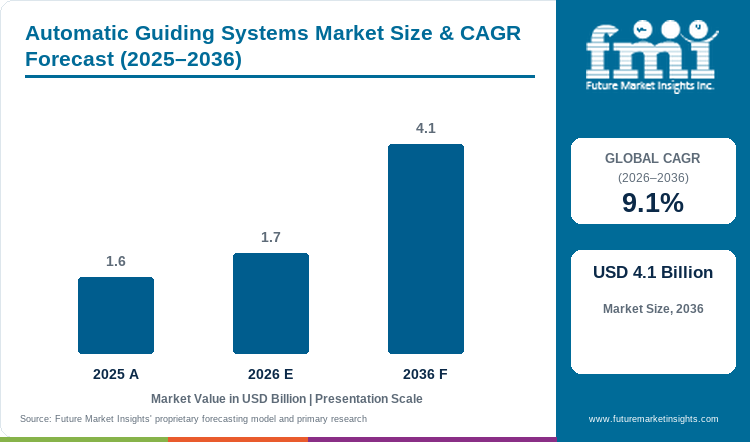
USD 1.7 Billion in 2026 and USD 4.1 Billion by 2036 at a 9.1% CAGR.
Sales of automatic guiding systems are estimated to grow at 9.1% CAGR from USD 1.7 billion in 2026 to USD 4.1 billion by 2036. The market was valued at USD 1.6 billion in 2025. Demand strengthens when a guidance stack can turn repetitive movement into measurable labor savings without disrupting the surrounding workflow. Seegrid reported in May 2026 that its autonomous mobile robot fleet had passed 20 million autonomous miles in customer production facilities. That operating scale shifts buying criteria away from autonomy as a feature and toward dependable localization, safe stopping behavior, fleet coordination, and recovery when a route is blocked.
Automatic guidance has to work with the traffic and infrastructure at each site. Germany's VDA 5050 Version 3.0 addresses mixed-fleet communication. Singapore's middleware programs connect robots with lifts and doors. In manufacturing and logistics, automated guided vehicles need sensing, navigation and control that remain predictable when a route is blocked or another vehicle enters an intersection. Site integration determines how much of a fleet's operating time is productive.
Key Takeaways
- Labor availability and throughput pressure support spending when automatic guidance can remove repetitive travel without creating new bottlenecks at handoff points.
- AGV guidance systems are projected to hold 28.0% of System Type revenue in 2026, supported by repeatable industrial transport routes with measurable utilization.
- LiDAR / SLAM leads Guidance Technology with 31.0% share, while Navigation software accounts for 26.0% of Component revenue as buyers prioritize infrastructure-light localization and reusable route logic.
- Site integration remains the main restraint because traffic rules, safety behavior, vehicle interfaces, and plant software must work together before the system can scale.
- Singapore is the fastest-growing profiled country at 9.6% CAGR from 2026 to 2036, followed by South Korea at 9.2%.
- Notable companies include SICK, Kollmorgen Automation, Bastian Solutions, Jungheinrich, Toyota Material Handling, Seegrid, BlueBotics, Balyo, John Deere, and Trimble.
Analyst Perspective
A guidance system has to recover from ordinary site interruptions: a blocked aisle, a moved rack or a delayed handoff. Reliable localization is only part of that task. Fleet software and vehicle controls must coordinate the response. Reusable interfaces can make it easier to add vehicles or repeat a deployment at another facility without redoing every connection.
- Nikhil Kaitwade, Principal Consultant, Future Market Insights
How is the automatic guiding systems market segmented?
The market is segmented by System Type, Guidance Technology, Component, End Use, and Sales Model.
The Automatic Guiding Systems Market is segmented by System Type into AGV guidance systems, AMR navigation systems, Machine guidance systems, Automated steering systems, and Rail / transit guidance systems. Guidance Technology includes LiDAR / SLAM, Magnetic guidance, Vision guidance, Laser guidance, and GNSS / RTK. Component covers Navigation software, Controllers, Sensors, Actuators, and Integration services. End Use includes Manufacturing, Warehousing, Agriculture, Construction / mining, and Ports / terminals. Sales Model includes Hardware sale, Software license, Integrated system supply, and Retrofit service. The component layer also intersects with the wider market for industrial automation where motion, safety, and system-level commands must be translated into repeatable machine behavior.
Why do AGV guidance systems lead demand within the System Type category?
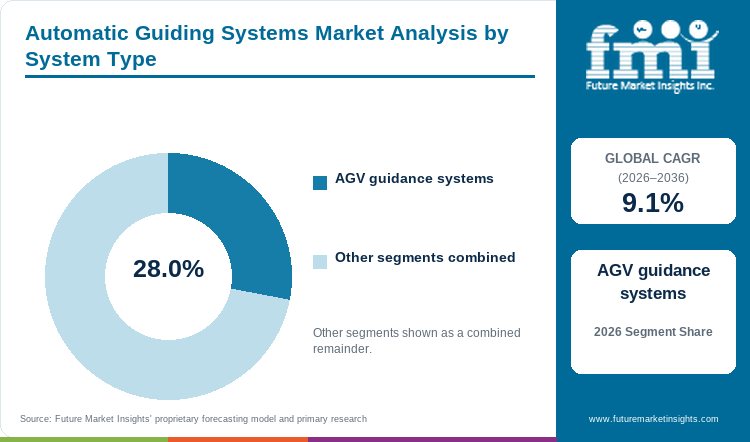
AGV guidance systems fit facilities where material moves through stable lanes, stations, and handoff points on a known cadence. That predictability gives buyers a clearer payback model because route frequency, vehicle utilization, and labor displacement can be measured before installation. Toyota Material Handling stated in March 2026 that AGVs are especially useful for repetitive and standardized material-handling tasks. AMR navigation offers more freedom in changing layouts, but AGV guidance remains commercially strong where production logistics depend on deterministic movement between fixed points.
- AGV guidance systems represent 28.0% of System Type revenue in 2026, reflecting mature use in repeatable industrial transport.
- The purchasing case is strongest when a defined lane can carry high trip frequency across multiple shifts without repeated route redesign.
Why does LiDAR / SLAM lead demand within the Guidance Technology category?
LiDAR / SLAM reduces dependence on buried wires, magnetic tape, or other fixed route infrastructure by localizing a vehicle against mapped surroundings. That matters when racks, machines, or staging areas move after commissioning. It also supports route adaptation without reopening the floor. SICK's 2025/2026 innovation material presents Triton Floor-LOC as an infrastructure-light localization system that can operate alongside LiDAR-LOC, showing how current mobile-robot stacks are combining natural environmental information with complementary localization methods. Magnetic and laser guidance remain useful where routes are stable, but LiDAR / SLAM has an advantage when layout flexibility carries economic value.
- LiDAR / SLAM holds 31.0% of Guidance Technology revenue in 2026 because it supports flexible mapping with less fixed guidance infrastructure.
- Buyers can change routes or operating zones more easily when localization depends on mapped environmental features rather than a physical path embedded in the floor.
Why does Navigation software lead demand within the Component category?
Navigation software converts sensor input, vehicle constraints, and route rules into a usable position and movement decision. Software design affects how quickly the system can be mapped, extended or adapted to another vehicle. Kollmorgen's June 2025 NDC release expanded API support across AGVs, AMRs, software platforms, and surrounding systems. The value is not only in path calculation. Buyers use the software layer to connect localization with traffic logic, mission allocation, and higher-level workflow commands.
- Navigation software accounts for 26.0% of Component revenue in 2026 because mapping, localization, and route logic determine how reusable the physical platform becomes.
- Broader APIs lower integration effort when customers connect vehicle behavior with WMS, MES, or facility-control systems.
Why does Manufacturing lead demand within the End Use category?
Manufacturing creates a dense sequence of repeatable transport tasks between receiving, storage, machining, assembly, and line-side replenishment. A missed move can interrupt production rather than merely delay a warehouse pick. Jungheinrich announced in April 2025 that the bilstein group planned a pilot with four EAE 212a autonomous mobile robots for internal transport at its Gelsenkirchen site. The project also aimed to shift skilled forklift drivers toward more complex work. This use case sits inside broader factory automation and industrial controls programs where the economic case depends on protecting line flow, not simply replacing a single operator.
- Manufacturing represents 32.0% of End Use revenue in 2026, supported by repeatable internal logistics and high vehicle utilization.
- Guidance investment becomes easier to justify when an autonomous transport loop protects production continuity and releases skilled labor for tasks that cannot be automated as easily.
Why does Hardware sale lead demand within the Sales Model category?
Automatic guidance still requires physical sensing, computing, controllers, safety devices, and vehicle interfaces before software can produce movement. That keeps capital hardware central to new installations and major retrofits. Toyota Material Handling's March 2026 AGV portfolio includes tow tractors, automated forklifts, pallet carts, and mini-load autonomous vehicles. Software licensing and integrated system supply become more important as fleets grow, but many projects still begin with a defined vehicle platform that must be equipped and commissioned for a specific movement task.
- Hardware sale represents 34.0% of Sales Model revenue in 2026 because the guidance and control layer remains a required physical purchase in most deployments.
- Software and services capture more value as fleet complexity rises, but sensors, controllers, computing, and vehicle interfaces remain the entry point for most projects.
What are the drivers, restraints and opportunities in the Automatic Guiding Systems Market?
Demand is supported by labor and throughput pressure, while site integration and safety validation slow conversion, and interoperable retrofit-ready architectures open the clearest expansion path.
- Driver: Labor and throughput pressure increases spending on repeatable autonomous transport and equipment positioning.
- Restraint: Site-specific integration, safety behavior, and localization reliability can extend commissioning and weaken project payback.
- Opportunity: Open interfaces, modular guidance software, and retrofit architectures can scale automation across mixed fleets and installed equipment.
Repeated transport between stations creates an opportunity to automate manual movement. The International Federation of Robotics identified transportation and logistics as the largest professional service-robot application in its 2025 service-robot release. Buyers act when the cost of repetitive travel, missed handoffs, or shift coverage becomes larger than the combined cost of guidance hardware, commissioning, and support. Related warehouse robotics spending reinforces the same logic because internal movement becomes a throughput constraint long before every warehouse task is automated.
Commissioning must account for people, manual forklifts, intersections and obstructed routes. A navigation system that works in an empty aisle may need further mapping, traffic rules and safety validation during production. Door controls, lifts and plant software add interfaces. Installation costs are harder to recover when these tasks take longer than expected or the fleet operates too few hours.
Common interfaces can reduce the integration needed when a fleet expands. VDA 5050 Version 3.0, released in April 2026, expands cross-manufacturer communication for mobile robots and introduces a zone concept for freely navigating vehicles. A common interface does not eliminate site engineering, but it reduces the amount of custom work needed when a buyer adds a new vehicle type or extends automation into another area. Suppliers that package navigation, fleet control, APIs, and retrofit support around open interfaces can shorten the path from a successful pilot to a multi-site program.
Which country CAGRs are profiled in the Automatic Guiding Systems Market?
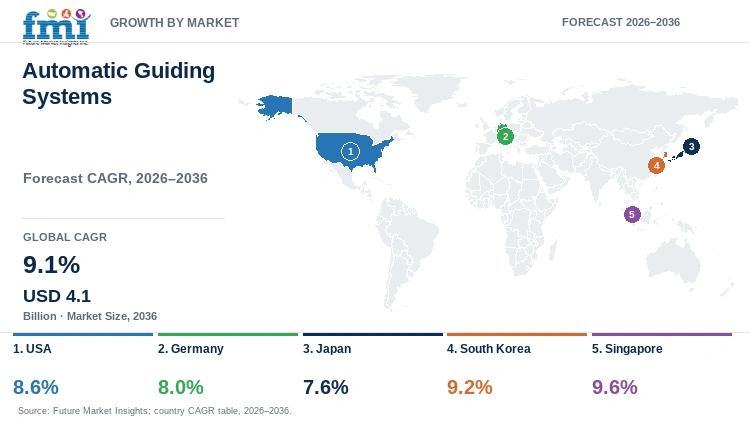
| Country | CAGR |
|---|---|
| USA | 8.6% |
| Germany | 8.0% |
| Japan | 7.6% |
| South Korea | 9.2% |
| Singapore | 9.6% |
How do country-level CAGRs compare in the Automatic Guiding Systems Market?
The five country forecasts range from 7.6% to 9.6% CAGR from 2026 to 2036, a 2.0 percentage-point spread. Singapore and South Korea support adoption through mobile-robot and smart-factory programs. Germany's mixed-fleet standards and Japan's autonomous-delivery roadmap address specific deployment barriers. In the USA, large multi-shift sites can spread commissioning costs across more operating hours.
- Singapore exceeds South Korea by 0.4 percentage points as interoperability support broadens the addressable base for multi-robot deployments.
- South Korea exceeds the USA by 0.6 percentage points as smart-factory support can pull guidance projects into wider plant modernization budgets.
- The USA exceeds Germany by 0.6 percentage points, while Germany's VDA 5050 work can reduce mixed-fleet integration friction over the forecast period.
- Germany exceeds Japan by 0.4 percentage points. Japan's growth remains tied to carefully defined use cases where labor pressure can justify autonomous operation without disrupting established processes.
Country-wise Analysis
- USA: Demand for Automatic Guiding Systems is forecast to expand at 8.6% CAGR from 2026 to 2036. Large manufacturing and logistics sites can use fleets across several shifts, spreading integration costs over more operating hours. Mixed equipment and enterprise software create substantial interface work. Guidance suppliers need to maintain reliable traffic behavior and recovery procedures as vehicles are added to an operating facility.
- Germany: Adoption of Automatic Guiding Systems in Germany is forecast to rise at 8.0% CAGR from 2026 to 2036. German automotive and industrial plants often run equipment from several suppliers, which raises the value of common fleet interfaces. VDA 5050 Version 3.0 was released in April 2026 with support for cross-manufacturer data exchange and free-navigation zones. Suppliers that fit this interoperability framework can address mixed fleets without forcing the customer to standardize every vehicle on one vendor's control layer.
- Japan: Sales of Automatic Guiding Systems in Japan are forecast to expand at 7.6% CAGR from 2026 to 2036. Japan's Ministry of Economy, Trade and Industry published a February 2025 roadmap for wider social implementation of autonomous delivery robots as the logistics sector faces labor shortages. The roadmap emphasizes repeated demonstrations and defined operating conditions before broader deployment. That favors guidance suppliers able to package localization and control around narrow, testable tasks rather than asking operators to redesign an entire workflow at once.
- South Korea: Demand for Automatic Guiding Systems in South Korea is forecast to rise at 9.2% CAGR from 2026 to 2036. The Ministry of SMEs and Startups expanded its 2025 inter-ministry smart-factory support program from KRW 7 billion to KRW 30 billion and targeted 150 companies across ten fields. That creates a route for guidance systems to enter as part of connected manufacturing upgrades rather than as isolated vehicle purchases. Suppliers still need to fit the plant's OT architecture, but funded modernization lowers the barrier to projects that combine movement automation with broader process control.
- Singapore: Adoption of Automatic Guiding Systems in Singapore is forecast to expand at 9.6% CAGR from 2026 to 2036. IMDA's Autonomous Mobile Robots program, updated in January 2026, supports interoperability middleware that can coordinate robots with infrastructure such as lifts and doors. The program also offers support for eligible enterprise deployments. In a compact logistics environment, that makes facility integration a direct part of the buying case. Suppliers that can coordinate robots with building systems have a clearer route to scale across multi-use facilities.
Who are the notable companies in the Automatic Guiding Systems Market?
SICK, Kollmorgen Automation, Bastian Solutions, Jungheinrich, Toyota Material Handling, Seegrid, BlueBotics, Balyo, John Deere, and Trimble are the notable companies profiled in this market.
Competition splits by where the supplier controls the guidance stack. SICK, Kollmorgen Automation, and BlueBotics compete close to localization, navigation, and control. Bastian Solutions, Jungheinrich, Toyota Material Handling, Seegrid, and Balyo compete closer to deployed material flow through vehicles, integration, or fleet-level software. John Deere and Trimble extend automatic guidance into outdoor equipment where positioning must remain useful across variable terrain. These suppliers also overlap with the broader autonomous mobile robots ecosystem, but automatic guiding systems are differentiated by the need to connect sensing, route logic, vehicle control, and site interfaces into repeatable movement.
- SICK, Kollmorgen Automation, and BlueBotics compete through localization, vehicle control, APIs, and software layers that can be embedded by OEMs or integrators.
- Bastian Solutions, Jungheinrich, Toyota Material Handling, Seegrid, and Balyo compete through deployed intralogistics systems where fleet behavior and commissioning are part of the customer outcome.
- John Deere and Trimble compete through precise machine guidance and autonomy for field or construction equipment, where terrain and task accuracy change the navigation problem.
Competitive Benchmarking: Automatic Guiding Systems Market
| Company | Guidance & Localization Depth | Vehicle / Equipment Control Integration | Fleet & Workflow Orchestration | Geographic Reach |
|---|---|---|---|---|
| SICK | High | Medium | Unscored | Americas, Europe, and Asia-Pacific |
| Kollmorgen Automation | High | High | High | Americas, Europe, and Asia-Pacific |
| Bastian Solutions | Medium | High | High | North America with international automation project capability |
| Jungheinrich | High | High | High | Europe with international intralogistics operations |
| Toyota Material Handling | Medium | High | High | North America with wider Toyota automation reach |
| Seegrid | High | High | High | North America and enterprise manufacturing or logistics sites |
| BlueBotics | High | Medium | High | Europe, North America, and Asia through vehicle-maker partners |
| Balyo | High | High | High | Americas, EMEA, and Asia-Pacific |
| John Deere | High | High | Medium | North America, Europe, and major agricultural markets |
| Trimble | High | High | Medium | North America, Europe, Asia-Pacific, and global channels |
Guidance & Localization Depth considers mapping, positioning, perception, and navigation capability. Vehicle / Equipment Control Integration considers steering, traction, machine motion, and direct vehicle-level automation. Fleet & Workflow Orchestration considers mission management, fleet coordination, APIs, and operational-software integration. High indicates broad or deep capability in the named criterion, Medium indicates narrower or application-specific coverage, and Low is reserved for a documented limitation.
Key Developments in the Automatic Guiding Systems Market
- In January 2025, SICK announced the acquisition of Accerion to expand its autonomous mobile robot portfolio with AI- and software-based localization technology. The move strengthens SICK's position in infrastructure-light positioning for industrial mobile platforms.
- In April 2026, Kollmorgen launched NDC Layout Assistant to give AGV and AMR developers structured feedback on layout quality before deployment. The product targets a costly part of project engineering by helping teams identify design issues earlier in the automation cycle.
- In May 2026, Seegrid reported that its AMR fleet had surpassed 20 million autonomous miles in customer production facilities across manufacturing, warehousing, and logistics. The milestone gives buyers a large operating reference for repeatable autonomous material movement.
Key Players in the Automatic Guiding Systems Market
Navigation, Sensing and Control Technology Providers
- SICK
- Kollmorgen Automation
- BlueBotics
Integrated Intralogistics Vehicle and System Providers
- Bastian Solutions
- Jungheinrich
- Toyota Material Handling
- Seegrid
- Balyo
Precision Machine Guidance and Autonomous Equipment Platforms
- John Deere
- Trimble
Automatic Guiding Systems Market - Report Scope
| Coverage field | Report scope |
|---|---|
| Market breakdown | System Type; Guidance Technology; Component; End Use; Sales Model |
| Quantitative Units | USD Billion |
| Market Definition | The market includes revenue from guidance and navigation hardware, software, controllers, sensors, actuators, integration services, and retrofit services sold for automated or assisted motion within the defined segmentation universe. It excludes downstream finished vehicles or equipment where guidance revenue is not separately attributable, generic adjacent controls, and substitute product revenue. |
| Regions Covered | North America, Latin America, Western Europe, Eastern Europe, East Asia, South Asia and Pacific, Middle East and Africa |
| Countries Covered | USA, Germany, Japan, South Korea, Singapore, and more than twenty-five additional countries in the full report |
| Key Companies Profiled | SICK; Kollmorgen Automation; Bastian Solutions; Jungheinrich; Toyota Material Handling; Seegrid; BlueBotics; Balyo; John Deere; Trimble |
| Forecast Period | 2026 to 2036 |
| Approach | FMI uses a hybrid bottom-up and top-down approach that reconciles supplier activity, system economics, end-use demand, and country adoption conditions within the defined revenue boundary. |
Automatic Guiding Systems Market - Research Methodology
| Method | Approach |
|---|---|
| Primary Research | FMI validates market structure through discussions with manufacturers, system integrators, distributors, end users, procurement teams, and subject-matter specialists. Primary questions focus on buying criteria, deployment conditions, route-to-market patterns, integration requirements, and adoption barriers. |
| Desk Research | FMI reviews public statistics, standards, government programs, company filings, product documentation, technical publications, and trade information relevant to automatic guiding systems. |
| Market Sizing and Forecasting | FMI uses a hybrid bottom-up and top-down framework that reconciles supplier activity, system and component economics, application demand, installed automation patterns, and country-level adoption conditions. |
| Data Validation | Quantitative outputs and qualitative conclusions are cross-checked across independent evidence streams while keeping downstream finished-product revenue and adjacent substitute categories outside the defined market boundary. |
Automatic Guiding Systems Market by Segments
Automatic Guiding Systems Market segmented by System Type:
- AGV guidance systems
- AMR navigation systems
- Machine guidance systems
- Automated steering systems
- Rail / transit guidance systems
Automatic Guiding Systems Market segmented by Guidance Technology:
- LiDAR / SLAM
- Magnetic guidance
- Vision guidance
- Laser guidance
- GNSS / RTK
Automatic Guiding Systems Market segmented by Component:
- Navigation software
- Controllers
- Sensors
- Actuators
- Integration services
Automatic Guiding Systems Market segmented by End Use:
- Manufacturing
- Warehousing
- Agriculture
- Construction / mining
- Ports / terminals
Automatic Guiding Systems Market segmented by Sales Model:
- Hardware sale
- Software license
- Integrated system supply
- Retrofit service
Automatic Guiding Systems Market by Region:
- North America
- United States
- Canada
- Latin America
- Brazil
- Mexico
- Argentina
- Chile
- Western Europe
- Germany
- France
- United Kingdom
- Italy
- Spain
- Benelux
- Nordics
- Eastern Europe
- Poland
- Czech Republic
- Romania
- Hungary
- East Asia
- China
- Japan
- South Korea
- South Asia and Pacific
- India
- ASEAN
- Australia and New Zealand
- Middle East and Africa
- GCC Countries
- South Africa
- Türkiye
- Israel
Research Sources and Bibliography
- International Federation of Robotics, 2025. World Robotics 2025: Service Robots.
- German Association of the Automotive Industry, April 2026. Version 3.0 of VDA 5050 released.
- Ministry of Economy, Trade and Industry, Japan, February 2025. Future Perspectives on Autonomous Delivery Robots Compiled.
- Ministry of SMEs and Startups, Republic of Korea, February 2025. 2025 inter-ministry smart factory support program.
- Infocomm Media Development Authority, Singapore, January 2026. Autonomous Mobile Robots.
- SICK, January 2025. SICK acquires tech startup Accerion and expands Autonomous Mobile Robots portfolio.
- SICK, 2025/2026. SICK Innovations: Localization Systems, Triton Floor-LOC.
- Kollmorgen, June 2025. The Future of NDC: Smarter Integration for AGVs and AMRs.
- Kollmorgen, April 2026. Kollmorgen Launches NDC Layout Assistant.
- BlueBotics, March 2025. BlueBotics Enables Precise Asset Tracing and Transport Flow Optimization with Launch of ANT locator.
- Jungheinrich, April 2025. Jungheinrich automates warehouse logistics for bilstein group.
- Seegrid, May 2026. Seegrid Surpasses 20 Million Autonomous Miles.
- John Deere, January 2025. John Deere Reveals New Autonomous Machines & Technology at CES 2025.
- Trimble, April 2025. Dig Smarter, Not Harder: Trimble Tech Turns Excavators into Precision Construction Tool.
- Toyota Material Handling, March 2026. Automated Guided Vehicle FAQ.
- Bastian Solutions, September 2025. Maximizing Efficiency: Eliminating Space Constraints with Material Handling Automation Solutions.
- Balyo, June 2026. Autonomous Forklift Fleet Helps 3PLs Meet Fluctuating Client Demand.
This Report Answers
- What is the size of the Automatic Guiding Systems Market in 2026 and what value is forecast by 2036?
- Which labor and throughput pressures support spending on automatic guiding systems?
- Why do AGV guidance systems hold the leading position within System Type?
- How does LiDAR / SLAM change infrastructure requirements and route flexibility?
- Why does Navigation software hold the leading position within Component?
- How do growth rates differ across the USA, Germany, Japan, South Korea, and Singapore?
- Which companies provide sensing, navigation, integrated intralogistics, or machine-guidance capabilities?
- How do site integration and localization conditions limit adoption?
Frequently Asked Questions
How big is the Automatic Guiding Systems Market in 2026?
The Automatic Guiding Systems Market is valued at USD 1.7 billion in 2026 and is forecast to reach USD 4.1 billion by 2036.
What is the CAGR of the Automatic Guiding Systems Market from 2026 to 2036?
The market is projected to expand at 9.1% CAGR between 2026 and 2036, supported by automation of repetitive transport and positioning work.
Which System Type leads the Automatic Guiding Systems Market?
AGV guidance systems are projected to hold 28.0% of System Type revenue in 2026 because repeatable industrial routes create a clear utilization and payback case.
Which profiled countries record the fastest growth?
Singapore is forecast at 9.6% CAGR from 2026 to 2036, followed by South Korea at 9.2%. The USA is forecast at 8.6%, Germany at 8.0%, and Japan at 7.6%.
Which companies are active in the Automatic Guiding Systems Market?
Key companies include SICK, Kollmorgen Automation, Bastian Solutions, Jungheinrich, Toyota Material Handling, Seegrid, BlueBotics, Balyo, John Deere, and Trimble.
What is the main restraint on Automatic Guiding Systems Market adoption?
The main restraint is site-level engineering. Localization, traffic behavior, safety logic, vehicle interfaces, and plant software must work together before the system can scale reliably.
Preview the report firsthand - request a free sample
Get SampleGet the brochure for pricing and purchase details.
Get PDFTable of Content
- Key Takeaways
- Market Size and CAGR
- Top Growth Driver
- Fastest Growing Segment
- Leading Region
- Key Companies
- Emerging Opportunities
- Executive Summary
- Global Market Outlook
- Demand-side Trends
- Supply-side Trends
- Technology Roadmap Analysis
- Analysis and Recommendations
- Analyst Perspective (What is happening? Why now? What should investors know?)
- Key Questions Answered
- How large is the market?
- What is the CAGR?
- What are key trends?
- Which region dominates?
- Who are the leaders?
- Market Overview
- Market Coverage / Taxonomy
- Market Definition / Scope / Limitations
- Research Methodology
- Chapter Orientation
- Analytical Lens and Working Hypotheses
- Market Structure, Signals, and Trend Drivers
- Benchmarking and Cross-market Comparability
- Market Sizing, Forecasting, and Opportunity Mapping
- Research Design and Evidence Framework
- Desk Research Programme (Secondary Evidence)
- Expert Input and Fieldwork (Primary Evidence)
- Tooling, Models, and Reference Databases
- Data Engineering and Model Build
- Quality Assurance and Audit Trail
- Market Background
- Market Dynamics (Drivers, Restraints, Opportunity, Trends)
- Scenario Forecast (Optimistic, Likely, Conservative)
- Impact Analysis
- AI Impact
- Sustainability Impact
- Regulatory Impact
- Technology Impact
- Consumer / Buyer Analysis
- Purchase Drivers
- Adoption Barriers
- Buyer Journey
- Opportunity Map Analysis
- Product Life Cycle Analysis
- Supply Chain Analysis
- Investment Feasibility Matrix
- Value Chain Analysis
- PESTLE and Porter's Analysis
- Regulatory Landscape
- Regional Parent Market Outlook
- Production and Consumption Statistics
- Import and Export Statistics
- Global Market Analysis and Forecast, 2021 to 2036
- Historical Market Size Value (USD Billion) Analysis, 2021 to 2025
- Current and Future Market Size Value (USD Billion) Projections, 2026 to 2036
- Y-o-Y Growth Trend Analysis
- Absolute $ Opportunity Analysis
- Global Market Pricing Analysis, 2021 to 2036
- Global Market Analysis and Forecast, By System Type, 2021 to 2036
- Introduction / Key Findings
- Historical Market Size Value (USD Billion) Analysis By System Type, 2021 to 2025
- Current and Future Market Size Value (USD Billion) Analysis and Forecast By System Type, 2026 to 2036
- AGV guidance systems
- AMR navigation systems
- Machine guidance systems
- Automated steering systems
- Rail / transit guidance systems
- Y-o-Y Growth Trend Analysis By System Type, 2021 to 2025
- Absolute $ Opportunity Analysis By System Type, 2026 to 2036
- Global Market Analysis and Forecast, By Guidance Technology, 2021 to 2036
- Introduction / Key Findings
- Historical Market Size Value (USD Billion) Analysis By Guidance Technology, 2021 to 2025
- Current and Future Market Size Value (USD Billion) Analysis and Forecast By Guidance Technology, 2026 to 2036
- LiDAR / SLAM
- Magnetic guidance
- Vision guidance
- Laser guidance
- GNSS / RTK
- Y-o-Y Growth Trend Analysis By Guidance Technology, 2021 to 2025
- Absolute $ Opportunity Analysis By Guidance Technology, 2026 to 2036
- Global Market Analysis and Forecast, By Component, 2021 to 2036
- Introduction / Key Findings
- Historical Market Size Value (USD Billion) Analysis By Component, 2021 to 2025
- Current and Future Market Size Value (USD Billion) Analysis and Forecast By Component, 2026 to 2036
- Navigation software
- Controllers
- Sensors
- Actuators
- Integration services
- Y-o-Y Growth Trend Analysis By Component, 2021 to 2025
- Absolute $ Opportunity Analysis By Component, 2026 to 2036
- Global Market Analysis and Forecast, By End Use, 2021 to 2036
- Introduction / Key Findings
- Historical Market Size Value (USD Billion) Analysis By End Use, 2021 to 2025
- Current and Future Market Size Value (USD Billion) Analysis and Forecast By End Use, 2026 to 2036
- Manufacturing
- Warehousing
- Agriculture
- Construction / mining
- Ports / terminals
- Y-o-Y Growth Trend Analysis By End Use, 2021 to 2025
- Absolute $ Opportunity Analysis By End Use, 2026 to 2036
- Global Market Analysis and Forecast, By Sales Model, 2021 to 2036
- Introduction / Key Findings
- Historical Market Size Value (USD Billion) Analysis By Sales Model, 2021 to 2025
- Current and Future Market Size Value (USD Billion) Analysis and Forecast By Sales Model, 2026 to 2036
- Hardware sale
- Software license
- Integrated system supply
- Retrofit service
- Y-o-Y Growth Trend Analysis By Sales Model, 2021 to 2025
- Absolute $ Opportunity Analysis By Sales Model, 2026 to 2036
- Global Market Analysis and Forecast, By Region, 2021 to 2036
- Introduction
- Historical Market Size Value (USD Billion) Analysis By Region, 2021 to 2025
- Current Market Size Value (USD Billion) Analysis and Forecast By Region, 2026 to 2036
- North America
- Latin America
- Western Europe
- Eastern Europe
- East Asia
- South Asia and Pacific
- Middle East and Africa
- Market Attractiveness Analysis By Region
- North America Market Analysis and Forecast, By Country, 2021 to 2036
- Historical Market Size Value (USD Billion) Trend Analysis By Market Taxonomy, 2021 to 2025
- Market Size Value (USD Billion) Forecast By Market Taxonomy, 2026 to 2036
- By Country
- United States
- Canada
- By System Type
- By Guidance Technology
- By Component
- By End Use
- By Sales Model
- By Country
- Market Attractiveness Analysis
- By Country
- By System Type
- By Guidance Technology
- By Component
- By End Use
- By Sales Model
- Key Takeaways
- Latin America Market Analysis and Forecast, By Country
- Historical Market Size Value (USD Billion) Trend Analysis By Market Taxonomy, 2021 to 2025
- Market Size Value (USD Billion) Forecast By Market Taxonomy, 2026 to 2036
- By Country
- Brazil
- Mexico
- Argentina
- Chile
- By System Type
- By Guidance Technology
- By Component
- By End Use
- By Sales Model
- By Country
- Market Attractiveness Analysis
- By Country
- By System Type
- By Guidance Technology
- By Component
- By End Use
- By Sales Model
- Key Takeaways
- Western Europe Market Analysis and Forecast, By Country
- Historical Market Size Value (USD Billion) Trend Analysis By Market Taxonomy, 2021 to 2025
- Market Size Value (USD Billion) Forecast By Market Taxonomy, 2026 to 2036
- By Country
- Germany
- France
- United Kingdom
- Italy
- Spain
- Benelux
- Nordics
- By System Type
- By Guidance Technology
- By Component
- By End Use
- By Sales Model
- By Country
- Market Attractiveness Analysis
- By Country
- By System Type
- By Guidance Technology
- By Component
- By End Use
- By Sales Model
- Key Takeaways
- Eastern Europe Market Analysis and Forecast, By Country
- Historical Market Size Value (USD Billion) Trend Analysis By Market Taxonomy, 2021 to 2025
- Market Size Value (USD Billion) Forecast By Market Taxonomy, 2026 to 2036
- By Country
- Poland
- Czech Republic
- Romania
- Hungary
- By System Type
- By Guidance Technology
- By Component
- By End Use
- By Sales Model
- By Country
- Market Attractiveness Analysis
- By Country
- By System Type
- By Guidance Technology
- By Component
- By End Use
- By Sales Model
- Key Takeaways
- East Asia Market Analysis and Forecast, By Country
- Historical Market Size Value (USD Billion) Trend Analysis By Market Taxonomy, 2021 to 2025
- Market Size Value (USD Billion) Forecast By Market Taxonomy, 2026 to 2036
- By Country
- China
- Japan
- South Korea
- By System Type
- By Guidance Technology
- By Component
- By End Use
- By Sales Model
- By Country
- Market Attractiveness Analysis
- By Country
- By System Type
- By Guidance Technology
- By Component
- By End Use
- By Sales Model
- Key Takeaways
- South Asia and Pacific Market Analysis and Forecast, By Country
- Historical Market Size Value (USD Billion) Trend Analysis By Market Taxonomy, 2021 to 2025
- Market Size Value (USD Billion) Forecast By Market Taxonomy, 2026 to 2036
- By Country
- India
- ASEAN
- Australia and New Zealand
- By System Type
- By Guidance Technology
- By Component
- By End Use
- By Sales Model
- By Country
- Market Attractiveness Analysis
- By Country
- By System Type
- By Guidance Technology
- By Component
- By End Use
- By Sales Model
- Key Takeaways
- Middle East and Africa Market Analysis and Forecast, By Country
- Historical Market Size Value (USD Billion) Trend Analysis By Market Taxonomy, 2021 to 2025
- Market Size Value (USD Billion) Forecast By Market Taxonomy, 2026 to 2036
- By Country
- GCC Countries
- South Africa
- Türkiye
- Israel
- By System Type
- By Guidance Technology
- By Component
- By End Use
- By Sales Model
- By Country
- Market Attractiveness Analysis
- By Country
- By System Type
- By Guidance Technology
- By Component
- By End Use
- By Sales Model
- Key Takeaways
- Key Countries Market Analysis
- United States
- Pricing Analysis
- Market Share Analysis, 2025
- By System Type
- By Guidance Technology
- By Component
- By End Use
- By Sales Model
- Canada
- Pricing Analysis
- Market Share Analysis, 2025
- By System Type
- By Guidance Technology
- By Component
- By End Use
- By Sales Model
- Mexico
- Pricing Analysis
- Market Share Analysis, 2025
- By System Type
- By Guidance Technology
- By Component
- By End Use
- By Sales Model
- Brazil
- Pricing Analysis
- Market Share Analysis, 2025
- By System Type
- By Guidance Technology
- By Component
- By End Use
- By Sales Model
- Chile
- Pricing Analysis
- Market Share Analysis, 2025
- By System Type
- By Guidance Technology
- By Component
- By End Use
- By Sales Model
- Germany
- Pricing Analysis
- Market Share Analysis, 2025
- By System Type
- By Guidance Technology
- By Component
- By End Use
- By Sales Model
- United Kingdom
- Pricing Analysis
- Market Share Analysis, 2025
- By System Type
- By Guidance Technology
- By Component
- By End Use
- By Sales Model
- Italy
- Pricing Analysis
- Market Share Analysis, 2025
- By System Type
- By Guidance Technology
- By Component
- By End Use
- By Sales Model
- Spain
- Pricing Analysis
- Market Share Analysis, 2025
- By System Type
- By Guidance Technology
- By Component
- By End Use
- By Sales Model
- France
- Pricing Analysis
- Market Share Analysis, 2025
- By System Type
- By Guidance Technology
- By Component
- By End Use
- By Sales Model
- India
- Pricing Analysis
- Market Share Analysis, 2025
- By System Type
- By Guidance Technology
- By Component
- By End Use
- By Sales Model
- ASEAN
- Pricing Analysis
- Market Share Analysis, 2025
- By System Type
- By Guidance Technology
- By Component
- By End Use
- By Sales Model
- Australia and New Zealand
- Pricing Analysis
- Market Share Analysis, 2025
- By System Type
- By Guidance Technology
- By Component
- By End Use
- By Sales Model
- China
- Pricing Analysis
- Market Share Analysis, 2025
- By System Type
- By Guidance Technology
- By Component
- By End Use
- By Sales Model
- Japan
- Pricing Analysis
- Market Share Analysis, 2025
- By System Type
- By Guidance Technology
- By Component
- By End Use
- By Sales Model
- South Korea
- Pricing Analysis
- Market Share Analysis, 2025
- By System Type
- By Guidance Technology
- By Component
- By End Use
- By Sales Model
- Poland
- Pricing Analysis
- Market Share Analysis, 2025
- By System Type
- By Guidance Technology
- By Component
- By End Use
- By Sales Model
- Hungary
- Pricing Analysis
- Market Share Analysis, 2025
- By System Type
- By Guidance Technology
- By Component
- By End Use
- By Sales Model
- Türkiye
- Pricing Analysis
- Market Share Analysis, 2025
- By System Type
- By Guidance Technology
- By Component
- By End Use
- By Sales Model
- South Africa
- Pricing Analysis
- Market Share Analysis, 2025
- By System Type
- By Guidance Technology
- By Component
- By End Use
- By Sales Model
- Singapore
- Pricing Analysis
- Market Share Analysis, 2025
- By System Type
- By Guidance Technology
- By Component
- By End Use
- By Sales Model
- United States
- Market Structure Analysis
- Competition Dashboard
- Competition Benchmarking
- Market Share Analysis of Top Players
- By Regional
- By System Type
- By Guidance Technology
- By Component
- By End Use
- By Sales Model
- Emerging Startups
- Innovation Benchmarking
- Competition Analysis
- Competition Deep Dive
- SICK
- Overview
- Product Portfolio
- Profitability by Market Segments
- Sales Footprint
- Strategy Overview
- Marketing Strategy
- Product Strategy
- Channel Strategy
- Kollmorgen Automation
- Bastian Solutions
- Jungheinrich
- Toyota Material Handling
- Seegrid
- BlueBotics
- Balyo
- John Deere
- Trimble
- SICK
- Case Studies
- Success Stories
- Recent Developments
- Competition Deep Dive
- Assumptions & Acronyms Used


