

- Market Size (2026)
- USD 1180.60 Mn
- Forecast (2036)
- USD 2366.20 Mn
- CAGR (2026 to 2036)
- 7.2%
How big is the Automatic Hemming Machine Market in 2026?
USD 1,180.60 million in 2026 and USD 2,366.20 million by 2036 at a 7.2% CAGR.
Automatic hemming machine industry value is anticipated to grow from USD 1,101.31 million in 2025 to USD 2,366.20 million by 2036 at 7.2% CAGR as apparel factories move repetitive hem work toward guided sewing cells. Apparel manufacturing is expected to hold 61.0% share in 2026, supported by repeat T-shirt and uniform finishing operations. Direct OEM is projected to secure 55.0% share in 2026, guided by installation and operator training needs.
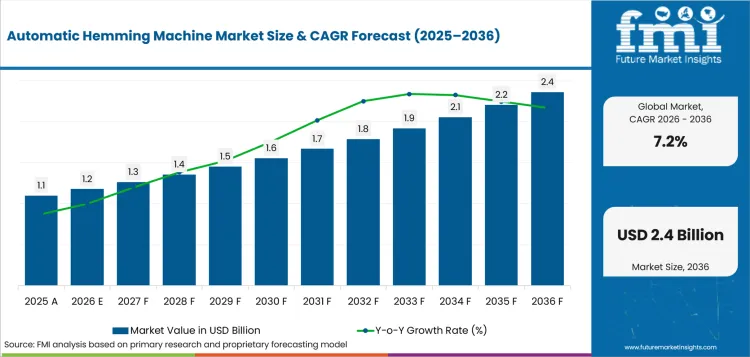
| 2026 Market Size | USD 1,180.60 million |
|---|---|
| 2036 Market Size | USD 2,366.20 million |
| Forecast CAGR | 7.2% from 2026 to 2036 |
| Leading End Use | Apparel Manufacturing |
| Apparel Manufacturing Share in 2026 | 61.0% |
| Leading Sales Channel | Direct OEM |
| Direct OEM Share in 2026 | 55.0% |
| Leading CAGR Country | China |
| China CAGR | 8.2% by 2036 |
Summary of the Automatic Hemming Machine Market
| Market Signal | Commercial Impact |
|---|---|
| Demand and Growth Drivers | Demand for automatic hemming machines is increasing with rising knitwear production and factory automation.
|
| Product and Segment View | OEM sales, knit fabrics, and apparel manufacturing remain the leading market segments.
|
| Geography and Growth Outlook | China and India are expected to remain the fastest-growing markets.
|
| Competitive Landscape | Competition is centered on automation capability and after-sales service.
|
| Analyst Perspective | Automatic hemming machines are becoming productivity-focused investments rather than standalone equipment purchases.
— Nikhil Kaitwade, Principal Consultant, Industrial Automation, Future Market Insights |
Factory automation planning is strengthening around apparel productivity, fabric consistency, and shorter training cycles. International Textile Machinery Shipment Statistics (ITMSS) 2024 machinery shipment issue was published in June 2025 and covers machinery shipments across spinning and finishing equipment, showing sustained measurement of textile machinery flows.
VDMA reported that order intake in textile care and leather technologies rose 8.8% year on year in real terms from March 2025 to February 2026, although sales revenues declined 5.3% during the same period. Brother’s MB5003C-IM automatic bottom hemmer claims 50% cycle-time reduction versus manual operation and removal of 1 machine and 1 operator from the process, strengthening the value case for repeat knit hemming cells.
Which factors support expansion in the Automatic Hemming Machine Market?
Finished hem consistency and service-linked installation programs support market value across apparel and textile factories.
- Market value rises as repeat knitwear operations need guided bottom hemmers to reduce twisting, roping, and visible seam variation.
- Standalone units support adoption as factories can automate one sewing cell before redesigning full material flow.
- Apparel exporters influence steady demand through retail quality requirements and repeat order finishing standards.
- Home textile and technical textile producers promote demand for programmable units suited to wider fabrics and more varied hem widths.
Why is the Automatic Hemming Machine Market growing?
High-repeat garment finishing increases machine demand as labor skill gaps and knit-fabric defects reduce sewing-room consistency.
Automatic hemming machine buyers spend more on guided cells as repeat operations expose skill variation and rework risk. International Labour Organization’s 2025 brief stated that textiles and clothing industries provide jobs to over 90 million people, showing the size of labor-intensive production linked to sewing automation needs. Repeat garment lines need guided feeding and seam control to reduce operator dependence. Suppliers able to link machinery and training gain stronger acceptance in apparel factory investment decisions.
How is the Automatic Hemming Machine Market segmented?
Automatic Hemming Machine Market is segmented by machine type, operation, end use, fabric type, and sales channel.
- Automatic Bottom Hemmers are projected to account for 38.0% share in 2026, influenced by repeat circular hems across T-shirts and sportswear.
- Standalone Machines are expected to hold 44.0% share in 2026, shaped by factory preference for cell-by-cell automation before full-line redesign.
- Apparel Manufacturing is anticipated to account for 61.0% share in 2026, led by recurring hem work across casualwear and export garments.
- Knits are projected to hold 46.0% share in 2026, guided by stretch-control needs reducing roping and seam distortion.
- Direct OEM is expected to represent 55.0% share in 2026, supported by installation and factory trial requirements.
Why do automatic bottom hemmers dominate the Automatic Hemming Machine Market by machine type?
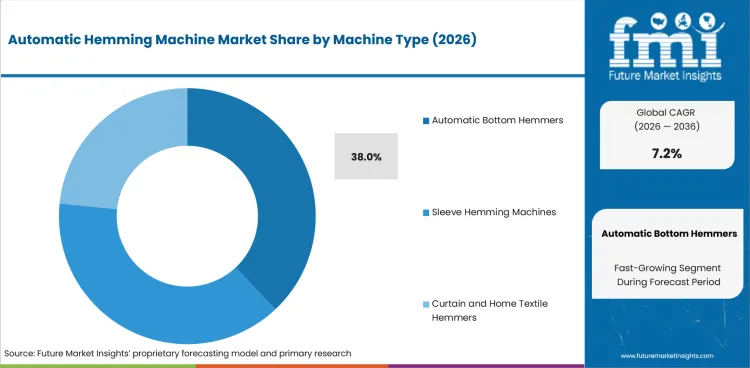
- Automatic bottom hemmers are projected to account for 38.0% share in 2026, driven by circular hem standardization across T-shirts and knit basics.
- Sleeve hemming machines gain demand as factories automate sleeve finishes across knitwear and high-repeat apparel lines.
Which operation leads the Automatic Hemming Machine Market?
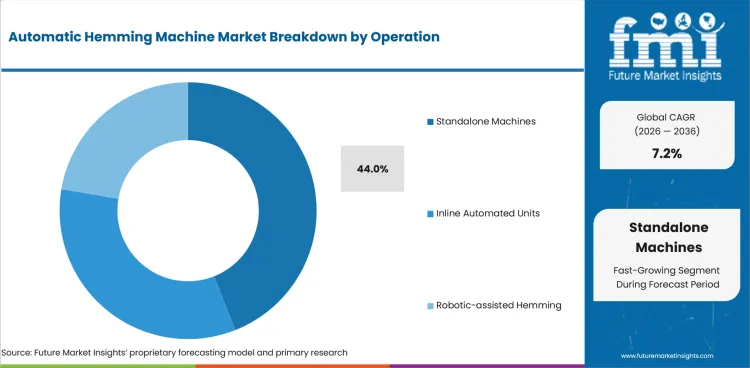
- Standalone machines are expected to hold 44.0% share in 2026, shaped by lower implementation risk and easier trial use in existing sewing rooms.
- Inline automated units gain use as larger exporters align hemming cells with automated material flow and higher daily throughput.
Which end use leads the Automatic Hemming Machine Market?
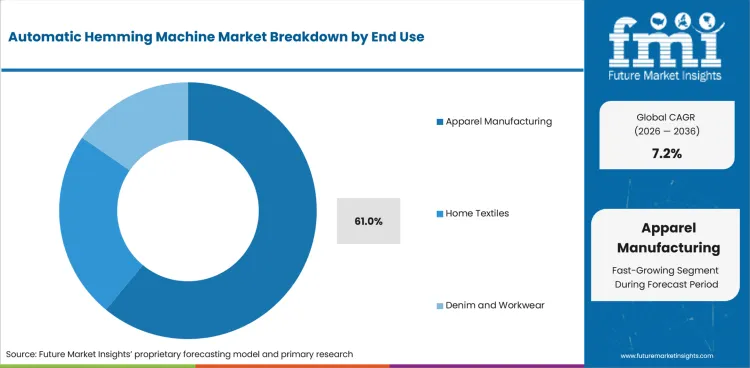
- Apparel manufacturing is anticipated to account for 61.0% share in 2026, led by repeat finishing across uniforms and sportswear.
- Home textiles create added demand as curtains and household fabrics need consistent long seams and wider table support.
Which fabric type leads the Automatic Hemming Machine Market?
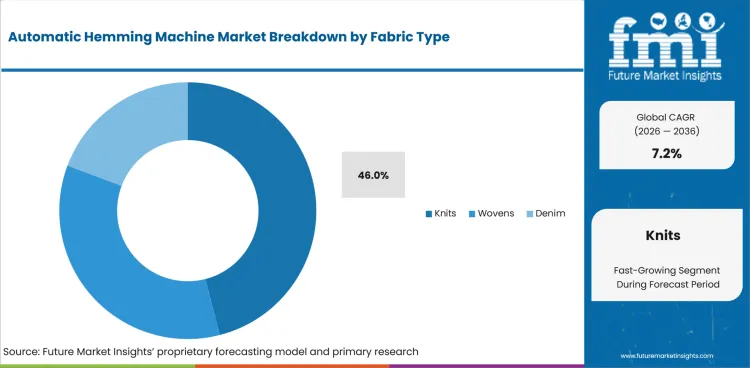
- Knits are projected to hold 46.0% share in 2026, reflected by stretch behavior that requires controlled feeding and hem-twist reduction.
- Wovens remain active as shirt and uniform producers need repeat hem finishing across stable fabric constructions.
Which sales channel leads the Automatic Hemming Machine Market?
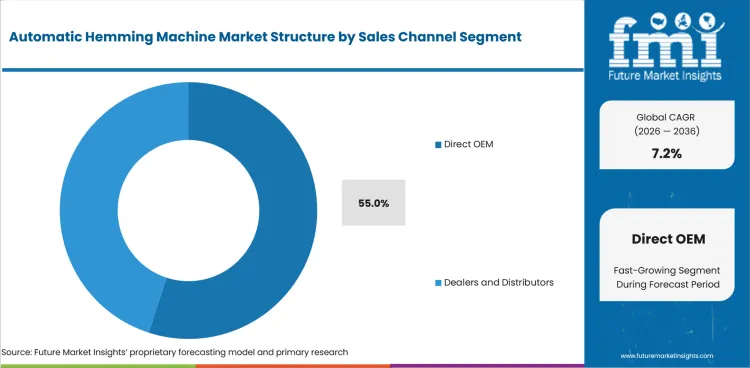
- Direct OEM is expected to represent 55.0% share in 2026, guided by buyer preference for machine setup and trial support.
- Dealers and distributors remain active across price-sensitive factories and replacement purchases needing faster local supply.
What are the drivers, restraints, and opportunities in the Automatic Hemming Machine Market?
Industrial garment automation and service-led machinery programs are shaping automatic hemming machine buying decisions.
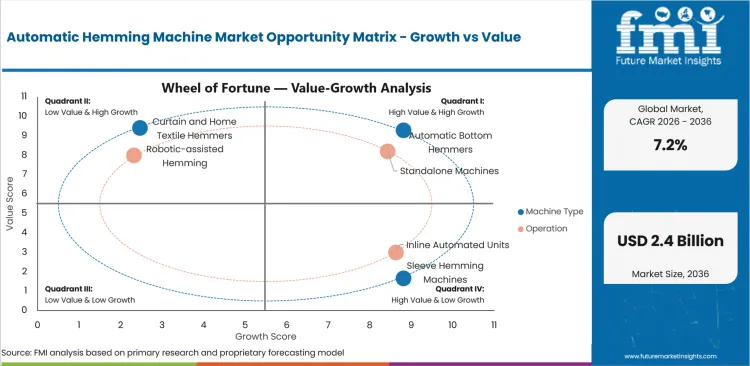
- Driver: High-repeat knitwear operations require guided hemming cells before quality targets can be achieved.
- Restraint: Frequent style and fabric changes can limit uptime in small-batch factories with limited setup capacity.
- Opportunity: Sensor-linked hemming cells can improve supplier renewal rates as buyers request documented output and rework reduction.
Knit Hem Stability Strengthens Machine Demand
Knitwear production creates a strong reason for guided hemming adoption. Brother’s MB5003C-IM automatic bottom hemmer states 50% cycle-time reduction compared to manual operation, along with removal of 1 machine and 1 operator from the process. Such measurable output claims help apparel factories test payback on T-shirts and knit basics. Automatic hemming machine suppliers gain demand as hem stability becomes a quality-control issue rather than a simple sewing-speed upgrade.
Style-Change Burden Limits Small-Batch Adoption
Small-batch factories can face slower payback if frequent fabric changes require repeated folder and feed adjustments. SelectUSA reported around 84,000 apparel manufacturing employees in the United States in mid-2024, showing how a smaller domestic apparel base can favor specialty and shorter-run production over mass standardized output. Smaller buyers may delay automatic hemming purchases until suppliers prove quick setup and reliable service. Trial-led selling can reduce hesitation by showing output benefits on actual buyer fabrics.
Service-Led OEM Programs Create Expansion
Direct OEM support creates a stronger opening for automatic hemming adoption as machine heads alone cannot guarantee seam quality. VDMA Textile Machinery represents around 140 manufacturers and about 90% of Germany’s textile machinery industry volume, indicating the scale of service and equipment knowledge behind premium machinery networks. Automatic hemming suppliers can convert factory interest into repeat purchases through setup logs and preventive maintenance support.
Which countries are growing in the Automatic Hemming Machine Market?
China 8.2% CAGR, India 8.0% CAGR, South Korea 7.5% CAGR, United States 6.8% CAGR, Germany 6.6% CAGR, Japan 6.4% CAGR, United Kingdom 6.2% CAGR, and France 6.1% CAGR through 2036.
.webp "Top Country Growth Comparison Automatic Hemming Machine Market Cagr (2026 2036)")
| Country | CAGR |
|---|---|
| China | 8.2% |
| India | 8.0% |
| South Korea | 7.5% |
| United States | 6.8% |
| Germany | 6.6% |
| Japan | 6.4% |
| United Kingdom | 6.2% |
| France | 6.1% |
Source: Future Market Insights, 2026.
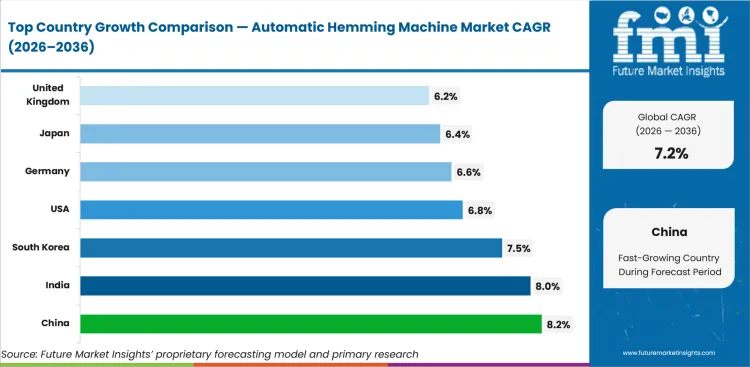
How do country-level CAGRs compare in the Automatic Hemming Machine Market?
China leads country expansion while France records the most cautious pace among profiled markets.
- China is forecast to record 8.2% CAGR by 2036 due to garment clusters and machinery export strength.
- India is expected to expand at 8.0% CAGR from 2026 to 2036, led by apparel modernization and automatic sewing equipment access.
- South Korea is projected to grow at 7.5% CAGR through 2036 as export-quality garment producers need reliable seam output.
- United States is estimated to rise at 6.8% CAGR by 2036, reflected by specialty apparel and sewn-product factories investing in labor-saving equipment.
- Germany is expected to advance at 6.6% CAGR over the forecast period as premium sewing engineering supports higher-service buying.
- Japan is forecast to grow at 6.4% CAGR by 2036, backed by premium OEM portfolios across industrial sewing.
- United Kingdom is projected to post 6.2% CAGR by 2036, guided by repair and home textile workshops.
- France is expected to record 6.1% CAGR by 2036, driven by specialty textile and small-batch production support.
How fast is the Automatic Hemming Machine Market growing in China?
An 8.2% CAGR through 2036 reflects garment clusters and value-equipment supply.
Country Market Snapshot Table
| Parameter | Value |
|---|---|
| Market Size in 2025 (Value) | USD 217.2 million |
| Market Size in 2026 (Value) | USD 235.0 million |
| Market Forecast in 2036 (Value) | USD 516.8 million |
| CAGR (2026 to 2036) | 8.2% |
| Years Considered | 2021 to 2036 |
| Base Year | 2025 |
| Forecast Period | 2026 to 2036 |
| Units Considered | Value (USD million) |
| Leading Sub-Region | Yangtze River Delta and Guangdong apparel machinery corridors |
China Automatic Hemming Machine Market Outlook
- China automatic hemming machine industry is shaped by apparel clusters and value industrial sewing supply. Domestic factories need guided hemming cells that support repeat knitwear output and lower operator dependence.
- Buyers are expected to favor suppliers combining affordable equipment and setup support. Export-facing machinery producers will remain influential as Asian garment factories compare Chinese machine price and service reach.
Key Growth Drivers
- Machinery export strength creates scale for automatic sewing equipment supply, supported by 2024 WITS reporting that China exported USD 409.3 million of non-book sewing machines across 1,563,060 items.
- Machinery digitalization supports automated sewing upgrades, reinforced by China’s 2025 machinery-sector plan targeting 500 excellence-level smart factories by 2030.
- Apparel clusters need bottom hem cells as knit basics and sportswear demand repeatable finishing quality.
- Domestic suppliers gain scope as buyers need fast installation visits, spare parts, and price-accessible automation.
Key Restraints
- Price competition can compress service quality if buyers compare automatic hemmers only by machine cost.
- Exporters can face qualification pressure as foreign buyers ask for stable seam output across varied fabric lots.
- Smaller manufacturers can delay premium machine upgrades as wage pressure strains factory budgets, reflected in China’s 2024 private-unit manufacturing wage of 71,467 yuan, down 0.4% from 2023.
What makes China unique
China is unique due to industrial sewing machinery exports and value equipment supply across Asian sourcing hubs.
Key Companies
- Jack Sewing Machine
- Zoje Sewing Machine
- Typical
- Bruce Sewing Machine
- Lejiang Sewing Machine
- Baoyu Sewing Machine
- ShangGong Group
Sales & Marketing Channels
- Direct OEM sales to garment factories
- Dealer-led value equipment distribution
- Export distributor networks
- Factory demonstration centers
- Spare-parts and service partnerships
- Trial-based selling for knitwear lines
Country Segment Breakdown Table
| Segment | Sub-Segments |
|---|---|
| By Machine Type | Automatic Bottom Hemmers · Sleeve Hemming Machines · Curtain and Home Textile Hemmers · Programmable Hemming Units |
| By Operation | Standalone Machines · Inline Automated Units · Robotic-assisted Hemming |
| By End Use | Apparel Manufacturing · Home Textiles · Denim and Workwear · Technical Textiles |
| By Fabric Type | Knits · Wovens · Denim · Delicate and Other |
| By Sales Channel | Direct OEM · Dealers and Distributors |
| Key Sub-Regions Covered, Industrial Corridors | Guangdong · Zhejiang · Jiangsu · Shanghai · Fujian · Shandong |
Frequently Asked Questions
How fast is China Automatic Hemming Machine Market growing?
China records the prominent country pace at an estimated 8.2% CAGR, driven by garment clusters and machinery export strength.
Who leads China Automatic Hemming Machine Market?
Jack Sewing Machine leads China Automatic Hemming Machine Market, supported by Zoje Sewing Machine and Typical across domestic industrial sewing equipment supply.
What is driving adoption in China Automatic Hemming Machine Market?
Garment cluster modernization and value automatic sewing equipment supply are moving buyers toward guided hemming cells.
What is the Automatic Hemming Machine Market outlook in India?
An 8.0% CAGR through 2036 reflects apparel factory modernization and import-led machinery access.
Country Market Snapshot Table
| Parameter | Value |
|---|---|
| Market Size in 2025 (Value) | USD 142.6 million |
| Market Size in 2026 (Value) | USD 154.0 million |
| Market Forecast in 2036 (Value) | USD 332.5 million |
| CAGR (2026 to 2036) | 8.0% |
| Years Considered | 2021 to 2036 |
| Base Year | 2025 |
| Forecast Period | 2026 to 2036 |
| Units Considered | Value (USD million) |
| Leading Sub-Region | Tirupur, Bengaluru, Delhi-NCR, and western apparel corridors |
India Automatic Hemming Machine Market Outlook
- India automatic hemming machine demand is driven by knitwear production and modernization of sewing rooms. Buyers need machines reducing operator skill dependence while supporting repeat hem quality.
- Factories are expected to begin with standalone bottom hem cells before moving into inline systems. Local training and folder setup support will remain central to supplier selection.
Key Growth Drivers
- Import-led machinery access supports factory modernization, shown by 2024 WITS reporting that India imported USD 142.7 million of non-book sewing machines from China across 1,725,950 items.
- Apparel export momentum supports automation spending, reinforced by India’s Ministry of Textiles reporting 7% growth in textile and apparel exports from April to December 2024 versus the prior-year period.
- Knitwear clusters need bottom hemmers to reduce hem twist and rework in repeat T-shirt lines.
- Domestic dealers gain scope as small and midsized factories need training and guided installation.
Key Restraints
- Smaller apparel units can delay automation if financing and service coverage remain uneven across clusters.
- Frequent style changes can reduce utilization if folder adjustment time is not managed through training.
- Export softness can delay equipment plans, indicated by government-data reporting that India’s textile and apparel exports declined 2.21% in FY26.
What makes India unique
India is unique due to garment export factories and a wide base of small and midsized sewing rooms.
Key Companies
- SERA Sewing Machines
- Mehala Machines India
- Ramsons Garment Finishing Equipment
- Parvin Machines
- HCA Garment Machinery
- Ample Garment Machinery
- Star Group India
Sales & Marketing Channels
- Regional machinery dealers
- Direct OEM demonstration programs
- Apparel cluster roadshows
- Factory-floor trials
- Spare-parts partnerships
- Training-led installation programs
Country Segment Breakdown Table
| Segment | Sub-Segments |
|---|---|
| By Machine Type | Automatic Bottom Hemmers · Sleeve Hemming Machines · Curtain and Home Textile Hemmers · Programmable Hemming Units |
| By Operation | Standalone Machines · Inline Automated Units · Robotic-assisted Hemming |
| By End Use | Apparel Manufacturing · Home Textiles · Denim and Workwear · Technical Textiles |
| By Fabric Type | Knits · Wovens · Denim · Delicate and Other |
| By Sales Channel | Direct OEM · Dealers and Distributors |
| Key Sub-Regions Covered, Industrial Corridors | Tirupur · Bengaluru · Noida · Gurugram · Ludhiana · Mumbai |
Frequently Asked Questions
How fast is India Automatic Hemming Machine Market growing?
India shows notable country expansion at an anticipated 8.0% CAGR, driven by apparel modernization and knitwear factory automation.
Who leads India Automatic Hemming Machine Market?
SERA Sewing Machines leads India Automatic Hemming Machine Market among local industrial sewing machine suppliers, followed by Mehala Machines India and Parvin Machines across garment factory equipment channels.
What is driving adoption in India Automatic Hemming Machine Market?
Knitwear output, operator scarcity, and import-led machinery access are moving factories toward automatic hemming cells.
What is the Automatic Hemming Machine Market outlook in South Korea?
A 7.5% CAGR through 2036 reflects export-quality apparel and advanced factory expectations.
Country Market Snapshot Table
| Parameter | Value |
|---|---|
| Market Size in 2025 (Value) | USD 72.6 million |
| Market Size in 2026 (Value) | USD 78.0 million |
| Market Forecast in 2036 (Value) | USD 160.8 million |
| CAGR (2026 to 2036) | 7.5% |
| Years Considered | 2021 to 2036 |
| Base Year | 2025 |
| Forecast Period | 2026 to 2036 |
| Units Considered | Value (USD million) |
| Leading Sub-Region | Seoul, Gyeonggi, and Daegu textile corridors |
South Korea Automatic Hemming Machine Market Outlook
- South Korea automatic hemming machine industry is influenced by export-quality apparel and technical sewn products. Buyers need machines supporting consistent seam output and faster operator training.
- Factories are expected to prioritize compact machine footprints and automation compatibility. Premium Japanese and specialist sewing brands can gain acceptance through local support.
Key Growth Drivers
- Imported premium equipment supports selective automation, reflected in 2024 WITS data showing Japan exported USD 689.5 thousand of non-book sewing machines to South Korea across 837 items.
- China-based value equipment also supports machinery availability, with 2024 WITS data showing China exported USD 2.3 million of non-book sewing machines to South Korea across 4,665 items.
- Export-quality garment buyers need lower rework and repeat seam finish across small and medium order runs.
- Compact sewing rooms favor standalone automatic units with limited layout disruption.
Key Restraints
- Qualification cycles can slow new machine approval as factories test feed behavior across varied fabrics.
- Higher wage environments can support automation but also increase expectations for measurable output gains.
- Export-market softness can slow sewing-room investments, shown by South Korea’s 2025 exports to China falling 1.7% to USD 130.8 billion and exports to the United States falling 3.8% to USD 122.9 billion.
What makes South Korea unique
South Korea is unique due to quality-sensitive apparel production, compact factory layouts, and strong expectations for after-sales support.
Key Companies
- Mobase SunStar
- SunStar
- SWF
- Brother Sangsa
- Won Chang Industrial
- Daeha Industrial
- Kakang International
Sales & Marketing Channels
- Premium OEM distributors
- Factory trials through sewing-room specialists
- Technical service partnerships
- Apparel exporter demonstrations
- Spare-parts support networks
- Training packages for compact plants
Country Segment Breakdown Table
| Segment | Sub-Segments |
|---|---|
| By Machine Type | Automatic Bottom Hemmers · Sleeve Hemming Machines · Curtain and Home Textile Hemmers · Programmable Hemming Units |
| By Operation | Standalone Machines · Inline Automated Units · Robotic-assisted Hemming |
| By End Use | Apparel Manufacturing · Home Textiles · Denim and Workwear · Technical Textiles |
| By Fabric Type | Knits · Wovens · Denim · Delicate and Other |
| By Sales Channel | Direct OEM · Dealers and Distributors |
| Key Sub-Regions Covered, Industrial Corridors | Seoul · Gyeonggi · Daegu · Busan · Incheon · Gwangju |
Frequently Asked Questions
How fast is South Korea Automatic Hemming Machine Market growing?
South Korea shows steady expansion at an expected 7.5% CAGR, guided by quality-sensitive apparel and technical sewing demand.
Who leads South Korea Automatic Hemming Machine Market?
Mobase SunStar leads South Korea Automatic Hemming Machine Market, supported by SunStar and SWF across domestic sewing and embroidery machinery supply.
What is driving adoption in South Korea Automatic Hemming Machine Market?
Export-quality finishing expectations and compact plant modernization are moving factories toward guided hemming equipment.
How is the Automatic Hemming Machine Market performing in the United States?
A 6.8% CAGR through 2036 reflects specialty apparel and sewn-product automation.
Country Market Snapshot Table
| Parameter | Value |
|---|---|
| Market Size in 2025 (Value) | USD 168.5 million |
| Market Size in 2026 (Value) | USD 180.0 million |
| Market Forecast in 2036 (Value) | USD 347.5 million |
| CAGR (2026 to 2036) | 6.8% |
| Years Considered | 2021 to 2036 |
| Base Year | 2025 |
| Forecast Period | 2026 to 2036 |
| Units Considered | Value (USD million) |
| Leading Sub-Region | Southeast sewn-products and West Coast specialty apparel corridors |
United States Automatic Hemming Machine Market Outlook
- United States automatic hemming machine demand is shaped by home textiles and technical sewn products. Buyers focus on labor saving and quality control rather than mass garment output.
- Factories are expected to favor programmable units and bottom hem cells that can handle shorter production runs. Dealer service and OEM training remain important as sewn-product producers are geographically dispersed.
Key Growth Drivers
- Specialty sewn-product factories need labor-saving equipment, supported by SelectUSA reporting around 84,000 apparel manufacturing employees in mid-2024.
- Domestic apparel output retains a measurable base, reflected in Federal Reserve data showing 2024 apparel manufacturing sectoral output of USD 9,026.283 million.
- Uniform and repair channels need machines that reduce skill dependence in shorter production lots.
- Factory buyers favor trials proving lower rework on real fabrics before purchasing premium cells.
Key Restraints
- Smaller domestic apparel operations can delay automation if equipment payback is uncertain across short runs.
- Service distance can raise downtime risk as factories are spread across multiple states.
- Labor contraction can reduce replacement demand, shown by Federal Reserve employment data placing apparel manufacturing at 94.0 thousand jobs in 2025, down from 101.8 thousand in 2024.
What makes the United States unique
United States is unique due to specialty sewn-products and labor-saving equipment demand.
Key Companies
- Union Special
- Merrow Sewing Machine Company
- Sailrite
- Consew USA
- Reliable Industrial Sewing USA
- M.J. Foley Company
- Henderson Sewing Machine Company
Sales & Marketing Channels
- Dealer-led equipment sales
- Direct OEM support for large factories
- Demonstration centers
- Repair and alteration workshop channels
- Technical textile production accounts
- Spare-parts and service contracts
Country Segment Breakdown Table
| Segment | Sub-Segments |
|---|---|
| By Machine Type | Automatic Bottom Hemmers · Sleeve Hemming Machines · Curtain and Home Textile Hemmers · Programmable Hemming Units |
| By Operation | Standalone Machines · Inline Automated Units · Robotic-assisted Hemming |
| By End Use | Apparel Manufacturing · Home Textiles · Denim and Workwear · Technical Textiles |
| By Fabric Type | Knits · Wovens · Denim · Delicate and Other |
| By Sales Channel | Direct OEM · Dealers and Distributors |
| Key Sub-Regions Covered, Industrial Corridors | Southeast · California · New York · Texas · Midwest · Northeast |
Frequently Asked Questions
How fast is the United States Automatic Hemming Machine Market growing?
United States demand is set to rise at 6.8% CAGR through specialty apparel and sewn-product automation.
Who leads the United States Automatic Hemming Machine Market?
Union Special leads United States Automatic Hemming Machine Market among local industrial sewing machine companies, followed by Merrow Sewing Machine Company and Consew USA.
What is driving adoption in the United States Automatic Hemming Machine Market?
Labor-saving needs and specialty sewn-product output are moving factories toward automatic hemming cells.
What is the Automatic Hemming Machine Market forecast for Germany?
A 6.6% CAGR through 2036 reflects premium sewing engineering and high-service machinery buying.
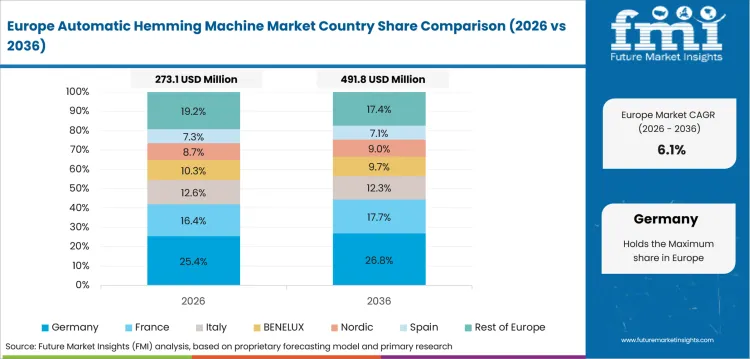
Country Market Snapshot Table
| Parameter | Value |
|---|---|
| Market Size in 2025 (Value) | USD 86.3 million |
| Market Size in 2026 (Value) | USD 92.0 million |
| Market Forecast in 2036 (Value) | USD 174.3 million |
| CAGR (2026 to 2036) | 6.6% |
| Years Considered | 2021 to 2036 |
| Base Year | 2025 |
| Forecast Period | 2026 to 2036 |
| Units Considered | Value (USD million) |
| Leading Sub-Region | North Rhine-Westphalia, Bavaria, and Baden-Wurttemberg industrial corridors |
Germany Automatic Hemming Machine Market Outlook
- Germany automatic hemming machine demand is shaped by specialized industrial sewing expertise and specialist apparel production. Buyers place higher value on service and production integration.
- Duerkopp Adler strengthens specialized sewing technology context. Suppliers with automation controls and engineering support are expected to gain preference over low-price alternatives.
Key Growth Drivers
- Premium machinery capability supports export-linked influence, shown by 2024 WITS data that Germany exported USD 101.4 million of non-book sewing machines across 35,037 items.
- German textile machinery depth supports service-led sales, reinforced by VDMA’s statement that its textile machinery association represents around 140 manufacturers and about 90% of national industry volume.
- Technical textile and specialist sewn-product factories need programmable hemming units for mixed fabric requirements.
- Specialty buyers favor equipment suppliers aligning folders and training into one operating package.
Key Restraints
- High equipment pricing can slow adoption among smaller sewing rooms unless rework savings are measurable.
- European apparel demand softness can reduce urgency for new sewing-room investments.
- Manufacturing softness can pressure machinery spending, with Destatis reporting real industrial production down 2.4% month on month in December 2024.
What makes Germany unique
Germany is unique due to industrial machinery service depth and technical textile capability.
Key Companies
- Duerkopp Adler
- Union Special Maschinenfabrik
- PFAFF Industrial
- Schmetz Industrial
- KSL Keilmann Sondermaschinenbau
- Strobel Spezialmaschinen
- Maier-Unitas
Sales & Marketing Channels
- Direct OEM selling
- Specialist industrial sewing dealers
- Trade-fair demonstrations
- Technical textile accounts
- Automation integrator partnerships
- Factory service contracts
Country Segment Breakdown Table
| Segment | Sub-Segments |
|---|---|
| By Machine Type | Automatic Bottom Hemmers · Sleeve Hemming Machines · Curtain and Home Textile Hemmers · Programmable Hemming Units |
| By Operation | Standalone Machines · Inline Automated Units · Robotic-assisted Hemming |
| By End Use | Apparel Manufacturing · Home Textiles · Denim and Workwear · Technical Textiles |
| By Fabric Type | Knits · Wovens · Denim · Delicate and Other |
| By Sales Channel | Direct OEM · Dealers and Distributors |
| Key Sub-Regions Covered, Industrial Corridors | North Rhine-Westphalia · Bavaria · Baden-Wurttemberg · Saxony · Lower Saxony · Hesse |
Frequently Asked Questions
How fast is Germany Automatic Hemming Machine Market growing?
Germany advances through premium industrial sewing and technical textile demand.
Who leads Germany Automatic Hemming Machine Market?
Duerkopp Adler leads Germany Automatic Hemming Machine Market, supported by PFAFF Industrial and Strobel Spezialmaschinen across specialist industrial sewing applications.
What is driving adoption in Germany Automatic Hemming Machine Market?
Premium sewing engineering and demand for reliable automated cells are moving buyers toward service-led automatic hemming systems.
What is the Automatic Hemming Machine Market forecast for Japan?
A 6.4% CAGR through 2036 reflects premium OEM portfolios and knitwear machinery expertise.
Country Market Snapshot Table
| Parameter | Value |
|---|---|
| Market Size in 2025 (Value) | USD 97.7 million |
| Market Size in 2026 (Value) | USD 104.0 million |
| Market Forecast in 2036 (Value) | USD 193.4 million |
| CAGR (2026 to 2036) | 6.4% |
| Years Considered | 2021 to 2036 |
| Base Year | 2025 |
| Forecast Period | 2026 to 2036 |
| Units Considered | Value (USD million) |
| Leading Sub-Region | Osaka, Tokyo, and Aichi industrial sewing corridors |
Japan Automatic Hemming Machine Market Outlook
- Japan automatic hemming machine industry is guided by premium industrial sewing portfolios from Pegasus and Yamato. Domestic demand is mature, yet export credibility remains strong.
- Buyers across Asia monitor Japanese machine performance for knitwear applications and long service life. Suppliers will keep value through quality engineering and application-specific hemming systems.
Key Growth Drivers
- Export credibility supports Japanese OEM influence, reflected in 2024 WITS data showing Japan exported USD 99.7 million of non-book sewing machines across 77,381 items.
- Juki’s Texprocess program supports premium OEM visibility, listing 39 industrial sewing machine models, 5 new models, 4 soon-to-release models, and 3 systems in 2024.
- Knitwear-focused Japanese machine portfolios support demand for bottom hemming and sleeve hemming applications.
- Regional export customers value long machine life and reliable technical documentation.
Key Restraints
- Mature domestic apparel production can limit replacement demand compared with faster-growing Asian garment hubs.
- Premium machine pricing can delay purchases in cost-sensitive factories.
- Japan’s machinery exports face competition from lower-cost suppliers, while China exported USD 409.3 million of comparable non-book sewing machines in 2024.
What makes Japan unique
Japan is unique due to knit-feed control expertise and strong credibility in industrial machine engineering.
Key Companies
- Juki
- Brother
- Pegasus
- Yamato
- Kansai Special
- Mitsubishi Electric
- Seiko Sewing Machine
Sales & Marketing Channels
- Direct OEM export sales
- Distributor-led overseas supply
- Trade-fair demonstration programs
- Technical training packages
- Application-specific machine trials
- Spare-parts and documentation support
Country Segment Breakdown Table
| Segment | Sub-Segments |
|---|---|
| By Machine Type | Automatic Bottom Hemmers · Sleeve Hemming Machines · Curtain and Home Textile Hemmers · Programmable Hemming Units |
| By Operation | Standalone Machines · Inline Automated Units · Robotic-assisted Hemming |
| By End Use | Apparel Manufacturing · Home Textiles · Denim and Workwear · Technical Textiles |
| By Fabric Type | Knits · Wovens · Denim · Delicate and Other |
| By Sales Channel | Direct OEM · Dealers and Distributors |
| Key Sub-Regions Covered, Industrial Corridors | Osaka · Tokyo · Aichi · Kyoto · Hyogo · Fukuoka |
Frequently Asked Questions
How fast is Japan Automatic Hemming Machine Market growing?
Japan maintains steady expansion at an expected 6.4% CAGR, backed by premium OEM portfolios and knitwear machinery capability.
Who leads Japan Automatic Hemming Machine Market?
Juki leads Japan Automatic Hemming Machine Market, followed by Brother, Pegasus, and Yamato across premium industrial sewing and knitwear hemming systems.
What is driving adoption in Japan Automatic Hemming Machine Market?
Knitwear machine expertise and application-specific hemming systems are supporting demand.
How is the Automatic Hemming Machine Market performing in the United Kingdom?
A 6.2% CAGR through 2036 reflects specialty apparel and small-batch manufacturing demand.
Country Market Snapshot Table
| Parameter | Value |
|---|---|
| Market Size in 2025 (Value) | USD 53.7 million |
| Market Size in 2026 (Value) | USD 57.0 million |
| Market Forecast in 2036 (Value) | USD 104.0 million |
| CAGR (2026 to 2036) | 6.2% |
| Years Considered | 2021 to 2036 |
| Base Year | 2025 |
| Forecast Period | 2026 to 2036 |
| Units Considered | Value (USD million) |
| Leading Sub-Region | Midlands, North West, Yorkshire, and London specialist production corridors |
United Kingdom Automatic Hemming Machine Market Outlook
- United Kingdom automatic hemming machine demand is linked to workwear and home textile workshops. Buyers are cautious as order lots can be smaller and style variation can be high.
- Flexible setup and dealer support will decide adoption. Machines reducing operator skill needs while handling frequent changes can gain stronger acceptance across domestic workshops.
Key Growth Drivers
- Domestic textile capability supports equipment trials, with a parliamentary briefing citing 49,000 textile manufacturing jobs in Great Britain in 2024.
- Small-business density supports flexible equipment demand, backed by 5.64 million small private-sector businesses recorded in the United Kingdom at the start of 2025.
- Repair and specialty apparel workshops need automatic hemmers reducing operator skill dependence.
- Home textile producers need machines that manage wider seams and frequent fabric changes.
Key Restraints
- Smaller order sizes can reduce machine utilization if setup time is not improved.
- Dealer coverage can shape payback as workshops need quick support for folders and guide changes.
- Apparel manufacturing represents a small employment share, with a parliamentary briefing stating apparel manufacturing accounted for 0.06% of total jobs in 2024.
What makes the United Kingdom unique
United Kingdom is unique due to specialty apparel workshops and smaller-batch production.
Key Companies
- AE Sewing Machines
- Advance Sewing Automation
- Konsew
- College Sewing Machine Parts
- Northern Industrial Sewing Machines
- Sovereign Sewing Machines
- Jack Industrial Sewing Machines UK
Sales & Marketing Channels
- Specialist industrial sewing dealers
- Repair workshop channels
- Direct OEM training packages
- Home textile producer accounts
- Demonstration-led selling
- Spare-parts service networks
Country Segment Breakdown Table
| Segment | Sub-Segments |
|---|---|
| By Machine Type | Automatic Bottom Hemmers · Sleeve Hemming Machines · Curtain and Home Textile Hemmers · Programmable Hemming Units |
| By Operation | Standalone Machines · Inline Automated Units · Robotic-assisted Hemming |
| By End Use | Apparel Manufacturing · Home Textiles · Denim and Workwear · Technical Textiles |
| By Fabric Type | Knits · Wovens · Denim · Delicate and Other |
| By Sales Channel | Direct OEM · Dealers and Distributors |
| Key Sub-Regions Covered, Industrial Corridors | Midlands · North West · Yorkshire · London · Scotland · Wales |
Frequently Asked Questions
How fast is the United Kingdom Automatic Hemming Machine Market growing?
United Kingdom demand is predicted to grow at 6.2% CAGR guided by specialty apparel and home textiles.
Who leads the United Kingdom Automatic Hemming Machine Market?
AE Sewing Machines leads United Kingdom Automatic Hemming Machine Market among local industrial textile equipment suppliers, followed by Advance Sewing Automation and Konsew.
What is driving adoption in the United Kingdom Automatic Hemming Machine Market?
Specialty apparel and home textile finishing are moving buyers toward flexible automatic hemming units.
What is driving Automatic Hemming Machine Market growth in France?
A 6.1% CAGR through 2036 reflects specialty textile and small-batch production support.
Country Market Snapshot Table
| Parameter | Value |
|---|---|
| Market Size in 2025 (Value) | USD 49.0 million |
| Market Size in 2026 (Value) | USD 52.0 million |
| Market Forecast in 2036 (Value) | USD 94.0 million |
| CAGR (2026 to 2036) | 6.1% |
| Years Considered | 2021 to 2036 |
| Base Year | 2025 |
| Forecast Period | 2026 to 2036 |
| Units Considered | Value (USD million) |
| Leading Sub-Region | Auvergne-Rhone-Alpes, Hauts-de-France, and Paris specialist corridors |
France Automatic Hemming Machine Market Outlook
- France automatic hemming machine demand is shaped by specialty apparel and high-quality small-batch production. Buyers value machines reducing rework while supporting varied fabrics.
- Dealer and OEM support matter as factories require folder changes and operator training. Premium machinery can gain acceptance in workshops focused on consistency and craftsmanship.
Key Growth Drivers
- Manufacturing momentum supports equipment trials, indicated by France’s manufacturing business climate indicator reaching 102 in May 2026, up 2 points and above its long-term average of 100.
- European textile producers face regulatory and sustainability pressure, while European Commission reporting states that textile ecosystem SMEs represent 99.5% of active companies.
- Repair and premium apparel workshops need guided hemming that protects visible seam quality.
- Home textile producers require programmable hemming support for varied fabric sizes and seam widths.
Key Restraints
- Small-batch production can limit uptime if folder changes are slow and operator training is thin.
- Lower-cost imports can pressure domestic workshops lacking automation budgets.
- Import pressure can slow small workshop investment, reflected in EURATEX’s 2026 figures showing EU textile and clothing exports down 2.9%, employment down 2.8%, and imports at EUR 122 billion against EUR 61 billion in exports.
What makes France unique
France is unique due to home textile production and demand for quality finishing.
Key Companies
- C.C.R. Machines à Coudre
- Glasman Machines à Coudre
- Jema Machines à Coudre
- Matériel de Confection France
- Exapro France
- France Machines à Coudre Industrielles
- Local leather and textile equipment suppliers in Mayenne and Rhône-Alpes
Sales & Marketing Channels
- Specialist sewing-machine dealers
- Direct OEM demonstrations
- Repair and alteration workshop outreach
- Home textile producer accounts
- Trade-fair sales programs
- Training-led service packages
Country Segment Breakdown Table
| Segment | Sub-Segments |
|---|---|
| By Machine Type | Automatic Bottom Hemmers · Sleeve Hemming Machines · Curtain and Home Textile Hemmers · Programmable Hemming Units |
| By Operation | Standalone Machines · Inline Automated Units · Robotic-assisted Hemming |
| By End Use | Apparel Manufacturing · Home Textiles · Denim and Workwear · Technical Textiles |
| By Fabric Type | Knits · Wovens · Denim · Delicate and Other |
| By Sales Channel | Direct OEM · Dealers and Distributors |
| Key Sub-Regions Covered, Industrial Corridors | Auvergne-Rhone-Alpes · Hauts-de-France · Paris Region · Grand Est · Occitanie · Normandy |
Frequently Asked Questions
How fast is France Automatic Hemming Machine Market growing?
France shows measured expansion at a predicted 6.1% CAGR, supported by specialty apparel and repair-focused demand.
Who leads France Automatic Hemming Machine Market?
C.C.R. Machines à Coudre leads France Automatic Hemming Machine Market among local industrial sewing equipment suppliers, followed by Glasman Machines à Coudre and Jema Machines à Coudre.
What is driving adoption in France Automatic Hemming Machine Market?
Specialty textile production and repair-led apparel services are moving buyers toward flexible hemming systems.
Who are the leading companies in the Automatic Hemming Machine Market?
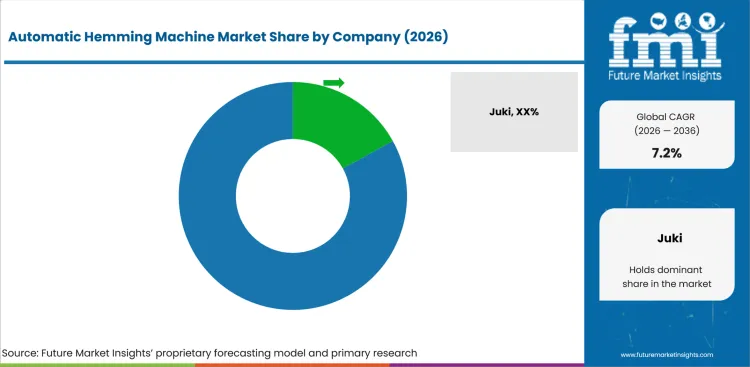
Juki, Brother, Pegasus, Yamato and Duerkopp Adler.
- Established industrial sewing companies hold an advantage through technical service teams and proven hemming machine portfolios.
- Machine-linked suppliers gain stronger acceptance by combining hemming units and operator training.
- Regional machinery suppliers win in country markets through spare-part access and local installation support.
- Service-ready suppliers improve renewal chances through fabric trials and sewing-room troubleshooting.
Industrial sewing companies compete by combining automatic hemming machines and service programs. Juki has a strong position through industrial sewing portfolios and apparel automation support. Brother competes depending on automatic bottom hemming products and productivity claims for knitwear factories. Pegasus and Yamato hold value across chainstitch and knitwear hemming applications.
Manufacturing and technical service depth have become stronger competitive separators as garment factories move beyond basic sewing machine purchases. Duerkopp Adler competes through premium automatic sewing units and digital sewing solutions. Jack Sewing Machine, Typical, Siruba, and Kansai Special strengthen competition led by value equipment and knitwear exposure. Buyers compare supplier performance through stitch stability and local service records.
Smaller and regional suppliers can win through local sewing-room knowledge and faster field support. China, India, and South Korea create opportunities for suppliers operating demonstration centers and trained mechanic networks. United States and Europe create stronger demand for flexible machines suited to shorter production runs. Companies proving lower rework across changing fabric lots should gain more durable factory relationships.
How do top Automatic Hemming Machine companies compare?
Juki and Brother score on service depth while Pegasus and Yamato lead through knitwear hemming capability.
| Company | Relevance to Market Title | Machine Portfolio Depth | Hemming Service Strength | Automation Support | Channel Reach | Geographic Footprint |
|---|---|---|---|---|---|---|
| Juki | Very High | Very Strong | Very Strong | Strong | Very Strong | Global |
| Brother | Very High | Strong | Very Strong | Strong | Very Strong | Global |
| Pegasus | Very High | Strong | Strong | Strong | Strong | Japan and global distributors |
| Yamato | Very High | Strong | Strong | Strong | Strong | Japan and global distributors |
| Duerkopp Adler | High | Strong | Strong | Very Strong | Strong | Europe and global |
| Jack Sewing Machine | High | Strong | Moderate | Moderate | Strong | China and international |
| Typical | High | Strong | Moderate | Moderate | Strong | China and international |
| Siruba | High | Strong | Moderate | Moderate | Strong | Asia and global distributors |
| Kansai Special | High | Moderate | Moderate | Strong | Moderate | Japan and global distributors |
| Mitsubishi Electric | Moderate to High | Moderate | Moderate | Very Strong | Strong | Global |
Source: Future Market Insights competitive analysis, 2026.
Who are the key players in the Automatic Hemming Machine Market?
Juki, Brother and Pegasus are listed with Yamato and Duerkopp Adler among other suppliers.
Key global companies leading the Automatic Hemming Machine Market include:
- Juki
- Brother
- Pegasus
- Yamato
- Duerkopp Adler
- Jack Sewing Machine
- Typical
- Siruba
- Kansai Special
- Mitsubishi Electric
Key Developments in Automatic Hemming Machine Market
- In March 2024, Juki announced its Texprocess 2024 industrial sewing machine and production-line service program in Germany.
- In 2024, Brother promoted the MB5003C-IM automatic bottom hemmer with a 50% cycle-time reduction claim compared to manual operation.
- In 2026, Duerkopp Adler’s Texprocess exhibitor profile covered the fully digitized CNC small field sewing unit 910, offering 3 hook types, 4 sewing areas, and operation up to 2,800 rpm.
Key Players in the Automatic Hemming Machine Market
Industrial Sewing Machine Leaders
Premium Sewing and Automation Companies
- Duerkopp Adler
- Mitsubishi Electric
- Kansai Special
Value Equipment and Regional Suppliers
- Jack Sewing Machine
- Typical
- Siruba
- Local industrial sewing distributors
Knitwear and Hemming Specialists
Automatic Hemming Machine Market - Scope & Definition
| Attribute | Detail |
|---|---|
| Market Definition | Industrial machines and automated units used to fold, guide, sew, trim, and finish fabric edges in apparel and textile production |
| Functions Covered | Fabric folding, feed guidance, stitch formation, thread trimming, hem finishing, operator assistance, setup control, and seam standardization |
| Applications Covered | Bottom hemming, sleeve hemming, curtain hemming, home textile finishing, programmable hemming, knitwear finishing, and technical textile edge finishing |
| End-Use Industries | Apparel manufacturing, home textiles, denim and workwear, technical textiles, repair workshops, uniforms, and specialty sewn products |
| Grades Covered | Standard automatic machines, premium guided hemming systems, semi-automatic units, inline automated units, and robotic-assisted hemming systems |
| Inclusions | All commercially traded automatic hemming machines across machine type, operation, end use, fabric type, sales channel, and country-level industrial sewing use |
| Exclusions | Domestic sewing machines, ordinary lockstitch machines without automatic hemming function, sewing needles, presser feet sold alone, fabric cutting machines, embroidery systems, and general factory automation not tied to hemming operations |
Automatic Hemming Machine Market - Research Methodology
| Method | Description |
|---|---|
| Primary Research | FMI analyst interviews with apparel manufacturers, sewing-room managers, industrial sewing dealers, service technicians, factory automation teams, and textile machinery suppliers across selected markets |
| Desk Research | Review of industrial sewing machine trade data, official OEM product pages, textile machinery association material, apparel manufacturing signals, and country-level production evidence |
| Market Sizing & Forecasting | Bottom-up equipment revenue approach using machine shipment estimates, average system pricing, installation support share, channel structure, and adoption by factory type |
| Data Validation | Cross-verification using company portfolios, official trade data, garment output indicators, machinery association reports, channel checks, and country-level apparel automation signals |
Automatic Hemming Machine Market - Report Scope
| Parameter | Details |
|---|---|
| Forecast period | 2026 to 2036 |
| Historical period | 2021 to 2025 |
| Quantitative unit | Revenue in USD million |
| By machine type | Automatic Bottom Hemmers, Sleeve Hemming Machines, Curtain and Home Textile Hemmers, Programmable Hemming Units |
| By operation | Standalone Machines, Inline Automated Units, Robotic-assisted Hemming |
| By end use | Apparel Manufacturing, Home Textiles, Denim and Workwear, Technical Textiles |
| By fabric type | Knits, Wovens, Denim, Delicate and Other |
| By sales channel | Direct OEM, Dealers and Distributors |
| Regions covered | North America, Latin America, Europe, East Asia, South Asia and Pacific, Middle East and Africa |
| Countries covered | China, India, South Korea, United States, Germany, Japan, United Kingdom, France |
| Key companies profiled | Juki, Brother, Pegasus, Yamato, Duerkopp Adler, Jack Sewing Machine, Typical, Siruba, Kansai Special, Mitsubishi Electric |
| Approach | Bottom-up equipment revenue approach using machine shipments, average system pricing, installation support share, channel mix, and country-level apparel automation exposure |
Source: Future Market Insights competitive analysis, 2026.
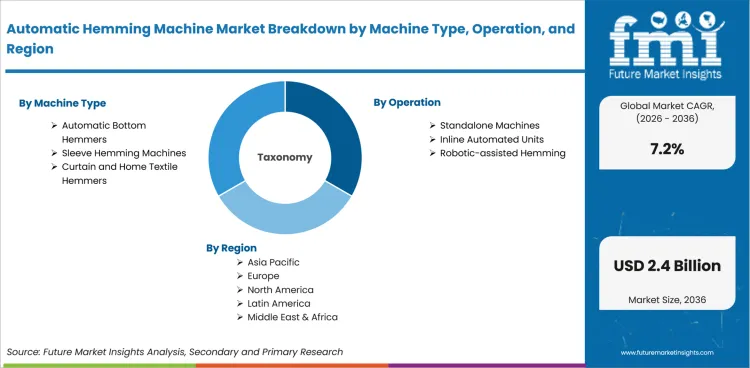
Automatic Hemming Machine Market Breakdown by Machine Type, Operation, End Use, Fabric Type, Sales Channel, and Region
Automatic Hemming Machine Market Segmented by Machine Type
- Automatic Bottom Hemmers
- Sleeve Hemming Machines
- Curtain and Home Textile Hemmers
- Programmable Hemming Units
Automatic Hemming Machine Market Segmented by Operation
- Standalone Machines
- Inline Automated Units
- Robotic-assisted Hemming
Automatic Hemming Machine Market Segmented by End Use
- Apparel Manufacturing
- Home Textiles
- Denim and Workwear
- Technical Textiles
Automatic Hemming Machine Market Segmented by Fabric Type
- Knits
- Wovens
- Denim
- Delicate and Other
Automatic Hemming Machine Market Segmented by Sales Channel
- Direct OEM
- Dealers and Distributors
Automatic Hemming Machine Market by Region
- North America
- Latin America
- Europe
- East Asia
- South Asia and Pacific
- Middle East and Africa
Research Sources and Bibliography
- Brother Industries. (2024). Automatic bottom hemmer: MB5003C-IM.
- Department for Business and Trade. (2025, October 2). Business population estimates for the UK and regions 2025.
- EURATEX. (2026). Facts and key figures.
- European Commission. (2025). Textiles, clothing, leather and footwear industries.
- Federal Reserve Bank of St. Louis. (2026). Sectoral output for manufacturing: Apparel manufacturing.
- Federal Reserve Bank of St. Louis. (2026). Employment for manufacturing: Apparel manufacturing.
- German Federal Statistical Office. (2025, February). Production in December 2024.
- India Press Information Bureau. (2025, April 1). Threads of progress.
- INSEE. (2026, May 22). In May 2026, the business climate in manufacturing industry has brightened again.
- International Labour Organization. (2025, March 28). Decent work challenges and opportunities in the textiles and clothing sector.
- International Textile Manufacturers Federation. (2025, June). International Textile Machinery Shipment Statistics, Vol. 47/2024.
- Juki Corporation. (2024, March 27). A guide to the JUKI exhibits at Texprocess 2024 in Germany.
- Messe Frankfurt. (2026). Duerkopp Adler GmbH exhibitor profile: Texprocess 2026.
- Ministry of Trade, Industry and Resources, Republic of Korea. (2026, January 2). Korea’s annual exports reach new highs in 2025.
- National Bureau of Statistics of China. (2025, May 20). Average annual wages of persons employed in urban units in 2024.
- Office for National Statistics. (2025, September 24). UK business: Activity, size and location.
- SelectUSA. (2024). Textiles industry.
- State Council of the People’s Republic of China. (2025, August 5). China unveils plan to promote digital transformation of machinery industry.
- UK Parliament House of Commons Library. (2026, February 9). Onshoring in the fashion and textiles industry.
- VDMA. (2026, April 21). Automation, digitalization and sustainability shaping the future of textile processing.
- VDMA Textile Machinery. (2025). Textile Machinery Association overview.
- World Integrated Trade Solution. (2026). China sewing machines, other than book-sewing machine exports by country, 2024.
- World Integrated Trade Solution. (2026). Germany sewing machines, other than book-sewing machine exports by country, 2024.
- World Integrated Trade Solution. (2026). India sewing machines, other than book-sewing machine imports by country, 2024.
- World Integrated Trade Solution. (2026). Japan sewing machines, other than book-sewing machine exports by country, 2024.
This bibliography is provided for reader reference and is not exhaustive. The full report contains the complete reference list and detailed citations.
This Report Answers
- Market size estimates for 2026 and forecasts through 2036 for the Automatic Hemming Machine Market.
- Insights across regional and country-level industrial sewing automation markets.
- Analysis of demand drivers and purchasing behavior.
- Evaluation of machine types, operations, end uses, fabric types, and sales channels.
- Assessment of apparel factory modernization and hemming quality requirements.
- Identification of opportunities across bottom hemmers and service-led machine sales.
- Evaluation of direct OEM models and dealer-led machinery channels.
- Country-level analysis covering China, India, South Korea, United States, Germany, Japan, United Kingdom, and France.
- Assessment of competition, including leading industrial sewing OEMs and automation-support companies.
- Analysis of plant-level decision drivers and service criteria.
- Regional outlooks across North America, Europe, East Asia, South Asia and Pacific, Latin America, and Middle East and Africa.
- Delivery of market data, forecasts, and supporting analysis in report-ready format.
Frequently Asked Questions
What is the growth prospect for automatic hemming machines?
Demand for automatic hemming machines is expected to rise at a considerable pace as apparel factories automate repeat hem operations and reduce operator skill dependence.
Which companies are expected to shape the automatic hemming machine market?
Juki, Brother, Pegasus, Yamato, Duerkopp Adler, Jack Sewing Machine, Typical, and Siruba are expected to shape market competition due to machine portfolios and service support.
Why are industrial sewing companies investing in automatic hemming machines?
Industrial sewing companies are investing in automatic hemming machines to support garment factories managing knitwear output and labor-saving production cells.
Why are direct OEM sales channels important in the automatic hemming machine market?
Direct OEM sales channels support installation and troubleshooting across automatic hemming systems.
Which machine formats are gaining attention in automatic hemming machines?
Automatic bottom hemmers and sleeve hemming machines are gaining attention as factories target repeat knitwear finishing and lower rework.
How does apparel automation influence automatic hemming machine demand?
Apparel automation influences demand through finished seam consistency and shorter operator training cycles.
Why is fabric type important for automatic hemming machines?
Fabric type is important since knits and delicate fabrics need different folders, feed settings, and seam-control methods.
What role does Direct OEM play in automatic hemming machine adoption?
Direct OEM supports adoption by combining machine supply and after-sales support.
Preview the report firsthand - request a free sample
Get SampleGet the brochure for pricing and purchase details.
Get PDFTable of Content
- Key Takeaways
- Market Size and CAGR
- Top Growth Driver
- Fastest Growing Segment
- Leading Region
- Key Companies
- Emerging Opportunities
- Executive Summary
- Global Market Outlook
- Demand-side Trends
- Supply-side Trends
- Technology Roadmap Analysis
- Analysis and Recommendations
- Analyst Perspective (What is happening? Why now? What should investors know?)
- Key Questions Answered
- How large is the market?
- What is the CAGR?
- What are key trends?
- Which region dominates?
- Who are the leaders?
- Market Overview
- Market Coverage / Taxonomy
- Market Definition / Scope / Limitations
- Research Methodology
- Chapter Orientation
- Analytical Lens and Working Hypotheses
- Market Structure, Signals, and Trend Drivers
- Benchmarking and Cross-market Comparability
- Market Sizing, Forecasting, and Opportunity Mapping
- Research Design and Evidence Framework
- Desk Research Programme (Secondary Evidence)
- Expert Input and Fieldwork (Primary Evidence)
- Tooling, Models, and Reference Databases
- Data Engineering and Model Build
- Quality Assurance and Audit Trail
- Market Background
- Market Dynamics (Drivers, Restraints, Opportunity, Trends)
- Scenario Forecast (Optimistic, Likely, Conservative)
- Impact Analysis
- AI Impact
- Sustainability Impact
- Regulatory Impact
- Technology Impact
- Consumer / Buyer Analysis
- Purchase Drivers
- Adoption Barriers
- Buyer Journey
- Opportunity Map Analysis
- Product Life Cycle Analysis
- Supply Chain Analysis
- Investment Feasibility Matrix
- Value Chain Analysis
- PESTLE and Porter's Analysis
- Regulatory Landscape
- Regional Parent Market Outlook
- Production and Consumption Statistics
- Import and Export Statistics
- Global Market Analysis and Forecast, 2021 to 2036
- Historical Market Size Value (USD Million) Analysis, 2021 to 2025
- Current and Future Market Size Value (USD Million) Projections, 2026 to 2036
- Y-o-Y Growth Trend Analysis
- Absolute $ Opportunity Analysis
- Global Market Pricing Analysis, 2021 to 2036
- Global Market Analysis and Forecast, By Machine Type, 2021 to 2036
- Introduction / Key Findings
- Historical Market Size Value (USD Million) Analysis By Machine Type, 2021 to 2025
- Current and Future Market Size Value (USD Million) Analysis and Forecast By Machine Type, 2026 to 2036
- Automatic Bottom Hemmers
- Sleeve Hemming Machines
- Curtain and Home Textile Hemmers
- Automatic Bottom Hemmers
- Y-o-Y Growth Trend Analysis By Machine Type, 2021 to 2025
- Absolute $ Opportunity Analysis By Machine Type, 2026 to 2036
- Global Market Analysis and Forecast, By Operation, 2021 to 2036
- Introduction / Key Findings
- Historical Market Size Value (USD Million) Analysis By Operation, 2021 to 2025
- Current and Future Market Size Value (USD Million) Analysis and Forecast By Operation, 2026 to 2036
- Standalone Machines
- Inline Automated Value (USD Million)s
- Robotic-assisted Hemming
- Standalone Machines
- Y-o-Y Growth Trend Analysis By Operation, 2021 to 2025
- Absolute $ Opportunity Analysis By Operation, 2026 to 2036
- Global Market Analysis and Forecast, By End Use, 2021 to 2036
- Introduction / Key Findings
- Historical Market Size Value (USD Million) Analysis By End Use, 2021 to 2025
- Current and Future Market Size Value (USD Million) Analysis and Forecast By End Use, 2026 to 2036
- Apparel Manufacturing
- Home Textiles
- Denim and Workwear
- Apparel Manufacturing
- Y-o-Y Growth Trend Analysis By End Use, 2021 to 2025
- Absolute $ Opportunity Analysis By End Use, 2026 to 2036
- Global Market Analysis and Forecast, By Fabric Type, 2021 to 2036
- Introduction / Key Findings
- Historical Market Size Value (USD Million) Analysis By Fabric Type, 2021 to 2025
- Current and Future Market Size Value (USD Million) Analysis and Forecast By Fabric Type, 2026 to 2036
- Knits
- Wovens
- Denim
- Knits
- Y-o-Y Growth Trend Analysis By Fabric Type, 2021 to 2025
- Absolute $ Opportunity Analysis By Fabric Type, 2026 to 2036
- Global Market Analysis and Forecast, By Sales Channel, 2021 to 2036
- Introduction / Key Findings
- Historical Market Size Value (USD Million) Analysis By Sales Channel, 2021 to 2025
- Current and Future Market Size Value (USD Million) Analysis and Forecast By Sales Channel, 2026 to 2036
- Direct OEM
- Dealers and Distributors
- Direct OEM
- Y-o-Y Growth Trend Analysis By Sales Channel, 2021 to 2025
- Absolute $ Opportunity Analysis By Sales Channel, 2026 to 2036
- Global Market Analysis and Forecast, By Region, 2021 to 2036
- Introduction
- Historical Market Size Value (USD Million) Analysis By Region, 2021 to 2025
- Current Market Size Value (USD Million) Analysis and Forecast By Region, 2026 to 2036
- North America
- Latin America
- Western Europe
- Eastern Europe
- East Asia
- South Asia and Pacific
- Middle East & Africa
- Market Attractiveness Analysis By Region
- North America Market Analysis and Forecast, By Country, 2021 to 2036
- Historical Market Size Value (USD Million) Trend Analysis By Market Taxonomy, 2021 to 2025
- Market Size Value (USD Million) Forecast By Market Taxonomy, 2026 to 2036
- By Country
- USA
- Canada
- Mexico
- By Machine Type
- By Operation
- By End Use
- By Fabric Type
- By Sales Channel
- By Country
- Market Attractiveness Analysis
- By Country
- By Machine Type
- By Operation
- By End Use
- By Fabric Type
- By Sales Channel
- Key Takeaways
- Latin America Market Analysis and Forecast, By Country
- Historical Market Size Value (USD Million) Trend Analysis By Market Taxonomy, 2021 to 2025
- Market Size Value (USD Million) Forecast By Market Taxonomy, 2026 to 2036
- By Country
- Brazil
- Chile
- Rest of Latin America
- By Machine Type
- By Operation
- By End Use
- By Fabric Type
- By Sales Channel
- By Country
- Market Attractiveness Analysis
- By Country
- By Machine Type
- By Operation
- By End Use
- By Fabric Type
- By Sales Channel
- Key Takeaways
- Western Europe Market Analysis and Forecast, By Country
- Historical Market Size Value (USD Million) Trend Analysis By Market Taxonomy, 2021 to 2025
- Market Size Value (USD Million) Forecast By Market Taxonomy, 2026 to 2036
- By Country
- Germany
- UK
- Italy
- Spain
- France
- Nordic
- BENELUX
- Rest of Western Europe
- By Machine Type
- By Operation
- By End Use
- By Fabric Type
- By Sales Channel
- By Country
- Market Attractiveness Analysis
- By Country
- By Machine Type
- By Operation
- By End Use
- By Fabric Type
- By Sales Channel
- Key Takeaways
- Eastern Europe Market Analysis and Forecast, By Country
- Historical Market Size Value (USD Million) Trend Analysis By Market Taxonomy, 2021 to 2025
- Market Size Value (USD Million) Forecast By Market Taxonomy, 2026 to 2036
- By Country
- Russia
- Poland
- Hungary
- Balkan & Baltic
- Rest of Eastern Europe
- By Machine Type
- By Operation
- By End Use
- By Fabric Type
- By Sales Channel
- By Country
- Market Attractiveness Analysis
- By Country
- By Machine Type
- By Operation
- By End Use
- By Fabric Type
- By Sales Channel
- Key Takeaways
- East Asia Market Analysis and Forecast, By Country
- Historical Market Size Value (USD Million) Trend Analysis By Market Taxonomy, 2021 to 2025
- Market Size Value (USD Million) Forecast By Market Taxonomy, 2026 to 2036
- By Country
- China
- Japan
- South Korea
- By Machine Type
- By Operation
- By End Use
- By Fabric Type
- By Sales Channel
- By Country
- Market Attractiveness Analysis
- By Country
- By Machine Type
- By Operation
- By End Use
- By Fabric Type
- By Sales Channel
- Key Takeaways
- South Asia and Pacific Market Analysis and Forecast, By Country
- Historical Market Size Value (USD Million) Trend Analysis By Market Taxonomy, 2021 to 2025
- Market Size Value (USD Million) Forecast By Market Taxonomy, 2026 to 2036
- By Country
- India
- ASEAN
- Australia & New Zealand
- Rest of South Asia and Pacific
- By Machine Type
- By Operation
- By End Use
- By Fabric Type
- By Sales Channel
- By Country
- Market Attractiveness Analysis
- By Country
- By Machine Type
- By Operation
- By End Use
- By Fabric Type
- By Sales Channel
- Key Takeaways
- Middle East & Africa Market Analysis and Forecast, By Country
- Historical Market Size Value (USD Million) Trend Analysis By Market Taxonomy, 2021 to 2025
- Market Size Value (USD Million) Forecast By Market Taxonomy, 2026 to 2036
- By Country
- Kingdom of Saudi Arabia
- Other GCC Countries
- Türkiye
- South Africa
- Other African Union
- Rest of Middle East & Africa
- By Machine Type
- By Operation
- By End Use
- By Fabric Type
- By Sales Channel
- By Country
- Market Attractiveness Analysis
- By Country
- By Machine Type
- By Operation
- By End Use
- By Fabric Type
- By Sales Channel
- Key Takeaways
- Key Countries Market Analysis
- USA
- Pricing Analysis
- Market Share Analysis, 2025
- By Machine Type
- By Operation
- By End Use
- By Fabric Type
- By Sales Channel
- Canada
- Pricing Analysis
- Market Share Analysis, 2025
- By Machine Type
- By Operation
- By End Use
- By Fabric Type
- By Sales Channel
- Mexico
- Pricing Analysis
- Market Share Analysis, 2025
- By Machine Type
- By Operation
- By End Use
- By Fabric Type
- By Sales Channel
- Brazil
- Pricing Analysis
- Market Share Analysis, 2025
- By Machine Type
- By Operation
- By End Use
- By Fabric Type
- By Sales Channel
- Chile
- Pricing Analysis
- Market Share Analysis, 2025
- By Machine Type
- By Operation
- By End Use
- By Fabric Type
- By Sales Channel
- Germany
- Pricing Analysis
- Market Share Analysis, 2025
- By Machine Type
- By Operation
- By End Use
- By Fabric Type
- By Sales Channel
- UK
- Pricing Analysis
- Market Share Analysis, 2025
- By Machine Type
- By Operation
- By End Use
- By Fabric Type
- By Sales Channel
- Italy
- Pricing Analysis
- Market Share Analysis, 2025
- By Machine Type
- By Operation
- By End Use
- By Fabric Type
- By Sales Channel
- Spain
- Pricing Analysis
- Market Share Analysis, 2025
- By Machine Type
- By Operation
- By End Use
- By Fabric Type
- By Sales Channel
- France
- Pricing Analysis
- Market Share Analysis, 2025
- By Machine Type
- By Operation
- By End Use
- By Fabric Type
- By Sales Channel
- India
- Pricing Analysis
- Market Share Analysis, 2025
- By Machine Type
- By Operation
- By End Use
- By Fabric Type
- By Sales Channel
- ASEAN
- Pricing Analysis
- Market Share Analysis, 2025
- By Machine Type
- By Operation
- By End Use
- By Fabric Type
- By Sales Channel
- Australia & New Zealand
- Pricing Analysis
- Market Share Analysis, 2025
- By Machine Type
- By Operation
- By End Use
- By Fabric Type
- By Sales Channel
- China
- Pricing Analysis
- Market Share Analysis, 2025
- By Machine Type
- By Operation
- By End Use
- By Fabric Type
- By Sales Channel
- Japan
- Pricing Analysis
- Market Share Analysis, 2025
- By Machine Type
- By Operation
- By End Use
- By Fabric Type
- By Sales Channel
- South Korea
- Pricing Analysis
- Market Share Analysis, 2025
- By Machine Type
- By Operation
- By End Use
- By Fabric Type
- By Sales Channel
- Russia
- Pricing Analysis
- Market Share Analysis, 2025
- By Machine Type
- By Operation
- By End Use
- By Fabric Type
- By Sales Channel
- Poland
- Pricing Analysis
- Market Share Analysis, 2025
- By Machine Type
- By Operation
- By End Use
- By Fabric Type
- By Sales Channel
- Hungary
- Pricing Analysis
- Market Share Analysis, 2025
- By Machine Type
- By Operation
- By End Use
- By Fabric Type
- By Sales Channel
- Kingdom of Saudi Arabia
- Pricing Analysis
- Market Share Analysis, 2025
- By Machine Type
- By Operation
- By End Use
- By Fabric Type
- By Sales Channel
- Türkiye
- Pricing Analysis
- Market Share Analysis, 2025
- By Machine Type
- By Operation
- By End Use
- By Fabric Type
- By Sales Channel
- South Africa
- Pricing Analysis
- Market Share Analysis, 2025
- By Machine Type
- By Operation
- By End Use
- By Fabric Type
- By Sales Channel
- USA
- Market Structure Analysis
- Competition Dashboard
- Competition Benchmarking
- Market Share Analysis of Top Players
- By Regional
- By Machine Type
- By Operation
- By End Use
- By Fabric Type
- By Sales Channel
- Emerging Startups
- Innovation Benchmarking
- Competition Analysis
- Competition Deep Dive
- Juki
- Overview
- Product Portfolio
- Profitability by Market Segments (Product/Region/Sales Channel)
- Sales Footprint
- Strategy Overview
- Marketing Strategy
- Product Strategy
- Channel Strategy
- Brother
- Pegasus
- Yamato
- Duerkopp Adler
- Juki
- Case Studies
- Success Stories
- Recent Developments
- Competition Deep Dive
- Assumptions & Acronyms Used


