

- Market Size (2026)
- USD 1120.7 Mn
- Forecast (2036)
- USD 2677.5 Mn
- CAGR (2026 to 2036)
- 9.1%
How big is the Container Fire Detection System Market?
USD 1,120.7 million in 2026 and USD 2,677.5 million by 2036 at a 9.1% CAGR.
The container fire detection is moving into a more demanding phase across maritime and port operations. Older alarm layouts were designed for simpler cargo risks and smaller operating areas. Modern container flows now include battery cargo and regulated dangerous goods within the same safety environment. Allianz Commercial recorded 250 fire incidents during 2024, up 20% year over year, which shows why early warning systems are moving higher on vessel and terminal safety agendas.
Safety teams need warning systems that can identify heat signals first. Gas or visual change can then confirm escalation before a crew reaches the affected container space. Allianz Commercial also reported 69 fire incidents on container or ro-ro vessels during 2024, giving operators a stronger case for detector layouts that can work across cargo holds and landside handling points. Vessel owners want alarms that help crew response inside cargo holds. Port operators need alerts that reach control rooms and maintenance teams without unclear handoffs.
System integrators gain a wider role by linking detector placement with certified panels and service records. World Shipping Council reported 576 containers lost at sea out of more than 250 million transported in 2024, which shows how container operations need better documented risk controls even before a fire event occurs. A planned safety workflow is replacing device-only purchasing as buyers seek alarms that can be tested and serviced across vessels and terminals.
Summary of the Container Fire Detection System Market
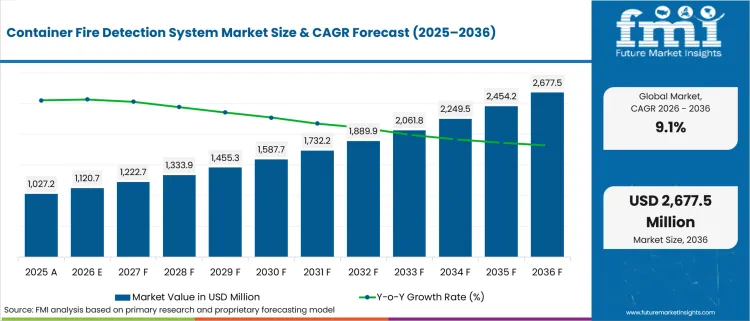
| Metric | Value |
|---|---|
| 2025 Market Size | USD 1,027.2 million |
| 2026 Market Size | USD 1,120.7 million |
| 2036 Market Size | USD 2,677.5 million |
| Forecast CAGR (2026-2036) | 9.1% |
| Leading Connectivity | Networked / IoT |
| Networked / IoT Share (2026) | 52.0% |
| Leading Detection Type | Multi-sensor Systems |
| Multi-sensor Systems Share (2026) | 46.0% |
| Leading Container Environment | Battery / Hazardous Cargo |
| Battery / Hazardous Cargo Share (2026) | 38.0% |
| Fastest-growing Country | China |
| China CAGR by 2036 | 10.2% |
| Market Signal | Commercial Impact |
|---|---|
| Demand and Growth Drivers | Demand for container fire detection systems is increasing as battery cargo, hazardous materials, and high-density container operations require faster fire detection and coordinated emergency response across ports and vessels.
|
| Product and Segment View | Networked connectivity, multi-sensor detection, and battery cargo monitoring continue to represent the leading commercial opportunities across the market.
|
| Geography and Growth Outlook | Asia continues to dominate market expansion while North America strengthens demand through port modernization and enhanced cargo safety regulations.
|
| Competitive Landscape | Competition increasingly focuses on marine-certified fire detection technologies, gas sensing capabilities, and comprehensive service support for maritime operators.
|
| Analyst Perspective | Container fire detection systems are evolving from standalone alarm solutions into integrated safety platforms that enable early risk identification, centralized monitoring, and coordinated emergency response across ports and vessels.
- Nikhil Kaitwade, Principal Consultant at Future Market Insights |
How is the Container Fire Detection System Market segmented?
Container Fire Detection System industry is segmented by detection type and container environment. It also covers end use and connectivity. Sales channel and region complete the scope.
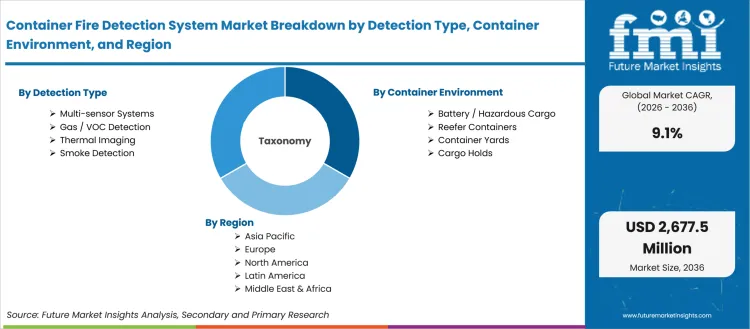
The container fire detection system market is segmented by detection type and container environment. It also covers end use and connectivity. Sales channel and region complete the scope. By detection type, scope covers smoke detection and thermal imaging. It also includes gas / VOC detection and multi-sensor systems. By container environment, demand covers cargo holds and container yards. Reefer containers and battery / hazardous cargo create the remaining scope. By end use, demand comes from container ships and ports & terminals. Warehouses and intermodal rail / truck operators form the other buyer groups. By connectivity, scope includes standalone and networked / IoT systems. Cloud-linked systems support remote alarm review. By sales channel, buyers work through direct OEM supply and system integrators. Service retrofit channels support older assets. Regional coverage includes North America and Western Europe. East Asia, South Asia and Pacific, and selected markets complete the scope.
Why do Multi-sensor Systems lead the detection type segment?
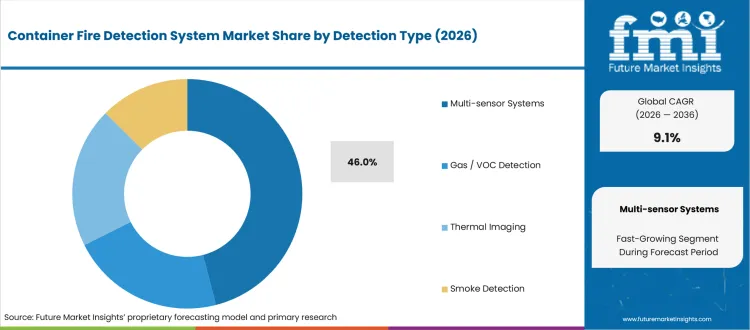
Single-sensor coverage is harder to defend in container operations. Cargo may show heat before smoke, while hazardous material can add gas signals before visible flame. World Shipping Council reported that a container ship fire occurs every 17 days, which strengthens the buyer case for alarm chains that combine thermal, smoke, gas, and visual signals before response access narrows.
- Multi-sensor Systems are estimated to command 46.0% of detection type demand in 2026, with buyers comparing heat and image cues before selecting detector packages for mixed cargo. Smoke and gas signals add further warning layers. Allianz Commercial reported 250 fire incidents during 2024, up 20% year over year, which gives ship operators a stronger reason to review sensor combinations.
- Operational value comes from cleaner alarm judgment. Smoke may appear late in some incidents, while heat or gas can appear earlier in battery cargo. Allianz Commercial reported 69 fire incidents on container, cargo, or ro-ro vessels during 2024, which supports earlier multi-signal assessment before crew access becomes constrained.
What raises demand for Battery / Hazardous Cargo within container environment?
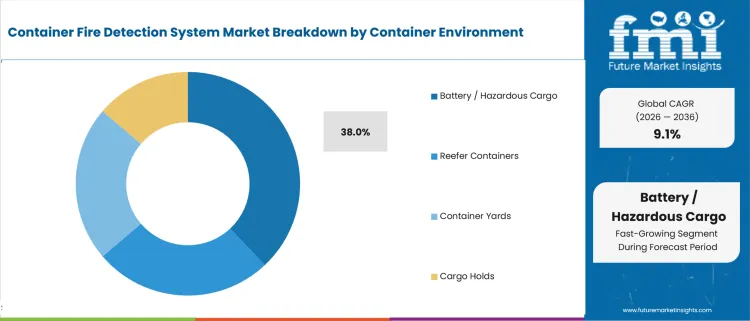
Battery and hazardous cargo areas need closer monitoring as fire behavior can change quickly. Terminal and vessel teams need early signals before a response crew has limited access to container or cargo-hold space. CINS guidance classifies lithium-ion cell transport under UN 3480 and UN 3481, which gives buyers a clear cargo-control basis for stricter monitoring.
- Battery / Hazardous Cargo is anticipated to represent 38.0% of container environment demand in 2026, given the need for closer monitoring around lithium-ion cargo and regulated goods. CINS guidance recommends a minimum 30 cm gap between cargo and both the container ceiling and container doors, which supports detector placement closer to battery-cargo risk zones.
- Hazardous cargo buyers need systems that support early escalation instead of late confirmation. Thermal imaging and gas / VOC sensing help terminal teams classify risk before a small anomaly turns into a hard-to-reach incident. CINS lists 6 hazardous properties for lithium-ion cells, including explosion risk and electrical hazard.
How do Container Ships lead demand within end use?
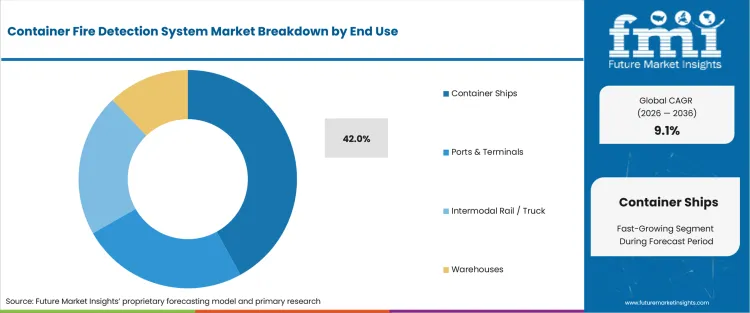
Container ships create the hardest access challenge after an incident starts. Cargo holds can limit crew movement, and stacked containers can reduce visual confirmation. World Shipping Council reported 1,478 containers lost at sea out of more than 280 million transported in 2025, which shows why shipboard safety decisions need stronger documentation and earlier risk signals.
- Container Ships are projected to capture 42.0% of end-use demand in 2026, driven by cargo-hold access limits and marine approval needs. Vessel operators need detection layouts that can identify risk across stacked containers and move alarms toward crew response procedures. World Shipping Council reported 128 recovered containers in 2025, proving how post-incident coordination has become part of container safety planning.
- Marine buyers also value service access, certified installation work, and panel compatibility. Retrofit projects often occur during short dry-dock periods, which makes engineering preparation important for equipment selection. One major incident accounted for 640 containers lost in 2025, or about 43% of annual container losses, explaining why isolated shipboard events can reshape safety priorities.
What supports demand for Networked / IoT within connectivity?
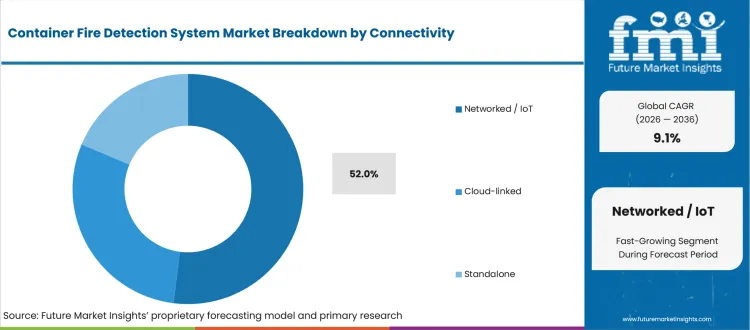
Connected alarm systems are important as a container incident can involve yard teams and maintenance contractors. A detector signal has limited value unless it reaches the right response point quickly. World Shipping Council members operate 90% of global liner shipping capacity and move more than USD 4 trillion worth of goods each year, making connected risk communication central to large-scale container safety.
- Networked / IoT systems are expected to hold 52.0% of connectivity demand in 2026, through control-room alarm routing that allows terminals to coordinate yard alerts and response action across dispersed container assets. World Shipping Council’s Cargo Safety Program had carriers representing more than 70% of global TEU capacity at launch, demonstrating why shared screening signals are becoming more important across container safety workflows.
- Connected alarm systems help operators move from isolated detector points to documented response workflows. Service teams can review fault signals and maintenance history more easily, while control rooms gain better clarity during yard incidents. World Shipping Council says a major shipboard fire occurs roughly every 60 days, justifying the connected alarm-routing demand across vessel and terminal response chains.
How are System Integrators positioned within sales channel?
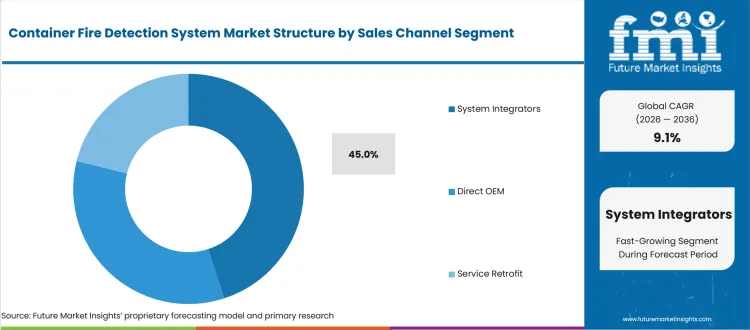
System integrators are important as container fire detection projects usually involve old panels and service documentation. Buyers need a project path that keeps these tasks under one technical plan. CINS guidance states that overpack lettering must be at least 12 mm high, which shows how technical documentation and cargo-marking checks can influence hazardous-cargo project planning.
- System Integrators are projected to account for 45.0% of sales-channel demand in 2026, under a project model that starts with site survey and detector placement. Control panel work and commissioning support complete the upgrade path. CINS guidance recommends keeping damaged or defective cell packaging at least 50 cm from container doors, giving integrators a measurable design point for inspection access and detector placement.
- Integrator value improves during complex upgrades involving hazardous cargo areas and cargo-hold interfaces. Buyers often prefer a partner able to manage technical drawings and marine approval steps together. Installation timing and service documentation then follow a clearer project path, while CINS guidance says packages containing cells or batteries outside equipment must not exceed 30 kg gross mass.
What are the drivers, restraints, and opportunities in the Container Fire Detection System Market?
Near-term purchases are being shaped by the operating requirement and expansion route outlined below.
- Driver: Battery and hazardous cargo flows drive system spending when terminals need earlier gas and smoke alerts near risk containers.
- Restraint: Retrofit complexity restrains adoption when older vessels and terminals require panel compatibility checks before detector upgrades.
- Opportunity: Networked alarm routing opens an opportunity for suppliers able to connect detector alerts with control rooms and service records.
Container fire detection demand grows when safety teams treat alarm evidence as an operating control. Battery cargo and dangerous goods make early detection more valuable than simple alarm placement. World Shipping Council reported that misdeclared dangerous goods are responsible for more than 25% of cargo-related incidents, strengthening the case for detection systems supporting declared-risk checks before response teams face limited access.
Retrofit work adds complexity as older vessels and terminals often have limited access points and tight service windows. Buyers delay projects when engineering ownership is unclear. CINS guidance requires packages outside equipment to withstand a 1.2 m drop test in any orientation, which adds another packaging and inspection requirement around hazardous-cargo handling before detector upgrades are finalized.
Connected alarm platforms create a wider route for suppliers. Port operators need detector data to reach control rooms and safety managers without manual relay. World Shipping Council states that more than 100 international liner operators provide over 2,000 regularly scheduled services, attracting supplier demand for alarm-routing discipline across vessel and terminal networks.
Which country CAGRs are profiled in the Container Fire Detection System Market?
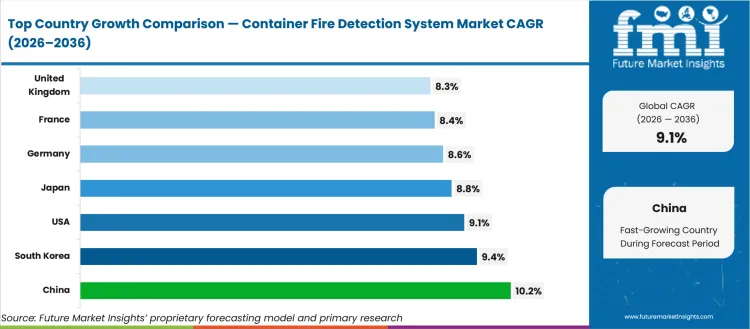
| Country | CAGR |
|---|---|
| United States | 9.1% |
| United Kingdom | 8.3% |
| Germany | 8.6% |
| France | 8.4% |
| Japan | 8.8% |
| China | 10.2% |
| South Korea | 9.4% |
| India | 9.8% |
Source: Future Market Insights analysis, 2026.
How do country-level CAGRs compare in the Container Fire Detection System Market?
Country demand for container fire detection should be read through the safety pressure behind vessel and terminal operations. In China, India, and South Korea, large port activity and shipbuilding support wider detector installation. In the United States and Western Europe, and terminal safety programs shape demand. Japan shows a steadier path since buyers validate safety systems carefully before scaling installation work. For executives, the key question is not only country pace. The practical issue is where missed detection creates higher risk across crew response and hazardous cargo handling.
- United States demand is projected to advance at 9.1% CAGR from 2026 to 2036, supported by inspection-led vessel safety and documentation needs. USA Coast Guard conducted 8,999 SOLAS safety exams in 2025. A total of 77 detentions kept safety systems within active port-state review for vessels entering USA ports.
- United Kingdom is estimated to rise at 8.3% CAGR by 2036, shaped by controlled port spending and safety upgrades at major gateways. UK port freight data recorded 16.6 million tonnes of container tonnage in Q1 2026, giving suppliers a steady base for targeted retrofit and alarm-routing projects.
- Germany is forecast to record 8.6% CAGR by 2036, helped by containerized trade concentration and high service expectations at major ports. Port of Hamburg handled 8.3 million TEUs in 2025, with container throughput rising 7.3%, creating a practical demand setting for certified detection and terminal-linked alarm systems.
- France is projected to grow at 8.4% CAGR through 2036, influenced by container activity along Seine corridor gateways and port safety modernization. HAROPA reported 83.19 million tonnes of maritime trade in 2024, while container traffic advanced 18.7%, giving suppliers a stronger base for yard and terminal monitoring discussions.
- Japan is expected to progress at 8.8% CAGR over the forecast period, with measured equipment validation shaping buying decisions across vessel and terminal projects. Japan’s 12 major ports handled 3.89 million TEUs of foreign-trade containers in Q3 2024, supporting demand for reliable alarm coverage in busy container gateways.
- China is forecast to grow at 10.2% CAGR through 2036, supported by dense terminal activity and large vessel calls. Shanghai Port crossed 50 million TEUs in 2024, giving system suppliers a high-volume operating setting for multi-sensor packages and service-led safety upgrades.
- South Korea is projected to post 9.4% CAGR by 2036, backed by shipbuilding capability and transshipment traffic across major trade ports. Ministry of Oceans and Fisheries reported 31.73 million TEUs of container volume in 2024, up 5.3%, reinforcing demand for certified fire and gas detection across port and vessel interfaces.
- India is forecast to record 9.8% CAGR by 2036, aided by port capacity expansion and terminal modernization. Major ports handled about 855 million tonnes in FY 2024-25, up 4.3%, creating a larger installation base for fire detection systems across cargo berths and retrofit projects.
Who are the notable companies in the Container Fire Detection System Market?
Consilium Safety, Autronica, Dräger, Honeywell, Bosch Security, Siemens, Johnson Controls, Minimax, Fike and Marioff are the notable companies shaping this market.
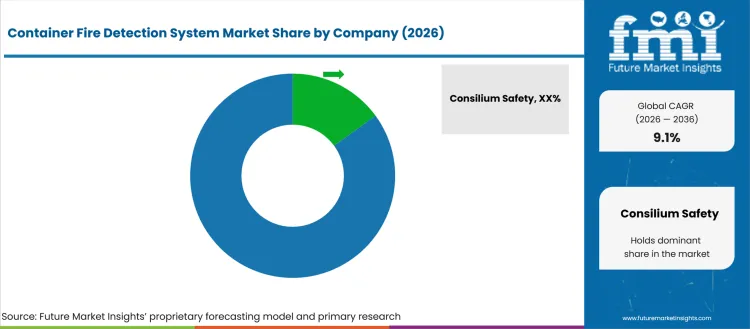
Competition in the container fire detection system market is divided by buyers wanting safety control. Consilium Safety, Autronica, and Dräger are stronger when buyers need marine fire and gas detection depth. Honeywell, Bosch Security, Siemens, and Johnson Controls become more practical when fire alarm control must connect with terminal buildings and facility safety systems. Minimax, Fike, and Marioff are contributive for detection projects need to connect with suppression planning and hazard response design.
- Consilium Safety is well positioned in vessel projects through marine fire and gas safety capabilities. Cargo-space detector knowledge supports shipowners that need certified systems and installation experience across complex vessel environments.
- Autronica has a strong role in fire and gas detection for maritime and infrastructure settings. Energy and industrial projects add further demand for its system range. Its product range supports projects that need technical control and service support across land and sea applications.
- Dräger is positioned in maritime gas detection through fixed systems used on ships and terminals handling dangerous goods and regulated materials. Gas detection depth supports hazardous cargo monitoring before smoke appears.
- Honeywell, Bosch Security, and Siemens compete through fire alarm portfolios and control interfaces. Johnson Controls adds service depth for facility-linked projects. Service channels help these suppliers support container-linked warehouses and terminal buildings.
- Minimax, Fike, and Marioff bring adjacent fire protection capability for high-risk cargo environments. Detection projects can connect with suppression planning and hazard-specific system engineering.
Competitive Benchmarking: Container Fire Detection System Market
| Company | Marine Fire / Gas Detection Depth | Container Hazard Monitoring Fit | Retrofit Service Reach | Geographic Footprint |
|---|---|---|---|---|
| Consilium Safety | High | Strong | Strong | Global |
| Autronica | High | Strong | Strong | Global |
| Dräger | High | Strong | Strong | Global |
| Honeywell | Medium | Strong | High | Global |
| Bosch Security | Medium | Medium | High | Global |
| Siemens | Medium | Medium | High | Global |
| Johnson Controls | Medium | Medium | High | Global |
| Minimax | Medium | Medium | Strong | Global |
| Fike | Medium | Strong | Moderate | Global |
| Marioff | Low | Medium | Strong | Global |
Source: Future Market Insights competitive analysis, 2026.
Key Developments in the Container Fire Detection System Market
- In December 2025, Autronica acquired Engtek’s fire and gas safety business, adding direct operations in Singapore and Shanghai. The move strengthens Asian engineering and service support for shipyards and vessel owners needing certified fire and gas detection.
- In February 2026, Autronica launched AutroMaster Mobile for technical monitoring and maintenance of AutroSafe and AutroPrime fire detection systems. Mobile alarm handling and fault support improve service workflows for distributed fire detection sites.
- In May 2026, MSA Safety agreed to acquire Autronica Fire and Security for about USD 555 million. The transaction adds fire detection, gas detection, and alarm system capability across maritime and industrial customers.
Key Players in the Container Fire Detection System Market
Marine Fire and Gas Detection Specialists
- Consilium Safety
- Autronica
- Dräger
Integrated Building and Industrial Safety Groups
- Honeywell
- Bosch Security
- Siemens
- Johnson Controls
Fire Suppression and Hazard Specialists
- Minimax
- Marioff
- Fike
Container Fire Detection System Market - Report Scope
| Coverage field | Report scope |
|---|---|
| Market breakdown | Container Fire Detection System Market Breakdown By Detection Type, Container Environment, End Use, Connectivity, Sales Channel, and Region |
| Market Definition | Sensors, alarm panels, control interfaces, and monitoring software used to detect fire risk in containerized cargo operations |
| Regions Covered | North America, Western Europe, East Asia, South Asia and Pacific |
| Countries Covered | United States, United Kingdom, Germany, France, Japan, China, South Korea, India and selected countries |
| Key Companies Profiled | Consilium Safety, Autronica, Dräger, Honeywell, Bosch Security, Siemens, Johnson Controls, Minimax, Fike, Marioff |
| Forecast Period | 2026 to 2036 |
| Approach | Hybrid bottom-up and top-down methodology using system volume, detector pricing, retrofit timing, port activity, cargo risk, and supplier portfolio validation |
Source: Future Market Insights analysis, 2026.
Container Fire Detection System Market - Research Methodology
| Method | Approach |
|---|---|
| Primary Research | FMI analysts reviewed inputs from vessel operators, terminal safety teams, marine system integrators, port engineering teams, and hazardous cargo specialists. Discussions covered alarm reliability and retrofit timing. Certification needs and service access were also reviewed. |
| Desk Research | Desk research reviewed maritime safety work and port statistics. Classification guidance, company product information, and official trade publications were also assessed. Evidence was separated between direct container fire detection and marine fire safety. Gas detection and adjacent hazard protection were reviewed separately. |
| Market Sizing and Forecasting | Model inputs combined detector package volume and average system pricing. Retrofit intensity and newbuild fitment were then applied. Service contract value and country-level port activity completed the model. Segment shares were estimated from buyer use cases and supplier portfolio depth. |
| Data Validation | Forecasts were checked against cargo handling activity and maritime safety priorities. Supplier product scope and channel behavior were then reviewed. Company inclusion was validated against fire detection and gas detection. Marine safety and adjacent container fire risk capability were also assessed. |
Container Fire Detection System Market by Segments
Container Fire Detection System Market segmented by Detection Type:
- Smoke Detection
- Thermal Imaging
- Gas / VOC Detection
- Multi-sensor Systems
Container Fire Detection System Market segmented by Container Environment:
- Cargo Holds
- Container Yards
- Reefer Containers
- Battery / Hazardous Cargo
Container Fire Detection System Market segmented by End Use:
- Container Ships
- Ports & Terminals
- Warehouses
- Intermodal Rail / Truck
Container Fire Detection System Market segmented by Connectivity:
- Standalone
- Networked / IoT
- Cloud-linked
Container Fire Detection System Market segmented by Sales Channel:
- Direct OEM
- System Integrators
- Service Retrofit
Container Fire Detection System Market by Region:
- North America
- United States
- Canada
- Mexico
- Latin America
- Brazil
- Chile
- Rest of Latin America
- Western Europe
- Germany
- UK
- Italy
- Spain
- France
- Nordic
- BENELUX
- Rest of Western Europe
- Eastern Europe
- Russia
- Poland
- Hungary
- Balkan & Baltic
- Rest of Eastern Europe
- East Asia
- China
- Japan
- South Korea
- South Asia and Pacific
- India
- ASEAN
- Australia & New Zealand
- Rest of South Asia and Pacific
- Middle East & Africa
- Kingdom of Saudi Arabia
- Other GCC Countries
- Turkiye
- South Africa
- Other African Union
- Rest of Middle East & Africa
Research Sources and Bibliography
- Allianz Commercial. (2025). Safety and Shipping Review 2025. Allianz Commercial.
- World Shipping Council. (2025, June 30). World Shipping Council releases Container Lost at Sea Report - 2025 Update. World Shipping Council.
- World Shipping Council. (2025, September 15). World Shipping Council launches industry-first Cargo Safety Program to prevent ship fires. World Shipping Council.
- World Shipping Council. (2026, June 24). Misdeclared dangerous goods remain a persistent threat to shipping and supply chains. World Shipping Council.
- World Shipping Council. (2026, June 25). World Shipping Council releases Containers Lost at Sea Report: 2026 Update. World Shipping Council.
- World Shipping Council. (2026). World Shipping Council. World Shipping Council.
- World Shipping Council. (2026). A competitive industry. World Shipping Council.
- Cargo Incident Notification System, International Group of P&I Clubs, & TT Club. (2025, June). CINS guidelines for shipping lithium-ion cells in containers. Cargo Incident Notification System.
- Lloyd’s Register. (2024, March). IMO Ship Systems and Equipment Tenth Session: Summary Report. Lloyd’s Register.
- International Maritime Organization. (2024, March 8). Sub-Committee on Ship Systems and Equipment, 10th session. International Maritime Organization.
- International Maritime Organization. (2024, December 6). Maritime Safety Committee, 109th session. International Maritime Organization.
- Ministry of Transport of China. (2024, May 30). Container throughput at China’s ports up 9 percent in January-April. Ministry of Transport of China.
- Shanghai Port. (2024, December 25). 50 million TEUs: Shanghai Port sets world record for annual throughput. Shanghai Port.
- Ministry of Ports, Shipping and Waterways. (2025, May 13). India’s major ports achieve historic milestones in FY 2024-25. Ministry of Ports, Shipping and Waterways.
- Ministry of Ports, Shipping and Waterways. (2026, April 5). Major ports record 915 million tonnes cargo in FY 2025-26, surpass target with 7.06% growth. Ministry of Ports, Shipping and Waterways.
- Bureau of Transportation Statistics. (2025, January 13). Port Performance Freight Statistics: 2025 Annual Report. USA Department of Transportation.
- USA Coast Guard. (2026, May 19). 2025 Port State Control Annual Report Posted. USA Coast Guard.
- Department for Transport. (2026, June 10). Port freight quarterly statistics: January to March 2026. Department for Transport.
- Port of Hamburg. (2026, February 19). Throughput figures for 2025 at a glance. Port of Hamburg.
- HAROPA PORT. (2025, January 29). A new model for traffic growth and rising numbers of new industrial operations. HAROPA PORT.
- Japan International Freight Forwarders Association. (2025, April 1). Containers to/from Japan’s 12 major ports increase 0.6% to 3.89 million TEUs. Japan International Freight Forwarders Association.
- Ministry of Oceans and Fisheries. (2025, January 23). Korea’s trade ports handled a record-breaking container volume of 31.73 million TEUs. Ministry of Oceans and Fisheries.
- Consilium Safety. (2026). Marine safety technology. Consilium Safety.
- Consilium Safety. (2026). A world leader in fire, flame, and gas safety solutions. Consilium Safety.
- Autronica Fire and Security. (2026). Fire and gas detection systems. Autronica Fire and Security.
- Drägerwerk AG & Co. KGaA. (2024, December 20). Annual Report 2024. Drägerwerk AG & Co. KGaA.
- Siemens. (2024, December 2). Siemens closes acquisition of Danfoss Fire Safety. Siemens.
- Autronica Fire and Security. (2025, December 1). Autronica strengthens Asian presence with acquisition of Engtek’s fire and gas safety business. Autronica Fire and Security.
- Autronica Fire and Security. (2026, February 25). Introducing AutroMaster Mobile: Real-time control and efficient operations for technical personnel. Autronica Fire and Security.
- MSA Safety. (2026, May 5). MSA Safety to acquire Autronica Fire and Security, a leading provider of fire and gas detection and alarm systems. MSA Safety.
This bibliography is provided for reader reference and is not exhaustive. The full report contains the complete reference list and detailed citations.
This Report Answers
- What is the expected global value of the container fire detection system market in 2026 and 2036?
- What CAGR is forecast for container fire detection systems during 2026 to 2036?
- Which detection type category is used to assess multi-sensor system demand in 2026?
- Why do vessel owners and terminal operators buy multi-sensor fire detection systems?
- How does Battery / Hazardous Cargo shape detector specifications and monitoring needs?
- Which countries are compared in the container fire detection system forecast?
- Which companies compete across marine fire detection and hazard protection systems?
- What products and applications are included within the container fire detection system market definition?
- How does FMI size and forecast container fire detection demand across segments and countries?
- What implementation and supplier-selection factors should executives assess?
Frequently Asked Questions
What is driving growth in the Container Fire Detection System Market?
Growth is driven by battery cargo and the need for earlier alarm routing across ships and terminals.
Why should executives track the Container Fire Detection System Market?
Executives should track this market since missed fire detection can affect crew safety and retrofit spending.
What business problem does the Container Fire Detection System Market address?
It helps buyers detect heat or visual fire signals before cargo access becomes difficult and response teams lose time.
What should sourcing leaders evaluate before selecting suppliers?
Sourcing leaders should compare marine approvals and alarm-routing support.
What can limit return on investment for buyers?
Return on investment can be delayed when older panels and terminal access limits slow installation. Buyers can reduce this risk by assigning clear technical ownership and phasing retrofit work.
How can suppliers build executive confidence?
Suppliers build confidence through certified systems and accountable post-installation support.
Preview the report firsthand - request a free sample
Get SampleGet the brochure for pricing and purchase details.
Get PDFTable of Content
- Key Takeaways
- Market Size and CAGR
- Top Growth Driver
- Fastest Growing Segment
- Leading Region
- Key Companies
- Emerging Opportunities
- Executive Summary
- Global Market Outlook
- Demand-side Trends
- Supply-side Trends
- Technology Roadmap Analysis
- Analysis and Recommendations
- Analyst Perspective (What is happening? Why now? What should investors know?)
- Key Questions Answered
- How large is the market?
- What is the CAGR?
- What are key trends?
- Which region dominates?
- Who are the leaders?
- Market Overview
- Market Coverage / Taxonomy
- Market Definition / Scope / Limitations
- Research Methodology
- Chapter Orientation
- Analytical Lens and Working Hypotheses
- Market Structure, Signals, and Trend Drivers
- Benchmarking and Cross-market Comparability
- Market Sizing, Forecasting, and Opportunity Mapping
- Research Design and Evidence Framework
- Desk Research Programme (Secondary Evidence)
- Expert Input and Fieldwork (Primary Evidence)
- Tooling, Models, and Reference Databases
- Data Engineering and Model Build
- Quality Assurance and Audit Trail
- Market Background
- Market Dynamics (Drivers, Restraints, Opportunity, Trends)
- Scenario Forecast (Optimistic, Likely, Conservative)
- Impact Analysis
- AI Impact
- Sustainability Impact
- Regulatory Impact
- Technology Impact
- Consumer / Buyer Analysis
- Purchase Drivers
- Adoption Barriers
- Buyer Journey
- Opportunity Map Analysis
- Product Life Cycle Analysis
- Supply Chain Analysis
- Investment Feasibility Matrix
- Value Chain Analysis
- PESTLE and Porter's Analysis
- Regulatory Landscape
- Regional Parent Market Outlook
- Production and Consumption Statistics
- Import and Export Statistics
- Global Market Analysis and Forecast, 2021 to 2036
- Historical Market Size Value (USD Million) & Volume (Unit) Analysis, 2021 to 2025
- Current and Future Market Size Value (USD Million) & Volume (Unit) Projections, 2026 to 2036
- Y-o-Y Growth Trend Analysis
- Absolute $ Opportunity Analysis
- Global Market Pricing Analysis, 2021 to 2036
- Global Market Analysis and Forecast, By Detection Type, 2021 to 2036
- Introduction / Key Findings
- Historical Market Size Value (USD Million) & Volume (Unit) Analysis By Detection Type, 2021 to 2025
- Current and Future Market Size Value (USD Million) & Volume (Unit) Analysis and Forecast By Detection Type, 2026 to 2036
- Multi-sensor Systems
- Gas / VOC Detection
- Thermal Imaging
- Smoke Detection
- Multi-sensor Systems
- Y-o-Y Growth Trend Analysis By Detection Type, 2021 to 2025
- Absolute $ Opportunity Analysis By Detection Type, 2026 to 2036
- Global Market Analysis and Forecast, By Container Environment, 2021 to 2036
- Introduction / Key Findings
- Historical Market Size Value (USD Million) & Volume (Unit) Analysis By Container Environment, 2021 to 2025
- Current and Future Market Size Value (USD Million) & Volume (Unit) Analysis and Forecast By Container Environment, 2026 to 2036
- Battery / Hazardous Cargo
- Reefer Containers
- Container Yards
- Cargo Holds
- Battery / Hazardous Cargo
- Y-o-Y Growth Trend Analysis By Container Environment, 2021 to 2025
- Absolute $ Opportunity Analysis By Container Environment, 2026 to 2036
- Global Market Analysis and Forecast, By End Use, 2021 to 2036
- Introduction / Key Findings
- Historical Market Size Value (USD Million) & Volume (Unit) Analysis By End Use, 2021 to 2025
- Current and Future Market Size Value (USD Million) & Volume (Unit) Analysis and Forecast By End Use, 2026 to 2036
- Container Ships
- Ports & Terminals
- Intermodal Rail / Truck
- Warehouses
- Container Ships
- Y-o-Y Growth Trend Analysis By End Use, 2021 to 2025
- Absolute $ Opportunity Analysis By End Use, 2026 to 2036
- Global Market Analysis and Forecast, By Connectivity, 2021 to 2036
- Introduction / Key Findings
- Historical Market Size Value (USD Million) & Volume (Unit) Analysis By Connectivity, 2021 to 2025
- Current and Future Market Size Value (USD Million) & Volume (Unit) Analysis and Forecast By Connectivity, 2026 to 2036
- Networked / IoT
- Cloud-linked
- Standalone
- Networked / IoT
- Y-o-Y Growth Trend Analysis By Connectivity, 2021 to 2025
- Absolute $ Opportunity Analysis By Connectivity, 2026 to 2036
- Global Market Analysis and Forecast, By Sales Channel, 2021 to 2036
- Introduction / Key Findings
- Historical Market Size Value (USD Million) & Volume (Unit) Analysis By Sales Channel, 2021 to 2025
- Current and Future Market Size Value (USD Million) & Volume (Unit) Analysis and Forecast By Sales Channel, 2026 to 2036
- System Integrators
- Direct OEM
- Service Retrofit
- System Integrators
- Y-o-Y Growth Trend Analysis By Sales Channel, 2021 to 2025
- Absolute $ Opportunity Analysis By Sales Channel, 2026 to 2036
- Global Market Analysis and Forecast, By Region, 2021 to 2036
- Introduction
- Historical Market Size Value (USD Million) & Volume (Unit) Analysis By Region, 2021 to 2025
- Current Market Size Value (USD Million) & Volume (Unit) Analysis and Forecast By Region, 2026 to 2036
- North America
- Latin America
- Western Europe
- Eastern Europe
- East Asia
- South Asia and Pacific
- Middle East & Africa
- Market Attractiveness Analysis By Region
- North America Market Analysis and Forecast, By Country, 2021 to 2036
- Historical Market Size Value (USD Million) & Volume (Unit) Trend Analysis By Market Taxonomy, 2021 to 2025
- Market Size Value (USD Million) & Volume (Unit) Forecast By Market Taxonomy, 2026 to 2036
- By Country
- USA
- Canada
- Mexico
- By Detection Type
- By Container Environment
- By End Use
- By Connectivity
- By Sales Channel
- By Country
- Market Attractiveness Analysis
- By Country
- By Detection Type
- By Container Environment
- By End Use
- By Connectivity
- By Sales Channel
- Key Takeaways
- Latin America Market Analysis and Forecast, By Country
- Historical Market Size Value (USD Million) & Volume (Unit) Trend Analysis By Market Taxonomy, 2021 to 2025
- Market Size Value (USD Million) & Volume (Unit) Forecast By Market Taxonomy, 2026 to 2036
- By Country
- Brazil
- Chile
- Rest of Latin America
- By Detection Type
- By Container Environment
- By End Use
- By Connectivity
- By Sales Channel
- By Country
- Market Attractiveness Analysis
- By Country
- By Detection Type
- By Container Environment
- By End Use
- By Connectivity
- By Sales Channel
- Key Takeaways
- Western Europe Market Analysis and Forecast, By Country
- Historical Market Size Value (USD Million) & Volume (Unit) Trend Analysis By Market Taxonomy, 2021 to 2025
- Market Size Value (USD Million) & Volume (Unit) Forecast By Market Taxonomy, 2026 to 2036
- By Country
- Germany
- UK
- Italy
- Spain
- France
- Nordic
- BENELUX
- Rest of Western Europe
- By Detection Type
- By Container Environment
- By End Use
- By Connectivity
- By Sales Channel
- By Country
- Market Attractiveness Analysis
- By Country
- By Detection Type
- By Container Environment
- By End Use
- By Connectivity
- By Sales Channel
- Key Takeaways
- Eastern Europe Market Analysis and Forecast, By Country
- Historical Market Size Value (USD Million) & Volume (Unit) Trend Analysis By Market Taxonomy, 2021 to 2025
- Market Size Value (USD Million) & Volume (Unit) Forecast By Market Taxonomy, 2026 to 2036
- By Country
- Russia
- Poland
- Hungary
- Balkan & Baltic
- Rest of Eastern Europe
- By Detection Type
- By Container Environment
- By End Use
- By Connectivity
- By Sales Channel
- By Country
- Market Attractiveness Analysis
- By Country
- By Detection Type
- By Container Environment
- By End Use
- By Connectivity
- By Sales Channel
- Key Takeaways
- East Asia Market Analysis and Forecast, By Country
- Historical Market Size Value (USD Million) & Volume (Unit) Trend Analysis By Market Taxonomy, 2021 to 2025
- Market Size Value (USD Million) & Volume (Unit) Forecast By Market Taxonomy, 2026 to 2036
- By Country
- China
- Japan
- South Korea
- By Detection Type
- By Container Environment
- By End Use
- By Connectivity
- By Sales Channel
- By Country
- Market Attractiveness Analysis
- By Country
- By Detection Type
- By Container Environment
- By End Use
- By Connectivity
- By Sales Channel
- Key Takeaways
- South Asia and Pacific Market Analysis and Forecast, By Country
- Historical Market Size Value (USD Million) & Volume (Unit) Trend Analysis By Market Taxonomy, 2021 to 2025
- Market Size Value (USD Million) & Volume (Unit) Forecast By Market Taxonomy, 2026 to 2036
- By Country
- India
- ASEAN
- Australia & New Zealand
- Rest of South Asia and Pacific
- By Detection Type
- By Container Environment
- By End Use
- By Connectivity
- By Sales Channel
- By Country
- Market Attractiveness Analysis
- By Country
- By Detection Type
- By Container Environment
- By End Use
- By Connectivity
- By Sales Channel
- Key Takeaways
- Middle East & Africa Market Analysis and Forecast, By Country
- Historical Market Size Value (USD Million) & Volume (Unit) Trend Analysis By Market Taxonomy, 2021 to 2025
- Market Size Value (USD Million) & Volume (Unit) Forecast By Market Taxonomy, 2026 to 2036
- By Country
- Kingdom of Saudi Arabia
- Other GCC Countries
- Türkiye
- South Africa
- Other African Union
- Rest of Middle East & Africa
- By Detection Type
- By Container Environment
- By End Use
- By Connectivity
- By Sales Channel
- By Country
- Market Attractiveness Analysis
- By Country
- By Detection Type
- By Container Environment
- By End Use
- By Connectivity
- By Sales Channel
- Key Takeaways
- Key Countries Market Analysis
- USA
- Pricing Analysis
- Market Share Analysis, 2025
- By Detection Type
- By Container Environment
- By End Use
- By Connectivity
- By Sales Channel
- Canada
- Pricing Analysis
- Market Share Analysis, 2025
- By Detection Type
- By Container Environment
- By End Use
- By Connectivity
- By Sales Channel
- Mexico
- Pricing Analysis
- Market Share Analysis, 2025
- By Detection Type
- By Container Environment
- By End Use
- By Connectivity
- By Sales Channel
- Brazil
- Pricing Analysis
- Market Share Analysis, 2025
- By Detection Type
- By Container Environment
- By End Use
- By Connectivity
- By Sales Channel
- Chile
- Pricing Analysis
- Market Share Analysis, 2025
- By Detection Type
- By Container Environment
- By End Use
- By Connectivity
- By Sales Channel
- Germany
- Pricing Analysis
- Market Share Analysis, 2025
- By Detection Type
- By Container Environment
- By End Use
- By Connectivity
- By Sales Channel
- UK
- Pricing Analysis
- Market Share Analysis, 2025
- By Detection Type
- By Container Environment
- By End Use
- By Connectivity
- By Sales Channel
- Italy
- Pricing Analysis
- Market Share Analysis, 2025
- By Detection Type
- By Container Environment
- By End Use
- By Connectivity
- By Sales Channel
- Spain
- Pricing Analysis
- Market Share Analysis, 2025
- By Detection Type
- By Container Environment
- By End Use
- By Connectivity
- By Sales Channel
- France
- Pricing Analysis
- Market Share Analysis, 2025
- By Detection Type
- By Container Environment
- By End Use
- By Connectivity
- By Sales Channel
- India
- Pricing Analysis
- Market Share Analysis, 2025
- By Detection Type
- By Container Environment
- By End Use
- By Connectivity
- By Sales Channel
- ASEAN
- Pricing Analysis
- Market Share Analysis, 2025
- By Detection Type
- By Container Environment
- By End Use
- By Connectivity
- By Sales Channel
- Australia & New Zealand
- Pricing Analysis
- Market Share Analysis, 2025
- By Detection Type
- By Container Environment
- By End Use
- By Connectivity
- By Sales Channel
- China
- Pricing Analysis
- Market Share Analysis, 2025
- By Detection Type
- By Container Environment
- By End Use
- By Connectivity
- By Sales Channel
- Japan
- Pricing Analysis
- Market Share Analysis, 2025
- By Detection Type
- By Container Environment
- By End Use
- By Connectivity
- By Sales Channel
- South Korea
- Pricing Analysis
- Market Share Analysis, 2025
- By Detection Type
- By Container Environment
- By End Use
- By Connectivity
- By Sales Channel
- Russia
- Pricing Analysis
- Market Share Analysis, 2025
- By Detection Type
- By Container Environment
- By End Use
- By Connectivity
- By Sales Channel
- Poland
- Pricing Analysis
- Market Share Analysis, 2025
- By Detection Type
- By Container Environment
- By End Use
- By Connectivity
- By Sales Channel
- Hungary
- Pricing Analysis
- Market Share Analysis, 2025
- By Detection Type
- By Container Environment
- By End Use
- By Connectivity
- By Sales Channel
- Kingdom of Saudi Arabia
- Pricing Analysis
- Market Share Analysis, 2025
- By Detection Type
- By Container Environment
- By End Use
- By Connectivity
- By Sales Channel
- Türkiye
- Pricing Analysis
- Market Share Analysis, 2025
- By Detection Type
- By Container Environment
- By End Use
- By Connectivity
- By Sales Channel
- South Africa
- Pricing Analysis
- Market Share Analysis, 2025
- By Detection Type
- By Container Environment
- By End Use
- By Connectivity
- By Sales Channel
- USA
- Market Structure Analysis
- Competition Dashboard
- Competition Benchmarking
- Market Share Analysis of Top Players
- By Regional
- By Detection Type
- By Container Environment
- By End Use
- By Connectivity
- By Sales Channel
- Emerging Startups
- Innovation Benchmarking
- Competition Analysis
- Competition Deep Dive
- Consilium Safety
- Overview
- Product Portfolio
- Profitability by Market Segments (Product/Region/Sales Channel)
- Sales Footprint
- Strategy Overview
- Marketing Strategy
- Product Strategy
- Channel Strategy
- Autronica
- Dräger
- Honeywell
- Siemens
- Consilium Safety
- Case Studies
- Success Stories
- Recent Developments
- Competition Deep Dive
- Assumptions & Acronyms Used


