

- Market Size (2026)
- USD 145.2 Mn
- Forecast (2036)
- USD 253.7 Mn
- CAGR (2026 to 2036)
- 5.7%
How big is Remote Center Compliance Devices Market in 2026?
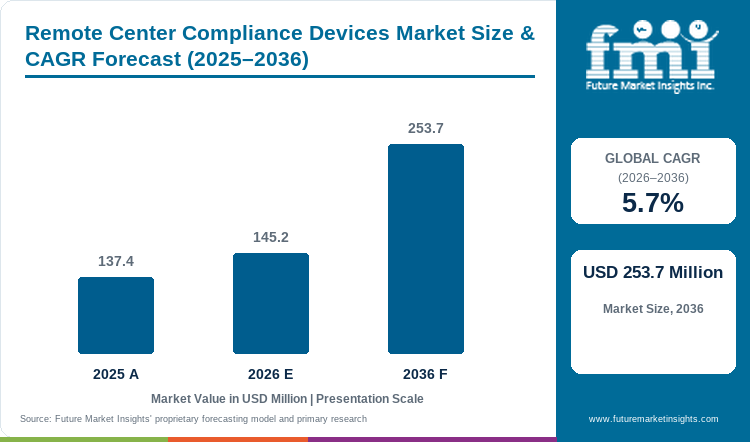
USD 145.2 million in 2026 and USD 253.7 million by 2036 at a 5.7% CAGR.
The market was valued at USD 137.4 million in 2025. Demand is estimated at USD 145.2 million in 2026 and is projected to reach USD 253.7 million by 2036, reflecting a 5.7% CAGR. The estimate covers dedicated remote center compliance devices mounted between a robot wrist and end effector for passive alignment during insertion or assembly. General force-torque sensors, spring plungers and active compliance software sold without an RCC device are excluded.
RCC devices sit alongside the collaborative robot force torque modules market, but their operating principle is different. ATI describes RCC units as passive devices that project a compliance center forward of the wrist, allowing lateral and rotational misalignment to correct itself as the part enters the mating feature. Typical uses include dowel insertion, bearing placement and shaft-to-bearing assembly. Revenue therefore depends on the number of insertion-sensitive robot cells, the payload and geometry of the end effector, and how much positional error the process must absorb without adding active sensing or software control.
Key Takeaways
- The market is valued at USD 145.2 million in 2026 and is projected to create USD 108.5 million in additional value by 2036.
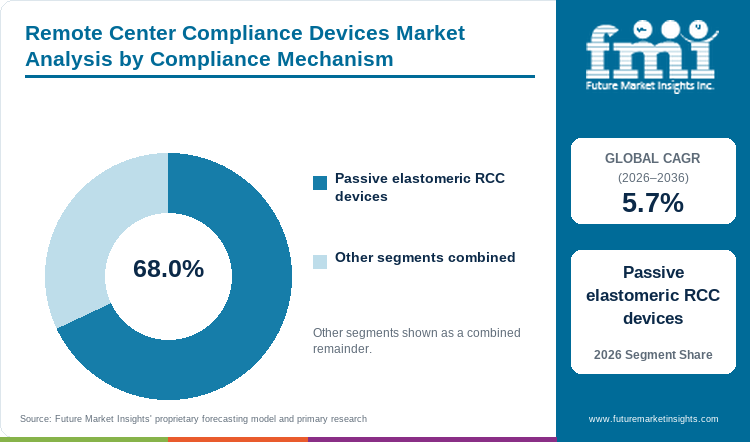
- Passive elastomeric RCC devices is projected to hold 68.0% of Compliance Mechanism demand in 2026 because passive correction is simple to integrate and responds immediately.
- 5 kg to 50 kg is projected to hold 52.0% of Payload Class demand in 2026 because common assembly tooling falls within the medium payload range.
- Peg-in-hole and component insertion is projected to hold 61.0% of Application demand in 2026 because insertion is the reference remote-center-compliance problem.
- An RCC unit with excessive compliance can reduce placement stability, while an overly stiff unit may not correct the intended misalignment.
- Some of the key players in this market include ATI Industrial Automation, DESTACO, PHD, Applied Robotics, RAD, SCHUNK, Zimmer Group, SMC, Festo, Robotiq.
Analyst Perspective
"Remote center compliance works because mechanics solve the last millimeters of alignment before software can react. Correct stiffness and projected-center location matter more than adding motion indiscriminately."
- Nikhil Kaitwade, Principal Consultant, Future Market Insights
How is the remote center compliance devices market segmented?
The remote center compliance devices market is segmented by compliance mechanism, payload class, application, robot type, sales channel and region.
The remote center compliance devices market is segmented by compliance mechanism, payload class, application, robot type, sales channel and region. Compliance mechanism distinguishes passive elastomeric, spring or flexure, pneumatic, and active or hybrid approaches. Payload class reflects the combined mass and force requirements of the tool and handled part. Application separates insertion, connector mating, machine loading, fastening and other contact-driven tasks. Robot type identifies the platform carrying the RCC device, while sales channel reflects how much application engineering and integrator involvement is required before installation.
Why do passive elastomeric devices lead?
Passive elastomeric RCC devices correct alignment mechanically at the tool interface. ATI's architecture uses elastomer shear pads arranged around a projected compliance center, allowing lateral and angular movement while maintaining axial support. This removes the need for motors, sensors or controller logic during the correction itself. Material selection also changes stiffness, temperature tolerance and resistance to oil exposure, so the mechanism can be matched to the assembly environment.
- Passive elastomeric RCC devices are estimated to account for 68.0% of compliance-mechanism demand in 2026.
- ATI documents RCC designs that use elastomer shear pads to reduce jamming and contact loads during robotic assembly.
Why does the 5 kg to 50 kg class lead?
Medium-payload RCC units sit in the useful middle ground between lightweight connector work and heavy insertion tooling. Model selection depends on more than robot payload. Engineers have to account for tool mass, compression load, side load, moment and the projected compliance-center location. That gives the 5 kg to 50 kg range broad relevance across grippers, shafts, bearings and machined components used in automated assembly.
- The 5 kg to 50 kg class is estimated to account for 52.0% of payload-class demand in 2026.
- ATI publishes RCC families with different compression, tension and moment limits, reflecting the need to match the device to the complete tooling load.
Why does insertion lead application demand?
Insertion is the application where remote-center compliance directly addresses a mechanical failure mode. Small positional or angular errors can create edge contact, wedging or excessive insertion force when a robot drives one rigid part into another. A compliant interface lets the mating geometry guide the final correction as contact develops. This is why peg-in-hole work remains central to RCC design and testing.
- Peg-in-hole and component insertion are estimated to account for 61.0% of application demand in 2026.
- ATI lists dowel insertion, bearing placement, washer insertion and shaft-to-bearing assembly among typical RCC applications, while NIST has studied registration error in robotic peg-in-hole tasks.
Why do six-axis robots lead device demand?
Six-axis robots are used where the tool must approach parts from several orientations, yet the final mating operation still occurs over a very small distance. RCC devices add local compliance at that final contact point without changing the robot's broader motion program. This is useful in machine loading, component handling and general assembly, especially when fixture variation is greater than the insertion clearance.
- Six-axis industrial robots are estimated to account for 72.0% of robot-type demand in 2026.
- RCC modules are commonly mounted between the articulated robot wrist and end effector so that passive correction occurs close to the mating interface.
Why do direct and integrator sales lead?
RCC units are difficult to specify from a catalog number alone. The buyer has to define expected misalignment, insertion force, tooling mass and the location of the desired compliance center. Environmental exposure can also change elastomer selection. The commercial process therefore tends to involve the equipment maker or integrator before the hardware is ordered, particularly on custom assembly cells.
- Direct and integrator sales are estimated to account for 65.0% of sales-channel demand in 2026.
- ATI's selection process asks users to evaluate load capacity, misalignment, insertion force and compliance-center geometry before choosing a model.
What are the drivers, restraints and opportunities in the Remote Center Compliance Devices Market?
Automated insertion drives adoption, application-specific sizing restrains standardization, and collaborative assembly creates opportunity for compact low-force devices.
- Driver: Assembly automation requires reliable insertion despite fixture, part and robot-position variation.
- Restraint: Incorrect stiffness or projected-center selection can increase jamming instead of reducing it.
- Opportunity: Compact RCC modules can improve connector and component insertion in collaborative and electronics cells.
Growth in the industrial robotics market supports compliance devices as robots move into tighter assembly tasks. RCC units can reduce the need for extreme fixture precision when contact geometry can guide the part.
The same compliant motion that corrects misalignment can allow unwanted tool movement during transport or fastening. Engineers must calculate lateral load, moment, deflection and recovery for each tool. This keeps selection application-specific.
The factory automation and industrial controls market shows growing demand for force-aware robot tooling. RCC devices can complement sensing by providing immediate passive alignment and protecting delicate parts from contact spikes.
Which country CAGRs are profiled in the Remote Center Compliance Devices Market?
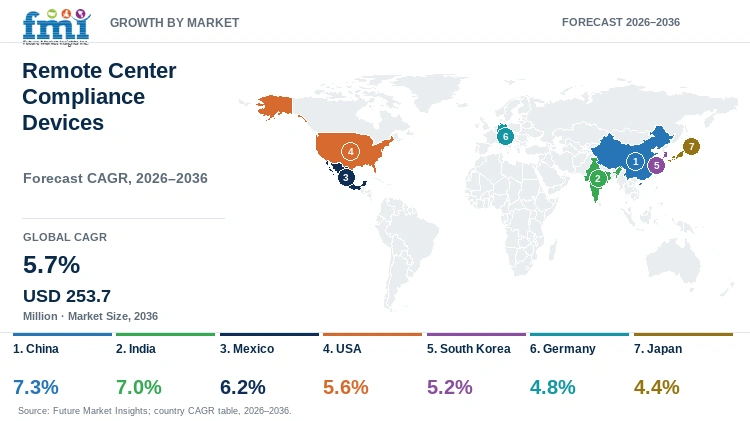
| Country | CAGR |
|---|---|
| China | 7.3% |
| India | 7.0% |
| Mexico | 6.2% |
| USA | 5.6% |
| South Korea | 5.2% |
| Germany | 4.8% |
| Japan | 4.4% |
How do country-level CAGRs compare in the Remote Center Compliance Devices Market?
RCC demand follows the spread of robotic assembly tasks where small positional errors can cause jamming, edge contact or failed insertion. China combines a very large robot base with high electronics and machinery activity. India is adding automation from a lower installed base, while Mexico is more closely tied to automotive component production. The USA has a broad mix of engineered assembly applications. South Korea, Germany and Japan are more mature automation markets, so demand is shaped increasingly by tooling upgrades, tighter insertion tolerances and replacement of existing end-effectors. IFR reported that China had more than 2 million industrial robots in operation by 2024, while India installed a record 9,120 units during the year.
- China: Electronics and machinery assembly provide a wide addressable base for RCC devices. More than 295,000 industrial robots were installed in 2024, creating additional opportunities for compliance tooling around connector mating, component insertion and machine loading.
- India: New robot cells are being added rapidly, particularly in automotive manufacturing. The sector accounted for 45% of Indian robot installations in 2024, giving RCC suppliers an entry point through assembly and component-handling applications.
- Mexico: Automotive manufacturing dominates the country's robotics mix, accounting for 63% of installations in 2024. RCC demand is therefore concentrated in component insertion, subassembly and machine-loading cells rather than spread evenly across manufacturing.
- USA: A large integrator network and 38,000 new robot installations in 2025 support a broader application mix. Automotive remains important, but food, machinery and electrical-electronics are adding more varied automation requirements.
- South Korea: High robot density shifts the opportunity toward improving existing cells rather than basic automation adoption. Compact compliance devices are relevant where electronics and other precision assembly tasks require low-force insertion.
- Germany: Nearly 27,000 industrial robots were installed in 2024 despite softer capital spending. RCC suppliers compete more through application engineering and precise mechanical sizing than through simple hardware availability.
- Japan: A mature robotics base supports replacement tooling and specialized assembly demand. Automotive plants installed about 13,000 robots in 2024, the highest level in five years, sustaining demand for compliant end-effectors in new and redesigned cells.
Across the key countries in this market, these rates measure revenue within the defined product boundary and do not represent growth of the wider parent industry.
Country-wise Analysis
- China: 7.3% CAGR through 2036. The scale of its installed robot fleet creates demand beyond new equipment alone. RCC devices can enter through replacement tooling, new electronics cells and assembly applications where passive alignment reduces sensitivity to fixture variation.
- India: 7.0% CAGR through 2036. A younger automation base means compliance can be designed into new robot cells from the start. Record robot additions and strong automotive adoption increase the number of assembly operations where passive correction can simplify insertion.
- Mexico: 6.2% CAGR through 2036. Automotive concentration makes the market highly application-specific. Integrator capability and local replacement stock matter when compliance devices are embedded in dedicated production equipment that cannot tolerate prolonged downtime.
- USA: 5.6% CAGR through 2036. The opportunity extends beyond vehicle plants into aerospace, medical assembly and general manufacturing. A broad system-integrator base supports custom RCC applications where fixture redesign would cost more than adding mechanical compliance.
- South Korea: 5.2% CAGR through 2036. Dense automation changes the buying case. RCC devices are more likely to be justified by tighter tolerances, smaller components and repeated low-force insertion than by simple expansion in robot numbers.
- Germany: 4.8% CAGR through 2036. Mature machine-building activity favors engineered compliance solutions. Device selection is closely tied to payload, insertion force and allowable deflection, especially when RCC hardware is integrated into existing precision assembly equipment.
- Japan: 4.4% CAGR through 2036. Replacement tooling and new generations of automated assembly equipment provide the main demand base. Strong domestic robotics capability and renewed automotive robot investment support selective use of RCC devices where passive alignment remains preferable to adding active control.
Who are the notable companies in the Remote Center Compliance Devices Market?
ATI Industrial Automation, DESTACO, PHD, Applied Robotics, RAD, SCHUNK, Zimmer Group, SMC, Festo, Robotiq are the notable companies profiled in this market.
Direct RCC specialists compete with end-of-arm tooling groups and adjacent compensation-module suppliers. High scores require a named remote-center-compliance product; force sensing or generic floating mechanisms alone remain Unscored.
- Direct RCC and Compliance Suppliers: ATI Industrial Automation, DESTACO, PHD, Applied Robotics, RAD, Zimmer Group.
- Pneumatic and Handling Platforms: SCHUNK, SMC, Festo.
- Collaborative Tooling Platforms: Robotiq.
Competitive Benchmarking: Remote Center Compliance Devices Market
| Company | Direct RCC Evidence | Application Engineering | Channel Reach | Geographic Reach |
|---|---|---|---|---|
| ATI Industrial Automation | High | High | High | Global |
| DESTACO | High | High | High | Global |
| PHD | Medium | High | High | Global |
| Applied Robotics | Medium | High | High | Global |
| RAD | Medium | Medium | Medium | North America, export |
| SCHUNK | Unscored | High | High | Global |
| Zimmer Group | Medium | High | High | Global |
| SMC | Unscored | High | High | Global |
| Festo | Unscored | High | High | Global |
| Robotiq | Unscored | Medium | High | Global |
High direct evidence requires a named RCC family. Medium reflects documented compliance tooling. Unscored identifies adjacent compensation or force-aware products without a confirmed RCC device.
Key Developments in the Remote Center Compliance Devices Market
- In 2026, IFR reported growth in US industrial-robot installations during 2025, expanding the installed base for assembly tooling and peripherals.
- In September 2025, IFR reported 128,899 industrial robots installed in electronics during 2024, a relevant demand base for insertion and connector tasks.
- In 2025, ATI continued to document UCC and LCC remote-center-compliance families for robotic assembly and insertion.
Key Players in the Remote Center Compliance Devices Market
Direct RCC and Compliance Suppliers
- ATI Industrial Automation
- DESTACO
- PHD
- Applied Robotics
- RAD
- Zimmer Group
Pneumatic and Handling Platforms
- SCHUNK
- SMC
- Festo
Collaborative Tooling Platforms
- Robotiq
Remote Center Compliance Devices Market - Report Scope
| Coverage field | Report scope |
|---|---|
| Market Size | USD 145.2 million in 2026 and USD 253.7 million by 2036 at 5.7% CAGR. |
| Market Definition | Mechanical devices mounted between a robot wrist and end effector that project a remote center of compliance to passively correct insertion misalignment. |
| Segmentation | Compliance mechanism, payload class, application, robot type, sales channel and region. |
| Regional Coverage | North America, Latin America, Western Europe, Eastern Europe, East Asia, South Asia and Pacific, and Middle East and Africa. |
| Countries Covered | China, India, Mexico, USA, South Korea, Germany, Japan and more than 20 countries included in the full report. |
| Key Companies Profiled | ATI Industrial Automation, DESTACO, PHD, Applied Robotics, RAD, SCHUNK, Zimmer Group, SMC, Festo, Robotiq. |
| Forecast Period | 2026 to 2036. |
| Approach | Bottom-up model using assembly-robot installations, RCC attachment rates, payload mix, replacement cycles, average device value and integrator activity. |
Remote Center Compliance Devices Market - Research Methodology
| Method | Approach |
|---|---|
| Primary Research | FMI analysts gathered input from manufacturers, system integrators, distributors, plant engineers, procurement teams and application specialists. Interviews tested purchasing criteria, replacement cycles, qualification work and technical-service requirements. |
| Desk Research | Desk research covered government statistics, standards, industry associations, technical literature, patents, official product information and corporate announcements. Evidence was screened for scope, date and direct relevance. |
| Market Sizing and Forecasting | Bottom-up model using assembly-robot installations, RCC attachment rates, payload mix, replacement cycles, average device value and integrator activity. |
| Data Validation | Estimates were checked against parent-market activity, installed-base indicators, product specifications and supplier participation. Adjacent products without the defined function were excluded. |
Remote Center Compliance Devices Market by Segments
Remote Center Compliance Devices Market segmented by Compliance Mechanism:
- Passive elastomeric RCC devices
- Spring and flexure RCC devices
- Pneumatic compliance devices
- Active and hybrid compliance modules
Remote Center Compliance Devices Market segmented by Payload Class:
- Below 5 kg
- 5 kg to 50 kg
- Above 50 kg
Remote Center Compliance Devices Market segmented by Application:
- Peg-in-hole and component insertion
- Connector mating
- Machine loading
- Assembly and fastening
- Deburring and contact processes
Remote Center Compliance Devices Market segmented by Robot Type:
- Six-axis industrial robots
- SCARA robots
- Collaborative robots
- Cartesian and other robots
Remote Center Compliance Devices Market segmented by Sales Channel:
- Direct and integrator sales
- Automation distributors
- Online and catalog channels
Remote Center Compliance Devices Market by Region:
- North America
- United States
- Canada
- Latin America
- Brazil
- Mexico
- Argentina
- Chile
- Western Europe
- Germany
- France
- United Kingdom
- Italy
- Spain
- Benelux
- Nordics
- Eastern Europe
- Poland
- Czech Republic
- Romania
- Hungary
- East Asia
- China
- Japan
- South Korea
- South Asia and Pacific
- India
- ASEAN
- Australia and New Zealand
- Middle East and Africa
- GCC Countries
- South Africa
- Türkiye
- Israel
Research Sources and Bibliography
- International Federation of Robotics. (2025, September 25). World Robotics 2025 industrial robot statistics.
- International Federation of Robotics. (2026). United States robot installation update for 2025.
- ATI Industrial Automation. (n.d.; accessed September 23, 2026). Remote Center Compliance devices.
- National Institute of Standards and Technology. (2025). Robotic assembly and performance resources.
- International Organization for Standardization. (2011). ISO 10218-1 industrial robot safety requirements.
- Charles Stark Draper Laboratory. (1980). Research on remote center compliance for robotic assembly.
- Future Market Insights. (2026). Industrial Robotics Market.
- Future Market Insights. (2026). Collaborative Robot Force Torque Modules Market.
This bibliography is provided for reader reference and is not exhaustive. The full report contains the complete reference list and detailed citations.
This Report Answers
- How large is the remote center compliance devices market in 2026 and 2036?
- Which product specification leads demand in 2026?
- What operating condition converts technical need into a purchase?
- Which constraint can delay qualification or replacement?
- How do country growth rates compare across the profiled markets?
- Which companies provide direct or adjacent market capability?
Frequently Asked Questions
How big is the remote center compliance devices market in 2026?
The remote center compliance devices market is valued at USD 145.2 million in 2026 and is projected to reach USD 253.7 million by 2036. The estimate covers revenue within the stated market definition and excludes adjacent equipment or chemicals sold without the required function.
What is the CAGR of the remote center compliance devices market from 2026 to 2036?
The market is projected to grow at 5.7% CAGR between 2026 and 2036. Expansion depends on end-market output together with the rate at which plants adopt higher-specification products.
Which compliance mechanism leads the remote center compliance devices market?
Passive elastomeric RCC devices is expected to hold 68.0% share in 2026 because passive correction is simple to integrate and responds immediately. Passive systems remain attractive for repetitive insertion.
Which countries are projected to record higher growth?
China is projected at 7.3% CAGR, followed by India at 7.0% and Mexico at 6.2% through 2036. The comparison reflects local production investment and the timing of replacement or qualification cycles.
Which companies are active in the remote center compliance devices market?
The profiled group includes ATI Industrial Automation, DESTACO, PHD, Applied Robotics, RAD, SCHUNK, Zimmer Group, SMC, Festo, Robotiq. Capability differs by product range and application evidence.
Preview the report firsthand - request a free sample
Get SampleGet the brochure for pricing and purchase details.
Get PDFTable of Content
- Key Takeaways
- Market Size and CAGR
- Top Growth Driver
- Fastest Growing Segment
- Leading Region
- Key Companies
- Emerging Opportunities
- Executive Summary
- Global Market Outlook
- Demand-side Trends
- Supply-side Trends
- Technology Roadmap Analysis
- Analysis and Recommendations
- Analyst Perspective (What is happening? Why now? What should investors know?)
- Key Questions Answered
- How large is the market?
- What is the CAGR?
- What are key trends?
- Which region dominates?
- Who are the leaders?
- Market Overview
- Market Coverage / Taxonomy
- Market Definition / Scope / Limitations
- Research Methodology
- Chapter Orientation
- Analytical Lens and Working Hypotheses
- Market Structure, Signals, and Trend Drivers
- Benchmarking and Cross-market Comparability
- Market Sizing, Forecasting, and Opportunity Mapping
- Research Design and Evidence Framework
- Desk Research Programme (Secondary Evidence)
- Expert Input and Fieldwork (Primary Evidence)
- Tooling, Models, and Reference Databases
- Data Engineering and Model Build
- Quality Assurance and Audit Trail
- Market Background
- Market Dynamics (Drivers, Restraints, Opportunity, Trends)
- Scenario Forecast (Optimistic, Likely, Conservative)
- Impact Analysis
- AI Impact
- Sustainability Impact
- Regulatory Impact
- Technology Impact
- Consumer / Buyer Analysis
- Purchase Drivers
- Adoption Barriers
- Buyer Journey
- Opportunity Map Analysis
- Product Life Cycle Analysis
- Supply Chain Analysis
- Investment Feasibility Matrix
- Value Chain Analysis
- PESTLE and Porter's Analysis
- Regulatory Landscape
- Regional Parent Market Outlook
- Production and Consumption Statistics
- Import and Export Statistics
- Global Market Analysis and Forecast, 2021 to 2036
- Historical Market Size Value (USD Million) Analysis, 2021 to 2025
- Current and Future Market Size Value (USD Million) Projections, 2026 to 2036
- Y-o-Y Growth Trend Analysis
- Absolute $ Opportunity Analysis
- Global Market Pricing Analysis, 2021 to 2036
- Global Market Analysis and Forecast, By Compliance Mechanism, 2021 to 2036
- Introduction / Key Findings
- Historical Market Size Value (USD Million) Analysis By Compliance Mechanism, 2021 to 2025
- Current and Future Market Size Value (USD Million) Analysis and Forecast By Compliance Mechanism, 2026 to 2036
- Passive elastomeric RCC devices
- Spring and flexure RCC devices
- Pneumatic compliance devices
- Active and hybrid compliance modules
- Y-o-Y Growth Trend Analysis By Compliance Mechanism, 2021 to 2025
- Absolute $ Opportunity Analysis By Compliance Mechanism, 2026 to 2036
- Global Market Analysis and Forecast, By Payload Class, 2021 to 2036
- Introduction / Key Findings
- Historical Market Size Value (USD Million) Analysis By Payload Class, 2021 to 2025
- Current and Future Market Size Value (USD Million) Analysis and Forecast By Payload Class, 2026 to 2036
- Below 5 kg
- 5 kg to 50 kg
- Above 50 kg
- Y-o-Y Growth Trend Analysis By Payload Class, 2021 to 2025
- Absolute $ Opportunity Analysis By Payload Class, 2026 to 2036
- Global Market Analysis and Forecast, By Application, 2021 to 2036
- Introduction / Key Findings
- Historical Market Size Value (USD Million) Analysis By Application, 2021 to 2025
- Current and Future Market Size Value (USD Million) Analysis and Forecast By Application, 2026 to 2036
- Peg-in-hole and component insertion
- Connector mating
- Machine loading
- Assembly and fastening
- Deburring and contact processes
- Y-o-Y Growth Trend Analysis By Application, 2021 to 2025
- Absolute $ Opportunity Analysis By Application, 2026 to 2036
- Global Market Analysis and Forecast, By Robot Type, 2021 to 2036
- Introduction / Key Findings
- Historical Market Size Value (USD Million) Analysis By Robot Type, 2021 to 2025
- Current and Future Market Size Value (USD Million) Analysis and Forecast By Robot Type, 2026 to 2036
- Six-axis industrial robots
- SCARA robots
- Collaborative robots
- Cartesian and other robots
- Y-o-Y Growth Trend Analysis By Robot Type, 2021 to 2025
- Absolute $ Opportunity Analysis By Robot Type, 2026 to 2036
- Global Market Analysis and Forecast, By Sales Channel, 2021 to 2036
- Introduction / Key Findings
- Historical Market Size Value (USD Million) Analysis By Sales Channel, 2021 to 2025
- Current and Future Market Size Value (USD Million) Analysis and Forecast By Sales Channel, 2026 to 2036
- Direct and integrator sales
- Automation distributors
- Online and catalog channels
- Y-o-Y Growth Trend Analysis By Sales Channel, 2021 to 2025
- Absolute $ Opportunity Analysis By Sales Channel, 2026 to 2036
- Global Market Analysis and Forecast, By Region, 2021 to 2036
- Introduction
- Historical Market Size Value (USD Million) Analysis By Region, 2021 to 2025
- Current Market Size Value (USD Million) Analysis and Forecast By Region, 2026 to 2036
- North America
- Latin America
- Western Europe
- Eastern Europe
- East Asia
- South Asia and Pacific
- Middle East and Africa
- Market Attractiveness Analysis By Region
- North America Market Analysis and Forecast, By Country, 2021 to 2036
- Historical Market Size Value (USD Million) Trend Analysis By Market Taxonomy, 2021 to 2025
- Market Size Value (USD Million) Forecast By Market Taxonomy, 2026 to 2036
- By Country
- United States
- Canada
- By Compliance Mechanism
- By Payload Class
- By Application
- By Robot Type
- By Sales Channel
- By Country
- Market Attractiveness Analysis
- By Country
- By Compliance Mechanism
- By Payload Class
- By Application
- By Robot Type
- By Sales Channel
- Key Takeaways
- Latin America Market Analysis and Forecast, By Country
- Historical Market Size Value (USD Million) Trend Analysis By Market Taxonomy, 2021 to 2025
- Market Size Value (USD Million) Forecast By Market Taxonomy, 2026 to 2036
- By Country
- Brazil
- Mexico
- Argentina
- Chile
- By Compliance Mechanism
- By Payload Class
- By Application
- By Robot Type
- By Sales Channel
- By Country
- Market Attractiveness Analysis
- By Country
- By Compliance Mechanism
- By Payload Class
- By Application
- By Robot Type
- By Sales Channel
- Key Takeaways
- Western Europe Market Analysis and Forecast, By Country
- Historical Market Size Value (USD Million) Trend Analysis By Market Taxonomy, 2021 to 2025
- Market Size Value (USD Million) Forecast By Market Taxonomy, 2026 to 2036
- By Country
- Germany
- France
- United Kingdom
- Italy
- Spain
- Benelux
- Nordics
- By Compliance Mechanism
- By Payload Class
- By Application
- By Robot Type
- By Sales Channel
- By Country
- Market Attractiveness Analysis
- By Country
- By Compliance Mechanism
- By Payload Class
- By Application
- By Robot Type
- By Sales Channel
- Key Takeaways
- Eastern Europe Market Analysis and Forecast, By Country
- Historical Market Size Value (USD Million) Trend Analysis By Market Taxonomy, 2021 to 2025
- Market Size Value (USD Million) Forecast By Market Taxonomy, 2026 to 2036
- By Country
- Poland
- Czech Republic
- Romania
- Hungary
- By Compliance Mechanism
- By Payload Class
- By Application
- By Robot Type
- By Sales Channel
- By Country
- Market Attractiveness Analysis
- By Country
- By Compliance Mechanism
- By Payload Class
- By Application
- By Robot Type
- By Sales Channel
- Key Takeaways
- East Asia Market Analysis and Forecast, By Country
- Historical Market Size Value (USD Million) Trend Analysis By Market Taxonomy, 2021 to 2025
- Market Size Value (USD Million) Forecast By Market Taxonomy, 2026 to 2036
- By Country
- China
- Japan
- South Korea
- By Compliance Mechanism
- By Payload Class
- By Application
- By Robot Type
- By Sales Channel
- By Country
- Market Attractiveness Analysis
- By Country
- By Compliance Mechanism
- By Payload Class
- By Application
- By Robot Type
- By Sales Channel
- Key Takeaways
- South Asia and Pacific Market Analysis and Forecast, By Country
- Historical Market Size Value (USD Million) Trend Analysis By Market Taxonomy, 2021 to 2025
- Market Size Value (USD Million) Forecast By Market Taxonomy, 2026 to 2036
- By Country
- India
- ASEAN
- Australia and New Zealand
- By Compliance Mechanism
- By Payload Class
- By Application
- By Robot Type
- By Sales Channel
- By Country
- Market Attractiveness Analysis
- By Country
- By Compliance Mechanism
- By Payload Class
- By Application
- By Robot Type
- By Sales Channel
- Key Takeaways
- Middle East and Africa Market Analysis and Forecast, By Country
- Historical Market Size Value (USD Million) Trend Analysis By Market Taxonomy, 2021 to 2025
- Market Size Value (USD Million) Forecast By Market Taxonomy, 2026 to 2036
- By Country
- GCC Countries
- South Africa
- Türkiye
- Israel
- By Compliance Mechanism
- By Payload Class
- By Application
- By Robot Type
- By Sales Channel
- By Country
- Market Attractiveness Analysis
- By Country
- By Compliance Mechanism
- By Payload Class
- By Application
- By Robot Type
- By Sales Channel
- Key Takeaways
- Key Countries Market Analysis
- United States
- Pricing Analysis
- Market Share Analysis, 2025
- By Compliance Mechanism
- By Payload Class
- By Application
- By Robot Type
- By Sales Channel
- Canada
- Pricing Analysis
- Market Share Analysis, 2025
- By Compliance Mechanism
- By Payload Class
- By Application
- By Robot Type
- By Sales Channel
- Mexico
- Pricing Analysis
- Market Share Analysis, 2025
- By Compliance Mechanism
- By Payload Class
- By Application
- By Robot Type
- By Sales Channel
- Brazil
- Pricing Analysis
- Market Share Analysis, 2025
- By Compliance Mechanism
- By Payload Class
- By Application
- By Robot Type
- By Sales Channel
- Chile
- Pricing Analysis
- Market Share Analysis, 2025
- By Compliance Mechanism
- By Payload Class
- By Application
- By Robot Type
- By Sales Channel
- Germany
- Pricing Analysis
- Market Share Analysis, 2025
- By Compliance Mechanism
- By Payload Class
- By Application
- By Robot Type
- By Sales Channel
- United Kingdom
- Pricing Analysis
- Market Share Analysis, 2025
- By Compliance Mechanism
- By Payload Class
- By Application
- By Robot Type
- By Sales Channel
- Italy
- Pricing Analysis
- Market Share Analysis, 2025
- By Compliance Mechanism
- By Payload Class
- By Application
- By Robot Type
- By Sales Channel
- Spain
- Pricing Analysis
- Market Share Analysis, 2025
- By Compliance Mechanism
- By Payload Class
- By Application
- By Robot Type
- By Sales Channel
- France
- Pricing Analysis
- Market Share Analysis, 2025
- By Compliance Mechanism
- By Payload Class
- By Application
- By Robot Type
- By Sales Channel
- India
- Pricing Analysis
- Market Share Analysis, 2025
- By Compliance Mechanism
- By Payload Class
- By Application
- By Robot Type
- By Sales Channel
- ASEAN
- Pricing Analysis
- Market Share Analysis, 2025
- By Compliance Mechanism
- By Payload Class
- By Application
- By Robot Type
- By Sales Channel
- Australia and New Zealand
- Pricing Analysis
- Market Share Analysis, 2025
- By Compliance Mechanism
- By Payload Class
- By Application
- By Robot Type
- By Sales Channel
- China
- Pricing Analysis
- Market Share Analysis, 2025
- By Compliance Mechanism
- By Payload Class
- By Application
- By Robot Type
- By Sales Channel
- Japan
- Pricing Analysis
- Market Share Analysis, 2025
- By Compliance Mechanism
- By Payload Class
- By Application
- By Robot Type
- By Sales Channel
- South Korea
- Pricing Analysis
- Market Share Analysis, 2025
- By Compliance Mechanism
- By Payload Class
- By Application
- By Robot Type
- By Sales Channel
- Poland
- Pricing Analysis
- Market Share Analysis, 2025
- By Compliance Mechanism
- By Payload Class
- By Application
- By Robot Type
- By Sales Channel
- Hungary
- Pricing Analysis
- Market Share Analysis, 2025
- By Compliance Mechanism
- By Payload Class
- By Application
- By Robot Type
- By Sales Channel
- Türkiye
- Pricing Analysis
- Market Share Analysis, 2025
- By Compliance Mechanism
- By Payload Class
- By Application
- By Robot Type
- By Sales Channel
- South Africa
- Pricing Analysis
- Market Share Analysis, 2025
- By Compliance Mechanism
- By Payload Class
- By Application
- By Robot Type
- By Sales Channel
- United States
- Market Structure Analysis
- Competition Dashboard
- Competition Benchmarking
- Market Share Analysis of Top Players
- By Regional
- By Compliance Mechanism
- By Payload Class
- By Application
- By Robot Type
- By Sales Channel
- Emerging Startups
- Innovation Benchmarking
- Competition Analysis
- Competition Deep Dive
- ATI Industrial Automation
- Overview
- Product Portfolio
- Profitability by Market Segments
- Sales Footprint
- Strategy Overview
- Marketing Strategy
- Product Strategy
- Channel Strategy
- DESTACO
- PHD
- Applied Robotics
- RAD
- SCHUNK
- Zimmer Group
- SMC
- Festo
- Robotiq
- ATI Industrial Automation
- Case Studies
- Success Stories
- Recent Developments
- Competition Deep Dive
- Assumptions & Acronyms Used


