

- Industry Size (2026)
- USD 1100.0 Mn
- Forecast (2036)
- USD 3477.9 Mn
- CAGR (2026 to 2036)
- 12.2%
Remote Ventilator Monitoring Market Forecast and Outlook 2026 to 2036
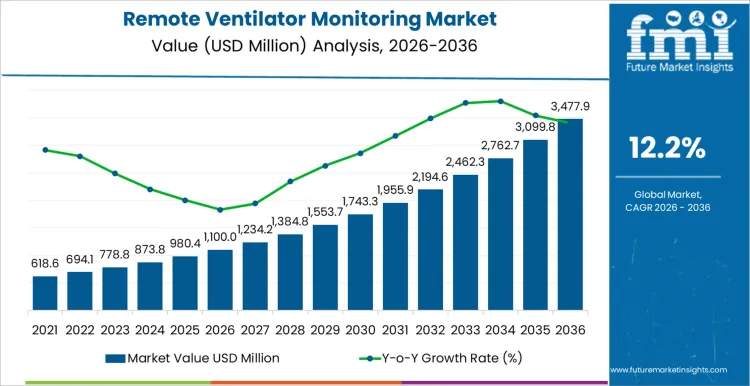
The remote ventilator monitoring market is expected to reach USD 1,100.0 million in 2026 and expand to USD 3,477.9 million by 2036, at a CAGR of 12.2%. Value behavior reflects structural reliance on continuous visibility of ventilated patients across intensive care, step-down units, and long-term care settings. Spending concentrates on software platforms and connectivity layers that convert ventilator data into actionable clinical oversight, rather than on ventilator hardware expansion itself. Demand intensity aligns with staffing constraints, alarm management needs, and institutional emphasis on reducing adverse ventilation events through centralized supervision.
Adoption patterns are governed by care decentralization, interoperability readiness, and governance requirements around data security and clinical accountability. Utilization increases where hospitals operate distributed ICUs, tele-ICU hubs, or home ventilation programs requiring remote clinical oversight. Integration complexity, alarm fatigue risk, and legacy device limitations moderate uniform deployment across facilities. Cost justification depends on measurable workload reduction, response time improvement, and continuity of respiratory care. Market structure remains shaped by digital infrastructure maturity, regulatory acceptance of remote monitoring, and alignment with broader connected care strategies rather than short-term critical care capacity expansion.
Quick Stats for Remote Ventilator Monitoring Market
- Remote Ventilator Monitoring Market Value (2026): USD 1,100.0 million
- Remote Ventilator Monitoring Market Forecast Value (2036): USD 3,477.9 million
- Remote Ventilator Monitoring Market Forecast CAGR 2026 to 2036: 12.2%
- Leading Platform Type by Demand Share: Cloud-based monitoring software
- Fastest-Growing Countries: India, Brazil, China, USA, Germany
- Top Players in Global Demand: Philips, GE HealthCare, Dräger, ResMed, Medtronic
Remote Ventilator Monitoring Market Key Takeaways
| Metric | Value |
|---|---|
| Market Value (2026) | USD 1,100.0 million |
| Market Forecast Value (2036) | USD 3,477.9 million |
| Forecast CAGR 2026 to 2036 | 12.2% |
Why is the Demand for Remote Ventilator Monitoring Growing?
Demand for remote ventilator monitoring is increasing as hospitals and critical care networks adopt technologies that support continuous oversight of mechanically ventilated patients without requiring constant bedside presence. Intensive care units face pressure to manage ventilator resources efficiently while maintaining high standards of patient safety, and remote monitoring systems transmit real-time ventilation parameters, waveform data, and alarm status to centralized dashboards or clinician mobile devices. Respiratory therapists and critical care physicians specify solutions that integrate with existing ventilator brands and hospital information systems because seamless data flow improves visibility into tidal volumes, pressure settings, and patient-ventilator synchrony. Procurement teams evaluate system interoperability, cybersecurity measures, and analytic capabilities to ensure installations meet facility IT policies and support clinical workflows that reduce response time when ventilation adjustments or interventions are required.
Growth in demand reflects increasing patient volumes in acute care settings and the need to optimize clinician workload under constrained staffing conditions. Facilities with multiple ventilators deployed across ICUs, step-down units, and temporary surge areas benefit from consolidated monitoring that enhances situational awareness and reduces time spent physically checking each device. Integration with clinical decision support tools enables trend analysis and early detection of deteriorating respiratory status, which supports timely interventions and may reduce incidence of ventilator-associated complications. Expansion of tele-ICU services and regional care networks further drives adoption, as remote monitoring extends expert oversight to facilities with limited in-house critical care resources. These clinical efficiency and patient safety priorities are contributing to sustained demand growth in the remote ventilator monitoring market.
How Is the Remote Ventilator Monitoring Industry Segmented by Platform Type, Use Case, and End User?
Demand for remote ventilator monitoring is driven by ICU capacity management, clinician workload optimization, and expansion of connected care models. Providers emphasize continuous visibility into ventilation parameters, early deterioration detection, and centralized oversight across care settings. Adoption aligns with growth in telehealth infrastructure, integration of medical devices with hospital IT systems, and preparedness planning for surge scenarios. Purchasing decisions prioritize interoperability, alert reliability, cybersecurity, and clinical workflow fit. Segmentation clarifies how technology layers, clinical use contexts, and provider structures shape deployment patterns.
Which Platform Type Holds the Largest Share in Remote Ventilator Monitoring?
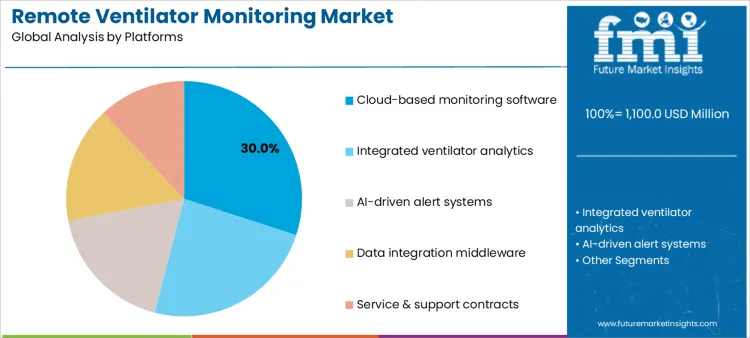
Cloud-based monitoring software accounts for 30.0%, reflecting its role in enabling centralized data access across locations and devices. These platforms support scalability, remote clinician access, and software-based updates. Integrated ventilator analytics at 24.0% embed monitoring directly within device ecosystems, supporting real-time performance assessment. AI-driven alert systems at 18.0% focus on early warning through pattern recognition and threshold management. Data integration middleware at 16.0% connects ventilators with electronic health records and analytics platforms. Service and support contracts at 12.0% ensure uptime, compliance, and system optimization. Platform segmentation highlights emphasis on centralized visibility supported by advanced analytics.
Key Points
- Cloud platforms enable scalable, centralized monitoring.
- Integrated analytics support real-time ventilator assessment.
- AI alerts and middleware enhance clinical responsiveness.
How Do Clinical Use Cases Influence Adoption of Remote Ventilator Monitoring?
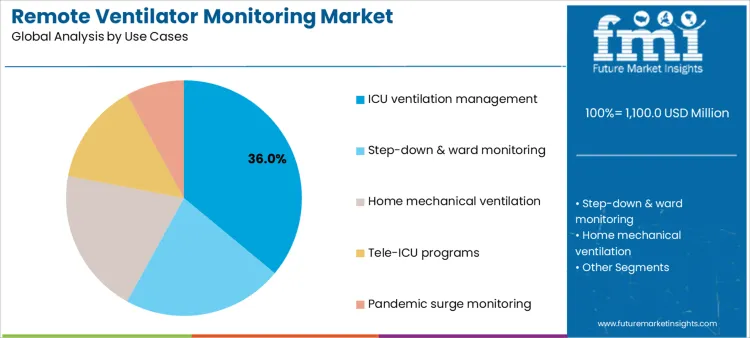
ICU ventilation management represents 36.0%, driven by high-acuity patients requiring continuous oversight and rapid intervention. Step-down and ward monitoring at 22.0% extends visibility beyond critical care units to support safe patient transitions. Home mechanical ventilation at 20.0% relies on remote monitoring to manage chronic respiratory patients outside hospital settings. Tele-ICU programs at 14.0% use centralized hubs to oversee multiple facilities. Pandemic surge monitoring at 8.0% focuses on rapid capacity expansion and resource coordination. Use-case segmentation reflects stronger adoption where continuous data access directly supports patient safety and staffing efficiency.
Key Points
- ICUs require continuous, high-resolution monitoring.
- Step-down and home settings extend monitoring reach.
- Tele-ICU models centralize expertise across sites.
Which End User Groups Drive Utilization of Remote Ventilator Monitoring Systems?
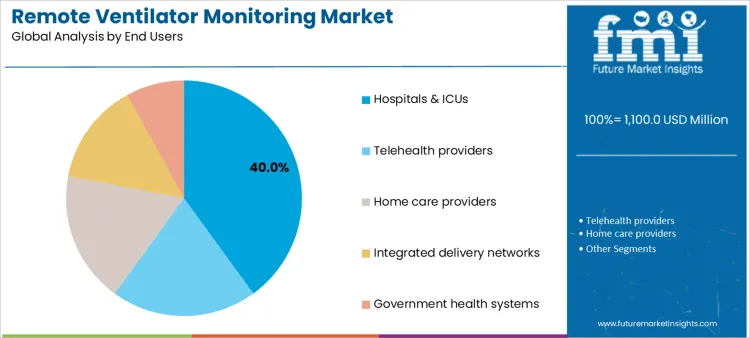
Hospitals and ICUs account for 40.0%, reflecting primary responsibility for acute ventilation management and critical care outcomes. Telehealth providers at 20.0% integrate ventilator data into remote care platforms supporting virtual oversight. Home care providers at 18.0% apply monitoring to manage long-term ventilated patients and reduce emergency visits. Integrated delivery networks at 14.0% deploy systems across multiple facilities for standardized oversight. Government health systems at 8.0% utilize monitoring for public health capacity management. End-user segmentation shows concentration where care coordination, scale, and accountability drive technology adoption.
Key Points
- Hospitals anchor demand through critical care usage.
- Telehealth and home care expand remote oversight.
- Networks and public systems focus on coordinated monitoring.
What are the Key Dynamics in the Remote Ventilator Monitoring Market?
Demand for remote ventilator monitoring reflects need to oversee respiratory support performance outside continuous bedside supervision. Adoption concentrates in intensive care units, step-down wards, long-term care facilities, and home ventilation programs. Global scope aligns with distributed care delivery and capacity management pressures. Usage centers on connected ventilators, gateways, and software platforms that transmit ventilation parameters, alarms, and usage data to centralized clinical dashboards.
How do care decentralization and clinical risk management requirements shape adoption?
Respiratory support requires timely response to changes in patient status, device function, and therapy adherence. Demand increases where staffing ratios limit constant bedside observation. Remote monitoring enables clinicians to track tidal volume, pressures, oxygenation proxies, and alarm events across multiple patients simultaneously. Early detection of circuit disconnections, secretion buildup, or patient-ventilator asynchrony supports faster intervention. Home ventilation programs rely on remote visibility to reduce emergency visits and optimize settings without frequent in-person assessments. Integration with electronic health records supports documentation and trend analysis. Adoption reflects operational need to extend clinical oversight, prioritize interventions, and maintain safety across dispersed care environments.
How do interoperability limits, data governance, and economic constraints influence market scalability?
Remote monitoring depends on reliable connectivity, standardized data formats, and device compatibility across vendors. Demand sensitivity rises where legacy ventilators lack upgrade paths. Alarm fatigue risk increases with poorly tuned thresholds and high data volume. Cybersecurity and patient privacy requirements add compliance and IT oversight burden. Workflow integration challenges affect clinician acceptance and response consistency. Capital and subscription costs influence adoption in resource-constrained settings. Technical support and training requirements vary by deployment scale. Scalability remains constrained by interoperability gaps, governance obligations, and cost justification tied to measurable workload reduction and outcome improvement.
How Is Demand for Remote Ventilator Monitoring Evolving Globally?
Demand for remote ventilator monitoring is expanding globally as healthcare systems integrate connected critical care and home ventilation oversight. Continuous data transmission supports early intervention, alarm management, and therapy optimization across acute and long-term settings. Workforce constraints and infection control considerations accelerate virtual monitoring adoption. Interoperability with hospital information systems influences deployment scale. Growth rates in India at 14.7%, Brazil at 14.2%, China at 13.8%, the USA at 10.6%, and Germany at 10.5% indicate sustained expansion driven by care continuity needs, digital health integration, and capacity optimization rather than episodic emergency preparedness.
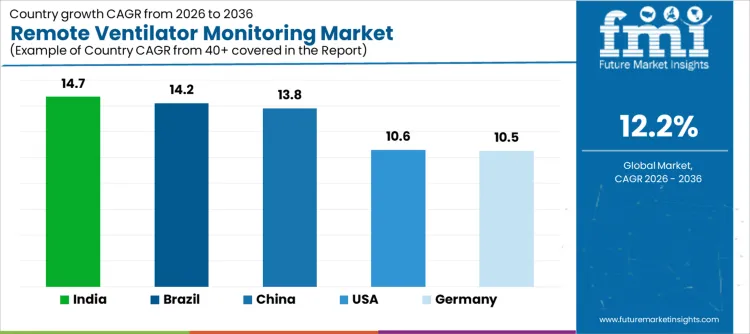
| Country | CAGR (%) |
|---|---|
| India | 14.7% |
| Brazil | 14.2% |
| China | 13.8% |
| USA | 10.6% |
| Germany | 10.5% |
What Is Driving Rapid Expansion of Remote Ventilator Monitoring Demand in India?
Remote ventilator monitoring demand in India is growing at a CAGR of 14.7%, supported by expansion of critical care beds and home ventilation programs. Tertiary hospitals deploy centralized dashboards to manage ventilated patients across multiple wards. Homecare providers adopt remote monitoring to supervise chronic respiratory patients and reduce readmissions. Limited specialist availability increases reliance on tele-ICU oversight. Integration with mobile networks improves reach beyond urban centers. Growth reflects care delivery scalability, workforce efficiency, and continuity requirements rather than temporary surge capacity expansion.
- Expansion of critical care and home ventilation
- Tele-ICU oversight addressing specialist shortages
- Centralized monitoring across hospital wards
- Improved connectivity supporting remote deployment
Why Is Brazil Experiencing Strong Uptake of Remote Ventilator Monitoring?
Remote ventilator monitoring demand in Brazil is expanding at a CAGR of 14.2%, driven by regional disparities in critical care access. Hospital networks use remote platforms to extend specialist supervision to peripheral facilities. Home ventilation programs incorporate monitoring to support long-term respiratory care. Public health investments prioritize digital tools to improve outcomes and efficiency. Vendor partnerships support scalable deployments. Growth reflects networked care models and access extension rather than expansion of ventilator inventories.
- Extension of specialist oversight to regional hospitals
- Growth of monitored home ventilation programs
- Public investment in digital critical care tools
- Scalable vendor-supported deployments
How Is China Sustaining Momentum in Remote Ventilator Monitoring Adoption?
Remote ventilator monitoring demand in China is growing at a CAGR of 13.8%, aligned with large hospital systems and digital health initiatives. Central hospitals deploy monitoring platforms to manage high patient volumes efficiently. Integration with electronic medical records supports data-driven care adjustments. Domestic technology providers offer interoperable solutions at scale. Policy support for smart hospitals reinforces adoption. Growth reflects system-wide digital integration and scale management rather than isolated pilot projects.
- High-volume hospital efficiency requirements
- Integration with electronic medical records
- Availability of domestic interoperable platforms
- Policy support for smart hospital initiatives
What Factors Are Supporting Remote Ventilator Monitoring Demand in United States?
Remote ventilator monitoring demand in the United States is expanding at a CAGR of 10.6%, supported by telehealth reimbursement and mature critical care infrastructure. Hospitals use remote monitoring to optimize alarm management and staffing efficiency. Home ventilation providers integrate platforms for chronic disease management. Interoperability standards enable vendor-neutral deployments. Data analytics support quality improvement initiatives. Growth reflects workflow optimization and continuity of care rather than expansion of ventilated patient populations.
- Telehealth reimbursement enabling remote oversight
- Alarm management and staffing optimization needs
- Integration within home ventilation services
- Data analytics supporting quality improvement
Why Is Germany Showing Steady Expansion in Remote Ventilator Monitoring?
Remote ventilator monitoring demand in Germany is growing at a CAGR of 10.5%, shaped by structured healthcare governance and digitalization strategies. Hospitals adopt monitoring platforms within certified intensive care frameworks. Home ventilation oversight supports long-term respiratory patients. Data protection and interoperability standards guide system selection. Procurement emphasizes reliability and clinical validation. Growth remains steady, reflecting regulated digital adoption and care coordination priorities rather than rapid technology diffusion.
- Certified intensive care framework integration
- Long-term home ventilation oversight needs
- Strong data protection and interoperability standards
- Reliability-focused procurement decisions
What is the competitive landscape of demand for the remote ventilator monitoring market globally?
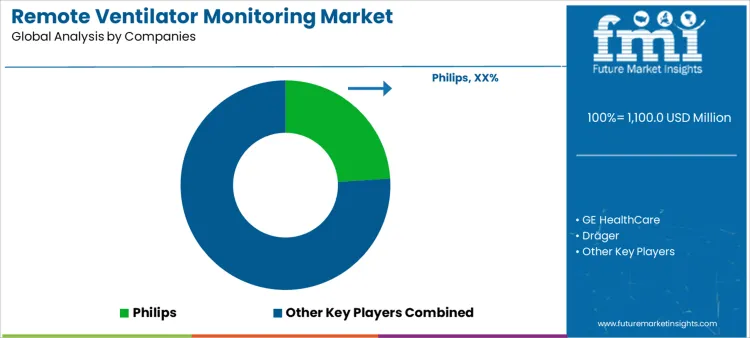
Demand for remote ventilator monitoring is driven by critical care capacity optimization, chronic respiratory disease management, and post-acute care expansion. Clinicians and hospital administrators evaluate real-time data accuracy, alarm reliability, connectivity stability, cybersecurity safeguards, and integration with electronic medical records. Buyer assessment includes scalability across ICU and homecare settings, interoperability with ventilator fleets, analytics for therapy adjustment, and regulatory compliance. Procurement behavior reflects preference for vendors offering cloud-enabled platforms, strong service infrastructure, and long-term software support. Trend in the remote ventilator monitoring market shows increasing adoption across hospital-at-home models and decentralized respiratory care pathways.
Philips leads competitive positioning through integrated ventilator ecosystems combining hardware, connectivity, and remote monitoring analytics. GE HealthCare competes by offering monitoring platforms aligned with acute care ventilation workflows and hospital IT systems. Dräger supports demand with robust monitoring solutions emphasizing clinical safety, alarm management, and ICU-grade reliability. ResMed maintains relevance through remote monitoring platforms optimized for long-term ventilation and home respiratory care. Medtronic participates by integrating ventilator monitoring within broader patient surveillance and critical care technology portfolios. Competitive differentiation centers on data reliability, interoperability, clinical decision support depth, and scalability across care settings.
Key Players in the Remote Ventilator Monitoring Market
- Philips
- GE HealthCare
- Dräger
- ResMed
- Medtronic
- Others
Scope of the Report
| Items | Values |
|---|---|
| Quantitative Units | USD million |
| Platforms | Cloud-based monitoring software; Integrated ventilator analytics; AI-driven alert systems; Data integration middleware; Service & support contracts |
| Use Cases | ICU ventilation management; Step-down & ward monitoring; Home mechanical ventilation; Tele-ICU programs; Pandemic surge monitoring |
| End Users | Hospitals & ICUs; Telehealth providers; Home care providers; Integrated delivery networks; Government health systems |
| Regions Covered | Asia Pacific, Europe, North America, Latin America, Middle East & Africa |
| Countries Covered | India, Brazil, China, USA, Germany, and 40+ countries |
| Key Companies Profiled | Philips; GE HealthCare; Dräger; ResMed; Medtronic; Others |
| Additional Attributes | Dollar sales by platform type, use case, and end user; real-time data reliability, latency, and interoperability with ventilator hardware and hospital IT systems; AI-driven alert accuracy supporting early intervention and workload reduction; scalability across ICU, ward, and home ventilation settings; cybersecurity, data privacy, and regulatory compliance considerations; procurement dynamics shaped by hospital digital transformation, tele-ICU expansion, and long-term service contracts. |
Remote Ventilator Monitoring Market by Segment
Platforms:
- Cloud-based monitoring software
- Integrated ventilator analytics
- AI-driven alert systems
- Data integration middleware
- Service & support contracts
Use Cases:
- ICU ventilation management
- Step-down & ward monitoring
- Home mechanical ventilation
- Tele-ICU programs
- Pandemic surge monitoring
End Users:
- Hospitals & ICUs
- Telehealth providers
- Home care providers
- Integrated delivery networks
- Government health systems
Region:
- Asia Pacific
- China
- Japan
- South Korea
- India
- Australia & New Zealand
- ASEAN
- Rest of Asia Pacific
- Europe
- Germany
- United Kingdom
- France
- Italy
- Spain
- Nordic
- BENELUX
- Rest of Europe
- North America
- United States
- Canada
- Mexico
- Latin America
- Brazil
- Chile
- Rest of Latin America
- Middle East & Africa
- Kingdom of Saudi Arabia
- Other GCC Countries
- Turkey
- South Africa
- Other African Union
- Rest of Middle East & Africa
Bibliography
- World Health Organization. (2023). Clinical management of severe acute respiratory infections when advanced respiratory support is indicated. World Health Organization.
- United States Food and Drug Administration. (2023). Cybersecurity in medical devices: Quality system considerations and content of premarket submissions. U.S. Department of Health and Human Services.
- European Commission. (2023). Medical Device Regulation (EU) 2017/745: Requirements for software, connectivity, and post-market surveillance. Official Journal of the European Union.
- Centers for Disease Control and Prevention. (2023). Ventilator-associated event (VAE) surveillance: Definition and guidance. U.S. Department of Health and Human Services.
Frequently Asked Questions
How big is the remote ventilator monitoring market in 2026?
The global remote ventilator monitoring market is estimated to be valued at USD 1,100.0 million in 2026.
What will be the size of remote ventilator monitoring market in 2036?
The market size for the remote ventilator monitoring market is projected to reach USD 3,477.9 million by 2036.
How much will be the remote ventilator monitoring market growth between 2026 and 2036?
The remote ventilator monitoring market is expected to grow at a 12.2% CAGR between 2026 and 2036.
What are the key product types in the remote ventilator monitoring market?
The key product types in remote ventilator monitoring market are cloud-based monitoring software, integrated ventilator analytics, ai-driven alert systems, data integration middleware and service & support contracts.
Which use cases segment to contribute significant share in the remote ventilator monitoring market in 2026?
In terms of use cases, icu ventilation management segment to command 36.0% share in the remote ventilator monitoring market in 2026.
Preview the report firsthand - request a free sample
Get SampleGet the brochure for pricing and purchase details.
Get PDFTable of Content
- Executive Summary
- Global Market Outlook
- Demand-side Trends
- Supply-side Trends
- Technology Roadmap Analysis
- Analysis and Recommendations
- Market Overview
- Market Coverage / Taxonomy
- Market Definition / Scope / Limitations
- Market Background
- Market Dynamics
- Drivers
- Restraints
- Opportunity
- Trends
- Scenario Forecast
- Demand in Optimistic Scenario
- Demand in Likely Scenario
- Demand in Conservative Scenario
- Opportunity Map Analysis
- Product Life Cycle Analysis
- Supply Chain Analysis
- Investment Feasibility Matrix
- Value Chain Analysis
- PESTLE and Porter’s Analysis
- Regulatory Landscape
- Regional Parent Market Outlook
- Production and Consumption Statistics
- Import and Export Statistics
- Market Dynamics
- Global Market Analysis 2021 to 2025 and Forecast, 2026 to 2036
- Historical Market Size Value (USD Million) Analysis, 2021 to 2025
- Current and Future Market Size Value (USD Million) Projections, 2026 to 2036
- Y-o-Y Growth Trend Analysis
- Absolute $ Opportunity Analysis
- Global Market Pricing Analysis 2021 to 2025 and Forecast 2026 to 2036
- Global Market Analysis 2021 to 2025 and Forecast 2026 to 2036, By Platforms
- Introduction / Key Findings
- Historical Market Size Value (USD Million) Analysis By Platforms , 2021 to 2025
- Current and Future Market Size Value (USD Million) Analysis and Forecast By Platforms , 2026 to 2036
- Cloud-based monitoring software
- Integrated ventilator analytics
- AI-driven alert systems
- Data integration middleware
- Service & support contracts
- Cloud-based monitoring software
- Y-o-Y Growth Trend Analysis By Platforms , 2021 to 2025
- Absolute $ Opportunity Analysis By Platforms , 2026 to 2036
- Global Market Analysis 2021 to 2025 and Forecast 2026 to 2036, By Use Cases
- Introduction / Key Findings
- Historical Market Size Value (USD Million) Analysis By Use Cases, 2021 to 2025
- Current and Future Market Size Value (USD Million) Analysis and Forecast By Use Cases, 2026 to 2036
- ICU ventilation management
- Step-down & ward monitoring
- Home mechanical ventilation
- Tele-ICU programs
- Pandemic surge monitoring
- ICU ventilation management
- Y-o-Y Growth Trend Analysis By Use Cases, 2021 to 2025
- Absolute $ Opportunity Analysis By Use Cases, 2026 to 2036
- Global Market Analysis 2021 to 2025 and Forecast 2026 to 2036, By End Users
- Introduction / Key Findings
- Historical Market Size Value (USD Million) Analysis By End Users, 2021 to 2025
- Current and Future Market Size Value (USD Million) Analysis and Forecast By End Users, 2026 to 2036
- Hospitals & ICUs
- Telehealth providers
- Home care providers
- Integrated delivery networks
- Government health systems
- Hospitals & ICUs
- Y-o-Y Growth Trend Analysis By End Users, 2021 to 2025
- Absolute $ Opportunity Analysis By End Users, 2026 to 2036
- Global Market Analysis 2021 to 2025 and Forecast 2026 to 2036, By Region
- Introduction
- Historical Market Size Value (USD Million) Analysis By Region, 2021 to 2025
- Current Market Size Value (USD Million) Analysis and Forecast By Region, 2026 to 2036
- North America
- Latin America
- Western Europe
- Eastern Europe
- East Asia
- South Asia and Pacific
- Middle East & Africa
- Market Attractiveness Analysis By Region
- North America Market Analysis 2021 to 2025 and Forecast 2026 to 2036, By Country
- Historical Market Size Value (USD Million) Trend Analysis By Market Taxonomy, 2021 to 2025
- Market Size Value (USD Million) Forecast By Market Taxonomy, 2026 to 2036
- By Country
- USA
- Canada
- Mexico
- By Platforms
- By Use Cases
- By End Users
- By Country
- Market Attractiveness Analysis
- By Country
- By Platforms
- By Use Cases
- By End Users
- Key Takeaways
- Latin America Market Analysis 2021 to 2025 and Forecast 2026 to 2036, By Country
- Historical Market Size Value (USD Million) Trend Analysis By Market Taxonomy, 2021 to 2025
- Market Size Value (USD Million) Forecast By Market Taxonomy, 2026 to 2036
- By Country
- Brazil
- Chile
- Rest of Latin America
- By Platforms
- By Use Cases
- By End Users
- By Country
- Market Attractiveness Analysis
- By Country
- By Platforms
- By Use Cases
- By End Users
- Key Takeaways
- Western Europe Market Analysis 2021 to 2025 and Forecast 2026 to 2036, By Country
- Historical Market Size Value (USD Million) Trend Analysis By Market Taxonomy, 2021 to 2025
- Market Size Value (USD Million) Forecast By Market Taxonomy, 2026 to 2036
- By Country
- Germany
- UK
- Italy
- Spain
- France
- Nordic
- BENELUX
- Rest of Western Europe
- By Platforms
- By Use Cases
- By End Users
- By Country
- Market Attractiveness Analysis
- By Country
- By Platforms
- By Use Cases
- By End Users
- Key Takeaways
- Eastern Europe Market Analysis 2021 to 2025 and Forecast 2026 to 2036, By Country
- Historical Market Size Value (USD Million) Trend Analysis By Market Taxonomy, 2021 to 2025
- Market Size Value (USD Million) Forecast By Market Taxonomy, 2026 to 2036
- By Country
- Russia
- Poland
- Hungary
- Balkan & Baltic
- Rest of Eastern Europe
- By Platforms
- By Use Cases
- By End Users
- By Country
- Market Attractiveness Analysis
- By Country
- By Platforms
- By Use Cases
- By End Users
- Key Takeaways
- East Asia Market Analysis 2021 to 2025 and Forecast 2026 to 2036, By Country
- Historical Market Size Value (USD Million) Trend Analysis By Market Taxonomy, 2021 to 2025
- Market Size Value (USD Million) Forecast By Market Taxonomy, 2026 to 2036
- By Country
- China
- Japan
- South Korea
- By Platforms
- By Use Cases
- By End Users
- By Country
- Market Attractiveness Analysis
- By Country
- By Platforms
- By Use Cases
- By End Users
- Key Takeaways
- South Asia and Pacific Market Analysis 2021 to 2025 and Forecast 2026 to 2036, By Country
- Historical Market Size Value (USD Million) Trend Analysis By Market Taxonomy, 2021 to 2025
- Market Size Value (USD Million) Forecast By Market Taxonomy, 2026 to 2036
- By Country
- India
- ASEAN
- Australia & New Zealand
- Rest of South Asia and Pacific
- By Platforms
- By Use Cases
- By End Users
- By Country
- Market Attractiveness Analysis
- By Country
- By Platforms
- By Use Cases
- By End Users
- Key Takeaways
- Middle East & Africa Market Analysis 2021 to 2025 and Forecast 2026 to 2036, By Country
- Historical Market Size Value (USD Million) Trend Analysis By Market Taxonomy, 2021 to 2025
- Market Size Value (USD Million) Forecast By Market Taxonomy, 2026 to 2036
- By Country
- Kingdom of Saudi Arabia
- Other GCC Countries
- Turkiye
- South Africa
- Other African Union
- Rest of Middle East & Africa
- By Platforms
- By Use Cases
- By End Users
- By Country
- Market Attractiveness Analysis
- By Country
- By Platforms
- By Use Cases
- By End Users
- Key Takeaways
- Key Countries Market Analysis
- USA
- Pricing Analysis
- Market Share Analysis, 2025
- By Platforms
- By Use Cases
- By End Users
- Canada
- Pricing Analysis
- Market Share Analysis, 2025
- By Platforms
- By Use Cases
- By End Users
- Mexico
- Pricing Analysis
- Market Share Analysis, 2025
- By Platforms
- By Use Cases
- By End Users
- Brazil
- Pricing Analysis
- Market Share Analysis, 2025
- By Platforms
- By Use Cases
- By End Users
- Chile
- Pricing Analysis
- Market Share Analysis, 2025
- By Platforms
- By Use Cases
- By End Users
- Germany
- Pricing Analysis
- Market Share Analysis, 2025
- By Platforms
- By Use Cases
- By End Users
- UK
- Pricing Analysis
- Market Share Analysis, 2025
- By Platforms
- By Use Cases
- By End Users
- Italy
- Pricing Analysis
- Market Share Analysis, 2025
- By Platforms
- By Use Cases
- By End Users
- Spain
- Pricing Analysis
- Market Share Analysis, 2025
- By Platforms
- By Use Cases
- By End Users
- France
- Pricing Analysis
- Market Share Analysis, 2025
- By Platforms
- By Use Cases
- By End Users
- India
- Pricing Analysis
- Market Share Analysis, 2025
- By Platforms
- By Use Cases
- By End Users
- ASEAN
- Pricing Analysis
- Market Share Analysis, 2025
- By Platforms
- By Use Cases
- By End Users
- Australia & New Zealand
- Pricing Analysis
- Market Share Analysis, 2025
- By Platforms
- By Use Cases
- By End Users
- China
- Pricing Analysis
- Market Share Analysis, 2025
- By Platforms
- By Use Cases
- By End Users
- Japan
- Pricing Analysis
- Market Share Analysis, 2025
- By Platforms
- By Use Cases
- By End Users
- South Korea
- Pricing Analysis
- Market Share Analysis, 2025
- By Platforms
- By Use Cases
- By End Users
- Russia
- Pricing Analysis
- Market Share Analysis, 2025
- By Platforms
- By Use Cases
- By End Users
- Poland
- Pricing Analysis
- Market Share Analysis, 2025
- By Platforms
- By Use Cases
- By End Users
- Hungary
- Pricing Analysis
- Market Share Analysis, 2025
- By Platforms
- By Use Cases
- By End Users
- Kingdom of Saudi Arabia
- Pricing Analysis
- Market Share Analysis, 2025
- By Platforms
- By Use Cases
- By End Users
- Turkiye
- Pricing Analysis
- Market Share Analysis, 2025
- By Platforms
- By Use Cases
- By End Users
- South Africa
- Pricing Analysis
- Market Share Analysis, 2025
- By Platforms
- By Use Cases
- By End Users
- USA
- Market Structure Analysis
- Competition Dashboard
- Competition Benchmarking
- Market Share Analysis of Top Players
- By Regional
- By Platforms
- By Use Cases
- By End Users
- Competition Analysis
- Competition Deep Dive
- Philips
- Overview
- Product Portfolio
- Profitability by Market Segments (Product/Age /Sales Channel/Region)
- Sales Footprint
- Strategy Overview
- Marketing Strategy
- Product Strategy
- Channel Strategy
- GE HealthCare
- Dräger
- ResMed
- Medtronic
- Others
- Philips
- Competition Deep Dive
- Assumptions & Acronyms Used
- Research Methodology


