

- Market Size (2026)
- USD 360.0 Mn
- Forecast (2036)
- USD 1108.2 Mn
- CAGR (2026 to 2036)
- 11.9%
How big is the collaborative robot force-torque modules market in 2026?
USD 360.0 million in 2026 and USD 1,108.2 million by 2036 at a 11.9% CAGR.
The collaborative robot force-torque modules market value is forecast to grow from USD 321.7 million in 2025 to USD 1,108.2 million by 2036 at 11.9% CAGR as factories use contact-sensitive automation for assembly, finishing, inspection, and delicate handling. Six-Axis External Modules are forecast to represent 58.0% share in 2026 because tool-side force and torque data supports higher accuracy in production cells. Collaborative Robots are projected to hold 46.0% share in 2026.
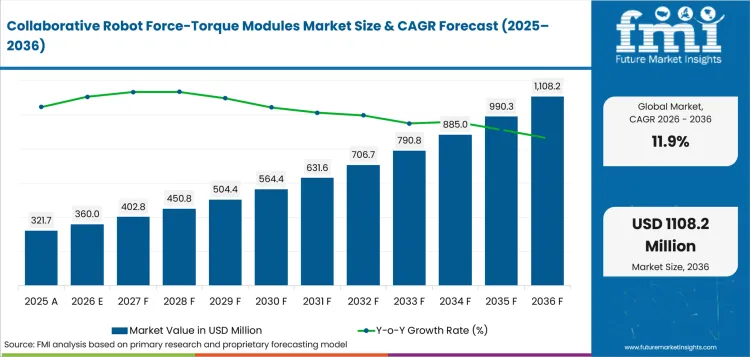
Collaborative Robot Force-Torque Modules Market Overview: Size and Forecast
- 2026 Market Size: USD 360.0 million
- 2036 Market Size: USD 1,108.2 million
- Forecast CAGR: 11.9% from 2026 to 2036
- Leading Module Configuration: Six-Axis External Modules
- Six-Axis External Modules Share in 2026: 58.0%
- Leading Robot Type: Collaborative Robots
- Collaborative Robots Share in 2026: 46.0%
- Fastest-growing Country: China
- China CAGR: 13.4% by 2036
Summary of the Collaborative Robot Force-Torque Modules Market
- Demand and Growth Drivers
- Assembly, polishing, deburring, and inspection users are shifting toward force-guided robots that can react to contact variation.
- Robot integrators are giving more attention to modules with simple setup, stable calibration, and teach-pendant software support.
- Factory operators are extending cobot cells into contact-rich tasks where position-only movement can create scrap or rework.
- Product and Segment View
- Six-Axis External Modules are forecast to represent 58.0% share in 2026, led by tool-side measurement needs in assembly and finishing cells.
- Collaborative Robots are projected to hold 46.0% share in 2026, influenced by fast setup needs and human-adjacent production use.
- 5-20 kg payload modules are expected to secure 42.0% share in 2026, supported by mid-payload cells used across common factory tasks.
- Geography and Competitive Outlook
- China is projected to record 13.4% CAGR by 2036, backed by large robot installation scale and local automation ecosystems.
- India is expected to expand at 13.0% CAGR by 2036 through electronics, automotive, and pharmaceutical automation demand.
- ATI Industrial Automation, OnRobot, Robotiq, and Bota Systems compete through module accuracy, robot fit, and software support.
- FANUC, Universal Robots, Epson Robots, ABB Robotics, Yaskawa, and KUKA influence demand through robot-level force-control ecosystems.
- Analyst Opinion
- Nikhil Kaitwade, Principal Consultant at Future Market Insights for industrial domain, says, “Collaborative robot force-torque modules are no longer simple sensor add-ons. Buyers now assess whether the module reduces scrap, shortens setup, protects parts, and keeps force data stable across shifts. The strongest suppliers will combine six-axis sensing, clean robot integration, overload protection, and software that line teams can tune without specialist coding.”
Factory automation is moving toward measurable contact control as industrial robots enter more fit-sensitive tasks. The International Federation of Robotics reported 542,000 industrial robot installations worldwide in 2024, giving module suppliers a broader production base for force sensing. The Association for Advancing Automation reported 36,766 North American robot orders in 2025, reflecting wider automation investment outside single robot-dense markets. Universal Robots introduced the UR15 in May 2025 with a maximum TCP speed of 5 m/s, which raises the value of accurate force feedback in faster cobot cells. Suppliers with stable calibration, low-profile hardware, overload protection, and robot-ready software can secure stronger integrator confidence.
Which factors support expansion in the collaborative robot force-torque modules market?
Finished module revenue, retrofit sales, cobot accessory kits, and application software support market value across industrial automation channels.
- Market value is supported by external six-axis modules sold for assembly, finishing, inspection, and delicate handling cells.
- Supplier pricing reflects force range, overload rating, calibration stability, interface electronics, and robot-brand software support.
- Revenue improves as older robot arms gain force control through external modules and controller-ready accessory packages.
- Buyer trust rises when module suppliers show repeatable force data, field service, cabling reliability, and application proof.
Why is the collaborative robot force-torque modules market growing?
Cobot cells now handle insertion and fit jobs that need controlled contact instead of position movement alone.
Growth outlook has become more structured because factories are expanding robot use into skilled manual tasks that require tactile feedback. NIST reported 15.0 million U.S. manufacturing employees in 2024, showing the depth of production environments where labor relief and repeatable contact quality can support automation purchases. Force-torque modules help robots detect misalignment before parts fail during press-fit, screwdriving, polishing, deburring, and inspection work. Buyers also want application software that reduces setup time for integrators serving small and mid-sized manufacturers. This makes module value depend on production certainty, not only sensor hardware.
How is the collaborative robot force-torque modules market segmented?
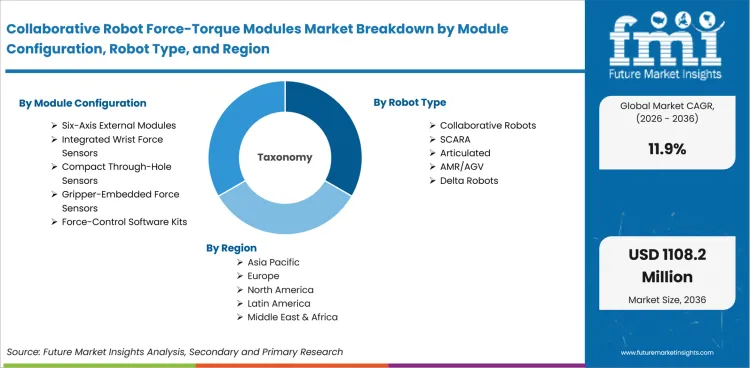
The collaborative robot force-torque modules industry is segmented by module configuration, robot type, payload, application, and end-use industry.
- Six-Axis External Modules is projected to secure 58.0% share in 2026 under By Module Configuration, six-axis external modules dominate because tool-side measurement gives integrators fuller force and torque visibility during assembly, polishing, deburring, and delicate handling work.
- Collaborative Robots is projected to secure 46.0% share in 2026 under By Robot Type, collaborative robots lead because human-adjacent cells need fast setup, simpler teaching, and external force feedback that can be added without rebuilding the full robot line.
- 5-20 kg is projected to secure 42.0% share in 2026 under By Payload, the 5-20 kg payload band leads because mid-payload cobots handle the widest set of insertion, tending, inspection, and packaging tasks across flexible production cells.
- Assembly is projected to secure 31.0% share in 2026 under By Application, assembly leads because press-fit, fastening, connector insertion, and part seating tasks need live correction before over-force creates scrap or rework.
- Automotive is projected to secure 34.0% share in 2026 under By End-use Industry, automotive leads because vehicle suppliers use force-controlled cells for surface finishing, joining, quality checks, and component fit validation.
Collaborative Robot Force-Torque Modules Market Analysis By Module Configuration
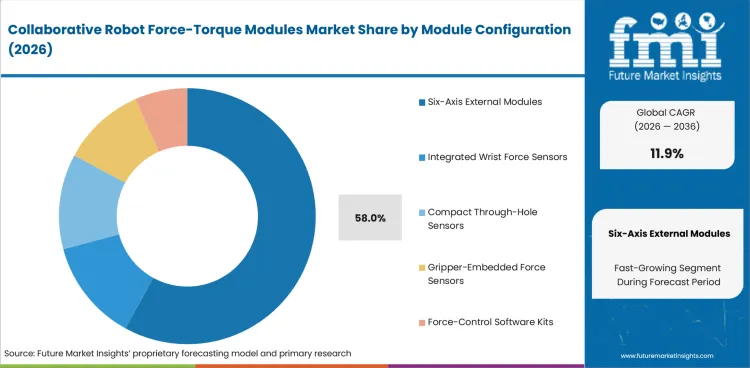
- Six-Axis External Modules are projected to account for 58.0% share in 2026, influenced by demand for tool-side force and torque data in contact-rich applications.
- Integrated wrist sensors gain use in newer cobots, but external modules keep stronger value where validated accuracy and replaceable sensing are required.
Collaborative Robot Force-Torque Modules Market Analysis By Robot Type
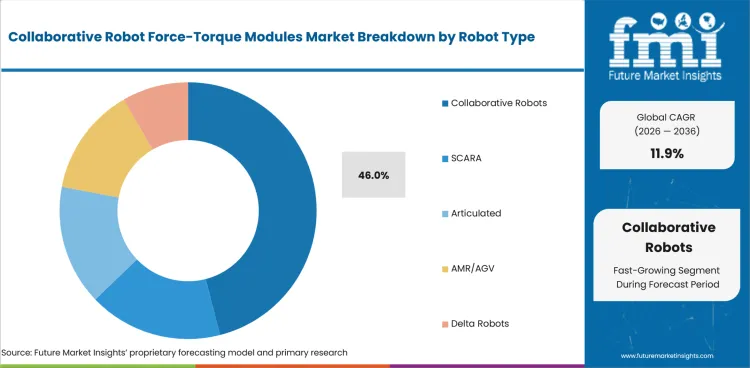
- Collaborative Robots are expected to represent 46.0% share in 2026, led by flexible cell deployment and easier module mounting across small factories.
- SCARA and articulated robots retain value in speed-driven assembly cells, although module suppliers must adapt mounting kits and software to each robot family.
Collaborative Robot Force-Torque Modules Market Analysis By Payload
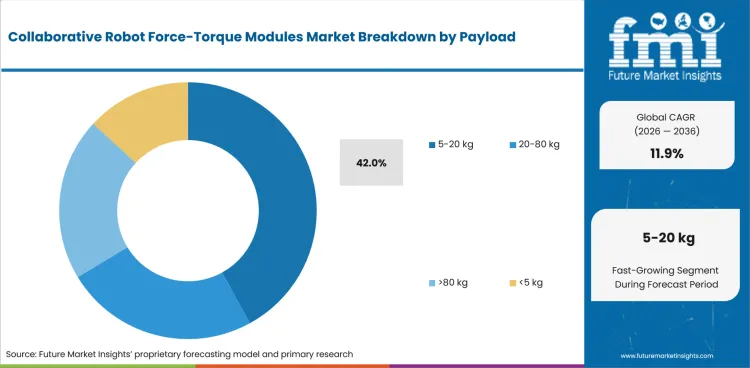
- 5-20 kg modules are anticipated to hold 42.0% share in 2026, supported by broad mid-payload use in assembly, tending, inspection, and packaging cells.
- Buyers in this payload band compare sensor height, cable routing, and flange fit because added module length can affect reach inside compact fixtures.
Collaborative Robot Force-Torque Modules Market Analysis By Application
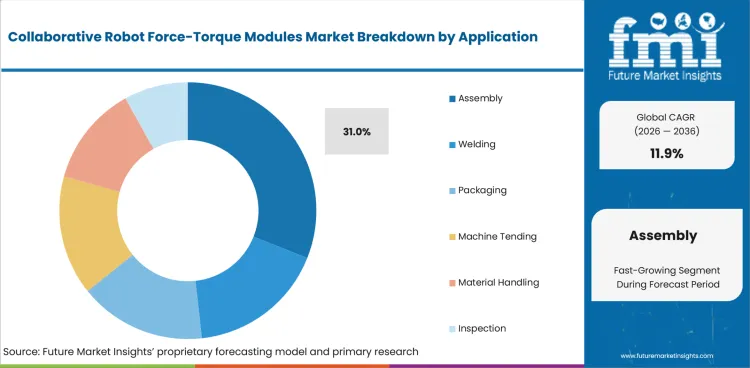
- Assembly is forecast to account for 31.0% share in 2026, reflected by insertion, pressing, fastening, and seating tasks needing live force correction.
- Inspection and finishing applications gain share when surface pressure and part contact quality become more important than simple robot speed.
Collaborative Robot Force-Torque Modules Market Analysis By End-use Industry
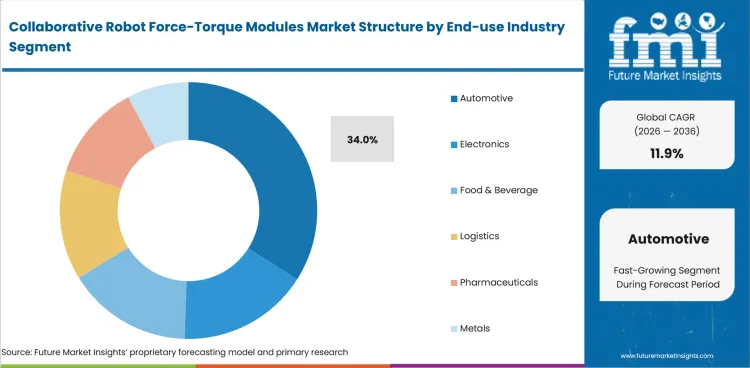
- Automotive is projected to account for 34.0% share in 2026, shaped by vehicle assembly and finishing cells that need repeatable contact pressure.
- Electronics users create additional demand because small connectors, displays, and battery components require careful force limits during handling.
What are the driver, restraints, and opportunities in the collaborative robot force-torque modules market?
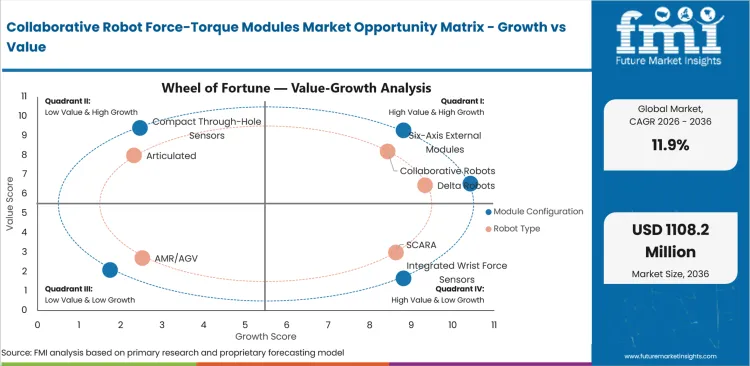
Contact-rich production tasks support module adoption while calibration concerns and software gaps can slow wider factory use.
- Driver: Assembly scrap reduction drives module demand as controlled contact protects connectors, bearings, and machined surfaces.
- Restraint: Calibration drift restrains wider use when factories need stable readings after tool changes and temperature shifts.
- Opportunity: Retrofit projects create new value when older robot arms need external sensing to perform contact-sensitive tasks.
Collaborative Robot Force-Torque Modules Market Demand Outlook
Demand outlook is moving toward force-guided robot cells that can prove contact quality before full line deployment. IFR reported that Western Europe reached 267 robots per 10,000 manufacturing employees in 2024, ahead of North America with 204 and Asia with 131. This creates a practical demand signal because dense automation regions can evaluate external six-axis modules across existing robot populations. Suppliers that combine stable measurement, overload protection, application templates, and quick recalibration can appraise their value through lower scrap and smoother line trials.
Calibration and Integration Restraint Analysis
Calibration risk remains a restraint when plants need repeatable readings across shifts, tools, and temperature changes. IFR reported industrial robot installations in Europe fell 8% to 85,000 units in 2024, showing that investment cycles can become cautious even in automation-heavy regions. This matters because force-torque modules are often add-on purchases that must survive tighter budget review. Vendors need clearer service intervals, simpler recalibration, and stronger diagnostics to keep external modules from being treated as optional hardware.
Retrofit and Demonstration Opportunity Analysis
Opportunity is strongest where public programs and demonstration centers reduce adoption risk for first-time buyers. The UK Smart Machines Strategy stated that fully adopted smart machines could raise UK GVA across sectors from £6.4 billion to £150 billion by 2035. That scale highlights why module suppliers should support try-before-buy cells, training kits, and integrator-ready software. Retrofit demand can grow when factories see force control as a measurable path to safer handling, lower rework, and wider cobot use.
Which countries are growing fastest in the collaborative robot force-torque modules market?
China 13.4% CAGR, India 13.0% CAGR, South Korea 12.2% CAGR, United States 11.8% CAGR, Japan 11.5% CAGR, Germany 10.9% CAGR, France 10.2% CAGR, and United Kingdom 9.8% CAGR through 2036.
.webp "Top Country Growth Comparison Collaborative Robot Force Torque Modules Market Cagr (2026 2036)")
| Country | CAGR |
|---|---|
| China | 13.4% |
| India | 13.0% |
| South Korea | 12.2% |
| United States | 11.8% |
| Japan | 11.5% |
| Germany | 10.9% |
| France | 10.2% |
| United Kingdom | 9.8% |
Source: Future Market Insights, 2026.
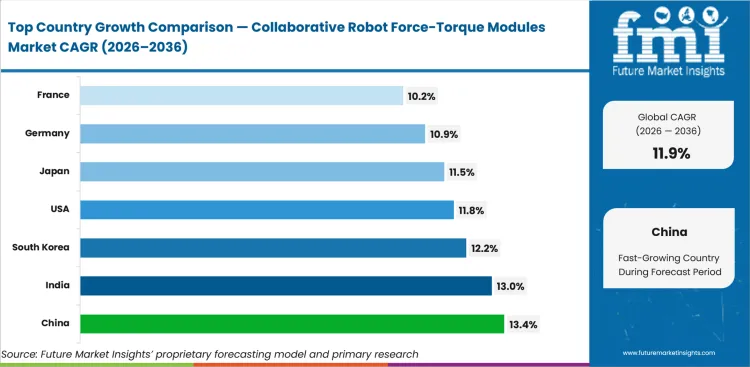
How do country-level CAGRs compare in the collaborative robot force-torque modules market?
China leads country growth while the United Kingdom records the most cautious expansion outlook among profiled markets.
- China is forecast to record 13.4% CAGR by 2036 as robot scale and local automation ecosystems support faster module deployment.
- India is expected to expand at 13.0% CAGR from 2026 to 2036 as electronics and automotive factories add flexible robot cells.
- South Korea is projected to grow at 12.2% CAGR through 2036 as high robot density supports advanced sensing evaluation.
- The United States is estimated to rise at 11.8% CAGR by 2036 with integrators supporting force-control retrofits and new cells.
- Japan is expected to advance at 11.5% CAGR over the forecast period as precision assembly users adopt force-guided automation.
- Germany is forecast to grow at 10.9% CAGR through 2036 as automotive and machinery users require documented process control.
- France is projected to post 10.2% CAGR by 2036 as aerospace and industrial users approve selective quality-focused modules.
- The United Kingdom is expected to grow at 9.8% CAGR by 2036 as SME adoption programs support a cautious market path.
What is the collaborative robot force-torque modules market outlook in the United States?
An 11.8% CAGR through 2036 reflects advanced manufacturing depth and strong integrator-led cobot deployment.
Country Market Snapshot Table
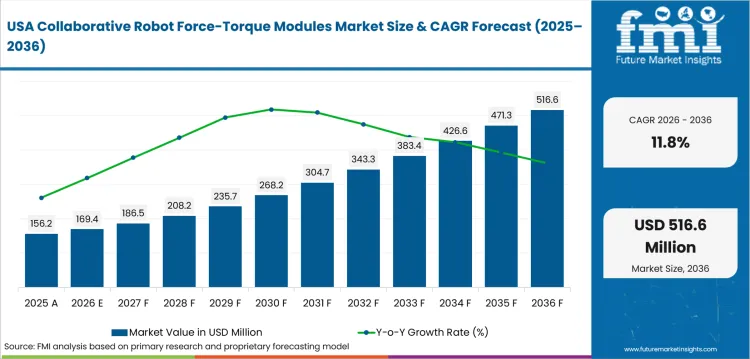
| Parameter | Value |
|---|---|
| Market Size in 2025 (Value) | USD 65.3 million |
| Market Size in 2026 (Value) | USD 73.0 million |
| Market Forecast in 2036 (Value) | USD 222.7 million |
| CAGR (2026 to 2036) | 11.8% |
| Years Considered | 2021 to 2036 |
| Base Year | 2025 |
| Forecast Period | 2026 to 2036 |
| Units Considered | Value (USD million) |
| Leading Sub-Region | Midwest automotive belt and advanced manufacturing corridors |
United States Collaborative Robot Force-Torque Modules Market Outlook
United States demand is shaped by automotive, electronics, medical device, and general manufacturing users that need contact-sensitive robot cells. Buyers prefer validated modules with distributor support, local service access, and proven compatibility across FANUC, Universal Robots, ABB, and Yaskawa platforms.
Force-torque modules gain strongest traction when integrators can show shorter setup work and lower scrap during first-line trials. External six-axis modules are expected to hold value where built-in sensing cannot provide enough tool-side data for precise finishing or insertion tasks.
Key Growth Drivers
- Automotive and medical-device plants use force feedback to protect high-value components during assembly, inspection, and finishing tasks. NIST reported 15.0 million U.S. manufacturing employees in 2024, giving suppliers a deep skilled-factory base for force-control retrofits.
- Robot order recovery supports accessory demand through integrator channels. A3 reported 36,766 North American robot orders worth USD 2.25 billion in 2025, reinforcing the need for sensing modules attached to new cells.
- Local system integrators shorten qualification work when force modules arrive with ready software blocks and robot-brand mounting kits.
- Manufacturers using high-mix production need contact feedback because flexible cells must handle part variation without constant fixture redesign.
Key Restraints
- Robot investment softness can slow optional sensor purchases. IFR reported U.S. annual robot installations at 34,200 units in 2024, down 9% from the prior year.
- Small and mid-sized factories often delay module purchases when force-control programming skills are not available internally.
- External modules add stack height and cabling, which can complicate compact fixtures already designed around narrow robot wrists.
What makes United States unique
The United States is unique because local module suppliers, robot OEMs, and integrators form a strong retrofit ecosystem for high-mix factories.
Key Companies
- ATI Industrial Automation
- FANUC America
- Universal Robots USA
- ABB Robotics USA
- OnRobot USA
- Robotiq USA
- Yaskawa Motoman
Sales & Marketing Channels
- Direct enterprise sales
- Robot integrator partnerships
- End-of-arm tooling distributors
- Robot OEM accessory programs
- Application demonstration cells
- Automation exhibitions
Country Segment Breakdown Table
| Segment | Sub-Segments |
|---|---|
| By Module Configuration | Six-Axis External Modules · Integrated Wrist Force Sensors · Compact Through-Hole Sensors · Gripper-Embedded Force Sensors · Force-Control Software Kits |
| By Robot Type | Collaborative Robots · SCARA · Articulated · AMR/AGV · Delta Robots |
| By Payload | <5 kg · 5-20 kg · 20-80 kg · >80 kg |
| By Application | Material Handling · Inspection · Assembly · Welding · Packaging · Machine Tending |
| By End-use Industry | Automotive · Electronics · Food & Beverage · Logistics · Pharmaceuticals · Metals |
| Key Sub-Regions Covered, Industrial Automation Clusters | Midwest · Southeast · California · Texas · Northeast · Pacific Northwest |
Frequently Asked Questions
How fast is United States collaborative robot force-torque modules market growing?
Demand in United States is ready to rise at 11.8% CAGR from 2026 to 2036, guided by country-specific automation adoption.
Who leads United States collaborative robot force-torque modules market?
ATI Industrial Automation, FANUC America, Universal Robots USA, and ABB Robotics USA compete through robot channels, integrator support, and force-control portfolios.
What is driving adoption in United States collaborative robot force-torque modules market?
Force-controlled assembly, finishing, inspection, and delicate handling tasks are moving buyers toward external and integrated force-torque modules.
How is the United Kingdom collaborative robot force-torque modules market performing?
A 9.8% CAGR through 2036 is supported by SME automation programs and practical robotics adoption support.
Country Market Snapshot Table
| Parameter | Value |
|---|---|
| Market Size in 2025 (Value) | USD 15.5 million |
| Market Size in 2026 (Value) | USD 17.0 million |
| Market Forecast in 2036 (Value) | USD 43.3 million |
| CAGR (2026 to 2036) | 9.8% |
| Years Considered | 2021 to 2036 |
| Base Year | 2025 |
| Forecast Period | 2026 to 2036 |
| Units Considered | Value (USD million) |
| Leading Sub-Region | Midlands and regional robotics adoption clusters |
United Kingdom Collaborative Robot Force-Torque Modules Market Outlook
United Kingdom demand is expected to develop through SME manufacturing, packaging, inspection, and light assembly projects. Buyers often need demonstrations before purchasing force-torque modules, so adoption centers and integrator labs carry strong influence.
Force-torque module suppliers can win by packaging sensors with application software and training. Smaller factories are more likely to accept modules when they see consistent contact pressure during trials before committing to production orders.
Key Growth Drivers
- SME automation programs create trial routes for cobot-based force control. The UK government stated in 2026 that GBP 40.0 million would support a new network of Robotics Adoption Hubs and an expansion of the Made Smarter adoption programme.
- Robotics adoption hubs can convert cautious buyers into pilot users. UKRI opened a £38 million funding opportunity in February 2026 for one-stop shops that help end-users adopt robotics and autonomous systems.
- Packaging and inspection users need gentle handling because damage and misplacement create visible losses in small-batch production.
- Regional integrators can bundle force modules with cobots, safety reviews, training, and application validation for first-time buyers.
Key Restraints
- Lower industrial robot installations keep the retrofit pool smaller than leading markets. IFR reported UK robot installations down 35% to 2,500 units in 2024 after a one-off peak in 2023.
- Many factories require payback proof before adding an external force-torque module to a basic cobot cell.
- Limited in-house robotics skills can make buyers choose simple gripper automation before force-guided assembly tasks.
What makes United Kingdom unique
The United Kingdom is unique because adoption support can move cautious SME manufacturers from demonstrations into first force-control purchases.
Key Companies
- Universal Robots UK
- OnRobot UK
- ABB Robotics UK
- FANUC UK
- Bota Systems UK partners
- KUKA Robotics UK
- Yaskawa UK
Sales & Marketing Channels
- Direct enterprise sales
- Robot integrator partnerships
- End-of-arm tooling distributors
- Robot OEM accessory programs
- Application demonstration cells
- Automation exhibitions
Country Segment Breakdown Table
| Segment | Sub-Segments |
|---|---|
| By Module Configuration | Six-Axis External Modules · Integrated Wrist Force Sensors · Compact Through-Hole Sensors · Gripper-Embedded Force Sensors · Force-Control Software Kits |
| By Robot Type | Collaborative Robots · SCARA · Articulated · AMR/AGV · Delta Robots |
| By Payload | <5 kg · 5-20 kg · 20-80 kg · >80 kg |
| By Application | Material Handling · Inspection · Assembly · Welding · Packaging · Machine Tending |
| By End-use Industry | Automotive · Electronics · Food & Beverage · Logistics · Pharmaceuticals · Metals |
| Key Sub-Regions Covered, Industrial Automation Clusters | Midlands · Greater Manchester · London · Bristol · Scotland Central Belt · Northern Ireland |
Frequently Asked Questions
How fast is United Kingdom collaborative robot force-torque modules market growing?
Demand in United Kingdom is ready to rise at 9.8% CAGR from 2026 to 2036, guided by country-specific automation adoption.
Who leads United Kingdom collaborative robot force-torque modules market?
Universal Robots UK, OnRobot UK, ABB Robotics UK, and FANUC UK compete through robot channels, integrator support, and force-control portfolios.
What is driving adoption in United Kingdom collaborative robot force-torque modules market?
Force-controlled assembly, finishing, inspection, and delicate handling tasks are moving buyers toward external and integrated force-torque modules.
What is driving Germany collaborative robot force-torque modules demand?
A 10.9% CAGR through 2036 reflects demanding automotive and machinery applications that require documented force control.
Country Market Snapshot Table
| Parameter | Value |
|---|---|
| Market Size in 2025 (Value) | USD 34.3 million |
| Market Size in 2026 (Value) | USD 38.0 million |
| Market Forecast in 2036 (Value) | USD 106.9 million |
| CAGR (2026 to 2036) | 10.9% |
| Years Considered | 2021 to 2036 |
| Base Year | 2025 |
| Forecast Period | 2026 to 2036 |
| Units Considered | Value (USD million) |
| Leading Sub-Region | Bavaria, Baden-Wuerttemberg, and North Rhine-Westphalia factory clusters |
Germany Collaborative Robot Force-Torque Modules Market Outlook
Germany demand is shaped by process reliability, strict qualification, and deep engineering review. Buyers use force-torque modules when surface quality, dimensional fit, or cycle repeatability justifies the added hardware and software cost.
Suppliers need documented accuracy, overload protection, calibration stability, and local application support. German manufacturers often prefer a slower qualification path when it lowers the risk of unstable readings in production cells.
Key Growth Drivers
- High robot density supports repeat module opportunities in mature automation plants. IFR reported Germany at 449 robots per 10,000 manufacturing employees in 2024.
- Manufacturing depth keeps demanding force-control applications active. Deutschland.de reported manufacturing generated 19.7% of gross value added in 2024, with automotive, machinery, chemical, and electrical sectors dominating industry.
- Automotive finishing and machining suppliers use pressure control to make sanding, polishing, and deburring results more repeatable.
- Specialist integrators support advanced retrofits when older robots need external sensing for assembly or inspection upgrades.
Key Restraints
- Industrial softness can lengthen approvals for premium sensing hardware. Destatis reported Germany GDP rose 0.2% in 2025 while manufacturing and construction gross value added declined further.
- Technical validation expectations can slow qualification of newer suppliers lacking German service support.
- Robot OEM force packages can displace external modules when built-in sensing meets the task specification.
What makes Germany unique
Germany is unique because buyers value process-stability evidence and engineering documentation before they value lower sensor cost.
Key Companies
- KUKA
- SCHUNK
- ATI Industrial Automation
- OnRobot Germany
- ABB Robotics Germany
- Universal Robots Germany
- Yaskawa Europe
Sales & Marketing Channels
- Direct enterprise sales
- Robot integrator partnerships
- End-of-arm tooling distributors
- Robot OEM accessory programs
- Application demonstration cells
- Automation exhibitions
Country Segment Breakdown Table
| Segment | Sub-Segments |
|---|---|
| By Module Configuration | Six-Axis External Modules · Integrated Wrist Force Sensors · Compact Through-Hole Sensors · Gripper-Embedded Force Sensors · Force-Control Software Kits |
| By Robot Type | Collaborative Robots · SCARA · Articulated · AMR/AGV · Delta Robots |
| By Payload | <5 kg · 5-20 kg · 20-80 kg · >80 kg |
| By Application | Material Handling · Inspection · Assembly · Welding · Packaging · Machine Tending |
| By End-use Industry | Automotive · Electronics · Food & Beverage · Logistics · Pharmaceuticals · Metals |
| Key Sub-Regions Covered, Industrial Automation Clusters | Bavaria · Baden-Wuerttemberg · North Rhine-Westphalia · Lower Saxony · Saxony · Hesse |
Frequently Asked Questions
How fast is Germany collaborative robot force-torque modules market growing?
Demand in Germany is ready to rise at 10.9% CAGR from 2026 to 2036, guided by country-specific automation adoption.
Who leads Germany collaborative robot force-torque modules market?
KUKA, SCHUNK, ATI Industrial Automation, and OnRobot Germany compete through robot channels, integrator support, and force-control portfolios.
What is driving adoption in Germany collaborative robot force-torque modules market?
Force-controlled assembly, finishing, inspection, and delicate handling tasks are moving buyers toward external and integrated force-torque modules.
How fast is France collaborative robot force-torque modules market growing?
A 10.2% CAGR through 2036 is supported by aerospace, automotive, and selective factory modernization programs.
Country Market Snapshot Table
| Parameter | Value |
|---|---|
| Market Size in 2025 (Value) | USD 19.1 million |
| Market Size in 2026 (Value) | USD 21.0 million |
| Market Forecast in 2036 (Value) | USD 55.5 million |
| CAGR (2026 to 2036) | 10.2% |
| Years Considered | 2021 to 2036 |
| Base Year | 2025 |
| Forecast Period | 2026 to 2036 |
| Units Considered | Value (USD million) |
| Leading Sub-Region | Ile-de-France, Auvergne-Rhone-Alpes, and aerospace supplier corridors |
France Collaborative Robot Force-Torque Modules Market Outlook
France demand is expected to be application-led rather than volume-led. Aerospace, automotive, food, and industrial goods users adopt force-torque modules when quality gains or worker-relief benefits can be measured during pilot cells.
Suppliers should lead with finishing, assembly, and inspection proof instead of broad automation claims. Country demand will depend on integrators that can show fewer defects and easier operation before plants approve added sensing cost.
Key Growth Drivers
- Industrial modernization support gives automation suppliers a policy tailwind. The French government describes France 2030 as a EUR 54 billion investment program for innovation, industrialization, and strategic sectors.
- Robot use still creates a meaningful installed base for sensor suppliers. IFR reported France installed 4,900 industrial robots in 2024 despite a weaker purchase cycle.
- Aerospace suppliers need controlled force during composite finishing and metal surface preparation because rework is costly.
- Food and packaging plants can use force-guided cobots for careful handling, inspection, and secondary packaging tasks.
Key Restraints
- The manufacturing base is smaller than Germany’s automation pool. World Bank data placed France manufacturing value added at 9.4332% of GDP in 2024.
- Lower robot installation scale limits near-term retrofit volume for external force-torque modules.
- Buyers may delay upgrades when sensor value is not tied to a clear reduction in defects or operator effort.
What makes France unique
France is unique because force-torque module demand is strongest in quality-sensitive applications rather than broad factory automation.
Key Companies
- Stäubli Robotics
- OnRobot France
- Universal Robots France
- ABB Robotics France
- FANUC France
- KUKA France
- Bota Systems partners
Sales & Marketing Channels
- Direct enterprise sales
- Robot integrator partnerships
- End-of-arm tooling distributors
- Robot OEM accessory programs
- Application demonstration cells
- Automation exhibitions
Country Segment Breakdown Table
| Segment | Sub-Segments |
|---|---|
| By Module Configuration | Six-Axis External Modules · Integrated Wrist Force Sensors · Compact Through-Hole Sensors · Gripper-Embedded Force Sensors · Force-Control Software Kits |
| By Robot Type | Collaborative Robots · SCARA · Articulated · AMR/AGV · Delta Robots |
| By Payload | <5 kg · 5-20 kg · 20-80 kg · >80 kg |
| By Application | Material Handling · Inspection · Assembly · Welding · Packaging · Machine Tending |
| By End-use Industry | Automotive · Electronics · Food & Beverage · Logistics · Pharmaceuticals · Metals |
| Key Sub-Regions Covered, Industrial Automation Clusters | Ile-de-France · Auvergne-Rhone-Alpes · Occitanie · Nouvelle-Aquitaine · Hauts-de-France · Grand Est |
Frequently Asked Questions
How fast is France collaborative robot force-torque modules market growing?
Demand in France is ready to rise at 10.2% CAGR from 2026 to 2036, guided by country-specific automation adoption.
Who leads France collaborative robot force-torque modules market?
Stäubli Robotics, OnRobot France, Universal Robots France, and ABB Robotics France compete through robot channels, integrator support, and force-control portfolios.
What is driving adoption in France collaborative robot force-torque modules market?
Force-controlled assembly, finishing, inspection, and delicate handling tasks are moving buyers toward external and integrated force-torque modules.
What is the Japan collaborative robot force-torque modules market forecast?
An 11.5% CAGR through 2036 reflects precision assembly needs and strong local robot OEM influence.
Country Market Snapshot Table
| Parameter | Value |
|---|---|
| Market Size in 2025 (Value) | USD 44.8 million |
| Market Size in 2026 (Value) | USD 50.0 million |
| Market Forecast in 2036 (Value) | USD 148.5 million |
| CAGR (2026 to 2036) | 11.5% |
| Years Considered | 2021 to 2036 |
| Base Year | 2025 |
| Forecast Period | 2026 to 2036 |
| Units Considered | Value (USD million) |
| Leading Sub-Region | Tokyo-Nagoya-Osaka industrial corridor |
Japan Collaborative Robot Force-Torque Modules Market Outlook
Japan demand is shaped by local robot OEM ecosystems and precision manufacturing needs. Force-torque modules gain use in electronics, automotive, machinery, and inspection cells that require accurate contact data.
External suppliers must prove compatibility with FANUC, Yaskawa, Epson, and Kawasaki systems. Buyers favor proven packages when module readings must survive tight process windows and long factory qualification cycles.
Key Growth Drivers
- Japan remains a deep robot market for advanced components. The International Trade Administration reported 435,300 robotic units went into operation in Japan over three years, representing a 17% growth rate.
- Automotive automation supports high-value force-control tasks. IFR reported Japan’s automotive industry installed about 13,000 industrial robots in 2024, up 11% from the prior year.
- Electronics assembly needs fine force feedback because connectors, displays, and small components are exposed to over-force risk.
- Local robot OEMs create trusted force-control paths through integrated packages, accessories, and application engineering.
Key Restraints
- Specialist qualification capacity can slow external module approvals. Japan’s Statistics Bureau reported manufacturing process workers declined to 8.64 million in 2024 from 8.78 million in 2023, limiting plant time for calibration trials.
- OEM-integrated force control can reduce demand for third-party modules when built-in sensing satisfies the task.
- Japanese buyers often require extensive documentation before approving unfamiliar external sensor suppliers.
What makes Japan unique
Japan is unique because module demand is closely shaped by local robot OEM technology roadmaps and precision manufacturing discipline.
Key Companies
- FANUC
- Yaskawa Electric
- Epson Robots
- Kawasaki Robotics
- Universal Robots Japan
- OnRobot Japan
- ABB Robotics Japan
Sales & Marketing Channels
- Direct enterprise sales
- Robot integrator partnerships
- End-of-arm tooling distributors
- Robot OEM accessory programs
- Application demonstration cells
- Automation exhibitions
Country Segment Breakdown Table
| Segment | Sub-Segments |
|---|---|
| By Module Configuration | Six-Axis External Modules · Integrated Wrist Force Sensors · Compact Through-Hole Sensors · Gripper-Embedded Force Sensors · Force-Control Software Kits |
| By Robot Type | Collaborative Robots · SCARA · Articulated · AMR/AGV · Delta Robots |
| By Payload | <5 kg · 5-20 kg · 20-80 kg · >80 kg |
| By Application | Material Handling · Inspection · Assembly · Welding · Packaging · Machine Tending |
| By End-use Industry | Automotive · Electronics · Food & Beverage · Logistics · Pharmaceuticals · Metals |
| Key Sub-Regions Covered, Industrial Automation Clusters | Tokyo · Nagoya · Osaka · Kanagawa · Aichi · Kyushu electronics clusters |
Frequently Asked Questions
How fast is Japan collaborative robot force-torque modules market growing?
Demand in Japan is ready to rise at 11.5% CAGR from 2026 to 2036, guided by country-specific automation adoption.
Who leads Japan collaborative robot force-torque modules market?
FANUC, Yaskawa Electric, Epson Robots, and Kawasaki Robotics compete through robot channels, integrator support, and force-control portfolios.
What is driving adoption in Japan collaborative robot force-torque modules market?
Force-controlled assembly, finishing, inspection, and delicate handling tasks are moving buyers toward external and integrated force-torque modules.
Why is China the fastest-growing collaborative robot force-torque modules market?
A 13.4% CAGR through 2036 reflects unmatched robot installation scale and expanding local automation ecosystems.
Country Market Snapshot Table
| Parameter | Value |
|---|---|
| Market Size in 2025 (Value) | USD 84.7 million |
| Market Size in 2026 (Value) | USD 96.0 million |
| Market Forecast in 2036 (Value) | USD 337.6 million |
| CAGR (2026 to 2036) | 13.4% |
| Years Considered | 2021 to 2036 |
| Base Year | 2025 |
| Forecast Period | 2026 to 2036 |
| Units Considered | Value (USD million) |
| Leading Sub-Region | Yangtze River Delta and Greater Bay Area automation hubs |
China Collaborative Robot Force-Torque Modules Market Outlook
China is the largest arena for collaborative robot force-torque modules because high robot installation volume creates a large addressable pool for new cells and retrofits. Electronics, automotive, logistics, and metalworking plants provide broad use cases.
Premium suppliers can win in demanding applications, but they must defend value against lower-cost modules and integrated robot options. Local service, fast delivery, and robot-brand compatibility will shape purchase decisions.
Key Growth Drivers
- Scale gives China a large test bed for force-control applications. IFR reported 295,000 industrial robots installed in China in 2024, equal to 54% of global installations.
- Industrial production strength supports automation upgrades. China’s National Bureau of Statistics reported industrial value added above designated size increased 5.9% year on year in 2025.
- Electronics factories use force sensing for connector insertion, delicate placement, and display-module handling.
- Local robot OEMs create fast integration routes when module suppliers can meet price, delivery, and service expectations.
Key Restraints
- Premium margins face pressure from domestic competition. The State Council reported that nearly 200 generative AI models had been registered and launched in China by 2024, showing how quickly local technology ecosystems can scale.
- Rapid supplier entry can make quality validation harder for buyers comparing low-cost modules with limited field history.
- Export-oriented plants may delay add-on purchases when customers demand cost reduction across automation lines.
What makes China unique
China is unique because robot installation scale allows force-torque module suppliers to move from pilots to volume orders faster.
Key Companies
- ABB Robotics China
- FANUC China
- Universal Robots China
- OnRobot China
- Bota Systems China partners
- KUKA China
- local cobot integrators
Sales & Marketing Channels
- Direct enterprise sales
- Robot integrator partnerships
- End-of-arm tooling distributors
- Robot OEM accessory programs
- Application demonstration cells
- Automation exhibitions
Country Segment Breakdown Table
| Segment | Sub-Segments |
|---|---|
| By Module Configuration | Six-Axis External Modules · Integrated Wrist Force Sensors · Compact Through-Hole Sensors · Gripper-Embedded Force Sensors · Force-Control Software Kits |
| By Robot Type | Collaborative Robots · SCARA · Articulated · AMR/AGV · Delta Robots |
| By Payload | <5 kg · 5-20 kg · 20-80 kg · >80 kg |
| By Application | Material Handling · Inspection · Assembly · Welding · Packaging · Machine Tending |
| By End-use Industry | Automotive · Electronics · Food & Beverage · Logistics · Pharmaceuticals · Metals |
| Key Sub-Regions Covered, Industrial Automation Clusters | Yangtze River Delta · Greater Bay Area · Beijing-Tianjin-Hebei · Chengdu-Chongqing · Wuhan · Shandong |
Frequently Asked Questions
How fast is China collaborative robot force-torque modules market growing?
Demand in China is ready to rise at 13.4% CAGR from 2026 to 2036, guided by country-specific automation adoption.
Who leads China collaborative robot force-torque modules market?
ABB Robotics China, FANUC China, Universal Robots China, and OnRobot China compete through robot channels, integrator support, and force-control portfolios.
What is driving adoption in China collaborative robot force-torque modules market?
Force-controlled assembly, finishing, inspection, and delicate handling tasks are moving buyers toward external and integrated force-torque modules.
How is South Korea collaborative robot force-torque modules market positioned?
A 12.2% CAGR through 2036 reflects dense electronics automation and strict contact-control requirements.
Country Market Snapshot Table
| Parameter | Value |
|---|---|
| Market Size in 2025 (Value) | USD 37.4 million |
| Market Size in 2026 (Value) | USD 42.0 million |
| Market Forecast in 2036 (Value) | USD 132.8 million |
| CAGR (2026 to 2036) | 12.2% |
| Years Considered | 2021 to 2036 |
| Base Year | 2025 |
| Forecast Period | 2026 to 2036 |
| Units Considered | Value (USD million) |
| Leading Sub-Region | Seoul capital region and southeastern electronics clusters |
South Korea Collaborative Robot Force-Torque Modules Market Outlook
South Korea demand is tied to high-density automation in electronics, semiconductor, battery, and automotive manufacturing. Force-torque modules appeal to buyers needing compact design, high uptime, and reliable readings in delicate handling cells.
Suppliers must show accuracy, clean software integration, and local service depth. Buyers are selective because mature automation plants already have high expectations for reliability and process proof.
Key Growth Drivers
- South Korea leads global robot density. IFR reported 1,220 robots per 10,000 manufacturing employees in 2024, supported by electronics and automotive automation.
- Annual installation volume gives module suppliers a continuing base. IFR reported South Korea installed 30,600 industrial robots in 2024, with installations trending near 31,000 units since 2019.
- Semiconductor and electronics lines need delicate contact control for high-value components and tight tolerance handling.
- Automotive suppliers use force feedback for press-fit assembly, surface finishing, and inspection cells.
Key Restraints
- New installations softened slightly from a mature base. IFR reported South Korean robot installations declined 3% in 2024, limiting immediate expansion for some accessory upgrades.
- Long validation cycles can slow production-line approvals for smaller module suppliers without local references.
- Compact equipment layouts can limit external module use when added wrist length affects reach inside semiconductor tools.
What makes South Korea unique
South Korea is unique because buyers combine the world’s highest robot density with strict expectations for compact and reliable module design.
Key Companies
- Universal Robots Korea
- OnRobot Korea
- ABB Robotics Korea
- FANUC Korea
- Yaskawa Korea
- local semiconductor automation integrators
- Hyundai Robotics
Sales & Marketing Channels
- Direct enterprise sales
- Robot integrator partnerships
- End-of-arm tooling distributors
- Robot OEM accessory programs
- Application demonstration cells
- Automation exhibitions
Country Segment Breakdown Table
| Segment | Sub-Segments |
|---|---|
| By Module Configuration | Six-Axis External Modules · Integrated Wrist Force Sensors · Compact Through-Hole Sensors · Gripper-Embedded Force Sensors · Force-Control Software Kits |
| By Robot Type | Collaborative Robots · SCARA · Articulated · AMR/AGV · Delta Robots |
| By Payload | <5 kg · 5-20 kg · 20-80 kg · >80 kg |
| By Application | Material Handling · Inspection · Assembly · Welding · Packaging · Machine Tending |
| By End-use Industry | Automotive · Electronics · Food & Beverage · Logistics · Pharmaceuticals · Metals |
| Key Sub-Regions Covered, Industrial Automation Clusters | Seoul capital region · Gyeonggi · Incheon · Busan-Ulsan · Daegu · Daejeon |
Frequently Asked Questions
How fast is South Korea collaborative robot force-torque modules market growing?
Demand in South Korea is ready to rise at 12.2% CAGR from 2026 to 2036, guided by country-specific automation adoption.
Who leads South Korea collaborative robot force-torque modules market?
Universal Robots Korea, OnRobot Korea, ABB Robotics Korea, and FANUC Korea compete through robot channels, integrator support, and force-control portfolios.
What is driving adoption in South Korea collaborative robot force-torque modules market?
Force-controlled assembly, finishing, inspection, and delicate handling tasks are moving buyers toward external and integrated force-torque modules.
What is the India collaborative robot force-torque modules market outlook?
A 13.0% CAGR through 2036 reflects fast expansion from a lower automation base and rising electronics manufacturing.
Country Market Snapshot Table
| Parameter | Value |
|---|---|
| Market Size in 2025 (Value) | USD 14.2 million |
| Market Size in 2026 (Value) | USD 16.0 million |
| Market Forecast in 2036 (Value) | USD 54.3 million |
| CAGR (2026 to 2036) | 13.0% |
| Years Considered | 2021 to 2036 |
| Base Year | 2025 |
| Forecast Period | 2026 to 2036 |
| Units Considered | Value (USD million) |
| Leading Sub-Region | Pune-Chennai-Bengaluru manufacturing corridor |
India Collaborative Robot Force-Torque Modules Market Outlook
India is expanding from a lower automation foundation, so education and demonstration-led selling are critical. Buyers often start with machine tending, packaging, and inspection before moving toward force-sensitive assembly.
Force-torque module demand will strengthen as electronics, automotive, pharmaceutical, and general manufacturing users adopt flexible robot cells. Suppliers need channel partners that can prove payback and train first-time robot users.
Key Growth Drivers
- Robot use is gaining scale from a smaller base. IFR reported India installed a record 9,100 industrial robots in 2024, up 7% from the previous year.
- Electronics production supports delicate placement demand. PIB reported India electronics production reached Rs 11.3 lakh crore in 2024-25, nearly six times the level of 2014-15.
- Automotive suppliers need flexible cells for component assembly, deburring, and inspection tasks across mixed model lines.
- Pharmaceutical and packaging plants can use force-guided cobots for careful handling and quality checks in controlled environments.
Key Restraints
- The installed base is still small compared with mature markets. IFR reported India’s industrial robot stock reached 52,570 units in 2024, placing it 10th worldwide.
- Add-on module pricing can delay purchases when factories first approve basic robot automation budgets.
- Limited in-house programming skills can slow force-control setup and raise reliance on integrator support.
What makes India unique
India is unique because demand depends on educating new robot users and proving payback in early automation projects.
Key Companies
- FANUC India
- Yaskawa India
- ABB Robotics India
- Universal Robots India
- OnRobot India
- Epson Robots India
- Bota Systems channel partners
Sales & Marketing Channels
- Direct enterprise sales
- Robot integrator partnerships
- End-of-arm tooling distributors
- Robot OEM accessory programs
- Application demonstration cells
- Automation exhibitions
Country Segment Breakdown Table
| Segment | Sub-Segments |
|---|---|
| By Module Configuration | Six-Axis External Modules · Integrated Wrist Force Sensors · Compact Through-Hole Sensors · Gripper-Embedded Force Sensors · Force-Control Software Kits |
| By Robot Type | Collaborative Robots · SCARA · Articulated · AMR/AGV · Delta Robots |
| By Payload | <5 kg · 5-20 kg · 20-80 kg · >80 kg |
| By Application | Material Handling · Inspection · Assembly · Welding · Packaging · Machine Tending |
| By End-use Industry | Automotive · Electronics · Food & Beverage · Logistics · Pharmaceuticals · Metals |
| Key Sub-Regions Covered, Industrial Automation Clusters | Pune · Chennai · Bengaluru · Hyderabad · Gujarat industrial corridor · Noida-Greater Noida |
Frequently Asked Questions
How fast is India collaborative robot force-torque modules market growing?
Demand in India is ready to rise at 13.0% CAGR from 2026 to 2036, guided by country-specific automation adoption.
Who leads India collaborative robot force-torque modules market?
FANUC India, Yaskawa India, ABB Robotics India, and Universal Robots India compete through robot channels, integrator support, and force-control portfolios.
What is driving adoption in India collaborative robot force-torque modules market?
Force-controlled assembly, finishing, inspection, and delicate handling tasks are moving buyers toward external and integrated force-torque modules.
Who are the leading companies in the collaborative robot force-torque modules market?
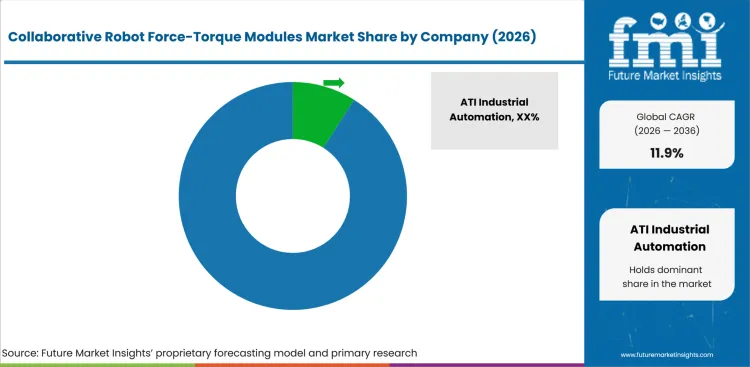
ATI Industrial Automation, OnRobot, Robotiq, Bota Systems, FANUC, Universal Robots, Epson Robots, ABB Robotics, Yaskawa, and KUKA.
- Specialist sensor suppliers hold an advantage when buyers need external six-axis measurement and documented calibration support.
- Cobot tooling suppliers gain shelf space by packaging force sensing with grippers, sanders, tool changers, and simple software.
- Robot OEMs influence module demand when built-in force control reduces the need for external wrist modules in basic applications.
- Application software supports trial because many buyers need ready motion blocks instead of custom robot programming.
The market connects closely with collaborative robot market outlook and factory cells that need safe human-adjacent automation. Suppliers also benefit from robotic sensors industry analysis as force data becomes more important inside production feedback loops.
Competition is shaped by the difference between module hardware and full force-control packages. ATI Industrial Automation has deep multi-axis sensing breadth, while OnRobot and Robotiq link force sensing to end-of-arm tooling in the robotic grippers market outlook. Robot OEMs protect demand through controller-native functions and installed-base access.
Software depth is becoming more important because plants want modules that connect with industrial automation market revenue without long integration cycles. Suppliers that combine data capture, overload protection, and application templates can defend premium pricing against low-cost hardware.
The strongest competitive position is expected to come from suppliers serving automotive robotics market outlook and electronics manufacturing services market analysis because both buyer groups require repeatable contact control and short qualification cycles.
How do top collaborative robot force-torque modules market companies compare?
ATI Industrial Automation and OnRobot score strongest on force-sensing depth while robot OEMs lead controller access and installed-base reach.
| Company | Relevance to Market Title | Six-Axis Sensing Depth | Application Software Fit | Robot-Brand Integration | Geographic Footprint | Positioning Signal |
|---|---|---|---|---|---|---|
| ATI Industrial Automation | Very High | Very Strong | Strong | High | Global | Six-axis sensor depth |
| OnRobot | Very High | Strong | Very Strong | High | Global | Cobot-ready application kits |
| Robotiq | High | Strong | Very Strong | Strong | North America and Europe | UR ecosystem fit |
| Bota Systems | High | Strong | Strong | Medium | Europe and North America | Compact sensing design |
| FANUC | High | Very Strong | Strong | Very Strong | Global | Robot-level force control |
| Universal Robots | Medium | Very Strong | Very Strong | Very Strong | Global | Cobot installed base |
| Epson Robots | High | Strong | Strong | High | Global | Delicate assembly accuracy |
| ABB Robotics | High | Very Strong | Strong | Very Strong | Global | Industrial automation breadth |
| Yaskawa | High | Very Strong | Strong | Very Strong | Global | MotoFit force function |
| KUKA | Medium | Very Strong | Strong | High | Global | Automotive automation base |
Source: Future Market Insights competitive analysis, 2026.
Who are the key players in the collaborative robot force-torque modules market?
ATI Industrial Automation, OnRobot, Robotiq, Bota Systems, FANUC, Universal Robots, Epson Robots, ABB Robotics, Yaskawa, KUKA, Kawasaki Robotics, and Stäubli are listed among active suppliers and force-control ecosystem participants.
Key global companies leading the collaborative robot force-torque modules market include:
- ATI Industrial Automation
- OnRobot
- Robotiq
- Bota Systems
- FANUC
- Universal Robots
- Epson Robots
- ABB Robotics
- Yaskawa
- KUKA
- Kawasaki Robotics
- Stäubli
- SCHUNK
- Kistler
- FerRobotics
Key Developments in Collaborative Robot Force-Torque Modules Market
- In May 2025, Universal Robots introduced the UR15 as its fastest cobot, widening the addressable base for contact-sensitive applications that need precise sensing at higher production speeds.
- In December 2025, OMRON announced a major expansion of its TM S Series collaborative robots, including new high-payload models and hardware upgrades relevant to force-torque sensing in demanding cobot tasks.
- In March 2026, Universal Robots and Scale AI launched the UR AI Trainer for imitation learning, highlighting how synchronized robot data can support AI-driven factory training workflows.
Key Companies in the Collaborative Robot Force-Torque Modules Market
Specialist Force-Torque Module Suppliers
- ATI Industrial Automation
- Bota Systems
- Robotiq
- SCHUNK
- Kistler
Cobot Tooling and Application Suppliers
- OnRobot
- Robotiq
- Weiss Robotics
- FerRobotics
Robot OEM Force-Control Ecosystems
- FANUC
- Universal Robots
- Epson Robots
- ABB Robotics
- Yaskawa
- KUKA
- Kawasaki Robotics
- Stäubli
Collaborative Robot Force-Torque Modules Market - Report Scope
| Parameter | Details |
|---|---|
| Forecast period | 2026 to 2036 |
| Historical period | 2021 to 2025 |
| Quantitative unit | Revenue in USD million |
| By module configuration | Six-axis external modules, integrated wrist force sensors, compact through-hole sensors, gripper-embedded force sensors, force-control software kits |
| By robot type | Collaborative robots, SCARA, articulated, AMR/AGV, and delta robots |
| By payload | <5 kg, 5-20 kg, 20-80 kg, and >80 kg |
| By application | Material handling, inspection, assembly, welding, packaging, and machine tending |
| By end-use industry | Automotive, electronics, food and beverage, logistics, pharmaceuticals, and metals |
| Regions covered | North America, Latin America, Europe, East Asia, South Asia and Pacific, Middle East and Africa |
| Countries covered | United States, United Kingdom, Germany, France, Japan, China, South Korea, and India |
| Key companies profiled | ATI Industrial Automation, OnRobot, Robotiq, Bota Systems, FANUC, Universal Robots, Epson Robots, ABB Robotics, Yaskawa, and KUKA |
| Report coverage | Market size, forecast, segmentation, regional analysis, competitive benchmarking, key developments, and FAQs |
Source: Future Market Insights, 2026.
Collaborative Robot Force-Torque Modules Market Breakdown by Module Configuration, Robot Type, Payload, Application, End-use Industry, and Region
Collaborative Robot Force-Torque Modules Market Segmented by Module Configuration:
- Six-Axis External Modules
- Integrated Wrist Force Sensors
- Compact Through-Hole Sensors
- Gripper-Embedded Force Sensors
- Force-Control Software Kits
Collaborative Robot Force-Torque Modules Market Segmented by Robot Type:
- Collaborative Robots
- SCARA
- Articulated
- AMR/AGV
- Delta Robots
Collaborative Robot Force-Torque Modules Market Segmented by Payload:
- <5 kg
- 5-20 kg
- 20-80 kg
- >80 kg
Collaborative Robot Force-Torque Modules Market Segmented by Application:
- Material Handling
- Inspection
- Assembly
- Welding
- Packaging
- Machine Tending
Collaborative Robot Force-Torque Modules Market Segmented by End-use Industry:
- Automotive
- Electronics
- Food & Beverage
- Logistics
- Pharmaceuticals
- Metals
Collaborative Robot Force-Torque Modules Market by Region:
- North America
- Latin America
- Europe
- East Asia
- South Asia and Pacific
- Middle East and Africa
Research Sources and Bibliography
- Association for Advancing Automation. (2026, February 6). Robot orders grow 6.6% in 2025 as general industries drive broader automation adoption.
- Department for Science, Innovation and Technology. (2025, February 11). Smart Machines Strategy 2035.
- Destatis. (2026, January 15). Gross domestic product up 0.2% in 2025.
- Federal Government of Germany. (2025, March 27). Germany’s industry: The most important facts and figures.
- French Government. (2025, May 6). France 2030: Invest and innovate to bring the future closer.
- International Federation of Robotics. (2025, July 15). Japan’s car industry has highest robot installations in five years.
- International Federation of Robotics. (2025, September 25). World Robotics 2025 report - Industrial robots: Global robot demand in factories doubles over 10 years.
- International Federation of Robotics. (2026, April 8). Robot density surges in Europe, Asia, and Americas.
- Japan External Trade Organization. (2025, April 18). Japan advanced manufacturing opportunities. International Trade Administration.
- National Bureau of Statistics of China. (2026, January 20). Industrial production operation in December 2025.
- National Institute of Standards and Technology. (2025). U.S. manufacturing economy.
- OMRON Robotics and Safety Technologies. (2025, December 4). OMRON TM S Series launch.
- Press Information Bureau. (2025, October 11). India’s electronics leap.
- The State Council of the People’s Republic of China. (2025, March 11). China evolving into AI super market driven by scale, innovation.
- UK Research and Innovation. (2026, February 26). Robotics adoption hubs.
- Universal Robots. (2025, May 12). Universal Robots introduces its fastest ever cobot.
- Universal Robots. (2026, March 16). Universal Robots and Scale AI launch imitation learning system to accelerate AI model training.
- World Bank. (2026, May). Manufacturing, value added (% of GDP) - France.
- Yaskawa Motoman. (2026, January 13). Torque Sensor MotoFit - FSE Tool.
Statistics Bureau of Japan. (2025). Statistical Handbook of Japan 2025.
Department for Science, Innovation and Technology. (2026, January 29). AI Opportunities Action Plan: One Year On.
This bibliography is provided for reader reference and is not exhaustive. The full report contains the complete reference list and detailed citations.
Collaborative Robot Force-Torque Modules Market - Scope & Definition
| Attribute | Detail |
|---|---|
| Market Definition | Collaborative robot force-torque modules are sensing and control units that measure force and torque at or near the robot wrist for contact-sensitive automation. |
| Functions Covered | Force measurement, torque measurement, contact correction, pressure control, misalignment detection, and force-guided motion. |
| Applications Covered | Assembly, insertion, polishing, sanding, deburring, inspection, packaging, handling, welding assistance, and machine tending. |
| End-Use Industries | Automotive, electronics, food and beverage, logistics, pharmaceuticals, metals, and precision manufacturing. |
| Product Scope | External six-axis modules, integrated wrist sensors, through-hole modules, gripper-embedded sensing, controller interfaces, and force-control software kits. |
| Exclusions | Vision-only sensors, safety scanners, standard grippers without force measurement, stand-alone load cells, and robot arms sold without force-torque capability. |
| Stakeholders | Module suppliers, robot OEMs, system integrators, end-of-arm tooling providers, distributors, automotive suppliers, electronics plants, and factory automation teams. |
Collaborative Robot Force-Torque Modules Market - Research Methodology
| Method | Description |
|---|---|
| Primary Research | FMI analyst interviews with cobot integrators, end-of-arm tooling suppliers, automotive automation teams, electronics assembly users, and robotics distributors. |
| Desk Research | Review of official robot installation data, government manufacturing sources, company product documentation, robot safety references, and sensor technical notes. |
| Market Sizing & Forecasting | Bottom-up approach using robot installation signals, module attachment rates, average selling prices, retrofit demand, application mix, and country-level automation readiness. |
| Data Validation | Cross-verification using supplier portfolios, robot density evidence, force-control applications, and relative module cost inside complete robot cells. |
This Report Answers
- Market size estimates for 2026 and forecasts through 2036 for the collaborative robot force-torque modules market.
- Insights across more than 30 regional and country-level markets.
- Analysis of demand drivers, automation adoption patterns, robot integration trends, and purchasing behavior.
- Evaluation of key module configurations and robot types, including external six-axis modules and integrated wrist force sensors.
- Assessment of force-control adoption across assembly, finishing, inspection, handling, and machine-tending applications.
- Identification of opportunities across collaborative robots, mid-payload cells, automotive production, electronics assembly, and retrofit programs.
- Evaluation of supply chain dynamics, calibration risk, software compatibility, and distributor-led support structures.
- Country-level growth analysis covering the United States, United Kingdom, Germany, France, Japan, China, South Korea, and India.
- Assessment of the competitive landscape, including specialist sensor suppliers, cobot tooling companies, and robot OEM ecosystems.
- Analysis of product boundaries, exclusions, market taxonomy, and forecast methodology.
- Regional outlooks across North America, Europe, East Asia, South Asia and Pacific, Latin America, and Middle East and Africa.
- Delivery of market data, forecasts, and supporting analysis in PDF and Excel formats.
Frequently Asked Questions
What is the growth prospect for collaborative robot force-torque modules?
Demand for collaborative robot force-torque modules is expected to rise at a considerable pace as factories extend cobots into assembly, finishing, inspection, and handling tasks that need controlled contact.
Which companies are expected to shape the collaborative robot force-torque modules market?
ATI Industrial Automation, OnRobot, Robotiq, Bota Systems, FANUC, Universal Robots, Epson Robots, ABB Robotics, Yaskawa, and KUKA are expected to shape competition through sensor accuracy, integration depth, and robot access.
Why are robot integrators investing in force-torque modules?
Robot integrators are investing in force-torque modules to reduce scrap, shorten setup, and help cobot cells respond correctly when parts are misaligned.
Which module configuration is gaining attention in collaborative robot force-torque modules?
Six-axis external modules are gaining attention because they provide tool-side force and torque measurement for contact-sensitive production work.
How do payload requirements influence module purchases?
Payload requirements influence purchases through rated load, overload protection, flange fit, sensor height, and cable routing needs.
Why is calibration important for force-torque modules?
Calibration is important because unstable readings can create wrong insertion force, uneven polishing pressure, or unreliable quality signals across shifts.
What role does software play in force-torque module adoption?
Software supports adoption by helping operators set force thresholds, tune motion blocks, and integrate modules with robot controllers more easily.
Which applications create the clearest need for force feedback?
Assembly, polishing, deburring, inspection, and delicate handling create the clearest need because the robot must respond to contact during the task.
How do external modules compare with built-in force sensing?
External modules usually provide tool-side measurement and replaceable sensing, while built-in force sensing can reduce wiring and setup cost in simpler cells.
How do regional trends affect demand for force-torque modules?
Regional trends affect demand through robot density, integrator networks, manufacturing depth, and public support for practical automation adoption.
Preview the report firsthand - request a free sample
Get SampleGet the brochure for pricing and purchase details.
Get PDFTable of Content
- Key Takeaways
- Market Size and CAGR
- Top Growth Driver
- Fastest Growing Segment
- Leading Region
- Key Companies
- Emerging Opportunities
- Executive Summary
- Global Market Outlook
- Demand-side Trends
- Supply-side Trends
- Technology Roadmap Analysis
- Analysis and Recommendations
- Analyst Perspective (What is happening? Why now? What should investors know?)
- Key Questions Answered
- How large is the market?
- What is the CAGR?
- What are key trends?
- Which region dominates?
- Who are the leaders?
- Market Overview
- Market Coverage / Taxonomy
- Market Definition / Scope / Limitations
- Research Methodology
- Chapter Orientation
- Analytical Lens and Working Hypotheses
- Market Structure, Signals, and Trend Drivers
- Benchmarking and Cross-market Comparability
- Market Sizing, Forecasting, and Opportunity Mapping
- Research Design and Evidence Framework
- Desk Research Programme (Secondary Evidence)
- Expert Input and Fieldwork (Primary Evidence)
- Tooling, Models, and Reference Databases
- Data Engineering and Model Build
- Quality Assurance and Audit Trail
- Market Background
- Market Dynamics (Drivers, Restraints, Opportunity, Trends)
- Scenario Forecast (Optimistic, Likely, Conservative)
- Impact Analysis
- AI Impact
- Sustainability Impact
- Regulatory Impact
- Technology Impact
- Consumer / Buyer Analysis
- Purchase Drivers
- Adoption Barriers
- Buyer Journey
- Opportunity Map Analysis
- Product Life Cycle Analysis
- Supply Chain Analysis
- Investment Feasibility Matrix
- Value Chain Analysis
- PESTLE and Porter's Analysis
- Regulatory Landscape
- Regional Parent Market Outlook
- Production and Consumption Statistics
- Import and Export Statistics
- Global Market Analysis and Forecast, 2021 to 2036
- Historical Market Size Value (USD Million) Analysis, 2021 to 2025
- Current and Future Market Size Value (USD Million) Projections, 2026 to 2036
- Y-o-Y Growth Trend Analysis
- Absolute $ Opportunity Analysis
- Global Market Pricing Analysis, 2021 to 2036
- Global Market Analysis and Forecast, By Module Configuration, 2021 to 2036
- Introduction / Key Findings
- Historical Market Size Value (USD Million) Analysis By Module Configuration, 2021 to 2025
- Current and Future Market Size Value (USD Million) Analysis and Forecast By Module Configuration, 2026 to 2036
- Six-Axis External Modules
- Integrated Wrist Force Sensors
- Compact Through-Hole Sensors
- Gripper-Embedded Force Sensors
- Force-Control Software Kits
- Six-Axis External Modules
- Y-o-Y Growth Trend Analysis By Module Configuration, 2021 to 2025
- Absolute $ Opportunity Analysis By Module Configuration, 2026 to 2036
- Global Market Analysis and Forecast, By Robot Type, 2021 to 2036
- Introduction / Key Findings
- Historical Market Size Value (USD Million) Analysis By Robot Type, 2021 to 2025
- Current and Future Market Size Value (USD Million) Analysis and Forecast By Robot Type, 2026 to 2036
- Collaborative Robots
- SCARA
- Articulated
- AMR/AGV
- Delta Robots
- Collaborative Robots
- Y-o-Y Growth Trend Analysis By Robot Type, 2021 to 2025
- Absolute $ Opportunity Analysis By Robot Type, 2026 to 2036
- Global Market Analysis and Forecast, By Payload, 2021 to 2036
- Introduction / Key Findings
- Historical Market Size Value (USD Million) Analysis By Payload, 2021 to 2025
- Current and Future Market Size Value (USD Million) Analysis and Forecast By Payload, 2026 to 2036
- 5-20 kg
- 20-80 kg
- >80 kg
- <5 kg
- 5-20 kg
- Y-o-Y Growth Trend Analysis By Payload, 2021 to 2025
- Absolute $ Opportunity Analysis By Payload, 2026 to 2036
- Global Market Analysis and Forecast, By Application, 2021 to 2036
- Introduction / Key Findings
- Historical Market Size Value (USD Million) Analysis By Application, 2021 to 2025
- Current and Future Market Size Value (USD Million) Analysis and Forecast By Application, 2026 to 2036
- Assembly
- Welding
- Packaging
- Machine Tending
- Material Handling
- Inspection
- Assembly
- Y-o-Y Growth Trend Analysis By Application, 2021 to 2025
- Absolute $ Opportunity Analysis By Application, 2026 to 2036
- Global Market Analysis and Forecast, By End-use Industry, 2021 to 2036
- Introduction / Key Findings
- Historical Market Size Value (USD Million) Analysis By End-use Industry, 2021 to 2025
- Current and Future Market Size Value (USD Million) Analysis and Forecast By End-use Industry, 2026 to 2036
- Automotive
- Electronics
- Food & Beverage
- Logistics
- Pharmaceuticals
- Metals
- Automotive
- Y-o-Y Growth Trend Analysis By End-use Industry, 2021 to 2025
- Absolute $ Opportunity Analysis By End-use Industry, 2026 to 2036
- Global Market Analysis and Forecast, By Region, 2021 to 2036
- Introduction
- Historical Market Size Value (USD Million) Analysis By Region, 2021 to 2025
- Current Market Size Value (USD Million) Analysis and Forecast By Region, 2026 to 2036
- North America
- Latin America
- Western Europe
- Eastern Europe
- East Asia
- South Asia and Pacific
- Middle East & Africa
- Market Attractiveness Analysis By Region
- North America Market Analysis and Forecast, By Country, 2021 to 2036
- Historical Market Size Value (USD Million) Trend Analysis By Market Taxonomy, 2021 to 2025
- Market Size Value (USD Million) Forecast By Market Taxonomy, 2026 to 2036
- By Country
- USA
- Canada
- Mexico
- By Module Configuration
- By Robot Type
- By Payload
- By Application
- By End-use Industry
- By Country
- Market Attractiveness Analysis
- By Country
- By Module Configuration
- By Robot Type
- By Payload
- By Application
- By End-use Industry
- Key Takeaways
- Latin America Market Analysis and Forecast, By Country
- Historical Market Size Value (USD Million) Trend Analysis By Market Taxonomy, 2021 to 2025
- Market Size Value (USD Million) Forecast By Market Taxonomy, 2026 to 2036
- By Country
- Brazil
- Chile
- Rest of Latin America
- By Module Configuration
- By Robot Type
- By Payload
- By Application
- By End-use Industry
- By Country
- Market Attractiveness Analysis
- By Country
- By Module Configuration
- By Robot Type
- By Payload
- By Application
- By End-use Industry
- Key Takeaways
- Western Europe Market Analysis and Forecast, By Country
- Historical Market Size Value (USD Million) Trend Analysis By Market Taxonomy, 2021 to 2025
- Market Size Value (USD Million) Forecast By Market Taxonomy, 2026 to 2036
- By Country
- Germany
- UK
- Italy
- Spain
- France
- Nordic
- BENELUX
- Rest of Western Europe
- By Module Configuration
- By Robot Type
- By Payload
- By Application
- By End-use Industry
- By Country
- Market Attractiveness Analysis
- By Country
- By Module Configuration
- By Robot Type
- By Payload
- By Application
- By End-use Industry
- Key Takeaways
- Eastern Europe Market Analysis and Forecast, By Country
- Historical Market Size Value (USD Million) Trend Analysis By Market Taxonomy, 2021 to 2025
- Market Size Value (USD Million) Forecast By Market Taxonomy, 2026 to 2036
- By Country
- Russia
- Poland
- Hungary
- Balkan & Baltic
- Rest of Eastern Europe
- By Module Configuration
- By Robot Type
- By Payload
- By Application
- By End-use Industry
- By Country
- Market Attractiveness Analysis
- By Country
- By Module Configuration
- By Robot Type
- By Payload
- By Application
- By End-use Industry
- Key Takeaways
- East Asia Market Analysis and Forecast, By Country
- Historical Market Size Value (USD Million) Trend Analysis By Market Taxonomy, 2021 to 2025
- Market Size Value (USD Million) Forecast By Market Taxonomy, 2026 to 2036
- By Country
- China
- Japan
- South Korea
- By Module Configuration
- By Robot Type
- By Payload
- By Application
- By End-use Industry
- By Country
- Market Attractiveness Analysis
- By Country
- By Module Configuration
- By Robot Type
- By Payload
- By Application
- By End-use Industry
- Key Takeaways
- South Asia and Pacific Market Analysis and Forecast, By Country
- Historical Market Size Value (USD Million) Trend Analysis By Market Taxonomy, 2021 to 2025
- Market Size Value (USD Million) Forecast By Market Taxonomy, 2026 to 2036
- By Country
- India
- ASEAN
- Australia & New Zealand
- Rest of South Asia and Pacific
- By Module Configuration
- By Robot Type
- By Payload
- By Application
- By End-use Industry
- By Country
- Market Attractiveness Analysis
- By Country
- By Module Configuration
- By Robot Type
- By Payload
- By Application
- By End-use Industry
- Key Takeaways
- Middle East & Africa Market Analysis and Forecast, By Country
- Historical Market Size Value (USD Million) Trend Analysis By Market Taxonomy, 2021 to 2025
- Market Size Value (USD Million) Forecast By Market Taxonomy, 2026 to 2036
- By Country
- Kingdom of Saudi Arabia
- Other GCC Countries
- Türkiye
- South Africa
- Other African Union
- Rest of Middle East & Africa
- By Module Configuration
- By Robot Type
- By Payload
- By Application
- By End-use Industry
- By Country
- Market Attractiveness Analysis
- By Country
- By Module Configuration
- By Robot Type
- By Payload
- By Application
- By End-use Industry
- Key Takeaways
- Key Countries Market Analysis
- USA
- Pricing Analysis
- Market Share Analysis, 2025
- By Module Configuration
- By Robot Type
- By Payload
- By Application
- By End-use Industry
- Canada
- Pricing Analysis
- Market Share Analysis, 2025
- By Module Configuration
- By Robot Type
- By Payload
- By Application
- By End-use Industry
- Mexico
- Pricing Analysis
- Market Share Analysis, 2025
- By Module Configuration
- By Robot Type
- By Payload
- By Application
- By End-use Industry
- Brazil
- Pricing Analysis
- Market Share Analysis, 2025
- By Module Configuration
- By Robot Type
- By Payload
- By Application
- By End-use Industry
- Chile
- Pricing Analysis
- Market Share Analysis, 2025
- By Module Configuration
- By Robot Type
- By Payload
- By Application
- By End-use Industry
- Germany
- Pricing Analysis
- Market Share Analysis, 2025
- By Module Configuration
- By Robot Type
- By Payload
- By Application
- By End-use Industry
- UK
- Pricing Analysis
- Market Share Analysis, 2025
- By Module Configuration
- By Robot Type
- By Payload
- By Application
- By End-use Industry
- Italy
- Pricing Analysis
- Market Share Analysis, 2025
- By Module Configuration
- By Robot Type
- By Payload
- By Application
- By End-use Industry
- Spain
- Pricing Analysis
- Market Share Analysis, 2025
- By Module Configuration
- By Robot Type
- By Payload
- By Application
- By End-use Industry
- France
- Pricing Analysis
- Market Share Analysis, 2025
- By Module Configuration
- By Robot Type
- By Payload
- By Application
- By End-use Industry
- India
- Pricing Analysis
- Market Share Analysis, 2025
- By Module Configuration
- By Robot Type
- By Payload
- By Application
- By End-use Industry
- ASEAN
- Pricing Analysis
- Market Share Analysis, 2025
- By Module Configuration
- By Robot Type
- By Payload
- By Application
- By End-use Industry
- Australia & New Zealand
- Pricing Analysis
- Market Share Analysis, 2025
- By Module Configuration
- By Robot Type
- By Payload
- By Application
- By End-use Industry
- China
- Pricing Analysis
- Market Share Analysis, 2025
- By Module Configuration
- By Robot Type
- By Payload
- By Application
- By End-use Industry
- Japan
- Pricing Analysis
- Market Share Analysis, 2025
- By Module Configuration
- By Robot Type
- By Payload
- By Application
- By End-use Industry
- South Korea
- Pricing Analysis
- Market Share Analysis, 2025
- By Module Configuration
- By Robot Type
- By Payload
- By Application
- By End-use Industry
- Russia
- Pricing Analysis
- Market Share Analysis, 2025
- By Module Configuration
- By Robot Type
- By Payload
- By Application
- By End-use Industry
- Poland
- Pricing Analysis
- Market Share Analysis, 2025
- By Module Configuration
- By Robot Type
- By Payload
- By Application
- By End-use Industry
- Hungary
- Pricing Analysis
- Market Share Analysis, 2025
- By Module Configuration
- By Robot Type
- By Payload
- By Application
- By End-use Industry
- Kingdom of Saudi Arabia
- Pricing Analysis
- Market Share Analysis, 2025
- By Module Configuration
- By Robot Type
- By Payload
- By Application
- By End-use Industry
- Türkiye
- Pricing Analysis
- Market Share Analysis, 2025
- By Module Configuration
- By Robot Type
- By Payload
- By Application
- By End-use Industry
- South Africa
- Pricing Analysis
- Market Share Analysis, 2025
- By Module Configuration
- By Robot Type
- By Payload
- By Application
- By End-use Industry
- USA
- Market Structure Analysis
- Competition Dashboard
- Competition Benchmarking
- Market Share Analysis of Top Players
- By Regional
- By Module Configuration
- By Robot Type
- By Payload
- By Application
- By End-use Industry
- Emerging Startups
- Innovation Benchmarking
- Competition Analysis
- Competition Deep Dive
- ATI Industrial Automation
- Overview
- Product Portfolio
- Profitability by Market Segments (Product/Region/Sales Channel)
- Sales Footprint
- Strategy Overview
- Marketing Strategy
- Product Strategy
- Channel Strategy
- OnRobot
- Robotiq
- Bota Systems
- FANUC
- Universal Robots
- Epson Robots
- ABB Robotics
- Yaskawa
- KUKA
- ATI Industrial Automation
- Case Studies
- Success Stories
- Recent Developments
- Competition Deep Dive
- Assumptions & Acronyms Used


