

- Market Size (2026)
- USD 420.0 Mn
- Forecast (2036)
- USD 1376.0 Mn
- CAGR (2026 to 2036)
- 12.6%
How big is the Robot-Guided Bin Picking Vision Software Market?
The Robot-Guided Bin Picking Vision Software Market is projected to grow from USD 420.0 million in 2026 to USD 1376.0 million by 2036, at a CAGR of 12.6%.
Robot-guided bin picking vision software was valued at USD 373.0 million in 2025. The market is projected to reach USD 420.0 million in 2026 and USD 1376.0 million by 2036, expanding at a CAGR of 12.6% from 2026 to 2036.
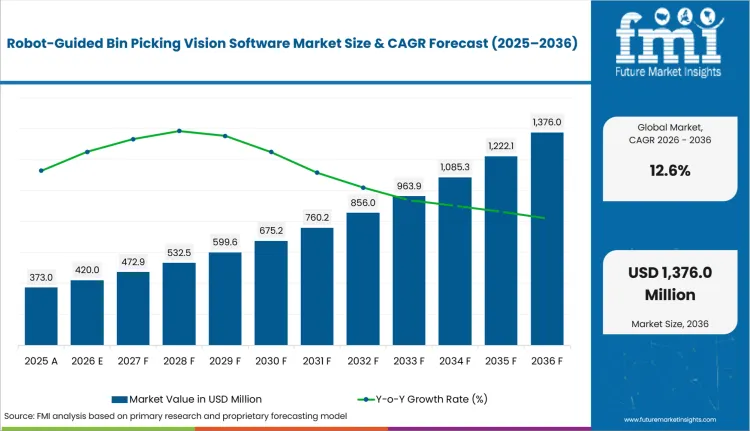
| Metric | Value |
|---|---|
| 2025 Market Size | USD 373.0 million |
| 2026 Market Size | USD 420.0 million |
| 2036 Market Size | USD 1376.0 million |
| Forecast CAGR (2026-2036) | 12.6% |
| Leading Component | Vision Software |
| Vision Software Share (2026) | 42.0% |
| Leading Inspection Type | Guidance |
| Guidance Share (2026) | 48.0% |
| Fastest-growing Country | China |
| China CAGR by 2036 | 14.4% |
Summary of the Robot-Guided Bin Picking Vision Software Market
| Market Signal | Commercial Impact |
|---|---|
| Demand and Growth Drivers | Demand for robot-guided bin picking vision software is increasing as manufacturers seek flexible automation solutions that improve robot accuracy, reduce manual handling, and support high-mix production environments.
|
| Product and Segment View | Vision software, guidance systems, and robotic cell deployments continue to define the leading commercial opportunities across the market.
|
| Geography and Growth Outlook | East Asia remains the leading regional opportunity while the United States and Germany continue expanding industrial automation and robotic integration capabilities.
|
| Competitive Landscape | Competition increasingly centers on advanced vision software, AI-enabled processing, and seamless robot integration capabilities.
|
| Analyst Perspective | Robot-guided bin picking vision software is shifting from hardware-focused purchasing toward software-driven automation performance and long-term operational reliability.
- Nikhil Kaitwade, Principal Consultant at Future Market Insights |
In April 2024, Cognex launched the In-Sight L38 3D Vision System with AI. The launch supports easier 3D inspection and guidance setup for factories. In December 2024, Zebra Technologies agreed to acquire Photoneo to expand its 3D machine vision portfolio. The deal strengthened Zebra’s role in robotic guidance.
This changes buying behavior, as manufacturers no longer buy bin picking only as a robot accessory.
Why is the Robot-Guided Bin Picking Vision Software Market growing?
Randomly oriented parts create a practical automation gap that fixed feeders and 2D vision cannot solve. Automotive and metal plants use bin picking to reduce manual handling of heavy parts and improve cell uptime.
- Randomly oriented parts create a practical automation gap that fixed feeders and 2D vision cannot solve.
- Automotive and metal plants use bin picking to reduce manual handling of heavy parts and improve cell uptime.
- Electronics and battery suppliers need flexible feeding as product variants change faster than dedicated fixtures.
Bin picking demand grows when factories need flexible part feeding without rebuilding fixtures for each product change. IFR reported 4,664,000 industrial robots in operational use worldwide in 2024, up 9% from the previous year. That figure shows how large the automation foundation has become for add-on vision software. The practical effect is clear for suppliers: every new robot cell creates a potential need for sensing, guidance, and safety-aware motion planning. Companies selling vision guided robots benefit most when they link robot kinematics with part-recognition software. The second growth driver is the move from simple pick-and-place toward random bin picking of reflective and overlapping parts.
How is the Robot-Guided Bin Picking Vision Software Market segmented?
The Robot-Guided Bin Picking Vision Software Market is segmented by component, inspection type, deployment, end-use industry, and region.
- With an estimated 42.0% share in 2026, Vision Software is expected to lead the component category because its role in pose calculation.
- Guidance is projected to account for 48.0% of the inspection type category in 2026 as robot movement depends on safe coordinate output.
- Robotic Cell is anticipated to hold 56.0% of the deployment category in 2026, with enclosed workcells preferred for heavy and sharp parts.
How does Vision Software contribute to the component category?
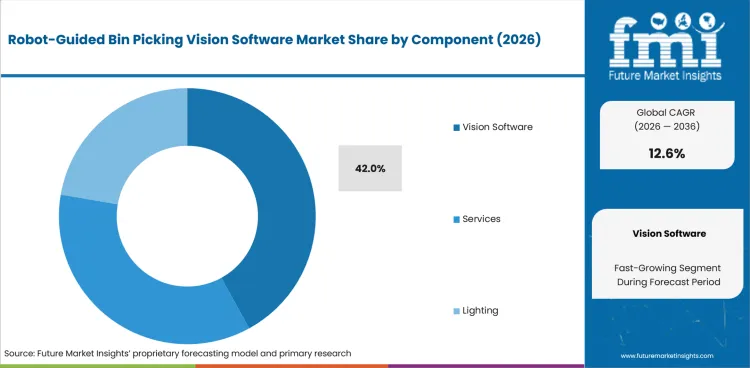
- Vision Software is projected to account for 42.0% of the component category in 2026, as part localization and collision checks decide whether a robotic cell can run unattended.
- Camera hardware can be swapped across many projects, but software libraries tied to ABB, FANUC, KUKA, and Universal Robots influence repeat purchase decisions.
What supports demand for Guidance?
- Guidance is estimated to hold 48.0% of the inspection type category in 2026, since the key output is a usable robot path rather than a pass-fail image.
- KEYENCE describes multi-camera 3D bin picking that reconstructs part location and simulates motion paths before robot movement, which shows why guidance quality affects downtime.
How do buyers evaluate Robotic Cell within the deployment category?
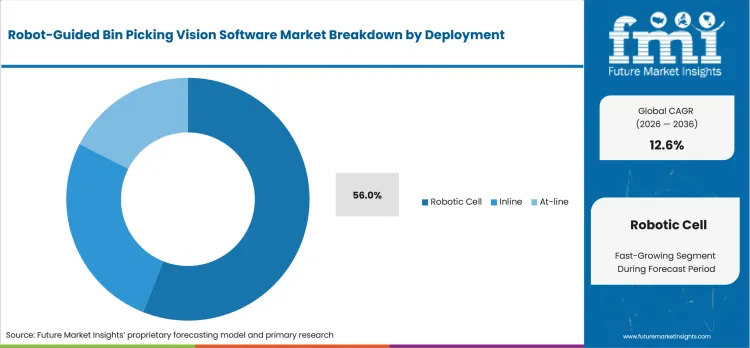
- Robotic Cell is anticipated to represent 56.0% of the deployment category in 2026, as random bin picking usually needs guarding, tool access, and fixed lighting.
- Portable setups fit demos and maintenance checks, but high-throughput customers prefer enclosed cells linked to smart factory data and robot safety systems.
What market factors influence demand for Automotive?
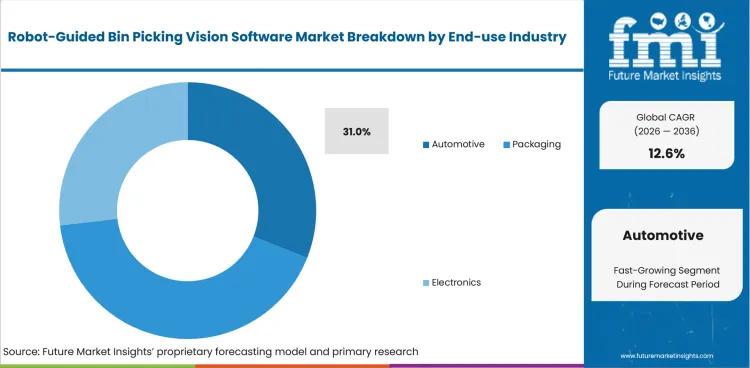
- Automotive is expected to account for 31.0% of the end-use industry category in 2026, given the use of crankshafts, castings, and machined metal parts.
- Heavy part handling changes the buying case, as the payback includes operator safety and fixture reduction along with cycle-time improvement.
How does East Asia affect the regional outlook?
- East Asia is projected to hold 38.0% of the region category in 2026, with China, Japan, and South Korea combining robot volume and electronics depth.
- Regional demand is less price-only than it appears, as high-speed electronics lines require stable picks and repeatable calibration across multiple robot cells.
What drives and restrains the market?
Driver: CAD matching drives repeat software sales as factories reuse part models across machine-tending cells; restraint: Point-cloud quality is a restraint since shiny metal, black plastic, and occluded parts can break picking reliability; opportunity: gripper-aware path planning creates an opportunity for suppliers with robot and end-effector libraries.
The market reflects a balance between the identified demand driver, adoption constraints, and the supplier opportunity outlined below.
- Driver: CAD matching drives repeat software sales as factories reuse part models across machine-tending cells.
- Restraint: Point-cloud quality is a restraint since shiny metal, black plastic, and occluded parts can break picking reliability.
- Opportunity: gripper-aware path planning creates an opportunity for suppliers with robot and end-effector libraries.
CAD-Match Cell Scaling CAD-match bin picking is gaining traction as manufacturers automate repeated part families across several cells. OMRON’s FH-SMD 3D robot vision system combines a 3D bin picking camera, 3D application software, and multi-axis robots. It lists repeatability of 0.2 mm and placement tolerance of plus or minus 2 mm. These specifications show why buyers treat software and robot control as one decision. If the part pose is correct but the robot path is unsafe, the cell still stops.
This gap between lab success and factory repeatability explains why buyers demand proof using their own parts. It also means low-cost cameras can fail when lighting, part coating, or bin depth changes. The forecast therefore favors suppliers with application testing labs and strong field engineers. Robot Interface Depth: Robot interface depth is becoming a direct sales lever rather than a support feature. Basler lists integration modules and sample programs for KUKA, Universal Robots, ABB, FANUC, and Techman Robot. That range matters in factories with mixed robot fleets and legacy cells. A vision package that connects quickly to several brands cuts commissioning time for integrators.
Which factors support expansion?
Commercial expansion is reinforced by the value, workflow, and recurring-demand factors below.
- Market value is rising as bin picking shifts from fixed feeders toward 3D-guided robotic cells that handle random part orientation.
- The 2026 value of USD 420.0 million reflects early software standardization around CAD matching and collision-aware pick planning.
- The 2036 value of USD 1376.0 million depends on repeat cell rollouts in automotive, electronics, and metalworking plants.
Which country markets are included in the CAGR comparison?
The selected CAGR comparison covers China (14.4%), India (14.0%), South Korea (13.4%), Japan (12.9%), and United States (12.2%) through 2036.
| Country | CAGR |
|---|---|
| China | 14.4% |
| India | 14.0% |
| South Korea | 13.4% |
| Japan | 12.9% |
| United States | 12.2% |
Source: Future Market Insights analysis.
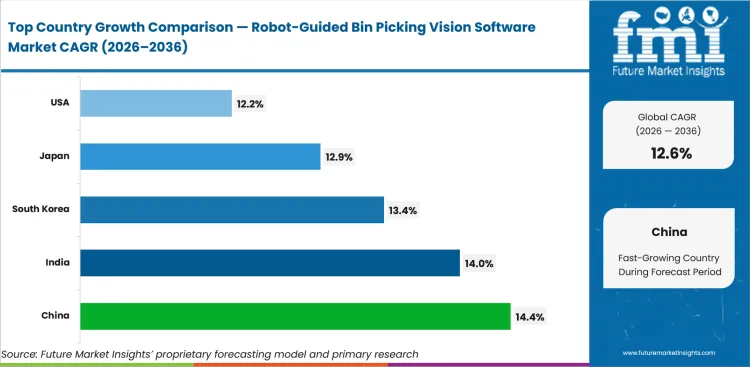
How do country-level CAGRs compare?
- China (CAGR: 14.4%): China installed 295,000 industrial robots in 2024 and represented 54% of global deployments.
- India (CAGR: 14.0%): India installed a record 9,100 industrial robots in 2024.
- South Korea (CAGR: 13.4%): South Korea is a high-density automation market with strong fit for precise bin picking and part presentation.
- Japan (CAGR: 12.9%): Japan installed 44,500 industrial robots in 2024 and held the second-largest national installation total among the cited countries.
- United States (CAGR: 12.2%): The United States installed 34,200 industrial robots in 2024, according to IFR data.
The global Robot-Guided Bin Picking Vision Software Market is forecast to record a CAGR of 12.6% from 2026 to 2036. The study covers 30+ countries across the report regions.
How is the Robot-Guided Bin Picking Vision Software Market developing in China?
China is projected to record a CAGR of 14.4% through 2036. The country outlook identifies this demand signal: China installed 295,000 industrial robots in 2024 and represented 54% of global deployments.
Country Market Snapshot
| Country | China |
|---|---|
| Forecast CAGR | 14.4% |
| Demand anchor | China installed 295,000 industrial robots in 2024 and represented 54% of global deployments. |
| Supply shift | Domestic Chinese robot suppliers held 57% of their home market in 2024. |
| Application mix | Electronics, automotive, batteries, and metalworking drive demand. |
| Channel route | Large factories often buy through robot OEMs and local integrators. |
| Restraint | Price pressure is intense for standard vision hardware. |
| Competitive context | KEYENCE, SICK, Cognex, Basler, and Chinese automation vendors compete across segments. |
| Company context | Companies active in or serving this market include Mech-Mind Robotics, Hikrobot, Cognex, KEYENCE, and SICK. |
Market Outlook
China is a large opportunity because robot volume and supplier competition reinforce each other. IFR reported 295,000 robot installations in 2024, a high annual total. This creates a deep pool of robotic cells that can adopt bin picking software. The notable demand comes from electronics, batteries, and automotive suppliers that need high-volume flexible feeding. China’s supplier structure is changing the software buying equation. Domestic robot suppliers outsold foreign competitors in their home market in 2024, reaching 57% share.
Key Growth Drivers
- Electronics and battery plants need high-speed bin picking for compact parts.
- Domestic robot OEM growth creates a large route for bundled vision software.
- Automotive suppliers use robotic cells to reduce manual sorting and loading.
- China installed 295,000 industrial robots in 2024 and represented 54% of global deployments.
Key Restraints
- Local price pressure can compress margins for standard 3D vision packages.
- Integration across domestic and global robot brands increases support needs.
- This creates pressure on foreign vision vendors to support local robots and price-sensitive integrators.
Country Market FAQs
What should C-suite teams prioritize in China?
C-suite teams should prioritize qualification requirements, procurement routes, local service coverage, and implementation economics before committing capital or supplier volume.
How should suppliers approach the China market?
Suppliers should align technical evidence, local channel support, and account-specific commercial terms with the buying process used by major customers in China.
What can weaken the business case in China?
Price pressure is intense for standard vision hardware. Executives should test this exposure during supplier, investment, and rollout reviews.
How is the Robot-Guided Bin Picking Vision Software Market developing in India?
India is projected to record a CAGR of 14.0% through 2036. The country outlook identifies this demand signal: India installed a record 9,100 industrial robots in 2024.
Country Market Snapshot
| Country | India |
|---|---|
| Forecast CAGR | 14.0% |
| Demand anchor | India installed a record 9,100 industrial robots in 2024. |
| Application mix | Automotive accounted for 45% of India’s robot installations in 2024. |
| Market role | India ranked sixth worldwide by annual industrial robot installations in 2024. |
| Buyer behavior | Plants often start with automotive and metalworking cells. |
| Restraint | Integration skill shortages can delay repeat rollouts. |
| Channel route | Robot OEMs, distributors, and system integrators shape project access. |
| Company context | Companies active in or serving this market include Cognex, KEYENCE, OMRON, SICK, and Zebra Technologies. |
Market Outlook
India is a smaller but faster-growing market with a clear automotive-led automation path. IFR reported 9,100 robot installations in 2024, up 7% and a national record. Automotive accounted for 45% of those installations, which gives bin picking software an obvious first customer group. Plants often begin with machine loading, castings, and repetitive handling before broader flexible automation. The market is price-sensitive but not purely low-end. Buyers compare system payback against labor availability, quality losses, and line downtime.
Key Growth Drivers
- Automotive suppliers use bin picking for castings, shafts, and machine loading.
- Electronics manufacturing creates demand for compact robotic handling cells.
- Integrator-led demos reduce buyer risk before multi-cell purchases.
- India installed a record 9,100 industrial robots in 2024.
Key Restraints
- Skilled commissioning talent is concentrated in major industrial clusters.
- Buyers may delay software upgrades when robot projects compete with other capital needs.
- Integration skill shortages can delay repeat rollouts.
Country Market FAQs
What should C-suite teams prioritize in India?
C-suite teams should prioritize qualification requirements, procurement routes, local service coverage, and implementation economics before committing capital or supplier volume.
How should suppliers approach the India market?
Suppliers should align technical evidence, local channel support, and account-specific commercial terms with the buying process used by major customers in India.
What can weaken the business case in India?
Integration skill shortages can delay repeat rollouts. Executives should test this exposure during supplier, investment, and rollout reviews.
How is the Robot-Guided Bin Picking Vision Software Market developing in South Korea?
South Korea is projected to record a CAGR of 13.4% through 2036. The country outlook identifies this demand signal: Battery plants need safe automated handling of repetitive and sensitive components.
Country Market Snapshot
| Country | South Korea |
|---|---|
| Forecast CAGR | 13.4% |
| Demand signal | South Korea installed 30,600 industrial robots in 2024. |
| Market role | The country ranked fourth worldwide by annual robot installations in 2024. |
| Application mix | Semiconductors, electronics, batteries, and automotive dominate demand. |
| Buyer behavior | Buyers emphasize precision, repeatability, and support for clean production environments. |
| Restraint | Supplier qualification is strict in electronics and battery plants. |
| Channel signal | Global vision suppliers sell through direct offices and Korean automation partners. |
| Company context | Companies active in or serving this market include Cognex, KEYENCE, OMRON, SICK, and Zebra Technologies. |
Market Outlook
South Korea is a high-density automation market with strong fit for precise bin picking and part presentation. IFR reported 30,600 robot installations in 2024, down 3% from the prior year. The slight decline does not weaken the software opportunity, since electronics and battery plants keep raising expectations for flexible automation. Buyers seek vision systems that can handle small parts, trays, bins, and strict takt requirements. The country’s opportunity is shaped by demanding end users rather than broad factory count alone.
Key Growth Drivers
- Battery plants need safe automated handling of repetitive and sensitive components.
- Electronics assembly favors high-precision 3D guidance and low false-pick rates.
- Automotive suppliers add bin picking in machining and subassembly cells.
- Global vision suppliers sell through direct offices and Korean automation partners.
Key Restraints
- Qualification standards can slow entry for smaller foreign software vendors.
- High precision needs raise total system cost beyond camera and license pricing.
- Supplier qualification is strict in electronics and battery plants.
Country Market FAQs
What should C-suite teams prioritize in South Korea?
C-suite teams should prioritize qualification requirements, procurement routes, local service coverage, and implementation economics before committing capital or supplier volume.
How should suppliers approach the South Korea market?
Suppliers should align technical evidence, local channel support, and account-specific commercial terms with the buying process used by major customers in South Korea.
What can weaken the business case in South Korea?
Supplier qualification is strict in electronics and battery plants. Executives should test this exposure during supplier, investment, and rollout reviews.
How is the Robot-Guided Bin Picking Vision Software Market developing in Japan?
Japan is projected to record a CAGR of 12.9% through 2036. The country outlook identifies this demand signal: Japan installed 44,500 industrial robots in 2024 and held the second-largest national installation total among the cited countries.
Country Market Snapshot
| Country | Japan |
|---|---|
| Forecast CAGR | 12.9% |
| Demand anchor | Japan installed 44,500 industrial robots in 2024 and held the second-largest national installation total among the cited countries. |
| Supply structure | Japan is home to major robot and automation technology suppliers. |
| Application mix | Electronics, automotive, precision machinery, and metal parts drive demand. |
| Buyer behavior | Plants favor reliable automation with clear cycle-time evidence. |
| Restraint | Mature robot penetration can slow greenfield cell growth. |
| Company context | Companies active in or serving this market include KEYENCE, OMRON, Mujin, FANUC, and SICK. |
| Executive implication | Executive teams should compare qualification requirements, local service depth, and total implementation economics before selecting suppliers. |
Market Outlook
Japan is a technically mature market where buyers already understand robot cell economics. IFR reported 44,500 robot installations in 2024, with operational robot stock reaching 450,500 units. This gives bin picking software a large replacement and upgrade base. Many plants are less interested in first-time automation and more focused on reliability, compact cell design, and faster changeover. KEYENCE and OMRON give Japan strong domestic supply-side credibility.
Key Growth Drivers
- Electronics producers need fast part recognition for compact and varied components.
- Automotive suppliers automate heavy and repetitive loading tasks.
- Domestic automation vendors reduce perceived integration risk for factories.
- Japan installed 44,500 industrial robots in 2024 and held the second-largest national installation total among the cited countries.
Key Restraints
- Mature robot use can limit first-time automation upside.
- Buyers require high reliability before replacing proven feeder systems.
- Mature robot penetration can slow greenfield cell growth.
Country Market FAQs
What should C-suite teams prioritize in Japan?
C-suite teams should prioritize qualification requirements, procurement routes, local service coverage, and implementation economics before committing capital or supplier volume.
How should suppliers approach the Japan market?
Suppliers should align technical evidence, local channel support, and account-specific commercial terms with the buying process used by major customers in Japan.
What can weaken the business case in Japan?
Mature robot penetration can slow greenfield cell growth. Executives should test this exposure during supplier, investment, and rollout reviews.
How is the Robot-Guided Bin Picking Vision Software Market developing in the United States?
The United States is projected to record a CAGR of 12.2% through 2036. The country outlook identifies this demand signal: The United States installed 34,200 industrial robots in 2024, according to IFR data.
Country Market Snapshot
| Country | United States |
|---|---|
| Forecast CAGR | 12.2% |
| Demand anchor | The United States installed 34,200 industrial robots in 2024, according to IFR data. |
| Channel route | Domestic robot system integrators remain central since the country imports many robots from Japan and Europe. |
| Application mix | Automotive, logistics, electronics, and metalworking plants shape early bin picking use. |
| Buyer behavior | Plants favor proof-of-concept cells before scaling multiple bin picking stations. |
| Competitive context | Cognex, Zebra Technologies, and OMRON maintain strong local commercial visibility. |
| Restraint | High integration labor cost can delay smaller factory projects. |
| Company context | Companies active in or serving this market include Cognex, Zebra Technologies, OMRON Automation, SICK, and Mech-Mind Robotics. |
Market Outlook
The United States market behaves like an integrator-led upgrade market. IFR reported that the United States accounted for 68% of installations in the Americas in 2024, with 34,200 robot installations. This supports steady demand for vision software but keeps purchasing tied to cell-level return. Buyers often ask integrators to prove cycle time and failure recovery using real production parts. Cognex and Zebra Technologies give the country a strong supply-side position in machine vision camera and industrial vision systems.
Key Growth Drivers
- Reshoring of automotive and electronics work supports bin picking cells near machine-tending stations.
- System integrator density creates a practical route for software suppliers without full robot portfolios.
- Worker safety programs support automation of heavy or sharp part handling.
- The United States installed 34,200 industrial robots in 2024, according to IFR data.
Key Restraints
- High engineering labor rates raise project cost before the first production run.
- Mixed robot brands across plants increase integration complexity for software vendors.
- High integration labor cost can delay smaller factory projects.
Country Market FAQs
What should C-suite teams prioritize in the United States?
C-suite teams should prioritize qualification requirements, procurement routes, local service coverage, and implementation economics before committing capital or supplier volume.
How should suppliers approach the United States market?
Suppliers should align technical evidence, local channel support, and account-specific commercial terms with the buying process used by major customers in the United States.
What can weaken the business case in the United States?
High integration labor cost can delay smaller factory projects. Executives should test this exposure during supplier, investment, and rollout reviews.
Which companies are discussed in the Robot-Guided Bin Picking Vision Software Market?
The preview discusses Cognex, KEYENCE, Basler, Teledyne, and OMRON among the companies active in this market.
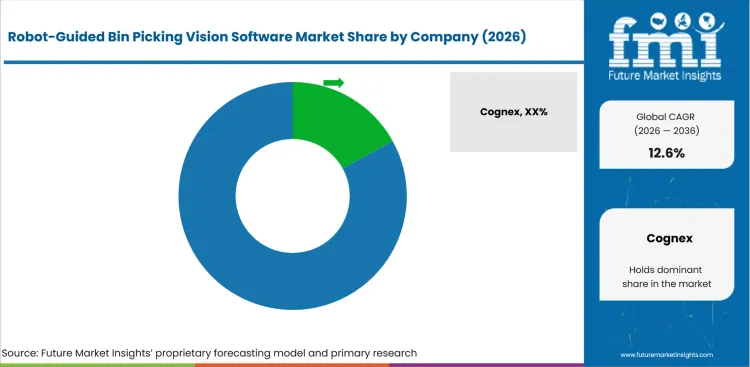
The market is moderately concentrated, with established suppliers controlling software depth and camera integration. Smaller specialists win by solving hard parts such as reflective metal, bags, and mixed-bin picking. Entry barriers are high since buyers need robot interface libraries and proof on real factory parts.
Integrators remain influential as they turn vision software into working production cells. Competition centers on the ability to turn a noisy 3D scene into a safe robot action. Cognex launched the In-Sight L38 3D Vision System in April 2024, combining AI, 2D, and 3D vision for manufacturing automation.
How is competition structured?
Competition reflects differences in specialization, portfolio scope, geographic reach, evidence, and customer access.
The competitive field includes vision specialists, automation vendors, and 3D sensing firms with robot integration depth.
- Global Leaders: Cognex, KEYENCE, OMRON, SICK, and Zebra Technologies compete with broad machine vision portfolios and strong sales channels. Their strengths include 3D cameras, application software, robot guidance features, and global technical support.
- Specialist Vision and Component Suppliers: Basler, Teledyne DALSA, and Balluff compete by supplying cameras, sensors, software modules, and imaging components. Basler is especially relevant through robotics application software and 3D CAD matching.
- Automation Ecosystem Players: Siemens, Datalogic, and regional integrators support the broader buying chain through factory automation, identification, and control integration. They may not always sell the core bin picking software, but they influence project architecture.
How do selected companies compare?
The selected companies differ in portfolio focus, geographic reach, evidence depth, and channel strength.
| Company | Competitive position |
|---|---|
| Cognex | Cognex is assessed for software or automation portfolio fit, integration capability, service coverage, and access to industrial buyers. |
| KEYENCE | KEYENCE is assessed for software or automation portfolio fit, integration capability, service coverage, and access to industrial buyers. |
| Basler | Basler is assessed for software or automation portfolio fit, integration capability, service coverage, and access to industrial buyers. |
| Teledyne DALSA | Teledyne DALSA is assessed for software or automation portfolio fit, integration capability, service coverage, and access to industrial buyers. |
| OMRON | OMRON is assessed for software or automation portfolio fit, integration capability, service coverage, and access to industrial buyers. |
What are the key developments in the Robot-Guided Bin Picking Vision Software Market?
- In April 2024, Cognex launched the In-Sight L38 3D Vision System with AI. The launch supports easier 3D inspection and guidance setup for factories.
- In December 2024, Zebra Technologies agreed to acquire Photoneo to expand its 3D machine vision portfolio. The deal strengthened Zebra’s role in robotic guidance.
- In March 2025, Zebra Technologies completed the acquisition of Photoneo. The move expanded Zebra’s 3D machine vision use cases for automotive and logistics customers.
Selected Companies in the Robot-Guided Bin Picking Vision Software Market
Companies referenced in this preview
- Cognex.
- KEYENCE.
- Basler.
- Teledyne DALSA.
- OMRON.
- SICK.
- Zebra Technologies.
- Mech-Mind Robotics.
Market Scope & Definition
| Metric | Value |
|---|---|
| Market definition | Robot-guided bin picking vision software includes 3D perception, part localization, grasp planning, and robot guidance tools used to pick randomly stacked parts from bins. |
| Functions covered | Cameras, Lenses, Lighting, Frame Grabbers, Vision Software, Services |
| Applications covered | Electronics, Automotive, Packaging, Pharmaceuticals, Food & Beverage, Metals |
| End-use industries | Electronics, Automotive, Packaging, Pharmaceuticals, Food & Beverage, Metals |
| Inclusions | Market scope covers cameras, lenses, lighting, frame grabbers, vision software, and services used for robotic bin picking across inline, at-line, robotic cell, and portable setups in electronics, automotive, packaging, pharmaceuticals, food and beverage, and metals applications. |
| Exclusions | Market scope excludes mobile warehouse robots, humanoid robots, simple barcode scanners, non-robotic inspection stations, fixed bowl feeders, manual sorting systems, and robot programming services not tied to 3D bin picking vision. |
Research Methodology
| Metric | Value |
|---|---|
| Primary Research | FMI analysts reviewed machine builders, robot integrators, plant automation heads, and vision-system distributors. Interviews focused on part variability, gripper choice, cycle time, and after-sales support. |
| Desk Research | Desk work covered robotics installation data, machine vision product documentation, technical references, and company product information. Sources were used to define the addressable pool within machine vision systems and robotic guidance. |
| Market Sizing and Forecasting | The model combined robot cell volumes, software attach rates, average system pricing, and country-level automation intensity. Forecasts were adjusted for end-use mix and the share of projects that need 3D bin localization. |
| Data Validation | Forecasts were checked against industrial robot installations, robot controller, integrator, and software demand, and vendor portfolios. Validation focused on whether software revenue tracked real robotic cell adoption. |
What does the report cover?
The report covers component, inspection type, deployment, end-use industry, and region across the 2026-2036 forecast period in 30+ countries.
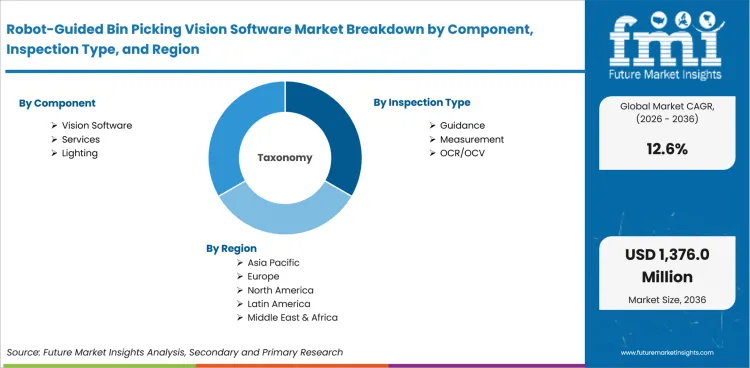
| Metric | Value |
|---|---|
| Periods | Base year 2025; estimated year 2026; forecast period 2026-2036 |
| Quantitative units | USD 420.0 million to USD 1376.0 million, at a CAGR of 12.6% |
| Segment axes | component, inspection type, deployment, end-use industry, and region |
| Regions | North America, Latin America, Europe, East Asia, South Asia and Pacific, Middle East and Africa |
| Countries | United States, United Kingdom, Germany, France, Japan, China, South Korea, India and 30+ countries |
| Companies | Cognex, KEYENCE, Basler, Teledyne DALSA, OMRON, SICK, Zebra Technologies, Mech-Mind Robotics, and others |
| Approach | Hybrid bottom-up and top-down methodology using robot cell adoption, software attach rates, and country automation intensity. |
Market Segmentation Analysis
Segmented by Component
- Cameras.
- Lenses.
- Lighting.
- Frame Grabbers.
- Vision Software.
- Services.
Segmented by Inspection Type
- Defect Detection.
- Measurement.
- OCR/OCV.
- Presence/Absence.
- Guidance.
Segmented by Deployment
- Inline.
- At-line.
- Robotic Cell.
- Portable.
Segmented by End-use Industry
- Electronics.
- Automotive.
- Packaging.
- Pharmaceuticals.
- Food & Beverage.
- Metals.
By Region
- North America.
- United States.
- Canada.
- Mexico.
- Latin America.
- Brazil.
- Chile.
- Rest of Latin America.
- Western Europe.
- Germany.
- UK.
- Italy.
- Spain.
- France.
- Nordic.
- BENELUX.
- Rest of Western Europe.
- Eastern Europe.
- Russia.
- Poland.
- Hungary.
- Balkan & Baltic.
- Rest of Eastern Europe.
- East Asia.
- China.
- Japan.
- South Korea.
- South Asia and Pacific.
- India.
- ASEAN.
- Australia & New Zealand.
- Rest of South Asia and Pacific.
- Middle East & Africa.
- Kingdom of Saudi Arabia.
- Other GCC Countries.
- Turkiye.
- South Africa.
- Other African Union.
- Rest of Middle East & Africa.
Research Sources and Bibliography
- 1. International Federation of Robotics. (2025, September 25). World Robotics 2025 report - INDUSTRIAL ROBOTS - released by IFR. International Federation of Robotics.
- 2. Cognex Corporation. (2024, April 2). Cognex launches the world’s first 3D vision system with AI. Cognex Corporation.
- 3. Zebra Technologies. (2025, March 3). Zebra Technologies completes acquisition of Photoneo. Zebra Technologies.
- 4. Zebra Technologies. (2024, December 30). Zebra Technologies to acquire Photoneo, expanding its portfolio of 3D machine vision solutions. Zebra Technologies.
- 5. Basler AG. (2026). Basler robotics application software. Basler AG.
- 6. OMRON Automation. (2026). FH-SMD 3D robot vision system. OMRON Automation.
- 7. KEYENCE Corporation. (2026). 3D vision-guided robotic bin picking. KEYENCE Corporation.
- 8. SICK AG. (2026). Bin picking: robot guidance and orientation with 3D vision sensors. SICK AG.
- 9. Fu, X., Miao, L., Ohnishi, Y., Hasegawa, Y., & Suwa, M. (2024, October). A low-cost, high-speed, and robust bin picking system for factory automation enabled by a non-stop, multi-view, and active vision scheme. arXiv.
- 10. Association for Advancing Automation. (2026). Teledyne DALSA company profile. Association for Advancing Automation.
The bibliography is provided for reader reference and uses primary, official company, academic, or trade body publications.
This Report Answers
- What is the projected value of the Robot-Guided Bin Picking Vision Software Market in 2026?
- What value is forecast for the Robot-Guided Bin Picking Vision Software Market by 2036?
- What CAGR is forecast for the Robot-Guided Bin Picking Vision Software Market from 2026 to 2036?
- What 2026 share is projected for Vision Software within the component category?
- What 2026 share is projected for Guidance within the inspection type category?
- Which demand factors support the Robot-Guided Bin Picking Vision Software Market outlook?
- Which restraints and opportunities affect adoption in the Robot-Guided Bin Picking Vision Software Market?
- How are country CAGR outlooks, including China at 14.4%, compared?
- Which companies and product developments are covered in the competitive analysis?
- What is included in the market scope, and how is the forecast validated?
Frequently Asked Questions
Why should executives track the Robot-Guided Bin Picking Vision Software Market?
Executives should track this market because it can affect capital allocation, supplier strategy, operating risk, and competitive positioning across commercial planning cycles.
What business problem does the Robot-Guided Bin Picking Vision Software Market address?
It helps executive teams judge where customer pain, supplier capability, compliance exposure, and implementation economics justify investment, procurement, or portfolio action.
What should procurement leaders evaluate before selecting suppliers?
Procurement leaders should assess evidence quality, integration fit, service coverage, compliance readiness, total cost of ownership, and supplier execution capability.
What can limit return on investment for buyers?
Return on investment can be limited by low utilization, integration delays, training gaps, unclear ownership, pricing pressure, or weak fit with existing workflows.
How can suppliers build executive confidence?
Suppliers can build confidence by proving implementation speed, risk reduction, support depth, reference use cases, and measurable outcomes for budget owners.
Preview the report firsthand - request a free sample
Get SampleGet the brochure for pricing and purchase details.
Get PDFTable of Content
- Key Takeaways
- Market Size and CAGR
- Top Growth Driver
- Fastest Growing Segment
- Leading Region
- Key Companies
- Emerging Opportunities
- Executive Summary
- Global Market Outlook
- Demand-side Trends
- Supply-side Trends
- Technology Roadmap Analysis
- Analysis and Recommendations
- Analyst Perspective (What is happening? Why now? What should investors know?)
- Key Questions Answered
- How large is the market?
- What is the CAGR?
- What are key trends?
- Which region dominates?
- Who are the leaders?
- Market Overview
- Market Coverage / Taxonomy
- Market Definition / Scope / Limitations
- Research Methodology
- Chapter Orientation
- Analytical Lens and Working Hypotheses
- Market Structure, Signals, and Trend Drivers
- Benchmarking and Cross-market Comparability
- Market Sizing, Forecasting, and Opportunity Mapping
- Research Design and Evidence Framework
- Desk Research Programme (Secondary Evidence)
- Expert Input and Fieldwork (Primary Evidence)
- Tooling, Models, and Reference Databases
- Data Engineering and Model Build
- Quality Assurance and Audit Trail
- Market Background
- Market Dynamics (Drivers, Restraints, Opportunity, Trends)
- Scenario Forecast (Optimistic, Likely, Conservative)
- Impact Analysis
- AI Impact
- Sustainability Impact
- Regulatory Impact
- Technology Impact
- Consumer / Buyer Analysis
- Purchase Drivers
- Adoption Barriers
- Buyer Journey
- Opportunity Map Analysis
- Product Life Cycle Analysis
- Supply Chain Analysis
- Investment Feasibility Matrix
- Value Chain Analysis
- PESTLE and Porter's Analysis
- Regulatory Landscape
- Regional Parent Market Outlook
- Production and Consumption Statistics
- Import and Export Statistics
- Global Market Analysis and Forecast, 2021 to 2036
- Historical Market Size Value (USD Million) & Volume (Unit) Analysis, 2021 to 2025
- Current and Future Market Size Value (USD Million) & Volume (Unit) Projections, 2026 to 2036
- Y-o-Y Growth Trend Analysis
- Absolute $ Opportunity Analysis
- Global Market Pricing Analysis, 2021 to 2036
- Global Market Analysis and Forecast, By Component, 2021 to 2036
- Introduction / Key Findings
- Historical Market Size Value (USD Million) & Volume (Unit) Analysis By Component, 2021 to 2025
- Current and Future Market Size Value (USD Million) & Volume (Unit) Analysis and Forecast By Component, 2026 to 2036
- Vision Software
- Services
- Lighting
- Vision Software
- Y-o-Y Growth Trend Analysis By Component, 2021 to 2025
- Absolute $ Opportunity Analysis By Component, 2026 to 2036
- Global Market Analysis and Forecast, By Inspection Type, 2021 to 2036
- Introduction / Key Findings
- Historical Market Size Value (USD Million) & Volume (Unit) Analysis By Inspection Type, 2021 to 2025
- Current and Future Market Size Value (USD Million) & Volume (Unit) Analysis and Forecast By Inspection Type, 2026 to 2036
- Guidance
- Measurement
- OCR/OCV
- Guidance
- Y-o-Y Growth Trend Analysis By Inspection Type, 2021 to 2025
- Absolute $ Opportunity Analysis By Inspection Type, 2026 to 2036
- Global Market Analysis and Forecast, By Deployment, 2021 to 2036
- Introduction / Key Findings
- Historical Market Size Value (USD Million) & Volume (Unit) Analysis By Deployment, 2021 to 2025
- Current and Future Market Size Value (USD Million) & Volume (Unit) Analysis and Forecast By Deployment, 2026 to 2036
- Robotic Cell
- Inline
- At-line
- Robotic Cell
- Y-o-Y Growth Trend Analysis By Deployment, 2021 to 2025
- Absolute $ Opportunity Analysis By Deployment, 2026 to 2036
- Global Market Analysis and Forecast, By End-use Industry, 2021 to 2036
- Introduction / Key Findings
- Historical Market Size Value (USD Million) & Volume (Unit) Analysis By End-use Industry, 2021 to 2025
- Current and Future Market Size Value (USD Million) & Volume (Unit) Analysis and Forecast By End-use Industry, 2026 to 2036
- Automotive
- Packaging
- Electronics
- Automotive
- Y-o-Y Growth Trend Analysis By End-use Industry, 2021 to 2025
- Absolute $ Opportunity Analysis By End-use Industry, 2026 to 2036
- Global Market Analysis and Forecast, By Region, 2021 to 2036
- Introduction
- Historical Market Size Value (USD Million) & Volume (Unit) Analysis By Region, 2021 to 2025
- Current Market Size Value (USD Million) & Volume (Unit) Analysis and Forecast By Region, 2026 to 2036
- North America
- Latin America
- Western Europe
- Eastern Europe
- East Asia
- South Asia and Pacific
- Middle East & Africa
- Market Attractiveness Analysis By Region
- North America Market Analysis and Forecast, By Country, 2021 to 2036
- Historical Market Size Value (USD Million) & Volume (Unit) Trend Analysis By Market Taxonomy, 2021 to 2025
- Market Size Value (USD Million) & Volume (Unit) Forecast By Market Taxonomy, 2026 to 2036
- By Country
- USA
- Canada
- Mexico
- By Component
- By Inspection Type
- By Deployment
- By End-use Industry
- By Country
- Market Attractiveness Analysis
- By Country
- By Component
- By Inspection Type
- By Deployment
- By End-use Industry
- Key Takeaways
- Latin America Market Analysis and Forecast, By Country
- Historical Market Size Value (USD Million) & Volume (Unit) Trend Analysis By Market Taxonomy, 2021 to 2025
- Market Size Value (USD Million) & Volume (Unit) Forecast By Market Taxonomy, 2026 to 2036
- By Country
- Brazil
- Chile
- Rest of Latin America
- By Component
- By Inspection Type
- By Deployment
- By End-use Industry
- By Country
- Market Attractiveness Analysis
- By Country
- By Component
- By Inspection Type
- By Deployment
- By End-use Industry
- Key Takeaways
- Western Europe Market Analysis and Forecast, By Country
- Historical Market Size Value (USD Million) & Volume (Unit) Trend Analysis By Market Taxonomy, 2021 to 2025
- Market Size Value (USD Million) & Volume (Unit) Forecast By Market Taxonomy, 2026 to 2036
- By Country
- Germany
- UK
- Italy
- Spain
- France
- Nordic
- BENELUX
- Rest of Western Europe
- By Component
- By Inspection Type
- By Deployment
- By End-use Industry
- By Country
- Market Attractiveness Analysis
- By Country
- By Component
- By Inspection Type
- By Deployment
- By End-use Industry
- Key Takeaways
- Eastern Europe Market Analysis and Forecast, By Country
- Historical Market Size Value (USD Million) & Volume (Unit) Trend Analysis By Market Taxonomy, 2021 to 2025
- Market Size Value (USD Million) & Volume (Unit) Forecast By Market Taxonomy, 2026 to 2036
- By Country
- Russia
- Poland
- Hungary
- Balkan & Baltic
- Rest of Eastern Europe
- By Component
- By Inspection Type
- By Deployment
- By End-use Industry
- By Country
- Market Attractiveness Analysis
- By Country
- By Component
- By Inspection Type
- By Deployment
- By End-use Industry
- Key Takeaways
- East Asia Market Analysis and Forecast, By Country
- Historical Market Size Value (USD Million) & Volume (Unit) Trend Analysis By Market Taxonomy, 2021 to 2025
- Market Size Value (USD Million) & Volume (Unit) Forecast By Market Taxonomy, 2026 to 2036
- By Country
- China
- Japan
- South Korea
- By Component
- By Inspection Type
- By Deployment
- By End-use Industry
- By Country
- Market Attractiveness Analysis
- By Country
- By Component
- By Inspection Type
- By Deployment
- By End-use Industry
- Key Takeaways
- South Asia and Pacific Market Analysis and Forecast, By Country
- Historical Market Size Value (USD Million) & Volume (Unit) Trend Analysis By Market Taxonomy, 2021 to 2025
- Market Size Value (USD Million) & Volume (Unit) Forecast By Market Taxonomy, 2026 to 2036
- By Country
- India
- ASEAN
- Australia & New Zealand
- Rest of South Asia and Pacific
- By Component
- By Inspection Type
- By Deployment
- By End-use Industry
- By Country
- Market Attractiveness Analysis
- By Country
- By Component
- By Inspection Type
- By Deployment
- By End-use Industry
- Key Takeaways
- Middle East & Africa Market Analysis and Forecast, By Country
- Historical Market Size Value (USD Million) & Volume (Unit) Trend Analysis By Market Taxonomy, 2021 to 2025
- Market Size Value (USD Million) & Volume (Unit) Forecast By Market Taxonomy, 2026 to 2036
- By Country
- Kingdom of Saudi Arabia
- Other GCC Countries
- Türkiye
- South Africa
- Other African Union
- Rest of Middle East & Africa
- By Component
- By Inspection Type
- By Deployment
- By End-use Industry
- By Country
- Market Attractiveness Analysis
- By Country
- By Component
- By Inspection Type
- By Deployment
- By End-use Industry
- Key Takeaways
- Key Countries Market Analysis
- USA
- Pricing Analysis
- Market Share Analysis, 2025
- By Component
- By Inspection Type
- By Deployment
- By End-use Industry
- Canada
- Pricing Analysis
- Market Share Analysis, 2025
- By Component
- By Inspection Type
- By Deployment
- By End-use Industry
- Mexico
- Pricing Analysis
- Market Share Analysis, 2025
- By Component
- By Inspection Type
- By Deployment
- By End-use Industry
- Brazil
- Pricing Analysis
- Market Share Analysis, 2025
- By Component
- By Inspection Type
- By Deployment
- By End-use Industry
- Chile
- Pricing Analysis
- Market Share Analysis, 2025
- By Component
- By Inspection Type
- By Deployment
- By End-use Industry
- Germany
- Pricing Analysis
- Market Share Analysis, 2025
- By Component
- By Inspection Type
- By Deployment
- By End-use Industry
- UK
- Pricing Analysis
- Market Share Analysis, 2025
- By Component
- By Inspection Type
- By Deployment
- By End-use Industry
- Italy
- Pricing Analysis
- Market Share Analysis, 2025
- By Component
- By Inspection Type
- By Deployment
- By End-use Industry
- Spain
- Pricing Analysis
- Market Share Analysis, 2025
- By Component
- By Inspection Type
- By Deployment
- By End-use Industry
- France
- Pricing Analysis
- Market Share Analysis, 2025
- By Component
- By Inspection Type
- By Deployment
- By End-use Industry
- India
- Pricing Analysis
- Market Share Analysis, 2025
- By Component
- By Inspection Type
- By Deployment
- By End-use Industry
- ASEAN
- Pricing Analysis
- Market Share Analysis, 2025
- By Component
- By Inspection Type
- By Deployment
- By End-use Industry
- Australia & New Zealand
- Pricing Analysis
- Market Share Analysis, 2025
- By Component
- By Inspection Type
- By Deployment
- By End-use Industry
- China
- Pricing Analysis
- Market Share Analysis, 2025
- By Component
- By Inspection Type
- By Deployment
- By End-use Industry
- Japan
- Pricing Analysis
- Market Share Analysis, 2025
- By Component
- By Inspection Type
- By Deployment
- By End-use Industry
- South Korea
- Pricing Analysis
- Market Share Analysis, 2025
- By Component
- By Inspection Type
- By Deployment
- By End-use Industry
- Russia
- Pricing Analysis
- Market Share Analysis, 2025
- By Component
- By Inspection Type
- By Deployment
- By End-use Industry
- Poland
- Pricing Analysis
- Market Share Analysis, 2025
- By Component
- By Inspection Type
- By Deployment
- By End-use Industry
- Hungary
- Pricing Analysis
- Market Share Analysis, 2025
- By Component
- By Inspection Type
- By Deployment
- By End-use Industry
- Kingdom of Saudi Arabia
- Pricing Analysis
- Market Share Analysis, 2025
- By Component
- By Inspection Type
- By Deployment
- By End-use Industry
- Türkiye
- Pricing Analysis
- Market Share Analysis, 2025
- By Component
- By Inspection Type
- By Deployment
- By End-use Industry
- South Africa
- Pricing Analysis
- Market Share Analysis, 2025
- By Component
- By Inspection Type
- By Deployment
- By End-use Industry
- USA
- Market Structure Analysis
- Competition Dashboard
- Competition Benchmarking
- Market Share Analysis of Top Players
- By Regional
- By Component
- By Inspection Type
- By Deployment
- By End-use Industry
- Emerging Startups
- Innovation Benchmarking
- Competition Analysis
- Competition Deep Dive
- Cognex
- Overview
- Product Portfolio
- Profitability by Market Segments (Product/Region/Sales Channel)
- Sales Footprint
- Strategy Overview
- Marketing Strategy
- Product Strategy
- Channel Strategy
- KEYENCE
- Basler
- Teledyne DALSA
- OMRON
- SICK
- Zebra Technologies
- Cognex
- Case Studies
- Success Stories
- Recent Developments
- Competition Deep Dive
- Assumptions & Acronyms Used


