

- Market Size (2026)
- USD 1.38 Bn
- Forecast (2036)
- USD 4.87 Bn
- CAGR (2026 to 2036)
- 13.4%
How big is the AI vision robotic lawn mowers market in 2026?
USD 1.38 billion in 2026 and USD 4.87 billion by 2036 at a 13.4% CAGR.
The AI vision robotic lawn mowers market was valued at USD 1.22 billion in 2025 and is expected to reach USD 1.38 billion in 2026. The market is projected to reach USD 4.87 billion by 2036 at a 13.4% CAGR from 2026 to 2036. Vision RTK is projected to account for 46% of navigation stack demand in 2026. Residential users are expected to represent 67% of demand as wire-free setup lowers the barrier for homeowners.
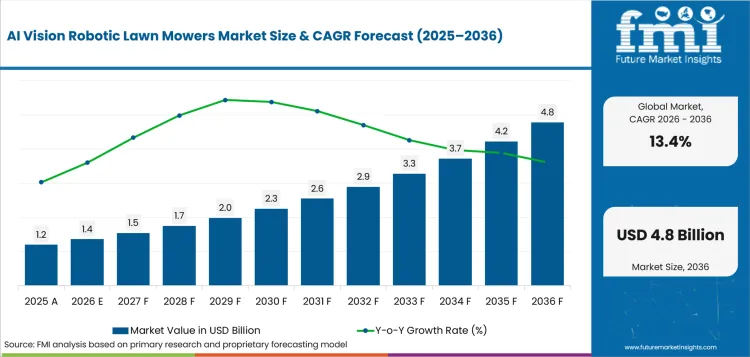
AI Vision Robotic Lawn Mowers Market Overview: Size and Forecast
- 2026 Market Size: USD 1.38 billion
- 2036 Market Size: USD 4.87 billion
- Forecast CAGR: 13.4% from 2026 to 2036
- Leading Navigation Stack: Vision RTK
- Vision RTK Share in 2026: 46%
- Leading End User: Residential
- Residential Share in 2026: 67%
- Fastest-growing Country: China
- China CAGR: 15.8% by 2036
Summary of AI Vision Robotic Lawn Mowers Market
- Demand and Growth Drivers
- Wire-free installation is the largest demand driver as Vision RTK is projected to hold 46% share in 2026.
- Residential buyers are expected to represent 67% share in 2026 as automatic mapping reduces setup friction.
- China is forecast at 15.8% CAGR as domestic producers expand export-ready AI vision mower lines.
- Professional turf adoption is projected to expand as fleet-grade mowers reduce repeated mowing labor across campuses and sports turf.
- Product and Segment View
- Vision RTK is projected to lead the Navigation Stack segment with 46% share in 2026 as buyers need precision under open sky and recovery under trees.
- Residential is expected to lead the End User segment with 67% share in 2026 since homeowners value low setup effort.
- Medium Lawns are projected to lead the Lawn Size segment with 43% share in 2026 as most premium models target 700 m² to 3,000 m² gardens.
- Mid Premium is expected to lead the Price Band segment with 48% share in 2026 as buyers accept higher prices for wire-free setup and AI obstacle handling.
- Specialist Dealers are projected to lead the Sales Channel segment with 38% share in 2026 as the buying process includes setup guidance and local service.
- Geography and Competitive Outlook
- The United States is projected to remain the largest revenue country in 2026 due to high lawn ownership and professional landscaping labor pressure.
- Germany and France are expected to keep strong European positions as mower trade flows and dealer networks support premium robotic lawn care.
- China is forecast to grow fastest at 15.8% CAGR through 2036 due to domestic robotics suppliers and export scale.
- Key verified companies include Husqvarna and Mammotion. Segway Navimow and Dreame also compete alongside Worx, Ecovacs, and Kress.
- Analyst Opinion
- Nikhil Kaitwade, Senior Consultant at FMI says, “I see the real break in this market coming from the buyer’s fear of setup failure. The old robotic mower sale depended on wires, trained installers, and repeated site visits. AI vision changes that equation by moving the hardest part of the job into the mower itself. Buyers now judge suppliers on boundary confidence, night safety, recovery under trees, and how well the mower handles mixed edges. Professional users are watching labor savings, but they are not buying blind. They need proof that a mower can work across zones without creating more supervision work. Suppliers with vision data, service coverage, and clear software updates will have the best position. Clients should watch one point closely: the winner will not be the brand with the most sensors. It will be the brand that turns sensing into fewer stops and cleaner edges.”
- What supports value in the AI vision robotic lawn mowers market?
- Market value is rising as AI vision changes robotic mowing from a specialist installation product into a self-setup appliance.
- Premium pricing is supported by sensor stacks that combine cameras with RTK or LiDAR in one mower platform.
- Professional turf buyers are expected to add fleet-grade models as mowing shifts from manual rounds to scheduled autonomous runs.
- Mid-sized residential lawns are the main value pool because they justify premium pricing without needing commercial-grade area coverage.
- Replacement demand is starting as early wire-based robotic mower owners compare older units with new wire-free AI systems.
AI vision robotic lawn mowers are moving beyond wire-free installation into perception-led lawn care because buyers now compare mowing accuracy, obstacle response and operation under trees. In August 2025, the U.S. Bureau of Labor Statistics reported 1,296,400 grounds maintenance jobs in 2024 and projected 171,600 openings each year through 2034. That labor signal matters because homeowners, campuses and service contractors need equipment that can reduce routine mowing time without raising setup risk. Husqvarna’s October 2025 AI Vision release for 2026 mowers adds a clear product marker because the new NERA models cover gardens from 400 m² to 7,500 m² and include camera-led AI navigation with night-time IR support. Segway Navimow’s X3 platform and Dreame’s A2 further show the same buying shift because large-lawn coverage now has to be paired with mapping speed, object classification and cleaner edge control.
Why is the AI vision robotic lawn mowers market growing?
- Buyers are expected to avoid buried wire systems as AI vision and RTK allow virtual boundaries with less site work.
- Homeowners are expected to move toward robotic mowing as product pages now target garden sizes from 400 m² to 7,500 m².
- Professional turf managers are expected to test autonomous mowing where labor availability and mowing frequency create direct cost pressure.
- Safety expectations are rising as camera systems detect pets and toys. Hedgehogs and edge hazards add further safety use cases.
- Supplier competition is expected to shift toward sensor fusion as LiDAR and AI cameras are packaged with RTK in one mower.
Primary driver influencing industry growth is installation friction. Boundary-wire systems made robotic mowing reliable, but they also tied adoption to dealer visits and garden preparation. Husqvarna’s 2026 AI Vision models are designed for wire-free installation with EPOS via cloud correction and AI object avoidance. This changes the buyer decision from “who will install the wire” to “how quickly the mower can map and recover.” It favors suppliers with strong app setup, dealer training, and clean service workflows. Another driver is labor substitution in professional turf. The United States Bureau of Labor Statistics reported 171,600 projected annual openings for grounds maintenance workers during 2024 to 2034. That number explains why commercial landscapers examine robotic mowing as a route to cover repetitive mowing hours. The practical result is that professional buyers will focus on uptime, fleet control, and safe obstacle detection before they scale.
How is the AI vision robotic lawn mowers market segmented?
- Vision RTK is projected to account for 46% share of navigation stack demand in 2026 as it gives buyers boundary accuracy and recovery support.
- With an estimated 67% share in 2026, Residential is expected to lead end-user demand as homeowners value wire-free setup over fleet control.
- Medium Lawns are anticipated to hold 43% of lawn-size demand in 2026 since many AI vision models target 700 m² to 3,000 m² gardens.
- Mid Premium models are projected to represent 48% of price band demand in 2026 with buyers paying for mapping, obstacle detection, and service coverage.
- Specialist Dealers are expected to hold 38% channel share in 2026 as premium buyers still need site advice and after-sales support.
Segmentation shows that the market is moving toward mowers that reduce the buyer’s setup burden. Vision RTK leads because it combines centimeter-level location claims with camera-based recovery. Vision LiDAR follows as suppliers target shaded and complex lawns. The residential segment dominates early revenue, but professional users shape product design through uptime and fleet monitoring needs. This creates a two-speed market in which homeowners drive unit volume and commercial buyers shape reliability benchmarks.
Why does Vision RTK lead the AI vision robotic lawn mowers market?
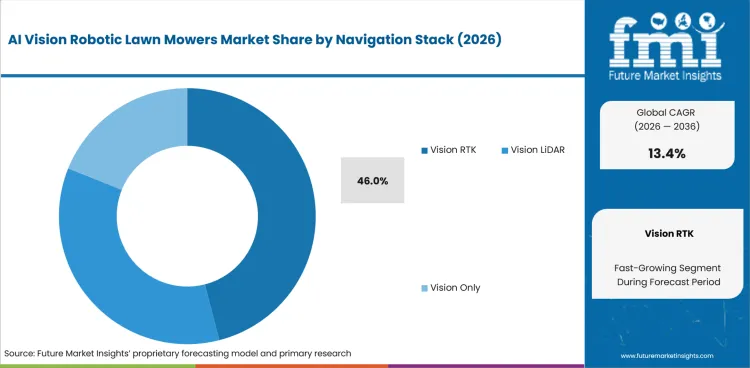
- Vision RTK is projected to account for 46% share in 2026 as it blends camera-based perception with satellite correction for boundary control and obstacle response.
- Segway Navimow X3 uses AI Assist Mapping and advanced 3D camera technology for large yards, which shows why premium buyers compare mapping speed with cut quality.
Which end user leads the AI vision robotic lawn mowers market?
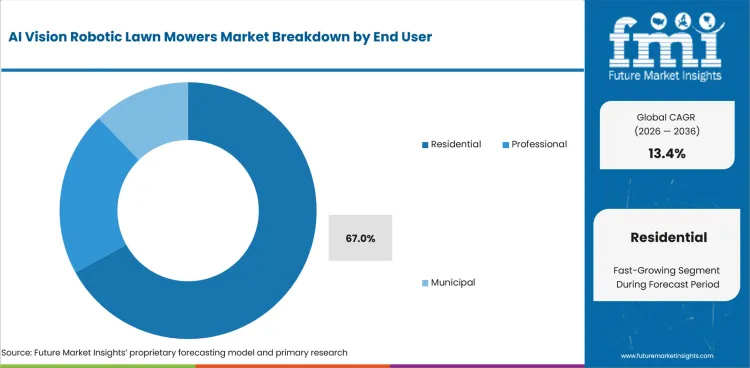
- Residential is expected to represent 67% share in 2026 as homeowners buy AI vision mowers to avoid perimeter wires and reduce weekly mowing time.
- Worx Landroid Vision uses a trained neural network and Full HD wide-angle camera, which supports drop-and-mow buying for single-zone lawns.
Which lawn size leads the AI vision robotic lawn mowers market?
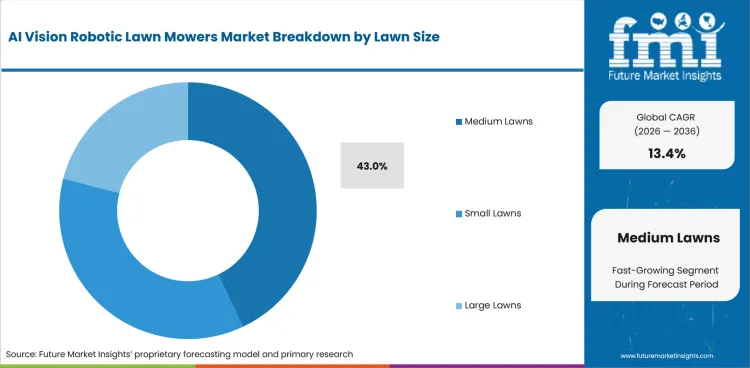
- Medium Lawns are anticipated to hold 43% share in 2026 as the 700 m² to 3,000 m² band matches premium European and suburban yard sizes.
- Dreame A2 covers lawns up to 3,000 m² with LiDAR and a 1080p HDR AI camera, which makes medium gardens the main test zone.
Which price band leads the AI vision robotic lawn mowers market?
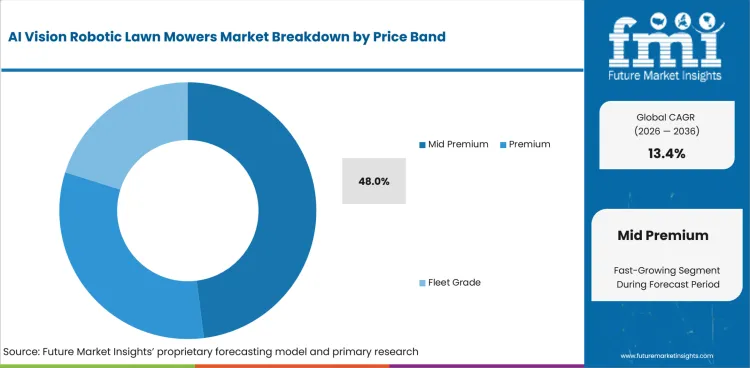
- Mid Premium is projected to represent 48% share in 2026 as buyers accept a higher price for self-mapping and stronger obstacle recognition.
- Mammotion’s LUBA 2 AWD uses UltraSense AI Vision for accurate mowing up to 300 meters without satellite reliance, which protects value in premium yards.
Which sales channel leads the AI vision robotic lawn mowers market?
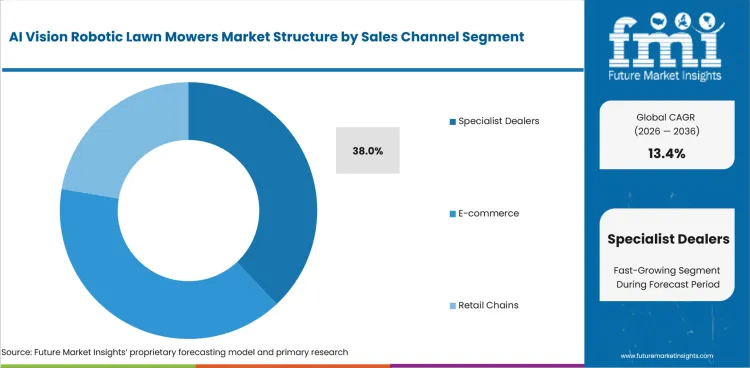
- Specialist Dealers are expected to hold 38% share in 2026 as buyers need site assessment, boundary advice, service help, and warranty handling.
- Kress lists EyePilot RTK models through dealer routes with lawn area bands up to 5,000 m², which keeps local advice central to conversion.
What are the drivers, restraints, and opportunities in the AI vision robotic lawn mowers market?
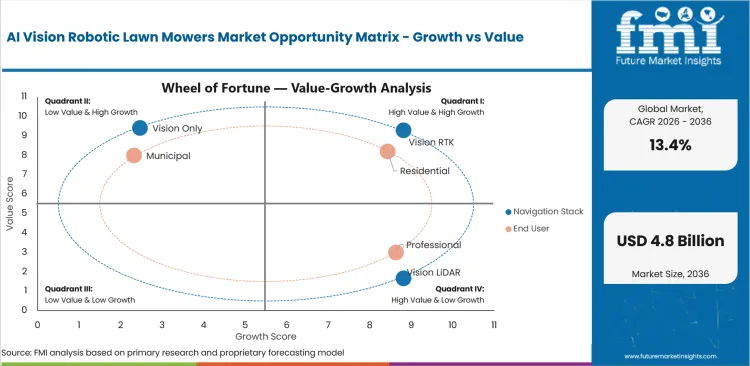
- Driver: Boundary-free setup lowers adoption friction by replacing buried wires with camera-led mapping and virtual zones.
- Driver: Professional labor pressure creates a practical use case for fleet-grade autonomous mowing.
- Driver: Wildlife and object detection raise the value of AI cameras during day and night mowing.
- Restraint: Shaded gardens and complex edges can reduce buyer trust when RTK or vision systems lose confidence.
- Opportunity: Service contracts and software updates create a recurring revenue layer beyond mower hardware.
Wire-Free Setup Economics
Wire-free setup is the core commercial trigger for AI vision mower demand. Buyers do not only compare cutting width or battery capacity. They compare how much site work is needed before the first mow. Worx says Landroid Vision does not need wires, antennas, or mapping before use. That claim speaks directly to a homeowner problem that slowed older robotic mower adoption. The implication is clear for suppliers. The easier the first setup becomes, the wider the reachable customer pool becomes.
Sensor Fusion Reliability
Sensor fusion is becoming the main technical battleground. RTK gives location accuracy in open areas, while cameras and LiDAR recover performance near trees and walls. Ecovacs says its GOAT systems combine AI Vision and 3D-ToF LiDAR to avoid over 200 obstacle types. That matters for buyers who fear mower stoppages and animal contact. Suppliers that prove clean transitions between sensor modes will win more complex gardens.
Professional Turf Labor Pressure
Professional turf adoption is different from homeowner adoption. Contractors and campus managers buy uptime, not novelty. John Deere’s autonomous battery electric mower uses camera technology at smaller scale with two cameras on each side for 360-degree coverage. This shows how commercial mowing will judge autonomy by supervision reduction and fleet control. The opportunity is strongest where labor gaps meet repeatable mowing routes.
Which countries are growing fastest in the AI vision robotic lawn mowers market?
.webp "Top Country Growth Comparison Ai Vision Robotic Lawn Mowers Market Cagr (2026 2036)")
| Country | CAGR |
|---|---|
| China | 15.8% |
| India | 14.9% |
| South Korea | 14.6% |
| United States | 13.6% |
| Japan | 13.1% |
| United Kingdom | 12.7% |
| Germany | 12.1% |
| France | 11.9% |
Source: Future Market Insights, 2026.
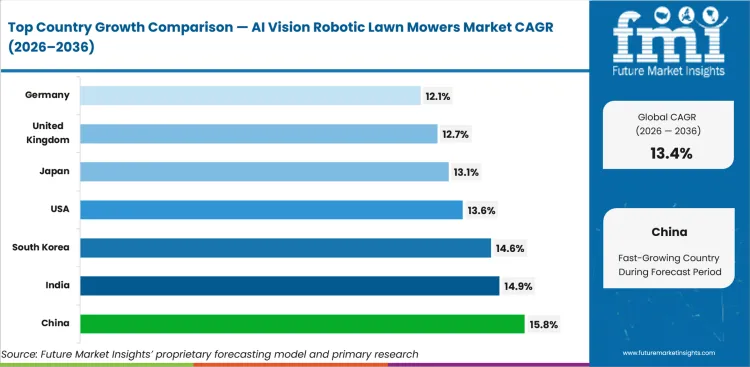
How do country-level CAGRs compare in the AI vision robotic lawn mowers market?
China leads country growth as domestic robotics suppliers scale sensor-rich mower platforms for export. India grows from a smaller base through hotels and institutional turf use. South Korea gains from smart-device familiarity and managed turf trials. The United States remains the largest premium-use country. Japan supports compact-site automation. The United Kingdom, Germany, and France support dealer-led European adoption through residential lawns and garden-equipment retail.
What is the AI vision robotic lawn mowers market outlook in China?
China is projected to grow at 15.8% CAGR through 2036 due to robotics manufacturing depth and export-oriented mower production.
Country Market Snapshot Table
| Parameter | Value |
|---|---|
| CAGR (2026 to 2036) | 15.8% |
| Years Considered | 2021 to 2036 |
| Base Year | 2025 |
| Forecast Period | 2026 to 2036 |
| Units Considered | Value (USD million) |
| Leading Sub-Region | Guangdong and Yangtze River Delta export clusters |
China AI Vision Robotic Lawn Mowers Market Outlook
China demand is shaped more by product development and export supply than by domestic lawn replacement. Local electronics and robotics capacity gives suppliers a faster route to integrate cameras, RTK, and LiDAR into mower platforms.
Domestic household demand remains narrower than in suburban Western markets. Export-led growth is expected to keep China ahead of other profiled countries through 2036.
Key Growth Drivers
- Local robotics capacity supports faster AI vision mower development. China produced 8,824,452 service robots from January to June 2025, which strengthens supplier access to robotics components and integration skills.
- Industrial automation depth supports precision manufacturing for mower platforms. China produced 369,316 industrial robots from January to June 2025, up 35.6% year over year.
- Export-oriented suppliers can lower unit costs for mid-premium mower models through electronics sourcing and rapid model refresh cycles.
- Cross-border e-commerce helps Chinese brands test AI vision mower demand in Europe and North America before wider dealer expansion.
Key Restraints
- Domestic private lawn demand is limited by urban employment concentration. China reported 473.45 million urban employed people in 2024, equal to 64.5% of total employment.
- Overseas buyers may delay repeat purchases when warranty service and spare-parts access are not strong enough.
- Export brands face higher support expectations in mature mower markets where dealer service shapes premium purchases.
What makes China unique
China is the supply engine for AI vision robotic lawn mowers because it links robotics electronics with global mower export channels.
Key Companies
- Mammotion
- Dreame
- Ecovacs
- Segway Navimow
- Worx
- Kress
Sales & Marketing Channels
- Cross-border e-commerce
- European dealer importers
- North American online retail
- Distributor partnerships
- OEM and ODM supply routes
- Direct brand webstores
Country Segment Breakdown Table
| Segment | Sub-Segments |
|---|---|
| By Navigation Stack | Vision RTK · Vision LiDAR · Vision Only · Vision Wire |
| By End User | Residential · Professional · Municipal |
| By Lawn Size | Small Lawns · Medium Lawns · Large Lawns · Campus Turf |
| By Price Band | Entry · Mid Premium · Premium · Fleet Grade |
| By Sales Channel | Specialist Dealers · E-commerce · Retail Chains · Direct Fleet |
| Key Sub-Regions Covered | Shenzhen · Guangzhou · Suzhou · Shanghai · Ningbo · Hangzhou |
Frequently Asked Questions
How fast is China AI vision robotic lawn mowers market growing?
China is forecast to grow at 15.8% CAGR from 2026 to 2036.
Who leads China AI vision robotic lawn mowers market?
Mammotion, Dreame, Ecovacs, and Segway Navimow lead through China-linked robotics and outdoor automation portfolios.
What is driving adoption in China AI vision robotic lawn mowers market?
Robotics manufacturing and export scale are moving Chinese suppliers toward AI camera, RTK, and LiDAR mower platforms.
What is the AI vision robotic lawn mowers market outlook in India?
India is projected to grow at 14.9% CAGR through 2036 as institutional users test robotic mowing across hotels, campuses, and premium gated properties.
Country Market Snapshot Table
| Parameter | Value |
|---|---|
| CAGR (2026 to 2036) | 14.9% |
| Years Considered | 2021 to 2036 |
| Base Year | 2025 |
| Forecast Period | 2026 to 2036 |
| Units Considered | Value (USD million) |
| Leading Sub-Region | Bengaluru, Delhi NCR, Mumbai, Hyderabad, and premium resort corridors |
India AI Vision Robotic Lawn Mowers Market Outlook
India remains a small residential lawn market compared with the United States or Europe. Demand is expected to start with hotels, resorts, golf facilities, campuses, and gated communities where turf appearance matters.
Premium import prices will limit mass household adoption. Demonstration-led selling and service assurance are expected to decide early conversion.
Key Growth Drivers
- Hotel and resort buyers create the first professional turf route. India recorded 9.66 million foreign tourist arrivals in 2024, which supports premium hospitality spending on property upkeep.
- Domestic tourism increases the need for maintained resort and campus landscapes. India recorded 2,509.63 million domestic tourist visits in 2023, according to the Ministry of Tourism
- Premium real estate and gated communities can justify robotic mowing where facility teams need consistent turf presentation.
- Golf courses and institutional campuses can test fleet-grade models before wider residential adoption develops.
Key Restraints
- Premium import pricing limits household adoption because average urban monthly per-capita consumption expenditure was Rs. 6,996 in 2023 to 2024.
- Dust, monsoon exposure, and uneven service coverage can raise uptime concerns for early institutional buyers.
- Country-specific company coverage remains limited in public sources compared with Europe and North America.
What makes India unique
India is an institutional trial market where hotels, campuses, and gated communities are more relevant than mass residential lawn care.
Key Companies
- Husqvarna
- Segway Navimow
- Mammotion
- Worx
- Dreame
- Ecovacs
- Kress
Sales & Marketing Channels
- Facility management procurement
- Golf course suppliers
- Hotel and resort purchase teams
- Premium housing developers
- E-commerce imports
- Garden equipment distributors
Country Segment Breakdown Table
| Segment | Sub-Segments |
|---|---|
| By Navigation Stack | Vision RTK · Vision LiDAR · Vision Only · Vision Wire |
| By End User | Residential · Professional · Municipal |
| By Lawn Size | Small Lawns · Medium Lawns · Large Lawns · Campus Turf |
| By Price Band | Entry · Mid Premium · Premium · Fleet Grade |
| By Sales Channel | Specialist Dealers · E-commerce · Retail Chains · Direct Fleet |
| Key Sub-Regions Covered | Delhi NCR · Bengaluru · Mumbai · Hyderabad · Pune · Goa |
Frequently Asked Questions
How fast is India AI vision robotic lawn mowers market growing?
India is projected to rise at 14.9% CAGR from 2026 to 2036.
Who leads India AI vision robotic lawn mowers market?
Verified local leadership is limited, while global brands are expected to compete through import and distributor channels.
What is driving adoption in India AI vision robotic lawn mowers market?
Hotels, gated communities, golf facilities, and campuses are creating early use cases for robotic mowing trials.
How fast is the AI vision robotic lawn mowers market growing in South Korea?
South Korea is forecast to grow at 14.6% CAGR through 2036 as smart-appliance familiarity supports autonomous outdoor equipment trials.
Country Market Snapshot Table
| Parameter | Value |
|---|---|
| CAGR (2026 to 2036) | 14.6% |
| Years Considered | 2021 to 2036 |
| Base Year | 2025 |
| Forecast Period | 2026 to 2036 |
| Units Considered | Value (USD million) |
| Leading Sub-Region | Seoul Capital Area and premium managed turf corridors |
South Korea AI Vision Robotic Lawn Mowers Market Outlook
South Korea is a smaller mower market by lawn ownership, but it is relevant for smart-device acceptance. Early demand is expected from golf facilities, villas, managed public spaces, and premium homes.
AI vision products will need quiet operation and strong app control. Imported models must also show reliable service support before wider buyer confidence develops.
Key Growth Drivers
- Household formation supports smart-device selling routes. South Korea had 23.00 million households in 2024, up 1.2% from the previous year.
- Managed housing stock creates a defined property-care base. South Korea recorded 19.87 million housing units in 2024, up 1.7% from 2023.
- Smart-home familiarity can make app-controlled mowing easier to explain in premium consumer channels.
- Golf and managed turf sites can provide proof cases before broader residential expansion.
Key Restraints
- Private lawn ownership is limited by apartment-heavy housing. Apartments accounted for 53.9% of general households in 2024.
- Imported premium models face price sensitivity when buyers cannot confirm after-sales support.
- Dense urban housing limits the number of households that can use larger robotic mower platforms.
What makes South Korea unique
South Korea is a smart-appliance adoption market where product experience can matter more than mower tradition.
Key Companies
- Husqvarna
- Segway Navimow
- Mammotion
- Ecovacs
- Dreame
- Kress
Sales & Marketing Channels
- Consumer electronics retail
- Garden equipment dealers
- E-commerce platforms
- Golf course suppliers
- Facility management buyers
- Smart home integrators
Country Segment Breakdown Table
| Segment | Sub-Segments |
|---|---|
| By Navigation Stack | Vision RTK · Vision LiDAR · Vision Only · Vision Wire |
| By End User | Residential · Professional · Municipal |
| By Lawn Size | Small Lawns · Medium Lawns · Large Lawns · Campus Turf |
| By Price Band | Entry · Mid Premium · Premium · Fleet Grade |
| By Sales Channel | Specialist Dealers · E-commerce · Retail Chains · Direct Fleet |
| Key Sub-Regions Covered | Seoul · Incheon · Gyeonggi · Busan · Daegu · Jeju |
Frequently Asked Questions
How fast is South Korea AI vision robotic lawn mowers market growing?
South Korea is forecast at 14.6% CAGR from 2026 to 2036.
Who leads South Korea AI vision robotic lawn mowers market?
Husqvarna, Segway Navimow, Mammotion, Ecovacs, and Dreame are relevant through premium robotic mower positioning.
What is driving adoption in South Korea AI vision robotic lawn mowers market?
Smart-device familiarity and managed turf sites are supporting early robotic mower interest.
What is the AI vision robotic lawn mowers market outlook in the United States?
The United States is projected to grow at 13.6% CAGR through 2036 due to large suburban lawns and professional landscaping labor pressure.
Country Market Snapshot Table
| Parameter | Value |
|---|---|
| CAGR (2026 to 2036) | 13.6% |
| Years Considered | 2021 to 2036 |
| Base Year | 2025 |
| Forecast Period | 2026 to 2036 |
| Units Considered | Value (USD million) |
| Leading Sub-Region | Sun Belt, Midwest, and Northeast suburban lawn corridors |
United States AI Vision Robotic Lawn Mowers Market Outlook
United States demand is led by homeowners who already spend on outdoor power equipment and yard care. Large suburban lawns favor Vision RTK models with multi-zone scheduling.
Professional adoption is tied to crew productivity. Contractors are expected to scale robotic mowing only when uptime reduces repeated mowing passes without adding supervision work.
Key Growth Drivers
- Grounds maintenance labor pressure supports robotic mowing tests. The U.S. Bureau of Labor Statistics projects 171,600 annual openings for grounds maintenance workers from 2024 to 2034.
- Professional labor demand supports automation planning. BLS projects grounds maintenance employment to grow 4% from 2024 to 2034.
- Suburban lawn size supports larger Vision RTK mowers with bigger batteries and multi-zone mowing schedules.
- Dealer and big-box retail breadth increases buyer exposure to premium mower demonstrations.
Key Restraints
- Contractors may delay fleet adoption where robot oversight fails to reduce labor. BLS still projects 171,600 yearly openings in grounds maintenance through 2034.
- Buyers may hesitate where trees block satellite correction during boundary mapping.
- Premium robotic mower prices remain high against walk-behind and ride-on alternatives.
What makes the United States unique
The United States is the strongest market for large-lawn AI vision models with premium pricing and commercial fleet testing.
Key Companies
- Husqvarna
- Segway Navimow
- Mammotion
- Worx
- Ecovacs
- Kress
- John Deere
Sales & Marketing Channels
- Outdoor power equipment dealers
- Big-box home improvement retail
- E-commerce marketplaces
- Landscape contractor demonstrations
- Commercial fleet trials
- Golf and campus equipment procurement
Country Segment Breakdown Table
| Segment | Sub-Segments |
|---|---|
| By Navigation Stack | Vision RTK · Vision LiDAR · Vision Only · Vision Wire |
| By End User | Residential · Professional · Municipal |
| By Lawn Size | Small Lawns · Medium Lawns · Large Lawns · Campus Turf |
| By Price Band | Entry · Mid Premium · Premium · Fleet Grade |
| By Sales Channel | Specialist Dealers · E-commerce · Retail Chains · Direct Fleet |
| Key Sub-Regions Covered | California · Texas · Florida · New York · Midwest suburbs · Northeast suburbs |
Frequently Asked Questions
How fast is the United States AI vision robotic lawn mowers market growing?
The United States is projected to expand at 13.6% CAGR from 2026 to 2036.
Who leads the United States AI vision robotic lawn mowers market?
Husqvarna, Segway Navimow, Mammotion, Worx, Ecovacs, Kress, and John Deere compete through premium mower channels.
What is driving adoption in the United States AI vision robotic lawn mowers market?
Large lawns and landscaping labor pressure are moving buyers toward wire-free autonomous mowing.
What is the AI vision robotic lawn mowers market forecast for Japan?
Japan is expected to grow at 13.1% CAGR through 2036 as compact-site automation gains use in schools, parks, and managed properties.
Country Market Snapshot Table
| Parameter | Value |
|---|---|
| CAGR (2026 to 2036) | 13.1% |
| Years Considered | 2021 to 2036 |
| Base Year | 2025 |
| Forecast Period | 2026 to 2036 |
| Units Considered | Value (USD million) |
| Leading Sub-Region | Tokyo, Kansai, and institutional turf corridors |
Japan AI Vision Robotic Lawn Mowers Market Outlook
Japan is not a high-volume residential lawn market, but it is important for compact automation. Institutional turf and managed properties are expected to shape early uptake.
Quiet operation and safe obstacle response matter more than acreage coverage. Vision-only and Vision LiDAR models may fit compact sites better than larger RTK platforms.
Key Growth Drivers
- Detached homes create a defined addressable base. Japan recorded 29 million occupied detached dwellings, equal to 53.6% of occupied dwellings.
- Housing data supports compact-site segmentation. The 2023 Housing and Land Survey used about 200,000 selected unit districts, giving suppliers a useful basis for housing-type assessment.
- Robotics familiarity supports buyer acceptance of autonomous lawn care in managed settings.
- Professional grounds teams can value quiet operation near schools, parks, and residential areas.
Key Restraints
- Apartment living limits private lawn ownership. Japan recorded 23 million occupied apartment dwellings, equal to 43.6% of occupied dwellings.
- Smaller private lawns cap the addressable household pool compared with the United States.
- Premium pricing limits adoption among small facility managers that lack recurring turf budgets.
What makes Japan unique
Japan is a compact-site proving ground where quiet operation and safe navigation matter more than acreage coverage.
Key Companies
- Husqvarna
- Segway Navimow
- Mammotion
- Ecovacs
- Dreame
- Kress
Sales & Marketing Channels
- Robotics product distributors
- Garden machinery retailers
- Facility management channels
- Sports turf suppliers
- Online direct sales
- Institutional procurement
Country Segment Breakdown Table
| Segment | Sub-Segments |
|---|---|
| By Navigation Stack | Vision RTK · Vision LiDAR · Vision Only · Vision Wire |
| By End User | Residential · Professional · Municipal |
| By Lawn Size | Small Lawns · Medium Lawns · Large Lawns · Campus Turf |
| By Price Band | Entry · Mid Premium · Premium · Fleet Grade |
| By Sales Channel | Specialist Dealers · E-commerce · Retail Chains · Direct Fleet |
| Key Sub-Regions Covered | Tokyo · Osaka · Nagoya · Yokohama · Kyoto · Fukuoka |
Frequently Asked Questions
How fast is Japan AI vision robotic lawn mowers market growing?
Japan is projected to rise at 13.1% CAGR from 2026 to 2036.
Who leads Japan AI vision robotic lawn mowers market?
Husqvarna, Segway Navimow, Mammotion, Ecovacs, and Dreame have relevant product fit.
What is driving adoption in Japan AI vision robotic lawn mowers market?
Compact-site automation and institutional turf use are supporting early AI vision mower demand.
How is the AI vision robotic lawn mowers market performing in the United Kingdom?
The United Kingdom is expected to expand at 12.7% CAGR through 2036 as compact gardens create demand for edge recognition and easy app control.
Country Market Snapshot Table
| Parameter | Value |
|---|---|
| CAGR (2026 to 2036) | 12.7% |
| Years Considered | 2021 to 2036 |
| Base Year | 2025 |
| Forecast Period | 2026 to 2036 |
| Units Considered | Value (USD million) |
| Leading Sub-Region | London commuter belt and regional garden retail corridors |
United Kingdom AI Vision Robotic Lawn Mowers Market Outlook
United Kingdom demand is shaped by smaller lawns and high sensitivity to setup effort. AI vision mowers gain attention where homeowners want clean edges without installing wires under paths or flower borders.
Dealer advice remains important because wet lawns and irregular borders can raise after-sales needs. E-commerce supports product discovery, but installation confidence still affects conversion.
Key Growth Drivers
- Private gardens create a clear residential use base. ONS reported that 88% of adults said their home had a garden in June 2020.
- Garden use supports repeat interest in low-effort maintenance. As per study, it was reported that 89% of adults with a garden had used it in the previous seven days.
- Small and medium gardens favor drop-and-mow products with strong edge detection.
- Online comparison behavior supports early adoption of new AI vision mower brands.
Key Restraints
- The addressable household pool is limited in dense areas. ONS reported that 12% of Great Britain households lacked access to a private or shared garden, rising to 21% in London.
- Damp weather and mossy edges can reduce mapping confidence for some models.
- Price sensitivity limits premium fleet-grade mowers to affluent homes and estates.
What makes the United Kingdom unique
The United Kingdom is a high-fit market for compact AI vision mowers that solve setup and edge challenges.
Key Companies
- Husqvarna
- Worx
- Segway Navimow
- Mammotion
- Dreame
- Ecovacs
- Kress
Sales & Marketing Channels
- Specialist mower dealers
- Garden machinery retailers
- E-commerce stores
- Estate maintenance suppliers
- Installer-led demonstrations
- Home improvement retail partners
Country Segment Breakdown Table
| Segment | Sub-Segments |
|---|---|
| By Navigation Stack | Vision RTK · Vision LiDAR · Vision Only · Vision Wire |
| By End User | Residential · Professional · Municipal |
| By Lawn Size | Small Lawns · Medium Lawns · Large Lawns · Campus Turf |
| By Price Band | Entry · Mid Premium · Premium · Fleet Grade |
| By Sales Channel | Specialist Dealers · E-commerce · Retail Chains · Direct Fleet |
| Key Sub-Regions Covered | London commuter belt · Southeast England · Midlands · Manchester · Bristol · Scotland suburbs |
Frequently Asked Questions
How fast is United Kingdom AI vision robotic lawn mowers market growing?
The United Kingdom is expected to grow at 12.7% CAGR from 2026 to 2036.
Who leads United Kingdom AI vision robotic lawn mowers market?
Husqvarna, Worx, Segway Navimow, Mammotion, Dreame, Ecovacs, and Kress compete through retail and dealer channels.
What is driving adoption in United Kingdom AI vision robotic lawn mowers market?
Compact gardens and wire-free setup needs are moving buyers toward AI vision robotic mowers.
How is the AI vision robotic lawn mowers market performing in Germany?
Germany is forecast to grow at 12.1% CAGR through 2036 as buyers test AI vision claims against service depth and field reliability.
Country Market Snapshot Table
| Parameter | Value |
|---|---|
| CAGR (2026 to 2036) | 12.1% |
| Years Considered | 2021 to 2036 |
| Base Year | 2025 |
| Forecast Period | 2026 to 2036 |
| Units Considered | Value (USD million) |
| Leading Sub-Region | Bavaria, Baden-Württemberg, North Rhine-Westphalia, and Lower Saxony |
Germany AI Vision Robotic Lawn Mowers Market Outlook
Germany is a demanding market because buyers expect engineering proof and service coverage before paying premium prices. Supplier credibility matters more than novelty.
Dealer networks are expected to shape adoption. Buyers compare navigation reliability, spare parts, battery service, and warranty response before switching from wire-based robotic mowers.
Key Growth Drivers
- Large dwelling stock supports replacement demand. Destatis reported 43.8 million dwellings in Germany in 2024.
- Spacious housing supports premium mower use. For example, as per research, average living floor space of 94.0 m² per dwelling in 2024.
- Strong dealer service networks support higher-price robotic mower purchases.
- Technically aware buyers reward sensor fusion and verified obstacle detection.
Key Restraints
- Rental concentration limits owner-led garden equipment spending. Eurostat data cited by Destatis showed 52.8% of Germany’s population lived in rented accommodation in 2025.
- Buyers may reject weak service coverage even when product specifications look strong.
- Strict expectations on safety and durability slow adoption of unproven new entrants.
What makes Germany unique
Germany is the quality gate for AI vision robotic mowers in Europe because buyers test claims against field reliability.
Key Companies
- Husqvarna
- Worx
- Kress
- Segway Navimow
- Mammotion
- Dreame
- Ecovacs
Sales & Marketing Channels
- Garden machinery specialists
- Dealer installation networks
- Technical retail chains
- Home improvement stores
- Professional turf suppliers
- Online direct sales
Country Segment Breakdown Table
| Segment | Sub-Segments |
|---|---|
| By Navigation Stack | Vision RTK · Vision LiDAR · Vision Only · Vision Wire |
| By End User | Residential · Professional · Municipal |
| By Lawn Size | Small Lawns · Medium Lawns · Large Lawns · Campus Turf |
| By Price Band | Entry · Mid Premium · Premium · Fleet Grade |
| By Sales Channel | Specialist Dealers · E-commerce · Retail Chains · Direct Fleet |
| Key Sub-Regions Covered | Bavaria · Baden-Württemberg · North Rhine-Westphalia · Lower Saxony · Hesse · Hamburg suburbs |
Frequently Asked Questions
How fast is Germany AI vision robotic lawn mowers market growing?
Germany is projected to expand at 12.1% CAGR from 2026 to 2036.
Who leads Germany AI vision robotic lawn mowers market?
Husqvarna, Worx, Kress, Segway Navimow, Mammotion, Dreame, and Ecovacs are relevant suppliers.
What is driving adoption in Germany AI vision robotic lawn mowers market?
Dealer service depth and robotic mower familiarity are supporting premium AI vision mower adoption.
What is the AI vision robotic lawn mowers market outlook in France?
France is expected to advance at 11.9% CAGR through 2036 as mid-premium models become easier to buy and service.
Country Market Snapshot Table
| Parameter | Value |
|---|---|
| CAGR (2026 to 2036) | 11.9% |
| Years Considered | 2021 to 2036 |
| Base Year | 2025 |
| Forecast Period | 2026 to 2036 |
| Units Considered | Value (USD million) |
| Leading Sub-Region | Île-de-France suburbs, Auvergne-Rhône-Alpes, Occitanie, and Provence corridors |
France AI Vision Robotic Lawn Mowers Market Outlook
France combines one-family dwellings, second-home gardening, and a mature garden retail culture. AI vision mowers gain interest where owners cannot maintain lawns weekly.
Garden centers and specialist dealers are expected to explain product setup to non-technical buyers. Service availability will shape adoption outside affluent suburban and second-home areas.
Key Growth Drivers
- One-family housing supports residential mower use. For example, around 38.2 million dwellings was reported in France on January 1, 2024, with 54.8% classified as one-family dwellings.
- Second homes support absence-based mowing. INSEE reported 3.7 million second homes and occasional dwellings in France in 2024.
- Garden centers help explain AI mower setup to non-technical buyers.
- Medium and large lawns support higher battery capacity and Vision RTK products.
Key Restraints
- Ownership limits can slow household adoption. It was reported that 57.0% of households owned their main residence in 2024, leaving a large non-owner pool with weaker incentive to buy premium mowers.
- Rural buyers may delay adoption if local service support is thin.
- Lower-priced conventional mowers remain a strong substitute in price-sensitive areas.
What makes France unique
France is suited to absence-based mowing because second-home owners value remote scheduling and low weekly intervention.
Key Companies
- Husqvarna
- Worx
- Segway Navimow
- Mammotion
- Dreame
- Ecovacs
- Kress
Sales & Marketing Channels
- Garden center retail
- Specialist machinery dealers
- E-commerce platforms
- Installer recommendations
- Estate maintenance suppliers
- Professional grounds contractors
Country Segment Breakdown Table
| Segment | Sub-Segments |
|---|---|
| By Navigation Stack | Vision RTK · Vision LiDAR · Vision Only · Vision Wire |
| By End User | Residential · Professional · Municipal |
| By Lawn Size | Small Lawns · Medium Lawns · Large Lawns · Campus Turf |
| By Price Band | Entry · Mid Premium · Premium · Fleet Grade |
| By Sales Channel | Specialist Dealers · E-commerce · Retail Chains · Direct Fleet |
| Key Sub-Regions Covered | Île-de-France suburbs · Auvergne-Rhône-Alpes · Provence-Alpes-Côte d’Azur · Occitanie · Nouvelle-Aquitaine · Brittany |
Frequently Asked Questions
How fast is France AI vision robotic lawn mowers market growing?
France is forecast to advance at 11.9% CAGR from 2026 to 2036.
Who leads France AI vision robotic lawn mowers market?
Husqvarna, Worx, Segway Navimow, Mammotion, Dreame, Ecovacs, and Kress compete through retail and dealer access.
What is driving adoption in France AI vision robotic lawn mowers market?
Second homes, one-family dwellings, and garden retail channels are supporting AI vision mower adoption.
Competitive Landscape and Strategic Positioning
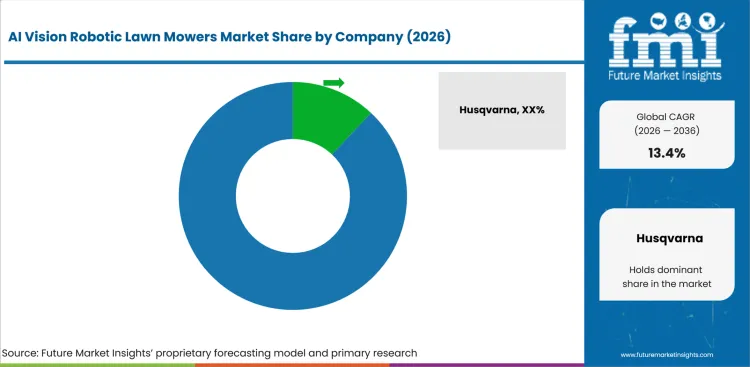
- The market is moderately concentrated as Husqvarna leads premium dealer coverage and Chinese brands accelerate product refresh cycles.
- Smaller brands win by solving a narrow problem such as edge trimming or low-cost wire-free setup.
- Entry barriers include field data and multi-country service networks.
- Competition is shifting from mower hardware toward perception stacks and service reliability.
Company competition is now centered on how well the mower sees and recovers. Husqvarna’s 2025 AI Vision announcement matters because it brings camera-led navigation into an established Automower dealer ecosystem. This gives the company an advantage in premium trust and after-sales support. The competitive result is that newer brands must beat incumbents on setup simplicity or price. The adjacent robotic lawn mower category will increasingly split between wire-based legacy fleets and AI vision upgrades.
Capability depth is broadening beyond camera detection. Mammotion uses UltraSense AI Vision and RTK recovery for satellite-blocked areas. Dreame uses LiDAR plus a 1080p HDR AI camera in the A2. Ecovacs uses AI Vision and 3D-ToF LiDAR for obstacle avoidance. These moves show that suppliers now compete on sensor fusion rather than one navigation claim. This creates upside for component suppliers in robot sensor systems and vision guided robots. Dealer strength still matters because lawns vary more than indoor floors. Kress EyePilot models show how specialist channels remain important even when the mower promises wire-free setup. Buyers still ask whether the mower can handle slopes, shade, narrow passages, and rain. This protects companies with service networks and field installation experience. It also gives local dealers a role in the wider outdoor power equipment ecosystem.
One of the toughest entry barrier is reliable perception across weather and mixed surfaces. Ecovacs’ TruEdge and Husqvarna’s night-time IR camera show where product proof is moving. Suppliers that only offer a low-cost robotic shell will struggle to satisfy premium buyers. This favors companies with data and product families that span homeowner and professional use cases.
Who are the leading companies in the AI vision robotic lawn mowers market?
Competition is organized by role because product depth and channel strategy matter more than company size alone.
- Integrated Outdoor Power Leaders: Husqvarna and Kress hold strong positions through dealer networks, outdoor power equipment credibility, and robotic mower families. Husqvarna adds AI Vision to its NERA and EPOS lines. Kress builds on RTK networks and EyePilot vision routing for shaded and complex properties.
- Consumer Robotics Challengers: Mammotion, Segway Navimow, Dreame, and Ecovacs are expanding from smart robotics into outdoor mowing. Their advantage sits in fast sensor integration, app-led setup, and direct online buyer education. These suppliers are especially active in Vision RTK and Vision LiDAR configurations.
- Vision-Only Specialists: Worx stands out with Landroid Vision and Vision Cloud systems that reduce dependence on wires and antennas. Its positioning fits buyers who want simple setup and camera-based lawn awareness. The same shift supports demand for adjacent SLAM robots and mobile robots.
How do top AI vision robotic lawn mowers companies compare?
| Company | Vision Navigation Depth | Wire-Free Setup Capability | Dealer and Service Reach | Geographic Footprint |
|---|---|---|---|---|
| Husqvarna | High | High | Strong | Global |
| Mammotion | High | High | Moderate | North America / Europe / Asia |
| Segway Navimow | High | High | Moderate | North America / Europe / Asia |
| Dreame | High | High | Moderate | Europe / Asia / North America |
| Worx | High | Strong | Strong | Europe / North America |
| Ecovacs | High | Strong | Moderate | Europe / North America / Asia |
| Kress | Medium | High | Strong | Europe / North America |
| John Deere | Medium | Medium | Strong | North America |
Source: Future Market Insights competitive analysis, 2026.
Key Developments in AI Vision Robotic Lawn Mowers Market
- In October 2025, Husqvarna introduced four Automower NERA models with built-in AI vision technology. The launch brought camera-led obstacle handling into a major premium robotic mower line.
- In October 2025, Husqvarna introduced the Automower 540 EPOS with an AI Vision accessory for professional users. The product targets facilities up to 8,000 m².
- In January 2025, Segway Navimow unveiled the X3 Series at CES 2025. The series uses AI-assisted mapping and advanced 3D camera technology for large lawns.
- In February 2026, Ecovacs launched the GOAT PRO LiDAR series with a built-in AI edge trimmer. The launch targets the manual edging problem in robotic mowing.
- In January 2025, John Deere revealed an autonomous battery electric mower for commercial landscaping. The machine uses eight cameras to achieve 360-degree coverage.
Who are the key players in the AI vision robotic lawn mowers market?
Integrated Outdoor Power Leaders
- Husqvarna
- Kress
Consumer Robotics Challengers
- Mammotion
- Segway Navimow
- Dreame
- Ecovacs
Vision-Only Specialists
- Worx
AI Vision Robotic Lawn Mowers Market - Report Scope
| Item | Value |
|---|---|
| Market size by 2036 | USD 4.87 billion |
| Growth rate | 13.4% CAGR from 2026 to 2036 |
| Forecast period | 2026 to 2036 |
| Base year value (2025) | USD 1.22 billion |
| 2026 market value | USD 1.38 billion |
| By navigation stack | Vision RTK, Vision LiDAR, Vision Only, Vision Wire |
| By end user | Residential, Professional, Municipal |
| By lawn size | Small Lawns, Medium Lawns, Large Lawns, Campus Turf |
| By price band | Entry, Mid Premium, Premium, Fleet Grade |
| By sales channel | Specialist Dealers, E-commerce, Retail Chains, Direct Fleet |
| Regions covered | North America, Latin America, Europe, East Asia, South Asia and Pacific, Middle East and Africa |
| Countries covered | United States, United Kingdom, Germany, France, Japan, China, South Korea, India |
| Key companies profiled | Husqvarna, Mammotion, Segway Navimow, Dreame, Worx, Ecovacs, Kress, John Deere |
| Approach | Hybrid bottom-up and top-down methodology using trade data, product pricing, company portfolio checks, and country-level adoption velocity |
| Source | Future Market Insights, 2026 |
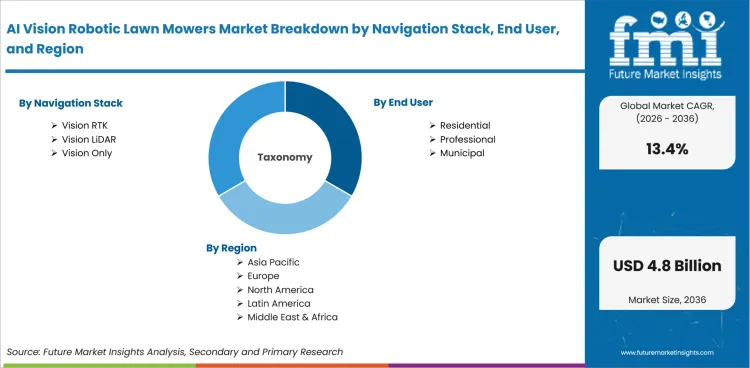
AI Vision Robotic Lawn Mowers Market Breakdown By Navigation Stack, End User, Lawn Size, Price Band, Sales Channel, and Region
AI Vision Robotic Lawn Mowers Market Segmented by Navigation Stack:
- Vision RTK
- Vision LiDAR
- Vision Only
- Vision Wire
AI Vision Robotic Lawn Mowers Market Segmented by End User:
- Residential
- Professional
- Municipal
AI Vision Robotic Lawn Mowers Market Segmented by Lawn Size:
- Small Lawns
- Medium Lawns
- Large Lawns
- Campus Turf
AI Vision Robotic Lawn Mowers Market Segmented by Price Band:
- Entry
- Mid Premium
- Premium
- Fleet Grade
AI Vision Robotic Lawn Mowers Market Segmented by Sales Channel:
- Specialist Dealers
- E-commerce
- Retail Chains
- Direct Fleet
AI Vision Robotic Lawn Mowers Market by Region:
- North America
- United States
- Canada
- Mexico
- Latin America
- Brazil
- Chile
- Rest of Latin America
- Western Europe
- Germany
- UK
- Italy
- Spain
- France
- Nordic
- BENELUX
- Rest of Western Europe
- Eastern Europe
- Russia
- Poland
- Hungary
- Balkan & Baltic
- Rest of Eastern Europe
- East Asia
- China
- Japan
- South Korea
- South Asia and Pacific
- India
- ASEAN
- Australia & New Zealand
- Rest of South Asia and Pacific
- Middle East & Africa
- Kingdom of Saudi Arabia
- Other GCC Countries
- Turkiye
- South Africa
- Other African Union
- Rest of Middle East & Africa
Research Sources and Bibliography
- World Integrated Trade Solution. (2025). Mowers, powered, lawn, with horizontal cutting imports by country in 2024. World Bank and UN Comtrade.
- World Integrated Trade Solution. (2025). China exports of mowers, powered, lawn, with horizontal cutting in 2024. World Bank and UN Comtrade.
- World Integrated Trade Solution. (2025). United States imports of mowers, powered, lawn, with horizontal cutting in 2024. World Bank and UN Comtrade.
- World Integrated Trade Solution. (2025). Korea, Rep. imports of mowers, powered, lawn, with horizontal cutting in 2024. World Bank and UN Comtrade.
- U.S. Bureau of Labor Statistics. (2025, September). Grounds maintenance workers: Occupational outlook handbook. U.S. Department of Labor.
- Husqvarna Group. (2025, October 17). Husqvarna Group reveals AI Vision technology on robotic lawnmowers for 2026.
- Husqvarna. (2025, October 16). Husqvarna introduces 4 new mowers to its Automower NERA range.
- Segway Navimow. (2025, January 7). Segway Navimow unveils X3 Series at CES 2025.
- Dreame Technology. (2026). Dreame Roboticmower A2.
- Mammotion. (2026). LUBA 2 AWD robotic lawn mower.
- Ecovacs. (2026). CES 2026 highlights: GOAT robotic lawn mowers.
- Kress. (2026). EyePilot robotic lawn mowers.
- John Deere. (2025, January 6). John Deere reveals new autonomous machines and technology at CES 2025.
The bibliography is provided for reader reference and uses primary non-commercial trade data, government labor data, and official company sources.
Adaptive Torque Control Smart Power Tools Market - Scope & Definition
| Attribute | Detail |
|---|---|
| Market Definition | Powered fastening and cutting tools that adjust, limit, stop, or record torque through sensors, controllers, embedded electronics, or connected software. |
| Functions Covered | Torque control, automatic shutoff, kickback sensing, preset fastening, fastening record storage, calibration tracking, tool reporting |
| Applications Covered | Structural bolting, anchor installation, factory assembly, wheel fastening, chassis service, renewable structure fastening, fleet maintenance |
| End-Use Industries | Industrial assembly, construction fastening, automotive service, renewable structures, MRO fleets |
| Control Architectures Covered | Closed Loop Torque, Sensor Kickback, App Preset, Trigger Control |
| Inclusions | Commercially sold smart impact wrenches, drill drivers, screwdrivers, angle grinders, rotary tools, adaptive fastening modules, torque reporting software, and connected setup tools used for controlled fastening and torque documentation. |
| Exclusions | Manual torque wrenches, basic cordless drills without torque sensing, standard impact tools without control electronics, standalone asset tags, conventional pneumatic tools without electronic control, and general hand tools without powered fastening or recorded torque output. |
Adaptive Torque Control Smart Power Tools Market - Research Methodology
| Method | Description |
|---|---|
| Primary Research | FMI analyst interviews with construction contractors, factory assembly teams, automotive service operators, tool distributors, and fleet managers across key markets. |
| Desk Research | Review of government construction data, official industrial output statistics, safety guidance, company product documents, product manuals, and verified launch material related to connected power tools and torque systems. |
| Market Sizing & Forecasting | Bottom-up equipment-boundary approach using parent power tool revenue, smart tool penetration, controlled fastening share, product pricing, and country-level adoption differences. |
| Data Validation | Cross-verification using construction spending, industrial automation demand, factory output indicators, company portfolios, calibration support availability, and professional channel feedback. |
This Report Answers
- What is the projected size of the AI Vision Robotic Lawn Mowers Market in 2026 and 2036?
- What CAGR is expected for AI vision robotic lawn mowers from 2026 to 2036?
- Which navigation stack is expected to lead AI vision robotic lawn mower demand in 2026?
- Why are residential users the leading end-user group for AI vision robotic lawn mowers?
- Which countries are forecast to grow fastest in AI vision robotic lawn mower adoption?
- How do AI cameras, RTK, and LiDAR change supplier competition in robotic mowing?
- What restraints limit AI vision robotic mower adoption in shaded and complex lawns?
- Which companies are active in AI vision robotic lawn mower product development?
- How does FMI define the scope of AI Vision Robotic Lawn Mowers Market revenue?
- Which methodology is used to forecast AI vision robotic lawn mower demand?
Frequently Asked Questions
What is the global market demand for AI Vision Robotic Lawn Mowers Market in 2026?
In 2026, the global AI Vision Robotic Lawn Mowers Market is expected to be worth USD 1.38 billion as wire-free products expand.
What is the forecast value of the AI Vision Robotic Lawn Mowers Market by 2036?
The AI Vision Robotic Lawn Mowers Market is projected to reach USD 4.87 billion by 2036 as sensor fusion becomes standard.
What CAGR is expected for the AI Vision Robotic Lawn Mowers Market?
The market is projected to grow at a 13.4% CAGR from 2026 to 2036 across the global forecast period.
Which navigation segment is expected to lead the market in 2026?
Vision RTK is projected to lead with 46% share in 2026 due to its mix of boundary precision and visual recovery.
Which end-user segment is expected to lead in 2026?
Residential users are expected to account for 67% share in 2026 as homeowners adopt wire-free mowing for weekly lawn care.
Which country is expected to grow fastest in this market?
China is forecast to grow fastest at 15.8% CAGR through 2036 due to robotics suppliers, export scale, and AI hardware integration.
What does the AI Vision Robotic Lawn Mowers Market include?
The market includes autonomous battery mowers using cameras and AI software for mapping, object detection, boundary recognition, and edge handling.
How did FMI forecast the AI Vision Robotic Lawn Mowers Market?
FMI used trade data, verified product portfolios, pricing bands, company launches, and country-level adoption assumptions to build the 2026 to 2036 forecast.
Which AI vision robotic mower is best for medium lawns?
A Vision RTK or Vision LiDAR mower is best for medium lawns when the garden has trees, multiple zones, or mixed borders.
How much does an AI vision robotic lawn mower cost?
Most mid-premium AI vision robotic mowers cost more than basic wire-based robots because cameras, RTK, LiDAR, and app mapping raise hardware value.
What is the difference between Vision RTK and Vision LiDAR robotic mowers?
Vision RTK uses satellite correction plus cameras for boundary control. Vision LiDAR uses laser sensing with cameras to navigate shaded or complex spaces.
How long does an AI vision robotic lawn mower last?
A premium AI vision robotic mower typically lasts several mowing seasons when blades, batteries, wheels, firmware, and sensors are maintained through dealer service.
What are the main disadvantages of AI vision robotic lawn mowers?
The main disadvantages are high purchase price, weak performance in difficult lighting, service gaps, and setup problems in gardens with complex edges.
Preview the report firsthand - request a free sample
Get SampleGet the brochure for pricing and purchase details.
Get PDFTable of Content
- Key Takeaways
- Market Size and CAGR
- Top Growth Driver
- Fastest Growing Segment
- Leading Region
- Key Companies
- Emerging Opportunities
- Executive Summary
- Global Market Outlook
- Demand-side Trends
- Supply-side Trends
- Technology Roadmap Analysis
- Analysis and Recommendations
- Analyst Perspective (What is happening? Why now? What should investors know?)
- Key Questions Answered
- How large is the market?
- What is the CAGR?
- What are key trends?
- Which region dominates?
- Who are the leaders?
- Market Overview
- Market Coverage / Taxonomy
- Market Definition / Scope / Limitations
- Research Methodology
- Chapter Orientation
- Analytical Lens and Working Hypotheses
- Market Structure, Signals, and Trend Drivers
- Benchmarking and Cross-market Comparability
- Market Sizing, Forecasting, and Opportunity Mapping
- Research Design and Evidence Framework
- Desk Research Programme (Secondary Evidence)
- Expert Input and Fieldwork (Primary Evidence)
- Tooling, Models, and Reference Databases
- Data Engineering and Model Build
- Quality Assurance and Audit Trail
- Market Background
- Market Dynamics (Drivers, Restraints, Opportunity, Trends)
- Scenario Forecast (Optimistic, Likely, Conservative)
- Impact Analysis
- AI Impact
- Sustainability Impact
- Regulatory Impact
- Technology Impact
- Consumer / Buyer Analysis
- Purchase Drivers
- Adoption Barriers
- Buyer Journey
- Opportunity Map Analysis
- Product Life Cycle Analysis
- Supply Chain Analysis
- Investment Feasibility Matrix
- Value Chain Analysis
- PESTLE and Porter's Analysis
- Regulatory Landscape
- Regional Parent Market Outlook
- Production and Consumption Statistics
- Import and Export Statistics
- Global Market Analysis and Forecast, 2021 to 2036
- Historical Market Size Value (USD Billion) & Volume (Unit) Analysis, 2021 to 2025
- Current and Future Market Size Value (USD Billion) & Volume (Unit) Projections, 2026 to 2036
- Y-o-Y Growth Trend Analysis
- Absolute $ Opportunity Analysis
- Global Market Pricing Analysis, 2021 to 2036
- Global Market Analysis and Forecast, By Navigation Stack, 2021 to 2036
- Introduction / Key Findings
- Historical Market Size Value (USD Billion) & Volume (Unit) Analysis By Navigation Stack, 2021 to 2025
- Current and Future Market Size Value (USD Billion) & Volume (Unit) Analysis and Forecast By Navigation Stack, 2026 to 2036
- Vision RTK
- Vision LiDAR
- Vision Only
- Vision Wire
- Vision RTK
- Y-o-Y Growth Trend Analysis By Navigation Stack, 2021 to 2025
- Absolute $ Opportunity Analysis By Navigation Stack, 2026 to 2036
- Global Market Analysis and Forecast, By End User, 2021 to 2036
- Introduction / Key Findings
- Historical Market Size Value (USD Billion) & Volume (Unit) Analysis By End User, 2021 to 2025
- Current and Future Market Size Value (USD Billion) & Volume (Unit) Analysis and Forecast By End User, 2026 to 2036
- Residential
- Professional
- Municipal
- Residential
- Y-o-Y Growth Trend Analysis By End User, 2021 to 2025
- Absolute $ Opportunity Analysis By End User, 2026 to 2036
- Global Market Analysis and Forecast, By Lawn Size, 2021 to 2036
- Introduction / Key Findings
- Historical Market Size Value (USD Billion) & Volume (Unit) Analysis By Lawn Size, 2021 to 2025
- Current and Future Market Size Value (USD Billion) & Volume (Unit) Analysis and Forecast By Lawn Size, 2026 to 2036
- Medium Lawns
- Large Lawns
- Campus Turf
- Small Lawns
- Medium Lawns
- Y-o-Y Growth Trend Analysis By Lawn Size, 2021 to 2025
- Absolute $ Opportunity Analysis By Lawn Size, 2026 to 2036
- Global Market Analysis and Forecast, By Price Band, 2021 to 2036
- Introduction / Key Findings
- Historical Market Size Value (USD Billion) & Volume (Unit) Analysis By Price Band, 2021 to 2025
- Current and Future Market Size Value (USD Billion) & Volume (Unit) Analysis and Forecast By Price Band, 2026 to 2036
- Mid Premium
- Premium
- Fleet Grade
- Entry
- Mid Premium
- Y-o-Y Growth Trend Analysis By Price Band, 2021 to 2025
- Absolute $ Opportunity Analysis By Price Band, 2026 to 2036
- Global Market Analysis and Forecast, By Sales Channel, 2021 to 2036
- Introduction / Key Findings
- Historical Market Size Value (USD Billion) & Volume (Unit) Analysis By Sales Channel, 2021 to 2025
- Current and Future Market Size Value (USD Billion) & Volume (Unit) Analysis and Forecast By Sales Channel, 2026 to 2036
- Specialist Dealers
- E-commerce
- Retail Chains
- Direct Fleet
- Specialist Dealers
- Y-o-Y Growth Trend Analysis By Sales Channel, 2021 to 2025
- Absolute $ Opportunity Analysis By Sales Channel, 2026 to 2036
- Global Market Analysis and Forecast, By Region, 2021 to 2036
- Introduction
- Historical Market Size Value (USD Billion) & Volume (Unit) Analysis By Region, 2021 to 2025
- Current Market Size Value (USD Billion) & Volume (Unit) Analysis and Forecast By Region, 2026 to 2036
- North America
- Latin America
- Western Europe
- Eastern Europe
- East Asia
- South Asia and Pacific
- Middle East & Africa
- Market Attractiveness Analysis By Region
- North America Market Analysis and Forecast, By Country, 2021 to 2036
- Historical Market Size Value (USD Billion) & Volume (Unit) Trend Analysis By Market Taxonomy, 2021 to 2025
- Market Size Value (USD Billion) & Volume (Unit) Forecast By Market Taxonomy, 2026 to 2036
- By Country
- USA
- Canada
- Mexico
- By Navigation Stack
- By End User
- By Lawn Size
- By Price Band
- By Sales Channel
- By Country
- Market Attractiveness Analysis
- By Country
- By Navigation Stack
- By End User
- By Lawn Size
- By Price Band
- By Sales Channel
- Key Takeaways
- Latin America Market Analysis and Forecast, By Country
- Historical Market Size Value (USD Billion) & Volume (Unit) Trend Analysis By Market Taxonomy, 2021 to 2025
- Market Size Value (USD Billion) & Volume (Unit) Forecast By Market Taxonomy, 2026 to 2036
- By Country
- Brazil
- Chile
- Rest of Latin America
- By Navigation Stack
- By End User
- By Lawn Size
- By Price Band
- By Sales Channel
- By Country
- Market Attractiveness Analysis
- By Country
- By Navigation Stack
- By End User
- By Lawn Size
- By Price Band
- By Sales Channel
- Key Takeaways
- Western Europe Market Analysis and Forecast, By Country
- Historical Market Size Value (USD Billion) & Volume (Unit) Trend Analysis By Market Taxonomy, 2021 to 2025
- Market Size Value (USD Billion) & Volume (Unit) Forecast By Market Taxonomy, 2026 to 2036
- By Country
- Germany
- UK
- Italy
- Spain
- France
- Nordic
- BENELUX
- Rest of Western Europe
- By Navigation Stack
- By End User
- By Lawn Size
- By Price Band
- By Sales Channel
- By Country
- Market Attractiveness Analysis
- By Country
- By Navigation Stack
- By End User
- By Lawn Size
- By Price Band
- By Sales Channel
- Key Takeaways
- Eastern Europe Market Analysis and Forecast, By Country
- Historical Market Size Value (USD Billion) & Volume (Unit) Trend Analysis By Market Taxonomy, 2021 to 2025
- Market Size Value (USD Billion) & Volume (Unit) Forecast By Market Taxonomy, 2026 to 2036
- By Country
- Russia
- Poland
- Hungary
- Balkan & Baltic
- Rest of Eastern Europe
- By Navigation Stack
- By End User
- By Lawn Size
- By Price Band
- By Sales Channel
- By Country
- Market Attractiveness Analysis
- By Country
- By Navigation Stack
- By End User
- By Lawn Size
- By Price Band
- By Sales Channel
- Key Takeaways
- East Asia Market Analysis and Forecast, By Country
- Historical Market Size Value (USD Billion) & Volume (Unit) Trend Analysis By Market Taxonomy, 2021 to 2025
- Market Size Value (USD Billion) & Volume (Unit) Forecast By Market Taxonomy, 2026 to 2036
- By Country
- China
- Japan
- South Korea
- By Navigation Stack
- By End User
- By Lawn Size
- By Price Band
- By Sales Channel
- By Country
- Market Attractiveness Analysis
- By Country
- By Navigation Stack
- By End User
- By Lawn Size
- By Price Band
- By Sales Channel
- Key Takeaways
- South Asia and Pacific Market Analysis and Forecast, By Country
- Historical Market Size Value (USD Billion) & Volume (Unit) Trend Analysis By Market Taxonomy, 2021 to 2025
- Market Size Value (USD Billion) & Volume (Unit) Forecast By Market Taxonomy, 2026 to 2036
- By Country
- India
- ASEAN
- Australia & New Zealand
- Rest of South Asia and Pacific
- By Navigation Stack
- By End User
- By Lawn Size
- By Price Band
- By Sales Channel
- By Country
- Market Attractiveness Analysis
- By Country
- By Navigation Stack
- By End User
- By Lawn Size
- By Price Band
- By Sales Channel
- Key Takeaways
- Middle East & Africa Market Analysis and Forecast, By Country
- Historical Market Size Value (USD Billion) & Volume (Unit) Trend Analysis By Market Taxonomy, 2021 to 2025
- Market Size Value (USD Billion) & Volume (Unit) Forecast By Market Taxonomy, 2026 to 2036
- By Country
- Kingdom of Saudi Arabia
- Other GCC Countries
- Türkiye
- South Africa
- Other African Union
- Rest of Middle East & Africa
- By Navigation Stack
- By End User
- By Lawn Size
- By Price Band
- By Sales Channel
- By Country
- Market Attractiveness Analysis
- By Country
- By Navigation Stack
- By End User
- By Lawn Size
- By Price Band
- By Sales Channel
- Key Takeaways
- Key Countries Market Analysis
- USA
- Pricing Analysis
- Market Share Analysis, 2025
- By Navigation Stack
- By End User
- By Lawn Size
- By Price Band
- By Sales Channel
- Canada
- Pricing Analysis
- Market Share Analysis, 2025
- By Navigation Stack
- By End User
- By Lawn Size
- By Price Band
- By Sales Channel
- Mexico
- Pricing Analysis
- Market Share Analysis, 2025
- By Navigation Stack
- By End User
- By Lawn Size
- By Price Band
- By Sales Channel
- Brazil
- Pricing Analysis
- Market Share Analysis, 2025
- By Navigation Stack
- By End User
- By Lawn Size
- By Price Band
- By Sales Channel
- Chile
- Pricing Analysis
- Market Share Analysis, 2025
- By Navigation Stack
- By End User
- By Lawn Size
- By Price Band
- By Sales Channel
- Germany
- Pricing Analysis
- Market Share Analysis, 2025
- By Navigation Stack
- By End User
- By Lawn Size
- By Price Band
- By Sales Channel
- UK
- Pricing Analysis
- Market Share Analysis, 2025
- By Navigation Stack
- By End User
- By Lawn Size
- By Price Band
- By Sales Channel
- Italy
- Pricing Analysis
- Market Share Analysis, 2025
- By Navigation Stack
- By End User
- By Lawn Size
- By Price Band
- By Sales Channel
- Spain
- Pricing Analysis
- Market Share Analysis, 2025
- By Navigation Stack
- By End User
- By Lawn Size
- By Price Band
- By Sales Channel
- France
- Pricing Analysis
- Market Share Analysis, 2025
- By Navigation Stack
- By End User
- By Lawn Size
- By Price Band
- By Sales Channel
- India
- Pricing Analysis
- Market Share Analysis, 2025
- By Navigation Stack
- By End User
- By Lawn Size
- By Price Band
- By Sales Channel
- ASEAN
- Pricing Analysis
- Market Share Analysis, 2025
- By Navigation Stack
- By End User
- By Lawn Size
- By Price Band
- By Sales Channel
- Australia & New Zealand
- Pricing Analysis
- Market Share Analysis, 2025
- By Navigation Stack
- By End User
- By Lawn Size
- By Price Band
- By Sales Channel
- China
- Pricing Analysis
- Market Share Analysis, 2025
- By Navigation Stack
- By End User
- By Lawn Size
- By Price Band
- By Sales Channel
- Japan
- Pricing Analysis
- Market Share Analysis, 2025
- By Navigation Stack
- By End User
- By Lawn Size
- By Price Band
- By Sales Channel
- South Korea
- Pricing Analysis
- Market Share Analysis, 2025
- By Navigation Stack
- By End User
- By Lawn Size
- By Price Band
- By Sales Channel
- Russia
- Pricing Analysis
- Market Share Analysis, 2025
- By Navigation Stack
- By End User
- By Lawn Size
- By Price Band
- By Sales Channel
- Poland
- Pricing Analysis
- Market Share Analysis, 2025
- By Navigation Stack
- By End User
- By Lawn Size
- By Price Band
- By Sales Channel
- Hungary
- Pricing Analysis
- Market Share Analysis, 2025
- By Navigation Stack
- By End User
- By Lawn Size
- By Price Band
- By Sales Channel
- Kingdom of Saudi Arabia
- Pricing Analysis
- Market Share Analysis, 2025
- By Navigation Stack
- By End User
- By Lawn Size
- By Price Band
- By Sales Channel
- Türkiye
- Pricing Analysis
- Market Share Analysis, 2025
- By Navigation Stack
- By End User
- By Lawn Size
- By Price Band
- By Sales Channel
- South Africa
- Pricing Analysis
- Market Share Analysis, 2025
- By Navigation Stack
- By End User
- By Lawn Size
- By Price Band
- By Sales Channel
- USA
- Market Structure Analysis
- Competition Dashboard
- Competition Benchmarking
- Market Share Analysis of Top Players
- By Regional
- By Navigation Stack
- By End User
- By Lawn Size
- By Price Band
- By Sales Channel
- Emerging Startups
- Innovation Benchmarking
- Competition Analysis
- Competition Deep Dive
- Husqvarna
- Overview
- Product Portfolio
- Profitability by Market Segments (Product/Region/Sales Channel)
- Sales Footprint
- Strategy Overview
- Marketing Strategy
- Product Strategy
- Channel Strategy
- Kress
- Mammotion
- Segway Navimow
- Dreame
- Ecovacs
- Worx
- Husqvarna
- Case Studies
- Success Stories
- Recent Developments
- Competition Deep Dive
- Assumptions & Acronyms Used


