

- Industry Size (2026)
- USD 2.2 Bn
- Forecast (2036)
- USD 4.5 Bn
- CAGR (2026 to 2036)
- 7.50%
AI Recognition Machine Vision Alignment Systems Market Forecast and Outlook 2026 to 2036
The AI recognition machine vision alignment systems segment is projected to grow from USD 2.2 billion in 2026 to USD 4.6 billion by 2036, reflecting a compound annual growth rate of 7.5%. Capital allocation in this market is shaped by high upfront R&D intensity, long qualification cycles, and a strong bias toward proven deployment at scale rather than speculative expansion. Investment is concentrated in software development, edge-processing capability, sensor integration, and algorithm training infrastructure, all of which require sustained funding before returns materialize. Payback periods are typically extended, as adoption depends on factory integration, process validation, and yield improvement metrics rather than immediate volume sales. As a result, investors favor firms with established industrial customer bases, recurring software or upgrade revenues, and strong balance sheets that can support multi-year development timelines. Expansion capital is selectively deployed toward semiconductor, electronics, and robotics-aligned platforms where alignment accuracy directly influences yield economics.
Quick Stats for AI Recognition Machine Vision Alignment Systems Market
- AI Recognition Machine Vision Alignment Systems Market Value (2026): USD 2.2 Billion
- AI Recognition Machine Vision Alignment Systems Market Forecast Value (2036): USD 4.5 Billion
- AI Recognition Machine Vision Alignment Systems Market Forecast CAGR 2026 to 2036: 7.50%
- Leading Vision Type in AI Recognition Machine Vision Alignment Systems Market: 2D Machine Vision Systems
- Key Growth Regions in AI Recognition Machine Vision Alignment Systems Market: Asia Pacific, North America, Latin America, Middle East & Africa
- Top Key Players in AI Recognition Machine Vision Alignment Systems Market: Cognex Corporation, KEYENCE CORPORATION, Basler AG, ISRA VISION GmbH, Zebra Technologies, Teledyne DALSA
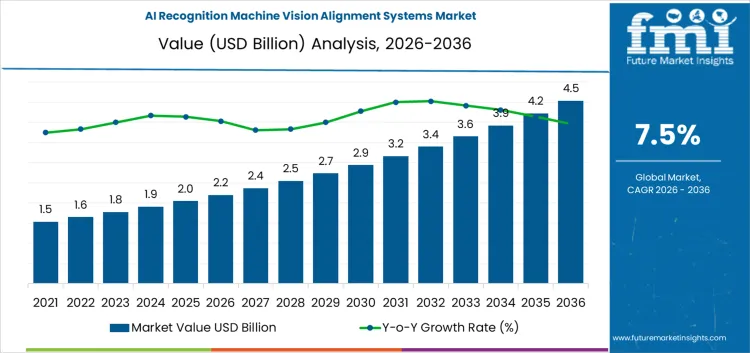
AI Recognition Machine Vision Alignment Systems Market Key Takeaways
| Metric | Value |
|---|---|
| Industry Value (2026) | USD 2.2 Billion |
| Forecast Value (2036) | USD 4.5 Billion |
| Forecast CAGR 2026 to 2036 | 7.50% |
How Is the Global AI Recognition Machine Vision Alignment Systems Market Advancing?
The global AI recognition machine vision alignment systems market is advancing steadily, driven by increasing automation requirements in precision manufacturing and inspection processes. These systems are widely used to enable accurate positioning, alignment, and verification of components in production environments such as electronics assembly, semiconductor fabrication, automotive manufacturing, and industrial automation.
A key driver supporting market growth is the rising demand for high-precision and high-speed production lines. AI-powered machine vision alignment systems use advanced image recognition, pattern matching, and deep learning algorithms to detect alignment deviations in real time, reducing defects and improving throughput. This capability is critical in applications such as PCB assembly, wafer alignment, robotic guidance, and quality inspection, where even minor misalignments can result in product failure.
Technological advancements are further strengthening market adoption. Improvements in camera resolution, edge AI processing, and software algorithms are enhancing detection accuracy and system responsiveness. Integration with robotic systems, motion controllers, and manufacturing execution systems is enabling closed-loop automation and adaptive process control. As manufacturers continue to pursue higher yield, reduced rework, and consistent product quality, the AI recognition machine vision alignment systems market is expected to maintain stable growth over the forecast period.
What Is the Segment-Wise Overview of the AI Recognition Machine Vision Alignment Systems Market?
The AI recognition machine vision alignment systems market is driven by precision manufacturing requirements and high adoption in advanced electronics production. 2D machine vision systems dominate with a 60% share, as they offer reliable alignment, fast processing speeds, and cost-effective deployment for high-throughput industrial environments. These systems are widely used for pattern recognition, positioning, and inspection tasks. By application, semiconductor manufacturing accounts for 30% of demand, reflecting the critical need for ultra-precise alignment during wafer processing, lithography, and packaging operations. Together, these segments highlight a market focused on high-speed, high-accuracy vision systems and strong demand from technology-intensive manufacturing sectors.
Why Do 2D Machine Vision Systems Lead the AI Recognition Machine Vision Alignment Systems Market?
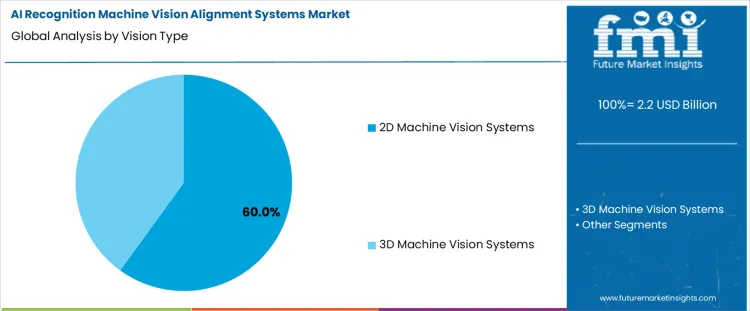
2D machine vision systems account for 60% of the AI recognition machine vision alignment systems market due to their simplicity, reliability, and suitability for most industrial alignment tasks. These systems excel in applications requiring high-speed image capture, pattern matching, and planar alignment, making them ideal for electronics assembly, packaging, and semiconductor processes. Compared to 3D systems, 2D vision solutions are easier to integrate, require lower computational resources, and offer faster processing times. Their proven performance in controlled production environments supports consistent accuracy and repeatability. Advances in AI-based image recognition further enhance defect detection and positioning accuracy. As manufacturers prioritize throughput, cost efficiency, and stable performance, 2D machine vision systems continue to dominate adoption.
How Does Semiconductor Manufacturing Drive Demand in the AI Recognition Machine Vision Alignment Systems Market?
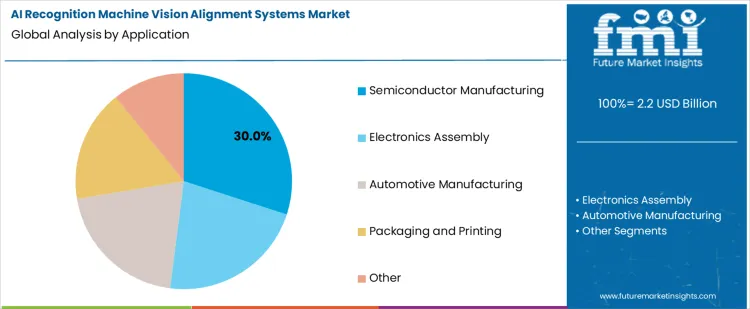
Semiconductor manufacturing represents 30% of application demand, making it the largest end-use segment in the AI recognition machine vision alignment systems market. Chip fabrication and packaging processes require extremely precise alignment to ensure yield and device performance. Machine vision alignment systems are critical for wafer positioning, mask alignment, die bonding, and inspection steps. AI-enhanced recognition improves accuracy by compensating for process variations and material inconsistencies. As semiconductor nodes shrink and packaging complexity increases, alignment tolerances become tighter, increasing reliance on advanced vision systems. Continuous fab expansion and technology upgrades further reinforce semiconductor manufacturing as the primary driver of demand for AI-based machine vision alignment solutions.
What Are the Key Dynamics for the AI Recognition Machine Vision Alignment Systems Market?
The AI recognition machine vision alignment systems market is driven by the increasing need for high-precision positioning, inspection, and alignment in automated manufacturing environments. These systems use AI-powered image recognition and vision algorithms to detect patterns, edges, and reference points for accurate alignment of components during assembly, inspection, and processing. Key market dynamics include rising adoption of industrial automation, demand for micron-level accuracy in electronics and semiconductor manufacturing, and growing use of robotics in production lines. Integration of AI enables faster learning, adaptive correction, and reduced dependency on fixed programming. As manufacturers seek higher throughput and lower defect rates, AI recognition-based alignment systems are becoming critical tools for ensuring consistency and precision across complex, high-speed production processes.
Why Is the AI Recognition Machine Vision Alignment Systems Market Growing?
The AI recognition machine vision alignment system market is growing due to expanding deployment of smart factories and increasing complexity of manufactured products. Industries such as electronics, automotive, medical devices, and precision engineering require reliable alignment of small and intricate components, which manual or rule-based vision systems struggle to achieve. AI-based recognition improves tolerance to variation in lighting, orientation, and component appearance, enhancing alignment accuracy. Growth in semiconductor fabrication, PCB assembly, and battery manufacturing further accelerates demand. Manufacturers are upgrading legacy vision systems with AI-enabled platforms to improve flexibility and reduce retooling time.
How Are the Key Drivers Shaping the AI Recognition Machine Vision Alignment Systems Market?
Key drivers shaping the AI recognition machine vision alignment systems market include advances in deep learning, high-resolution imaging sensors, and real-time processing hardware. AI-driven vision systems can dynamically adjust alignment parameters based on learned patterns, improving yield in variable production environments. Integration with robotic arms, pick-and-place machines, and automated guided systems enhances positioning accuracy and operational efficiency. Increasing use of digital twins and closed-loop feedback systems allows alignment data to directly influence process optimization. OEMs are embedding AI recognition capabilities into turnkey automation solutions, making deployment easier for end users.
What Is the Growth Outlook for the AI Recognition Machine Vision Alignment Systems Market by Country?
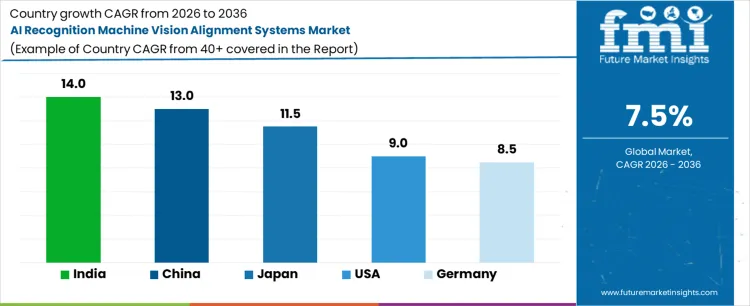
| Country | CAGR (%) |
|---|---|
| India | 14.0% |
| China | 13.0% |
| Japan | 11.5% |
| USA | 9.0% |
| Germany | 8.5% |
The AI recognition machine vision alignment systems market is expanding as manufacturers adopt intelligent automation for precision-driven production. India leads with a 14.0% CAGR, supported by rapid industrial automation and electronics manufacturing growth. China follows at 13.0%, driven by large-scale adoption in high-volume manufacturing. Japan grows at 11.5%, reflecting demand for ultra-precision alignment in advanced industries. The USA records 9.0% growth, supported by smart factory deployment and reshoring efforts. Germany expands at 8.5%, driven by upgrade-led demand in a mature automation landscape. As manufacturing complexity increases, demand for AI-based vision alignment systems is expected to remain strong across regions.
Why Is the AI Recognition Machine Vision Alignment Systems Market Advancing Rapidly in India?
The AI recognition machine vision alignment systems market in India is growing at a CAGR of 14.0%, driven by rapid automation across electronics, automotive components, pharmaceuticals, and packaging manufacturing. Indian factories are adopting vision-based alignment systems to improve precision in assembly, inspection, and robotic guidance tasks. Expansion of electronics manufacturing clusters and contract manufacturing facilities is increasing demand for high-accuracy alignment solutions. Manufacturers are focusing on yield improvement, defect reduction, and throughput optimization, which supports adoption of AI-driven vision systems. Growth of robotics integration in production lines is strengthening demand for alignment systems that adapt to product variation. Rising labor costs and skill shortages are pushing manufacturers toward intelligent automation. Availability of cost-competitive AI vision solutions tailored for mid-scale factories is improving adoption rates. As India accelerates smart manufacturing initiatives, demand for AI recognition-based alignment systems is expected to grow strongly.
What Is Driving AI Recognition Machine Vision Alignment Systems Market Growth in China?
The AI recognition machine vision alignment systems market in China is expanding at a CAGR of 13.0%, supported by large-scale adoption of automation in electronics, semiconductors, and precision manufacturing. High-volume production environments require fast and accurate alignment systems to maintain yield and reduce scrap. Chinese manufacturers are investing in AI-powered vision systems that enable real-time correction and adaptive alignment. Government support for intelligent manufacturing and industrial digitalization is reinforcing adoption. Domestic suppliers are rapidly advancing capabilities in deep learning vision algorithms, improving affordability and performance. Strong demand from consumer electronics, battery manufacturing, and display panel production is driving system deployment. Integration of vision alignment with robotics and automated handling systems is becoming standard across factories. As China continues to optimize manufacturing efficiency and quality, demand for AI recognition machine vision alignment systems is expected to remain strong.
Why Is the AI Recognition Machine Vision Alignment Systems Market Expanding in Japan?
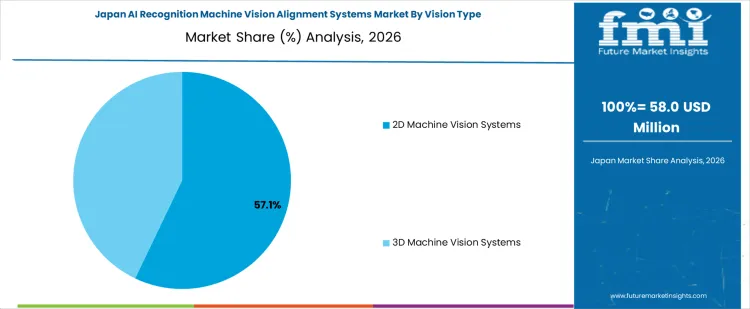
The AI recognition machine vision alignment systems market in Japan is growing at a CAGR of 11.5%, driven by demand for ultra-high precision manufacturing. Japan’s electronics, automotive, and semiconductor equipment industries rely on accurate alignment for miniaturized and complex components. Manufacturers are adopting AI-based vision systems to handle tighter tolerances and variable production conditions. Aging workforce challenges are increasing reliance on automation and intelligent inspection solutions. Japanese factories prioritize process stability, defect prevention, and continuous improvement, supporting adoption of advanced alignment systems. Integration of AI vision with collaborative robots is strengthening deployment in assembly and inspection tasks. Strong emphasis on quality assurance and traceability further supports system upgrades. As Japan continues to lead in precision manufacturing, demand for AI recognition-based machine vision alignment systems is expected to grow steadily.
What Factors Are Supporting AI Recognition Machine Vision Alignment Systems Market Growth in the USA?
The AI recognition machine vision alignment systems market in the USA is expanding at a CAGR of 9.0%, supported by automation adoption across aerospace, medical devices, electronics, and advanced manufacturing. USA manufacturers are deploying AI-based vision alignment systems to improve consistency and reduce manual adjustment requirements. Growth of smart factories and digital production lines is increasing demand for real-time alignment and feedback capabilities. Emphasis on reshoring and high-mix, low-volume manufacturing supports adoption of flexible AI vision solutions. Manufacturers value systems that integrate easily with existing automation and data platforms. Strong focus on productivity improvement and quality compliance reinforces investment in advanced alignment technologies. As automation adoption deepens across industries, demand for AI recognition machine vision alignment systems in the USA is expected to rise steadily.
Why Is the AI Recognition Machine Vision Alignment Systems Market Growing at a Measured Pace in Germany?
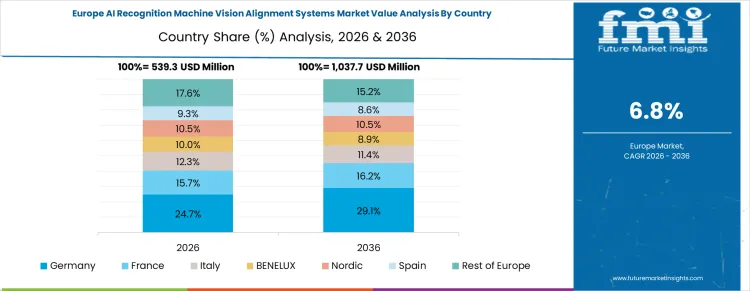
The AI recognition machine vision alignment systems market in Germany is growing at a CAGR of 8.5%, reflecting a mature industrial automation environment. German manufacturers in automotive, machinery, and industrial equipment sectors use vision alignment systems to ensure precision and repeatability. Growth is driven mainly by system upgrades and integration of AI capabilities into existing machine vision platforms. Focus on efficiency, quality assurance, and predictive manufacturing supports adoption of intelligent alignment solutions. Manufacturers prioritize robust systems with long operational life and high reliability. Integration with Industry 4.0 architectures and factory data systems is strengthening value propositions. While new installations are moderate, retrofit demand remains consistent. As Germany continues to enhance advanced manufacturing efficiency, demand for AI recognition machine vision alignment systems is expected to grow steadily.
How Are Companies Competing in the AI Recognition Machine Vision Alignment Systems Market?
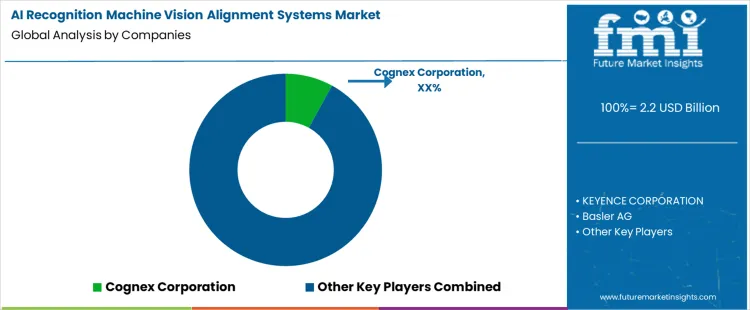
Competition in the AI recognition machine vision alignment systems market is driven by accuracy of pattern detection, real-time processing speed, system robustness, and the ability to adapt to variable production environments. These systems are essential for high-precision alignment, defect inspection, and positioning tasks across electronics, automotive, semiconductor, and packaging industries. Companies compete on AI algorithm sophistication, camera resolution, lighting adaptability, and integration with factory automation and robotics. Differentiation increasingly centers on deep learning-enabled recognition, reduced false-positive rates, edge computing capability, and seamless integration with existing control systems rather than on traditional rule-based vision alone.
Cognex Corporation, KEYENCE CORPORATION, Basler AG, and ISRA VISION GmbH lead competition through advanced imaging technology, strong R&D pipelines, and broad industry adoption. Cognex differentiates with deep learning vision modules, extensive patent portfolios, and edge-optimized processing that accelerate recognition and alignment accuracy in complex production lines. KEYENCE competes through high-speed image acquisition, intuitive configuration interfaces, and compact vision units that minimize setup time and drive strong throughput performance. Basler emphasizes high-resolution cameras, modular vision solutions, and flexible integration into diverse automation platforms. ISRA VISION leverages scalable machine vision systems tailored for precision inspection and alignment, particularly in automotive and high-mix manufacturing.
Zebra Technologies and Teledyne DALSA compete through barcode recognition, code verification systems, and vision analytics that support alignment tasks in warehousing, logistics, and discrete manufacturing. Zebra integrates AI recognition with traceability and scanning ecosystems, enabling alignment validation as part of broader data capture workflows. Teledyne DALSA focuses on specialized sensor technologies and processing solutions that enhance alignment reliability under demanding lighting and motion conditions. Across the market, competitive advantage is defined by recognition accuracy, system responsiveness, AI learning capacity, interoperability with factory systems, and the ability to deliver consistent, high-precision alignment outcomes in dynamic industrial settings.
Key Players in AI Recognition Machine Vision Alignment Systems Market
- Cognex Corporation
- KEYENCE CORPORATION
- Basler AG
- ISRA VISION GmbH
- Zebra Technologies
- Teledyne DALSA
Scope of Report
| Attributes | Description |
|---|---|
| Quantitative Unit (2026) | USD Billion |
| Vision Type | 2D Machine Vision Systems, 3D Machine Vision Systems |
| Application | Semiconductor Manufacturing, Electronics Assembly, Automotive Manufacturing, Packaging and Printing, Other |
| Regions Covered | Asia Pacific, Europe, North America, Latin America, Middle East & Africa |
| Countries Covered | China, Japan, South Korea, India, Australia & New Zealand, ASEAN, Rest of Asia Pacific, Germany, United Kingdom, France, Italy, Spain, Nordic, BENELUX, Rest of Europe, United States, Canada, Mexico, Brazil, Chile, Rest of Latin America, Kingdom of Saudi Arabia, Other GCC Countries, Turkey, South Africa, Other African Union, Rest of Middle East & Africa |
| Key Companies Profiled | Cognex Corporation, KEYENCE CORPORATION, Basler AG, ISRA VISION GmbH, Zebra Technologies, Teledyne DALSA |
| Additional Attributes | Dollar sales by vision type and application; regional market size and forecast analysis; growth outlook across major regions; adoption trends for AI-enabled machine vision alignment systems; assessment of accuracy requirements, inspection speed, and demand patterns across semiconductor fabs, electronics assembly lines, automotive production, and packaging operations. |
AI Recognition Machine Vision Alignment Systems Market by Key Segments
Vision Type:
- 2D Machine Vision Systems
- 3D Machine Vision Systems
Application:
- Semiconductor Manufacturing
- Electronics Assembly
- Automotive Manufacturing
- Packaging and Printing
- Other
Region:
- Asia Pacific
- China
- Japan
- South Korea
- India
- Australia & New Zealand
- ASEAN
- Rest of Asia Pacific
- Europe
- Germany
- United Kingdom
- France
- Italy
- Spain
- Nordic
- BENELUX
- Rest of Europe
- North America
- United States
- Canada
- Mexico
- Latin America
- Brazil
- Chile
- Rest of Latin America
- Middle East & Africa
- Kingdom of Saudi Arabia
- Other GCC Countries
- Turkey
- South Africa
- Other African Union
- Rest of Middle East & Africa
Bibliography
- National Institute of Standards and Technology. (2023, January). Artificial intelligence risk management framework (AI RMF 1.0). U.S. Department of Commerce.
- Teledyne DALSA. (2023, December 14). Teledyne DALSA Genie Nano-10GigE cameras in full production. Teledyne DALSA.
- Association for Advancing Automation. (2024, October 18). Designing a robust GigE Vision camera system. A3.
Frequently Asked Questions
How big is the AI recognition machine vision alignment systems market in 2026?
The global AI recognition machine vision alignment systems market is estimated to be valued at USD 2.2 billion in 2026.
What will be the size of AI recognition machine vision alignment systems market in 2036?
The market size for the AI recognition machine vision alignment systems market is projected to reach USD 4.5 billion by 2036.
How much will be the AI recognition machine vision alignment systems market growth between 2026 and 2036?
The AI recognition machine vision alignment systems market is expected to grow at a 7.5% CAGR between 2026 and 2036.
What are the key product types in the AI recognition machine vision alignment systems market?
The key product types in AI recognition machine vision alignment systems market are 2d machine vision systems and 3d machine vision systems.
Which application segment to contribute significant share in the AI recognition machine vision alignment systems market in 2026?
In terms of application, semiconductor manufacturing segment to command 30.0% share in the AI recognition machine vision alignment systems market in 2026.
Preview the report firsthand - request a free sample
Get SampleGet the brochure for pricing and purchase details.
Get PDFTable of Content
- Executive Summary
- Global Market Outlook
- Demand-side Trends
- Supply-side Trends
- Technology Roadmap Analysis
- Analysis and Recommendations
- Market Overview
- Market Coverage / Taxonomy
- Market Definition / Scope / Limitations
- Market Background
- Market Dynamics
- Drivers
- Restraints
- Opportunity
- Trends
- Scenario Forecast
- Demand in Optimistic Scenario
- Demand in Likely Scenario
- Demand in Conservative Scenario
- Opportunity Map Analysis
- Product Life Cycle Analysis
- Supply Chain Analysis
- Investment Feasibility Matrix
- Value Chain Analysis
- PESTLE and Porter’s Analysis
- Regulatory Landscape
- Regional Parent Market Outlook
- Production and Consumption Statistics
- Import and Export Statistics
- Market Dynamics
- Global Market Analysis 2021 to 2025 and Forecast, 2026 to 2036
- Historical Market Size Value (USD Million) Analysis, 2021 to 2025
- Current and Future Market Size Value (USD Million) Projections, 2026 to 2036
- Y-o-Y Growth Trend Analysis
- Absolute $ Opportunity Analysis
- Global Market Pricing Analysis 2021 to 2025 and Forecast 2026 to 2036
- Global Market Analysis 2021 to 2025 and Forecast 2026 to 2036, By Vision Type
- Introduction / Key Findings
- Historical Market Size Value (USD Million) Analysis By Vision Type, 2021 to 2025
- Current and Future Market Size Value (USD Million) Analysis and Forecast By Vision Type, 2026 to 2036
- 2D Machine Vision Systems
- 3D Machine Vision Systems
- 2D Machine Vision Systems
- Y-o-Y Growth Trend Analysis By Vision Type, 2021 to 2025
- Absolute $ Opportunity Analysis By Vision Type, 2026 to 2036
- Global Market Analysis 2021 to 2025 and Forecast 2026 to 2036, By Application
- Introduction / Key Findings
- Historical Market Size Value (USD Million) Analysis By Application, 2021 to 2025
- Current and Future Market Size Value (USD Million) Analysis and Forecast By Application, 2026 to 2036
- Semiconductor Manufacturing
- Electronics Assembly
- Automotive Manufacturing
- Packaging and Printing
- Other
- Semiconductor Manufacturing
- Y-o-Y Growth Trend Analysis By Application, 2021 to 2025
- Absolute $ Opportunity Analysis By Application, 2026 to 2036
- Global Market Analysis 2021 to 2025 and Forecast 2026 to 2036, By Region
- Introduction
- Historical Market Size Value (USD Million) Analysis By Region, 2021 to 2025
- Current Market Size Value (USD Million) Analysis and Forecast By Region, 2026 to 2036
- North America
- Latin America
- Western Europe
- Eastern Europe
- East Asia
- South Asia and Pacific
- Middle East & Africa
- Market Attractiveness Analysis By Region
- North America Market Analysis 2021 to 2025 and Forecast 2026 to 2036, By Country
- Historical Market Size Value (USD Million) Trend Analysis By Market Taxonomy, 2021 to 2025
- Market Size Value (USD Million) Forecast By Market Taxonomy, 2026 to 2036
- By Country
- USA
- Canada
- Mexico
- By Vision Type
- By Application
- By Country
- Market Attractiveness Analysis
- By Country
- By Vision Type
- By Application
- Key Takeaways
- Latin America Market Analysis 2021 to 2025 and Forecast 2026 to 2036, By Country
- Historical Market Size Value (USD Million) Trend Analysis By Market Taxonomy, 2021 to 2025
- Market Size Value (USD Million) Forecast By Market Taxonomy, 2026 to 2036
- By Country
- Brazil
- Chile
- Rest of Latin America
- By Vision Type
- By Application
- By Country
- Market Attractiveness Analysis
- By Country
- By Vision Type
- By Application
- Key Takeaways
- Western Europe Market Analysis 2021 to 2025 and Forecast 2026 to 2036, By Country
- Historical Market Size Value (USD Million) Trend Analysis By Market Taxonomy, 2021 to 2025
- Market Size Value (USD Million) Forecast By Market Taxonomy, 2026 to 2036
- By Country
- Germany
- UK
- Italy
- Spain
- France
- Nordic
- BENELUX
- Rest of Western Europe
- By Vision Type
- By Application
- By Country
- Market Attractiveness Analysis
- By Country
- By Vision Type
- By Application
- Key Takeaways
- Eastern Europe Market Analysis 2021 to 2025 and Forecast 2026 to 2036, By Country
- Historical Market Size Value (USD Million) Trend Analysis By Market Taxonomy, 2021 to 2025
- Market Size Value (USD Million) Forecast By Market Taxonomy, 2026 to 2036
- By Country
- Russia
- Poland
- Hungary
- Balkan & Baltic
- Rest of Eastern Europe
- By Vision Type
- By Application
- By Country
- Market Attractiveness Analysis
- By Country
- By Vision Type
- By Application
- Key Takeaways
- East Asia Market Analysis 2021 to 2025 and Forecast 2026 to 2036, By Country
- Historical Market Size Value (USD Million) Trend Analysis By Market Taxonomy, 2021 to 2025
- Market Size Value (USD Million) Forecast By Market Taxonomy, 2026 to 2036
- By Country
- China
- Japan
- South Korea
- By Vision Type
- By Application
- By Country
- Market Attractiveness Analysis
- By Country
- By Vision Type
- By Application
- Key Takeaways
- South Asia and Pacific Market Analysis 2021 to 2025 and Forecast 2026 to 2036, By Country
- Historical Market Size Value (USD Million) Trend Analysis By Market Taxonomy, 2021 to 2025
- Market Size Value (USD Million) Forecast By Market Taxonomy, 2026 to 2036
- By Country
- India
- ASEAN
- Australia & New Zealand
- Rest of South Asia and Pacific
- By Vision Type
- By Application
- By Country
- Market Attractiveness Analysis
- By Country
- By Vision Type
- By Application
- Key Takeaways
- Middle East & Africa Market Analysis 2021 to 2025 and Forecast 2026 to 2036, By Country
- Historical Market Size Value (USD Million) Trend Analysis By Market Taxonomy, 2021 to 2025
- Market Size Value (USD Million) Forecast By Market Taxonomy, 2026 to 2036
- By Country
- Kingdom of Saudi Arabia
- Other GCC Countries
- Turkiye
- South Africa
- Other African Union
- Rest of Middle East & Africa
- By Vision Type
- By Application
- By Country
- Market Attractiveness Analysis
- By Country
- By Vision Type
- By Application
- Key Takeaways
- Key Countries Market Analysis
- USA
- Pricing Analysis
- Market Share Analysis, 2025
- By Vision Type
- By Application
- Canada
- Pricing Analysis
- Market Share Analysis, 2025
- By Vision Type
- By Application
- Mexico
- Pricing Analysis
- Market Share Analysis, 2025
- By Vision Type
- By Application
- Brazil
- Pricing Analysis
- Market Share Analysis, 2025
- By Vision Type
- By Application
- Chile
- Pricing Analysis
- Market Share Analysis, 2025
- By Vision Type
- By Application
- Germany
- Pricing Analysis
- Market Share Analysis, 2025
- By Vision Type
- By Application
- UK
- Pricing Analysis
- Market Share Analysis, 2025
- By Vision Type
- By Application
- Italy
- Pricing Analysis
- Market Share Analysis, 2025
- By Vision Type
- By Application
- Spain
- Pricing Analysis
- Market Share Analysis, 2025
- By Vision Type
- By Application
- France
- Pricing Analysis
- Market Share Analysis, 2025
- By Vision Type
- By Application
- India
- Pricing Analysis
- Market Share Analysis, 2025
- By Vision Type
- By Application
- ASEAN
- Pricing Analysis
- Market Share Analysis, 2025
- By Vision Type
- By Application
- Australia & New Zealand
- Pricing Analysis
- Market Share Analysis, 2025
- By Vision Type
- By Application
- China
- Pricing Analysis
- Market Share Analysis, 2025
- By Vision Type
- By Application
- Japan
- Pricing Analysis
- Market Share Analysis, 2025
- By Vision Type
- By Application
- South Korea
- Pricing Analysis
- Market Share Analysis, 2025
- By Vision Type
- By Application
- Russia
- Pricing Analysis
- Market Share Analysis, 2025
- By Vision Type
- By Application
- Poland
- Pricing Analysis
- Market Share Analysis, 2025
- By Vision Type
- By Application
- Hungary
- Pricing Analysis
- Market Share Analysis, 2025
- By Vision Type
- By Application
- Kingdom of Saudi Arabia
- Pricing Analysis
- Market Share Analysis, 2025
- By Vision Type
- By Application
- Turkiye
- Pricing Analysis
- Market Share Analysis, 2025
- By Vision Type
- By Application
- South Africa
- Pricing Analysis
- Market Share Analysis, 2025
- By Vision Type
- By Application
- USA
- Market Structure Analysis
- Competition Dashboard
- Competition Benchmarking
- Market Share Analysis of Top Players
- By Regional
- By Vision Type
- By Application
- Competition Analysis
- Competition Deep Dive
- Cognex Corporation
- Overview
- Product Portfolio
- Profitability by Market Segments (Product/Age /Sales Channel/Region)
- Sales Footprint
- Strategy Overview
- Marketing Strategy
- Product Strategy
- Channel Strategy
- KEYENCE CORPORATION
- Basler AG
- ISRA VISION GmbH
- Zebra Technologies
- Teledyne DALSA
- Cognex Corporation
- Competition Deep Dive
- Assumptions & Acronyms Used
- Research Methodology


