

- Industry Size (2026)
- USD 4.6 Bn
- Forecast (2036)
- USD 12.8 Bn
- CAGR (2026 to 2036)
- 10.8%
Marine Propulsion Low-Carbon Ammonia Market Forecast and Outlook 2026 to 2036
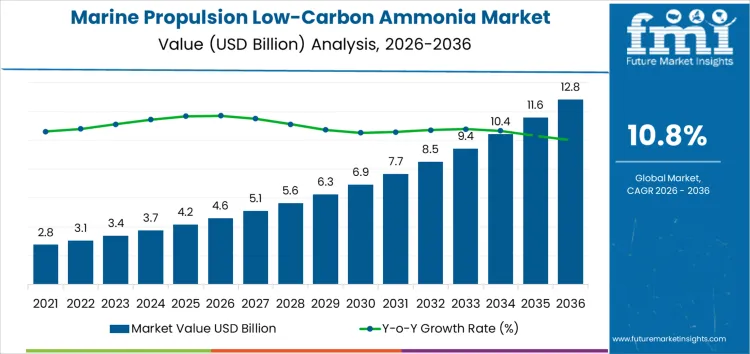
The global marine propulsion low-carbon ammonia market is valued at USD 4.6 billion in 2026 and is expected to reach USD 12.8 billion by 2036, growing at a CAGR of 10.8%. Capital intensity plays a crucial role in the expansion of this market, as significant investments are required in both the development of ammonia-powered propulsion systems and the infrastructure needed for fuel production and storage. Return timelines are typically long, with projects requiring years of development and regulatory alignment before yielding substantial returns.
As the maritime sector increasingly embraces sustainability goals, the demand for low-carbon fuels like ammonia presents a promising investment opportunity. Selective investment in innovative technologies, such as ammonia combustion optimization and green ammonia production, will be key to capturing value in this evolving market. Investors should focus on companies with a strong track record of regulatory compliance, technological advancements, and a strategic vision aligned with the industry's decarbonization goals.
Quick Stats for Marine Propulsion Low-Carbon Ammonia Market
- Marine Propulsion Low-Carbon Ammonia Market Value (2026): USD 4.6 Billion
- Marine Propulsion Low-Carbon Ammonia Market Forecast Value (2036): USD 12.8 Billion
- Marine Propulsion Low-Carbon Ammonia Market Forecast CAGR 2026 to 2036: 10.8%
- Leading Fuel Type in Marine Propulsion Low-Carbon Ammonia Market: Low-Carbon Ammonia
- Key Growth Regions in Marine Propulsion Low-Carbon Ammonia Market: North America, Europe, Asia Pacific
- Top Key Players in Marine Propulsion Low-Carbon Ammonia Market: Yara International, Japan Engine Corporation (J‑ENG), MAN Energy Solutions, Wärtsilä Corporation, Mitsubishi Heavy Industries
Marine Propulsion Low-Carbon Ammonia Market Key Takeaways
| Metric | Value |
|---|---|
| Industry Value (2026) | USD 4.6 Billion |
| Forecast Value (2036) | USD 12.8 Billion |
| Forecast CAGR 2026 to 2036 | 10.8% |
How Is the Global Marine Propulsion Low-Carbon Ammonia Market Advancing?
The global marine propulsion low-carbon ammonia market is witnessing significant growth, driven by the increasing push for decarbonization in the maritime industry. As the shipping sector works to meet global emissions reduction targets, low-carbon ammonia is emerging as a key alternative fuel for marine propulsion systems. Ammonia, when produced from renewable sources, offers a low-carbon solution for powering ships, as it contains no carbon atoms and emits no CO2 when burned in engines.
A major driver of the market is the growing regulatory pressure on the shipping industry to reduce greenhouse gas emissions. International regulations such as the International Maritime Organization’s (IMO) stricter sulfur content limits and carbon intensity goals are pushing maritime operators to seek alternative, cleaner fuels. Low-carbon ammonia presents a viable option due to its high energy density and potential to be produced using renewable energy sources, thus aligning with the industry's sustainability goals.
Technological advancements in ammonia combustion engines and fuel cells are also contributing to the growth of this market. Research and development efforts are focused on optimizing ammonia-powered engines and overcoming challenges related to ammonia’s corrosiveness and storage requirements. The development of ammonia production methods, such as green ammonia, which is produced using renewable energy sources, is expected to accelerate the adoption of this fuel in the maritime sector. As the demand for cleaner maritime fuels rises, the low-carbon ammonia market is poised for continued growth, providing a key solution for the shipping industry's transition to a low-carbon future.
What Is the Segment-Wise Analysis for the Marine Propulsion Low-Carbon Ammonia Market?
The marine propulsion low-carbon ammonia market is segmented by fuel type and end-user. Low-carbon ammonia leads the fuel type segment with a 46.5% share, followed by ammonia-hydrogen blends, green hydrogen, and other fuel types. Low-carbon ammonia is increasingly being used as an eco-friendly alternative to traditional marine fuels due to its ability to significantly reduce carbon emissions. In terms of end-users, commercial shipping holds the largest share at 46.9%, followed by offshore support vessels, cruise & passenger liners, naval & defense, and other sectors. The growing demand for eco-friendly fuel options in the maritime industry is driving the adoption of low-carbon ammonia and related fuel types across these applications.
Why Does Low-Carbon Ammonia Lead the Marine Propulsion Market?
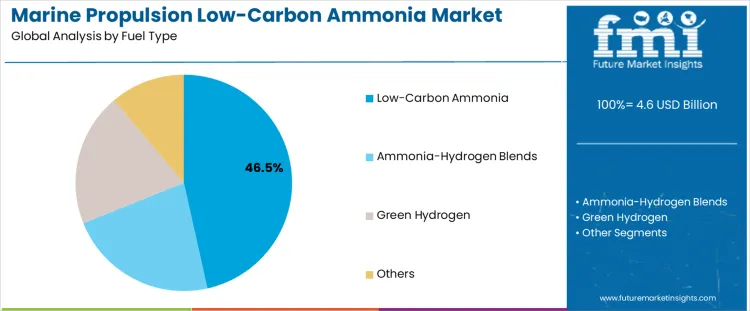
Low-carbon ammonia leads the marine propulsion fuel market with a 46.5% share due to its potential as an eco-friendly alternative to traditional marine fuels. It can be used in existing combustion engines or fuel cells and has the advantage of being carbon-neutral when produced from renewable sources. As the maritime industry seeks to reduce its carbon emissions in response to global environmental regulations, low-carbon ammonia is increasingly seen as a viable solution. Its ability to be stored and transported similarly to traditional fuels, along with the significant reduction in greenhouse gas emissions, drives its dominance in the market, especially in commercial shipping.
How Does Commercial Shipping Contribute to the Marine Propulsion Low-Carbon Ammonia Market?
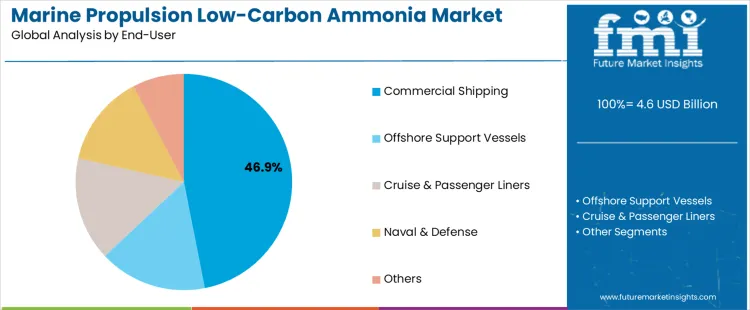
Commercial shipping accounts for 46.9% of the end-user segment in the marine propulsion low-carbon ammonia market. The shipping industry, a major contributor to global emissions, is under increasing pressure to adopt cleaner, eco-friendlier fuels. Low-carbon ammonia offers a promising solution, as it can significantly reduce carbon emissions when used in marine propulsion systems. The push for more environmentally friendly shipping solutions, alongside regulatory pressures to comply with decarbonization targets, has led commercial shipping companies to adopt low-carbon ammonia as a fuel source. This trend is expected to drive continued growth in the market, as shipping companies increasingly invest in eco-friendly fuel technologies.
What Are the Key Dynamics for the Marine Propulsion Low-Carbon Ammonia Market?
The marine propulsion low-carbon ammonia market is driven by the global push for decarbonization in the shipping industry. Ammonia is emerging as a promising alternative fuel for marine propulsion due to its potential to significantly reduce greenhouse gas emissions compared to conventional marine fuels like heavy fuel oil. As regulations such as the International Maritime Organization's (IMO) decarbonization targets for 2050 tighten, the demand for eco-friendly marine fuels, including low-carbon ammonia, is increasing. Ammonia's high energy density, carbon-free combustion, and the growing interest in alternative fuels are propelling the market's growth.
Why Is the Marine Propulsion Low-Carbon Ammonia Market Growing?
The growth of the marine propulsion low-carbon ammonia market is driven by the shipping industry's need to comply with stringent environmental regulations and reduce its carbon footprint. The IMO’s ambitious target to reduce carbon emissions from international shipping by 50% by 2050 is a major factor driving the adoption of alternative fuels like ammonia. Ammonia, which can be produced using renewable energy sources, offers a zero-carbon emission solution when combusted. The increasing focus on sustainability, coupled with ammonia's potential for scalable production, is further accelerating the transition toward low-carbon fuels in marine propulsion systems.
How Are the Key Drivers Shaping the Marine Propulsion Low-Carbon Ammonia Market?
Key drivers shaping the marine propulsion low-carbon ammonia market include the growing regulatory pressure on the shipping industry to reduce its greenhouse gas emissions. As ammonia can be synthesized from renewable energy sources, it provides an ideal low-carbon alternative to traditional marine fuels. Technological advancements in ammonia-based propulsion systems are enhancing their viability, enabling ships to operate more efficiently with reduced environmental impact. The increasing investment in ammonia fuel infrastructure, such as bunkering stations and storage facilities, is improving its adoption, making it a feasible solution for commercial maritime fleets seeking to meet environmental standards.
What is the Growth Outlook for the Marine Propulsion Low-Carbon Ammonia Market by Country?
| Country | CAGR (%) |
|---|---|
| Norway | 12.1% |
| Japan | 11.6% |
| South Korea | 11.4% |
| China | 10.9% |
| USA | 10.7% |
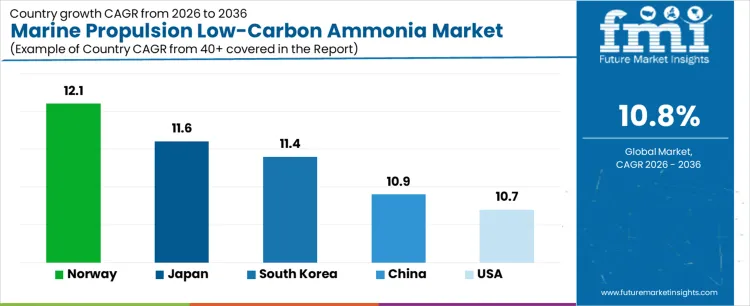
The marine propulsion low-carbon ammonia market is experiencing strong growth across key regions. Norway leads at 12.1%, driven by its commitment to sustainability and green shipping technologies. Japan follows at 11.6%, fueled by government initiatives and its goal of achieving carbon neutrality by 2050. South Korea grows at 11.4%, supported by its maritime industry’s focus on green fuel alternatives and emission reductions. China’s market expands at 10.9%, driven by its need to meet international emissions targets and the growing adoption of ammonia as an eco-friendly marine fuel. The USA grows at 10.7%, supported by regulatory frameworks, technological advancements, and the need for cleaner shipping solutions.
What is Driving the Growth of the Marine Propulsion Low-Carbon Ammonia Market in Norway?
Norway’s marine propulsion low-carbon ammonia market is growing at 12.1%, driven by the country’s strong commitment to sustainability and decarbonizing its maritime sector. As one of the world’s leaders in green technology, Norway is investing heavily in renewable energy solutions, including low-carbon ammonia, to reduce carbon emissions from marine propulsion systems. Norway’s maritime industry, particularly in shipping, is increasingly adopting low-carbon ammonia as a fuel alternative, in line with the country’s ambitious carbon neutrality goals. The Norwegian government’s policies promoting green shipping technologies, coupled with international initiatives aimed at reducing emissions in maritime transport, are further accelerating the market’s growth. As the demand for cleaner, eco-friendlier fuel options grows, Norway continues to lead the charge in the development and adoption of low-carbon ammonia in the marine propulsion industry.
How is the Marine Propulsion Low-Carbon Ammonia Market Expanding in Japan?
Japan’s marine propulsion low-carbon ammonia market is growing at 11.6%, driven by the country’s strong focus on sustainability and innovation in the maritime sector. As Japan moves toward achieving its carbon neutrality goals by 2050, there is growing interest in low-carbon ammonia as a viable marine fuel alternative. The Japanese government has introduced various initiatives to support the development of green technologies, including funding for low-carbon ammonia projects. Japan’s large shipping industry is investing in alternative propulsion systems that use ammonia, which has the potential to drastically reduce emissions. The country’s ongoing technological advancements in ammonia production and utilization in marine propulsion, combined with strong regulatory support, are contributing to market growth. As Japan strengthens its position in the global transition to low-carbon maritime fuels, the demand for low-carbon ammonia will continue to rise.
How is the Marine Propulsion Low-Carbon Ammonia Market Expanding in South Korea?
South Korea’s marine propulsion low-carbon ammonia market is growing at 11.4%, supported by the country’s emphasis on green shipping and reducing carbon emissions from maritime transport. South Korea, a leader in shipbuilding and maritime technology, is investing heavily in low-carbon ammonia as a fuel alternative to help meet both domestic and international emissions targets. The government’s commitment to sustainability and carbon neutrality, along with its strong maritime industry, is driving the adoption of low-carbon ammonia in marine propulsion systems. South Korea’s shipping companies are increasingly exploring ammonia-powered vessels to meet new global environmental standards, particularly in Europe and other regions with stringent emission regulations. As technological advancements in ammonia production and propulsion continue to improve, South Korea’s market for low-carbon ammonia in marine propulsion is expected to expand further.
What is Driving the Growth of the Marine Propulsion Low-Carbon Ammonia Market in China?
China’s marine propulsion low-carbon ammonia market is growing at 10.9%, driven by the country’s ambitious green energy targets and growing need for eco-friendly fuel alternatives in the maritime sector. As the world’s largest emitter of CO2, China is under increasing pressure to reduce emissions, and the adoption of low-carbon ammonia is seen as a key solution for achieving this goal in its rapidly expanding maritime industry. The government’s strong support for green shipping technologies, along with growing interest from Chinese shipbuilders and shipping companies, is accelerating the use of ammonia as a marine fuel. China’s commitment to environmental sustainability and its push for innovation in clean energy solutions are significant drivers of market growth. As the demand for low-carbon fuels increases globally, China’s market for marine propulsion low-carbon ammonia is expected to grow steadily, supported by both regulatory frameworks and industry advancements.
How is the Marine Propulsion Low-Carbon Ammonia Market Expanding in the USA?
The marine propulsion low-carbon ammonia market in the USA is growing at 10.7%, driven by a strong push toward decarbonization in the maritime sector. The USA’s regulatory frameworks, particularly its commitment to the International Maritime Organization’s emission reduction targets, are encouraging the adoption of low-carbon ammonia as an alternative marine fuel. The USA shipping industry, along with private stakeholders and energy companies, is investing in ammonia-powered propulsion technologies to meet sustainability goals and regulatory requirements. Technological advancements in ammonia production, storage, and propulsion systems, combined with government incentives and industry support for clean energy initiatives, are fueling the growth of this market. As the USA works towards reducing its carbon footprint and transitioning to cleaner energy sources, the demand for low-carbon ammonia in marine propulsion will continue to rise.
How Are Companies Competing in the Marine Propulsion Low Carbon Ammonia Market?
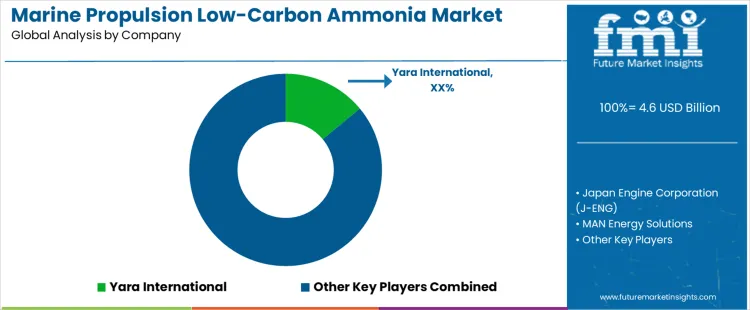
Competition in the Marine Propulsion Low Carbon Ammonia Market is driven by fuel system integration, combustion optimization, emissions reduction performance, safety handling protocols, and scalability for commercial fleets. Yara International positions itself as a leading provider of low carbon ammonia fuels and related supply solutions, with product materials emphasizing consistent fuel quality, compatibility with maritime bunkering standards, and alignment with decarbonization goals. Japan Engine Corporation (J-ENG) competes by developing ammonia capable marine engines designed to burn ammonia efficiently with minimized NOx and particulates, and its collateral highlights modular design and retrofittable features tailored to existing ship platforms.
MAN Energy Solutions and Wärtsilä Corporation differentiate through engine and propulsion systems engineered for flexible fuel operation and optimized combustion control, marketed for reduced carbon footprints and compliance with emerging marine emissions regulations. Their product materials stress fuel injection precision, thermal stability, and integration with hybrid power systems that support ammonia adoption in large commercial vessels. Mitsubishi Heavy Industries adds value by combining large bore engine technology with fuel system adaptations that enable high efficiency ammonia use in demanding marine applications, with documentation emphasizing reliability and multi fuel flexibility.
Others in the market contribute with niche engine components, ammonia handling and storage systems, and retrofit solutions that help shipowners transition toward low carbon propulsion. Across all vendors, product literature underscores emission performance, fuel compatibility, safety protocols, and integration readiness as key differentiators that help stakeholders adopt low carbon ammonia solutions while meeting operational and regulatory demands.
Key Players in Marine Propulsion Low-Carbon Ammonia Market
- Yara International
- Japan Engine Corporation (J‑ENG)
- MAN Energy Solutions
- Wärtsilä Corporation
- Mitsubishi Heavy Industries
- Others
Scope of Report
| Attributes | Description |
|---|---|
| Quantitative Unit (2026) | USD Billion |
| Fuel Type | Low Carbon Ammonia, Ammonia Hydrogen Blends, Green Hydrogen, Others |
| End-User | Commercial Shipping, Offshore Support Vessels, Cruise & Passenger Liners, Naval & Defense, Others |
| Regions Covered | Asia Pacific, Europe, North America, Latin America, Middle East & Africa |
| Countries Covered | China, Japan, South Korea, India, Australia & New Zealand, ASEAN, Germany, United Kingdom, France, Italy, Spain, Nordic, BENELUX, United States, Canada, Mexico, Brazil, Chile, Turkey, South Africa, Other GCC Countries |
| Key Companies Profiled | Yara International, Japan Engine Corporation (J ENG), MAN Energy Solutions, Wärtsilä Corporation, Mitsubishi Heavy Industries, Others |
| Additional Attributes | Dollar sales by fuel type and end-user; regional CAGR and growth outlook for the marine propulsion low-carbon ammonia market. |
Marine Propulsion Low-Carbon Ammonia Market by Key Segments
Fuel Type
- Low‑Carbon Ammonia
- Ammonia‑Hydrogen Blends
- Green Hydrogen
- Others
End‑User
- Commercial Shipping
- Offshore Support Vessels
- Cruise & Passenger Liners
- Naval & Defense
- Others
Region
- Asia Pacific
- China
- Japan
- South Korea
- India
- Australia & New Zealand
- ASEAN
- Rest of Asia Pacific
- Europe
- Germany
- United Kingdom
- France
- Italy
- Spain
- Nordic
- BENELUX
- Rest of Europe
- North America
- United States
- Canada
- Mexico
- Latin America
- Brazil
- Chile
- Rest of Latin America
- Middle East & Africa
- Kingdom of Saudi Arabia
- Other GCC Countries
- Turkey
- South Africa
- Other African Union
- Rest of Middle East & Africa
Bibliography
- International Maritime Organization (IMO). (2023). MARPOL Annex VI: Regulations for the Prevention of Air Pollution from Ships — Amendments on Greenhouse Gas and Ammonia-Fuel Provisions. IMO Publications.
- International Energy Agency (IEA). (2024). Ammonia as a Marine Fuel: Energy Technology Perspectives for Decarbonizing Global Shipping. IEA Publications.
- International Renewable Energy Agency (IRENA). (2023). Innovation Outlook: Ammonia as an Energy Carrier for Maritime Transport. IRENA Publications.
- European Commission. (2024). FuelEU Maritime Regulation (EU) 2024/1123 — Promoting the Use of Renewable and Low-Carbon Fuels in Maritime Transport. Publications Office of the European Union.
- U.S. Department of Energy (DOE). (2023). Pathways to Commercial Liftoff: Clean Ammonia for Energy and Marine Propulsion Applications. Office of Energy Efficiency and Renewable Energy (EERE).
Frequently Asked Questions
How big is the marine propulsion low-carbon ammonia market in 2026?
The global marine propulsion low-carbon ammonia market is estimated to be valued at USD 4.6 billion in 2026.
What will be the size of marine propulsion low-carbon ammonia market in 2036?
The market size for the marine propulsion low-carbon ammonia market is projected to reach USD 12.8 billion by 2036.
How much will be the marine propulsion low-carbon ammonia market growth between 2026 and 2036?
The marine propulsion low-carbon ammonia market is expected to grow at a 10.8% CAGR between 2026 and 2036.
What are the key product types in the marine propulsion low-carbon ammonia market?
The key product types in marine propulsion low-carbon ammonia market are low‑carbon ammonia, ammonia‑hydrogen blends, green hydrogen and others.
Which end‑user segment to contribute significant share in the marine propulsion low-carbon ammonia market in 2026?
In terms of end‑user, commercial shipping segment to command 46.9% share in the marine propulsion low-carbon ammonia market in 2026.
Preview the report firsthand - request a free sample
Get SampleGet the brochure for pricing and purchase details.
Get PDFTable of Content
- Executive Summary
- Global Market Outlook
- Demand-side Trends
- Supply-side Trends
- Technology Roadmap Analysis
- Analysis and Recommendations
- Market Overview
- Market Coverage / Taxonomy
- Market Definition / Scope / Limitations
- Market Background
- Market Dynamics
- Drivers
- Restraints
- Opportunity
- Trends
- Scenario Forecast
- Demand in Optimistic Scenario
- Demand in Likely Scenario
- Demand in Conservative Scenario
- Opportunity Map Analysis
- Product Life Cycle Analysis
- Supply Chain Analysis
- Investment Feasibility Matrix
- Value Chain Analysis
- PESTLE and Porter’s Analysis
- Regulatory Landscape
- Regional Parent Market Outlook
- Production and Consumption Statistics
- Import and Export Statistics
- Market Dynamics
- Global Market Analysis 2021 to 2025 and Forecast, 2026 to 2036
- Historical Market Size Value (USD Million) Analysis, 2021 to 2025
- Current and Future Market Size Value (USD Million) Projections, 2026 to 2036
- Y-o-Y Growth Trend Analysis
- Absolute $ Opportunity Analysis
- Global Market Pricing Analysis 2021 to 2025 and Forecast 2026 to 2036
- Global Market Analysis 2021 to 2025 and Forecast 2026 to 2036, By Fuel Type
- Introduction / Key Findings
- Historical Market Size Value (USD Million) Analysis By Fuel Type , 2021 to 2025
- Current and Future Market Size Value (USD Million) Analysis and Forecast By Fuel Type , 2026 to 2036
- Low‑Carbon Ammonia
- Ammonia‑Hydrogen Blends
- Green Hydrogen
- Others
- Low‑Carbon Ammonia
- Y-o-Y Growth Trend Analysis By Fuel Type , 2021 to 2025
- Absolute $ Opportunity Analysis By Fuel Type , 2026 to 2036
- Global Market Analysis 2021 to 2025 and Forecast 2026 to 2036, By End‑User
- Introduction / Key Findings
- Historical Market Size Value (USD Million) Analysis By End‑User, 2021 to 2025
- Current and Future Market Size Value (USD Million) Analysis and Forecast By End‑User, 2026 to 2036
- Commercial Shipping
- Offshore Support Vessels
- Cruise & Passenger Liners
- Naval & Defense
- Others
- Commercial Shipping
- Y-o-Y Growth Trend Analysis By End‑User, 2021 to 2025
- Absolute $ Opportunity Analysis By End‑User, 2026 to 2036
- Global Market Analysis 2021 to 2025 and Forecast 2026 to 2036, By Region
- Introduction
- Historical Market Size Value (USD Million) Analysis By Region, 2021 to 2025
- Current Market Size Value (USD Million) Analysis and Forecast By Region, 2026 to 2036
- North America
- Latin America
- Western Europe
- Eastern Europe
- East Asia
- South Asia and Pacific
- Middle East & Africa
- Market Attractiveness Analysis By Region
- North America Market Analysis 2021 to 2025 and Forecast 2026 to 2036, By Country
- Historical Market Size Value (USD Million) Trend Analysis By Market Taxonomy, 2021 to 2025
- Market Size Value (USD Million) Forecast By Market Taxonomy, 2026 to 2036
- By Country
- USA
- Canada
- Mexico
- By Fuel Type
- By End‑User
- By Country
- Market Attractiveness Analysis
- By Country
- By Fuel Type
- By End‑User
- Key Takeaways
- Latin America Market Analysis 2021 to 2025 and Forecast 2026 to 2036, By Country
- Historical Market Size Value (USD Million) Trend Analysis By Market Taxonomy, 2021 to 2025
- Market Size Value (USD Million) Forecast By Market Taxonomy, 2026 to 2036
- By Country
- Brazil
- Chile
- Rest of Latin America
- By Fuel Type
- By End‑User
- By Country
- Market Attractiveness Analysis
- By Country
- By Fuel Type
- By End‑User
- Key Takeaways
- Western Europe Market Analysis 2021 to 2025 and Forecast 2026 to 2036, By Country
- Historical Market Size Value (USD Million) Trend Analysis By Market Taxonomy, 2021 to 2025
- Market Size Value (USD Million) Forecast By Market Taxonomy, 2026 to 2036
- By Country
- Germany
- UK
- Italy
- Spain
- France
- Nordic
- BENELUX
- Rest of Western Europe
- By Fuel Type
- By End‑User
- By Country
- Market Attractiveness Analysis
- By Country
- By Fuel Type
- By End‑User
- Key Takeaways
- Eastern Europe Market Analysis 2021 to 2025 and Forecast 2026 to 2036, By Country
- Historical Market Size Value (USD Million) Trend Analysis By Market Taxonomy, 2021 to 2025
- Market Size Value (USD Million) Forecast By Market Taxonomy, 2026 to 2036
- By Country
- Russia
- Poland
- Hungary
- Balkan & Baltic
- Rest of Eastern Europe
- By Fuel Type
- By End‑User
- By Country
- Market Attractiveness Analysis
- By Country
- By Fuel Type
- By End‑User
- Key Takeaways
- East Asia Market Analysis 2021 to 2025 and Forecast 2026 to 2036, By Country
- Historical Market Size Value (USD Million) Trend Analysis By Market Taxonomy, 2021 to 2025
- Market Size Value (USD Million) Forecast By Market Taxonomy, 2026 to 2036
- By Country
- China
- Japan
- South Korea
- By Fuel Type
- By End‑User
- By Country
- Market Attractiveness Analysis
- By Country
- By Fuel Type
- By End‑User
- Key Takeaways
- South Asia and Pacific Market Analysis 2021 to 2025 and Forecast 2026 to 2036, By Country
- Historical Market Size Value (USD Million) Trend Analysis By Market Taxonomy, 2021 to 2025
- Market Size Value (USD Million) Forecast By Market Taxonomy, 2026 to 2036
- By Country
- India
- ASEAN
- Australia & New Zealand
- Rest of South Asia and Pacific
- By Fuel Type
- By End‑User
- By Country
- Market Attractiveness Analysis
- By Country
- By Fuel Type
- By End‑User
- Key Takeaways
- Middle East & Africa Market Analysis 2021 to 2025 and Forecast 2026 to 2036, By Country
- Historical Market Size Value (USD Million) Trend Analysis By Market Taxonomy, 2021 to 2025
- Market Size Value (USD Million) Forecast By Market Taxonomy, 2026 to 2036
- By Country
- Kingdom of Saudi Arabia
- Other GCC Countries
- Turkiye
- South Africa
- Other African Union
- Rest of Middle East & Africa
- By Fuel Type
- By End‑User
- By Country
- Market Attractiveness Analysis
- By Country
- By Fuel Type
- By End‑User
- Key Takeaways
- Key Countries Market Analysis
- USA
- Pricing Analysis
- Market Share Analysis, 2025
- By Fuel Type
- By End‑User
- Canada
- Pricing Analysis
- Market Share Analysis, 2025
- By Fuel Type
- By End‑User
- Mexico
- Pricing Analysis
- Market Share Analysis, 2025
- By Fuel Type
- By End‑User
- Brazil
- Pricing Analysis
- Market Share Analysis, 2025
- By Fuel Type
- By End‑User
- Chile
- Pricing Analysis
- Market Share Analysis, 2025
- By Fuel Type
- By End‑User
- Germany
- Pricing Analysis
- Market Share Analysis, 2025
- By Fuel Type
- By End‑User
- UK
- Pricing Analysis
- Market Share Analysis, 2025
- By Fuel Type
- By End‑User
- Italy
- Pricing Analysis
- Market Share Analysis, 2025
- By Fuel Type
- By End‑User
- Spain
- Pricing Analysis
- Market Share Analysis, 2025
- By Fuel Type
- By End‑User
- France
- Pricing Analysis
- Market Share Analysis, 2025
- By Fuel Type
- By End‑User
- India
- Pricing Analysis
- Market Share Analysis, 2025
- By Fuel Type
- By End‑User
- ASEAN
- Pricing Analysis
- Market Share Analysis, 2025
- By Fuel Type
- By End‑User
- Australia & New Zealand
- Pricing Analysis
- Market Share Analysis, 2025
- By Fuel Type
- By End‑User
- China
- Pricing Analysis
- Market Share Analysis, 2025
- By Fuel Type
- By End‑User
- Japan
- Pricing Analysis
- Market Share Analysis, 2025
- By Fuel Type
- By End‑User
- South Korea
- Pricing Analysis
- Market Share Analysis, 2025
- By Fuel Type
- By End‑User
- Russia
- Pricing Analysis
- Market Share Analysis, 2025
- By Fuel Type
- By End‑User
- Poland
- Pricing Analysis
- Market Share Analysis, 2025
- By Fuel Type
- By End‑User
- Hungary
- Pricing Analysis
- Market Share Analysis, 2025
- By Fuel Type
- By End‑User
- Kingdom of Saudi Arabia
- Pricing Analysis
- Market Share Analysis, 2025
- By Fuel Type
- By End‑User
- Turkiye
- Pricing Analysis
- Market Share Analysis, 2025
- By Fuel Type
- By End‑User
- South Africa
- Pricing Analysis
- Market Share Analysis, 2025
- By Fuel Type
- By End‑User
- USA
- Market Structure Analysis
- Competition Dashboard
- Competition Benchmarking
- Market Share Analysis of Top Players
- By Regional
- By Fuel Type
- By End‑User
- Competition Analysis
- Competition Deep Dive
- Yara International
- Overview
- Product Portfolio
- Profitability by Market Segments (Product/Age /Sales Channel/Region)
- Sales Footprint
- Strategy Overview
- Marketing Strategy
- Product Strategy
- Channel Strategy
- Japan Engine Corporation (J‑ENG)
- MAN Energy Solutions
- Wärtsilä Corporation
- Mitsubishi Heavy Industries
- Others
- Yara International
- Competition Deep Dive
- Assumptions & Acronyms Used
- Research Methodology


