

- Industry Size (2026)
- USD 1.52 Bn
- Forecast (2036)
- USD 3.43 Bn
- CAGR (2026 to 2036)
- 8.5%
Marine Spreader Lights Market Size, Market Forecast and Outlook By FMI
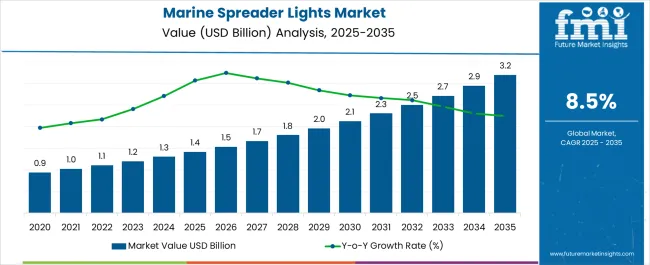
The marine spreader lights market was valued at USD 1.40 billion in 2025, projected to reach USD 1.52 billion in 2026, and is forecast to expand to USD 3.43 billion by 2036 at a 8.5% CAGR. The global transition from halogen and HID marine lighting to LED-based spreader light systems, combined with expanding commercial fishing fleet modernization and naval vessel lighting upgrades, is accelerating procurement across both new installation and retrofit channels. FMI analysts note that classification society requirements for minimum deck illumination levels and the increasing specification of corrosion-resistant housings for harsh marine environments are raising average unit values across the product range.
Summary of Marine Spreader Lights Market
- Market Overview
- The market is valued at USD 1.40 billion in 2025 and is projected to reach USD 3.43 billion by 2036.
- The industry is expected to grow at a 8.5% CAGR from 2026 to 2036, creating an incremental opportunity of USD 1.91 billion.
- The market is an LED-transition-driven marine lighting category where fleet modernization programs, classification society illumination standards, and corrosion-resistant housing specifications define spreader light procurement and retrofit cycles.
- Demand and Growth Drivers
- The global transition from halogen and HID to LED marine lighting is generating fleet-wide retrofit demand as vessel operators capture energy savings and reduced maintenance costs from solid-state lighting conversion.
- Classification society deck illumination requirements mandate minimum lux levels for cargo handling and work areas, creating compliance-driven procurement for higher-output spreader light systems.
- Commercial fishing fleet modernization programs in Asia Pacific and Latin America are driving first-time LED spreader light adoption on vessels transitioning from basic halogen deck lighting.
- Among key countries, China leads at 11.5% CAGR, followed by India at 10.6%, Germany at 9.8%, France at 8.9%, the UK at 8.1%, the USA at 7.2%, and Brazil at 6.4%.
- Product and Segment View
- The market covers high-output marine illumination fixtures in LED, halogen, and HID technologies mounted on masts and superstructures for broad-area deck lighting.
- Housing materials span aluminum and stainless steel configurations engineered for saltwater corrosion resistance and thermal management of high-output LED arrays.
- Commercial leads by Application with 62.8% share in 2026, driven by cargo handling, fishing operations, and offshore platform deck illumination requirements.
- Aluminum leads by Housing Material Type with 54.1% share in 2026, reflecting its corrosion resistance, light weight, and thermal dissipation advantages for marine LED arrays.
- Scope includes all marine spreader light fixtures and excludes navigation signal lights, underwater lighting, interior cabin lighting, and shore-side floodlighting.
- Geography and Competitive Outlook
- China and India are the fastest-growing markets driven by fishing fleet LED conversion and shipbuilding pre-delivery installation volumes.
- Germany and the United States lead LED marine lighting technology development, while France and the UK sustain demand through naval vessel lighting modernization programs.
- Competition is shaped by lumen output, corrosion resistance, energy efficiency, and classification society certification, with key players including Lumitec LLC, Hella Marine, Perko Inc., Aqualuma LED Lighting, OceanLED Marine Ltd., Rigid Industries, and Lumishore.
- Analyst Opinion at FMI
- Nikhil Kaitwade, Principal Consultant for Marine Equipment at Future Market Insights, opines: 'In my analysis, the marine spreader lights market is at the midpoint of an LED conversion cycle that will replace the majority of halogen and HID deck lighting installations across the global commercial fleet within the forecast period. Lighting manufacturers that cannot offer classification-society-certified LED fixtures with documented saltwater corrosion warranties exceeding five years will lose specification position as fleet procurement shifts from lowest-unit-cost to lowest-total-cost-of-ownership evaluation. The online distribution channel is capturing an increasing share of recreational and small commercial vessel replacement purchases, compressing margins for traditional chandler networks.'
- Strategic Implications / Executive Takeaways
- LED marine lighting manufacturers must secure classification society type approval with documented five-year-plus saltwater corrosion warranties to capture commercial fleet specification contracts shifting to total-cost-of-ownership procurement models.
- Fishing fleet modernization programs in Asia Pacific should bundle LED spreader light procurement with vessel electrical system upgrades to maximize energy savings and reduce installation costs through integrated wiring packages.
- Marine lighting distributors must develop online sales capabilities for the recreational and small commercial segments where chandler-based procurement is migrating to direct-to-customer digital channels.
Commercial vessel applications dominate the market as cargo ships, fishing vessels, and offshore platforms require high-output deck illumination for safe cargo handling, fishing operations, and maintenance work in low-visibility conditions. Aluminum housing leads the material preference due to its corrosion resistance, light weight, and thermal dissipation properties for high-output LED arrays. The offline distribution channel retains majority share as marine equipment procurement remains concentrated through specialized chandlers, OEM shipyard supply chains, and direct sales networks, though online channels are gaining share in the recreational and small commercial vessel segments.
China leads with an 11.5% CAGR, driven by commercial fishing fleet LED conversion programs and shipbuilding pre-delivery lighting installation volumes. India follows at 10.6%, supported by naval vessel lighting modernization and coastal fishing fleet upgrades. Germany registers 9.8% growth tied to its marine LED technology engineering and port logistics illumination demand. France posts 8.9%, reflecting naval defense vessel lighting specifications. The United Kingdom tracks at 8.1%, the United States at 7.2% reflecting Coast Guard and commercial fleet LED retrofit programs, and Brazil at 6.4% sustained by offshore platform deck lighting requirements.
Marine Spreader Lights Market Key Takeaways
| Metric | Details |
|---|---|
| Industry Size (2026) | USD 1.52 billion |
| Industry Value (2036) | USD 3.43 billion |
| CAGR (2026-2036) | 8.5% |
Source: Future Market Insights, 2026
Marine Spreader Lights Market Definition
Marine spreader lights are high-output illumination fixtures mounted on vessel masts, superstructures, and deck infrastructure to provide broad-area white light coverage for deck operations, cargo handling, navigation safety, and work-area visibility. Core housing materials include aluminum and stainless steel, with LED technology increasingly replacing halogen and HID light sources across commercial, military, and recreational marine applications.
Marine Spreader Lights Market Inclusions
Market scope covers LED, halogen, and HID marine spreader light fixtures in aluminum and stainless steel housings. Coverage spans commercial and military vessel applications through offline and online distribution channels. Regional and country-level market sizes for 2026 to 2036 are included.
Marine Spreader Lights Market Exclusions
The scope excludes navigation signal lights regulated under COLREGS, underwater hull illumination, interior cabin lighting, and decorative marine accent lighting. Shore-side port and harbor floodlighting systems are also excluded.
Marine Spreader Lights Market Research Methodology
- Primary Research: Analysts engaged with procurement managers, operations engineers, and industry supply chain directors to identify the decision triggers, specification requirements, and budget allocation patterns governing equipment and technology upgrades.
- Desk Research: Data collection aggregated publicly available regulatory filings, government procurement records, trade association publications, and company annual reports and investor presentations.
- Market-Sizing and Forecasting: Baseline values derive from a bottom-up aggregation of product-level shipment volumes and average selling prices, applying region-specific adoption curves to project demand through the forecast period.
- Data Validation and Update Cycle: Projections are cross-validated against publicly reported company revenue guidance, government statistical agency databases, and trade body shipment records.
Why is the Marine Spreader Lights Market Growing?
The Marine Spreader Lights market is demonstrating robust growth, supported by rising demand for efficient illumination systems in marine operations and recreational boating activities. The current market environment reflects an increasing emphasis on safety, operational efficiency, and energy-efficient lighting solutions, driving the transition from conventional lighting to advanced LED-based systems with smart control capabilities. Strong investments in maritime infrastructure and the expansion of both commercial and leisure marine fleets are influencing adoption trends.
The capability of marine spreader lights to provide broad and consistent coverage for deck operations and navigation support has reinforced their necessity in modern marine applications. Furthermore, the need for compliance with marine safety standards and regulations has accelerated their deployment across vessel categories.
Future market growth is expected to be guided by advancements in durable housing materials, enhanced power efficiency, and integration with automated lighting systems As the marine industry continues to evolve with a focus on safety, sustainability, and performance, spreader lights are projected to remain an essential component of marine lighting systems across diverse applications.
Segmental Analysis
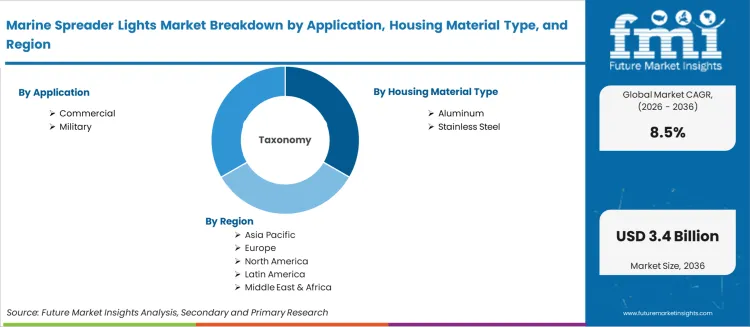
The marine spreader lights market is segmented by application, housing material type, distribution channel, and geographic regions. By application, marine spreader lights market is divided into Commercial and Military. In terms of housing material type, marine spreader lights market is classified into Aluminum and Stainless Steel. Based on distribution channel, marine spreader lights market is segmented into Offline and Online. Regionally, the marine spreader lights industry is classified into North America, Latin America, Western Europe, Eastern Europe, Balkan & Baltic Countries, Russia & Belarus, Central Asia, East Asia, South Asia & Pacific, and the Middle East & Africa.
Insights into the Commercial Segment
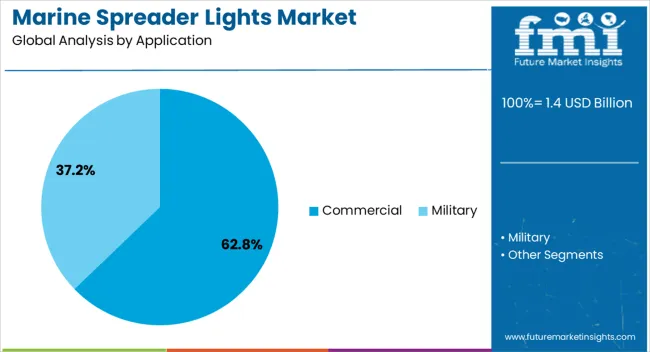
The Commercial segment is expected to hold 62.80% of the Marine Spreader Lights market revenue in 2026, making it the dominant application category. This leading share is being driven by the increasing reliance on marine spreader lights in cargo vessels, fishing fleets, and offshore service vessels, where robust lighting is critical for night-time operations, loading, and navigation safety.
The segment’s growth has been supported by the rising global maritime trade, which has resulted in higher demand for lighting systems that can withstand harsh marine environments while ensuring uninterrupted functionality. The focus on maximizing vessel productivity has encouraged operators to adopt spreader lights that can provide high-intensity illumination with reduced energy consumption.
Additionally, stricter safety protocols in commercial shipping and the need for compliance with international marine standards have favored widespread installation The ability of modern commercial-grade spreader lights to deliver enhanced durability, weather resistance, and integration with energy-efficient power systems has further strengthened their appeal, ensuring continued dominance of the commercial segment in the market.
Insights into the Aluminum Segment
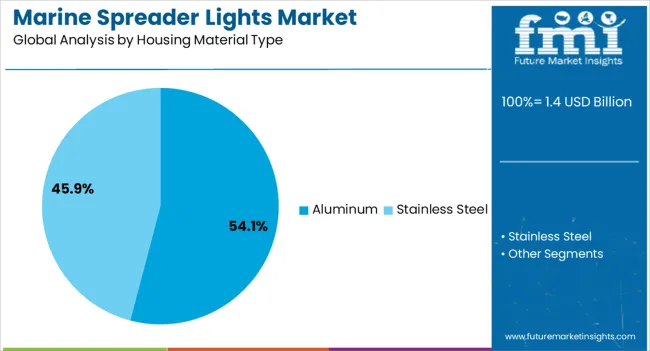
The Aluminum housing material type is projected to account for 54.10% of the Marine Spreader Lights market revenue in 2026, emerging as the leading segment in this category. The growth of this segment is being attributed to the superior balance of strength, durability, and lightweight characteristics that aluminum offers compared to other materials. In marine environments where corrosion resistance and long-term reliability are essential, aluminum housings provide a cost-effective and resilient solution.
The ability of aluminum-based housings to dissipate heat efficiently has further reinforced their adoption in high-intensity lighting applications, where consistent performance over extended operating periods is required. Moreover, the affordability of aluminum relative to premium alloys has enabled its wider use across both commercial and recreational vessels.
The segment has also benefited from the rising preference for sustainable and recyclable materials in marine equipment manufacturing With increased emphasis on long-lasting performance and reduced maintenance costs, aluminum housings are expected to maintain their leadership as the material of choice in marine spreader light production.
Insights into the Offline Segment
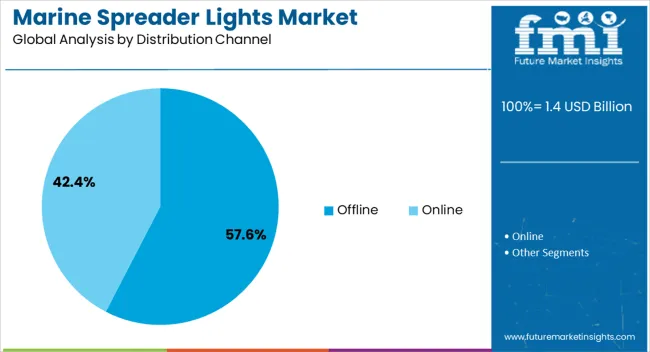
The Offline distribution channel is anticipated to command 57.60% of the Marine Spreader Lights market revenue in 2026, representing the leading channel for product sales. This dominance is being reinforced by the continued preference of buyers in the marine industry to procure lighting equipment through established offline networks, including specialized distributors, marine supply stores, and authorized dealers.
Offline channels provide buyers with the advantage of direct product inspection, technical consultation, and assured after-sales support, which are critical factors in high-value marine equipment purchases. The segment’s growth has been further supported by the ability of offline distributors to offer customized solutions tailored to vessel specifications, ensuring reliable installation and compatibility.
Trust and long-standing relationships between marine operators and suppliers have also contributed to sustained reliance on offline channels Despite the growing presence of online platforms, offline distribution remains the primary choice for marine spreader lights due to the complexity of product selection, the importance of technical validation, and the need for ongoing service support in maritime operations.
Market Overview
Marine Spreader Lights Market Overview
Marine spreader lights are the high intensity LED lights installed on the ship’s deck for the better vision during the night time. Marine Spreader Lights can also be used for flood lightning during flood control. Marine spreader lights provides high intensity vision which is used for avoiding the major accident. Marine spreader lights are also used for patrolling mainly in military fleets.
Marine spreader lights are successfully replacing the traditional halogen lights which were irritating to the eyes. Marine spreader lights are manufactured in such a way that the LEDs deliver cool light similar to daylight. Manufacturers have focused on the reducing the UV light emission which reduce the attraction of insects. Companies have also developed the light’s housing from non-corrosive material like aluminum and stainless steel which will make it sustainable in the humid environment.
Marine Spreader Lights Market: Dynamics
The shipbuilding industry is expected to grow over the period due to the rising seaborne trade due to the increasing trade relations and economic growth, which will increase the demand for marine spreader lights in the global market. Water transportation is relatively economical as compared to the other transportation.
Due to which there is increase in the shipping activities across the globe, many countries are carrying their shipping activities from the other countries which have economic shipping culture. The increasing shipping activities is boosting the marine spreader lights market. Navy, sea security and patrol is a prominent end use sector which is expected to use the marine spreader lights to a significant extent. The marine spreader light manufacturers are focusing on the production of the marine spreader lights which are waterproof and can with stand drastic environmental condition around the sea.
Upcoming innovation will have positive impact on the marine spreader lights market. In the recent years the growth of shipbuilding industry has slowed down which is a setback for the marine spreader lights market. The marine exploration activities with respect to oil and gas as well as environmental survey operations are poised to provide healthy growth opportunities for the global marine spreader lights market.
Marine Spreader Lights Market: Regional Outlook
The predominance of prominent shipbuilding countries such as China, South Korea and Japan in Asia Pacific region increases the demand for marine spreader lights in this region, also the increasing marine trade due large coastal areas in the countries like China, India, and Japan etc. makes Asia Pacific a promising market for marine spreader lights.
In Europe, Greece, Germany, UK are the prominent ship fleet owing countries also there is significant presence of shipbuilding industry in Europe region. The growing water transportation along with above factors make Europe a significant market for marine spreader light. The increasing shipping activities in the countries such as Panama, Brazil, Mexico and Colombia makes Latin America a potential market region. Countries such as Egypt, Morocco and South Africa due to their locations provides better connectivity for shipping activities and water transportation.
In the Middle East region water transportation plays significant role in oil & gas industry, owing to which Middle East & Africa collectively makes a good market for marine spreader lights. In the regions of North America countries like United States have good presence of shipbuilding industry. Also United States is one of the countries which has owns large number of ship fleet. North America has large coastal area which makes it easy for carrying out shipping activities and water transportation, owing to which North America makes a strong market region for marine spreader lights.
The report covers exhaustive analysis on
- Marine Spreader Lights Market Segments
- Marine Spreader Lights Market Dynamics
- Marine Spreader Lights Market Size
- Marine Spreader Lights Supply & Demand Scenario
- Current Trends/Issues/Challenges in Marine Spreader Lights market
- Competition & Companies involved in Marine Spreader Lights market
- Technology used in Marine Spreader Lights Market
- Value Chain of Marine Spreader Lights Market
Regional analysis includes
- North America (USA, Canada)
- Latin America (Mexico, Brazil, Argentina, Chile, Peru)
- Western Europe (Germany, Italy, France, UK, Spain, BENELUX, Nordics)
- Eastern Europe (Russia, Poland, CIS)
- Asia-Pacific (China, India, ASEAN, South Korea)
- Japan
- Middle East and Africa (GCC Countries, South Africa, Turkey, Iran, Israel)
The Marine Spreader Lights Market report is a compilation of first-hand information, qualitative and quantitative assessment by industry analysts, inputs from industry experts and industry participants across the value chain. The report provides in-depth analysis of parent market trends, macro-economic indicators and governing factors along with Marine Spreader Lights market attractiveness as per segments. The report also maps the qualitative impact of various market factors on Marine Spreader Lights market segments and geographies.
Analysis of Marine Spreader Lights Market By Key Countries
.webp "Top Country Growth Comparison Marine Spreader Lights Market Cagr (2026 2036)")
| Country | CAGR |
|---|---|
| China | 11.5% |
| India | 10.6% |
| Germany | 9.8% |
| France | 8.9% |
| UK | 8.1% |
| USA | 7.2% |
| Brazil | 6.4% |
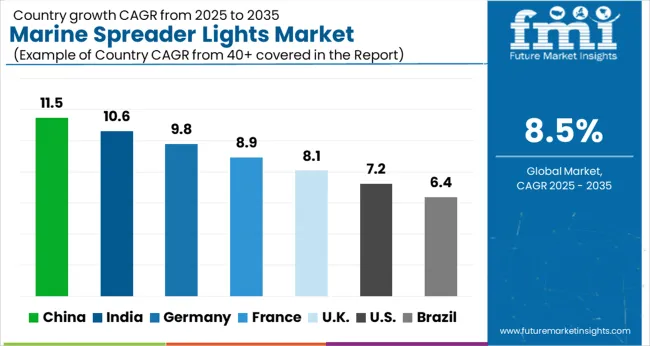
The Marine Spreader Lights Market is expected to register a CAGR of 8.5% during the forecast period, exhibiting varied country level momentum. China leads with the highest CAGR of 11.5%, followed by India at 10.6%. Developed markets such as Germany, France, and the UK continue to expand steadily, while the USA is likely to grow at consistent rates. Brazil posts the lowest CAGR at 6.4%, yet still underscores a broadly positive trajectory for the global Marine Spreader Lights Market. In 2024, Germany held a dominant revenue in the Western Europe market and is expected to grow with a CAGR of 9.8%. The USA Marine Spreader Lights Market is estimated to be valued at USD 512.2 million in 2026 and is anticipated to reach a valuation of USD 1.0 billion by 2036. Sales are projected to rise at a CAGR of 7.2% over the forecast period between 2026 and 2036. While Japan and South Korea markets are estimated to be valued at USD 76.8 million and USD 41.2 million respectively in 2026.
Marine Spreader Lights Market: Key Participants
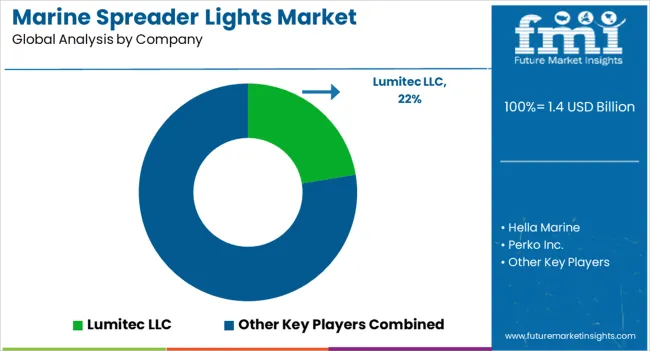
Examples of some of the market participants operating in the global Marine Spreader Lights market include,
Calibra Marine Equipment Ltd., Lumitec LLC, TACO MARINE, West Marine, Boatlamps Ltd, DRSA, Gael Force Marine, Boemarine, Inc., Oracle Lighting among others
The Marine Spreader Lights market research report presents a comprehensive assessment of the Marine Spreader Lights market and contains thoughtful insights, facts, historical data and statistically supported and industry-validated market data. It also contains projections using a suitable set of assumptions and methodologies. The Marine Spreader Lights market research report provides analysis and information according to Marine Spreader Lights market segments such as geographies, application and industry.
Key Players in the Marine Spreader Lights Market
- Lumitec LLC
- Hella Marine
- Perko Inc.
- Aqualuma LED Lighting
- OceanLED Marine Ltd.
- Imtra Corporation
- Attwood Corporation
- Shadow-Caster Marine LEDs
- TACO Marine
- TH Marine Supplies
- Apex Lighting
- Baja Designs
- Rigid Industries
- Sea-Dog Line
- Bluefin LED
- Lumishore
- Dr. LED
- Marinebeam
- Aqua Signal
- Lopolight
Scope of the Report
| Metric | Value |
|---|---|
| Quantitative Units | USD 1.52 billion to USD 3.43 billion, at a CAGR of 8.5% |
| Market Definition | Marine spreader lights are high-output illumination fixtures mounted on vessel masts, superstructures, and deck infrastructure to provide broad-area white light coverage for deck operations, cargo han... |
| Segmentation | Application: Commercial, Military; Housing Material Type: Aluminum, Stainless Steel; Distribution Channel: Offline, Online |
| Regions Covered | North America, Latin America, Europe, East Asia, South Asia, Oceania, Middle East & Africa |
| Countries Covered | China, India, Germany, France, UK, USA, Brazil, and 40 plus countries |
| Key Companies Profiled | Lumitec LLC, Hella Marine, Perko Inc., Aqualuma LED Lighting, OceanLED Marine Ltd., Imtra Corporation, Attwood Corporation, Shadow-Caster Marine LEDs, TACO Marine, Apex Lighting, Rigid Industries, Lumishore, Aqua Signal, Lopolight |
| Forecast Period | 2026 to 2036 |
| Approach | Forecasting models apply a bottom-up methodology starting with global installed base metrics and product-level demand curves, cross-validated against publicly reported revenue and trade data. |
Marine Spreader Lights Market by Segments
Application:
- Commercial
- Military
Housing Material Type:
- Aluminum
- Stainless Steel
Distribution Channel:
- Offline
- Online
Region:
- North America
- USA
- Canada
- Mexico
- Latin America
- Brazil
- Chile
- Rest of Latin America
- Western Europe
- Germany
- UK
- Italy
- Spain
- France
- Nordic
- BENELUX
- Rest of Western Europe
- Eastern Europe
- Russia
- Poland
- Hungary
- Balkan & Baltic
- Rest of Eastern Europe
- East Asia
- China
- Japan
- South Korea
- South Asia and Pacific
- India
- ASEAN
- Australia & New Zealand
- Rest of South Asia and Pacific
- Middle East & Africa
- Kingdom of Saudi Arabia
- Other GCC Countries
- Turkiye
- South Africa
- Other African Union
- Rest of Middle East & Africa
Bibliography
- International Maritime Organization. (2024). SOLAS Chapter II-1: Vessel Lighting and Electrical Installation Requirements. IMO.
- International Association of Classification Societies. (2024). Unified Requirements for Marine Lighting Equipment. IACS.
- International Electrotechnical Commission. (2024). IEC 60598: Luminaires for Ships and Marine Platforms. IEC.
- Food and Agriculture Organization of the United Nations. (2024). Fishing Vessel Safety and Equipment Standards. FAO.
- United States Coast Guard. (2024). Electrical Engineering Regulations: Vessel Lighting Standards. USCG.
- Organisation for Economic Co-operation and Development. (2024). Energy Efficiency in Maritime Operations: Lighting Technology Assessment. OECD.
This bibliography is provided for reader reference. The full Future Market Insights report contains the complete reference list with primary research documentation.
Frequently Asked Questions
How large is the demand for Marine Spreader Lights in the global market in 2026?
Demand is estimated to be valued at USD 1.52 billion in 2026.
What will be the market size by 2036?
Market size is projected to reach USD 3.43 billion by 2036.
What is the expected demand growth between 2026 and 2036?
Demand is expected to grow at a CAGR of 8.5% between 2026 and 2036.
Which Application is poised to lead by 2026?
Commercial accounts for 62.8% share in 2026, driven by cargo handling, fishing operations, and offshore platform deck illumination requirements.
Which Housing Material Type leads?
Aluminum holds 54.1% share in 2026, reflecting its corrosion resistance, light weight, and thermal dissipation properties for marine LED arrays.
What is driving demand in China?
Commercial fishing fleet LED conversion programs and shipbuilding pre-delivery lighting installation volumes sustain procurement growth.
What is India's growth outlook in this report?
India is projected to grow at a CAGR of 10.6% during 2026 to 2036.
Preview the report firsthand - request a free sample
Get SampleGet the brochure for pricing and purchase details.
Get PDFTable of Content
- Executive Summary
- Global Market Outlook
- Demand-side Trends
- Supply-side Trends
- Technology Roadmap Analysis
- Analysis and Recommendations
- Market Overview
- Market Coverage / Taxonomy
- Market Definition / Scope / Limitations
- Research Methodology
- Chapter Orientation
- Analytical Lens and Working Hypotheses
- Market Structure, Signals, and Trend Drivers
- Benchmarking and Cross-market Comparability
- Market Sizing, Forecasting, and Opportunity Mapping
- Research Design and Evidence Framework
- Desk Research Programme (Secondary Evidence)
- Company Annual and Sustainability Reports
- Peer-reviewed Journals and Academic Literature
- Corporate Websites, Product Literature, and Technical Notes
- Earnings Decks and Investor Briefings
- Statutory Filings and Regulatory Disclosures
- Technical White Papers and Standards Notes
- Trade Journals, Industry Magazines, and Analyst Briefs
- Conference Proceedings, Webinars, and Seminar Materials
- Government Statistics Portals and Public Data Releases
- Press Releases and Reputable Media Coverage
- Specialist Newsletters and Curated Briefings
- Sector Databases and Reference Repositories
- FMI Internal Proprietary Databases and Historical Market Datasets
- Subscription Datasets and Paid Sources
- Social Channels, Communities, and Digital Listening Inputs
- Additional Desk Sources
- Expert Input and Fieldwork (Primary Evidence)
- Primary Modes
- Qualitative Interviews and Expert Elicitation
- Quantitative Surveys and Structured Data Capture
- Blended Approach
- Why Primary Evidence is Used
- Field Techniques
- Interviews
- Surveys
- Focus Groups
- Observational and In-context Research
- Social and Community Interactions
- Stakeholder Universe Engaged
- C-suite Leaders
- Board Members
- Presidents and Vice Presidents
- R&D and Innovation Heads
- Technical Specialists
- Domain Subject-matter Experts
- Scientists
- Physicians and Other Healthcare Professionals
- Governance, Ethics, and Data Stewardship
- Research Ethics
- Data Integrity and Handling
- Primary Modes
- Tooling, Models, and Reference Databases
- Desk Research Programme (Secondary Evidence)
- Data Engineering and Model Build
- Data Acquisition and Ingestion
- Cleaning, Normalisation, and Verification
- Synthesis, Triangulation, and Analysis
- Quality Assurance and Audit Trail
- Market Background
- Market Dynamics
- Drivers
- Restraints
- Opportunity
- Trends
- Scenario Forecast
- Demand in Optimistic Scenario
- Demand in Likely Scenario
- Demand in Conservative Scenario
- Opportunity Map Analysis
- Product Life Cycle Analysis
- Supply Chain Analysis
- Investment Feasibility Matrix
- Value Chain Analysis
- PESTLE and Porter’s Analysis
- Regulatory Landscape
- Regional Parent Market Outlook
- Production and Consumption Statistics
- Import and Export Statistics
- Market Dynamics
- Global Market Analysis 2021 to 2025 and Forecast, 2026 to 2036
- Historical Market Size Value (USD Million) Analysis, 2021 to 2025
- Current and Future Market Size Value (USD Million) Projections, 2026 to 2036
- Y-o-Y Growth Trend Analysis
- Absolute $ Opportunity Analysis
- Global Market Pricing Analysis 2021 to 2025 and Forecast 2026 to 2036
- Global Market Analysis 2021 to 2025 and Forecast 2026 to 2036, By Application
- Introduction / Key Findings
- Historical Market Size Value (USD Million) Analysis By Application , 2021 to 2025
- Current and Future Market Size Value (USD Million) Analysis and Forecast By Application , 2026 to 2036
- Commercial
- Military
- Commercial
- Y-o-Y Growth Trend Analysis By Application , 2021 to 2025
- Absolute $ Opportunity Analysis By Application , 2026 to 2036
- Global Market Analysis 2021 to 2025 and Forecast 2026 to 2036, By Housing Material Type
- Introduction / Key Findings
- Historical Market Size Value (USD Million) Analysis By Housing Material Type, 2021 to 2025
- Current and Future Market Size Value (USD Million) Analysis and Forecast By Housing Material Type, 2026 to 2036
- Aluminum
- Stainless Steel
- Aluminum
- Y-o-Y Growth Trend Analysis By Housing Material Type, 2021 to 2025
- Absolute $ Opportunity Analysis By Housing Material Type, 2026 to 2036
- Global Market Analysis 2021 to 2025 and Forecast 2026 to 2036, By Distribution Channel
- Introduction / Key Findings
- Historical Market Size Value (USD Million) Analysis By Distribution Channel, 2021 to 2025
- Current and Future Market Size Value (USD Million) Analysis and Forecast By Distribution Channel, 2026 to 2036
- Offline
- Online
- Offline
- Y-o-Y Growth Trend Analysis By Distribution Channel, 2021 to 2025
- Absolute $ Opportunity Analysis By Distribution Channel, 2026 to 2036
- Global Market Analysis 2021 to 2025 and Forecast 2026 to 2036, By Region
- Introduction
- Historical Market Size Value (USD Million) Analysis By Region, 2021 to 2025
- Current Market Size Value (USD Million) Analysis and Forecast By Region, 2026 to 2036
- North America
- Latin America
- Western Europe
- Eastern Europe
- East Asia
- South Asia and Pacific
- Middle East & Africa
- Market Attractiveness Analysis By Region
- North America Market Analysis 2021 to 2025 and Forecast 2026 to 2036, By Country
- Historical Market Size Value (USD Million) Trend Analysis By Market Taxonomy, 2021 to 2025
- Market Size Value (USD Million) Forecast By Market Taxonomy, 2026 to 2036
- By Country
- USA
- Canada
- Mexico
- By Application
- By Housing Material Type
- By Distribution Channel
- By Country
- Market Attractiveness Analysis
- By Country
- By Application
- By Housing Material Type
- By Distribution Channel
- Key Takeaways
- Latin America Market Analysis 2021 to 2025 and Forecast 2026 to 2036, By Country
- Historical Market Size Value (USD Million) Trend Analysis By Market Taxonomy, 2021 to 2025
- Market Size Value (USD Million) Forecast By Market Taxonomy, 2026 to 2036
- By Country
- Brazil
- Chile
- Rest of Latin America
- By Application
- By Housing Material Type
- By Distribution Channel
- By Country
- Market Attractiveness Analysis
- By Country
- By Application
- By Housing Material Type
- By Distribution Channel
- Key Takeaways
- Western Europe Market Analysis 2021 to 2025 and Forecast 2026 to 2036, By Country
- Historical Market Size Value (USD Million) Trend Analysis By Market Taxonomy, 2021 to 2025
- Market Size Value (USD Million) Forecast By Market Taxonomy, 2026 to 2036
- By Country
- Germany
- UK
- Italy
- Spain
- France
- Nordic
- BENELUX
- Rest of Western Europe
- By Application
- By Housing Material Type
- By Distribution Channel
- By Country
- Market Attractiveness Analysis
- By Country
- By Application
- By Housing Material Type
- By Distribution Channel
- Key Takeaways
- Eastern Europe Market Analysis 2021 to 2025 and Forecast 2026 to 2036, By Country
- Historical Market Size Value (USD Million) Trend Analysis By Market Taxonomy, 2021 to 2025
- Market Size Value (USD Million) Forecast By Market Taxonomy, 2026 to 2036
- By Country
- Russia
- Poland
- Hungary
- Balkan & Baltic
- Rest of Eastern Europe
- By Application
- By Housing Material Type
- By Distribution Channel
- By Country
- Market Attractiveness Analysis
- By Country
- By Application
- By Housing Material Type
- By Distribution Channel
- Key Takeaways
- East Asia Market Analysis 2021 to 2025 and Forecast 2026 to 2036, By Country
- Historical Market Size Value (USD Million) Trend Analysis By Market Taxonomy, 2021 to 2025
- Market Size Value (USD Million) Forecast By Market Taxonomy, 2026 to 2036
- By Country
- China
- Japan
- South Korea
- By Application
- By Housing Material Type
- By Distribution Channel
- By Country
- Market Attractiveness Analysis
- By Country
- By Application
- By Housing Material Type
- By Distribution Channel
- Key Takeaways
- South Asia and Pacific Market Analysis 2021 to 2025 and Forecast 2026 to 2036, By Country
- Historical Market Size Value (USD Million) Trend Analysis By Market Taxonomy, 2021 to 2025
- Market Size Value (USD Million) Forecast By Market Taxonomy, 2026 to 2036
- By Country
- India
- ASEAN
- Australia & New Zealand
- Rest of South Asia and Pacific
- By Application
- By Housing Material Type
- By Distribution Channel
- By Country
- Market Attractiveness Analysis
- By Country
- By Application
- By Housing Material Type
- By Distribution Channel
- Key Takeaways
- Middle East & Africa Market Analysis 2021 to 2025 and Forecast 2026 to 2036, By Country
- Historical Market Size Value (USD Million) Trend Analysis By Market Taxonomy, 2021 to 2025
- Market Size Value (USD Million) Forecast By Market Taxonomy, 2026 to 2036
- By Country
- Kingdom of Saudi Arabia
- Other GCC Countries
- Turkiye
- South Africa
- Other African Union
- Rest of Middle East & Africa
- By Application
- By Housing Material Type
- By Distribution Channel
- By Country
- Market Attractiveness Analysis
- By Country
- By Application
- By Housing Material Type
- By Distribution Channel
- Key Takeaways
- Key Countries Market Analysis
- USA
- Pricing Analysis
- Market Share Analysis, 2025
- By Application
- By Housing Material Type
- By Distribution Channel
- Canada
- Pricing Analysis
- Market Share Analysis, 2025
- By Application
- By Housing Material Type
- By Distribution Channel
- Mexico
- Pricing Analysis
- Market Share Analysis, 2025
- By Application
- By Housing Material Type
- By Distribution Channel
- Brazil
- Pricing Analysis
- Market Share Analysis, 2025
- By Application
- By Housing Material Type
- By Distribution Channel
- Chile
- Pricing Analysis
- Market Share Analysis, 2025
- By Application
- By Housing Material Type
- By Distribution Channel
- Germany
- Pricing Analysis
- Market Share Analysis, 2025
- By Application
- By Housing Material Type
- By Distribution Channel
- UK
- Pricing Analysis
- Market Share Analysis, 2025
- By Application
- By Housing Material Type
- By Distribution Channel
- Italy
- Pricing Analysis
- Market Share Analysis, 2025
- By Application
- By Housing Material Type
- By Distribution Channel
- Spain
- Pricing Analysis
- Market Share Analysis, 2025
- By Application
- By Housing Material Type
- By Distribution Channel
- France
- Pricing Analysis
- Market Share Analysis, 2025
- By Application
- By Housing Material Type
- By Distribution Channel
- India
- Pricing Analysis
- Market Share Analysis, 2025
- By Application
- By Housing Material Type
- By Distribution Channel
- ASEAN
- Pricing Analysis
- Market Share Analysis, 2025
- By Application
- By Housing Material Type
- By Distribution Channel
- Australia & New Zealand
- Pricing Analysis
- Market Share Analysis, 2025
- By Application
- By Housing Material Type
- By Distribution Channel
- China
- Pricing Analysis
- Market Share Analysis, 2025
- By Application
- By Housing Material Type
- By Distribution Channel
- Japan
- Pricing Analysis
- Market Share Analysis, 2025
- By Application
- By Housing Material Type
- By Distribution Channel
- South Korea
- Pricing Analysis
- Market Share Analysis, 2025
- By Application
- By Housing Material Type
- By Distribution Channel
- Russia
- Pricing Analysis
- Market Share Analysis, 2025
- By Application
- By Housing Material Type
- By Distribution Channel
- Poland
- Pricing Analysis
- Market Share Analysis, 2025
- By Application
- By Housing Material Type
- By Distribution Channel
- Hungary
- Pricing Analysis
- Market Share Analysis, 2025
- By Application
- By Housing Material Type
- By Distribution Channel
- Kingdom of Saudi Arabia
- Pricing Analysis
- Market Share Analysis, 2025
- By Application
- By Housing Material Type
- By Distribution Channel
- Turkiye
- Pricing Analysis
- Market Share Analysis, 2025
- By Application
- By Housing Material Type
- By Distribution Channel
- South Africa
- Pricing Analysis
- Market Share Analysis, 2025
- By Application
- By Housing Material Type
- By Distribution Channel
- USA
- Market Structure Analysis
- Competition Dashboard
- Competition Benchmarking
- Market Share Analysis of Top Players
- By Regional
- By Application
- By Housing Material Type
- By Distribution Channel
- Competition Analysis
- Competition Deep Dive
- Lumitec LLC
- Overview
- Product Portfolio
- Profitability by Market Segments (Product/Age /Sales Channel/Region)
- Sales Footprint
- Strategy Overview
- Marketing Strategy
- Product Strategy
- Channel Strategy
- Hella Marine
- Perko Inc.
- Aqualuma LED Lighting
- OceanLED Marine Ltd.
- Imtra Corporation
- Attwood Corporation
- Shadow-Caster Marine LEDs
- TACO Marine
- TH Marine Supplies
- Apex Lighting
- Baja Designs
- Rigid Industries
- Sea-Dog Line
- Bluefin LED
- Lumishore
- Dr. LED
- Marinebeam
- Aqua Signal
- Lopolight
- Lumitec LLC
- Competition Deep Dive
- Assumptions & Acronyms Used


