

- Market Size (2026)
- USD 1.5 Bn
- Forecast (2036)
- USD 2.5 Bn
- CAGR (2026 to 2036)
- 5.1%
How big is Marine Rudder Carrier Bearings Market in 2026?
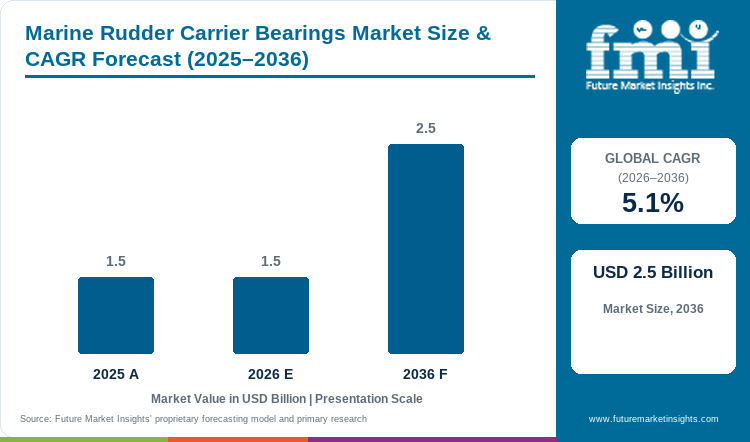
USD 1.5 Billion in 2026 and USD 2.5 Billion by 2036 at a 5.1% CAGR.
Sales of marine rudder carrier bearings are estimated to grow at a 5.1% CAGR from USD 1.5 billion in 2026 to USD 2.5 billion in 2036. The market was valued at USD 1.5 billion in 2025. Demand comes from two distinct buying events: a carrier bearing is specified into a new rudder arrangement, or an installed vessel reaches drydock with clearance, wear, corrosion, or lubrication issues that justify replacement. UN Trade and Development reported in September 2025 that vessel rerouting had lifted ton-miles by 5.9% during 2024. Longer operating exposure expands the population of steering systems moving toward inspection, but revenue is ultimately released when vessel owners and yards authorize engineering and drydock work.
Newbuild programs and drydock repairs create different delivery requirements for rudder bearings. South Korean yards need repeatable supply against shipbuilding schedules, while Australia's vessel programs combine construction with long-term sustainment. In the ship repair and maintenance service market, a replacement must fit the measured rudder stock and housing and arrive within a fixed docking window. Class acceptance, machining allowances and installation support must be resolved before the vessel returns to service.
Key Takeaways
- Newbuild vessel programs and recurring drydock inspection create separate but complementary demand pools for marine rudder carrier bearings.
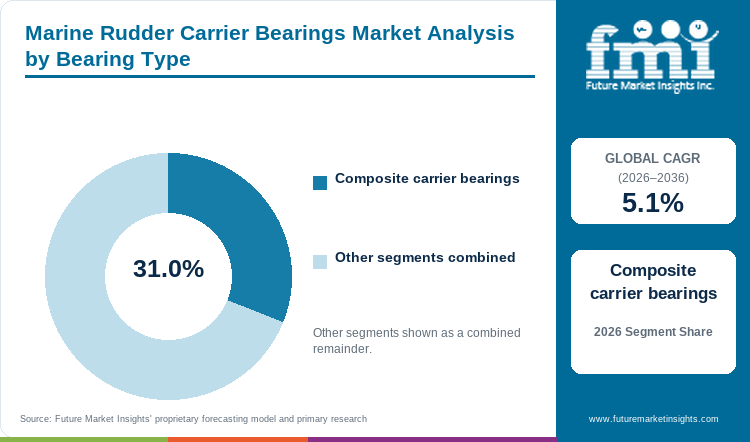
- Composite carrier bearings are projected to hold 31.0% of Bearing Type demand in 2026, supported by low-friction operation and reduced dependence on grease.
- Commercial vessels lead Vessel Type at 37.0%, while Composite polymers lead Material at 35.0% and Rudder stock support accounts for 43.0% of Application demand.
- Class approval, vessel-specific sizing, shaft condition, and machining responsibility can delay conversion even when the proposed bearing material meets performance requirements.
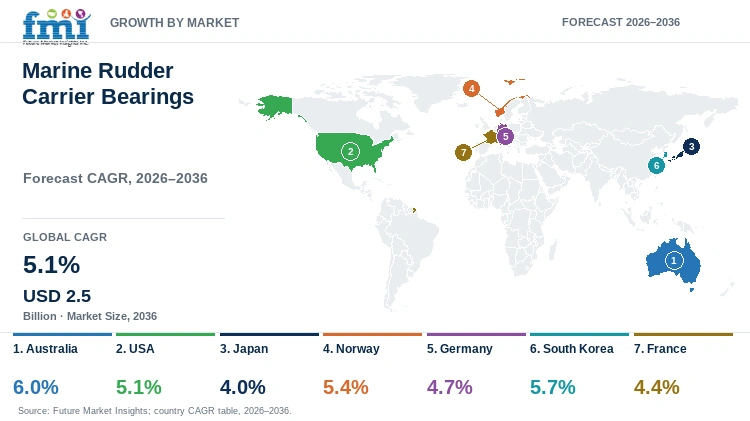
- Australia leads the profiled countries at 6.0% CAGR, followed by South Korea at 5.7% and Norway at 5.4% from 2026 to 2036.
- Key suppliers include Thordon Bearings, Vesconite Bearings, Trelleborg Sealing Solutions through Orkot, Wärtsilä, SKF Marine, Tenmat, Duramax Marine, and Kahlenberg Industries.
Analyst Perspective
A carrier bearing can delay a drydock job even though it represents a small part of the vessel's cost. The material must carry the specified load at the correct clearance, and final dimensions may become available only after dismantling. Calculation support, accessible stock and nearby machining help a yard turn the approved material into a correctly fitted replacement on time.
- Nikhil Kaitwade, Principal Consultant, Future Market Insights
How is the marine rudder carrier bearings market segmented?
The market is assessed across Bearing Type, Vessel Type, Material, Sales Channel, and Application.
The Marine Rudder Carrier Bearings Market is segmented by Bearing Type into Composite carrier bearings, Bronze carrier bearings, Spherical carrier bearings, Elastomer-lined bearings, and Self-lubricating bearings; by Vessel Type into Commercial vessels, Naval vessels, Offshore support vessels, Workboats, and Yachts; by Material into Composite polymers, Bronze, Stainless steel, Rubber/elastomer, and Hybrid liners; by Sales Channel into Shipyards, Marine equipment distributors, MRO/drydock, and Direct bearing OEM; and by Application into Rudder stock support, Steering gear interface, Stern frame support, and High-load rudder systems.
Why do Composite carrier bearings lead demand within the Bearing Type category?
Composite carrier bearings combine structural load support with low-friction material behavior suited to the slow oscillating movement of a rudder stock. Their appeal is strongest where the vessel owner wants to reduce grease requirements without creating a corrosion-sensitive metal-on-metal interface. Composite designs can also tolerate a degree of edge loading and misalignment while being machined to an existing housing during retrofit work. The engineering burden remains substantial because pressure limits, water swell, thermal expansion, shaft finish, and final clearance still have to be established for the individual installation. This places carrier bearings inside the broader marine bearings market, but with a much narrower set of load, motion, and class requirements.
- Composite carrier bearings account for 31.0% of Bearing Type demand in 2026 because grease-free operation and machinability address both operating and retrofit requirements.
- Trelleborg Sealing Solutions' April 2025 Orkot Marine Bearings Engineering Manual covers rudder-bearing design pressure, material selection, machining tolerances, and installation, illustrating how specification support accompanies the composite material itself.
Why do Commercial vessels lead demand within the Vessel Type category?
Commercial vessels provide the widest combination of installed-base replacement and newbuild demand. Bulk carriers, container ships, tankers, ferries, and other merchant ships accumulate high operating hours and periodically enter drydock for class survey and steering-system work. A carrier bearing may remain in service for years, but once clearance or wear exceeds limits the owner has little incentive to postpone the job because extended steering work can hold the vessel out of service. Naval vessels can carry more demanding shock and documentation requirements, while workboats and offshore support vessels operate in harsh duty cycles. Commercial fleets nevertheless generate the broadest sequence of replacement opportunities.
- Commercial vessels represent 37.0% of Vessel Type demand in 2026, supported by the scale of the merchant fleet and recurring docking schedules.
- The commercial replacement opportunity overlaps directly with vessel overhaul spending, particularly when rudder work is coordinated with shaft, seal, hull, or propulsion maintenance during the same dock period.
Why do Composite polymers lead demand within the Material category?
Composite polymers lead where corrosion resistance, low friction, and stable dimensional behavior in seawater matter more than the familiarity of traditional bronze. A carrier bearing must retain the intended running clearance despite changes in temperature and prolonged exposure to water. It must also handle oscillating load without creating excessive shaft wear. Composite material can be supplied as finished rings, tubes, or engineered sections, which gives yards options when an existing housing must be reused. Bronze remains relevant in legacy designs, stainless steel serves selected structural requirements, and elastomer or hybrid formats suit specialized loading conditions.
- Composite polymers hold 35.0% of Material demand in 2026 because corrosion resistance and controlled dimensional behavior support predictable fit in both above-water and submerged positions.
- Vesconite stated in December 2025 that its rudder-bearing materials hold approvals or certifications from ABS, Bureau Veritas, Lloyd's Register, DNV, ClassNK, China Classification Society, and RINA, showing the importance of class acceptance in converting polymer performance into marine use.
Why do Shipyards lead demand within the Sales Channel category?
Shipyards lead because the bearing is installed as part of a larger steering and structural job. The yard verifies housing dimensions, coordinates removal of the rudder, schedules machining, interfaces with the class surveyor, and manages the sequence in which seals, stock, bearings, and steering equipment return to service. Marine distributors matter when standard material or replacement stock is needed quickly, and direct OEM relationships are common for engineered bearing packages. MRO providers can strongly influence retrofit selection. The shipyard, however, usually controls the point at which the bearing specification becomes an installed component.
- Shipyards account for 36.0% of Sales Channel demand in 2026 because they control measurement, installation sequence, machining access, and vessel redelivery.
- The procurement decision increasingly overlaps with the wider marine steering systems market, since bearing condition must be considered together with rudder stock, steering gear, seals, and alignment.
Why does Rudder stock support lead demand within the Application category?
Rudder stock support is the defining carrier-bearing function. The bearing transfers rudder weight into the vessel structure while permitting controlled steering movement and preserving stock alignment. Uneven contact or excessive bearing pressure can accelerate wear and influence steering response, so stock diameter, rudder mass, housing geometry, and shock loading all enter the design calculation. Steering gear interfaces and high-load arrangements generate additional demand, but the carrier position remains the central application because it combines structural support and oscillating motion.
- Rudder stock support represents 43.0% of Application demand in 2026, reflecting the carrier bearing's direct role in supporting rudder weight and maintaining alignment.
- ClassNK listed IACS Unified Requirement S10 Revision 8 in September 2025, with implementation from January 1, 2027. The requirement covers rudders, sole pieces, and rudder horns and reinforces the engineering discipline surrounding steering structures.
What are the drivers, restraints and opportunities in the Marine Rudder Carrier Bearings Market?
Vessel construction and scheduled steering renewal support demand, while class qualification and retrofit fit-up slow conversion, and grease-free replacements create the clearest lifecycle opportunity.
- Driver: Newbuild programs and recurring drydock inspections create specification and replacement demand.
- Restraint: Class approval, vessel-specific machining, and installation risk extend the supplier-conversion cycle.
- Opportunity: Grease-free composite retrofits can reduce maintenance and lubrication exposure during planned steering overhauls.
The primary demand driver is the number of vessels being constructed, operated, inspected, and repaired. A growing fleet increases the installed base, but bearing revenue is released only when a rudder system is built or when an existing bearing crosses a maintenance threshold. The relationship is therefore less linear than the link between vessel production and a component installed on every new ship. Commercial fleets create repeated drydock opportunities, while naval programs give suppliers longer forward visibility. This dynamic connects rudder carrier bearings with the wider marine vessels market, but replacement timing remains governed by vessel condition and survey requirements rather than fleet growth alone.
Bearing replacement can be delayed by qualification and dimensional requirements. A replacement bearing must work within an existing stock and housing, preserve allowable pressure and clearance, account for thermal behavior and water exposure, and arrive in a format that can be machined without extending the docking schedule. Switching material can therefore require more work than changing a catalog component. The incumbent design retains an advantage when drawings are incomplete or final dimensions cannot be confirmed until the rudder has been dismantled.
Planned overhauls provide a chance to install grease-free bearings. Thordon currently offers SXL pintle, stock, and carrier-disc bearings that operate without grease, while its published engineering process requires vessel and dimensional information before final sizing. Owners can consider this type of conversion when the existing bearing is already being removed, since the incremental engineering burden is lower than opening an otherwise serviceable rudder system purely to change bearing material. Suppliers that combine material supply with calculation support and nearby machining can capture more of this retrofit value.
Which country CAGRs are profiled in the Marine Rudder Carrier Bearings Market?
| Country | CAGR |
|---|---|
| Australia | 6.0% |
| USA | 5.1% |
| Japan | 4.0% |
| Norway | 5.4% |
| Germany | 4.7% |
| South Korea | 5.7% |
| France | 4.4% |
How do country-level CAGRs compare in the Marine Rudder Carrier Bearings Market?
The seven country forecasts span 4.0% CAGR in Japan to 6.0% in Australia, a 2.0 percentage-point range. Australia's vessel construction and sustainment programs create long procurement cycles. South Korean demand follows high-throughput shipbuilding. Norway's operating fleet creates retrofit and repair work, while established yards in USA, Germany and France serve both new vessels and replacement bearings.
- Australia exceeds South Korea by 0.3 percentage points as naval shipbuilding and sustainment create a long procurement horizon.
- South Korea exceeds Norway by 0.3 percentage points, with Korean demand weighted more heavily toward high-throughput newbuild activity.
- Norway exceeds the USA by 0.3 percentage points as environmental requirements and coastal vessel renewal strengthen retrofit activity.
- Germany, France, and Japan remain important engineering markets even though their forecast rates sit below the three fastest profiled countries.
Country-wise Analysis
- Australia: Demand for marine rudder carrier bearings in Australia is forecast to expand at 6.0% CAGR from 2026 to 2036. Procurement is moving through both new surface-combatant construction and long-term sustainment. In April 2026, Australia signed contracts for the first three upgraded Mogami-class general-purpose frigates, with later ships planned for construction in Western Australia. In September 2026, the government also announced a five-year contract supporting the Anzac-class fleet as part of its wider naval shipbuilding and sustainment program. Bearing suppliers therefore need a route into both original vessel programs and through-life repair, with local engineering and machining capacity becoming more valuable as work transfers into Australian yards.
- USA: Demand for marine rudder carrier bearings in the USA is forecast to rise at 5.1% CAGR from 2026 to 2036. Purchases often move through naval yards, prime shipbuilders, repair contractors, and approved supplier networks with tight material traceability. The U.S. Department of the Navy released its fiscal year 2027 shipbuilding plan in May 2026 with a USD 65.8 billion shipbuilding request. Local stock and field engineering are commercially important when yard congestion limits the time available for final machining or corrective work.
- Japan: Demand for marine rudder carrier bearings in Japan is estimated to expand at 4.0% CAGR from 2026 to 2036. Japan combines serial naval construction with a mature domestic shipbuilding and component supply base. In August 2025, Japan's Ministry of Defense stated that 12 Mogami-class frigates had been built and that 12 06FFM vessels were planned from fiscal 2024 onward. Supplier entry is constrained less by absence of demand than by early design commitment and established qualification relationships. External bearing suppliers need local technical representation and engagement before rudder arrangements reach design freeze.
- Norway: Demand for marine rudder carrier bearings in Norway is forecast to expand at 5.4% CAGR from 2026 to 2036. Norwegian owners operate ferries, offshore vessels, fishing vessels, and other craft in a market where maintenance access and environmental exposure are central operating concerns. In April 2025, Norway confirmed zero-emission requirements beginning in 2026 for smaller passenger ships operating in World Heritage fjords. The rule concerns vessel emissions rather than bearings directly, but it reinforces a broader lifecycle focus on cleaner marine systems. Grease-free rudder-bearing systems can gain attention during the same scheduled retrofit periods used for propulsion and vessel-efficiency upgrades.
- Germany: Demand for marine rudder carrier bearings in Germany is forecast to rise at 4.7% CAGR from 2026 to 2036. The procurement outlook changed sharply in June 2026 when Germany terminated the F126 frigate project because of delays, cost escalation, and implementation risk. The Navy subsequently moved toward MEKO A-200 DEU frigates to address the resulting capability requirement. For component suppliers, that change shifts the timing and platform route through which future rudder-system opportunities may emerge. Early engagement with designers and yards is particularly important because bearing substitution becomes harder after shaft, housing, and steering arrangements are frozen.
- South Korea: Demand for marine rudder carrier bearings in South Korea is forecast to expand at 5.7% CAGR from 2026 to 2036. Korean yards operate at a scale that rewards suppliers able to hold delivery dates while preserving dimensional and documentation control. In August 2026, the Ministry of Trade, Industry and Resources reported application of autonomous welding and inspection to rudder-trunk production at HD Hyundai Samho. This matters commercially because automated yard processes reduce tolerance for late design changes or inconsistent component documentation. Suppliers that can combine nearby inventory with rapid machining have an advantage in high-throughput production.
- France: Demand for marine rudder carrier bearings in France is forecast to expand at 4.4% CAGR from 2026 to 2036. Naval programs create long specification cycles in which prime contractors retain strong control over technical packages. In April 2026, France's Direction générale de l'armement discussed continuing FDI frigate procurement after delivery of Amiral Ronarc'h in October 2025. Bearing suppliers seeking naval work need to enter before detailed steering arrangements are locked, while commercial repair demand creates a separate route through French yards and marine service organizations.
Who are the notable companies in the Marine Rudder Carrier Bearings Market?
Thordon Bearings, Vesconite Bearings, Trelleborg Sealing Solutions through Orkot, Wärtsilä, SKF Marine, Tenmat, Duramax Marine, and Kahlenberg Industries are the notable companies profiled in this market.
Competition separates specialist bearing-material suppliers from companies that enter the rudder system through a wider marine engineering relationship. Thordon Bearings, Vesconite Bearings, Trelleborg Sealing Solutions through Orkot, Tenmat, and Duramax Marine compete primarily through polymer, composite, or water-lubricated bearing technologies. Wärtsilä adds a broader shaft-line and rudder-system proposition. Its current Steersafe range includes composite rudder stock and stabiliser bearings designed for oil, grease, water, or dry-running conditions. SKF Marine brings bearing and marine-service capability, while Kahlenberg Industries participates more narrowly through marine shaft machining and repair work that includes rudder posts, bearings, seals, and related components.
- Composite and self-lubricating specialists: Thordon Bearings, Vesconite Bearings, Trelleborg Sealing Solutions through Orkot, Tenmat, and Duramax Marine.
- Integrated marine engineering supplier: Wärtsilä combines rudder and stabiliser bearings with wider shaft-line and vessel-service capabilities.
- Marine bearing and repair support: SKF Marine and Kahlenberg Industries participate through marine bearing, lubrication, shaft, and repair capabilities.
Competitive Benchmarking: Marine Rudder Carrier Bearings Market
| Company | Composite and Self-Lubricating Bearing Depth | Rudder-System Integration | Newbuild and Retrofit Support | Geographic Reach |
|---|---|---|---|---|
| Thordon Bearings | High | High | High | Global distributor and service network |
| Vesconite Bearings | High | Medium | High | International marine supply with multiple class approvals |
| Trelleborg Sealing Solutions / Orkot | High | Medium | High | Global manufacturing and distributor coverage |
| Wärtsilä | High | High | High | Global marine sales and lifecycle service network |
| SKF Marine | Medium | Medium | High | Global marine and industrial service coverage |
| Tenmat | High | Medium | Medium | European manufacturing with international marine distribution |
| Duramax Marine | High | Medium | High | North American manufacturing with international marine supply |
| Kahlenberg Industries | Low | Medium | High | U.S. machining and repair base with international customers |
Scoring basis: Composite and Self-Lubricating Bearing Depth considers documented material options and suitability for rudder or steering applications. Rudder-System Integration considers the supplier's ability to connect the bearing with wider steering, shaft-line, or rudder engineering. Newbuild and Retrofit Support considers engineering assistance, machining, installation, repair, and service capability. High represents broad documented capability within the criterion, Medium represents credible but narrower capability, and Low represents limited direct depth relative to specialist bearing suppliers.
Key Developments in the Marine Rudder Carrier Bearings Market
- In May 2026, Hanwha Ocean and Thordon Bearings signed a memorandum of understanding concerning the Canadian Patrol Submarine Program and other maritime projects. Thordon described its scope as high-performance polymer propeller-shaft, rudder, and other bearings and seals for naval applications, giving the company a direct route into potential future submarine programs.
- In July 2026, Vesconite Bearings supplied upper and lower rudder bearings and associated washers for a custom 60-meter sportfishing yacht under construction in New Zealand. The lower bearings were made longer to provide the bearing area required for the higher reaction load, illustrating the vessel-specific sizing that characterizes the market. The project was reported in September 2026.
- Trelleborg Sealing Solutions issued the April 2025 edition of its Orkot Marine Bearings Engineering Manual covering rudder-bearing design pressure, material selection, machining tolerances, installation methods, and marine stock sizes. The update strengthens the engineering route from material selection to finished installation for shipbuilding and repair applications.
Key Players in the Marine Rudder Carrier Bearings Market
Composite and Self-Lubricating Bearing Specialists
- Thordon Bearings
- Vesconite Bearings
- Trelleborg Sealing Solutions / Orkot
- Tenmat
- Duramax Marine
Integrated Marine-System and Bearing Suppliers
- Wärtsilä
- SKF Marine
Marine Machining and Repair Specialist
- Kahlenberg Industries
Marine Rudder Carrier Bearings Market - Report Scope
| Coverage field | Report scope |
|---|---|
| Market breakdown | Bearing Type; Vessel Type; Material; Sales Channel; Application |
| Quantitative Units | USD Billion |
| Market Definition | Revenue includes marine rudder carrier bearings, carrier discs, bearing liners, housings, and engineered bearing units sold for newbuild or replacement within the listed segmentation. Complete rudders, rudder stocks, steering gear systems, propulsion systems, adjacent shaft bearings sold separately, and downstream vessel revenue are excluded. |
| Regions Covered | North America; Latin America; Western Europe; Eastern Europe; East Asia; South Asia and Pacific; Middle East and Africa |
| Countries Covered | Australia, USA, Japan, Norway, Germany, South Korea, France, and more than twenty-five additional countries in the full report |
| Key Companies Profiled | Thordon Bearings; Vesconite Bearings; Trelleborg Sealing Solutions / Orkot; Wärtsilä; SKF Marine; Tenmat; Duramax Marine; Kahlenberg Industries |
| Forecast Period | 2026 to 2036 |
| Approach | Market sizing combines newbuild vessel requirements and installed-fleet replacement cycles with bearing configuration, material mix, application, procurement channel, supplier activity, and country-level shipbuilding and maintenance conditions. |
Marine Rudder Carrier Bearings Market - Research Methodology
| Method | Approach |
|---|---|
| Primary Research | Structured discussions with bearing manufacturers, marine-equipment distributors, shipyard procurement teams, naval architects, MRO providers, vessel owners, and technical specialists examine specification practices, replacement triggers, qualification barriers, pricing, and service requirements. |
| Desk Research | Classification requirements, maritime statistics, official shipbuilding programs, regulatory material, company product documentation, current technical manuals, government announcements, and supplier developments are reviewed within the defined market boundary. |
| Market Sizing and Forecasting | Revenue estimates combine bearing demand from vessel programs with installed-fleet replacement cycles, material mix, application, procurement channel, drydock activity, shipbuilding pipelines, and country conditions. |
| Data Validation | Supply-side and demand-side findings are triangulated while maintaining consistent revenue boundaries between carrier bearings, adjacent shaft bearings, complete steering systems, vessel construction, and downstream marine services. |
Marine Rudder Carrier Bearings Market by Segments
Marine Rudder Carrier Bearings Market segmented by Bearing Type:
- Composite carrier bearings
- Bronze carrier bearings
- Spherical carrier bearings
- Elastomer-lined bearings
- Self-lubricating bearings
Marine Rudder Carrier Bearings Market segmented by Vessel Type:
- Commercial vessels
- Naval vessels
- Offshore support vessels
- Workboats
- Yachts
Marine Rudder Carrier Bearings Market segmented by Material:
- Composite polymers
- Bronze
- Stainless steel
- Rubber/elastomer
- Hybrid liners
Marine Rudder Carrier Bearings Market segmented by Sales Channel:
- Shipyards
- Marine equipment distributors
- MRO/drydock
- Direct bearing OEM
Marine Rudder Carrier Bearings Market segmented by Application:
- Rudder stock support
- Steering gear interface
- Stern frame support
- High-load rudder systems
Marine Rudder Carrier Bearings Market by Region:
- North America
- United States
- Canada
- Latin America
- Brazil
- Mexico
- Argentina
- Chile
- Western Europe
- Germany
- France
- United Kingdom
- Italy
- Spain
- Benelux
- Nordics
- Eastern Europe
- Poland
- Czech Republic
- Romania
- Hungary
- East Asia
- China
- Japan
- South Korea
- South Asia and Pacific
- India
- ASEAN
- Australia and New Zealand
- Middle East and Africa
- GCC Countries
- South Africa
- Türkiye
- Israel
Research Sources and Bibliography
- UN Trade and Development. September 24, 2025. Review of Maritime Transport 2025: Staying the Course in Turbulent Waters.
- ClassNK. September 2025. IACS Unified Requirement and Unified Interpretation.
- Australian Department of Defence. April 18, 2026. Australia locks in delivery of our first three general purpose frigates.
- Australian Department of Defence. September 2, 2026. Australian Government invests more than $129 million to support Navy's Anzac class ships.
- United States Navy. May 11, 2026. Department of the Navy Releases Fiscal Year 2027 Shipbuilding Plan.
- Japan Ministry of Defense. August 5, 2025. Press Conference by Defense Minister Nakatani.
- Norway Ministry of Climate and Environment. April 22, 2025. Zero-Emission Requirements for Passenger Ships in World Heritage Fjords.
- Bundeswehr. June 24, 2026. Defence Ministry ends F126 frigate procurement project.
- Bundeswehr. 2026. MEKO A-200 DEU procurement and construction update.
- Republic of Korea Ministry of Trade, Industry and Resources. August 5, 2026. M.AX Delivers Tangible Results on the Factory Floor.
- Direction générale de l'armement. April 2, 2026. French FDI frigate program update.
- Thordon Bearings. May 7, 2026. Hanwha Ocean and Thordon Bearings Sign MOU for Royal Canadian Navy Submarine Project.
- Vesconite Bearings. September 7, 2026. Vesconite rudder bearings selected for 60 m New Zealand-built sportfishing superyacht.
- Vesconite Bearings. December 3, 2025. Vesconite rudder bearings meet stringent global class-society standards.
- Trelleborg Sealing Solutions. April 2025. Orkot Marine Bearings Engineering Manual.
- Duramax Marine. June 2025. Advanced Water-Lubricated Bearing Systems.
- Wärtsilä. Accessed 2026. Wärtsilä Rudder Stock and Stabiliser Bearings.
This bibliography is provided for reader reference and is not exhaustive. The full report contains the complete reference list and supporting citations.
This Report Answers
- What is the Marine Rudder Carrier Bearings Market size in 2026 and what value is forecast for 2036?
- Which newbuild and drydock activities support demand for rudder carrier bearings?
- Why do Composite carrier bearings lead the Bearing Type category?
- Why do Commercial vessels and Composite polymers hold leading positions in their respective categories?
- Why do Shipyards lead Sales Channel demand and Rudder stock support lead Application demand?
- How do market growth rates compare across Australia, USA, Japan, Norway, Germany, South Korea, and France?
- Which companies provide composite materials, integrated rudder-bearing systems, machining, and retrofit support?
- How do class qualification, vessel-specific dimensions, and installation timing affect supplier conversion?
Frequently Asked Questions
What is driving growth in the Marine Rudder Carrier Bearings Market?
New vessel construction creates original specification demand, while scheduled drydock work creates a recurring replacement market. Bearings can require replacement when clearance, wear, corrosion, or lubrication performance no longer meets operating or class requirements.
Who are the key players in the Marine Rudder Carrier Bearings Market?
Notable companies include Thordon Bearings, Vesconite Bearings, Trelleborg Sealing Solutions through Orkot, Wärtsilä, SKF Marine, Tenmat, Duramax Marine, and Kahlenberg Industries. Their competitive positions differ by bearing material, engineering depth, machining support, rudder-system integration, and geographic service capability.
What is a notable restraint in the Marine Rudder Carrier Bearings Market?
A technically suitable bearing cannot always be substituted quickly. Final stock and housing dimensions, bearing pressure, water behavior, class documentation, machining allowances, and installation responsibility may need to be resolved before a yard can approve the replacement.
Why should executives track the Marine Rudder Carrier Bearings Market?
The component represents a small portion of total vessel cost but can influence steering-system reliability and drydock duration. Avoiding an extended drydock stay or a second intervention can outweigh a saving on bearing price.
What should shipyard procurement teams evaluate before purchasing marine rudder carrier bearings?
Teams should compare allowable bearing pressure, water swell, thermal behavior, coefficient of friction, shaft surface requirements, machining format, class acceptance, delivery timing, and local installation support.
What limits return on investment in marine rudder carrier bearings?
Return deteriorates when incorrect sizing, late machining, inadequate shaft preparation, or missing installation support extends vessel downtime. A lower-priced bearing can therefore carry a higher total cost if it adds work to the docking sequence.
Preview the report firsthand - request a free sample
Get SampleGet the brochure for pricing and purchase details.
Get PDFTable of Content
- Key Takeaways
- Market Size and CAGR
- Top Growth Driver
- Fastest Growing Segment
- Leading Region
- Key Companies
- Emerging Opportunities
- Executive Summary
- Global Market Outlook
- Demand-side Trends
- Supply-side Trends
- Technology Roadmap Analysis
- Analysis and Recommendations
- Analyst Perspective (What is happening? Why now? What should investors know?)
- Key Questions Answered
- How large is the market?
- What is the CAGR?
- What are key trends?
- Which region dominates?
- Who are the leaders?
- Market Overview
- Market Coverage / Taxonomy
- Market Definition / Scope / Limitations
- Research Methodology
- Chapter Orientation
- Analytical Lens and Working Hypotheses
- Market Structure, Signals, and Trend Drivers
- Benchmarking and Cross-market Comparability
- Market Sizing, Forecasting, and Opportunity Mapping
- Research Design and Evidence Framework
- Desk Research Programme (Secondary Evidence)
- Expert Input and Fieldwork (Primary Evidence)
- Tooling, Models, and Reference Databases
- Data Engineering and Model Build
- Quality Assurance and Audit Trail
- Market Background
- Market Dynamics (Drivers, Restraints, Opportunity, Trends)
- Scenario Forecast (Optimistic, Likely, Conservative)
- Impact Analysis
- AI Impact
- Sustainability Impact
- Regulatory Impact
- Technology Impact
- Consumer / Buyer Analysis
- Purchase Drivers
- Adoption Barriers
- Buyer Journey
- Opportunity Map Analysis
- Product Life Cycle Analysis
- Supply Chain Analysis
- Investment Feasibility Matrix
- Value Chain Analysis
- PESTLE and Porter's Analysis
- Regulatory Landscape
- Regional Parent Market Outlook
- Production and Consumption Statistics
- Import and Export Statistics
- Global Market Analysis and Forecast, 2021 to 2036
- Historical Market Size Value (USD Billion) Analysis, 2021 to 2025
- Current and Future Market Size Value (USD Billion) Projections, 2026 to 2036
- Y-o-Y Growth Trend Analysis
- Absolute $ Opportunity Analysis
- Global Market Pricing Analysis, 2021 to 2036
- Global Market Analysis and Forecast, By Bearing Type, 2021 to 2036
- Introduction / Key Findings
- Historical Market Size Value (USD Billion) Analysis By Bearing Type, 2021 to 2025
- Current and Future Market Size Value (USD Billion) Analysis and Forecast By Bearing Type, 2026 to 2036
- Composite carrier bearings
- Bronze carrier bearings
- Spherical carrier bearings
- Elastomer-lined bearings
- Self-lubricating bearings
- Y-o-Y Growth Trend Analysis By Bearing Type, 2021 to 2025
- Absolute $ Opportunity Analysis By Bearing Type, 2026 to 2036
- Global Market Analysis and Forecast, By Vessel Type, 2021 to 2036
- Introduction / Key Findings
- Historical Market Size Value (USD Billion) Analysis By Vessel Type, 2021 to 2025
- Current and Future Market Size Value (USD Billion) Analysis and Forecast By Vessel Type, 2026 to 2036
- Commercial vessels
- Naval vessels
- Offshore support vessels
- Workboats
- Yachts
- Y-o-Y Growth Trend Analysis By Vessel Type, 2021 to 2025
- Absolute $ Opportunity Analysis By Vessel Type, 2026 to 2036
- Global Market Analysis and Forecast, By Material, 2021 to 2036
- Introduction / Key Findings
- Historical Market Size Value (USD Billion) Analysis By Material, 2021 to 2025
- Current and Future Market Size Value (USD Billion) Analysis and Forecast By Material, 2026 to 2036
- Composite polymers
- Bronze
- Stainless steel
- Rubber/elastomer
- Hybrid liners
- Y-o-Y Growth Trend Analysis By Material, 2021 to 2025
- Absolute $ Opportunity Analysis By Material, 2026 to 2036
- Global Market Analysis and Forecast, By Sales Channel, 2021 to 2036
- Introduction / Key Findings
- Historical Market Size Value (USD Billion) Analysis By Sales Channel, 2021 to 2025
- Current and Future Market Size Value (USD Billion) Analysis and Forecast By Sales Channel, 2026 to 2036
- Shipyards
- Marine equipment distributors
- MRO/drydock
- Direct bearing OEM
- Y-o-Y Growth Trend Analysis By Sales Channel, 2021 to 2025
- Absolute $ Opportunity Analysis By Sales Channel, 2026 to 2036
- Global Market Analysis and Forecast, By Application, 2021 to 2036
- Introduction / Key Findings
- Historical Market Size Value (USD Billion) Analysis By Application, 2021 to 2025
- Current and Future Market Size Value (USD Billion) Analysis and Forecast By Application, 2026 to 2036
- Rudder stock support
- Steering gear interface
- Stern frame support
- High-load rudder systems
- Y-o-Y Growth Trend Analysis By Application, 2021 to 2025
- Absolute $ Opportunity Analysis By Application, 2026 to 2036
- Global Market Analysis and Forecast, By Region, 2021 to 2036
- Introduction
- Historical Market Size Value (USD Billion) Analysis By Region, 2021 to 2025
- Current Market Size Value (USD Billion) Analysis and Forecast By Region, 2026 to 2036
- North America
- Latin America
- Western Europe
- Eastern Europe
- East Asia
- South Asia and Pacific
- Middle East and Africa
- Market Attractiveness Analysis By Region
- North America Market Analysis and Forecast, By Country, 2021 to 2036
- Historical Market Size Value (USD Billion) Trend Analysis By Market Taxonomy, 2021 to 2025
- Market Size Value (USD Billion) Forecast By Market Taxonomy, 2026 to 2036
- By Country
- United States
- Canada
- By Bearing Type
- By Vessel Type
- By Material
- By Sales Channel
- By Application
- By Country
- Market Attractiveness Analysis
- By Country
- By Bearing Type
- By Vessel Type
- By Material
- By Sales Channel
- By Application
- Key Takeaways
- Latin America Market Analysis and Forecast, By Country
- Historical Market Size Value (USD Billion) Trend Analysis By Market Taxonomy, 2021 to 2025
- Market Size Value (USD Billion) Forecast By Market Taxonomy, 2026 to 2036
- By Country
- Brazil
- Mexico
- Argentina
- Chile
- By Bearing Type
- By Vessel Type
- By Material
- By Sales Channel
- By Application
- By Country
- Market Attractiveness Analysis
- By Country
- By Bearing Type
- By Vessel Type
- By Material
- By Sales Channel
- By Application
- Key Takeaways
- Western Europe Market Analysis and Forecast, By Country
- Historical Market Size Value (USD Billion) Trend Analysis By Market Taxonomy, 2021 to 2025
- Market Size Value (USD Billion) Forecast By Market Taxonomy, 2026 to 2036
- By Country
- Germany
- France
- United Kingdom
- Italy
- Spain
- Benelux
- Nordics
- By Bearing Type
- By Vessel Type
- By Material
- By Sales Channel
- By Application
- By Country
- Market Attractiveness Analysis
- By Country
- By Bearing Type
- By Vessel Type
- By Material
- By Sales Channel
- By Application
- Key Takeaways
- Eastern Europe Market Analysis and Forecast, By Country
- Historical Market Size Value (USD Billion) Trend Analysis By Market Taxonomy, 2021 to 2025
- Market Size Value (USD Billion) Forecast By Market Taxonomy, 2026 to 2036
- By Country
- Poland
- Czech Republic
- Romania
- Hungary
- By Bearing Type
- By Vessel Type
- By Material
- By Sales Channel
- By Application
- By Country
- Market Attractiveness Analysis
- By Country
- By Bearing Type
- By Vessel Type
- By Material
- By Sales Channel
- By Application
- Key Takeaways
- East Asia Market Analysis and Forecast, By Country
- Historical Market Size Value (USD Billion) Trend Analysis By Market Taxonomy, 2021 to 2025
- Market Size Value (USD Billion) Forecast By Market Taxonomy, 2026 to 2036
- By Country
- China
- Japan
- South Korea
- By Bearing Type
- By Vessel Type
- By Material
- By Sales Channel
- By Application
- By Country
- Market Attractiveness Analysis
- By Country
- By Bearing Type
- By Vessel Type
- By Material
- By Sales Channel
- By Application
- Key Takeaways
- South Asia and Pacific Market Analysis and Forecast, By Country
- Historical Market Size Value (USD Billion) Trend Analysis By Market Taxonomy, 2021 to 2025
- Market Size Value (USD Billion) Forecast By Market Taxonomy, 2026 to 2036
- By Country
- India
- ASEAN
- Australia and New Zealand
- By Bearing Type
- By Vessel Type
- By Material
- By Sales Channel
- By Application
- By Country
- Market Attractiveness Analysis
- By Country
- By Bearing Type
- By Vessel Type
- By Material
- By Sales Channel
- By Application
- Key Takeaways
- Middle East and Africa Market Analysis and Forecast, By Country
- Historical Market Size Value (USD Billion) Trend Analysis By Market Taxonomy, 2021 to 2025
- Market Size Value (USD Billion) Forecast By Market Taxonomy, 2026 to 2036
- By Country
- GCC Countries
- South Africa
- Türkiye
- Israel
- By Bearing Type
- By Vessel Type
- By Material
- By Sales Channel
- By Application
- By Country
- Market Attractiveness Analysis
- By Country
- By Bearing Type
- By Vessel Type
- By Material
- By Sales Channel
- By Application
- Key Takeaways
- Key Countries Market Analysis
- United States
- Pricing Analysis
- Market Share Analysis, 2025
- By Bearing Type
- By Vessel Type
- By Material
- By Sales Channel
- By Application
- Canada
- Pricing Analysis
- Market Share Analysis, 2025
- By Bearing Type
- By Vessel Type
- By Material
- By Sales Channel
- By Application
- Mexico
- Pricing Analysis
- Market Share Analysis, 2025
- By Bearing Type
- By Vessel Type
- By Material
- By Sales Channel
- By Application
- Brazil
- Pricing Analysis
- Market Share Analysis, 2025
- By Bearing Type
- By Vessel Type
- By Material
- By Sales Channel
- By Application
- Chile
- Pricing Analysis
- Market Share Analysis, 2025
- By Bearing Type
- By Vessel Type
- By Material
- By Sales Channel
- By Application
- Germany
- Pricing Analysis
- Market Share Analysis, 2025
- By Bearing Type
- By Vessel Type
- By Material
- By Sales Channel
- By Application
- United Kingdom
- Pricing Analysis
- Market Share Analysis, 2025
- By Bearing Type
- By Vessel Type
- By Material
- By Sales Channel
- By Application
- Italy
- Pricing Analysis
- Market Share Analysis, 2025
- By Bearing Type
- By Vessel Type
- By Material
- By Sales Channel
- By Application
- Spain
- Pricing Analysis
- Market Share Analysis, 2025
- By Bearing Type
- By Vessel Type
- By Material
- By Sales Channel
- By Application
- France
- Pricing Analysis
- Market Share Analysis, 2025
- By Bearing Type
- By Vessel Type
- By Material
- By Sales Channel
- By Application
- India
- Pricing Analysis
- Market Share Analysis, 2025
- By Bearing Type
- By Vessel Type
- By Material
- By Sales Channel
- By Application
- ASEAN
- Pricing Analysis
- Market Share Analysis, 2025
- By Bearing Type
- By Vessel Type
- By Material
- By Sales Channel
- By Application
- Australia and New Zealand
- Pricing Analysis
- Market Share Analysis, 2025
- By Bearing Type
- By Vessel Type
- By Material
- By Sales Channel
- By Application
- China
- Pricing Analysis
- Market Share Analysis, 2025
- By Bearing Type
- By Vessel Type
- By Material
- By Sales Channel
- By Application
- Japan
- Pricing Analysis
- Market Share Analysis, 2025
- By Bearing Type
- By Vessel Type
- By Material
- By Sales Channel
- By Application
- South Korea
- Pricing Analysis
- Market Share Analysis, 2025
- By Bearing Type
- By Vessel Type
- By Material
- By Sales Channel
- By Application
- Poland
- Pricing Analysis
- Market Share Analysis, 2025
- By Bearing Type
- By Vessel Type
- By Material
- By Sales Channel
- By Application
- Hungary
- Pricing Analysis
- Market Share Analysis, 2025
- By Bearing Type
- By Vessel Type
- By Material
- By Sales Channel
- By Application
- Türkiye
- Pricing Analysis
- Market Share Analysis, 2025
- By Bearing Type
- By Vessel Type
- By Material
- By Sales Channel
- By Application
- South Africa
- Pricing Analysis
- Market Share Analysis, 2025
- By Bearing Type
- By Vessel Type
- By Material
- By Sales Channel
- By Application
- Australia
- Pricing Analysis
- Market Share Analysis, 2025
- By Bearing Type
- By Vessel Type
- By Material
- By Sales Channel
- By Application
- Norway
- Pricing Analysis
- Market Share Analysis, 2025
- By Bearing Type
- By Vessel Type
- By Material
- By Sales Channel
- By Application
- United States
- Market Structure Analysis
- Competition Dashboard
- Competition Benchmarking
- Market Share Analysis of Top Players
- By Regional
- By Bearing Type
- By Vessel Type
- By Material
- By Sales Channel
- By Application
- Emerging Startups
- Innovation Benchmarking
- Competition Analysis
- Competition Deep Dive
- Thordon Bearings
- Overview
- Product Portfolio
- Profitability by Market Segments
- Sales Footprint
- Strategy Overview
- Marketing Strategy
- Product Strategy
- Channel Strategy
- Vesconite Bearings
- Trelleborg Sealing Solutions / Orkot
- Wärtsilä
- SKF Marine
- Tenmat
- Duramax Marine
- Kahlenberg Industries
- Thordon Bearings
- Case Studies
- Success Stories
- Recent Developments
- Competition Deep Dive
- Assumptions & Acronyms Used


