

- Market Size (2026)
- USD 1.9 Bn
- Forecast (2036)
- USD 4.1 Bn
- CAGR (2026 to 2036)
- 8.1%
How big is Marine Telematics Systems Market in 2026?
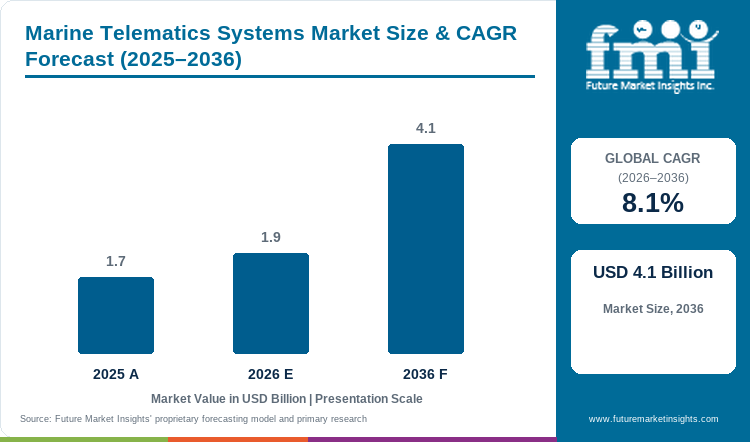
USD 1.9 billion in 2026 and USD 4.1 billion by 2036, expanding at 8.1% CAGR.
Sales of marine telematics systems are estimated to rise at 8.1% CAGR through 2036, increasing valuation from USD 1.7 billion in 2025 to USD 1.9 billion in 2026, and reaching USD 4.1 billion by 2036. Commercial spending rises when vessel operators replace periodic reports with continuously available position and machinery data for maintenance or safety decisions. Danelec reported in March 2025 that high-frequency data systems were connected to 15,000 ships and captured more than 1.5 trillion onboard datapoints during 2024. Ship managers already use continuous vessel data at scale so telematics budgets can be tied to performance and maintenance work instead of isolated position reporting.
Brazil converts satellite-monitoring policy into a more immediate equipment decision than Japan because covered fishing operators must keep a working tracking route. Brazil is forecast to grow at 8.8% CAGR while Japan is forecast at 6.1% during the same assessment period. Brazil’s Ministry of Fisheries and Aquaculture reported in March 2026 that 86 vessels joined PREPS during 2025 and represented 10.6% of the program’s monitored vessel base. The same report identifies equipment cost and system modernization as practical barriers to broader participation. Hardware availability and reliable service affect how many regulated vessels can join PREPS and keep reporting without operational interruptions.
Key Takeaways
- Vessel operators increasingly purchase marine telematics when continuous position and machinery data can support maintenance decisions alongside safety monitoring.
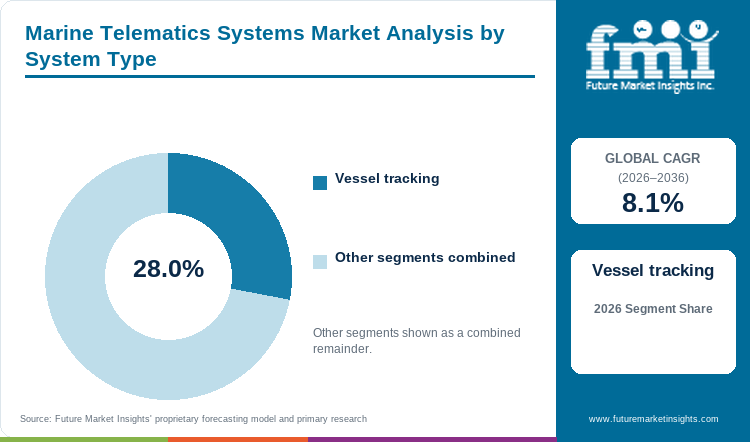
- Based on system type, vessel tracking is projected to account for 28.0% in 2026 owing to position visibility serving as the broadest shared requirement.
- By connectivity, cellular is estimated to hold 28.0% in 2026 because many coastal and recreational vessels operate within terrestrial coverage.
- In 2026, recreational boats are expected to lead the vessel type category with 27.0% share driven by owner demand for alerts during unattended periods.
- Retrofit integration and network continuity can delay adoption because buyers must connect mixed onboard electronics without weakening alarm reliability or cybersecurity.
- Some of the key players in this market include Garmin Ltd., Navico Group, Siren Marine, Yacht Sentinel, Inmarsat Maritime (a Viasat company), Iridium Communications Inc., S&P Global Market Intelligence, Danelec (a GTT Group company), Kongsberg Maritime ASA, and Wärtsilä Corporation.
Analyst Perspective
“Marine telematics earns budget when the data reaches someone who can act before a vessel issue becomes an operational interruption. Buyers should judge integration depth and service continuity before comparing dashboard breadth or adding another recurring subscription.”
- Nikhil Kaitwade, Principal Consultant, Future Market Insights
How is the marine telematics systems market segmented?
The marine telematics systems market is segmented by system type, connectivity, vessel type, deployment, sales channel and region.
The marine telematics systems market is segmented by system type, connectivity, vessel type, deployment, sales channel and region for the 2026 to 2036 assessment. System type covers vessel tracking, engine telematics, fuel monitoring, predictive maintenance and safety - geofence telematics as separate operating functions. Connectivity distinguishes cellular, satellite, AIS-linked, Wi-Fi marina and hybrid connectivity routes used to move vessel data. Vessel type covers recreational boats, commercial fleets, fishing vessels, workboats and yachts with different ownership and operating patterns. Deployment includes hardware + platform, software platform, OEM embedded and aftermarket retrofit approaches used to install and manage the system. Sales channel covers fleet solution providers, boat OEMs, marine electronics dealers and subscription platforms that control the customer relationship.
What operating condition supports vessel tracking demand in the system type category?
Fishing fleets and commercial operators need position records that remain available between port calls because safety and compliance decisions depend on current vessel location. NOAA Fisheries updated its West Coast vessel monitoring guidance in August 2026 and defines VMS using a type-approved transmitter that automatically determines vessel position before sending it to a communications provider. The operating logic extends beyond enforcement because a dependable position feed also gives shore teams a common reference for dispatch and incident response.
- By system type, vessel tracking is forecast to represent 28.0% in 2026 because regulated and commercial operators already use vessel tracking systems as a baseline for remote position visibility and shore-side response.
- NOAA guidance shows how location telemetry becomes an ongoing service need when operators must maintain approved equipment and reliable position reporting.
Why do coastal operators favor cellular connectivity within the connectivity category?
Near-shore operators can send frequent alerts without carrying satellite service for every routine update when terrestrial coverage remains available. Cellular equipment also fits dealer installation patterns because owners already use mobile applications for alarms and remote controls outside the marina. Yamaha and Siren Marine updated the Connected Boat mobile application in April 2026 to place vessel information and controls directly in the owner workflow with marine IoT functions. That development illustrates a purchase route where connectivity is valuable because it makes onboard status usable away from the vessel. Cellular therefore competes on update frequency and service simplicity for boats whose normal operating area remains inside reliable shore-based network coverage.
- Cellular is likely to capture 28.0% share of connectivity demand in 2026 attributable to coastal operating patterns that support familiar data plans and frequent remote updates.
- Dealers can position cellular monitoring beside broader marine communication systems when boat owners want alerts that fit the electronics and service channels already used near shore.
What makes recreational boats the largest stated vessel type share in 2026?
Recreational boats spend long periods without crew aboard while owners still need warning of movement and changing onboard conditions. Remote monitoring becomes useful when one interface can turn battery status or vessel movement into an alert before the next marina visit. Garmin introduced the GMI 40 in September 2026 as a marine instrument that presents live onboard information and integrates with other Garmin electronics for real-time vessel awareness. The development reflects an installed-electronics path that dealers can extend with remote monitoring functions instead of replacing the owner’s full helm system. Recreational demand therefore converts where sensing and alerts fit a straightforward owner workflow with limited installation burden.
- Recreational boats are set to lead the vessel type category with 27.0% share in 2026 because unattended ownership makes remote alerts commercially useful.
- Owner monitoring also connects naturally with marine battery sensors when installers need condition signals that can warn about power problems before the next scheduled visit.
How does hardware + platform secure its deployment position in marine telematics?
Marine telematics needs a reliable onboard collection point before software can turn vessel signals into useful alerts or fleet records. The installation becomes easier to support when the hardware interface and data platform share one accountable service path instead of leaving integration responsibility between several vendors. Danelec launched the DM100 VDR G3 in September 2025 with cloud-ready connectivity for modern bridge and engine data inside a connected shipboard recording architecture. That launch illustrates how data capture hardware increasingly arrives with a defined route into remote software. Buyers can then evaluate one deployment against power and interface requirements before committing to ongoing analytics or fleet services.
- Hardware + platform is projected to hold 33.0% share of deployment demand in 2026 driven by buyer preference for one accountable route from onboard capture to usable software.
- Integrated data capture also links the deployment case with marine data loggers when vessel owners require time-stamped operating information that can move into remote analysis and compliance workflows.
Why do fleet solution providers hold the stated sales channel share?
Multi-vessel operators usually need installation support and connectivity management under one service relationship because inconsistent vessel configurations raise support cost. A fleet solution provider can standardize onboarding and service escalation while the operator retains one accountable commercial contact for several vessels. Inmarsat Maritime announced in March 2025 that Anthony Veder would upgrade its entire fleet to NexusWave for managed bonded connectivity supporting crew and business applications. The fleetwide decision demonstrates why channel value increases when the provider can repeat one service model on different vessels without making each installation a separate commercial project. That approach lowers coordination work for operators that need predictable support and ongoing connectivity at fleet scale.
- The sales channel category is forecast to be led by fleet solution providers at 34.0% share in 2026 because operators value consistent deployment and support for multiple vessels.
- That service model overlaps with fleet management software when shore teams want one workflow for vessel status and routine operating decisions instead of separate device relationships.
What are the drivers, restraints and opportunities in the Marine Telematics Systems Market?
Continuous vessel data supports broader monitoring demand while retrofit integration slows installation and hybrid connectivity gives suppliers a practical route to extend service coverage.
- Driver: Fleet operators increase telematics spending when remote condition data reduces maintenance uncertainty and gives shore teams earlier warning of developing equipment problems.
- Restraint: Shipboard cybersecurity and mixed electronics can lengthen approval because connected devices must exchange useful data without weakening trusted onboard system boundaries.
- Opportunity: Hybrid communication lets suppliers preserve lower-cost coastal links while adding satellite continuity for vessels that move beyond reliable terrestrial coverage.
Continuous Vessel Data Improves Maintenance Decisions
Fleet maintenance teams gain a clearer buying case when telematics data can change service timing before an equipment issue becomes an interruption. Wärtsilä signed a February 2025 Lifecycle Agreement covering 14 CMA Ships vessels and included Expert Insight for predictive maintenance with remote operational support. That agreement connects real-time vessel data with an established maintenance service decision instead of treating monitoring as a separate dashboard purchase. Maintenance planners can schedule a service window before sensor evidence becomes an urgent unscheduled repair request. Suppliers that link onboard measurements to predictive maintenance tools can sell a ongoing operating function that maintenance teams can evaluate against avoided downtime and planned service work.
Cyber Review Raises the Retrofit Approval Threshold
Connected vessel systems face a higher approval threshold when telematics traffic touches shipboard information and communication technology used for safe operations. ClassNK awarded Cyber Security Type Approval to Inmarsat Maritime NexusWave in June 2026 after assessing onboard ICT architecture against IACS UR E27 Rev.1. The approval illustrates the documentation burden that connected platforms must satisfy as owners place more operational data on shared ship networks. Integrators also need clear responsibility for software updates because an unmanaged change can reopen the approval review. Retrofit projects can slow when teams must reconcile older electronics with cybersecurity controls and prove remote access will not compromise reliable onboard functions.
Hybrid Connectivity Extends Service Beyond Coastal Coverage
Hybrid communications give telematics suppliers a practical way to keep data available when vessels move between coastal cellular service and remote operating areas. Iridium reported in April 2025 that K Line Energy Shipping vessels were adding Iridium Certus as a companion to Starlink for resilient maritime connectivity. That deployment establishes a direct commercial route for maritime satellite communication inside telematics designs that need backup connectivity instead of one network path. Fleet managers can compare one service contract against coverage gaps that previously required separate hardware and support arrangements. System developers can package network switching with position and machinery monitoring so operators receive consistent alerts without managing separate communication devices independently.
Which country CAGRs are profiled in the Marine Telematics Systems Market?
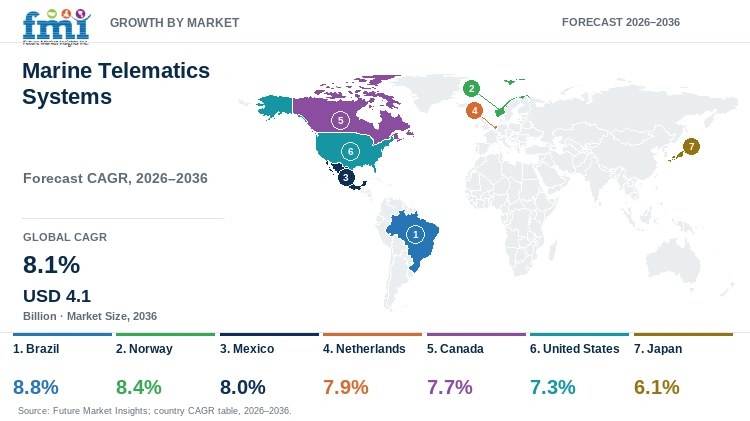
| Country | CAGR |
|---|---|
| Brazil | 8.8% |
| Norway | 8.4% |
| Mexico | 8.0% |
| Netherlands | 7.9% |
| Canada | 7.7% |
| United States | 7.3% |
| Japan | 6.1% |
How do country-level CAGRs compare in the Marine Telematics Systems Market?
The seven country forecasts form a 2.7-point range with Brazil and Norway above the middle cluster and Japan separated at the lower end. The spacing reflects different monitoring obligations and fleet operating patterns instead of a simple ranking of present market size. Suppliers should compare the CAGR with the vessel base and the local route that turns monitoring needs into installed equipment or subscription service.
- Brazil ties fishing-vessel tracking to a formal PREPS enrollment route that makes approved equipment access important for covered operators.
- Norway presents a large merchant-vessel service base where remote data can support condition monitoring beyond regulatory tracking alone.
- Mexico publishes national fishing-vessel position records that keep satellite monitoring embedded in routine fisheries oversight and operating visibility.
- The Netherlands receives substantial seagoing vessel traffic so integration with port and fleet information systems influences supplier fit.
- Canada requires approved monitoring units in many fisheries which makes replacement support and registration handling part of the service decision.
- United States requirements vary by fishery and transmission schedule so vendors must match devices to specific federal operating rules.
- Japan places connected ship systems inside a broader maritime safety framework where documentation and integration quality affect adoption timing.
Comparable country CAGRs can therefore produce different commercial conditions because the purchase trigger ranges from regulated tracking to broader vessel-performance management. The full report provides country-level CAGR analysis across North America, Latin America, Western Europe, Eastern Europe, East Asia, South Asia and Pacific, and the Middle East and Africa.
Country-wise Analysis
- Brazilian fishing operators work under a national satellite-tracking framework that links covered vessels with PREPS equipment and reporting requirements. By 2036, Brazil is projected to grow at 8.8% CAGR because regulated fishing activity keeps position reporting tied to an identifiable operating need. The Ministry of Fisheries and Aquaculture published Portaria GM/MPA No. 484/2025 in July 2025 to consolidate PREPS obligations for specified permitted or authorized vessels. Suppliers need approved equipment plus installation support because compliance depends on keeping the tracking unit registered and operational during fishing activity. Dealer retrofit work can also pair tracking hardware with boat camera systems when owners use the same service visit to expand remote situational awareness.
- Norwegian vessel operators support a broad marine service network that spans coastal routes and internationally trading ships under national registration systems. Norway's marine telematics systems outlook is anticipated to advance at 8.4% CAGR over the assessment period supported by a merchant fleet that can apply remote monitoring beyond basic position reporting. Statistics Norway counted 1,498 merchant-fleet vessels of at least 100 gross tonnes in NIS and NOR during 2025. Local service partners also need remote troubleshooting capacity because offshore schedule disruptions can make vessel visits costly and slow. That fleet gives telematics providers a substantial installed service base where reliable satellite IoT can support vessel data continuity when coastal communication becomes insufficient for remote monitoring tasks.
- Mexican fisheries already use satellite position reporting as an operating record for monitored vessels under federal fisheries administration. Marine telematics systems demand in Mexico is forecast to rise at 8.0% CAGR over the forecast period because national tracking is part of routine oversight for participating fishing activity. CONAPESCA updated its 2026 national monitoring dataset in May and publishes vessel-route reports containing heading plus latitude and longitude with speed. Channel partners need replacement stock near working ports because a failed unit can interrupt required position reporting. Suppliers also need durable low-power devices and practical activation support because dispersed fishing operators must keep location reporting reliable outside major service centers.
- Dutch telematics demand develops from high vessel traffic and the need to move ship data into port and fleet planning systems. Adoption of marine telematics systems in the Netherlands is estimated to expand at 7.9% CAGR through 2036 driven by dense port activity that increases the value of timely vessel status and interoperable data feeds. Statistics Netherlands recorded 38,200 seagoing vessel calls at Dutch seaports during 2025 covering cargo and passenger vessel types. Port-facing integrations also need consistent identifiers so repeated vessel calls can be matched with the correct operational record. Suppliers can use marine electronics integration as the entry point but must support stable data exchange with shore systems that manage repeated port interactions.
- Canadian fisheries use near-real-time vessel monitoring as a national management tool and require approved hardware wherever license conditions impose VMS participation. In Canada, marine telematics systems demand is predicted to advance at 7.7% CAGR through 2036 as replacement and registration events keep compliant tracking tied to repeat equipment decisions. Fisheries and Oceans Canada stated in October 2025 that many fisheries require VMS units and participating vessels must buy plus register an approved device. A failed approved unit can stop a vessel from meeting license conditions so providers need replacement stock near active fishing ports. Providers therefore compete on approved hardware and reliable satellite service while registration support can reduce disruption during installation or transfer events.
- United States commercial fisheries follow federal monitoring rules that differ by region and fishery while retaining a common requirement for reliable position transmission. The United States is estimated to post 7.3% CAGR over the forecast period reinforced by approved monitoring requirements embedded in multiple federal fisheries. NOAA Fisheries updated its Regional Vessel Monitoring Information in May 2026 and documents operational units with prescribed reporting intervals for several federal fisheries. Regional support teams must understand fishery-specific activation rules before recommending one device for several operating areas. Vendors therefore need configurable reporting and responsive technical support so each installation fits the applicable federal rule without unnecessary operating complexity.
- Japanese shipowners operate a mature domestic vessel base that raises retrofit and interface work for connected monitoring systems. Marine telematics systems sales in Japan are forecast to expand at 6.1% CAGR by 2036 shaped by an older domestic fleet that raises interface and compatibility work before wider adoption. The Ministry of Land Infrastructure Transport and Tourism reported in Maritime Statistics 2025 that 66% of the measured vessel fleet was at least fourteen years old in 2024. Marine integrators therefore need detailed interface records before owners treat a connected function as routine shipboard equipment. Suppliers that document compatibility can address replacement work without forcing operators to modernize unrelated systems during the same project.
Who are the notable companies in the Marine Telematics Systems Market?
Garmin Ltd., Navico Group, Siren Marine, Yacht Sentinel, Inmarsat Maritime (a Viasat company), Iridium Communications Inc., S&P Global Market Intelligence, Danelec (a GTT Group company), Kongsberg Maritime ASA, and Wärtsilä Corporation are notable companies serving this market.
Competition separates by the part of the vessel-data problem each company controls rather than by one common product architecture. Garmin Ltd. and Navico Group begin from integrated marine electronics while Siren Marine and Yacht Sentinel emphasize connected-boat monitoring. Danelec and Kongsberg Maritime ASA focus more heavily on fleet data and digital vessel operations. Inmarsat Maritime and Iridium Communications Inc. control connectivity routes while S&P Global Market Intelligence provides vessel-tracking data and Wärtsilä Corporation links remote data with lifecycle support.
- Garmin Ltd. plus Navico Group and Siren Marine serve connected-boat workflows where onboard electronics integration shapes installation and daily use.
- Danelec together with Kongsberg Maritime ASA and Wärtsilä Corporation supports commercial fleet data workflows that connect vessel measurements with shore-side operating decisions.
- Inmarsat Maritime with Iridium Communications Inc. and S&P Global Market Intelligence covers connectivity or vessel-tracking data while Yacht Sentinel concentrates on specialist yacht monitoring.
Competitive Benchmarking: Marine Telematics Systems Market
| Company | Vessel Data Integration | Remote Fleet Workflow | Connectivity Resilience | Geographic Reach |
|---|---|---|---|---|
| Garmin Ltd. | High | Medium | Medium | Global recreational marine |
| Navico Group | High | Medium | Medium | Global marine channels |
| Siren Marine | High | High | Medium | North America and international leisure marine |
| Yacht Sentinel | Medium | High | Medium | Europe and international yacht market |
| Inmarsat Maritime (a Viasat company) | High | High | High | Global commercial maritime |
| Iridium Communications Inc. | Medium | Medium | High | Global ocean connectivity |
| S&P Global Market Intelligence | Medium | High | High | Global maritime data services |
| Danelec (a GTT Group company) | High | High | Medium | Global merchant fleet |
| Kongsberg Maritime ASA | High | High | Medium | Global commercial and offshore marine |
| Wärtsilä Corporation | High | High | Medium | Global commercial marine |
Scoring basis: High vessel-data integration requires documented support for several onboard data sources or integrated ship systems while Medium covers a narrower verified interface set. High remote fleet workflow requires documented multi-vessel monitoring or shore-side operational use while Medium covers a narrower remote function. High connectivity resilience requires documented multi-network or global satellite continuity while Medium covers reliable but more limited connectivity. Low identifies a documented single-purpose function that does not meet the Medium threshold for that criterion.
Key Developments in the Marine Telematics Systems Market
- In May 2026, Navico Group brand B&G partnered with Ocean Safety to integrate the Jon Buoy Smart Release directly with vessel navigation systems for automated man-overboard response.
- In February 2026, Kongsberg Maritime ASA unveiled its harmonized Digital Solutions portfolio and launched KM Performance for fleet operations using a common vessel-data foundation.
- In January 2026, Inmarsat Maritime confirmed Evergreen Marine would move its fleet to NexusWave bonded connectivity after successful trials supporting secure vessel communications.
- In April 2025, Wärtsilä Corporation completed the first NACOS Connect remote-mimics pilot on Sun Princess to provide shoreside access to real-time ship automation data.
Key Players in the Marine Telematics Systems Market
Connected Recreational Marine Platforms
- Garmin Ltd.
- Navico Group
- Siren Marine
- Yacht Sentinel
Fleet Data and Vessel Performance Platforms
- Danelec (a GTT Group company)
- Kongsberg Maritime ASA
- Wärtsilä Corporation
- S&P Global Market Intelligence
Maritime Connectivity Platforms
- Inmarsat Maritime (a Viasat company)
- Iridium Communications Inc.
Marine Telematics Systems Market - Report Scope
| Coverage field | Report scope |
|---|---|
| Market breakdown | By system type, connectivity, vessel type, deployment, sales channel and region. |
| Quantitative Units | USD billion. |
| Market Definition | Connected marine hardware and software systems that collect vessel position or onboard condition data and deliver it to onboard or shore-side users for monitoring, alerts, maintenance, compliance or fleet decisions. |
| Regions Covered | North America, Latin America, Western Europe, Eastern Europe, East Asia, South Asia and Pacific, and Middle East and Africa. |
| Countries Covered | Brazil, Norway, Mexico, Netherlands, Canada, United States, Japan, and 20+ countries included in the full report. |
| Key Companies Profiled | Garmin Ltd., Navico Group, Siren Marine, Yacht Sentinel, Inmarsat Maritime (a Viasat company), Iridium Communications Inc., S&P Global Market Intelligence, Danelec (a GTT Group company), Kongsberg Maritime ASA, and Wärtsilä Corporation. |
| Forecast Period | 2026 to 2036. |
| Approach | Primary and secondary research with market triangulation. |
Marine Telematics Systems Market - Research Methodology
| Method | Approach |
|---|---|
| Primary Research | FMI analysts gathered input from manufacturers, service providers, technology developers, distributors, end users, procurement teams, and subject-matter experts. Interviews examined purchasing decisions, product or service evaluation, adoption barriers, approval requirements, pricing considerations, and expectations for technical or commercial support. Respondents were also asked what evidence is required before a trial, pilot, or initial order develops into regular purchasing. |
| Desk Research | Desk research covered government statistics, regulatory publications, trade data, industry associations, technical literature, standards, company filings, product information, and official corporate announcements. Sources were reviewed for relevance, publication date, geographic coverage, and consistency with the defined market scope. Claims relating to performance, applications, approvals, capacity, investment, and commercial activity were retained only when supported by credible public evidence. |
| Market Sizing and Forecasting | The market model combined the baseline value with historical performance, segment structure, pricing and volume indicators, adoption levels, company participation, and country-level demand conditions. Forecast assumptions considered economic activity, investment trends, regulatory developments, technology adoption, purchasing cycles, supply availability, and barriers to wider market use. Segment and regional estimates were reconciled before the final market total was calculated. |
| Data Validation | Estimates were checked against multiple independent indicators, including public data, company activity, trade patterns, industry developments, and findings from primary interviews. Validation also tested whether products, services, applications, and company revenues fell within the defined market boundaries. Adjacent categories, unsupported claims, overlapping revenues, and activities without direct market relevance were excluded to reduce double counting and maintain consistency across segments and countries. |
Marine Telematics Systems Market by Segments
Marine Telematics Systems Market segmented by System Type:
- Vessel tracking
- Engine telematics
- Fuel monitoring
- Predictive maintenance
- Safety - geofence telematics
Marine Telematics Systems Market segmented by Connectivity:
- Cellular
- Satellite
- AIS-linked
- Wi-Fi marina
- Hybrid connectivity
Marine Telematics Systems Market segmented by Vessel Type:
- Recreational boats
- Commercial fleets
- Fishing vessels
- Workboats
- Yachts
Marine Telematics Systems Market segmented by Deployment:
- Hardware + platform
- Software platform
- OEM embedded
- Aftermarket retrofit
Marine Telematics Systems Market segmented by Sales Channel:
- Fleet solution providers
- Boat OEMs
- Marine electronics dealers
- Subscription platforms
Marine Telematics Systems Market by Region:
- North America
- United States
- Canada
- Latin America
- Brazil
- Mexico
- Argentina
- Chile
- Western Europe
- Germany
- France
- United Kingdom
- Italy
- Spain
- Benelux
- Nordics
- Eastern Europe
- Poland
- Czech Republic
- Romania
- Hungary
- East Asia
- China
- Japan
- South Korea
- South Asia and Pacific
- India
- ASEAN
- Australia and New Zealand
- Middle East and Africa
- GCC Countries
- South Africa
- Türkiye
- Israel
Research Sources and Bibliography
- Danelec. (2025, March 12). Danelec expands High-Frequency Data installed-base with 15,000 ships now connected.
- Ministério da Pesca e Aquicultura. (2026, March). Relatório de Gestão - 2025.
- Ministério da Pesca e Aquicultura. (2025, July 29). Atos Normativos que tratam da obrigatoriedade de adesão ao PREPS e envio de Mapa de Bordo.
- NOAA Fisheries. (2026, August). Vessel Monitoring System on the West Coast.
- NOAA Fisheries. (2026, May 6). Regional Vessel Monitoring Information.
- Yamaha USA Marine Business Unit and Siren Marine. (2026, April 8). Siren Marine Announces Major Update to Connected Boat Mobile App, Expanding Personalized Boating Experience.
- Garmin. (2026, September 1). See all essential data on a sleek, high-resolution color display with the intuitive GMI 40 from Garmin.
- Danelec. (2025, September 24). Danelec launches next generation Voyage Data Recorder for improved safety, compliance and connectivity.
- Inmarsat Maritime. (2025, March 25). Anthony Veder To Upgrade Entire Fleet with Inmarsat NexusWave for Seamless High-speed Connectivity.
- Wärtsilä Corporation. (2025, February 18). Wärtsilä Lifecycle Agreement to ensure operational reliability for 14 vessels in CMA Ships fleet.
- Inmarsat Maritime. (2026, June 11). Inmarsat NexusWave certified by ClassNK for latest IACS cyber security standards.
- Iridium Communications Inc. (2025, April 30). “K” Line Taps Iridium Certus to Power Resilient Connectivity Alongside Starlink.
- Statistics Norway. (2026, January 23). The Norwegian Merchant Fleet.
- Comisión Nacional de Acuacultura y Pesca. (2026, May 8). Localización y monitoreo satelital de embarcaciones pesqueras (2026).
- Statistics Netherlands. (2026, June 12). Zeevaart; aantal schepen, type schip.
- Fisheries and Oceans Canada. (2025, October 22). National Vessel Monitoring System.
- Ministry of Land, Infrastructure, Transport and Tourism. (2025, September 26). 数字で見る海事2025.
- Ministry of Land, Infrastructure, Transport and Tourism. (2025, June 30). 国際海事機関(IMO)第110回海上安全委員会(MSC 110)の開催結果概要.
- Navico Group. (2026, May 14). B&G Technology Powers New Life Saving Jon Buoy Smart Release System in Partnership with Ocean Safety.
- Kongsberg Maritime. (2026, February 13). Harmonised Digital Solutions portfolio and KM Performance unveiled.
- Inmarsat Maritime. (2026, January 7). Evergreen confirms fleetwide rollout of Inmarsat NexusWave.
- Wärtsilä Corporation. (2025, April 7). Wärtsilä ANCS installs first NACOS Connect remote mimics application on Princess Cruises’ newest ship, Sun Princess.
- Inmarsat Maritime. (2026, July 7). Hapag-Lloyd Commits to Fleetwide Inmarsat NexusWave Roll-Out.
- Inmarsat Maritime. (2025, November 18). Coastal Transportation selects Inmarsat NexusWave fleetwide to deliver cyber-secure, reliable connectivity.
- Danelec. (2026, April 13). Danelec and CleanQuote partner to connect Vessel Performance Insights with underwater services execution.
- Inmarsat Maritime. (2026, September 8). NexusWave earns Bureau Veritas Cyber Security Type Approval, advancing secure multi-network connectivity for the digital vessel.
- S&P Global. (2025, April 24). S&P Global agrees to acquire ORBCOMM’s Automatic Identification System business, strengthening its supply chain and maritime offerings.
- Garmin. (2025, October 16). New Garmin OnBoard System redefines boating safety.
- Garmin. (2025, April 3). Garmin expands boater warning capabilities with new AIS warning messaging feature.
- Navico Group. (2025, October 10). Navico Group Partners with Maccaferri Futura to Advance Ocean Health Through Cutting-Edge Marine Technology.
- Yamaha USA Marine Business Unit and Siren Marine. (2026, July 30). Siren 3 Pro Now Standard with Yamaha Digital Electronic Control Outboard Kits.
- Yacht Sentinel. (2025, January 6). Yacht Sentinel Acquires TSM Systems (Tow Pro), Expanding Marine Technology Solutions Portfolio.
- Iridium Communications Inc. (2026, September 1). Furuno Unveils New SOLION-100 Terminal for Iridium GMDSS.
- S&P Global. (2025, November 10). S&P Global Announces Successful Completion of its Acquisition of ORBCOMM’s Automatic Identification System Business.
- GTT. (2025, July 31). GTT completes the acquisition of Danelec and strengthens its leadership in maritime digitalisation.
- Kongsberg Maritime ASA. (2026, April 23). Kongsberg Maritime begins trading on Oslo Stock Exchange.
- Kongsberg Gruppen ASA. (2025, May 8). Financial results Q1 2025: Positioned for further growth.
- Wärtsilä Corporation. (2025, October 7). Seagems renews Wärtsilä Lifecycle Agreement to support the reliability and sustainability of its fleet.
This bibliography is provided for reader reference and is not exhaustive. The full report contains the complete reference list and detailed citations
This Report Answers
- How large is the marine telematics systems market in 2026 and 2036?
- Which operating needs convert vessel data into repeat telematics purchases?
- Which system type accounts for 28.0% of demand during 2026?
- Why does cellular connectivity account for 28.0% of connectivity demand?
- What makes recreational boats account for 27.0% of vessel type demand?
- How do country CAGRs differ among the seven profiled markets?
- Which companies serve connected boats, fleets and maritime data workflows?
- Which constraints slow retrofit installation and subscription telematics service adoption?
Frequently Asked Questions
How big is the Marine Telematics Systems Market in 2026?
The marine telematics systems market is valued at USD 1.9 billion in 2026 and is projected to reach USD 4.1 billion by 2036. Continuous vessel data supports spending when operators can use remote visibility for maintenance and safety decisions.
What is the CAGR of the Marine Telematics Systems Market from 2026 to 2036?
The marine telematics systems market is projected to grow at 8.1% CAGR between 2026 and 2036. Expansion depends on vessel data becoming usable inside ongoing maintenance and fleet workflows instead of remaining a stand-alone tracking function.
Which system type accounts for 28.0% of marine telematics demand in 2026?
The vessel tracking segment is projected to account for 28.0% of system type demand in 2026. Position visibility supports fishing compliance and commercial fleet monitoring so suppliers can build additional condition functions on an established location-data requirement.
Which profiled countries form the upper forecast band through 2036?
Brazil is projected at 8.8% CAGR and Norway at 8.4% between 2026 and 2036. Brazil converts formal tracking obligations into equipment demand while Norway gives providers a large merchant-vessel base for broader remote operating services.
Which companies are active in the Marine Telematics Systems Market?
Active companies include Garmin Ltd., Navico Group, Siren Marine, Yacht Sentinel, Inmarsat Maritime (a Viasat company), Iridium Communications Inc., S&P Global Market Intelligence, Danelec (a GTT Group company), Kongsberg Maritime ASA and Wärtsilä Corporation. Their roles cover onboard electronics and remote monitoring while other companies provide maritime connectivity or commercial vessel-data workflows for shore teams.
Preview the report firsthand - request a free sample
Get SampleGet the brochure for pricing and purchase details.
Get PDFTable of Content
- Key Takeaways
- Market Size and CAGR
- Top Growth Driver
- Fastest Growing Segment
- Leading Region
- Key Companies
- Emerging Opportunities
- Executive Summary
- Global Market Outlook
- Demand-side Trends
- Supply-side Trends
- Technology Roadmap Analysis
- Analysis and Recommendations
- Analyst Perspective (What is happening? Why now? What should investors know?)
- Key Questions Answered
- How large is the market?
- What is the CAGR?
- What are key trends?
- Which region dominates?
- Who are the leaders?
- Market Overview
- Market Coverage / Taxonomy
- Market Definition / Scope / Limitations
- Research Methodology
- Chapter Orientation
- Analytical Lens and Working Hypotheses
- Market Structure, Signals, and Trend Drivers
- Benchmarking and Cross-market Comparability
- Market Sizing, Forecasting, and Opportunity Mapping
- Research Design and Evidence Framework
- Desk Research Programme (Secondary Evidence)
- Expert Input and Fieldwork (Primary Evidence)
- Tooling, Models, and Reference Databases
- Data Engineering and Model Build
- Quality Assurance and Audit Trail
- Market Background
- Market Dynamics (Drivers, Restraints, Opportunity, Trends)
- Scenario Forecast (Optimistic, Likely, Conservative)
- Impact Analysis
- AI Impact
- Sustainability Impact
- Regulatory Impact
- Technology Impact
- Consumer / Buyer Analysis
- Purchase Drivers
- Adoption Barriers
- Buyer Journey
- Opportunity Map Analysis
- Product Life Cycle Analysis
- Supply Chain Analysis
- Investment Feasibility Matrix
- Value Chain Analysis
- PESTLE and Porter's Analysis
- Regulatory Landscape
- Regional Parent Market Outlook
- Production and Consumption Statistics
- Import and Export Statistics
- Global Market Analysis and Forecast, 2021 to 2036
- Historical Market Size Value (USD Billion) Analysis, 2021 to 2025
- Current and Future Market Size Value (USD Billion) Projections, 2026 to 2036
- Y-o-Y Growth Trend Analysis
- Absolute $ Opportunity Analysis
- Global Market Pricing Analysis, 2021 to 2036
- Global Market Analysis and Forecast, By System Type, 2021 to 2036
- Introduction / Key Findings
- Historical Market Size Value (USD Billion) Analysis By System Type, 2021 to 2025
- Current and Future Market Size Value (USD Billion) Analysis and Forecast By System Type, 2026 to 2036
- Vessel tracking
- Engine telematics
- Fuel monitoring
- Predictive maintenance
- Safety - geofence telematics
- Y-o-Y Growth Trend Analysis By System Type, 2021 to 2025
- Absolute $ Opportunity Analysis By System Type, 2026 to 2036
- Global Market Analysis and Forecast, By Connectivity, 2021 to 2036
- Introduction / Key Findings
- Historical Market Size Value (USD Billion) Analysis By Connectivity, 2021 to 2025
- Current and Future Market Size Value (USD Billion) Analysis and Forecast By Connectivity, 2026 to 2036
- Cellular
- Satellite
- AIS-linked
- Wi-Fi marina
- Hybrid connectivity
- Y-o-Y Growth Trend Analysis By Connectivity, 2021 to 2025
- Absolute $ Opportunity Analysis By Connectivity, 2026 to 2036
- Global Market Analysis and Forecast, By Vessel Type, 2021 to 2036
- Introduction / Key Findings
- Historical Market Size Value (USD Billion) Analysis By Vessel Type, 2021 to 2025
- Current and Future Market Size Value (USD Billion) Analysis and Forecast By Vessel Type, 2026 to 2036
- Recreational boats
- Commercial fleets
- Fishing vessels
- Workboats
- Yachts
- Y-o-Y Growth Trend Analysis By Vessel Type, 2021 to 2025
- Absolute $ Opportunity Analysis By Vessel Type, 2026 to 2036
- Global Market Analysis and Forecast, By Deployment, 2021 to 2036
- Introduction / Key Findings
- Historical Market Size Value (USD Billion) Analysis By Deployment, 2021 to 2025
- Current and Future Market Size Value (USD Billion) Analysis and Forecast By Deployment, 2026 to 2036
- Hardware + platform
- Software platform
- OEM embedded
- Aftermarket retrofit
- Y-o-Y Growth Trend Analysis By Deployment, 2021 to 2025
- Absolute $ Opportunity Analysis By Deployment, 2026 to 2036
- Global Market Analysis and Forecast, By Sales Channel, 2021 to 2036
- Introduction / Key Findings
- Historical Market Size Value (USD Billion) Analysis By Sales Channel, 2021 to 2025
- Current and Future Market Size Value (USD Billion) Analysis and Forecast By Sales Channel, 2026 to 2036
- Fleet solution providers
- Boat OEMs
- Marine electronics dealers
- Subscription platforms
- Y-o-Y Growth Trend Analysis By Sales Channel, 2021 to 2025
- Absolute $ Opportunity Analysis By Sales Channel, 2026 to 2036
- Global Market Analysis and Forecast, By Region, 2021 to 2036
- Introduction
- Historical Market Size Value (USD Billion) Analysis By Region, 2021 to 2025
- Current Market Size Value (USD Billion) Analysis and Forecast By Region, 2026 to 2036
- North America
- Latin America
- Western Europe
- Eastern Europe
- East Asia
- South Asia and Pacific
- Middle East and Africa
- Market Attractiveness Analysis By Region
- North America Market Analysis and Forecast, By Country, 2021 to 2036
- Historical Market Size Value (USD Billion) Trend Analysis By Market Taxonomy, 2021 to 2025
- Market Size Value (USD Billion) Forecast By Market Taxonomy, 2026 to 2036
- By Country
- United States
- Canada
- By System Type
- By Connectivity
- By Vessel Type
- By Deployment
- By Sales Channel
- By Country
- Market Attractiveness Analysis
- By Country
- By System Type
- By Connectivity
- By Vessel Type
- By Deployment
- By Sales Channel
- Key Takeaways
- Latin America Market Analysis and Forecast, By Country
- Historical Market Size Value (USD Billion) Trend Analysis By Market Taxonomy, 2021 to 2025
- Market Size Value (USD Billion) Forecast By Market Taxonomy, 2026 to 2036
- By Country
- Brazil
- Mexico
- Argentina
- Chile
- By System Type
- By Connectivity
- By Vessel Type
- By Deployment
- By Sales Channel
- By Country
- Market Attractiveness Analysis
- By Country
- By System Type
- By Connectivity
- By Vessel Type
- By Deployment
- By Sales Channel
- Key Takeaways
- Western Europe Market Analysis and Forecast, By Country
- Historical Market Size Value (USD Billion) Trend Analysis By Market Taxonomy, 2021 to 2025
- Market Size Value (USD Billion) Forecast By Market Taxonomy, 2026 to 2036
- By Country
- Germany
- France
- United Kingdom
- Italy
- Spain
- Benelux
- Nordics
- By System Type
- By Connectivity
- By Vessel Type
- By Deployment
- By Sales Channel
- By Country
- Market Attractiveness Analysis
- By Country
- By System Type
- By Connectivity
- By Vessel Type
- By Deployment
- By Sales Channel
- Key Takeaways
- Eastern Europe Market Analysis and Forecast, By Country
- Historical Market Size Value (USD Billion) Trend Analysis By Market Taxonomy, 2021 to 2025
- Market Size Value (USD Billion) Forecast By Market Taxonomy, 2026 to 2036
- By Country
- Poland
- Czech Republic
- Romania
- Hungary
- By System Type
- By Connectivity
- By Vessel Type
- By Deployment
- By Sales Channel
- By Country
- Market Attractiveness Analysis
- By Country
- By System Type
- By Connectivity
- By Vessel Type
- By Deployment
- By Sales Channel
- Key Takeaways
- East Asia Market Analysis and Forecast, By Country
- Historical Market Size Value (USD Billion) Trend Analysis By Market Taxonomy, 2021 to 2025
- Market Size Value (USD Billion) Forecast By Market Taxonomy, 2026 to 2036
- By Country
- China
- Japan
- South Korea
- By System Type
- By Connectivity
- By Vessel Type
- By Deployment
- By Sales Channel
- By Country
- Market Attractiveness Analysis
- By Country
- By System Type
- By Connectivity
- By Vessel Type
- By Deployment
- By Sales Channel
- Key Takeaways
- South Asia and Pacific Market Analysis and Forecast, By Country
- Historical Market Size Value (USD Billion) Trend Analysis By Market Taxonomy, 2021 to 2025
- Market Size Value (USD Billion) Forecast By Market Taxonomy, 2026 to 2036
- By Country
- India
- ASEAN
- Australia and New Zealand
- By System Type
- By Connectivity
- By Vessel Type
- By Deployment
- By Sales Channel
- By Country
- Market Attractiveness Analysis
- By Country
- By System Type
- By Connectivity
- By Vessel Type
- By Deployment
- By Sales Channel
- Key Takeaways
- Middle East and Africa Market Analysis and Forecast, By Country
- Historical Market Size Value (USD Billion) Trend Analysis By Market Taxonomy, 2021 to 2025
- Market Size Value (USD Billion) Forecast By Market Taxonomy, 2026 to 2036
- By Country
- GCC Countries
- South Africa
- Türkiye
- Israel
- By System Type
- By Connectivity
- By Vessel Type
- By Deployment
- By Sales Channel
- By Country
- Market Attractiveness Analysis
- By Country
- By System Type
- By Connectivity
- By Vessel Type
- By Deployment
- By Sales Channel
- Key Takeaways
- Key Countries Market Analysis
- United States
- Pricing Analysis
- Market Share Analysis, 2025
- By System Type
- By Connectivity
- By Vessel Type
- By Deployment
- By Sales Channel
- Canada
- Pricing Analysis
- Market Share Analysis, 2025
- By System Type
- By Connectivity
- By Vessel Type
- By Deployment
- By Sales Channel
- Mexico
- Pricing Analysis
- Market Share Analysis, 2025
- By System Type
- By Connectivity
- By Vessel Type
- By Deployment
- By Sales Channel
- Brazil
- Pricing Analysis
- Market Share Analysis, 2025
- By System Type
- By Connectivity
- By Vessel Type
- By Deployment
- By Sales Channel
- Chile
- Pricing Analysis
- Market Share Analysis, 2025
- By System Type
- By Connectivity
- By Vessel Type
- By Deployment
- By Sales Channel
- Germany
- Pricing Analysis
- Market Share Analysis, 2025
- By System Type
- By Connectivity
- By Vessel Type
- By Deployment
- By Sales Channel
- United Kingdom
- Pricing Analysis
- Market Share Analysis, 2025
- By System Type
- By Connectivity
- By Vessel Type
- By Deployment
- By Sales Channel
- Italy
- Pricing Analysis
- Market Share Analysis, 2025
- By System Type
- By Connectivity
- By Vessel Type
- By Deployment
- By Sales Channel
- Spain
- Pricing Analysis
- Market Share Analysis, 2025
- By System Type
- By Connectivity
- By Vessel Type
- By Deployment
- By Sales Channel
- France
- Pricing Analysis
- Market Share Analysis, 2025
- By System Type
- By Connectivity
- By Vessel Type
- By Deployment
- By Sales Channel
- India
- Pricing Analysis
- Market Share Analysis, 2025
- By System Type
- By Connectivity
- By Vessel Type
- By Deployment
- By Sales Channel
- ASEAN
- Pricing Analysis
- Market Share Analysis, 2025
- By System Type
- By Connectivity
- By Vessel Type
- By Deployment
- By Sales Channel
- Australia and New Zealand
- Pricing Analysis
- Market Share Analysis, 2025
- By System Type
- By Connectivity
- By Vessel Type
- By Deployment
- By Sales Channel
- China
- Pricing Analysis
- Market Share Analysis, 2025
- By System Type
- By Connectivity
- By Vessel Type
- By Deployment
- By Sales Channel
- Japan
- Pricing Analysis
- Market Share Analysis, 2025
- By System Type
- By Connectivity
- By Vessel Type
- By Deployment
- By Sales Channel
- South Korea
- Pricing Analysis
- Market Share Analysis, 2025
- By System Type
- By Connectivity
- By Vessel Type
- By Deployment
- By Sales Channel
- Poland
- Pricing Analysis
- Market Share Analysis, 2025
- By System Type
- By Connectivity
- By Vessel Type
- By Deployment
- By Sales Channel
- Hungary
- Pricing Analysis
- Market Share Analysis, 2025
- By System Type
- By Connectivity
- By Vessel Type
- By Deployment
- By Sales Channel
- Türkiye
- Pricing Analysis
- Market Share Analysis, 2025
- By System Type
- By Connectivity
- By Vessel Type
- By Deployment
- By Sales Channel
- South Africa
- Pricing Analysis
- Market Share Analysis, 2025
- By System Type
- By Connectivity
- By Vessel Type
- By Deployment
- By Sales Channel
- Norway
- Pricing Analysis
- Market Share Analysis, 2025
- By System Type
- By Connectivity
- By Vessel Type
- By Deployment
- By Sales Channel
- Netherlands
- Pricing Analysis
- Market Share Analysis, 2025
- By System Type
- By Connectivity
- By Vessel Type
- By Deployment
- By Sales Channel
- United States
- Market Structure Analysis
- Competition Dashboard
- Competition Benchmarking
- Market Share Analysis of Top Players
- By Regional
- By System Type
- By Connectivity
- By Vessel Type
- By Deployment
- By Sales Channel
- Emerging Startups
- Innovation Benchmarking
- Competition Analysis
- Competition Deep Dive
- Garmin Ltd.
- Overview
- Product Portfolio
- Profitability by Market Segments
- Sales Footprint
- Strategy Overview
- Marketing Strategy
- Product Strategy
- Channel Strategy
- Navico Group
- Siren Marine
- Yacht Sentinel
- Inmarsat Maritime (a Viasat company)
- Iridium Communications Inc.
- S&P Global Market Intelligence
- Danelec (a GTT Group company)
- Kongsberg Maritime ASA
- Wärtsilä Corporation
- Garmin Ltd.
- Case Studies
- Success Stories
- Recent Developments
- Competition Deep Dive
- Assumptions & Acronyms Used


