

- Market Size (2026)
- USD 620.6 Mn
- Forecast (2036)
- USD 1243.8 Mn
- CAGR (2026 to 2036)
- 7.2%
How big is Marine Data Loggers Market in 2026?
USD 620.6 million in 2026 and USD 1,243.8 million by 2036 at a 7.2% CAGR.
Demand for marine data loggers is projected to expand at 7.2% CAGR between 2026 and 2036, increasing valuation from USD 620.6 million in 2026 to USD 1,243.8 million by 2036. Ship operators buy recorders to retain signals already moving through marine electronics networks. In March 2025, the European Commission said maritime ETS rules covered around 12,000 large ships. Although no logger is mandated, verified emissions reporting raises the value of retrievable source records.
Country demand depends on fleet structure and the depth of local service. Statistics Norway counted 1,498 vessels of 100 gross tonnes or more in 2025, including 883 in the Norwegian Ordinary Ship Register and 615 in the Norwegian International Ship Register. That fleet keeps retrofit work near Norwegian ports and supports faster 8.0% growth than Japan's 5.5%. Marine electronics testing becomes important during retrofit work where mixed-age bridges raise commissioning risk.
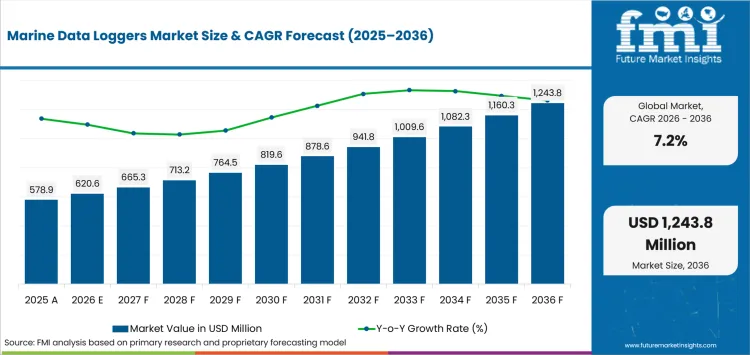
Key Takeaways
- Demand for marine data loggers rises as operating records serve maintenance, emissions review, incident reconstruction, and research without replacing upstream sensors.
- Based on logger type, NMEA data loggers are projected to account for 26.0% in 2026 due to their fit with standard marine network interfaces.
- By storage, on-device memory is estimated to hold 25.0% in 2026 owing to uninterrupted local capture during communications outages.
- In 2026, performance analytics is expected to lead application demand with 24.0% share because time-stamped histories support efficiency and equipment-behavior review.
- Mixed NMEA 0183, NMEA 2000, Ethernet, and proprietary networks can turn a low-cost recorder into a longer integration and validation project.
- Some of the key players in this market include Maretron, Actisense, Yacht Devices, Furuno, Garmin, Navico Group, Kongsberg Maritime, Campbell Scientific, Onset HOBO, and Digital Yacht.
Analyst Perspective
"Marine data logger value is decided during commissioning, not by storage capacity alone. Strong offers prove message coverage, retain data during connection loss, and give technicians records they can retrieve without redesigning the vessel network."
- Nikhil Kaitwade, Principal Consultant, Future Market Insights
How is the marine data loggers market segmented?
The marine data loggers market is segmented by logger type, storage, application, vessel type, sales channel, and region.
Logger type covers NMEA data loggers, engine data loggers, environmental data loggers, voyage data loggers, and cloud-connected loggers. Storage includes on-device memory, SD-card logging, cloud storage, and hybrid edge-cloud storage. Applications cover performance analytics, compliance logs, fleet diagnostics, research - survey logging, and maintenance history. Vessel types include commercial vessels, research vessels, yachts, fishing vessels, and workboats. Sales channels include marine electronics dealers, fleet software providers, research equipment distributors, and system integrators.
What makes NMEA data loggers central to the logger type category?
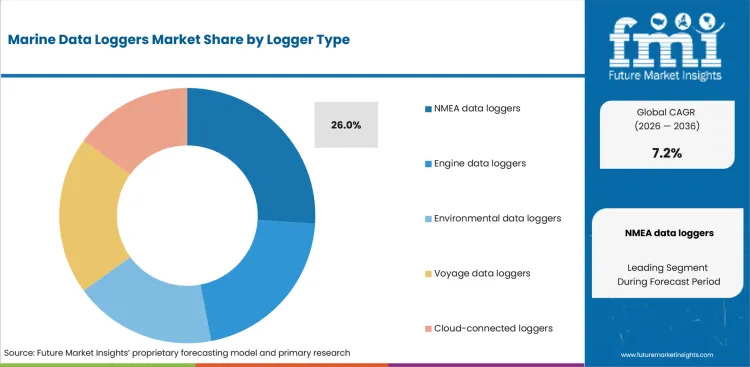
NMEA data loggers fit retrofits by capturing navigation, engine, and instrument messages already on the vessel network. Their value depends on message coverage and passive behavior so diagnostics do not introduce a new fault.
- Based on logger type, NMEA data loggers are projected to account for 26.0% in 2026 due to multi-source capture over standard marine interfaces.
- Actisense released W2K-1 firmware 1.396 in February 2025 with direct access to stored data logs and a live PGN viewer. Those functions let installers inspect timestamps and network traffic without removing the gateway from service.
Why does on-device memory lead the storage category?
On-device memory protects the vessel record during communications loss and gives technicians a direct retrieval route after a fault. Selection depends on memory endurance, overwrite rules, and power-loss behavior since offshore service cannot assume uninterrupted shore access.
- By storage, on-device memory is estimated to hold 25.0% in 2026 owing to uninterrupted local capture during weak or unavailable shore communications.
- Yacht Devices released YDVR-04 firmware 1.11 in February 2025 with diagnostic telemetry and improved bus-voltage detection. The recorder stops MicroSD card operation below 10.5 volts to protect the file system during unstable power conditions.
How does performance analytics shape the application category?
Performance analytics requires consistent timestamps so engineers can compare speed, load, position, and other variables over the same operating period. Useful analysis also depends on bringing records from several sensors into one review process.
- In 2026, performance analytics is expected to lead the application category with 24.0% share because time-stamped histories support efficiency and equipment-behavior review.
- Digital Yacht introduced OneFix in September 2025 with NMEA 0183 and NMEA 2000 connectivity, onboard logging, and an external event-marker input. Recorded track and vessel data can then be exported for review through a mobile device.
What supports commercial vessels in the vessel type category?
Commercial vessels face higher consequences for missing records since safety and environmental reporting depend on reconstructable histories. Marine loggers cannot replace regulated VDRs, but they can retain extra network data for diagnostics and performance work.
- By vessel type, commercial vessels are forecast to represent 25.0% in 2026 driven by high utilization and formal operating-record requirements.
- The European Commission updated maritime MRV guidance in April 2025 and confirmed expanded coverage for specified offshore and general cargo ships from January 2025. Broader reporting scope increases the need for dependable source records without prescribing a stand-alone logger.
What drives marine electronics dealers in the sales channel category?
Marine electronics dealers reduce installation risk because network topology, cabling, protocol support, and commissioning determine logger performance. Their role is strongest on mixed-generation vessels that need gateways, testing, and message validation before acceptance.
- Marine electronics dealers are set to lead the sales channel category with 34.0% share in 2026 due to interface validation and onboard commissioning requirements.
- NMEA's 2025 installer schedule included Basic and Advanced NMEA 2000 courses in Fort Lauderdale during June. The curriculum covered network installation and diagnostics, which strengthen dealer commissioning skills on live vessel networks.
What are the drivers, restraints and opportunities in the Marine Data Loggers Market?
Traceable vessel records support demand, mixed-generation networks raise installed cost, and resilient edge-to-shore data workflows widen the retrofit opportunity.
- Driver: Safety, emissions, maintenance, and research work requires time-stamped operating records that remain retrievable after the voyage or event.
- Restraint: Mixed NMEA 0183, NMEA 2000, Ethernet, and proprietary interfaces can require gateways, extra labor, and vessel-specific validation before useful capture begins.
- Opportunity: Edge systems that retain the authoritative local record and send selected data ashore extend logging into fleet, survey, and service workflows.
Reporting Requirements Increase the Value of Defensible Source Data
Emission reporting and engineering reviews depend on records that can be reconstructed after a voyage. At MEPC 83 in April 2025, IMO approved changes that increase access to ship fuel-use data in its Data Collection System. Local loggers preserve the onboard variables behind those submissions without changing bridge operation.
Mixed Network Generations Raise Retrofit Cost and Validation Time
Retrofit cost rises if a recorder cannot read existing vessel data without added gateways. Actisense documented in August 2025 that commercial ships commonly carry NMEA 0183 beside NMEA 2000 and type-approved equipment. Interface matrices let installers budget bridging and validation work before purchase.
Edge-to-Shore Data Workflows Expand the Commercial Use Case
Local capture preserves the complete record even if selected data is sent ashore. Kongsberg Discovery launched Geomatics in April 2025 to collect and log onboard and remote sensor data before cloud distribution. Separating capture from access gives vessel tracking programs a record that does not depend on continuous connectivity.
Which country CAGRs are profiled in the Marine Data Loggers Market?
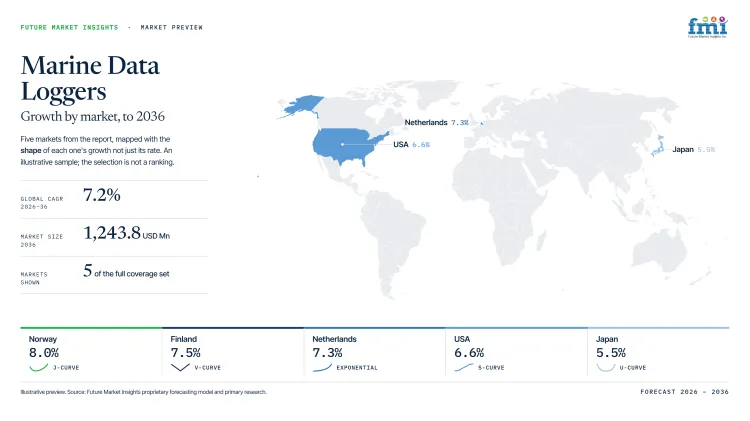
| Country | CAGR |
|---|---|
| Norway | 8.0% |
| Finland | 7.5% |
| Netherlands | 7.3% |
| Canada | 6.9% |
| USA | 6.6% |
| Germany | 6.4% |
| Japan | 5.5% |
How do country-level CAGRs compare in the Marine Data Loggers Market?
The 2.5 percentage-point range separates a northern European lead group from mature marine-electronics markets with slower replacement cycles. Norway, Finland, and the Netherlands form the upper band above 7.0%. Canada, USA, and Germany cluster within 0.5 percentage points. Japan posts 5.5% because longer equipment lifecycles slow replacement-led demand.
- Norway's coastal-service network shortens complex commissioning turnaround.
- Finland's shipbuilding base favors protocol-aware retrofit work.
- Dutch short-sea traffic rewards rapid fault diagnosis.
- Canada's mixed fleets widen environmental hardware requirements.
- USA fleet diversity rewards modular product coverage.
- Germany favors planned retrofit integration before installation.
- Japan's domestic electronics ties raise entry barriers.
Similar CAGRs still produce different entry conditions because installed fleets and service reach vary by country. The full report provides country-level CAGR analysis across North America, Latin America, Western Europe, Eastern Europe, East Asia, South Asia and Pacific, and Middle East and Africa.
Country-wise Analysis
- Norwegian offshore operators need local records that survive cold-weather voyages and weak shore connectivity because troubleshooting often starts before a vessel returns to port. Marine data logger demand in Norway is projected to expand at 8.0% CAGR through 2036, reinforced by dense maritime service capacity and digital voyage planning, and on September 5, 2025, the Norwegian Coastal Administration launched digital Pilot Guidelines that provide route constraints and safety parameters before sailing. Mixed bridge generations still raise commissioning effort, so companies with rugged storage and installers able to verify NMEA traffic onboard can shorten fault diagnosis and support retrofit orders without waiting for shore access.
- Baltic winter operations make integration failures costly for Finnish operators because a field visit can interrupt tightly scheduled commercial service. On July 2, 2025, Traficom published Finland's first S-100 test products for simulator piloting before vessel trials, giving local navigation teams a controlled route to test standardized digital data. Finland's marine data logger outlook is anticipated to advance at 7.5% CAGR over the assessment period, tied to wider use of interoperable navigation data, while mixed-age bridge equipment keeps qualification work high and companies that document message support and coexistence with older systems gain a clearer path into staged upgrades without forcing early replacement.
- Port-linked fleets in the Netherlands need reliable ship-to-shore records because terminal planning depends on timely arrival, clearance, and vessel-status data. The Port of Rotterdam documented on March 25, 2025 that Rotterdam and Singapore had digital port-clearance infrastructure in place and began standards-based trials that month, which makes clean export from onboard records more useful during port calls. Marine data logger demand in the Netherlands is forecast to rise at 7.3% CAGR during the forecast period, aided by dense commercial shipping workflows, while data-governance rules and mixed-vendor bridges favor open export formats over closed recorders that complicate transfer between vessel and terminal systems.
- Canadian ferries, towboats, workboats, and commercial vessels operate far beyond major service hubs, making straightforward diagnosis and local retrieval important during unscheduled faults. Marine data logger sales in Canada are estimated to post 6.9% CAGR by 2036, shaped by safety-management requirements and equipment that dealers can commission in dispersed ports, and Transport Canada confirmed on May 15, 2025 that specified vessel classes would need documented safety management systems and certification from July 3. Distance raises lifecycle support costs, so manufacturers with broad dealer coverage and simple retrieval tools are better placed than feature-heavy platforms that require specialist visits for routine commissioning.
- USA projects range from ocean research to workboats and recreational refits, so a logger that fits one channel may fail another on interface or service requirements. NOAA NCEI published the EX2503 Okeanos Explorer archive on June 18, 2025 with navigation, shipboard sensor, CTD, mapping, and event-log data from a 28-day expedition, demonstrating the breadth of records research vessels retain for later analysis. Marine data logger demand in the USA is projected to grow at 6.6% CAGR between 2026 and 2036, attributable to broad vessel-data use, while modular interfaces and specialist channel support are more defensible than a single national configuration for every vessel class.
- German commercial shipping teams expect bridge additions to fit documented maintenance practices, so retrofit approval often depends on compatibility evidence before hardware reaches the vessel. Marine data logger demand in Germany is likely to register 6.4% CAGR over the forecast period, linked to steady digital-navigation adoption, and BSH's July 18, 2025 Notices to Mariners said electronic nautical charts were already the most-used cartographic product with dynamic digital charts planned for 2026. Formal integration requirements can extend purchasing cycles, which gives companies with documented interface behavior and local engineering support an advantage over rapid feature updates that add qualification work without reducing commissioning risk.
- Japanese passenger and commercial operators often keep bridge equipment in service for long periods, placing more weight on compatibility and repeatable playback than rapid replacement. On March 28, 2025, Japan's Ministry of Land, Infrastructure, Transport and Tourism issued guidance for using shipboard drive-recorder video in operator training after the Shiretoko passenger-vessel accident, giving recorded data a defined operational use beyond incident review. Marine data logger sales in Japan are forecast to expand at 5.5% CAGR through 2036, tied to steady demand for retrievable records, while long service expectations keep switching risk high and new entrants must prove stable integration before displacing familiar installed equipment.
Who are the notable companies in the Marine Data Loggers Market?
Maretron, Actisense, Yacht Devices, Furuno, Garmin, Navico Group, Kongsberg Maritime, Campbell Scientific, Onset HOBO, and Digital Yacht are the notable companies profiled in this market.
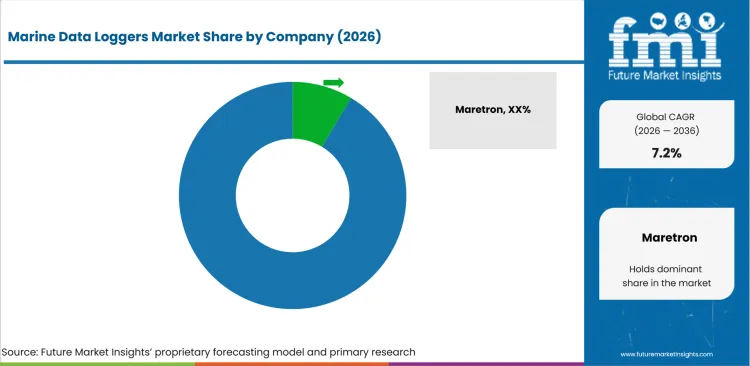
The ten-company register spans focused NMEA specialists and diversified marine-electronics manufacturers. Entry barriers rise where loggers touch operational networks because ship operators expect protocol coverage, onboard retention, commissioning support, and usable exports. Focused recorders still compete on defined retrofit or research tasks without wider bridge replacement.
- Maretron, Actisense, Yacht Devices, and Digital Yacht focus on NMEA capture, gateways, diagnostics, and retrofit network tools.
- Furuno, Garmin, Navico Group, and Kongsberg Maritime place logging within broader navigation, bridge, or vessel-data platforms.
- Campbell Scientific and Onset HOBO serve environmental and research acquisition where unattended records and field retrieval shape selection.
Competitive Benchmarking: Marine Data Loggers Market
| Company | Marine Data Capture Breadth | Local Recording Control | Remote or Export Workflow | Geographic Reach |
|---|---|---|---|---|
| Maretron | High | Medium | High | North America and international |
| Actisense | High | Medium | High | Global |
| Yacht Devices | High | High | High | International |
| Furuno | High | Medium | High | Global |
| Garmin | Medium | Medium | High | Global |
| Navico Group | High | Medium | High | Global |
| Kongsberg Maritime | High | Medium | High | Global |
| Campbell Scientific | High | High | High | International |
| Onset HOBO | High | High | High | International |
| Digital Yacht | High | High | High | International |
Scoring basis: High marine-data breadth requires three documented data classes or interfaces. Medium requires two and Low one. High local-recording control requires dedicated storage and retrieval. Medium denotes integrated storage and Low a limited role. High remote or export workflow requires multiple documented access routes, with Medium limited to one and Low to local-only delivery. Geographic reach is descriptive.
Key Developments in the Marine Data Loggers Market
- In November 2025, Digital Yacht launched the iKreate NMEA 2000 simulator at METS with replay support for saved network log files. The tool lets installers reproduce vessel data during diagnostics and integration testing.
- In October 2025, Navico Group partnered with Maccaferri Futura to equip a Class40 yacht with oceanographic sensors and onboard systems that send environmental data to EMODnet Physics.
- In July 2025, Teledyne acquired Maretron assets including Octoplex, MPower, and MConnect. Raymarine said it would retain the Maretron trade name and product lines for existing customers and integrators.
Key Players in the Marine Data Loggers Market
NMEA and Vessel-Network Logging Specialists
- Maretron
- Actisense
- Yacht Devices
- Digital Yacht
Integrated Bridge and Fleet-Data Platforms
- Furuno
- Garmin
- Navico Group
- Kongsberg Maritime
Environmental and Research Data Acquisition
- Campbell Scientific
- Onset HOBO
Marine Data Loggers Market - Report Scope
| Coverage field | Report scope |
|---|---|
| Market breakdown | By logger type, storage, application, vessel type, sales channel, and region. |
| Quantitative Units | USD million. |
| Market Definition | Revenue includes marine data logger hardware and logger-specific bundled functionality sold for recording, timestamping, storing, exporting, or relaying vessel data within the defined segmentation. Sensors, complete bridge systems, connectivity services, finished-vessel revenue, and stand-alone analytics without sold logging functionality are excluded. |
| Regions Covered | North America, Latin America, Western Europe, Eastern Europe, East Asia, South Asia and Pacific, and Middle East and Africa. |
| Countries Covered | Norway, Finland, Netherlands, Canada, USA, Germany, Japan, and 20+ countries included in the full report. |
| Key Companies Profiled | Maretron, Actisense, Yacht Devices, Furuno, Garmin, Navico Group, Kongsberg Maritime, Campbell Scientific, Onset HOBO, Digital Yacht. |
| Forecast Period | 2026 to 2036. |
| Approach | Primary and secondary research with market triangulation. |
Marine Data Loggers Market - Research Methodology
| Method | Approach |
|---|---|
| Primary Research | FMI analysts gathered input from manufacturers, service providers, technology developers, distributors, end users, procurement teams, and subject-matter experts. Interviews examined purchasing decisions, product or service evaluation, adoption barriers, approval requirements, pricing considerations, and expectations for technical or commercial support. Respondents were also asked what evidence is required before a trial, pilot, or initial order develops into regular purchasing. |
| Desk Research | Desk research covered government statistics, regulatory publications, trade data, industry associations, technical literature, standards, company filings, product information, and official corporate announcements. Sources were reviewed for relevance, publication date, geographic coverage, and consistency with the defined market scope. Claims relating to performance, applications, approvals, capacity, investment, and commercial activity were retained only when supported by credible public evidence. |
| Market Sizing and Forecasting | The market model combined the baseline value with historical performance, segment structure, pricing and volume indicators, adoption levels, company participation, and country-level demand conditions. Forecast assumptions considered economic activity, investment trends, regulatory developments, technology adoption, purchasing cycles, supply availability, and barriers to wider market use. Segment and regional estimates were reconciled before the final market total was calculated. |
| Data Validation | Estimates were checked against multiple independent indicators, including public data, company activity, trade patterns, industry developments, and findings from primary interviews. Validation also tested whether products, services, applications, and company revenues fell within the defined market boundaries. Adjacent categories, unsupported claims, overlapping revenues, and activities without direct market relevance were excluded to reduce double counting and maintain consistency across segments and countries. |
Marine Data Loggers Market by Segments
Marine Data Loggers Market segmented by Logger Type:
- NMEA data loggers
- Engine data loggers
- Environmental data loggers
- Voyage data loggers
- Cloud-connected loggers
Marine Data Loggers Market segmented by Storage:
- On-device memory
- SD-card logging
- Cloud storage
- Hybrid edge-cloud
Marine Data Loggers Market segmented by Application:
- Performance analytics
- Compliance logs
- Fleet diagnostics
- Research - survey logging
- Maintenance history
Marine Data Loggers Market segmented by Vessel Type:
- Commercial vessels
- Research vessels
- Yachts
- Fishing vessels
- Workboats
Marine Data Loggers Market segmented by Sales Channel:
- Marine electronics dealers
- Fleet software providers
- Research equipment distributors
- System integrators
Marine Data Loggers Market by Region:
- North America
- United States
- Canada
- Latin America
- Brazil
- Mexico
- Argentina
- Chile
- Western Europe
- Germany
- France
- United Kingdom
- Italy
- Spain
- Benelux
- Nordics
- Eastern Europe
- Poland
- Czech Republic
- Romania
- Hungary
- East Asia
- China
- Japan
- South Korea
- South Asia and Pacific
- India
- ASEAN
- Australia and New Zealand
- Middle East and Africa
- GCC Countries
- South Africa
- Türkiye
- Israel
Research Sources and Bibliography
- European Commission, Directorate-General for Climate Action. (2025, March 19). The Commission adopts two new reports on the implementation of EU ETS in maritime transport and the maritime Monitoring, Reporting and Verification review.
- Statistics Norway. (2026, January 23). The Norwegian Merchant Fleet.
- Actisense. (2025, February 5). New Features Alert: W2K-1 NMEA 2000 Wi-Fi Gateway.
- Yacht Devices. (2025, February 17). Raymarine, your turn!
- Digital Yacht. (2025, September 15). OneFix is Digital Yacht's newly introduced high-performance GNSS sensor.
- European Commission, Directorate-General for Climate Action. (2025, April 2). FAQ - Monitoring, reporting and verification of maritime transport emissions.
- National Marine Electronics Association. (2025). NMEA 2025 preliminary marine electronics installer training schedule.
- International Maritime Organization. (2025, April 11). Marine Environment Protection Committee (MEPC 83), 7 to 11 April 2025.
- Actisense. (2025, August 6). Integrating NMEA 0183 and NMEA 2000 systems on commercial vessels.
- Kongsberg Discovery. (2025, April 8). Transforming ocean data management.
- Norwegian Coastal Administration. (2025, September 5). Pilot Guidelines in a new digital solution - we want your feedback.
- Finnish Transport and Communications Agency Traficom. (2025, July 2). First S-100 test products ready for piloting.
- Port of Rotterdam Authority. (2025, March 25). Rotterdam and Singapore Strengthen Collaboration on Green and Digital Shipping Corridor.
- Transport Canada. (2025, May 15). The Marine Safety Management System Regulations First Anniversary - SSB No. 06/2025.
- NOAA National Centers for Environmental Information. (2025, June 18). Oceanographic and multimedia data collected during the EX2503: Beyond the Blue expedition on NOAA Ship Okeanos Explorer.
- Federal Maritime and Hydrographic Agency of Germany. (2025, July 18). Nachrichten für Seefahrer Heft 29/2025.
- Ministry of Land, Infrastructure, Transport and Tourism, Japan. (2025, March 28). Guidelines for education and training using drive-recorder video on ships.
- Digital Yacht. (2025, November 13). Digital Yacht launch iKreate NMEA 2000 Simulator at METS '25.
- Navico Group. (2025, October 10). Navico Group partners with Maccaferri Futura to advance ocean health through marine technology.
- Teledyne Raymarine. (2025, July 1). Teledyne acquires Maretron.
- Actisense. (2025, September 26). Double win for Actisense at NMEA Product of Excellence Awards 2025.
- Yacht Devices. (2025, October 23). Suzuki and Hyundai protocols.
- Furuno Electric Co., Ltd. (2025). Integrated Report 2025.
- Garmin International. (2025, September 29). Garmin named 2025 Manufacturer of the Year by NMEA for 11th straight year.
- Navico Group. (2025, February 12). Discover a smoother, faster sailing experience with the new B&G Zeus SR chartplotter.
- Kongsberg Maritime. (2025). Annual Report 2024: Digitalisation - an important driver in the maritime industry's green revolution.
- Campbell Scientific. (2025, December 8). Measuring What Mattered in 2025.
- LI-COR. (2025, August 28). LI-COR launches new HOBO multiparameter data loggers to help growers and researchers make data-driven decisions with confidence.
- Kongsberg Discovery. (2025, April 10). On board with One Ocean Expedition for ambitious, year-long research voyage.
- LI-COR. (2026, April 24). LI-COR expands HOBO portfolio with the MX20 Water Level Logger for Bluetooth-enabled water monitoring.
- Digital Yacht. (2026, January 6). Digital Yacht launches veLINK: The wireless bridge between Victron Energy products and NMEA 2000 network.
- Actisense. (2025, October 17). Actisense commits to the Australian boating & commercial marine markets with new venture.
- Furuno Electric Co., Ltd. (2025, March 25). Furuno achieves world's first successful remote VDR APT.
- Digital Yacht. (2025, November 13). Digital Yacht adds Garmin OneHelm connectivity to NET Protect for continuous NMEA 2000 network monitoring.
- Furuno Electric Co., Ltd. (2026, January 8). Furuno achieves IACS UR E27 certification from multiple classification societies.
- Maretron. (2025, April 22). Release to Manufacturing: MConnect Version 1.2.0 [Technical service bulletin].
This bibliography is provided for reader reference and is not exhaustive. The full report contains the complete reference list and detailed citations.
This Report Answers
- How large is the marine data loggers market through 2036?
- Which operating records are increasing logger demand?
- Why do NMEA data loggers lead logger type?
- Why does on-device memory lead storage?
- How does performance analytics affect purchasing?
- How do the seven country CAGRs compare?
- Which companies serve the main marine logging routes?
- Which integration frictions raise installed logger cost?
Frequently Asked Questions
How big is the marine data loggers market in 2026?
The marine data loggers market is valued at USD 620.6 million in 2026 and is projected to reach USD 1,243.8 million by 2036. Operators retain records for maintenance, research, reporting, and performance review.
What is the CAGR of the marine data loggers market from 2026 to 2036?
The marine data loggers market is projected to grow at a CAGR of 7.2% between 2026 and 2036. Growth depends on retrievable vessel data during offshore connectivity gaps.
Which logger type leads the marine data loggers market?
The NMEA data loggers segment is expected to hold 26.0% of the marine data loggers market in 2026, driven by multi-source capture over standard marine interfaces. Retrofit compatibility preserves its lead on mixed-network vessels.
Which storage type leads the marine data loggers market?
The on-device memory segment is expected to hold 25.0% of the marine data loggers market in 2026, attributable to uninterrupted local capture during communications gaps. Direct retrieval after faults reduces dependence on shore connectivity.
Which countries are projected to record the highest growth in the marine data loggers market?
Norway is projected to grow at 8.0% CAGR, followed by Finland at 7.5% and the Netherlands at 7.3% through 2036. Digital navigation programs and port-data exchange support their higher rates.
Which companies are active in the marine data loggers market?
Key companies operating in the market include Maretron, Actisense, Yacht Devices, Furuno, Garmin, Navico Group, Kongsberg Maritime, Campbell Scientific, Onset HOBO, and Digital Yacht. Their positions differ by NMEA integration, bridge platforms, environmental acquisition, and export support.
Preview the report firsthand - request a free sample
Get SampleGet the brochure for pricing and purchase details.
Get PDFTable of Content
- Key Takeaways
- Market Size and CAGR
- Top Growth Driver
- Fastest Growing Segment
- Leading Region
- Key Companies
- Emerging Opportunities
- Executive Summary
- Global Market Outlook
- Demand-side Trends
- Supply-side Trends
- Technology Roadmap Analysis
- Analysis and Recommendations
- Analyst Perspective (What is happening? Why now? What should investors know?)
- Key Questions Answered
- How large is the market?
- What is the CAGR?
- What are key trends?
- Which region dominates?
- Who are the leaders?
- Market Overview
- Market Coverage / Taxonomy
- Market Definition / Scope / Limitations
- Research Methodology
- Chapter Orientation
- Analytical Lens and Working Hypotheses
- Market Structure, Signals, and Trend Drivers
- Benchmarking and Cross-market Comparability
- Market Sizing, Forecasting, and Opportunity Mapping
- Research Design and Evidence Framework
- Desk Research Programme (Secondary Evidence)
- Expert Input and Fieldwork (Primary Evidence)
- Tooling, Models, and Reference Databases
- Data Engineering and Model Build
- Quality Assurance and Audit Trail
- Market Background
- Market Dynamics (Drivers, Restraints, Opportunity, Trends)
- Scenario Forecast (Optimistic, Likely, Conservative)
- Impact Analysis
- AI Impact
- Sustainability Impact
- Regulatory Impact
- Technology Impact
- Consumer / Buyer Analysis
- Purchase Drivers
- Adoption Barriers
- Buyer Journey
- Opportunity Map Analysis
- Product Life Cycle Analysis
- Supply Chain Analysis
- Investment Feasibility Matrix
- Value Chain Analysis
- PESTLE and Porter's Analysis
- Regulatory Landscape
- Regional Parent Market Outlook
- Production and Consumption Statistics
- Import and Export Statistics
- Global Market Analysis and Forecast, 2021 to 2036
- Historical Market Size Value (USD Million) Analysis, 2021 to 2025
- Current and Future Market Size Value (USD Million) Projections, 2026 to 2036
- Y-o-Y Growth Trend Analysis
- Absolute $ Opportunity Analysis
- Global Market Pricing Analysis, 2021 to 2036
- Global Market Analysis and Forecast, By Logger Type, 2021 to 2036
- Introduction / Key Findings
- Historical Market Size Value (USD Million) Analysis By Logger Type, 2021 to 2025
- Current and Future Market Size Value (USD Million) Analysis and Forecast By Logger Type, 2026 to 2036
- NMEA data loggers
- Engine data loggers
- Environmental data loggers
- Voyage data loggers
- Cloud-connected loggers
- NMEA data loggers
- Y-o-Y Growth Trend Analysis By Logger Type, 2021 to 2025
- Absolute $ Opportunity Analysis By Logger Type, 2026 to 2036
- Global Market Analysis and Forecast, By Storage, 2021 to 2036
- Introduction / Key Findings
- Historical Market Size Value (USD Million) Analysis By Storage, 2021 to 2025
- Current and Future Market Size Value (USD Million) Analysis and Forecast By Storage, 2026 to 2036
- On-device memory
- SD-card logging
- Cloud storage
- Hybrid edge-cloud
- On-device memory
- Y-o-Y Growth Trend Analysis By Storage, 2021 to 2025
- Absolute $ Opportunity Analysis By Storage, 2026 to 2036
- Global Market Analysis and Forecast, By Application, 2021 to 2036
- Introduction / Key Findings
- Historical Market Size Value (USD Million) Analysis By Application, 2021 to 2025
- Current and Future Market Size Value (USD Million) Analysis and Forecast By Application, 2026 to 2036
- Performance analytics
- Compliance logs
- Fleet diagnostics
- Research / survey logging
- Maintenance history
- Performance analytics
- Y-o-Y Growth Trend Analysis By Application, 2021 to 2025
- Absolute $ Opportunity Analysis By Application, 2026 to 2036
- Global Market Analysis and Forecast, By Vessel Type, 2021 to 2036
- Introduction / Key Findings
- Historical Market Size Value (USD Million) Analysis By Vessel Type, 2021 to 2025
- Current and Future Market Size Value (USD Million) Analysis and Forecast By Vessel Type, 2026 to 2036
- Commercial vessels
- Research vessels
- Yachts
- Fishing vessels
- Workboats
- Commercial vessels
- Y-o-Y Growth Trend Analysis By Vessel Type, 2021 to 2025
- Absolute $ Opportunity Analysis By Vessel Type, 2026 to 2036
- Global Market Analysis and Forecast, By Sales Channel, 2021 to 2036
- Introduction / Key Findings
- Historical Market Size Value (USD Million) Analysis By Sales Channel, 2021 to 2025
- Current and Future Market Size Value (USD Million) Analysis and Forecast By Sales Channel, 2026 to 2036
- Marine electronics dealers
- Fleet software providers
- Research equipment distributors
- System integrators
- Marine electronics dealers
- Y-o-Y Growth Trend Analysis By Sales Channel, 2021 to 2025
- Absolute $ Opportunity Analysis By Sales Channel, 2026 to 2036
- Global Market Analysis and Forecast, By Region, 2021 to 2036
- Introduction
- Historical Market Size Value (USD Million) Analysis By Region, 2021 to 2025
- Current Market Size Value (USD Million) Analysis and Forecast By Region, 2026 to 2036
- North America
- Latin America
- Western Europe
- Eastern Europe
- East Asia
- South Asia and Pacific
- Middle East & Africa
- Market Attractiveness Analysis By Region
- North America Market Analysis and Forecast, By Country, 2021 to 2036
- Historical Market Size Value (USD Million) Trend Analysis By Market Taxonomy, 2021 to 2025
- Market Size Value (USD Million) Forecast By Market Taxonomy, 2026 to 2036
- By Country
- USA
- Canada
- By Logger Type
- By Storage
- By Application
- By Vessel Type
- By Sales Channel
- By Country
- Market Attractiveness Analysis
- By Country
- By Logger Type
- By Storage
- By Application
- By Vessel Type
- By Sales Channel
- Key Takeaways
- Latin America Market Analysis and Forecast, By Country
- Historical Market Size Value (USD Million) Trend Analysis By Market Taxonomy, 2021 to 2025
- Market Size Value (USD Million) Forecast By Market Taxonomy, 2026 to 2036
- By Country
- Brazil
- Mexico
- Chile
- Rest of Latin America
- By Logger Type
- By Storage
- By Application
- By Vessel Type
- By Sales Channel
- By Country
- Market Attractiveness Analysis
- By Country
- By Logger Type
- By Storage
- By Application
- By Vessel Type
- By Sales Channel
- Key Takeaways
- Western Europe Market Analysis and Forecast, By Country
- Historical Market Size Value (USD Million) Trend Analysis By Market Taxonomy, 2021 to 2025
- Market Size Value (USD Million) Forecast By Market Taxonomy, 2026 to 2036
- By Country
- Germany
- UK
- Italy
- Spain
- France
- Nordic
- BENELUX
- Rest of Western Europe
- By Logger Type
- By Storage
- By Application
- By Vessel Type
- By Sales Channel
- By Country
- Market Attractiveness Analysis
- By Country
- By Logger Type
- By Storage
- By Application
- By Vessel Type
- By Sales Channel
- Key Takeaways
- Eastern Europe Market Analysis and Forecast, By Country
- Historical Market Size Value (USD Million) Trend Analysis By Market Taxonomy, 2021 to 2025
- Market Size Value (USD Million) Forecast By Market Taxonomy, 2026 to 2036
- By Country
- Russia
- Poland
- Hungary
- Balkan & Baltic
- Rest of Eastern Europe
- By Logger Type
- By Storage
- By Application
- By Vessel Type
- By Sales Channel
- By Country
- Market Attractiveness Analysis
- By Country
- By Logger Type
- By Storage
- By Application
- By Vessel Type
- By Sales Channel
- Key Takeaways
- East Asia Market Analysis and Forecast, By Country
- Historical Market Size Value (USD Million) Trend Analysis By Market Taxonomy, 2021 to 2025
- Market Size Value (USD Million) Forecast By Market Taxonomy, 2026 to 2036
- By Country
- China
- Japan
- South Korea
- By Logger Type
- By Storage
- By Application
- By Vessel Type
- By Sales Channel
- By Country
- Market Attractiveness Analysis
- By Country
- By Logger Type
- By Storage
- By Application
- By Vessel Type
- By Sales Channel
- Key Takeaways
- South Asia and Pacific Market Analysis and Forecast, By Country
- Historical Market Size Value (USD Million) Trend Analysis By Market Taxonomy, 2021 to 2025
- Market Size Value (USD Million) Forecast By Market Taxonomy, 2026 to 2036
- By Country
- India
- ASEAN
- Australia & New Zealand
- Rest of South Asia and Pacific
- By Logger Type
- By Storage
- By Application
- By Vessel Type
- By Sales Channel
- By Country
- Market Attractiveness Analysis
- By Country
- By Logger Type
- By Storage
- By Application
- By Vessel Type
- By Sales Channel
- Key Takeaways
- Middle East & Africa Market Analysis and Forecast, By Country
- Historical Market Size Value (USD Million) Trend Analysis By Market Taxonomy, 2021 to 2025
- Market Size Value (USD Million) Forecast By Market Taxonomy, 2026 to 2036
- By Country
- Kingdom of Saudi Arabia
- Other GCC Countries
- Türkiye
- South Africa
- Other African Union
- Rest of Middle East & Africa
- By Logger Type
- By Storage
- By Application
- By Vessel Type
- By Sales Channel
- By Country
- Market Attractiveness Analysis
- By Country
- By Logger Type
- By Storage
- By Application
- By Vessel Type
- By Sales Channel
- Key Takeaways
- Key Countries Market Analysis
- USA
- Pricing Analysis
- Market Share Analysis, 2025
- By Logger Type
- By Storage
- By Application
- By Vessel Type
- By Sales Channel
- Canada
- Pricing Analysis
- Market Share Analysis, 2025
- By Logger Type
- By Storage
- By Application
- By Vessel Type
- By Sales Channel
- Mexico
- Pricing Analysis
- Market Share Analysis, 2025
- By Logger Type
- By Storage
- By Application
- By Vessel Type
- By Sales Channel
- Brazil
- Pricing Analysis
- Market Share Analysis, 2025
- By Logger Type
- By Storage
- By Application
- By Vessel Type
- By Sales Channel
- Chile
- Pricing Analysis
- Market Share Analysis, 2025
- By Logger Type
- By Storage
- By Application
- By Vessel Type
- By Sales Channel
- Germany
- Pricing Analysis
- Market Share Analysis, 2025
- By Logger Type
- By Storage
- By Application
- By Vessel Type
- By Sales Channel
- UK
- Pricing Analysis
- Market Share Analysis, 2025
- By Logger Type
- By Storage
- By Application
- By Vessel Type
- By Sales Channel
- Italy
- Pricing Analysis
- Market Share Analysis, 2025
- By Logger Type
- By Storage
- By Application
- By Vessel Type
- By Sales Channel
- Spain
- Pricing Analysis
- Market Share Analysis, 2025
- By Logger Type
- By Storage
- By Application
- By Vessel Type
- By Sales Channel
- France
- Pricing Analysis
- Market Share Analysis, 2025
- By Logger Type
- By Storage
- By Application
- By Vessel Type
- By Sales Channel
- India
- Pricing Analysis
- Market Share Analysis, 2025
- By Logger Type
- By Storage
- By Application
- By Vessel Type
- By Sales Channel
- ASEAN
- Pricing Analysis
- Market Share Analysis, 2025
- By Logger Type
- By Storage
- By Application
- By Vessel Type
- By Sales Channel
- Australia & New Zealand
- Pricing Analysis
- Market Share Analysis, 2025
- By Logger Type
- By Storage
- By Application
- By Vessel Type
- By Sales Channel
- China
- Pricing Analysis
- Market Share Analysis, 2025
- By Logger Type
- By Storage
- By Application
- By Vessel Type
- By Sales Channel
- Japan
- Pricing Analysis
- Market Share Analysis, 2025
- By Logger Type
- By Storage
- By Application
- By Vessel Type
- By Sales Channel
- South Korea
- Pricing Analysis
- Market Share Analysis, 2025
- By Logger Type
- By Storage
- By Application
- By Vessel Type
- By Sales Channel
- Russia
- Pricing Analysis
- Market Share Analysis, 2025
- By Logger Type
- By Storage
- By Application
- By Vessel Type
- By Sales Channel
- Poland
- Pricing Analysis
- Market Share Analysis, 2025
- By Logger Type
- By Storage
- By Application
- By Vessel Type
- By Sales Channel
- Hungary
- Pricing Analysis
- Market Share Analysis, 2025
- By Logger Type
- By Storage
- By Application
- By Vessel Type
- By Sales Channel
- Kingdom of Saudi Arabia
- Pricing Analysis
- Market Share Analysis, 2025
- By Logger Type
- By Storage
- By Application
- By Vessel Type
- By Sales Channel
- Türkiye
- Pricing Analysis
- Market Share Analysis, 2025
- By Logger Type
- By Storage
- By Application
- By Vessel Type
- By Sales Channel
- South Africa
- Pricing Analysis
- Market Share Analysis, 2025
- By Logger Type
- By Storage
- By Application
- By Vessel Type
- By Sales Channel
- USA
- Market Structure Analysis
- Competition Dashboard
- Competition Benchmarking
- Market Share Analysis of Top Players
- By Regional
- By Logger Type
- By Storage
- By Application
- By Vessel Type
- By Sales Channel
- Emerging Startups
- Innovation Benchmarking
- Competition Analysis
- Competition Deep Dive
- Maretron
- Overview
- Product Portfolio
- Profitability by Market Segments
- Sales Footprint
- Strategy Overview
- Marketing Strategy
- Product Strategy
- Channel Strategy
- Actisense
- Yacht Devices
- Furuno
- Garmin
- Navico Group
- Kongsberg Maritime
- Campbell Scientific
- Onset HOBO
- Digital Yacht
- Maretron
- Case Studies
- Success Stories
- Recent Developments
- Competition Deep Dive
- Assumptions & Acronyms Used


