

- Market Size (2026)
- USD 520.6 Mn
- Forecast (2036)
- USD 1103.3 Mn
- CAGR (2026 to 2036)
- 7.8%
How big is Marine CAN Gateways Market in 2026?
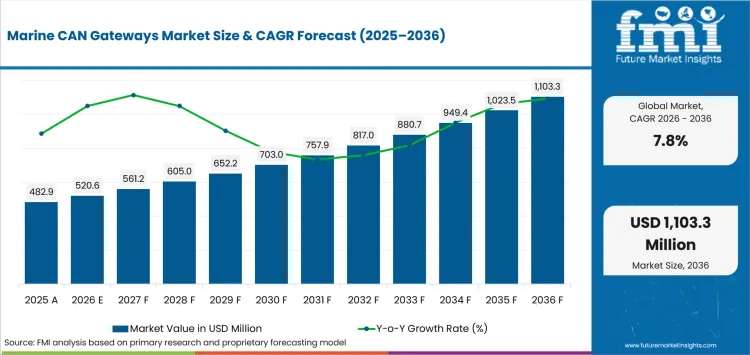
USD 520.6 million in 2026 and USD 1,103.3 million by 2036 at a 7.8% CAGR.
Demand for marine CAN gateways is projected to expand at 7.8% CAGR between 2026 and 2036, increasing valuation from USD 520.6 million in 2026 to USD 1,103.3 million by 2036. Electrified propulsion and networked controls expose more CAN data to helm displays and supervisory systems. In March 2025, the International Maritime Organization began a maritime digitalization strategy focused on interoperability and automated operations. That work raises gateway value by preserving installed controllers and transferring selected data into newer marine electronics.
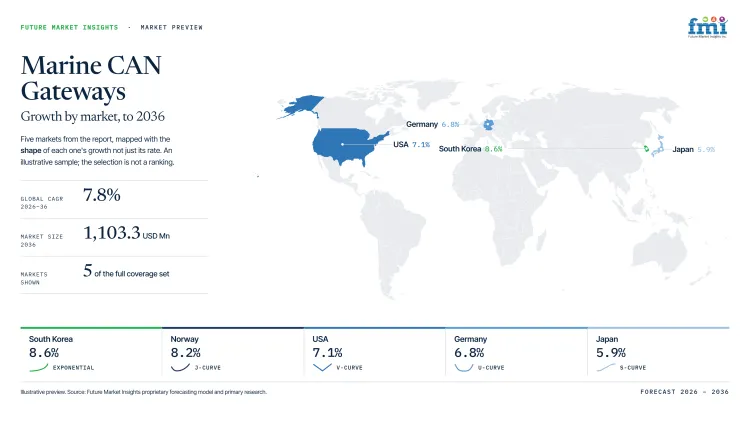
Country execution separates the forecast as electric boats and ferries follow different funding and approval routes. The USA is forecast at 7.1% CAGR versus Japan at 5.9% over the assessment period. The USA Department of Transportation lists USD 98 million for its FY2026 Electric or Low-Emitting Ferry Pilot Program. The funded route gives USA integrators a defined project pipeline. Japan’s class-led approvals make gateway qualification more sequential.
Key Takeaways
- Gateway demand rises as propulsion, battery and automation controllers exchange data with displays, logging systems and remote services on the same vessel.
- Based on gateway type, CANopen gateways are projected to account for 23.0% in 2026 due to deterministic object mapping in embedded controls.
- In 2026, single-channel gateways are expected to lead port configuration with 24.0% share because many retrofit jobs need one controlled network boundary.
- The engine CAN integration segment is likely to capture 25.0% share in 2026 attributable to propulsion status and alarms feeding displays and diagnostics.
- Proprietary message maps, class expectations and cyber review can lengthen commissioning and delay repeat use on a production vessel or fleet.
- Some of the key players in this market include Maretron, Actisense, Yacht Devices, Kvaser, HMS Networks, Vector Informatik, PEAK-System Technik, Garmin, Navico Group, and WAGO.
Analyst Perspective
"Gateway selection should begin with the messages a vessel must transfer and the evidence required to qualify that path. Commercial value concentrates in products that shorten mapping, diagnostics and commissioning without forcing replacement of serviceable propulsion controllers."
- Nikhil Kaitwade, Principal Consultant, Future Market Insights
How is the marine CAN gateways market segmented?
The marine CAN gateways market is segmented by gateway type, port configuration, application, vessel type, sales channel, and region.
Gateway type includes CANopen, J1939 marine, NMEA 2000 CAN, CAN-to-Ethernet and protocol conversion gateways. Port configuration covers single-channel, dual-channel, multi-channel and rugged IP-rated units. Applications include engine CAN integration, battery/BMS data transfer, propulsion monitoring, fleet telematics and industrial marine automation. Vessel types include workboats, yachts, electric boats, ferries and commercial vessels. Sales channels include automation integrators, marine electronics dealers, propulsion OEMs and aftermarket retrofit specialists.
What makes CANopen gateways central to the gateway type category?
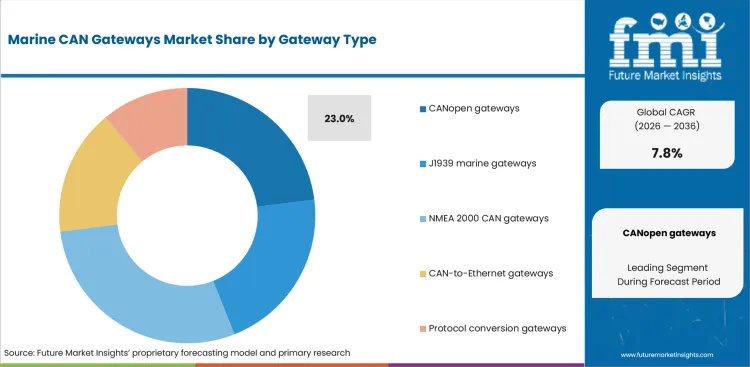
CANopen gateways serve machinery islands that expose structured object dictionaries but need selected signals passed into higher-level vessel control. CAN in Automation released CiA 443 version 4.1.0 in August 2025 for SIIS level-2 devices, retaining gateway or proxy behavior for linked functions.
- By gateway type, CANopen gateways are estimated to hold 23.0% in 2026 owing to deterministic object mapping that fits embedded control and offshore automation.
- Integrators map required objects into supervisory control without changing the qualified source controller. The approach keeps commissioning traceable and limits unnecessary changes to proven machinery controls.
Why does single-channel lead the port configuration category?
Single-channel hardware fits retrofit work on vessels with one engine bus or equipment island needing a controlled path into a display, logger or IP service. One interface narrows configuration variables and suits many yacht retrofit systems on older vessels during scheduled service.
- Single-channel gateways are set to lead port configuration with 24.0% share in 2026 due to frequent point-integration work on existing vessels.
- Actisense released W2K-1 firmware v1.396 in February 2025 with live PGN viewing, network mapping and onboard logging. Installers can isolate faults on one NMEA 2000 boundary. Larger vessels may require multi-channel routing.
How does engine CAN integration lead the application category?
Engine integration retains the propulsion controller as the source record and translates selected operating data for helm displays, alarms and service tools. Yacht Devices updated its Engine Gateway in October 2025 to support Suzuki outboards and Hyundai marine engines.
- By application, engine CAN integration is forecast to represent 25.0% in 2026 driven by propulsion status and alarms feeding vessel monitoring.
- Service teams route approved engine data into marine communication systems and verify alarms against each replacement engine’s message map. Repower work therefore needs fresh validation without forcing duplicate sensors or changes to qualified propulsion controllers.
What supports workboats as the leading vessel type segment?
Workboats often retain propulsion hardware longer than positioning, control and job-equipment systems as those assets follow different maintenance cycles. Retrofit gateways preserve that machinery as newer functions enter the vessel network, including marine steering systems.
- In 2026, workboats are expected to lead vessel type with 24.0% share because mixed equipment generations require repeated integration work.
- Japan’s Ministry of Land, Infrastructure, Transport and Tourism formed a working group in June 2025 for automated workboats and port data-linkage systems. Downtime directly removes a working asset from paid duty, so commercial operators need readable diagnostics and local service.
What drives automation integrators to lead the sales channel category?
Automation integrators carry the engineering work between a gateway purchase and a functioning data path. They coordinate message mapping with battery management systems and other control or Ethernet interfaces during newbuild and retrofit work.
- Automation integrators are projected to hold 32.0% share in 2026 owing to multi-vendor installations that require configuration, diagnostics and commissioning responsibility.
- NMEA’s 2025 schedule lists Advanced NMEA 2000 Installer classes in September for technicians working on complex networks. Dealers suit simpler retrofits. Integrators retain the advantage once several network domains require joint testing at handover.
What are the drivers, restraints and opportunities in the Marine CAN Gateways Market?
Electrification and digital vessel functions increase gateway demand, while validation and cyber requirements slow commissioning. Secure CAN-to-Ethernet handling gives integrators a larger retrofit route.
- Driver: Electronically controlled propulsion, energy and navigation equipment requires selected CAN data to reach other onboard systems without replacing source controllers.
- Restraint: Proprietary message definitions, approval evidence and cybersecurity review can extend engineering work and delay repeat-vessel acceptance.
- Opportunity: Secure programmable gateways can consolidate filtering, diagnostics and Ethernet access for mixed-generation networks, reducing the number of separate interfaces integrators must qualify.
Vessel builders reconcile more data paths as propulsion, energy and navigation systems become electronically controlled. In March 2026, IMO approved its maritime digitalization strategy covering interoperability, system standardization and data sharing. Marine CAN gateway orders follow when translation between retained marine propulsion engines and newer automation layers avoids duplicate sensing or controller replacement.
Qualification becomes harder once a gateway feeds data into marine radar or autonomous vessel functions. IMO adopted the non-mandatory MASS Code in May 2026 with provisions for connectivity, cybersecurity, remote operations and system risk assessment. Integrators need documented message behavior and controlled software changes to satisfy the vessel safety case beyond physical CAN compatibility.
Mixed-generation commercial vessels give certified gateways a retrofit route from legacy NMEA 0183 equipment into NMEA 2000 and Ethernet services. In August 2025, Actisense documented a RINA-approved PRO-NDC-1E2K configuration routing NMEA 0183 data into NMEA 2000. Revenue follows once certified conversion and diagnostics reduce the separate interfaces an integrator must qualify for repeat installations.
Which country CAGRs are profiled in the Marine CAN Gateways Market?
| Country | CAGR |
|---|---|
| South Korea | 8.6% |
| Norway | 8.2% |
| Finland | 7.7% |
| Canada | 7.4% |
| USA | 7.1% |
| Germany | 6.8% |
| Japan | 5.9% |
How do country-level CAGRs compare in the Marine CAN Gateways Market?
The seven forecasts span 2.7 percentage points, separating South Korea and Norway from a middle group led by Finland and Canada. USA and Germany track nearer the global rate. Japan is lower at 5.9%. The spacing reflects shipyard integration, electrification programs and approval intensity, not current gateway market size.
- Major South Korean yards standardize interfaces during newbuild reviews.
- Norwegian ferry contracts reward rapid local service response.
- Finnish engineering clusters shorten bridge-integration feedback cycles.
- Canadian distributed fleets favor stocked hardware near working ports.
- USA retrofit channels produce uneven practices by vessel class.
- German automation depth favors programmable routing inside shipyards.
- Japanese equipment lifecycles reward gateways that preserve approved controllers.
Comparable rates produce different entry conditions as approval effort and service distance vary. The full report provides country-level CAGR analysis across North America, Latin America, Western Europe, Eastern Europe, East Asia, South Asia and Pacific, and Middle East and Africa.
Country-wise Analysis
- Korean shipyards define autonomous-vessel data paths early to align machinery, navigation and remote-control interfaces inside one approved system. South Korea is forecast to post 8.6% CAGR through 2036, tied to shipyard programs that standardize data exchange between installed controllers and higher-level services. In May 2026, MOTIR and the Ministry of Oceans and Fisheries opened a ship-data platform covering about 100 data types in eight operational areas. Major yards place systems engineers and class interfaces near the build program, reducing handoff delays during newbuild integration. Vessel-specific message maps require local commissioning and traceable configuration records for repeat installations.
- Norwegian passenger ferries run dense schedules, so gateway faults can interrupt revenue trips and public-service commitments. Marine CAN gateway demand in Norway is forecast to rise at 8.2% CAGR over the forecast period, attributable to battery and propulsion systems needing dependable helm data. The Ministry of Climate and Environment confirmed in April 2025 that zero-emission rules cover passenger ships under 10,000 gross tons in five World Heritage fjords from January 2026. Local teams can diagnose network faults remotely before technicians travel. Mature electric-ferry engineering lowers integration risk. Limited downtime makes local spares and rapid service commercially decisive.
- Finnish marine projects often integrate bridge electronics with machinery controls under ice-class and Baltic service requirements. Traficom stated in November 2025 that S-101 electronic navigational charts will cover all Finnish sea areas by the end of 2026. Finland’s marine CAN gateway outlook is anticipated to advance at 7.7% CAGR over the assessment period, helped by close coordination between yards and maritime technology firms. Tight engineering clusters let yards test interface changes with equipment specialists ahead of final commissioning. Standardized bridge data shortens some qualification work, but legacy machinery signals require careful normalization and documented message behavior during commissioning.
- Canadian ferry and workboat fleets operate over long coastal distances, making technician travel and replacement logistics part of retrofit economics. Regional distribution shortens repair cycles by keeping stocked hardware near scheduled service windows. The Canadian marine CAN gateways sector is projected to record 7.4% CAGR during the assessment period, given clean-vessel projects that place new energy controls beside older electronics. Transport Canada’s February 2026 Green Shipping Corridor brief states that commercial vessels over 150 gross tons account for most domestic fleet emissions. Service distance raises travel costs and downtime. Remote diagnostics and documented replacement procedures improve the route to repeat fleet orders.
- USA gateway projects enter through boatbuilders, marine dealers, ferry programs and specialized workboat integrators, leaving installation responsibility fragmented by vessel class. The USA Coast Guard documented Project Minerva in June 2025 as an effort linking platforms, sensors and communications for faster operational decisions. Channel depth gives gateway firms many retrofit entry points, although installer message maps and service practices differ. The USA is estimated to post 7.1% CAGR over the forecast period, aided by a broad installed base that needs selected marine engine data exposed to newer monitoring systems. Repeatable configuration records become more valuable once several installers service the same fleet.
- German shipyards place gateway changes inside formal engineering reviews that link control behavior, documentation and vessel acceptance. Germany is forecast to advance at 6.8% CAGR through 2036, reflecting demand for programmable CAN routing tested against higher-level automation. In June 2026, the Federal Ministry of Transport brought about 200 specialists together in Rostock and demonstrated autonomous plus remotely controlled maritime systems. Domestic automation firms give yards nearby engineering support for protocol tests, software changes and fault analysis. Deep automation expertise gives gateway firms capable local partners, but approval records can lengthen commissioning and require reproducible tests for shipyard standardization.
- Japanese shipyards treat network changes as part of vessel safety documentation, placing approval evidence close to hardware selection. Local classification expertise gives gateway firms a clear test route, though each interface change carries vessel-level documentation work. In December 2025, the Ministry of Land, Infrastructure, Transport and Tourism announced Japan’s first vessel inspection certificate covering an installed autonomous navigation system. Marine CAN gateway sales in Japan are forecast to expand at 5.9% CAGR by 2036, driven by digital-vessel programs that favor stable software records and formal test evidence. Japan’s slower commercial path rewards well-documented products more than rapid low-support retrofit volume.
Who are the notable companies in the Marine CAN Gateways Market?
Maretron, Actisense, Yacht Devices, Kvaser, HMS Networks, Vector Informatik, PEAK-System Technik, Garmin, Navico Group, and WAGO are notable companies serving the marine CAN gateways market.
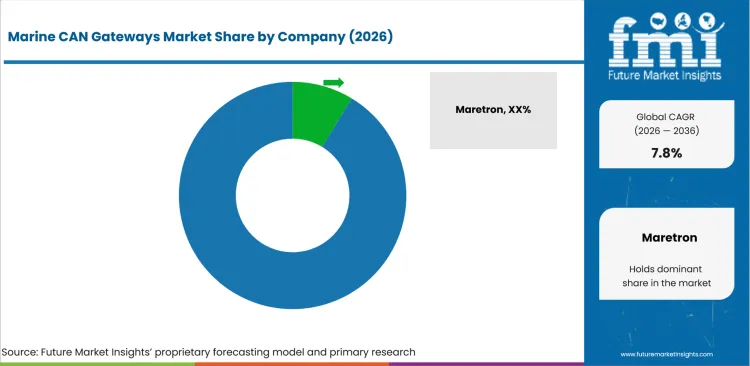
Competition spans marine protocol specialists, CAN engineering firms and integrated marine-electronics groups. Protocol depth, qualification evidence and installer support set the practical entry barrier. Dedicated gateway firms compete on conversion coverage. Larger automation groups depend more on engineering depth and service channels.
- Maretron, Actisense and Yacht Devices focus on NMEA conversion, vessel-data access and retrofit networking.
- Kvaser, HMS Networks, Vector Informatik and PEAK-System Technik supply CAN engineering, diagnostics and Ethernet-routing tools used in complex integration work.
- Garmin and Navico Group approach the market from integrated marine electronics. WAGO serves vessel automation and controller networking.
Competitive Benchmarking: Marine CAN Gateways Market
| Company | Marine Protocol Translation | CAN/Ethernet Integration | Marine Qualification and Support | Geographic Reach |
|---|---|---|---|---|
| Maretron | Medium | Medium | High | North America and international marine channels |
| Actisense | High | High | High | Europe, North America and Asia-Pacific |
| Yacht Devices | High | High | Medium | Europe and international dealer channels |
| Kvaser | Medium | High | Medium | Global |
| HMS Networks | Medium | High | Medium | Global |
| Vector Informatik | Low | Medium | Low | Europe, Americas and Asia |
| PEAK-System Technik | Medium | High | Medium | Europe and international distribution |
| Garmin | Low | Medium | High | Global marine channels |
| Navico Group | Low | Medium | High | Global marine channels |
| WAGO | Low | High | High | Global industrial and marine channels |
High marine protocol translation requires several documented NMEA or marine conversion routes. Medium requires one direct gateway route. Low covers broader CAN interoperability without dedicated marine translation. High CAN/Ethernet integration requires programmable routing plus multiple network paths. Medium covers narrower transport functions and Low basic connectivity. High marine qualification and support requires approvals plus marine service evidence. Medium requires one element and Low indicates limited marine documentation.
Key Developments in the Marine CAN Gateways Market
- In September 2025, Yacht Devices released firmware for its Ethernet Gateway YDEN-02 that transferred StructureScan 3D depth data from Lowrance Ethernet into NMEA 2000.
- In July 2025, Maretron became part of Teledyne’s Raymarine business after Teledyne acquired the brand’s MConnect, Octoplex and MPower assets.
- In June 2025, Garmin launched the GPSMAP 15x3 chartplotter with NMEA networking, engine-data display and onboard control integration.
Key Players in the Marine CAN Gateways Market
Marine Protocol and NMEA Gateway Specialists
- Maretron
- Actisense
- Yacht Devices
CAN Infrastructure and Integration Specialists
- Kvaser
- HMS Networks
- Vector Informatik
- PEAK-System Technik
Integrated Marine and Vessel Automation Platforms
- Garmin
- Navico Group
- WAGO
Marine CAN Gateways Market - Report Scope
| Coverage field | Report scope |
|---|---|
| Market breakdown | By gateway type, port configuration, application, vessel type, sales channel and region. |
| Quantitative Units | USD million. |
| Market Definition | Hardware and embedded gateway platforms that translate, route or bridge CAN-based vessel data between marine, industrial and IP network domains. |
| Regions Covered | North America, Latin America, Western Europe, Eastern Europe, East Asia, South Asia and Pacific, and Middle East and Africa. |
| Countries Covered | South Korea, Norway, Finland, Canada, USA, Germany, Japan, and 20+ countries included in the full report. |
| Key Companies Profiled | Maretron, Actisense, Yacht Devices, Kvaser, HMS Networks, Vector Informatik, PEAK-System Technik, Garmin, Navico Group, WAGO. |
| Forecast Period | 2026 to 2036. |
| Approach | Primary and secondary research with market triangulation. |
Marine CAN Gateways Market - Research Methodology
| Method | Approach |
|---|---|
| Primary Research | FMI analysts gathered input from manufacturers, service providers, technology developers, distributors, end users, procurement teams, and subject-matter experts. Interviews examined purchasing decisions, product or service evaluation, adoption barriers, approval requirements, pricing considerations, and expectations for technical or commercial support. Respondents were also asked what evidence is required before a trial, pilot, or initial order develops into regular purchasing. |
| Desk Research | Desk research covered government statistics, regulatory publications, trade data, industry associations, technical literature, standards, company filings, product information, and official corporate announcements. Sources were reviewed for relevance, publication date, geographic coverage, and consistency with the defined market scope. Claims relating to performance, applications, approvals, capacity, investment, and commercial activity were retained only when supported by credible public evidence. |
| Market Sizing and Forecasting | The market model combined the baseline value with historical performance, segment structure, pricing and volume indicators, adoption levels, company participation, and country-level demand conditions. Forecast assumptions considered economic activity, investment trends, regulatory developments, technology adoption, purchasing cycles, supply availability, and barriers to wider market use. Segment and regional estimates were reconciled before the final market total was calculated. |
| Data Validation | Estimates were checked against multiple independent indicators, including public data, company activity, trade patterns, industry developments, and findings from primary interviews. Validation also tested whether products, services, applications, and company revenues fell within the defined market boundaries. Adjacent categories, unsupported claims, overlapping revenues, and activities without direct market relevance were excluded to reduce double counting and maintain consistency across segments and countries. |
Marine CAN Gateways Market by Segments
Marine CAN Gateways Market segmented by Gateway Type:
- CANopen Gateways
- J1939 Marine Gateways
- NMEA 2000 CAN Gateways
- CAN-to-Ethernet Gateways
- Protocol Conversion Gateways
Marine CAN Gateways Market segmented by Port Configuration:
- Single-channel
- Dual-channel
- Multi-channel
- Rugged IP-rated Gateway
Marine CAN Gateways Market segmented by Application:
- Engine CAN Integration
- Battery/BMS Data Transfer
- Propulsion System Monitoring
- Fleet Telematics Interface
- Industrial Marine Automation
Marine CAN Gateways Market segmented by Vessel Type:
- Workboats
- Yachts
- Electric Boats
- Ferries
- Commercial Vessels
Marine CAN Gateways Market segmented by Sales Channel:
- Automation Integrators
- Marine Electronics Dealers
- Propulsion OEMs
- Aftermarket Retrofit
Marine CAN Gateways Market by Region:
- North America
- United States
- Canada
- Latin America
- Brazil
- Mexico
- Argentina
- Chile
- Western Europe
- Germany
- France
- United Kingdom
- Italy
- Spain
- Benelux
- Nordics
- Eastern Europe
- Poland
- Czech Republic
- Romania
- Hungary
- East Asia
- China
- Japan
- South Korea
- South Asia and Pacific
- India
- ASEAN
- Australia and New Zealand
- Middle East and Africa
- GCC Countries
- South Africa
- Türkiye
- Israel
Research Sources and Bibliography
- International Maritime Organization. (2025, March 18). IMO to develop global strategy for maritime digitalization
- USA Department of Transportation. (2026, April 6). Electric or Low-Emitting Ferry Pilot Program
- CAN in Automation. (2025, August 5). CiA 443: CANopen profile for SIIS level-2 devices
- Actisense. (2025, February 5). New features alert: W2K-1 NMEA 2000 Wi-Fi Gateway
- Yacht Devices. (2025, October 23). Suzuki and Hyundai protocols
- Ministry of Land, Infrastructure, Transport and Tourism, Japan. (2025, June 25)
- National Marine Electronics Association. (2025). NMEA 2025 Preliminary Marine Electronics Installer Training Schedule
- International Maritime Organization. (2026, March 31). Facilitation Committee approves digitalization strategy and cyber security measures
- International Maritime Organization. (2026, May 22). IMO adopts first global Code for autonomous ships
- Actisense. (2025, August 6). Integrating NMEA 0183 and NMEA 2000 systems - commercial vessels
- Ministry of Trade, Industry and Resources, Republic of Korea. (2026, May 7). MOTIR and MOF Open the Era of Autonomous Ships with Data
- Ministry of Climate and Environment, Norway. (2025, April 22). Zero-Emission Requirements for Passenger Ships in World Heritage Fjords
- Finnish Transport and Communications Agency. (2025, November 20). A new era in navigation is approaching - the implementation of the S-100 standards begins in early 2026
- Transport Canada. (2026, February). 16. PIC - Green Shipping Corridor Program
- United States Coast Guard. (2025, June 25). How new sensor technology is improving operational decisions
- Federal Ministry of Transport, Germany. (2026, June 17). Autonome Schifffahrt im Praxiseinsatz - Fachkonferenz Neue Technologien und Testfelder für Wasserstraßen und Häfen in Rostock
- Ministry of Land, Infrastructure, Transport and Tourism, Japan. (2025, December 10)
- Yacht Devices. (2025, September 9). Ethernet Gateway for Lowrance
- Teledyne Technologies. (2025, July 1). Teledyne Acquires Maretron
- Garmin. (2025, June 12). Garmin debuts the GPSMAP 15x3 chartplotter with a 15-inch ultrawide premium display
- Kvaser. (2025, February 13). Seakeeper uses Kvaser CAN interfaces for innovative boat stabilization system
- HMS Networks. (n.d.). Remote access to marine engines via CAN gateway. Retrieved September 3, 2026.
- Vector Informatik. (n.d.). SAE J1939 know-how. Retrieved September 3, 2026.
- WAGO. (n.d.). Maritime 4.0: Exploit Opportunities. Retrieved September 3, 2026.
- PEAK-System Technik. (2025, May 6). Firmware
- Kvaser. (2026, February 26). Introducing Kvaser Edge: a secure Linux edge platform for automotive and industrial applications
- Simrad Marine Electronics. (2026, February 11). Simrad Marine Electronics Debuts New NSO 4
- Garmin. (2025, October 16). New Garmin OnBoard System redefines boating safety
- Yacht Devices. (2025, February 3). Python Gateway 1.05 Update
- Maretron. (2025, April 22). Release to Manufacturing: MConnect Version 1.2.0
- Actisense. (2025, October 17). Actisense commits to the Australian boating & commercial marine markets with new venture
- Yacht Devices. (2026, February 4). New Web Gauges
- Kvaser. (2026, June 8). Kvaser’s May 2026 Software Release
- HMS Networks. (2026, January 2). HMS Networks has completed the acquisition of Molex Industrial Communications Business
- Vector Informatik. (2026, May 11). Certified for Safety Projects: Development and Test Platform CANoe From Vector
- PEAK-System Technik. (2025, October 1). PCAN-Router Pro FD - Data Logger Firmware History
- Garmin. (2025, October 28). Garmin expands flagship chartplotter lineup with premium GPSMAP 9000xsv for the ultimate experience at the helm
- Simrad Marine Electronics. (2025, October 7). Simrad Marine Electronics Unveils Simrad AutoCaptain
- WAGO. (2025, August 18). WAGO Device Sphere
This bibliography is provided for reader reference and is not exhaustive. The full report contains the complete reference list and detailed citations.
This Report Answers
- How large is the marine CAN gateways market in 2026 and 2036?
- Which vessel-data conditions increase demand for CAN gateway hardware?
- Why do CANopen gateways account for 23.0% of gateway type demand in 2026?
- Why do single-channel gateways lead the port configuration category?
- Why does engine CAN integration represent 25.0% of application demand?
- How do growth rates differ among South Korea, Norway, Finland, Canada, USA, Germany and Japan?
- Which companies compete in marine protocol conversion, CAN infrastructure and integrated vessel networking?
- Which validation and cybersecurity requirements can delay gateway commissioning?
Frequently Asked Questions
How big is the marine CAN gateways market in 2026?
The marine CAN gateways market is valued at USD 520.6 million in 2026 and is projected to reach USD 1,103.3 million by 2036. Demand rises as propulsion, battery and automation controllers exchange data with newer vessel systems.
What is the CAGR of the marine CAN gateways market from 2026 to 2036?
The marine CAN gateways market is projected to grow at a CAGR of 7.8% between 2026 and 2036. Expansion follows vessel electrification and retrofit integration as more controllers exchange data with monitoring systems.
Which gateway type leads the marine CAN gateways market?
The CAN open gateways segment is expected to hold 23.0% of the marine CAN gateways market in 2026, supported by structured object mapping in embedded controls. Integrators use deterministic translation to retain qualified source controllers during vessel upgrades.
How much value will the marine CAN gateways market add between 2026 and 2036?
The marine CAN gateways market is expected to add USD 582.7 million in value between 2026 and 2036. Additional value follows retrofits that bridge installed CAN controllers into newer monitoring and Ethernet services.
Which companies are active in the marine CAN gateways market?
Key companies operating in the marine CAN gateways market include Maretron, Actisense, Yacht Devices, Kvaser, HMS Networks, Vector Informatik, PEAK-System Technik, Garmin, Navico Group, and WAGO. Their positions differ by marine protocol depth, CAN engineering, qualification support and vessel-system coverage.
Preview the report firsthand - request a free sample
Get SampleGet the brochure for pricing and purchase details.
Get PDFTable of Content
- Key Takeaways
- Market Size and CAGR
- Top Growth Driver
- Fastest Growing Segment
- Leading Region
- Key Companies
- Emerging Opportunities
- Executive Summary
- Global Market Outlook
- Demand-side Trends
- Supply-side Trends
- Technology Roadmap Analysis
- Analysis and Recommendations
- Analyst Perspective (What is happening? Why now? What should investors know?)
- Key Questions Answered
- How large is the market?
- What is the CAGR?
- What are key trends?
- Which region dominates?
- Who are the leaders?
- Market Overview
- Market Coverage / Taxonomy
- Market Definition / Scope / Limitations
- Research Methodology
- Chapter Orientation
- Analytical Lens and Working Hypotheses
- Market Structure, Signals, and Trend Drivers
- Benchmarking and Cross-market Comparability
- Market Sizing, Forecasting, and Opportunity Mapping
- Research Design and Evidence Framework
- Desk Research Programme (Secondary Evidence)
- Expert Input and Fieldwork (Primary Evidence)
- Tooling, Models, and Reference Databases
- Data Engineering and Model Build
- Quality Assurance and Audit Trail
- Market Background
- Market Dynamics (Drivers, Restraints, Opportunity, Trends)
- Scenario Forecast (Optimistic, Likely, Conservative)
- Impact Analysis
- AI Impact
- Sustainability Impact
- Regulatory Impact
- Technology Impact
- Consumer / Buyer Analysis
- Purchase Drivers
- Adoption Barriers
- Buyer Journey
- Opportunity Map Analysis
- Product Life Cycle Analysis
- Supply Chain Analysis
- Investment Feasibility Matrix
- Value Chain Analysis
- PESTLE and Porter's Analysis
- Regulatory Landscape
- Regional Parent Market Outlook
- Production and Consumption Statistics
- Import and Export Statistics
- Global Market Analysis and Forecast, 2021 to 2036
- Historical Market Size Value (USD Million) Analysis, 2021 to 2025
- Current and Future Market Size Value (USD Million) Projections, 2026 to 2036
- Y-o-Y Growth Trend Analysis
- Absolute $ Opportunity Analysis
- Global Market Pricing Analysis, 2021 to 2036
- Global Market Analysis and Forecast, By Gateway Type, 2021 to 2036
- Introduction / Key Findings
- Historical Market Size Value (USD Million) Analysis By Gateway Type, 2021 to 2025
- Current and Future Market Size Value (USD Million) Analysis and Forecast By Gateway Type, 2026 to 2036
- CANopen gateways
- J1939 marine gateways
- NMEA 2000 CAN gateways
- CAN-to-Ethernet gateways
- Protocol conversion gateways
- CANopen gateways
- Y-o-Y Growth Trend Analysis By Gateway Type, 2021 to 2025
- Absolute $ Opportunity Analysis By Gateway Type, 2026 to 2036
- Global Market Analysis and Forecast, By Port Configuration, 2021 to 2036
- Introduction / Key Findings
- Historical Market Size Value (USD Million) Analysis By Port Configuration, 2021 to 2025
- Current and Future Market Size Value (USD Million) Analysis and Forecast By Port Configuration, 2026 to 2036
- Single-channel
- Dual-channel
- Multi-channel
- Rugged IP-rated gateway
- Single-channel
- Y-o-Y Growth Trend Analysis By Port Configuration, 2021 to 2025
- Absolute $ Opportunity Analysis By Port Configuration, 2026 to 2036
- Global Market Analysis and Forecast, By Application, 2021 to 2036
- Introduction / Key Findings
- Historical Market Size Value (USD Million) Analysis By Application, 2021 to 2025
- Current and Future Market Size Value (USD Million) Analysis and Forecast By Application, 2026 to 2036
- Engine CAN integration
- Battery/BMS data transfer
- Propulsion system monitoring
- Fleet telematics interface
- Industrial marine automation
- Engine CAN integration
- Y-o-Y Growth Trend Analysis By Application, 2021 to 2025
- Absolute $ Opportunity Analysis By Application, 2026 to 2036
- Global Market Analysis and Forecast, By Vessel Type, 2021 to 2036
- Introduction / Key Findings
- Historical Market Size Value (USD Million) Analysis By Vessel Type, 2021 to 2025
- Current and Future Market Size Value (USD Million) Analysis and Forecast By Vessel Type, 2026 to 2036
- Workboats
- Yachts
- Electric boats
- Ferries
- Commercial vessels
- Workboats
- Y-o-Y Growth Trend Analysis By Vessel Type, 2021 to 2025
- Absolute $ Opportunity Analysis By Vessel Type, 2026 to 2036
- Global Market Analysis and Forecast, By Sales Channel, 2021 to 2036
- Introduction / Key Findings
- Historical Market Size Value (USD Million) Analysis By Sales Channel, 2021 to 2025
- Current and Future Market Size Value (USD Million) Analysis and Forecast By Sales Channel, 2026 to 2036
- Automation integrators
- Marine electronics dealers
- Propulsion OEMs
- Aftermarket retrofit
- Automation integrators
- Y-o-Y Growth Trend Analysis By Sales Channel, 2021 to 2025
- Absolute $ Opportunity Analysis By Sales Channel, 2026 to 2036
- Global Market Analysis and Forecast, By Region, 2021 to 2036
- Introduction
- Historical Market Size Value (USD Million) Analysis By Region, 2021 to 2025
- Current Market Size Value (USD Million) Analysis and Forecast By Region, 2026 to 2036
- North America
- Latin America
- Western Europe
- Eastern Europe
- East Asia
- South Asia and Pacific
- Middle East & Africa
- Market Attractiveness Analysis By Region
- North America Market Analysis and Forecast, By Country, 2021 to 2036
- Historical Market Size Value (USD Million) Trend Analysis By Market Taxonomy, 2021 to 2025
- Market Size Value (USD Million) Forecast By Market Taxonomy, 2026 to 2036
- By Country
- USA
- Canada
- By Gateway Type
- By Port Configuration
- By Application
- By Vessel Type
- By Sales Channel
- By Country
- Market Attractiveness Analysis
- By Country
- By Gateway Type
- By Port Configuration
- By Application
- By Vessel Type
- By Sales Channel
- Key Takeaways
- Latin America Market Analysis and Forecast, By Country
- Historical Market Size Value (USD Million) Trend Analysis By Market Taxonomy, 2021 to 2025
- Market Size Value (USD Million) Forecast By Market Taxonomy, 2026 to 2036
- By Country
- Brazil
- Mexico
- Chile
- Rest of Latin America
- By Gateway Type
- By Port Configuration
- By Application
- By Vessel Type
- By Sales Channel
- By Country
- Market Attractiveness Analysis
- By Country
- By Gateway Type
- By Port Configuration
- By Application
- By Vessel Type
- By Sales Channel
- Key Takeaways
- Western Europe Market Analysis and Forecast, By Country
- Historical Market Size Value (USD Million) Trend Analysis By Market Taxonomy, 2021 to 2025
- Market Size Value (USD Million) Forecast By Market Taxonomy, 2026 to 2036
- By Country
- Germany
- UK
- Italy
- Spain
- France
- Nordic
- BENELUX
- Rest of Western Europe
- By Gateway Type
- By Port Configuration
- By Application
- By Vessel Type
- By Sales Channel
- By Country
- Market Attractiveness Analysis
- By Country
- By Gateway Type
- By Port Configuration
- By Application
- By Vessel Type
- By Sales Channel
- Key Takeaways
- Eastern Europe Market Analysis and Forecast, By Country
- Historical Market Size Value (USD Million) Trend Analysis By Market Taxonomy, 2021 to 2025
- Market Size Value (USD Million) Forecast By Market Taxonomy, 2026 to 2036
- By Country
- Russia
- Poland
- Hungary
- Balkan & Baltic
- Rest of Eastern Europe
- By Gateway Type
- By Port Configuration
- By Application
- By Vessel Type
- By Sales Channel
- By Country
- Market Attractiveness Analysis
- By Country
- By Gateway Type
- By Port Configuration
- By Application
- By Vessel Type
- By Sales Channel
- Key Takeaways
- East Asia Market Analysis and Forecast, By Country
- Historical Market Size Value (USD Million) Trend Analysis By Market Taxonomy, 2021 to 2025
- Market Size Value (USD Million) Forecast By Market Taxonomy, 2026 to 2036
- By Country
- China
- Japan
- South Korea
- By Gateway Type
- By Port Configuration
- By Application
- By Vessel Type
- By Sales Channel
- By Country
- Market Attractiveness Analysis
- By Country
- By Gateway Type
- By Port Configuration
- By Application
- By Vessel Type
- By Sales Channel
- Key Takeaways
- South Asia and Pacific Market Analysis and Forecast, By Country
- Historical Market Size Value (USD Million) Trend Analysis By Market Taxonomy, 2021 to 2025
- Market Size Value (USD Million) Forecast By Market Taxonomy, 2026 to 2036
- By Country
- India
- ASEAN
- Australia & New Zealand
- Rest of South Asia and Pacific
- By Gateway Type
- By Port Configuration
- By Application
- By Vessel Type
- By Sales Channel
- By Country
- Market Attractiveness Analysis
- By Country
- By Gateway Type
- By Port Configuration
- By Application
- By Vessel Type
- By Sales Channel
- Key Takeaways
- Middle East & Africa Market Analysis and Forecast, By Country
- Historical Market Size Value (USD Million) Trend Analysis By Market Taxonomy, 2021 to 2025
- Market Size Value (USD Million) Forecast By Market Taxonomy, 2026 to 2036
- By Country
- Kingdom of Saudi Arabia
- Other GCC Countries
- Türkiye
- South Africa
- Other African Union
- Rest of Middle East & Africa
- By Gateway Type
- By Port Configuration
- By Application
- By Vessel Type
- By Sales Channel
- By Country
- Market Attractiveness Analysis
- By Country
- By Gateway Type
- By Port Configuration
- By Application
- By Vessel Type
- By Sales Channel
- Key Takeaways
- Key Countries Market Analysis
- USA
- Pricing Analysis
- Market Share Analysis, 2025
- By Gateway Type
- By Port Configuration
- By Application
- By Vessel Type
- By Sales Channel
- Canada
- Pricing Analysis
- Market Share Analysis, 2025
- By Gateway Type
- By Port Configuration
- By Application
- By Vessel Type
- By Sales Channel
- Mexico
- Pricing Analysis
- Market Share Analysis, 2025
- By Gateway Type
- By Port Configuration
- By Application
- By Vessel Type
- By Sales Channel
- Brazil
- Pricing Analysis
- Market Share Analysis, 2025
- By Gateway Type
- By Port Configuration
- By Application
- By Vessel Type
- By Sales Channel
- Chile
- Pricing Analysis
- Market Share Analysis, 2025
- By Gateway Type
- By Port Configuration
- By Application
- By Vessel Type
- By Sales Channel
- Germany
- Pricing Analysis
- Market Share Analysis, 2025
- By Gateway Type
- By Port Configuration
- By Application
- By Vessel Type
- By Sales Channel
- UK
- Pricing Analysis
- Market Share Analysis, 2025
- By Gateway Type
- By Port Configuration
- By Application
- By Vessel Type
- By Sales Channel
- Italy
- Pricing Analysis
- Market Share Analysis, 2025
- By Gateway Type
- By Port Configuration
- By Application
- By Vessel Type
- By Sales Channel
- Spain
- Pricing Analysis
- Market Share Analysis, 2025
- By Gateway Type
- By Port Configuration
- By Application
- By Vessel Type
- By Sales Channel
- France
- Pricing Analysis
- Market Share Analysis, 2025
- By Gateway Type
- By Port Configuration
- By Application
- By Vessel Type
- By Sales Channel
- India
- Pricing Analysis
- Market Share Analysis, 2025
- By Gateway Type
- By Port Configuration
- By Application
- By Vessel Type
- By Sales Channel
- ASEAN
- Pricing Analysis
- Market Share Analysis, 2025
- By Gateway Type
- By Port Configuration
- By Application
- By Vessel Type
- By Sales Channel
- Australia & New Zealand
- Pricing Analysis
- Market Share Analysis, 2025
- By Gateway Type
- By Port Configuration
- By Application
- By Vessel Type
- By Sales Channel
- China
- Pricing Analysis
- Market Share Analysis, 2025
- By Gateway Type
- By Port Configuration
- By Application
- By Vessel Type
- By Sales Channel
- Japan
- Pricing Analysis
- Market Share Analysis, 2025
- By Gateway Type
- By Port Configuration
- By Application
- By Vessel Type
- By Sales Channel
- South Korea
- Pricing Analysis
- Market Share Analysis, 2025
- By Gateway Type
- By Port Configuration
- By Application
- By Vessel Type
- By Sales Channel
- Russia
- Pricing Analysis
- Market Share Analysis, 2025
- By Gateway Type
- By Port Configuration
- By Application
- By Vessel Type
- By Sales Channel
- Poland
- Pricing Analysis
- Market Share Analysis, 2025
- By Gateway Type
- By Port Configuration
- By Application
- By Vessel Type
- By Sales Channel
- Hungary
- Pricing Analysis
- Market Share Analysis, 2025
- By Gateway Type
- By Port Configuration
- By Application
- By Vessel Type
- By Sales Channel
- Kingdom of Saudi Arabia
- Pricing Analysis
- Market Share Analysis, 2025
- By Gateway Type
- By Port Configuration
- By Application
- By Vessel Type
- By Sales Channel
- Türkiye
- Pricing Analysis
- Market Share Analysis, 2025
- By Gateway Type
- By Port Configuration
- By Application
- By Vessel Type
- By Sales Channel
- South Africa
- Pricing Analysis
- Market Share Analysis, 2025
- By Gateway Type
- By Port Configuration
- By Application
- By Vessel Type
- By Sales Channel
- USA
- Market Structure Analysis
- Competition Dashboard
- Competition Benchmarking
- Market Share Analysis of Top Players
- By Regional
- By Gateway Type
- By Port Configuration
- By Application
- By Vessel Type
- By Sales Channel
- Emerging Startups
- Innovation Benchmarking
- Competition Analysis
- Competition Deep Dive
- Maretron
- Overview
- Product Portfolio
- Profitability by Market Segments
- Sales Footprint
- Strategy Overview
- Marketing Strategy
- Product Strategy
- Channel Strategy
- Actisense
- Yacht Devices
- Kvaser
- HMS Networks
- Vector Informatik
- PEAK-System Technik
- Garmin
- Navico Group
- WAGO
- Maretron
- Case Studies
- Success Stories
- Recent Developments
- Competition Deep Dive
- Assumptions & Acronyms Used


