

- Market Size (2026)
- USD 860.7 Mn
- Forecast (2036)
- USD 1428.9 Mn
- CAGR (2026 to 2036)
- 5.2%
How big is Marine Fuel Hose Market in 2026?
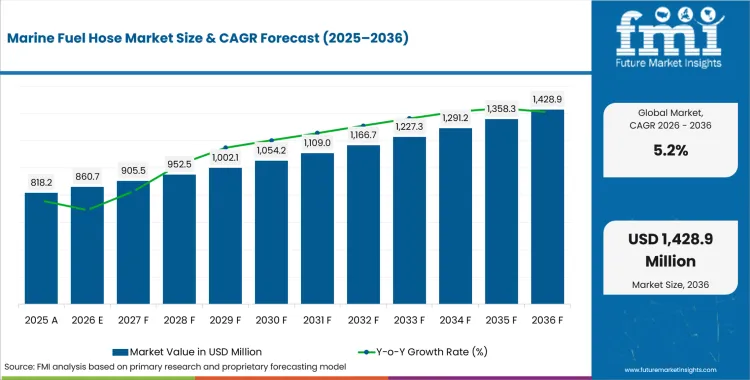
USD 860.7 million in 2026 and USD 1,428.9 million by 2036 at a 5.2% CAGR.
Demand for marine fuel hose is projected to expand at 5.2% CAGR between 2026 and 2036 with valuation rising from USD 860.7 million to USD 1,428.9 million. Replacement activity remains a key source of demand because fuel-transfer components are exposed to continual contact with fuel and routine maintenance handling throughout their service life. The USA Coast Guard reported 11,674,073 registered recreational vessels in 2024 through its June 2025 national statistics. The installed base sustains replacement demand in marine vessel fleets because fuel hoses age under continuous fuel exposure and repeated service handling.
Australia’s 6.5% outlook exceeds the USA’s 5.1% rate because smaller craft place more replacement work in dealer and service channels. The Boating Industry Association reported in August 2025 that 67% of Australia’s registered boats measure under six metres. Australia’s small-craft profile raises the value of readily stocked fuel-line sizes while the larger USA base depends on wider regional distribution.
Key Takeaways
- Marine fuel hose demand rises as boatbuilders and service yards replace aging lines under documented safety and fuel-compatibility requirements.
- Based on product type, fuel feed hoses are projected to account for 29.0% in 2026 due to continuous fuel contact and recurring inspection requirements.
- By material, nitrile rubber is estimated to hold 34.0% in 2026 owing to hydrocarbon resistance and familiar hose-processing methods.
- The boat type category is forecast to be led by outboard boats at 27.0% share in 2026 due to their large serviceable installed base.
- Application-specific hose classes and fitting requirements can lengthen qualification work when replacements must match exact onboard locations and fuel blends.
- Some of the key players in this market include Parker Hannifin, Continental, Trident Marine, Dometic (Shields Marine), Gates Corporation, Kuriyama, Novaflex, and VETUS.
Analyst Perspective
“Marine fuel hose should be screened first by SAE J1527 or ISO 7840 duty, then by the fuel blend and routing limits of the installation. Distributors that stock approved diameters with matching fittings reduce the chance that a routine replacement stalls while a yard searches for a compliant substitute.”
- Nikhil Kaitwade, Principal Consultant, Future Market Insights
How is the Marine Fuel Hose Market segmented?
The marine fuel hose market is segmented by product type, material, boat type, fuel type and sales channel.
Marine fuel hose is segmented by product type, material, boat type, fuel type and sales channel. Product type covers fuel feed, fill, vent, return and low-permeation barrier hoses for marine systems. Material includes nitrile rubber, fluoroelastomer-lined rubber, PVC-blended rubber, reinforced composite and thermoplastic hose constructions available commercially. Boat type covers outboard boats, inboard motorboats, yachts, commercial workboats and fishing vessels in service. Fuel type covers gasoline, diesel, marine distillate, biofuel blends and portable tank fuel while sales channels separate OEM and replacement purchasing.
What makes Fuel Feed Hoses central to the Product Type category?
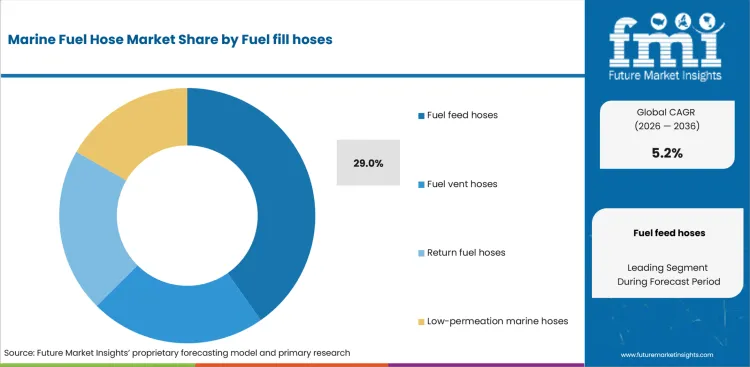
Fuel feed hoses carry fuel between the tank-side system and the engine during normal operation. Continuous exposure makes leakage control and secure connections central during routine inspection or repower work involving marine fuel injection systems on powered boats.
- By product type, fuel feed hoses are estimated to hold 29.0% in 2026 owing to continuous fuel exposure and routine inspection points.
- SAE International’s May 2026 revision of J1942 directs small-craft gasoline and diesel fuel-hose applications to SAE J1527. The standard linkage keeps fuel-feed qualification tied to recognized marine requirements instead of general-purpose hose specifications.
Why does Nitrile Rubber lead the Material category?
Nitrile rubber resists hydrocarbon exposure without making hose difficult to route in confined engine spaces. Its flexibility also accommodates reinforcement and barrier layers used for different permeability targets. Boatbuilders can retain familiar fabrication methods already used in industrial hose assemblies.
- Nitrile rubber is set to lead the material category with 34.0% share in 2026 due to hydrocarbon resistance and flexible processing.
- Continental announced in October 2025 that its Mount Pleasant expansion would add a compounding center for rubber products used in hose manufacturing. The investment strengthens regional material-processing capacity without treating a company expansion as proof of the modelled nitrile share.
How do Outboard Boats Shape the Boat Type category?
Outboard boats concentrate fuel hose demand in compact systems where short feed lines and serviceable engine connections turn common diameters into regular dealer-stock items beside hose protection sleeves.
- By boat type, outboard boats are forecast to represent 27.0% in 2026 driven by their large installed base and frequent dealer-service connections.
- Dealer networks carry much of the service burden for outboard fuel lines during scheduled maintenance. The National Marine Manufacturers Association reported in April 2026 that 267,000 outboard engines were sold in the United States during 2025. The reported sales volume keeps fuel-line replacement closely tied to outboard dealer and repair networks in active boating regions.
What drives marine OEMs in the Sales Channel category?
Marine OEMs coordinate fuel hose with marine engines during design because access becomes expensive after vessel assembly. Yacht construction raises the cost of late routing changes once finished interiors restrict connection access. VETUS stated in September 2025 that its teams would meet key OEMs in Europe and North America for integrated onboard systems.
- In 2026, marine OEMs are expected to lead the sales channel category with 37.0% share because design-in purchasing standardizes hose dimensions and connection methods.
- Factory-backed installation support gives builders a direct route to resolve hose placement and service access before production begins.
What are the drivers, restraints and opportunities in the Marine Fuel Hose Market?
Safety-led replacement increases demand while location-specific qualification slows substitution and changing fuel blends raise the value of low-permeation hose.
- Driver: Fuel-system safety requirements turn visible hose deterioration and uncertain markings into practical replacement triggers for boatbuilders and service yards.
- Restraint: Different feed, fill and vent duties require matched hose classes and fittings which can extend qualification or retrofit work.
- Opportunity: Verified low-permeation constructions for higher ethanol or biofuel content can secure OEM design-ins and documented aftermarket replacements.
Failure risk keeps marine fuel hose replacement tied to inspection and maintenance instead of discretionary upgrading during seasonal service periods. In July 2025, the USA Coast Guard said 3,887 recreational boating incidents occurred in 2024 and ranked machinery failure among the top five primary contributing factors. Service yards therefore prioritize cracked lines and uncertain fittings because fuel-system faults carry both safety and downtime consequences.
Qualification slows if a replacement hose must match the onboard location as well as the intended fuel. Transport Canada documented updates to the Small Vessel Regulations and Small Vessel Construction and Equipment Regulations in its November 2025 results report. Installers need traceable specifications even if oil and gas hose assemblies use similar materials, which raises the cost of informal substitution.
Higher renewable-fuel content raises the value of barrier hose families with published blend limits and marine approvals. Brazil’s ANP stated in July 2026 that regular gasoline would temporarily use an E32 specification from August for 180 days. Manufacturers that qualify one hose family for changing gasoline blends can pursue OEM approvals and replacement work without asking yards to reinterpret material compatibility.
Which country CAGRs are profiled in the Marine Fuel Hose Market?
| Country | CAGR |
|---|---|
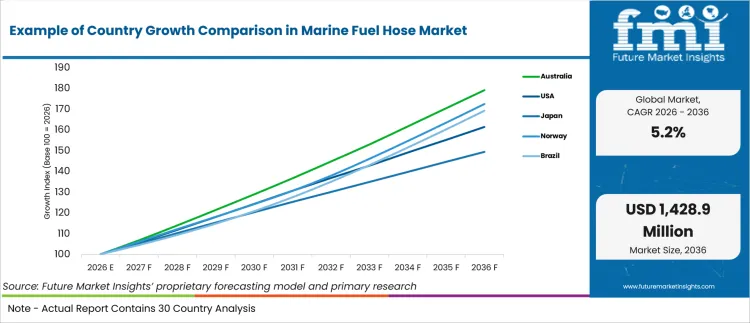
| Australia | 6.5% |
| Norway | 6.2% |
| Brazil | 5.8% |
| Canada | 5.5% |
| USA | 5.1% |
How do country-level CAGRs compare in the Marine Fuel Hose Market?
Australia is anticipated to expand at 6.5% CAGR and Norway at 6.2% form the upper pair while Brazil and Canada occupy the middle of the 1.4-point range. The USA at 5.1% CAGR closes the group. The spacing reflects different replacement channels and fleet conditions rather than current revenue size or installed-base concentration.
- Australia concentrates maintenance in seasonal dealer service activity for coastal recreational boats.
- Norwegian yards schedule fuel-system work during winter lay-up before seasonal spring relaunch.
- Brazil’s long coastline disperses hose replacement among regional marina and service networks.
- Canada’s short boating season compresses repair work into fewer months for service operators.
- The USA installed base makes replacement demand less dependent on new-boat production.
Similar CAGRs produce different stocking decisions because local fleet conditions change order timing. The full report provides country-level CAGR analysis across North America, Latin America, Europe, East Asia, South Asia, Oceania and the Middle East and Africa.
Country-wise Analysis
- Australian repair channels serve recreational marinas and commercial vessels over long coastal distances, which makes local stock of approved fuel-hose diameters important during seasonal maintenance and unscheduled repairs. AMSA stated in June 2026 that it received 4,174 marine incident reports during 2025 and Australia is projected to post 6.5% CAGR owing to maintenance demand linked with onboard system reliability. Long freight routes can leave uncommon diameters unavailable during peak service periods, so distributors that stock approved feed and vent hose near coastal centres can shorten repair delays without compromising hose class or fuel compatibility for commercial and recreational operators.
- During winter lay-up Norwegian yards complete much of their fuel-system maintenance while older recreational boats stay in service outside coastal hubs with uneven access to specialist stock. In May 2026 the Norwegian government documented more than one million recreational boats and proposed mandatory registration for craft down to 2.5 metres. Marine fuel hose demand in Norway is forecast to rise at 6.2% CAGR supported by better vessel visibility, yet cold operating conditions and long replenishment routes keep compatibility records important for refit companies that need certified replacement sizes ahead of scheduled spring relaunch periods in smaller coastal service locations.
- Older Brazilian boats often lack reliable records for installed hose compounds, so changing gasoline chemistry complicates replacement work for service yards in secondary coastal towns. More than 1.4 million active amateur boating licence holders were recorded at the end of 2025 in Brazilian Navy data. Brazil is estimated to post 5.8% CAGR during the forecast period because ethanol-compatible replacement needs stay visible in a large recreational fleet. Mixed vessel ages raise uncertainty over earlier materials so manufacturers that publish traceable blend limits and barrier constructions can win specifications as coastal yards evaluate lower-priced substitutes for boats with incomplete maintenance and service histories.
- Long coastal and inland service distances make local stock important in Canada since a missing hose diameter can extend routine repair time during the short boating season and delay vessel return. Transport Canada stated in May 2026 that more than 12 million Canadian adults participate in recreational boating every year which gives distributors a broad maintenance audience beyond new-boat production. The Canadian marine fuel hose market is anticipated to advance at 5.5% CAGR given this installed service base, although remote access keeps compliant part identification and stocked sizes central to order conversion in smaller ports and inland service locations.
- To serve large boating populations efficiently USA service yards must keep approved hose sizes close to regional dealer networks during summer repair peaks and support many vessel ages. NMMA’s October 2025 registration data show 11.8 million boats were registered or documented during 2024. The USA is forecast to expand at 5.1% CAGR by 2036, influenced by broad aftermarket exposure and persistent replacement work. Regional differences prevent one stocking model from serving every state so manufacturers need national distribution and legible hose markings while local distributors must match fuel-system location without weakening qualification discipline during urgent seasonal service work.
Who are the notable companies in the Marine Fuel Hose Market?
Parker Hannifin, Continental, Trident Marine, Dometic (Shields Marine), Gates Corporation, Kuriyama, Novaflex and VETUS are the notable companies profiled in this market.
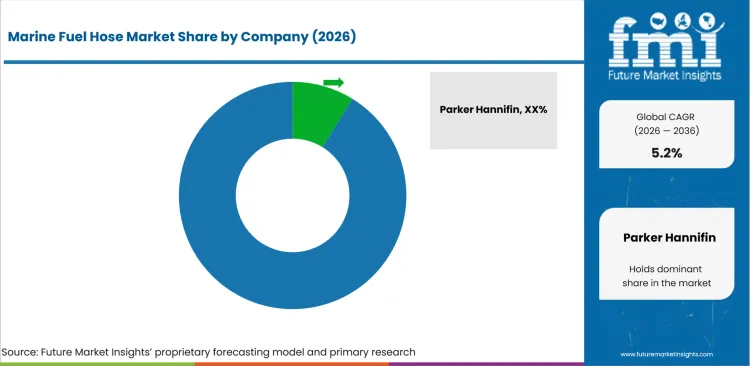
Marine specialists and diversified hose groups compete on qualification, fuel compatibility and channel depth during purchase decisions. Service yards buying air compressor hose can consolidate orders if approved fuel lines are stocked locally. Industrial accounts using hose pump systems follow different distribution routes, so marine qualification is a separate gate. High-pressure grease hose programs widen distributor access without proving SAE or ISO marine fuel-hose compliance.
- Parker Hannifin, Continental and Trident Marine compete on documented marine hose classes and low-permeation fuel-line performance.
- Dometic (Shields Marine) and VETUS pair fuel hose with onboard-system portfolios supporting OEM and service relationships.
- Gates Corporation, Kuriyama and Novaflex serve marine fuel-hose accounts through industrial hose manufacturing plus regional replacement distribution.
Competitive Benchmarking: Marine Fuel Hose Market
| Company | Marine Standards Coverage | Low-Permeation / Blend Fit | Marine Integration | Geographic Reach |
|---|---|---|---|---|
| Parker Hannifin | High | High | Medium | Global |
| Continental | High | High | High | Global |
| Trident Marine | High | High | Medium | North America and export marine channels |
| Dometic (Shields Marine) | High | High | High | Global marine channels |
| Gates Corporation | High | Medium | Medium | Global |
| Kuriyama | Medium | Medium | Medium | North America and international industrial channels |
| Novaflex | High | High | Medium | North America and international distribution |
| VETUS | High | High | High | Europe, North America and international marine channels |
Scoring basis: High requires broad documented exact-market evidence while Medium reflects narrower verified coverage and Low marks a documented limitation. Low-permeation and blend-fit ratings use regulator certifications or independent qualification records that identify barrier construction and compatible fuel classes. Marine integration measures support beyond one hose family while geographic reach records verified sales or service regions.
Key Developments in the Marine Fuel Hose Market
- In June 2025, Continental introduced a multi-purpose marine hose for fuel filler and tank vent service under SAE J1527 A2 and ISO 7840 A2. The launch places two fuel-system duties under one documented marine qualification route.
- In January 2025, Kuriyama announced a 120,000-square-foot East Coast Distribution Center in Carlisle with customer service scheduled for March. The expansion increases regional stocking capacity for replacement channels that depend on fast seasonal replenishment.
- In January 2025, VETUS issued an EU Declaration of Conformity for FHA115_A fuel hose covering ISO 7840 and SAE J1527 requirements. The declaration gives OEMs and service yards a dated conformity record for the hose family.
Key Players in the Marine Fuel Hose Market
Direct Marine Fuel-Hose Specialists
- Parker Hannifin
- Continental
- Trident Marine
- Dometic (Shields Marine)
Diversified Hose and Distribution Platforms
- Gates Corporation
- Kuriyama
- Novaflex
Integrated Marine Systems
- VETUS
Marine Fuel Hose Market - Report Scope
| Coverage field | Report scope |
|---|---|
| Market breakdown | By product type, material, boat type, fuel type, sales channel and region. |
| Quantitative Units | USD million |
| Market Definition | Commercial revenue from marine fuel hose used in feed, fill, vent, return and low-permeation fuel-system duties for powered vessels. |
| Regions Covered | North America, Latin America, Europe, East Asia, South Asia and Pacific and Middle East and Africa. |
| Countries Covered | Australia, Norway, Brazil, Canada, USA, and 20+ countries included in the full report. |
| Key Companies Profiled | Parker Hannifin, Continental, Trident Marine, Dometic (Shields Marine), Gates Corporation, Kuriyama, Novaflex and VETUS. |
| Forecast Period | 2026 to 2036. |
| Approach | Primary and secondary research with market triangulation. |
Marine Fuel Hose Market - Research Methodology
| Method | Approach |
|---|---|
| Primary Research | FMI analysts gathered input from manufacturers, service providers, technology developers, distributors, end users, procurement teams, and subject-matter experts. Interviews examined purchasing decisions, product or service evaluation, adoption barriers, approval requirements, pricing considerations, and expectations for technical or commercial support. Respondents were also asked what evidence is required before a trial, pilot, or initial order develops into regular purchasing. |
| Desk Research | Desk research covered government statistics, regulatory publications, trade data, industry associations, technical literature, standards, company filings, product information, and official corporate announcements. Sources were reviewed for relevance, publication date, geographic coverage, and consistency with the defined market scope. Claims relating to performance, applications, approvals, capacity, investment, and commercial activity were retained only when supported by credible public evidence. |
| Market Sizing and Forecasting | The market model combined the baseline value with historical performance, segment structure, pricing and volume indicators, adoption levels, company participation, and country-level demand conditions. Forecast assumptions considered economic activity, investment trends, regulatory developments, technology adoption, purchasing cycles, supply availability, and barriers to wider market use. Segment and regional estimates were reconciled before the final market total was calculated. |
| Data Validation | Estimates were checked against multiple independent indicators, including public data, company activity, trade patterns, industry developments, and findings from primary interviews. Validation also tested whether products, services, applications, and company revenues fell within the defined market boundaries. Adjacent categories, unsupported claims, overlapping revenues, and activities without direct market relevance were excluded to reduce double counting and maintain consistency across segments and countries. |
Marine Fuel Hose Market by Segments
Marine Fuel Hose Market segmented by Product Type:
- Fuel feed hoses
- Fuel fill hoses
- Fuel vent hoses
- Return fuel hoses
- Low-permeation barrier hoses
Marine Fuel Hose Market segmented by Material:
- Nitrile rubber
- Fluoroelastomer-lined rubber
- PVC-blended rubber
- Reinforced composite
- Thermoplastic
Marine Fuel Hose Market segmented by Boat Type:
- Outboard boats
- Inboard motorboats
- Yachts and leisure craft
- Commercial workboats
- Fishing vessels
Marine Fuel Hose Market segmented by Fuel Type:
- Gasoline
- Diesel
- Marine distillate
- Biofuel blends
- Portable tank fuel
Marine Fuel Hose Market segmented by Sales Channel:
- Marine OEMs
- Aftermarket distributors
- Boat repair yards
- Marine retail / chandlery
Marine Fuel Hose Market by Region:
- North America
- United States
- Canada
- Latin America
- Brazil
- Mexico
- Argentina
- Chile
- Western Europe
- Germany
- France
- United Kingdom
- Italy
- Spain
- Benelux
- Nordics
- Eastern Europe
- Poland
- Czech Republic
- Romania
- Hungary
- East Asia
- China
- Japan
- South Korea
- South Asia and Pacific
- India
- ASEAN
- Australia and New Zealand
- Middle East and Africa
- GCC Countries
- South Africa
- Türkiye
- Israel
Research Sources and Bibliography
- USA Coast Guard. (2025, June 24). 2024 Recreational Boating Statistics.
- Boating Industry Association. (2025, August 15). 2025 Boating Data Report Card Released.
- SAE International. (2026, May 6). J1942_202605: Hose and Hose Assemblies for Marine Applications.
- Continental AG. (2025, October 20). ContiTech plans to expand Manufacturing Operations in Mount Pleasant, Iowa Facility.
- National Marine Manufacturers Association. (2026, April 6). Latest Outboard Engine Trends Report Shows Shift to Higher Horsepower Continues.
- VETUS. (2025, September 29). VETUS and Maxwell set to connect with key OEM’s and stakeholders in Europe and North America.
- USA Coast Guard. (2025, July 1). Coast Guard reports fewest boating fatalities in more than 50 years..
- Transport Canada. (2025, November 7). Transport Canada’s 2024-25 Departmental results report.
- Agência Nacional do Petróleo, Gás Natural e Biocombustíveis. (2026, July 31). E32: gasolina com 32% de etanol passa a valer, temporariamente, a partir de amanhã (1/8).
- Australian Maritime Safety Authority. (2026, June 25). Marine incident data highlights safety risks across Australia’s fleet.
- Government of Norway. (2026, May 14). Et steg nærmere obligatorisk registrering av fritidsbåter.
- Brazilian Navy, Directorate of Ports and Coasts. (2026, January). Total de amadores existentes até 31DEZ do ano de referência 2025.
- Transport Canada. (2026, May 19). Minister of Transport launches call for proposals to improve boating safety across Canada.
- National Marine Manufacturers Association. (2025, October 17). Boat Registrations Report Details Shifts Across Fleet and Regions in 2024.
- Continental AG. (2025, June 17). Continental Introduces Multi-Purpose Marine Hose to Streamline Vessel Maintenance and Reduce Complexity.
- Kuriyama of America, Inc. (2025, January 29). Kuriyama Announces Relocation and Expansion of East Coast Distribution Center.
- VETUS. (2025, January 8). EU Declaration of Conformity: Fuel Hose FHA115_A.
- California Air Resources Board. (2026). SIMW - Component Executive Orders.
- National Marine Manufacturers Association. (2026). B2B Directory - Engines.
- Dometic Group. (2021, January 19). Dometic Marines Shields Marine Fuel Hose Excels in Permeation Test.
- Gates Industrial Corporation plc. (2026, February 12). 2025 Annual Report.
- National Marine Manufacturers Association. (2010, August 19). NMMA Type Accepted Equipment by Manufacturer.
- Dometic Group. (2025, November). METSTRADE 2025 Press Kit.
- VETUS. (2026, March 24). VETUS France welcome C2 Marine as VETUS CENTRE.
- Continental AG. (2025, November 3). Continental Celebrates Grand Opening of New Hydraulic Plant in Aguascalientes, Mexico.
This bibliography is provided for reader reference and is not exhaustive. The full report contains the complete reference list and detailed citations
This Report Answers
- How large is the marine fuel hose market in 2026 and what value is projected for 2036?
- Which safety and fuel-compatibility requirements create recurring marine fuel hose replacement demand?
- Why do fuel feed hoses hold the leading position within the product type category?
- How does nitrile rubber influence material selection for marine fuel hose manufacturing and installation?
- Why do outboard boats create a broad service base for fuel-line replacement demand?
- How do country growth rates differ among Australia, Norway, Brazil, Canada and the USA?
- Which companies have the strongest verified marine fuel-hose and channel positions?
- What should marine OEMs and repair channels evaluate before approving a replacement fuel hose?
Frequently Asked Questions
How big is the Marine Fuel Hose Market in 2026?
The marine fuel hose market is valued at USD 860.7 million in 2026 and is projected to reach USD 1,428.9 million by 2036. Safety-led replacement and fuel compatibility requirements support demand in new builds and service work.
What is the CAGR of the Marine Fuel Hose Market from 2026 to 2036?
The marine fuel hose market is projected to grow at a CAGR of 5.2% between 2026 and 2036. Recurring maintenance and application-specific qualification support expansion during powered-vessel service and replacement.
Which product type leads the Marine Fuel Hose Market?
The fuel feed hose segment is expected to hold 29.0% of the marine fuel hose market in 2026 due to continuous fuel exposure. Regular inspection and replacement keep feed-line duty commercially important in powered boats.
Which material segment leads the Marine Fuel Hose Market?
The nitrile rubber segment is expected to hold 34.0% of the marine fuel hose market in 2026 owing to hydrocarbon resistance. Familiar processing and flexible routing keep nitrile practical during common marine fuel-line installations.
Which companies are active in the Marine Fuel Hose Market?
Key companies operating in the marine fuel hose market include Parker Hannifin, Continental, Trident Marine, Dometic (Shields Marine), Gates Corporation, Kuriyama, Novaflex and VETUS. Their positions differ in standards coverage, marine-system support and distribution depth for OEM and aftermarket work.
Preview the report firsthand - request a free sample
Get SampleGet the brochure for pricing and purchase details.
Get PDFTable of Content
- Key Takeaways
- Market Size and CAGR
- Top Growth Driver
- Fastest Growing Segment
- Leading Region
- Key Companies
- Emerging Opportunities
- Executive Summary
- Global Market Outlook
- Demand-side Trends
- Supply-side Trends
- Technology Roadmap Analysis
- Analysis and Recommendations
- Analyst Perspective (What is happening? Why now? What should investors know?)
- Key Questions Answered
- How large is the market?
- What is the CAGR?
- What are key trends?
- Which region dominates?
- Who are the leaders?
- Market Overview
- Market Coverage / Taxonomy
- Market Definition / Scope / Limitations
- Research Methodology
- Chapter Orientation
- Analytical Lens and Working Hypotheses
- Market Structure, Signals, and Trend Drivers
- Benchmarking and Cross-market Comparability
- Market Sizing, Forecasting, and Opportunity Mapping
- Research Design and Evidence Framework
- Desk Research Programme (Secondary Evidence)
- Expert Input and Fieldwork (Primary Evidence)
- Tooling, Models, and Reference Databases
- Data Engineering and Model Build
- Quality Assurance and Audit Trail
- Market Background
- Market Dynamics (Drivers, Restraints, Opportunity, Trends)
- Scenario Forecast (Optimistic, Likely, Conservative)
- Impact Analysis
- AI Impact
- Sustainability Impact
- Regulatory Impact
- Technology Impact
- Consumer / Buyer Analysis
- Purchase Drivers
- Adoption Barriers
- Buyer Journey
- Opportunity Map Analysis
- Product Life Cycle Analysis
- Supply Chain Analysis
- Investment Feasibility Matrix
- Value Chain Analysis
- PESTLE and Porter's Analysis
- Regulatory Landscape
- Regional Parent Market Outlook
- Production and Consumption Statistics
- Import and Export Statistics
- Global Market Analysis and Forecast, 2021 to 2036
- Historical Market Size Value (USD Million) Analysis, 2021 to 2025
- Current and Future Market Size Value (USD Million) Projections, 2026 to 2036
- Y-o-Y Growth Trend Analysis
- Absolute $ Opportunity Analysis
- Global Market Pricing Analysis, 2021 to 2036
- Global Market Analysis and Forecast, By Fuel fill hoses, 2021 to 2036
- Introduction / Key Findings
- Historical Market Size Value (USD Million) Analysis By Fuel fill hoses, 2021 to 2025
- Current and Future Market Size Value (USD Million) Analysis and Forecast By Fuel fill hoses, 2026 to 2036
- Fuel feed hoses
- Fuel vent hoses
- Return fuel hoses
- Low-permeation marine hoses
- Fuel feed hoses
- Y-o-Y Growth Trend Analysis By Fuel fill hoses, 2021 to 2025
- Absolute $ Opportunity Analysis By Fuel fill hoses, 2026 to 2036
- Global Market Analysis and Forecast, By Nitrile rubber, 2021 to 2036
- Introduction / Key Findings
- Historical Market Size Value (USD Million) Analysis By Nitrile rubber, 2021 to 2025
- Current and Future Market Size Value (USD Million) Analysis and Forecast By Nitrile rubber, 2026 to 2036
- Fluoroelastomer-lined rubber
- EPDM blends
- Thermoplastic hose
- Reinforced composite hose
- Fluoroelastomer-lined rubber
- Y-o-Y Growth Trend Analysis By Nitrile rubber, 2021 to 2025
- Absolute $ Opportunity Analysis By Nitrile rubber, 2026 to 2036
- Global Market Analysis and Forecast, By Outboard boats, 2021 to 2036
- Introduction / Key Findings
- Historical Market Size Value (USD Million) Analysis By Outboard boats, 2021 to 2025
- Current and Future Market Size Value (USD Million) Analysis and Forecast By Outboard boats, 2026 to 2036
- Inboard motorboats
- Commercial workboats
- Yachts
- Fishing vessels
- Inboard motorboats
- Y-o-Y Growth Trend Analysis By Outboard boats, 2021 to 2025
- Absolute $ Opportunity Analysis By Outboard boats, 2026 to 2036
- Global Market Analysis and Forecast, By Gasoline, 2021 to 2036
- Introduction / Key Findings
- Historical Market Size Value (USD Million) Analysis By Gasoline, 2021 to 2025
- Current and Future Market Size Value (USD Million) Analysis and Forecast By Gasoline, 2026 to 2036
- Diesel
- Biofuel blends
- Marine distillate
- Portable tank fuel
- Diesel
- Y-o-Y Growth Trend Analysis By Gasoline, 2021 to 2025
- Absolute $ Opportunity Analysis By Gasoline, 2026 to 2036
- Global Market Analysis and Forecast, By Marine OEMs, 2021 to 2036
- Introduction / Key Findings
- Historical Market Size Value (USD Million) Analysis By Marine OEMs, 2021 to 2025
- Current and Future Market Size Value (USD Million) Analysis and Forecast By Marine OEMs, 2026 to 2036
- Aftermarket distributors
- Boat repair yards
- Marine retail / chandlery
- Aftermarket distributors
- Y-o-Y Growth Trend Analysis By Marine OEMs, 2021 to 2025
- Absolute $ Opportunity Analysis By Marine OEMs, 2026 to 2036
- Global Market Analysis and Forecast, By Region, 2021 to 2036
- Introduction
- Historical Market Size Value (USD Million) Analysis By Region, 2021 to 2025
- Current Market Size Value (USD Million) Analysis and Forecast By Region, 2026 to 2036
- North America
- Latin America
- Western Europe
- Eastern Europe
- East Asia
- South Asia and Pacific
- Middle East & Africa
- Market Attractiveness Analysis By Region
- North America Market Analysis and Forecast, By Country, 2021 to 2036
- Historical Market Size Value (USD Million) Trend Analysis By Market Taxonomy, 2021 to 2025
- Market Size Value (USD Million) Forecast By Market Taxonomy, 2026 to 2036
- By Country
- USA
- Canada
- By Fuel fill hoses
- By Nitrile rubber
- By Outboard boats
- By Gasoline
- By Marine OEMs
- By Country
- Market Attractiveness Analysis
- By Country
- By Fuel fill hoses
- By Nitrile rubber
- By Outboard boats
- By Gasoline
- By Marine OEMs
- Key Takeaways
- Latin America Market Analysis and Forecast, By Country
- Historical Market Size Value (USD Million) Trend Analysis By Market Taxonomy, 2021 to 2025
- Market Size Value (USD Million) Forecast By Market Taxonomy, 2026 to 2036
- By Country
- Brazil
- Mexico
- Chile
- Rest of Latin America
- By Fuel fill hoses
- By Nitrile rubber
- By Outboard boats
- By Gasoline
- By Marine OEMs
- By Country
- Market Attractiveness Analysis
- By Country
- By Fuel fill hoses
- By Nitrile rubber
- By Outboard boats
- By Gasoline
- By Marine OEMs
- Key Takeaways
- Western Europe Market Analysis and Forecast, By Country
- Historical Market Size Value (USD Million) Trend Analysis By Market Taxonomy, 2021 to 2025
- Market Size Value (USD Million) Forecast By Market Taxonomy, 2026 to 2036
- By Country
- Germany
- UK
- Italy
- Spain
- France
- Nordic
- BENELUX
- Rest of Western Europe
- By Fuel fill hoses
- By Nitrile rubber
- By Outboard boats
- By Gasoline
- By Marine OEMs
- By Country
- Market Attractiveness Analysis
- By Country
- By Fuel fill hoses
- By Nitrile rubber
- By Outboard boats
- By Gasoline
- By Marine OEMs
- Key Takeaways
- Eastern Europe Market Analysis and Forecast, By Country
- Historical Market Size Value (USD Million) Trend Analysis By Market Taxonomy, 2021 to 2025
- Market Size Value (USD Million) Forecast By Market Taxonomy, 2026 to 2036
- By Country
- Russia
- Poland
- Hungary
- Balkan & Baltic
- Rest of Eastern Europe
- By Fuel fill hoses
- By Nitrile rubber
- By Outboard boats
- By Gasoline
- By Marine OEMs
- By Country
- Market Attractiveness Analysis
- By Country
- By Fuel fill hoses
- By Nitrile rubber
- By Outboard boats
- By Gasoline
- By Marine OEMs
- Key Takeaways
- East Asia Market Analysis and Forecast, By Country
- Historical Market Size Value (USD Million) Trend Analysis By Market Taxonomy, 2021 to 2025
- Market Size Value (USD Million) Forecast By Market Taxonomy, 2026 to 2036
- By Country
- China
- Japan
- South Korea
- By Fuel fill hoses
- By Nitrile rubber
- By Outboard boats
- By Gasoline
- By Marine OEMs
- By Country
- Market Attractiveness Analysis
- By Country
- By Fuel fill hoses
- By Nitrile rubber
- By Outboard boats
- By Gasoline
- By Marine OEMs
- Key Takeaways
- South Asia and Pacific Market Analysis and Forecast, By Country
- Historical Market Size Value (USD Million) Trend Analysis By Market Taxonomy, 2021 to 2025
- Market Size Value (USD Million) Forecast By Market Taxonomy, 2026 to 2036
- By Country
- India
- ASEAN
- Australia & New Zealand
- Rest of South Asia and Pacific
- By Fuel fill hoses
- By Nitrile rubber
- By Outboard boats
- By Gasoline
- By Marine OEMs
- By Country
- Market Attractiveness Analysis
- By Country
- By Fuel fill hoses
- By Nitrile rubber
- By Outboard boats
- By Gasoline
- By Marine OEMs
- Key Takeaways
- Middle East & Africa Market Analysis and Forecast, By Country
- Historical Market Size Value (USD Million) Trend Analysis By Market Taxonomy, 2021 to 2025
- Market Size Value (USD Million) Forecast By Market Taxonomy, 2026 to 2036
- By Country
- Kingdom of Saudi Arabia
- Other GCC Countries
- Türkiye
- South Africa
- Other African Union
- Rest of Middle East & Africa
- By Fuel fill hoses
- By Nitrile rubber
- By Outboard boats
- By Gasoline
- By Marine OEMs
- By Country
- Market Attractiveness Analysis
- By Country
- By Fuel fill hoses
- By Nitrile rubber
- By Outboard boats
- By Gasoline
- By Marine OEMs
- Key Takeaways
- Key Countries Market Analysis
- USA
- Pricing Analysis
- Market Share Analysis, 2025
- By Fuel fill hoses
- By Nitrile rubber
- By Outboard boats
- By Gasoline
- By Marine OEMs
- Canada
- Pricing Analysis
- Market Share Analysis, 2025
- By Fuel fill hoses
- By Nitrile rubber
- By Outboard boats
- By Gasoline
- By Marine OEMs
- Mexico
- Pricing Analysis
- Market Share Analysis, 2025
- By Fuel fill hoses
- By Nitrile rubber
- By Outboard boats
- By Gasoline
- By Marine OEMs
- Brazil
- Pricing Analysis
- Market Share Analysis, 2025
- By Fuel fill hoses
- By Nitrile rubber
- By Outboard boats
- By Gasoline
- By Marine OEMs
- Chile
- Pricing Analysis
- Market Share Analysis, 2025
- By Fuel fill hoses
- By Nitrile rubber
- By Outboard boats
- By Gasoline
- By Marine OEMs
- Germany
- Pricing Analysis
- Market Share Analysis, 2025
- By Fuel fill hoses
- By Nitrile rubber
- By Outboard boats
- By Gasoline
- By Marine OEMs
- UK
- Pricing Analysis
- Market Share Analysis, 2025
- By Fuel fill hoses
- By Nitrile rubber
- By Outboard boats
- By Gasoline
- By Marine OEMs
- Italy
- Pricing Analysis
- Market Share Analysis, 2025
- By Fuel fill hoses
- By Nitrile rubber
- By Outboard boats
- By Gasoline
- By Marine OEMs
- Spain
- Pricing Analysis
- Market Share Analysis, 2025
- By Fuel fill hoses
- By Nitrile rubber
- By Outboard boats
- By Gasoline
- By Marine OEMs
- France
- Pricing Analysis
- Market Share Analysis, 2025
- By Fuel fill hoses
- By Nitrile rubber
- By Outboard boats
- By Gasoline
- By Marine OEMs
- India
- Pricing Analysis
- Market Share Analysis, 2025
- By Fuel fill hoses
- By Nitrile rubber
- By Outboard boats
- By Gasoline
- By Marine OEMs
- ASEAN
- Pricing Analysis
- Market Share Analysis, 2025
- By Fuel fill hoses
- By Nitrile rubber
- By Outboard boats
- By Gasoline
- By Marine OEMs
- Australia & New Zealand
- Pricing Analysis
- Market Share Analysis, 2025
- By Fuel fill hoses
- By Nitrile rubber
- By Outboard boats
- By Gasoline
- By Marine OEMs
- China
- Pricing Analysis
- Market Share Analysis, 2025
- By Fuel fill hoses
- By Nitrile rubber
- By Outboard boats
- By Gasoline
- By Marine OEMs
- Japan
- Pricing Analysis
- Market Share Analysis, 2025
- By Fuel fill hoses
- By Nitrile rubber
- By Outboard boats
- By Gasoline
- By Marine OEMs
- South Korea
- Pricing Analysis
- Market Share Analysis, 2025
- By Fuel fill hoses
- By Nitrile rubber
- By Outboard boats
- By Gasoline
- By Marine OEMs
- Russia
- Pricing Analysis
- Market Share Analysis, 2025
- By Fuel fill hoses
- By Nitrile rubber
- By Outboard boats
- By Gasoline
- By Marine OEMs
- Poland
- Pricing Analysis
- Market Share Analysis, 2025
- By Fuel fill hoses
- By Nitrile rubber
- By Outboard boats
- By Gasoline
- By Marine OEMs
- Hungary
- Pricing Analysis
- Market Share Analysis, 2025
- By Fuel fill hoses
- By Nitrile rubber
- By Outboard boats
- By Gasoline
- By Marine OEMs
- Kingdom of Saudi Arabia
- Pricing Analysis
- Market Share Analysis, 2025
- By Fuel fill hoses
- By Nitrile rubber
- By Outboard boats
- By Gasoline
- By Marine OEMs
- Türkiye
- Pricing Analysis
- Market Share Analysis, 2025
- By Fuel fill hoses
- By Nitrile rubber
- By Outboard boats
- By Gasoline
- By Marine OEMs
- South Africa
- Pricing Analysis
- Market Share Analysis, 2025
- By Fuel fill hoses
- By Nitrile rubber
- By Outboard boats
- By Gasoline
- By Marine OEMs
- USA
- Market Structure Analysis
- Competition Dashboard
- Competition Benchmarking
- Market Share Analysis of Top Players
- By Regional
- By Fuel fill hoses
- By Nitrile rubber
- By Outboard boats
- By Gasoline
- By Marine OEMs
- Emerging Startups
- Innovation Benchmarking
- Competition Analysis
- Competition Deep Dive
- Parker Hannifin
- Overview
- Product Portfolio
- Profitability by Market Segments
- Sales Footprint
- Strategy Overview
- Marketing Strategy
- Product Strategy
- Channel Strategy
- Continental
- Trident Marine
- Shields Marine / Teleflex
- Trelleborg
- Eaton
- Kuriyama
- Novaflex
- Vetus
- Parker Hannifin
- Case Studies
- Success Stories
- Recent Developments
- Competition Deep Dive
- Assumptions & Acronyms Used


