

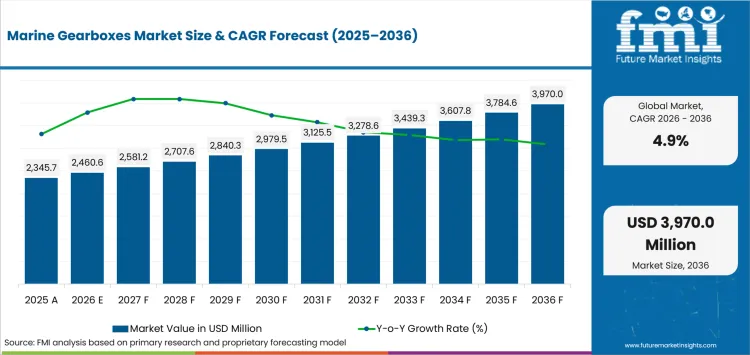
- Market Size (2026)
- USD 2460.6 Mn
- Forecast (2036)
- USD 3970.0 Mn
- CAGR (2026 to 2036)
- 4.9%
How big is Marine Gearboxes Market in 2026?
USD 2460.6 Million in 2026 and USD 3970.0 Million by 2036 at a 4.9% CAGR.
Marine gearbox demand is projected to expand at 4.9% CAGR between 2026 and 2036 as shipowners redesign propulsion packages around fuel use and operating flexibility. The International Maritime Organization approved draft net-zero measures in April 2025 that include a marine fuel standard and greenhouse-gas pricing for large ocean-going ships. Those draft measures do not mandate a gearbox, but they increase the value of ratio selection and shaft-power interfaces that reduce propulsion losses before a vessel design is frozen.
Investment routes differ by fleet economics and public support instead of following one replacement cycle across every country. In the United Kingdom, UK SHORE support gives domestic operators a funded pathway for electric vessel programs through multi-year clean-maritime research and development. Mature fleets elsewhere may convert spending through repower work or scheduled service, so gearbox orders depend on the project gate where ratio changes and electric-machine interfaces remain technically feasible.
Key Takeaways
- Propulsion-efficiency rules and fleet renewal increase marine gearbox demand as vessel designers match engine output with propeller speed before final equipment selection.
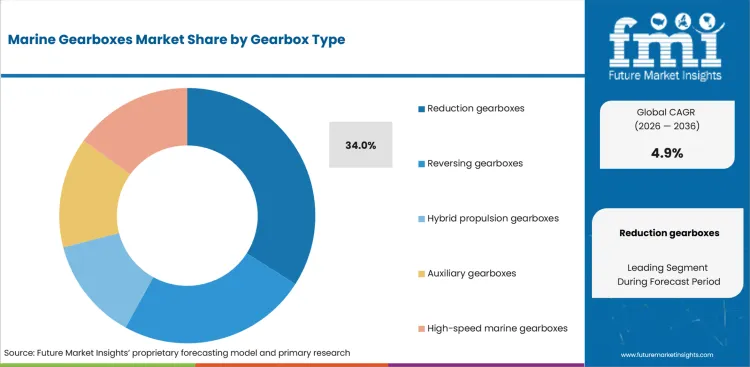
- Based on product type, reduction gearboxes are projected to account for 34.0% in 2026 due to their role in matching higher engine speed with efficient shaft speed.
- By type the 500-2,000 hp category is estimated to hold 33.0% in 2026 owing to recurring demand from commercial craft that use medium-power transmission packages.
- In 2026, workboats are expected to lead boat type with 24.0% share because frequent maneuvering and long operating hours raise transmission duty.
- Vessel-specific alignment and classification work can lengthen engineering cycles as replacement can alter foundations and shaft interfaces along with controls or drydock requirements.
- Key players in the marine gearboxes market include Wärtsilä, Kongsberg Maritime, ZF Friedrichshafen AG, RENK, Reintjes, Twin Disc, Berg Propulsion, and SCHOTTEL.
Analyst Perspective
“Marine gearbox evaluation should begin with vessel duty because ratio selection and PTO/PTI architecture set the usable propulsion envelope. Commercial value then depends on reducing installation risk and protecting vessel availability with service coverage matched to gearbox duty.”
- Nikhil Kaitwade, Principal Consultant, Future Market Insights
How is the marine gearboxes market segmented?
The market is analyzed by Product Type, Type, Boat Type, Sales Channel, Application, and Region.
The marine gearboxes market is segmented by product type, type, boat type, sales channel, application, and region. Product types include reduction, reversing, high-speed marine, auxiliary, and hybrid propulsion gearboxes. Type covers below 500 hp, 500-2,000 hp, 2,000-10,000 hp, and above 10,000 hp. Boat types include workboats, fishing vessels, commercial ships, yachts, and offshore vessels. Sales channels comprise engine package OEM, shipyard direct, aftermarket replacement, and marine propulsion distributors. Applications include newbuild, repower, refit or service, and spare gearbox replacement.
What makes reduction gearboxes central to the product type category?
Medium-speed marine engines usually turn faster than efficient propeller shaft speeds, making reduction gearboxes central to conventional marine drivetrains. In April 2025, MAN Energy Solutions confirmed that five Indian Navy fleet support ships would receive ten engines together with main reduction gearboxes and shaft generators.
- Based on product type, reduction gearboxes are projected to account for 34.0% in 2026 due to speed reduction that matches engine efficiency with required propeller speed.
- The Indian Navy package places the gearbox inside a coordinated propulsion decision, showing why early interface definition matters more than stand-alone component pricing on complex newbuilds.
Why does 500-2,000 hp lead the type category?
The 500-2,000 hp band serves commercial craft that need substantial continuous torque without the weight and engineering burden of very large transmission trains. ZF introduced its first pure-electric marine transmission family in June 2025 with variants beginning at the ZF 2000 platform for ferries and tugs.
- By type the 500-2,000 hp category is estimated to hold 33.0% in 2026 owing to standardized engine interfaces that support repeat orders across medium-power vessel programs.
- ZF’s launch extends electric transmission choices into working-vessel duty, increasing the importance of compact housings and familiar integration points as propulsion architectures change.
What supports engine package OEM leadership in the sales channel category?
Engine package OEMs reduce interface risk by fixing torque curves and ratio selection inside one propulsion specification before the shipyard begins detailed installation. Wärtsilä announced four Dutch newbuilds in June 2025 with integrated hybrid propulsion packages using Wärtsilä 25 engines and PTO/PTI/PTH functionality.
- In 2026, engine package OEM is expected to lead sales channel with 35.0% share because coordinated engine and transmission engineering assigns critical interfaces to one propulsion partner.
- The Dutch order demonstrates how shipowners increasingly evaluate mechanical gearing beside electric operating modes, making package-level validation commercially stronger than an isolated gearbox quote.
What drives newbuild leadership in the application category?
Newbuild projects give naval architects the widest freedom to set shaft geometry and gearbox ratios before foundations or machinery-room layouts become fixed across marine vessels. Wärtsilä reported in January 2026 that a new Hartman Seatrade vessel would use a gearbox supporting PTI/PTO/PTH functions beside controllable-pitch propulsion.
- By application, newbuild is forecast to represent 41.0% in 2026 driven by clean-sheet vessel design that fixes gearbox selection before structural and control interfaces narrow the options.
- Hartman Seatrade’s specification places electric-machine functions inside the initial propulsion architecture, which reduces later retrofit compromises and gives integrated engineering greater influence over award decisions.
What are the drivers, restraints and opportunities in the marine gearboxes market?
Newbuild investment and efficiency pressure support demand, while vessel-specific integration slows substitution and hybrid-ready repower engineering extends lifecycle revenue.
- Driver: New vessel programs and fuel-efficiency targets bring gearbox selection into propulsion engineering before machinery layouts and shaft speeds become fixed.
- Restraint: Alignment requirements and classification rules increase switching costs as a replacement must fit certified mechanical interfaces without extending vessel downtime.
- Opportunity: Hybrid PTO/PTI repower packages can increase transmission value by adding electric operating modes without requiring complete vessel replacement.
Shipowners now compare marine fuel systems with other efficiency measures across the full propulsion train as fuel savings depend on how engines and propellers operate together. DNV reported in March 2025 that its maritime efficiency guide assessed more than 40 measures with fuel-saving effects and ship-type suitability. Inefficient mechanical matching can dilute gains from other equipment, keeping gearbox ratio and shaft-power choices commercially relevant during newbuild design.
Approved vessel arrangements constrain shaft speed and foundations together with clutch behavior and machinery interfaces. Lloyd’s Register published its July 2026 ship rules covering twelve listed ship categories and a wide range of engineering systems. Gearbox substitution therefore carries engineering and approval work beyond the unit itself, which can favor companies with vessel records and established repair networks.
Repower projects offer revenue where operators need lower fuel use but cannot justify replacing a serviceable hull or complete propulsion train. Berg Propulsion reported in February 2025 that a Norwegian coaster retrofit using a new gearbox and permanent-magnet motors cut fuel costs by 33%. Gearbox companies can pursue similar work by validating PTO/PTI interfaces beside marine emissions controls before drydock schedules make design changes uneconomic.
Which country CAGRs are profiled in the marine gearboxes market?
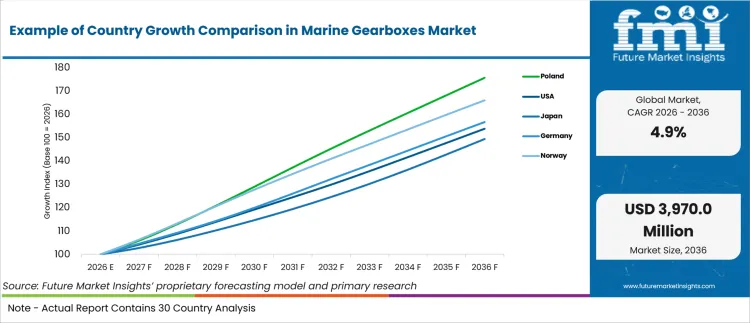
| Country | CAGR |
|---|---|
| Poland | 6.1% |
| Norway | 5.8% |
| Netherlands | 5.4% |
| Brazil | 5.1% |
| Germany | 4.7% |
How do country-level CAGRs compare in the marine gearboxes market?
The countries span 1.4 percentage points from Poland at 6.1% to Germany at 4.7%. Poland and Norway form the upper band as offshore demand and emission deadlines advance propulsion decisions. Netherlands and Brazil follow financed or demonstration-backed projects, while Germany relies more on specialized shipbuilding and service networks.
- Poland turns Baltic offshore servicing into repeated workboat duty with high transmission availability.
- Norway advances ferry propulsion decisions under a zero-emission transition schedule for operators.
- Netherlands uses maritime demonstration funding to pull lower-emission vessel projects into consortia.
- Brazil ties gearbox timing to financed newbuilds and Merchant Marine Fund approvals.
- Germany converts specialized shipbuilding demand through strict documentation and established service relationships.
Similar growth rates do not imply similar revenue because project timing differs. The full report provides country-level CAGR analysis across North America, Latin America, Europe, East Asia, South Asia, Oceania and the Middle East and Africa.
Country-wise Analysis
- Offshore service work in Poland increasingly pulls gearbox demand toward Baltic vessels, where long operating cycles and harsh weather raise the commercial cost of transmission downtime. Marine gearbox demand in Poland is forecast to expand at 6.1% CAGR through 2036 supported by Baltic Power’s completed Łeba service base and its 1.2 GW project with 76 turbines reported by the Prime Minister’s office in August 2025. That operating base gives gearbox manufacturers a direct workboat route, although rapid service expectations favor class-ready units with Baltic parts coverage and trained field support before a new brand can displace propulsion partners already specified by local yards.
- Ferry operators in Norway judge gearbox packages against short-sea duty cycles and winter operating conditions that leave little tolerance for lost propulsion availability. The government confirmed in April 2025 that zero-emission requirements would apply from January 2026 to passenger ships below 10,000 gross tons in World Heritage fjords and allocated NOK 100 million for shore power in Flåm. Norway is projected to record 5.8% CAGR through 2036 driven by this defined transition schedule, but machinery-space limits and drydock economics favor transmission companies with proven ferry interfaces plus local engineering support that can resolve retrofit problems without extending service interruptions.
- Across Dutch shipyards, marine transmission demand moves through dense engineering networks that can take propulsion changes from design review into newbuild or conversion work within the same maritime cluster. The Netherlands is anticipated to grow at 5.4% CAGR over the assessment period driven by the Maritime Master Plan 2026, which opened applications in May 2026 for research and demonstration projects involving new ships or lower-emission retrofits. The program gives gearbox manufacturers an entry route through Dutch project consortia, although each installation must integrate with vessel controls and energy systems that favor companies already working with local yards and commissioning partners across major Dutch ports.
- Merchant Marine Fund approvals shape Brazilian gearbox orders by tying equipment timing to financed vessel construction, domestic shipyard schedules, and equipment sequencing. Resolution 219 confirmed priority changes for four Petrobras Handy product tankers to be built by the ECOVIX/MACLAREN consortium, while Transpetro separately stated that its TP 25 program would expand logistics capacity by at least 25%. Brazil is estimated to post 5.1% CAGR through 2036, reinforced by that visible newbuild pipeline, but long approval cycles and local commissioning requirements reward transmission companies that establish yard relationships and technical representation early enough to influence equipment lists before contract specifications become fixed.
- Specialized shipbuilding and conversion work concentrates German marine gearbox demand around yards that require detailed engineering records before accepting unfamiliar propulsion equipment. Marine gearbox sales in Germany are forecast to advance at 4.7% CAGR by 2036, supported by federal plans to modernize ports and shipping through the National Port Strategy and climate-friendly shipping measures between 2026 and 2029. Mature competition raises the main friction because established yards expect documented duty performance and dependable service coverage, so a new transmission platform needs credible reference projects and responsive technical support from German service teams before it can enter newbuild or retrofit specifications.
Who are the notable companies in the marine gearboxes market?
Wärtsilä, Kongsberg Maritime, ZF Friedrichshafen AG, RENK, Reintjes, Twin Disc, Berg Propulsion, and SCHOTTEL are the notable companies profiled in this market.
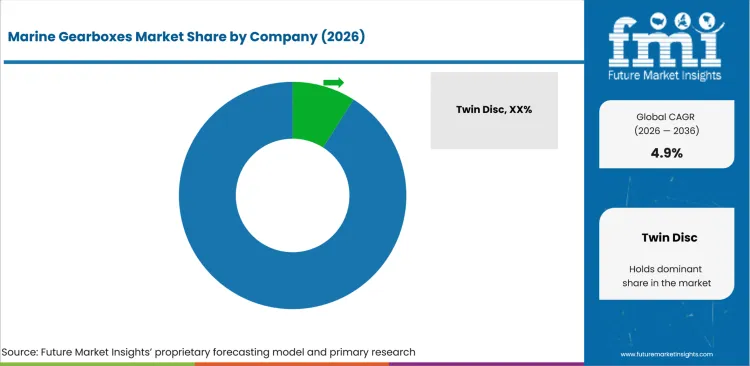
Competition spans integrated propulsion groups and gearbox specialists that enter vessel projects through different specification routes. Class records and local service history raise entry barriers, while adjacent marine steering systems increase interface responsibility for package providers.
- Wärtsilä, Kongsberg Maritime, and ZF Friedrichshafen AG place transmission choices within broader propulsion or electrification packages.
- RENK, Reintjes, and Twin Disc focus on marine transmission engineering with established aftermarket support networks.
- Berg Propulsion and SCHOTTEL address propulsion programs where gearbox choices are engineered alongside propellers and vessel controls.
Competitive Benchmarking: Marine Gearboxes Market
| Company | Gearbox Engineering Breadth | Hybrid / Electric Integration | Lifecycle Service Depth | Geographic Reach |
|---|---|---|---|---|
| Wärtsilä | High | High | High | Global marine markets |
| Kongsberg Maritime | Medium | High | High | Global marine markets with support locations in 35 countries |
| ZF Friedrichshafen AG | High | High | High | Global marine markets |
| RENK | High | High | High | Europe, North America and selected Asian naval markets |
| Reintjes | High | Medium | High | Europe with international sales and service partners |
| Twin Disc | High | High | High | Americas, Europe and Asia-Pacific |
| Berg Propulsion | High | High | Medium | Europe and Asia with global project support |
| SCHOTTEL | Medium | High | High | Global marine markets |
Scoring basis: High gearbox engineering breadth requires several documented marine transmission architectures across distinct vessel duties while Medium reflects narrower package-led coverage and Low identifies one verified route. High hybrid integration requires repeated documented PTO/PTI or electric-propulsion applications while Medium reflects one established integration route and Low reflects conventional-only evidence. High lifecycle depth requires broad multi-region service infrastructure while Medium reflects narrower regional coverage and Low indicates a limited documented support network.
Key Developments in the Marine Gearboxes Market
- In July 2026, Wärtsilä secured propulsion orders for nine Grimaldi Group ferry newbuilds with two gearboxes and hybrid-electric propulsion specified for three Finnlines vessels.
- In October 2025, RENK received an order for twelve NDSL-3600 double marine gear units with integrated PTO shafts for six RoPax ferries.
- In August 2025, Reintjes signed an MoU with Garden Reach Shipbuilders & Engineers covering integrated propulsion gear trains for warships and commercial vessels.
Key Players in the Marine Gearboxes Market
Integrated Propulsion and Package Providers
- Wärtsilä
- Kongsberg Maritime
- ZF Friedrichshafen AG
Dedicated Marine Transmission Specialists
- RENK
- Reintjes
- Twin Disc
Integrated Propulsion System Houses
- Berg Propulsion
- SCHOTTEL
Marine Gearboxes Market - Report Scope
| Coverage field | Report scope |
|---|---|
| Market breakdown | By product type, type, boat type, sales channel, application and region. |
| Quantitative Units | USD billion. |
| Market Definition | Marine gear units that transmit and condition propulsion power between prime movers, shaft systems, propellers and integrated auxiliary power interfaces. |
| Regions Covered | North America, Latin America, Western Europe, Eastern Europe, East Asia, South Asia and Pacific and Middle East and Africa. |
| Countries Covered | Poland, Norway, Netherlands, Brazil, Germany, and 20+ countries included in the full report. |
| Key Companies Profiled | Wärtsilä, Kongsberg Maritime, ZF Friedrichshafen AG, RENK, Reintjes, Twin Disc, Berg Propulsion, and SCHOTTEL. |
| Forecast Period | 2026 to 2036. |
| Approach | Primary and secondary research with market triangulation. |
Marine Gearboxes Market - Research Methodology
| Method | Approach |
|---|---|
| Primary Research | FMI analysts gathered input from manufacturers, service providers, technology developers, distributors, end users, procurement teams, and subject-matter experts. Interviews examined purchasing decisions, product or service evaluation, adoption barriers, approval requirements, pricing considerations, and expectations for technical or commercial support. Respondents were also asked what evidence is required before a trial, pilot, or initial order develops into regular purchasing. |
| Desk Research | Desk research covered government statistics, regulatory publications, trade data, industry associations, technical literature, standards, company filings, product information, and official corporate announcements. Sources were reviewed for relevance, publication date, geographic coverage, and consistency with the defined market scope. Claims relating to performance, applications, approvals, capacity, investment, and commercial activity were retained only when supported by credible public evidence. |
| Market Sizing and Forecasting | The market model combined the baseline value with historical performance, segment structure, pricing and volume indicators, adoption levels, company participation, and country-level demand conditions. Forecast assumptions considered economic activity, investment trends, regulatory developments, technology adoption, purchasing cycles, supply availability, and barriers to wider market use. Segment and regional estimates were reconciled before the final market total was calculated. |
| Data Validation | Estimates were checked against multiple independent indicators, including public data, company activity, trade patterns, industry developments, and findings from primary interviews. Validation also tested whether products, services, applications, and company revenues fell within the defined market boundaries. Adjacent categories, unsupported claims, overlapping revenues, and activities without direct market relevance were excluded to reduce double counting and maintain consistency across segments and countries. |
Marine Gearboxes Market by Segments
Marine Gearboxes Market segmented by Product Type:
- Reduction gearboxes
- Reversing gearboxes
- High-speed marine gearboxes
- Auxiliary gearboxes
- Hybrid propulsion gearboxes
Marine Gearboxes Market segmented by Type:
- Below 500 hp
- 500-2,000 hp
- 2,000-10,000 hp
- Above 10,000 hp
Marine Gearboxes Market segmented by Boat Type:
- Workboats
- Fishing vessels
- Commercial ships
- Yachts
- Offshore vessels
Marine Gearboxes Market segmented by Sales Channel:
- Engine package OEM
- Shipyard direct
- Aftermarket replacement
- Marine propulsion distributors
Marine Gearboxes Market segmented by Application:
- Newbuild
- Repower
- Refit / service
- Spare gearbox replacement
Marine Gearboxes Market by Region:
- North America
- United States
- Canada
- Latin America
- Brazil
- Mexico
- Chile
- Rest of Latin America
- Western Europe
- Germany
- United Kingdom
- Italy
- Spain
- France
- Nordics
- Benelux
- Rest of Western Europe
- Eastern Europe
- Russia
- Poland
- Hungary
- Balkan and Baltic States
- Rest of Eastern Europe
- East Asia
- China
- Japan
- South Korea
- South Asia and Pacific
- India
- ASEAN
- Australia and New Zealand
- Rest of South Asia and Pacific
- Middle East and Africa
- Kingdom of Saudi Arabia
- Other GCC Countries
- Türkiye
- South Africa
- Other African Union Countries
- Rest of Middle East and Africa
Research Sources and Bibliography
- International Maritime Organization. (2025, April 11). IMO approves net-zero regulations for global shipping.
- Department for Transport. (2025, September 15). The future of UK Shipping Office for Reducing Emissions (UK SHORE).
- MAN Energy Solutions. (2025, April 15). MAN Engines at Heart of Indian Navy Newbuilding Propulsion Package.
- ZF Friedrichshafen AG. (2025, June 2). Quiet, Clean, Flexible: ZF Presents New ENC Transmission Series for All-Electric Vessels.
- Wärtsilä Corporation. (2025, June 11). Wärtsilä hybrid propulsion solution to optimise efficiency and enable zero emissions for four new Dutch vessels.
- Wärtsilä Corporation. (2026, January 13). Wärtsilä 31 engine selected to minimise fuel consumption and emissions for new Hartman Seatrade vessel.
- DNV. (2025, March 4). DNV launches new report to help shipowners select energy-efficiency measures and technologies.
- Lloyd’s Register. (2026, July 1). Rules for the Classification of Ships.
- Berg Propulsion. (2025, February 24). Berg efficiency upgrade cuts fuel costs by 33% for Lighthouse Ship Management’s Norwegian coaster.
- Chancellery of the Prime Minister of Poland. (2025, August 8). Prime Minister Tusk Visits Poland’s First Offshore Wind Farm.
- Ministry of Climate and Environment. (2025, April 22). Zero-Emission Requirements for Passenger Ships in World Heritage Fjords.
- Netherlands Enterprise Agency. (2026). Subsidy scheme Maritime Master Plan 2026.
- Ministry of Ports and Airports of Brazil. (2025, May 14). RESOLUÇÃO Nº 219, DE 13 DE MAIO DE 2025; Transpetro. (2024, December 23). Transpetro concludes commercial negotiation phase with Ecovix/Mac Laren consortium for acquisition of Handy ships.
- German Bundestag. (2026, April 23). Bundestag will Deutschlands maritime Wirtschaft stärken; Clean Energy Wire. (2025, July 4). German ports and shipping get climate-friendly modernisation funding.
- Wärtsilä Corporation. (2026, July 7). Wärtsilä propulsion solutions selected for Grimaldi Group’s major newbuild programme.
- RENK Group AG. (2025, October 29). RENK to supply 12 double marine gear units for six RoPax ferries operated by a major international customer.
- Garden Reach Shipbuilders & Engineers Limited. (2025, August 1). GRSE signs MoU with REINTJES GmbH for marine propulsion gearboxes.
- Twin Disc, Inc. (2025, February 18). Twin Disc, Inc. Finalizes Acquisition of Kobelt.
- Wärtsilä Corporation. (2025, November 20). Repeat order emphasises strength of Wärtsilä hybrid propulsion system for Aasen Shipping’s bulk carrier series.
- Berg Propulsion. (2026, June 1). Berg Propulsion and Stone Marine formalise service and support agreement for the UK and Ireland.
- SCHOTTEL. (2025, May 7). Powerful and environmentally friendly: SCHOTTEL hybrid drive solution for KOTUG’s methanol-fuelled tugs.
- Brunvoll. (2025, April 10). Brunvoll Propulsion, Manoeuvring, and DP2 System for Emergency Towing Vessel.
- Wärtsilä Corporation. (2026, April 14). Wärtsilä integrated propulsion solution to deliver future-proofing for new next-generation short-sea cargo vessel.
- RENK Group AG. (2026, July 3). RENK Group AG bolsters leading position in the naval sector with acquisition of David Brown Defence from Stellex Capital Management.
- Twin Disc, Inc. (2026, June 3). Veth Propulsion by Twin Disc onthult op Maritime Industry nieuwe generatie voortstuwingstechnologie: Streamline-CRP™.
- SCHOTTEL. (2026, June 1). SCHOTTEL expands presence in India with new subsidiary.
- Kongsberg Maritime. (2026, July 12). Kongsberg Maritime to strengthen marine propulsion offering through acquisition of Berg Propulsion.
- TORM plc. (2025, June 3). TORM Acquires Full Ownership of ME Production to Accelerate Green Maritime Innovation.
- ZF Friedrichshafen AG. (2025, September 10). Powered-Up Propulsion: ZF Marine Unveils new POD 4900.
- Everllence. (2026, July 14). WE Tech Solutions and Everllence Join Forces to Advance Maritime Decarbonisation.
- RENK Group AG. (2026). Quality management.
- SCHOTTEL. (2026). Our quality promise.
This bibliography is provided for reader reference and is not exhaustive. The full report contains the complete reference list and detailed citations.
This Report Answers
- What are 2026 and 2036 marine gearbox values?
- Which efficiency pressures influence gearbox demand?
- Why do reduction gearboxes lead product type?
- Why does 500-2,000 hp lead by type?
- Why does engine package OEM lead sales channel?
- How do CAGRs compare across five profiled countries?
- Which companies supply marine gearboxes?
- Which constraints delay marine gearbox replacement?
Frequently Asked Questions
Which product type leads the marine gearboxes market?
The reduction gearboxes segment is expected to hold 34.0% of the marine gearboxes market in 2026, driven by engine-to-propeller speed matching. Conventional shaft-line propulsion supports repeat newbuild specification.
Which type leads the marine gearboxes market?
The 500–2,000 hp segment is expected to hold 33.0% of the marine gearboxes market in 2026. Medium-power commercial craft support this position through repeatable transmission interfaces.
Which boat type leads the marine gearboxes market?
The workboats segment is expected to hold 24.0% of the marine gearboxes market in 2026, attributable to frequent maneuvering and long operating hours. High utilization raises demand for durable transmissions and local service.
Which countries are projected to record the highest growth in the marine gearboxes market?
Poland leads growth in the marine gearboxes market at 6.1% CAGR, followed by Norway at 5.8% and Netherlands at 5.4% through 2036. Offshore servicing and emissions programs advance propulsion investment.
Which companies are active in the marine gearboxes market?
Key companies operating in the marine gearboxes market include Wärtsilä, Kongsberg Maritime, ZF Friedrichshafen AG, RENK, Reintjes, Twin Disc, Berg Propulsion, and SCHOTTEL. Coverage differs by transmission engineering and lifecycle service depth.
Preview the report firsthand - request a free sample
Get SampleGet the brochure for pricing and purchase details.
Get PDFTable of Content
- Key Takeaways
- Market Size and CAGR
- Top Growth Driver
- Fastest Growing Segment
- Leading Region
- Key Companies
- Emerging Opportunities
- Executive Summary
- Global Market Outlook
- Demand-side Trends
- Supply-side Trends
- Technology Roadmap Analysis
- Analysis and Recommendations
- Analyst Perspective (What is happening? Why now? What should investors know?)
- Key Questions Answered
- How large is the market?
- What is the CAGR?
- What are key trends?
- Which region dominates?
- Who are the leaders?
- Market Overview
- Market Coverage / Taxonomy
- Market Definition / Scope / Limitations
- Research Methodology
- Chapter Orientation
- Analytical Lens and Working Hypotheses
- Market Structure, Signals, and Trend Drivers
- Benchmarking and Cross-market Comparability
- Market Sizing, Forecasting, and Opportunity Mapping
- Research Design and Evidence Framework
- Desk Research Programme (Secondary Evidence)
- Expert Input and Fieldwork (Primary Evidence)
- Tooling, Models, and Reference Databases
- Data Engineering and Model Build
- Quality Assurance and Audit Trail
- Market Background
- Market Dynamics (Drivers, Restraints, Opportunity, Trends)
- Scenario Forecast (Optimistic, Likely, Conservative)
- Impact Analysis
- AI Impact
- Sustainability Impact
- Regulatory Impact
- Technology Impact
- Consumer / Buyer Analysis
- Purchase Drivers
- Adoption Barriers
- Buyer Journey
- Opportunity Map Analysis
- Product Life Cycle Analysis
- Supply Chain Analysis
- Investment Feasibility Matrix
- Value Chain Analysis
- PESTLE and Porter's Analysis
- Regulatory Landscape
- Regional Parent Market Outlook
- Production and Consumption Statistics
- Import and Export Statistics
- Global Market Analysis and Forecast, 2021 to 2036
- Historical Market Size Value (USD Million) Analysis, 2021 to 2025
- Current and Future Market Size Value (USD Million) Projections, 2026 to 2036
- Y-o-Y Growth Trend Analysis
- Absolute $ Opportunity Analysis
- Global Market Pricing Analysis, 2021 to 2036
- Global Market Analysis and Forecast, By Gearbox Type, 2021 to 2036
- Introduction / Key Findings
- Historical Market Size Value (USD Million) Analysis By Gearbox Type, 2021 to 2025
- Current and Future Market Size Value (USD Million) Analysis and Forecast By Gearbox Type, 2026 to 2036
- Reduction gearboxes
- Reversing gearboxes
- Hybrid propulsion gearboxes
- Auxiliary gearboxes
- High-speed marine gearboxes
- Reduction gearboxes
- Y-o-Y Growth Trend Analysis By Gearbox Type, 2021 to 2025
- Absolute $ Opportunity Analysis By Gearbox Type, 2026 to 2036
- Global Market Analysis and Forecast, By Power Rating, 2021 to 2036
- Introduction / Key Findings
- Historical Market Size Value (USD Million) Analysis By Power Rating, 2021 to 2025
- Current and Future Market Size Value (USD Million) Analysis and Forecast By Power Rating, 2026 to 2036
- Below 500 hp
- 500-2,000 hp
- 2,000-10,000 hp
- Above 10,000 hp
- Below 500 hp
- Y-o-Y Growth Trend Analysis By Power Rating, 2021 to 2025
- Absolute $ Opportunity Analysis By Power Rating, 2026 to 2036
- Global Market Analysis and Forecast, By Vessel Type, 2021 to 2036
- Introduction / Key Findings
- Historical Market Size Value (USD Million) Analysis By Vessel Type, 2021 to 2025
- Current and Future Market Size Value (USD Million) Analysis and Forecast By Vessel Type, 2026 to 2036
- Workboats
- Fishing vessels
- Yachts
- Commercial ships
- Offshore vessels
- Workboats
- Y-o-Y Growth Trend Analysis By Vessel Type, 2021 to 2025
- Absolute $ Opportunity Analysis By Vessel Type, 2026 to 2036
- Global Market Analysis and Forecast, By Sales Channel, 2021 to 2036
- Introduction / Key Findings
- Historical Market Size Value (USD Million) Analysis By Sales Channel, 2021 to 2025
- Current and Future Market Size Value (USD Million) Analysis and Forecast By Sales Channel, 2026 to 2036
- Engine package OEM
- Shipyard direct
- Aftermarket replacement
- Marine propulsion distributors
- Engine package OEM
- Y-o-Y Growth Trend Analysis By Sales Channel, 2021 to 2025
- Absolute $ Opportunity Analysis By Sales Channel, 2026 to 2036
- Global Market Analysis and Forecast, By Installation, 2021 to 2036
- Introduction / Key Findings
- Historical Market Size Value (USD Million) Analysis By Installation, 2021 to 2025
- Current and Future Market Size Value (USD Million) Analysis and Forecast By Installation, 2026 to 2036
- Newbuild
- Repower
- Refit / service
- Spare gearbox replacement
- Newbuild
- Y-o-Y Growth Trend Analysis By Installation, 2021 to 2025
- Absolute $ Opportunity Analysis By Installation, 2026 to 2036
- Global Market Analysis and Forecast, By Region, 2021 to 2036
- Introduction
- Historical Market Size Value (USD Million) Analysis By Region, 2021 to 2025
- Current Market Size Value (USD Million) Analysis and Forecast By Region, 2026 to 2036
- North America
- Latin America
- Western Europe
- Eastern Europe
- East Asia
- South Asia and Pacific
- Middle East & Africa
- Market Attractiveness Analysis By Region
- North America Market Analysis and Forecast, By Country, 2021 to 2036
- Historical Market Size Value (USD Million) Trend Analysis By Market Taxonomy, 2021 to 2025
- Market Size Value (USD Million) Forecast By Market Taxonomy, 2026 to 2036
- By Country
- USA
- Canada
- By Gearbox Type
- By Power Rating
- By Vessel Type
- By Sales Channel
- By Installation
- By Country
- Market Attractiveness Analysis
- By Country
- By Gearbox Type
- By Power Rating
- By Vessel Type
- By Sales Channel
- By Installation
- Key Takeaways
- Latin America Market Analysis and Forecast, By Country
- Historical Market Size Value (USD Million) Trend Analysis By Market Taxonomy, 2021 to 2025
- Market Size Value (USD Million) Forecast By Market Taxonomy, 2026 to 2036
- By Country
- Brazil
- Mexico
- Chile
- Rest of Latin America
- By Gearbox Type
- By Power Rating
- By Vessel Type
- By Sales Channel
- By Installation
- By Country
- Market Attractiveness Analysis
- By Country
- By Gearbox Type
- By Power Rating
- By Vessel Type
- By Sales Channel
- By Installation
- Key Takeaways
- Western Europe Market Analysis and Forecast, By Country
- Historical Market Size Value (USD Million) Trend Analysis By Market Taxonomy, 2021 to 2025
- Market Size Value (USD Million) Forecast By Market Taxonomy, 2026 to 2036
- By Country
- Germany
- UK
- Italy
- Spain
- France
- Nordic
- BENELUX
- Rest of Western Europe
- By Gearbox Type
- By Power Rating
- By Vessel Type
- By Sales Channel
- By Installation
- By Country
- Market Attractiveness Analysis
- By Country
- By Gearbox Type
- By Power Rating
- By Vessel Type
- By Sales Channel
- By Installation
- Key Takeaways
- Eastern Europe Market Analysis and Forecast, By Country
- Historical Market Size Value (USD Million) Trend Analysis By Market Taxonomy, 2021 to 2025
- Market Size Value (USD Million) Forecast By Market Taxonomy, 2026 to 2036
- By Country
- Russia
- Poland
- Hungary
- Balkan & Baltic
- Rest of Eastern Europe
- By Gearbox Type
- By Power Rating
- By Vessel Type
- By Sales Channel
- By Installation
- By Country
- Market Attractiveness Analysis
- By Country
- By Gearbox Type
- By Power Rating
- By Vessel Type
- By Sales Channel
- By Installation
- Key Takeaways
- East Asia Market Analysis and Forecast, By Country
- Historical Market Size Value (USD Million) Trend Analysis By Market Taxonomy, 2021 to 2025
- Market Size Value (USD Million) Forecast By Market Taxonomy, 2026 to 2036
- By Country
- China
- Japan
- South Korea
- By Gearbox Type
- By Power Rating
- By Vessel Type
- By Sales Channel
- By Installation
- By Country
- Market Attractiveness Analysis
- By Country
- By Gearbox Type
- By Power Rating
- By Vessel Type
- By Sales Channel
- By Installation
- Key Takeaways
- South Asia and Pacific Market Analysis and Forecast, By Country
- Historical Market Size Value (USD Million) Trend Analysis By Market Taxonomy, 2021 to 2025
- Market Size Value (USD Million) Forecast By Market Taxonomy, 2026 to 2036
- By Country
- India
- ASEAN
- Australia & New Zealand
- Rest of South Asia and Pacific
- By Gearbox Type
- By Power Rating
- By Vessel Type
- By Sales Channel
- By Installation
- By Country
- Market Attractiveness Analysis
- By Country
- By Gearbox Type
- By Power Rating
- By Vessel Type
- By Sales Channel
- By Installation
- Key Takeaways
- Middle East & Africa Market Analysis and Forecast, By Country
- Historical Market Size Value (USD Million) Trend Analysis By Market Taxonomy, 2021 to 2025
- Market Size Value (USD Million) Forecast By Market Taxonomy, 2026 to 2036
- By Country
- Kingdom of Saudi Arabia
- Other GCC Countries
- Türkiye
- South Africa
- Other African Union
- Rest of Middle East & Africa
- By Gearbox Type
- By Power Rating
- By Vessel Type
- By Sales Channel
- By Installation
- By Country
- Market Attractiveness Analysis
- By Country
- By Gearbox Type
- By Power Rating
- By Vessel Type
- By Sales Channel
- By Installation
- Key Takeaways
- Key Countries Market Analysis
- USA
- Pricing Analysis
- Market Share Analysis, 2025
- By Gearbox Type
- By Power Rating
- By Vessel Type
- By Sales Channel
- By Installation
- Canada
- Pricing Analysis
- Market Share Analysis, 2025
- By Gearbox Type
- By Power Rating
- By Vessel Type
- By Sales Channel
- By Installation
- Mexico
- Pricing Analysis
- Market Share Analysis, 2025
- By Gearbox Type
- By Power Rating
- By Vessel Type
- By Sales Channel
- By Installation
- Brazil
- Pricing Analysis
- Market Share Analysis, 2025
- By Gearbox Type
- By Power Rating
- By Vessel Type
- By Sales Channel
- By Installation
- Chile
- Pricing Analysis
- Market Share Analysis, 2025
- By Gearbox Type
- By Power Rating
- By Vessel Type
- By Sales Channel
- By Installation
- Germany
- Pricing Analysis
- Market Share Analysis, 2025
- By Gearbox Type
- By Power Rating
- By Vessel Type
- By Sales Channel
- By Installation
- UK
- Pricing Analysis
- Market Share Analysis, 2025
- By Gearbox Type
- By Power Rating
- By Vessel Type
- By Sales Channel
- By Installation
- Italy
- Pricing Analysis
- Market Share Analysis, 2025
- By Gearbox Type
- By Power Rating
- By Vessel Type
- By Sales Channel
- By Installation
- Spain
- Pricing Analysis
- Market Share Analysis, 2025
- By Gearbox Type
- By Power Rating
- By Vessel Type
- By Sales Channel
- By Installation
- France
- Pricing Analysis
- Market Share Analysis, 2025
- By Gearbox Type
- By Power Rating
- By Vessel Type
- By Sales Channel
- By Installation
- India
- Pricing Analysis
- Market Share Analysis, 2025
- By Gearbox Type
- By Power Rating
- By Vessel Type
- By Sales Channel
- By Installation
- ASEAN
- Pricing Analysis
- Market Share Analysis, 2025
- By Gearbox Type
- By Power Rating
- By Vessel Type
- By Sales Channel
- By Installation
- Australia & New Zealand
- Pricing Analysis
- Market Share Analysis, 2025
- By Gearbox Type
- By Power Rating
- By Vessel Type
- By Sales Channel
- By Installation
- China
- Pricing Analysis
- Market Share Analysis, 2025
- By Gearbox Type
- By Power Rating
- By Vessel Type
- By Sales Channel
- By Installation
- Japan
- Pricing Analysis
- Market Share Analysis, 2025
- By Gearbox Type
- By Power Rating
- By Vessel Type
- By Sales Channel
- By Installation
- South Korea
- Pricing Analysis
- Market Share Analysis, 2025
- By Gearbox Type
- By Power Rating
- By Vessel Type
- By Sales Channel
- By Installation
- Russia
- Pricing Analysis
- Market Share Analysis, 2025
- By Gearbox Type
- By Power Rating
- By Vessel Type
- By Sales Channel
- By Installation
- Poland
- Pricing Analysis
- Market Share Analysis, 2025
- By Gearbox Type
- By Power Rating
- By Vessel Type
- By Sales Channel
- By Installation
- Hungary
- Pricing Analysis
- Market Share Analysis, 2025
- By Gearbox Type
- By Power Rating
- By Vessel Type
- By Sales Channel
- By Installation
- Kingdom of Saudi Arabia
- Pricing Analysis
- Market Share Analysis, 2025
- By Gearbox Type
- By Power Rating
- By Vessel Type
- By Sales Channel
- By Installation
- Türkiye
- Pricing Analysis
- Market Share Analysis, 2025
- By Gearbox Type
- By Power Rating
- By Vessel Type
- By Sales Channel
- By Installation
- South Africa
- Pricing Analysis
- Market Share Analysis, 2025
- By Gearbox Type
- By Power Rating
- By Vessel Type
- By Sales Channel
- By Installation
- USA
- Market Structure Analysis
- Competition Dashboard
- Competition Benchmarking
- Market Share Analysis of Top Players
- By Regional
- By Gearbox Type
- By Power Rating
- By Vessel Type
- By Sales Channel
- By Installation
- Emerging Startups
- Innovation Benchmarking
- Competition Analysis
- Competition Deep Dive
- Twin Disc
- Overview
- Product Portfolio
- Profitability by Market Segments
- Sales Footprint
- Strategy Overview
- Marketing Strategy
- Product Strategy
- Channel Strategy
- RENK
- Reintjes
- Wärtsilä
- Kongsberg Maritime
- Masson Marine
- Dong-I Industrial
- Kanzaki Kokyukoki
- PRM Marine
- Twin Disc
- Case Studies
- Success Stories
- Recent Developments
- Competition Deep Dive
- Assumptions & Acronyms Used


