

- Market Size (2026)
- USD 1420.6 Mn
- Forecast (2036)
- USD 2691.8 Mn
- CAGR (2026 to 2036)
- 6.6%
How big is the marine emergency lighting market in 2026?
USD 1,420.6 million in 2026 and USD 2,691.8 million by 2036 at a 6.6% CAGR.
The marine emergency lighting market was valued at USD 1,332.6 million in 2025. It is expected to grow from USD 1,420.6 million in 2026 to USD 2,691.8 million in 2036 at a CAGR of 6.6%. The forecast reflects vessel survey exposure and the cost of delayed sailing approvals. Emergency Bulkhead Lights are estimated to hold 38.5% share in 2026 because protected routes need fixed backup illumination. LED is projected to hold 76.0% share in 2026 as shipowners prioritize approval readiness and maintenance control.
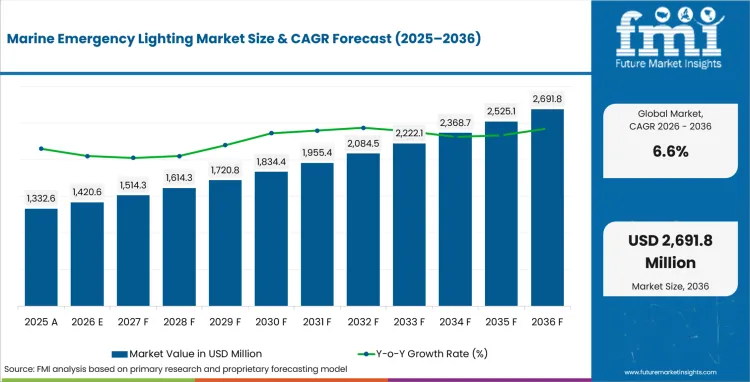
| Metric | Value |
|---|---|
| 2026 Market Size | USD 1,420.6 million |
| 2036 Market Size | USD 2,691.8 million |
| Forecast CAGR | 6.6% from 2026 to 2036 |
| Leading Product Type | Emergency Bulkhead Lights |
| Emergency Bulkhead Lights Share in 2026 | 38.5% |
| Leading Light Source | LED |
| LED Share in 2026 | 76.0% |
| Fastest-growing Country | China |
| China CAGR | 7.2% by 2036 |
Summary of the Marine Emergency Lighting Market
| Market Signal | Commercial Impact |
|---|---|
| Demand and Growth Drivers | Demand for marine emergency lighting systems is being driven by stringent safety requirements and the need for reliable illumination during power failures across commercial and offshore vessels.
|
| Product and Segment View | Emergency bulkhead lights, LED technology, commercial vessels, and self-contained battery systems are expected to dominate their respective segments.
|
| Geography and Growth Outlook | China, India, and the United States are expected to remain key growth markets, supported by shipbuilding activity, maritime infrastructure development, and inspection-led replacement demand.
|
| Competitive Landscape | Competition is increasingly focused on regulatory approvals, offshore expertise, and the availability of retrofit-ready emergency lighting solutions.
|
| Analyst Perspective | Marine emergency lighting is increasingly evolving from a fixture replacement market into a broader safety assurance system market.
- Nikhil Kaitwade, Principal Analyst at Future Market Insights |
Compliance pressure has become a practical buying trigger because emergency lighting failures can affect port-state review and repair release. In its May 2026 annual report, the USA Coast Guard recorded 8999 SOLAS safety exams and 77 detentions during 2025. UNCTAD reported in September 2025 that maritime trade grew 2.2% in 2024 before a slower 2025 outlook.
Glamox added project evidence in April 2026 by confirming 8000 marine lights for four Offshore Energy Support Vessels. These point to a market where approved LED fixtures and battery test records carry commercial value which also puts shipboard purchases inside a broader emergency lighting replacement cycle.
Which factors support expansion in the marine emergency lighting market?
Certified lighting demand is expected to improve as shipowners manage approval risk and maintenance schedules together.
- Aging vessels are expected to raise replacement demand during dry dock due to crews testing batteries and sealed housings during scheduled repair.
- LED systems are likely to improve buying economics by reducing lamp replacement work and crew maintenance time.
- Offshore platforms create explosion-proof lighting needs in hazardous zones that require certified illumination after power loss.
- Open-deck fixtures draw durability expectations from outdoor LED lighting applications due to marine salt exposure that raises the testing burden.
Why is the marine emergency lighting market growing?
Shipowners replace legacy fittings when failed emergency lighting can create inspection findings and sailing delays.
Inspection exposure turns emergency lighting from a fixture item into scheduled repair work. The USA Coast Guard reported in August 2025 that the USA flag fleet had 17765 vessels subject to inspection in 2024. It also recorded 21187 inspections during the same year. These visits create a clear reason to replace weak batteries and failed luminaires during yard windows. Marine electronics procurement can be scheduled during the same yard window.
How is the marine emergency lighting market segmented?
The marine emergency lighting industry is segmented by product type, light source, end use, power supply, sales channel
- Emergency bulkhead lights are projected to capture a 38.5% share in 2026, reflecting their essential role in corridors and machinery spaces where safety compliance is critical.
- LED technology is anticipated to account for a 76.0% share in 2026, as buyers prioritize lower maintenance requirements and improved performance during emergency operation.
- Commercial vessels are forecast to hold a 52.0% share in 2026, supported by the scale of the merchant fleet and the frequency of recurring surveys and replacement cycles.
- Self‑contained battery systems are estimated to represent a 49.0% share in 2026, driven by simpler installation and compatibility with existing vessel layouts.
- Retrofit and MRO activities are projected to account for a 46.0% share in 2026, as inspection findings often translate into targeted fixture replacement rather than full system overhauls.
Which product type category holds a notable share in the marine emergency lighting market?
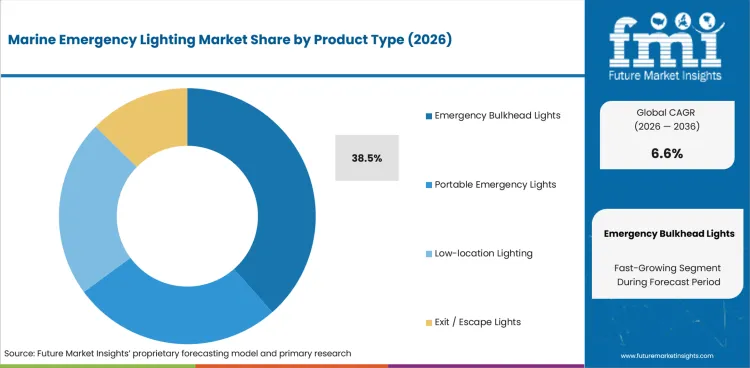
- Emergency Bulkhead Lights are projected to account for 38.5% share in 2026 due to protected ship routes needing fixed lighting after main power loss.
- Portable emergency lights remain useful for crew response due to flexible illumination needs during maintenance work and abandonment drills.
How does the light source segment perform in the marine emergency lighting market?
- LED is expected to represent 76.0% share in 2026 owing to lower lamp replacement work in difficult shipboard spaces.
- Photoluminescent products gain use in low-location guidance supported by passive visibility during smoke or power loss events.
What shapes demand across end-use categories in the marine emergency lighting market?
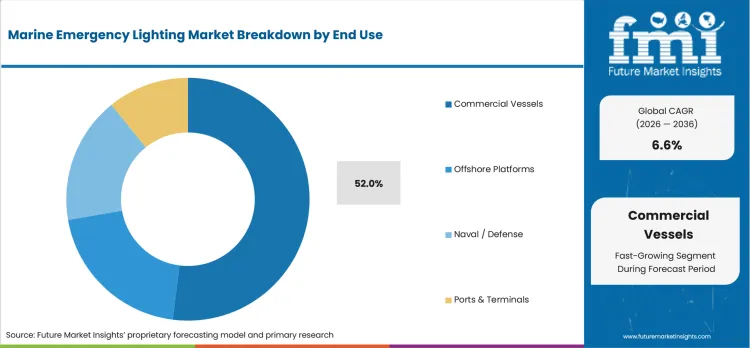
- Commercial Vessels are anticipated to hold 52.0% share in 2026 attributable to merchant fleet scale and recurring inspection exposure.
- Naval and defense vessels require deeper documentation before acceptance owing to procurement teams reviewing durability and traceability before price comparisons begin.
Which power supply option shows a prominent position in the marine emergency lighting market?
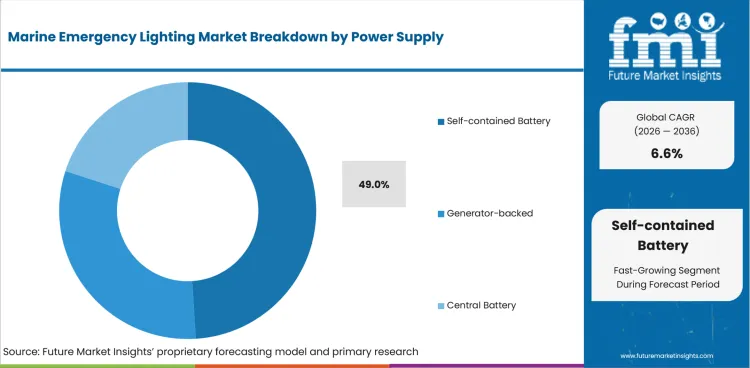
- Self-contained Battery systems are projected to represent 49.0% share in 2026 due to simpler installation for retrofit work on existing vessels.
- Central Battery systems remain important for larger ships owing to unified monitoring and planned duration testing requirements.
How are buyers selecting across sales channels in the marine emergency lighting market?
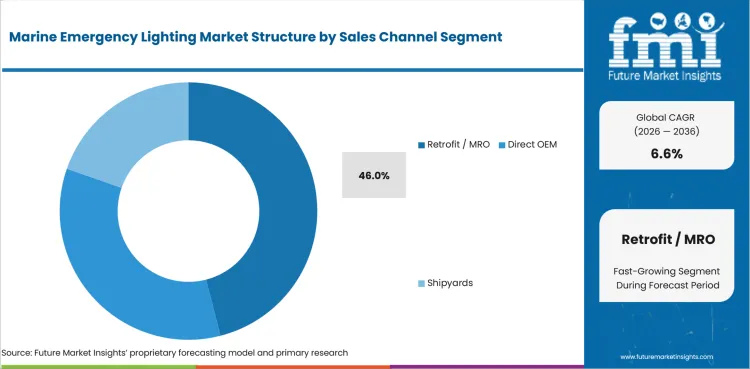
- Retrofit / MRO is expected to account for 46.0% share in 2026 driven by dry dock cycles and survey findings.
- Direct OEM supply gains relevance due to shipyards finalizing approved lighting packages before wiring drawings are locked.
What are the drivers and restraints in the marine emergency lighting market and where are the opportunities?
Safety approval demand is pulling buyers toward certified fixtures. Marine documentation cost still limits smaller suppliers.
- Driver: demand is supported by SOLAS-aligned compliance for certified fixtures that must operate after main power loss.
- Restraint: supplier entry is constrained by approval cost and class documentation requirements that buyers need for battery evidence.
- Opportunity: offshore energy projects are expected to drive demand for packaged battery-backed lighting and hazardous-area fixtures.
SOLAS Escape Route Assurance
Emergency lighting demand depends on proof that escape routes and emergency power chains work during casualty conditions. The USA Coast Guard reported 8710 PSC exams in its April 2025 Port State Control annual report. The same report listed 82 detentions during 2024. That enforcement base gives approved fixtures and test records a practical role in shipowner purchase decisions.
Offshore Battery Test Burden
Offshore assets require products that can survive vibration and salt exposure. Moisture and hazardous-area checks then raise the approval burden. In September 2025, Glamox said its TenneT HVDC contracts covered 11 offshore converter platforms and more than 38000 marine lights. The development shows why emergency fixtures are often bought as part of wider certified lighting packages. Hazardous-area buyers also compare certified emergency fixtures with intrinsically safe lighting used across energy sites.
Approval Cost Barrier
Approval cost remains a barrier for suppliers that lack clear certificates and test records. Paris MoU reported in July 2025 that the 2024 detention rate reached 4.03%. The rate was higher than 3.81% in 2023. That inspection risk makes documentation a purchasing filter. Smaller suppliers can lose tenders if battery duration and hazardous-area proof are incomplete.
Which countries are growing fastest in the marine emergency lighting market?
China 7.2% CAGR, India 7.0% CAGR, United States 6.9% CAGR, South Korea 6.8% CAGR, United Kingdom 6.7% CAGR, Germany 6.5% CAGR, France 6.4% CAGR, Japan 6.2% CAGR through 2036.
| Country | CAGR |
|---|---|
| China | 7.2% |
| India | 7.0% |
| United States | 6.9% |
| South Korea | 6.8% |
| United Kingdom | 6.7% |
| Germany | 6.5% |
| France | 6.4% |
| Japan | 6.2% |
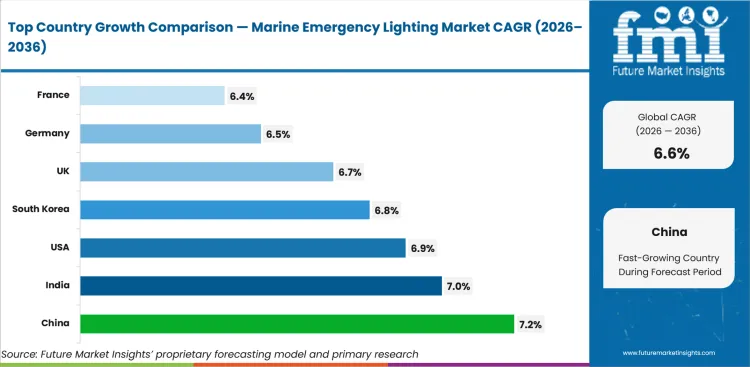
Source: Future Market Insights, 2026.
How do country-level CAGRs compare in the marine emergency lighting market
- China is expected to register a 7.2% CAGR by 2036, as export‑oriented vessel specifications and large shipyard capacity continue to sustain order activity.
- India is projected to grow at a 7.0% CAGR by 2036, supported by rising port cargo volumes and domestic maritime policies that broaden the demand base.
- The United States is forecast to record a 6.9% CAGR by 2036, with inspection‑driven retrofit cycles and naval procurement creating parallel demand channels.
- South Korea is anticipated to reach a 6.8% CAGR by 2036, driven by shipyard qualification requirements and offshore fabrication activity that improve supplier access.
- The United Kingdom is expected to post a 6.7% CAGR by 2036, as North Sea offshore operations and defense‑related lighting capabilities underpin upgrade demand.
- Germany is projected to expand at a 6.5% CAGR by 2036, with port service activity and offshore platform integration influencing purchasing decisions.
- France is forecast to grow at a 6.4% CAGR by 2036, supported by ferry operations and fleet renewal planning that encourage replacement activity.
- Japan is expected to advance at a 6.2% CAGR by 2036, as quality‑focused shipyard procurement and ferry safety requirements guide market demand.
What supports marine emergency lighting growth in China?
A 7.2% CAGR through 2036 reflects shipyard scale and export vessel specifications.
Country Market Snapshot Table
| Parameter | Value |
|---|---|
| Market Size in 2025 (Value) | USD 279.9 million |
| Market Size in 2026 (Value) | USD 300.0 million |
| Market Forecast in 2036 (Value) | USD 601.3 million |
| CAGR (2026 to 2036) | 7.2% |
| Years Considered | 2021 to 2036 |
| Base Year | 2025 |
| Forecast Period | 2026 to 2036 |
| Units Considered | Value (USD million) |
| Leading Sub-Region | Yangtze River Delta and Pearl River Delta shipbuilding corridors |
China Marine Emergency Lighting Market Outlook
China demand starts at the shipyard quotation stage as Export projects require emergency lighting documentation before owners and class teams accept the vessel package.
Standard builds remain price sensitive. High-spec export and offshore jobs give approved suppliers more room to compete on battery duration and corrosion resistance.
Key Growth Drivers
- China’s shipyard scale makes newbuild emergency lighting a specification issue before sea trials. China’s State Council placed port cargo throughput at 5.75 billion tonnes in the January-April 2025 period. This keeps approved bulkhead and exit lights inside early package discussions.
- Export vessel work gives certified lighting suppliers a second demand route. UNCTAD put maritime trade growth at 2.2% in its September 2025 review of 2024 activity. That trade base keeps owner specifications focused on accepted test records and class documentation.
- Recurring retrofit work for bulkhead lights and exit lights is supported by port-linked service networks.
- Offshore buyers gain shorter lead times due to local hazardous-area suppliers that source certified battery-backed fixtures.
Key Restraints
- Standard emergency fixtures remain exposed to price pressure in cost-sensitive port service channels. China’s State Council also put cargo throughput growth at 3.7% in January-April 2025. Higher traffic can raise service demand without giving suppliers wider pricing room.
- Product rejection risk is attributable to international owners requiring class documentation and accepted test records.
- Shipyard procurement windows can close early owing to fixed electrical drawings and package lists.
What makes China unique
China is unique because large export shipyards can shape lighting specifications before vessels enter service.
Key Companies
- Warom Technology
- Ocean's King Lighting Science & Technology
- Glamox China
- WISKA China
- R. STAHL China
Sales & Marketing Channels
- Shipyard package supply
- Export vessel OEM routes
- Marine electrical wholesalers
- Offshore platform EPCs
- Distributor-led retrofit supply
Country Segment Breakdown Table
| Segment | Sub-Segments |
|---|---|
| By Product Type | Exit / Escape Lights · Emergency Bulkhead Lights · Portable Emergency Lights · Low-location Lighting |
| By Light Source | LED · Fluorescent / Legacy · Photoluminescent · Hybrid |
| By End Use | Commercial Vessels · Offshore Platforms · Naval / Defense · Ports & Terminals |
| By Power Supply | Central Battery · Self-contained Battery · Generator-backed |
| By Sales Channel | Direct OEM · Shipyards · Retrofit / MRO |
| Key Sub-Regions Covered, Manufacturing and service corridors | Yangtze River Delta and Pearl River Delta shipbuilding corridors |
Frequently Asked Questions
How fast is China marine emergency lighting market growing?
China demand is forecast to advance at 7.2% CAGR from 2026 to 2036.
Who competes in China marine emergency lighting market?
Warom Technology and Ocean's King Lighting compete alongside Glamox China. WISKA China supports export and retrofit routes.
What drives adoption in China marine emergency lighting market?
Shipyard package supply and export vessel documentation are moving buyers toward certified LED emergency fixtures.
How is the marine emergency lighting forecast developing in India?
A 7.0% CAGR through 2036 reflects port cargo scale and domestic shipbuilding policy support.
Country Market Snapshot Table
| Parameter | Value |
|---|---|
| Market Size in 2025 (Value) | USD 84.1 million |
| Market Size in 2026 (Value) | USD 90.0 million |
| Market Forecast in 2036 (Value) | USD 177.0 million |
| CAGR (2026 to 2036) | 7.0% |
| Years Considered | 2021 to 2036 |
| Base Year | 2025 |
| Forecast Period | 2026 to 2036 |
| Units Considered | Value (USD million) |
| Leading Sub-Region | Gujarat, Maharashtra, Kerala, Tamil Nadu, and Andhra Pradesh port corridors |
India Marine Emergency Lighting Market Outlook
India demand begins with port expansion and then moves into ship repair. Naval and offshore assets create a higher-spec route for approved LED products.
Local service coverage is important because repair windows are short. Suppliers with certified fixtures and Indian replacement stock are better placed for retrofit orders.
Key Growth Drivers
- India’s port scale gives workboats and support vessels a clear replacement base for certified emergency lighting. The Ministry of Ports, Shipping and Waterways put national port throughput at about 1602.56 million metric tonnes during 2024-25. That volume keeps port-linked retrofit and service demand active.
- Major port modernization gives buyers more reason to review safety systems during planned upgrades. In April 2026, PIB said major ports handled 915.17 million tonnes in FY 2025-26. This supports demand visibility for approved bulkhead lights and exit lighting.
- Domestic electrical suppliers gain a longer project pipeline due to shipbuilding and repair policy support.
- Documented marine lighting package demand is supported by naval and coast guard procurement routes.
Key Restraints
- Safety equipment practices remain uneven and can keep replacement work inspection led. DG Shipping counted 637 initial FSI inspections of Indian-flagged vessels in 2024. That inspection base makes documented emergency lighting more relevant during compliance reviews.
- Smaller vessel owners may choose low-cost products due to uneven enforcement of full marine documentation.
- Imported approved fixtures can face longer lead times during urgent refits owing to price pressure that makes replacements harder to schedule.
What makes India unique
India is unique because domestic shipbuilding expansion creates opportunity while cost pressure keeps supplier selection practical.
Key Companies
- Marine Electricals India
- McGeoch Marine Electricals
- WISKA India
- Eaton India
- R. STAHL India
Sales & Marketing Channels
- Shipyard procurement
- Port authority tenders
- Naval and coast guard suppliers
- Marine electrical dealers
- MRO contractor networks
Country Segment Breakdown Table
| Segment | Sub-Segments |
|---|---|
| By Product Type | Exit / Escape Lights · Emergency Bulkhead Lights · Portable Emergency Lights · Low-location Lighting |
| By Light Source | LED · Fluorescent / Legacy · Photoluminescent · Hybrid |
| By End Use | Commercial Vessels · Offshore Platforms · Naval / Defense · Ports & Terminals |
| By Power Supply | Central Battery · Self-contained Battery · Generator-backed |
| By Sales Channel | Direct OEM · Shipyards · Retrofit / MRO |
| Key Sub-Regions Covered, Manufacturing and service corridors | Gujarat · Maharashtra · Kerala · Tamil Nadu · and Andhra Pradesh port corridors |
Frequently Asked Questions
How fast is India marine emergency lighting market growing?
India demand is projected to grow at 7.0% CAGR from 2026 to 2036.
Who supplies India marine emergency lighting market?
Marine Electricals India and McGeoch Marine Electricals serve local routes. WISKA India and Eaton India add approved international product access.
What supports adoption in India marine emergency lighting market?
Port cargo growth and inspection-led replacement are guiding buyers toward approved LED emergency lights.
How fast is the marine emergency lighting market growing in the United States?
A 6.9% CAGR through 2036 reflects inspection-led replacement and naval procurement needs.
Country Market Snapshot Table
| Parameter | Value |
|---|---|
| Market Size in 2025 (Value) | USD 205.8 million |
| Market Size in 2026 (Value) | USD 220.0 million |
| Market Forecast in 2036 (Value) | USD 428.7 million |
| CAGR (2026 to 2036) | 6.9% |
| Years Considered | 2021 to 2036 |
| Base Year | 2025 |
| Forecast Period | 2026 to 2036 |
| Units Considered | Value (USD million) |
| Leading Sub-Region | Gulf Coast, Pacific Coast, Great Lakes, and Northeast vessel service corridors |
United States Marine Emergency Lighting Market Outlook
United States industry growth begins with inspection exposure and then moves into shipyard repair schedules. Defense procurement adds a route where documentation and durability carry more weight.
Domestic service matters because downtime is costly during yard periods. Phoenix Lighting and Eaton Crouse-Hinds give buyers local access to harsh-environment products.
Key Growth Drivers
- Failed emergency lighting can become immediate replacement work during inspection-led maintenance. The USA Coast Guard identified 17765 vessels subject to inspection in 2024. That fleet base gives certified batteries and fixtures a clear retrofit route.
- Broad port coverage supports distributor and service-channel demand for marine lighting. BTS counted 299 USA ports handling waterborne cargo in its January 2025 annual report. This explains why replacement supply needs reach beyond the largest coastal hubs.
- Offshore service vessels need sealed products due to exposed decks and machinery spaces.
- Domestic marine lighting suppliers gain preference supported by naval and Coast Guard projects that require traceable support routes.
Key Restraints
- Naval and commercial yard schedules face pressure from competing maintenance programs. In May 2026, the Navy shipbuilding plan listed 46 planned ship inactivations within the FYDP. That workload can limit near-term capacity for discretionary lighting upgrades.
- Approved marine lighting can cost more than general industrial alternatives owing to marine testing and documentation requirements.
- Retrofit work can be delayed due to certified parts availability during short yard periods.
What makes United States unique
The United States is unique because inspection-led retrofit demand overlaps with Coast Guard and naval procurement requirements.
Key Companies
- Phoenix Lighting
- Eaton Crouse-Hinds
- Glamox Marine
- Hella Marine
- R. STAHL Inc.
Sales & Marketing Channels
- Marine electrical distributors
- Shipyard retrofit teams
- Coast Guard and naval procurement
- Offshore vessel owner direct sales
- Port and terminal integrators
Country Segment Breakdown Table
| Segment | Sub-Segments |
|---|---|
| By Product Type | Exit / Escape Lights · Emergency Bulkhead Lights · Portable Emergency Lights · Low-location Lighting |
| By Light Source | LED · Fluorescent / Legacy · Photoluminescent · Hybrid |
| By End Use | Commercial Vessels · Offshore Platforms · Naval / Defense · Ports & Terminals |
| By Power Supply | Central Battery · Self-contained Battery · Generator-backed |
| By Sales Channel | Direct OEM · Shipyards · Retrofit / MRO |
| Key Sub-Regions Covered, Manufacturing and service corridors | Gulf Coast · Pacific Coast · Great Lakes · and Northeast vessel service corridors |
Frequently Asked Questions
How fast is United States marine emergency lighting market growing?
United States demand is expected to rise at 6.9% CAGR from 2026 to 2036.
Who leads United States marine emergency lighting market?
Phoenix Lighting and Eaton Crouse-Hinds compete through local service routes. Glamox Marine and Hella Marine add wider marine product coverage.
What is driving adoption in United States marine emergency lighting market?
Inspection pressure and defense procurement are supporting documented LED emergency lighting purchases.
What is shaping marine emergency lighting demand in South Korea?
A 6.8% CAGR through 2036 reflects shipyard qualification and offshore fabrication activity.
Country Market Snapshot Table
| Parameter | Value |
|---|---|
| Market Size in 2025 (Value) | USD 112.4 million |
| Market Size in 2026 (Value) | USD 120.0 million |
| Market Forecast in 2036 (Value) | USD 231.7 million |
| CAGR (2026 to 2036) | 6.8% |
| Years Considered | 2021 to 2036 |
| Base Year | 2025 |
| Forecast Period | 2026 to 2036 |
| Units Considered | Value (USD million) |
| Leading Sub-Region | Ulsan, Geoje, Busan, and Mokpo shipbuilding clusters |
South Korea Marine Emergency Lighting Market Outlook
South Korea demand is concentrated around large shipyards that specify lighting packages for LNG carriers and offshore vessels. Supplier access depends on qualification depth and delivery discipline.
Offshore wind fabrication adds another route for marine-certified lighting. Project contractors need products that can handle harsh environments and documentation-heavy procurement systems.
Key Growth Drivers
- South Korea’s shipyard concentration keeps emergency lighting tied to package approval for new vessels. The Korean Ministry of Oceans and Fisheries confirmed 54 environment-friendly ships in its 2025 distribution plan. This supports demand for certified lighting that can pass owner and class reviews.
- Refit demand gains support from vessel remodeling work inside the same program. Korea confirmed 27 environment-friendly ship remodels in the 2025 plan. That activity gives battery-backed emergency fixtures a practical route into upgrade packages.
- Battery-backed marine lighting packages gain support from offshore wind fabrication for transition pieces and service platforms.
- Export vessel demand is shaped by customers requiring documentation accepted by owners and classification bodies.
Key Restraints
- New supplier entry remains difficult because shipyard qualification requires proof before purchase approval. The Korean plan placed 2025 investment at about KRW 222.3 billion. Larger project budgets can favor suppliers with references and documentation already accepted by yards.
- Lighting supplier margins can compress due to large project bidding in package tenders.
- Shipyard approval cycles can be long owing to limited local references for unfamiliar brands.
What makes South Korea unique
South Korea is unique because major shipyards can decide supplier access across several export vessel classes.
Key Companies
- Glamox Korea
- Eaton Korea
- R. STAHL Korea
- Warom Technology
- Hella Marine
Sales & Marketing Channels
- Major shipyard procurement
- Offshore wind fabricator routes
- Marine electrical agents
- Export vessel package supply
- EPC contractor channels
Country Segment Breakdown Table
| Segment | Sub-Segments |
|---|---|
| By Product Type | Exit / Escape Lights · Emergency Bulkhead Lights · Portable Emergency Lights · Low-location Lighting |
| By Light Source | LED · Fluorescent / Legacy · Photoluminescent · Hybrid |
| By End Use | Commercial Vessels · Offshore Platforms · Naval / Defense · Ports & Terminals |
| By Power Supply | Central Battery · Self-contained Battery · Generator-backed |
| By Sales Channel | Direct OEM · Shipyards · Retrofit / MRO |
| Key Sub-Regions Covered, Manufacturing and service corridors | Ulsan · Geoje · Busan · and Mokpo shipbuilding clusters |
Frequently Asked Questions
How fast is South Korea marine emergency lighting market growing?
South Korea demand is estimated to increase at 6.8% CAGR from 2026 to 2036.
Who competes in South Korea marine emergency lighting market?
Glamox Korea and Eaton Korea compete through shipyard routes. R. STAHL Korea and Warom Technology add hazardous-area coverage.
What supports adoption in South Korea marine emergency lighting market?
Shipyard qualification and offshore fabrication are moving buyers toward certified LED emergency packages.
What is the marine emergency lighting outlook in the United Kingdom?
A 6.7% CAGR through 2036 reflects North Sea offshore activity and defense lighting capability.
Country Market Snapshot Table
| Parameter | Value |
|---|---|
| Market Size in 2025 (Value) | USD 89.0 million |
| Market Size in 2026 (Value) | USD 95.0 million |
| Market Forecast in 2036 (Value) | USD 181.7 million |
| CAGR (2026 to 2036) | 6.7% |
| Years Considered | 2021 to 2036 |
| Base Year | 2025 |
| Forecast Period | 2026 to 2036 |
| Units Considered | Value (USD million) |
| Leading Sub-Region | North Sea, Solent, Clyde, Belfast, and Merseyside marine corridors |
United Kingdom Marine Emergency Lighting Market Outlook
Industry in United Kingdom is expected to be influenced by factors such as rising ferries and offshore assets. Defense craft and workboats add retrofit demand where approved lighting must be fitted quickly.
Local defense lighting depth improved after Glamox acquired MARL International. Buyers in the United Kingdom value approved products that can be installed during planned maintenance windows.
Key Growth Drivers
- UK vessel service demand starts with port activity and ferry-linked maintenance needs. The Department for Transport put all UK port handling at 429.7 million tonnes in 2024. That freight base keeps emergency lighting replacement relevant for repair yards and marine wholesalers.
- Specialist lighting demand also benefits from local shipbuilding and defense capability. The UK Parliament Library cited around 38650 ship and boat building employee jobs in 2023. That workforce base supports retrofit and vessel-service routes for approved lighting suppliers.
- Battery-backed and explosion-proof lighting demand is supported by North Sea offshore work.
- Tested lighting systems gain relevance due to UK naval and defense projects requiring traceable component supply.
Key Restraints
- Maintenance budgets can tighten during weaker cargo activity. The Department for Transport reported that UK port tonnage declined 1% in 2024. That softness can delay full LED conversion for smaller commercial operators.
- Offshore products need deeper certification owing to harsher operating exposure than standard commercial lighting products.
- Smaller operators may delay full LED conversion due to tight repair budgets.
What makes United Kingdom unique
The United Kingdom is unique because North Sea offshore exposure overlaps with domestic defense lighting expertise.
Key Companies
- MARL International
- Glamox Marine
- Eaton UK
- R. STAHL UK
- Hella Marine
Sales & Marketing Channels
- Offshore contractor procurement
- Defense project integrators
- Marine electrical wholesalers
- Ship repair yards
- Classification-led retrofit planning
Country Segment Breakdown Table
| Segment | Sub-Segments |
|---|---|
| By Product Type | Exit / Escape Lights · Emergency Bulkhead Lights · Portable Emergency Lights · Low-location Lighting |
| By Light Source | LED · Fluorescent / Legacy · Photoluminescent · Hybrid |
| By End Use | Commercial Vessels · Offshore Platforms · Naval / Defense · Ports & Terminals |
| By Power Supply | Central Battery · Self-contained Battery · Generator-backed |
| By Sales Channel | Direct OEM · Shipyards · Retrofit / MRO |
| Key Sub-Regions Covered, Manufacturing and service corridors | North Sea · Solent · Clyde · Belfast · and Merseyside marine corridors |
Frequently Asked Questions
How fast is United Kingdom marine emergency lighting market growing?
United Kingdom demand is forecast to grow at 6.7% CAGR from 2026 to 2036.
Who supplies United Kingdom marine emergency lighting market?
MARL International and Glamox Marine serve defense routes. Eaton UK and R. STAHL UK add hazardous-area access.
What shapes United Kingdom marine emergency lighting adoption?
MCA inspection practice and North Sea operating conditions are supporting certified emergency lighting use.
How does Germany compare in the marine emergency lighting market?
A 6.5% CAGR through 2036 reflects port service demand and offshore platform integration.
Country Market Snapshot Table
| Parameter | Value |
|---|---|
| Market Size in 2025 (Value) | USD 93.9 million |
| Market Size in 2026 (Value) | USD 100.0 million |
| Market Forecast in 2036 (Value) | USD 187.7 million |
| CAGR (2026 to 2036) | 6.5% |
| Years Considered | 2021 to 2036 |
| Base Year | 2025 |
| Forecast Period | 2026 to 2036 |
| Units Considered | Value (USD million) |
| Leading Sub-Region | Hamburg, Bremen, Bremerhaven, Wilhelmshaven, and Rostock corridors |
Germany Marine Emergency Lighting Market Outlook
Germany demand is supported by ports and ship service networks. Offshore energy projects add platform lighting demand. Hamburg and North Sea service routes give suppliers regular replacement opportunities.
Procurement is specification heavy before price is discussed. Buyers compare documentation and durability before approving lighting packages. Cable entry quality and conformity also affect selection.
Key Growth Drivers
- Germany’s port service network gives replacement suppliers a steady vessel-access route. Eurostat counted 115012 vessel calls at German main ports in 2024. That activity keeps approved emergency lights and electrical accessories in regular maintenance planning.
- Offshore platform lighting needs are strengthened by Germany’s energy infrastructure work. The Federal Network Agency recorded 0.3 GW of new offshore wind capacity entering operation in 2025. This supports demand for certified fixtures used around harsh marine energy sites.
- Shipyard and distributor access is supported by domestic electrical suppliers.
- Emergency lighting demand for energy and platform applications is supported by hazardous-area expertise.
Key Restraints
- Offshore project timing can shift lighting orders and make supplier forecasting less predictable. The Federal Network Agency said 2025 capacity additions were lower than the previous year. That slower addition pace can push some platform-related purchases into later project windows.
- Entry costs rise for smaller suppliers due to documentation expectations across class and buyer reviews.
- Specialist fixture maker margins can narrow owing to package tendering that limits price flexibility.
What makes Germany unique
Germany is unique because domestic electrical manufacturing depth overlaps with port service and offshore platform demand.
Key Companies
- WISKA
- R. STAHL
- Glamox Germany
- Eaton Germany
- Aqua Signal
Sales & Marketing Channels
- Maritime electrical wholesalers
- Shipyard engineering teams
- Offshore platform EPC contractors
- Port maintenance contractors
- Direct OEM lighting package supply
Country Segment Breakdown Table
| Segment | Sub-Segments |
|---|---|
| By Product Type | Exit / Escape Lights · Emergency Bulkhead Lights · Portable Emergency Lights · Low-location Lighting |
| By Light Source | LED · Fluorescent / Legacy · Photoluminescent · Hybrid |
| By End Use | Commercial Vessels · Offshore Platforms · Naval / Defense · Ports & Terminals |
| By Power Supply | Central Battery · Self-contained Battery · Generator-backed |
| By Sales Channel | Direct OEM · Shipyards · Retrofit / MRO |
| Key Sub-Regions Covered, Manufacturing and service corridors | Hamburg · Bremen · Bremerhaven · Wilhelmshaven · and Rostock corridors |
Frequently Asked Questions
How fast is Germany marine emergency lighting market growing?
Germany demand is projected to advance at 6.5% CAGR from 2026 to 2036.
Who competes in Germany marine emergency lighting market?
WISKA and R. STAHL compete through maritime and hazardous-area portfolios. Glamox Germany and Eaton Germany add wider marine lighting coverage.
What supports adoption in Germany marine emergency lighting market?
Port calls and offshore platform work are sustaining demand for approved marine lighting packages.
What supports marine emergency lighting growth in France?
A 6.4% CAGR through 2036 reflects ferry operations and fleet renewal planning.
Country Market Snapshot Table
| Parameter | Value |
|---|---|
| Market Size in 2025 (Value) | USD 75.2 million |
| Market Size in 2026 (Value) | USD 80.0 million |
| Market Forecast in 2036 (Value) | USD 148.8 million |
| CAGR (2026 to 2036) | 6.4% |
| Years Considered | 2021 to 2036 |
| Base Year | 2025 |
| Forecast Period | 2026 to 2036 |
| Units Considered | Value (USD million) |
| Leading Sub-Region | Saint-Nazaire, Marseille-Fos, Le Havre, Brest, and Toulon corridors |
France Marine Emergency Lighting Market Outlook
France demand is shaped by passenger vessel safety needs and offshore service routes. French-flag fleet activity adds retrofit exposure for exit lights and low-location guidance.
Procurement often runs through ship repair yards and marine electrical contractors. Suppliers need class documentation and service access near port and ferry routes.
Key Growth Drivers
- French-flag fleet activity gives retrofit suppliers a defined service base. Armateurs de France counted 428 ships under the French flag in its 2024/2025 annual report. That fleet base supports replacement demand for exit lights and emergency bulkhead units.
- Passenger vessel operations create a safety reason for clearer escape lighting and low-location guidance. Eurostat identified France among countries with larger average vessel size at main ports in 2023. That vessel profile makes certified route marking more important for ferry and passenger service routes.
- Exit lighting and low-location lighting use is supported by ferry and passenger operations.
- Certified platform lighting demand is expected to be driven by offshore energy planning.
Key Restraints
- Project lighting orders can shift with offshore timing and inspection exposure. Paris MoU reported a 4.03% detention rate for 2024. That rate keeps documentation checks important even when project awards move slowly.
- Local emergency lighting specialist visibility remains narrower due to limited public evidence compared with Germany or the United States.
- Ship repair channels can favor suppliers supported by proven local service records.
What makes France unique
France is unique because passenger vessel safety requirements sit beside a French-flag fleet and ship repair base.
Key Companies
- Glamox France
- Eaton France
- R. STAHL France
- Aqua Signal
- Hella Marine
Sales & Marketing Channels
- Ship repair yards
- Marine electrical contractors
- Offshore EPC routes
- Ferry operator procurement
- Distributor-led retrofit supply
Country Segment Breakdown Table
| Segment | Sub-Segments |
|---|---|
| By Product Type | Exit / Escape Lights · Emergency Bulkhead Lights · Portable Emergency Lights · Low-location Lighting |
| By Light Source | LED · Fluorescent / Legacy · Photoluminescent · Hybrid |
| By End Use | Commercial Vessels · Offshore Platforms · Naval / Defense · Ports & Terminals |
| By Power Supply | Central Battery · Self-contained Battery · Generator-backed |
| By Sales Channel | Direct OEM · Shipyards · Retrofit / MRO |
| Key Sub-Regions Covered, Manufacturing and service corridors | Saint-Nazaire · Marseille-Fos · Le Havre · Brest · and Toulon corridors |
Frequently Asked Questions
How fast is France marine emergency lighting market growing?
France demand is expected to expand at 6.4% CAGR from 2026 to 2036.
Who serves France marine emergency lighting market?
Glamox France and Eaton France compete through regional marine lighting access. R. STAHL France and Aqua Signal add hazardous-area and vessel-service routes.
What drives France marine emergency lighting adoption?
Ferry routes and fleet renewal planning are supporting approved exit and bulkhead lighting demand.
How is Japan performing in the marine emergency lighting market?
A 6.2% CAGR through 2036 reflects quality-focused shipyard procurement and ferry safety needs.
Country Market Snapshot Table
| Parameter | Value |
|---|---|
| Market Size in 2025 (Value) | USD 108.3 million |
| Market Size in 2026 (Value) | USD 115.0 million |
| Market Forecast in 2036 (Value) | USD 209.9 million |
| CAGR (2026 to 2036) | 6.2% |
| Years Considered | 2021 to 2036 |
| Base Year | 2025 |
| Forecast Period | 2026 to 2036 |
| Units Considered | Value (USD million) |
| Leading Sub-Region | Tokyo Bay, Osaka-Kobe, Imabari, Nagasaki, and Setouchi corridors |
Japan Marine Emergency Lighting Market Outlook
Japan demand is supported by shipbuilding and passenger ferry routes. Port inspection exposure adds replacement pressure for emergency circuits. Buyers often prefer products with clear lifecycle evidence.
Retrofit demand is steadier than in China or India. Certification expectations remain high. Suppliers need documented durability and strong distributor support before gaining repeat accounts.
Key Growth Drivers
- Japan’s shipbuilding base gives local suppliers a clear route for specification-led demand. OECD reported in April 2026 that Japanese shipyards delivered 15.4% of newly built vessels by gross tonnage in 2023. That position keeps certified marine lighting inside quality-focused procurement.
- Inspection exposure reinforces documentation discipline across vessels operating in the Asia-Pacific region. Tokyo MoU counted 32054 inspections across the region in 2024. This gives Japanese buyers a practical reason to favor accepted test records and proven marine certification.
- Low-location and exit lighting demand is supported by ferry and passenger routes.
- Proven marine certification gains preference due to quality-focused procurement over low-cost imports.
Key Restraints
- New supplier entry can slow in Japan because buyers favor proven references before changing approved vendors. Tokyo MoU reported 1189 ships detained across its inspection region in 2024. That enforcement context makes conservative procurement easier to understand.
- Older vessel operators may extend legacy fluorescent fittings owing to tight budget periods.
- Unfamiliar brands can face access limits due to established local distributor relationships.
What makes Japan unique
Japan is unique because shipowners and yards place high value on proven certification and lifecycle reliability.
Key Companies
- Koito Manufacturing
- Glamox Marine
- Hella Marine
- Eaton Japan
- R. STAHL Japan
Sales & Marketing Channels
- Shipyard specification teams
- Marine electrical distributors
- Class-guided retrofit routes
- Ferry operator procurement
- Offshore service contractors
Country Segment Breakdown Table
| Segment | Sub-Segments |
|---|---|
| By Product Type | Exit / Escape Lights · Emergency Bulkhead Lights · Portable Emergency Lights · Low-location Lighting |
| By Light Source | LED · Fluorescent / Legacy · Photoluminescent · Hybrid |
| By End Use | Commercial Vessels · Offshore Platforms · Naval / Defense · Ports & Terminals |
| By Power Supply | Central Battery · Self-contained Battery · Generator-backed |
| By Sales Channel | Direct OEM · Shipyards · Retrofit / MRO |
| Key Sub-Regions Covered, Manufacturing and service corridors | Tokyo Bay · Osaka-Kobe · Imabari · Nagasaki · and Setouchi corridors |
Frequently Asked Questions
How fast is Japan marine emergency lighting market growing?
Japan demand is forecast to rise at 6.2% CAGR from 2026 to 2036.
Who competes in Japan marine emergency lighting market?
Koito Manufacturing and Glamox Marine serve local routes. Hella Marine and Eaton Japan add broader product access.
What supports Japan marine emergency lighting adoption?
Shipyard quality expectations and ferry safety needs are sustaining certified LED emergency lighting demand.
Who are the leading companies in the marine emergency lighting market?
Glamox, Eaton, WISKA, R. STAHL, Phoenix Lighting, Hella Marine, Aqua Signal, Tranberg, Warom Technology, Marine Electricals India are profiled in this market.
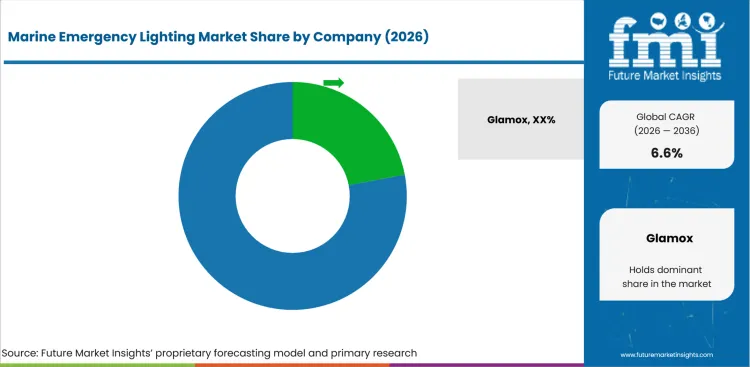
- Competition is based on class documentation and battery duration evidence while corrosion resistance and marine project references help suppliers reduce buyer risk.
- Full marine lighting groups win shipyard access due to bundled indoor and exterior lighting that adds package depth for newbuild buyers.
- Hazardous-area specialists compete in offshore projects owing to certified emergency luminaire requirements and explosion-proof product evidence.
- Regional suppliers gain MRO access supported by local stock and short yard repair window coverage.
Competition outlook in the marine emergency lighting market is predicted to be shaped by documentation depth. Buyers need proof that emergency lights work under marine stress and meet class expectations. Glamox stated in September 2025 that its offshore grid contracts covered 11 TenneT HVDC converter platforms. The project illustrates how large marine lighting orders reward suppliers that can document scale and product reliability. Military lighting procurement also keeps traceability and durability evidence important in naval routes.
Full package suppliers gain an advantage in shipyards that want fewer interfaces between lighting drawings and cable runs. In October 2024, Glamox secured Canadian Coast Guard lighting contracts covering 19 ships. That award shows how vessel programs can bundle interior lighting and emergency readiness into one supplier relationship. Bridge and vessel packages often connect lighting refits to marine radar and communication system procurement.
Specialist suppliers are better placed when the buyer needs hazardous-area competence or local retrofit speed. WISKA supports maritime lighting and electrical installation routes. R. STAHL and Eaton cover harsh and hazardous areas. Offshore support vessel buyers use dynamic positioning systems and lighting packages in the same project environment.
How do top marine emergency lighting companies compare?
Glamox is differentiated by marine package breadth. Eaton and R. STAHL stand out in hazardous-area emergency lighting routes.
| Company | Marine Approval Depth | Emergency Battery Portfolio | Hazard Coverage | Channel Reach | Geographic Footprint |
|---|---|---|---|---|---|
| Glamox | Very Strong | Very Strong | Strong | Very Strong | Global |
| Eaton Crouse-Hinds | Strong | Very Strong | Very Strong | Strong | Global |
| WISKA | Strong | Moderate | Moderate | Strong | Europe and Asia |
| R. STAHL | Strong | Strong | Very Strong | Strong | Global |
| Phoenix Lighting | Moderate | Moderate | Moderate | Strong | North America |
| Hella Marine | Moderate | Low | Low | Strong | Global |
| Aqua Signal | Strong | Moderate | Moderate | Moderate | Global |
| R. STAHL Tranberg | Strong | Moderate | Strong | Moderate | Europe and Offshore |
| Marine Electricals India | Moderate | Moderate | Low | Strong | India |
| Warom Technology | Moderate | Strong | Very Strong | Moderate | China and export markets |
Source: Future Market Insights competitive analysis, 2026.
Who are the key players in the marine emergency lighting market?
The market includes full marine lighting groups and hazardous-area lighting specialists. Regional retrofit suppliers fill urgent replacement routes.
Key global companies leading the Marine Emergency Lighting Market include:
- Glamox
- Eaton Crouse-Hinds
- WISKA
- R. STAHL
- Phoenix Lighting
- Hella Marine
- Aqua Signal
- R. STAHL Tranberg
- Marine Electricals India
- Warom Technology
Key Developments in Marine Emergency Lighting Market
- In September 2025, Glamox secured contracts to provide connected marine lighting systems for 11 TenneT offshore HVDC converter platforms.
- In October 2024, Glamox received contracts to light 19 Canadian Coast Guard ships with more than 24000 LED lights.
- In April 2026, Glamox won a contract to supply 8000 marine lights for four Offshore Energy Support Vessels for Sea1 Offshore.
Key Players in the Marine Emergency Lighting Market
Full Marine Lighting Groups:
- Glamox
- WISKA
- Hella Marine
- Aqua Signal
- R. STAHL Tranberg
Hazardous-area Lighting Specialists:
- Eaton Crouse-Hinds
- R. STAHL
- Warom Technology
Regional Retrofit and Marine Electrical Suppliers:
- Phoenix Lighting
- Marine Electricals India
- McGeoch Marine Electricals
Report Scope
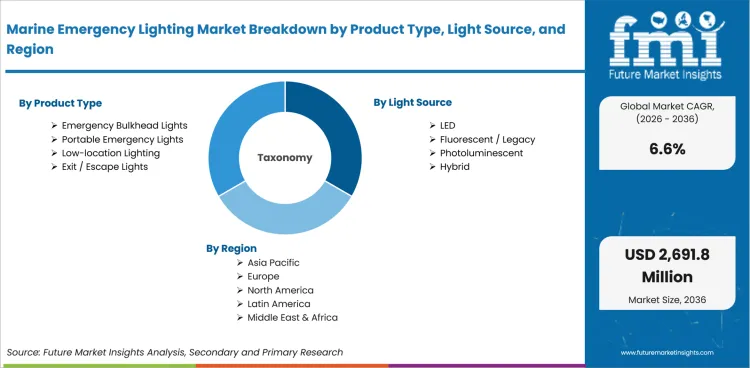
| Parameter | Details |
|---|---|
| Forecast period | 2026 to 2036 |
| Historical period | 2021 to 2025 |
| Quantitative unit | Revenue in USD million |
| By product type | Exit / escape lights, emergency bulkhead lights, portable emergency lights, low-location lighting |
| By light source | LED, fluorescent / legacy, photoluminescent, hybrid |
| By end use | Commercial vessels, offshore platforms, naval / defense, ports and terminals |
| By power supply | Central battery, self-contained battery, generator-backed |
| By sales channel | Direct OEM, shipyards, retrofit / MRO |
| Regions covered | North America, Latin America, Europe, East Asia, South Asia and Pacific, Middle East and Africa |
| Countries covered | United States, United Kingdom, Germany, France, Japan, China, South Korea, India |
| Key companies profiled | Glamox, Eaton Crouse-Hinds, WISKA, R. STAHL, Phoenix Lighting, Hella Marine, Aqua Signal, R. STAHL Tranberg, Marine Electricals India, Warom Technology |
| Approach | Hybrid bottom-up and top-down methodology using vessel population, inspection activity, newbuild exposure, retrofit cycles, and supplier portfolio validation |
What is included in the marine emergency lighting market scope and definition?
| Attribute | Detail |
|---|---|
| Market Definition | Lighting products that operate during power loss, fire response, evacuation, or vessel abandonment on ships and offshore assets |
| Functions Covered | Emergency illumination, escape route visibility, low-location guidance, muster area visibility, battery-backed lighting, and hazardous-area emergency lighting |
| Applications Covered | Exit lights, escape lights, emergency bulkhead lights, portable emergency lights, and low-location lighting used on ships and offshore assets |
| End-Use Industries | Commercial shipping, offshore energy, naval and defense vessels, ports and terminals, ship repair, and marine electrical services |
| Grades Covered | LED, fluorescent / legacy, photoluminescent, hybrid, central battery, self-contained battery, and generator-backed formats |
| Inclusions | Commercially supplied marine emergency lighting products across product type, light source, end use, power supply, sales channel, and selected regions |
| Exclusions | Decorative marine lighting, navigation-only lights, underwater leisure lights, dock architectural lighting, vehicle lighting, aircraft emergency lighting, and non-marine building emergency lighting systems |
How was the marine emergency lighting market researched?
| Method | Description |
|---|---|
| Primary Research | FMI analyst interviews with shipowners, shipyard specification teams, marine electrical distributors, offshore safety buyers, and retrofit contractors across key markets |
| Desk Research | Review of SOLAS rules, port state control reports, maritime statistics, class society guidance, company product documentation, and official supplier developments |
| Market Sizing & Forecasting | Bottom-up and top-down approach using vessel population, lighting replacement intervals, newbuild activity, offshore platform demand, and country-level shipyard exposure |
| Market Calibration | Forecasts reflect inspection activity, port call exposure, shipbuilding signals, recent marine lighting contracts, and supplier portfolio depth |
Marine Emergency Lighting Market Breakdown by Product Type, Light Source, End Use, Power Supply, Sales Channel, and Region
Marine Emergency Lighting Market Segmented by Product Type
- Exit / Escape Lights
- Emergency Bulkhead Lights
- Portable Emergency Lights
- Low-location Lighting
Marine Emergency Lighting Market Segmented by Light Source
- LED
- Fluorescent / Legacy
- Photoluminescent
- Hybrid
Marine Emergency Lighting Market Segmented by End Use
- Commercial Vessels
- Offshore Platforms
- Naval / Defense
- Ports & Terminals
Marine Emergency Lighting Market Segmented by Power Supply
- Central Battery
- Self-contained Battery
- Generator-backed
Marine Emergency Lighting Market Segmented by Sales Channel
- Direct OEM
- Shipyards
- Retrofit / MRO
Marine Emergency Lighting Market by Region
- North America
- United States
- Canada
- Europe
- Germany
- United Kingdom
- France
- Italy
- Spain
- Asia Pacific
- China
- Japan
- South Korea
- Taiwan
- Singapore
- Latin America
- Brazil
- Mexico
- Argentina
- Middle East & Africa
- GCC Countries
- South Africa
- Israel
Bibliography
- International Maritime Organization. (2026). International Convention for the Safety of Life at Sea. International Maritime Organization.
- Maritime and Coastguard Agency. (2024, January). MIN 704(M): Amendments to SOLAS Chapter II-1 with an entry into force date of 1 January 2024. UK Government.
- Maritime and Coastguard Agency. (2025, December). Port State Control expanded inspections. UK Government.
- United States Coast Guard. (2025, August). 2024 Flag State Control Annual Report. USA Coast Guard.
- United States Coast Guard. (2025, April). 2024 Port State Control Annual Report. USA Coast Guard.
- Bureau of Transportation Statistics. (2025, January). Port Performance Freight Statistics Program: 2025 Annual Report. USA Department of Transportation.
- United Nations Trade and Development. (2025, September). Review of Maritime Transport 2025: Staying the course in turbulent waters. UNCTAD.
- Paris Memorandum of Understanding. (2025, June). 2024 Annual Report. Paris MoU.
- Tokyo Memorandum of Understanding. (2025, May). Annual Report on Port State Control in the Asia-Pacific Region 2024. Tokyo MoU.
- Eurostat. (2026, January). Maritime vessels statistics. European Commission.
- Eurostat. (2025, September). Maritime passenger statistics. European Commission.
- Department for Transport. (2025, December). Port freight annual statistics 2024. UK Government.
- House of Commons Library. (2025, March). Role of shipyards in economic growth. UK Parliament.
- Ministry of Ports, Shipping and Waterways. (2026). Annual Report 2025-26. Government of India.
- Press Information Bureau. (2026, April). Major ports record 915 million tonnes cargo in FY 2025-26. Government of India.
- Directorate General of Shipping. (2026, April). Annual Report on Port State Control and Flag State Implementation 2024. Government of India.
- Korean Ministry of Oceans and Fisheries. (2025, February). Distributing environment-friendly ships to capture greenhouse gases properly. Government of Korea.
- OECD. (2026, April). Peer Review of the Korean Shipbuilding Industry 2026. Organisation for Economic Co-operation and Development.
- OECD. (2026, April). Peer Review of the Japanese Shipbuilding Industry 2026. Organisation for Economic Co-operation and Development.
- China State Council. (2025, June). Cargo throughput at China's ports logs solid growth in January-April. Government of China.
- Armateurs de France. (2025, May). 2024/2025 Annual Report. Armateurs de France.
- Bundesnetzagentur. (2026, January). Growth in renewable energy in 2025. Federal Network Agency.
- Glamox. (2025, September). Glamox wins contracts to provide smart lighting for 11 offshore grid connection HVDC converter platforms for TenneT. Glamox.
- Glamox. (2024, October). Glamox lands contracts to light up to 19 Canadian Coast Guard ships. Glamox.
- Glamox. (2026, April). Glamox wins contract to light four Offshore Energy Support Vessels for Sea1 Offshore. Glamox.
- WISKA. (2026). Maritime lighting. WISKA Hoppmann GmbH.
- Eaton. (2025). Crouse-Hinds series global LED lighting portfolio. Eaton.
- R. STAHL. (2026). Emergency lighting for hazardous areas. R. STAHL.
- Phoenix Lighting. (2026, May). Marine grade lighting capabilities statement. Phoenix Products LLC.
- Marine Electricals India. (2026). Marine LED lights. Marine Electricals India Limited.
- Koito Manufacturing. (2026). Ship lights. Koito Manufacturing Co., Ltd.
- Warom Technology. (2026). Explosion proof marine products. Warom Technology Incorporated Company.
- United States Coast Guard. (2026, May). 2025 Port State Control Annual Report. USA Coast Guard.
The bibliography is provided for reader reference. It uses official regulatory sources and non-commercial institutional sources.
This Report Answers
- What is the current and forecast value of the marine emergency lighting market from 2026 to 2036?
- Which emergency lighting product type is projected to lead marine safety demand in 2026?
- Why is LED expected to hold a notable share in the marine emergency lighting light source segment?
- Which end-use category is expected to create the main demand base for marine emergency lighting?
- How do retrofit and MRO channels shape replacement demand for emergency lighting systems?
- Which countries are expected to record stronger demand for marine emergency lighting through 2036?
- How do SOLAS rules and vessel inspections influence buying decisions for emergency lighting?
- Which companies are active in marine emergency lighting and harsh-environment lighting supply?
- What is included and excluded in the marine emergency lighting market definition?
- How does FMI size and forecast marine emergency lighting demand across countries and segments?
Frequently Asked Questions
How large is the Marine Emergency Lighting Market expected to be in the near term?
The market is expanding as vessel operators prioritize certified emergency lighting to meet inspection and sailing approval requirements.
What is the long term outlook for the Marine Emergency Lighting Market?
The outlook remains steady as emergency lighting shifts from simple fixture replacement toward documented safety assurance over the vessel life cycle.
How fast is the Marine Emergency Lighting Market expected to grow?
Growth is driven by recurring inspections, retrofit cycles, and continued investment in offshore and commercial fleets.
What is the main driver of marine emergency lighting demand?
Demand is driven by SOLAS compliance and port state inspection exposure that makes emergency lighting readiness a sailing critical requirement.
Which product type dominates the market?
Emergency bulkhead lights dominate because fixed, protected illumination is required along corridors, machinery spaces, and escape routes.
Which light source is most widely preferred?
LED is preferred due to longer service life and easier compliance with emergency duration requirements.
Which end use segment generates the highest demand?
Commercial vessels lead demand as the global merchant fleet faces recurring survey and retrofit exposure.
Which power supply configuration is most common?
Self contained battery systems dominate because they simplify retrofit installation without major rewiring.
Which sales channel is most important in this market?
Retrofit and MRO channels lead because inspection findings often trigger targeted lighting replacement during dry dock windows.
Which regions show strong marine emergency lighting demand?
East Asia, South Asia, Europe, and North America show strong demand due to shipbuilding activity and inspection enforcement.
What supports China’s leading growth momentum?
Large export shipyards and early specification of approved lighting packages drive strong demand.
Why is India an important growth market?
Port expansion, ship repair activity, and inspection led replacement support sustained lighting demand.
What drives demand in the United States?
Inspection pressure overlaps with naval and offshore procurement and upgrade cycles.
What restrains faster growth in the marine emergency lighting market?
High approval costs and documentation requirements limit entry for smaller or unproven suppliers.
Preview the report firsthand - request a free sample
Get SampleGet the brochure for pricing and purchase details.
Get PDFTable of Content
- Key Takeaways
- Market Size and CAGR
- Top Growth Driver
- Fastest Growing Segment
- Leading Region
- Key Companies
- Emerging Opportunities
- Executive Summary
- Global Market Outlook
- Demand-side Trends
- Supply-side Trends
- Technology Roadmap Analysis
- Analysis and Recommendations
- Analyst Perspective (What is happening? Why now? What should investors know?)
- Key Questions Answered
- How large is the market?
- What is the CAGR?
- What are key trends?
- Which region dominates?
- Who are the leaders?
- Market Overview
- Market Coverage / Taxonomy
- Market Definition / Scope / Limitations
- Research Methodology
- Chapter Orientation
- Analytical Lens and Working Hypotheses
- Market Structure, Signals, and Trend Drivers
- Benchmarking and Cross-market Comparability
- Market Sizing, Forecasting, and Opportunity Mapping
- Research Design and Evidence Framework
- Desk Research Programme (Secondary Evidence)
- Expert Input and Fieldwork (Primary Evidence)
- Tooling, Models, and Reference Databases
- Data Engineering and Model Build
- Quality Assurance and Audit Trail
- Market Background
- Market Dynamics (Drivers, Restraints, Opportunity, Trends)
- Scenario Forecast (Optimistic, Likely, Conservative)
- Impact Analysis
- AI Impact
- Sustainability Impact
- Regulatory Impact
- Technology Impact
- Consumer / Buyer Analysis
- Purchase Drivers
- Adoption Barriers
- Buyer Journey
- Opportunity Map Analysis
- Product Life Cycle Analysis
- Supply Chain Analysis
- Investment Feasibility Matrix
- Value Chain Analysis
- PESTLE and Porter's Analysis
- Regulatory Landscape
- Regional Parent Market Outlook
- Production and Consumption Statistics
- Import and Export Statistics
- Global Market Analysis and Forecast, 2021 to 2036
- Historical Market Size Value (USD Million) & Volume (Unit) Analysis, 2021 to 2025
- Current and Future Market Size Value (USD Million) & Volume (Unit) Projections, 2026 to 2036
- Y-o-Y Growth Trend Analysis
- Absolute $ Opportunity Analysis
- Global Market Pricing Analysis, 2021 to 2036
- Global Market Analysis and Forecast, By Product Type, 2021 to 2036
- Introduction / Key Findings
- Historical Market Size Value (USD Million) & Volume (Unit) Analysis By Product Type, 2021 to 2025
- Current and Future Market Size Value (USD Million) & Volume (Unit) Analysis and Forecast By Product Type, 2026 to 2036
- Emergency Bulkhead Lights
- Portable Emergency Lights
- Low-location Lighting
- Exit / Escape Lights
- Emergency Bulkhead Lights
- Y-o-Y Growth Trend Analysis By Product Type, 2021 to 2025
- Absolute $ Opportunity Analysis By Product Type, 2026 to 2036
- Global Market Analysis and Forecast, By Light Source, 2021 to 2036
- Introduction / Key Findings
- Historical Market Size Value (USD Million) & Volume (Unit) Analysis By Light Source, 2021 to 2025
- Current and Future Market Size Value (USD Million) & Volume (Unit) Analysis and Forecast By Light Source, 2026 to 2036
- LED
- Fluorescent / Legacy
- Photoluminescent
- Hybrid
- LED
- Y-o-Y Growth Trend Analysis By Light Source, 2021 to 2025
- Absolute $ Opportunity Analysis By Light Source, 2026 to 2036
- Global Market Analysis and Forecast, By End Use, 2021 to 2036
- Introduction / Key Findings
- Historical Market Size Value (USD Million) & Volume (Unit) Analysis By End Use, 2021 to 2025
- Current and Future Market Size Value (USD Million) & Volume (Unit) Analysis and Forecast By End Use, 2026 to 2036
- Commercial Vessels
- Offshore Platforms
- Naval / Defense
- Ports & Terminals
- Commercial Vessels
- Y-o-Y Growth Trend Analysis By End Use, 2021 to 2025
- Absolute $ Opportunity Analysis By End Use, 2026 to 2036
- Global Market Analysis and Forecast, By Power Supply, 2021 to 2036
- Introduction / Key Findings
- Historical Market Size Value (USD Million) & Volume (Unit) Analysis By Power Supply, 2021 to 2025
- Current and Future Market Size Value (USD Million) & Volume (Unit) Analysis and Forecast By Power Supply, 2026 to 2036
- Self-contained Battery
- Generator-backed
- Central Battery
- Self-contained Battery
- Y-o-Y Growth Trend Analysis By Power Supply, 2021 to 2025
- Absolute $ Opportunity Analysis By Power Supply, 2026 to 2036
- Global Market Analysis and Forecast, By Sales Channel, 2021 to 2036
- Introduction / Key Findings
- Historical Market Size Value (USD Million) & Volume (Unit) Analysis By Sales Channel, 2021 to 2025
- Current and Future Market Size Value (USD Million) & Volume (Unit) Analysis and Forecast By Sales Channel, 2026 to 2036
- Retrofit / MRO
- Direct OEM
- Shipyards
- Retrofit / MRO
- Y-o-Y Growth Trend Analysis By Sales Channel, 2021 to 2025
- Absolute $ Opportunity Analysis By Sales Channel, 2026 to 2036
- Global Market Analysis and Forecast, By Region, 2021 to 2036
- Introduction
- Historical Market Size Value (USD Million) & Volume (Unit) Analysis By Region, 2021 to 2025
- Current Market Size Value (USD Million) & Volume (Unit) Analysis and Forecast By Region, 2026 to 2036
- North America
- Latin America
- Western Europe
- Eastern Europe
- East Asia
- South Asia and Pacific
- Middle East & Africa
- Market Attractiveness Analysis By Region
- North America Market Analysis and Forecast, By Country, 2021 to 2036
- Historical Market Size Value (USD Million) & Volume (Unit) Trend Analysis By Market Taxonomy, 2021 to 2025
- Market Size Value (USD Million) & Volume (Unit) Forecast By Market Taxonomy, 2026 to 2036
- By Country
- USA
- Canada
- Mexico
- By Product Type
- By Light Source
- By End Use
- By Power Supply
- By Sales Channel
- By Country
- Market Attractiveness Analysis
- By Country
- By Product Type
- By Light Source
- By End Use
- By Power Supply
- By Sales Channel
- Key Takeaways
- Latin America Market Analysis and Forecast, By Country
- Historical Market Size Value (USD Million) & Volume (Unit) Trend Analysis By Market Taxonomy, 2021 to 2025
- Market Size Value (USD Million) & Volume (Unit) Forecast By Market Taxonomy, 2026 to 2036
- By Country
- Brazil
- Chile
- Rest of Latin America
- By Product Type
- By Light Source
- By End Use
- By Power Supply
- By Sales Channel
- By Country
- Market Attractiveness Analysis
- By Country
- By Product Type
- By Light Source
- By End Use
- By Power Supply
- By Sales Channel
- Key Takeaways
- Western Europe Market Analysis and Forecast, By Country
- Historical Market Size Value (USD Million) & Volume (Unit) Trend Analysis By Market Taxonomy, 2021 to 2025
- Market Size Value (USD Million) & Volume (Unit) Forecast By Market Taxonomy, 2026 to 2036
- By Country
- Germany
- UK
- Italy
- Spain
- France
- Nordic
- BENELUX
- Rest of Western Europe
- By Product Type
- By Light Source
- By End Use
- By Power Supply
- By Sales Channel
- By Country
- Market Attractiveness Analysis
- By Country
- By Product Type
- By Light Source
- By End Use
- By Power Supply
- By Sales Channel
- Key Takeaways
- Eastern Europe Market Analysis and Forecast, By Country
- Historical Market Size Value (USD Million) & Volume (Unit) Trend Analysis By Market Taxonomy, 2021 to 2025
- Market Size Value (USD Million) & Volume (Unit) Forecast By Market Taxonomy, 2026 to 2036
- By Country
- Russia
- Poland
- Hungary
- Balkan & Baltic
- Rest of Eastern Europe
- By Product Type
- By Light Source
- By End Use
- By Power Supply
- By Sales Channel
- By Country
- Market Attractiveness Analysis
- By Country
- By Product Type
- By Light Source
- By End Use
- By Power Supply
- By Sales Channel
- Key Takeaways
- East Asia Market Analysis and Forecast, By Country
- Historical Market Size Value (USD Million) & Volume (Unit) Trend Analysis By Market Taxonomy, 2021 to 2025
- Market Size Value (USD Million) & Volume (Unit) Forecast By Market Taxonomy, 2026 to 2036
- By Country
- China
- Japan
- South Korea
- By Product Type
- By Light Source
- By End Use
- By Power Supply
- By Sales Channel
- By Country
- Market Attractiveness Analysis
- By Country
- By Product Type
- By Light Source
- By End Use
- By Power Supply
- By Sales Channel
- Key Takeaways
- South Asia and Pacific Market Analysis and Forecast, By Country
- Historical Market Size Value (USD Million) & Volume (Unit) Trend Analysis By Market Taxonomy, 2021 to 2025
- Market Size Value (USD Million) & Volume (Unit) Forecast By Market Taxonomy, 2026 to 2036
- By Country
- India
- ASEAN
- Australia & New Zealand
- Rest of South Asia and Pacific
- By Product Type
- By Light Source
- By End Use
- By Power Supply
- By Sales Channel
- By Country
- Market Attractiveness Analysis
- By Country
- By Product Type
- By Light Source
- By End Use
- By Power Supply
- By Sales Channel
- Key Takeaways
- Middle East & Africa Market Analysis and Forecast, By Country
- Historical Market Size Value (USD Million) & Volume (Unit) Trend Analysis By Market Taxonomy, 2021 to 2025
- Market Size Value (USD Million) & Volume (Unit) Forecast By Market Taxonomy, 2026 to 2036
- By Country
- Kingdom of Saudi Arabia
- Other GCC Countries
- Türkiye
- South Africa
- Other African Union
- Rest of Middle East & Africa
- By Product Type
- By Light Source
- By End Use
- By Power Supply
- By Sales Channel
- By Country
- Market Attractiveness Analysis
- By Country
- By Product Type
- By Light Source
- By End Use
- By Power Supply
- By Sales Channel
- Key Takeaways
- Key Countries Market Analysis
- USA
- Pricing Analysis
- Market Share Analysis, 2025
- By Product Type
- By Light Source
- By End Use
- By Power Supply
- By Sales Channel
- Canada
- Pricing Analysis
- Market Share Analysis, 2025
- By Product Type
- By Light Source
- By End Use
- By Power Supply
- By Sales Channel
- Mexico
- Pricing Analysis
- Market Share Analysis, 2025
- By Product Type
- By Light Source
- By End Use
- By Power Supply
- By Sales Channel
- Brazil
- Pricing Analysis
- Market Share Analysis, 2025
- By Product Type
- By Light Source
- By End Use
- By Power Supply
- By Sales Channel
- Chile
- Pricing Analysis
- Market Share Analysis, 2025
- By Product Type
- By Light Source
- By End Use
- By Power Supply
- By Sales Channel
- Germany
- Pricing Analysis
- Market Share Analysis, 2025
- By Product Type
- By Light Source
- By End Use
- By Power Supply
- By Sales Channel
- UK
- Pricing Analysis
- Market Share Analysis, 2025
- By Product Type
- By Light Source
- By End Use
- By Power Supply
- By Sales Channel
- Italy
- Pricing Analysis
- Market Share Analysis, 2025
- By Product Type
- By Light Source
- By End Use
- By Power Supply
- By Sales Channel
- Spain
- Pricing Analysis
- Market Share Analysis, 2025
- By Product Type
- By Light Source
- By End Use
- By Power Supply
- By Sales Channel
- France
- Pricing Analysis
- Market Share Analysis, 2025
- By Product Type
- By Light Source
- By End Use
- By Power Supply
- By Sales Channel
- India
- Pricing Analysis
- Market Share Analysis, 2025
- By Product Type
- By Light Source
- By End Use
- By Power Supply
- By Sales Channel
- ASEAN
- Pricing Analysis
- Market Share Analysis, 2025
- By Product Type
- By Light Source
- By End Use
- By Power Supply
- By Sales Channel
- Australia & New Zealand
- Pricing Analysis
- Market Share Analysis, 2025
- By Product Type
- By Light Source
- By End Use
- By Power Supply
- By Sales Channel
- China
- Pricing Analysis
- Market Share Analysis, 2025
- By Product Type
- By Light Source
- By End Use
- By Power Supply
- By Sales Channel
- Japan
- Pricing Analysis
- Market Share Analysis, 2025
- By Product Type
- By Light Source
- By End Use
- By Power Supply
- By Sales Channel
- South Korea
- Pricing Analysis
- Market Share Analysis, 2025
- By Product Type
- By Light Source
- By End Use
- By Power Supply
- By Sales Channel
- Russia
- Pricing Analysis
- Market Share Analysis, 2025
- By Product Type
- By Light Source
- By End Use
- By Power Supply
- By Sales Channel
- Poland
- Pricing Analysis
- Market Share Analysis, 2025
- By Product Type
- By Light Source
- By End Use
- By Power Supply
- By Sales Channel
- Hungary
- Pricing Analysis
- Market Share Analysis, 2025
- By Product Type
- By Light Source
- By End Use
- By Power Supply
- By Sales Channel
- Kingdom of Saudi Arabia
- Pricing Analysis
- Market Share Analysis, 2025
- By Product Type
- By Light Source
- By End Use
- By Power Supply
- By Sales Channel
- Türkiye
- Pricing Analysis
- Market Share Analysis, 2025
- By Product Type
- By Light Source
- By End Use
- By Power Supply
- By Sales Channel
- South Africa
- Pricing Analysis
- Market Share Analysis, 2025
- By Product Type
- By Light Source
- By End Use
- By Power Supply
- By Sales Channel
- USA
- Market Structure Analysis
- Competition Dashboard
- Competition Benchmarking
- Market Share Analysis of Top Players
- By Regional
- By Product Type
- By Light Source
- By End Use
- By Power Supply
- By Sales Channel
- Emerging Startups
- Innovation Benchmarking
- Competition Analysis
- Competition Deep Dive
- Glamox
- Overview
- Product Portfolio
- Profitability by Market Segments (Product/Region/Sales Channel)
- Sales Footprint
- Strategy Overview
- Marketing Strategy
- Product Strategy
- Channel Strategy
- Eaton Crouse-Hinds
- WISKA
- R. STAHL
- Phoenix Lighting
- Hella Marine
- Aqua Signal
- R. STAHL Tranberg
- Marine Electricals India
- Warom Technology
- Glamox
- Case Studies
- Success Stories
- Recent Developments
- Competition Deep Dive
- Assumptions & Acronyms Used


