

- Market Size (2026)
- USD 2.5 Bn
- Forecast (2036)
- USD 5.6 Bn
- CAGR (2026 to 2036)
- 8.6%
How big is Marine Battery Modules Market in 2026?
USD 2.5 billion in 2026 and USD 5.6 billion by 2036 at an 8.6% CAGR.
Sales of marine battery modules are projected to expand at 8.6% CAGR from 2026 to 2036, raising valuation from USD 2.5 billion to USD 5.6 billion. Vessel operators commit to modules after propulsion design fixes duty cycle and charging strategy. DNV introduced a Battery ready class notation in July 2026 for vessels prepared to use batteries in the main onboard energy installation, moving battery-space and interface planning into class review before equipment selection.
National programs produce different conversion speeds because fleets enter projects with uneven funding and shipyard commitments. South Korea’s Ministry of Oceans and Fisheries approved 54 environment-friendly newbuilds and 27 vessel remodels for 2025. Repeated yard activity gives domestic manufacturers more battery specifications before project economics decide conversion.
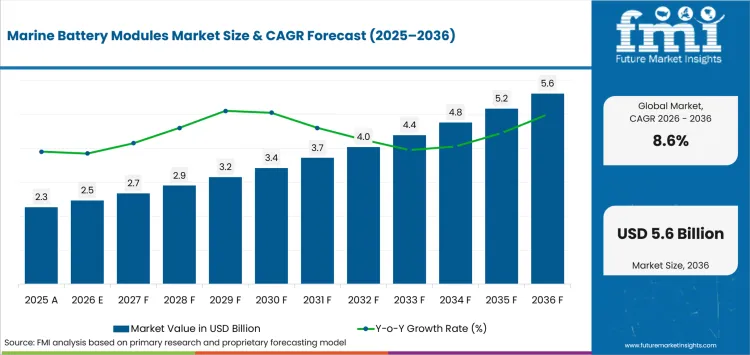
Key Takeaways
- Vessel owners order marine battery modules once propulsion designs fix energy capacity and charging requirements for shipboard systems.
- By module type, prismatic cell modules are estimated to hold 28.0% in 2026 owing to space-efficient rack packaging.
- LFP modules are likely to capture 36.0% share in 2026 attributable to frequent cycling and long service life.
- In 2026, below 48 V modules are expected to represent 20.0% of voltage demand because smaller craft often retain low-voltage architectures.
- Marine qualification can extend purchasing cycles because reviewers assess thermal propagation alongside enclosure integrity and vessel-specific control interfaces.
- Some of the key players in this market include Corvus Energy, Leclanché SA, Echandia, EST-Floattech, XING Mobility, Sunwoda Electronic Co., Ltd., Williams Grand Prix Technologies, and MG Energy Systems.
Analyst Perspective
"Marine battery modules gain commercial value when yards can reuse qualified electrical and thermal interfaces between sister-vessel designs. The buying case improves when repeated engineering falls while class documentation and cooling control stay consistent with field-service coverage."
- Nikhil Kaitwade, Principal Consultant, Future Market Insights
How is the marine battery modules market segmented?
The marine battery modules market is segmented by module type, chemistry, voltage, application, sales channel, and region.
Market taxonomy covers module type, chemistry, voltage, application, sales channel, and region across the full forecast period. Module type spans prismatic, cylindrical, pouch, rack-mounted, and liquid-cooled modules used across different vessel battery architectures. Chemistry categories cover LFP, NMC, LTO, and high-energy marine modules with different vessel duty-cycle requirements. Voltage and application categories separate electrical architecture from vessel use, while sales channels identify the organizations assembling or integrating modules.
What makes prismatic cell modules central to the module type category?
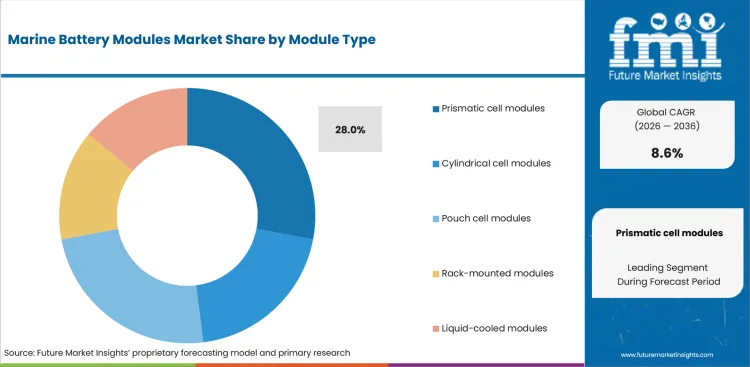
Prismatic battery technology gives module engineers broad faces for thermal contact and predictable restraint inside vessel racks. IMO finalized a January 2026 workplan covering safety rules for lithium-ion batteries and swappable traction battery containers on ships. The work keeps module containment and integration inside the ship-safety specification rather than treating cell geometry as a stand-alone qualification.
- By module type, prismatic cell modules are projected to account for 28.0% in 2026, owing to structured racks that simplify heat removal and space use.
- Marine integrators must translate cell geometry into accessible busbars and cooling paths before sensing and fault-containment features enter vessel approval.
Why do LFP modules hold the stated chemistry share?
Repeated charging makes cycle life and thermal behavior material chemistry decisions for ferries and workboats. DNV reported in March 2026 that IMO work had begun on technology-neutral interim safety guidelines for ships using battery energy storage systems. That rulemaking path keeps LFP selection inside a ship-level safety case within the wider lithium-ion batteries category.
- By chemistry, LFP modules are estimated to hold 36.0% in 2026, driven by repeated vessel duty that rewards long cycle life and stable thermal behavior.
- Shipowners still require detection and cooling controls because LFP chemistry does not replace system-level isolation or electrical protection onboard.
How does below 48 V shape demand within the voltage category?
Low-voltage battery systems let smaller craft and auxiliary loads retain familiar electrical practices while moving from lead-acid to lithium-ion capacity. ISO 23625:2025 sets selection and installation requirements for lithium-ion battery systems above 500 Wh on small craft used for general loads or electric propulsion. The standard gives manufacturers and installers a direct safety route for electric boats without implying that every craft uses the same voltage.
- In 2026, below 48 V modules are expected to represent 20.0% of voltage demand, attributable to smaller craft and retrofits that retain low-voltage architectures.
- Higher current becomes a design constraint at greater power levels and pushes larger propulsion loads toward higher-voltage protection systems.
What supports propulsion packs within the application category?
Route energy demand and available charging windows set a measurable battery requirement for each vessel propulsion project. Corvus Energy reported in February 2026 that ABB selected its Dolphin NxtGen battery systems for two Washington State Ferries hybrid-electric vessels, with an option for a third. The repeat-vessel program ties propulsion-pack selection to a defined ferry design and scheduled fleet deployment.marine propulsion systems
- By application, propulsion packs are forecast to represent 34.0% in 2026, supported by suitable routes that need enough battery capacity to displace propulsion fuel.
- Pack sizing stays vessel-specific because reserve energy and charging access determine the module count required for each propulsion installation.
Why do battery pack OEMs account for the stated sales channel share?
Battery pack OEMs integrate modules with BMS logic and protection hardware before shipyard installation begins. Corvus Energy won a June 2026 contract to deliver Orca energy storage systems for two Scylla Shipping river-cruise vessels, with the system carrying ES-TRIN approval for inland navigation. The project keeps battery management systems inside a qualified pack architecture carried into vessel commissioning.
- Battery pack OEMs are set to lead the sales channel with 42.0% share in 2026 because they convert modules into qualified rack assemblies.
- Module manufacturers reach more vessel programs once pack partners reuse validated electrical and thermal interfaces instead of rebuilding battery architecture for each shipyard.
What are the drivers, restraints and opportunities in the Marine Battery Modules Market?
Funded vessel electrification expands module orders, shipboard safety review slows conversion, and qualification-ready modular platforms give manufacturers a repeatable route into multiple vessel programs.
- Driver: Public ferry and fleet-electrification programs turn emissions targets into funded vessel projects with defined battery capacity and charging requirements.
- Restraint: Marine safety rules delay installation until battery systems control fire propagation and ventilation alongside emergency response and electrical hazards.
- Opportunity: Reusable module platforms reduce repeated engineering when cooling and BMS interfaces transfer cleanly between compatible vessel designs.
Government funding becomes a demand trigger once vessel operators can finance both ship and charging requirements. The USA Federal Transit Administration offered USD 98 million for its Electric or Low-Emitting Ferry Pilot Program in April 2026. Funded projects place battery capacity beside shore power systems that must match vessel charging loads.
Marine approval delays adoption because reviewers assess battery capacity together with fire and electrical protection. Norway’s Maritime Authority proposed dedicated rules in April 2025 for lithium-ion battery systems with at least 20 kWh capacity. Each vessel configuration therefore requires ventilation and thermal-propagation records for marine power battery systems.
Connected control interfaces make reusable module platforms more valuable because cyber qualification travels with BMS architecture. Corvus Energy received DNV cybersecurity type approval for Dolphin NxtGen and its Gen 4 BMS controller in April 2026. The approval gives compatible vessel projects documented control-system evidence before integration review. battery energy storage systems
Which country CAGRs are profiled in the Marine Battery Modules Market?
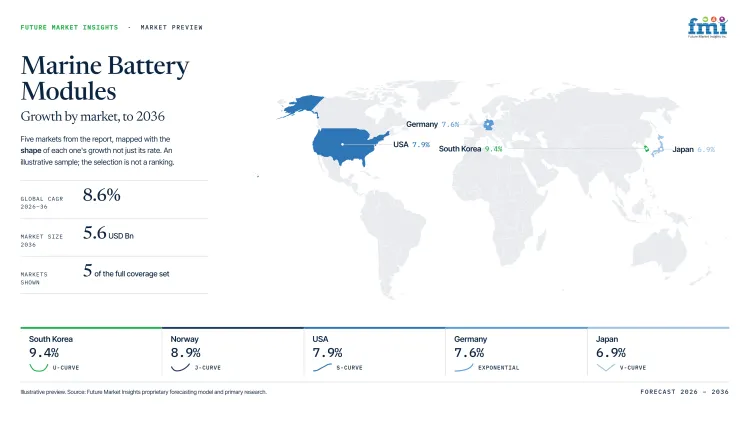
| Country | CAGR |
|---|---|
| South Korea | 9.4% |
| Norway | 8.9% |
| Finland | 8.3% |
| Canada | 8.2% |
| USA | 7.9% |
| Germany | 7.6% |
| Japan | 6.9% |
How do country-level CAGRs compare in the Marine Battery Modules Market?
The forecasts span 2.5 percentage points from South Korea at 9.4% to Japan at 6.9%. South Korea and Norway lead on shipbuilding scale or established electric-vessel use, while Finland and Canada form the middle group. The USA, Germany, and Japan advance more deliberately because project timing and qualification slow conversion.
- South Korea pairs shipyard scale with revised electric-propulsion standards that tighten module safety and redundancy requirements.
- Norway’s mature battery-ferry fleet shifts competitive pressure toward replacement timing and lifecycle service availability.
- Finland’s 8.3% CAGR by 2036 reflects maritime electrification activity without the ferry saturation already visible in Norway.
- Canada’s outlook follows federal ferry replacement programs that specify onboard battery storage before wider fleet replication.
- USA ferry awards define a visible project pipeline, but separate vessel and terminal schedules can delay commissioning.
- Germany’s coastal-vessel modernization program gives modular batteries a retrofit route despite varied space and load constraints.
- Japan links battery adoption to formal reliability evidence as domestic zero-emission ship production capacity expands.
Similar growth rates can yield different module volumes because vessel mix and approval routes determine battery content. The full report covers North America, Latin America, Western Europe, Eastern Europe, East Asia, South Asia and Pacific, and Middle East and Africa.
Country-wise Analysis
- South Korea places battery suppliers close to shipyards that engineer propulsion and auxiliary systems for export vessels. Demand is forecast to rise at 9.4% CAGR through 2036 as policy-backed conversion supports domestic engineering capacity. The Ministry of Oceans and Fisheries expanded environment-friendly ship certification to equipment in February 2025 after 102 ships had received certification grades through 2024. Equipment-level certification improves the qualification route, but high-power installations still require fire-safety evidence and yard-specific integration.
- Norway already operates battery ferries at commercial scale, so purchases increasingly concern replacement cycles and fleet expansion. Industry is projected to grow at 8.9% CAGR during the forecast period, due to established electric vessel programs that sustain procurement. Norway’s 2025-2026 transport budget recorded 78 domestic ferries and smaller passenger ships with high electrification or hydrogen capability during 2024. Remote routes still require service coverage that fits charging access and planned vessel-availability windows.
- Finland gives battery suppliers access to shipyards and marine engineers already working on hybrid and electric propulsion. Demand is anticipated to advance at 8.3% CAGR through 2036 as operators weigh energy use against emissions costs. Traficom reported in October 2025 that Finnish-administered shipping surrendered allowances for about 1.74 million tonnes of CO2 in the first maritime ETS cycle. Cold-weather service still requires low-temperature performance data and charging plans that shipyards can carry into class review.
- Canada concentrates marine electrification in public fleet programs that must prove performance across long routes and cold conditions. Sector in Canada is forecast to post 8.2% CAGR through 2036 as federal replacements place onboard storage inside formal vessel designs. Transport Canada reported in 2025 that two new federal ferries would use diesel-electric hybrid propulsion with onboard battery storage and allow later expansion. Local commissioning support can turn those designs into repeat specifications for other ferries and workboats.
- State and local operators control much of USA fleet conversion, making ferry awards and shipyard schedules central to procurement. Demand is forecast to grow at 7.9% CAGR by 2036 as funded low-emission ferry replacements define vessel and charging work. The Federal Transit Administration listed five Electric or Low-Emitting Ferry projects in its August 2026 selected-project awards. Module manufacturers working beside propulsion engine suppliers need domestic technical coverage from design review through commissioning and field service.
- Germany combines coastal and inland modernization programs with vessel fleets that differ sharply in space and load constraints. Demand is predicted to advance at 7.6% CAGR over the assessment period, as retrofit activity and newbuild efficiency measures support battery use. The federal transport ministry reported in January 2025 that 53 additional NaMKü projects included electric and hybrid propulsion among emissions-reduction measures. Modular voltage and capacity options can reduce redesign work across vessel classes with different operating profiles.
- Japan emphasizes reliability evidence and formal technical acceptance before battery systems move into demanding vessel duty cycles. Japan industry is anticipated to advance at 6.9% CAGR through 2036 owing to rise in domestic investment which expands zero-emission ship production capacity. Japan’s transport ministry opened a June 2025 program supporting production equipment for zero-emission ships using battery electricity among eligible propulsion sources. Suppliers still need documented cycle-life and charging performance that fits conservative marine qualification practices.
Who are the notable companies in the Marine Battery Modules Market?
Corvus Energy, Leclanché SA, Echandia, EST-Floattech, XING Mobility, Sunwoda Electronic Co., Ltd., Williams Grand Prix Technologies, and MG Energy Systems are notable companies serving this market.
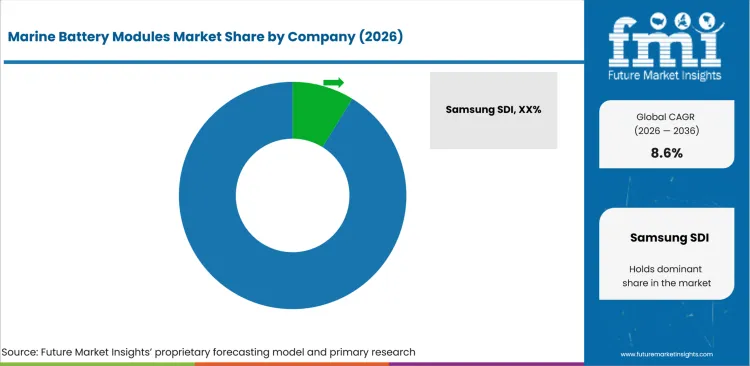
Marine battery specialists compete on class approval, module architecture, integration support, and evidence from operating vessel programs. The profiled companies supply direct marine battery systems or modules with verifiable current market activity.
- Corvus Energy, Leclanché SA, Echandia, and EST-Floattech compete closest to vessel approval with dedicated marine battery systems and documented projects.
- XING Mobility, Sunwoda Electronic Co., Ltd., Williams Grand Prix Technologies, and MG Energy Systems add newer or module-led routes with direct marine applications.
Competitive Benchmarking: Marine Battery Modules Market
| Company | Module Architecture Breadth | Marine Qualification Evidence | System Integration Support | Geographic Reach |
|---|---|---|---|---|
| Corvus Energy | High | High | High | Europe, Asia, North America, Latin America |
| Leclanché SA | Medium | High | High | Europe and international marine projects |
| Echandia | Medium | High | High | Europe, Asia, North America |
| EST-Floattech | High | High | High | Europe and international vessel projects |
| XING Mobility | Low | Low | Medium | Asia and Europe |
| Sunwoda Electronic Co., Ltd. | Medium | Medium | High | Asia; Europe expansion planned |
| Williams Grand Prix Technologies | Low | Low | Medium | Europe |
| MG Energy Systems | Low | High | High | Europe |
Scoring basis: High architecture breadth requires three or more documented marine system routes, Medium requires two, and Low identifies one primary route. High marine qualification requires named class approval, Medium reflects certified deployment or component-level approval, and Low means approval is still limited or in progress. High integration support combines BMS, thermal controls, and vessel-level support, while Medium covers fewer verified integration functions.
Key Developments in the Marine Battery Modules Market
- In August 2026, Corvus Energy secured a 40 MWh battery-system contract for four BC Ferries Summit Class hybrid-electric vessels.
- In July 2026, Echandia was selected to supply Echandia Core battery systems for two fully electric tugs under India’s Green Tug Transition Program.
- In May 2026, Sunwoda Electronic Co., Ltd. unveiled its full marine battery portfolio and disclosed battery systems for methanol-hybrid container ships under construction.
Key Players in the Marine Battery Modules Market
Marine Battery System Specialists
- Corvus Energy
- Leclanché SA
- Echandia
Certified Modular Battery Platforms
- EST-Floattech
- MG Energy Systems
Marine Electrification Entrants and Platforms
- XING Mobility
- Sunwoda Electronic Co., Ltd.
- Williams Grand Prix Technologies
Marine Battery Modules Market - Report Scope
| Coverage field | Report scope |
|---|---|
| Market breakdown | By module type, chemistry, voltage, application, sales channel, and region. |
| Quantitative Units | USD billion. |
| Market Definition | Battery modules engineered for marine propulsion, auxiliary power, hotel loads, containerized storage, and vessel retrofit systems. |
| Regions Covered | North America, Latin America, Western Europe, Eastern Europe, East Asia, South Asia and Pacific, and Middle East and Africa. |
| Countries Covered | South Korea, Norway, Finland, Canada, USA, Germany, Japan, and 20+ countries included in the full report. |
| Key Companies Profiled | Corvus Energy, Leclanché SA, Echandia, EST-Floattech, XING Mobility, Sunwoda Electronic Co., Ltd., Williams Grand Prix Technologies, and MG Energy Systems. |
| Forecast Period | 2026 to 2036. |
| Approach | Primary and secondary research with market triangulation. |
Marine Battery Modules Market - Research Methodology
| Method | Approach |
|---|---|
| Primary Research | FMI analysts gathered input from manufacturers, service providers, technology developers, distributors, end users, procurement teams, and subject-matter experts. Interviews examined purchasing decisions, product or service evaluation, adoption barriers, approval requirements, pricing considerations, and expectations for technical or commercial support. Respondents were also asked what evidence is required before a trial, pilot, or initial order develops into regular purchasing. |
| Desk Research | Desk research covered government statistics, regulatory publications, trade data, industry associations, technical literature, standards, company filings, product information, and official corporate announcements. Sources were reviewed for relevance, publication date, geographic coverage, and consistency with the defined market scope. Claims relating to performance, applications, approvals, capacity, investment, and commercial activity were retained only when supported by credible public evidence. |
| Market Sizing and Forecasting | The market model combined the baseline value with historical performance, segment structure, pricing and volume indicators, adoption levels, company participation, and country-level demand conditions. Forecast assumptions considered economic activity, investment trends, regulatory developments, technology adoption, purchasing cycles, supply availability, and barriers to wider market use. Segment and regional estimates were reconciled before the final market total was calculated. |
| Data Validation | Estimates were checked against multiple independent indicators, including public data, company activity, trade patterns, industry developments, and findings from primary interviews. Validation also tested whether products, services, applications, and company revenues fell within the defined market boundaries. Adjacent categories, unsupported claims, overlapping revenues, and activities without direct market relevance were excluded to reduce double counting and maintain consistency across segments and countries. |
Marine Battery Modules Market by Segments
Marine Battery Modules Market segmented by Module Type:
- Prismatic cell modules
- Cylindrical cell modules
- Pouch cell modules
- Rack-mounted modules
- Liquid-cooled modules
Marine Battery Modules Market segmented by Chemistry:
- LFP modules
- NMC modules
- LTO modules
- High-energy marine modules
Marine Battery Modules Market segmented by Voltage:
- Below 48 V
- 48-100 V
- 100-400 V
- Above 400 V
Marine Battery Modules Market segmented by Application:
- Propulsion packs
- Containerized batteries
- Hybrid auxiliary power
- Hotel load systems
- Retrofit packs
Marine Battery Modules Market segmented by Sales Channel:
- Battery pack OEMs
- Marine system integrators
- Shipyards
- Module distributors
Marine Battery Modules Market by Region:
- North America
- United States
- Canada
- Latin America
- Brazil
- Mexico
- Chile
- Rest of Latin America
- Western Europe
- Germany
- United Kingdom
- Italy
- Spain
- France
- Nordics
- Benelux
- Rest of Western Europe
- Eastern Europe
- Russia
- Poland
- Hungary
- Balkan and Baltic States
- Rest of Eastern Europe
- East Asia
- China
- Japan
- South Korea
- South Asia and Pacific
- India
- ASEAN
- Australia and New Zealand
- Rest of South Asia and Pacific
- Middle East and Africa
- Kingdom of Saudi Arabia
- Other GCC Countries
- Türkiye
- South Africa
- Other African Union Countries
- Rest of Middle East and Africa
Research Sources and Bibliography
- DNV. (2026, July 2). Now available: The July 2026 edition of the DNV class rules and standards for ship and offshore
- Ministry of Oceans and Fisheries, Republic of Korea. (2025, February 11). Distributing Environment-Friendly Ships to Capture Greenhouse Gases Properly
- International Maritime Organization. (2026, January 29). Draft workplan agreed on safety rules for battery, wind and nuclear-powered ships
- DNV. (2026, March 13). IMO Sub-Committee on Ship Systems and Equipment (SSE 12)
- International Organization for Standardization. (2025, March 5). ISO 23625:2025 Small craft - Lithium-ion batteries
- Corvus Energy. (2026, August 17). Corvus Energy expands service support for Brazil’s growing offshore sector with Belga Marine
- Corvus Energy. (2026, February 23). Corvus Energy battery systems selected by ABB for Washington State Ferries
- Federal Transit Administration. (2026, April 6). FY 2026 Notice of Funding Opportunity: Passenger Ferry Program, Electric or Low-Emitting Ferry Pilot Program, and Ferry Service for Rural Communities Program
- Norwegian Maritime Authority. (2025, April 2). Høring - Forslag til forskrift om skip som bruker batterisystem med litium-ion-celler som har en samlet kapasitet på 20 kWh eller mer
- Corvus Energy. (2026, April 30). Corvus Energy Achieves DNV Cybersecurity Type Approval for Dolphin NxtGen, Strengthening Leadership in Secure Maritime Energy Storage
- Ministry of Oceans and Fisheries, Republic of Korea. (2025, February 28). Expanding Eco-Friendly Ship Certification to Include Equipment... Accelerating the Eco-Friendly Transformation of Ships and Greenhouse Gas Reduction
- Samferdselsdepartementet. (2025, September 26). Prop. 1 S (2025-2026)
- Finnish Transport and Communications Agency Traficom. (2025, October 28). Maritime transport’s first year in the EU Emissions Trading System achieved its goals
- Transport Canada. (2025, November 26). 08. Ferry Services QAs
- Federal Transit Administration. (2026, August 21). FTA Ferry Grant Program 2026 Selected Projects
- Federal Ministry for Digital and Transport, Germany. (2025, January 10). BMDV zieht positives Zwischenfazit bei „NaMKü“-Förderprogramm
- Ministry of Land, Infrastructure, Transport and Tourism, Japan. (2025, June 6). 令和7年度「ゼロエミッション船等の建造促進事業」の公募開始
- Corvus Energy. (2026, August 11). Corvus Energy Secures 40MWh Landmark Battery Contract for BC Ferries’ New Major Vessels Program
- Corvus Energy. (2026, June 18). Scylla Shipping sets course for a more sustainable future with battery systems from Corvus Energy
- Corvus Energy. (2026, May 13). Corvus Energy and BYD Energy Storage strengthen partnership with Strategic Cooperation Agreement to Advance Next Generation Maritime Battery Technology
- Corvus Energy. (2026, March 30). Corvus Energy and Beyonder Sign MoU to Explore Next-Generation Maritime Battery Systems
- Leclanché SA. (2026, January 5). Leclanché Restarts M3 Module Production Line Following Incident
- Leclanché SA. (2025, June 16). Leclanché Receives Lloyds Register and Bureau Veritas Type Approvals for Navius MRS-3 Marine Rack System
- Echandia. (2026, July 3). Echandia strengthens India position with battery systems for two new electric tugs
- Echandia. (2026, June 17). Echandia to supply battery system for Incat’s new 78-meter hybrid ferry
- Echandia. (2026, June 2). Echandia launches new battery system - Echandia Core
- Echandia. (2026, March 12). Echandia launches the next generation of Echandia Ultra
- Echandia. (2026, January 13). Echandia to deliver battery system for India’s first fully electric tugboat at Kandla Port
- EST-Floattech. (2026, September 2). Van Tiem Elektro selects EST-Floattech to supply Octopus High Energy battery systems for 15 new river cruise vessels
- EST-Floattech. (2026, June 19). EST-Floattech Receives DNV Type Approval for Octopus LFP Battery System
- XING Mobility. (2026, June 11). XING Mobility Launches Immersion-cooled Battery System for Advanced Electric Vessels
- Sunwoda Electronic Co., Ltd. (2026, May 18). Sunwoda Unveils Full Marine Battery Portfolio: From Proven Cells to Scalable Electrification Solutions
- Sunwoda Electronic Co., Ltd. (2026, April 7). Sunwoda Partners with a Marine Technology Company to Advance Marine Electrification
- Williams Grand Prix Technologies. (2026, July 15). Williams Grand Prix Technologies to bring elite motorsport engineering expertise to marine sector
- MG Energy Systems. (2026, March 17). The MG Story of Rederij Doeksen
- MG Energy Systems. (2025, June 6). The RS 230 Marine Battery Officially Lloyd’s Type Approved
- Leclanché SA. (2025, March 11). Leclanché Awarded DNV Certification for Navius MRS-3 Marine Rack System
- EST-Floattech. (2025, April 16). EST-Floattech expands type approved certifications for the Octopus Series with RINA
This bibliography is provided for reader reference and is not exhaustive. The full report contains the complete reference list and detailed citations.
This Report Answers
- What are the global Marine Battery Modules market values in 2026 and 2036?
- What factors are converting vessel electrification initiatives into commercial orders for marine battery modules?
- Why do prismatic battery modules account for 28.0% of the market share in 2026?
- How do different battery chemistries affect lifecycle performance, safety, charging characteristics, and total cost of ownership?
- Why do propulsion battery packs hold 34.0% of market demand?
- Which leading companies supply marine battery modules, battery packs, and integrated marine energy storage systems?
- Which technical, regulatory, infrastructure, and economic constraints can delay vessel electrification and marine battery adoption?
Frequently Asked Questions
How big is the Marine Battery Modules Market in 2026?
The marine battery modules market is valued at USD 2.5 billion in 2026 and is projected to reach USD 5.6 billion by 2036. Vessel electrification raises module orders once propulsion designs define capacity and charging requirements for qualified shipboard systems.
What is the CAGR of the Marine Battery Modules Market from 2026 to 2036?
The marine battery modules market is projected to grow at a CAGR of 8.6% between 2026 and 2036. Funded electric-vessel programs and reusable qualified platforms support expansion where vessels have workable charging plans.
Which module type leads the Marine Battery Modules Market?
The prismatic cell module segment is expected to hold 28.0% of the marine battery modules market in 2026, supported by compact rack packaging. Vessel designers require documented containment and sensing before modules enter approved shipboard systems and commercial operation.
Which chemistry accounts for the stated share in the Marine Battery Modules Market?
The LFP module segment is projected to account for 36.0% of the marine battery modules market in 2026, driven by frequent cycling. System-level detection and isolation remain necessary because LFP chemistry does not remove shipboard protection requirements.
Which companies are active in the Marine Battery Modules Market?
Key companies operating in the marine battery modules market include Corvus Energy, Leclanché SA, Echandia, EST-Floattech, XING Mobility, Sunwoda Electronic Co., Ltd., Williams Grand Prix Technologies, and MG Energy Systems. Their positions differ by class approval, module architecture, integration support, and verified vessel activity.
Preview the report firsthand - request a free sample
Get SampleGet the brochure for pricing and purchase details.
Get PDFTable of Content
- Key Takeaways
- Market Size and CAGR
- Top Growth Driver
- Fastest Growing Segment
- Leading Region
- Key Companies
- Emerging Opportunities
- Executive Summary
- Global Market Outlook
- Demand-side Trends
- Supply-side Trends
- Technology Roadmap Analysis
- Analysis and Recommendations
- Analyst Perspective (What is happening? Why now? What should investors know?)
- Key Questions Answered
- How large is the market?
- What is the CAGR?
- What are key trends?
- Which region dominates?
- Who are the leaders?
- Market Overview
- Market Coverage / Taxonomy
- Market Definition / Scope / Limitations
- Research Methodology
- Chapter Orientation
- Analytical Lens and Working Hypotheses
- Market Structure, Signals, and Trend Drivers
- Benchmarking and Cross-market Comparability
- Market Sizing, Forecasting, and Opportunity Mapping
- Research Design and Evidence Framework
- Desk Research Programme (Secondary Evidence)
- Expert Input and Fieldwork (Primary Evidence)
- Tooling, Models, and Reference Databases
- Data Engineering and Model Build
- Quality Assurance and Audit Trail
- Market Background
- Market Dynamics (Drivers, Restraints, Opportunity, Trends)
- Scenario Forecast (Optimistic, Likely, Conservative)
- Impact Analysis
- AI Impact
- Sustainability Impact
- Regulatory Impact
- Technology Impact
- Consumer / Buyer Analysis
- Purchase Drivers
- Adoption Barriers
- Buyer Journey
- Opportunity Map Analysis
- Product Life Cycle Analysis
- Supply Chain Analysis
- Investment Feasibility Matrix
- Value Chain Analysis
- PESTLE and Porter's Analysis
- Regulatory Landscape
- Regional Parent Market Outlook
- Production and Consumption Statistics
- Import and Export Statistics
- Global Market Analysis and Forecast, 2021 to 2036
- Historical Market Size Value (USD Billion) Analysis, 2021 to 2025
- Current and Future Market Size Value (USD Billion) Projections, 2026 to 2036
- Y-o-Y Growth Trend Analysis
- Absolute $ Opportunity Analysis
- Global Market Pricing Analysis, 2021 to 2036
- Global Market Analysis and Forecast, By Module Type, 2021 to 2036
- Introduction / Key Findings
- Historical Market Size Value (USD Billion) Analysis By Module Type, 2021 to 2025
- Current and Future Market Size Value (USD Billion) Analysis and Forecast By Module Type, 2026 to 2036
- Prismatic cell modules
- Cylindrical cell modules
- Pouch cell modules
- Rack-mounted modules
- Liquid-cooled modules
- Prismatic cell modules
- Y-o-Y Growth Trend Analysis By Module Type, 2021 to 2025
- Absolute $ Opportunity Analysis By Module Type, 2026 to 2036
- Global Market Analysis and Forecast, By Chemistry, 2021 to 2036
- Introduction / Key Findings
- Historical Market Size Value (USD Billion) Analysis By Chemistry, 2021 to 2025
- Current and Future Market Size Value (USD Billion) Analysis and Forecast By Chemistry, 2026 to 2036
- LFP modules
- NMC modules
- LTO modules
- High-energy marine modules
- LFP modules
- Y-o-Y Growth Trend Analysis By Chemistry, 2021 to 2025
- Absolute $ Opportunity Analysis By Chemistry, 2026 to 2036
- Global Market Analysis and Forecast, By Voltage, 2021 to 2036
- Introduction / Key Findings
- Historical Market Size Value (USD Billion) Analysis By Voltage, 2021 to 2025
- Current and Future Market Size Value (USD Billion) Analysis and Forecast By Voltage, 2026 to 2036
- Below 48 V
- 48-100 V
- 100-400 V
- Above 400 V
- Below 48 V
- Y-o-Y Growth Trend Analysis By Voltage, 2021 to 2025
- Absolute $ Opportunity Analysis By Voltage, 2026 to 2036
- Global Market Analysis and Forecast, By Application, 2021 to 2036
- Introduction / Key Findings
- Historical Market Size Value (USD Billion) Analysis By Application, 2021 to 2025
- Current and Future Market Size Value (USD Billion) Analysis and Forecast By Application, 2026 to 2036
- Propulsion packs
- Containerized batteries
- Hybrid auxiliary power
- Hotel load systems
- Retrofit packs
- Propulsion packs
- Y-o-Y Growth Trend Analysis By Application, 2021 to 2025
- Absolute $ Opportunity Analysis By Application, 2026 to 2036
- Global Market Analysis and Forecast, By Sales Channel, 2021 to 2036
- Introduction / Key Findings
- Historical Market Size Value (USD Billion) Analysis By Sales Channel, 2021 to 2025
- Current and Future Market Size Value (USD Billion) Analysis and Forecast By Sales Channel, 2026 to 2036
- Battery pack OEMs
- Marine system integrators
- Shipyards
- Module distributors
- Battery pack OEMs
- Y-o-Y Growth Trend Analysis By Sales Channel, 2021 to 2025
- Absolute $ Opportunity Analysis By Sales Channel, 2026 to 2036
- Global Market Analysis and Forecast, By Region, 2021 to 2036
- Introduction
- Historical Market Size Value (USD Billion) Analysis By Region, 2021 to 2025
- Current Market Size Value (USD Billion) Analysis and Forecast By Region, 2026 to 2036
- North America
- Latin America
- Western Europe
- Eastern Europe
- East Asia
- South Asia and Pacific
- Middle East & Africa
- Market Attractiveness Analysis By Region
- North America Market Analysis and Forecast, By Country, 2021 to 2036
- Historical Market Size Value (USD Billion) Trend Analysis By Market Taxonomy, 2021 to 2025
- Market Size Value (USD Billion) Forecast By Market Taxonomy, 2026 to 2036
- By Country
- USA
- Canada
- By Module Type
- By Chemistry
- By Voltage
- By Application
- By Sales Channel
- By Country
- Market Attractiveness Analysis
- By Country
- By Module Type
- By Chemistry
- By Voltage
- By Application
- By Sales Channel
- Key Takeaways
- Latin America Market Analysis and Forecast, By Country
- Historical Market Size Value (USD Billion) Trend Analysis By Market Taxonomy, 2021 to 2025
- Market Size Value (USD Billion) Forecast By Market Taxonomy, 2026 to 2036
- By Country
- Brazil
- Mexico
- Chile
- Rest of Latin America
- By Module Type
- By Chemistry
- By Voltage
- By Application
- By Sales Channel
- By Country
- Market Attractiveness Analysis
- By Country
- By Module Type
- By Chemistry
- By Voltage
- By Application
- By Sales Channel
- Key Takeaways
- Western Europe Market Analysis and Forecast, By Country
- Historical Market Size Value (USD Billion) Trend Analysis By Market Taxonomy, 2021 to 2025
- Market Size Value (USD Billion) Forecast By Market Taxonomy, 2026 to 2036
- By Country
- Germany
- UK
- Italy
- Spain
- France
- Nordic
- BENELUX
- Rest of Western Europe
- By Module Type
- By Chemistry
- By Voltage
- By Application
- By Sales Channel
- By Country
- Market Attractiveness Analysis
- By Country
- By Module Type
- By Chemistry
- By Voltage
- By Application
- By Sales Channel
- Key Takeaways
- Eastern Europe Market Analysis and Forecast, By Country
- Historical Market Size Value (USD Billion) Trend Analysis By Market Taxonomy, 2021 to 2025
- Market Size Value (USD Billion) Forecast By Market Taxonomy, 2026 to 2036
- By Country
- Russia
- Poland
- Hungary
- Balkan & Baltic
- Rest of Eastern Europe
- By Module Type
- By Chemistry
- By Voltage
- By Application
- By Sales Channel
- By Country
- Market Attractiveness Analysis
- By Country
- By Module Type
- By Chemistry
- By Voltage
- By Application
- By Sales Channel
- Key Takeaways
- East Asia Market Analysis and Forecast, By Country
- Historical Market Size Value (USD Billion) Trend Analysis By Market Taxonomy, 2021 to 2025
- Market Size Value (USD Billion) Forecast By Market Taxonomy, 2026 to 2036
- By Country
- China
- Japan
- South Korea
- By Module Type
- By Chemistry
- By Voltage
- By Application
- By Sales Channel
- By Country
- Market Attractiveness Analysis
- By Country
- By Module Type
- By Chemistry
- By Voltage
- By Application
- By Sales Channel
- Key Takeaways
- South Asia and Pacific Market Analysis and Forecast, By Country
- Historical Market Size Value (USD Billion) Trend Analysis By Market Taxonomy, 2021 to 2025
- Market Size Value (USD Billion) Forecast By Market Taxonomy, 2026 to 2036
- By Country
- India
- ASEAN
- Australia & New Zealand
- Rest of South Asia and Pacific
- By Module Type
- By Chemistry
- By Voltage
- By Application
- By Sales Channel
- By Country
- Market Attractiveness Analysis
- By Country
- By Module Type
- By Chemistry
- By Voltage
- By Application
- By Sales Channel
- Key Takeaways
- Middle East & Africa Market Analysis and Forecast, By Country
- Historical Market Size Value (USD Billion) Trend Analysis By Market Taxonomy, 2021 to 2025
- Market Size Value (USD Billion) Forecast By Market Taxonomy, 2026 to 2036
- By Country
- Kingdom of Saudi Arabia
- Other GCC Countries
- Türkiye
- South Africa
- Other African Union
- Rest of Middle East & Africa
- By Module Type
- By Chemistry
- By Voltage
- By Application
- By Sales Channel
- By Country
- Market Attractiveness Analysis
- By Country
- By Module Type
- By Chemistry
- By Voltage
- By Application
- By Sales Channel
- Key Takeaways
- Key Countries Market Analysis
- USA
- Pricing Analysis
- Market Share Analysis, 2025
- By Module Type
- By Chemistry
- By Voltage
- By Application
- By Sales Channel
- Canada
- Pricing Analysis
- Market Share Analysis, 2025
- By Module Type
- By Chemistry
- By Voltage
- By Application
- By Sales Channel
- Mexico
- Pricing Analysis
- Market Share Analysis, 2025
- By Module Type
- By Chemistry
- By Voltage
- By Application
- By Sales Channel
- Brazil
- Pricing Analysis
- Market Share Analysis, 2025
- By Module Type
- By Chemistry
- By Voltage
- By Application
- By Sales Channel
- Chile
- Pricing Analysis
- Market Share Analysis, 2025
- By Module Type
- By Chemistry
- By Voltage
- By Application
- By Sales Channel
- Germany
- Pricing Analysis
- Market Share Analysis, 2025
- By Module Type
- By Chemistry
- By Voltage
- By Application
- By Sales Channel
- UK
- Pricing Analysis
- Market Share Analysis, 2025
- By Module Type
- By Chemistry
- By Voltage
- By Application
- By Sales Channel
- Italy
- Pricing Analysis
- Market Share Analysis, 2025
- By Module Type
- By Chemistry
- By Voltage
- By Application
- By Sales Channel
- Spain
- Pricing Analysis
- Market Share Analysis, 2025
- By Module Type
- By Chemistry
- By Voltage
- By Application
- By Sales Channel
- France
- Pricing Analysis
- Market Share Analysis, 2025
- By Module Type
- By Chemistry
- By Voltage
- By Application
- By Sales Channel
- India
- Pricing Analysis
- Market Share Analysis, 2025
- By Module Type
- By Chemistry
- By Voltage
- By Application
- By Sales Channel
- ASEAN
- Pricing Analysis
- Market Share Analysis, 2025
- By Module Type
- By Chemistry
- By Voltage
- By Application
- By Sales Channel
- Australia & New Zealand
- Pricing Analysis
- Market Share Analysis, 2025
- By Module Type
- By Chemistry
- By Voltage
- By Application
- By Sales Channel
- China
- Pricing Analysis
- Market Share Analysis, 2025
- By Module Type
- By Chemistry
- By Voltage
- By Application
- By Sales Channel
- Japan
- Pricing Analysis
- Market Share Analysis, 2025
- By Module Type
- By Chemistry
- By Voltage
- By Application
- By Sales Channel
- South Korea
- Pricing Analysis
- Market Share Analysis, 2025
- By Module Type
- By Chemistry
- By Voltage
- By Application
- By Sales Channel
- Russia
- Pricing Analysis
- Market Share Analysis, 2025
- By Module Type
- By Chemistry
- By Voltage
- By Application
- By Sales Channel
- Poland
- Pricing Analysis
- Market Share Analysis, 2025
- By Module Type
- By Chemistry
- By Voltage
- By Application
- By Sales Channel
- Hungary
- Pricing Analysis
- Market Share Analysis, 2025
- By Module Type
- By Chemistry
- By Voltage
- By Application
- By Sales Channel
- Kingdom of Saudi Arabia
- Pricing Analysis
- Market Share Analysis, 2025
- By Module Type
- By Chemistry
- By Voltage
- By Application
- By Sales Channel
- Türkiye
- Pricing Analysis
- Market Share Analysis, 2025
- By Module Type
- By Chemistry
- By Voltage
- By Application
- By Sales Channel
- South Africa
- Pricing Analysis
- Market Share Analysis, 2025
- By Module Type
- By Chemistry
- By Voltage
- By Application
- By Sales Channel
- USA
- Market Structure Analysis
- Competition Dashboard
- Competition Benchmarking
- Market Share Analysis of Top Players
- By Regional
- By Module Type
- By Chemistry
- By Voltage
- By Application
- By Sales Channel
- Emerging Startups
- Innovation Benchmarking
- Competition Analysis
- Competition Deep Dive
- Samsung SDI
- Overview
- Product Portfolio
- Profitability by Market Segments
- Sales Footprint
- Strategy Overview
- Marketing Strategy
- Product Strategy
- Channel Strategy
- LG Energy Solution
- Panasonic Energy
- Toshiba
- Kokam / SolarEdge
- Akasol / BorgWarner
- Forsee Power
- Leclanché
- EVE Energy not included
- Corvus Energy
- Samsung SDI
- Case Studies
- Success Stories
- Recent Developments
- Competition Deep Dive
- Assumptions & Acronyms Used


