

- Market Size (2026)
- USD 520.6 Mn
- Forecast (2036)
- USD 1166.3 Mn
- CAGR (2026 to 2036)
- 8.4%
How big is Marine Battery Sensors Market in 2026?
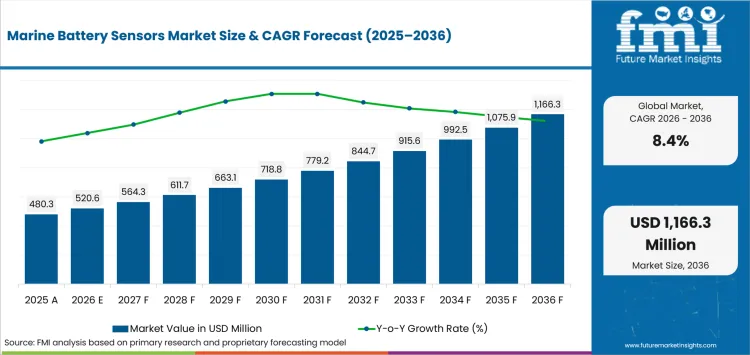
USD 520.6 million in 2026 and USD 1166.3 million by 2036 at an 8.4% CAGR.
Demand in the marine battery sensors market is anticipated to push valuation from USD 520.6 million in 2026 to USD 1166.3 million by 2036, expanding at an 8.4% CAGR over the forecast period. More vessel projects are specifying marine power battery systems, which places voltage and fault data inside propulsion control. In April 2025, the International Maritime Organization approved a draft net-zero framework covering ships above 5,000 gross tonnage that produce more than 85% of international shipping CO2 emissions. The policy signal increases engineering work on lower-emission propulsion, though sensor revenue begins only after a battery architecture reaches procurement.
Country conversion depends on how quickly fleet plans become yard work. South Korea illustrates the link between policy and executable vessel programs because its February 2025 plan covered 81 environment-friendly ship builds or conversions during the year. Those projects place battery management systems earlier in specification than broad decarbonization targets alone. The commercial constraint is timing: a funded vessel still needs a pack design, class review, and component release before embedded sensors become booked revenue.
Key Takeaways
- Battery-electric and hybrid vessel programs require pack measurements that the BMS can use for protection, state estimation, thermal response, and fault isolation.
- In 2026, voltage sensors are expected to lead sensor type with 24.0% share because pack protection and battery-state calculations depend on continuous voltage information.
- By battery system, low-voltage packs are estimated to hold 21.0% in 2026 owing to the number of auxiliary and replacement positions installed per vessel.
- Safety monitoring is set to lead the function category with 27.0% share in 2026 due to higher consequences from undetected battery faults at sea.
- Marine qualification slows component substitution because isolation performance, environmental endurance, and controller interfaces must be cleared before a new sensor enters an approved pack.
- Some of the key players in this market include Sensata Technologies, LEM, Honeywell, Texas Instruments, Victron Energy, Leclanché, Corvus Energy, and ABB.
Analyst Perspective
"Marine battery sensor selection is decided at the interface between measurement integrity and the vessel's approved BMS logic. A lower component price loses its appeal if a yard must reopen isolation testing, CAN mapping, or class documentation late in design."
- Nikhil Kaitwade, Principal Consultant, Future Market Insights
How is the marine battery sensors market segmented?
The marine battery sensors market is segmented by sensor type, battery system, function, communication, sales channel, and region.
The taxonomy separates the measurement from the battery position and the operating decision that uses the signal. sensor technologies cover electrical and environmental inputs. Battery system separates service packs from propulsion storage. Function identifies the BMS or safety task. Communication records the controller interface, while sales channel identifies which commercial route places the device into a vessel program.
Why do low-voltage packs lead the battery system category?
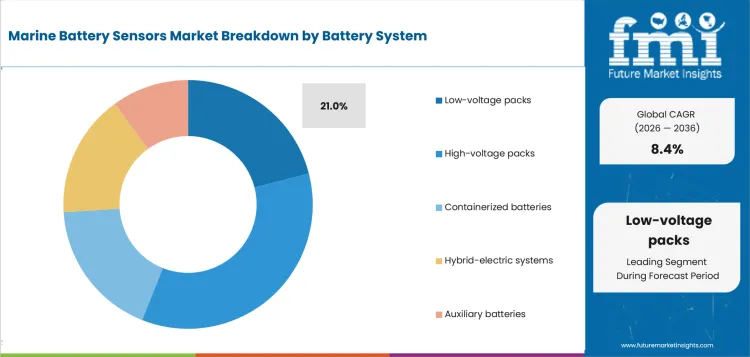
Low-voltage packs serve house loads, navigation electronics, backup circuits, and smaller propulsion systems that do not require a high-voltage conversion. Marine electricians can also replace these batteries during routine electrical work. Victron Energy presented Lithium NG and Lynx Smart BMS NG at METSTRADE in November 2025 for 12 V, 24 V, and 48 V installations with cell-level monitoring and BMS protection.
- By battery system, low-voltage packs are estimated to hold 21.0% in 2026 owing to the number of auxiliary and replacement battery positions installed per vessel.
- Aftermarket access is wider because dealers can replace or upgrade these systems without redesigning a complete high-voltage propulsion package.
What makes voltage sensors central to the sensor type category?
Voltage measurement reaches nearly every battery architecture because cell limits and pack state calculations depend on it. NXP released BMx7318 and BMx7518 battery cell controllers in July 2025 with 18 measurement channels and a dedicated ADC for each channel. The design places voltage acquisition directly beside cell-control logic, which reduces the distance between measurement and protective action.
- Based on sensor type, voltage sensors are projected to account for 24.0% in 2026 due to their use in cell limits, pack supervision, and battery-state calculations.
- Current sensing gains content as pack power rises, yet voltage measurement stays necessary in smaller service batteries and high-voltage propulsion packs alike.
How does safety monitoring shape the function category?
Safety monitoring carries more weight at sea because a cell fault can affect propulsion availability and fire-control decisions. Leclanché received DNV certification for the Navius MRS-3 marine rack system in March 2025 with a functionally safe BMS and Battery Active Safety System. Marine purchase decisions therefore depend on proof that each sensing input triggers a defined protective response.
- Safety monitoring is set to lead the function category with 27.0% share in 2026 due to shutdown logic and early warning requirements inside marine batteries.
- Gas, temperature, pressure, and electrical inputs compete for content with pack design, so each detector must justify the protective action it triggers.
What supports CAN bus in the communication category?
CAN bus carries battery measurements and fault states through a shared controller network instead of separate wiring for every signal. Its value depends on predictable message timing and fault behavior inside the selected BMS.
- By communication, CAN bus is forecast to represent 38.0% in 2026 driven by its fit with multi-node diagnostics and controller networks already used in battery systems.
- Victron Energy released Venus OS 3.70 in February 2026 with CANopen profiles for electric propulsion and cell data from compatible BMS hardware. Connected sensors earn vessel positions only if their message format matches the BMS fault logic used during commissioning.
What are the drivers, restraints and opportunities in the Marine Battery Sensors Market?
Vessel electrification raises the amount of battery data required for control, marine qualification slows late component changes, and deeper diagnostics increase the commercial value of integrated sensing modules.
- Driver: Larger battery-electric and hybrid vessel programs make pack measurements part of propulsion control, energy management, and fault protection.
- Restraint: Class requirements and vessel-specific interfaces increase validation work before a different sensor can replace a qualified device.
- Opportunity: Networked sensing modules can shorten fault isolation if their diagnostic data fits the existing BMS and vessel communication path.
Larger batteries raise the number of measurements that propulsion controls must trust. ABB received a December 2025 order for two Washington State Ferries vessels with 13.2 MWh energy storage on each ship. Electric ships pull sensor specifications into battery and propulsion design early because charging and protective actions depend on verified pack data.
Qualification becomes the barrier once a battery package has matured. DNV published its July 2026 class rules with a new Battery Ready notation that takes effect in January 2027. The rule formalizes preparation for future battery installations, so late sensor substitutions can reopen documentation or testing even if the replacement device performs well on the bench.
Diagnostic value grows with battery scale because faults become harder to isolate inside larger installations. Wärtsilä announced in August 2025 that Aurora Botnia would receive a 10.4 MWh battery extension, raising installed storage from 2.2 MWh to 12.6 MWh. That scale gives battery technology vendors a clearer revenue route if added measurements reduce commissioning work or shorten service fault isolation.
Which country CAGRs are profiled in the Marine Battery Sensors Market?
| Country | CAGR |
|---|---|
| Mexico | 9.0% |
| South Korea | 8.5% |
| Finland | 8.1% |
| Canada | 7.9% |
| USA | 7.6% |
| Germany | 7.2% |
| Japan | 6.6% |
How do country-level CAGRs compare in the Marine Battery Sensors Market?
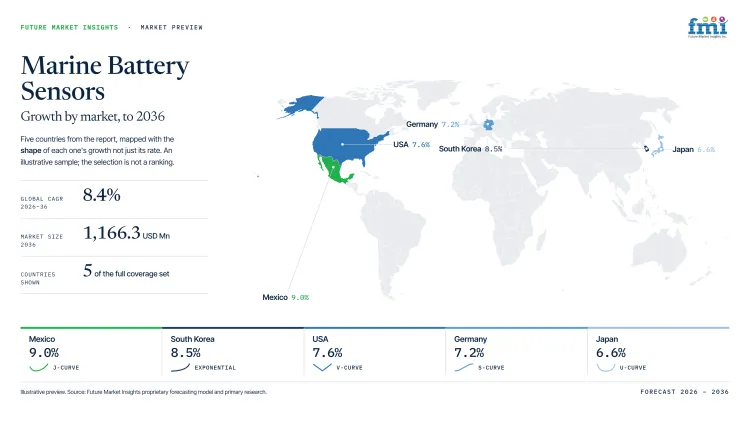
The country CAGRs span 2.4 percentage points from Mexico at 9.0% to Japan at 6.6% between 2026 and 2036. Mexico and South Korea form the fastest-growth tier. Finland and Canada sit just below that band. USA and Germany show moderate expansion while Japan has the slowest rate in the group.
- Mexico's coastal fleet base gives retrofit distributors more influence than shipyard-led markets.
- South Korea can repeat approved component choices through standardized yard platforms.
- Finland's marine engineering cluster shortens coordination between battery designers and vessel projects.
- Canada relies more heavily on fleet programs converting demonstrations into repeat orders.
- USA ferry procurement gives projects visible owners but extends component-release timing.
- Japanese buyers tend to emphasize technical validation and long supplier relationships before new components are embedded in domestic vessel platforms.
- Germany german demand includes inland-vessel modernization as well as broader commercial and shipbuilding applications where compliance documentation can be decisive.
Comparable CAGRs can still produce different routes. The full report provides country-level CAGR analysis across North America, Latin America, Europe, East Asia, South Asia, Oceania and the Middle East and Africa.
Country-wise Analysis
- Ferry operators and marine technology firms work in cold conditions that expose weak seals and unstable readings and Traficom stated in October 2025 that Finland-administered shipping companies accounted for 10.7% of CO2 reported in the Finnish Union Registry during the first maritime EU ETS year. Finland is estimated to post 8.1% CAGR through 2036 tied to electrified-vessel expertise and a stronger operating-cost signal for lower-emission shipping. Seasonal service conditions raise the qualification threshold, so firms that prove low-temperature performance and keep technical support near Finnish yards have a clearer route into repeat installations than vendors relying on remote support alone.
- Port-linked coastal fleets and retrofit yards give local marine electrical firms unusual influence over component choice because smaller projects depend on local commissioning and replacement stock near working ports during maintenance calls between scheduled yard periods. Marine battery sensor demand in Mexico is forecast to grow at 9.0% CAGR through 2036 propelled by decarbonization planning that is reaching shipping and port operators, though financing still controls project conversion. In May 2025 SEMAR brought 35 maritime actors into GreenVoyage2050 for a national action plan, which gives firms with local engineering coverage and corrosion-resistant retrofit hardware a clearer route into specifications.
- Large domestic yards can repeat an approved BMS architecture through vessel series because qualification decisions carry more commercial weight than spot component pricing and local application teams stay close to system integrators. The Ministry of Oceans and Fisheries expanded eco-friendly ship certification to equipment in February 2025 and stated that 102 ships had received certification by 2024, so late component changes face a high proof burden inside yard-led programs. South Korea is positioned to record 8.5% CAGR through 2036 given close yard-integrator coordination, which favors companies that resolve interface testing before the first vessel freezes its battery architecture.
- Ferry fleets operate long routes between dispersed terminals, so a failed sensor can become a service problem before it becomes a component-cost issue. Transport Canada stated in February 2025 that a Green Shipping Corridor project would upgrade four Seaspan roll-on/roll-off ferries in British Columbia, but pilot funding still has to convert into repeat fleet orders before local volume becomes predictable. Marine battery sensor sales in Canada are projected to grow at 7.9% CAGR by 2036 aided by ferry electrification and vessel demonstrations, which puts more weight on service coverage near operating ports and replacement documentation that avoids reopening a complete battery design.
- Public ferry programs give battery and hybrid projects named owners and procurement routes while government award cycles can delay component specifications as responsibility shifts between agencies and shipyards. USA demand is set to post 7.6% CAGR through 2036 driven by funded ferry replacement and fleet modernization that gives shipyards a defined program owner before component selection begins. The Federal Transit Administration listed five Low or No Emitting Ferry Program projects in five states in its August 2026 selections, which favors firms entering the propulsion package before component freeze because approved interfaces and domestic service coverage outweigh late price concessions.
- German demand includes inland-vessel modernization as well as broader commercial and shipbuilding applications where compliance documentation can be decisive. Marine battery sensor demand in Germany is forecast to rise at a 7.2% CAGR from 2026 to 2036. The Federal Ministry published its sustainable inland-vessel modernization funding framework in March 2024, supporting zero- and low-emission propulsion plus energy-efficiency measures. Retrofit projects create openings for new sensing content, but vessel-specific wiring, class requirements, and high-voltage isolation can extend approval work. Suppliers need robust technical files, retrofit-friendly packaging, and integrator relationships that reduce engineering effort on each vessel class.
- Japanese buyers tend to emphasize technical validation and long supplier relationships before new components are embedded in domestic vessel platforms. Adoption of marine battery sensors in Japan is forecast to expand at a 6.6% CAGR from 2026 to 2036. Japan's Ministry of Land, Infrastructure, Transport and Tourism opened a July 2024 program supporting efficiency and non-fossil energy conversion in domestic shipping, with batteries listed among eligible equipment and partial support for design or verification. The main constraint is the proof burden around integration and reliability. Suppliers need precise documentation, local engineering support, and interfaces that fit established BMS and shipyard practices.
Who are the notable companies in the Marine Battery Sensors Market?
Sensata Technologies, LEM, Honeywell, Texas Instruments, Victron Energy, Leclanché, Corvus Energy, and ABB are the notable companies profiled in this market.
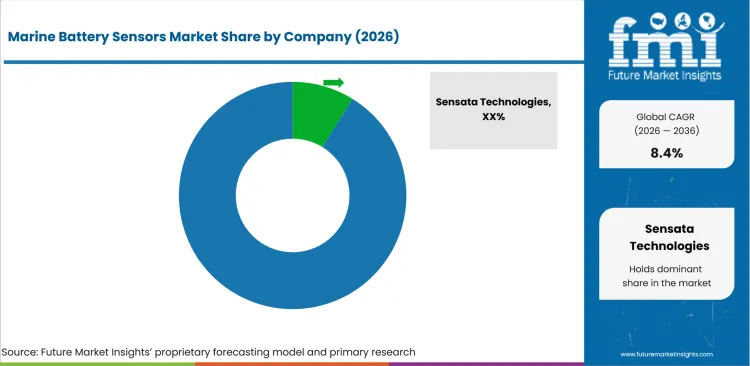
Competition spans discrete electrical measurement, battery-safety sensing, BMS electronics, marine monitoring, and vessel battery integration. Revenue counts standalone and embedded sensor hardware but excludes full battery packs and propulsion systems. Adjacent battery energy storage systems still influence qualification because pack control logic determines required measurements. Marine propulsion engines influence the same interface from vessel control.
- Sensata Technologies, LEM, Honeywell, and Texas Instruments compete closest to discrete measurement, isolation, or battery fault-detection functions.
- Victron Energy has direct marine exposure through BMS, shunt, GX, CAN, and NMEA interfaces used in onboard electrical systems.
- Leclanché, Corvus Energy, and ABB sit at the system-integration edge of scope because their battery platforms determine which embedded sensing functions clear vessel qualification.
Competitive Benchmarking: Marine Battery Sensors Market
| Company | Electrical Measurement Depth | Battery Safety Sensing Depth | BMS / Vessel-Network Integration | Geographic Reach |
|---|---|---|---|---|
| Sensata Technologies | High | Medium | High | North America, Europe, and Asia |
| LEM | High | Medium | Medium | Europe, Asia, and North America |
| Honeywell | Low | High | Medium | Global |
| Texas Instruments | High | Medium | High | North America, Europe, and Asia |
| Victron Energy | Medium | Medium | High | Europe-led global marine distribution |
| Leclanché | Medium | High | High | Europe and international marine projects |
| Corvus Energy | Medium | High | High | Europe, North America, and Asia |
| ABB | Low | Medium | High | Global |
Scoring basis: High electrical depth requires multiple voltage or current functions. Medium marks a narrower measurement role and Low one direct layer. High safety depth requires several fault-detection or protective functions. Medium and Low mark narrower coverage. High digital integration requires BMS plus vessel-network diagnostics. Medium covers one layer and Low indicates limited integration. Geographic reach describes documented operating presence.
Key Developments in the Marine Battery Sensors Market
- In April 2026, Corvus Energy received DNV Cyber Security Type Approval for Dolphin NxtGen and its Gen 4 BMS Pack Controller, giving vessel integrators a documented route for cyber-secure battery monitoring.
- In July 2025, Victron Energy released the GX Boat Page for electric and hybrid boats, bringing battery and propulsion information from NMEA 2000 or SmartShunt inputs into one marine display.
- In June 2025, Leclanché received Lloyd's Register and Bureau Veritas Type Approvals for Navius MRS-3, strengthening the qualification basis for its marine BMS and safety functions.
Key Players in the Marine Battery Sensors Market
Electrical Measurement and Battery Safety
- Sensata Technologies
- LEM
- Honeywell
- Texas Instruments
Marine BMS and Battery-System Integration
- Victron Energy
- Leclanché
- Corvus Energy
- ABB
Marine Battery Sensors Market - Report Scope
| Coverage field | Report scope |
|---|---|
| Market breakdown | By sensor type, battery system, function, communication, sales channel, and region. |
| Quantitative Units | USD million. |
| Market Definition | Revenue includes standalone and embedded sensing hardware sold for marine battery packs and BMS architectures. Battery cells, complete battery packs, standalone BMS software or controller revenue, propulsion equipment, chargers, generic marine sensors, and finished-vessel revenue are excluded. |
| Regions Covered | North America, Latin America, Western Europe, Eastern Europe, East Asia, South Asia and Pacific, and Middle East and Africa. |
| Countries Covered | Mexico, South Korea, Finland, Canada, USA, and 25+ countries included in the full report. |
| Key Companies Profiled | Sensata Technologies, LEM, Honeywell, Texas Instruments, Victron Energy, Leclanché, Corvus Energy, and ABB. |
| Forecast Period | 2026 to 2036. |
| Approach | Primary and secondary research with market triangulation. |
Marine Battery Sensors Market - Research Methodology
| Method | Approach |
|---|---|
| Primary Research | FMI analysts gathered input from manufacturers, service providers, technology developers, distributors, end users, procurement teams, and subject-matter experts. Interviews examined purchasing decisions, product or service evaluation, adoption barriers, approval requirements, pricing considerations, and expectations for technical or commercial support. Respondents were also asked what evidence is required before a trial, pilot, or initial order develops into regular purchasing. |
| Desk Research | Desk research covered government statistics, regulatory publications, trade data, industry associations, technical literature, standards, company filings, product information, and official corporate announcements. Sources were reviewed for relevance, publication date, geographic coverage, and consistency with the defined market scope. Claims relating to performance, applications, approvals, capacity, investment, and commercial activity were retained only when supported by credible public evidence. |
| Market Sizing and Forecasting | The market model combined the baseline value with historical performance, segment structure, pricing and volume indicators, adoption levels, company participation, and country-level demand conditions. Forecast assumptions considered economic activity, investment trends, regulatory developments, technology adoption, purchasing cycles, supply availability, and barriers to wider market use. Segment and regional estimates were reconciled before the final market total was calculated. |
| Data Validation | Estimates were checked against multiple independent indicators, including public data, company activity, trade patterns, industry developments, and findings from primary interviews. Validation also tested whether products, services, applications, and company revenues fell within the defined market boundaries. Adjacent categories, unsupported claims, overlapping revenues, and activities without direct market relevance were excluded to reduce double counting and maintain consistency across segments and countries. |
Marine Battery Sensors Market by Segments
Marine Battery Sensors Market segmented by Sensor Type:
- voltage sensors
- current sensors
- temperature sensors
- gas / venting sensors
- pressure sensors
- humidity / leak sensors
Marine Battery Sensors Market segmented by Battery System:
- low-voltage packs
- high-voltage packs
- containerized batteries
- hybrid-electric systems
- auxiliary batteries
Marine Battery Sensors Market segmented by Function:
- safety monitoring
- SOC / SOH estimation
- thermal runaway detection
- leak detection
- remote diagnostics
Marine Battery Sensors Market segmented by Communication:
- CAN bus
- Modbus
- Ethernet
- wireless
- analog sensor output
Marine Battery Sensors Market segmented by Sales Channel:
- BMS suppliers
- battery pack OEMs
- propulsion integrators
- marine electrical distributors
Marine Battery Sensors Market by Region:
- North America
- United States
- Canada
- Latin America
- Brazil
- Mexico
- Chile
- Argentina
- Rest of Latin America
- Western Europe
- Germany
- United Kingdom
- France
- Italy
- Spain
- Nordics
- Benelux
- Rest of Western Europe
- Eastern Europe
- Russia
- Poland
- Hungary
- Balkan and Baltic States
- Rest of Eastern Europe
- East Asia
- China
- Japan
- South Korea
- South Asia and Pacific
- India
- ASEAN
- Australia and New Zealand
- Rest of South Asia and Pacific
- Middle East and Africa
- Kingdom of Saudi Arabia
- Other GCC Countries
- Türkiye
- South Africa
- Other African Union Countries
- Rest of Middle East and Africa
Research Sources and Bibliography
- International Maritime Organization. (2025, April 11). IMO approves net-zero regulations for global shipping.
- Ministry of Oceans and Fisheries, Republic of Korea. (2025, February 11). Distributing Environment-Friendly Ships to Capture Greenhouse Gases Properly.
- NXP Semiconductors. (2025, July 2). NXP's New Battery Cell Control IC Family Advances New Energy Solutions.
- Victron Energy. (2025, November 14). Victron Energy at Metstrade 2025.
- Leclanché. (2025, March 11). Leclanché Awarded DNV Certification for Navius MRS-3 Marine Rack System.
- Victron Energy. (2026, February 25). Introducing Venus OS 3.70.
- ABB. (2025, December 1). Washington State Ferries selects ABB to power their first hybrid-electric newbuild vessels.
- DNV. (2026, July 2). Now available: The July 2026 edition of the DNV class rules and standards for ship and offshore.
- Wärtsilä. (2025, August 27). Wärtsilä and Wasaline's close cooperation continues with world's largest marine battery hybrid system project.
- Secretaría de Marina, Mexico. (2025, May 21). La SEMAR y el Programa Green Voyage 2050 organizan taller para desarrollar un Plan de Acción Nacional para la Descarbonización Marítima.
- Ministry of Oceans and Fisheries, Republic of Korea. (2025, February 28). Expanding Eco-Friendly Ship Certification to Include Equipment... Accelerating the Eco-Friendly Transformation of Ships and Greenhouse Gas Reduction.
- Finnish Transport and Communications Agency Traficom. (2025, October 28). Maritime transport's first year in the EU Emissions Trading System achieved its goals.
- Transport Canada. (2025, February 11). Green Shipping Corridor Program - Funding for projects in British Columbia.
- USA Federal Transit Administration. (2026, August 21). FTA Ferry Programs.
- Corvus Energy. (2026, April 30). Corvus Energy Achieves DNV Cybersecurity Type Approval for Dolphin NxtGen, Strengthening Leadership in Secure Maritime Energy Storage.
- Victron Energy. (2025, July 23). GX Boat Page.
- Leclanché. (2025, June 16). Leclanché Receives Lloyds Register and Bureau Veritas Type Approvals for Navius MRS-3 Marine Rack System.
- Sensata Technologies. (2025, April 23). Sensata Technologies' High Voltage Distribution Units Enabling Megawatt Charging in Production on Heavy-Duty Electric Trucks.
- LEM. (2025, June 11). LEM releases new high-voltage battery sensor with shunt & Hall effect.
- Honeywell. (2025, July 1). Honeywell Makes Strategic Tuck-in Acquisition of Li-ion Tamer to Bolster Fire Detection Technologies, Further Strengthening Building Automation Portfolio.
- Texas Instruments. (2026, June 9). TI brings intelligence to battery management systems with industry's highest-cell-count EIS-enabled battery monitor.
- Victron Energy. (2025, June 10). Introducing Venus OS 3.60.
- Leclanché. (2025, June 18). Leclanché Commences Serial Production of Navius MRS-3 Marine Rack Systems - Meeting Surging Demand for Zero-Emissions Marine Solutions.
- Corvus Energy. (2025, December 4). Corvus Energy Launches Next-Generation Marine LFP Energy Storage System.
- ABB. (2026, March 31). Delaware River and Bay Authority takes electric route in Cape May-Lewes ferry modernization project.
- Corvus Energy. (2026, August 11). Corvus Energy Secures 40MWh Landmark Battery Contract for BC Ferries' New Major Vessels Program.
- ABB. (2025, December 11). South Korea's first state-owned all-electric ferry powered by ABB.
- Wärtsilä. (2025, September 10). Wärtsilä to equip two high-speed fully battery-electric Danish ferries with integrated electric propulsion system and waterjets.
- Leclanché. (2025, October 9). Leclanché and Century Ship Services Partner to Supply 4 MWh of Battery Systems for a Hybrid Ocean Cruise Vessel.
- EST-Floattech. (2026, June 19). EST-Floattech Receives DNV Type Approval for Octopus LFP Battery System.
- KONGSBERG. (2025, May 8). Financial results Q1 2025: Positioned for further growth.
- Navico Group. (2025, January 22). RELiON® Delivers Unrivaled Performance and Ease-of-Use with New RELiON ELiTE™ 48V Lithium Battery.
This bibliography is provided for reader reference and is not exhaustive. The full report contains the complete reference list and detailed citations
This Report Answers
- What are the 2026 and 2036 marine battery sensors market values?
- Why do voltage sensors lead sensor type in 2026?
- Why do low-voltage packs lead battery system in 2026?
- Why does safety monitoring lead function in 2026?
- How do growth conditions differ among the five profiled countries?
- Which companies cover measurement, safety sensing, BMS, and marine integration?
- How do class rules affect sensor substitution after pack design freeze?
- What must marine battery integrators verify before changing approved sensing hardware?
Frequently Asked Questions
How big is the marine battery sensors market in 2026?
The marine battery sensors market is valued at USD 520.6 million in 2026 and is projected to reach USD 1,166.3 million by 2036. Expansion follows battery-electric and hybrid vessel projects that place more measurement points inside qualified battery systems.
What is the CAGR of the marine battery sensors market from 2026 to 2036?
The marine battery sensors market is projected to grow at a CAGR of 8.4% between 2026 and 2036. Growth follows vessel electrification and the need for battery data used in protection, state estimation, and service diagnostics.
Which sensor type leads the marine battery sensors market?
The voltage sensors segment is expected to hold 24.0% of the marine battery sensors market in 2026, driven by continuous pack-protection and battery-state measurement needs. Voltage information is required in low-voltage service packs and high-voltage propulsion batteries.
Which communication segment holds the leading approved share in the marine battery sensors market?
The CAN bus segment is forecast to account for 38.0% of the marine battery sensors market in 2026, attributable to its fit with controller-based diagnostics. The protocol carries measurement and fault data without separate wiring for every battery signal.
Which companies are active in the marine battery sensors market?
Key companies operating in the marine battery sensors market include Sensata Technologies, LEM, Honeywell, Texas Instruments, Victron Energy, Leclanché, Corvus Energy, and ABB. Their positions span discrete sensing, battery safety, marine monitoring, BMS electronics, and vessel integration.
Preview the report firsthand - request a free sample
Get SampleGet the brochure for pricing and purchase details.
Get PDFTable of Content
- Key Takeaways
- Market Size and CAGR
- Top Growth Driver
- Fastest Growing Segment
- Leading Region
- Key Companies
- Emerging Opportunities
- Executive Summary
- Global Market Outlook
- Demand-side Trends
- Supply-side Trends
- Technology Roadmap Analysis
- Analysis and Recommendations
- Analyst Perspective (What is happening? Why now? What should investors know?)
- Key Questions Answered
- How large is the market?
- What is the CAGR?
- What are key trends?
- Which region dominates?
- Who are the leaders?
- Market Overview
- Market Coverage / Taxonomy
- Market Definition / Scope / Limitations
- Research Methodology
- Chapter Orientation
- Analytical Lens and Working Hypotheses
- Market Structure, Signals, and Trend Drivers
- Benchmarking and Cross-market Comparability
- Market Sizing, Forecasting, and Opportunity Mapping
- Research Design and Evidence Framework
- Desk Research Programme (Secondary Evidence)
- Expert Input and Fieldwork (Primary Evidence)
- Tooling, Models, and Reference Databases
- Data Engineering and Model Build
- Quality Assurance and Audit Trail
- Market Background
- Market Dynamics (Drivers, Restraints, Opportunity, Trends)
- Scenario Forecast (Optimistic, Likely, Conservative)
- Impact Analysis
- AI Impact
- Sustainability Impact
- Regulatory Impact
- Technology Impact
- Consumer / Buyer Analysis
- Purchase Drivers
- Adoption Barriers
- Buyer Journey
- Opportunity Map Analysis
- Product Life Cycle Analysis
- Supply Chain Analysis
- Investment Feasibility Matrix
- Value Chain Analysis
- PESTLE and Porter's Analysis
- Regulatory Landscape
- Regional Parent Market Outlook
- Production and Consumption Statistics
- Import and Export Statistics
- Global Market Analysis and Forecast, 2021 to 2036
- Historical Market Size Value (USD Million) Analysis, 2021 to 2025
- Current and Future Market Size Value (USD Million) Projections, 2026 to 2036
- Y-o-Y Growth Trend Analysis
- Absolute $ Opportunity Analysis
- Global Market Pricing Analysis, 2021 to 2036
- Global Market Analysis and Forecast, By Sensor Type, 2021 to 2036
- Introduction / Key Findings
- Historical Market Size Value (USD Million) Analysis By Sensor Type, 2021 to 2025
- Current and Future Market Size Value (USD Million) Analysis and Forecast By Sensor Type, 2026 to 2036
- Voltage sensors
- Current sensors
- Temperature sensors
- Gas / venting sensors
- Pressure sensors
- Humidity / leak sensors
- Voltage sensors
- Y-o-Y Growth Trend Analysis By Sensor Type, 2021 to 2025
- Absolute $ Opportunity Analysis By Sensor Type, 2026 to 2036
- Global Market Analysis and Forecast, By Battery System, 2021 to 2036
- Introduction / Key Findings
- Historical Market Size Value (USD Million) Analysis By Battery System, 2021 to 2025
- Current and Future Market Size Value (USD Million) Analysis and Forecast By Battery System, 2026 to 2036
- Low-voltage packs
- High-voltage packs
- Containerized batteries
- Hybrid-electric systems
- Auxiliary batteries
- Low-voltage packs
- Y-o-Y Growth Trend Analysis By Battery System, 2021 to 2025
- Absolute $ Opportunity Analysis By Battery System, 2026 to 2036
- Global Market Analysis and Forecast, By Function, 2021 to 2036
- Introduction / Key Findings
- Historical Market Size Value (USD Million) Analysis By Function, 2021 to 2025
- Current and Future Market Size Value (USD Million) Analysis and Forecast By Function, 2026 to 2036
- Safety monitoring
- SOC / SOH estimation
- Thermal runaway detection
- Leak detection
- Remote diagnostics
- Safety monitoring
- Y-o-Y Growth Trend Analysis By Function, 2021 to 2025
- Absolute $ Opportunity Analysis By Function, 2026 to 2036
- Global Market Analysis and Forecast, By Communication, 2021 to 2036
- Introduction / Key Findings
- Historical Market Size Value (USD Million) Analysis By Communication, 2021 to 2025
- Current and Future Market Size Value (USD Million) Analysis and Forecast By Communication, 2026 to 2036
- CAN bus
- Modbus
- Ethernet
- Wireless
- Analog sensor output
- CAN bus
- Y-o-Y Growth Trend Analysis By Communication, 2021 to 2025
- Absolute $ Opportunity Analysis By Communication, 2026 to 2036
- Global Market Analysis and Forecast, By Sales Channel, 2021 to 2036
- Introduction / Key Findings
- Historical Market Size Value (USD Million) Analysis By Sales Channel, 2021 to 2025
- Current and Future Market Size Value (USD Million) Analysis and Forecast By Sales Channel, 2026 to 2036
- BMS suppliers
- Battery pack OEMs
- Propulsion integrators
- Marine electrical distributors
- BMS suppliers
- Y-o-Y Growth Trend Analysis By Sales Channel, 2021 to 2025
- Absolute $ Opportunity Analysis By Sales Channel, 2026 to 2036
- Global Market Analysis and Forecast, By Region, 2021 to 2036
- Introduction
- Historical Market Size Value (USD Million) Analysis By Region, 2021 to 2025
- Current Market Size Value (USD Million) Analysis and Forecast By Region, 2026 to 2036
- North America
- Latin America
- Western Europe
- Eastern Europe
- East Asia
- South Asia and Pacific
- Middle East & Africa
- Market Attractiveness Analysis By Region
- North America Market Analysis and Forecast, By Country, 2021 to 2036
- Historical Market Size Value (USD Million) Trend Analysis By Market Taxonomy, 2021 to 2025
- Market Size Value (USD Million) Forecast By Market Taxonomy, 2026 to 2036
- By Country
- USA
- Canada
- By Sensor Type
- By Battery System
- By Function
- By Communication
- By Sales Channel
- By Country
- Market Attractiveness Analysis
- By Country
- By Sensor Type
- By Battery System
- By Function
- By Communication
- By Sales Channel
- Key Takeaways
- Latin America Market Analysis and Forecast, By Country
- Historical Market Size Value (USD Million) Trend Analysis By Market Taxonomy, 2021 to 2025
- Market Size Value (USD Million) Forecast By Market Taxonomy, 2026 to 2036
- By Country
- Brazil
- Mexico
- Chile
- Rest of Latin America
- By Sensor Type
- By Battery System
- By Function
- By Communication
- By Sales Channel
- By Country
- Market Attractiveness Analysis
- By Country
- By Sensor Type
- By Battery System
- By Function
- By Communication
- By Sales Channel
- Key Takeaways
- Western Europe Market Analysis and Forecast, By Country
- Historical Market Size Value (USD Million) Trend Analysis By Market Taxonomy, 2021 to 2025
- Market Size Value (USD Million) Forecast By Market Taxonomy, 2026 to 2036
- By Country
- Germany
- UK
- Italy
- Spain
- France
- Nordic
- BENELUX
- Rest of Western Europe
- By Sensor Type
- By Battery System
- By Function
- By Communication
- By Sales Channel
- By Country
- Market Attractiveness Analysis
- By Country
- By Sensor Type
- By Battery System
- By Function
- By Communication
- By Sales Channel
- Key Takeaways
- Eastern Europe Market Analysis and Forecast, By Country
- Historical Market Size Value (USD Million) Trend Analysis By Market Taxonomy, 2021 to 2025
- Market Size Value (USD Million) Forecast By Market Taxonomy, 2026 to 2036
- By Country
- Russia
- Poland
- Hungary
- Balkan & Baltic
- Rest of Eastern Europe
- By Sensor Type
- By Battery System
- By Function
- By Communication
- By Sales Channel
- By Country
- Market Attractiveness Analysis
- By Country
- By Sensor Type
- By Battery System
- By Function
- By Communication
- By Sales Channel
- Key Takeaways
- East Asia Market Analysis and Forecast, By Country
- Historical Market Size Value (USD Million) Trend Analysis By Market Taxonomy, 2021 to 2025
- Market Size Value (USD Million) Forecast By Market Taxonomy, 2026 to 2036
- By Country
- China
- Japan
- South Korea
- By Sensor Type
- By Battery System
- By Function
- By Communication
- By Sales Channel
- By Country
- Market Attractiveness Analysis
- By Country
- By Sensor Type
- By Battery System
- By Function
- By Communication
- By Sales Channel
- Key Takeaways
- South Asia and Pacific Market Analysis and Forecast, By Country
- Historical Market Size Value (USD Million) Trend Analysis By Market Taxonomy, 2021 to 2025
- Market Size Value (USD Million) Forecast By Market Taxonomy, 2026 to 2036
- By Country
- India
- ASEAN
- Australia & New Zealand
- Rest of South Asia and Pacific
- By Sensor Type
- By Battery System
- By Function
- By Communication
- By Sales Channel
- By Country
- Market Attractiveness Analysis
- By Country
- By Sensor Type
- By Battery System
- By Function
- By Communication
- By Sales Channel
- Key Takeaways
- Middle East & Africa Market Analysis and Forecast, By Country
- Historical Market Size Value (USD Million) Trend Analysis By Market Taxonomy, 2021 to 2025
- Market Size Value (USD Million) Forecast By Market Taxonomy, 2026 to 2036
- By Country
- Kingdom of Saudi Arabia
- Other GCC Countries
- Türkiye
- South Africa
- Other African Union
- Rest of Middle East & Africa
- By Sensor Type
- By Battery System
- By Function
- By Communication
- By Sales Channel
- By Country
- Market Attractiveness Analysis
- By Country
- By Sensor Type
- By Battery System
- By Function
- By Communication
- By Sales Channel
- Key Takeaways
- Key Countries Market Analysis
- USA
- Pricing Analysis
- Market Share Analysis, 2025
- By Sensor Type
- By Battery System
- By Function
- By Communication
- By Sales Channel
- Canada
- Pricing Analysis
- Market Share Analysis, 2025
- By Sensor Type
- By Battery System
- By Function
- By Communication
- By Sales Channel
- Mexico
- Pricing Analysis
- Market Share Analysis, 2025
- By Sensor Type
- By Battery System
- By Function
- By Communication
- By Sales Channel
- Brazil
- Pricing Analysis
- Market Share Analysis, 2025
- By Sensor Type
- By Battery System
- By Function
- By Communication
- By Sales Channel
- Chile
- Pricing Analysis
- Market Share Analysis, 2025
- By Sensor Type
- By Battery System
- By Function
- By Communication
- By Sales Channel
- Germany
- Pricing Analysis
- Market Share Analysis, 2025
- By Sensor Type
- By Battery System
- By Function
- By Communication
- By Sales Channel
- UK
- Pricing Analysis
- Market Share Analysis, 2025
- By Sensor Type
- By Battery System
- By Function
- By Communication
- By Sales Channel
- Italy
- Pricing Analysis
- Market Share Analysis, 2025
- By Sensor Type
- By Battery System
- By Function
- By Communication
- By Sales Channel
- Spain
- Pricing Analysis
- Market Share Analysis, 2025
- By Sensor Type
- By Battery System
- By Function
- By Communication
- By Sales Channel
- France
- Pricing Analysis
- Market Share Analysis, 2025
- By Sensor Type
- By Battery System
- By Function
- By Communication
- By Sales Channel
- India
- Pricing Analysis
- Market Share Analysis, 2025
- By Sensor Type
- By Battery System
- By Function
- By Communication
- By Sales Channel
- ASEAN
- Pricing Analysis
- Market Share Analysis, 2025
- By Sensor Type
- By Battery System
- By Function
- By Communication
- By Sales Channel
- Australia & New Zealand
- Pricing Analysis
- Market Share Analysis, 2025
- By Sensor Type
- By Battery System
- By Function
- By Communication
- By Sales Channel
- China
- Pricing Analysis
- Market Share Analysis, 2025
- By Sensor Type
- By Battery System
- By Function
- By Communication
- By Sales Channel
- Japan
- Pricing Analysis
- Market Share Analysis, 2025
- By Sensor Type
- By Battery System
- By Function
- By Communication
- By Sales Channel
- South Korea
- Pricing Analysis
- Market Share Analysis, 2025
- By Sensor Type
- By Battery System
- By Function
- By Communication
- By Sales Channel
- Russia
- Pricing Analysis
- Market Share Analysis, 2025
- By Sensor Type
- By Battery System
- By Function
- By Communication
- By Sales Channel
- Poland
- Pricing Analysis
- Market Share Analysis, 2025
- By Sensor Type
- By Battery System
- By Function
- By Communication
- By Sales Channel
- Hungary
- Pricing Analysis
- Market Share Analysis, 2025
- By Sensor Type
- By Battery System
- By Function
- By Communication
- By Sales Channel
- Kingdom of Saudi Arabia
- Pricing Analysis
- Market Share Analysis, 2025
- By Sensor Type
- By Battery System
- By Function
- By Communication
- By Sales Channel
- Türkiye
- Pricing Analysis
- Market Share Analysis, 2025
- By Sensor Type
- By Battery System
- By Function
- By Communication
- By Sales Channel
- South Africa
- Pricing Analysis
- Market Share Analysis, 2025
- By Sensor Type
- By Battery System
- By Function
- By Communication
- By Sales Channel
- USA
- Market Structure Analysis
- Competition Dashboard
- Competition Benchmarking
- Market Share Analysis of Top Players
- By Regional
- By Sensor Type
- By Battery System
- By Function
- By Communication
- By Sales Channel
- Emerging Startups
- Innovation Benchmarking
- Competition Analysis
- Competition Deep Dive
- Sensata Technologies
- Overview
- Product Portfolio
- Profitability by Market Segments
- Sales Footprint
- Strategy Overview
- Marketing Strategy
- Product Strategy
- Channel Strategy
- TE Connectivity
- Amphenol
- LEM
- Vishay
- Honeywell
- TDK
- NXP Semiconductors
- Texas Instruments
- Victron Energy
- Sensata Technologies
- Case Studies
- Success Stories
- Recent Developments
- Competition Deep Dive
- Assumptions & Acronyms Used


