

- Market Size (2026)
- USD 720.60 Mn
- Forecast (2036)
- USD 2159.40 Mn
- CAGR (2026 to 2036)
- 11.6%
How big is the Battery Metal Chelants Market in 2026?
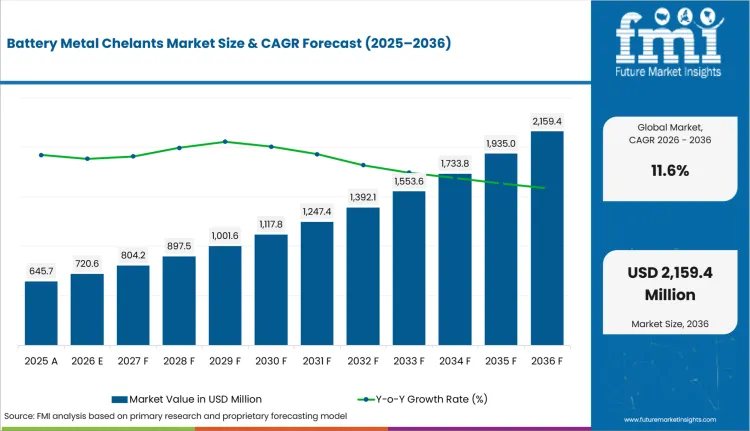
USD 720.60 million in 2026 and USD 2,159.40 million by 2036 at an 11.6% CAGR.
The battery metal chelants industry value is anticipated to rise from USD 645.70 million in 2025 to USD 2,159.40 million by 2036 at 11.6% CAGR since battery recyclers shift black mass processing toward selective leaching and impurity control. Battery recycling is expected to hold 51.0% share in 2026, supported by reagent-intensive hydrometallurgical lines. Direct sales are projected to secure 48.0% share in 2026, guided by formulation trials and plant-level troubleshooting needs.
| Metric | Value |
|---|---|
| 2026 Market Size | USD 720.60 million |
| 2036 Market Size | USD 2,159.40 million |
| Forecast CAGR | 11.6% from 2026 to 2036 |
| Leading End Use | Battery Recycling |
| Battery Recycling Share in 2026 | 51.0% |
| Leading Sales Channel | Direct Sales |
| Direct Sales Share in 2026 | 48.0% |
| Leading CAGR Country | China |
| China CAGR | 12.8% by 2036 |
Summary of the Battery Metal Chelants Market
| Market Signal | Commercial Impact |
|---|---|
| Demand and Growth Drivers | Battery metal chelant demand is increasing as hydrometallurgical recycling facilities seek higher metal recovery efficiency and improved refining performance.
|
| Product and Segment View | Battery recycling, direct sales, and selective recovery applications lead the market.
|
| Geography and Growth Outlook | China and India are expected to remain the leading growth markets for battery metal chelants.
|
| Competitive Landscape | Competition is focused on chelation chemistry, impurity management, and process optimization support.
|
| Analyst Perspective | Battery metal chelants are evolving into critical process-control chemicals that directly influence recovery quality and refining efficiency.
— Nikhil Kaitwade, Principal Consultant, Chemicals and Materials, Future Market Insights |
Battery circularity planning is strengthening around critical mineral security and cathode-grade recovered salts. IEA reported that announced global battery recycling capacity in 2030 could be seven times available feedstock if all projects start on schedule.
European Commission capacity benchmarks under the Critical Raw Materials Act include 25% recycling for strategic raw materials by 2030. BASF announced a USD 0.33/kg North America price increase for select Trilon chelating agents from July 1, 2026, strengthening the commercial argument for dosing efficiency and qualified supplier support.Battery metal chelants demand is forecast to expand through 2036, supported by battery recycling scale-up and direct supplier support.
Which factors support expansion in the Battery Metal Chelants Market?
Cathode-grade recovery and direct supplier trials support market value across battery recyclers and metal refiners.
- Market value rises as black mass refiners need chelants that keep target metals controlled during leaching and precipitation steps.
- Selective recovery supports adoption as recyclers try to reduce downstream correction after mixed NMC and consumer battery inputs.
- Battery producers influence steady demand through recycled-content declarations and tighter impurity expectations for precursor inputs.
- Wastewater treatment concerns promote biodegradable chelants suited to effluent-sensitive recycling and refining sites.
Why is the Battery Metal Chelants Market growing?
High-repeat hydrometallurgical recovery increases chelant demand as mixed battery feedstock adds impurity risk and metal-yield pressure.
Battery recyclers spend more on chelants as black mass streams move from manufacturing scrap toward end-of-life batteries. IEA reported that manufacturing scrap still accounts for two-thirds of available battery recycling feedstock in 2030. Early plant utilization will rely on cleaner scrap streams before older EV batteries arrive in larger volumes. Chelants suit this phase as pH control and dosing can be tuned for higher lithium and cobalt recovery. Suppliers linking reagent performance with plant records gain stronger acceptance in qualification programs.
How is the Battery Metal Chelants Market segmented?
Battery Metal Chelants Market is segmented by chelant type, target metal, application, end use, and sales channel.
- EDTA / aminopolycarboxylates are projected to account for 36.0% share in 2026, influenced by wide pH operation and familiar metal-binding behavior.
- Nickel / cobalt is expected to hold 38.0% share in 2026, shaped by NMC recovery routes and high sensitivity to impurity carryover.
- Selective recovery is anticipated to account for 42.0% share in 2026, led by yield targets across lithium and manganese streams.
- Battery recycling is projected to hold 51.0% share in 2026, guided by industrial black mass refining and formal waste battery programs.
- Direct sales are expected to represent 48.0% share in 2026, supported by dosing support and plant-specific service.
Why do EDTA / Aminopolycarboxylates dominate the Battery Metal Chelants Market by chelant type?
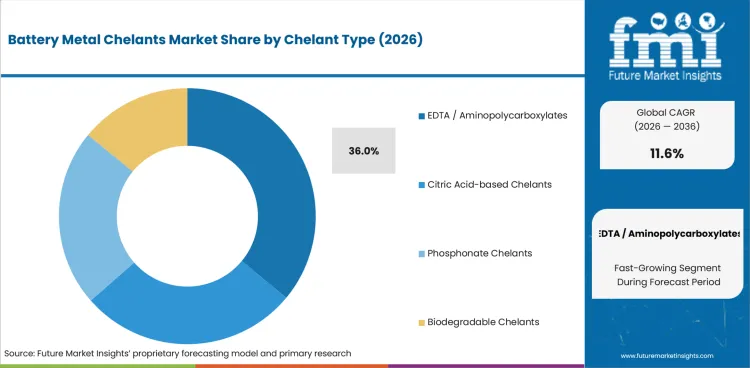
- EDTA / aminopolycarboxylates are projected to account for 36.0% share in 2026, driven by established use in complex metal streams and predictable complexation across varied acidity levels.
- Biodegradable chelants gain demand as effluent scrutiny increases. Buyers still test performance against EDTA systems before switching production lines.
Which target metal leads the Battery Metal Chelants Market?
- Nickel / cobalt is expected to hold 38.0% share in 2026, shaped by NMC recycling economics and stricter separation demands before cathode precursor use.
- Lithium recovery gains attention as battery regulation and processing investment move recyclers toward carbonate and hydroxide recovery routes.
Which application leads the Battery Metal Chelants Market?
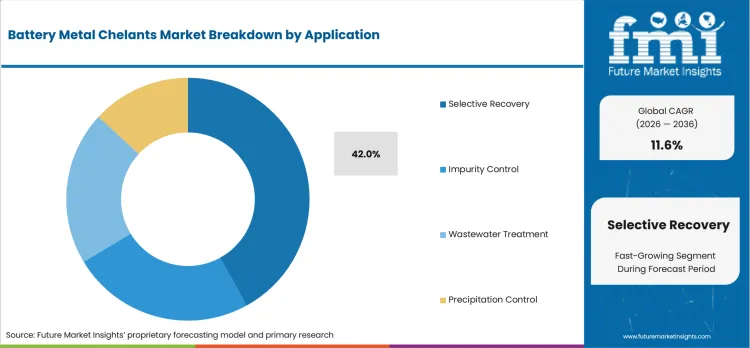
- Selective recovery is anticipated to account for 42.0% share in 2026, led by plants seeking higher recovered metal yield per ton of black mass.
- Impurity control remains active as aluminum and manganese carryover can reduce downstream salt value if not controlled.
Which end use leads the Battery Metal Chelants Market?
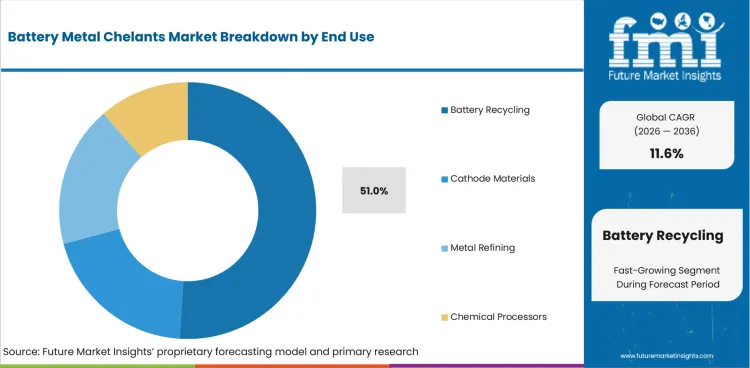
- Battery recycling is projected to hold 51.0% share in 2026, reflected by dedicated hydrometallurgical plants and waste battery collection systems.
- Cathode materials create added demand as precursor producers qualify recycled inputs through tighter chemical and traceability checks.
Which sales channel leads the Battery Metal Chelants Market?
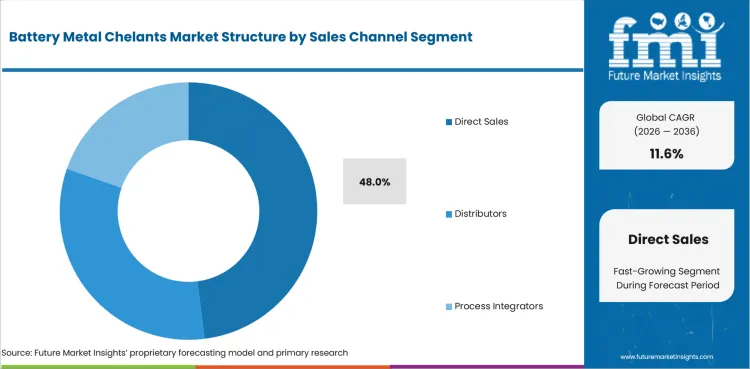
- Direct sales is expected to represent 48.0% share in 2026, guided by buyer preference for dosing support and pilot-line evaluation.
- Process integrators remain active as chelants can be specified during flowsheet design and commercial line commissioning.
What are the drivers, restraints, and opportunities in the Battery Metal Chelants Market?
Battery recycling capacity and wastewater chemistry are shaping battery metal chelant buying decisions.
- Driver: Commercial black mass refining requires selective recovery chemistry before cathode-grade salts can be qualified.
- Restraint: Persistent chelants can raise effluent treatment effort if plant design does not control downstream metal mobility.
- Opportunity: Biodegradable chelants can improve supplier renewal rates as buyers request lower residue burden and documented recovery performance.
Black Mass Selectivity Strengthens Reagent Demand
Battery recyclers buy chelants to narrow the gap between recovered metal yield and downstream purification cost. IEA reported in 2025 that lithium demand rose nearly 30% in 2024, while demand for nickel and rare earths rose 6-8%. Such mineral demand reinforces recycling economics as secondary feedstock turns into a supply option for battery makers. Battery metal chelant suppliers gain demand as selectivity turns into a commercial recovery issue.
Effluent Burden Limits Legacy Chelant Adoption
Recycling plants can face slower approvals if strong chelants keep metals mobile after the recovery step. European battery rules require recovery targets of 90% for cobalt and nickel by the end of 2027 and 95% by the end of 2031. Recovery targets raise the importance of metal capture, yet wastewater permits also require stable residues. Smaller buyers may delay legacy chelant purchases until suppliers prove effluent compatibility and treatment economics.
Biodegradable Chemistry Creates Expansion
Biodegradable chelants create a stronger opening as battery recyclers seek lower-persistence alternatives without losing recovery performance. BASF announced in April 2025 that Trilon G uses GLDA chemistry, contains about 56% renewable carbon atoms, and degrades by more than 60% within 28 days under OECD 301D testing. Such product evidence helps buyers compare environmental claims against process output. Suppliers can convert pilot interest into repeat purchases through side-by-side dosing records and wastewater checks.
Which countries are growing in the Battery Metal Chelants Market?
China 12.8% CAGR, India 12.5% CAGR, South Korea 12.2% CAGR, United States 11.8% CAGR, Germany 11.7% CAGR, France 11.3% CAGR, United Kingdom 10.9% CAGR, and Japan 10.4% CAGR through 2036.
.webp "Top Country Growth Comparison Battery Metal Chelants Market Cagr (2026 2036)")
| Country | CAGR |
|---|---|
| China | 12.8% |
| India | 12.5% |
| South Korea | 12.2% |
| United States | 11.8% |
| Germany | 11.7% |
| France | 11.3% |
| United Kingdom | 10.9% |
| Japan | 10.4% |
Source: Future Market Insights, 2026.
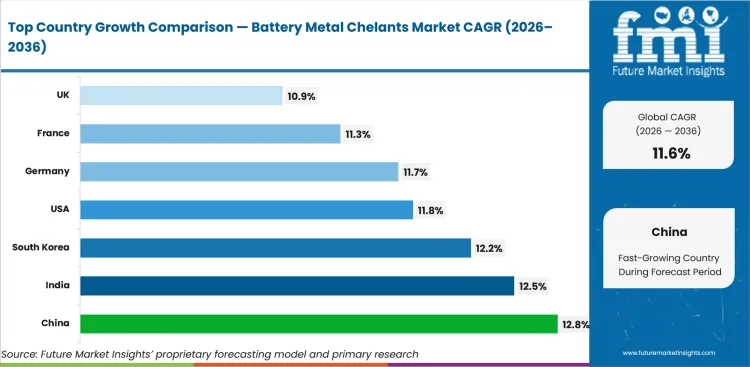
How do country-level CAGRs compare in the Battery Metal Chelants Market?
China leads country expansion while Japan posts the most cautious pace among profiled markets.
- China is projected to reach 12.8% CAGR by 2036 through cathode-material clusters and recycler scale.
- India is anticipated to expand at 12.5% CAGR by 2036, led by EPR-linked collection and lithium-ion battery demand.
- South Korea is estimated to grow at 12.2% CAGR by 2036 as certification programs lift recovery documentation needs.
- United States is expected to rise at 11.8% CAGR by 2036, supported by federal funding and hazardous-waste compliance requirements.
- Germany is likely to advance at 11.7% CAGR by 2036 as chemical-park capacity and auto recycling support reagent trials.
- France is projected to reach 11.3% CAGR by 2036, backed by automaker circularity systems and battery collection networks.
- United Kingdom is forecast to post 10.9% CAGR by 2036, guided by critical-minerals strategy targets and pilot refining projects.
- Japan is expected to reach 10.4% CAGR by 2036, led by high-specification material quality and metal-refiner coordination.
What is the Battery Metal Chelants Market outlook in China?
A 12.8% CAGR through 2036 reflects power battery recycling rules and cathode-material supply chain integration.
Country Market Snapshot Table
| Parameter | Value |
|---|---|
| Market Size in 2025 (Value) | USD 170.9 million |
| Market Size in 2026 (Value) | USD 181.0 million |
| Market Forecast in 2036 (Value) | USD 603.0 million |
| CAGR (2026 to 2036) | 12.8% |
| Years Considered | 2021 to 2036 |
| Base Year | 2025 |
| Forecast Period | 2026 to 2036 |
| Leading Application | Selective Recovery |
| Leading Sales Channel | Direct Sales |
China Battery Metal Chelants Market Outlook
- China battery metal chelants demand is shaped by power battery recycling rules and cathode-material production clusters. Local recyclers need metal-binding chemistry that supports high-throughput black mass processing and documented material traceability.
- Buyers are expected to favor reagent suppliers that combine stable chelation performance with plant service. Domestic cathode producers will remain influential as recycled nickel and manganese require consistent impurity control.
Key Growth Drivers
- Retired battery flows create selective recovery demand, supported by China State Council reporting that NEV production and sales both exceeded 16 million units in 2025.
- Digital traceability supports reagent qualification as recyclers need metal-origin and material-composition records, evidenced by China’s 2024 output of recycled non-ferrous metals reaching 19.15 million tonnes.
- Cathode-material clusters need consistent dosing support as recycled salts move into precursor production checks.
- Domestic recyclers gain scope as plant operators compare chelant performance against recovery yield and residue burden.
Key Restraints
- Price competition can compress technical service if recyclers compare chelants only by reagent cost.
- Used battery generation exceeding 1 million tonnes by 2030 can strain standardized collection and pretreatment before chemical recovery.
- Mixed LFP and NMC streams can reduce reagent payback if plants lack feedstock sorting and lab controls.
What makes China unique
China combines power battery traceability and local recycler scale, placing chelant trials close to commercial battery supply chains.
Key Companies
- GEM
- Brunp Recycling
- Huayou Cobalt
- Ganfeng Lithium
- CNGR Advanced Material
- BTR New Material
- Guangdong Brunp Circular Technology
Sales & Marketing Channels
- Direct supply to battery recyclers
- Cathode-material producer trials
- Chemical park distributor networks
- Equipment-integrator specifications
- Regional recycling association contacts
- Pilot-line validation programs
Country Segment Breakdown Table
| Segment | Sub-Segments |
|---|---|
| By Chelant Type | EDTA / Aminopolycarboxylates · Citric Acid-based Chelants · Phosphonate Chelants · Biodegradable Chelants |
| By Target Metal | Lithium · Nickel / Cobalt · Manganese · Copper / Aluminum |
| By Application | Selective Recovery · Impurity Control · Wastewater Treatment · Precipitation Control |
| By End Use | Battery Recycling · Cathode Materials · Metal Refining · Chemical Processors |
| By Sales Channel | Direct Sales · Distributors · Process Integrators |
| Key Sub-Regions Covered, Industrial Corridors | Guangdong · Jiangsu · Zhejiang · Hunan · Sichuan · Shanghai |
Frequently Asked Questions
How fast is China Battery Metal Chelants Market growing?
China is estimated to grow at 12.8% CAGR as power battery traceability and cathode-material production keep recovery chemistry near commercial battery output.
Who leads China Battery Metal Chelants Market?
GEM leads China Battery Metal Chelants Market, supported by Brunp Recycling and Huayou Cobalt across local battery recycling and materials channels.
What is driving adoption in China Battery Metal Chelants Market?
Power battery recycling rules and local cathode-material qualification are moving Chinese recyclers toward chelant-assisted separation.
What is the Battery Metal Chelants Market outlook in India?
A 12.5% CAGR through 2036 reflects lithium-ion battery demand and recycler-led pilot projects.
Country Market Snapshot Table
| Parameter | Value |
|---|---|
| Market Size in 2025 (Value) | USD 62.2 million |
| Market Size in 2026 (Value) | USD 70.0 million |
| Market Forecast in 2036 (Value) | USD 227.5 million |
| CAGR (2026 to 2036) | 12.5% |
| Years Considered | 2021 to 2036 |
| Base Year | 2025 |
| Forecast Period | 2026 to 2036 |
| Leading Application | Selective Recovery |
| Leading Sales Channel | Direct Sales |
India Battery Metal Chelants Market Outlook
- India battery metal chelants demand is guided by formal EPR systems and domestic recycling technology programs. Recyclers need selective chemistry that can help turn battery waste into lithium and manganese salts.
- Buyers are expected to test chelants through pilot plants and domestic technology partners. Supplier selection are expected to depend on dosage economics and compatibility with zero-discharge ambitions.
Key Growth Drivers
- Future battery stock supports recovery chemical demand, with NITI Aayog reporting lithium-ion battery demand rising from 29 GWh in 2025 to 248 GWh by 2035.
- Battery-linked circularity expands through national waste planning, reinforced by PIB reporting EV sales rising from 50,000 in 2016 to 2.08 million in 2024.
- Domestic recyclers need chelants that help recover lithium and manganese from end-of-life packs.
- Startup-led process development supports direct supplier engagement for dosing trials and plant audits.
Key Restraints
- EPR compliance gaps can slow high-quality feedstock availability for formal recyclers.
- CPCB dashboard data show lithium EPR target of 85,556.08 tonnes against 576.572 tonnes of credits procured, signaling a collection-to-recycling gap.
- Financing limitations can delay commercial plants after lab-scale recovery processes are proven.
What makes India unique
India stands apart through EPR-based battery waste tracking and recycler startups that test chemistries through pilot plants.
Key Companies
- Attero Recycling
- Lohum Cleantech
- BatX Energies
- MiniMines Cleantech
- LICO Materials
- Rubamin
- Metastable Materials
Sales & Marketing Channels
- Direct recycler supply contracts
- Battery producer EPR networks
- Government-backed pilot programs
- Specialty chemical distributors
- Process engineering consultants
- Industrial waste management partners
Country Segment Breakdown Table
| Segment | Sub-Segments |
|---|---|
| By Chelant Type | EDTA / Aminopolycarboxylates · Citric Acid-based Chelants · Phosphonate Chelants · Biodegradable Chelants |
| By Target Metal | Lithium · Nickel / Cobalt · Manganese · Copper / Aluminum |
| By Application | Selective Recovery · Impurity Control · Wastewater Treatment · Precipitation Control |
| By End Use | Battery Recycling · Cathode Materials · Metal Refining · Chemical Processors |
| By Sales Channel | Direct Sales · Distributors · Process Integrators |
| Key Sub-Regions Covered, Industrial Corridors | Gujarat · Maharashtra · Karnataka · Tamil Nadu · Telangana · Uttar Pradesh |
Frequently Asked Questions
How fast is India Battery Metal Chelants Market growing?
India is anticipated to expand at 12.5% CAGR as EPR systems and lithium-ion battery demand enlarge the addressable recovery chemistry base.
Who leads India Battery Metal Chelants Market?
Attero Recycling leads India Battery Metal Chelants Market, supported by Lohum Cleantech and BatX Energies across local battery recycling and materials channels.
What is driving adoption in India Battery Metal Chelants Market?
EPR-linked collection and battery material recovery needs are creating stronger demand for plant-tested chelant systems.
What is the Battery Metal Chelants Market outlook in South Korea?
A 12.2% CAGR through 2036 reflects export-quality cathode materials and closed-loop battery recovery.
Country Market Snapshot Table
| Parameter | Value |
|---|---|
| Market Size in 2025 (Value) | USD 65.1 million |
| Market Size in 2026 (Value) | USD 73.0 million |
| Market Forecast in 2036 (Value) | USD 230.8 million |
| CAGR (2026 to 2036) | 12.2% |
| Years Considered | 2021 to 2036 |
| Base Year | 2025 |
| Forecast Period | 2026 to 2036 |
| Leading Application | Selective Recovery |
| Leading Sales Channel | Direct Sales |
South Korea Battery Metal Chelants Market Outlook
- South Korea battery metal chelants demand is shaped by export-quality battery materials and recycled-material certification. Domestic recyclers need reliable complexation chemistry that supports evidence-backed recovery records.
- Buyer behavior will favor suppliers able to validate metal purity across nickel-rich streams. Battery material exporters are likely to push reagent choices toward traceable and auditable processes.
Key Growth Drivers
- Certification programs support clean recovery chemistry, with the Ministry of Environment signing a pilot agreement with 5 EV battery recycling companies in March 2024.
- Waste battery volume creates reagent demand, as the Ministry of Environment expects waste EV batteries to rise from 2,058 in 2024 to about 20,000 by 2029.
- Battery-material exporters need consistent recycled salt quality for overseas customer audits.
- Domestic recyclers gain scope as cathode and precursor companies evaluate closed-loop supply options.
Key Restraints
- Mineral price declines can delay reagent upgrades if recyclers struggle to defend recovery-margin gains.
- Export-market exposure can delay reagent upgrades as battery-material customers face weaker buyer conditions, evidenced by Korea’s trade ministry reporting 2025 exports to China down 1.7% to USD 130.8 billion and exports to the United States down 3.8% to USD 122.9 billion.
- High-purity expectations can lengthen qualification timelines for new chelant families.
What makes South Korea unique
South Korea links recycler certification and closed-loop battery materials, allowing chelant suppliers to prove chemistry through formal verification projects.
Key Companies
- SungEel HiTech
- EcoPro CnG
- POSCO HY Clean Metal
- SK ecoplant
- Energy Materials
- Korea Zinc
- Young Poong
Sales & Marketing Channels
- Direct recycler validation programs
- Battery-material exporter supply chains
- Government certification pilots
- Cathode producer trials
- Specialty chemical distributors
- Technical seminars for recycling plants
Country Segment Breakdown Table
| Segment | Sub-Segments |
|---|---|
| By Chelant Type | EDTA / Aminopolycarboxylates · Citric Acid-based Chelants · Phosphonate Chelants · Biodegradable Chelants |
| By Target Metal | Lithium · Nickel / Cobalt · Manganese · Copper / Aluminum |
| By Application | Selective Recovery · Impurity Control · Wastewater Treatment · Precipitation Control |
| By End Use | Battery Recycling · Cathode Materials · Metal Refining · Chemical Processors |
| By Sales Channel | Direct Sales · Distributors · Process Integrators |
| Key Sub-Regions Covered, Industrial Corridors | Gunsan · Pohang · Ulsan · Gyeonggi · Chungcheong · Seoul |
Frequently Asked Questions
How fast is South Korea Battery Metal Chelants Market growing?
South Korea is projected to register 12.2% CAGR as certification pilots and export-oriented battery materials lift documented recovery chemistry needs.
Who leads South Korea Battery Metal Chelants Market?
SungEel HiTech leads South Korea Battery Metal Chelants Market, supported by EcoPro CnG and POSCO HY Clean Metal across local battery recycling and materials channels.
What is driving adoption in South Korea Battery Metal Chelants Market?
Certification-linked recovery records and recycler-exporter partnerships are encouraging qualified chelant use.
What is the Battery Metal Chelants Market outlook in United States?
An 11.8% CAGR through 2036 reflects hazardous-waste handling rules and specialty chemical support.
Country Market Snapshot Table
| Parameter | Value |
|---|---|
| Market Size in 2025 (Value) | USD 93.0 million |
| Market Size in 2026 (Value) | USD 104.0 million |
| Market Forecast in 2036 (Value) | USD 317.2 million |
| CAGR (2026 to 2036) | 11.8% |
| Years Considered | 2021 to 2036 |
| Base Year | 2025 |
| Forecast Period | 2026 to 2036 |
| Leading Application | Selective Recovery |
| Leading Sales Channel | Direct Sales |
United States Battery Metal Chelants Market Outlook
- United States battery metal chelants demand is shaped by domestic battery supply-chain funding and hazardous-waste controls. Recyclers need reagents that improve recovery yield while matching plant safety and waste handling requirements.
- Purchasing behavior will favor direct technical service as recycling plants scale across several states. Qualified chelant suppliers can gain repeat orders through pilot data and recovered-salt validation.
Key Growth Drivers
- Federal funding supports recycling and battery-material projects, with the Department of Energy awarding USD 1.82 billion to 14 projects involving lithium and recycled-material approaches.
- Mineral demand supports domestic recovery, as IEA reported lithium demand rose nearly 30% in 2024 and nickel and rare earth demand rose 6-8%.
- OEM recycling agreements create predictable feedstock routes for qualified hydrometallurgical refiners.
- Specialty chemical channels support direct formulation support near battery recycling hubs.
Key Restraints
- Battery fire risk raises collection and storage costs before chemical processing.
- EPA guidance notes discarded lithium-ion batteries are likely ignitable and reactive hazardous wastes under D001 and D003 codes.
- Project ramp delays can slow reagent offtake after grant selections and site announcements.
What makes United States unique
United States pairs federal battery funding with making recovery yield and effluent safety central to reagent qualification.
Key Companies
- American Battery Technology Company
- Redwood Materials
- Cirba Solutions
- Ascend Elements
- Aqua Metals
- Princeton NuEnergy
- Li Industries
Sales & Marketing Channels
- Direct recycler supply agreements
- OEM recycling program supply chains
- Specialty chemical distributors
- DOE-backed demonstration projects
- Environmental services partnerships
- Process integrator specifications
Country Segment Breakdown Table
| Segment | Sub-Segments |
|---|---|
| By Chelant Type | EDTA / Aminopolycarboxylates · Citric Acid-based Chelants · Phosphonate Chelants · Biodegradable Chelants |
| By Target Metal | Lithium · Nickel / Cobalt · Manganese · Copper / Aluminum |
| By Application | Selective Recovery · Impurity Control · Wastewater Treatment · Precipitation Control |
| By End Use | Battery Recycling · Cathode Materials · Metal Refining · Chemical Processors |
| By Sales Channel | Direct Sales · Distributors · Process Integrators |
| Key Sub-Regions Covered, Industrial Corridors | Nevada · Ohio · New York · South Carolina · Texas · Georgia |
Frequently Asked Questions
How fast is United States Battery Metal Chelants Market growing?
United States is expected to rise at 11.8% CAGR as federal battery funding and recycling project activity support hydrometallurgical reagent use.
Who leads United States Battery Metal Chelants Market?
American Battery Technology Company leads United States Battery Metal Chelants Market, supported by Redwood Materials and Cirba Solutions across local battery recycling and materials channels.
What is driving adoption in United States Battery Metal Chelants Market?
Federal recycling grants and strict battery waste controls are pushing refiners toward recoverable, auditable chelant systems.
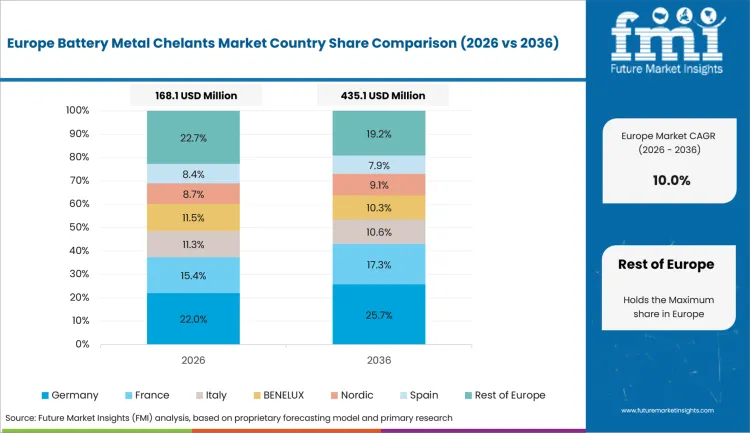
What is the Battery Metal Chelants Market outlook in Germany?
An 11.7% CAGR through 2036 reflects chemical-park infrastructure and EU recovery targets.
Country Market Snapshot Table
| Parameter | Value |
|---|---|
| Market Size in 2025 (Value) | USD 71.6 million |
| Market Size in 2026 (Value) | USD 80.0 million |
| Market Forecast in 2036 (Value) | USD 241.9 million |
| CAGR (2026 to 2036) | 11.7% |
| Years Considered | 2021 to 2036 |
| Base Year | 2025 |
| Forecast Period | 2026 to 2036 |
| Leading Application | Selective Recovery |
| Leading Sales Channel | Direct Sales |
Germany Battery Metal Chelants Market Outlook
- Germany battery metal chelants demand connects automotive recycling and EU compliance. Recyclers need metal-binding chemistry that supports industrial-scale recovery and effluent management.
- Buyers are expected to favor suppliers able to serve chemical parks and pilot-to-commercial plants. Local process engineering depth will influence chelant selection during line commissioning and wastewater design.
Key Growth Drivers
- Industrial recycling scale supports reagent demand, with cylib building a 30,000 tons-per-year battery recycling plant at Chempark Dormagen.
- European plant activity supports supplier trials, as Fraunhofer ISI said installed lithium-ion battery recycling capacity in Europe could exceed 400,000 tonnes per year by 2026.
- Automotive supply-chain integration supports qualification of recycled nickel and lithium streams.
- Chemical park infrastructure helps technical suppliers service recyclers and wastewater treatment partners.
Key Restraints
- Feedstock uncertainty can pressure plant utilization if announced recycling capacity outpaces available batteries.
- Germany’s circular economy strategy aims to reduce annual raw material use per person toward 8 tonnes by 2045, pushing recyclers to prove real material efficiency.
- High energy and labor costs can lengthen payback for reagent-intensive flowsheets.
What makes Germany unique
Germany brings chemical-park infrastructure and automotive recycling demand together, giving process-support suppliers a solid qualification route.
Key Companies
- cylib
- Duesenfeld
- Accurec Recycling
- Redux Recycling
- tozero
- BASF Schwarzheide
- Mercedes-Benz Battery Recycling
Sales & Marketing Channels
- Chemical park supply agreements
- Automotive recycler partnerships
- Process engineering consultants
- Direct technical service
- Specialty chemical distributors
- Pilot plant validation centers
Country Segment Breakdown Table
| Segment | Sub-Segments |
|---|---|
| By Chelant Type | EDTA / Aminopolycarboxylates · Citric Acid-based Chelants · Phosphonate Chelants · Biodegradable Chelants |
| By Target Metal | Lithium · Nickel / Cobalt · Manganese · Copper / Aluminum |
| By Application | Selective Recovery · Impurity Control · Wastewater Treatment · Precipitation Control |
| By End Use | Battery Recycling · Cathode Materials · Metal Refining · Chemical Processors |
| By Sales Channel | Direct Sales · Distributors · Process Integrators |
| Key Sub-Regions Covered, Industrial Corridors | North Rhine-Westphalia · Saxony · Bavaria · Baden-Wurttemberg · Hesse · Lower Saxony |
Frequently Asked Questions
How fast is Germany Battery Metal Chelants Market growing?
Germany is estimated to advance at 11.7% CAGR as chemical-park recycling capacity and automotive material recovery improve reagent qualification scope.
Who leads Germany Battery Metal Chelants Market?
cylib leads Germany Battery Metal Chelants Market, supported by Duesenfeld and Accurec Recycling across local battery recycling and materials channels.
What is driving adoption in Germany Battery Metal Chelants Market?
Chemical-park recycling plants and EU metal recovery targets are moving German buyers toward controlled chelation chemistry.
What is the Battery Metal Chelants Market outlook in France?
An 11.3% CAGR through 2036 reflects automaker circularity programs and EV battery collection networks.
Country Market Snapshot Table
| Parameter | Value |
|---|---|
| Market Size in 2025 (Value) | USD 45.8 million |
| Market Size in 2026 (Value) | USD 51.0 million |
| Market Forecast in 2036 (Value) | USD 148.9 million |
| CAGR (2026 to 2036) | 11.3% |
| Years Considered | 2021 to 2036 |
| Base Year | 2025 |
| Forecast Period | 2026 to 2036 |
| Leading Application | Selective Recovery |
| Leading Sales Channel | Direct Sales |
France Battery Metal Chelants Market Outlook
- France battery metal chelants demand is shaped by automaker-led circularity and European battery obligations. Recyclers need chemistry that can support traceable recovery and closed-loop material routing.
- Supplier access will depend on partnerships with automotive circularity groups and recycling operators. Dosing proof and wastewater compatibility will decide repeat purchasing.
Key Growth Drivers
- Automaker recycling control supports reagent qualification, with Renault Group reporting that GAIA has repaired more than 18,000 batteries since 2012.
- Hydrometallurgical recycling projects create a stronger route for chelant trials, with SUEZ and Eramet outlining full-scale plant capacity of 50,000 tonnes of modules per year, equivalent to 200,000 EV batteries.
- Closed-loop battery ambitions create demand for stable recycled lithium and cobalt salt quality.
- Recycling partners need chelants that reduce rework before recovered metals enter European battery supply chains.
Key Restraints
- Battery collection responsibility increases administrative and documentation costs for automotive groups.
- Battery due-diligence obligations can raise compliance workload for recyclers and automakers, as a 2025 European Commission proposal cites EUR 40 million as the net-turnover threshold below which certain operators are exempt.
- Project delays in regional battery valleys can slow reagent purchases before hydrometallurgical capacity reaches stable utilization.
What makes France unique
France combines automaker circularity programs and end-of-life vehicle channels, helping chelant suppliers reach battery collection networks through established recycling operators.
Key Companies
- The Future is NEUTRAL
- Orano
- SNAM
- Eramet
- SUEZ
- Veolia
- Batribox
Sales & Marketing Channels
- Automaker circularity programs
- End-of-life vehicle centers
- Direct recycler contracts
- Battery collection platforms
- Specialty chemical distributors
- Hydrometallurgical pilot projects
Country Segment Breakdown Table
| Segment | Sub-Segments |
|---|---|
| By Chelant Type | EDTA / Aminopolycarboxylates · Citric Acid-based Chelants · Phosphonate Chelants · Biodegradable Chelants |
| By Target Metal | Lithium · Nickel / Cobalt · Manganese · Copper / Aluminum |
| By Application | Selective Recovery · Impurity Control · Wastewater Treatment · Precipitation Control |
| By End Use | Battery Recycling · Cathode Materials · Metal Refining · Chemical Processors |
| By Sales Channel | Direct Sales · Distributors · Process Integrators |
| Key Sub-Regions Covered, Industrial Corridors | Grand Est · Hauts-de-France · Normandy · Auvergne-Rhone-Alpes · Paris Region · Occitanie |
Frequently Asked Questions
How fast is France Battery Metal Chelants Market growing?
France is predicted to progress at 11.3% CAGR as automaker-led battery collection and closed-loop recovery programs lift selective reagent demand.
Who leads France Battery Metal Chelants Market?
Future is NEUTRAL leads France Battery Metal Chelants Market, supported by Orano and SNAM across local battery recycling and materials channels.
What is driving adoption in France Battery Metal Chelants Market?
Automaker battery collection platforms and European recycling obligations are supporting chelant use in French recovery lines.
What is the Battery Metal Chelants Market outlook in United Kingdom?
A 10.9% CAGR through 2036 reflects critical-minerals strategy targets and early recycled battery material validation.
Country Market Snapshot Table
| Parameter | Value |
|---|---|
| Market Size in 2025 (Value) | USD 38.8 million |
| Market Size in 2026 (Value) | USD 43.0 million |
| Market Forecast in 2036 (Value) | USD 121.0 million |
| CAGR (2026 to 2036) | 10.9% |
| Years Considered | 2021 to 2036 |
| Base Year | 2025 |
| Forecast Period | 2026 to 2036 |
| Leading Application | Selective Recovery |
| Leading Sales Channel | Direct Sales |
United Kingdom Battery Metal Chelants Market Outlook
- United Kingdom battery metal chelants demand is strategy-led and linked to domestic circular supply-chain projects. Recyclers need reagents that can support recovered cathode and anode material validation.
- Early buying will concentrate around pilot refiners and government-supported demonstrators. Technical proof will carry more weight than general chemical availability during market formation.
Key Growth Drivers
- Critical mineral policy supports recycling demand, with Vision 2035 targeting 20% of annual UK critical mineral demand from recycling by 2035.
- Domestic lithium strategy supports future refining, with Vision 2035 targeting at least 50,000 tonnes of lithium carbonate equivalent produced domestically by 2035.
- Recovered battery cell validation creates a route for chelant trials across cathode active material recovery.
- Process developers need supplier support for impurity control before recovered materials move into automotive testing.
Key Restraints
- Commercial refining depth remains limited compared with continental Europe and China.
- UK strategy limits reliance on any single country to no more than 60% for critical mineral supply by 2035, which raises pressure to prove domestic routes quickly.
- Waste classification and permitting can delay black mass upgrading after collection and shredding.
What makes United Kingdom unique
United Kingdom stands out through critical-minerals strategy targets and automotive validation programs.
Key Companies
- Altilium
- Recyclus Group
- Technology Minerals
- Ecosurety
- Valpak
- RS Bruce Metals
- Cawleys
Sales & Marketing Channels
- Pilot-plant technical supply
- Automotive circularity partnerships
- Critical-minerals grant projects
- Specialty chemical distributors
- Process engineering firms
- University-linked technology programs
Country Segment Breakdown Table
| Segment | Sub-Segments |
|---|---|
| By Chelant Type | EDTA / Aminopolycarboxylates · Citric Acid-based Chelants · Phosphonate Chelants · Biodegradable Chelants |
| By Target Metal | Lithium · Nickel / Cobalt · Manganese · Copper / Aluminum |
| By Application | Selective Recovery · Impurity Control · Wastewater Treatment · Precipitation Control |
| By End Use | Battery Recycling · Cathode Materials · Metal Refining · Chemical Processors |
| By Sales Channel | Direct Sales · Distributors · Process Integrators |
| Key Sub-Regions Covered, Industrial Corridors | Plymouth · West Midlands · North East · Teesside · Oxfordshire · Scotland |
Frequently Asked Questions
How fast is United Kingdom Battery Metal Chelants Market growing?
United Kingdom is forecast to expand at 10.9% CAGR as critical-minerals strategy and pilot refining projects increase documented recovery chemistry needs.
Who leads United Kingdom Battery Metal Chelants Market?
Altilium leads United Kingdom Battery Metal Chelants Market, supported by Recyclus Group and Technology Minerals across local battery recycling and materials channels.
What is driving adoption in United Kingdom Battery Metal Chelants Market?
Domestic critical-mineral targets and black mass refining pilots are encouraging selective chelant testing.
What is the Battery Metal Chelants Market outlook in Japan?
A 10.4% CAGR through 2036 reflects battery strategy coordination and high-purity material recovery standards.
Country Market Snapshot Table
| Parameter | Value |
|---|---|
| Market Size in 2025 (Value) | USD 53.4 million |
| Market Size in 2026 (Value) | USD 59.0 million |
| Market Forecast in 2036 (Value) | USD 159.2 million |
| CAGR (2026 to 2036) | 10.4% |
| Years Considered | 2021 to 2036 |
| Base Year | 2025 |
| Forecast Period | 2026 to 2036 |
| Leading Application | Selective Recovery |
| Leading Sales Channel | Direct Sales |
Japan Battery Metal Chelants Market Outlook
- Japan battery metal chelants demand is shaped by battery strategy and quality-focused recycling routes. Buyers need recovery chemistry with low impurity risk and strong documentation.
- Adoption will favor suppliers able to prove repeatability across smaller but high-specification feedstock streams. Local recyclers and metal companies are expected to prefer technical service aligned with battery material standards.
Key Growth Drivers
- Battery strategy supports recovery chemistry demand, with METI revising domestic manufacturing-base targets to 150 GWh per year from 2030 to the mid-2030s.
- Supply-chain collaboration supports recycled material pathways as cross-border battery ecosystems require recycling and critical-mineral partners, with METI’s July 2025 conference gathering more than 200 people from over 70 companies, including 33 Battery Association for Supply Chain members.
- Trading houses and metal refiners can move recovered materials into existing quality-control systems.
- Automotive battery diagnostics support disciplined sorting before chemical recovery and chelant dosing.
Key Restraints
- Qualification cycles can be lengthy as buyers test impurity profiles against high battery-material standards.
- IEA policy tracking notes Japan’s 150 GWh battery base would require about 100,000 tonnes of lithium and 90,000 tonnes of nickel annually, raising supply pressure before recycling volumes mature.
- Aging consumer battery streams can require more pretreatment before selective recovery chemistry performs consistently.
What makes Japan unique
Japan emphasizes material quality and metal-refiner discipline, creating demand for documented chelant performance.
Key Companies
- JX Metals
- Mitsubishi Materials
- Sumitomo Metal Mining
- DOWA Eco-System
- Toyota Chemical Engineering
- 4R Energy
- JERA
Sales & Marketing Channels
- Metal refiner qualification programs
- Automaker circularity channels
- Trading house supply agreements
- Battery producer trials
- Specialty chemical distributors
- University and government research programs
Country Segment Breakdown Table
| Segment | Sub-Segments |
|---|---|
| By Chelant Type | EDTA / Aminopolycarboxylates · Citric Acid-based Chelants · Phosphonate Chelants · Biodegradable Chelants |
| By Target Metal | Lithium · Nickel / Cobalt · Manganese · Copper / Aluminum |
| By Application | Selective Recovery · Impurity Control · Wastewater Treatment · Precipitation Control |
| By End Use | Battery Recycling · Cathode Materials · Metal Refining · Chemical Processors |
| By Sales Channel | Direct Sales · Distributors · Process Integrators |
| Key Sub-Regions Covered, Industrial Corridors | Tokyo · Osaka · Aichi · Fukuoka · Kanagawa · Hyogo |
Frequently Asked Questions
How fast is Japan Battery Metal Chelants Market growing?
Japan is expected to post 10.4% CAGR as battery strategy targets and quality-focused metal refining sustain controlled separation chemistry demand.
Who leads Japan Battery Metal Chelants Market?
JX Metals leads Japan Battery Metal Chelants Market, supported by Mitsubishi Materials and Sumitomo Metal Mining across local battery recycling and materials channels.
What is driving adoption in Japan Battery Metal Chelants Market?
Battery strategy coordination and high-purity recovered material requirements are guiding Japanese chelant qualification.
Who are the leading companies in the Battery Metal Chelants Market?
BASF, Nouryon, Dow, Jungbunzlauer and Italmatch Chemicals.
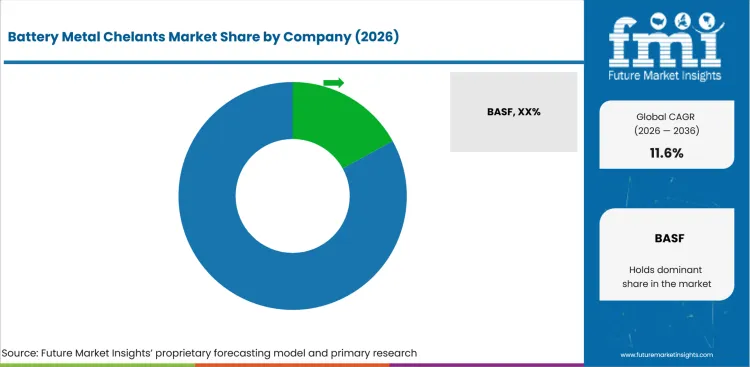
- Established chelant suppliers hold an advantage through technical documentation and plant support.
- Reagent-linked suppliers gain stronger acceptance by combining chelant families with application testing.
- Regional process chemical suppliers acquire in country markets through distributor access and wastewater treatment support.
- Service-ready suppliers improve renewal chances through dosing trials and impurity-control data.
Industrial chemical companies compete by combining metal-binding chemistry and process support programs. BASF has a strong position through Trilon chelating agents and biodegradable GLDA chemistry. Nouryon competes through chelant chemistry and global account access. Dow holds value across EDTA and aminopolycarboxylate applications.
Manufacturing and technical service depth have become stronger competitive separators as battery recyclers move beyond basic reagent purchases. Jungbunzlauer competes through organic acid products that support milder leaching routes. Italmatch Chemicals, LANXESS, Kemira, and Innospec strengthen competition across phosphonates and water treatment chemistry. Buyers compare supplier performance through recovery yield and local support records.
Smaller and regional suppliers can win through local plant knowledge and faster field support. China, India, and South Korea create openings for suppliers operating technical labs and pilot validation networks. United States and Europe create stronger demand for wastewater-compatible chemistry suited to regulated recycling plants. Companies proving lower impurity swings across changing black mass lots should gain more durable recycler relationships.
How do top Battery Metal Chelants companies compare?
BASF and Nouryon score on chelant chemistry depth while Jungbunzlauer and Italmatch Chemicals support organic acid and phosphonate use cases.
| Company | Market Title Alignment | Metal-Binding Chemistry Depth | Battery Recycling Process Suitability | Wastewater Compatibility Support | Channel Reach | Geographic Footprint |
|---|---|---|---|---|---|---|
| BASF | Very High | Very Strong | Strong | Very Strong | Very Strong | Global |
| Nouryon | Very High | Strong | Strong | Strong | Very Strong | Global |
| Dow | High | Strong | Moderate | Strong | Strong | Global |
| Jungbunzlauer | High | Moderate | Strong | Strong | Moderate | Europe and global distributors |
| Italmatch Chemicals | High | Moderate | Moderate | Strong | Strong | Europe and North America |
| LANXESS | Medium | Moderate | Moderate | Strong | Strong | Global |
| Kemira | Medium | Moderate | Low | Strong | Strong | Europe and North America |
| Innospec | Medium | Moderate | Low | Moderate | Moderate | Global |
Source: Future Market Insights competitive analysis, 2026.
Who are the key players in the Battery Metal Chelants Market?
BASF, Nouryon and Dow are listed with Jungbunzlauer and Italmatch Chemicals among other suppliers.
Key global companies leading the Battery Metal Chelants Market include:
- BASF
- Nouryon
- Dow
- Jungbunzlauer
- Italmatch Chemicals
- LANXESS
- Kemira
- Innospec
Key Developments in Battery Metal Chelants Market
- In April 2025, BASF expanded its sustainable chelating agent solutions with Trilon G, adding GLDA chemistry alongside MGDA and EDTA families for customers seeking lower persistence.
- In September 2024, cylib held the groundbreaking for its battery recycling plant at Chempark Dormagen, with planned processing capacity of 30,000 tons of end-of-life batteries per year.
- In March 2026, The Future is NEUTRAL extended its AUTOLOOP digital platform to electric vehicle traction battery collection, adding a digital route for strategic metal recovery.
Key Players in the Battery Metal Chelants Market
Chelant Formulators
- BASF
- Nouryon
- Dow
- LANXESS
Organic Acid and Biodegradable Specialists
- Jungbunzlauer
- BASF Trilon G portfolio
- Citric acid formulators
Process Chemical and Water Treatment Specialists
- Italmatch Chemicals
- Kemira
- Innospec
- Regional specialty chemical distributors
Battery Recycling Chemistry Specialists
- BASF
- Nouryon
- Jungbunzlauer
- Italmatch Chemicals
Battery Metal Chelants Market - Scope & Definition
| Attribute | Detail |
|---|---|
| Market Definition | Chemical agents used to bind, separate, stabilize, and control metal ions during battery material recovery and related processing |
| Functions Covered | Metal ion complexation, selective recovery, impurity control, precipitation control, wastewater treatment support, dosing control, and metal stream stabilization |
| Applications Covered | Lithium recovery, nickel and cobalt recovery, manganese separation, copper and aluminum impurity control, black mass refining, and cathode-material recovery |
| End-Use Industries | Battery recycling, cathode materials, metal refining, chemical processors, process integrators, and wastewater treatment contractors |
| Grades Covered | Standard industrial chelants, high-purity chelants, biodegradable chelants, phosphonate systems, organic-acid chelant blends, and process-specific reagent formulations |
| Inclusions | All commercially traded battery metal chelants across chelant type, target metal, application, end use, sales channel, and country-level battery recovery use |
| Exclusions | General mineral acids, reducing agents, solvent extraction reagents, ion-exchange resins, flotation chemicals, smelting fluxes, black mass trading, battery collection services, and recycling equipment sold without chelant chemistry |
Battery Metal Chelants Market - Research Methodology
| Method | Description |
|---|---|
| Primary Research | FMI analyst interviews with battery recyclers, cathode-material producers, metal refiners, specialty chemical distributors, process integrators, and wastewater treatment suppliers across selected markets |
| Desk Research | Review of battery recycling policy, official critical-minerals documents, chelant supplier portfolios, company product information, recycling capacity evidence, and country-level battery recovery signals |
| Market Sizing & Forecasting | Bottom-up reagent revenue approach using recycling activity estimates, chelant use rates, average reagent pricing, application support share, channel structure, and adoption by process type |
| Data Validation | Cross-verification using company portfolios, official policy targets, recycling capacity announcements, battery recovery indicators, distributor checks, and country-level recycling chemistry signals |
Battery Metal Chelants Market - Report Scope
| Parameter | Details |
|---|---|
| Forecast period | 2026 to 2036 |
| Historical period | 2021 to 2025 |
| Quantitative unit | Revenue in USD million |
| By chelant type | EDTA / Aminopolycarboxylates, Citric Acid-based Chelants, Phosphonate Chelants, Biodegradable Chelants |
| By target metal | Lithium, Nickel / Cobalt, Manganese, Copper / Aluminum |
| By application | Selective Recovery, Impurity Control, Wastewater Treatment, Precipitation Control |
| By end use | Battery Recycling, Cathode Materials, Metal Refining, Chemical Processors |
| By sales channel | Direct Sales, Distributors, Process Integrators |
| Regions covered | North America, Latin America, Europe, East Asia, South Asia and Pacific, Middle East and Africa |
| Countries covered | China, India, South Korea, United States, Germany, France, United Kingdom, Japan |
| Key companies profiled | BASF, Nouryon, Dow, Jungbunzlauer, Italmatch Chemicals, LANXESS, Kemira, Innospec |
| Approach | Bottom-up reagent revenue approach using recycling activity, chelant use rates, average reagent pricing, application support share, channel mix, and country-level battery recovery exposure |
Source: Future Market Insights competitive analysis, 2026.
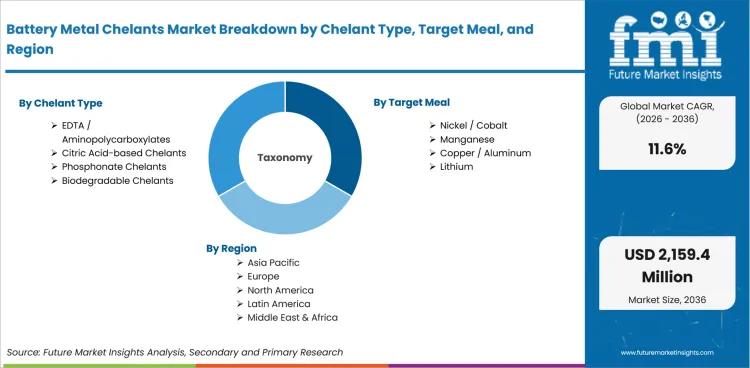
Battery Metal Chelants Market Breakdown by Chelant Type, Target Metal, Application, End Use, Sales Channel, and Region
Battery Metal Chelants Market Segmented by Chelant Type
- EDTA / Aminopolycarboxylates
- Citric Acid-based Chelants
- Phosphonate Chelants
- Biodegradable Chelants
Battery Metal Chelants Market Segmented by Target Metal
- Lithium
- Nickel / Cobalt
- Manganese
- Copper / Aluminum
Battery Metal Chelants Market Segmented by Application
- Selective Recovery
- Impurity Control
- Wastewater Treatment
- Precipitation Control
Battery Metal Chelants Market Segmented by End Use
- Battery Recycling
- Cathode Materials
- Metal Refining
- Chemical Processors
Battery Metal Chelants Market Segmented by Sales Channel
- Direct Sales
- Distributors
- Process Integrators
Battery Metal Chelants Market by Region
- North America
- Latin America
- Europe
- East Asia
- South Asia and Pacific
- Middle East and Africa
Research Sources and Bibliography
- Altilium. (2025, February 3). Altilium commences recycling of LFP EV batteries for global automotive OEM.
- Ascend Elements. (2024, December 10). Ascend Elements to increase USA production of lithium carbonate by 60% with start of new lithium recovery line in 2025.
- Ascend Elements. (2025, September 17). Ascend Elements produces recycled lithium carbonate at commercial scale.
- BASF. (2024, April 16). Recovering valuable metals in Schwarzheide: BASF has started prototype metal refinery for battery recycling.
- BASF Battery Materials. (2025, June 3). BASF starts commercial operation of black mass plant for battery recycling in Schwarzheide, Germany.
- Department for Business and Trade. (2026, January 23). Vision 2035: Critical Minerals Strategy.
- European Commission. (2025, July 4). New rules to boost recycling efficiency from waste batteries.
- GEM Co., Ltd. (2024, May 10). GEM held a 2023 full-year and 2024 Q1 performance briefing.
- German Federal Statistical Office. (2025, February 7). Production in December 2024.
- Glencore. (2025, August 8). Li-Cycle.
- India Press Information Bureau. (2025, April 1). The Ministry of Heavy Industries has successfully achieved sales of more than one million EVs in financial year 2024-25.
- India Press Information Bureau. (2025, August 11). Electronic waste management.
- India Press Information Bureau. (2025, August 21). Parliamentary question: Circular economy for batteries.
- India Press Information Bureau. (2026, January 27). NITI Aayog launched three reports on enhancing circular economy.
- International Energy Agency. (2025, May 21). Global Critical Minerals Outlook 2025.
- International Energy Agency. (2025). Electric vehicle batteries - Global EV Outlook 2025.
- International Energy Agency. (2026). Electric vehicle batteries - Global EV Outlook 2026.
- International Energy Agency. (2026). Manufacturing and trade - Global EV Outlook 2026.
- Japan Ministry of Economy, Trade and Industry. (2025, September 30). Conceptual roadmap on building an export-oriented industrial structure.
- Korea Ministry of Climate, Energy and Environment. (2025, November 4). Full-scale operation of battery recycling hub begins: Opening of the Korea Battery Circulation Cluster.
- Korea Ministry of Environment. (2024, July 10). Establishing an integrated management system for used batteries to support the formation of a new market.
- Korea Ministry of Trade, Industry and Resources. (2026, May 20). Korea to build circular battery ecosystem with used batteries.
- Mitsui & Co. (2024, May 15). Mitsui to invest in lithium-ion battery recycling plant in Japan.
- New Energy and Industrial Technology Development Organization. (2026, March 13). Recycling lithium-ion batteries: Toward mid-scale demonstration and validation.
- Redwood Materials. (2024, May 23). Redwood partners with Ultium Cells.
- Renault Group. (2025, September 26). The circular economy of electric vehicle batteries.
- State Council of the People’s Republic of China. (2025, January 2). Government policy moves from past week.
- The Future Is NEUTRAL. (2025, November 28). The Future Is NEUTRAL operates the first individual system in France for recycling electric vehicles batteries.
- United Nations Economic Commission for Europe. (2024, October 17). Battery management of EV in Korea.
- USA Department of Energy. (2024, December). Manufacturing and Energy Supply Chains Fiscal Year 2024 annual report.
This bibliography is provided for reader reference and is not exhaustive. The full report contains the complete reference list and detailed citations.
This Report Answers
- Market size estimates for 2026 and forecasts through 2036 for the Battery Leaching Reagents Market.
- Forecast CAGR analysis for battery leaching reagent demand from 2026 to 2036.
- Evaluation of reagent types, battery chemistries, process steps, end uses, and sales channels.
- Assessment of hydrometallurgical recycling plants and controlled leaching reagent requirements.
- Analysis of EU recovery rules and their effect on reagent buying and documentation.
- Country-level analysis covering India, China, United States, Germany, South Korea, France, Japan, and United Kingdom.
- Assessment of companies active across battery recycling and recovered material pathways.
- Definition of inclusions and exclusions for the Battery Leaching Reagents Market scope.
- Explanation of FMI’s forecast approach across chemistry mix and country maturity.
- Evaluation of direct bulk supply models and their role in leaching reagent purchasing.
- Regional outlooks across North America, Latin America, Europe, East Asia, South Asia and Pacific, and Middle East and Africa.
- Delivery of market data, forecasts, and supporting analysis in report-ready format.
Frequently Asked Questions
What is the growth prospect for battery metal chelants?
Demand for battery metal chelants is expected to rise at a considerable pace as battery recyclers process mixed black mass and improve selective metal recovery.
Which companies are expected to shape the battery metal chelants market?
BASF, Nouryon, Dow, Jungbunzlauer, Italmatch Chemicals, LANXESS, Kemira, and Innospec are expected to shape competition through reagent portfolios and process support.
Why are specialty chemical companies investing in battery metal chelants?
Specialty chemical companies are investing in battery metal chelants to support lithium and aluminum recovery from battery recycling circuits.
Why are direct sales channels important in the battery metal chelants market?
Direct sales channels support dosing trials and troubleshooting across battery recovery systems.
Which chelant formats are gaining attention in battery metal chelants?
EDTA / Aminopolycarboxylates and biodegradable chelants are gaining attention as recyclers compare metal yield and process stability.
How does battery recycling influence battery metal chelants demand?
Battery recycling influences demand through wastewater treatment and cathode-grade recovered salt requirements.
Why is target metal important for battery metal chelants?
Target metal is important since lithium and aluminum require different complexation and precipitation controls.
What role does Direct Sales play in battery metal chelants adoption?
Direct Sales supports adoption by combining reagent supply and process validation.
Preview the report firsthand - request a free sample
Get SampleGet the brochure for pricing and purchase details.
Get PDFTable of Content
- Key Takeaways
- Market Size and CAGR
- Top Growth Driver
- Fastest Growing Segment
- Leading Region
- Key Companies
- Emerging Opportunities
- Executive Summary
- Global Market Outlook
- Demand-side Trends
- Supply-side Trends
- Technology Roadmap Analysis
- Analysis and Recommendations
- Analyst Perspective (What is happening? Why now? What should investors know?)
- Key Questions Answered
- How large is the market?
- What is the CAGR?
- What are key trends?
- Which region dominates?
- Who are the leaders?
- Market Overview
- Market Coverage / Taxonomy
- Market Definition / Scope / Limitations
- Research Methodology
- Chapter Orientation
- Analytical Lens and Working Hypotheses
- Market Structure, Signals, and Trend Drivers
- Benchmarking and Cross-market Comparability
- Market Sizing, Forecasting, and Opportunity Mapping
- Research Design and Evidence Framework
- Desk Research Programme (Secondary Evidence)
- Expert Input and Fieldwork (Primary Evidence)
- Tooling, Models, and Reference Databases
- Data Engineering and Model Build
- Quality Assurance and Audit Trail
- Market Background
- Market Dynamics (Drivers, Restraints, Opportunity, Trends)
- Scenario Forecast (Optimistic, Likely, Conservative)
- Impact Analysis
- AI Impact
- Sustainability Impact
- Regulatory Impact
- Technology Impact
- Consumer / Buyer Analysis
- Purchase Drivers
- Adoption Barriers
- Buyer Journey
- Opportunity Map Analysis
- Product Life Cycle Analysis
- Supply Chain Analysis
- Investment Feasibility Matrix
- Value Chain Analysis
- PESTLE and Porter's Analysis
- Regulatory Landscape
- Regional Parent Market Outlook
- Production and Consumption Statistics
- Import and Export Statistics
- Global Market Analysis and Forecast, 2021 to 2036
- Historical Market Size Value (USD Million) & Volume (Unit) Analysis, 2021 to 2025
- Current and Future Market Size Value (USD Million) & Volume (Unit) Projections, 2026 to 2036
- Y-o-Y Growth Trend Analysis
- Absolute $ Opportunity Analysis
- Global Market Pricing Analysis, 2021 to 2036
- Global Market Analysis and Forecast, By Chelant Type, 2021 to 2036
- Introduction / Key Findings
- Historical Market Size Value (USD Million) & Volume (Unit) Analysis By Chelant Type, 2021 to 2025
- Current and Future Market Size Value (USD Million) & Volume (Unit) Analysis and Forecast By Chelant Type, 2026 to 2036
- EDTA / Aminopolycarboxylates
- Citric Acid-based Chelants
- Phosphonate Chelants
- Biodegradable Chelants
- EDTA / Aminopolycarboxylates
- Y-o-Y Growth Trend Analysis By Chelant Type, 2021 to 2025
- Absolute $ Opportunity Analysis By Chelant Type, 2026 to 2036
- Global Market Analysis and Forecast, By Target Meal, 2021 to 2036
- Introduction / Key Findings
- Historical Market Size Value (USD Million) & Volume (Unit) Analysis By Target Meal, 2021 to 2025
- Current and Future Market Size Value (USD Million) & Volume (Unit) Analysis and Forecast By Target Meal, 2026 to 2036
- Nickel / Cobalt
- Manganese
- Copper / Aluminum
- Lithium
- Nickel / Cobalt
- Y-o-Y Growth Trend Analysis By Target Meal, 2021 to 2025
- Absolute $ Opportunity Analysis By Target Meal, 2026 to 2036
- Global Market Analysis and Forecast, By Application, 2021 to 2036
- Introduction / Key Findings
- Historical Market Size Value (USD Million) & Volume (Unit) Analysis By Application, 2021 to 2025
- Current and Future Market Size Value (USD Million) & Volume (Unit) Analysis and Forecast By Application, 2026 to 2036
- Selective Recovery
- Impurity Control
- Wastewater Treatment
- Precipitation Control
- Selective Recovery
- Y-o-Y Growth Trend Analysis By Application, 2021 to 2025
- Absolute $ Opportunity Analysis By Application, 2026 to 2036
- Global Market Analysis and Forecast, By End Use, 2021 to 2036
- Introduction / Key Findings
- Historical Market Size Value (USD Million) & Volume (Unit) Analysis By End Use, 2021 to 2025
- Current and Future Market Size Value (USD Million) & Volume (Unit) Analysis and Forecast By End Use, 2026 to 2036
- Battery Recycling
- Cathode Materials
- Metal Refining
- Chemical Processors
- Battery Recycling
- Y-o-Y Growth Trend Analysis By End Use, 2021 to 2025
- Absolute $ Opportunity Analysis By End Use, 2026 to 2036
- Global Market Analysis and Forecast, By Sales Channel, 2021 to 2036
- Introduction / Key Findings
- Historical Market Size Value (USD Million) & Volume (Unit) Analysis By Sales Channel, 2021 to 2025
- Current and Future Market Size Value (USD Million) & Volume (Unit) Analysis and Forecast By Sales Channel, 2026 to 2036
- Direct Sales
- Distributors
- Process Integrators
- Direct Sales
- Y-o-Y Growth Trend Analysis By Sales Channel, 2021 to 2025
- Absolute $ Opportunity Analysis By Sales Channel, 2026 to 2036
- Global Market Analysis and Forecast, By Region, 2021 to 2036
- Introduction
- Historical Market Size Value (USD Million) & Volume (Unit) Analysis By Region, 2021 to 2025
- Current Market Size Value (USD Million) & Volume (Unit) Analysis and Forecast By Region, 2026 to 2036
- North America
- Latin America
- Western Europe
- Eastern Europe
- East Asia
- South Asia and Pacific
- Middle East & Africa
- Market Attractiveness Analysis By Region
- North America Market Analysis and Forecast, By Country, 2021 to 2036
- Historical Market Size Value (USD Million) & Volume (Unit) Trend Analysis By Market Taxonomy, 2021 to 2025
- Market Size Value (USD Million) & Volume (Unit) Forecast By Market Taxonomy, 2026 to 2036
- By Country
- USA
- Canada
- Mexico
- By Chelant Type
- By Target Meal
- By Application
- By End Use
- By Sales Channel
- By Country
- Market Attractiveness Analysis
- By Country
- By Chelant Type
- By Target Meal
- By Application
- By End Use
- By Sales Channel
- Key Takeaways
- Latin America Market Analysis and Forecast, By Country
- Historical Market Size Value (USD Million) & Volume (Unit) Trend Analysis By Market Taxonomy, 2021 to 2025
- Market Size Value (USD Million) & Volume (Unit) Forecast By Market Taxonomy, 2026 to 2036
- By Country
- Brazil
- Chile
- Rest of Latin America
- By Chelant Type
- By Target Meal
- By Application
- By End Use
- By Sales Channel
- By Country
- Market Attractiveness Analysis
- By Country
- By Chelant Type
- By Target Meal
- By Application
- By End Use
- By Sales Channel
- Key Takeaways
- Western Europe Market Analysis and Forecast, By Country
- Historical Market Size Value (USD Million) & Volume (Unit) Trend Analysis By Market Taxonomy, 2021 to 2025
- Market Size Value (USD Million) & Volume (Unit) Forecast By Market Taxonomy, 2026 to 2036
- By Country
- Germany
- UK
- Italy
- Spain
- France
- Nordic
- BENELUX
- Rest of Western Europe
- By Chelant Type
- By Target Meal
- By Application
- By End Use
- By Sales Channel
- By Country
- Market Attractiveness Analysis
- By Country
- By Chelant Type
- By Target Meal
- By Application
- By End Use
- By Sales Channel
- Key Takeaways
- Eastern Europe Market Analysis and Forecast, By Country
- Historical Market Size Value (USD Million) & Volume (Unit) Trend Analysis By Market Taxonomy, 2021 to 2025
- Market Size Value (USD Million) & Volume (Unit) Forecast By Market Taxonomy, 2026 to 2036
- By Country
- Russia
- Poland
- Hungary
- Balkan & Baltic
- Rest of Eastern Europe
- By Chelant Type
- By Target Meal
- By Application
- By End Use
- By Sales Channel
- By Country
- Market Attractiveness Analysis
- By Country
- By Chelant Type
- By Target Meal
- By Application
- By End Use
- By Sales Channel
- Key Takeaways
- East Asia Market Analysis and Forecast, By Country
- Historical Market Size Value (USD Million) & Volume (Unit) Trend Analysis By Market Taxonomy, 2021 to 2025
- Market Size Value (USD Million) & Volume (Unit) Forecast By Market Taxonomy, 2026 to 2036
- By Country
- China
- Japan
- South Korea
- By Chelant Type
- By Target Meal
- By Application
- By End Use
- By Sales Channel
- By Country
- Market Attractiveness Analysis
- By Country
- By Chelant Type
- By Target Meal
- By Application
- By End Use
- By Sales Channel
- Key Takeaways
- South Asia and Pacific Market Analysis and Forecast, By Country
- Historical Market Size Value (USD Million) & Volume (Unit) Trend Analysis By Market Taxonomy, 2021 to 2025
- Market Size Value (USD Million) & Volume (Unit) Forecast By Market Taxonomy, 2026 to 2036
- By Country
- India
- ASEAN
- Australia & New Zealand
- Rest of South Asia and Pacific
- By Chelant Type
- By Target Meal
- By Application
- By End Use
- By Sales Channel
- By Country
- Market Attractiveness Analysis
- By Country
- By Chelant Type
- By Target Meal
- By Application
- By End Use
- By Sales Channel
- Key Takeaways
- Middle East & Africa Market Analysis and Forecast, By Country
- Historical Market Size Value (USD Million) & Volume (Unit) Trend Analysis By Market Taxonomy, 2021 to 2025
- Market Size Value (USD Million) & Volume (Unit) Forecast By Market Taxonomy, 2026 to 2036
- By Country
- Kingdom of Saudi Arabia
- Other GCC Countries
- Türkiye
- South Africa
- Other African Union
- Rest of Middle East & Africa
- By Chelant Type
- By Target Meal
- By Application
- By End Use
- By Sales Channel
- By Country
- Market Attractiveness Analysis
- By Country
- By Chelant Type
- By Target Meal
- By Application
- By End Use
- By Sales Channel
- Key Takeaways
- Key Countries Market Analysis
- USA
- Pricing Analysis
- Market Share Analysis, 2025
- By Chelant Type
- By Target Meal
- By Application
- By End Use
- By Sales Channel
- Canada
- Pricing Analysis
- Market Share Analysis, 2025
- By Chelant Type
- By Target Meal
- By Application
- By End Use
- By Sales Channel
- Mexico
- Pricing Analysis
- Market Share Analysis, 2025
- By Chelant Type
- By Target Meal
- By Application
- By End Use
- By Sales Channel
- Brazil
- Pricing Analysis
- Market Share Analysis, 2025
- By Chelant Type
- By Target Meal
- By Application
- By End Use
- By Sales Channel
- Chile
- Pricing Analysis
- Market Share Analysis, 2025
- By Chelant Type
- By Target Meal
- By Application
- By End Use
- By Sales Channel
- Germany
- Pricing Analysis
- Market Share Analysis, 2025
- By Chelant Type
- By Target Meal
- By Application
- By End Use
- By Sales Channel
- UK
- Pricing Analysis
- Market Share Analysis, 2025
- By Chelant Type
- By Target Meal
- By Application
- By End Use
- By Sales Channel
- Italy
- Pricing Analysis
- Market Share Analysis, 2025
- By Chelant Type
- By Target Meal
- By Application
- By End Use
- By Sales Channel
- Spain
- Pricing Analysis
- Market Share Analysis, 2025
- By Chelant Type
- By Target Meal
- By Application
- By End Use
- By Sales Channel
- France
- Pricing Analysis
- Market Share Analysis, 2025
- By Chelant Type
- By Target Meal
- By Application
- By End Use
- By Sales Channel
- India
- Pricing Analysis
- Market Share Analysis, 2025
- By Chelant Type
- By Target Meal
- By Application
- By End Use
- By Sales Channel
- ASEAN
- Pricing Analysis
- Market Share Analysis, 2025
- By Chelant Type
- By Target Meal
- By Application
- By End Use
- By Sales Channel
- Australia & New Zealand
- Pricing Analysis
- Market Share Analysis, 2025
- By Chelant Type
- By Target Meal
- By Application
- By End Use
- By Sales Channel
- China
- Pricing Analysis
- Market Share Analysis, 2025
- By Chelant Type
- By Target Meal
- By Application
- By End Use
- By Sales Channel
- Japan
- Pricing Analysis
- Market Share Analysis, 2025
- By Chelant Type
- By Target Meal
- By Application
- By End Use
- By Sales Channel
- South Korea
- Pricing Analysis
- Market Share Analysis, 2025
- By Chelant Type
- By Target Meal
- By Application
- By End Use
- By Sales Channel
- Russia
- Pricing Analysis
- Market Share Analysis, 2025
- By Chelant Type
- By Target Meal
- By Application
- By End Use
- By Sales Channel
- Poland
- Pricing Analysis
- Market Share Analysis, 2025
- By Chelant Type
- By Target Meal
- By Application
- By End Use
- By Sales Channel
- Hungary
- Pricing Analysis
- Market Share Analysis, 2025
- By Chelant Type
- By Target Meal
- By Application
- By End Use
- By Sales Channel
- Kingdom of Saudi Arabia
- Pricing Analysis
- Market Share Analysis, 2025
- By Chelant Type
- By Target Meal
- By Application
- By End Use
- By Sales Channel
- Türkiye
- Pricing Analysis
- Market Share Analysis, 2025
- By Chelant Type
- By Target Meal
- By Application
- By End Use
- By Sales Channel
- South Africa
- Pricing Analysis
- Market Share Analysis, 2025
- By Chelant Type
- By Target Meal
- By Application
- By End Use
- By Sales Channel
- USA
- Market Structure Analysis
- Competition Dashboard
- Competition Benchmarking
- Market Share Analysis of Top Players
- By Regional
- By Chelant Type
- By Target Meal
- By Application
- By End Use
- By Sales Channel
- Emerging Startups
- Innovation Benchmarking
- Competition Analysis
- Competition Deep Dive
- BASF
- Overview
- Product Portfolio
- Profitability by Market Segments (Product/Region/Sales Channel)
- Sales Footprint
- Strategy Overview
- Marketing Strategy
- Product Strategy
- Channel Strategy
- Nouryon
- Dow
- Jungbunzlauer
- Italmatch Chemicals
- LANXESS
- Kemira
- Innospec
- BASF
- Case Studies
- Success Stories
- Recent Developments
- Competition Deep Dive
- Assumptions & Acronyms Used


