

- Market Size (2026)
- USD 2.1 Bn
- Forecast (2036)
- USD 3.6 Bn
- CAGR (2026 to 2036)
- 5.2%
How big is Metal Solvent Extraction Reagents Market in 2026?
USD 2.1 billion in 2026 and USD 3.6 billion by 2036 at a 5.2% CAGR.
Demand for metal solvent extraction reagents is projected to expand at a 5.2% CAGR between 2026 and 2036, increasing valuation from USD 2.1 billion to USD 3.6 billion. Copper hydrometallurgy requires repeat reagent use during each operating cycle, and the Australian Department of Industry reported in June 2026 that acid-based SX-EW operations produce about 20% of world refined copper. Installed SX-EW capacity ties reagent replenishment to leach throughput and organic-phase operating condition during operations.
Project maturity determines how quickly new mine investment converts into solvent-extraction reagent orders at operating sites. In February 2026 the Australian Government identified 49 mines and 29 midstream processing projects seeking investment in its critical-minerals prospectus. Australia needs downstream processing capacity before reagents become routine inputs, while Chile's mature copper base shortens the conversion gap compared with Peru and Japan.
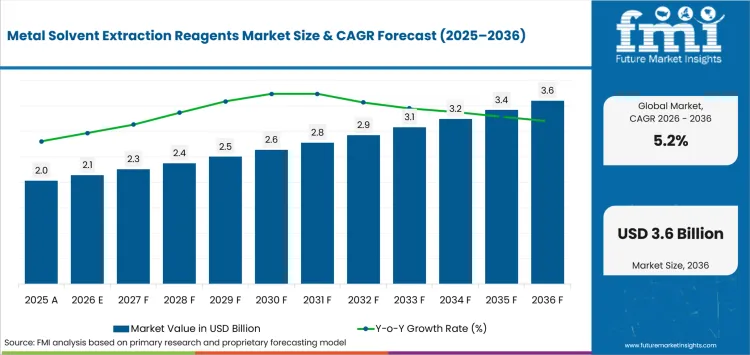
Key Takeaways of Metal Solvent Extraction Reagents Market
- Hydrometallurgical copper and critical-mineral circuits require repeat reagent use to preserve selective metal transfer as feed chemistry changes.
- By reagent type, oxime extractants are estimated to hold 34.0% in 2026 owing to their fit with acidic copper loading and stripping.
- Copper is projected to hold 38.0% share in 2026 owing to continuous leach-SX-EW processing that consumes extractants during routine recovery.
- In 2026, extraction is expected to lead the circuit stage category with 45.0% share because initial loading controls downstream impurity rejection.
- Feed variability and organic-phase degradation delay reagent substitution until metallurgical teams prove stable recovery under representative production conditions.
- Some of the key players in this market include Solvay, BASF, Clariant, Nouryon, Dow, Lanxess, Orica, Chevron Phillips Chemical, Syensqo's former Cytec product lines, and KopperChem.
Analyst Perspective
"Plant economics should be tested against copper transfer and impurity rejection before metallurgical teams compare reagent prices. Commercial value depends on qualification speed because unstable organic phases can raise reagent losses and compromise electrolyte quality."
- Nikhil Kaitwade, Principal Consultant, Future Market Insights
How is the Metal Solvent Extraction Reagents Market segmented?
The metal solvent extraction reagents market is segmented by reagent type, metal, circuit stage, end use, sales channel and region.
Reagent type covers oxime, organophosphorus, amine and chelating extractants with modifier blends for organic-phase control. Metal covers copper, cobalt, nickel, rare earths, uranium and zinc within the defined solvent-extraction boundary. Circuit stage covers extraction, scrubbing, stripping support and organic-phase conditioning during liquid-liquid metal separation. End use covers SX-EW plants, hydrometallurgy refineries, rare earth processors and battery metal projects. Sales channel covers direct plant contracts, specialty reagent suppliers, technical service packages and regional distributors.
Why do oxime extractants account for the stated share within the reagent type category?
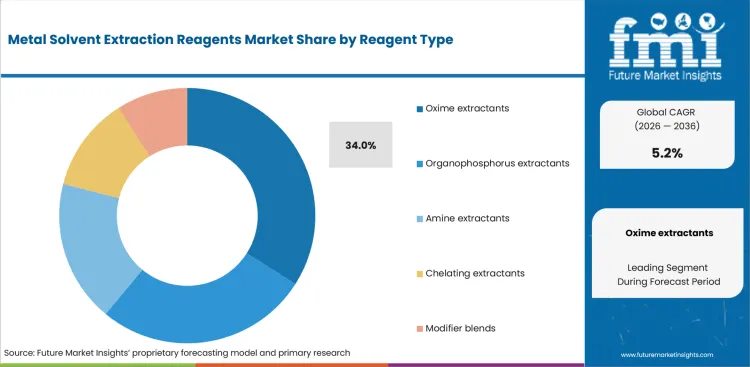
Copper leach circuits need oxime formulations that load copper at low pH without excessive impurity transfer during site qualification and routine operation.
- By reagent type, oxime extractants are estimated to hold 34.0% in 2026 owing to their fit with copper loading and stripping requirements.
- "BASF announced in May 2025 that it would relocate its global leaching R&D activities from Tucson, Arizona, to Houston, Texas, and separately decentralize its technical and analytical capabilities for solvent extraction and electrowinning closer to customers. The change keeps extraction reagent demand tied to site-specific analytical evidence before a plant approves formulation changes.
Why does copper account for the stated share within the metal category?
Copper leach-SX-EW flowsheets transfer metal from acidic solution into electrolyte before electrowinning and make reagent choice central to recovery and impurity control.
- Copper is forecast to represent 38.0% of the metal category in 2026, driven by the installed scale of copper leach-SX-EW flowsheets.
- COCHILCO recorded 5,415.2 kMT of Chilean mine copper production during 2025 in its May 2026 bulletin. That production base keeps solvent extraction stripping agents relevant because copper recovery must remain controlled before electrowinning.
Why does extraction account for the stated share within the circuit stage category?
The extraction contact determines initial metal loading into the organic phase and leaves downstream scrubbing and stripping to refine the transferred stream.
- Extraction is estimated to capture 45.0% of the circuit stage category in 2026 owing to its control over initial loading and impurity transfer.
- COCHILCO recorded 1,140.6 kMT of Chilean SX-EW cathode output during 2025 in its May 2026 bulletin. Production at that scale keeps solvent extraction diluents relevant because phase disengagement must stay stable during organic recycle.
Why do SX-EW plants account for the stated share within the end use category?
SX-EW plants use extractants continuously before electrowinning and organic-phase stability directly affects electrolyte quality under changing acidity and impurity loads.
- By end use, SX-EW plants are projected to account for 46.0% in 2026 attributable to their continuous dependence on solvent-extraction chemistry.
- COCHILCO recorded 368.6 kMT of Chilean SX-EW cathodes during January-April 2026 in its May bulletin. The operating base keeps beneficiation reagent supply sensitive to site inventory and circuit troubleshooting as feed chemistry changes.
Why do direct plant contracts account for the stated share within the sales channel category?
Direct plant contracts carry more value where reagent supply includes assay work and trial interpretation because a poor chemistry transition can reduce operating throughput.
- In 2026, direct plant contracts are expected to represent 51.0% of the sales channel category because technical support and supply planning are purchased together.
- BASF announced in June 2025 that it would keep Australian hydrometallurgy sales direct and shift selected flotation products to FUCHS. The split shows why mining flotation chemicals can use distribution partners without moving solvent-extraction support away from the producer.
What are the drivers, restraints and opportunities in the Metal Solvent Extraction Reagents Market?
Demand rises with selective copper and critical-mineral recovery while project conversion and circuit qualification slow reagent switching and favor metal-specific chemistry.
- Driver: Higher copper and critical-mineral throughput increases the number of circuits that require selective liquid-liquid metal transfer under variable feed conditions.
- Restraint: Early-stage projects and plant-specific organic-phase behavior delay reagent conversion until commissioning progress and circuit performance are demonstrated.
- Opportunity: Rare-earth and battery-metal purification requires chemistry that separates target ions from closely related impurities at commercial flow rates.
Copper supply must serve a larger electrical load that raises the value of selective hydrometallurgical recovery. The IEA projected in May 2025 that copper demand would rise about 30% by 2040 under stated policies. Planned circuits therefore increase extractant qualification work as flotation reagent programs compete for technical attention at the same processing sites.
Project announcements become reagent orders once engineering and financing produce committed processing capacity in practice. Australia counted 130 critical-minerals projects in its 2025 pipeline but only ten had reached the committed stage. That gap lengthens qualification and requires lithium mining projects to be tracked against commissioning evidence instead of headline counts.
Rare-earth and battery-metal circuits require selective separation before high-purity intermediates move into downstream manufacturing. The IEA projected rare-earth demand to rise roughly 50% to 60% by 2040 in May 2025. The forecast favors extractants in rare earth metals processing that prove separation factors under representative impurity loads.
Which country CAGRs are covered in the Metal Solvent Extraction Reagents Market?
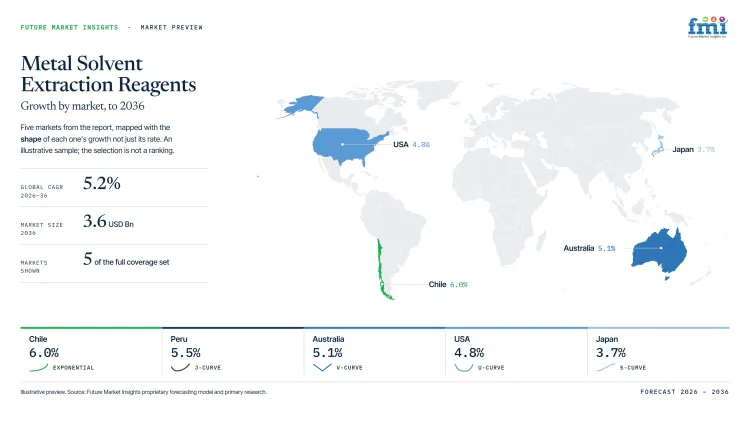
| Country | CAGR |
|---|---|
| Chile | 6.0% |
| Peru | 5.5% |
| Australia | 5.1% |
| South Africa | 5.0% |
| Canada | 4.9% |
| USA | 4.8% |
| Japan | 3.7% |
How do country-level CAGRs compare in the Metal Solvent Extraction Reagents Market?
Chile and Peru form the upper forecast group because copper processing gives solvent extraction a direct operating role. Australia through USA form a narrow 5.1% to 4.8% group where project maturity and service distance shape order timing. Japan at 3.7% depends more on high-purity separation than domestic mine scale for reagent demand.
- Chile's operating circuit base gives reagent companies more brownfield service work than greenfield qualification exposure.
- Peru's copper pipeline depends on investment projects becoming commissioned plants before routine reagent purchasing starts commercially.
- Australia's multi-metal project mix requires reagent companies to handle more flowsheets than copper-only portfolios.
- South Africa's metallurgical skills reduce staffing constraints for beneficiation projects that proceed into commercial plant trials.
- Canada's multi-metal project mix prevents one commodity from dominating solvent-extraction qualification and application support.
- US reagent demand depends more on downstream processing investment than mine output during project development cycles.
- Japan relies more on overseas resource partnerships than a broad domestic mining footprint for critical minerals.
Similar CAGRs can produce different sales conditions because installed circuits determine how quickly qualification becomes repeat purchasing. The full report provides country-level CAGR analysis for North America, Latin America, Western Europe, Eastern Europe, East Asia, South Asia and Pacific, and the Middle East and Africa.
Country-wise Analysis
- Chilean SX-EW plants run continuous leach and electrowinning schedules that make organic stability and local replenishment commercially important. Demand for metal solvent extraction reagents in Chile is forecast to expand at 6.0% CAGR through 2036 owing to the installed copper-processing base. COCHILCO reported in May 2026 that SX-EW cathode output during January-April was 3.3% below the prior-year period. Lower oxide-derived output increases pressure on plant teams to protect recovery as feed conditions shift without extending circuit downtime. Regional stock and rapid troubleshooting during operating changes favor reagent companies that can support circuits without assuming every copper feed requires identical chemistry.
- Peruvian reagent demand depends on converting a broad mining pipeline into operating hydrometallurgical circuits with stable feed plans. The Ministry of Energy and Mines documented 66 mining investment projects spread through 19 departments in June 2026. Demand for metal solvent extraction reagents in Peru is projected to grow at 5.5% CAGR during the assessment period driven by copper-led development. Local metallurgical teams can run staged trials near new projects although uneven commissioning dates keep commercial conversion uncertain. Ore-specific impurity profiles and site water chemistry can delay full use until operators confirm loading strength and phase behavior under representative solution chemistry.
- Australian plants operate within a mature mining-services network but long transport distances complicate specialty reagent replenishment at remote sites. The 2025 Resources and Energy Major Projects report counted 65 critical-minerals projects in Western Australia from a national pipeline of 130. Field laboratories and regional service contractors can shorten bench-to-plant qualification for multi-metal flowsheets near active mines. Demand for metal solvent extraction reagents in Australia is anticipated to advance at 5.1% CAGR over the forecast period attributable to diversified processing. Remote logistics and variable water chemistry favor companies that maintain regional stock consistently and adjust formulations without repeated long-distance trial cycles.
- South Africa is directing more critical-mineral value toward domestic beneficiation instead of relying solely on raw mineral exports. Demand for metal solvent extraction reagents in South Africa is forecast to rise at 5.0% CAGR through 2036 supported by local processing ambitions. In March 2026 the South African Government stated that its Critical Minerals and Metals Strategy includes expanded beneficiation special economic zones. Existing mining clusters provide technical talent for reagent trials although electricity constraints and project finance can delay new processing capacity. Near-term reagent sales depend more heavily on operating plants than policy announcements that have not reached commissioned production.
- Canadian metal processing spans operating mines and a broad development pipeline that divides reagent work between production support and project qualification. Canada reported in February 2026 that it had 56 active critical-mineral mines and 31 processing facilities as of March 2025. Demand for metal solvent extraction reagents in Canada is predicted to advance at 4.9% CAGR through 2036 driven by new processing routes. Remote infrastructure and long project timelines can slow trial conversion before repeat chemical purchasing becomes commercially justified. Technical teams familiar with ion exchange resins can position solvent extraction where liquid-liquid selectivity fits the intended flowsheet more closely.
- US reagent demand draws from operating base-metal sites and new domestic critical-mineral projects that must pass long development cycles before routine chemical consumption begins. Permitting and financing can delay the point where a proposed plant becomes a repeat customer for specialized extraction chemistry. The USA Geological Survey reported in February 2026 that national mineral production value increased 5.6% during 2025. Demand for metal solvent extraction reagents in USA is estimated to grow at 4.8% CAGR over the assessment period supported by processing investment. Application laboratories and regional distribution can shorten qualification once projects reach pilot or commissioning stages with stable solution chemistry.
- Japanese demand concentrates on secure high-purity processing because domestic mine supply is limited for several critical minerals. Demand for metal solvent extraction reagents in Japan is projected to record 3.7% CAGR during the forecast period driven by rare-earth supply security. JOGMEC and Toyota Tsusho established a special-purpose company for the Lofdal heavy rare-earth project in July 2026. Imported feed places tighter consistency requirements on purification because closely related rare-earth ions require repeated separation before high-purity products can ship. Chemistry that also fits battery materials recycling gives Japanese processors another commercial route for recovering high-value metals from controlled secondary feed streams.
Who are the notable companies in the Metal Solvent Extraction Reagents Market?
Solvay, BASF, Clariant, Nouryon, Dow, Lanxess, Orica, Chevron Phillips Chemical, Syensqo's former Cytec product lines and KopperChem are the notable companies serving this market.
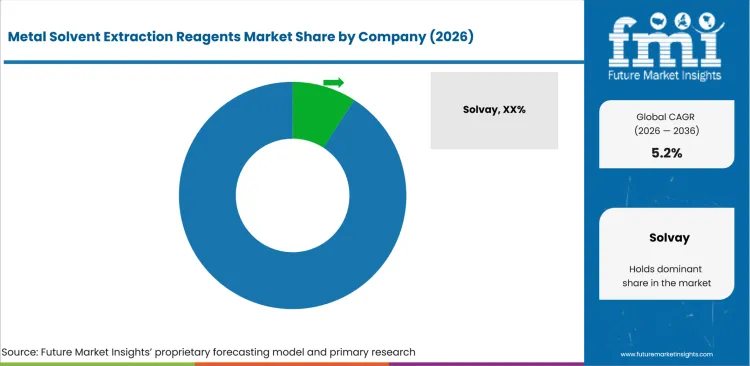
Competition separates dedicated solvent-extraction chemistry from broader mining reagents and adjacent inputs used near the same circuits. Metallurgical teams expect metal-specific formulations and local analytical support before they approve formulation changes. Legacy ownership also makes several portfolios harder to compare directly with current corporate structures.
- BASF and Orica hold direct hydrometallurgical reagent positions, while KopperChem and Syensqo's former Cytec product lines represent dedicated or successor solvent-extraction chemistry.
- Clariant and Nouryon cover adjacent mining chemistry, while Lanxess and Chevron Phillips Chemical provide competing separation or organic-phase inputs.
- Solvay and Dow require boundary treatment because current portfolios differ from specialty-extractant positions associated with earlier corporate structures.
Competitive Benchmarking: Metal Solvent Extraction Reagents Market
| Company | SX Extractant Breadth | Circuit Technical Support | Hydrometallurgy Integration | Geographic Reach |
|---|---|---|---|---|
| Solvay | Low | Low | Low | Global essential-chemistry footprint |
| BASF | High | High | High | Global |
| Clariant | Low | High | Medium | Global |
| Nouryon | Low | Medium | Medium | Global |
| Dow | Low | Low | Low | Global |
| Lanxess | Low | High | Medium | Global |
| Orica | High | High | High | Global mining regions |
| Chevron Phillips Chemical | Medium | Medium | Medium | Americas, Europe and Asia Pacific |
| Syensqo's former Cytec product lines | High | High | High | Global through successor portfolio |
| KopperChem | High | High | High | Asia and international mining markets |
Key Developments in the Metal Solvent Extraction Reagents Market
- In April 2026, Orica expanded its OptiOre range into copper processing chemistry through the acquisition of the Danafloat™ collector product range from FMC Corporation, targeting sulphide ore flotation for copper and other future-facing commodities.
- In May 2025, KopperChem disclosed an expansion project that would raise oxime metal-extractant preparation capacity from 5 kt/a to 15 kt/a.
- In March 2025, LANXESS introduced Lewatit MK51 for high-purity battery-metal concentrate purification where ion exchange competes with solvent extraction.
Key Players in the Metal Solvent Extraction Reagents Market
Direct Solvent Extraction and Hydrometallurgy Platforms
- BASF
- Orica
- Syensqo's former Cytec product lines
- KopperChem
Adjacent Mining and Separation Chemistry
- Clariant
- Nouryon
- Lanxess
- Chevron Phillips Chemical
Scope-Boundary and Legacy Portfolio Positions
- Solvay
- Dow
Metal Solvent Extraction Reagents Market - Report Scope
| Coverage field | Report scope |
|---|---|
| Market breakdown | By reagent type, metal, circuit stage, end use, sales channel and region. |
| Quantitative Units | Revenue in USD billion and CAGR in %. |
| Market Definition | Market revenue covers active organic-phase reagents sold for selective metal transfer or organic-phase conditioning in liquid-liquid solvent extraction circuits. It includes oxime, organophosphorus, amine and chelating extractants plus modifier blends. It excludes stand-alone hydrocarbon diluents, ion-exchange resins, flotation reagents, leaching agents, electrowinning chemicals, process equipment and downstream refined metals. |
| Regions Covered | North America, Latin America, Western Europe, Eastern Europe, East Asia, South Asia and Pacific and Middle East and Africa. |
| Countries Covered | Chile, Peru, Australia, South Africa, Canada, USA, Japan, and 20+ countries included in the full report. |
| Key Companies | Solvay, BASF, Clariant, Nouryon, Dow, Lanxess, Orica, Chevron Phillips Chemical, Syensqo's former Cytec product lines, KopperChem. |
| Forecast Period | 2026 to 2036. |
| Approach | Primary and secondary research with market triangulation. |
Metal Solvent Extraction Reagents Market - Research Methodology
| Method | Approach |
|---|---|
| Primary Research | FMI analysts gathered input from manufacturers, service providers, technology developers, distributors, end users, procurement teams, and subject-matter experts. Interviews examined purchasing decisions, product or service evaluation, adoption barriers, approval requirements, pricing considerations, and expectations for technical or commercial support. Respondents were also asked what evidence is required before a trial, pilot, or initial order develops into regular purchasing. |
| Desk Research | Desk research covered government statistics, regulatory publications, trade data, industry associations, technical literature, standards, company filings, product information, and official corporate announcements. Sources were reviewed for relevance, publication date, geographic coverage, and consistency with the defined market scope. Claims relating to performance, applications, approvals, capacity, investment, and commercial activity were retained only when supported by credible public evidence. |
| Market Sizing and Forecasting | The market model combined the baseline value with historical performance, segment structure, pricing and volume indicators, adoption levels, company participation, and country-level demand conditions. Forecast assumptions considered economic activity, investment trends, regulatory developments, technology adoption, purchasing cycles, supply availability, and barriers to wider market use. Segment and regional estimates were reconciled before the final market total was calculated. |
| Data Validation | Estimates were checked against multiple independent indicators, including public data, company activity, trade patterns, industry developments, and findings from primary interviews. Validation also tested whether products, services, applications, and company revenues fell within the defined market boundaries. Adjacent categories, unsupported claims, overlapping revenues, and activities without direct market relevance were excluded to reduce double counting and maintain consistency across segments and countries. |
Metal Solvent Extraction Reagents Market by Segments
Metal Solvent Extraction Reagents Market segmented by Reagent Type:
- Oxime extractants
- Organophosphorus extractants
- Amine extractants
- Chelating extractants
- Modifier blends
Metal Solvent Extraction Reagents Market segmented by Metal:
- Copper
- Cobalt
- Nickel
- Rare earths
- Uranium
- Zinc
Metal Solvent Extraction Reagents Market segmented by Circuit Stage:
- Extraction
- Scrubbing
- Stripping support
- Organic-phase conditioning
Metal Solvent Extraction Reagents Market segmented by End Use:
- SX-EW plants
- Hydrometallurgy refineries
- Rare earth processors
- Battery metal projects
Metal Solvent Extraction Reagents Market segmented by Sales Channel:
- Direct plant contracts
- Specialty reagent suppliers
- Technical service packages
- Regional distributors
Metal Solvent Extraction Reagents Market by Region:
- North America
- USA
- Canada
- Latin America
- Brazil
- Mexico
- Argentina
- Chile
- Western Europe
- Germany
- France
- United Kingdom
- Italy
- Spain
- Benelux
- Nordics
- Eastern Europe
- Poland
- Czech Republic
- Romania
- Hungary
- East Asia
- China
- Japan
- South Korea
- South Asia and Pacific
- India
- ASEAN
- Australia and New Zealand
- Middle East and Africa
- GCC Countries
- South Africa
- Türkiye
- Israel
Research Sources and Bibliography
- Department of Industry, Science and Resources. (2026, July 3). Resources and energy quarterly: June 2026.
- Australian Government Department of Industry, Science and Resources. (2026, February 4). Opportunities abound in Australian critical minerals.
- Chilean Copper Commission. (2026, May). Boletín mensual: Producción chilena de cobre por productos - anual y mensual.
- BASF. (2025, May 20). BASF Mining Solutions strengthens commitment to copper hydrometallurgy and flotation research and development.
- BASF. (2025, June 18). BASF Mining Solutions and FUCHS announce cooperation to serve the Australian mining industry.
- International Energy Agency. (2025, May 21). Global Critical Minerals Outlook 2025: Overview of outlook for key minerals.
- Department of Industry, Science and Resources. (2025, December). Resources and Energy Major Projects report 2025.
- Ministerio de Energía y Minas. (2026, June 17). Cartera de Proyectos de Inversión Minera 2026.
- Government of Canada. (2026, February). Canada's Critical Minerals Strategy: Progress update.
- USA Geological Survey. (2026, February 6). Value of USA mineral production rose last year, driven by precious metals prices.
- South African Government. (2026, March 19). Deputy President Paul Mashatile: Oral replies to questions in National Assembly.
- Japan Organization for Metals and Energy Security. (2026, July 30). Establishment of a Special Purpose Company for Heavy Rare Earth Development in the Republic of Namibia and Investment by JOGMEC.
- Syensqo. (2025, July 24). Syensqo and cylib reach a milestone in lithium recovery from spent electric vehicle batteries.
- Orica. (2025, November 13). Highest earnings in 13 years.
- Kopper Chemical Industry Corp., Ltd. (2025, May 16). Public participation second information disclosure on the environmental impact assessment of the technical transformation project for 18,000 tons of special chemicals per year.
- Solvay. (2025, April 8). Solvay advances European rare earths production through capacity expansion.
- Orica. (2026, April 17). Orica expands portfolio into copper chemistry with Danafloat acquisition.
- Solvay. (2026, June 1). Solvay and Viridis sign letter of intent (LOI) for rare earth materials sourcing.
- Nouryon. (2025, March 18). Nouryon becomes first Nordic supplier to launch low-carbon hydrogen peroxide.
- LANXESS. (2025, March 6). Refining high-purity battery metals with Lewatit MK51 from LANXESS.
- Solvay. (2026, July 29). Solvay second quarter 2026 results.
- BASF. (2026, February 27). BASF Report 2025.
- Clariant. (2026, February 26). Full Year 2025 Group Figures.
- Nouryon. (2025, March 7). Nouryon reports full year 2024 results.
- Dow Inc. (2026, February 3). Annual report for the fiscal year ended December 31, 2025 [Form 10-K].
- LANXESS. (2025, December 3). LewaPlus Online: Design software for ion exchange systems now browser-based.
- Orica. (2025, September 5). Continued strength in underlying business performance.
- Chevron Phillips Chemical. (2025, August 11). Chevron Phillips Chemical completes low viscosity PAO expansion.
- Syensqo. (2026, February 26). Syensqo fourth quarter and full year 2025 results.
- Kopper Chemical Industry Corp., Ltd. (2025, March 7). KopperChem approved to establish a national-level postdoctoral research workstation.
This bibliography is provided for reader reference and is not exhaustive. The full report contains the complete reference list and detailed citations
This Report Answers
- How do copper SX-EW circuits create repeat demand for solvent extraction reagents?
- Why do oxime extractants hold 34.0% of reagent type demand in 2026?
- Why does copper account for 38.0% of metal demand in 2026?
- Why does extraction represent 45.0% of circuit-stage demand in 2026?
- Why do direct plant contracts represent 51.0% of sales-channel demand in 2026?
- Which conditions separate Chile and Peru from the middle forecast group?
- What operating frictions delay reagent substitution during plant qualification?
- Which companies hold direct solvent-extraction or adjacent chemistry positions?
Frequently Asked Questions
How big is the Metal Solvent Extraction Reagents Market in 2026?
The metal solvent extraction reagents market is valued at USD 2.1 billion in 2026 and is projected to reach USD 3.6 billion by 2036. Recurring use in copper and critical-metal hydrometallurgy supports the forecast as operating circuits require selective transfer.
What is the CAGR of the Metal Solvent Extraction Reagents Market from 2026 to 2036?
The metal solvent extraction reagents market is projected to grow at a CAGR of 5.2% between 2026 and 2036. Copper recovery requirements and new critical-mineral processing projects expand the number of circuits that need selective liquid-liquid separation.
Which reagent type leads the Metal Solvent Extraction Reagents Market?
The oxime extractants segment is expected to hold 34.0% of the metal solvent extraction reagents market in 2026, driven by proven copper loading and stripping requirements. Copper SX-EW circuits keep oxime chemistry in repeat use because feed variability requires stable selective transfer performance.
Which end use leads the Metal Solvent Extraction Reagents Market?
The SX-EW plants segment is expected to hold 46.0% of the metal solvent extraction reagents market in 2026, attributable to continuous solvent-extraction use before electrowinning. Reagent stability protects electrolyte quality and plant throughput during routine leach and electrowinning operation.
Which countries are projected to record the country growth comparison in the Metal Solvent Extraction Reagents Market?
Chile is projected to grow at 6.0% CAGR followed by Peru at 5.5% and Australia at 5.1% through 2036. Copper processing intensity and critical-mineral project execution account for the different growth conditions among these covered countries.
Which companies are active in the Metal Solvent Extraction Reagents Market?
Key companies operating in the metal solvent extraction reagents market include Solvay, BASF, Clariant, Nouryon, Dow, Lanxess, Orica, Chevron Phillips Chemical, Syensqo's former Cytec product lines, and KopperChem. Their current positions separate direct extractant portfolios from adjacent mining and separation chemistry used near hydrometallurgical circuits.
Preview the report firsthand - request a free sample
Get SampleGet the brochure for pricing and purchase details.
Get PDFTable of Content
- Key Takeaways
- Market Size and CAGR
- Top Growth Driver
- Fastest Growing Segment
- Leading Region
- Key Companies
- Emerging Opportunities
- Executive Summary
- Global Market Outlook
- Demand-side Trends
- Supply-side Trends
- Technology Roadmap Analysis
- Analysis and Recommendations
- Analyst Perspective (What is happening? Why now? What should investors know?)
- Key Questions Answered
- How large is the market?
- What is the CAGR?
- What are key trends?
- Which region dominates?
- Who are the leaders?
- Market Overview
- Market Coverage / Taxonomy
- Market Definition / Scope / Limitations
- Research Methodology
- Chapter Orientation
- Analytical Lens and Working Hypotheses
- Market Structure, Signals, and Trend Drivers
- Benchmarking and Cross-market Comparability
- Market Sizing, Forecasting, and Opportunity Mapping
- Research Design and Evidence Framework
- Desk Research Programme (Secondary Evidence)
- Expert Input and Fieldwork (Primary Evidence)
- Tooling, Models, and Reference Databases
- Data Engineering and Model Build
- Quality Assurance and Audit Trail
- Market Background
- Market Dynamics (Drivers, Restraints, Opportunity, Trends)
- Scenario Forecast (Optimistic, Likely, Conservative)
- Impact Analysis
- AI Impact
- Sustainability Impact
- Regulatory Impact
- Technology Impact
- Consumer / Buyer Analysis
- Purchase Drivers
- Adoption Barriers
- Buyer Journey
- Opportunity Map Analysis
- Product Life Cycle Analysis
- Supply Chain Analysis
- Investment Feasibility Matrix
- Value Chain Analysis
- PESTLE and Porter's Analysis
- Regulatory Landscape
- Regional Parent Market Outlook
- Production and Consumption Statistics
- Import and Export Statistics
- Global Market Analysis and Forecast, 2021 to 2036
- Historical Market Size Value (USD Billion) Analysis, 2021 to 2025
- Current and Future Market Size Value (USD Billion) Projections, 2026 to 2036
- Y-o-Y Growth Trend Analysis
- Absolute $ Opportunity Analysis
- Global Market Pricing Analysis, 2021 to 2036
- Global Market Analysis and Forecast, By Reagent Type, 2021 to 2036
- Introduction / Key Findings
- Historical Market Size Value (USD Billion) Analysis By Reagent Type, 2021 to 2025
- Current and Future Market Size Value (USD Billion) Analysis and Forecast By Reagent Type, 2026 to 2036
- Oxime extractants
- Organophosphorus extractants
- Amine extractants
- Chelating extractants
- Modifier blends
- Oxime extractants
- Y-o-Y Growth Trend Analysis By Reagent Type, 2021 to 2025
- Absolute $ Opportunity Analysis By Reagent Type, 2026 to 2036
- Global Market Analysis and Forecast, By Metal, 2021 to 2036
- Introduction / Key Findings
- Historical Market Size Value (USD Billion) Analysis By Metal, 2021 to 2025
- Current and Future Market Size Value (USD Billion) Analysis and Forecast By Metal, 2026 to 2036
- Copper
- Cobalt
- Nickel
- Rare earths
- Uranium
- Zinc
- Copper
- Y-o-Y Growth Trend Analysis By Metal, 2021 to 2025
- Absolute $ Opportunity Analysis By Metal, 2026 to 2036
- Global Market Analysis and Forecast, By Circuit Stage, 2021 to 2036
- Introduction / Key Findings
- Historical Market Size Value (USD Billion) Analysis By Circuit Stage, 2021 to 2025
- Current and Future Market Size Value (USD Billion) Analysis and Forecast By Circuit Stage, 2026 to 2036
- Extraction
- Scrubbing
- Stripping support
- Organic phase conditioning
- Extraction
- Y-o-Y Growth Trend Analysis By Circuit Stage, 2021 to 2025
- Absolute $ Opportunity Analysis By Circuit Stage, 2026 to 2036
- Global Market Analysis and Forecast, By End Use, 2021 to 2036
- Introduction / Key Findings
- Historical Market Size Value (USD Billion) Analysis By End Use, 2021 to 2025
- Current and Future Market Size Value (USD Billion) Analysis and Forecast By End Use, 2026 to 2036
- SX-EW plants
- Hydrometallurgy refineries
- Rare earth processors
- Battery metal projects
- SX-EW plants
- Y-o-Y Growth Trend Analysis By End Use, 2021 to 2025
- Absolute $ Opportunity Analysis By End Use, 2026 to 2036
- Global Market Analysis and Forecast, By Sales Channel, 2021 to 2036
- Introduction / Key Findings
- Historical Market Size Value (USD Billion) Analysis By Sales Channel, 2021 to 2025
- Current and Future Market Size Value (USD Billion) Analysis and Forecast By Sales Channel, 2026 to 2036
- Direct plant contracts
- Specialty reagent suppliers
- Technical service packages
- Regional distributors
- Direct plant contracts
- Y-o-Y Growth Trend Analysis By Sales Channel, 2021 to 2025
- Absolute $ Opportunity Analysis By Sales Channel, 2026 to 2036
- Global Market Analysis and Forecast, By Region, 2021 to 2036
- Introduction
- Historical Market Size Value (USD Billion) Analysis By Region, 2021 to 2025
- Current Market Size Value (USD Billion) Analysis and Forecast By Region, 2026 to 2036
- North America
- Latin America
- Western Europe
- Eastern Europe
- East Asia
- South Asia and Pacific
- Middle East & Africa
- Market Attractiveness Analysis By Region
- North America Market Analysis and Forecast, By Country, 2021 to 2036
- Historical Market Size Value (USD Billion) Trend Analysis By Market Taxonomy, 2021 to 2025
- Market Size Value (USD Billion) Forecast By Market Taxonomy, 2026 to 2036
- By Country
- USA
- Canada
- By Reagent Type
- By Metal
- By Circuit Stage
- By End Use
- By Sales Channel
- By Country
- Market Attractiveness Analysis
- By Country
- By Reagent Type
- By Metal
- By Circuit Stage
- By End Use
- By Sales Channel
- Key Takeaways
- Latin America Market Analysis and Forecast, By Country
- Historical Market Size Value (USD Billion) Trend Analysis By Market Taxonomy, 2021 to 2025
- Market Size Value (USD Billion) Forecast By Market Taxonomy, 2026 to 2036
- By Country
- Brazil
- Mexico
- Chile
- Rest of Latin America
- By Reagent Type
- By Metal
- By Circuit Stage
- By End Use
- By Sales Channel
- By Country
- Market Attractiveness Analysis
- By Country
- By Reagent Type
- By Metal
- By Circuit Stage
- By End Use
- By Sales Channel
- Key Takeaways
- Western Europe Market Analysis and Forecast, By Country
- Historical Market Size Value (USD Billion) Trend Analysis By Market Taxonomy, 2021 to 2025
- Market Size Value (USD Billion) Forecast By Market Taxonomy, 2026 to 2036
- By Country
- Germany
- UK
- Italy
- Spain
- France
- Nordic
- BENELUX
- Rest of Western Europe
- By Reagent Type
- By Metal
- By Circuit Stage
- By End Use
- By Sales Channel
- By Country
- Market Attractiveness Analysis
- By Country
- By Reagent Type
- By Metal
- By Circuit Stage
- By End Use
- By Sales Channel
- Key Takeaways
- Eastern Europe Market Analysis and Forecast, By Country
- Historical Market Size Value (USD Billion) Trend Analysis By Market Taxonomy, 2021 to 2025
- Market Size Value (USD Billion) Forecast By Market Taxonomy, 2026 to 2036
- By Country
- Russia
- Poland
- Hungary
- Balkan & Baltic
- Rest of Eastern Europe
- By Reagent Type
- By Metal
- By Circuit Stage
- By End Use
- By Sales Channel
- By Country
- Market Attractiveness Analysis
- By Country
- By Reagent Type
- By Metal
- By Circuit Stage
- By End Use
- By Sales Channel
- Key Takeaways
- East Asia Market Analysis and Forecast, By Country
- Historical Market Size Value (USD Billion) Trend Analysis By Market Taxonomy, 2021 to 2025
- Market Size Value (USD Billion) Forecast By Market Taxonomy, 2026 to 2036
- By Country
- China
- Japan
- South Korea
- By Reagent Type
- By Metal
- By Circuit Stage
- By End Use
- By Sales Channel
- By Country
- Market Attractiveness Analysis
- By Country
- By Reagent Type
- By Metal
- By Circuit Stage
- By End Use
- By Sales Channel
- Key Takeaways
- South Asia and Pacific Market Analysis and Forecast, By Country
- Historical Market Size Value (USD Billion) Trend Analysis By Market Taxonomy, 2021 to 2025
- Market Size Value (USD Billion) Forecast By Market Taxonomy, 2026 to 2036
- By Country
- India
- ASEAN
- Australia & New Zealand
- Rest of South Asia and Pacific
- By Reagent Type
- By Metal
- By Circuit Stage
- By End Use
- By Sales Channel
- By Country
- Market Attractiveness Analysis
- By Country
- By Reagent Type
- By Metal
- By Circuit Stage
- By End Use
- By Sales Channel
- Key Takeaways
- Middle East & Africa Market Analysis and Forecast, By Country
- Historical Market Size Value (USD Billion) Trend Analysis By Market Taxonomy, 2021 to 2025
- Market Size Value (USD Billion) Forecast By Market Taxonomy, 2026 to 2036
- By Country
- Kingdom of Saudi Arabia
- Other GCC Countries
- Türkiye
- South Africa
- Other African Union
- Rest of Middle East & Africa
- By Reagent Type
- By Metal
- By Circuit Stage
- By End Use
- By Sales Channel
- By Country
- Market Attractiveness Analysis
- By Country
- By Reagent Type
- By Metal
- By Circuit Stage
- By End Use
- By Sales Channel
- Key Takeaways
- Key Countries Market Analysis
- USA
- Pricing Analysis
- Market Share Analysis, 2025
- By Reagent Type
- By Metal
- By Circuit Stage
- By End Use
- By Sales Channel
- Canada
- Pricing Analysis
- Market Share Analysis, 2025
- By Reagent Type
- By Metal
- By Circuit Stage
- By End Use
- By Sales Channel
- Mexico
- Pricing Analysis
- Market Share Analysis, 2025
- By Reagent Type
- By Metal
- By Circuit Stage
- By End Use
- By Sales Channel
- Brazil
- Pricing Analysis
- Market Share Analysis, 2025
- By Reagent Type
- By Metal
- By Circuit Stage
- By End Use
- By Sales Channel
- Chile
- Pricing Analysis
- Market Share Analysis, 2025
- By Reagent Type
- By Metal
- By Circuit Stage
- By End Use
- By Sales Channel
- Germany
- Pricing Analysis
- Market Share Analysis, 2025
- By Reagent Type
- By Metal
- By Circuit Stage
- By End Use
- By Sales Channel
- UK
- Pricing Analysis
- Market Share Analysis, 2025
- By Reagent Type
- By Metal
- By Circuit Stage
- By End Use
- By Sales Channel
- Italy
- Pricing Analysis
- Market Share Analysis, 2025
- By Reagent Type
- By Metal
- By Circuit Stage
- By End Use
- By Sales Channel
- Spain
- Pricing Analysis
- Market Share Analysis, 2025
- By Reagent Type
- By Metal
- By Circuit Stage
- By End Use
- By Sales Channel
- France
- Pricing Analysis
- Market Share Analysis, 2025
- By Reagent Type
- By Metal
- By Circuit Stage
- By End Use
- By Sales Channel
- India
- Pricing Analysis
- Market Share Analysis, 2025
- By Reagent Type
- By Metal
- By Circuit Stage
- By End Use
- By Sales Channel
- ASEAN
- Pricing Analysis
- Market Share Analysis, 2025
- By Reagent Type
- By Metal
- By Circuit Stage
- By End Use
- By Sales Channel
- Australia & New Zealand
- Pricing Analysis
- Market Share Analysis, 2025
- By Reagent Type
- By Metal
- By Circuit Stage
- By End Use
- By Sales Channel
- China
- Pricing Analysis
- Market Share Analysis, 2025
- By Reagent Type
- By Metal
- By Circuit Stage
- By End Use
- By Sales Channel
- Japan
- Pricing Analysis
- Market Share Analysis, 2025
- By Reagent Type
- By Metal
- By Circuit Stage
- By End Use
- By Sales Channel
- South Korea
- Pricing Analysis
- Market Share Analysis, 2025
- By Reagent Type
- By Metal
- By Circuit Stage
- By End Use
- By Sales Channel
- Russia
- Pricing Analysis
- Market Share Analysis, 2025
- By Reagent Type
- By Metal
- By Circuit Stage
- By End Use
- By Sales Channel
- Poland
- Pricing Analysis
- Market Share Analysis, 2025
- By Reagent Type
- By Metal
- By Circuit Stage
- By End Use
- By Sales Channel
- Hungary
- Pricing Analysis
- Market Share Analysis, 2025
- By Reagent Type
- By Metal
- By Circuit Stage
- By End Use
- By Sales Channel
- Kingdom of Saudi Arabia
- Pricing Analysis
- Market Share Analysis, 2025
- By Reagent Type
- By Metal
- By Circuit Stage
- By End Use
- By Sales Channel
- Türkiye
- Pricing Analysis
- Market Share Analysis, 2025
- By Reagent Type
- By Metal
- By Circuit Stage
- By End Use
- By Sales Channel
- South Africa
- Pricing Analysis
- Market Share Analysis, 2025
- By Reagent Type
- By Metal
- By Circuit Stage
- By End Use
- By Sales Channel
- USA
- Market Structure Analysis
- Competition Dashboard
- Competition Benchmarking
- Market Share Analysis of Top Players
- By Regional
- By Reagent Type
- By Metal
- By Circuit Stage
- By End Use
- By Sales Channel
- Emerging Startups
- Innovation Benchmarking
- Competition Analysis
- Competition Deep Dive
- Solvay
- Overview
- Product Portfolio
- Profitability by Market Segments
- Sales Footprint
- Strategy Overview
- Marketing Strategy
- Product Strategy
- Channel Strategy
- BASF
- Clariant
- Nouryon
- Dow
- Lanxess
- Orica
- Chevron Phillips Chemical
- Cytec legacy product lines
- KopperChem
- Solvay
- Case Studies
- Success Stories
- Recent Developments
- Competition Deep Dive
- Assumptions & Acronyms Used


